



Abstract
When forming a relationship, people can to some extent include their partner’s resources, perspectives and identities in their own identity (i.e., inclusion of the other in the self, or IOS). In this study, which was conducted with 169 couples, we examine the association of three sources of IOS: (a) the IOS of one member of the relationship; (b) the IOS of their partner; and (c) the similarity of both partners’ IOS with indicators of relational quality (partner conflicts, satisfaction with the relationship and sexual satisfaction) and quality of life (life satisfaction and stress). Using a multilevel approach, the results showed that higher IOS was related to higher levels of relational quality in the person and their partner, and with higher levels of quality of life in the person but not in their partner. Likewise, couples showed a strong similarity in IOS, which was indicative of higher relational quality and quality of life. These results underscore the importance of analysing the (inter)personal mechanisms and their consequences at different levels (i.e., individual and couple).
Close or intimate interpersonal relations bring people material, physical and psychological benefits. They also meet the fundamental needs of belonging and security (Li et al., 2021; Strelan et al., 2017). Furthermore, these relations are an essential ingredient in satisfaction and personal well-being (e.g., Valor-Segura & Guzmán-González, 2022). In fact, cross-cultural studies have found that people attach a great deal of importance to having a partner relationship and report high levels of satisfaction with them (EUROSTAT, 2018). However, despite all the positive aspects, research has also shown that when partner relationships are conflictive or violent, they are one of the greatest sources of stress and even put the relationship and personal well-being at risk (Overall & McNulty, 2017). The question we are asking is the following: ‘Why are partner relationships important?’ We suggest that partner relationships are fundamental for the well-being of the relationship and the individual because they somehow become part of the ‘self’, that is, of people’s own identity — which is the core of human experience and human behaviour (Aron et al., 1992, 2022). In fact, one of the relational variables that is currently receiving the most attention in terms of both its positive and negative influence in relational quality and quality of life is inclusion of the other in the self (henceforth, IOS; Agnew & Harman, 2019; Benavidez et al., 2016). Taking into consideration the strong interdependence between the members of a relationship, this research extends the prior literature with the goal of dyadically analysing how the IOS levels of one member of the relationship, that of their partner and the similarity between the two may affect relational quality and quality of life.
Inclusion of the partner in the self (IOS)
IOS can be defined as the perceived superimposition between oneself and the other person (Aron et al., 1992). Developed within the framework of the self-expansion model (Aron & Aron, 1986), it suggests that people have a universal motivation to explore and expand their perspectives, knowledge, skills, capacities and resources, that is, to expand themselves. One way that people seek to expand themselves is via close relationships, given that they enable people to experience the perspective (i.e., world view or prejudices), resources (i.e., knowledge) and identities (i.e., memories) of the other person as if they were their own, thus somehow including the other person in the self (Aron et al., 1992, 2022) 1 .
According to this model, as people develop a more intimate relationship with their partner, they may perceive a stronger superimposition between their personal identity and the partner’s identity (Agnew & Harman, 2019). In other words, people tend to see themselves less as separate entities and begin to develop a greater partner identity, in other words, an understanding of themselves within the relationship, the outcome of combining their own identity and that of their partner (Acitelli et al., 1999). Research has shown that people with a higher IOS feel closer to their partner, are more concerned about their relationship and are more willing to set their own interests aside and engage in actions to strengthen the relationship (Swann et al., 2009, see review of Aron et al., 2022). For example, it has been shown that people with a higher IOS tend to be more committed to their relationship and sacrifice more for their partner in order to overcome the challenges and conflicts that arise on a day-to-day basis (Joo & Park, 2017; Le et al., 2010) in order to maintain their relationship (Ledbetter, 2013). To the contrary, people with a low IOS tend to be more likely to activate their personal identity and therefore act in accordance with their own interests and objectives. They tend to engage in fewer behaviours aimed at protecting the relationship (Keltner et al., 2003) and even respond more destructively or maladaptively when conflicts appear in day-to-day life (Walsh & Neff, 2018).
Relationship between IOS, relational quality and quality of life
Inclusion of the other in the self may have implications for the quality of the relationship. Specifically, it may affect the frequency of conflicts within the relationship and the way both people resolve them. Generally speaking, it has been found that a high inclusion of the partner in the self is associated with fewer conflicts in the relationship (Kang et al., 2010). Furthermore, IOS is positively associated with the use of constructive conflict-resolution strategies and negatively with destructive strategies (Alonso-Ferres et al., 2021; Gesell et al., 2020). The studies by Scholl et al. (2018) and Walsh and Neff (2018) have also proven that people with high levels of IOS show higher motivation to provide constructive responses to partner conflicts by prioritizing the needs of the other person and setting their own aside. Likewise, there is evidence that higher levels of IOS are associated with higher satisfaction with the relationship (Aron et al., 1992; Tsapelas et al., 2009) and that these satisfaction levels remain steady over time (Muise et al., 2019). It has even been demonstrated that there is a positive relationship between IOS and synchronicity in partners’ electrodermal response during conflicts, reflecting the positive effects of the partners’ physiological bond on marital satisfaction (Bogacz et al., 2020). Finally, IOS also seems to have benefits on the quality of sexual relations within the couple (Pietras & Briken, 2021; Pietras et al., 2022) and is related to an increased frequency of sexual activity (Muise et al., 2019) and higher sexual satisfaction (Pietras et al., 2022; Træen & Kvalem, 2023).
Inclusion of the other in the self may not only affect relational quality but also people’s quality of life. Despite the scant literature on this topic, prior studies suggest that having a stronger sense of ‘us’ is associated with higher levels of life satisfaction (Agnew et al., 1998). In this vein, Leary et al. (2008) indicated that people with a stronger sense of personal connection with others (high-inclusive identity) show lower levels of depression and higher life satisfaction. Likewise, studies that analyse cortisol levels (a hormone released in response to stress) in interpersonal relations have found that these levels drop in people who experience more closeness with others (Ketay et al., 2017). Thus, a stronger sense of inclusion may be associated with lower levels of perceived stress (Jensen & Cross, 2021).
The current research: a methodological extension
A review of the literature suggests that IOS has a crucial influence on people and their intimate relationships. However, most previous studies have sought to analyse the effect of a person’s IOS on their relational quality and quality of life (e.g., Alonso-Ferres et al., 2021; Ketay et al., 2017; Leary et al., 2008; Muise et al., 2019; Pietras et al., 2021) — actor effect, which limits our understanding of how IOS may influence the everyday lives of both members of the relationship.
On the one hand, despite the dyadic nature of relationships, empirical studies have paid scarce attention to how a person’s IOS influences their partner’s relational quality — which is known as the partner effect — and no study to our knowledge has related IOS to the partner’s quality of life. The self-expansion of one member of the relationship, by incorporating the other member’s perspectives, resources or identities into their self-concept, may be a way to promote the other member’s relational quality and quality of life by fostering attitudes and behaviours that promote common needs (Aron & Aron, 1986). Some studies support the idea that the IOS of one member of the couple is related to positive results for the other. For example, Gordon and Baucom (2009) showed that a partner’s IOS promoted both the person’s own positive affect and a stronger positive affect in their partner. Likewise, two studies have corroborated that IOS is not only positively associated with a person’s sexual satisfaction and satisfaction with the relationship but also with their partner’s satisfaction (Muise et al., 2019; Walsh & Neff, 2018). This suggests that the IOS of one of the members of the couple — along with their own IOS — may have a positive influence on the other’s feelings about the relationship and life.
On the other hand, the couple’s characteristics — in this case the combination of the IOS of both members — may also influence relational quality and quality of life. According to Interdependence Theory (Thibaut & Kelley, 1959), the people in a partner relationship are interdependent in order to pursue their objectives, such that the actions, feelings and thoughts of one member of the relationship are somehow associated with the actions, feelings and thoughts of their partner (Kashy et al., 2018). However, it is important to bear in mind that both members of the couple may differ in their characteristics and ultimately in the degree of interdependence generated. This is going to determine how the members behave when conflict arises, in addition to their level of well-being and satisfaction with the relationship (VanderDrift et al., 2019). Thus, the literature has shown that greater similarity between both members of the relationship in certain key areas (e.g., personality) helps to ensure that they perceive higher levels of relational and life satisfaction (Zhou et al., 2017). This is due to the fact that partners who are more similar not only have the same view of the world and the self, but they also lower the risk of conflict, foster communication and promote mutual understanding (Morry, 2005). However, despite the recent interest in learning more about the consequences of the similarity of both members of a relationship, we do not yet know the impact this has on such a fundamental factor in human behaviour as personal identity and the degree to which including one’s partner in this identity (i.e., IOS) may be connected to both relational quality and quality of life.
Given the need to advance the understanding of the effect of IOS, whether from the point of view of the actor or that of the partner or considering the similarity between them, the objective of this study is to examine the effects that the IOS of both members of the couple (actor and partner) and the combination of both (similarity) might have on the relational quality and quality of life using the Actor-Partner Interdependence Model. Bearing this goal in mind, along with the results of the previous literature, we expect to find that a higher IOS in one member of the relationship, the IOS of their partner and the similarity between the combination of the two is associated with higher levels of relational quality (i.e., higher satisfaction with the relationship and sexual satisfaction and a lower frequency of relational conflicts) and quality of life (i.e., higher life satisfaction and lower perceived stress).
Method
Participants
The sample was comprised of 169 heterosexual couples. Table 1 shows their sociodemographic information. To estimate the power of the multilevel models, we applied a sensibility analysis following the approach of Lane and Hennes (2018). We conducted simulations to estimate the smallest effect size that could be reliably detected with a power of 80% in a study that replicated the same sample size and parameters as this study. The results showed that a replica of the study would provide sufficient statistical power (> 80%) to detect an association of at least .10 (SE = 0.04) between the similarity of the IOS of the two members of the couple and the indicators on relational quality and quality of life.
Sociodemographic characteristics of the participants (N = 338).
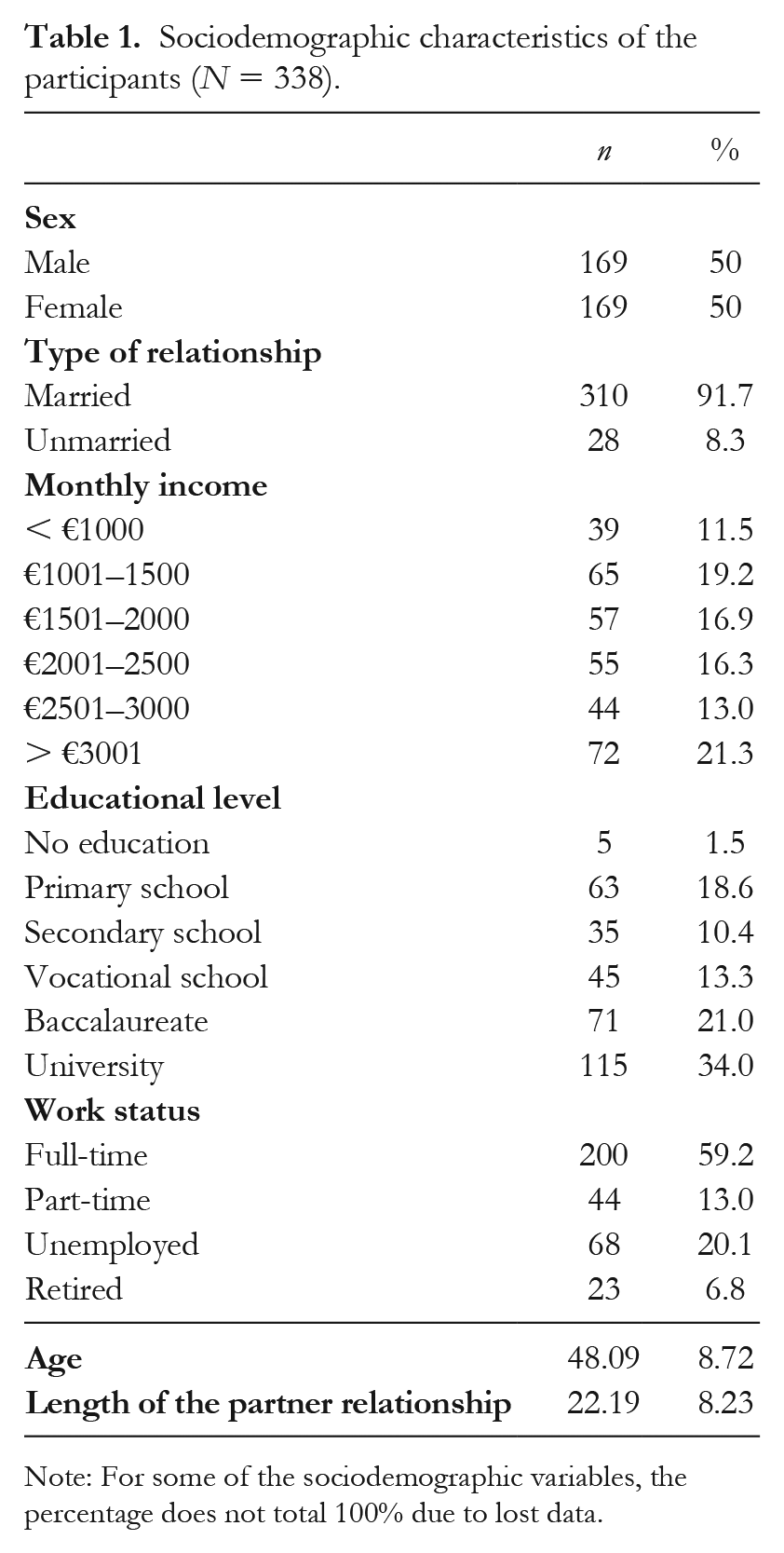
Note: For some of the sociodemographic variables, the percentage does not total 100% due to lost data.
Procedure
We used a non-probabilistic snowball sampling procedure. The evaluators (university students trained in sampling methods) administered the questionnaires on paper with pencils and received academic compensation for their participation. Before filling out the questionnaires in their own homes or public spaces, the respondents were provided with the informed consent form and information on the overall goal of the study (i.e., to ascertain the characteristics of happy partner relationships) and the estimated time it would take to fill it out (i.e., 20–30 minutes). They were guaranteed that participation was voluntary, and that their responses would be confidential and anonymous. They were told that they could stop filling out the questionnaire at any time if they wished. Once the questionnaires had been filled out, they were handed it inside a closed envelope. The study is part of a broader project whose ethical standards were accepted by the scholarly institution in charge. It is a non-experimental transversal associative study.
Instruments
Inclusion of the partner in the self
The degree of inclusion of the partner in the self was assessed via the Inclusion of the Other in the Self (IOS) scale (Aron et al., 1992). This measure captures the level of closeness experienced by the respondent with their partner through a graphic representation that is comprised of two circles that can have seven degrees of superimposition (1 = ‘completely separated’, 7 = ‘practically overlapping’). The participants are asked to indicate the graphic representation of the pair of circles that best reflects their relationship with their partner in terms of closeness. The measure adequately captured the different levels of inclusion in the sample (M = 5.29; SD = 1.46).
Satisfaction with the relationship
This was assessed via the seven items in the Relationship Assessment Scale (RAS; Hendrick, 1988) (e.g., ‘How well does your partner meet your needs?’). The participants responded using a Likert response format (1 = ‘Like the five least happy couples’; 7 = ‘Like the five happiest couples’; α = .90). The original one-dimensional model fit the data and explained 55.4% of the variance in sexual satisfaction. The items showed an adequate discriminatory power (ritem-test > .41). Their scores were averaged to calculate the total score.
Sexual satisfaction
We used a scale developed ad hoc to assess the degree of sexual satisfaction within the partner relationship. Three items (e.g., ‘I am satisfied with the frequency of intimate contact with my partner’; α = .86) were used with a Likert response format (1 = ‘I disagree’; 5 = ‘I agree’). The one-dimensional model explained 67.8% of the variance in sexual satisfaction. Likewise, all the items showed an adequate discriminatory power (ritem-test > .67). The total score was calculated with the average.
Relational conflicts
Based on the list of relational problems of Hahlweg et al. (1990), we presented 10 issues that could lead to conflicts or disputes within the partner relationship (e.g., ‘Dealing with relatives’) and asked the respondents to state the frequency with which they argue over them. We used a Likert response format (1 = ‘Never’; 5 = ‘Often’; α = .86). The one-dimensionality of the measure was confirmed and the items were found to explain 39.3% of the variance in relational conflicts. Furthermore, the items adequately discriminated between the participants with different levels of relational conflict (ritem-test > .35). The total score was calculated with the average.
Life satisfaction
This was assessed by administering the Satisfaction with Life Scale (SWLS; Diener et al., 1985). It contains five items (e.g., ‘I am satisfied with my life’) which provide an overall assessment of the person’s life satisfaction. We used a Likert response format (1 = I ‘disagree’; 5 = ‘I agree’; α = .88). The items had a single dimension, and they discriminated (ritem-test > .68) and explained 61.5% of the variance in life satisfaction. The total score was calculated with the sum of the scores on each item.
Perceived stress
Taking as a reference the stress scale developed by Holmes and Rahe (1967), we presented the participants with 10 potentially stressful life situations (e.g., ‘Serious problems at work or home’). The participants had to indicate whether or not they had suffered from any of the life situations described within the past year, and if so, the level of self-perceived stress on a Likert scale (1 = ‘Not at all stressful’; 5 = ‘Very stressful’; α = .85). The items explained 32.8% of the variance in perceived stress and were all discriminatory (ritem-test > .33). The total score was calculated with the sum.
Statistical analyses
First, we calculated the percentage of lost values, descriptive statistics and reliability of the measures administered. Given the small percentage of lost values (range of 0 to 1.8%) and the fact that the percentage of lost data was completely random (Little MCAR test, X2 = 30.90, p = .098), it was unnecessary to use any strategy to recover them, following the recommendations of previous studies (Bennett, 2001; Schafer, 1999). Secondly, we obtained a coefficient of the similarity of the IOS of both members of the couple (Kenny et al., 2006). More specifically, the similarity in IOS was represented via the discrepancy between the IOS scores of both members of the relationship. This discrepancy was calculated by taking the absolute value of the difference in the IOS scores of both members. Thirdly, we performed Pearson correlations to check the relationships between IOS and indicators of relational quality and quality of life. Finally, following the analysis strategies proposed by Dyrenforth et al. (2010), we examined whether the IOS of each member of the relationship and the IOS similarity coefficient were associated with indicators of relational quality and quality of life. Given that the data provided by both members of the couple in a relationship are not independent, multilevel models were used to estimate the Actor-Partner Interdependence Model (APIM; Kenny et al., 2006). These APIM analyses predict a person’s satisfaction with the relationship, sexual satisfaction, frequency of conflict, life satisfaction and perceived stress according to the person’s position in IOS, their partner’s position in IOS and the absolute value of the discrepancy between the person’s score on IOS and their partner’s score. More specifically, the actor effects capture the association between the IOS of one participant and their own level of relational quality and quality of life. The partner effects capture the association between a participant’s IOS and their partner’s level of relational quality and quality of life. Finally, the similarity effect reflects the single contribution of the discrepancy in the IOS of both members of the relationship. Therefore, this approach includes a crossed two-level model to bear in mind the nesting of the participants within the dyads. To test this approach, three models of multilevel analysis of APIM were tested for each criterion variable. To guarantee that the findings of the current study cannot be attributed to other known variables, the first model included the main effect of gender, age and length of the relationship, which have previously been associated with indicators of relational quality and quality of life (e.g., Alonso-Ferres et al., 2020; Aron et al., 1992; Joo & Park, 2007; Træen & Kvalem, 2023); the second model included the effects of the actor’s and partner’s IOS; and the third model included the similarity index. In each of the models, we introduced the different indicators of relational quality and quality of life separately as criterion variables. The estimated models had fixed slopes and random intercepts (Kenny et al., 2006). In them, a CI that did not include 0 indicates a statistically significant association. The data analysis was carried out using the lme4 package in the software R (R Core Team, 2017).
Results
Descriptive statistics and correlations
Table 2 shows the descriptive statistics and Pearson correlations between the IOS of each member of the relationship, their discrepancy in IOS and indicators of relational satisfaction and life satisfaction.
Descriptive statistics and correlations among the variables in the study.
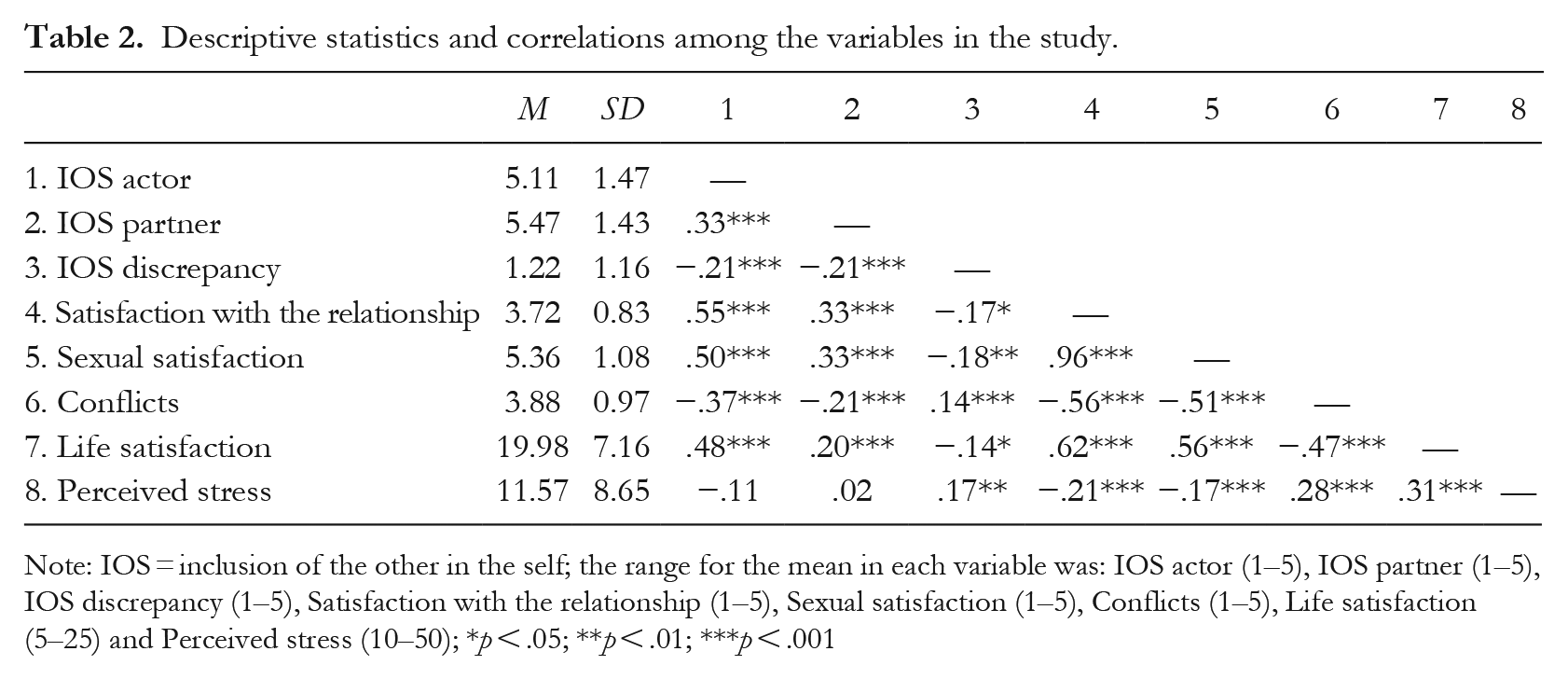
Note: IOS = inclusion of the other in the self; the range for the mean in each variable was: IOS actor (1–5), IOS partner (1–5), IOS discrepancy (1–5), Satisfaction with the relationship (1–5), Sexual satisfaction (1–5), Conflicts (1–5), Life satisfaction (5–25) and Perceived stress (10–50); *p < .05; **p < .01; ***p < .001
The IOS of a member of the relationship, ‘actor’, is positively and significantly associated with the IOS of their partner, ‘partner’ (r = .33, p < .001). However, this coefficient is under 0.70, which discards problems of multicollinearity and seems to indicate that even though the IOS of each member of the relationship shares components, there may also be certain differences. This supports the results provided by the similarity coefficient based on the discrepancy between both members of the relationship in IOS. Furthermore, the IOS of both members of the relationship was positive and significantly associated with satisfaction with the relationship, sexual satisfaction and life satisfaction (with coefficients r that range between 0.20 and 0.55, p < .001). Likewise, both the actor IOS and the partner IOS were significantly and negatively associated with the frequency of conflicts in the relationship (r = −.37 and −.21, respectively, p < .001). However, the connection between IOS and stress was not significant for either member of the couple (p > .05).
Regarding the similarity coefficient, we found that the discrepancy in the IOS of both members of the relationship was negatively and significantly associated with satisfaction with the relationship, sexual satisfaction and life satisfaction (with r coefficients that range between −0.14 and −0.18, p < .05). It also showed positive and significant relationships with the frequency of conflicts and perceived stress (r = .14 and .17, respectively, p < .05).
Effects of IOS on relational quality and quality of life
Table 3 reflects three general results: (a) the effect of the person’s IOS (‘actor effect’); (b) the effect of the partner’s IOS (‘partner effect’); and (c) the effect of the discrepancy in IOS (‘similarity effect’) on the indicators of relational quality and quality of life.
The IOS of each member of the relationship and similarity in IOS as predictors of relational quality and quality of life.
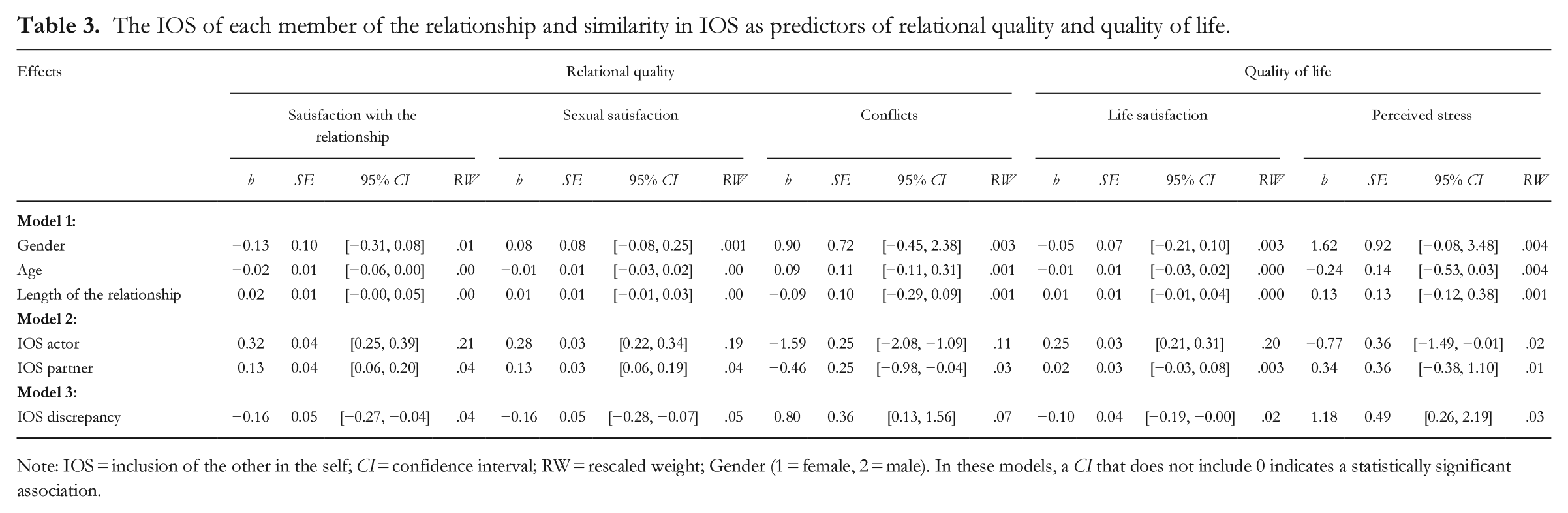
Note: IOS = inclusion of the other in the self; CI = confidence interval; RW = rescaled weight; Gender (1 = female, 2 = male). In these models, a CI that does not include 0 indicates a statistically significant association.
Examining first the effect of a person’s IOS (‘actor effect’), Table 3 shows that the actor IOS is significantly related to all indicators of relational quality and quality of life (with coefficients that range from 0.25 to −1.59). Specifically, the people who included their partner in their self more were more satisfied with their partner relationship, sexual relationship and life, and they also had fewer conflicts in their relationship and lower stress. The person’s own IOS accounted for 2 to 21% of the variance in these variables.
With regard to their partner (‘partner effect’), the results showed that a higher IOS in one member of the relationship was associated with higher relational quality (i.e., higher satisfaction with the relationship, higher sexual satisfaction and a lower frequency of conflicts) in the other member of the couple (b = 0.02 and b = 0.34, respectively). The presence of statistically significant partner effects reveals that one person’s relational quality is related to their partner’s IOS, even though the effect size of the partner tends to be smaller than the effect size of the actor. Furthermore, we found that the partner’s IOS accounted for an additional 3 to 4% of the variance in these variables.
Finally, regarding the similarity coefficient (‘similarity effect’), the results showed that the discrepancy in the IOS of both members of the couple has consistent effects on the indicators of relational quality and quality of life (with coefficients that range between −0.10 and 1.18). Specifically, the discrepancy in IOS indicates lower satisfaction with the relationship, sexual satisfaction and satisfaction with life, as well as a higher frequency of relational conflicts and perceived stress. Even though the effect size tends to be lower than the actor effects, that is, the person’s own IOS (with the exception of perceived stress), the results showed that the similarity in the degree to which each member of the relationship includes their partner in their identity has positive effects for the person and their relationship and accounts for 2 to 7% of the variance 2 .
Discussion
The results of this study show that a higher IOS in the person and/or their partner increases the indexes of relational quality (i.e., higher satisfaction with the relationship and sexual satisfaction and fewer relational conflicts). Likewise, the partners showed a high similarity in IOS, which was an indicator of higher relational quality and quality of life (i.e., higher life satisfaction and lower stress). Therefore, the results support the idea that the inclusion of the other in the self and its balance between both members of the relationship are important in predicting well-being, relational stability and mental health in couples (Frost & Forrester, 2013).
With regard to actor IOS, the findings of this study confirm prior results that show that intimate relationships are a very important aspect of individual well-being (Valor-Segura & Guzmán-González, 2022). Specifically, our results show that IOS is associated with higher relational quality and quality of life, which aligns with a meta-analysis that demonstrates the protective effect of IOS in the likelihood of the relationship dissolving (Le et al., 2010). Even though the study presented does not analyse the mechanisms that explain the positive effect of IOS on relational satisfaction, this effect may reflect the fact that a higher IOS is related to a stronger commitment to the relationship (Le et al., 2010) and a stronger perception of closeness (Swann et al., 2009). Furthermore, in relation to satisfaction in the couple, the results show that a higher IOS is related to fewer relational conflicts and lower levels of stress. This result is consistent with prior studies that show that IOS entails lower vigilance of potential threats and a stronger tendency to solve conflicts more constructively (Gesell et al., 2020; Walsh & Neff, 2018), as the people are more willing to make sacrifices to solve daily conflicts (Joo & Park, 2007). Regarding sexual satisfaction, the results support the conclusions drawn in prior studies in relation to the positive influence of the inclusion of the other in the self on sexual satisfaction (Pietras & Briken, 2021; Pietras et al., 2022; Træen & Kvalem, 2023). This association may be due to the fact that connection levels increase during sexual relations (Kashdan et al., 2011) and the partners have more orgasms (Denes et al., 2019), as well as more positive emotions after sexual relations (Denes, 2012). Furthermore, the results presented in this study show that considering the partner integrated into one’s own self-concept is related to higher levels of life satisfaction, and even though this is the first study to analyse this effect, it could be due to the close connections between satisfaction with the relationship, sexual satisfaction and life satisfaction (Dyrenforth et al., 2010; Stephenson & Meston, 2015).
The findings that focused on analysing the effect of the partner’s IOS show that the IOS of one member of the relationship positively affects the relational quality of the other member. This is due to the fact that if one person largely includes their partner in their own identity, they are going to behave in a way that favours the relationship, which could lead to a lower number of conflicts, more frequent sexual relations and ultimately a higher degree of both sexual and relational satisfaction shown by the other member of the couple (Aron & Aron, 1986; Muise et al., 2019). This explanation, in turn, justifies the fact that ‘partner effects’ are found in the measures concerning satisfaction with one's own partner but do not affect the scales that evaluate well-being more globally (e.g., life satisfaction or stress) because the partner’s IOS may promote meeting shared needs but does not have an impact on individual goals.
Finally, given that both members of romantic relationships are highly interdependent (Thibaut & Kelley, 1959), we found for the first time how the IOS of one person and that of their partner combine to predict relational quality and quality of life. The results show that high levels of IOS in one member of the relationship are associated with high levels of IOS in the other member. This similarity in the IOS of the members of the couple is associated with higher satisfaction with the relationship, sexual satisfaction and life satisfaction and a lower frequency of conflicts and lower stress levels. On the one hand, these results align with those of a qualitative study conducted by Ben-Ari et al. (2007) which asserts that both members of the couple may have similar ways of understanding the closeness of the relationship, as they have invested time in sharing what the closeness in it means and in what way the couple wants to address it (p. 363). On the other hand, they also concur with studies that have demonstrated that the similarity in personality features (Zhou et al., 2017) and in the need to seek emotions (Donaldson, 1989) or even in the partner’s electrodermal response during conflicts (Bogacz et al., 2020) are all related to higher satisfaction with the relationship and higher sexual satisfaction. Our study reveals the protective effect of a balanced IOS: couples with a strong similarity in the way they include their partners in their identity have a lower risk of conflict, favour communication and promote mutual understanding (Morry, 2005).
Limitations and future studies
The results of this study are mostly based on married couples (91.7%). IOS may increase as a relationship consolidates (Branand et al., 2019), so the high mean of this construct may be influenced by the strong commitment of the members of the couple in the relationship. Future studies should replicate the results obtained while including partners with more varied statuses, as well as controlling for the commitments made within that relationship (marriage, children, etc.). On the other hand, all the participants were also in heterosexual relationships. Even though this enables us to control for the effect of the sexual orientation of the relationship between IOS and relational quality and quality of life, and the literature has not revealed differences in IOS levels between heterosexual and homosexual couples (Carroll & Turner, 1999), future studies should examine the effect of sexual orientation on the consequences of IOS. Likewise, it is essential to bear in mind that in this study we have not assessed the IOS levels considered ideal or desirable by each member of the couple. Therefore, future studies should examine this issue (Frost & Forrester, 2013). Finally, given that both members of the couple have preestablished ideas on how partner relationships are and should be, future studies should assess the role of erroneous beliefs about partner relationships in the IOS levels of each member, such as in relation to gender differences within the partner relationship (Topkaya et al., 2023). Different levels of adherence to these erroneous beliefs by each member of the couple may explain a lower similarity in their IOS. To obtain valid conclusions, all the new ideas proposed should pay greater attention to the response bias. Our study focuses on people participating in ‘happy couple relationships’, which could lead to a response bias (e.g., social desirability). Therefore, future studies should pay special attention to the instructions or include indicators that enable biases in the responses to be detected.
Conclusions and practical implications
This study has focused on dyadically analysing how the inclusion of the other in one’s self-concept and the similarity of the scores of both members of the couple may affect relational quality and quality of life. We can conclude that high scores on IOS are related to higher levels of quality in the relationship (general and sexual), a lower number of conflicts and higher quality of life (life satisfaction and lower stress). Furthermore, considering the dyadic nature of relationships, we found that a higher score on IOS is associated with higher levels of couple satisfaction and sexual satisfaction and a lower frequency of couple conflicts. These findings indicate that in order to analyse how IOS may influence the course of everyday life of both members of the relationship, and specifically their relational quality, it is important to consider the levels of inclusion of the other into both partners’ self-concept. Finally, quite interestingly, the analyses of the similarity in IOS scores between both members of the couple show a positive effect on the different indicators of relational quality and quality of life. This last result may be particularly interesting for couples therapy because considering the similarity in IOS may contribute to determining, for example, the success of the continuity of the couple, the resolution of conflicts within the relationship and satisfaction with the relationship. The reinterpretation of what including the partner in the self means may be an interesting task to work on during the psychological intervention in order to foster similar dyadic levels between both members of the couple.