



Abstract
All societies are organized based on hierarchies, where some groups have more power than others. Although some may aspire for a hierarchy-free world, hierarchies are inevitable and strongly resistant to changes. People may feel motivated to see hierarchical social systems as fair, legitimate, and justified, and endorse system-justifying ideologies, such as social dominance orientation (SDO), contributing to the maintenance and perpetuation of intergroup inequality. Belief in the social system’s fairness and legitimacy should increase acceptance and support for the existing society-based social stratification and status hierarchies, weakening support for collective action towards social change. We tested this idea, with two studies, conducted on members of the general population (N = 121) and on members of a disadvantaged group highly mobilized for social change towards intergroup equality (N = 154). Results showed that system justification undermines collective action through SDO (full mediation). We discuss the implications of including ideological processes when predicting collective action.
All social systems tend to be organized by power and status hierarchies that are believed to be strongly resistant to changes, thereby promoting and maintaining intergroup inequality (e.g., Pratto et al., 2013). Indeed, all human societies are inevitably stratified based on socioeconomic factors such as race, gender, education, wealth, occupation, among others. The reason why hierarchical social systems thrive and persist has been an important issue in the field of social psychology.
Intuitively, we may assume that the maintenance of such inequality—and hierarchy-based social systems—is the result of the efforts of dominant or high-status groups to protect and maintain their privileges and their positions of power. However, paradoxically, subordinate or low-status group members may also contribute to it, based on distinct motivations. For instance, previous research has stated that this occurs because low-status group members feel negatively about their group membership or because they feel more positive about the high-status outgroup (i.e., outgroup favoritism; Jost et al., 2004; Levin & Sidanius, 1999); or as way for them to deal and cope with cognitive dissonance, anxiety, discomfort and uncertainty resulting from their disadvantaged or low-status condition, as proposed by system justification theory (SJT) (i.e., serving a palliative function; e.g., Jost & Hunyady, 2002, 2005; Jost et al., 2004, 2008). More recently, the social identity model of system attitudes (SIMSA) proposed that members of low-status groups may support hierarchical social systems that disadvantage their group, based on needs for social accuracy or a positively distinct social identity (e.g., Owuamalam et al., 2016, 2018, 2019; Rubin et al., 2023a). In other words, it is proposed that system justification among members of disadvantaged groups represents an accurate reflection of the status quo or a means to improve ingroup status derived from the belief that they can benefit from such system in the future (for a review, see Rubin et al., 2023a). Thus, why and when disadvantaged people support social realities that seemed unfavorable to them is an ongoing debate (for a discussion, see Jost et al., 2023; Rubin et al., 2023a, 2023b). Nevertheless, in this work, the initial standpoint is that, both high- and low-status groups can contribute to the normalization and perpetuation of social stratification and inequalities between social groups, by endorsing system-justifying or hierarchy-legitimizing ideologies based on the believe that the existing social system is fair, legitimate and justified (i.e., system justification tendencies), and as such, sooner or later, everyone gets what they deserve. It is important to note that, as highlighted by Rubin et al. (2023a), neither SJT or SIMSA address the question “Why would members of low status groups perceive the intergroup status hierarchy as stable and legitimate in the first place?” (p. 27). Nevertheless, both agree that the perceived fairness and legitimacy of the existing social system are determinant for system justification processes.
From System Justification to Perpetuation of Hierarchical Social System and Intergroup Inequality
Evidence has shown that perceiving the existing social, economic, and political arrangements (i.e., social system) as fair, legitimate and justified, that is, engaging in system justification, undermines individuals’ motivation to challenge the existing social system (i.e., to pursue social change through system-challenging collective actions; Jost et al., 2012, 2017; D. Osborne et al., 2017, 2018), hence contributing to normalizing and perpetuating social inequalities (e.g., Badaan et al., 2018; Jost et al., 2004). In support of this idea, a meta-analysis conducted by Agostini and van Zomeren (2021) showed a negative correlation between system justification beliefs and motivation to engage in collective action: the more people consider the system to be fair and to work well, the less they tend to engage in collective action against the system. Moreover, the undermining effect of system justification on willingness to protest can occur even among political activists (Jost et al., 2012). This negative relation is not surprising as perceptions of social injustice (or moral outrage), that is, the opposite of perceptions of a fair and justified treatment, is one of the most powerful predictors of collective action (for a review, see van Zomeren et al., 2008). As a result of this motivation to see the system as fair and legitimate and, thus, social arrangements as being appropriate, good, and just (i.e., general system justification beliefs), individuals may adopt system-justifying ideologies (or legitimizing myths), such as social dominance orientation (SDO; Jost & Hunyady, 2005), that lead individuals to endorse rather than oppose intergroup inequality. These system-justifying ideologies can be understood as a set of beliefs that “can explain or make sense of a social system in ways that provide a rationale for the appropriateness or reasonableness of differences in authority, power, status, or wealth” (Tyler, 2006, p. 376). In representing “moral and intellectual justification for the social practices that distributes social value within the social system” these legitimizing myths provide cognitive, ideological and behavioral support for the existing hierarchical social system (Sidanius & Pratto, 1999, p. 45). Thus, the negative relationship between the motivation to justify the social system and collective action tendencies to redress social inequality, may be explained by the adherence to an ideological orientation towards intergroup inequality and dominance (i.e., SDO).
Supporting Social Systems Based on Status hierarchies and Intergroup Inequality
According to Social Dominance Theory (SDT; e.g., Sidanius et al., 1994), social systems tend to be organized as group-based social hierarchies in which at least one group holds higher status and more power than the others. These social systems rely on ideologies or legitimizing myths, that either promote or attenuate intergroup differentials (hierarchy-enhancing vs. hierarchy-attenuating legitimizing myths). The extent to which these ideologies or legitimizing myths are accepted by individuals is represented by SDO, reflecting a “desire to establish and maintain hierarchically structured intergroup relations regardless of the position of one’ s own group(s) within this hierarchy” (Sidanius et al., 2017, p. 152). Thus, SDO should be positively related to people’s beliefs about the legitimacy of value differentials between groups in society, and negatively related to people’s support for group equality and opposition to status and power differentiation between groups (Pratto et al., 2000). Consequently, SDO, as a system-justifying or hierarchy-legitimizing ideology, has been found to be negatively associated with people’s willingness to engage in collective action towards intergroup equality (e.g., Choma et al., 2020; Jost & Hunyady, 2005; Jost et al., 2012, 2017; D. Osborne et al., 2017, 2018; Sidanius et al., 2001). For instance, Choma et al. (2020) found a negative relation between SDO and collective action aimed at equalizing race relations. Indeed, system-challenging (as opposed to system-supporting) collective actions (cf. Jost et al., 2017; D. Osborne et al., 2017, 2018) are driven by perceived social injustice and are more frequently motivated by concerns about equal treatment, equal opportunities, and equal rights for all social groups (e.g., civil rights movements). This motivation directs action towards decreasing status distinctions between groups hence achieving a more fair and equal distribution of social power, privileges and resources between groups, anchored in hierarchy-attenuating ideologies (i.e., low SDO; e.g., Jost et al., 2017; Pratto et al., 2006). As D. Osborne et al. (2017, p. 336) argue, SDO weakens “collective action support by easing concerns over inequities between groups.”
SDO as a Mediator Between System Justification and Collective Action
Although SDO was initially conceptualized as a relatively stable individual general orientation toward intergroup inequality (e.g., Sidanius et al., 1994), and as such, commonly operationalized as the predictor or a moderator of intergroup attitudes and behaviors, a great amount of evidence has demonstrated that SDO may, in fact, be context dependent (e.g., Duckitt & Sibley, 2009; Guimond et al., 2003; Jetten & Iyer, 2010; Lehmiller & Schmitt, 2007; Liu et al., 2008; K. K. Morrison et al., 2009; Reynolds et al., 2001; Schmitt et al., 2003). The conceptualization of SDO as either a stable personality trait, a moderator of the effect of situational factors, or even as a mediator between situational or contextual factors and individuals’ attitudes, have been widely discussed in the literature (e.g., Guimond et al., 2003; Schmitt et al., 2003). Importantly, the conceptualization of SDO as a mediator has gained consistent empirical support, showing that SDO is a function of situational factors (e.g., contingent to group membership, identities, features of the social structure), and it serves to justify and legitimate individuals’ attitudes and/or behaviors (cf. Guimond et al., 2003).
For instance, Duckitt (2001) provided empirical support for the dual-process model of prejudice, in which SDO results from personality, social environment, and social worldview beliefs (i.e., mediator), representing an indicator of ideological beliefs rather than a measure of personality. Guimond et al. (2003) distinguish three conceptualizations of SDO: SDO as a personality trait, SDO as a moderator of the effects of situational variables, and SDO as a mediator of the effect of social position on prejudice. They found stronger evidence for the mediating role of SDO. Jetten and Iyer (2010) found similar results supporting the conceptualization of SDO as a mediator. As Kteily et al. (2011, p. 209) stated, based on Guimond’s et al. (2003) work and other similar findings, “it is clear that SDO levels are not purely fixed, but are sensitive to social context.” Moreover, evidence also shows that SDO levels can be decreased over time, for instance, through positive intergroup contact (Dhont et al., 2014), or can increase as a result of realistic threat (K. R. Morrison & Ybarra, 2008), or exposure to hierarchy-enhancing courses such as Law (vs. hierarchy-attenuating such as Psychology; Guimond et al., 2003), challenging the assumption of SDO as a stable orientation.
In this work we propose that adherence to SDO mediates the relationship between general system justification beliefs and collective action tendencies. Specifically, we propose that, based on the assumption that all social systems are inherently hierarchically organized and unequal, individuals’ perception and beliefs that the existing social system and societal status quo is fair, legitimate, and justified, should boost an ideological orientation towards support for status differentials and intergroup inequality (i.e., SDO), in order to preserve such system. This, in turn, should undermine their motivation to get involved in actions towards changing the system, reducing status differentials and inequality between groups. This should happen because, if the system is believed to be fair and operating as it should so that individuals, sooner or later, get what they deserve, then the extant hierarchical structure, and the associated differences in status, value, power, and resources’ distribution between groups should be seen as beneficial and necessary, even for those at a disadvantaged position. In turn, individuals should not see the need or feel motivated to invest in collective efforts towards social change.
Some readers may argue that individuals’ predisposition to accept status hierarchies and intergroup inequality (i.e., SDO as a relatively stable individual general orientation) may lead to greater system justification beliefs or serve as a mediator in the relationship between SDO and collective action. Thus, to increase the validity of our mediation model and to ensure that the proposed mediation pathway is the most plausible explanation, we present, for each Study, an alternative mediation model, having SDO as the predictor and system justification as the mediator, and the interaction effects of system justification and SDO in predicting collective action.
The Present Studies
To test our mediational hypothesis, we first conducted a correlational study, regarding people’s views about social injustice and inequality in society, with the general population (Study 1). In Study 2, we tested our model with participants from a disadvantaged group that were already engaged in collective action towards intergroup equality. This was a group of health professionals’ struggling to obtain treatment, working conditions, and salary equal to other professional categories (e.g., doctors, nurses), as well as the recognition of their value in the national health system. We reasoned that this group’s current engagement in collective action should provide a robust test of the proposed mediation model. Indeed, in spite of their perceived disadvantage and unfair treatment relative to other health professional categories, participants’ willingness to get involved in their group’s collective efforts should decrease as a function of their belief in the fairness of the social system and that people get what they deserve, and thus, social groups should differ in value, status, and power. In other words, if the system is fair, the other health professional categories with higher status and better work conditions deserve to be on top. Thus, belief in the fairness of a social system that fosters status differentials should contribute do the demobilization or disengagement from their cause.
Study 1
Method
Participants
Participants were 62 female and 61 male Portuguese nationals (N = 123) aged between 18 and 76 years-old (M = 31.13, SD = 14.18) who volunteered to fill out a questionnaire.
Following previous recommendations (e.g., J. W. Osborne & Overbay, 2004), we discarded data from two participants who presented outlier scores in the System Justification scale, and in the SDO-D scale, respectively. Remained in the analysis 121 participants (61 female, 60 male) aged 18 to 72 years-old (M = 30.85, SD = 13.66), with complete basic education (13%), secondary education (45%) or higher education (42%). Participants were students (46%), employed (43%), unemployed (7%), or retired (3%). Regarding the left-right political spectrum, the average score on a 7-point Likert-scale (1 = Left, 7 = Right), was close to the scale midpoint of 4 (M = 3.87, SD = 1.36).
Procedure
Participants were approached in the street and invited to fill out a survey to gather citizens’ opinion on “the current state of society”. Participation was fully voluntary and not monetarily compensated. The study was conducted between the months of October and November of 2017. The political and economic context in Portugal, in this period, was relatively stable. At the time, Portugal had shift from a right-wing to a left-wing government, resulting from a historic four-party left-wing alliance on 2015 elections, that united leftist parties that were previously divided (Freire, 2016). This political alliance aimed at reversing public sector wage cuts and eliminate an extraordinary income tax implemented during the previous government, raise the minimum wage, and increase social benefits (Freire, 2016). Economically, Portugal was gradually recovering from the economic crisis that had hit the country (and worldwide) in previous years. For instance, the unemployment rate went down, from 12,9% (2015) to 9,2% (2017) and the GDP growth rate increased from 1,79 (2015) to 3,51 (2017) (Fundação Francisco Manuel dos Santos [FFMS], 2023a, 2023b). Moreover, the autumn 2017 Eurobarometer report (European Union, 2017) showed that the assessment of the national economy by the Portuguese sample was the most positive since 2004 (33% of the respondents rated as good or very good), and satisfaction with national democracy was the highest since 1991 (72% of the respondents indicated to be satisfied). Nevertheless, despite the above, the country experienced situations of social unrest. For instance, the year was marked by a surge in opposition across different public sectors, leading to strikes and protests, including teachers, healthcare professionals (e.g., nurses, senior diagnostic and therapeutic technicians) and transportation workers, among others (MadreMedia/Lusa, 2017). Portugal also experienced a period of extreme drought and a devastating wave of forest fires in 2017, particularly in June and October. These fires resulted in numerous fatalities and the destruction of large areas of forested land. The government and other national authorities faced strong public criticism for its response to the fires and the effectiveness of firefighting efforts resulting in the resignation of some government officials (MadreMedia/Lusa, 2017).
Measures
After giving their informed consent, participants provided demographic information about themselves (e.g., age, sex, occupation, education, and right-left wing political orientation). Next, participants answered to system justification, 1 SDO, and collective action scales.
System Justification and SDO
To assess participants' beliefs about the fairness, legitimacy, and justifiability of the existing social system, we used the Kay and Jost’s (2003) 8-item general system-justification scale (e.g., “In general, you find society to be fair”; 1 = I fully disagree; 7 = I fully agree). We averaged these items into a system justification score (Cronbach’s α = .59; M = 3.31, SD = 0.69), where higher scores indicate higher levels of system justification.
Then, participants answered to Ho et al.’s (2015) 8-item SDO 2 short scale (1 = I strongly oppose, 7 = I strongly favor). Following the two-dimensional conceptualization of SDO (Ho et al., 2015; Jost & Thompson, 2000; Kugler et al., 2010), we averaged these items to a SDO-D (Cronbach’s α = .53; M = 2.76, SD = 1.05) and a SDO-E scores (Cronbach’s α = .76; M = 2.53, SD = 1.10), corresponding, respectively to support for group-based dominance hierarchies (e.g., “An ideal society requires some groups to be on top and others to be on the bottom”) and to opposition to group-based equality (e.g., “It is unjust to try to make groups equal”).
Collective Action
Based on work by van Zomeren et al. (2010), four items assessed participants’ willingness to engage in collective actions against social injustice and inequality in society (1 = I fully disagree; 7 = I fully agree): “I would be willing to. . . (1) take part in demonstrations or protests against injustice or social inequalities; (2) participate in any form of collective action to stop an injustice or against social inequalities; (3) do something, together with fellow citizens, to stop an injustice or against social inequalities; (4) sign a petition to stop an injustice or against social inequalities.” We averaged these items’ scores to a collective action score (Cronbach’s α = .95; M = 5.57, SD = 1.19).
Results
Preliminary Results
Before proceeding with our analyses, we conducted a variance inflation factor (VIF) analysis to assess multicollinearity among the predictor variables, namely, system justification and the two SDO subdimensions. VIF results showed that tolerance values were greater than 0.10 and VIF values did not exceed the predetermined threshold (i.e., 10; Pallant, 2010). Thus, no evidence of significant multicollinearity among the predictor variables was found (see online Supplemental materials, OSM).
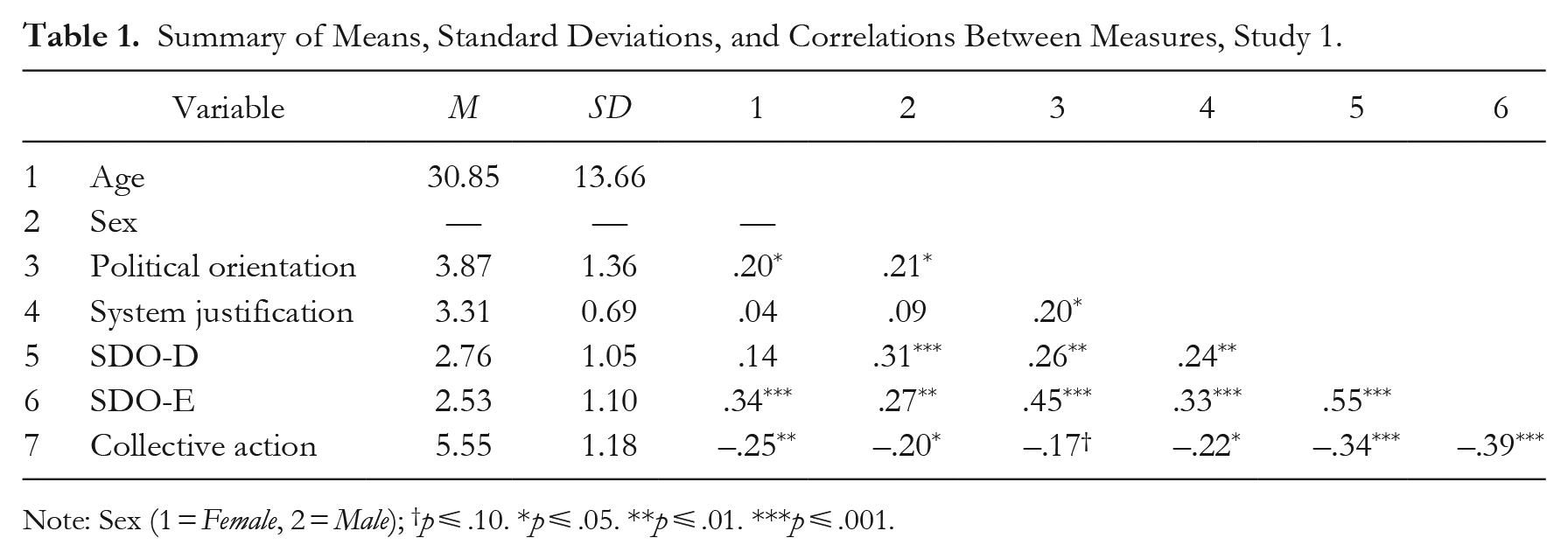
Table 1 summarizes the descriptive statistics and correlations between Measures (see OSM for the complete descriptive statistics). By observing the product-moment correlations between all measures we observe that, as expected, system justification is positively related with both SDO-D and SDO-E. System justification and both SDO subdimensions are negatively related with collective action intentions.
Summary of Means, Standard Deviations, and Correlations Between Measures, Study 1.
Note: Sex (1 = Female, 2 = Male); †p ⩽ .10. *p ⩽ .05. **p ⩽ .01. ***p ⩽ .001.
Predicting Collective Action
We expected that beliefs that the existing social system is fair and functions adequately for serving all its citizens (i.e., system justification) should undermine collective action tendencies by reinforcing the support for the existing status stratification and the hierarchical social system (i.e., SDO). To examine this idea, we conducted a mediation analysis (using PROCESS 3.3 version, Model 4 with 10,000 bootstrap samples; Hayes, 2018), considering system justification as the predictor, SDO as the mediator, and collective action as the dependent variable. We tested two independent models for each SDO subdimensions.
SDO-D Dimension
Results showed that system justification is a significant predictor of SDO-D, and, in turn, SDO-D negatively predicts collective action (see Figure 1). The model explains 14% of the variability observed in collective action, F(2, 118) = 9.26, p ⩽ .001. Importantly, the indirect effect is negative and significant, b = −.13, SE = .06, 95% CI [−0.271, −0.027]. These results support our mediational hypothesis (full mediation) for the SDO-D dimensions.
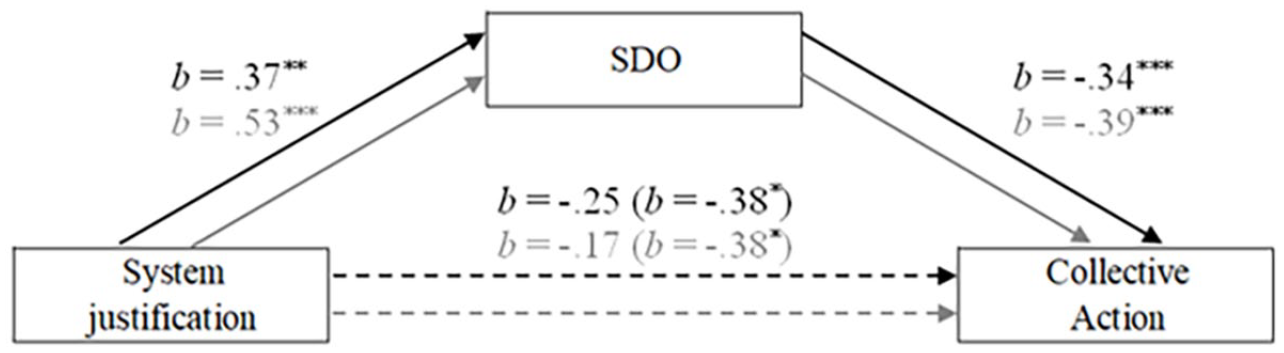
Mediation model (Model 4 with 10,000 bootstrap samples; N = 121) showing the effect of System Justification on Collective Action tendencies, as mediated by SDO.
SDO-E Dimension
Regarding the SDO-E dimension (see Figure 1), the results revealed that system justification is a significant predictor of SDO-E, and, in turn, SDO-E negatively predicts collective action. The model explains 16% of the variability observed in collective action, F(2, 118) = 11.39, p ⩽ .001. The indirect effect is negative and significant, b = −.20, SE = .08, 95% CI [−0.390, −0.077]. Results regarding the SDO-E dimension also support our mediational hypothesis (full mediation). 2
We tested for interaction effects (system justification × SDO), and no interactions were found with both SDO-D, F(1, 117) = 0.02, p = .896, and SDO-E, F(1, 117) = 1.78, p = .190.
We contrasted these models with the alternative model having SDO as the predictor and system justification as the mediator. We found no indirect effect with SDO-D as the predictor, b = −.04, SE = .03, 95% CI [−0.102, 0.006], nor with SDO-E, b = −.04, SE = .03, 95% CI [−0.104, 0.029] (see the alternative models at OSM).
Discussion
As predicted, SDO fully mediated the relationship between system justification and collective action tendencies. Believing that the existing social system is “functioning well” was positively related to participants’ support for status stratification and intergroup inequality, which, in turn, was negatively related to perceived need to fight injustice and social inequality.
The results of the alternative models (i.e., taking SDO as the predictor) confirmed our predictions that the proposed mediation pathway is consistent with the explanation of the expected directionality (causality) between system justification and SDO.
In Study 2, we tested the proposed model with a disadvantaged group already engaged in collective action: a health professionals’ group who have been actively struggling for years to obtain better working conditions for their professional category. Specifically, we conducted a study with Portuguese senior diagnostic and therapeutic technicians (TSDT) 3 who had been fighting for equal treatment and conditions (e.g., income, fringe benefits, working conditions, and recognition) as other health professionals (e.g., doctors). Their protest movements intensified in the year of 2018 following a period of unsuccessful negotiations with the government that failed to meet their demands (Sindicato dos Técnicos Superiores de Diagnóstico e Terapêutica [STSDT], 2018a). The TSDT trade union consistently emphasized the injustices and discrimination they faced, as well as the lack of equity in comparison to other professional categories. Indeed, a public statement of their trade union clearly expressed their stance: “When advocating for the TSDT's interests, our negotiations always aim to place this group on the same level as others [professional categories] in Health, upholding the principle of equal treatment, restoring justice. . .” (STSDT, 2018b). Their public announcements also repeatedly emphasized the need to fight for justice and equity, asserting their right to a dignified career and equal treatment compared to other careers, reflecting their perceived disadvantage compared to other occupational groups.
Thus, in this study, participants’ membership to a disadvantaged group, as well as the perception of their disadvantaged and unfair position as compared to other health relevant professional categories, was highly salient. Intergroup equality and fairness would be in line with the ingroup's interests. Again, we expected that the more participants believed in the fairness of the social system, the more they should support group-based dominance hierarchies, status stratification, and intergroup inequality, and in turn, the less motivated they should feel to engage in collective action towards decreasing inequality and status differentiation between groups, namely, to fight against their disadvantaged situation.
Study 2
Method
Participants
Participants were 128 female and 26 male TSDT (N = 154) aged between 22 to 67 years-old (M = 39.07, SD = 10.95). Following previous recommendations (e.g., J. W. Osborne & Overbay, 2004), we discarded four participants with outlier scores on the collective action scale. The final sample is composed by 150 participants (124 female, 26 male) aged 22 to 67 years-old (M = 39.48, SD = 10.57). Regarding the left-right political spectrum, the average score on a 7-point Likert-scale (1 = Left, 7 = Right), was close to the scale midpoint of 4 (M = 3.65, SD = 1.28).
Procedure
The study was conducted in Portugal between April and July 2019 in a period of great contestation and mobilization, including several strikes, involving TSDT workers. Participants were contacted through Facebook groups (TSDT groups) and were asked to fill out a survey about TSDT workers’ motivations to adhere to the ongoing protest and mobilizations. Participation was completely voluntary and not monetarily compensated.
Measures
After giving their informed consent, participants provided demographic information about themselves (e.g., age, sex, and right-left wing political orientation). Then, participants answered to the system justification, SDO, and collective action scales.
System Justification and SDO
As we did in Study 1, we asked participants to answer to the 8-item general system-justification scale (Kay & Jost, 2003; Cronbach’s α = .71; M = 2.62, SD = 0.83).
In this study we decided to use the full 16-item SDO7 scale (Ho et al., 2015) as a device to increase the external validity of the phenomenon under scrutiny. Both SDO-D (Cronbach’s α = .74; M = 2.59, SD = 0.98) and SDO-E (Cronbach’s α = .79; M = 2.33, SD = 1.01) dimensions were reliable.
Collective Action Tendencies
In Study 1 we measured willingness to engage in collective action against social injustice and inequality between groups in general, resulting from the evaluation and beliefs on a fair society. In this Study, we asked participants to indicate their motivation to participate in eight collective initiatives (based on Stürmer & Simon, 2004) in favor of the TSDT working category (1 = nothing motivated, 7 = very motivated): (1) “Participation in demonstrations and protests”; (2) “Participation in concentrations in front of relevant entities (e.g., Hospitals, Ministry of Health, Assembly of the Republic)”; (3) “Striking”; (4) “Signing a petition”; (5) “Participating in special working groups”; (6) “Attending discussion meetings”; (7) “Distributing flyers”; (8) “Helping to organize a public awareness campaign about TSDT claims.” We averaged the scores of all items to a measure of collective action (Cronbach’s α = .91; M = 5.50, SD = 1.41).
Results
Preliminary Results
VIF results showed that tolerance values were greater than 0.10 and VIF values did not exceed the predetermined threshold (i.e., 10; Pallant, 2010). Thus, no evidence of significant multicollinearity among the predictor variables was found (see OSM).
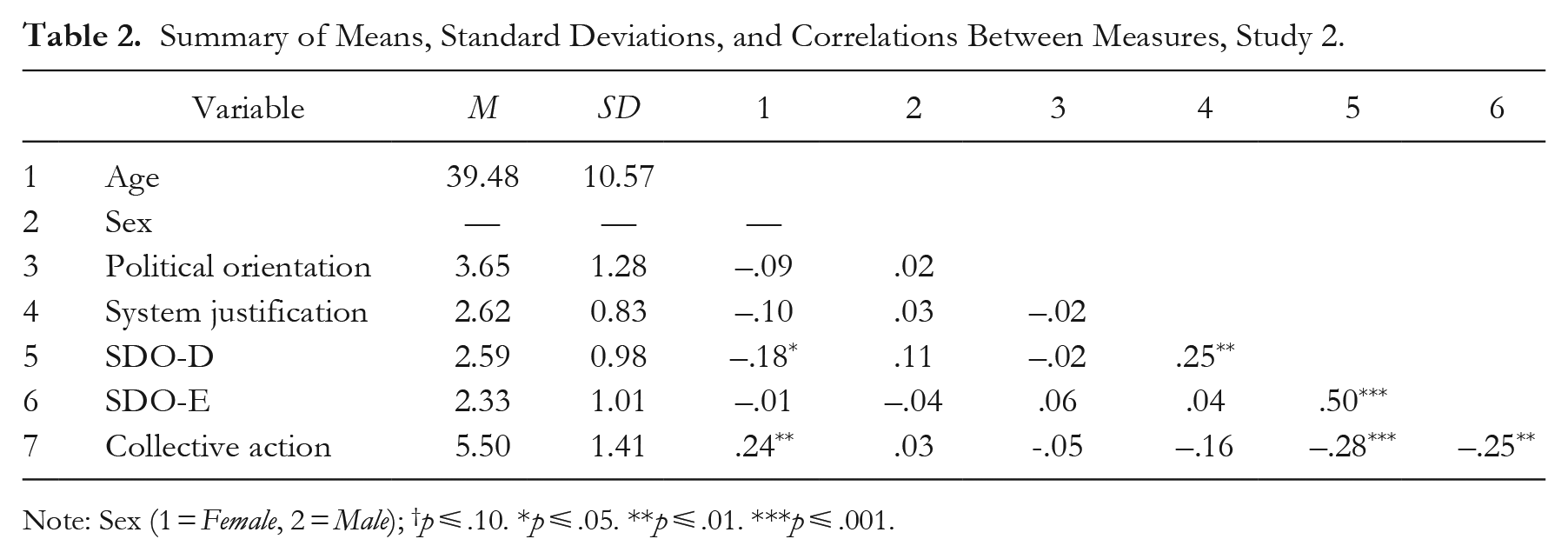
Table 2 summarizes the descriptive statistics and correlations between measures. By observing the product-moment correlations between all measures (see Table 2) we observe that system justification is positively related with SDO-D but not with SDO-E. Contrary to what was observed in Study 1, system justification is not related with collective action. Both SDO subdimensions are negatively related with collective action intentions.
Summary of Means, Standard Deviations, and Correlations Between Measures, Study 2.
Note: Sex (1 = Female, 2 = Male); †p ⩽ .10. *p ⩽ .05. **p ⩽ .01. ***p ⩽ .001.
Predicting Collective Action
As in Study 1, we conducted a mediation analysis (using PROCESS 3.3 version, Model 4 with 10,000 bootstrap samples; Hayes, 2018), taking system justification as the predictor, SDO as the mediator, and collective action as the dependent variable. As in Study 1, we tested two independent models for each SDO subdimensions.
SDO-D Dimension
System justification was positively related to SDO-D, which in turn, was negatively related to collective action (see Figure 2). The model explains 9% of the variability observed in collective action, F(2, 147) = 9.26, p ⩽ .001. The indirect effect was negative and significant, b = −.11, SE = .05, 95% CI [−0.233, −0.023]. These results support the mediational hypothesis for the SDO-D dimension.
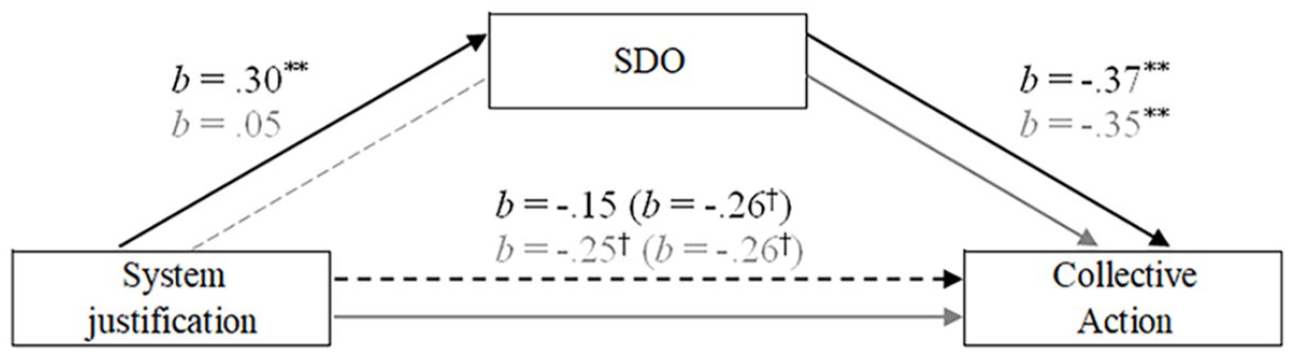
Mediation model (Model 4 with 10,000 bootstrap samples; N = 150) showing the effect of System Justification on Collective Action tendencies, as mediated by SDO.
SDO-E Dimension
System justification had no effect on SDO-E, but SDO-E was negatively related to collective action (see Figure 2). The model explains 9% of the variability observed in collective action, F(2, 147) = 6.87, p ⩽ .001. No indirect effect was found, b = −.02, SE = .04, 95% CI [−0.098, 0.056]. These results did not support the predicted mediation for the SDO-E dimension. 4
We tested for interaction effects (system justification × SDO), and no interactions were found with both SDO-D, F(1, 146) = 0.37, p = .543, and SDO-E, F(1, 146) = 0.22, p = .638.
As in Study 1, we contrasted these models with an alternative model having SDO as the predictor and system justification as the mediator. We found no indirect effect with SDO-D as the predictor, b = −.03, SE = .03, 95% CI [−0.104, 0.025], nor with SDO-E, b = −.01, SE = .02, 95% CI [−0.058, 0.028] (see OSM).
Discussion
As in Study 1, beliefs that the existing social system is fair, legitimate, and that people get what they deserve is positively associated with SDO. This, in turn, negatively associated with participants’ willingness to engage in collective efforts in support of TSDT workers. However, the mediational effect only occurred for the SDO-D dimension.
In this study, we observed that system justification was not related to either collective action or SDO-E. We may think that this may have occur because we used a general system justification scale that is inherent to a broader (national) social system and the items of the collective action scale used in this study were related to the context of intergroup relations within the health care system. Indeed, the collective initiatives presented to participants were not related to intergroup inequality or social injustice in general as in Study 1, but regarding actions to improve the conditions of the TSDT professionals, equalizing their working conditions with other professional categories.
Additionally, we may have found differences in the relationship between system justification and the two SDO dimensions since they are believed to reflect two distinct psychological orientations. Each dimension explains different kinds of political views and attitudes towards inequality, and may arise from different motivations (e.g., Ho et al., 2015). A related explanation could be the fact that, contrary to Study 1, in this study ingroup membership and ingroup disadvantage relative to other groups was highly salient for participants, and this may have triggered different psychological processes from those present in Study 1. Additionally, since a specific context and intergroup relationship was salient in Study 2, it may be possible that features of the existing social structure (e.g., stability of status relations; permeability of group boundaries) may have interact in predicting SDO-E. Indeed, a significant amount of research has shown that individuals tend to respond to the SDO scale according to the specific group membership or social categories brought to mind, and that, in turn, are contingent to specific social structural characteristics associated to them (Lehmiller & Schmitt, 2007).
General Discussion
When individuals perceived the existing social system as fair, legitimate, and justified, they may be less inclined to engage in collective efforts aimed at addressing social injustices and reducing intergroup inequality, hence contributing to the normalization and perpetuation of social inequalities and injustice. We proposed and found that the negative relationship between the motivation to justify the social system and to engage in collective action, may be explained by adherence to an ideological orientation towards intergroup inequality and dominance. Indeed, overall, results are consistent with the mediation effect of SDO in the relationship between system justification beliefs and collective action tendencies. In other words, individuals’ beliefs that the existing social system is fair and legitimate, and that everyone gets what they deserve, seem to reduce their motivation to get involved in actions towards reducing intergroup inequality and social injustice, in line with previous findings (e.g., Agostini & van Zomeren, 2021). However, results seem to suggest that this relationship may be explained through individuals’ support for maintenance of status/power differentials (i.e., social stratification) and intergroup inequality (i.e., SDO). Thus, our work contributes to a better understanding of why individuals detach from collective efforts that could benefit their group, and, ultimately, how inequality- and hierarchy-based social systems are maintained and so resistance to change.
Moreover, our work also contributes to the growing amount of evidence supporting the context-dependent nature of SDO, by examining alternative conceptualizations of SDO (i.e., as the focal predictor and moderator), and presenting strong empirical support for the mediating role of SDO between situational or contextual factors and individuals’ attitudes and behaviors.
Limitations and Future Directions
In spite of the potential contribution of our results, there are potential limitations that should be addressed in future research. Firstly, although we found the expected directionality between system justification and SDO, we acknowledge that the correlational nature of our studies prevents us from establishing causal relationships. Thus, future research should focus on experimental designs to determine causal relationships, such as, the causal effect of system justification beliefs, group identification and features of the social structure on SDO; and observe the different meanings and function of SDO (e.g., impact on attitudes and behaviors), especially among low-status groups.
Our results from Study 2 suggest that the proposed mediation process may not be so robust among low-status group members already engage in collective action, and other predictors or determinants (e.g., collective efficacy) may be involved in the relationship between system justification and SDO, that our study was unable to capture, as discussed above. Indeed, we observed discrepancy of results between the two studies regarding the relationship between system justification and SDO-E (in addition to the absence of a relationship between system justification and collective action). Future research may attempt to replicate our findings in different contexts and assigning attention to the potential role of other important variables, such as, the perceived social structure (e.g., perceived stability of status positions between low- and low-status groups). Indeed, some evidence has shown that support for group-based hierarchy and inequality may vary according to social-contextual factors (e.g., Jetten & Iyer, 2010; Laurin et al., 2013; Lehmiller & Schmitt, 2007; Levin & Sidanius, 1999; Schmitt et al., 2003), and the differential effects of SDO-D and SDO-E on intergroup attitudes and behaviors may be contingent on the sociostructural context (Ho et al., 2012). Moreover, individuals’ SDO may interact with, and be shaped by, social identities that are salient in specific social contexts (Sidanius et al., 2004). Thus, group membership and degree of ingroup identification, as well, the perceived social structure inherent to the salient social category, should be important to determine individual’s SDO levels and the effect of SDO on individuals’ motivation to address ingroup disadvantage whether the goal is to reduce status differences between groups towards intergroup equality, or to reverse the existing status positions between their low-status or disadvantaged group and another relevant high-status outgroup (i.e., social competition; e.g., Tajfel, 1978). Thus, future research should consider ingroup identification and features of the social structure, to better understand individuals’ support for group-based hierarchies and inequality (i.e., SDO), as well as the motivational antecedents of each SDO dimension, and how it impacts on individuals’ motivation to engage in collective action.
Clearly, the above possibilities deserve further inquiry about the processes leading to individuals’ adherence to hierarchy-legitimizing ideologies, such as SDO, or, on the contrary to reject such ideologies. This should contribute for a more thorough understanding of the mechanisms underlying the normalization and perpetuation of social stratification and inequalities between social groups, such as systemic racism and systemic inequality, and individuals’ adherence to narratives that stimulate and justify social inequality and injustice.