



Abstract
Middle-class contexts foster solipsism, a social cognitive tendency that focuses on one’s internal states, goals and motivations and favours dispositional attribution. By contrast, working-class contexts foster contextualism, a social cognitive tendency that focuses on uncontrollable situational forces and favours situational attribution. The current research investigates social class differences in attribution of stability and purchase intention following a product-harm crisis. Consistent with previous research on social class differences in social cognitive tendency, four studies (N = 680) demonstrate that middle- (vs. working-) class individuals perceive themselves as having a higher social status in society (Studies 1A and 3), which leads to a stronger tendency to attribute stability to a product-harm crisis (Studies 1A, 1B, 2 and 3), believing to a greater extent that the problem is typical of the brand’s products and the brand will likely run into similar problems in the future. Moreover, this stability attribution has downstream consequences for purchase intention — middle- (vs. working-) class individuals are less likely to purchase products from the same brand following a product-harm crisis (Study 3).
Safety and quality of products are, understandably, of great concern to consumers. Unfortunately, however, product-harm crises, defined as ‘discrete, well-publicized occurrences wherein products are found to be defective or dangerous’ (Dawar & Pilluta, 2000, p. 215), are not at all uncommon across industries, probably because of the complexity of modern-day products in conjunction with stringent legislation around product safety (Dawar & Pillutla, 2000). Some well-known examples include Maclaren, a British stroller-maker, recalling strollers after incidents of children’s fingertips being severed by a movable mechanism of the strollers (Leamy, 2009); Mattel, an American toy-maker, recalling toys that contained lead paint (BBC, 2007); Toyota, a Japanese automotive-maker, recalling vehicles that had the potential for unintended acceleration due to accelerator pedals being trapped in floormats (Allen & Sturcke, 2010); and Samsung, a Korean consumer electronics–maker, recalling mobile phones that had the potential for explosion or ignition (BBC, 2017). Extant literature suggests several negative consequences of product-harm crises. For example, it has been found that product-harm crisis leads to negative word of mouth (Nguyen et al., 2022), changes consumer attitudes towards the brand to be less positive (Klein & Dawar, 2004), decreases people’s purchase intention for all products made by the firm (Lei et al., 2008) and reduces brand equity (Davidson & Worrell, 1992). These negative consequences are detrimental to companies, which sometimes may not know how to respond effectively. As such, continuous research in this area is of great importance.
Marketing researchers have identified attribution as an important psychological process that can change the severity of some of these negative consequences. After observing an event, people would oftentimes search for the cause of it, so as to enhance their ability to predict and control future events. This psychological process is known as attribution (Weiner, 1980). Negative events are especially likely to elicit attribution because people are highly motivated to avoid negative events in the future (Weiner, 1985). When consumers learn about a product-harm crisis, they would likely think about the event, engaging in attribution. One important dimension of attribution that can potentially influence consumers’ attitudes and purchase intention following a product-harm crisis is attribution of stability — the degree to which the product-harm crisis is believed to reflect a stable, ongoing problem of the brand (Tsiros et al., 2004; Weiner, 1985). Perhaps not surprisingly, the more that consumers attribute stability to a product-harm crisis, thinking that the problem is a stable, ongoing one, the more that they will blame the brand (Klein & Dawar, 2004; Whelan & Dawar, 2016). As blaming a brand for a product-harm crisis is known to be associated with less positive attitudes towards and reduced purchase intention for offerings of the same brand (Klein & Dawar, 2004), increasing our understanding of the variables that predict attribution of stability to product-harm crises can have important implications for marketing practitioners.
Several predictors of attribution following a product-harm crisis have been identified in the literature, including variables related to the firm, such as prior corporate social responsibility activities (Klein & Dawar, 2004), variables related to the industry, such as base-rate information (i.e., how common similar product-harm crises haven been occurring in the industry) (Lei et al., 2012) and variables related to the consumer, such as general style of interpersonal attachment (Whelan & Dawar, 2016) and general style of thinking (Monga & John, 2008). Studies examining variables related to the consumer provide knowledge to companies regarding how they should respond differently to different types of consumers when a product-harm crisis happens. Whelan and Dawar (2016) examined how different interpersonal attachment styles would affect attributions of blame following a product-harm crisis. Their results showed that both secure and fearful attachment styles led to a decrease in consumers’ tendency to attribute blame to the company. Building on the framework of analytic and holistic thinking styles that are prevalent in individualistic and collectivistic cultures respectively, Monga and John (2008) showed that analytic and holistic thinking styles could be conceptualized as individual differences and affect how people respond to negative publicity of brands. Using luxury automotive brands, it was demonstrated that after being exposed to some information about how the brand’s product has some manufacturing and quality problems, analytic (vs. holistic) thinkers were less likely to consider external context-based events as potential explanations. This difference led to an update of beliefs about the brand to be less positive for analytic consumers but little or no revision of beliefs about the brand for holistic consumers. These studies have increased our understanding of how consumer characteristics (i.e., interpersonal attachment style, thinking style) could affect how consumers respond to product-harm crises. Yet, these predictors may not be easily utilized by marketing practitioners as these variables are not commonly used in market segmentation and targeting, and data of these variables (which are typically measured using multi-item instruments) may not be readily available.
The present research contributes to this domain of inquiry by examining a novel and more actionable predictor of consumer responses following a product-harm crisis: that is, consumer social class (operationalized as educational attainment), of which public data are more widely available. For example, information about educational attainment is publicly available at state or city level in the US.
Social class, subjective social status and attributional style
Social class has been an important segmentation and targeting variable that is of great interest to marketers because members of different social classes have distinct consumption motivations (Martineau, 1958). Social class is generally measured by objective indicators such as educational attainment (e.g., Elo & Preston, 1996; Snibbe & Markus, 2005), occupational prestige (e.g., Oakes & Rossi, 2003) and/or income (e.g., Drentea, 2000). Among these objective indicators, educational attainment can be considered as the primary indicator of social class because having attained more education increases the probability that one could acquire a high-status occupation that provides higher income (Day & Newburger, 2002). In addition, relative to income and occupation, educational attainment is a better predictor of beliefs of various kinds (Davis, 1994). Furthermore, whether one has a bachelor’s degree has been shown to predict various social psychological outcomes (e.g., cognitive dissonance, Snibbe & Markus, 2005; empathy, Kraus et al., 2010; preference for similarity to others, Stephens et al., 2007). Besides, some people may not currently have an income or a job, but all people can be classified according to their level of educational attainment. For these reasons and following previous research in social psychology and health psychology (e.g., Elo & Preston, 1996; Snibbe & Markus, 2005), educational attainment was used as the objective indicator of social class in the current research. Respondents having at least a bachelor’s degree (four-year degree in the US) were classified as middle class and respondents not having a bachelor’s degree (four-year degree in the US) were classified as working class.
Having a middle-class background would give an individual a subjective perception of status. That is, by possessing more education, a more prestigious occupation and/or more income, an individual would develop a self-perception that they are of a higher standing in society than those who possess less education, a less prestigious occupation and/or less income. This subjective perception of one’s own status in relation to others in society is known as subjective social status (Jackman & Jackman, 1973). Although understandably related, social class and subjective social status are only moderately correlated (average r = .23; Anderson et al., 2012, as cited in Kraus et al., 2012).
Psychological research suggests that social cognitive styles differ systematically between working-class and middle-class people (e.g., Grossmann & Varnum, 2011; Kluegel & Smith, 1986). In a nutshell, working-class people tend to perceive themselves as having a relatively low social status in society, which gives rise to a reduced sense of personal control (Kraus et al., 2009). This, in turn, fosters contextualism, a social cognitive tendency that focuses on uncontrollable situational forces (Kraus et al., 2012). By comparison, middle-class people tend to perceive themselves as having a relatively high social status in society, which gives rise to an increased sense of personal control (Kraus et al., 2009). This, in turn, fosters solipsism, a social cognitive tendency that focuses on one’s internal states, goals and motivations (Kraus et al., 2012).
Supporting the notion that working-class people tend to focus more on situational forces whereas middle-class people tend to focus more on their own internal states, Chen and Matthews (2001) found that working- (vs. middle-) class children and adolescents were more sensitive to potentially threatening social situations, exhibiting higher cardiovascular reactivity towards them. Furthermore, social class differences in social cognitive tendencies have also been shown in how people explain behaviours of other people. For example, Beauvois and Dubois (1988) tested how participants from different social classes explained certain behaviours of a fictitious person (e.g., a supermarket cashier who acted irritated). They found that working-class participants were more likely to explain behaviours as situationally caused (e.g., due to external distractions) whereas middle-class participants were more likely to explain behaviours as dispositionally caused (e.g., due to temperament; see also Kraus et al., 2009). As situational causes of behaviours (e.g., a student who failed a test because they had to spend a lot of time caring for their daughter who got severely sick, instead of studying, in the days before the test) tend to be less stable than dispositional causes (e.g., a student who failed a test because they have low intelligence), attributing a behaviour to a situational (vs. dispositional) cause implies that the same behaviour is less likely to happen again in the future.
Consumers oftentimes construe brands as people and exhibit psychological tendencies towards brands similar to that towards people (e.g., Fournier, 1998; Thomson et al., 2012). This suggests that middle-class consumers may attribute more stability to a product-harm crisis of a brand, compared with working-class consumers. Furthermore, when consumers attribute stability to a product-harm crisis, they may be less likely to purchase products from the same brand in the future, so as to avoid getting defective or dangerous products. Hence, following a product-harm crisis, middle-class (vs. working-class) consumers may be less likely to purchase a product from the same brand. In the current research, both social class and subjective social status were assessed. As social class and subjective social status are distinct constructs and social class differences in attribution of stability and purchase intention are theorized to be driven by differences in subjective perception of one’s own status in society, it would be important to demonstrate this empirically in a mediation model. This allows the examination of whether social class differences are indeed driven by differences in subjective social status or by some other differences confounding social class, or both.
Hypotheses and overview of studies
The forgoing analyses suggest the following hypotheses (see Figure 1 for the conceptual model):
In Study 1A, the relationship between social class and attribution of stability to a hypothetical product-harm crisis and the mediating role that subjective social status played in this relationship were examined, testing H1 to H4. In Study 1B, I attempted to replicate the results of Study 1A, testing H1 to H4 again, using a different product category with participants from a different culture. In Study 2, the effect of experimentally manipulated subjective social status on attribution of stability to a hypothetical product-harm crisis was examined, testing H3 again with a causal design. In Study 3, using a real instance of product-harm crisis, purchase intention — as a downstream consequence of attribution of stability to product-harm crises associated with having a middle-class background — was examined, testing H5 to H7 as well as H2 and H3 again.
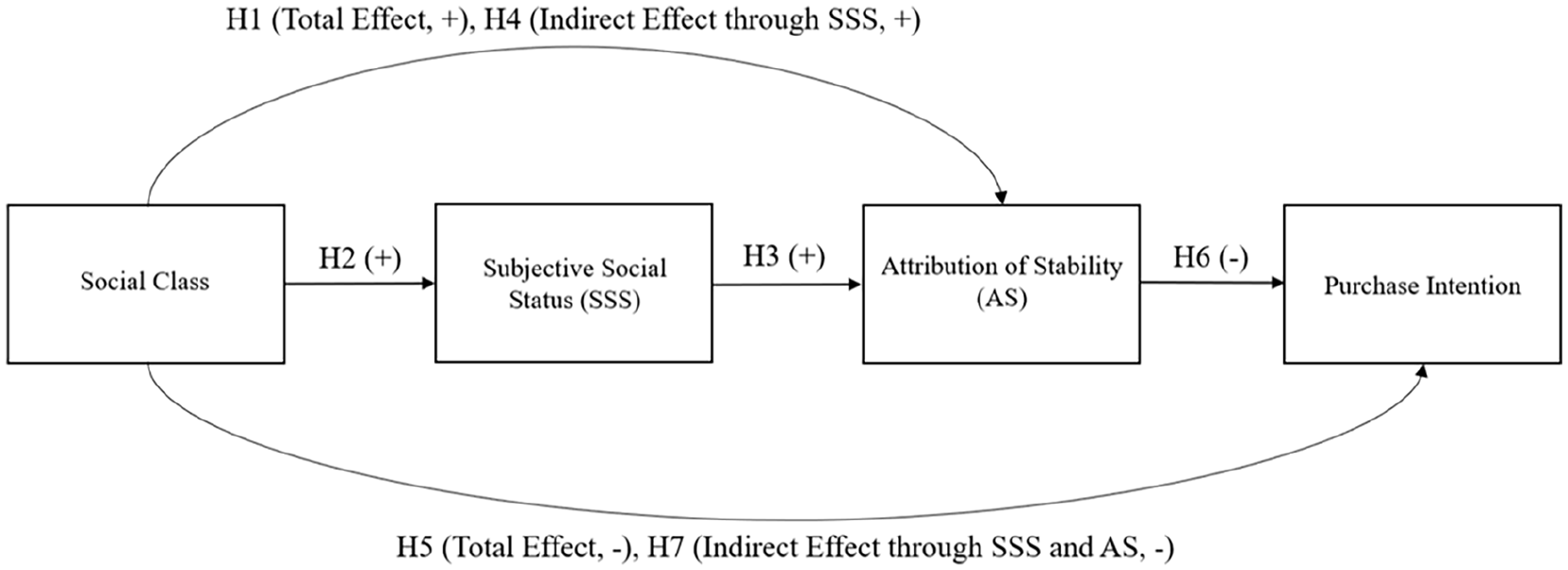
The conceptual model of the relationship between social class and purchase intention following a product-harm crisis.
Study 1A
The goal of Study 1A was to test the relationship between social class and attribution of stability to a product-harm crisis and probe the mediating role that subjective social status might play in this relationship.
Method
This study was conducted with 205 American adults (80 females, 125 males; Mage = 38.6 years; 165 White, 14 Black, two American Indian, 10 Asian, one Native Hawaiian, 13 other/mixed) recruited from the Amazon Mechanical Turk panel. Educational attainment (see Table 1 for frequency distribution) was used as an objective indicator of social class. Participants with at least a four-year degree were classified as middle class (n = 120) and those without a four-year degree were classified as working class (n = 85). Sensitivity power analysis assuming an alpha significance criterion of .05 and a power criterion of .80 indicated that the minimum effect size of the independent group difference between middle-class and working-class participants in attribution of stability that could be detected with the current sample size was d = 0.40.
Frequency distributions of educational attainment and subjective social status of American participants in Studies 1A and 3.
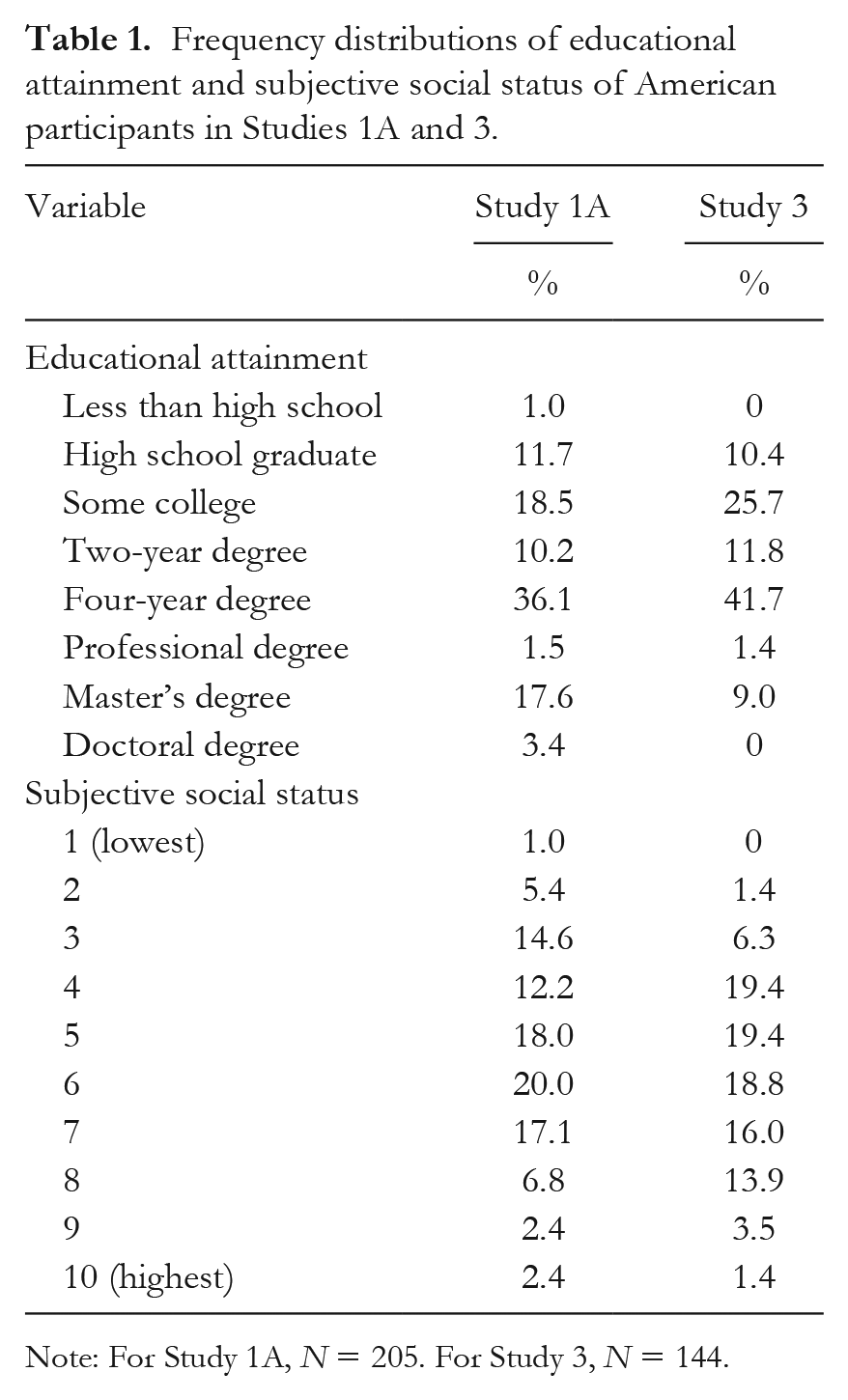
Note: For Study 1A, N = 205. For Study 3, N = 144.
Participants first read some moderately positive ratings that Stiegal (a fictitious beer brand) purportedly received from Consumer Reports in the year before. Then, participants read a short fictitious article, purportedly published in the current year, which described an incident in which Stiegal recalled more than 4,600 kegs of beer in the US after identifying two cases where the kegs were filled with cleaning solution, injuring two people (adapted from Lei et al. 2012). Following this, participants completed a measure of attribution of stability (adapted from Klein & Dawar, 2004) with four items (e.g., ‘This problem represents something stable and ongoing with Stiegal’) using a seven-point scale (1 = ‘Strongly disagree’, 7 = ‘Strongly agree’; α = .90 for middle-class participants; α = .88 for working-class participants). Finally, participants answered some sociodemographic questions (i.e., gender, age, race, educational attainment, subjective social status). The subjective social status measure was adopted from Adler et al. (2000). Participants were shown a social hierarchy ladder representing where people stand in the US and then asked to put themselves on this social hierarchy ladder (1 = ‘Lowest’, 10 = ‘Highest’; see Table 1 for frequency distribution).
Results and discussion
Consistent with H1, middle-class participants were more likely to attribute stability to Stiegal’s product-harm crisis (M = 3.48, SD = 1.35) compared with working-class participants (M = 2.78, SD = 1.35), t(203) = 3.65, p < .001, d = 0.52. Although this finding provides some initial support to the proposed relationship between social class and attribution of stability to product-harm crises, there is the possibility that formal university education promotes a social cognitive style that emphasizes decontextualized, stable attribution of events and their predictability across situations in the future (Cole & Scribner, 1974). Hence, mediational analyses were conducted to examine the effect of social class (university education) on attribution of stability through the effect of subjective social status using a bootstrapping technique with 5,000 resamples (Hayes, 2013). Results indicated that (1) middle-class participants perceived that they had a higher social status (M = 6.06, SD = 1.60) than working-class participants (M = 4.35, SD = 1.93), β = .44, t(203) = 6.89, p < .001, consistent with H2, and (2) subjective social status positively predicted attribution of stability, β = .24, t(202) = 3.23, p = .002, supporting H3. Importantly, the indirect effect of social class on attribution of stability through the effect of subjective social status was statistically significant, β = .10, 95% biased-corrected CI = .0271, .1836, supporting H4. The direct effect of social class on attribution of stability was marginally statistically significant, β = .14, t(202) = 1.96, p = .052 (see Figure 2).
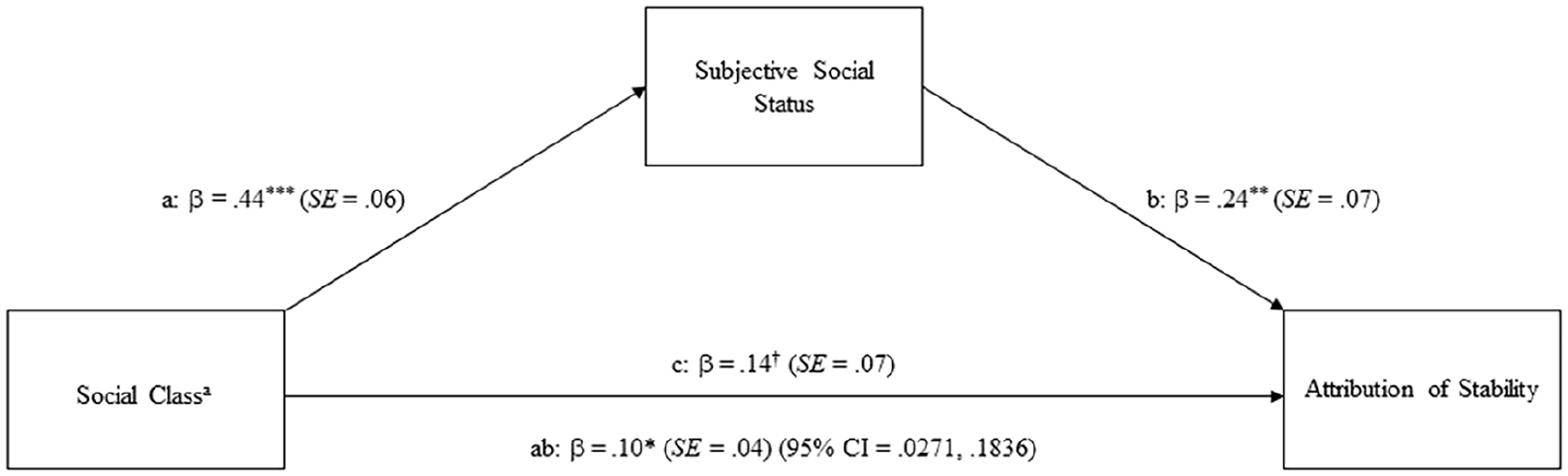
Study 1A: Indirect effect of social class on attribution of stability through the effect of subjective social status.
Finally, the above-mentioned mediational results remained very similar when age, β = −.12, t(200) = −1.81, p = .071, and gender (0 = female, 1 = male), β = .11, t(200) = 1.60, p = .112, were added as covariates. The indirect effect remained statistically significant, β = .10, 95% biased-corrected CI = .0277, .1768., and the direct effect was also statistically significant, β = .15, t(200) = 2.09, p = .038.
These results suggest that middle-class people (those with relatively high educational attainment) tend to see themselves as having a higher status in society, which in turn promotes an attributional style that emphasizes stability when a product-harm crisis is observed, seeing it as more likely to happen in the future and believing that the problem is typical of the brand’s products.
Study 1B
The goal of Study 1B was to conceptually replicate Study 1A with another product type and with participants from another culture.
Method
This study was conducted with 202 Indian adults (64 females, 138 males; Mage = 30.6 years; 201 Indian, one other/mixed) recruited from the Amazon Mechanical Turk panel. Educational attainment was highly skewed in this sample with 190 (94%) participants having at least a bachelor’s degree (see Table 2 for frequency distribution). Hence, data of this objective indicator of social class were not analysed. Sensitivity power analysis assuming an alpha significance criterion of .05 and a power criterion of .80 indicated that the minimum effect size of the association between subjective social status and attribution of stability that could be detected with the current sample size was |ρ| = .19.
Frequency distributions of educational attainment and subjective social status of Indian participants in Study 1B.
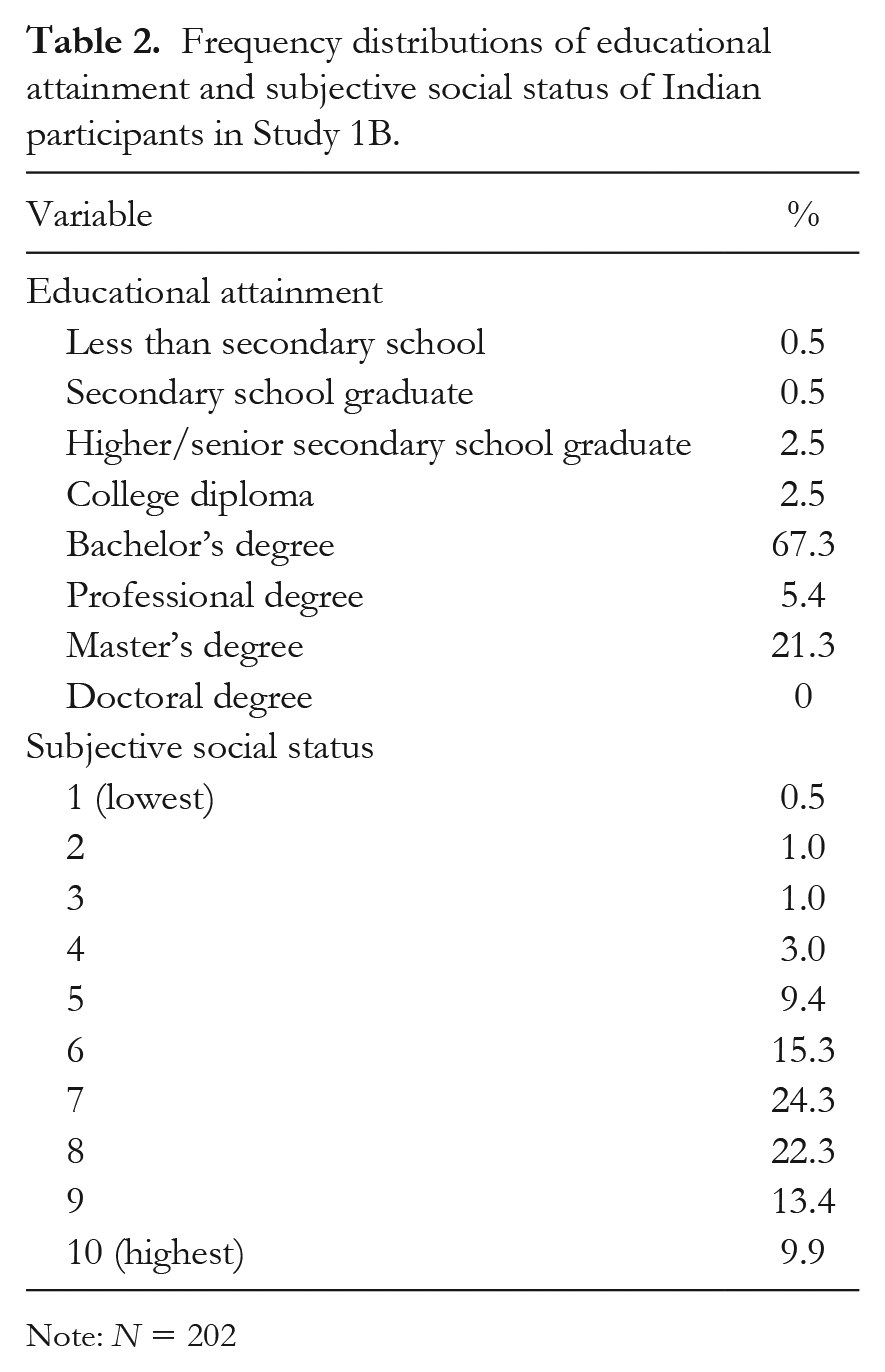
Note: N = 202
Participants read a short fictitious article describing an incident in which there were several hundred reports of severe engine damage linked to an oil company’s engine lubricant. The company was described as a well-known oil company, but the name was changed to OilCo in the article (adapted from Lei et al. 2012). Then, participants completed a measure of attribution of stability (α = .74) and answered some sociodemographic questions (i.e., gender, age, race, educational attainment, subjective social status). These measures were the same as those used in Study 1A except that the reference country of the subjective social status measure was India.
Results and discussion
Subjective social status positively predicted attribution of stability, β = .15, t(200) = 2.17, p = .031, supporting H3. This relationship remained marginally statistically significant, β = .13, t(198) = 1.90, p = .059, when age, β = −.24, t(198) = −3.46, p = .001, and gender (0 = female, 1 = male), β = .03, t(198) = 0.38, p = .703, were added as covariates. Hence, the finding of Study 1A that participants of a higher subjective social status were more likely to attribute stability to a product-harm crisis was replicated in this study using a different product category and participants from a different culture.
Study 2
The goal of Study 2 was to provide causal evidence of the proposed effect of having a high status in society on attribution of stability to product-harm crises.
Pilot Study
Method
This study was conducted with 90 Indians (39 females, 50 males, one did not report gender; Mage = 31.1 years; 88 Indian, one other/mixed, one did not report race) recruited from the Amazon Mechanical Turk panel, with the goal of confirming that subjective social status could be manipulated using mindset priming. The manipulation was adapted from past research (e.g., Kraus et al. 2010). Participants were randomly assigned to either the high (n = 44) or low (n = 46) subjective social status condition. Sensitivity power analysis assuming an alpha significance criterion of .05 and a power criterion of .80 indicated that the minimum effect size of the independent group difference between participants in the high subjective social status condition and participants in the low subjective social status condition in subjective social status that could be detected with the current sample size was d = 0.60.
Participants in the high (low) subjective social status condition were shown a social hierarchy ladder (Adler et al., 2000) and asked to compare themselves with people at the very bottom (top) of the social hierarchy and think about how they differed from those people. Subjective social status should become higher (lower) for those who made downward (upward) comparisons. Then, participants answered some sociodemographic questions (i.e., gender, age, race, subjective social status; same as Study 1B).
Results and discussion
Participants in the high subjective social status condition perceived themselves as having a higher social standing in society (M = 7.41, SD = 1.47) compared with participants in the low subjective social status condition (M = 6.59, SD = 2.11), t(80.41) = 2.15, p = .035, d = 0.45. This confirms that the manipulation of subjective social status is effective in shifting people’s perception of their social standing in society.
Main study
Method
This study was conducted with 129 Indian adults (62 females, 67 males; Mage = 33.3 years; 126 Indian, two other/mixed, one did not report race) recruited from the Amazon Mechanical Turk panel. Subjective social status was manipulated using mindset priming (same as Pilot Study). Participants were randomly assigned to either the high (n = 66) or low (n = 63) subjective social status condition. Sensitivity power analysis assuming an alpha significance criterion of .05 and a power criterion of .80 indicated that the minimum effect size of the independent group difference between participants in the high subjective social status condition and participants in the low subjective social status condition in attribution of stability that could be detected with the current sample size was d = 0.50.
Following the manipulation of subjective social status, participants read the same fictitious article as in Study 1B. Then, participants completed a measure of attribution of stability (same as Studies 1A and 1B) (α = .82 for participants in the high subjective social status condition; α = .81 for participants in the low subjective social status condition) and answered some demographic questions (i.e., gender, age, race).
Results and discussion
Participants whose perception of their social status was temporarily increased were more likely to attribute stability to the oil company’s product harm crisis (M = 5.30, SD = 1.01) compared with participants whose perception of their social status was temporarily decreased (M = 4.82, SD = 1.19), t(127) = 2.47, p = .015, d = 0.43, supporting H3. Hence, the present study conceptually replicates Studies 1A and 1B and confirms the causal role that subjective social status plays in attribution of stability following a product-harm crisis.
Study 3
The goal of Study 3 was two-fold. First, a real instance of product-harm crisis was used — the product failure of Samsung Galaxy Note 7 in 2016 (BBC, 2017) — to increase external validity. Second, a downstream consequence of attribution of stability to product-harm crises associated with having a middle-class background was examined in the present study — purchase intention of a mobile phone from Samsung.
Method
This study was conducted in the US in 2019. It was expected that a large majority of American participants would be aware of the product failure of Samsung Galaxy Note 7 that happened in 2016, and participants who were not aware of this product failure would be excluded. One hundred and ninety-six Americans recruited from the Amazon Mechanical Turk panel took part in this study, and 158 (81%) of them were aware of this product failure. Out of these 158 participants, 14 of them failed an attention check question and thus were excluded from data analysis. The final sample consisted of 144 Americans (68 females, 74 males, two other gender; Mage = 36.3 years; 107 White, 16 Black, nine Asian, 12 other/mixed race). Participants with at least a four-year degree were classified as middle class (n = 75) and those without a four-year degree were classified as working class (n = 69). Sensitivity power analysis assuming an alpha significance criterion of .05 and a power criterion of .80 indicated that the minimum effect size of the independent group difference between middle-class and working-class participants in purchase intention that could be detected with the current sample size was d = 0.47.
Participants completed the following measures in the order as presented:
Results and discussion
Purchase intention
Middle-class participants reported a lower intention to purchase a cell phone from Samsung in the future (M = 4.35, SD = 1.90) compared with working-class participants (M = 5.23, SD = 1.70), t(142) = −2.94, p = .004, d = 0.49, consistent with H5.
The indirect effect of social class on purchase intention through the effects of subjective social status and attribution of stability in serial
The finding that middle- (vs. working-) class participants had a lower intention to purchase a Samsung cell phone in the future in and of itself might be due to any reasons other than (or in addition to) their tendency to attribute stability to Samsung’s product-harm crisis associated with their relatively high subjective social status. Hence, it would be informative to examine the indirect effect of social class on purchase intention through the effects of subjective social status and attribution of stability in serial. This serial mediation model was tested using a bootstrapping technique with 5,000 resamples (Hayes, 2013).
Results indicated that: (1) middle-class participants perceived that they had a higher social status (M = 5.76, SD = 1.44) than working-class participants (M = 4.65, SD = 1.83), β = .32, t(142) = 4.05, p < .001, consistent with H2 and replicating Study 1A; (2) subjective social status positively predicted attribution of stability, β = .21, t(141) = 2.39, p = .018, supporting H3 and replicating Studies 1A, 1B and 2; and (3) attribution of stability negatively predicted purchase intention, β = −.20, t(140) = −2.43, p = .016, consistent with H6. Importantly, the indirect effect of social class on purchase intention through the effects of subjective social status and attribution of stability in serial was statistically significant, β = −.01, 95% biased-corrected CI = −.0391, −.0023, supporting H7. The direct effect of social class on purchase intention was also statistically significant, β = −.25, t(140) = −2.99, p = .003 (see Figure 3).
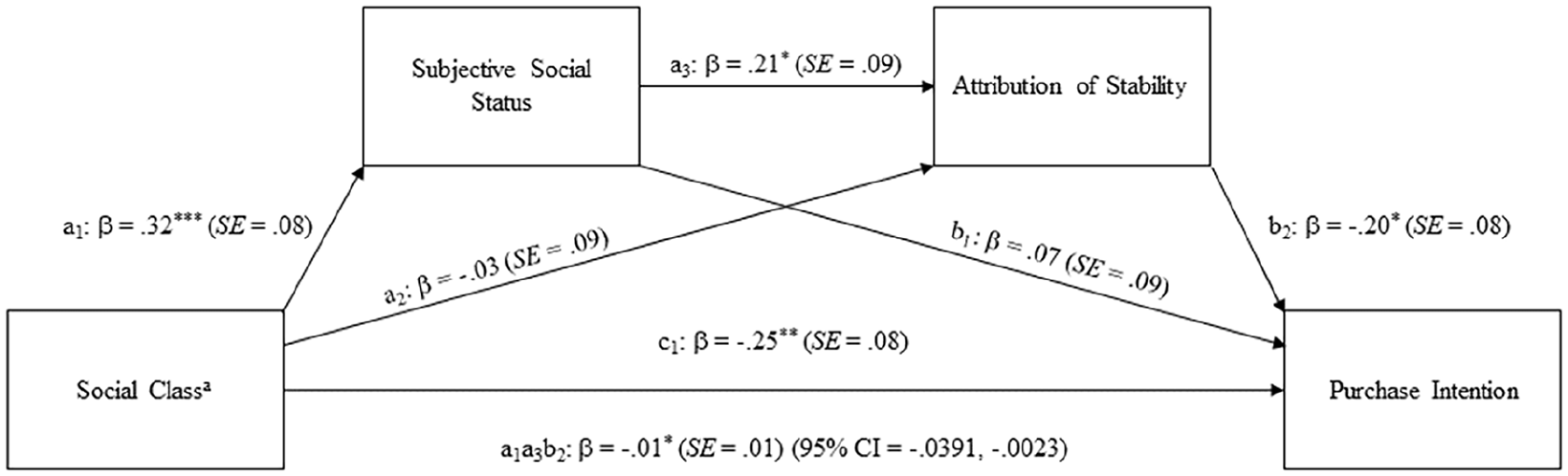
Study 3: Indirect effect of social class on purchase intention through the effects of subjective social status and attribution of stability in serial.
Finally, the above-mentioned mediational results remained the same when age, β = −.04, t(136) = −0.46, p = .644, and gender 1 (0 = ‘Female’, 1 = ‘Male’), β = .08, t(136) = 0.92, p = .358, were added as covariates. The indirect effect remained statistically significant, β = −.01, 95% biased-corrected CI = −.0404, −.0022., and the direct effect was also statistically significant, β = −.24, t(136) = −2.77, p = .006.
Using Samsung’s product-harm crisis, the present study conceptually replicates and extends the previous studies by showing that compared with working-class people, middle-class people tend to see themselves as having a higher social status in society, which in turn leads to a stronger tendency to attribute stability to Samsung’s product-harm crisis, seeing it as more likely to happen again, which in turn leads to a lower intention to purchase a Samsung cell phone in the future.
General discussion
This research demonstrates the impact of social class on attribution of stability to product-harm crises. Results across four studies suggest that following a product-harm crisis, middle-class individuals are more likely to believe that the problem is typical of the brand and that similar problems may occur in the future compared with working-class individuals. This social class difference in attribution of stability can be explained by middle-class individuals’ elevated perception of their status in society. Furthermore, this stability attribution has downstream consequences for purchase intention — middle- (vs. working-) class individuals are less likely to purchase products from the same brand following a product-harm crisis. The core link between subjective social status and attribution of stability to product-harm crises has been shown with three product categories (beer, Study 1A; engine lubricant, Studies 1B and 2; cell phone, Study 3), in two cultural contexts (United States, Studies 1A and 3; India, Studies 1B and 2) and using correlational (Studies 1A, 1B and 3) and causal (Study 2) designs, providing evidence for the robustness of the effect. The observed generalizability of the relationship between subjective social status and attribution of stability across an individualistic (i.e., American; Hofstede et al., 2010) culture and a collectivistic (i.e., Indian; Kapoor et al., 2003) culture is especially informative, given the extant literature in cultural psychology suggesting that some effects of social class or status found in individualistic cultures may be absent in collectivistic cultures (e.g., Miyamoto & Wilken, 2010; Na et al., 2016).
The results of the present research complement those of Monga and John (2008), supporting the general notion that consumer characteristics related to cognitive style could influence attribution when a firm suffers from negative publicity, while adding to this line of research by uncovering a novel consumer characteristic (i.e., social class) that could influence stability attribution in the context of product-harm crises and extending its downstream consequences to purchase intention, affording some practical implications for firms. First, firms need to devote more effort in reactive public relations following a product-harm crisis if they primarily target middle-class, rather than working-class, consumers and in states or provinces where the proportion of middle-class individuals is relatively high, rather than relatively low. Second, following a product-harm crisis, firms may adopt a communication strategy that prompts consumers to engage in an upward social comparison, conceptually similar to the manipulation of Study 2, so as to encourage them to attribute less stability to the product-harm crisis and importantly dampen their subsequent tendency to switch to competing brands.
The current results can also help consumers by providing insights on how their social class background may influence their tendency to attribute stability to a product-harm crisis and their inclination to purchase products from the same brand in the future. Consumers are advised to seek more information about the cause(s) of a product-harm crisis to the extent possible. Product-harm crises provide opportunities for firms to learn from their failures and improve their production procedures. Hence, when planning for purchases in the future, it would be beneficial for consumers to check up-to-date independent reports of product review and testing of all brands in their evoked set. These reports are more comprehensive than what was evident in an incident of product-harm crisis that happened in the past. With more information gathered, consumers could then make an overall more informed purchase decision than one that is primarily driven by a prior product-harm crisis and is influenced by their social class background.
The current work suggests that, probably because working-class consumers tend to, by default, put a relatively high focus on situational cause(s) of a product-harm crisis that may be relatively unstable, they tend to think that the problem may be an exception that is not typical of the brand’s products. Whether this social class difference would remain the same when a brand has had multiple product-harm crises overtime is an empirical question that is worthy of examining in the future. It may be the case that after learning that a brand has a history of product-harm crises, rather than just a single isolated product-harm crisis, working-class consumers’ default level of stability attribution would be increased to reflect this knowledge. Moreover, future research can examine whether other objective indicators of social class, such as income and occupation, would influence attribution of stability and purchase intention following a product-harm crisis in a similar way as would educational attainment. Finally, it is worth examining how attributional tendencies, as influenced by one’s social class, may play out in other domains of consumption. For example, future research can examine whether middle- (vs. working-) class people would similarly attribute more stability to a very good or very bad service experienced during one encounter with a service provider.