




Abstract
In light of the current discussion concerning poly families’ rights, this study examined the motivational underpinnings of opposition to poly families. Grounded on the theoretical line that institutional and ideological systems can legitimize the ostracism of stigmatized groups, the current exploratory research project examined the relationship between religiosity and opposition to poly families and whether this relationship is mediated by political positioning and mononormativity in a serial fashion. Specifically, Study 1 (N = 277) examined the effect of religiosity on opposition towards polyamorous parents and whether the endorsement of conservative ideology and mononormativity would mediate this relationship. Study 2 (N = 193) replicated the first study’s findings using a behavioural expression of negative stigma towards poly families’ rights. Study 1 showed that opposition towards poly families might be affected by religiosity and that the impact of religiosity is mediated by conservative ideology and mononormativity. Study 2 showed that religiosity could affect opposition to poly families’ rights through conservative ideology and mononormativity. This study provides evidence that the more religious participants are likely to express attitudinal and behavioural opposition towards poly families and that the more religious participants endorsed ideas based on conservative and mononormativity principles, the more they opposed poly families. The current exploratory study shows the relation between system-justifying ideological manifestations in prejudice towards poly families.
A significant body of research demonstrates the increasing researchers’ emphasis on polyamory and other forms of consensual non-monogamy (CNM; Kleese, 2018; Ossmann, 2020). Haritaworn et al. (2006) define polyamory as a form of relationship where it is possible, valid and worthwhile to maintain (usually long-term) intimate and sexual relationships with multiple partners simultaneously. Polyamory is commonly viewed as one variant of relational and familial practices that falls into the category of consensual nonmonogamies (CNMs; Klesse et al., 2022).
Consensual non-monogamy (CNM) involves varying levels of romantic and/or sexual openness, whereas monogamy includes social and sexual exclusivity (Conley et al., 2013; Moors et al., 2021; Sheff, 2020). Sheff (2011; p. 488) notes that in polyamorous partnerships, both women and men explicitly engage in ‘multiple romantic, sexual and/or affective partners with a focus on honesty and full disclosure of the network of relationships to all who are affected by them’. In particular, at the core of CNM relationships is that partners mutually agree to engage in varying degrees of sex and romance with more than one partner (see Balzarini & Muise, 2020; Moors, 2017). However, key issues remain scarcely studied despite the burgeoning interest in CNM relationships. In particular, parenting has been treated as a taboo issue within multi-adult intimate relationships (Klesse, 2019). Accordingly, the academic literature has yet to explore what everyday people think of multi-adult family units (Few-Demo & Allen, 2020).
Research data demonstrate that social views oppose CNM relationships. Moreover, polyamorous individuals report their stigmatizing (e.g., rejection from friends) and discriminating (e.g., child custody issues) experiences because of the traditional hegemonic patriarchal family social ideal (Kimberly & Hans, 2017; Pallotta-Chiarolli, 2010). In addition, like same-sex relationships, polyamorous partnerships are faced with discrimination since they are excluded from accessing their legal rights guaranteed by mononormative institutions such as marriage and dyadic definitions of the family institution (Sheff, 2014). Rhoten et al. (2021) argue that alternative family relationships, such as CNM and polyamorous parents, are in a similar situation as LGBTQI+ parents a few decades ago.
Polyamorous partnerships challenge dominant monogamous constructions of relationships and the idea that relationships should be between only two people (Mogilski et al., 2017). Polyamory contests compulsory monogamy (i.e., the assumption that monogamy is the only legitimate relationship model) that ethical and family laws impose on citizens (Mogilski et al., 2017; Ritchie & Barker, 2006). In Western culture and science, families are intertwined with the binary gender system and compulsory heterosexuality despite the variety of ways in which individuals navigate their intimate lives (Burleigh et al., 2017; Moors et al., 2019; Sheff, 2020). In addition, intimacy and human development theories propose that monogamy is universal (Conley et al.,2017, 2013). Little research on lay people’s attitudes towards polyamorous parenting demonstrates the low visibility of these family relationships (Klesse, 2019; Pallotta-Chiarolli et al., 2020). In addition, why people oppose poly families and their rights has yet to be adequately addressed at the social and political psychology level. Therefore, the current exploratory study tests a model in which religiosity affects attitudes towards poly families. In addition, it tests whether this religious opposition to poly families is motivated by conservative tendencies (i.e., conservative political ideology and mononormativity) to maintain (i.e., to justify) the status quo.
The impact of the monogamous ideal on polyamorous relationships
Given the dominant sociocultural expectations concerning normal relationships, romantic relationships are expected to occur only between two partners who are sexually and emotionally exclusive to each other (Conley et al., 2012). Thus, the cultural dominance of monogamy imposed implicitly through socialization shapes perceptions of what ‘normal relationships’ look like and how ‘serious relationships’ should be (Henrich et al., 2012; Ryan & Jetha, 2011). Hence, the monogamous ideal is established as a ‘natural’ part of the human experience, and consequently, sexual behaviour outside of exclusive coupled relationships is pathologized (De las Heras Gomez, 2019). Therefore, polyamorous individuals risk being demonized by social norms and attitudes and viewed as anomalous and deviant (Barker, 2005).
Queer scholars emphasized how sexual and gender minorities could be considered a ‘threat’ since they ‘disturb and trouble heterosexuality’ (Jackson, 2003, p.70). Accordingly, the same applies to polyamorous individuals (Ritchie & Barker, 2006). Individuals in CNM relationships violate the monogamous ideal, which in many cases can result in experiencing negativity and ostracization because of their non-conforming relationship structure (Ritchie & Barker, 2006). Hence, polyamory and other CNMs are considered as not normal (Sheff, 2020). The fundamental ideas underlying the dominant construction of sexuality in Western society are challenged by polyamory (Barker, 2005). According to three fundamental characteristics of this construction, sexual relationships must (a) be between a man and a woman (compulsory heterosexuality), (b) be monogamous and (c) be active on the part of the male and passive on the part of the woman (Barker, 2005). This view of heterosexuality, according to Richardson (1998; p. 2), is ‘constructed as a coherent, natural, fixed and stable category; as universal and monolithic’. This is due to the widespread perception in Western society that monogamy is essential to satisfying a person’s relationship requirements (Barker & Langdridge, 2010; Conley et al., 2013; Mitchell et al., 2014). Whatever name this belief system appears by (e.g., mono-normativity, mono-centrism, compulsory monogamy or heteronormative monogamy; Anderson, 2012; Noël, 2006), it stigmatizes non-monogamous relationship options as being unnatural and sees the monogamous (heterosexual) couple as the only viable option (Grunt-Mejer & Campell, 2016; Sheff & Hammers, 2011). There is evidence that every type of consensual non-monogamy relationship, such as swinging (couples engaged in extradyadic sex, often with a social component; Jenks, 1998), open relationships (partners engaging in independent sexual relationships outside of the dyad; Matsick et al., 2013) and polyamory (i.e., concurrent, consensual romantic relationships with multiple partners; Mitchell et al., 2013), bears social stigma and is viewed as undesirable to society or even harmful (Cardoso et al., 2021; Rodrigues et al., 2018; Séguin, 2019). Cardoso et al. (2021) also emphasize that consensual non-monogamy has conceptual issues because it highlights the importance of monogamy and assumes it to be the usual assumption.
According to research findings, many polyamorous people experience prejudice due to their way of living (Cox et al., 2013), even from friends, family and workplaces (Sheff, 2014; Young, 2014). Although polyamorous individuals also have long-lasting relationships, polyamorous partnerships are viewed as less devoted and less trustworthy than monogamous partnerships (Fleckenstein & Cox, 2014; Sequin, 2019; Wosick-Correa, 2010). Furthermore, equating polyamory with infidelity increases the societal stigma associated with CNM while ignoring the value that polyamorous people attach to the consent and accountability (Perez & Palma, 2018). Because of this, belonging to a stigmatized minority group with sexualized identities and behaviours can lead to potential misconceptions (such as the usage of the term ‘cheaters’), psychological suffering and possible prejudice (Cardoso et al., 2018).
Empirical data reveal the stigmatization of polyamorous parents and parents in other complex multi-adult family units, as well as a lack of representation in legal systems, despite shifting attitudes towards sexual- and gender-minority individuals (Pallotta-Chiarolli, 2010; Pallotta-Chiarolli et al., 2020). Additionally, without legal representation, polyamorous parents are vulnerable to custody disputes that might endanger their relationships with their children in situations of parental separation (Kleese, 2019). Parenthood and children not only constitute a normative marker of relationship legitimacy and success but also represent in many ways the reproduction of cis-normative ideals of mononormativity (Cardoso, 2014). Because monogamous partnerships are considered to be safer environments for raising a kid, children’s well-being is closely related to monogamy (Conley et al., 2012), which is why it is believed that raising children is another area where polygamous people face discrimination — although research shows that polygamous families provide more resources (e.g., economic and cognitive resources) and that children’s emotional problems are more likely to be caused by social prejudices (Sheff, 2014). People in domestic multiple partnerships are additionally confronted with several discriminatory issues, such as the recognition of their marital rights, their exclusion from civil unions and access to healthcare and taxation issues due to the legislator’s decision only to permit the marriage of two people (Aviram & Leachman, 2015). Consequently, the legislator portrays polyamory and other types of CNM as abnormal by presuming that everyone is monogamous and that all love relationships are dyadic (Aviram & Leachman, 2015). The stigmatization of polyamorous individuals and their discrimination as regards their marriage and parenting rights (Balzarini & Muise, 2020) underlines the need to examine the social-psychological processes that lead to negativity and opposition towards polyamorous familial arrangements.
Religiosity and alternative family relationships
Church and religious attendance are strongly associated with attitudes towards sexual and gender minorities (Jäckle & Wenzelburger, 2015; Whitehead & Perry, 2016). Legerski and Harker (2018) argue that religiosity (i.e., the degree to which one is involved with religion) significantly predicts attitudes towards sexual minorities, marriage equality and same-sex parenting rights. More specifically, those who are more religious and have more frequent worship attendance oppose same-sex relationships and marriage (Twenge & Blake, 2021; Worthen et al., 2017). Research data also report a positive relationship between macro-level religiosity and individual-level attitudes. On average, people oppose sexual minorities’ rights more in countries with higher levels of religiosity (Dotti-Sani & Quaranta, 2021). Furthermore, it is not uncommon for spiritual leaders to express their views against stigmatized groups (for example, sexual and gender minorities; Dotti-Sani & Quaranta, 2020).
Importantly, the Greek Orthodox Church is a significant institution profoundly affecting moral issues and family values (Grigoropoulos, 2021a b; Grigoropoulos et al., 2023), including sexual minorities’ right to become adoptive or foster parents (Grigoropoulos, 2023a b, 2022, 2019; Papadaki et al., 2022). Since the nuclear family continues to be considered ‘core’ to Greek society, attitudes towards poly families offer significant insight into social stigmatization. Given that religion provides believers with a strict moral framework that involves specific attitudes towards certain social groups, attitudes towards poly families might reflect religious proscriptions. On the other hand, opposition to poly families may also be driven by conservative tendencies to maintain the status quo. Hence, this study aims to examine the effect of religiosity on attitudes towards poly families and whether conservative political ideology and mononormativity, as system-justifying beliefs, help explain this effect.
Conservative political ideology
Political ideology is linked to sexual prejudice as conservatives report more opposition to sexual and gender minority individuals’ rights than liberals (Haslam & Levy, 2006; Pacilli et al., 2011). Political ideology encloses both belief systems and attributional processes that can actively support the justification of stigma. Ideologies such as social dominance orientations (i.e., individual preferences for hierarchies amongst social groups) can justify discriminatory treatment by supporting beliefs in social hierarchies or, in the case of political ideology, by supporting both hierarchical beliefs and attributions of blame and responsibility for the stigma (Crandall, 2000). Thus, conservatives are more likely than liberals to accept inequality and consent to the existing social and economic inequalities (Jost et al., 2009; Jost & Hunyady, 2005; Van der Toorn et al., 2014). Crandall (2000) states that justification ideologies are basic frames that influence people’s values, ethics and beliefs through which they understand the world. Ideological systems can legitimize the power and status inequalities linked with stigmatized groups. In other words, ideologies can provide ways to justify the ostracism of stigmatized individuals (van der Toorn et al., 2017).
Resistance to change is a basic feature of conservative political ideology (Jost et al., 2003). In addition, the association between religiosity and resistance to change is apparent since religions tend to support traditionalism and the maintenance of the social status quo (i.e., system justification; Jost et al., 2014). Thus, also taking into account that ideological self-placement on a single left-right dimension is associated with prejudice towards ostracized groups such as sexual and gender minorities (e.g., Luguri et al., 2012), this study aimed to examine whether the endorsement of conservative ideology would mediate the effect of religiosity on attitudes towards poly families.
Overview of studies and analysis plan
Grounded on the theoretical line that institutional and ideological (structural) systems can legitimize the ostracism of stigmatized groups (Hoyt & Parry, 2018), in Study 1, we examined the effect of religiosity on attitudes towards polyamorous parents and whether preferences for the status quo (i.e., political conservatism and mononormativity) mediate the effect of religiosity on attitudes towards polyamorous parents. The current research project’s second aim (Study 2) was to replicate the first study’s findings using a behavioural expression of negative stigma. To summarize, this study examines the effect of religiosity on attitudes towards poly families and a model in which political conservatism and mononormativity (cultural bias towards polyamory) would mediate the relationship between religiosity and opposition to poly families in serial fashion, such that religiosity → political conservatism →mononormativity→ opposition to poly families.
The current study extends the scholarship by empirically examining the effect of religiosity on attitudes towards poly families and the indirect roles of system-justifying beliefs (i.e., conservative political ideology and mononormativity) in linking religiosity and opposition towards polyamorous parents. Thus, this study aims to demonstrate institutional and ideological systems’ significant role in encouraging bias and discrimination against polyamory parents.
Study 1
Study 1 examines the hypothesis that religiosity is associated with opposition to polyamorous parents and that endorsing conservative political ideology and mononormativity serially mediates the relationship between religiosity and opposition towards polyamorous parents.
Method
Participants and procedure
Two hundred and seventy-seven undergraduate students and administrative and teaching staff recruited from two universities in northern Greece participated in an online study between 4 May and 4 June 2022. Informed consent was obtained from all individual participants included in the study. The mean age was 24.75 (SD = 8.72; 223 females). Convenience sampling with a snowball-like technique was utilized. The URL of the questionnaire was publicized on the researcher’s university social networks and forums. The online survey was completely anonymous, and participants indicated their agreement to participate by selecting the consent checkbox. The sample was predominantly heterosexual (90.6%, n = 251; lesbian/gay 2.2%, n = 6; bisexual 5.4%, n = 15; asexual 1.8%, n = 5). Most participants (185) were undergraduate students (43 had a high school diploma, 39 had a university degree and 10 had completed a master’s degree). Respondents completed measures of political ideology, religiosity, mononormativity and attitudes towards polyamorous parents. A sensitive power analysis was performed using the procedures suggested by Schoemann et al. (2017) to determine power and found that this study’s sample (N = 277) gives a power of .81 for detecting two serial indirect effects.
Measures
Socio-demographic variables
Participants gave background information about their age (reported by participants in a numerical entry box), gender (male, female, other-with specification required), sexual orientation (heterosexual, gay/lesbian, bisexual, other-with specification required), political positioning (left, center-left, center, center-right, right), level of education (high school diploma, undergraduate student, university degree, postgraduate degree).
Political ideology
Respondents’ ideology was assessed by asking them to place themselves on a scale ranging from 1 (‘Left’) to 5 (‘Right’; i.e., ‘Left’, ‘Center-left’, ‘Center’, ‘Center-right’, ‘Right’).
Religiosity
Respondents’ stated their frequency of religious services attendance and frequency of praying (1 = ‘Never’ to 7 = ‘Very frequently’). These two items were adapted from the ‘Duke Religion Index’ (DUREL; Koenig & Büssing, 2010). The two items assessing religiosity were strongly correlated (r τ = .545, p < .001). Accordingly, they were combined into one measure of religiosity (α = .73).
Mononormativity
Attitudes towards monogamy were assessed with a two-item index including the following statements: ‘I believe that monogamy is the normal orientation for relationships’ and ‘I believe that humans are biologically predisposed to be monogamous’. The aforementioned items were adapted from Johnson et al.’s (2015) study and were assessed on a seven-point Likert scale from 1 (‘Disagree strongly’) to 7 (‘Agree strongly’). The two items were strongly correlated (r τ = .611, p < .001); thus, they were combined into one measure of mononormativity (α = .76). Higher scores reflect more positive attitudes towards mononormativity.
Attitudes towards polyamorous parents
Respondents indicated their endorsement of the following item: ‘Society is now ready for children growing up with polyamorous parents’ (1 = ‘Strongly disagree’, 7 = ‘Strongly agree’). A high score indicated positive attitudes towards poly families. As this statement was previously used regarding attitudes towards same-sex marriage and parenthood, it was reworded in the current study to reflect attitudes towards polyamorous parents (Hollekim et al., 2011).
Design and statistical analysis
A between-subject correlational design was utilized. IBM SPSS statistics version 19 was used for the analysis of the data. Prior to the main statistical analyses, the parametric assumptions were examined (normality, outliers). Shapiro-Wilk test was utilized to determine the normality of the data distribution. Data were non-normally distributed. Bivariate correlation (Kendall’s Tau correlation analysis) was used to examine the relationships between variables of interest. We examined our hypotheses with mediation analyses using Hayes’s (2013) PROCESS macro for SPSS. In both studies, we conducted a bootstrapping analysis for serial multiple mediation analysis models (Hayes, 2013 Model 6). Alpha level was set at .05.
Results
Descriptive statistics are provided in Table 1. Political ideology was positively correlated with religiosity (r τ = .299, p < .001). Mononormativity was positively correlated with religiosity (r τ = .294, p < .001) and political ideology (rτ = .208, p < .001). Age was positively correlated with religiosity (r τ = .096, p = .034) and political positioning (r τ = .194, p < .001). Sexual orientation was negatively related to religiosity (r τ5 = –.228, p < .001), political positioning (r τ = –.166, p = .003) and mononormativity (r τ = –.232, p < .001). Attitudes towards polyamorous parents were negatively associated with religiosity (r τ = –.228, p < .001), political positioning (r τ = –.168, p < .001) and mononormativity (r τ = –.272, p < .001).
Cross-scale correlations for the study variables (n = 277).
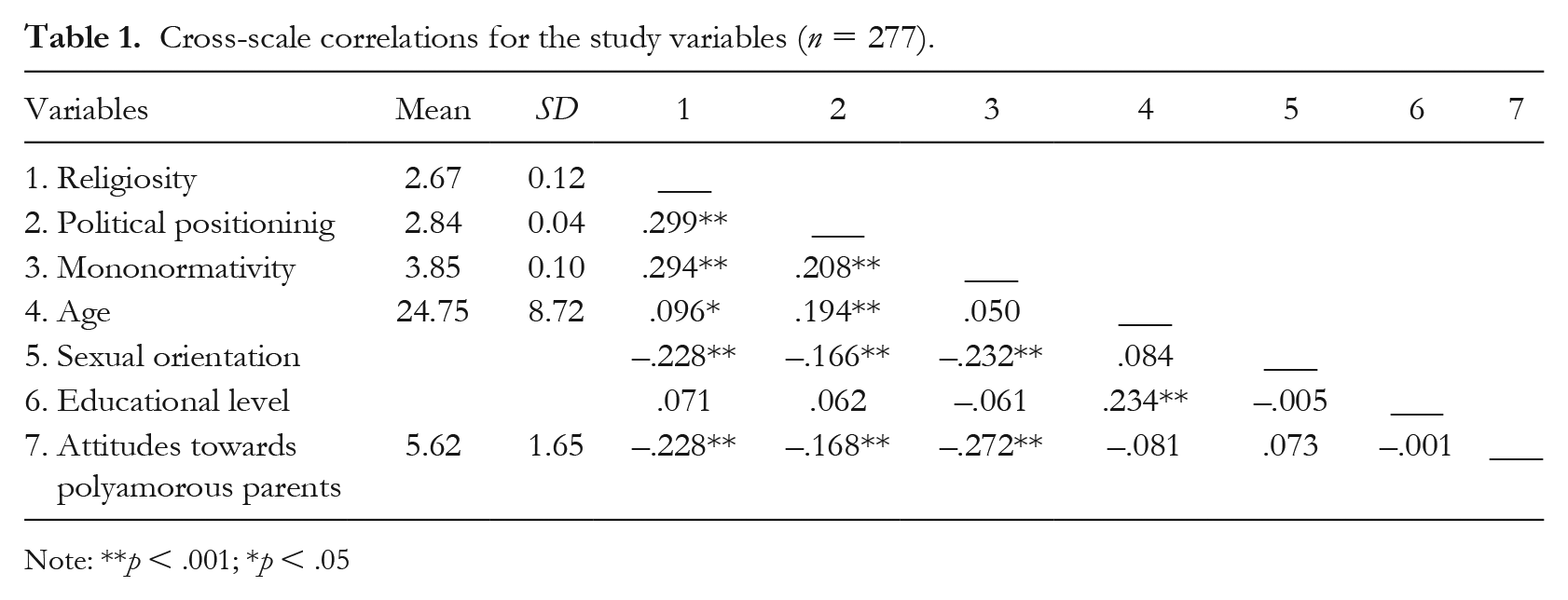
Note: **p < .001; *p < .05
Next, it was hypothesized that religiosity is associated with opposition to polyamorous parents and that endorsing conservative political ideology and mononormativity serially mediates the relationship between religiosity and opposition towards polyamorous parents. A serial mediation with political positioning and mononormativity serially mediating the relationship between religiosity and attitudes towards polyamorous parents was performed. Confidence intervals were calculated by using bootstrapping procedures with 5,000 resamplings. As depicted in Figure 1, a significant total effect of religiosity on opposition to polyamorous parents, c = −0.209, SE = 0.048, p = < .001, was obtained. The results also revealed a significant indirect effect of religiosity on attitudes towards polyamorous parents through political positioning and mononormativity (α1*d*b2 = −0.010, SE = 0.008, CI95 [−0.033, −0.001]). Moreover, the direct effect of religiosity on attitudes towards polyamorous parents in presence of the mediators was significant (c’ = −0.117, SE = 0.049, p = .017, CI95 [−0.214, −0.020]). Hence, there was a partial serial mediation of political positioning and attitudes towards monogamy on the relationship between religiosity and attitudes towards polyamorous parents. This study’s results provide evidence that religiosity negatively affects attitudes towards poyamorous parents, but the impact is also mediated by political conservatism and mononormativity (i.e., religiosity → political conservatism → monogamy → opposition to polyamorous parenting).
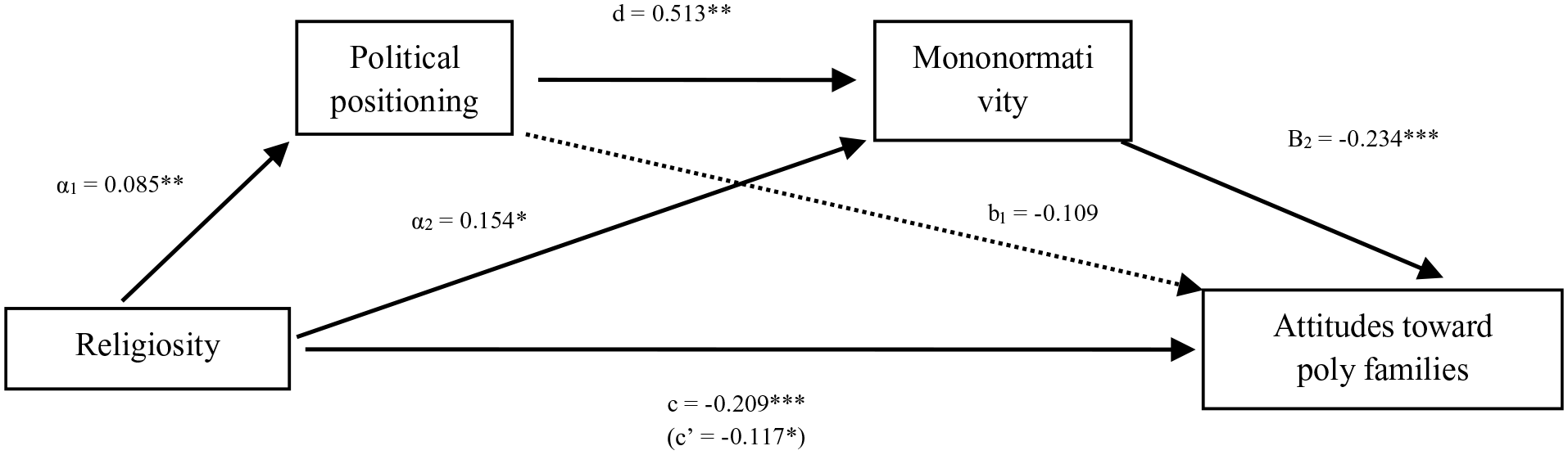
Serial multiple mediator model predicting attitudes towards poly families from religiosity, political positioning and mononormativity (Study 1). Dashed line represents a non-significant path in the model.
Overall, Study 1 supported the hypothesis that opposition to polyamorous parents may be attributable to religiosity. Also, Study 1 provided evidence that conservative preferences to maintain the status quo, that is, conservative political ideology and mononormativity, underlie religious opposition to polyamorous parenting. This mediating effect provides evidence that the more the participants adhered to religiosity, the more politically conservative ideology they were likely to exhibit — the more politically conservative the participants, the more mononormativity they were likely to exhibit — the more endorsement of mononormativity they exhibited, the less favorable attitudes towards polyamorous parents they were likely to report. The present exploratory study expands empirical evidence concerning opposition to poly families by providing evidence of a direct link between religiosity and opposition to poly families and an indirect link between religiosity and opposition to poly families through conservative ideology and mononormativity. However, to show that the aforementioned relationship can be enacted, a second study was conducted to replicate these results using a behavioural expression of opposition towards poly families’ rights.
Study 2
In Study 2, a conceptual replication of Study 1 with a measure of behavioural intention was attempted. Thus, Study 2 examined participants’ self-reported willingness to engage in action supporting poly families’ rights. As already mentioned, we reason that participants who endorse religious beliefs and conservative political ideology may be more motivated to defend society’s traditions and status (i.e., mononormativity) by opposing practices considered deviant. Thus, Study 2 examined the relationship between religiosity and willingness to engage in action supporting poly families’ rights and whether endorsing conservative ideology and mononormativity would serially mediate this relationship.
Method
Participants and procedure
One hundred and ninety-three undergraduate students recruited from a university in central Macedonia, Greece, participated in an online study between September 4 and October 4, 2022. Mean age was 20.55 (SD = 1.54; 165 females). Informed consent was obtained from all individual participants included in the study. Respondents participated in the online survey for course credit. Again, the online survey was completely anonymous, and participants indicated their agreement to participate by selecting the consent checkbox. The sample was predominantly heterosexual (95.3%, n = 184; lesbian/gay 4.7%, n = 9). Respondents completed measures of political ideology, religiosity, mononormativity and willingness to engage in action supporting poly families’ rights. A Monte Carlo power analysis for indirect effects was performed through an online application. For a conventional alpha level, this study had a power of .65 for serial mediations. The same procedures as in Study 1 were followed.
Measures
Political ideology
We used the same scale as in Study 1 to measure political ideology.
Religiosity
The same scale that we applied in Study 1 was used. The two items of mononormativity were strongly correlated (r τ = .576, p < .001). Accordingly, they were combined into one measure of religiosity (α = .71).
Attitudes towards monogamy
We used the same scale we applied in Study 1. The two items of mononormativity were strongly correlated (r τ = .596, p < .001); therefore, they were combined into one measure of mononormativity (α = .74).
Willingness to engage in action supporting poly families’ rights
Respondents indicated their endorsement of the following item: ‘I would join a protest supporting more rights for poly families’ (1 = ‘Strongly disagree’, 7 = ‘Strongly agree’). Higher scores indicated a greater willingness to protest on behalf of poly families’ rights. Most research uses different dimensions of protest, such as boycotting or attending demonstrations (see Jenkins et al., 2008). The current study emphasizes joining a protest to account for supporting poly families’ rights.
Design and statistical analysis
A between-subject correlational design was utilized. IBM SPSS statistics version 19 was used for the analysis of the data. Prior to the main statistical analyses, the parametric assumptions were examined (normality, outliers). Shapiro-Wilk test was utilized to determine the normality of the data distribution. Data were non-normally distributed. Bivariate correlation (Kendall’s Tau correlation analysis) was used to examine the relationships between variables of interest. Next, a bootstrapping analysis was performed for serial multiple mediation analysis models (Hayes, 2013 Model 6). Alpha level was set at .05.
Results and discussion
Descriptive statistics are provided in Table 2. Political ideology was positively correlated with religiosity (r τ = .314, p < .001). Attitudes to mononormativity were positively correlated with religiosity (r τ = .377, p < .001) and political ideology (r τ = .264, p < .001). Willingness to engage in action supporting poly families’ rights was negatively associated with religiosity (r τ = –.268, p < .001) and mononormativity (r τ = –.421, p < .001).
Cross-scale correlations for the study variables (n = 193).
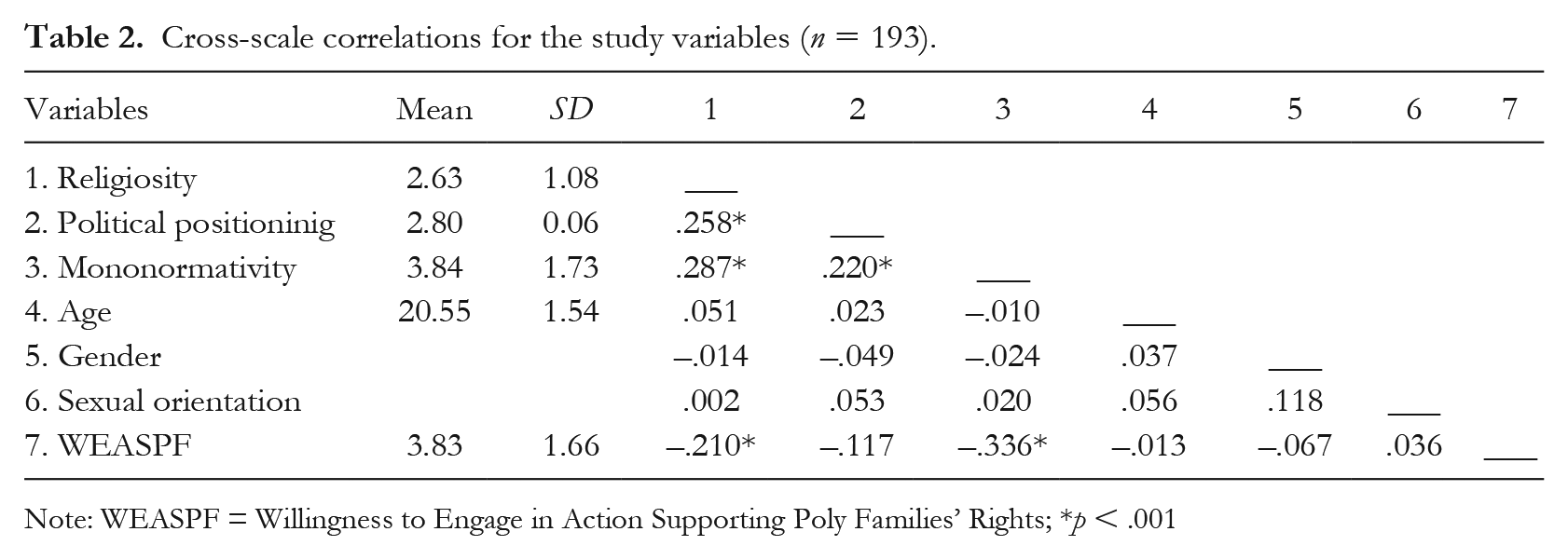
Note: WEASPF
Next, a serial multiple mediation model was conducted. As depicted in Figure 2, we obtained a significant total effect for religiosity on willingness to engage in action supporting poly families’ rights, c = −0.412, SE = 0.107, p < .001. The results also revealed a significant indirect effect of religiosity on willingness to engage in action supporting poly families’ rights through political positioning and attitudes towards monogamy (α1*d*b2 = −0.029, SE = 0.017, t(191) = 12.17, p < .001, CI95 [−0.069, −0.001]). Moreover, the direct effect of religiosity on attitudes towards polyamorous parents in the presence of the mediators was insignificant (c’ = −0.207, SE = 0.112, p = .064, CI95 [0.013, −0.135]). Hence, there was a full serial mediation of political positioning and mononormativity on the relationship between religiosity and willingness to engage in action supporting poly families’ rights. Interestingly, using a measure of enacted support that more directly assessed participants’ behavioural expression of negative attitudes, this study provided evidence that less support of poly families’ rights is enacted only due to political conservatism and mononormativity. Religiosity might increase opposition to supporting poly families’ rights, but only through political conservatism and mononormativity.
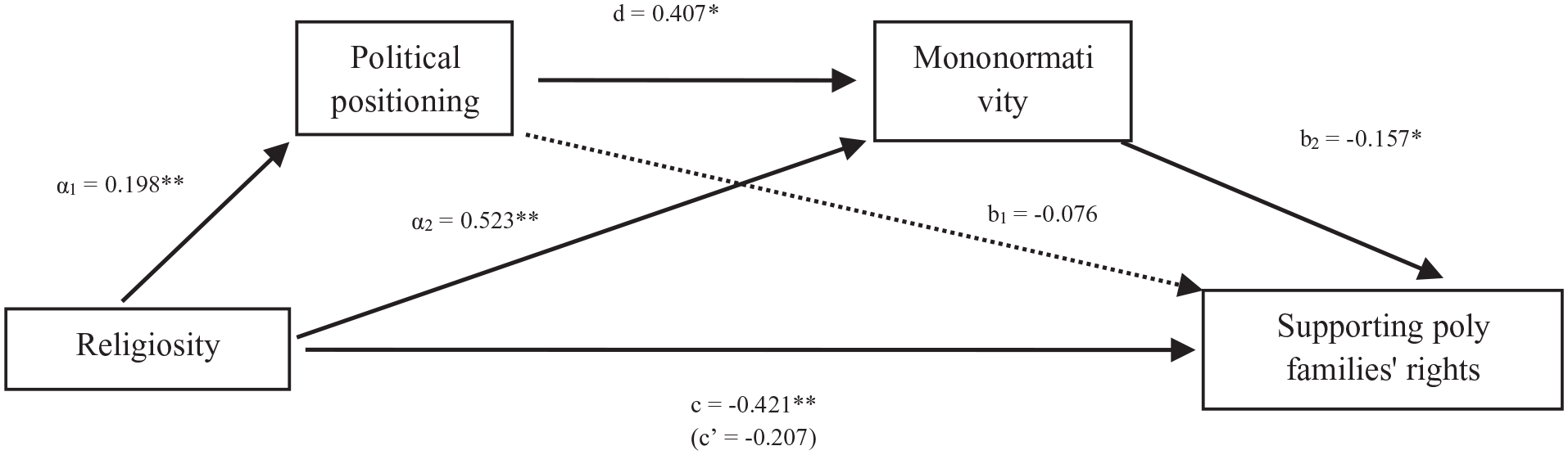
Serial multiple mediator model predicting attitudes towards poly families from religiosity, political positioning and mononormativity (Study 2). Dashed line represents a non-significant path in the model.
General discussion
In light of the discussion concerning the expansion of poly families’ rights (Klesse, 2019), the current exploratory study examined the motivational underpinnings of opposition to poly families. The legitimacy of prejudice towards poly families has been increasingly contested in recent years, but it remains strong in certain institutions (e.g., religious institutions) and ideological systems (i.e., conservatism; Muise et al., 2019; Pallotta-Chiarolli, 2020; Pallotta-Chiarolli et al., 2020). This study provides evidence of how religiosity, conservatism and mononormativity may relate to negative attitudes and enacted opposition to poly families and their rights. In two correlational studies, we showed (a) that there is a direct link between religiosity and opposition to poly families, but also that the impact is mediated by conservative ideology and mononormativity, and (b) that religiosity might increase opposition to supporting poly families’ rights through political conservatism and mononormativity. According to the theories of social identification and self-categorization (Tajfel & Turner, 1986; Turner, 1987), religiosity may influence people’s opposition to poly families due to ingroup bias. In other words, if religious persons self-identify and self-categorize as monogamous, their opposition to poly families may reflect their hostility to members of an outgroup. This study’s findings also show that individuals who adopt more traditional and conservative values and beliefs would be more likely to oppose poly families’ rights. Notably, the current exploratory study provided evidence that in addition to endorsing opposition towards poly families, the behavioural expression of the opposition reflected the enacted intolerance of poly families’ rights and participants’ motivation to ensure monogamy practices. This set of results can be explained based on the logic that conservative individuals are motivated to preserve the status quo and to oppose poly families and their rights because they represent a deviation from the norm (Cardoso, 2014). These findings coincide with previous studies reporting that individuals who adopt more conservative values and beliefs tend to oppose stigmatized groups’ rights (e.g., sexual and gender minorities’ rights; van der Toorn et al., 2017; Williams, 2018). Hence, opposition to poly families may be motivated by the need to preserve social norms and resist change and may lead to their discrimination as in this study, the behavioural expression of opposition represents a specific type of discriminatory practice resulting from opposition towards this group. Overall, the more religious participants endorsed ideas based on conservative and mononormativity principles, the more they expressed attitudinal and behavioural opposition towards poly families. However, it should be noted that religious opposition to poly families could also stem from other sources, such as sexual prejudice.
Additionally, the current study cannot demonstrate whether religion directly explains opposition to poly families or whether such opposition was a component of religiosity in the first place. In either scenario, their association provides a theoretical perspective emphasizing religiosity’s critical role in fostering opposition towards poly families. As Agler and De Boeck (2017) argue, human behaviour and psychology emerge from complex and dynamic systemic interactions that are impossible to understand fully. Researchers decide which perspective to take. Accordingly, any statistical judgement will inevitably entail subjectivity (Agler & De Boeck, 2017).
Theoretical implications
This exploratory study has significant implications for the study of conservatism and its connection to poly families. According to earlier studies, conservatism is linked to maintaining social norms that support traditional values (Jost et al., 2003). This study’s results are consistent with previous findings demonstrating the relationships between religiosity, political conservatism and prejudice (Pacilli et al., 2011; van der Toorn et al., 2017). Notably, our results contribute to this theoretical field by suggesting that political attitudes could be related to mononormativity and that this relationship may be sensitive among more religious participants. In addition, our results show that behavioural/enacted expression of opposition towards poly families can stem from ideological manifestations of monogamy. Thus, in this exploratory study, we extend the literature focusing on the association between religiosity, conservative political ideology, mononormativity and behavioural expressions of negative stigma (enacted stigma; Herek, 2007). To the researcher’s knowledge, there is limited research concerning the role of mononormativity in attitudinal and behavioural opposition to poly families.
To sum up, more religious participants who support the conservative political ideology and the maintenance of monogamy are more likely to oppose poly families’ rights. This research also contributes to the discussions about the inherently conservative tendency to justify the status quo, even if this means the legalization of social inequalities (Costa-Lopes et al., 2013). More specifically, this study provides evidence that negative attitudes and enacted opposition towards poly families may stem from internalized religious and political principles and monogamous sociocultural norms and accepting them as part of one’s value system. Thus, Greece’s religious, political and sociocultural ideological systems might legitimize prejudice and promote discrimination against poly families through individual internalization of prejudice. Accordingly, we suggest that one method to promote beliefs and ideologies that counteract the stigma-justifying mechanisms connected with religiosity, conservative political ideology and mononormativity is the humanitarianism/egalitarianism belief system that supports the equal worth and value of all people (Crandall, 2000; Katz & Hass, 1988).
This study also examines the endorsement of religious and political beliefs that justify prejudice in a new socio-political context. By providing evidence concerning the critical role of system-justifying ideologies, this research proposes that without considering sociocultural manifestations of negativity towards certain stigmatized groups, it would be difficult to understand the prevalence of discrimination (Bertrand & Duflo, 2017). Overall, in this research, we elucidate the role of system-justifying beliefs (i.e., religiosity, conservative political ideology and mononormativity) in shaping the moral standards and beliefs through which to view the world (Crandall, 2000) and show the processes through which these ideological systems promote attitudinal and behavioural expressions of negative stigma (enacted stigma; Herek, 2007). This exploratory study shows the critical influence of system-justifying ideological manifestations in prejudice towards poly families. More specifically, religiosity, conservative political ideology and monogamy beliefs may serve as powerful purveyors of prejudice and, in turn, enacted opposition towards poly families because they provide the necessary justifications for devaluing this particular stigmatized group.
Limitations
This study’s cross-sectional correlational findings do not support a causal conclusion. It should also be acknowledged that the results of Study 2 are underpowered. In addition, the current study was not pre-registered. Another limitation of this study is that it used a convenience sample, which may limit the generalizability of this study’s findings. In particular, this study’s sample was relatively homogenous, comprising mainly undergraduate students, whose attitudes certainly do not represent the larger Greek population. Considering that attitudes about sexuality may differ depending on participants’ age and sexual experience, future studies may use more diverse samples. Respondents may also be particularly interested in this subject (i.e., self-selection bias). Thus, greater socio-demographic variability and examining the impact of social desirability on participants may extend our knowledge. The fact that political positioning was measured with a single item is another weakness of this study. Moreover, the ordering we suggest is conceptually supported by psychological theory and research. However, we cannot completely rule out the idea that mononormativity may also be driven by sexual discrimination and that these factors could mediate the effect of religiosity on opposition to poly families. Our statistical judgements inevitably entailed subjectivity. Nevertheless, it is beneficial to acknowledge that various perspectives are pertinent to any statistical discussion and not deny that researchers only see a portion of reality (see Agler & De Boeck, 2017). Despite the aforementioned limitations, the current study advances our knowledge since it elucidates why polyamorous relationships tend to be considered morally inappropriate.