



Abstract
This article is a tribute to the brilliance and enduring influence of Luis C. Moll, whose scholarship and mentorship transformed how educators understand learning in diverse communities. Building on his visionary Funds of Knowledge framework, we foreground families’ cultural, linguistic and labor-based expertise as essential foundations for curriculum, pedagogy and teacher preparation. Inspired by Moll’s humanizing ethos and commitment to equity, we describe the CREATE model, an early childhood teacher education initiative that engages preservice teachers in community-centered inquiry (e.g., home literacy visits, photobook projects and literacy walks). These experiences cultivate asset-based orientations, critical interculturality and culturally sustaining literacy practices. In honoring Moll’s legacy, we argue that teacher education grounded in Funds of Knowledge not only disrupts deficit narratives but also advances just, relational and intellectually rigorous learning environments for multilingual children and their families. His work continues to guide us towards education that recognizes, dignifies and expands community brilliance.
Finding effective ways to prepare teachers to support language and literacy learning for multilingual learners (MLs) is a critical challenge for educational researchers and a necessary step in closing opportunity gaps and reducing educational inequities for these students. Research shows that schools are failing MLs with multiple potential causes of this failure, including (a) the need to enhance the preparation of teachers to work with MLs, (b) the paucity of effective curriculum that values their cultural and linguistic resources, and (c) denial or only toleration of their linguistic strengths via deficit-oriented language ideologies (National Assessment of Educational Progress, 2019).
Undeniably, MLs are among the most vulnerable to inequities in education and often need comprehensive and specialized programming to support their socioemotional, psychological and physiological needs as they build language and literacy skills in English and advance content knowledge. The cultural and linguistic assets of MLs have also been marginalized in curriculum and instructional practices. The ‘English-only’ legislation in 31 states in the US, which leads to the widely adopted English-only approach, subtractive bilingualism and lack of culturally responsive teaching practices, often results in MLs feeling undervalued or discounted from school (Paris & Alim, 2017), struggling to acquire the target language and to maintain their heritage language and cultural identity (García & Kleifgen, 2018). In addition, it is well documented that MLs have experienced educational inequities that limit their access to learning opportunities and academic success. These inequities include inadequate funding for schools serving immigrant and refugee students, a lack of high-quality educational programs, teachers and resources, and insufficient professional training and support for teachers (Gándara & Escamilla, 2017).
Moreover, recent executive orders (EO) allow immigration agents to enter schools and workplaces, violating previously held assumptions regarding safety, equity and well-being in schools and wreaking terror in immigrant communities across the US (Boggs, 2025; Gándara & Ee, 2022; Rodriguez et al., 2025). The preparedness of teachers to address the concerns of immigrants is essential, especially given research suggesting that anti-immigrant hostility is detrimental to all students, regardless of immigration status (Ee & Gándara, 2020).
In view of these challenges, educators and researchers have recognized the need to address the issues preventing MLs from educational opportunities and, concomitantly, have indicated that special efforts are needed to engage networks of multiple stakeholders in supporting MLs’ safety, growth and academic success (Da Silva Iddings & Warrich, 2024; Kanno & Kangas, 2023; Weddle et al., 2024). Further, educators and researchers have highlighted a need for teacher preparation programs focusing on MLs’ language and literacy development, culturally responsive pedagogical practices and tools and strategies to promote academic achievement for these students.
This article highlights an example of a teacher education model, the Community as Resources in Early Childhood Teacher Education (CREATE), at the University of Arizona, with a basis on Funds of Knowledge (González et al., 2005; Moll, 1992) as a foundational principle to help teacher candidates better understand and effectively engage the strategic ways that MLs use language and literacy in their homes and communities as a tool for inquiry and thinking, and for reflecting on their learning with new topics, activities and questions. Through the application of this proposed framework in the CREATE program, those preparing to be early childhood teachers and to work with immigrant children and families in educational settings engaged in experiential curricular activities designed to challenge the status quo that promotes a deficit view of these populations.
In broad strokes, the CREATE program aimed to develop new understandings with the potential to provoke a paradigmatic change for the teacher candidates in how language and literacy curricula and instruction can be approached and implemented to support MLs. To achieve this aim, the concepts of Critical Interculturality and Funds of Knowledge (González et al., 2005) offered a valuable foundation for designing teacher education programs that can better address the educational needs and empowerment of culturally and linguistically diverse immigrant students and their families and communities.
Complexifying the concept of culture and understanding critical interculturality
The concept of critical interculturality challenges superficial understandings of cultural exchange that merely promote coexistence without addressing underlying power imbalances. Unlike functional interculturalism, which tends to celebrate diversity within existing hierarchies, critical interculturality exposes and resists the colonial, racial and structural inequalities embedded in society. It draws from decolonial perspectives (e.g., Santos, 2018; Walsh, 2010) that reject the dominance of Western epistemologies and highlight the epistemicide of indigenous and marginalized ways of knowing.
In teacher education, embracing critical interculturality means going beyond the tokenistic inclusion of cultural practices. Instead, it involves reconfiguring the curriculum to acknowledge and draw upon the lived experiences and cultural knowledge of historically oppressed groups. This approach aligns with the Funds of Knowledge framework (González et al., 2005), which positions communities' knowledge, practices and values as integral to learning. By doing so, teacher preparation programs can foster reflective, anti-racist pedagogies that actively disrupt deficit perspectives and promote equity. Ultimately, critical interculturality calls for a kind of education that is deeply relational, situated in community and committed to epistemic justice. It reframes culture not as a collection of static traits but as dynamic, historically and politically situated interactions, essential for preparing teachers to work ethically and effectively with multilingual, immigrant and marginalized learners.
Funds of Knowledge
For the CREATE program, we based our work on the concept of Funds of Knowledge (González et al., 2005), which leverages the historical and cultural knowledge that was part of immigrant families’ lived experiences to appropriately use that knowledge in innovative teaching. Funds of Knowledge research has advanced a Vygotskian perspective and sociocultural orientation in education (Vygotsky, 1997), seeking to build strategically on the experiences, resources and knowledge of families and communities, especially those from low-income neighborhoods (e.g., Hogg, 2011). From this point of view, the social history of families and their productive or labor activities is particularly relevant to education because they reveal experiences that generate much of the knowledge household and community members may possess, display, elaborate or share with others. The relevance of such labour activities has been well documented in the primary as well as the secondary sectors of the economy. In addition, it’s noted that family Funds of Knowledge can serve as a kind of social capital, since it may develop through participation in social networks, often with kin, through which knowledge may be exchanged in addressing life’s necessities.
With respect to teacher education, researchers committed to a Funds of Knowledge perspective (e.g., da Silva Iddings, 2017; González, 2016; Reyes et al., 2017) found that teachers who learned about their students' family contexts were better prepared to know each student as a whole person who is continuously and actively engaged in multiple spheres of knowledge and relationships. Early on, Moll and González (1994) pointed out that linguistic-minority children use language and literacy in strategic ways in homes and communities to learn and communicate. They argued that ‘these children (and their communities) contain ample resources, which we term “funds of knowledge,” that can form the bases for an education that addresses broad social, academic and intellectual issues rather than simply learning basic, rudimentary skills’ (p. 441). Clearly, by participating in daily life activities, linguistically diverse families and their children use not only printed text but also oral and visual forms of text, including images, graphics, sign language, gestures, drama and a whole array of language and literacy activities (Gillanders & Jimenez, 2004; Hammerberg, 2004; Hartle-Schutte, 1993; Rodriguez, 2006). Through these activities, they not only develop their literacy abilities but also accumulate various forms of knowledge (e.g., numerical, digital, multimodal) that become essential to their functioning and survival.
Research on teacher education for MLs
The CREATE project entailed the redesign of a teacher education program, and to do so, we considered extensive research conducted on the efficacy of various forms of teacher learning. Guskey (2002) highlights three aspects of teacher learning programs: (a) change is gradual; (b) change is a process; and (c) change can be challenging. A program’s structure and process must include a mechanism (e.g., coaching and collaboration) to support teachers so they can successfully engage in the challenges presented throughout the change process and consider how the professional learning program may offer a positive alternative to current practice. Professionals must be provided with supportive experience that will foster their acquisition of the skills necessary to further develop their practice. Finally, teacher candidates must be provided with continued follow-up support and be accountable for implementation.
In combination, the research highlights the need for teacher candidates to receive competent, respectful, thoughtful support from engaged colleagues (e.g., a coach or collaborators) who can recognize and share the complexity of the interconnections between multiple stakeholders who support each multilingual (Viesca et al., 2019). This research review also concluded that intensive teacher learning programs, emphasizing ‘learning by improving doing’, can produce better teacher knowledge, beliefs and practices in comparison to programs that emphasize only knowledge and beliefs. Further, Desimone et al. (2002) emphasize the importance of long-term engagements that involve outside experts and school districts. In addition, the extant research underscores the urgency of preparing teachers to better support MLs’ language and literacy development and emphasizes the complexity of developing highly effective pedagogies and curricula that leverage MLs’ cultural and linguistic assets.
With that in mind, in this article we bring forth an overview of the work we (the authors) have engaged in with colleagues at the University of Arizona for the past several years (Clift et al., 2011–16) to comprehensively reform our early childhood teacher preparation program (CREATE) and to engage in an iterative and ongoing research project that focused on the following two questions: How do we prepare teachers to best support the education of culturally and linguistically diverse students? And how do we address the unique challenges facing immigrant and refugee students and families whose first language is not English as they come upon the institutional contexts of schools? In the next few paragraphs, we provide some background regarding the geopolitical landscape that has motivated this work, as well as illustrations of our research project.
Background
The Arizona context
Providing adequate education for culturally and linguistically diverse students — and for immigrant students in particular — in the state of Arizona has its specific challenges. The state’s strict borderlands politics, the militarized police at the border zone and other tactics of silencing and oppression reinforced within public spheres and institutions (e.g., English-only policies, racialized policies of control and the constant threat of deportation) have greatly impacted the lives of immigrant families and children.
Given such contentious and inhospitable sites of contact between human lives and institutional contexts (i.e., the Arizona/Nogales border areas), children and families live with the fear of being separated by detention, deportation or death. Unfortunately, this fear is grounded in a political reality that is not only found in Arizona but has become widespread throughout the United States, especially in the wake of the recent US government restrictions on immigration and the ramped-up anti-immigrant public sentiments.
In the CREATE program, by prioritizing a Funds of Knowledge framework, we set out to reconceptualize our early childhood teacher education programme to better prepare educators to recognize, value and draw upon the cultural wealth and knowledge of the communities they serve.
The CREATE program
The CREATE Research Team approached the comprehensive re-design of the early childhood teacher preparation program through the articulation, application and reiterations of four key principles: (a) Funds of Knowledge within diverse cultural communities; (b) story as a meaning-making process to understand self and world; (c) family literacies for literacy learning; (d) professional learning opportunities for educators across community, school and university settings.
We crafted a series of field experiences and course engagements where our teacher candidates could enter as they developed consistent relationships with families, teachers and other community members across different learning contexts. The teacher candidates documented and reflected on these experiences, and these were then debriefed with professors and mentors. More specifically, through these field experiences, the teacher candidates closely explored how individual, community and institutional interactions can and do impact the educational development of young MLs. Generally, the activities that we designed to prepare teachers through the course of the program have emphasized issues of linguistic and cultural diversity as an integral part of the curriculum. In all respects, these activities were deliberately meant to challenge: narrow conceptions of language, literacy and stories; bounded or contained views of learning contexts; hegemonic cultural and linguistic norms; matters regarding US language and educational policies and power; issues of voice and silencing; quantitative and static views of ‘resources’; and the limited attention to the agency, identities and strategic actions of immigrant MLs and their families as they traverse home, community and institutional contexts.
Curriculum considerations
We intended that our new curriculum would reinforce our commitment to knowledge of and engagement in community and family relationships that extended beyond knowing that or knowing about who to knowing with, focusing on actual relational knowledge. In addition, our focus on language and literacy through stories would allow us to illuminate historical local knowledge comparatively, through different variants of cultural practices coming into contact. So cultural Funds of Knowledge were not conceived as monolithic but instead as developed relationally by culture-to-culture contact and in the context of actual relationships, in their lived affective, cognitive, embodied and cultural dimensions.
We began this work by generating a wish list, or a set of desirable design features that we believed would be particularly relevant to guiding our work towards the broader vision for the program (Jurich et al., 2017). These features were:
a design-based research approach to curriculum;
a problem-posing approach situated in local knowledge and contextualized in the local communities;
an understanding of families’ and communities’ Funds of Knowledge;
a participatory and action-based approach to community engagement;
integrated experiences that involved multiple stakeholders;
the creation of places and spaces for community integration;
long-term engagement in the various partnering sites and communities;
emphasis on language and literacy;
sustainability plan.
These features helped develop a program model to represent our vision and the application of the CREATE principles as described earlier in this article. The program model makes evident the ways these principles permeated our work with the different stakeholders, keeping the commitment to community development at the core of our work in teacher education (see Figure 1).
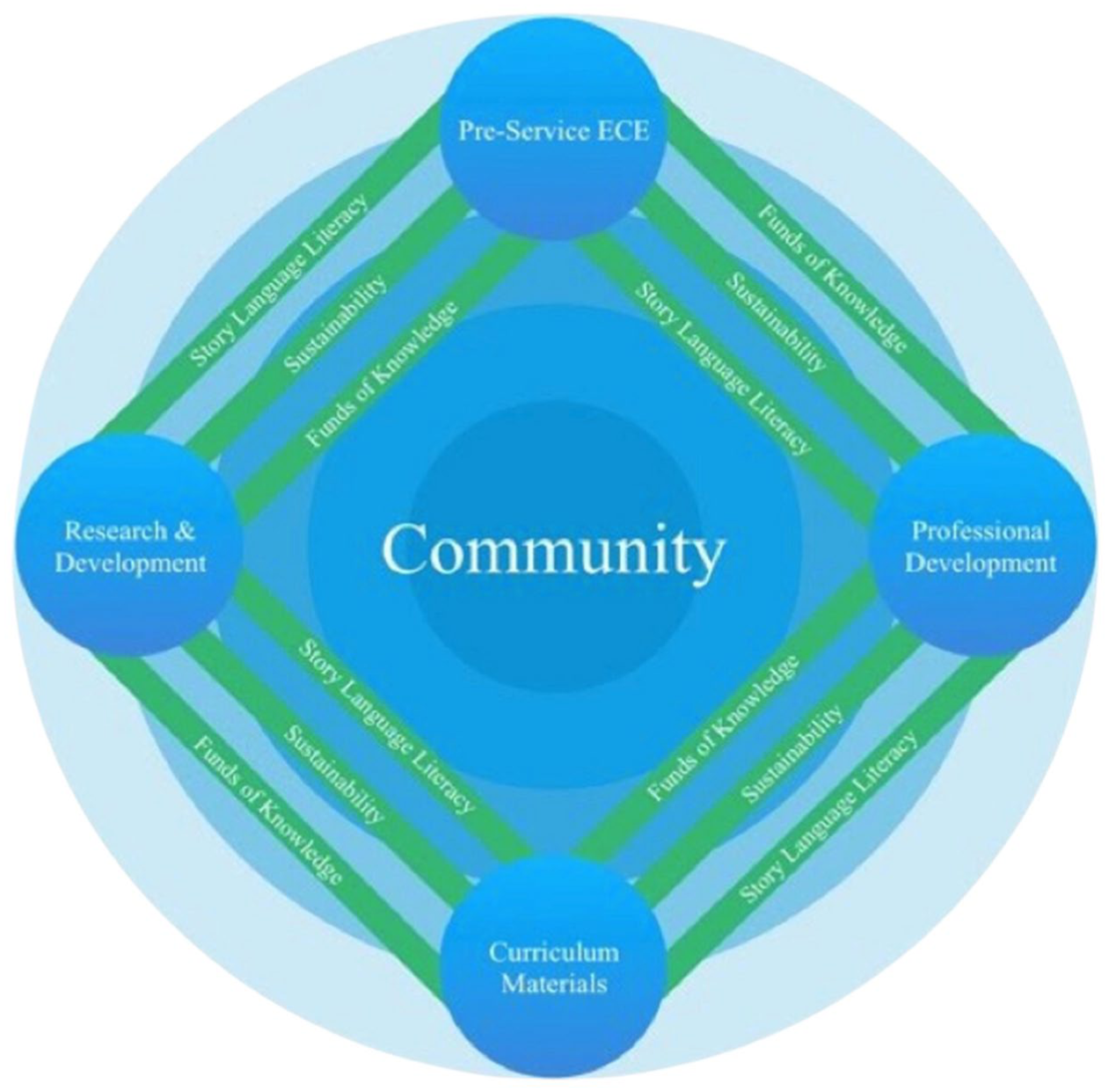
CREATE program model.
In addition to the curriculum work, we were able to forge stronger connections and relationships with our partnering sites, families and communities by providing opportunities for the creation of new forms of literacy circulations. As a result, our prospective teachers developed strong conceptual understandings of Funds of Knowledge, family literacies and story, as reflected in their coursework assessments, end-of-the-year interviews and discourse around their experiences in our program.
A design-based research methodology
While simultaneously engaging in a comprehensive curricular reform in our early childhood teacher preparation program, the CREATE team utilized a design-based research methodology to study the impact of the CREATE program on teacher candidates’ language orientation and perspectives towards immigrant students and families (Reyes & DaSilva Iddings, 2016).
According to Cobb et al. (2003), there are five features central to the methodology of design-based research:
(1) It aims to derive theories relating to the process of learning as well as how this process is supported.
(2) It relies upon intervention to bring about new forms of learning to study them.
(3) Two complementary faces: prospective and reflective. Prospectively, hypotheses are created about a specific form of learning and the means of supporting it. Reflectively, these conjectures are implemented, exposed to scrutiny, accepted or refuted.
(4) Repeated cycles of hypothesis creation and analysis.
(5) Reliance on theory: the work done within this paradigm tends to focus on the direct application of seemingly abstract theoretical concepts onto a specific context. In other words, the theories employed within the experiment are useful to impel not only thinking but also practice.
Using this research model to study the CREATE model of teacher education involved empirical investigations conducted in naturalistic contexts such as university classrooms, schools, community settings and households. These investigations offered the research team and practitioners the opportunity to generate evidence-based claims about the teacher candidates’ learning and to produce curricular interventions that could be readily usable (see Figure 2).
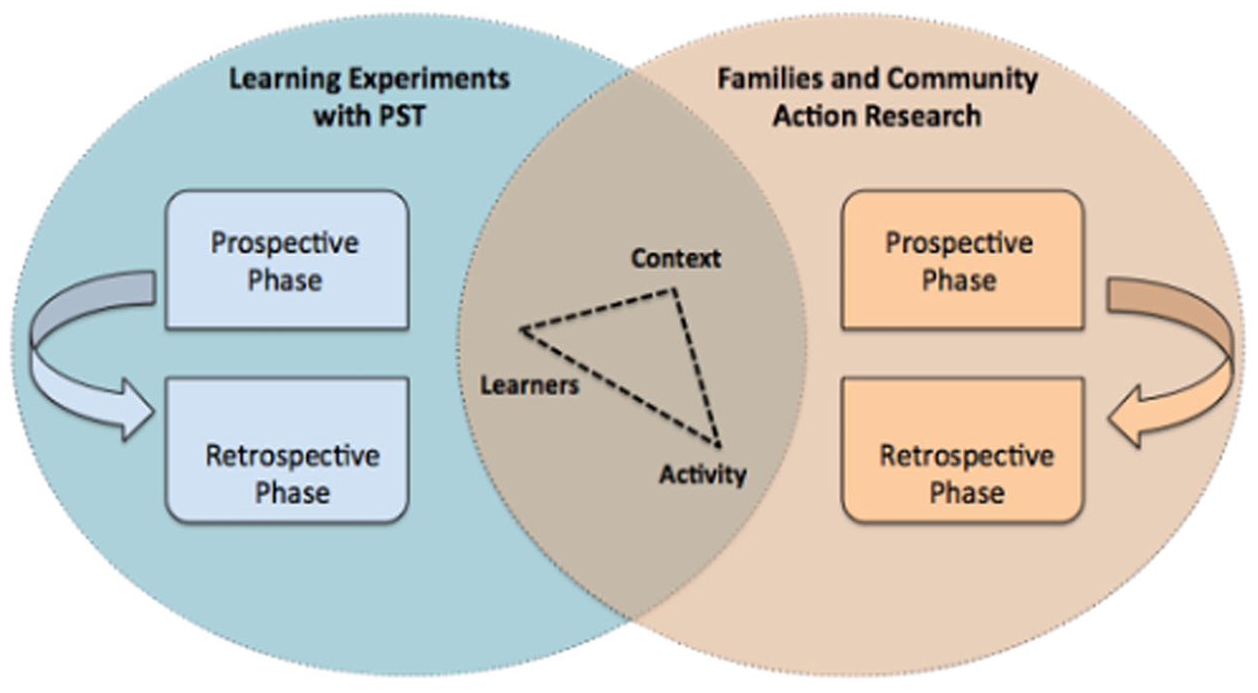
The CREATE research model.
More specifically, the design-based research provided the CREATE research team with ways to document and analyse iterative cycles of design and the redesign of our teacher preparation program. We utilized observations, reflections, recorded debriefing sessions, individual interviews and focus group interview transcripts as data sets, and the analysis was ongoing.
In the following paragraphs, we offer two examples of our studies into programmatic activities that were designed to promote the building of bridges between the university, homes and community contexts and develop language and literacy for ML children: the photobook project and the community literacy walk.
The photobook project
Photography has emerged as a significant methodological and pedagogical tool in early childhood education and research, particularly for accessing and representing young children’s perspectives. A growing body of critical scholarship highlights the affordances of photography in capturing children’s lived experiences and in facilitating multilingual and multimodal literacy practices (DeMarie and Ethridge, 2006; Barker & Smith, 2012; Butler et al., 2017; Schiller & Tillett, 2004; Templeton, 2018; Zapata, 2013). Photography offers unique flexibility and agency, enabling participants, especially young children, to revisit and reframe past spaces, events and emotions beyond the immediately observable, thus enriching qualitative inquiry. Taken together, these studies demonstrate how photography can challenge traditional, text-centric notions of literacy. Moreover, the integration of photographic methods foregrounds the affective and emotional dimensions of children’s literacies, offering insights into their cultural practices and communicative resources. In addition, the use of photography as a tool for inquiry underscores the importance of recognizing young children not merely as subjects of research but as agentive meaning-makers within their socio-cultural and linguistic worlds.
To closely understand the pedagogical implications for the relationships between photography and language and literacy development for ML children, we set out to examine how the teacher candidates enrolled in CREATE worked with kindergarteners and first-graders (approximately 5–6 years old) and their respective bi-/multilingual, immigrant families to collaboratively create digital picture books using the language experience approach (LEA).
In this project, a strong emphasis was placed on learning about the families’ home language and literacy practices and the children’s lived experiences through children’s photographs and the collaborative authoring (children and teacher candidate) of digital picture books. This study was guided by the concept of Funds of Knowledge and expertise that students and their family members have because of their various roles within their families, communities and culture (González et al., 2005). Guided by this approach, a key component of this study was the integral role of home engagements, wherein teacher candidates visited children and their families in their homes and community spaces, to learn about their lives and to build relationships of confianza (trust). This practice differs from general educational family visits, since the intention is to seek an understanding of family practices and values, from an assets-based perspective, to inform classroom instruction (Romero & Reyes, 2022).
The teacher candidates participating in this study were enrolled in a course on emergent literacy in which they learned about developing literacy instruction based on children’s Funds of Knowledge. Each preservice teacher was matched with an emerging bi-/multilingual child. The preservice teachers created a personal literacy memoir picture book (before the first visit) based upon their own Funds of Knowledge to share with the children and families. During the first engagement, the preservice teachers shared their stories, introduced the digital camera to the children and their families and conducted Funds of Knowledge interviews. In the following home engagements, the children shared the photographs that they took with the preservice teachers. During these audio-recorded, photo-elicited interviews, the children narrated their memories, emotions, feelings and stories about each chosen photograph (children could only select 20 photographs for the final picture book). These processes afforded the children opportunities to engage as agentive participants as they took pictures on their own and shared their feelings and thoughts about each photograph (see Figure 3).
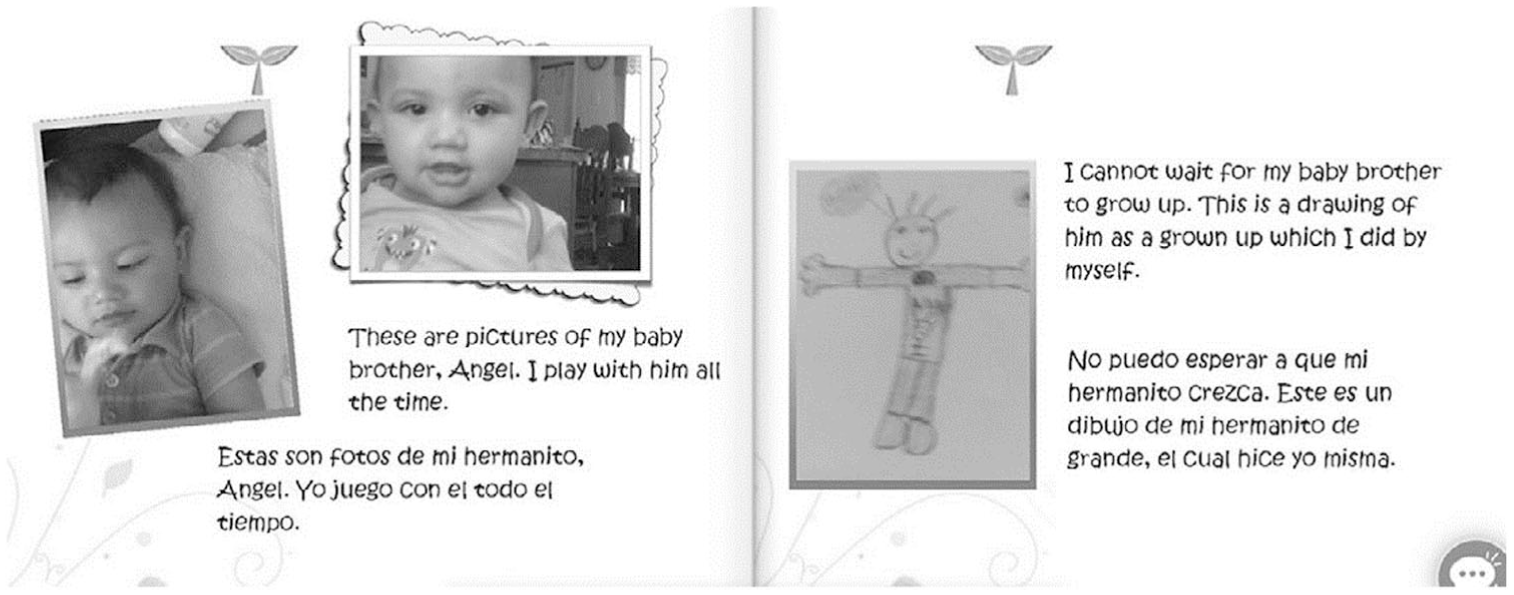
Selected pages from a child’s picture book.
The conversations, mediated by the photos and the photo-taking processes, provided opportunities for the preservice teachers to gain a sense of the children’s affective narratives and to participate in emotional and affective exchanges with the children. These dialogues were produced bi-/multilingually and were transcribed by the preservice teachers, either on their own or with the assistance of bilingual preservice teachers/community partners/instructors. Based on the photo-elicited interviews, the teacher candidates constructed the picture books for the children, including the images and dictations. The preservice teachers then developed and implemented read-aloud lessons connected to the completed picture books. Regarding this experience, the teacher candidates often reported how excited the children were in telling their own stories and how much they learned from the children on those occasions, as one of the teacher candidates reflected:
I learned that while he was getting a lot of practice with writing mechanics through copying, I noticed that he did not get many chances to write about something he cares about or to tell his own stories. I think that this may have caused somewhat of a lack of enthusiasm, which spurred me to really put the story we created for the guided reading book in his hands. He was extremely excited to be able to come up with the story for our book and had a ton of ideas. So, my observations were really useful in finding out ways to get him excited about the book. (Amalia)
Community literacy walks: observation, inquiry and the everyday literacies of children
Literacy exists beyond the classroom, and it is part of children’s daily lives — it thrives in murals, street signs, flyers, menus and handwritten notes posted in the windows of local shops. The community literacy walk, as designed by the CREATE team, invited preservice teachers to step into the lived worlds of their students and explore the rich, everyday literacy environments that often go unnoticed in traditional educational settings. These walks were meant to cultivate deep observational skills, critical inquiry and a more grounded understanding of how children engage with language and meaning beyond the school walls.
The conceptual foundation of the community literacy walk draws on the literacy frameworks developed by Marjorie Faulstich Orellana (1999, Orellana & Hernández, 1999) and the ethnographic approach to literacy observation detailed in Kidwatching (Goodman & Owocki, 2002). Together, these frameworks shift the lens of literacy from school-bound definitions of reading and writing to more expansive, socially situated practices that reflect the lived experiences of children (Reyes, 2012).
Orellana’s (1999) research positions literacy as something deeply embedded in children’s everyday lives, particularly within multilingual, immigrant and working-class communities. In her work, she documents how children navigate complex literacy tasks such as translating for adults, interpreting signage or managing household responsibilities. These activities may not be recognized within traditional schooling, but they demonstrate sophisticated literacy competencies. Through this lens, the literacy walk becomes a tool for uncovering these often invisible practices. Preservice teachers are encouraged to look beyond textbooks and worksheets and instead pay attention to how children use literacy to function, communicate and contribute within their families and neighborhoods.
For example, during their walks, teacher candidates may observe a student reading product labels to help a parent shop, interpreting a bus route or reading and discussing posters from a community health center. These activities embody what Orellana calls ‘everyday literacies’, reflecting children’s agency, bilingual negotiation and participation in community life. Recognizing these as valid and valuable forms of literacy challenges educators to broaden their definitions and pedagogical strategies.
Similarly, Kidwatching (Goodman & Owocki, 2002) provides a complementary framework that positions teachers as ethnographers of children’s literacy development. Rather than relying solely on standardized assessments, preservice teachers are taught to observe, document and interpret children’s literacy behaviors in natural contexts. The Kidwatching approach invites teachers to ask: What literacy practices is the child already using? How do these emerge across settings — home, school and community? What cues, resources or supports help shape these practices? These frameworks guided our project to identify the literacy Funds of Knowledge children engaged with during their walk to school in the mornings and back to school in the afternoon. Together with educators, preservice teachers, students and the CREATE graduate student team, we explored the literacy around the community and the meaning created together.
In our first guided walk around the Ochoa neighborhood (see Figure 4), we formed small groups to observe and document the ‘print environment’ that shapes children’s literacy experiences. What immediately stood out was the multilingual character of the community — signs in both English and Spanish, public murals with quotes and affirmations, and business storefronts using culturally familiar phrases. These observations led to meaningful conversations about linguistic landscapes and the assets that existed within the community (Romero & Reyes, 2022). Through this guided experience, preservice teachers began to see how language reflects identity, culture and community values.
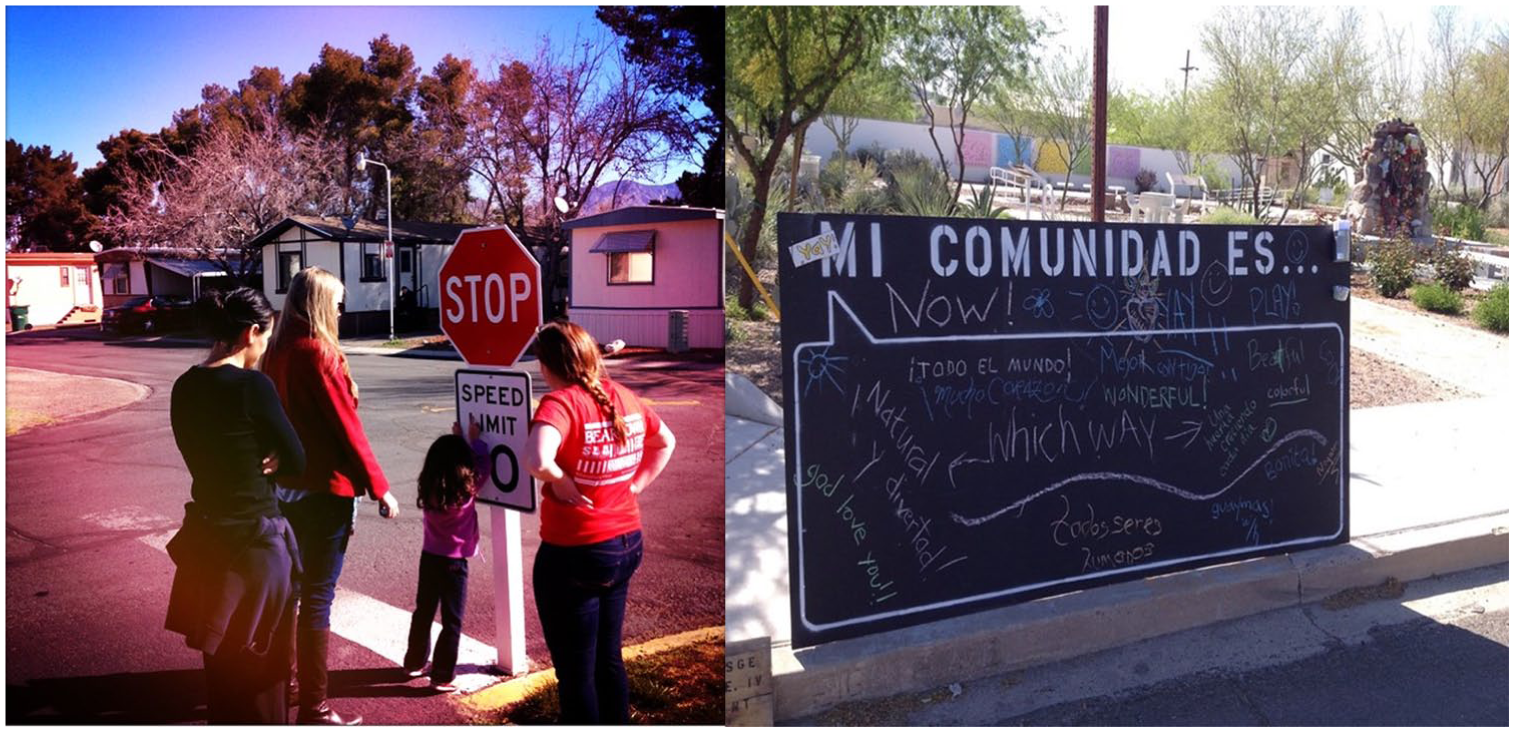
Community literacy walk and community signage.
As one of the preservice teachers wrote: ‘Although I have several connections to this community, I’ve never actually walked through it. It was fun, interesting and eye-opening. I saw the beauty of the community and even felt the desire to come back and take more photos and ask more questions. The literacy displayed is more than letters sitting together. They make up whole worlds.’
After preservice teachers had the opportunity to do the literacy walk with the UA class, they were able to conduct their literacy walks with their assigned case study student. The preservice teachers reported a noticeable shift in how they interpreted everyday print. One student teacher, for instance, documented that her student regularly visited a local corner store where the owner provided printed receipts with handwritten notes in Spanish, reminding parents of upcoming school events. Another observed how church bulletins, bilingual calendars on kitchen walls and fast-food menus shaped her students’ exposure to both functional and symbolic uses of print. These artefacts — often overlooked — reveal a broader picture of the child’s linguistic and cultural world. Insight that urban spaces are saturated with opportunities for literacy conversations.
What emerged across these reflections was a greater awareness of how home and community environments serve as sites of literacy learning. Instead of viewing literacy solely through school-centric lenses, preservice teachers began to recognize and value familial knowledge, oral storytelling and community print as foundational components of their students’ literacy development. For example, one preservice teacher noted how her student’s older sibling served as a literacy mentor, reading instructions from a bus schedule or helping fill out forms in English, effectively scaffolding learning in an authentic context.
This project and community experience also emphasized for pre-service teachers the importance of being ethnographers of children’s lives. By observing how print is accessed, used or even resisted in everyday routines, preservice teachers deepened their understanding of language development in a culturally sustaining way. They began to ask new questions: What messages are children absorbing from their surroundings? How do they navigate bilingual and multilingual spaces? What forms of literacy are validated at home vs. school?
The CREATE community literacy walk assignment thus became more than an exercise in observation. It became an act of pedagogical inquiry. It invited educators to see their students not through a deficit lens but through a strengths-based framework that acknowledges the rich literacies embedded in everyday life. By connecting literacy theory with direct community engagement, future educators were better equipped to create responsive, inclusive and empowering learning environments.
Some final thoughts
Writing this article for this Special Issue of Studies in Psychology focusing on the contributions of Luis Moll to the field of Education provided us with the opportunity to reflect on his intellectual legacy and his powerful impact on our (the authors’) academic development and scholarship, on our views about the field of education and, without exaggeration, also on the ways we approach life and learning in general.
As long-time colleagues and friends while working in the Department of Language, Reading, and Culture (LRC) at the University of Arizona, Luis instilled in us an interest in theories as applied to education. His book Vygotsky and Education: Instructional Implications and Applications of Sociohistorical Psychology (Moll, 1990) was truly revolutionary. In this volume, Vygotsky’s contributions to education became clear, engaged and contextualized in the very lives of children. In addition, his work in Tucson, Arizona, in partnership with Norma González (González et al., 2005), building on the seminal work on Funds of Knowledge put forth by Carlos Vélez-Ibáñez and James Greenberg (1992), was the first study to explore the educational potential of the Funds of Knowledge approach with the main goal to help teachers to design new forms of education based on the literacy practices and Funds of Knowledge of the documented households.
Thus, in a very strong sense, Luis’ work provided us with a window into the meaning and purpose of Vygotskian theory towards education, and even beyond that, allowed us to gain insight into the power of education towards humanizing individuals and communities, and gave us a methodology for how to disrupt the status quo and maintain a steadfast commitment to educational equity and social justice. Moreover, his work provided us with tools for understanding how theories, enacted in the everyday lives of teachers, students and community members, can and will provide new pathways forward, can and will allow for fundamentally new questions to be asked, and can and will bring about new possibilities.
Our development as scholars working to translate and extend the Funds of Knowledge framework has been a journey in every sense — intellectual, emotional and deeply personal. Luis was a close collaborator and friend who walked with us through every stage of the CREATE work. From early brainstorming sessions to community engagement strategies, he helped us stay focused on the heart of the work: recognizing and building upon the rich knowledge embedded in children’s homes and communities.
At every step, Luis was extraordinarily generous with his time and attention. He listened to us with genuine interest and care, offering not only academic advice but also moral support. Luis’s mentorship was never distant or detached. He brought humour, humility and a genuine sense of colegas to every conversation. Whether laughing over tamales at a community event or exchanging ideas over the latest ethnographic field notes, working with Luis was both intellectually invigorating and connected at a fundamental human level. His presence made us better scholars, and more importantly, better listeners and partners in the communities we serve.
We carry forward not only the framework of Funds of Knowledge but the spirit with which both Luis and Norma taught us to approach this work — with respect, critical inquiry and a deep belief in the brilliance of children and families. Luis’s legacy continues in every classroom partnership we engage with and at every moment a preservice teacher pauses to see their students’ world through a more expansive, culturally attuned lens.