



Abstract
This reflective and scholarly piece explores how hula embodies and activates Indigenous knowledge systems, serving as a vital site of resistance, resilience, cultural reclamation, language revitalization and education. The author traces her evolving engagement with the concept of Funds of Knowledge, first introduced during her university studies and later expanded and applied in educational settings focused on Indigenous language revitalization. This journey is further deepened through her participation in a roundtable discussion on dance ethnography, where hula emerged not just as a performative art but as a form of education that transmits generational knowledge, values and identity through an embodied practice. Centring Hawai‘i, the article highlights the centrality of ancestral and Indigenous knowledge in hula, illustrating how the cultural tradition and practice function as a vital vehicle for transmitting the Hawaiian language and reclaiming cultural identity. Through this lens, hula is examined as both a powerful pedagogical tool and a generative source of knowledge, essential to the documentation, preservation and revitalization of traditional practices, particularly in the context of historical colonization and ongoing occupation.
As a Kanaka Hawai‘i and Filipino academic scholar raised in a primarily monolingual yet multicultural home, hula (dance form of Hawaiʻi and the Hawaiian culture) has profoundly shaped my identity and worldview. Growing up in a small town where the sugar plantation employed many residents from diverse ethnic communities — including Filipino, Japanese, Chinese, Puerto Rican and Portuguese — I was immersed in an incredibly rich tapestry of cultural traditions. Despite the Hawaiian Renaissance and subsequent Hawaiian language revitalization movement, Hawaiian language was not the language of our home. While English and/or Pidgin (also known as Hawaiian Creole English) was the language of communication of my immediate family, Tagalog and Ilocano were languages primarily used between my father and his parents and grandparents. For my mother, who is a kumu hula (Hawaiian dance master), hula was the practice of our home that filled me with cultural knowledge, history, values and life lessons.
While I did not fully comprehend or embrace these teachings in my youth, attending Kamehameha Schools (Kapālama) as a boarder from middle to high school, coupled with my parents’ relocation to the continental U.S. when I began grade eight, prompted a deeper appreciation for my upbringing in the cultural practice of hula. In this reflective and scholarly article, I provide a retrospective of my journey engaging with the concept of Funds of Knowledge — from my initial introduction as a university student to its application in my teaching, particularly with students seeking to reclaim and revitalize their cultural and language traditions. I also share insights from a 2018 roundtable presentation on dance ethnography, where my peers, mentors and I discussed our individual engagements with Funds of Knowledge. Finally, I examine the traditional practice of hula, emphasizing the profound significance of ancestral Funds of Knowledge in Hawaiian culture and how hula serves as a vital vehicle for cultural revitalization and the embodiment of the Hawaiian language.
A retrospective of ancestral and Indigenous Funds of Knowledge
Post-secondary education in Arizona
My journey in post-secondary education at the University of Arizona led me to a destination I had not anticipated. After struggling academically — failing multiple courses, being placed on academic probation, changing my major several times — I enrolled in a course titled ‘Language’ during the summer before my third year. This course sparked an interest and shifted my major to linguistics the following semester.
Through my professors, specifically those who specialized in Indigenous languages, I realized that I could continue to learn about and of the Hawaiian language while living away from Hawai‘i and earn my degree simultaneously. In addition to linguistics courses, I enrolled in courses in the department of Language, Reading and Culture (LRC) in the College of Education. Through my partner, who earned his MA in LRC, I learned about the LRC faculty members, in particular Luis Moll and Richard Ruiz.
I pursued an MA in Native American Linguistics and later a PhD in LRC. Although I had not initially planned to transition to the field of education, LRC was a remarkably unique program that granted me the flexibility to combine my interests in applied linguistics, Indigenous language education and multimedia technology, while drawing upon Hawaiian epistemology and my cultural upbringing.
The experiences I gained from linguistics, education, the American Indian Language Development Institute (AILDI) and from my professors, peers and Indigenous Thinkers (a student club, see Galla & Holmes, 2020) at the University of Arizona helped me theorize Funds of Knowledge (Gonzalez et al., 2005) in relation to my early learning and formative cultural experiences. While I did not take courses with Luis Moll or Norma González, discussions both in and out of the classroom contributed to my understanding of Funds of Knowledge. LRC was a generative academic space that fostered diverse perspectives and critical dialogue among scholars (emerging and senior) committed to lifelong education and the promotion of linguistic human rights.
As one of a small number of Indigenous scholars in LRC, I came to recognize that the knowledge I had acquired through my mother’s teachings of hula — through observation, direct instruction and family participation in cultural events and gatherings — constituted a vital epistemological, ontological and axiological foundation. This embodied and experiential knowledge, rooted in Indigenous practice, became central to my development as a community member, scholar and educator. It affirmed that my cultural upbringing was not separate from but integral to my academic and pedagogical work. This realization shaped my contributions to Hawaiian and other Indigenous language revitalization efforts, particularly at the intersections of education, digital technology, cultural practices and the ongoing work of decolonizing and Indigenizing the academy. I continue to reflect on the profound impact of my time at the University of Arizona, LRC and AILDI, and remain deeply grateful for the intellectual and cultural grounding these experiences have provided.
Teaching in British Columbia
In my teaching at the University of British Columbia, I have intentionally integrated the concept of Funds of Knowledge to affirm and draw upon the lived experiences, cultural knowledges and community-centered practices (traditional and contemporary) that students — particularly Indigenous students — bring into academic spaces. In my teacher education course, I encourage future educators to recognize that Indigenous learners come to school — places that once stripped Indigenous children of their cultural identity, culture and language — with rich intellectual traditions, protocols and ways of knowing that are deeply rooted in their families, communities and Nations. Through Indigenous pedagogies, experiential learning, land-based learning, traditional cultural practices, storytelling and reflective assignments, students engage with the idea that relevant and meaningful education must begin with understanding and honoring what learners already know. This reframing not only disrupts deficit-based narratives but also equips educators to build more culturally sustaining and responsive pedagogies.
In my courses focused on Indigenous language education and language revitalization, I’ve introduced Funds of Knowledge as a way to emphasize that language is not learned in isolation but in relation to a People, community, land, culture and practice. Students explore how Indigenous languages are embedded in daily contemporary life, ceremonies, kinship networks and ecological knowledge. We examine how community-led revitalization efforts are sustained through intergenerational transmission, often outside formal schooling — through song, dance, creative expression, immersion camps and family-based learning. By centring these community-embedded practices, my courses validate the knowledge already held by Indigenous students and within their respective communities and challenges all students to see education as a reciprocal, place-based and relationship-driven process that exists outside the physical confines of the classroom walls.
Roundtable on dance ethnography and education
At the 2018 American Anthropological Association (AAA) Annual Meeting in San Jose, California, LRC faculty Perry Gilmore and Julio Cammarota organized a roundtable, ‘Dance as Resistance, Resilience and Adaptation: A “Funds of Knowledge” Approach to Dance Ethnography and Education’, that brought together dance practitioners and scholars with Luis Moll and his co-editor Cathy Amanti as discussants (see Figure 1). Our dance ethnography roundtable that included myself along with Theresa Arevgaq John (Yup’ik), Ojeya Cruz Banks (African American-Chamoru), Elizabeth Butler, and Julio Cammarota explored how embodied practices serve as vital repositories and transmitters of knowledge systems, including our family histories. In our individual presentations, we emphasized the language and cultural knowledge that individuals and communities possess and extended this framework to ancestral and Indigenous knowledge systems via embodied forms of cultural expression from Latina, Yup’ik, Hawaiian, African, African-American and Māori communities. Through these case studies from different thriving cultural communities, we demonstrated that dance is not merely entertainment, nor an aesthetic or performative act, but a complex system of knowledge transmission that is deeply rooted in ancestral practices and carried forward through generations.
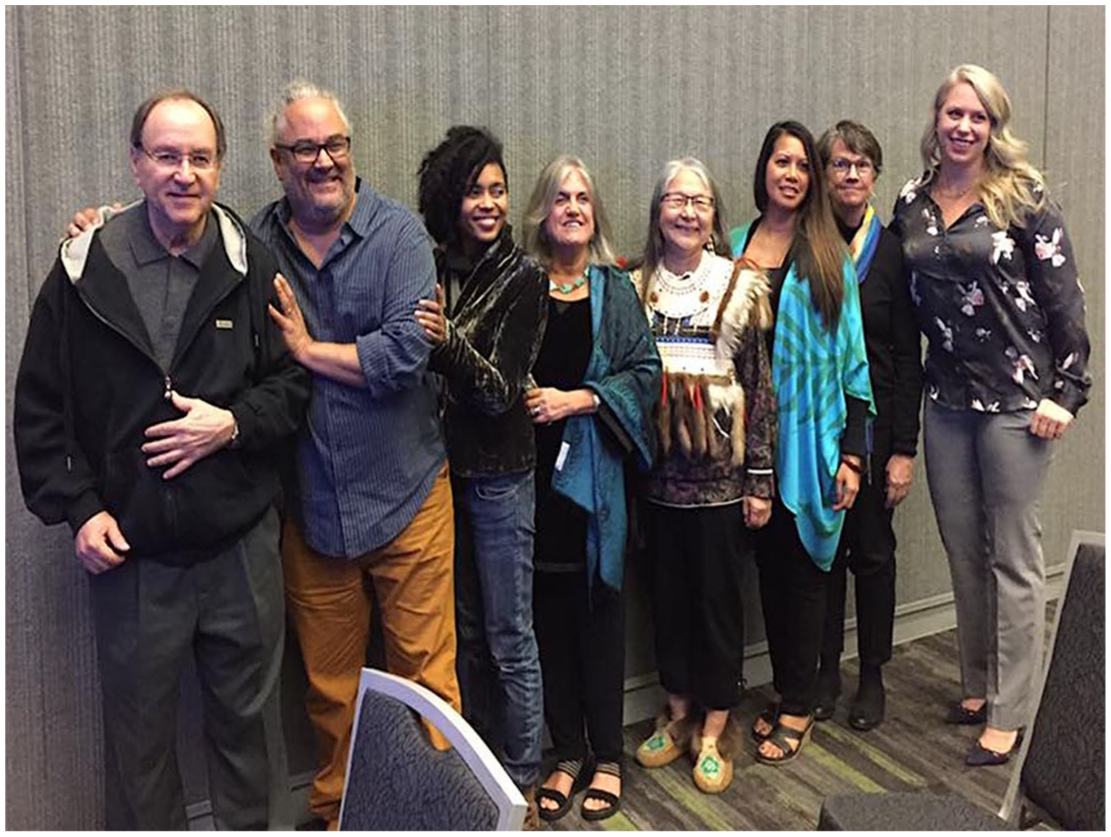
Roundtable participants (from left to right): Luis Moll, Julio Cammarota, Ojeya Cruz Banks, Perry Gilmore, Theresa Arevgaq John, Candace Galla, Cathy Amanti and Elizabeth Butler (photo credit: Ana Moll).
Collectively, our panel underscored the importance of recognizing embodied practices as valid, legitimate and sophisticated forms of knowledge and education, and which must not be overlooked in traditional academic settings. By doing so, we can better understand and appreciate the diverse ways of knowing, being and doing in which Indigenous communities sustain and transmit their cultural traditions and practices. The existence of these dance forms is a testament to the generations who have resisted colonial impositions and dominance. These dances and cultural expressions remain vibrant, relevant and dynamic, and are thriving examples of ancestral Funds of Knowledge that carry living histories, knowledges, stories of resilience, hope and imagined futures.
Following our individual presentations, I felt a deep sense of fulfillment knowing that we — as LRC alumni — were able to articulate how we are extending and applying the concept of Funds of Knowledge to our work and research in dance, especially in the presence of Luis and Cathy, two foundational scholars in this framework. It was especially meaningful to receive thoughtful insight which enriched the entire experience. Our goal was never to demonstrate uniformity or sameness but rather a celebration of our differences — a space where we could each bring our full, authentic selves to the work and in dance. I’ll always remember Luis’ remark in front of the audience, describing our roundtable as ‘one of the best’, which powerfully reaffirmed the relevance of Funds of Knowledge in our work and validated our efforts to apply this framework meaningfully within the context of dance ethnography.
Hula as an embodied language practice: a personal reflection
The AAA roundtable, the course offerings ‘Living Our Indigenous Languages Through Performative Arts’ at UBC and multiple invited keynote presentations have provided me with intellectual time, space and opportunities to reflect on how hula, as a cultural practice, has instilled valuable knowledge and teachings that may not be fully understood from within mainstream, dominant education. My experience with hula began before birth, as my mother, kumu hula and educator, instructed hundreds of students in the districts of Ka‘ū, Puna and Hilo. I often say that I acquired hula before I learned to crawl — an embodied practice that started even before I took my first breath in the contemporary world. Just a couple of years prior to my birth, Hawaiian became an official language of the occupied nation of Hawai‘i, alongside English in 1978. While I was raised during the revitalization movement, there were not equal opportunities across the islands for youth to be immersed in Hawaiian education or language. For myself, and many others, hula served as an entry point into learning about our Hawaiian culture and language (‘Ōlelo Hawai‘i).
Hula in popular media
The mention of hula, however, does not always conjure authentic images or memories that are true of Hawai‘i, its people, culture and traditions. In these examples of cinematic and animated works — Hula (1927) featuring Clara Bow, Waikiki Wedding (1937) with Bing Crosby and Martha Raye, Dance, Girl, Dance (1940) starring Lucille Ball, Bird of Paradise (1951) with Debra Paget, Blue Hawai‘i (1961) with Elvis Presley, Dirty Dancing (1987) featuring Patrick Swayze and Jennifer Grey, The Lion King (1994), Lilo & Stitch (2002), High School Musical 2 (2007) with Zac Efron, Vanessa Hudgens and Corbin Bleu, and Just Go With It (2011) starring Adam Sandler, Jennifer Aniston and Nicole Kidman — hula is at times prominently foregrounded and at other times incorporated more subtly as a background element. The portrayals of hula in these productions span a spectrum from authentic to deeply problematic. In some instances, Native Hawaiians are the performers of hula, or filmmakers have consulted with cultural practitioners to ensure respectful and accurate representation. However, many depictions rely on stereotypes that exoticize, romanticize, sexualize and ultimately misrepresent hula and Hawaiian culture. In these cases, actors often mimic hula without any understanding of its deep cultural and spiritual foundations, reducing a sacred tradition to mere entertainment, visual spectacle and accessory. These portrayals contribute to cultural appropriation and a distorted global understanding of hula, reinforcing harmful tropes while overshadowing the authentic voices and practices of Native Hawaiian communities.
A line from Disney’s The Lion King illustrates how hula is portrayed in popular media. In a scene where Simba, Nala, Timon and Pumbaa are strategizing how to sneak by a group of hyenas, Timon quips, ‘What do you want me to do — dress in drag and do the hula?’ 1 He then appears in a grass skirt, adorned with a lei and a flower behind his ear, singing and dancing to the tune of the ‘Hawaiian War Chant’. While framed as a comedic moment, the scene uses stereotypes as a punchline, reducing hula to a caricature and reinforcing insensitive portrayals and understanding of Hawaiian culture — all under the guise of humour — as Simba and Nala use the distraction to slip past unnoticed. If viewers do not critically engage with this line, they may uncritically internalize the assumption that men who dance hula are performing exaggerated femininity 2 (see Sen, 2011). As the late Native Hawaiian scholar and activist Trask (1999) stated, ‘the sacredness of the dance has completely evaporated, while the athleticism and sexual expression have been packaged like ornaments. The purpose is entertainment for profit’ (p. 144), a process that continues to exploit, commodify, sexualize and diminish Hawaiian cultural traditions — transforming them into something ‘ornamental, a form of exotica for the gaping tourist’ (p. 17), and in doing so, ‘render[ing] Hawaiian bodies into hypervisible commodities’ (Imada, 2011, p. 152).
What happens, then, when a kumu (source of knowledge; teacher) that we collectively rely upon is media like TV, movies, music videos, websites and social media? What does this mean for traditional and embodied cultural practices like hula? Some have come to learn about hula through media, Hollywood movies, books or attending lū‘au (traditional Hawaiian feast), which oftentimes, unfortunately, do not authentically represent hula and the Hawaiian culture. This perpetuated and skewed, altered and misrepresented understanding of hula requires an unlearning — and then a relearning.
Recognizing this urgent need to protect hula from such caricatures, derision, ignorance and the colonial gaze, an advocacy-based coalition of Kumu Hula — Huamakahikina — came together to ‘unif[y] and amplif[y] the voices of Kumu Hula. . .to address challenges, both old and new, that impact Kumu Hula and that threaten the integrity of Hula’ (Huamakahikina, 2021, p. 3). As a result, The Huamakahikina Declaration (2021) was ratified, which documented the ‘living expression of . . . views’ to ensure the integrity, stewardship and protection for generations to come and to address any abuse, ignorance and misuse of hula. While the Huamakahikina Declaration is a critical step in protecting the integrity of hula, it is only one part of a much larger effort. Ongoing education, advocacy, responsibility and accountability are essential to recognizing and addressing misrepresentation, appropriation with derision and harmful behavior, while ensuring that hula is honored, respected and understood as a cultural practice firmly rooted in Hawai‘i.
Embodied understanding of hula
Hula is a traditional dance form of Hawai‘i that is most often practised by Native Hawaiians, though its reach and rhythm now resonate globally. It is far more than a physical performance — it is a profound expression of cultural survival, resilience and identity. Hula embodies the perseverance of Native Hawaiians to sustain and revitalize a sacred tradition in the face of colonization and cultural suppression. It serves as a spiritual bridge to ancestors, a living connection between past, present and future generations, and a relationship to the more-than-human. As hula practitioner, scholar and cultural educator Taupōuri Tangarō (2025) shares, ‘relational awareness reinforces that hula is not a solitary practice but part of an intricate network of nature, ancestors, and the unseen’ (p. 104) — a recognition of all that surrounds us. Kumu Hula Kāne (2025) articulates that hula is a ‘space we prepare for, a relationship we cultivate, a presence that moves through us. And in that presence, we are never alone’ (p. 84).
As a form of documentation and remembrance (Stillman, 2001), hula, mele (song, chant; poetry) and oli (chant that was not danced to) are condensed records that stand as a testament to the enduring strength of Native Hawaiian knowledge systems. It offers an Indigenous counter-narrative to dominant histories, affirming a vibrant and thriving culture that continues to reclaim and renew its language, traditions, practices and identity.
However, as an evolving tradition (Silva, 2014), hula is now practiced by, learned by and taught to students of all ages and cultural backgrounds. These hālau hula are prevalent not only in Hawai‘i but in all parts of the world (see Stillman, 1999) including cities like Vancouver, Montreal, Chicago, New York, Seattle, Papeete, Paris, Berlin, Tokyo, Mexico City, Auckland and Singapore. In Japan, for example, there are more than a million learners of hula. There is likely a hālau hula near where you live — whether it is authentic or not is an important inquiry. With globalization, and the use of digital technology and communication via new social domains, hula ‘has been brought into the homes of many, bringing [an] awareness, but sometimes a superficial understanding of this traditional Hawaiian art’ (Galla et al., 2015, p. 129). Figure 2 represents the typical surface understanding of hula, but below the surface are all the lesser-known elements that make hula Hawaiian.
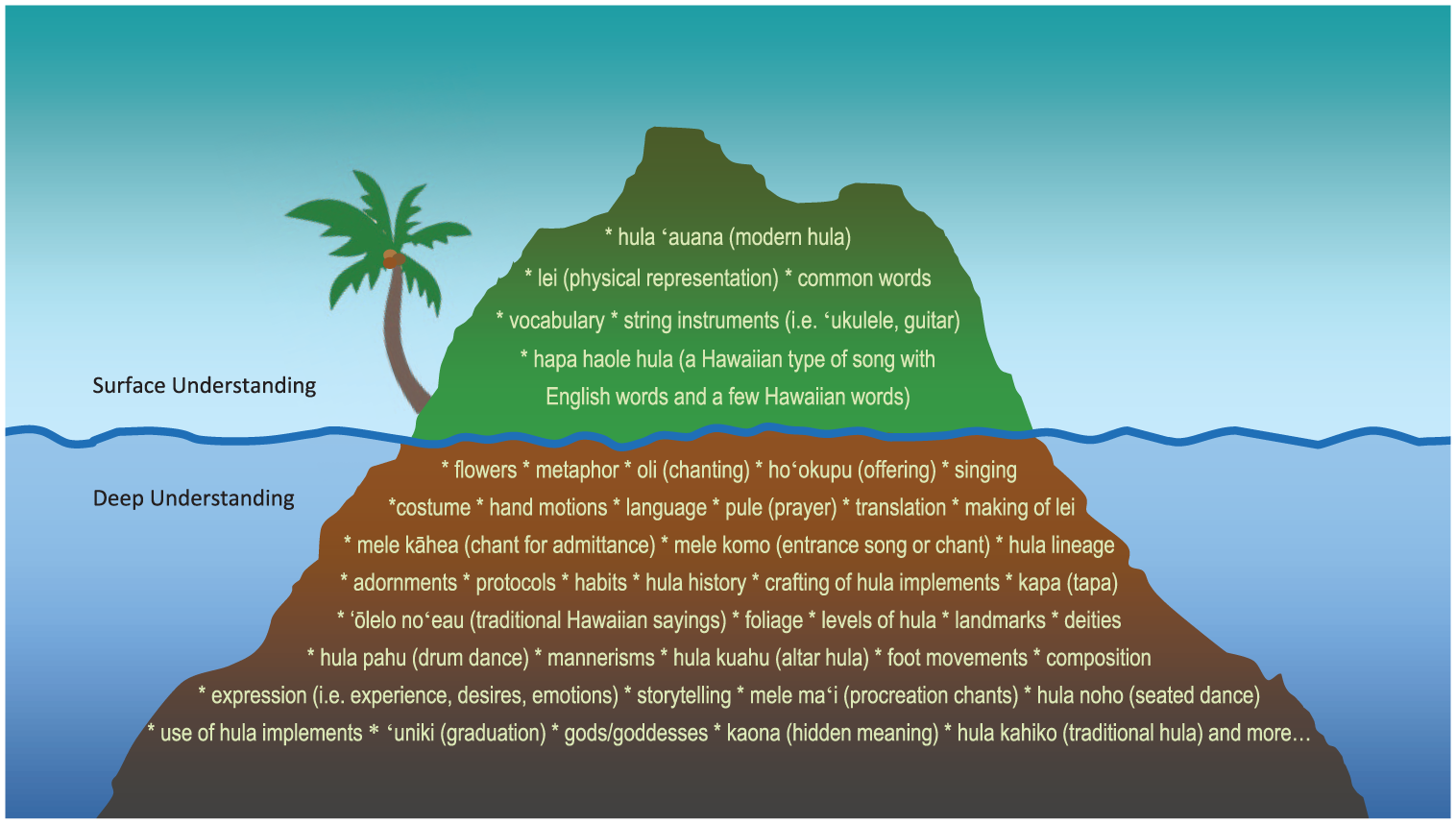
Embodied understanding of hula. Recreated from Galla et al. (2015, p. 131).
When hula is taught and learned from a kumu hula, language becomes the essence of the hula that helps to understand greater elements of the culture which includes: knowledge systems — ways of knowing, being, valuing, doing, teaching and learning — protocols, history, genealogy, adornments, instruments, family, community, responsibility and more. Each of these components are necessary when undertaking hula. It cannot be seen as a stand-alone performative art that is void of Hawai‘i, Native Hawaiians, our culture and language.
Without Hawaiian language, it’s just not the same
The essence of hula is deeply intertwined in the Hawaiian language. Prior to the illegal overthrow of the Hawaiian Kingdom in 1893 and the subsequent 1896 language ban that prohibited Hawaiian as a medium of instruction in schools, hula did not rely on physical motion alone to convey meaning — because the language itself carried the depth of narrative, imagery and emotion. As Taupōuri Tangarō affirms, ‘The essence was not in the dancer. The essence was in the language — was in the chanter. The dancer just amplified what the narrative said’ (Smithsonian Folklife, 2013, 1:12). This underscores that hula cannot be understood or performed fully without ‘Ōlelo Hawai‘i, the Hawaiian language. Galla et al. (2015) further explain, ‘The Hawaiian language composed poetically and presented melodically in mele carries the meaning in the art. Hula without the conventional use of its characteristic Indigenous language would not exist as a specific art form. The language encodes the values and knowledge of the Hawaiian people in a unique cultural way of being’ (p. 130). As hula continues to be taught, learned and performed worldwide, this quote reinforces the responsibility to remain true to the Hawaiian cultural and linguistic foundations of the practice. Kumu Hula Manu Boyd highlights this relationship, stating, ‘Speaking Hawaiian helps you to think in Hawaiian and dancing then becomes effortless. You can tell in the faces of those who understand the mele’ (‘Ōiwi TV, 2013, 1:06). Yet, for many — including myself — the Hawaiian language was not part of our upbringing, a direct result of colonization and the historical ban on its use in education, which was only officially repealed in 1986. These experiences mirror those of many Indigenous language learners who, through traditional and performative arts such as hula, are actively reclaiming not only their languages but their identities, histories and cultural futures. Without understanding the language, the depth and meaning of the hula are diminished and not fully appreciated.
Our histories and stories have been documented and preserved through our songs and hula. And it is through hula that we see Hawaiian language being practised in the present day, away from our traditional homelands: more than half of the Native Hawaiian population resides outside of Hawaiʻi. Unknown to many, Hawaiian language is a critical and necessary component of hula. Without it, hula cannot exist. ‘Hula is first a language. That has a choreographical piece to it.’ (Taupōuri Tangarō as cited in Smithsonian Folklife, 2013, 0:39).
Many teachers and students around the world are learning choreography and not learning the language — the foundation of the hula. A problem that arises is that choreography is arranged according to English translations of the Hawaiian lyrics. This presents an issue because now there is a reliance on another language for an interpretation. This presents challenges for our traditional art when it is performed and presented in this way across the world because if you are not an informed audience you may understand that what you are watching and experiencing is hula when it is in fact not. This is not to say that non-Hawaiians or those who do not know ‘Ōlelo Hawai‘i’ or Hawaiian language should not dance/teach hula, this just means that if you fall into this category, you should do your research and know that there are more capable others who are proficient in the language and culture that will support your learning, as well as defend, protect and point out when individuals or schools are misrepresenting or appropriating our cultural traditions.
Hula is not only a site of linguistic memory but also a powerful locus of cultural memory. As Stillman (2001) explains, ‘Hula is inherently a site of cultural memory, not only in the act of performance, but in the entirety of its practices of archiving knowledge of the past’ (p. 188). For Native Hawaiians, hula encodes and transmits essential knowledge of our historical past — knowledge through which we define ourselves and affirm our cultural identity. The disruption of intergenerational language transmission due to colonization and assimilationist policies has led to a deep sense of linguistic and cultural amnesia within our communities. In this context, the role of hula becomes even more critical. It is through the restoration, reclamation and revitalization of such embodied language practices that we can ensure the survival and continued relevance of our cultural traditions. Moreover, hula must be learned, performed and represented authentically, so that future generations — both within our communities and beyond — can understand and respect its depth, purpose and history. For me, hula remains a site of my family’s cultural memory, anchoring our stories, values and identities across time.
Hula: ancestral Funds of Knowledge and my language lifeline
I come from a family of hula practitioners. Hula was embedded in my life before I could even crawl or walk. My mother has been dancing for over 75 years and teaching for more than 55 years and continues to do so in Hilo. My father danced hula as well, along with my siblings and me — truthfully, we had no choice! 3 Hula was not simply an extracurricular activity; it was a part of my family and upbringing, a way of life and a family responsibility that was taught in our driveway. Although Hawaiian was not the language of my home (or the language of my mom), hula became the language through which I began to develop an understanding about Hawaiian, of Hawaiian and through Hawaiian. I remain a lifelong learner of the language and hula with kuleana (responsibility) to my homeland.
Hula became my currency, my identity — my resistance and resilience — a medium which became my language lifeline. This pathway led me to study Hawaiian language 4 formally for six years at Kamehameha Schools Kapālama, from grades 7 through 12. While this was not Hawaiian-immersion or Hawaiian-medium education, it offered an invaluable opportunity to learn from prominent Native Hawaiian and non-Hawaiian instructors committed to the revitalization of Hawaiian language. Their teachings helped me bridge my lived experience of hula with structured language instruction and broader cultural knowledge. Through hand motions, foot movements, facial expressions, costumes, lei (garlands or wreaths) and more, I was able to connect with the stories and values embedded in the mele. Hula served as a medium through which I could engage with the Hawaiian language in a contextual and embodied manner. The repetition of mele and the synchronization with movements facilitated language acquisition in a way that was both natural and meaningful. This embodied approach to language learning contrasts with traditional classroom settings, where language is often taught in isolation from cultural context. Understanding the nuances of the language enhances the interpretation and expression of the mele, allowing for a more authentic and profound performance. This interdependence underscores the inseparability of language and culture in Indigenous epistemologies. Unlike Western educational models that prioritize written and spoken forms of knowledge, hula emphasizes learning through observation, imitation and participation. This approach fosters a deep, experiential understanding of cultural practices and values.
For me, hula is not only an artistic practice but also a spiritual and genealogical connection. It connects me directly to my kūpuna (elders and ancestors), my ‘āina (land) and my identity as a Native Hawaiian — regardless of where I reside or travel. Hula is my language lifeline, my source of identity and a testament to both my ancestors’ resistance and resilience. It is my embodiment of our ancestral Funds of Knowledge, passed down through the Langsi/Aquino ‘ohana (family). 5 When I now teach and share hula with others, I always begin with language. The choreography comes later. While my mother, aunties and grandmother did not speak Hawaiian as their primary language of communication, the generations before them did. Hawaiian was primarily an oral language until the early 1820s, when missionaries helped develop a written orthography. Soon after, Hawai‘i achieved one of the highest literacy rates in the world — estimated at 97%. This rich linguistic heritage underscores the importance of starting from the knowledge we do possess and continuing to build upon it.
I also acknowledge the many kumu hula from whom I have learned — some over many years, others through brief yet impactful workshops. Importantly, I honor not only these teachers but also their kumu hula, whose wisdom has been passed down to me. The depth and breadth of this intergenerational knowledge resemble the structure of a tree, where roots, trunk, branches, leaves, fruits, flowers and seeds all contribute to a thriving ecosystem.
Kumu: source of knowledge
As the ‘ōlelo no‘eau (Hawaiian proverb) reminds us, ‘A‘ohe pau ka ‘ike i ka hālau ho‘okahi — not all knowledge is found in one school. We learn from many teachers and sources. Likewise, I ulu nō ka lālā i ke kumu — the branches grow because of the trunk. Without our ancestors, we would not be here. As shared by Yanagihashi and Galla (2019), ‘Each kumu has been tutored by kumu, has been influenced by other kumu, and has passed on the accumulated knowledge and skills to others while developing their own unique style’ (p. 20). In honoring our learning, we commemorate our kumu and their kumu — their legacy(ies) — by acknowledging our hula genealogy and continuing the traditions of hula through our kuleana (see Stillman, 2010) as practitioners, stewards, protectors and Lāhui Hula 6 (Tangarō, 2025) amidst today’s realities.
In the broader context of Indigenous education, hula challenges the conventional notions of schooling and boundaries of the classroom. It demonstrates that learning is not confined to formal institutions but takes place in the home, in community spaces, on the land and through the lived participation in cultural practices that span generations. As a dynamic form of Indigenous knowledge transmission, hula embodies educational values and philosophies grounded in Native Hawaiian epistemologies. This is aligned with the United Nations Declaration on the Rights of Indigenous Peoples (UNDRIP), which asserts that ‘Indigenous peoples have the right to establish and control their educational systems and institutions providing education in their own languages, in a manner appropriate to their cultural methods of teaching and learning’ (United Nations, 2007). Furthermore, as Moll and Ruiz (2016) have emphasized, ‘educational sovereignty requires that communities create their own infrastructures for development, including mechanisms for the education of their children that capitalize on rather than devalue their cultural resources’ (p. 293).
Hula is a powerful manifestation of such educational sovereignty. It serves as a vehicle for advancing Indigenous language rights, cultivating historical and contemporary consciousness (of oppression and lived realities) (Moll & Ruiz, 2016), reclaiming identity and transmitting cultural knowledge from one generation to the next. As a distinctly Native Hawaiian educational practice, hula is deeply rooted in spirituality, ancestral knowledges, land, relationality, responsibility and cultural values. It is both a form of resistance and a strategy for cultural resurgence, reinforcing the understanding that Indigenous education is most effective when it is community centered, led and driven, firmly grounded in ‘āina (land) and reflective on Native Hawaiian lived experiences.
As an embodied language practice, hula also exemplifies the concept of Funds of Knowledge by affirming the intellectual and cultural resources that reside within Indigenous practices, homes and communities. In this way, hula not only sustains Indigenous ways of knowing but also challenges dominant educational paradigms that often marginalize or erase them.
I offer these reflections as a form of consciousness-raising. The next time you consider traveling to Hawai‘i, I encourage a deeper awareness of its true nature — not merely as an imagined tourist destination of ‘paradise’ but as an occupied island nation shaped by colonization, historical and contemporary trauma and continued resistance. Despite the lasting effects of these injustices, Native Hawaiians remain a resilient people. Hula is not simply a form of entertainment; it is education, learning, teaching and a way of life that has been instrumental in revitalizing our ancestral and Indigenous Funds of Knowledge. Despite disruptions to our language and cultural traditions, hula is indeed a gift from our kupuna that connects us to the past, helps us to understand our present and provides us a blueprint for our future.
He lālā au no ku‘u kumu
I am a branch of my teacher, my source of knowledge.