




Abstract
Socio-emotional competencies have been the subject of numerous studies that have explored their primary impact on school outcomes. Based on the CASEL model (Collaborative for Academic, Social and Emotional Learning), this study aimed to investigate whether socio-emotional competencies moderate the relationships between students’ learning approaches and their academic performance in mathematics and reading. The sample consisted of 685 seventh- and eighth-grade students aged 12 to 15 (M = 13.92, SD = .69), of whom 54.6% were girls. The results showed that the relationship between the surface approach to learning and both types of grades was strongly negative only when the scores on the socio-emotional competencies scales were high. At the same time, these competencies did not moderate the relationships between the deep approach to learning and performance in the two disciplines. Although they did not impact all the relationships examined, fostering such skills may still enhance the learning process and support academic achievement through broader pathways.
Adolescence is characterized by significant and rapid physical, emotional and cognitive changes, exposing youths to multiple challenges, including the pursuit of independence and peer pressure (CASEL, 2015; Green et al., 2021). Developing social and emotional competencies (SECs) becomes essential for meeting the specific needs of this age group and supporting both personal and academic development (Flogie et al., 2019; Oberle et al., 2014). The growth of SECs is an integrated part of education and development, a process through which pupils acquire and apply knowledge, skills and abilities to promote healthy attitudes, manage emotions, achieve personal and collective goals, maintain beneficial relationships and make responsible decisions (Durlak et al., 2015; Oberle et al., 2014; Shi & Cheung, 2024). Strengthening SECs improves school adaptation, learning engagement and academic performance while reducing emotional distress and behavioural issues (Durlak et al., 2011; Eccles & Roeser, 2011; Shi & Cheung, 2024). A widely recognized framework for enhancing SECs is the CASEL model, which identifies five competencies classified into two distinct domains, intrapersonal and interpersonal (Bergin et al., 2025; CASEL, 2015; Cipriano et al., 2023). Intrapersonal competencies reflect the global functioning of individuals through the awareness and management of their emotions, while interpersonal competencies are related to establishing effective interactions and healthy relationships with others based on empathy and acceptance of diversity. Responsible decision-making is recognized as both an individual and a social process (Domitrovich et al., 2017; Müller et al., 2020).
Research supports the link between SECs and academic skills, emphasizing that learning in school is a social process (Vadeboncoeur & Collie, 2013) involving interactions with colleagues, teachers and staff members and implicating negotiation, collaboration and cooperation in various social situations (Oberle & Schonert-Reichl, 2017). Thus, beyond the cognitive skills necessary to achieve success, SECs are crucial for lifelong learning (Flogie et al., 2019; Hukkelberg & Ogden, 2019) because they shape learning, develop students' reading, writing, critical thinking and vocabulary, and improve school performance (Alzahrani et al., 2019; Bergin et al., 2025). When children understand themselves and others, they make informed decisions, regulate their behaviour effectively and interact successfully (Bergin et al., 2025; Denham & Brown, 2010). Learning task approach in the classroom becomes more accessible, the transition from one subject to another is easier to manage, and the interaction and collaboration with peers in solving assignments facilitates the organization, identification and choice of the most suitable methods and strategies, which leads to better performance (Denham & Brown, 2010; Hukkelberg & Ogden, 2019; Zuraida & Suganda, 2021). For instance, students’ self-awareness (i.e., the ability to identify their strengths) and self-management (i.e., self-discipline and self-motivation to organize and plan their learning) favour academic performance (Fernandez-Perez & Martin-Rojas, 2022; Skaar & Townsley, 2025). Moreover, decisions to engage in tasks, complete homework or collaborate on problem-solving reflect a realistic understanding of how one's behaviour can impact academic outcomes (Durlak et al., 2011).
SECs and the relationship between students, context and tasks also affect learning approach and information processing, facilitating either deep or surface learning (Kember et al., 2004; Ottmar, 2019; Panayiotou et al., 2019). The deep approach to learning (DAL) focuses on understanding materials through intrinsic motivation, critical thinking, collaboration, self-directed learning and effective communication (Ottmar, 2019). In contrast, the surface approach to learning (SAL) is driven by extrinsic motivation, minimal effort and mechanical learning (Janeiro et al., 2017). Engagement in learning is strongly shaped by emotions, a core component of SEC (Postareff et al., 2017; Trigwell et al., 2012). Students who can regulate their own emotions and understand those of others tend to show higher engagement, stronger peer and teacher relationships, better group collaboration and increased interest in school activities, all of which promote well-being and satisfaction (Bergin et al., 2025; Panayiotou et al., 2019). For example, positive emotions encourage DAL and enhance academic results, whereas negative emotions often lead to SAL and poorer outcomes (Postareff et al., 2017; Trigwell et al., 2012). Thus, emotions act as a bridge between socio-emotional functioning and the learning approach adopted, affecting cognitive resource allocation, learning strategies, self-regulation and academic achievement (Postareff et al., 2017; Trigwell et al., 2012).
Learning approaches can also vary depending on the discipline, leading to different outcomes (Baeten et al., 2010; Valadas et al., 2016). Although findings are sometimes inconsistent, research generally shows that DAL correlates positively and SAL negatively with academic performance (Baeten et al., 2010; Richardson et al., 2012), and DAL is more commonly used among humanities students (Baeten et al., 2010). However, Kremer et al. (2019) found that learning approaches predict reading and maths skills, while Murayama et al. (2013) discovered that both DAL and SAL are related to maths performance, with DAL showing a positive relationship and SAL showing a negative one. Nevertheless, few studies have directly examined the relationship between SECs, learning approaches and performance across different subjects, especially in middle school (Winje & Løndal, 2020). When explored, these links were often investigated indirectly, through mediators such as engagement, emotional regulation or self-regulated learning (Alzahrani et al., 2019; Bergin et al., 2025; Mella et al., 2021). Consequently, to fill this gap — and recognizing that grades reflect not only students' academic knowledge but also teachers' assessments of their learning behaviours shaped by SECs (Cipriano et al., 2023) — the present study aimed to explore the impact of SECs on the relationship between middle school students' learning approaches and their performance in mathematics and reading. In the Romanian education system, reading is taught as part of Romanian language and literature, a subject that combines grammar and literature and represents a key competence in native language communication.
This study contributes to both educational research and practice by examining how SECs simultaneously impact the relationships between learning approaches and school performance in two distinct subjects: mathematics (sciences) and reading (humanities). It also provides a basis for developing those SECs that improve pupils’ academic success, especially during secondary school, when such competencies often decline, influencing students' engagement, interest in learning and teacher–student relationships (Bergin et al., 2025).
Social-emotional competencies and students’ learning approach
SECs are crucial for social adaptation (Flogie et al., 2019). Understanding and managing one’s own emotions are the foundation of interpersonal relationships, while comprehending others’ emotions facilitates behaviour adjustment, conflict resolution, decision-making and complying with social rules (Durlak et al., 2015; Mella et al., 2021). According to the CASEL framework, five SECs are central to social-emotional development (CASEL, 2015; Durlak et al., 2015). Self-awareness (SeA) is an intrapersonal component that involves recognizing one’s strengths, weaknesses, feelings and emotions, and understanding how these may impact performance (Denham & Brown, 2010). Self-management (SM) refers to the ability to control one’s emotions and impulses, express them effectively and manage stress efficiently through self-discipline and organization (Denham et al., 2014; Müller et al., 2020; Zhou & Ee, 2012). Social awareness (SoA) is reading, understanding and responding appropriately to others' feelings (Müller et al., 2020). Relationship management (RM) includes analysing situations, setting goals, producing social strategies and initiating and maintaining conversations and cooperation with others (Denham et al., 2014). Responsible decision-making (RDM) involves considering ethical, safety and social factors, enabling individuals to effectively manage academic and social situations while contributing to the growth and prosperity of the school and community (Zhou & Ee, 2012).
Empirical findings showed that developing intrapersonal competencies (i.e., emotional skills) before interpersonal ones (i.e., social skills) had a significantly greater impact on academic achievement, study skills, engagement in learning tasks and school adjustment (Cipriano et al., 2023). Higher pupils’ SECs determine their learning engagement, facilitating classroom interactions, ability to listen and follow recommendations and persistence in challenging cognitive tasks (Alzahrani et al., 2019). Engaged students are intrinsically motivated, invest effort in learning, persist in completing assignments (Agger & Koenka, 2020), are more adaptable to school demands and report a greater sense of belonging and positive experiences related to school (Huttunen et al., 2025; Panayiotou et al., 2019). Engagement is also connected to students’ attitudes, relationships with colleagues and teachers, and positive emotions (Abulela et al., 2023). Positive emotions (e.g., enjoyment of learning, hope, pride and feelings of competence) facilitate creative, flexible and deep-processing strategies while improving learning self-regulation (Mella et al., 2021). In contrast, negative emotions (e.g., anger, worry, anxiety, frustration, shame) tend to lead to rigid, simplistic and surface learning strategies (Pekrun, 2017; Postareff et al., 2017).
Students’ DAL or SAL refer to the combination of motivation and learning strategies used in the learning process (Biggs et al., 2001). DAL involves intrinsic motivation to learn and understand materials using complex strategies. Students are interested in academic tasks, invest effort and persevere in their pursuit of fulfillment (Janeiro et al., 2017; Kember et al., 2008). DAL positively correlates with engagement and positive emotions (Abulela et al., 2023; Pekrun, 2017). SAL emphasizes instrumental motivation, where students learn to avoid failure by relying on mechanical memory and surface learning strategies. The effort invested is as minimal as possible, the interest is low, and the task is performed solely to ensure passing a test or exam (Janeiro et al., 2017; Kember et al., 2008). Prior studies have shown negative correlations between SAL and engagement, as well as between SAL and negative emotions (Murayama et al., 2013; Pekrun, 2017). To our knowledge, no studies have directly examined the relationship between SECs and learning approaches. Instead, existing research has primarily explored the effect of SECs indirectly through mediating variables such as engagement, self-regulation or emotions (Bergin et al., 2025; Mella et al., 2021; Pekrun, 2017). Consequently, we proposed the first hypothesis:
H1: Social-emotional competencies will relate positively to DAL (H1a) and negatively to SAL (H1b).
Students’ learning approach and academic performance
Students' learning approaches shape academic achievement differently, although the results are mixed (Agger & Koenka, 2020). Learners who approach academic tasks using deep strategies and motives tend to achieve great success, and their learning is more durable than that of those who prefer a SAL (Baeten et al., 2010; Garcia et al., 2016). For instance, there is evidence of positive associations between DAL and academic performance, as well as negative relationships between SAL and academic performance (Garcia et al., 2016; Richardson et al., 2012). On the other hand, Valadas et al. (2016) found no relationship between DAL and academic performance, while SAL was significantly related to academic achievement.
Moreover, empirical findings showed that the discipline or area of study shapes the learning approaches and leads to different patterns of relationships with academic performance (Baeten et al., 2010; Kember et al., 2008; Valadas et al., 2016). Although findings may vary across studies, some evidence suggests that university students in the human sciences (e.g., language, literature, psychology and health) tend to report higher DAL scores than those studying scientific disciplines, such as mathematics and economics (Baeten et al., 2010; Kember et al., 2008). The learning environment created by these disciplines seems to facilitate interactive activities and discussions, which favours a DAL (Kember et al., 2008). In the case of secondary school students, Kremer et al. (2019) discovered that learning approaches are predictors of both maths and reading abilities, and they affect achievement differently. Murayama et al. (2013) observed that DAL was positively associated with mathematics achievement, while SAL showed a negative association. Similarly, Garcia et al. (2016) reported that students who frequently adopt SAL tend to perform worse in mathematics. Peacock and Ho (2003) found that increased cognitive and metacognitive strategies (i.e., DAL) were associated with higher reading scores in English language courses. Furthermore, students who employ a wider variety of metacognitive and deep reading strategies achieve better comprehension and higher performance on specific reading tasks (Puusepp et al., 2024; Wong et al., 2025). In contrast, Aharony (2006) noted that high school students studying English as a foreign language tended to rely more on SAL than DAL. Based on these arguments, the second hypothesis was formulated:
H2. Students' DAL will be positively related to performance in mathematics and the Romanian language and literature (H2a), while SAL will be negatively related to performance in both subjects (H2b).
Social-emotional competencies as a moderator
While previous studies revealed mixed findings regarding the role of learning approaches in mathematics and reading performance, there is a consensus that their effect varies across different disciplines (Baeten et al., 2010; Garcia et al., 2016). DAL has been positively associated with maths performance (Murayama et al., 2013; Murphy, 2017), while SAL showed either a negative (Murayama et al., 2013) or no significant effect (Murphy, 2017). Additionally, learning approaches have been found to correlate with performance in both reading (Aharony, 2006; Puusepp et al., 2024) and maths (Kremer et al., 2019; Peacock & Ho, 2003). In this context, an important factor that may affect this relationship is the development of students' SECs, which impact both engagement in learning and their performance in maths and reading (Ottmar, 2019; Parsons, 2009). How might SECs shape the relationship between learning approaches and performance across these two subjects? This question enables a nuanced exploration of both intrapersonal (e.g., emotional factors) and interpersonal perspectives (e.g., interactions within the learning environment).
Thus, the extent to which students can know themselves and manage their emotions and feelings (i.e., SeA) helps them establish an optimal level of motivation, invest time and effort in solving tasks and organize themselves effectively (i.e., SM) (Panayiotou et al., 2019). When motivated, students become more curious and engaged in exploring and understanding materials (Agger & Koenka, 2020). This encourages them to invest in more cognitive resources and employ complex strategies (Postareff et al., 2017). Hence, high intrapersonal skills help pupils benefit more from cognitive opportunities and promote DAL (Ottmar, 2019). Completing these tasks often elicits positive emotions, such as joy or pride, which in turn encourage the use of deep-processing strategies (Pekrun, 2017). As a result, this leads to significantly improved academic performance (Postareff et al., 2017). On the contrary, if students are unaware of their strengths and how to leverage them and have lower emotional control, they may find it difficult to adjust to school requirements (Alzahrani et al., 2019). This can generate negative emotions and anxiety about their ability to handle different tasks. As a result, they may focus on memorization strategies and SAL to avoid failure (Pekrun, 2017).
Likewise, interpersonal competencies (e.g., SoA and RM) enable students to build strong connections and collaborate effectively (Oberle & Schonert-Reichl, 2017; Vadeboncoeur & Collie, 2013). Communication, collaboration and teamwork contribute to better understanding and learning, reflected in high performance (Bogard et al., 2018). They foster a positive attitude and enhance emotional engagement in school experiences because students perceive it as an environment that values and supports learning (Abulela et al., 2023). Hence, learners benefit from more cognitive opportunities by being involved in problem-solving and exposed to diverse perspectives, leading to greater engagement and perseverance (Ottmar, 2019). Associated positive emotions boost pupils' interest and intrinsic motivation, stimulating them to interact more actively with teachers and classmates, engage fully in tasks and use complex and deep information-processing strategies (Abulela et al., 2023; Pekrun, 2017).
MacCann et al. (2020) observed that both understanding and management of emotions, on the one hand, and the relationships between students and teachers, on the other hand, are essential in predicting performance, with the effect being more evident in the humanities than in the sciences. Parsons (2009) found that reading skills improved due to the stimulation of intrapersonal (e.g., self-monitoring, self-regulation) and interpersonal competencies (e.g., teamwork, social responsibility, problem-solving) in learning contexts (Bogard et al., 2018). Additionally, Ottmar (2019) demonstrated that students with higher collaboration skills achieve better results in maths, reading and science. Oberle et al. (2014) found that youth perceptions of their social responsibility goals (e.g., keeping commitments in peer relationships and adhering to classroom rules) predicted academic performance in reading but not in mathematics. Based on the above arguments, we expect SECs to buffer the relationship between learning approaches (i.e., DAL and SAL) and maths and reading achievement. Consequently, the following hypotheses were formulated:
H3. Students’ social-emotional competencies will positively relate to their performance in mathematics (H3a) and Romanian language and literature (H3b).
H4. Students’ social-emotional competencies moderate the relationship between the DAL and performance in mathematics and the Romanian language and literature (H4a), and SAL and performance in both subjects (H4b).
The present study
Early adolescence presents numerous biological, cognitive and social challenges, but it also offers a valuable opportunity for children to develop essential emotional and social skills that contribute to overall well-being (Green et al., 2021). This period is critical for fostering positive outcomes and preparing for future career and life transitions (Green et al., 2021). Well-developed SECs are associated with stronger school connectedness and better adaptation (Cipriano et al., 2023; Panayiotou et al., 2019), serving as reliable predictors of both academic performance (Zuraida & Suganda, 2021) and student well-being (Cipriano et al., 2023).
Recognizing that SECs can provide a foundation for both personal and academic growth (Huttunen et al., 2025), this study aimed to investigate how these competencies, according to the CASEL model, affect students' preferred learning approaches and how this is reflected in their performance in two key subjects: mathematics and the Romanian language and literature (see Figure 1). The selection of the two subjects is significant because the transition from middle to high school is conditional on taking a national exam in both areas, and much of the teaching and learning focuses on them. Since SECs can be enhanced through targeted programmes, knowing which have the most substantial impact allows for the design of effective interventions that facilitate their development and, implicitly, increase academic performance. Thus, these findings can offer a basis for initiatives that promote achievement, well-being and school adaptation while reducing the likelihood of future behavioural issues (Green et al., 2021).
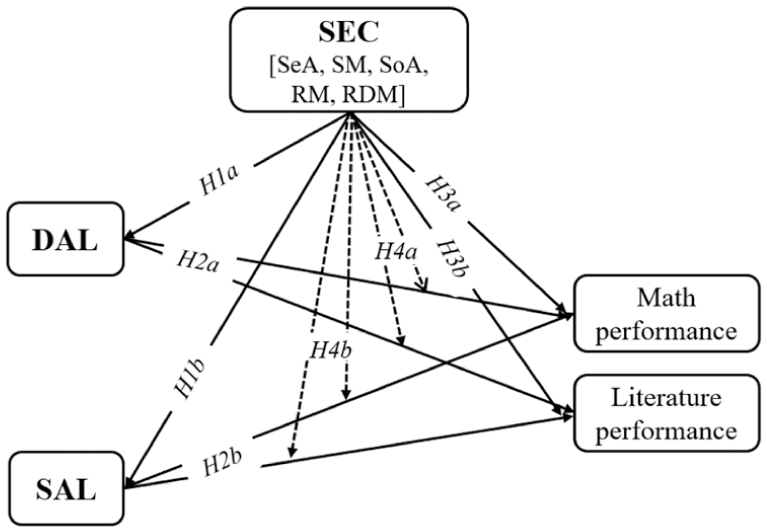
The hypothesized model.
Method
Participants and procedures
The convenience sample comprised 685 seventh- and eighth-grade students between 12 and 15 years old (M = 13.92, SD = .69), with 54.6% being girls. Pupils were selected from schools in the western part of the country between June and November 2022. As a first step, the school principals were informed about the purpose of the study and asked to allow their school to participate. After that, the teaching staff from the seventh and eighth grades presented the study's purpose to the parents and requested their consent for the children's participation. The questionnaires used in the research were entered into a Google Forms document, which also included the informed consent form for participation and an assurance of data confidentiality. The link to the questionnaires was posted on the parents’ chat groups so that their children could fill out the items. The time required to complete them was approximately 20–25 minutes. Inclusion criteria required students to be in seventh or eighth grade, while exclusion criteria included the lack of parental consent and incomplete questionnaire responses. All procedures followed the ethical standards of the Scientific Council of University Research and Creation at West University of Timisoara (39340/05.07.2022), which were based on the 1964 Helsinki Declaration and its subsequent amendments or comparable ethical standards.
Instruments
The socio-emotional competencies were assessed using the Social Emotional Competence Questionnaire (SECQ; Zhou & Ee, 2012). The scale includes five subscales with five items each: self-awareness (e.g., ‘I know what I am thinking and doing’), social awareness (e.g., ‘If a friend is upset, I have a pretty good idea why’), self-management (e.g., ‘I stay calm when things go wrong’), relationship management (e.g., ‘I always try and comfort my friends when they are sad’) and responsible decision-making (e.g., ‘When making decisions, I take into account the consequences of my actions’). The items were rated on a six-step Likert scale (from 1 — ‘Not true for me’ to 6 — ‘Very true for me’). The authors argue that the instrument is a reliable and valid measure of SECs, as defined by CASEL (Zhou & Ee, 2012), having been translated and validated in several countries. It enables exploration of the SECs’ nature, determinants, effects on other variables and development over time. This tool is valuable for assessing individuals’ SECs, improving self-understanding, identifying socio-emotional developmental issues or spotting indicators of poor academic performance (Zhou & Ee, 2012). In our study, the internal consistency for the entire scale was .89, ranging between .75 and .85 for the five subscales. The learning approach was assessed using the 22-item Revised Learning Process Questionnaire (R-LPQ-2F; Kember et al., 2004), adapted for the Romanian student population by Smarandache et al. (2022). The two subscales assess the SAL (11 items; ‘I see no point in learning material which is not likely to be in the examination’) and the DAL (11 items; ‘I work hard at my studies because I find the material interesting’). Students were asked to rate their answers on a five-point Likert scale (from 1 — ‘Always untrue’ to 5 — ‘Always true’). The questionnaire has been validated within the Romanian student population, demonstrating good psychometric properties (Smarandache et al., 2022). In the present study, the internal consistency for the entire scale was .82, .72 for the SAL subscale and .83 for the DAL subscale.
Academic performance was obtained by asking students what the average mathematics and Romanian language and literature grades were at the end of the previous semester. The final grade for Romanian language and literature encompasses both grammar and literature grades, since grammar and literature in the national education system represent a key competence in communication in the native language. The grading scale ranges from 1 to 10, with grades from 5 (lowest) to 10 (highest) indicating all passing grades, while grades below 5 denote failed exams.
Data analysis
The statistical software package SPSS 23.0 was used to analyse the data. We tested the moderation effects using hierarchical stepwise regression analysis, following the specifications outlined by Cohen et al. (2003). First, we transformed the raw scores of the predictors into standardized scores (z scores), which are centred on their mean. Second, we computed the cross-product vector of each learning approach and each socio-emotional competency. We conducted separate analyses for each SEC, in which the learning approaches and the SEC were included in the first step of the regression and the interaction terms were included in the second step. If the interaction term was statistically significant, we computed a simple slopes test to thoroughly examine the moderation phenomenon (Cohen et al., 2003).
Results
Preliminary analyses
First, we investigated the relationships between our study variables. The correlations in Table 1 indicated that both grades were positively associated with students’ DAL and all SECs. Students’ SAL did not correlate with students’ literature grades and had weak associations with the SECs of social awareness and self-management.
Descriptive statistics and correlations between study variables.
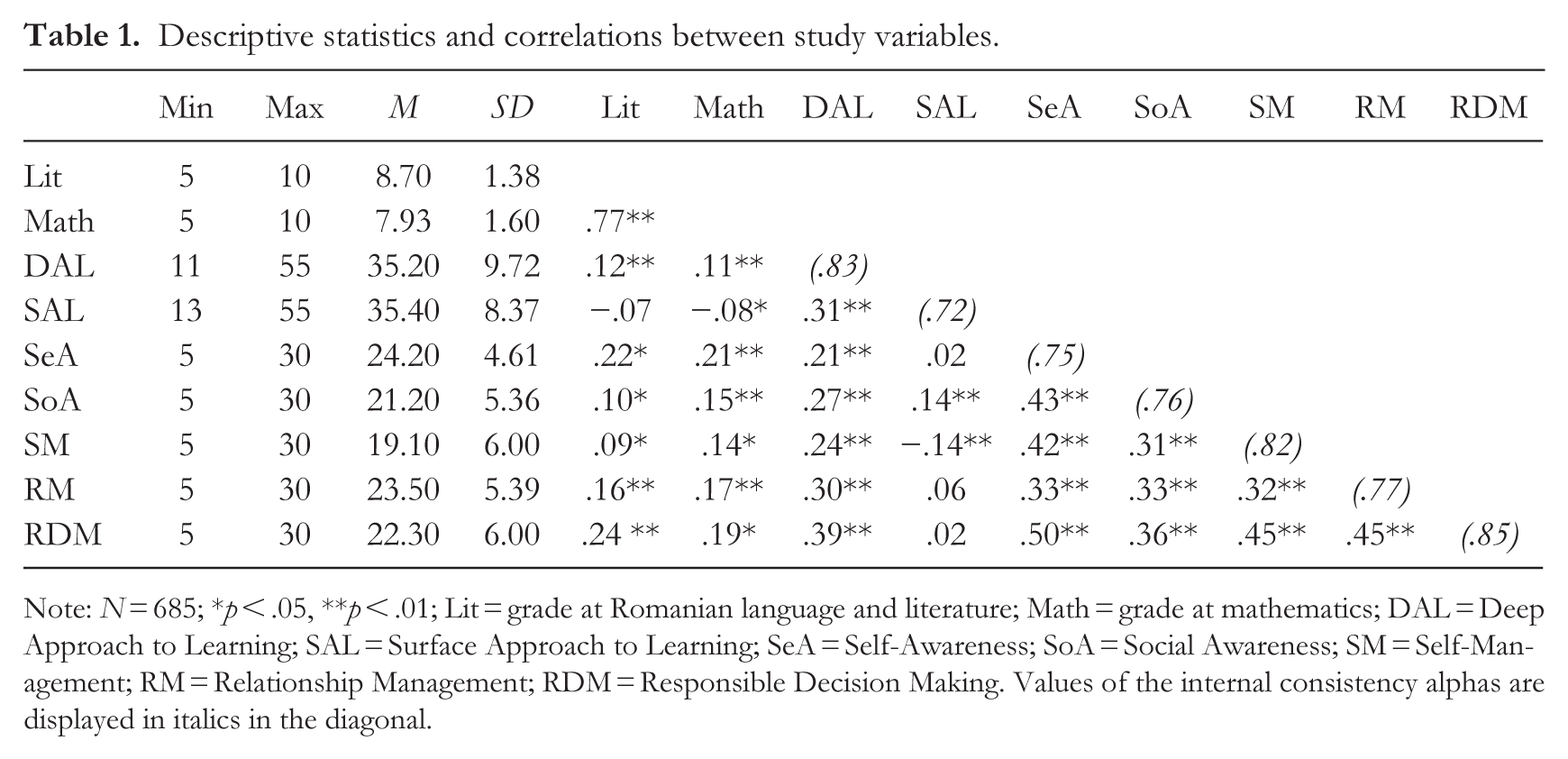
Note: N = 685; *p < .05, **p < .01; Lit = grade at Romanian language and literature; Math = grade at mathematics; DAL = Deep Approach to Learning; SAL = Surface Approach to Learning; SeA = Self-Awareness; SoA = Social Awareness; SM = Self-Management; RM = Relationship Management; RDM = Responsible Decision Making. Values of the internal consistency alphas are displayed in italics in the diagonal.
Main analysis
We tested our moderation hypotheses using stepwise linear regression. In the first step, we used the two learning approaches and the SEC scale. In the second step, we added the interaction terms (i.e., the interactions between each learning approach scale and the SECs scale). Although the SEC's questionnaire had five strongly correlated scales, we could not compute an overall score because its authors did not indicate that an overall score was appropriate (Zhou & Ee, 2012). Furthermore, using all scales led to violations of the multicollinearity assumption, particularly when interaction terms were also introduced. A significant moderation effect was identified based on the F change test, and its interpretation was based on simple slopes analysis. The results of these stepwise regressions are presented in Table 2.
Results of the stepwise regression analysis.
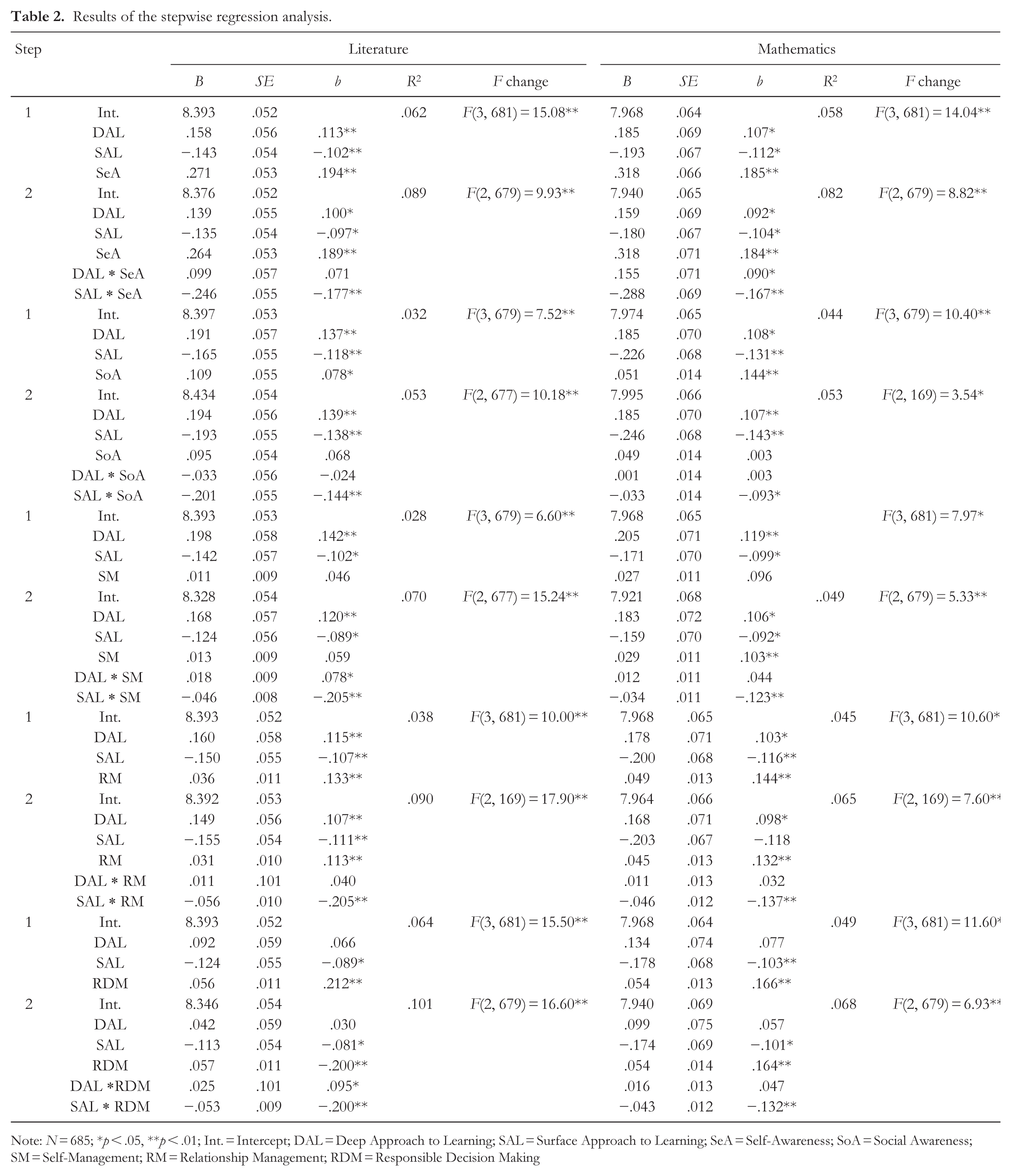
Note: N = 685; *p < .05, **p < .01; Int. = Intercept; DAL = Deep Approach to Learning; SAL = Surface Approach to Learning; SeA = Self-Awareness; SoA = Social Awareness; SM = Self-Management; RM = Relationship Management; RDM = Responsible Decision Making
Our regression analyses indicated significant moderation effects only in the relationship between the SAL and both types of grades. Regarding the relationships between DAL and both types of grades, the F change statistic was generally insignificant when we added the interaction effects. The relationship between SAL and literature grade was significantly moderated by all scales of the SEC questionnaire: SeA (B = −.246, SE = .055, p < .01), SoA (B = −.201, SE = .055, p < .01), SM (B = −.046, SE = .008, p < .01), RM (B = −.056, SE = .010, p < .01) and RDM (B = −.053, SE = .009, p < .01). The effects added small-to-moderate proportions of incremental explained variance (i.e., ΔR2), ranging between 2.10% (in the case of SoA) and 5.20% (the moderating effect of RM). We found similar effects when analysing the relationships between SAL and maths grades, but the effect sizes were smaller.
The simple slopes analyses (see Table 3) indicated that the relationships between the SAL and both types of grades were strongly negative only when the scores of the SEC scales were high. When SECs were low, SAL had an insignificant and positive relationship with the grades. These relationships were marginally significant only when the moderator was SM (B = .161, SE = .078, p = .04) or when the moderator was RDM (B = .165, SE = .074, p = .04). Given the small effects, we concluded that SAL was generally not associated with the grades at low levels of SECs. Visual graphs with interaction effects are presented in the first Supplementary Material.
Simple slope analyses for the moderation effects of the relationship between learning approaches and grades.
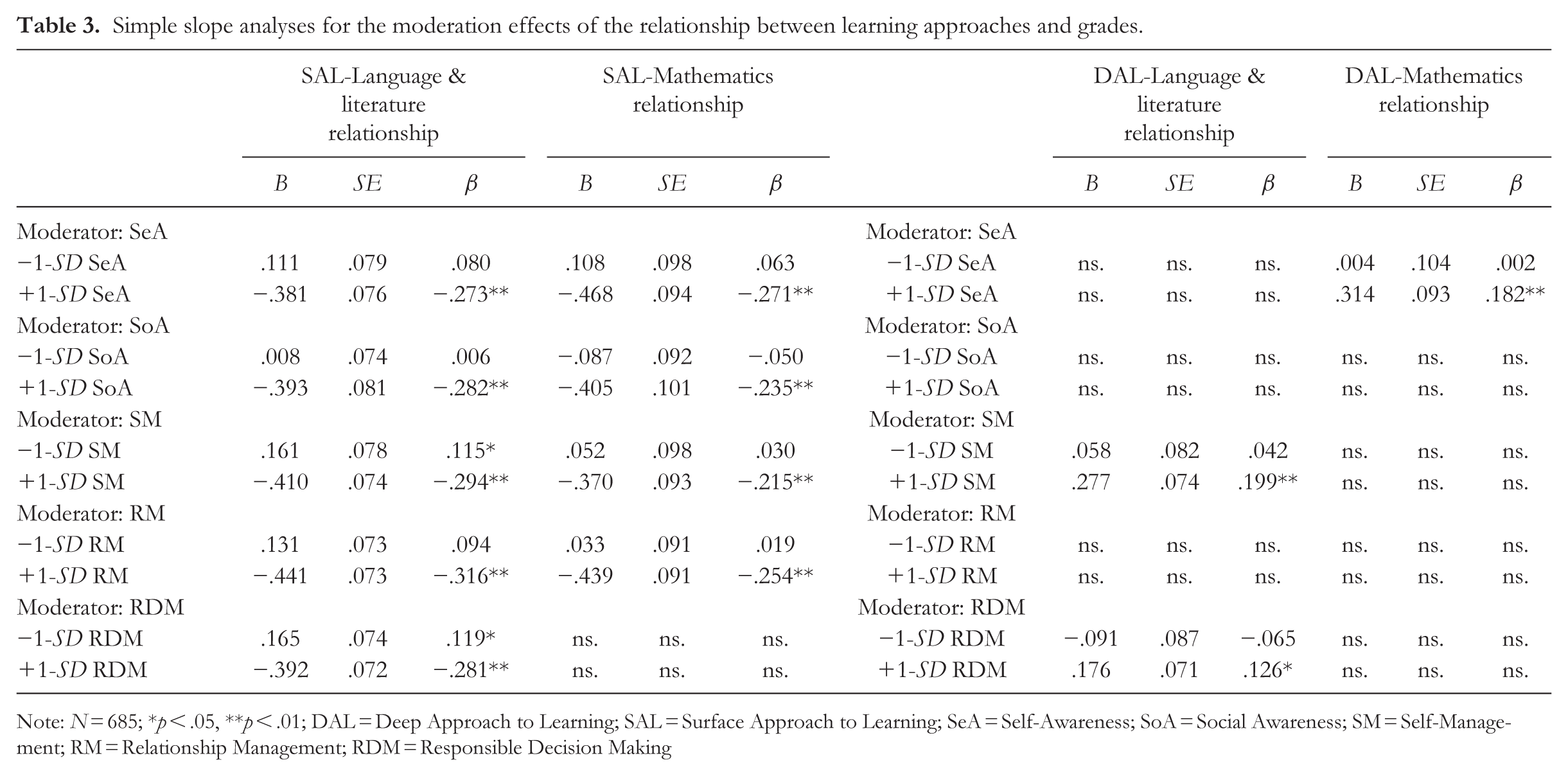
Note: N = 685; *p < .05, **p < .01; DAL = Deep Approach to Learning; SAL = Surface Approach to Learning; SeA = Self-Awareness; SoA = Social Awareness; SM = Self-Management; RM = Relationship Management; RDM = Responsible Decision Making
Discussion
The present study aimed to explore the impact of SECs on the relationships between middle school students’ learning approaches and their academic performance in mathematics and reading (i.e., Romanian language and literature). Thus, our results indicated that all five dimensions of the SECs were positively associated with DAL, which fully sustained H1a. In learning experiences, students are frequently exposed to diverse perspectives and need to communicate, defend their opinions, manage their emotions and understand those of others to negotiate and solve various situations (CASEL, 2015; Denham et al., 2014; Müller et al., 2020). DAL emphasizes meaningful inquiry, student agency, collaboration and real-world application (Kember et al., 2008), encouraging youth to engage actively in complex content and interpersonal dynamics. In this context, SECs become essential to succeed in environments that promote DAL, while DAL provides the setting for developing and practising these competencies (Cipriano et al., 2023). However, SAL had weak negative associations with the ability to control and express emotions (i.e., SM) and positive relations with understanding others' emotions (i.e., SoA), partially confirming H1b. Specifically, students who effectively manage their emotions and organize themselves tend to concentrate and engage more in academic tasks, relying less on SAL, which focuses merely on passing exams or avoiding failure. Conversely, the ability to read and understand cues from others, such as teachers and peers, can shape students' preparation for evaluation (e.g., Baeten et al., 2010), which means they are more likely to focus on learning the material relevant to the assessment (i.e., SAL) rather than understanding the content (i.e., DAL). The significant relationships between SAL and only SM and SoA may reflect the particular relevance of these competencies during middle school, where classroom behaviour and peer interactions are central (Mella et al., 2021). The other three SEC may have a less direct impact on learning approaches or may not yet be fully developed at this stage. Therefore, their lack of association with SAL may suggest that SAL is more closely related to behavioural regulation and social adaptation than to broader emotional or interpersonal skills (Farrington et al., 2012).
Our findings revealed positive associations between DAL and students' performance in mathematics and reading, supporting the second hypothesis (H2a) and aligning with previous research. According to Garcia et al. (2016), employing DAL enhances mathematics performance, whereas Peacock and Ho (2003) found a correlation between the increased use of cognitive and metacognitive strategies and improved reading outcomes. On the other hand, students’ SAL negatively correlated only with maths grades, while the relationship with Romanian language grades was non-significant, partially supporting our hypothesis (H2b). These findings sustain previous results that students who frequently use SAL report lower performances in mathematics (Garcia et al., 2016; Murayama et al., 2013) and contrast with Chou’s (2017) study, which suggests that surface processing strategies significantly predict students′ reading performance. In our education system, these two subjects are compulsory components of the end-of-middle-school national assessment, determining progression to high school. This emphasis often leads students to focus heavily on these subjects and to rely on SAL to handle the considerable information workload. The results can also be understood by examining the cognitive demands of the two topics. In maths, achieving good performance typically requires a deep understanding of concepts and their relationships, which is facilitated using complex cognitive information-processing strategies (Gilmore, 2023). Therefore, relying on SAL can be inadequate for optimal performance in such tasks. In contrast, reading performance often relies on fluency, vocabulary recognition and decoding skills (Paige & Smith, 2018), which can be accomplished through surface strategies (e.g., repetition, memorization or recalling information), allowing students to earn average or adequate grades. Furthermore, middle school reading tasks may not always require higher levels of cognitive engagement and assessments may not be complex or demanding enough to reveal the negative impact of superficial learning.
Students’ SECs were positively correlated with grades in both subjects, confirming the third hypothesis (H3a and H3b). These findings are consistent with previous investigations demonstrating how high emotional control (i.e., intrapersonal skills) and strong collaboration skills (i.e., interpersonal skills) help students perform better in maths, reading and science (Alzahrani et al., 2019; Skaar & Townsley, 2025). Such competencies allow youth to manage their emotions, interact more effectively, have more cognitive opportunities to solve problems, face challenging tasks and share different perspectives (Bergin et al., 2025; Ottmar, 2019).
Our findings showed that SECs did not moderate the relationship between the DAL and performance in the two subjects, indicating that H4a was not statistically supported. The result aligns with Bracket et al.’s (2012) study, which found that high SECs led to better post-test performance but not for mathematics scores, where there were no significant differences between the control and experimental groups. The absence of a moderating effect of SECs on the relationship between DAL and performance in the two disciplines could be explained by several reasons. First, both DAL and high SECs encompass key elements such as self-regulation, motivation and engagement (Bergin et al., 2025; Ottmar, 2019). Since these skills are already well integrated, any additional impact from SECs may not significantly affect academic outcomes. Second, DAL already directly affects grades, so SECs may not have enough power to make a noticeable difference in this relationship. Finally, performance in maths requires mostly complex strategies and deep reasoning for conceptual and procedural understanding, relying less on emotional or social factors (Gilmore, 2023). In the case of reading, while SECs may impact content understanding or persistence in tasks, the deep strategies necessary for capturing meanings or connecting information are more likely to be affected cognitively rather than socio-emotionally (Wong et al., 2025).
Conversely, the relationship between SAL and both grades was strongly negative when students’ SECs were high, which sustained H4b. Hence, students with strong SeA, SM, SoA, RM and RDM tend to perform poorly in maths and reading if they rely on SAL (e.g., rote memory, superficial cognitive strategies). In other words, strong emotional and social skills do not compensate for the negative impact of ineffective learning approaches, particularly in subjects that require deep cognitive engagement, such as maths and reading comprehension. A possible explanation is that students with high SECs are generally more capable of self-regulation and perseverance and are therefore expected to exhibit good academic performance (Alzahrani et al., 2019). When they rely on SAL, their performance may no longer meet expectations. In addition, greater emotional awareness can make them more aware of difficulties and a lack of interest when using SAL, leading to increased academic stress or dissatisfaction, which can further impact their performance (Pekrun, 2017; Postareff et al., 2017). The relationship between SAL and maths grades showed a smaller effect size for students with high SECs. At least two factors could lead to this finding. First, it could stem from the specificity of mathematics tasks compared to those in the Romanian language and literature. Although SECs can partially mitigate the disadvantages of SAL, their compensatory effect may be less significant in maths, where a deeper conceptual understanding is essential (Gilmore, 2023). Second, teaching and assessment techniques in the two subjects may reinforce or weaken SAL differently depending on specialization, leading to weaker negative associations in mathematics. Thus, returning to the main question — whether SECs shape the relationship between learning approaches and academic performance — the concise answer is that SAL is negatively associated with performance in both subjects only when students reveal high levels of SECs. At lower levels of SECs, this relationship does not reach statistical significance.
Study limitations and future research
Although the present study has several strengths, it also has some limitations. First, the young age of the students may have affected their understanding of the items, since the questionnaires were based solely on self-reported data, which required a high level of introspection to answer questions about socio-emotional and learning strategies (Zhou & Ee, 2012). To provide a more accurate picture of the competencies’ level and their impact on school performance, an assessment that gathers information from multiple sources (e.g., parents, teachers) could be helpful, given that previous studies have shown that adults have a more complex representation of these competencies (Junttila et al., 2006). Additionally, some studies have found that age influences the learning approach; as individuals get older, they tend to adopt more DAL and less SAL. However, this tendency can be reduced by carefully designing the learning environment (Baeten et al., 2010). Second, our research did not account for potential differences between boys and girls in the studied variables. Future investigations could assess this aspect, since some research discusses distinctions in the approach to learning, with girls' preference for DAL and boys for SAL (Baeten et al., 2010). Additionally, differences emerge at the level of SECs, with boys generally managing emotions more effectively, while girls tend to identify, understand and manage emotions and relationships with others more effectively (Zhou & Ee, 2012). Third, the family's socioeconomic status was not considered, although some studies have found that it can affect pupils' performance in reading (Wong et al., 2025) and mathematics (Suárez-Álvarez et al., 2014). Future research should explore the impact of students' socioeconomic backgrounds more deeply to understand their role in academic achievement and social-emotional development. Another limitation is the cross-sectional design, which did not allow for causal inferences but provided a starting point for identifying relationships to inform the design of an intervention aimed at developing SECs. Despite these limitations, the results still add value to educational practice, even if they cannot be generalized to other contexts.
Theoretical and practical implications
Prior research highlights the importance of integrating SECs into educational activities, since they support key aspects of the learning process, such as setting realistic expectations, increasing motivation and better managing stress, which in turn reflects improved school performance (Durlak et al., 2011; Postareff et al., 2017). While many studies have examined the links between SECs and academic outcomes in reading or maths (e.g., MacCann et al., 2020; Parsons, 2009), or between learning approaches and performance (Agger & Koenka, 2020; Garcia et al., 2016), few have addressed how SECs and learning approaches interact. This study contributes to the understanding of these interactions and their combined effect on performance across two academic subjects. This is particularly significant from a theoretical perspective since these two disciplines involve different learning approaches (Baeten et al., 2010; Valadas et al., 2016), including cognitive strategies, skills and evaluation contexts, which allow us to comprehend the diverse roles of SECs in the same students, depending on the educational requirements of a discipline. Thus, an interesting result is that SECs do not moderate the relationship between DAL and performance in either discipline. This raises a question about the benefits DAL might have, regardless of emotional competencies. Also, the moderating effect of SECs on reading (as opposed to maths) may be an argument in favour of the fact that cognitive strategies and affective factors interact differently and depend on the field of study.
From a practical perspective, a nuanced understanding of these interactions enables us to design interventions that prioritize the development of SECs explicitly valued in the context of a particular discipline. Furthermore, effective learning strategies are crucial for achieving success, since high SECs alone do not guarantee effective learning or high performance without the support of cognitive and metacognitive strategies (Shi & Cheung, 2024). Therefore, educators should utilize domain-specific instructional support strategies, since previous research suggests that SAL may offer short-term benefits for specific tasks or in the initial stages of learning (Hattie & Donoghue, 2016). At the same time, DAL, which involves elaborative processing, may be less suitable for contexts requiring rapid information retrieval, such as standardized assessments (Murayama et al., 2013). Consequently, educational practices should emphasize those approaches and learning skills that demonstrate the most significant adaptive value in relation to specific task demands and learners' developmental stages.
Conclusion
The SECs' development helps in emotional regulation, facilitates a better understanding of oneself and others, eases the way to academic achievement and promotes students' well-being (Denham & Brown, 2010). This study confirms that SECs play a significant role in shaping the academic performance of middle school students, particularly by affecting how learning approaches impact outcomes in mathematics and reading. Although SECs showed positive associations with performance in maths and reading, as well as with DAL, their role as a moderator proved to be more nuanced. Specifically, SECs strengthened the negative impact of SAL on achievement, especially in reading, suggesting that students with high SECs may still perform poorly if they rely heavily on SAL. However, SECs did not significantly moderate the relationship between DAL and performance in the two subjects. These findings highlight the importance of developing both SECs and effective learning strategies, since their combined development is crucial for supporting student achievement. Also, they open the way for designing interventions that support the development of SECs and promote students' successful adjustment to academic demands.
Supplementary Material
Please find the following supplemental material available below.
For Open Access articles published under a Creative Commons License, all supplemental material carries the same license as the article it is associated with.
For non-Open Access articles published, all supplemental material carries a non-exclusive license, and permission requests for re-use of supplemental material or any part of supplemental material shall be sent directly to the copyright owner as specified in the copyright notice associated with the article.
