




Abstract
During the first years of life, children need the support of their caregivers to regulate their internal states and behaviours. For this purpose, parents can use different strategies. This article presents the Spanish version of the instrument ‘IMpulse-MAnagement in the caregiver–child dyad Short-Form’ (IMMA-SF), which questions parents about (a) general beliefs and goals regarding child self-regulation, (b) children’s responses to goal-frustration and parental demands, and (c) parental co-regulation strategies. A total of 527 parents with children aged one to six years, living in different regions of Chile, completed the IMMA-SF questionnaire online. The IMMA-SF proved to be a valid tool for assessing child self-regulation and parental co-regulation during early childhood in the Chilean population, as indicated by the largely adequate fit indices. Parents have higher expectations and use negotiation more often when the child has siblings or attends kindergarten, and with higher family income. Parents also describe their children as showing more compliance and better negotiation skills as they get older, especially if they attend kindergarten or have siblings.
Important advances in self-regulation skills occur during early childhood. In the first six months of life, infants show a rudimentary ability to modulate arousal and attentional states, and by the age of two, the first signs of self-control emerge at the sensorimotor and behavioural levels (Eisenberg & Zhou, 2016; Samdan et al., 2020; Wesarg-Menzel et al., 2023). However, it is not until the preschool years that self-regulation begins to make substantial progress, and significant advances continue until adolescence (for a review, see Kelley et al., 2019; Wesarg-Menzel et al., 2023). One reason for this slow development is related to the late and gradual maturation of the prefrontal cortex, which plays an essential role in the interplay between top-down and bottom-up processing (Nigg, 2017; Palacios-Barrios & Hanson, 2019; Pauen & the EDOS group, 2016). In the present study, self-regulation is understood as the ability of individuals to control their own cognitive, motivational and emotional states in order to achieve explicit or implicit goals (Denham et al., 2014; Nigg, 2017). Previous studies have demonstrated the relevance of child self-regulation for cognitive and socio-emotional development and later life success across multiple dimensions, such as mental and physical well-being, social adaptability and academic success (e.g., Lindblom et al., 2016; Moffitt et al., 2011).
Individual and contextual variables jointly contribute to the development of self-regulation. A degree of heritability has been suggested, supported by associations between genetic predispositions and temperamental characteristics with later self-regulation skills (Kelley et al., 2019; Lemery-Chalfant et al., 2008; Willems et al., 2018). At the same time, contextual factors such as parental characteristics, family composition and socioeconomic status (SES) during childhood have been associated with the development of regulatory skills (Backer-Grøndahl & Nærde, 2016; Bridgett et al., 2015; Palacios-Barrios & Hanson, 2019).
Previous studies have shown that girls exhibit higher levels of self-regulation and executive function than boys (e.g., Daly & Corcoran, 2019; Gagne et al., 2013), varying with cultural background (for a review see Størksen et al., 2014). As children grow older, a positive effect of kindergarten attendance has been found (e.g., Alejandro et al., 2016; Gago-Galvagno et al., 2022; Melo et al., 2022), also in Chile (Cortázar & Vielma, 2017; Herrera et al., 2008). Yet, teacher–child relationships, classroom emotional climate and number of children per adult must be taken into account (Backer-Grøndahl & Nærde, 2016; Melo et al., 2022). Having siblings can also enhance the development of self-regulation, but this depends on the age of each sibling and the quality of the relationship (Orr et al., 2023; Pike et al., 2005). When it comes to caregivers’ characteristics, high levels of parental education and family income are positively associated with children’s early regulation skills (Gago-Galvagno et al., 2022; Kiss et al., 2014; Størksen et al., 2014). However, since heritable and contextual variables are likely to interact in complex ways and multiple potential confounders are difficult to control for in research designs, these interactions are not yet well understood (for reviews, see Bridgett et al., 2015; Kiss et al., 2014; Vrantsidis et al., 2022).
Theory suggests that the development of self-regulation strategies in early childhood can partly be explained by the internalization of co-regulatory strategies of caregivers (e.g., Feldman et al., 1999; Samdan et al., 2020; Sameroff & Fiese, 2000), referring to specific behaviours that parents use to help children to regulate their internal states (Silkenbeumer et al., 2016). As children grow older, they gradually acquire cognitive and motor skills that allow for more independence from their caregivers, but also their willingness to follow parental instructions may increase (Feng et al., 2017; Kochanska et al., 2001). Parents respond to these changes by adjusting the frequency and complexity of co-regulation strategies that they employ (Mata & Pauen, 2023; Silkenbeumer et al., 2016), which has an additional positive impact on self-regulation development. Based on this line of argument, there is a constant interaction between parental co-regulation and child self-regulation strategies throughout development. Thus, studies evaluating the early development of self-regulation should consider not only the child but also the behaviour of primary caregivers.
Dual assessment of child self-regulation and parental co-regulation
Reviews mention two main approaches to assess child self-regulation skills (e.g., Karreman et al., 2006; Pallini, et al., 2018; Rademacher & Koglin, 2018): (1) parent- or teacher-administered questionnaires focusing on children’s everyday behaviour (e.g., Child Behaviour Checklist — CBCL, Achenbach & Rescorla, 2000; Early Childhood Behaviour Questionnaire — ECBQ, Putnam et al. 2006; Children’s Behaviour Questionnaire — CBQ, Rothbart et al., 2001); and (2) laboratory tasks assessing related constructs such as children’s executive function (for a review see Garon et al., 2008), effortful control (e.g., Kim et al., 2013; Kochanska & Knaack 2003) or the ability to delay gratification (e.g., Kim et al., 2013; Razza & Raymond, 2013). These concepts overlap to varying degrees with self-regulation and have been shown to remain fairly stable into adulthood (for reviews, see Bridgett et al., 2015; Nigg, 2017; Wesarg-Menzel et al., 2023).
Parental co-regulation is typically evaluated through observational assessments of parent–child interactions, either by accounting for adult behaviours directed towards the child at the macro- (e.g., Dyadic Parent–Child Interaction Coding System — DPICS-III, Eyberg et al., 2005) or micro-level (e.g., Meek et al., 2012; Ostfeld-Etzion et al., 2015), or evaluating the coordination within caregiver–child dyads (e.g., Hirschler-Guttenberg et al., 2015; Lobo & Lunkenheimer, 2020). It is also common for questionnaires assessing parenting behaviours to include an assessment of parenting styles (e.g., Parenting Scale, Arnold et al., 1993; Parenting Styles and Dimensions Questionnaire — PSDQ, Robinson et al., 1995). For the infant period, the My Emotions Scale (Leerkes & Qu, 2021) measures parents’ self-oriented (i.e., amusement, anxiety, frustration) and infant-oriented (i.e., sympathy, empathy) emotional reactions to infant crying.
Questionnaires assessing children’s self-regulation usually don’t include information on parental co-regulation, which is also true in Chile. For example, the national longitudinal survey of early childhood (i.e., Encuesta Longitudinal de la Primera Infancia — ELPI) evaluates child self-regulation skills based on executive function tasks and screenings for behavioural and emotional problems. Furthermore, a review of Spanish-language scales for assessing child emotion regulation by Gómez and Calleja (2017) found only 17 instruments, including six questionnaires validated in Latin America and only one adult questionnaire validated in Chile (i.e., Guzmán-González et al., 2014). Importantly, IMMA-SF not only focuses on child self-regulation but also addresses co-regulation in the caregiver–child dyad, thus taking a systemic view that is still lacking. Learning more about the interplay between the regulatory strategies of both partners in situations of potential conflict is not only of great interest to researchers but also has important practical implications.
To the best of our knowledge, there are no instruments that have already been validated in Chile that assess children’s self-regulation and parental co-regulation in parallel. IMMA-SF covers a wide age range (one to six years), allowing for an assessment of regulation development over time, and it has recently been validated in four European countries with different languages (i.e., German, Polish, Italian, Danish; Pauen et al., 2025), inviting further multicultural studies.
The purpose of this article is to present the process of translation and validation of the IMMA-SF in the Chilean population. It also provides a first insight into how the results might vary in relation to key sociodemographic variables. Based on previous work, it is hypothesized that children’s self-regulation skills increase with age and that parents adapt their co-regulation strategies to the developmental stage of their children (Pauen et al., 2019). In addition, child gender (e.g., Daly & Corcoran, 2019; Gagne et al., 2013), kindergarten attendance (e.g., Cortázar & Vielma, 2017; Herrera et al., 2008) and the presence of siblings (Orr et al., 2023; Pike et al., 2005), as well as parental education and family income (Gago-Galvagno et al., 2022; Kiss et al., 2014; Størksen et al., 2014) are expected to be systematically related to parental and child regulation strategies.
Methodology
Participants
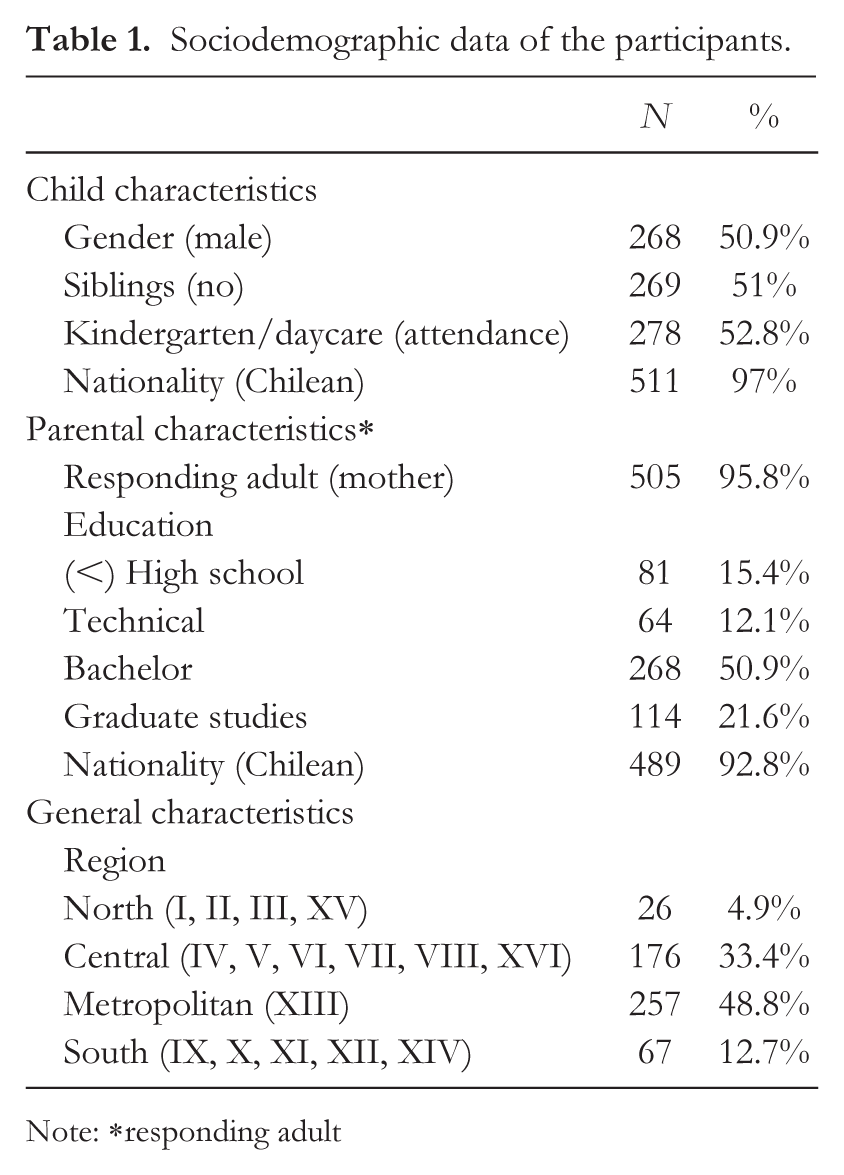
The sample consisted of parents/caregivers with children aged one to six years of age living in Chile, who completed the IMMA-SF online. From an initial sample of 542 cases, only those with complete data sets were selected. The final sample includes responses from 527 caregivers (father, mother or foster caregiver) with children between one and six years of age (M = 41.8 months, SD = 20.2, range 12–83) residing in any of the regions of Chile. In addition, they could complete the questionnaire again or ask another caregiver to complete it for a second child if they wished. The sociodemographic data of the participants are presented in Table 1.
Sociodemographic data of the participants.
Note: *responding adult
Most responses were obtained from mothers, with only 1.7% (n = 9) provided by fathers, 2.1% (n = 11) by another family main caregiver and 0.4% (n = 2) by a non-family main caregiver. The nationality of most children is Chilean, with only 1.3% of the parents reporting children holding a different nationality (all from other Latin American countries) and 1.7% reporting a second nationality/ethnicity (two Mapuche, three from other Latin American countries, four from European countries). Lastly, in 3.6% of cases, the participating adult reports that one of the parents is of a nationality other than Chilean (15 from other Latin American countries, four from European countries), while in 3.4% of cases, both parents have a different nationality (17 from other Latin American countries, one from Belgium). No significant differences were found in sociodemographic variables between mothers vs. other caregivers, as well as between Chilean vs. foreign caregivers.
Procedure
The study was approved by the Ethics Committee of the Faculty of Medicine of the University of Chile (CEISH, N° 203-2019), and the main author of the original version gave consent to conduct the translation and validation process in Chile.
Following Sperber’s (2004) procedure for cross-cultural research, all items were translated from German to Spanish and then back-translated from Spanish to German by two different people with knowledge of the topic, both languages and both cultures (i.e., a German psychologist living in Chile and a Chilean mother living in Germany). The back-translated version of each item was then compared with the original version by 10 native German speakers on two dimensions: linguistic comparability and similarity of interpretability (for details, see Sperber, 2004). Items identified as problematic were revised, and the process was repeated until an adequate version was obtained. Finally, the Spanish items were completed by two Chilean mothers who provided feedback on the wording of the items and the ease of understanding the questions.
Once the final Spanish version was obtained, parents were invited to participate virtually by sharing a publication through social networks (e.g., Instagram, Facebook, WhatsApp). All caregivers participated on a voluntary basis and gave their consent before the start of the assessment. Participants were consulted on sociodemographic aspects, daily family functioning and the IMMA-SF items.
Instrument
The IMMA questionnaire was developed in Germany (Bechtel-Kuehne et al., 2016; Pauen et al., 2019). The short form (i.e., IMMA-SF) has recently been validated and contains 75 items suitable for parents of children between one and six years of age (for details and a list of items, see Pauen et al., 2025). The IMMA-SF consists of three parts and 17 subscales, which are described below.
In Part 1, parents are asked how well children of the same age as their own child are able to deal with internal challenges (i.e., coping with own needs, emotions, impulses) and external requests (i.e., responding to demands or restrictions of others) and how important they consider self-regulation skills to be for child development. It consists of 16 items grouped into four factors: (F1.1) Ideas & Goals about Child SR (self-regulation) when Dealing with Internal Challenges, (F1.2) Ideas & Goals about Child SR in Social Relations, (F1.3) Goals about Child SR when Dealing with Demands and (F1.4) Ideas about Child SR when Dealing with Demands. In Part 2, parents describe how their child reacts when being frustrated or when asked to follow instructions or prohibitions, by answering 31 items grouped into seven factors: (F2.1) Compliance after Insisting on Demand, (F2.2) Negotiation with Caregiver, (F2.3) Evasion of Caregiver Demands, (F2.4) Goal-Perseverance, (F2.5) Emotional Dysregulation, (F2.6) Compliance under Physical Pressure and (F2.7) Immediate Compliance. In Part 3, parents are asked about their own behaviour (co-regulation, CR) when their children are frustrated and when they follow or disobey instructions, including 28 items grouped into six factors: (F3.1) Use of Rewards, (F3.2) Strictness, (F3.3) Social Appreciation, (F3.4) Negotiation with the Child, (F3.5) Withdrawal and (F3.6) Distraction. Parents respond to each item on a six-point Likert scale (1 = ‘not true at all’ to 6 = ‘completely right’ in Part 1; 1 = ‘never’ to 6 = ‘always’ in Parts 2 and 3).
Data analysis
All data analyses were performed using R Statistical Software. Confirmatory Factor Analyses (CFA) were conducted separately for each part of the IMMA-SF to test whether the above item-scale assignments showed adequate fit in the Chilean population. A second-order model was tested using the package Lavaan for structural equation modelling (Rosseel, 2012). According to the Mardia test, and as is usual for categorical data, the data did not meet multivariate normality in terms of both skewness and kurtosis. Therefore, as a robust estimator that does not assume that the variables are normally distributed, the weighted least square mean and variance adjusted (WLSMV) estimator was used (Brown, 2006). Reliability evidence was obtained through internal consistency analysis by calculating Omega (Geldhof et al., 2014) for each IMMA-Part and factor. CFA was chosen over EFA (i.e., Exploratory Factor Analysis) because the questionnaire has already been tested in populations from different countries (e.g., Pauen et al., 2025), including a small sample in Chile (Mata & Pauen, 2023). Thus, it can be assumed that the theoretical construct is already established and what needs to be measured is the relationship between the items and the construct (e.g., Knekta et al., 2019).
Cross-age comparisons and differences due to parental education level and family income in mean factor scores were performed with MANOVA (Pillai) analyses by IMMA-Part to control for the family error rate. If a given MANOVA was found to be significant, additional post hoc tests were tested. To assess significant differences by child gender, kindergarten attendance and sibling status, participants were divided into two groups (i.e., boys–girls, attendance–nonattendance, siblings–no siblings) and T-Test or Mann-Whitney-Wilcoxon was performed based on whether normality requirements were met.
Finally, multiple regression analyses were carried out to assess the predictive power of the sociodemographic variables. The following tests were used to check the assumptions: Durbin-Watson test (independence of errors), Breusch-Pagan test (homoscedasticity), Shapiro-Wilk (normality of residuals) and Cook’s D (outliers). Assumptions were met in all models except for the normality of residuals in two models (Compliance after Insisting on Demands, Strictness), a violation that is not critical when it comes to large samples according to the Central Limit Theorem (CLT; Islam, 2018).
Results
The first part of this section briefly presents the results of the CFA examining the scale structure of each IMMA-SF part. Following, differences in mean scores between age groups and sociodemographic variables were tested for statistical significance. The final section presents the regression results considering only relevant variables.
Confirmatory factor analysis
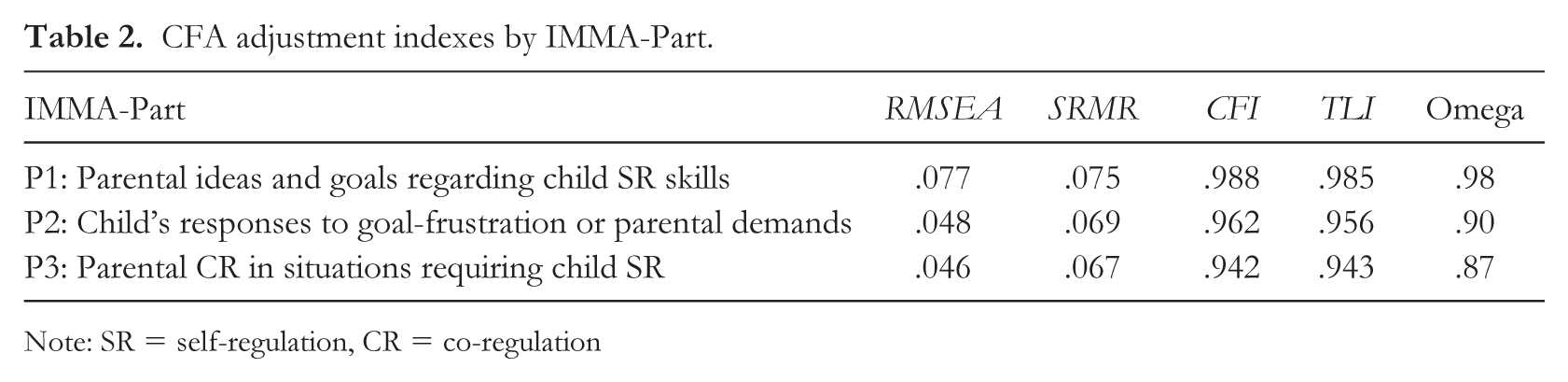
The IMMA-SF factorization revealed a good fit in the Chilean sample, as indicated by the largely adequate fit indices by IMMA-Part (see Table 2).
CFA adjustment indexes by IMMA-Part.
Note: SR = self-regulation, CR = co-regulation
RMSEA indices were either acceptable (i.e., < .08) or excellent (i.e., < .05; Brown & Cudeck, 1993). SRMR indices were adequate in all cases (i.e., < .10; Schermelleh-Engel et al., 2003). CFI and TLI were excellent in most cases (i.e., > .95; Bentler, 1990; Tucker & Lewis, 1973). Internal consistencies of all subscales ranged from good to high (α = .81 to .97; Geldhof et al., 2014). Correlations between subscales were high for Part 1 (r = .67 to .79) and low to moderate for Parts 2 and 3 (r = .01 to .57; for details, see Supplementary Materials Tables A.1–A.3).
These results show that the translated version of the IMMA-SF is suitable for use in the Chilean population and can be used to assess self- and co-regulation strategies in caregiver–child dyads during early childhood.
Age-related changes
A graphical representation of the changes by subscale across age groups is shown in Figures 1, 2 and 3. Details of the means and standard deviations, as well as the results of statistical tests, are provided in Table B in the Supplementary Material.
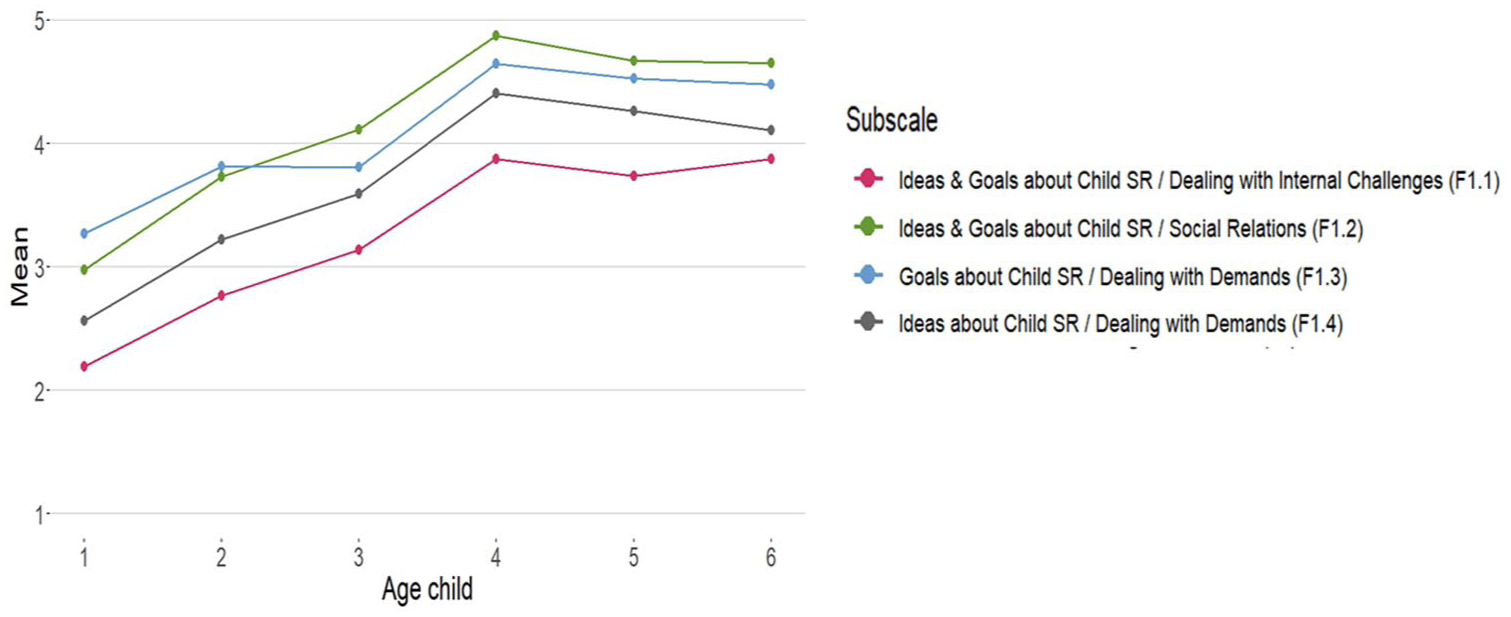
Age-related changes in parental ideas and goals regarding child SR.
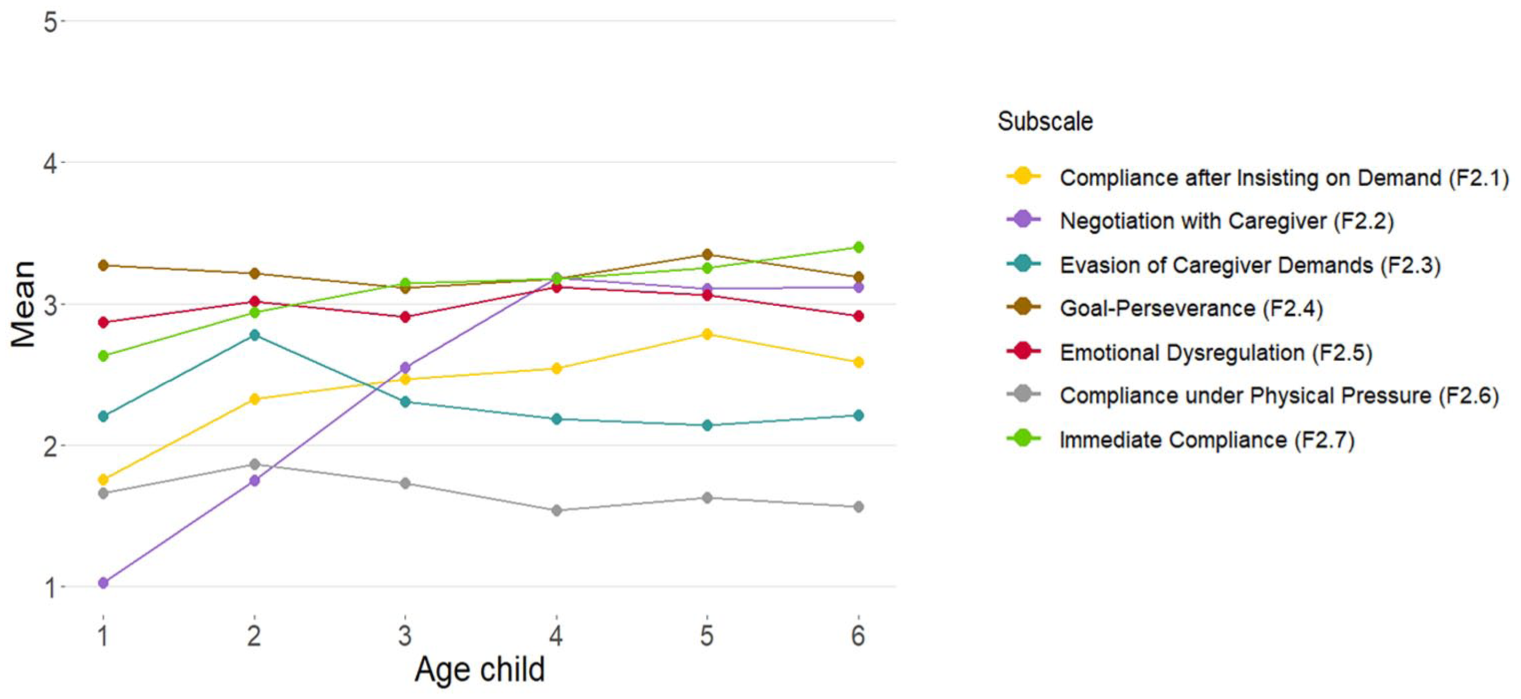
Age-related changes in child responses to goal-frustration and demands.
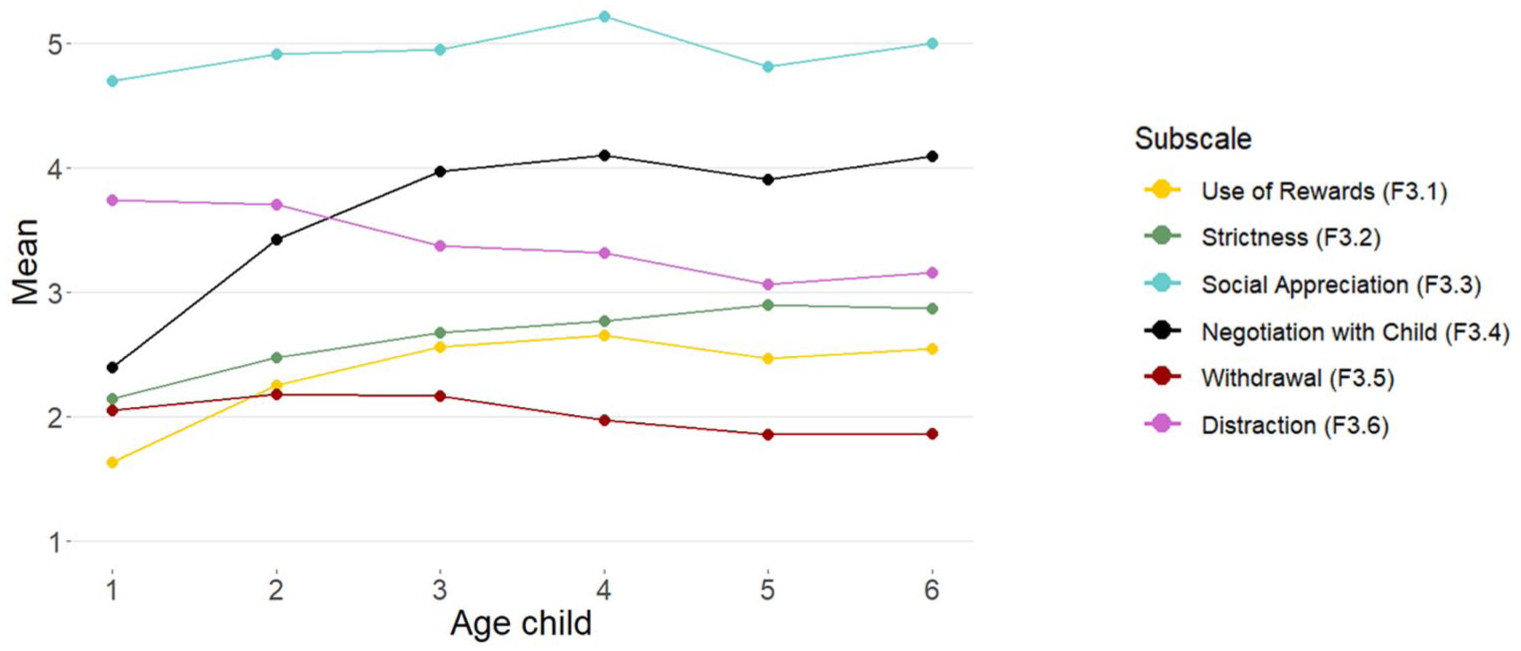
Age-related changes in parental CR strategies in situations requiring child SR.
Parental ideas and goals regarding child SR skills
Overall, parental scores for ideas and goals regarding child SR skills increased throughout early childhood (all p < .01). Particularly after age three, parents reported high expectations regarding children’s ability to adequately handle social relationships (e.g., being polite, treating others respectfully). Additionally, parents reported higher expectations (ideas and goals) for children’s ability to cope with parental requests or prohibitions than for their ability to cope with internal challenges (e.g., responding to goal-frustration, dealing with emotional arousal). Post-hoc analyses revealed that age-related increases on individual subscales were strong during toddlerhood and plateaued after four years of age (see Figure 1).
Child responses to goal-frustration and external demands
According to their parents, children of all ages are highly committed to achieving their own goals (Goal-Perseverance). They would also often become emotionally dysregulated throughout early childhood, showing behaviours such as complaining loudly and becoming aggressive towards objects or people. At the same time, they report an increasing willingness to comply with parental demands as children get older (Immediate Compliance and Compliance after Insisting on Demands; both p < .01), and they begin to negotiate more often (p < .01). Some parents also report using physical pressure in order to get compliance from their children, but the corresponding mean scores remained fairly low at all ages. Lastly, the strategy of Evasion decreased slightly with age (p = .04).
In general, children’s Evasion of Caregiver Demands decreased after the second year of life, whereas Immediate Compliance and Compliance after Insisting on Demands, as well as Negotiation with Caregiver, increased with age. In contrast, Emotional Dysregulation and Goal-Perseverance remained relatively stable at high levels throughout early childhood (see Figure 2).
Parental CR strategies in situations requiring child SR
Social Appreciation was the dominant parental co-regulation strategy at all ages. Parents also reported using Distraction when their children were still young, but scores for this strategy decreased with age (p < .01), as did scores for Withdrawal (p = .02), a strategy rarely used anyway. As their children get older, parents increase the use of Negotiation (p < .01), Strictness (p < .01) and the Use of Rewards (p < .01), although scores for the latter two strategies remained comparably low at all ages.
Differences in mean scores according to sociodemographic variables
To assess potential differences in scores on each of the 17 scales of the IMMA-SF in relation to sociodemographic variables, mean scores for each scale were compared for child gender, kindergarten attendance, sibling status, parental education level and family income. Only significant results are discussed in the following paragraphs (for details, see Tables C to G in the Supplementary Material).
Except for the fact that parents without a university degree reported lower expectations regarding their child’s ability to respond to external demands (p < .01) and used less Negotiation to resolve conflicts of interest (p = .01), results did not differ by parent education level. Nor did any of the factors differ significantly by the child’s gender.
Most of the differences were related to kindergarten attendance, sibling status and family income. Parents whose child attended kindergarten and/or had siblings reported significantly higher expectations for their child’s ability to cope with internal (p < .01) and external demands (p < .01 to .03), as well as to be polite and respectful in social situations (p < .01). Similarly, parental expectations regarding children’s self-regulation skills increased with family income (all p < .01).
Regarding child behaviour, parents reported higher levels of Compliance after Insisting on Demands and using Negotiation as a strategy more often (all p < .01) as children grow older, especially if they attended day care or had siblings. Parents of children attending kindergarten also reported higher levels of Immediate Compliance (p < .01). In terms of family income, parents with higher incomes reported that their children were more likely to use Negotiation when faced with parental demands (p = .02).
In terms of parental co-regulation strategies, parents reported the Use of Rewards (p < .01), Strictness (p < .01) and Negotiation (p < .01 to .02) more often when their child had siblings and/or attended kindergarten. In the latter case, parents were also less likely to report withdrawing their demands (p < .01) and distracting their children (p = .02) compared to cases in which the children did not attend kindergarten. Furthermore, parents with higher family incomes used Negotiation as a co-regulation strategy more often than parents with lower family incomes (p = .01).
Regression analyses
Multiple regression analyses were conducted to compare the predictive power of sociodemographic variables. To keep the analysis simple, the scores for individual scales of Part 1 (Parental Ideas and Goals regarding Child SR Skills) were summed up, which seems justified given the high inter-factor correlations. For Parts 2 and 3 of the IMMA-SF, only variables that correlated significantly with any of the IMMA-SF scales (p < .01) were included (for details, see Table H in the Supplementary Material).
Controlling for child age, higher family income predicted higher Parental Ideas and Goals regarding Child SR Skills (p = .003). On Part 2 of the IMMA-SF, parents of children attending kindergarten and those with more than one child were more likely to report that their child obeyed only after repeated requests (i.e., Compliance after Insisting on Demands; p = .009 to .33) and were more likely to engage in Negotiations to argue/convince the caregiver to get their way (i.e., Negotiation with Caregiver; p = .002 to .23). Parental education had a marginal effect on Immediate Compliance (p = .43), indicating that parents with higher levels of education perceived their child as less compliant. In Part 3, parents adapted their strategies primarily based on their child’s age, and other sociodemographic variables were relevant only in two cases: parents with more than one child were stricter (p = .22) and tended to withdraw their requests more often (p = .002).
Discussion
In recent decades, a bidirectional and contextualized view of parent–child relationships has gained prominence, suggesting that adult and child characteristics play a role and that contextual factors need to be taken into account (e.g., Pauen & the EDOS Group, 2016; Sameroff & Fiese, 2000). For instance, the same practice may be appropriate in one population and inappropriate in another, just as the same parental characteristics may suit some children better than others, depending on the characteristics of the latter. However, instruments that assess child self-regulation do not usually include information on parenting behaviours and do not always allow for the monitoring of changes over the course of development. To fill this gap, this article presents the Spanish translation and validation of the IMMA-SF (Pauen et al., 2025). The IMMA-SF assesses (1) parental expectations and goals regarding child self-regulation, (2) child responses to goal-frustration and parental demands and (3) parental co-regulation strategies related to these situations.
Given that the IMMA-SF is already available in several languages (English, German, Polish, Danish, Italian, Japanese), one of the main aims of the current article is to provide the validated version of the Spanish version in order to promote future cross-cultural research. The following sections discuss the results of the validation process and the changes according to the child’s age, before moving on to a general discussion.
Translation and validation process
The items were translated according to the recommendations for cross-cultural research in order to obtain a Spanish version of the IMMA-SF (Sperber, 2004). The process included the translation from German to Spanish and the back-translation by a different person. Both versions were compared by native German speakers, and the final version of the items was also revised for comprehension by Chilean mothers.
CFA were conducted using data from 527 caregivers living in Chile (mostly mothers) with children aged one to six years. The results showed a good fit for all three parts of the IMMA-SF (see Table 2) and good to high internal consistencies for all 17 subscales (see Supplementary Materials Tables A.1–A.3), indicating that the instrument is suitable for use in the Chilean context.
Of all three IMMA-Parts, Part 1, evaluating parental expectations of child self-regulation skills, shows the higher internal consistency and inter-factor correlations. In this line, and as previously suggested by Pauen et al. (2025), researchers can decide whether they want to measure the general construct ‘Parental Ideas and Goals regarding Child SR Skills’ by combining the scores of the individual scales.
Reliability evidence presented here shows similar results to those reported in other populations (Bechtel-Kuehne et al., 2016; Pauen et al., 2019, 2025). The high reliability of the instrument in different countries may be enhanced by the specific behaviours described by the items, which also makes it easy to use in populations with different sociodemographic and educational backgrounds and is expected to encourage future studies with larger samples to establish Chilean norms for each scale. However, given the lack of validated instruments in Chile, the usefulness of this study is highlighted as a step forward in the search for quality psychometric evidence.
Parental beliefs and expectations
Chilean parents revealed higher expectations for their children’s ability to follow parental instructions and to behave politely in social relationships than for their ability to manage emotional arousal. At the same time, parents consistently increased their expectations about their children’s self-regulation skills in all domains over the course of development, showing a steep increase between one and four years of age, while remaining largely stable thereafter. These findings are consistent with previous research, including studies applying the IMMA in other countries (e.g., Mata & Pauen, 2023; Pauen et al., 2019).
The role of sociodemographic variables
Parental beliefs and expectations were influenced by family and SES variables. Parents reported higher expectations when children attended day care and/or had siblings, but also when family income was higher. It could be argued that parents are more likely to have more children if their offspring manage to self-regulate well, but it is also possible that children who have siblings and attend kindergarten develop better self-regulation skills because environmental conditions require them to adapt accordingly. Longitudinal studies are needed to determine the causal direction of this relation. No previous research was found that specifically assessed parental expectations of self-regulation and socioeconomic variables. However, differences in socialization goals and beliefs have been reported in the Chilean population, with parents of higher SES prioritizing relational values (e.g., good manners and respect for others) and parents of lower SES prioritizing qualities useful for social mobility (e.g., hard work, thrift; Santander et al., 2020; Villarroel, 1990).
Children’s self-regulation strategies
According to parents’ perceptions, Chilean children are highly committed to achieving their own goals, but their willingness to follow parental instructions increases with age. This trend confirms previous findings (Feng et al., 2017; Kochanska et al., 2001) and is likely due to a combination of maturational processes and social experiences. The results also show a steep increase in the use of Negotiation between one and four years, which could be explained by the progress in children’s verbal skills and the development of theory of mind (for a review, see Stein & Albro, 2001). Somewhat surprisingly, Chilean parents describe their children as showing Emotional Dysregulation quite frequently and to a similar extent across all age groups. However, our findings do not allow us to rule out the causes of this apparent lack of progress in children’s ability to self-regulate emotional arousal. It is possible that changes occur at a qualitative rather than a quantitative level during this age period (e.g., children can cope with more complex situations before becoming dysregulated). Another possible explanation is that increasing parental expectations contribute to their perception of children’s self-regulation as inadequate. Future studies should explore this in more detail.
The role of sociodemographic variables
Except for negotiation skills, children’s behaviour as perceived by their parents was influenced to a lesser extent by sociodemographic variables. Children tend to negotiate more often when their parents have a higher level of education and family income, but especially when they attend kindergarten and/or have siblings. The latter two variables also affect children’s compliance (i.e., Immediate Compliance and Compliance after Insisting on Demands) to different degrees. These results are consistent with previous research showing that children take a more active role in conversations with peers and parents as they get older (Mammen et al., 2019), pointing to the active role of children in shaping their own development and how parents adapt to their children’s growing abilities. The findings reported here support the idea that attending kindergarten and having siblings both have a positive impact on child self-regulation (Alejandro et al., 2016; Melo et al., 2022; Orr et al., 2023; Pike et al., 2005) — at least from the perspective of parents. Given the recent decline in preschool coverage in Chile (Subsecretaría de Educación Parvularia, 2022), this point deserves further consideration.
Parental co-regulation strategies
Consistent with previous studies, parents reported Social Appreciation as their preferred strategy (e.g., Mata & Pauen, 2023; Pauen et al., 2019), reaching a ceiling in the Chilean population. An interesting pattern emerges between the use of Distraction and Negotiation as regulation strategies. Parents of one-year-olds use Distraction as one of their preferred strategies, but from there on they reduce its use and start using Negotiation instead. Given what Silkenbeumer et al. (2016) suggest, this pattern would indicate an appropriate age-related transition that is in line with children’s development and therefore would promote the development of self-regulatory skills. However, starting to use Negotiation at two years of age may be a bit premature, since children at this age still have very limited language skills.
The role of sociodemographic variables
Parents adapted their co-regulation strategies mostly according to their children’s developmental stage, but significant differences were also found for sibling status and kindergarten attendance. When children have siblings and/or attend kindergarten, parents were more likely to offer rewards to promote compliance, set stricter rules and use negotiation as a co-regulation strategy. Parents also tend to distract their children or withdraw their demands to a lesser extent when children attend kindergarten. Moreover, negotiation is a strategy preferred by parents with higher levels of education and family income. All these different findings support the idea that parents adapt their strategies not only to the age of the child but also to the life context (Nelson et al., 2011; Selin, 2014). Thus, future studies evaluating parental strategies should take into account contextual and situational cues. In addition, longitudinal studies are needed to clarify whether parents adapt their co-regulatory behaviour to the children and the context and/or whether children adapt their regulation strategies.
General discussion
Taking into account all the previous findings, three general aspects stand out. First, the lack of significant results related to child gender in contrast to previous studies (Daly & Corcoran, 2019; Gagne et al., 2013). It is possible that differences emerge later in development, but it could also be that societal shifts towards greater gender equality have already impacted early childhood socialization. Indeed, a shift towards more equal parental practices with boys and girls can be observed in recent decades (for a review, see Endendijk et al., 2016).
Second, having siblings and attending kindergarten were the two most important sociodemographic determinants associated with regulation in the caregiver–child dyad. Together with the higher expectations also reported, parents may be more confident in their children’s ability to cope with stressful situations if they have siblings and/or attend kindergarten. The presence of siblings has been shown to have a positive influence on children’s self-regulation abilities (Backer-Grøndahl & Nærde, 2016; van Berkel et al., 2020), but whether kindergarten attendance per se promotes better self-regulation is less clear. Melo et al. (2022) reported that children attending a federal school programme earlier showed better self-regulation skills in the United States, while Dee and Sievertsen (2018) concluded that delaying school entry from six to seven years in a Danish sample was associated with lower levels of inattention and hyperactivity. Therefore, other variables may also come into play, such as the quality of child–teacher interactions, weekly attendance hours, group size or even exposure to green spaces as part of the educational curriculum (Backer-Grøndahl & Nærde, 2016; Melo et al., 2022; Taylor & Butts-Wilmsmeyer, 2020).
In Chile, various studies have evaluated the effects of kindergarten attendance (vs. nonattendance) on the later academic performance (Beas, 2022; Cortázar & Vielma, 2017), but only a few studies have focused on the effects on socioemotional skills. A relevant antecedent for our study is the review by Beas (2022), which concludes that there is no evidence of a short-term positive effect of kindergarten attendance on socioemotional skills. Again, the answer may lie in qualitative aspects, as suggested by Herrera et al. (2008), who found that even when attendance is a positive indicator of child development (cognitive and language skills), those children who attended a high-quality kindergarten (as assessed by the Infant/Toddler Environment Rating Scale-R, Harms et al., 2003) showed better development than those who attended a low-quality institution. Future studies should deepen into qualitative aspects of early education and its impact on children’s self-regulation development.
Third, the link between early self-regulation skills and socioeconomic status has been noted previously (Backer-Grøndahl & Nærde, 2016; Palacios-Barrios & Hanson, 2019), but the complexity of both constructs and the high inequality in Chile (United Nations, 2022) make it difficult to draw clear conclusions. Parents from lower socioeconomic backgrounds in Chile work more hours on average (Andrade et al., 2017) and experience more stressful life events (Vázquez et al., 2007), which may also apply to children (Evans & English, 2003). Given such findings, it is not surprising that high levels of stress and mental health problems have been reported in low socioeconomic populations, aspects that would affect parental functioning and increase the risk of internalizing/externalizing symptomatology in children (Sandoval-Obando et al., 2022; Santelices et al., 2021). Thus, there may be multiple mediators of the relationship between family income and the regulation strategies used by parents and children.
Limitations
The main limitation of the present study is the self-report nature of the data. It is possible that high social desirability is reflected in parents’ reports of their own and their children’s behaviour. Online assessments also introduce a voluntary participation bias (Greenacre, 2016), which is reflected in the almost exclusive participation of mothers, in contrast to the recent trend of fathers becoming more involved in online child-related research (Parent et al., 2017). Thus, even with a large sample, the results may not be representative of the entire Chilean population. A second limitation relates to the lack of control for biological and genetic variables, which are known to play a relevant role in the development of children’s self-regulation (Lemery-Chalfant et al., 2008; Willems et al., 2018). Finally, all data were collected cross-sectionally using a single instrument. It is, therefore, possible that the associations between variables are overestimated. Future studies should include different methodologies that allow for more complex statistical designs and give priority to longitudinal designs to assess the temporal stability of measurement. A corresponding longitudinal study (i.e., BRISE; see website https://www.brise-bremen.de) is already underway in Germany.
Conclusions and future directions
The present article introduces the IMMA-SF as a valid tool for assessing child self-regulation and parental co-regulation during early childhood in the Chilean population. The results presented are generally consistent with previous studies on child self-regulation, with most changes occurring between one and three years of age. Social appreciation is the most preferred strategy of Chilean parents at all ages, but they increase the use of negotiation as children get older. Parents mostly adapt their ideas and expectations, as well as their co-regulation strategies, to the developmental stage of their children, but differences were found regarding sociodemographic variables. When their children attended kindergarten or when there was more than one child in the family, parents reported having higher expectations for their children’s self-regulation skills, and they perceived their children as being more compliant and using more negotiation strategies when faced with a conflict of interest with their parents. As a result, caregivers negotiated more often with their child, set stricter rules and were more likely to use rewards to promote child compliance.
The present findings point to the relevance of contextual and situational cues when assessing child self-regulation, rather than assuming universal standards. The translation and adaptation of the IMMA-SF to multiple cultures invites future cross-cultural longitudinal studies incorporating genetic and biological factors to explore the causal interaction of different variables across development. Both parental and child behaviors, as well as the context in which their interaction unfolds, should be taken into consideration to move towards a more integral understanding of child self-regulation development.
Supplementary Material
Please find the following supplemental material available below.
For Open Access articles published under a Creative Commons License, all supplemental material carries the same license as the article it is associated with.
For non-Open Access articles published, all supplemental material carries a non-exclusive license, and permission requests for re-use of supplemental material or any part of supplemental material shall be sent directly to the copyright owner as specified in the copyright notice associated with the article.
