




Abstract
The objective of this study was to test the effectiveness of a programme for the stimulation of executive functions (Programa para la Estimulación de las Funciones Ejecutivas — PEFEN) in preschool children (aged five years) with no pathologies. A total of 40 children participated. They were distributed into two groups (intervention and control groups) and were evaluated at two different moments in time (before and after the intervention) using the Child Neuropsychological Maturity Questionnaire (CUMANIN) and the Behavior Rating Instrument of Executive Function-Preschool (BRIEF-P). The programme’s duration was three months. The results revealed statistically significant differences between both groups in the subscales of psychomotricity, spatial structuring and visual perception of the CUMANIN as well as in the emotional control subscale of BRIEF-P. In conclusion, the intervention group presented higher scores in different neuropsychological domains related to executive functions. This research seems to suggest that programmes such as PEFEN may be useful to improve and stimulate the EFs of normal developing children who do not present any difficulties.
Executive Functions (EFs) are a set of skills involved in the generation, supervision, regulation, execution and readjustment of appropriate behaviours in order to achieve complex goals or develop action plans (Gilbert & Burgess, 2008). They are essential to a person’s cognitive development from a very young age. Indeed, they make it easier to adapt to new and complex situations, going beyond usual and automatic behaviours, and they allow the establishment of objectives, the development of action plans or the self-regulation of behaviour (García-Molina et al., 2009). They are dependent on three basic types of skills that are already present in the first years of life: inhibitory control (the ability to voluntarily inhibit an automatic response), working memory (monitoring, manipulation and updating of information) and cognitive flexibility (ability to switch between tasks or mental operations) (Diamond et al., 2007). In this sense, EFs contribute to inhibiting irrelevant information and to operating both one’s sustained and selective attention system as well as verbal and non-verbal working memory throughout decision-making processes.
EFs are necessary to develop school skills and to perform school activities, such as planning and temporal organization, identifying key ideas, changing tasks as required or monitoring the work done. On this matter, several studies have shown that EFs are predictors of academic performance and reduce the occurrence of behavioural problems (Cortés-Pascual et al., 2019). Importantly, disturbance or deficits related to these functions could be associated, among others, with attention difficulties in class, problems with completing tasks, not inhibiting impulsive behaviours, impeded ability to acquire new behavioural repertoires, learning demotivation and struggling to meet school requirements (e.g., Morgan et al., 2019). Therefore, the training of EFs is an essential aspect to consider in the curriculum and plays a role in enhancing school performance and reducing social inequalities (Diamond & Ling, 2016).
Neuropsychological assessment at preschool age is essential to detect neurodevelopmental problems and to be able to assess the effect of intervention programmes. There are few tests for the assessment of executive functions in children under six years of age. The BRIEF-P assesses EFs’ behavioural manifestations in preschool children, although it is an indirect measure because it is not completed by the children but by parents and/or teachers (Gioia et al., 2000). The CUMANIN assesses various areas of neuropsychological functioning, including sensory-motor development, memory, learning and language, which are of great importance for detecting possible neurodevelopmental difficulties (Portellano et al., 2000). The CUMANIN is completed by children and includes tasks to assess areas related to executive functions such as spatial structuring, visuoperception, comprehension language and verbal fluency. Along with the assessment of EFs, it is also important to consider other variables that may have a direct influence on them. For example, there are many studies indicating how the educational level of parents (especially of mothers), their intelligence and EF scores may impact on the stimulation levels of the children and thus affect their EF development (Muñoz-Vinuesa et al., 2018; Ribner et al., 2022). The role of EFs and psychopathology is also well known, with recent theoretical proposals suggesting the existence of a relation between EFs, stress and psychopathology due to the role that EFs have in learning and adaptation, as well as in agency and intentional action (Zelazo, 2020).
Nowadays, some specific EF-stimulation programmes for both primary and preschool children have recently been developed (Takacs & Kassai, 2019). Some of these programmes are based on methodologies that include computer tasks, paper and pencil tasks or a combination of both. In some cases, they are (or could be) integrated into the school curriculum (Cardoso et al., 2018). These latter programmes are implemented by the teachers themselves and incorporate activities in which students work simultaneously and globally on multiple aspects of EFs (Cardoso et al., 2018). In addition, they seem to be more generalized due to their more ecological mode of implementation (Traverso et al., 2019). Diamond and Lee (2011) identified different classroom curricula interventions that have proven to be effective for the improvement of EFs: (a) the Tools of the Mind (Tools) based on the use of games for training inhibition, memory, flexibility and creativity; (b) the Montessori approach, which includes activities not directly related to EFs as well as active meditation; (c) the Promoting Alternative Thinking Strategies (PATHS) focused on self-control, regulation of emotion and interpersonal problem-solving; and (d) the Chicago School Readiness Project (CSRP), whose objectives were stress regulation and behaviour management. However, a recent review highlights how these kinds of interventions are scarce, especially at preschool, due to their relative novelty (Cardoso et al., 2018).
Initial indications of the utility of these interventions in Spain were recently published. For example, Romero-López et al. (2021) showed the efficacy of an EF-stimulation programme (Programme for the improvement of executive functions in Preschool; EFE-P) in children aged five and six years who were evaluated using the Behaviour Rating Inventory of Executive Function-Preschool Version (BRIEF-P). For instance, Cruz-Quintana et al. (2014) develop a specific EF-stimulation programme integrated into the school curriculum (Programa para la Estimulación de las Funciones Ejecutivas — PEFEN) which has been proven to be useful and effective in preterm infants, aged four and five years, to improve motor, neuropsychological and behavioural aspects (García-Bermúdez et al., 2019). These types of programmes are highly cost-effective and the teacher training required is simple and intuitive.
The PEFEN programme is based on the EF theoretical models of Diamond and Lee (2011) and the rehabilitation model of Shonkoff (2011), according to which not only should children’s learning conditions be facilitated but concrete skills and training for children should also be implemented to strengthen development, avoiding the effects of ‘toxic stress’. EFs reach their peak development between 12 and 18 years of age but are present from the earliest years of life (Diamond et al., 2007). Not only do many children start school already deficient in the necessary executive function skills, but also research has shown that preschool children who are at risk due to economic disadvantage have low executive functions relative to other cognitive functions and relative to children from middle-class homes. These are children who fall progressively further behind in academic achievement over the school years. Early training focused on improving these skills is essential to enhance school performance and reduce social inequalities (Diamond, 2013). PEFEN’s approach to stimulate EFs is based on the construction of different types of group and individual activities that integrate several of its components: working memory, inhibition/self-control and flexibility.
Furthermore, the PEFEN programme provides a conceptualization of the components that require practice (operationalized through demands that become progressively more difficult) and incorporates tasks that involve changes, are dynamic, have to be carried out quickly and/or are novel for children García-Bermúdez et al., 2019). The programme is divided into five modules with specific tasks for each one. The activities are programmed to increase in difficulty each month, and group activities and individual activities are scheduled for each child. The characteristics of the programme tasks can be summarized as follows: (a) to make it possible to play with ideas; (b) to take time to think before acting (turns); (c) to make possible a challenge to measure anticipation or inhibitory control; (d) to involve games where children must inhibit their behaviour and thus measure their resistance; (e) to maintain concentration and working memory; (f) to involve creativity activities; (g) to promote cognitive flexibility where the child must adopt different perspectives on objects and/or situations and make changes quickly; (h) to include tasks in which children can make mistakes and thus enable the exercise of recognizing them and restructuring new responses; and (i) to include tasks focused on inhibiting attention/action, thoughts and emotions. Mindfulness is included because it has been shown that its practice in school-aged children favours the development of EFs, especially changes in behavioural regulation, metacognition and overall global executive control (Flook et al., 2010). The exercises proposed within this category are diverse, but they all share the training of attentional functions in the present moment.
The usefulness of this programme has not yet been tested in educational contexts with children without pathologies. The objective of this study was to verify the effectiveness of the PEFEN programme in preschool children without neuropsychological difficulties. Following previous studies (Diamond & Lee, 2011; García-Bermúdez et al., 2019), improvements in core EFs (such as flexibility, inhibition and working memory) and other neuropsychological variables associated with them were generally expected in children who participated in the PEFEN programme (intervention group) compared to those who undertook curricular activities (control group).
Materials and methods
Participants
An intentional sampling was conducted in which 46 children from two classes of children aged five years in an early childhood school in Granada province (Spain) initially took part. As the study unfolded, three participants dropped out due to a change of school and another three were excluded because they were not native Spanish speakers and had little command of the language (see Figure 1). The final sample was composed of 40 boys and girls aged five years who were distributed as follows: 11 boys (61.1%) and seven girls (38.9%) in the intervention group (class 1) and 14 boys (63.6%) and eight girls (36.4%) in the active control group (class 2). No significant differences were observed between the groups in relation to sex (χ2 = 0.870, p = .564).
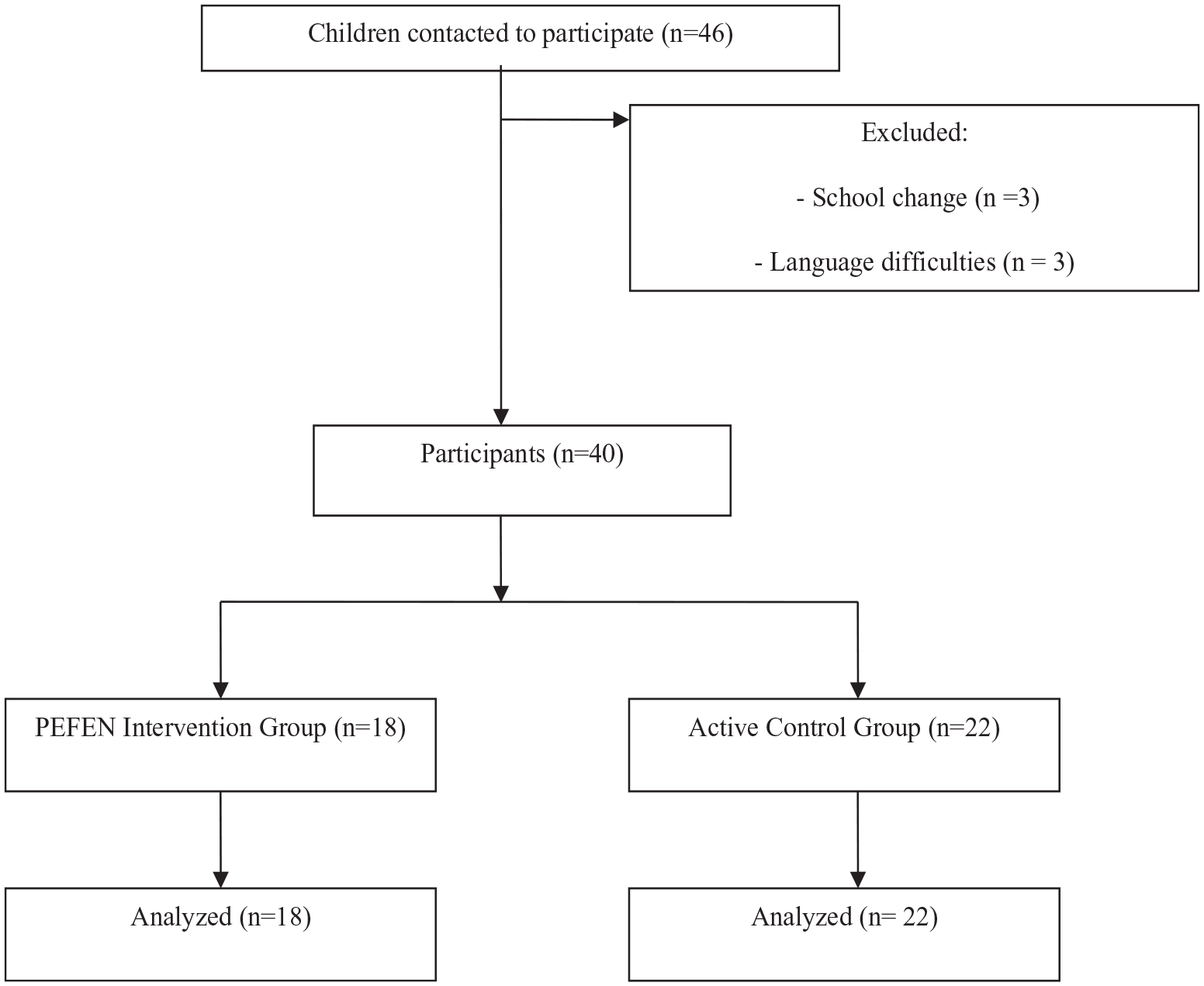
Flow of participants in the intervention and control group.
The inclusion criteria were: (a) to be five years of age; (b) to not present any neurological problems nor any previously diagnosed psychological or learning disabilities; and (c) to have the mother’s informed consent to participate in the study. The exclusion criteria were: (a) could not speak fluent Spanish; and (b) not being able to complete at least 75% of the programme due to illness, travelling or other similar reasons. In addition, all the mothers of the children in both groups had to participate by completing different questionnaires.
Instruments
Instruments completed by mothers Sociodemographic and behavioural data relating to executive functions
An ad hoc survey was designed in which mothers were asked their age, educational level and occupation, as well as a total of 15 of their child’s behaviours linked to attention, impulsivity, frustration, patience, tranquillity, anger, capacity for reflections, emotional regulation, task-switching and problem-solving. Specifically, mothers were asked if in the last three months they had observed changes in their children in behaviours related to EFs (examples: ‘Have you noticed in the last three months if your child is more attentive?’; ‘Have you noticed in the last three months if your child has problems changing activities?’). A final question asked whether the mothers had observed changes in their child’s behaviour in general (‘Has your child’s behaviour improved considerably’; ‘Has it improved’; ‘Has there been no change’; ‘Has it worsened’; or ‘Has it worsened considerably?’). These items collected examples of the activities that had been trained in the programme. The survey had an adequate reliability in the present sample (Cronbach’s α = .70).
G-Factor test
This instrument evaluates nonverbal aspects of intelligence in adults based on four tests (Cattell & Cattell, 1990). In the first, participants have to find out the correct figure in a logical series (‘Series’); in the second test (‘Classification’), individuals have to identify the different figure in a set of five figures; in the third sub-test (‘Matrix’), they have to complete a figure with the option that matches the rest of the elements; in the last test (‘Conditions’), adults choose the figure or drawing that fits the characteristics of an example. Participants had five minutes to complete the first two tests and four minutes for the remaining two. In the present study, sub-tests were taken as a measure of caregiver intelligence. The reliability of the Spanish version fluctuated between α = .70 and .80, with test-retest values of r = .50–.60 (Cattell & Cattell, 1990).
Behavior Rating Instrument of Executive Function-Preschool (BRIEF-P)
This tool enables the assessment of EF behavioural manifestations in preschool children (Gioia et al., 2000). The measure efficiently collects observations from parents and teachers on their children’s self-regulating behaviours in their daily lives in a number of related subdomains, including: difficulties in the ability to inhibit impulses; impediments to changing situation flexibly within a given task or from one task to another; problems in controlling and regulating emotions; struggling to keep information in working memory; difficulties in initiating, planning and organizing problem-solving; monitoring their task’s execution; and behaviour performance. Lower scores indicate better EFs. Recent research confirms the internal consistency of this instrument across all five subscales with a Cronbach’s α between .76 and .95 (Holth-Skogan et al., 2015).
Child Behaviour Checklist for Children aged 1½ to 5 (CBCL)
The CBCL is a self-report instrument that serves to obtain information on aspects related to children’s psychopathology through their caregivers (Achenbach & Rescorla, 2004). This tool, which can be completed within 25 to 30 minutes, evaluates a total of eight dimensions that are grouped into Internalizing and Externalizing Problems. They include: anxiety/depression; isolation; somatic complaints; social problems; thought disturbances; attentional disorders; norm-breaching and aggressive behaviour; as well as Social Competencies through three aspects (activities, social and school dimensions); as well as various problems referred to in the DSM-5. In the present study, only the values prior to the intervention in the dimensions of Internalizing Problems, Externalizing Problems and Total Problems were taken into account as control measures and compared between groups in the initial evaluation. The CBCL showed high test-retest reliability (r = .90) (Sardinero-García et al., 1997).
Instruments completed by children
Child Neuropsychological Maturity Questionnaire (CUMANIN)
This preschool-age neuropsychological maturity test was specifically designed for children aged three to six years (Portellano et al., 2000). It includes a total of 13 scales to assess the level of a child’s neuropsychological maturity, as well as any signs of possible brain dysfunction, especially in cases in which the scores are significantly lower than those corresponding to the chronological age.
This instrument allows one to obtain a developmental quotient formed by the results obtained in eight main scales and five additional ones: (1) Psychomotricity (11 items: e.g., touching the nose with the finger); (2) Language articulation (15 items: e.g., repetition of words with increasing articulatory difficulty); (3) Language expression (four items: e.g., repetition of four sentences of increasing difficulty); (4) Language comprehension (nine items: e.g., answering questions about a story); (5) Spatial structure (15 items: e.g., performing spatial orientation activities with increasing difficulty); (6) Visuoperception (15 items: e.g., reproduction of geometric drawings of increasing complexity; (7) Memory (10 items: e.g., memorizing drawings of simple objects); (8) Rhythm (seven items: e.g., reproduction of rhythmic series of increasing difficulty); (9) Verbal fluency (four items: e.g., forming sentences from various stimulus words); (10) Attention (20 items: e.g., identification and crossing out of geometric figures); (11) Reading (12 items), only for children over five years old; (12) Dictation (12 items), only for children over five years old; and (13) Laterality (17 items) (assessment of the lateral predominance of the hand, eye and foot). In the present study, along with the eight main scales, the attention scale was also included, given the use of mindfulness techniques in the programme. The instrument’s authors obtained Cronbach’s alpha coefficient values that ranged from .71 to .92. It presents adequate internal consistency, a fact which was also reported in studies conducted on the Spanish sample and a validation in the Peruvian population, the α obtained in all studies being above .66 (Portellano et al., 2000).
EF-stimulation programme (PEFEN)
This programme focuses on neuropsychological models (Diamond & Lee, 2011; Shonkoff, 2010) and the use of mindfulness techniques (Cruz-Quintana et al., 2014; Flook et al., 2010). It stimulates children’s EFs through play. The programme is composed of a series of activities that focus on: attentional aspects; working memory; the recognition of errors and restructuring of new responses; the inhibition of attention/action and the inhibition of thoughts or emotions; the continuity of concentration, flexibility, decision-making and creativity; or the ability to adopt different perspectives regarding situations or objects (for a review of the activities, see Cruz-Quintana et al., 2014; García-Bermúdez et al., 2019).
The total duration of the programme was three months and it is composed of five modules, each lasting 30 minutes and containing specific tasks. It was incorporated into the students’ classroom curricular activities. Therefore, it did not lead to any overload and did not interrupt the daily rhythm of the classes. The total duration of the intervention was 30 hours, with 20 sessions per month, i.e., a total of 60 sessions.
There were both group activities and individual activities, which were scheduled to increase in difficulty each month. The programme included two different activities each day (one focused on cognitive training and another on mindfulness). These activities varied throughout the five weekly days to avoid monotony. Examples of the activities included in the PEFEN are: (a) Orchestra: children have to coordinate their actions in order to perform the sound of an instrument; (b) Uses: children have to creatively think of possible uses or utilities of certain objects; (c) The drawing speak: they have to create a story from a set of drawings following specific instructions; or (d) Alternate Categories: children have to give examples of certain categories (such as ‘animal’ or ‘fruit’). A full description of the activities and their difficulty levels can be found in Cruz-Quintana et al. (2014).
Curricular intervention for the control group children
To verify the programme’s effects, the children in the control group performed curricular activities, though the tasks did not specifically target the stimulation of EFs. Examples of these tasks included colouring numbers and letters, reading stories in small groups and watching videos. The control group children engaged in these types of activities in parallel with the intervention group.
Procedure
First, a meeting was held with the mothers of the participating pupils to explain the study’s objectives and procedure. The mothers then completed the BRIEF-P and the G-Factor test.
The teachers of both groups subsequently underwent their training. They followed the course simultaneously to become familiar with the programme, learning about its characteristics and how to implement it in the classroom. This training was provided by psychologists who specialized in child neuropsychology and stimulation.
To start with, participants were assigned to the intervention or control group and completed the CUMANIN for an initial evaluation. The participants never knew the group to which they belonged. Once the children were evaluated, the intervention programme was conducted with the children in the intervention group for three months while the control group participants pursued their normal class activities.
Three months later, the children were re-evaluated with CUMANIN. On this occasion, the mothers were asked to refill the BRIEF-P as well as to answer a survey about their age, educational level, occupation and possible changes in their children’s behaviour.
Data analysis
First, descriptive analyses of means and standard deviations were performed for quantitative variables and frequency analyses for qualitative variables. Differences were analysed using the t-test (for independent samples and quantitative variables) and Chi-squared (for qualitative variables). Second, univariate analyses were carried out in order to check whether there were any differences regarding the measures of interest between the two groups before implementing the intervention. Finally, 2 × 2 mixed ANOVAs were performed and the differences between the Groups (Intervention vs. Control) and Temporal Moment (Pretest vs. Post-test) were evaluated. To measure the group’s effect size, the Cohen delta was used. The data were analysed using the statistical package SPSS 24, the significance level being p < .05.
Results
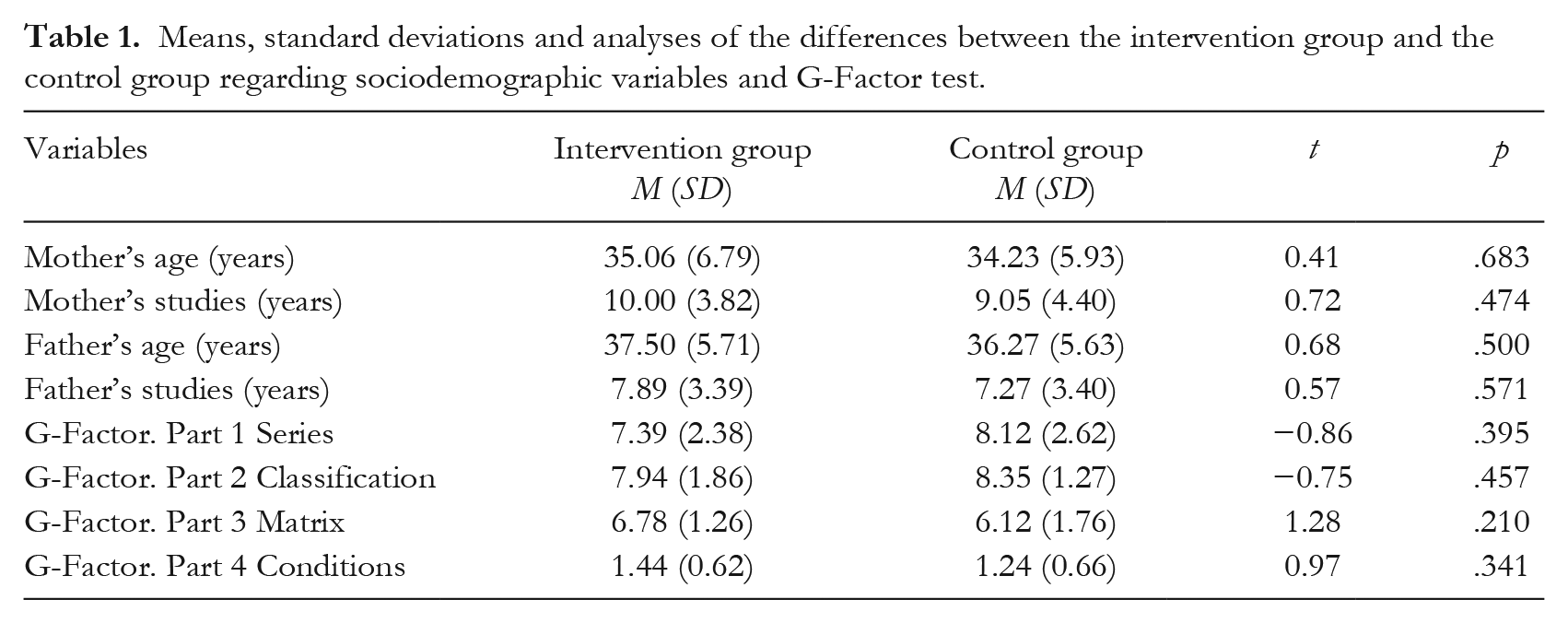
Table 1 presents the descriptive results of both groups with respect to the caregivers’ sociodemographic variables and the mothers’ scores in the G-Factor test. No significant differences were found for any of the variables.
Means, standard deviations and analyses of the differences between the intervention group and the control group regarding sociodemographic variables and G-Factor test.
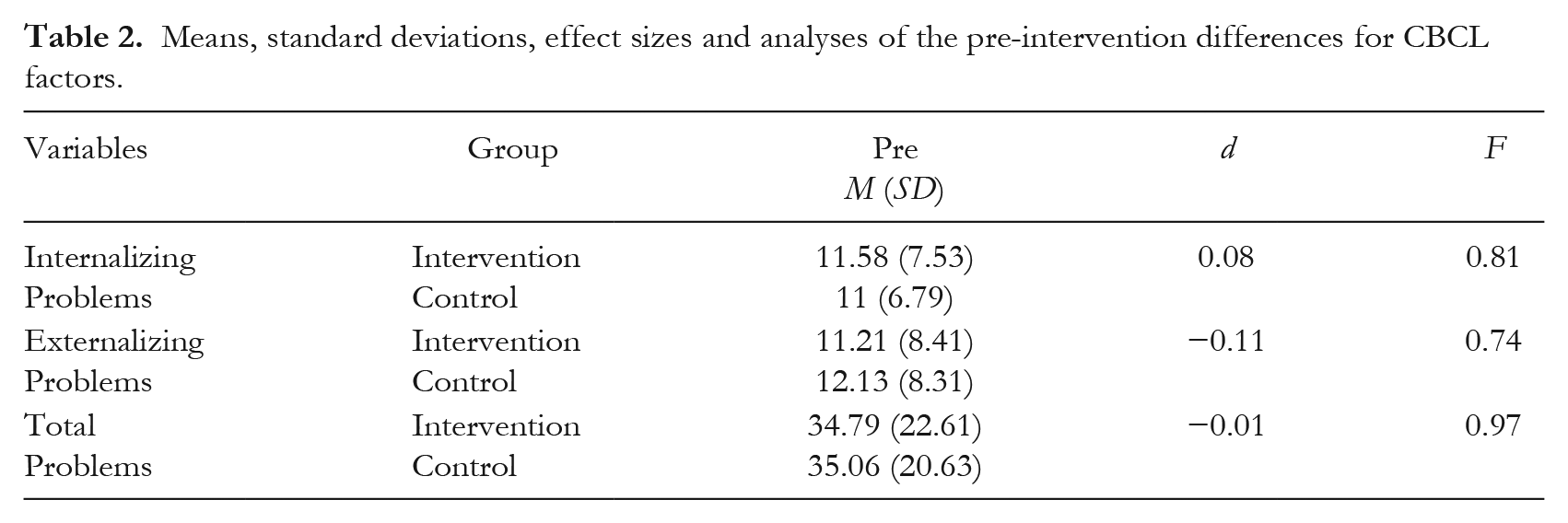
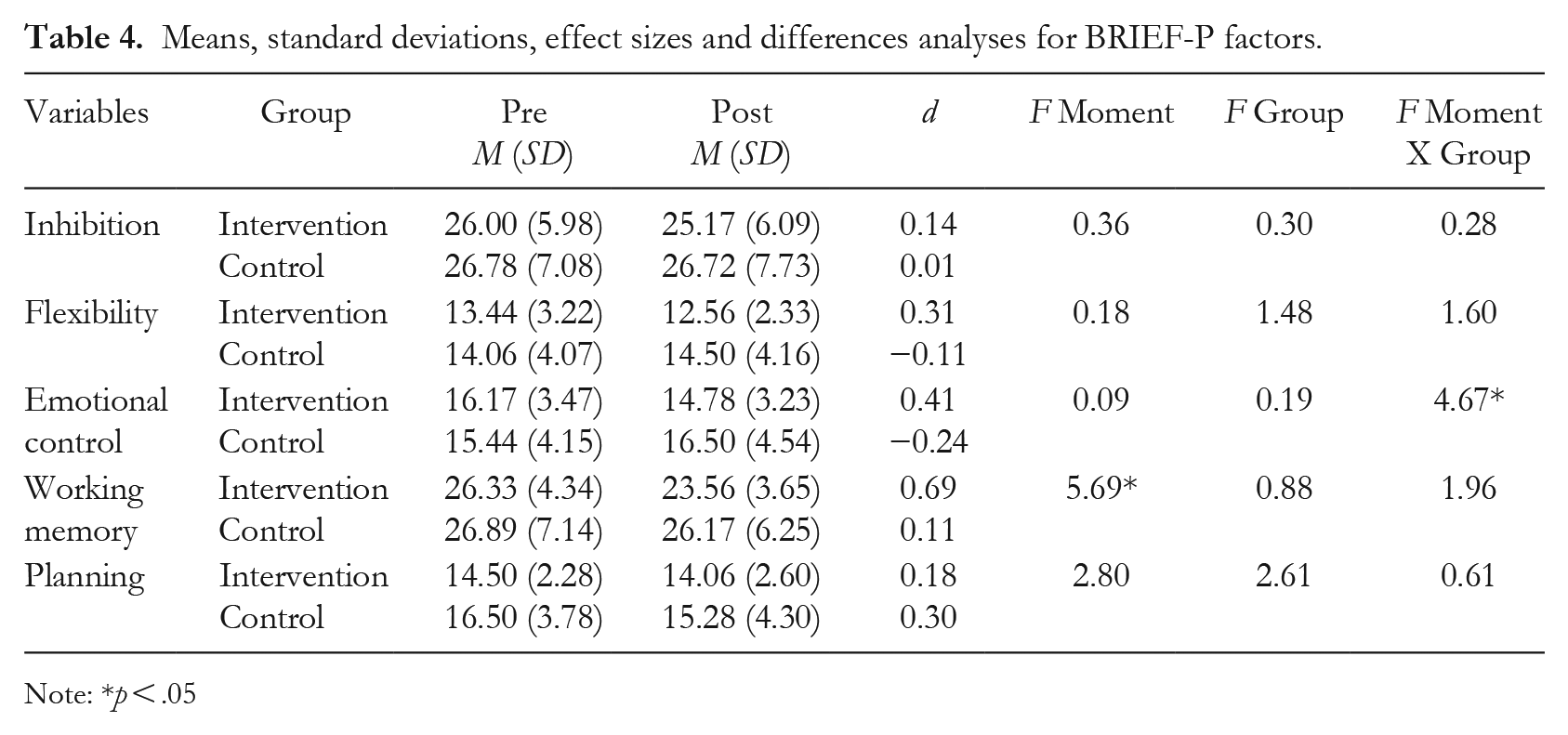
Regarding the ANOVAs performed to check whether any differences existed between both groups with respect to the measures of interest before the intervention, no statistically significant differences were found between the intervention group and the control group in the dimensions of Internalizing Problems, Externalizing Problems and Total Problems of the CBCL (see Table 2) or in the dimensions of the CUMANIN or the BRIEF-P (F < 1; see Tables 3 and 4).
Means, standard deviations, effect sizes and analyses of the pre-intervention differences for CBCL factors.
Means, standard deviations, effect sizes and differences analyses for CUMANIN factors.
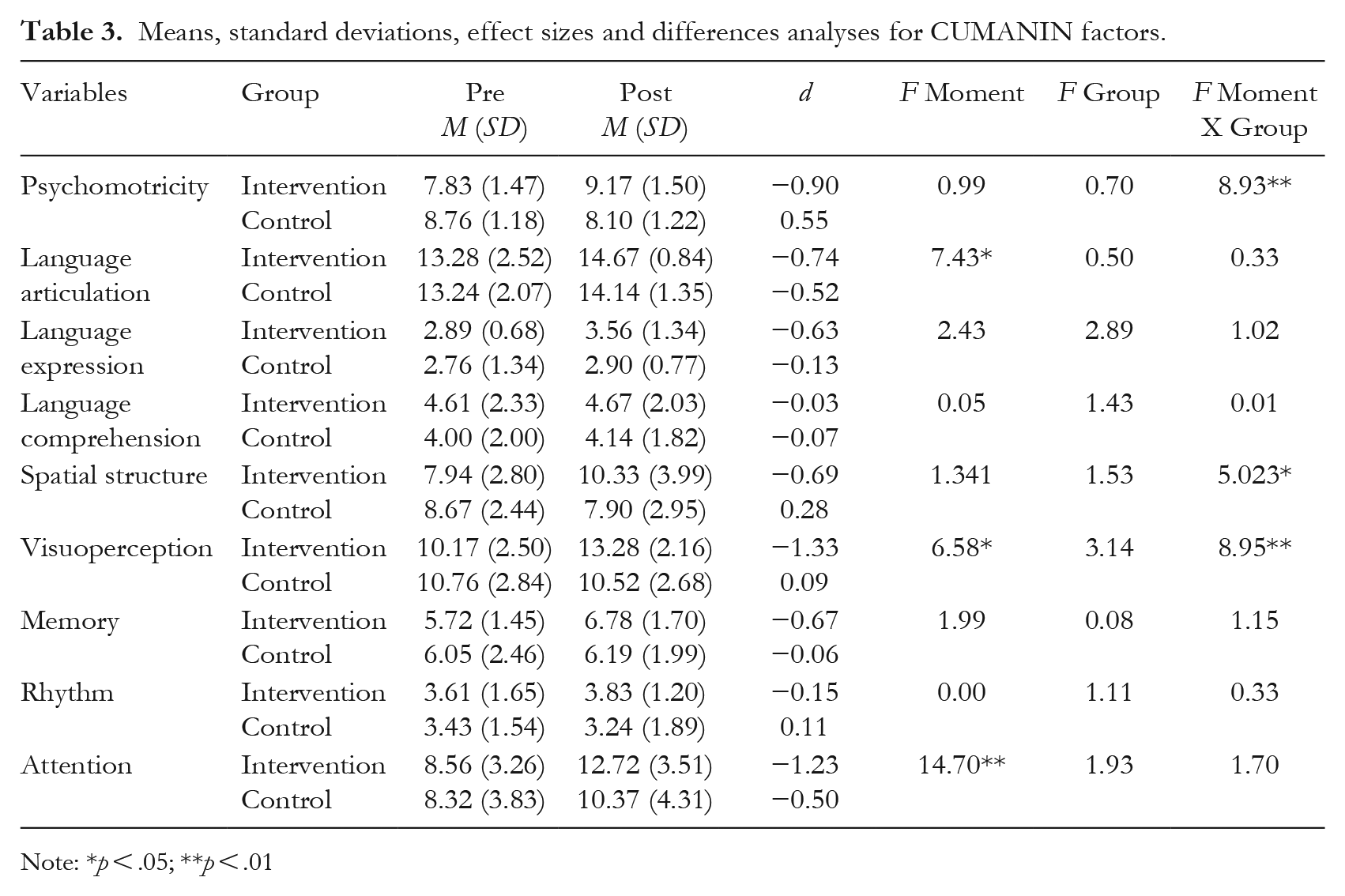
Note: *p < .05; **p < .01
Means, standard deviations, effect sizes and differences analyses for BRIEF-P factors.
Note: *p < .05
Tables 3 and 4 show the means, standard deviations, effect size and the result of the differences between the groups, the evaluation’s moment in time and the interaction of the different variables for the factors collected in the CUMANIN and BRIEF-P.
With respect to CUMANIN, statistically significant interactions (Group × Temporal Moment) were found for the variables of psychomotricity (F(1, 37) = 8.93, p = .005), Spatial Structuring (F(1, 37) = 5.03, p = .031) and visuoperception F(1, 37) = 8.95, p = .005). These results indicated a greater improvement in the intervention group compared to the control group as a consequence of the intervention (pre-post conditions), with a moderate to high effect size for the intervention group (psychomotricity: d = −0.90; spatial structuring: d = −0.69; and visuoperception: d = −1.33).
In addition, effects were found as a function of the Temporal Moment in articulatory language (F(1, 37) = 7.43, p = .010), visuoperception (F(1, 37) = 6.58, p = .014) and attention (F(1, 35) = 14.70, p = .001), indicating an improvement in these variables when comparing the pre-test with the post-test in both groups. The values of the effect sizes in the intervention group ranged from moderate (articulatory language d = −0.74) to high (visuoperception: d = −1.33).
With respect to BRIEF-P, statistically significant interactions (Group x Temporal Moment) were found for the emotional control dimension (F(1, 34) = 4.67, p = .038)). These results indicated a decrease in emotional control scores in the intervention group (d = 0.41), as well as an increase in the control group (d = −0.24). The latter thus indicated improvements in the first versus the second group regarding this variable.
Additionally, differences were found for the working memory factor for the Temporal Moment variable [F(1, 34) = 5.69, p = .023)], reflecting lower scores in the second evaluation with respect to the first one for the intervention group (d = 0.69). The latter suggests an improvement in this variable.
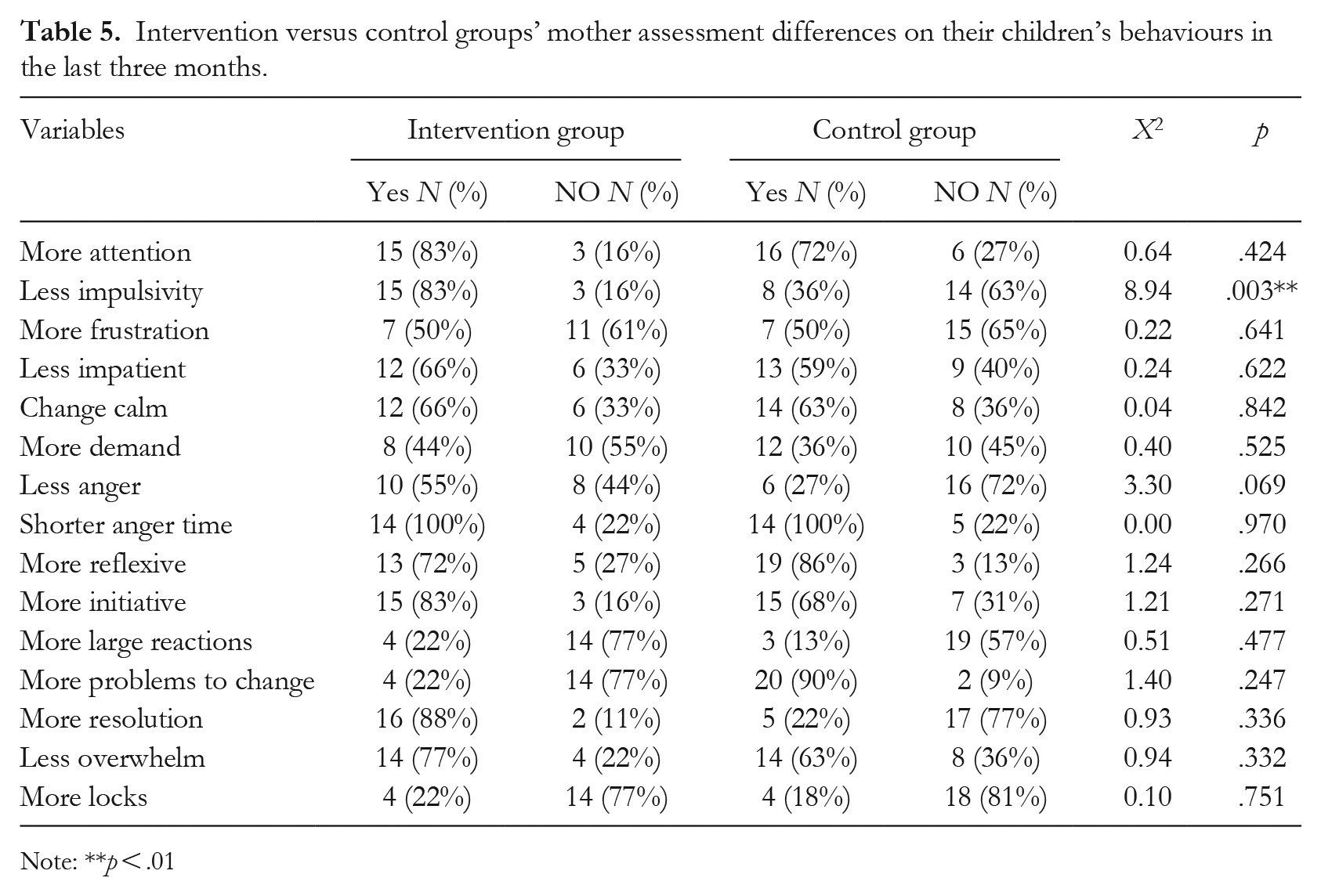
Finally, Table 5 shows the survey results for the items linked to changes in children’s behaviours observed by mothers over the last three months. The mothers indicated whether they had perceived a behavioural change for each item. Significant differences were found in mothers’ perceptions of their children’s level of impulsivity between the intervention group and the control group. The intervention group’s mothers perceived that their children were less impulsive after the programme.
Intervention versus control groups’ mother assessment differences on their children’s behaviours in the last three months.
Note: **p < .01
Discussion
The aim of the present study was to examine the effectiveness of an EF-stimulation programme in preschool children with no neuropsychological deficits. Significant improvements were found for the intervention group versus the control group in variables related to EFs. These results were not affected by the mothers’ level of intelligence (Cattell & Cattell, 1990), the sociodemographic characteristics of the caregivers or by the children’s behaviours (Achenbach & Rescorla, 2004). The results supported the hypothesis that our programme is effective both for the improvement of EFs and other neuropsychological domains in preschool children.
In relation to CUMANIN, results revealed differences depending on the Temporal Moment for the articulatory language, attention, and visuoperception subscales. In line with studies that used the PEFEN programme (García-Bermúdez et al., 2019), an increase was generally observed for the first two subscales over time, also reflecting the critical period of neuropsychological development proper to the evaluated sample. Importantly, improvements were observed in the psychomotricity, spatial structuring, and visuoperception subscales. These results are in line with Aydmune et al.’s (2019) study, which found how an intervention in children aged six to eight years focused on the inhibitory component of EFs produced transfer effects on tasks involving visuo-spatial aspects. Similarly, in Walk et al.’s (2018) programme, improvements in viso-spatial working memory emerged.
Moreover, the results of the BRIEF-P showed an effect depending on the Temporal Moment for the working memory subscale. A reduction in difficulty of the working memory subscale was observed in both groups (more pronounced in the intervention group although not statistically significant). In parallel, more pronounced emotional control was found for the intervention group. In addition, mothers also reported lower impulsivity after the programme. These results are similar to those of other, previous intervention programmes (e.g., Cardoso et al., 2019; Traverso et al., 2019; Walk et al., 2018). For example, Romero-López et al. (2021) carried out an intervention to enhance EFs in preschool children, finding improvements in both working memory and emotional control as well as inhibition, flexibility and planning/organization.
Diamond (2013) notes several characteristics of effective neuropsychological stimulation programmes: (a) the tasks should present an increasing demand for the child; (b) the practice should be repeated; and (c) that it should be integrated into daily tasks and not presented as isolated modules. The PEFEN has been designed following these recommendations and the tasks presented are aimed at training various EFs relevant to the child’s academic and social functioning and adaptation to novel situations. The proposed tasks are attractive for children, favour group work, avoid boredom and allow training more than one function. Moreover, the mindfulness activities are designed to facilitate emotional regulation and concentration. Children who have participated in the PEFEN programme show behavioural changes that reflect these results, specifically in various areas of sensorimotor development (psychomotor, spatial structure and visuoperception) as reflected in the CUMANIN scales. On the other hand, parental evaluation also shows improvements in emotional regulation and impulsivity.
Our results are also in line with those of programmes based on mindfulness-related techniques. Felver et al. (2013) make a distinction between general mindfulness interventions at schools and more specific ones. Despite the evidence supporting the improvements in cognitive and emotional control after these interventions, there is not much literature in the relation between EFs and mindfulness in preschool children (Semple et al., 2017). After implementing a mindfulness-based programme, improvements were found in children’s behaviour regulation, metacognition and overall executive control (Flook et al., 2010).
The present study has relevant practical implications. In this sense, this initiative represents a step forward because it empowers a Spanish population that presents no deficits at a very young age. Implementing a stimulation programme not only allows children to improve skills that contribute to appropriate cognitive development (Morgan et al., 2019), but it also helps to prevent school failure when starting primary school (Quintanar et al., 2008), improving their academic performance and/or reducing possible behavioural problems (Cortés-Pascual et al., 2019).
In addition, previous research using the PEFEN showed that the programme was effective for improving EFs and other neuropsychological domains in preterm children (García-Bermúdez et al., 2019). The results of the present study are in line with this, showing that PEFEN may also be useful for children who do not present any neuropsychological deficits. Moreover, the initiative could help to detect a range of early alterations to executive development. Finally, since the programme is integrated into the curriculum, it is pertinent to work on EFs at these stages (Cardoso et al., 2018) and it could be conducted by the teachers themselves, saving costs and time, making it, in turn, more ecological (Traverso et al., 2019).
The study presents several limitations. First, the sample size was limited and the pupils were selected from a single school. Future studies should apply the PEFEN programme to a larger and more heterogeneous sample. Second, the study did not explore the possible effects of the intervention over time. Given the relevance of these programmes on executive functions, it would be fruitful to evaluate children three or six months later and to examine the medium-/long-term impact. On the other hand, an evaluation of the efficacy of teachers’ implementation has not been carried out. It would be necessary to test whether there may be relevant differences in the results due to factors related to teacher differences. Finally, some of the findings were recorded using instruments designed ad hoc. Future research should include other standardized measures and/or use complete neuropsychological batteries (e.g., Battery for the Neuropsychological Evaluation of Children: BENCI; Cruz-Quintana et al., 2013).
To conclude, the results of this study are promising and seem to suggest the efficacy of the PEFEN programme to stimulate the EF skills of preschool children presenting no neuropsychological difficulties. However, the results presented should be replicated with a larger sample size from different schools. These findings should be taken into account in future interventions to facilitate the development of executive functions in early children.