




Abstract
Understanding the function of challenging behaviors is essential for developing effective interventions for individuals with autism spectrum disorder (ASD). To determine the function of challenging behaviors, descriptive assessment and functional analysis can be used; however, there are some strengths and limitations of these methods. The current study systematically compared three assessment methods: (1) descriptive assessment, (2) traditional functional analysis (TFA), and (3) trial-based functional analysis (TBFA). The descriptive assessment was conducted first and served as an initial hypothesis-generating method regarding the function of challenging behaviors. Six male children with ASD, ages 12 to 16 years, participated in the study. Results showed exact correspondence between both types of FAs and between descriptive assessment and FAs for five of the six participants. The TBFA identified behavioral function with strong agreement to TFA, required 77% less time, and did not necessitate repeated reinforcement of challenging behavior. These findings suggest that both functional analysis (FA) methods are highly consistent with descriptive assessment outcomes and that TBFA offers a practical, efficient alternative for practice settings. Implications for practice and recommendations for future research are discussed.
Keywords
Children with disabilities are more likely to engage in challenging behaviors than their typically developing peers (Bakkaloğlu et al., 2019; Jahr et al., 2007; Matson et al., 2008). These challenging behaviors may include self-injurious behaviors (e.g., head banging), aggression toward others (e.g., hitting or biting), disruptive vocalizations (e.g., shouting), and noncompliance (e.g., refusal to follow instructions). Autism spectrum disorder (ASD) may exacerbate children’s tendency to exhibit challenging behaviors, as it adversely affects behavior patterns, communication, and social interactions (Soke et al., 2016). A study on the prevalence of challenging behaviors revealed that such behaviors were exhibited by 94% of children (2.43–18.17 years) with ASD (Jang et al., 2011). The frequency, duration, or resistance of challenging behaviors to intervention may be of critical concern to parents and professionals (teachers, behavior analysts, and therapists; Lew-Koralewicz & Gagat-Matuła, 2021). Over the past two decades, there has been a notable increase in research aimed at understanding challenging behaviors and mitigating their impact on children and their environments (Reyes-Martín et al., 2022; Simó-Pinatella et al., 2019). These studies emphasize that identifying the functions of challenging behaviors is a critical step in their prevention and reduction (Reyes-Martín et al., 2022). Within this framework, functional behavior assessment (FBA) is a systematic process designed to identify the underlying functions of challenging behaviors through empirically supported methodologies. Functional behavior assessment examines the interaction between the individual and their environment by analyzing antecedents and consequences of behavior, thereby identifying the environmental variables that sustain the behavior (Gresham et al., 2001; Hadaway & Brue, 2015). This process is regarded as a fundamental tool for developing effective, individualized intervention strategies grounded in behavioral principles (Gresham et al., 2001).
A typical FBA consists of components such as descriptive assessments and sometimes functional analyses (FAs), depending on feasibility and ethical considerations. Not all FBAs include an FA due to practical constraints, but descriptive methods are commonly employed to gather initial data about behavior function (Oliver et al., 2015). Both types of FBAs often provide preliminary information for developing intervention strategies and play a pivotal role in guiding the overall assessment process (Contreras et al., 2023). Descriptive assessment and FA play a crucial role in behavioral assessment by facilitating the creation of effective, individualized, function-based intervention strategies (Kestner & Peter, 2018).
Descriptive assessment encompasses both direct and indirect assessment methods and focuses on analyzing environmental and situational factors in detail to identify the possible functions of an individual’s behavior. Direct assessment involves observing individuals within natural settings to document the frequency, conditions, and context of challenging behaviors. This method provides detailed information about the sequence of events and is often considered a preliminary step in understanding the function of behavior. Also, indirect assessment gathers information from teachers, parents, or other caregivers to infer possible behavioral functions, without direct observation of the behavior. While such assessments can offer indications about the potential causes of behavior, they typically require validation through direct observation (Hadaway & Brue, 2015). Descriptive assessment does not involve direct experimental manipulation, so it may be limited in terms of accuracy and reliability, although it can provide explanatory insights into the underlying functions of behavior (Sigafoos & Saggers, 1995). In such instances, FA is favored for its systematic and causal approach to identifying the relationship between behavior and environmental conditions (Iwata et al., 1982).
Functional analysis involves observation of behavior under experimentally manipulated conditions to test specific hypotheses and is widely recognized for its high levels of validity and reliability (Schmidt et al., 2014). Introduced by Iwata and colleagues (1982), FA systematically manipulates environmental variables to identify the functions of challenging behaviors and examines their occurrence across varying contexts. Its evidence-based status is supported by a robust body of research demonstrating its effectiveness across diverse populations and settings (Hanley et al., 2003). Furthermore, FA plays a crucial role in behavioral assessment by facilitating the creation of effective, individualized, function-based intervention strategies (Kestner & Peter, 2018; Saini & Mitteer, 2020). In this respect, FA is regarded as one of the most robust tools within applied behavior analysis (Schmidt et al., 2014). It is one of the first systematic approaches based on direct observation under controlled conditions to identify the functions of challenging behaviors and is therefore referred to as “traditional” in the literature. Traditional functional analysis (TFA), first introduced by Iwata et al. (1982), involves the direct observation of behavior across systematically manipulated conditions (e.g., attention, escape, alone, play) to experimentally identify its maintaining functions. This approach was the first systematic, experimental method developed to uncover the environmental contingencies influencing challenging behavior (Hanley et al., 2003; Schmidt et al., 2014).
Despite its widespread use in identifying the functions of challenging behaviors among children with disabilities (Iwata & Dozier, 2008), TFA presents several limitations. These include procedural complexity, the requirement for trained personnel, children’s exposure to evocative conditions, extended assessment durations, and challenges in implementing test sessions in natural settings (Iwata & Dozier, 2008; Kestner & Peter, 2018; LaRue et al., 2010). Specifically, “children’s exposure to evocative conditions” refers to the deliberate creation of environmental contexts during TFA that provoke or elicit challenging behaviors, such as restricted access to preferred items or attention. This exposure raises ethical concerns because it may temporarily increase the occurrence and severity of challenging behaviors, which can distress the child and place demands on school personnel to respond appropriately. These ethical implications require careful attention, including the use of trained personnel, minimizing session durations, and ensuring that subsequent interventions reduce problem behaviors and support positive outcomes (Iwata & Dozier, 2008; Kestner & Peter, 2018). Also, conducting FA in public school settings presents unique challenges that require careful consideration. Importantly, certain behaviors-such as severe self-injury or aggression directed toward peers or staff-pose significant safety risks that may render traditional in-school FA procedures ethically inappropriate. In such cases, the potential for harm to the child or others necessitates alternative assessment strategies or the implementation of antecedent-based interventions prior to or in place of functional analysis. Ethical guidelines emphasize the responsibility to protect all individuals and advocate for careful risk assessment, use of protective measures, and consultation with multidisciplinary teams when considering FA for high-risk behaviors in schools (Iwata et al., 1994; Northup et al., 1991; O’Neill et al., 2015). Horner (1994) proposed the development of TFA variants to address these limitations, which has led to the emergence of adaptations such as brief FA, single-function tests, single-sequence assessments, precursor FA, latency-based FA, and trial-based FA (Contreras et al., 2023; Iwata & Dozier, 2008; Rispoli et al., 2023). Trial-based functional analysis (TBFA) is the prominent type of FA for determining the functions of challenging behaviors among these alternative FA types (Bloom et al., 2011).
Trial-based functional analysis is a structured assessment method designed to identify the functions of challenging behavior through brief trials embedded within individuals’ daily routines. It is characterized by high feasibility and strong ecological validity, particularly in naturalistic settings such as classrooms or homes (LaRue et al., 2010; Rispoli et al., 2015). While TBFA shares the core principle of directly testing environmental contingencies that evoke challenging behaviors, it differs from TFA in that it is implemented within familiar routines and environments rather than under highly controlled experimental conditions. While TFA involves systematic manipulation of antecedents and consequences in controlled settings by trained professionals, TBFA can be conducted by teachers or family members without requiring clinical expertise or specialized equipment (Sigafoos & Saggers, 1995). The integration of TBFA into natural contexts makes it more accessible and less intrusive for children, thereby offering both practical and ethical advantages. Although TBFA may not match TFA in terms of methodological rigor, its ease of implementation and contextual relevance make it a valuable alternative for TFA in natural settings (Austin et al., 2015).
Traditional functional analysis is considered a well-established and scientifically robust approach due to its systematic manipulation of environmental variables, which allows for the identification of behavior functions with a high degree of accuracy (Gresham et al., 2001). However, its practical implementation is often constrained by factors such as time demands, the need for trained professionals, and limited feasibility in naturalistic settings, especially in schools or home environments (LaRue et al., 2010). In response to these limitations, TBFA was introduced as a more accessible and resource-efficient alternative, offering structured yet brief test trials that can be embedded into daily routines and implemented by teachers or caregivers in natural contexts (Rispoli et al., 2015; Sigafoos & Saggers, 1995).
A growing body of research indicates that both TFA and TBFA yield consistent and reliable outcomes in identifying behavioral functions. For instance, studies conducted by LaRue et al. (2010), Bloom et al. (2011), and Apaydın and Aykut (2018) demonstrate that the outcomes obtained from TFA and TBFA are highly consistent and mutually supportive, particularly in educational settings, with TBFA offering superior feasibility and ecological validity. While both approaches are effective, TBFA’s flexibility and ease of implementation in applied contexts enhance its practical utility. Nevertheless, researchers caution that TBFA may inadvertently reinforce challenging behaviors or lack the methodological precision of TFA in certain contexts (Contreras et al., 2023; Rispoli et al., 2023). Consequently, selection between TFA and TBFA should be guided by contextual demands and population-specific needs, and some scholars advocate for a combinatory application to produce more comprehensive and context-sensitive assessments (Chandler et al., 1999).
Evidence from studies comparing TFA and TBFA suggests that TBFA may serve as a feasible alternative in certain contexts. However, these studies also indicate that the outcomes of the two types of FA do not always align perfectly. Therefore, selecting the type of FA requires careful consideration of the specific advantages and limitations of each approach, in relation to the assessment context and objectives (Apaydın & Aykut, 2018; Rispoli et al., 2015). Traditional functional analysis typically involves extended periods of observation and data collection, which may be necessary for developing precise function-based interventions. In contrast, TBFA is designed to produce quicker results and may be more practical in applied settings with time or resource constraints. Nonetheless, due to its brief nature, TBFA may not capture all relevant variables with the same depth and accuracy as TFA, and its outcomes should be interpreted with caution and confirmed through additional observation or assessment. While the literature shows acceptable correspondence between the two methods, further research involving diverse populations and cultural contexts is essential to strengthen the generalizability of findings (LaRue et al., 2010; Rispoli et al., 2015; Ruiz & Kubina, 2017). Based on this requirement, the purpose of the current study is to examine the alignment between descriptive assessment outcomes and those derived from FA, as well as the correspondence between TFA and TBFA in identifying the functions of challenging behaviors in children with ASD. To compare the results of both types of FA, the study addresses the following research questions:
Method
Participants
Six pre-service special education teachers (P-SETs) and their six students with ASD participated in the current study. All P-SETs were in the last years of their undergraduate education. During the second year of their program, all P-SETs completed coursework in applied behavior analysis and classroom management. In their senior year, they completed Teaching Practice I and Teaching Practice II and participated voluntarily in supervised teaching practicals, which included exposure to functional assessment procedures. Children with ASD had been diagnosed by an independent national agency based on the Diagnostic and Statistical Manual of Mental Disorders (DSM), 4th Edition (American Psychiatric Association, 2000/2013) criteria. All students had intellectual disabilities as a comorbid diagnosis; however, they had not recorded IQ scores. Children were identified based on P-SET’s classroom observations and teacher recommendations. Table 1 illustrates the detailed characteristics of participants. After obtaining ethical approval from the Social and Humanities Scientific Research and Publication Ethical Committee, we obtained written consent from the Provincial Directorate of National Education. We got informed consent from all P-SETs and all children’s parents. We used pseudonyms for both P-SETs and children with ASD to protect their anonymity.
Pre-Service Special Education Teachers’ and Children’s Characteristics.
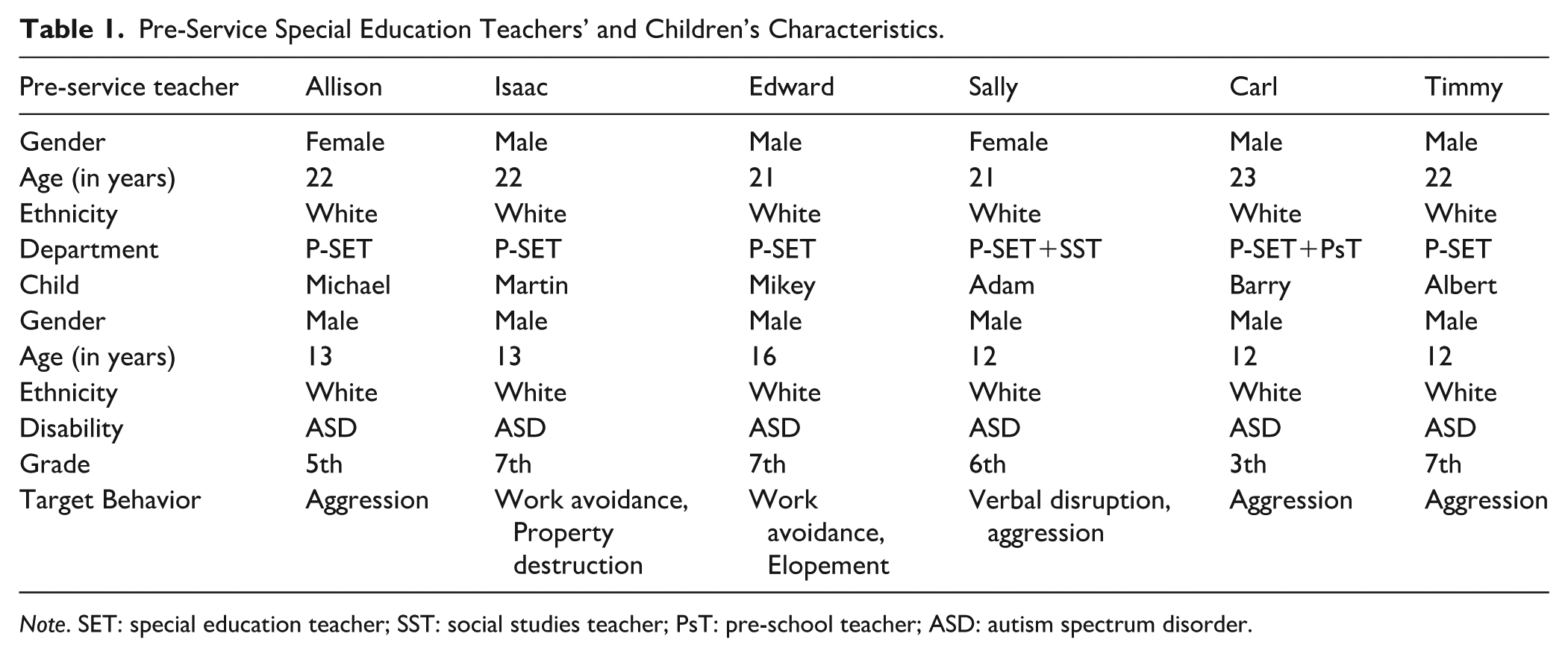
Note. SET: special education teacher; SST: social studies teacher; PsT: pre-school teacher; ASD: autism spectrum disorder.
Settings
We conducted the experimental procedure at the public special education school where the P-SETs were undergoing training and where children with ASD attended. We carried out the TFA sessions in an individualized instruction class once a week. The individualized instruction classroom is physically separate from the main classrooms where the children regularly attend. It is a smaller room (7 m × 10 m) designed to provide focused, one-on-one or small group instruction tailored to individual needs. The TFA sessions were conducted exclusively in this individualized instruction room, and no peers apart from the child participating in the session were present during these assessments. A table, two chairs, and a bookshelf were available in the classroom.
We completed the TBFA sessions in each child’s classroom, one session per week. The number of children in their classes varied from three to five. The TBFA sessions were conducted within the child’s usual classroom setting, where other students (peers) were also present and engaged in typical classroom activities. The size of the classrooms was ~15 m × 10 m. A smart board, a bookshelf, a teacher’s table, and the same number of desks as the number of children were available in classrooms.
The Training of P-SETs
We employed behavioral skills training while teaching TFA and TBFA to P-SETs. The first author conducted the training sessions simultaneously with all P-SETs. The training lasted two sessions (226 min). Behavioral skills training included didactic, modeling, rehearsal, and feedback (Parsons et al., 2012). In the didactic step, the researcher taught the teachers about challenging behaviors, identification of the functions of challenging behaviors, behavioral assessment, and FA processes. The researcher demonstrated video clips of TFA and TBFA sessions in the modeling step. The P-SETs and the researcher implemented the TFA and TBFA during the rehearsal. The feedback included corrective and supportive feedback on the P-SETs’ performances during the rehearsal phase. The researcher provided supportive feedback for the correct behaviors performed by the P-SETs while giving corrective feedback for the incorrect behaviors.
During the rehearsal, P-SETs had to demonstrate 100% accuracy on a detailed fidelity checklist across three consecutive sessions. This checklist was designed to evaluate their implementation of both TFA and TBFA procedures, focusing on critical elements within each. For TFA, the checklist included the following components: (a) correctly implementing the predetermined experimental condition (e.g., attention, escape, tangible, alone), (b) providing noncontingent access to attention or tangibles in control segment delivering the correct antecedent stimuli contingent on the condition, (c) providing or withholding the appropriate consequence based on the participant’s behavior and the specific condition, and (d) collecting data accurately using partial interval recording (e.g., noting the occurrence of target behaviors within the designated intervals). For TBFA, the checklist evaluated (a) correctly setting up the control and test segments; (b) providing noncontingent access to attention, demand, or tangibles in control segment; (c) establishing the motivating operation before beginning test segment; (d) presenting the appropriate task or demand in test segment; (e) delivering the programmed consequence (e.g., removing the task or demand in escape trials) immediately following the target behavior; and (f) accurately recording the presence or absence of the challenging behavior during each trial.
Fidelity data were obtained by direct observation during each rehearsal session, with the first author using a point-by-point coding system to score each step of the procedures as either correct or incorrect. Procedural fidelity was calculated as the percentage of correctly implemented steps out of the total number of steps on the checklist. P-SETs reached 100% fidelity across all checklist items in an average of four sessions (range = 2–6).
The literature recommends providing practitioners with ongoing support following the completion of the behavioral skills training process to transfer the acquired skills to classroom settings (Juarez, 2023). In this study, we did not provide ongoing support to P-SETs since our research does not aim to investigate the performance of P-SETs. However, fidelity data indicated that P-SETs could implement the skills with high implementation fidelity without ongoing support.
Response Definition and Data Collection
We developed a separate operational definition for each child’s challenging behavior and specified observable topographies, onset and offset criteria, and exclusions. For Michael, Adam, Barry, and Albert, aggression was defined as any instance of (a) hitting: rapid forward movement of the hand, arm, or object making forceful contact with another person’s body; (b) kicking: forceful contact between the child’s foot and another person’s body; (c) pushing: applying force with hands or body that moves another person’s body from its original position; (d) biting: closure of the teeth on another person’s skin or clothing; (e) hair pulling: grasping another person’s hair with the hand and pulling such that the hair or head moves; (f) tripping up: contacting another person’s leg or foot with the hand, leg, or foot in a way that disrupts balance or produces a loss of balance; or (g) physically engaging others by grabbing or pulling at another person’s clothes or body with sufficient force to move that person. Each aggressive episode was scored from the moment the child initiated the contact movement toward the other person until contact ceased and the child’s limbs and body returned to a neutral position; accidental contact during routine movement that did not alter the other person’s posture or movement was not scored.
For Martin, property destruction was defined as any instance of (a) throwing objects or materials with enough force that they travel at least 30 cm from their original location; (b) breaking materials such that they become unusable (e.g., snapping, cracking); (c) biting objects such that visible marks, indentations, or damage occur; (d) tearing materials so that they are ripped into two or more pieces; or (e) spilling materials by intentionally overturning or forcefully moving containers so that contents leave the container. A property-destruction episode began when the child initiated a movement that produced one of these outcomes and ended when all objects were stationary and no further destructive action occurred for 5 s.
For Martin and Mikey, work avoidance was defined as behavior that resulted in disengagement from or interruption of an assigned task, including (a) disengagement, defined as the child turning head and eyes away from task materials for at least 5 consecutive seconds while not manipulating materials; (b) distraction, defined as manipulating non-task items (e.g., pencils, clothing, nearby objects) for at least 5 s instead of task materials; (c) avoidance of a task, defined as moving task materials away from the body (e.g., sliding the worksheet aside, pushing materials toward the edge of the desk) or leaving the work area by more than one step; (d) refusal of the activity, defined as physically blocking task materials (e.g., covering them with arms), pushing them away, or emitting clear rejection responses (e.g., pushing the teacher’s hand away, turning the body away from the materials) for at least 3 s; (e) incompletion, defined as ceasing active responding for at least 10 consecutive seconds before the scheduled end of the work period while task demands remain in place; and (f) spending a short time on the task, defined as engaging with task materials for less than 30 s before transitioning to any of the other defined work-avoidance topographies. A work-avoidance episode began when any of these actions first occurred in the presence of a task demand and ended when the child reoriented to the task and engaged appropriately with materials for at least 5 consecutive seconds.
For Mikey, elopement was defined as moving more than 1 m beyond the assigned area or doorway boundary without adult permission, such that at least one foot crossed the boundary line and the child continued walking away from the assigned area. Elopement was scored from the moment the child stepped beyond the boundary until the child returned to the assigned area or an adult physically guided the child back and the child remained within the assigned area for at least 5 s. For Adam, verbal disruption was defined as any instance of (a) shouting, screaming, or crying at a volume clearly louder than conversational speech and audible to others more than 2 m away; (b) grumbling, defined as continuous low-volume vocalizations (e.g., complaining sounds, protest sounds) lasting at least 3 s; or (c) tantrum vocalizations, defined as a sequence of loud crying, screaming, or whining combined with other disruptive body movements (e.g., stamping, arm flailing). A verbal-disruption episode began at the onset of the first disruptive vocalization and ended when no disruptive vocalizations occurred for 5 consecutive seconds.
We collected data using partial interval recording for TFA. Partial interval recording is preferred for TFA primarily because it offers a practical and efficient way to capture behaviors that occur rapidly or have unclear start and end times during longer observation sessions (LeBlanc et al., 2016). The TFA sessions usually last between 5 to 15 min and involve multiple conditions, making continuous, moment-by-moment recording challenging (Schroeder et al., 2014). We divided 10 min into 10-second intervals. Then, we observed and scored the presence and absence of challenging behavior. We converted data into responses per minute by dividing the frequency of responses by the session duration (10 min).
We gathered data employing discrete trial recording for TBFA. Discrete trial recording matches the brief, structured trials of TBFA because each trial is a short, controlled segment embedded within typical routines, allowing for the clear measurement of the presence or absence, and sometimes latency, of challenging behavior in each trial. This method enables rapid and efficient data collection, as staff can record whether the behavior occurs during each discrete trial without the need for continuous observation, making it practical in naturalistic settings like classrooms with minimal disruption to ongoing activities (Kodak et al., 2013). We recorded the presence and absence of challenging behavior in each trial (1-min control and one test session). We converted data into the percentage of trials with challenging behaviors by dividing the number of phases with challenging behavior by the total number of trials.
Procedure
This study applied TFA and TBFA procedures, and the order of analyses was randomized for each child. The TFA was first conducted for Michael, Martin, and Mikey, whereas the TBFA was first carried out for Adam, Barry, and Albert. Before TFA and TBFA, descriptive assessment and preference assessment were completed.
Descriptive Assessment
During the descriptive assessment phase, each P-SET conducted direct observations using the ABC recording. Narrative ABC recording was used because it allows for the direct, descriptive documentation of the antecedents, behaviors, and consequences as they naturally occur, providing rich qualitative information essential for understanding the context and function of the problem behavior (Lanovaz et al., 2013). The P-SETs systematically conducted direct observations using a structured narrative ABC recording format in the students’ natural classroom and school routines. For each episode of challenging behavior, observers recorded (a) the immediate antecedent event (e.g., presentation of a task demand, withdrawal or denial of a preferred item, reduction of attention); (b) a brief, objective description of the target behavior using the operational definitions provided earlier; and (c) the immediate consequence (e.g., removal of the task, access to the preferred item, provision of attention, no programmed change). The antecedent was defined as the environmental event or stimulus change that occurred just before the onset of the behavior, whereas the consequence was defined as the environmental event or stimulus change that occurred immediately after the behavior. When multiple events occurred close together, observers coded as the antecedent the most immediate, discriminable change prior to the behavior (e.g., a new demand or removal of a preferred item) and coded as the consequence the first environmental change following the behavior (e.g., the demand being withdrawn or attention being delivered). Observations were conducted across multiple naturally occurring settings and times, allowing identification of consistent patterns.
The ABC records were then summarized by grouping antecedents (e.g., task demands, removal or denial of tangibles, reduced attention) and consequences (e.g., escape from demands, access to tangibles, attention, no change). For each student, we counted the number of challenging behavior episodes that occurred after each antecedent category and the number that were followed by each consequence category and then converted these counts to proportions of total episodes. Patterns in which specific antecedent–consequence combinations occurred most frequently (e.g., behavior often occurring after task demands and being followed by task removal) were used to generate hypotheses about behavioral function (attention, escape, tangible, automatic), which were later compared with the results of the traditional and trial‑based FA.
Multiple observations (10–15 min) were collected across three different times and environments to capture consistent patterns. The P-SETs analyzed these patterns to identify the likely function of the behaviors. To ensure the reliability of the observations, inter-observer agreement (IOA) was assessed for at least 20% of all ABC observation sessions. First author and P-SET simultaneously but independently recorded ABC events during these sessions. In these sessions, two independent observers simultaneously recorded the antecedents, behaviors, and consequences for the target student.
In addition, the teacher of children with ASD filled out the Motivational Assessment Scale (MAS; Durand & Crimmins, 1988). The MAS is a 16-item questionnaire designed to help identify the function of challenging behaviors in individuals with ASD and other developmental disabilities. The MAS is completed by someone familiar with the child, such as a teacher or caregiver, who rates how often the challenging behavior occurs in specific situations using a 7-point Likert-type scale ranging from “Never” to “Always.” Each item is crafted to assess one of four possible behavioral functions: attention, escape, tangible, or sensory/automatic reinforcement. For example, a sample question targeting attention might be, “Does this behavior occur when you are not paying attention to the person?” For escape, an item could be, “Does this behavior occur when a request or demand is made for this person to perform a task?” For tangible, a question might be, “Does this behavior occur when the person cannot have a preferred item or activity?” For sensory/automatic, an example is, “Would the behavior occur continuously, over and over, if this person were left alone for long periods of time?” By analyzing the pattern of responses, practitioners can hypothesize which function is most likely maintaining the challenging behavior, guiding further assessment and intervention planning (Durand & Crimmins, 1988).
By analyzing patterns in the ABC data and MAS, P-SETs developed hypotheses about the likely function of the challenging behavior (e.g., attention, escape, tangible, sensory/automatic). For example, if a behavior was frequently followed by a demand and was consistently followed by the removal of that demand, escape was hypothesized as the function. These hypotheses were then compared with results from TFA and TBFA to assess correspondence.
Preference Assessment
After the descriptive assessment, each P-SET administered a multiple-stimulus-without-replacement (MSWO) preference assessment to identify the highly preferred items for their student (DeLeon & Iwata, 1996). The MSWO arrays consisted of “6–8” items per assessment, selected in collaboration with teachers and parents based on reported preferences and direct observation. The stimuli included only tangible items such as small toys, drawing materials, and an electronic device. Only tangible items were included in the MSWO arrays; edible items were not used as potential reinforcers in this study. This arrangement avoided the need to manage interactions between hunger/satiation and access to toys, ensuring that preference rankings reflected relative preferences among tangible items only. Each item was placed simultaneously in front of the student, and the student was prompted to “Select one.” Once an item was selected, the student was allowed to interact with or consume it for approximately 30 s, after which the item was removed, and the remaining items were re‑presented in a new, randomized array until all items had been selected. For each student, we used the highest‑ranked stimuli from the MSWO as programmed reinforcers in the tangible reinforcement conditions of the TFA and TBFA. To minimize satiation, we restricted access to these items outside of assessments, limited the number and duration of FA sessions per day.
Functional Analysis
We compared the correspondence between TFA and TBFA for identifying the functions of challenging behavior. In the implementation of FA types, there are differences beyond just session length. The TFA involves longer sessions, typically lasting 5 to 10 min per condition, whereas TBFA uses brief trials of 1 to 2 min. These two methods primarily differ in their structure, setting, and data collection approaches (Apaydın & Aykut, 2018; Bloom et al., 2011; LaRue et al., 2010). The TFA consists of continuous sessions with systematically arranged conditions (e.g., attention, escape, tangible, alone) conducted in a controlled environment. This allows for extended observation of behavior under each condition and typically relies on continuous or partial interval recording to capture behavior rates and patterns. In contrast, TBFA breaks the assessment into brief, discrete trials embedded within the child’s typical daily routine, such as a classroom setting. Each trial includes a test segment with the motivating operation present and a control segment without it. This structure enables rapid alternation between conditions and focuses data collection on the presence or absence of behavior (and sometimes latency) during each short trial, rather than continuous measurement over longer periods. The following is a detailed description of the TFA and TBFA sessions.
Traditional Functional Analysis
We performed the TFA procedure in an individualized instruction classroom within a controlled setting. Each TFA condition lasted for 10 min. The TFA was designed using a method similar to that described by Iwata and colleagues (1982, 1994). Five conditions were employed: tangible, attention, escape, play/control, and ignore. For each participant, we conducted six sessions of each test condition (attention, escape, tangible, and ignore) and six sessions of the play (control) condition, per child. Sessions were presented in a quasi‑random order, with no condition conducted more than twice consecutively, to allow for repeated measurement of behavior under each contingency and visual inspection of differentiation across conditions. For the TFA, functions were identified by visually comparing responding in each test condition (attention, escape, tangible, ignore) with the play (control) condition. A function was assigned only when behavior in a test condition was clearly and consistently higher than in the play condition across sessions.
Tangible
In the tangible condition, the P-SET initially removed all highly preferred items identified in the MSWO from the child’s reach while remaining near the child. If the child engaged in challenging behavior, the P-SET immediately provided access to the preferred item and allowed continuous interaction with it for 30 s, after which the item was again removed. No attention was delivered other than brief neutral statements necessary to implement the procedure.
Attention
In the attention condition, moderately preferred items were available, and the P‑SET stated that they had work to do and turned slightly away from the child, providing minimal interaction. Contingent on challenging behavior, the P‑SET delivered approximately 5 s of attention (e.g., brief verbal comments, eye contact, gentle touch), then returned to the low‑attention posture. No other programmed consequences were provided.
Escape
In the escape condition, the P-SET sat near the child and presented academic demands using the prompting hierarchy described earlier. If the child engaged in challenging behavior, the P-SET immediately removed all task materials, stated that the child did not have to work, and withheld demands for 30 s, after which the task was re-presented.
Play
In the play (control) condition, the P-SET arranged an enriched environment with access to preferred leisure materials identified in the MSWO. The child had continuous noncontingent access to these items and to the P-SET’s attention (e.g., frequent comments, play interaction, and physical proximity) throughout the 10-min session, and no academic demands were presented. Challenging behavior did not produce any programmed change in attention, task demands, or access to items. This condition functioned as the control against which test conditions were compared.
Ignore
In the ignore condition, the child was seated in the same room with no programmed access to tangibles, tasks, or attention; the P-SET remained present but did not interact, and no materials were available. Challenging behavior did not produce any programmed consequence. This condition served as an automatic reinforcement test, in that elevated responding in the absence of social contingencies was taken as suggestive of automatic reinforcement.
Trial-Based Functional Analysis
The TBFA was designed using a method similar to the one described by Sigafoos and Saggers (1995). For each participant, we conducted 10 brief trials of each TBFA condition (attention, escape, tangible, ignore). Each trial consisted of a 1-min control segment followed by a 1-min test segment (except in the ignore condition, which included two identical 1-min test segments), and we summarized data as the percentage of trials with challenging behavior in test versus control segments for each condition.
Within each trial, observers recorded whether the target challenging behavior occurred during the control and test segments (occurrence/nonoccurrence). The primary metric for analysis was the percentage of trials in which challenging behavior occurred in the test segment for each function, relative to the corresponding control segments. A function was considered indicated when the percentage of trials with behavior in the test segment was consistently higher than in the control segment across trials for that condition.
Tangible
In the tangible condition, the 1-min control segment began with the child having noncontingent access to a preferred item identified in the MSWO, whereas the P-SET remained nearby and provided neutral or brief positive attention as needed. Challenging behavior during the control segment produced no programmed consequence. At the start of the 1-min test segment, the P-SET removed the preferred item and placed it out of reach, maintaining proximity but withholding attention. If challenging behavior occurred during the test segment, the P-SET immediately returned the preferred item for the remainder of the segment. If no challenging behavior occurred, the item was not returned. The trial ended at the end of the 2-min sequence
Attention
In the attention condition, the 1-min control segment involved noncontingent attention: the P-SET remained near the child, provided frequent brief comments, and allowed access to moderately preferred items. Challenging behavior produced no programmed change. In the 1-min test segment, the P-SET told the child they had work to do and turned away, providing minimal attention. If challenging behavior occurred, the P-SET delivered brief attention (e.g., about 5 s of verbal and social interaction) and then returned to the low-attention posture. If no challenging behavior occurred, no attention was delivered. The trial ended after the 1-min test segment.
Escape
In the escape condition, the 1-min control segment began with the P-SET providing noncontingent access to preferred items and no academic demands; challenging behavior produced no programmed consequences. In the test segment, the P-SET removed leisure items and presented academic demands using the same prompting hierarchy as in the TFA. If challenging behavior occurred, the P-SET immediately removed task materials and withheld demands for the remainder of the 1-min test segment after which the trial ended. If no challenging behavior occurred, demands continued until the test segment ended.
Ignore
In the ignore condition, each trial consisted of two identical 1-min test segments with no control segment. The child was seated in the classroom with no programmed access to toys, tasks, or attention; the P-SET remained present but did not interact. Challenging behavior did not produce any programmed consequence. This condition was included as a test for automatic reinforcement, with elevated behavior in the absence of social contingencies interpreted as potentially consistent with automatic reinforcement
To support comparison with the TFA, TBFA control segments were arranged to parallel the TFA play/control condition: the child had noncontingent access to relevant preferred items (or absence of demands in the escape control) and to neutral or positive adult presence, and challenging behavior produced no programmed changes. Test segments then introduced the establishing operation and contingency corresponding to each function, analogous to the TFA test conditions but implemented in brief, embedded trials.
Data Analysis and Outcome Comparisons
After completing the FA procedure, we emailed a set of 12 graphs to five special educators, each holding a doctoral degree, possessing detailed information, and exhibiting substantial experience in applied behavior analysis and FA. To be included as an expert, individuals had to meet the following criteria: (a) have experience conducting and interpreting FAs in educational or clinical settings; (b) authorship or co‑authorship of at least one peer‑reviewed journal article involving functional assessment or functional analysis; and (c) possession of a doctoral degree in special education or applied behavior analysis. Each expert received de‑identified graphs and was asked to identify the function(s) of the challenging behavior (attention, escape, tangible, automatic, or undifferentiated) for each participant and FA type.
Prior to reviewing the graphs, each expert received a standardized set of instructions. They were informed that they would be reviewing 12 graphs in total, with six representing TFA results (labeled numerically 1–6) and six representing TBFA results (labeled alphabetically A–F). The experts were blind to the study’s aims and were not provided with any identifying information about the graphs.
The evaluators were instructed to examine each pair of graphs (one TFA and one TBFA) for each child and to match them based on the consistency of the functional relation depicted. Specifically, they were asked to compare the patterns of responding across conditions (e.g., attention, escape, tangible, alone) and to identify which TBFA graph best corresponded to each TFA graph in terms of the function indicated by the data. The coding guide emphasized the following features for comparison: (a) the condition(s) in which the highest rates of challenging behavior were observed, (b) the overall pattern of responding across conditions (e.g., differentiation between control and test phases), and (c) the clarity of the functional relation (i.e., whether a clear function could be identified from the data). Experts recorded their responses by listing the TFA graph number and the corresponding TBFA graph letter they judged to be the best match. Consensus was determined by the number of experts who selected the same pairings.
Inter-rater agreement (IOA) among experts was calculated as the percentage of participant–analysis combinations (e.g., TFA for Michael, TBFA for Michael) for which experts assigned the same primary function. The agreement was computed by dividing the number of cases with matching classifications by the total number of cases and then multiplying by 100. Mean expert agreement was 96%, with a range of 88% to 100%. In cases in which classifications differed, experts participated in a brief consensus meeting; the final classification was determined by majority agreement after group discussion.
Match indicates complete agreement between assessment methods in identifying the same function(s) of the challenging behavior (e.g., attention, escape, tangible) without discrepancy. Partial Match indicates partial overlap where at least one function is shared between methods, but full alignment is not achieved (e.g., one method identifies both escape and tangible functions, whereas the other identifies only escape). Match decisions were made by systematically comparing identified functions on an individual basis according to behavior function categories and applying these definitions consistently. Match of descriptive assessment and FA reflects the agreement between the functions identified by descriptive assessments (ABC Recording and MAS) and the common function derived from the match of TBFA and TFA results.
After completing this step, we analyzed the TFA data by comparing the responses per minute. We analyzed TBFA data by comparing the percentage of control and test phases in which challenging behavior occurred for each condition. Also, using the same criteria as the experts, we matched the graphs based on the consistency of functional relations depicted across conditions. Our analysis results were consistent with the expert evaluations, indicating strong agreement between our data-driven approach and the judgments made by experts.
Interobserver Agreement and Fidelity
The P-SETs collected observation sessions (ABC recording), TFA, and TBFA data. The first author gathered the IOA data as a second observer during 20% of observation sessions and 100% of the FA trials and sessions. We calculated the IOA data by dividing the number of phases in which both second observers and P-SETs recorded either the presence or absence of challenging behavior in each part by the total number of phases and multiplying by 100. The IOA coefficient for the coded ABC data was 100% in observation sessions. In the TFA session, the IOA data were 93% to 100% (M = 96.3%) for the tangible condition, 91% to 100% (M = 96.5%) for the attention condition, 100% for the play condition, and 92% to 100% (M = 96.6%) for the escape condition. In the TBFA session, the IOA data were 90% to 100% (M = 98.3%) for the tangible condition, 90–100% (M = 95%) for the attention condition, 90% to 100% (M = 98.3%) for the ignore condition, and 80% to 100% (M = 90%) for the escape condition.
The first author collected fidelity data in at least 20% of the sessions for each type of FA across each condition (tangible, attention, escape, ignore, and play) during both TFA and TBFA to determine whether the P-SETs implemented both FA procedures as planned. Fidelity assessment for TFA involved coding the implementer’s adherence to the prescribed procedures for each experimental condition (such as attention, escape, tangible, and alone) using a detailed task analysis. Observers scored whether the implementer delivered the correct antecedent (e.g., presenting a demand in the escape condition), provided or withheld the programmed consequence contingent on the target behavior (such as giving attention following challenging behavior in the attention condition), maintained the session for the specified duration, and accurately recorded the occurrence of behaviors using partial interval recording. Each of these steps was scored as correct or incorrect based on the operational definitions outlined in the methods section (for instance, “attention delivered within 3 seconds of challenging behavior”), ensuring that fidelity data reflected precise adherence to the intended procedures.
For TBFA, fidelity assessment focused on the implementer’s accuracy in carrying out brief, discrete trials within natural routines. Observers coded several key features: whether the control segment was properly executed by providing noncontingent access to attention or tangibles, whether the test segment was implemented correctly by establishing the motivating operation before the trial, and whether the programmed consequence was delivered immediately following the challenging behavior (such as removing a demand in the escape test segment). In addition, observers assessed the accuracy of recording the presence or absence (and latency, if applicable) of the challenging behavior during each trial. Each of these features was scored as correct or incorrect according to the operational definitions provided in the methods, ensuring that fidelity data accurately reflected adherence to the intended TBFA procedures. The fidelity coefficient was calculated by dividing the number of agreements by the number of agreements plus disagreements and converting the result to a percentage. For all P-SETs, the fidelity coefficient for both types of FA were 100%.
Results
The expert consensus coefficients for the traditional and trial-based FA results for the functions of Michael, Martin, Mikey, Adam, Barry, and Albert’s challenging behaviors were 90%, 95%, 90%, 100%, and 100%, respectively. The expert consensus coefficient for agreement between descriptive assessment and FA was 100% for all children. The findings revealed that, overall, the correspondence across the FA types and the correspondence across descriptive assessment and FA was high. Five of the six children’s functions of challenging behavior demonstrated an exact correspondence across FA types and descriptive assessment and FA. In one child (Barry), a partial correspondence was identified. The results of the FA procedures (traditional and trial-based FA) are summarized in Figure 1. Table 2 summarizes the findings related to descriptive assessment and FA types comparatively.
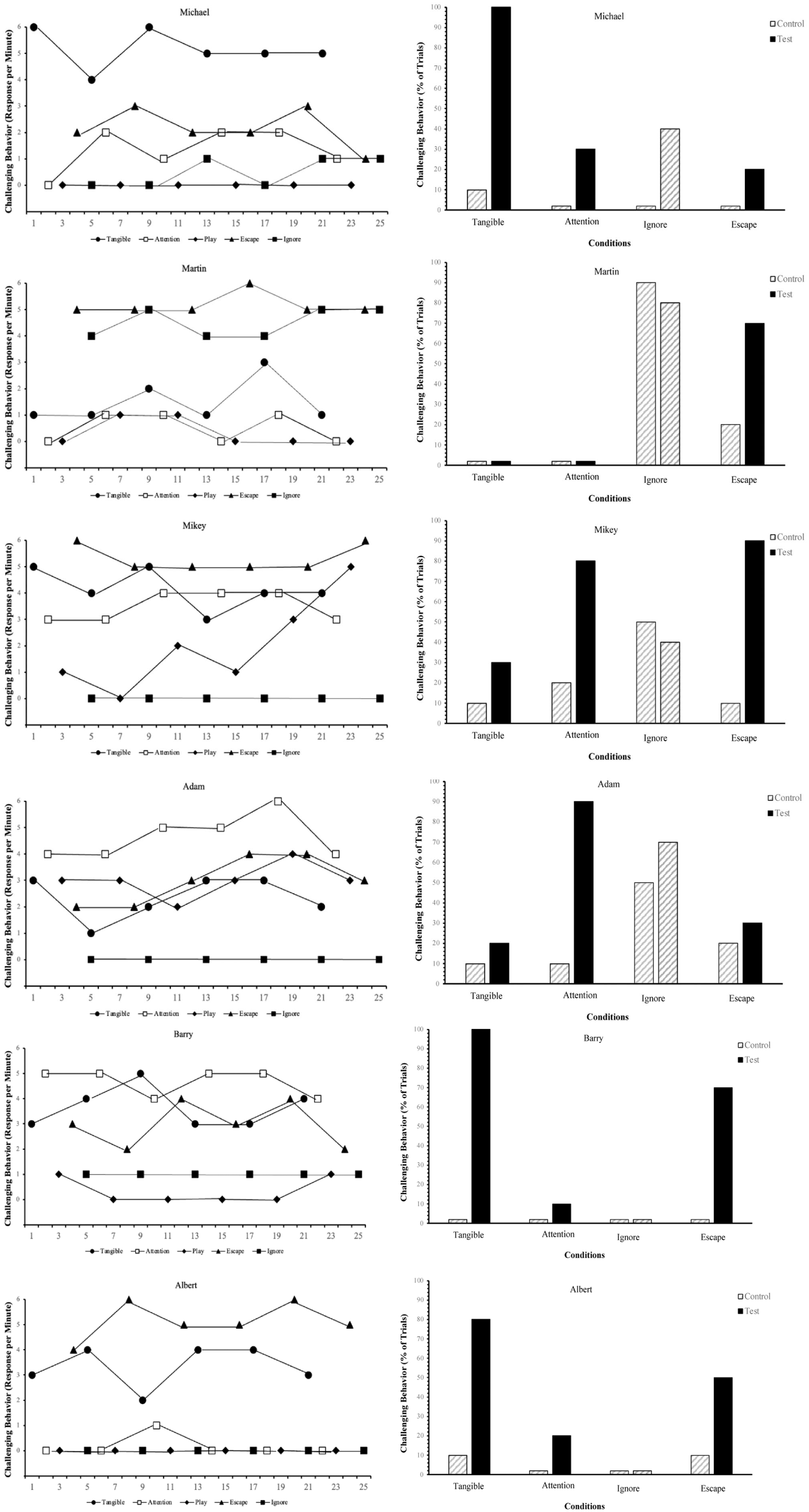
Traditional (Left Graph) and Trial-Based (Right Graph) Functional Analysis Results.
Comparison Results of Functional Assessment and Functional Analysis.
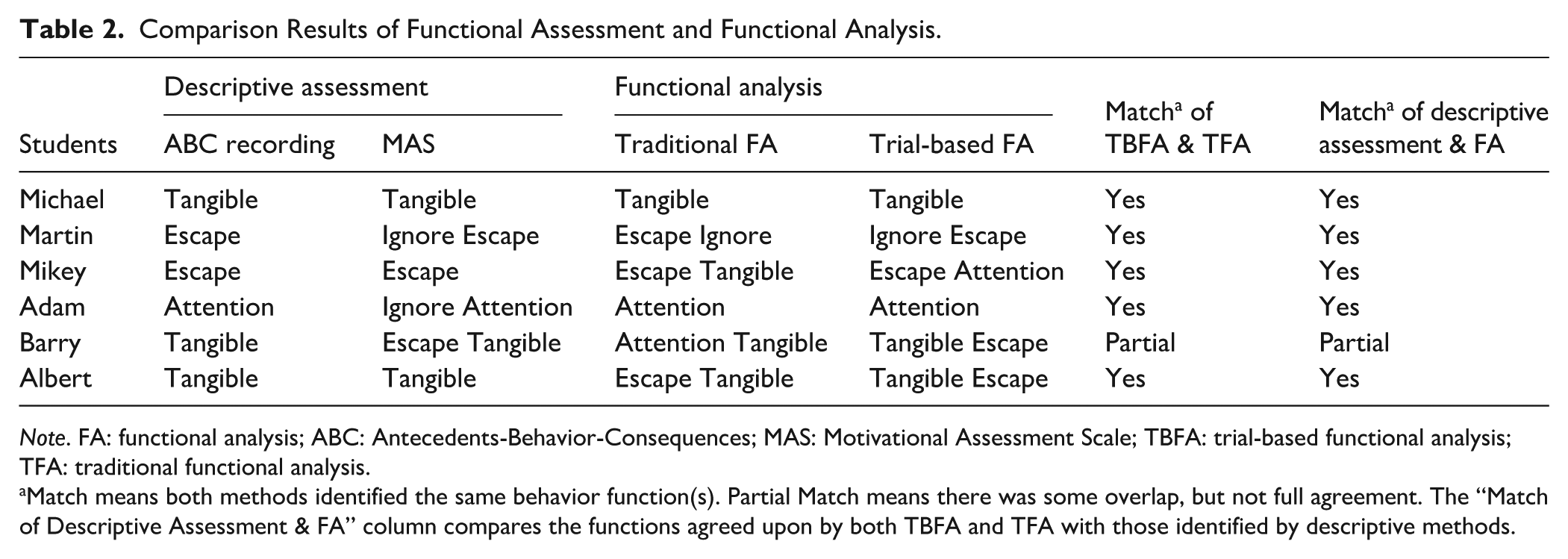
Note. FA: functional analysis; ABC: Antecedents-Behavior-Consequences; MAS: Motivational Assessment Scale; TBFA: trial-based functional analysis; TFA: traditional functional analysis.
Match means both methods identified the same behavior function(s). Partial Match means there was some overlap, but not full agreement. The “Match of Descriptive Assessment & FA” column compares the functions agreed upon by both TBFA and TFA with those identified by descriptive methods.
Michael
The ABC recording and MAS data suggested that the potential function of Michael’s challenging behavior was tangible. According to the data obtained from descriptive assessment, the P-SET hypothesized that the possible function of Michael’s challenging behavior was tangible. Michael’s challenging behavior was consistently higher in the tangible condition than in the play (control) condition, with low responding in the play condition, indicating a tangible function relative to the control condition. The TFA results indicated that the function of Michael’s challenging behavior was tangible. During the TBFA’s tangible condition, Michael showed challenging behavior in 10% of the control and 100% of the test phases. During the attention condition, he displayed challenging behavior in 0% of the control and 30% of the test phase. Michael engaged in challenging behavior in 30% during the ignore condition. During the escape condition, he was involved in challenging behavior in 0% of the control and 20% of the test phase. The TBFA results indicated that the function of Michael’s challenging behavior was tangible. Michael’s TFA sessions lasted 300 min, whereas TBFA sessions lasted 76 min.
Martin
The ABC recording data showed that the potential function of Martin’s challenging behavior was escape function. In contrast, MAS data suggested that the functions of Martin’s challenging behavior can be escape and ignore. Based on the data from the descriptive assessment, the P-SET hypothesized that the possible functions of Martin’s challenging behavior were escape and ignore. Martin’s challenging behavior was consistently higher in the escape and ignore condition than in the play (control) condition, with low responding in the play condition, indicating an escape and ignore function relative to the control condition. The TFA results indicated that the functions of Martin’s challenging behavior were escape and ignore. In TBFA, Martin engaged in challenging behavior in 90% and 80% of the phases during the ignore condition. During the escape condition, he exhibited challenging behavior in 20% of the control and 70% of the test phases. On the contrary, during both the test and control phases of the tangible and attention condition, Martin did not exhibit challenging behavior. The TBFA results indicate that the functions of Martin’s challenging behavior were ignore and escape. Martin’s TFA sessions lasted 300 min, whereas TBFA sessions lasted 64 min.
Mikey
The ABC recording and the MAS data suggested that the potential function of Mikey’s challenging behavior was escape. After completing the descriptive assessment, the P-SET hypothesized that the possible function of Mikey’s challenging behavior was escape.
Mikey’s challenging behavior was consistently higher in the escape condition than in the play (control) condition, with low responding in the play condition, indicating an escape and tangible function relative to the control condition. The TFA results showed that the functions of Mikey’s challenging behavior were escape and tangible. In TBFA, Mikey performed challenging behavior in 10% of the control and 90% of the test phases during the escape conditions. During the attention condition, he engaged in challenging behavior in 20% of the control and 80% of the test phases. He displayed challenging behavior in 50% and 40% of both phases in the ignore condition. In comparison, he engaged in challenging behavior in 10% of the control and 30% of the test phases in the tangible condition. The TBFA results indicate that the functions of Mikey’s challenging behavior were escape and attention. Mikey’s TFA sessions lasted 300 min, whereas TBFA sessions lasted 61 min.
Adam
The ABC recording and MAS data suggested that the potential function of Adam’s challenging behavior was attention. According to the data obtained from descriptive assessment, the P-SET hypothesized that the possible function of Adam’s challenging behavior was attention.
Adam’s challenging behavior in TFA was distinctively higher in the attention condition than in others. His challenging behavior was inconsistent in the tangible and escape conditions. In the play condition, he also performed challenging behavior.
Adam’s challenging behavior was consistently higher in the attention condition than in the play (control) condition, with low responding in the play condition, indicating an attention function relative to the control condition. The TFA results indicated that the function of Adam’s challenging behavior was attention. During the TBFA’s attention condition, Adam showed challenging behavior in 10% of the control and 90% of the test phases. Adam engaged in challenging behavior in 50% and 70% during the ignore condition. During the tangible condition, he displayed challenging behavior in 10% of the control and 20% of the test phases. During the escape condition, he was involved in challenging behavior in 20% of the control and 30% of the test phases. The TBFA results revealed that the function of Adam’s challenging behavior was attention. Adam’s TFA sessions lasted 300 min, whereas TBFA sessions lasted 73 min.
Barry
The ABC recording data revealed that the potential function of Barry’s challenging behavior was tangible. In contrast, MAS data suggested that the functions of Barry’s challenging behavior can be escape and tangible. Based on the data from the descriptive assessment, the P-SET hypothesized that the possible function of Barry’s challenging behavior was tangible.
Barry’s challenging behavior was consistently higher in the attention and tangible condition than in the play (control) condition, with low responding in the play condition, indicating an attention and tangible function relative to the control condition. The TFA results indicated that the possible functions of Barry’s challenging behavior were tangible and attention. In TBFA, Barry performed challenging behavior in 0% of the control and 100% of the test phases of the tangible condition and 0% of the control and 70% of the test phases of the escape condition. During the attention condition, he exhibited challenging behavior in 0% of the control and 10% of the test phases, whereas Barry did not display challenging behavior in the ignore condition. The TBFA results show that the function of Barry’s challenging behavior was tangible. Barry’s TFA sessions lasted 300 min, whereas TBFA sessions lasted 68 min.
Albert
The ABC recording and the MAS data suggested that the potential function of Albert’s challenging behavior was tangible. After completing the descriptive assessment, the P-SET hypothesized that the possible function of Albert’s challenging behavior was tangible. Albert’s challenging behavior was consistently higher in the escape and tangible condition than in the play (control) condition, with low responding in the play condition, indicating an escape and tangible function relative to the control condition. The TFA results showed that the functions of Albert’s challenging behavior were escape and tangible. In TBFA, Albert engaged in challenging behavior in 10% of the control and 80% of the test phases during the tangible condition. During the escape condition, he displayed challenging behavior in 10% of the control and 50% of the test phases. He performed challenging behavior in 0% of the control and 20% of the test phases in the attention condition. On the contrary, he did not engage in challenging behavior in an ignore condition. The TBFA results indicate that the functions of Albert’s challenging behavior were tangible and escape. Albert’s TFA sessions lasted 300 min, whereas TBFA sessions lasted 74 min.
Discussion
The purpose of the current study was to compare the correspondence across the results of traditional and trial-based FA and the results of descriptive assessment and FA in determining the functions of challenging behaviors in children with ASD. The findings indicated a high level of correspondence (5/6) across both types of FA and descriptive assessment and FA. While the findings regarding the high correspondence across FA types in determining the functioning of challenging behaviors are consistent with the findings of the previous research by LaRue and colleagues (2010) and Apaydın and Aykut (2018), they differ from the study conducted by Bloom and colleagues (2011), which found an unclear correspondence across FA types. In addition, the findings regarding the consistency of the descriptive assessment and FA results are consistent with the literature (Lewis et al., 2015; Tereshko et al., 2024).
Traditional FA procedures demand expertise, entail complexity, involve a lengthy implementation process, and often reinforce children’s challenging behaviors, which is why alternative FA types have been developed (Iwata & Dozier, 2008; LaRue et al., 2010). In this context, TBFA emerges as a type of FA developed as an alternative to TFA. The current study shows a high level of correspondence across FA types. This finding suggests that TBFA could serve as an alternative assessment model to address the limitations of TFA procedures in determining the functioning of challenging behaviors. In addition, the high correspondence observed among the FA types could support the clinical validity of the TBFA procedure. Also, it is generally assumed that the functions of challenging behaviors are static and that the function of the behavior will not change in different settings and the presence of different stimuli (LaRue et al., 2010). However, the functions of challenging behaviors may change in response to motivating operations and other stimuli in the setting. Given the limitations mentioned above of TFA, assessing in all possible settings and with all possible individuals is not always feasible. Therefore, TBFA may represent an effective method to evaluate changes in functioning across time, settings, and motivation levels. Overall, the findings from the current research are encouraging in terms of the utility, validity, and interpretability of TBFA procedures conducted in natural settings.
The findings revealed a high level of correspondence across the results of descriptive assessment and FA in determining the functions of challenging behaviors. Functional analysis is the acknowledged gold standard in determining the functions of behaviors and selecting and implementing function-based interventions (Schmidt et al., 2014). Despite its essential role in the behavior intervention process, it is observed that FA is not widely utilized in natural settings. The findings of Oliver and colleagues (2015) study involving 724 behavior analysts indicate that most behavior analysts use descriptive assessment more frequently than FA when identifying the functions of challenging behaviors. Furthermore, according to the findings, most participants described the descriptive assessment as the most helpful method for determining the functions of challenging behaviors. Considering all these implications, the high correspondence across descriptive assessment and FA in the current study suggests that descriptive assessment could also serve as an essential guide for practitioners in determining the functioning of behaviors. However, further research is required to compare the correspondence across descriptive assessment and FA to confirm this finding.
Some notable implications require discussion within the scope of the study. The first implication is that TBFA was completed shorter than TFA. While TBFA sessions lasted 416 min, TFA sessions lasted 1,800 min. This finding demonstrates that TBFA is 77% more time-efficient than TFA in determining the functions of challenging behaviors. The notable disparity in the total duration of TBFA (416 min) compared with TFA (1,800 min) reflects fundamental differences in these assessment approaches. The TFA typically involves longer, repeated sessions (e.g., 5–15 min per condition) conducted in highly controlled experimental settings, which can cumulatively require extensive time to complete all relevant conditions across multiple sessions. In contrast, TBFA is designed for greater efficiency by embedding brief assessment trials within natural classroom routines, often lasting just a few minutes each. The TBFA sessions are interspersed throughout typical activities, allowing for rapid data collection in multiple, naturally occurring settings without requiring extended continuous observation. Consequently, TBFA significantly reduces total assessment time while maintaining the validity of function identification (Bloom et al., 2011; Hanley et al., 2003). The study by Oliver and colleagues (2015) found that behavior analysts favored alternatives to TFA in determining the functions of behaviors. The main reason for this preference was the time-consuming nature of the TFA. Considering the high correspondence across FA types and the time efficiency of TBFA, it may be preferable to use TBFA in determining the functions of challenging behaviors in both natural and clinical settings. In addition, the ability to implement TBFA quickly may enable practitioners to be more flexible in evaluating the function of challenging behavior.
The second implication is that TBFA is more efficient than TFA in terms of data collection procedures. The TBFA procedures require focusing on challenging behaviors only in the presence of motivating operations (LaRue et al., 2010). For this reason, TBFA facilitates the data collection process and enhances the reliability of the data. Therefore, TBFA may be preferred in determining the functions of challenging behavior, especially in settings where resources are scarce and training is less intensive.
The third implication is that in TBFA sessions, the tested condition is immediately terminated when the challenging behavior occurs. This approach eliminates ethical concerns about repeatedly reinforcing challenging behaviors (Austin et al., 2015). In addition, TBFA procedures were conducted without removing children from the classroom environment, which is believed to address concerns about the artificiality of FA procedures (Sasso et al., 1992).
The last implication is that the P-SETs implemented the procedures for both types of FA with high fidelity. This can be attributed to the effectiveness of behavioral skills training in training educators on the implementation of interventions (e.g., Homlitas et al., 2014; Nigro-Bruzzi & Sturmey, 2010). One of the main criticisms of TFA is the complex implementation process that demands expertise. This study finding is consistent with the findings of previous studies, demonstrating that pre-service teachers can implement FA procedures with high fidelity when provided with support (Haider, 2023; Kunnavatana et al., 2013).
Limitation and Recommendations
The study’s main limitation lies in the fact that while it revealed the correspondence of both FA types in determining the functions of challenging behaviors, the accuracy of the findings was not verified with the intervention aspect. In further research, both FA types can be compared, and the accuracy of the results obtained from both FA types can be assessed using function-based interventions. The second limitation of the study is the absence of an assessment of P-SETs’ proficiency in implementing FA procedures before the intervention. Further research can be designed to evaluate the effect of the support provided to practitioners during the implementation of FA procedures. In addition, we did not collect social validity data from P-SETs regarding their perceptions of the acceptability, feasibility, and utility of traditional and trial-based FA procedures. Such data are critical because practitioners’ attitudes toward these assessments may affect their willingness to use them in real-world settings (Langthorne & McGill, 2011). Future research should incorporate social validity measures to better understand practitioner preferences and barriers. Furthermore, future research can be planned to examine the correspondence across different FA types (e.g., precursor FA, latency FA, trial-based) in determining the functions of the behaviors in individuals with other special needs. Practitioners may opt for the TBFA to define functions of behaviors in individuals with special needs due to its features, such as its simplicity in implementation and facilitating rapid assessment completion.
Footnotes
Acknowledgements
Thank you to the pre-service special education teachers who participated in the current research. Thank you to the experts for assistance with data analysis.

Ethical Considerations
This study received Institutional Review Board approval and was performed in accordance with the ethical standards as laid down in the 1964 Declaration of Helsinki and its later amendments or comparable ethical standards.
Funding
The authors received no financial support for the research, authorship, and/or publication of this article.
Declaration of Conflicting Interests
The authors declared no potential conflicts of interest with respect to the research, authorship, and/or publication of this article.
Data Availability Statement
Electronic data summaries of raw data are available upon request.