



Abstract
The purpose of this study was to provide deeper insight into the substantive nature of the friendships of students with or at risk for emotional and behavioral disorders. We examined the friendship nominations of a group of U.S. kindergarten to third grade students with or at risk for emotional and behavioral disorders (focal students), and their classmates, to describe the reciprocity, stability, and quality of friendships at two time points during the school year. Results revealed that a majority of focal students nominated at least one best friend in the beginning of the year. However, only 32% of these nominations were reciprocated by their classmates. Focal student’s reports of friendship quality did not differ between their reciprocated and unreciprocated nominations. Later in the year, 60% of the friendship nominations from Time 1 remained. However, focal student’s perceptions of friendship quality did not differ between the stable and unstable nominations. Finally, of the friendship nominations that were present at Time 1 and Time 2, approximately 48% were reciprocated. Findings reinforce that focal students experience social challenges, and that this population of students may overestimate the presence of reciprocal friendships. We conclude with a discussion of the implications of this work for research and practice.
Friendships in childhood are characterized as dyadic relationships based on mutual affection or reciprocity of liking (Hartup & Stevens, 1997). Friendships differ from other relationships that children have in their lives because being friends alludes to a general equality in social status or power, and they are generally viewed as voluntary as compared with other primary and important relationships children have with parents or siblings (Bagwell & Schmidt, 2011). Decades of research demonstrate that friendships contribute to student’s social, emotional, and psychological functioning and well-being (e.g., Rubin et al., 2015). For example, friendships provide children with the opportunity to practice perspective-taking skills, social competence, and moral reasoning and uniquely contribute to student’s performance in math, reading, and language (Ladd & Troop-Gordon, 2003; Raver, 2002; Rawlins, 1992).
In the context of school-based peer relationships, three aspects of friendship appear to be particularly meaningful in shaping student outcomes: reciprocity, stability, and quality. Each of these aspects uniquely predict student outcomes (e.g., Parker & Asher, 1993). Reciprocal friendships (i.e., when two students agree that they are both friends) can serve as a protective factor against negative peer experiences (e.g., bullying, peer rejection; Hodges et al., 1999; Laursen et al., 2007) and having at least one friend is associated with improved well-being (Bukoswki et al., 2010). Friendship stability is also important. Students who have stable friendships over time are less lonely and report higher levels of self-esteem (Parker & Asher, 1993). Finally, friendships that are high in positive traits (e.g., intimacy, companionship, support) are strongly connected to benefits for students (Nangle et al., 2003; Schwartz-Mette et al., 2020). However, friendships can also contribute to undesired outcomes (Bagwell & Schmidt, 2011). For example, friendships with others who engage in disruptive or aggressive behaviors can lead to increased engagement in challenging behaviors (e.g., Dishion & Snyder, 2016).
Elementary students with or at risk for emotional and behavioral disorders (EBD), characterized by persistent challenging behaviors such as noncompliance, impulsivity, aggression, and disruption, often face significant social challenges within their peer relationships. The majority of these students, who are described in the research literature as having challenging behaviors but may not be formally identified with emotional disturbance or receive Individuals with Disabilities Education Act (IDEA)-based support for this disability (National Research Council & Institute of Medicine, 2009), are primarily educated in general education classrooms. Within these settings, students with or at risk for EBD are at heightened risk for experiencing peer victimization, rejection, isolation, and negative peer influence (Chow et al., 2023; Parker et al., 2015; Sturaro et al., 2011; Useche et al., 2014). These difficulties often continue into adolescence and can remain a significant barrier to prosocial peer interactions and experiences (Henricsson & Rydell, 2006; Malti & Rubin, 2018). Although descriptive research has documented this range of poor peer experiences, a limited number of studies have examined the friendships of students with or at risk for EBD, and fewer have examined the evolution or dissolution of these friendships over time. Given the advantages of participating in mutual, stable, and high-quality friendships, understanding this population’s participation in friendships and the potential developmental consequences of different friendship constellations is an important goal. The current study aimed to address critical gaps in the literature by examining the presence and quality of reciprocated and unreciprocated friendship nominations made by students and the extent to which their friendship nominations are stable over time, dimensions often overlooked in research on students with or at risk for EBD. Findings are intended to inform targeted interventions for fostering meaningful peer relationships for this group of students. We examine these questions in a sample of Kindergarten-third grade classrooms, a time that has been marked as a critical period in behavioral and social development (Bierman, 2004; Legkauskas et al., 2019).
Theoretical Framework
To frame this investigation, we draw from two established theories. The first, social network theory, emphasizes the importance of the structure and dynamics of relationships within a social environment, highlighting how the position of an individual within the network can influence their social experiences and outcomes (Borgatti & Ofem, 2010; Wasserman & Faust, 1994). The current study uses this lens to make predictions about the patterns of friendships of students with or at risk for EBD. Students with or at risk for EBD often occupy peripheral or marginalized positions in classroom social networks, which may limit their access to reciprocal and stable friendships (e.g., Chow et al., 2023). Social network theory also emphasizes the bidirectional nature of relationships, where both individuals in a dyad influence each other’s behavior and perceptions (Grunspan et al., 2014). For students with or at risk for EBD, this bidirectionality may manifest in ways that reinforce social difficulties. For instance, peers may perceive these students as less desirable friends due to behavioral challenges, leading to lower rates of reciprocated friendships and stable connections within the network.
Second, the principle of homophily posits that individuals are more likely to form and maintain relationships with others who are similar to themselves across various characteristics, including demographics, behaviors, and attitudes (McPherson et al., 2001). Applied to the present study, this principle may help explain patterns of peer affiliation and exclusion for students with or at risk for EBD. Prior research has shown that students with externalizing behaviors are more likely to form friendships with similarly behaving peers than with their typically developing classmates (e.g., Fortuin et al., 2015). Although homophily can provide opportunities for connection among students with similar characteristics, it may also limit the diversity and quality of their friendships. For students with or at risk for EBD, the lack of similarity between these students and their more prosocial peers may contribute to low rates of reciprocated friendships. Together, social network theory and homophily highlight the potential barriers students with or at risk for EBD may face in forming and maintaining friendships.
Dimensions of Classroom-Based Friendships
Friendship Reciprocity
Student reports on their own friendships are considered the standard approach for measuring friendship (Bagwell & Schmidt, 2011). Typically, this is done by asking students to nominate others who they consider to be a friend. In classroom-based research, researchers commonly ask students to choose up to three best friends from a roster of their classmates (for a review of variability in friendship nomination methods/approaches, see Bagwell & Schmidt, 2011). A conservative definition of a friendship is set as two students who each list the other as friends (i.e., reciprocal nominations; Bagwell et al., 1998). The reciprocal nature of friendships makes them distinct from peer acceptance and represents a co-constructed mutual relationship between two students (Bagwell & Schmidt, 2011). Nearly all children name at least one friend when they are asked, and in typically developing samples approximately 70% have a reciprocal best friend (Chow et al., 2023; Parker & Asher, 1993; Rubin et al., 2006). However, unreciprocated friendship nominations do occur. These unreciprocated nominations may happen for a number of reasons but may mean that the nominating student believes the other was their friend when that friendship may not be mutual. This could be interpreted as an index of peer liking as opposed to a friendship (Bagwell & Schmidt, 2011). Reciprocated and unreciprocated friendships nominations have different influences on student outcomes. Reciprocal friendship nominations are associated with improved self-esteem, greater peer acceptance, school liking, friendship stability, and overall positive adjustment (Bagwell & Schmidt, 2011; Rubin et al., 2006). For example, Newcomb and Bagwell (1995), found students in a reciprocal friendship had greater positive engagement and better friendship quality than those in an unreciprocated friendship. These findings suggest that the distinction between reciprocated and unreciprocated friendships is meaningful.
Friendship Quality
Friendship quality is characterized by both positive and negative features of the interactions and processes between friends (Bukowski et al., 2009; Dryburgh et al., 2022; Erdley & Day, 2017). Positive features include spending time together, feeling close with a friend, and disclosing personal information and feelings. Negative features include conflict, exclusivity, and power asymmetry (e.g., Berndt, 2004). Positive and negative features of friendship are mutually exclusive, making examinations of each dimension important (e.g., Banny et al., 2011). High-quality friendships are those that are high in positive qualities such as validation/caring and help/guidance and low in negative qualities such as conflict and betrayal. Friendship quality plays an important role in a student’s developmental outcomes, perhaps over and above the influence of friendship quantity (Hartup, 1993; Kochendorfer & Kerns, 2020; Narr et al., 2019; Parker & Asher, 1993). To illustrate, friendships high in positive qualities have been associated with better psychological well-being, higher self-esteem, improved academic performance, and lower levels of anxiety and depression (Berndt, 2004; Hartup & Stevens, 1997). Friendship quality is also negatively related to maladaptive behaviors, internalizing problems, and school maladjustment (e.g., Berndt & Keefe, 1995; Gempp et al., 2021).
Friendship quality can be assessed by student reports on questionnaires (e.g., Friendships Qualities Scale; Friendship Quality Questionnaire [FQQ]; Bukowski et al., 1994; Parker & Asher, 1993). Focusing on a student’s perspective is important, because it measures their unique and expert insights into their relationship dynamics. It also offers a deeper understanding of the relationship’s context and underlying attitudes (Furman et al., 1989). For instance, Schwartz-Mette et al. (2020) found that a student’s perception of their friendships, regardless of the number of friends or the reciprocation of these friendships, can influence their feelings of loneliness or depression. This finding underscores the importance of the subjective quality of friendships from the student’s viewpoint, rather than just the quantity or reciprocity of these relationships.
Friendship Stability
Friendship stability is a different aspect of friendship than reciprocity and quality and is characterized as the existence of a friendship over time, whereas instability is characterized as changes in a friendship (i.e., termination; see Bowker, 2011, Meter & Card, 2016; Poulin & Chan, 2010; Way & Greene, 2006). Because friendships are voluntary, they are considered easier to end than student’s relationships with others in their lives (e.g., familial; Hartup, 1989; Laursen & Bukowski, 1997). Generally, elementary age students keep about 50% to 75% of their friendships across a school year (Berndt & Hoyle, 1985; Bowker, 2011; Hallinan & Tuma, 1978) and they tend to make more friends as the school year goes on but are not likely to lose their old ones (Berndt & Hoyle, 1985). Stability in friendships is important for student well-being and adjustment over time. For example, students who maintain their friendships over time present high levels of prosocial behaviors, are rated as more popular by their peers, and report lower levels of loneliness and lower levels of victimization (Rubin et al., 2006). Importantly, losing a best friend is associated with increased adjustment difficulties (e.g., prosocial behavior; Victimization; Rubin et al., 2006).
Several factors have shown potential to influence friendship stability including peers’ match/mismatch on characteristics such as age, gender, and race (Poulin et al., 1997; Poulin & Chan, 2010). These factors may also include features such as the friendship context (e.g., school, neighborhood), culture, and changes in the environment (e.g., transitioning schools; Poulin & Chan, 2010). Interestingly, friendship quality is a consistent predictor of friendship stability (Berndt & Perry, 1986; Branje et al., 2007; Bukowski et al., 1994; Schneider et al., 1997). Friendships tend to be more stable when they are higher in positive features and lower in negative features. For example, compared to students with stable friendships, those with unstable friendships give lower ratings for intimacy, have lower frequency of interactions, and comment less often on their liking for their peers and more often on the negative features of their peers (Berndt et al., 1986). Furthermore, high levels of conflict and conflict resolution styles are associated with lower friendship stability (Bowker et al., 2007; Bukowski et al., 1994). Taken together, findings suggest that students who have trouble establishing a high-quality friendship may be likely to experience a great deal of turnover in their friendships (Bukowski et al., 1994).
Peer Experiences of Students With or at Risk for EBD
Numerous studies across various disciplines have examined the friendship characteristics of elementary age students who exhibit aggressive behavior (both indirect and direct forms of aggression). This work primarily identifies students who exhibit aggressive behavior via (a) peer nomination ratings, in which students identify peers in their classroom who engage in aggressive acts (e.g., “These are kids in my class who start fights or say mean things to or about other kids”) or (b) teacher report. Fewer studies have examined the friendship formation, quality, and stability of students who display a broader range of externalizing behaviors, that cover characteristics of EBD, such as aggression, rule breaking, disruption, defiance, and emotion regulation challenges. Even fewer use systematic screeners to identify elementary students who may be with or at risk for EBD and face increased risk for negative developmental outcomes associated with their behavior patterns.
Given the limitations of the current research on the friendships of students with or at risk for EBD, we look to prior work on students with elevated rates of aggression and a small set of studies that include students with behavioral disorders to inform our hypotheses. This work documents three key features. First, aggressive children are often rejected by their peer group and may lack important social skills and competencies necessary for establishing positive peer relations. However, aggressive children do tend to have at least one close friend (e.g., Brendgen et al., 2002; Newcomb & Bagwell, 1995). Furthermore, children with behavioral disorders in self-contained classrooms tend to nominate more adults and other students who are in special education classrooms or children who are from their home/neighborhood as part of their network compared with their classroom peers (Panacek & Dunlap, 2003). Finally, one study with a large sample of kindergarteners reported that children who display higher rates of externalizing behaviors than their classroom peers (as selected by their teacher) have 48% lower odds of having reciprocated friendships than their typical peers (Chow et al., 2023).
Second, higher rates of aggressive behavior are associated with more negative friendship qualities, specifically, greater conflict and disagreement (Flannery & Smith, 2017). In a meta-analysis of studies examining links between interpersonal characteristics and friendship quality, Dryburgh and colleagues (2022) found that aggression was significantly associated with more negative and less positive friendships amongst students (average ages 8.25–16.5 years). In addition, Normand et al. (2020) found that the friendships of children with ADHD and a comorbid diagnosis of an externalizing disorder were characterized by poorer friendship quality on questionnaires than the friendships of children with ADHD and no externalizing disorder. Similarly, in a clinical sample of students (ages 9–18) with and without disruptive behavior disorders, Ackermann et al. (2019) found associations between externalizing problems and negative friendship quality reported on questionnaires.
Third, previous research shows that youth who behave aggressively have fewer stable friendships (Flannery & Smith, 2017; Poulin & Chan, 2010). This may be because the characteristics associated with aggression (e.g., fighting) may promote friendship instability. For example, relationally aggressive children, who behave poorly with their friends, have short-lived friendships (Bukowski, 2003; Poulin et al., 1997). Another study suggests that aggressive children did not necessarily have difficulty making new relationships but had difficulty sustaining their friendships (Ellis & Zarbatany, 2007). Finally, evidence also suggests the presence of a bidirectional link between antisocial behavior and friendship instability. In one study, friendship instability predicted an increase in antisocial behavior, and in return, antisocial behavior led to greater friendship instability (Poulin et al., 1997).
Taken together there is a critical gap in the literature, as existing research has predominantly focused on negative peer outcomes like rejection, victimization, or social isolation, while largely overlooking the dyadic nature of friendships of students with or at risk for EBD. Furthermore, most studies have explored these relationships at a single point in time, providing limited insight into how friendships of students with or at risk for EBD evolve or dissolve over time. Understanding these dynamics is crucial, as reciprocal, stable, and high-quality friendships are key protective factors that promote social and academic success. Without a deeper exploration of these factors, opportunities to design targeted interventions to improve peer relationships for students with EBD remain limited.
Present Study
To address this gap, we examine patterns of best friend nominations of students with or at risk for EBD, assessing the formation, quality, and stability of these friendship nominations across two time points during the school year. This is important to investigate given that students who do not form or maintain high quality friendships miss out on a crucial developmental process that has implications for their social and academic trajectories (Ladd & Troop-Gordon, 2003; Rubin et al., 2003). Specifically, we examine: (a) The percentage of best friendship nominations made by focal students that were reciprocated by their classmates. We anticipate that students with or at risk for EBD will have low rates of reciprocated friendship nominations; (b) The quality of best friendship nominations that were reciprocated and those that were unreciprocated at the first time point. We expect that students with or at risk for EBD will perceive that their friendships are high in negative features and low in positive features and that this will be more pronounced for unreciprocated friendship nominations compared with reciprocated friendship nomination; (c) The percentage of best friend nominations that remained at Time 2. The majority of the friendship nominations that are present at Time 1 are not expected to be present at Time 2; 4) The quality of the best friendship nominations that remained stable from Time 1 to Time 2. We expect stable friendship nominations to be higher quality than the friendship nominations that are not stable from Time 1 to Time 2. By investigating the friendship patterns of students with or at risk for EBD we hope to provide the field with an extended understanding of the classroom-based social experiences of this population of students, ultimately contributing to the development of more effective interventions and support strategies tailored to their unique social and behavioral needs.
Method
Setting and Participants
Teacher and student participants were recruited from six elementary schools in a U.S. Mid-Atlantic state. The mean number of students per school was 471 (SD = 115.84) and consisted of predominantly African American students (65%) from a low-income community (66% qualified for free and reduced-price lunch). The present study included teacher and student participants from a comparison condition who were part of a study aimed at testing an intervention designed to address the needs of young students who demonstrate persistent and intensive challenging behaviors in classroom settings. This intervention provided teacher training and coaching on evidence-based practices shown to reduce student problem behaviors and increase high-quality teacher-student relationships. Teachers were randomly assigned within grade and school to the intervention or a business-as-usual comparison condition. Peer nominations occurred in the Winter and Spring. All study activities were approved by the district and university human participants protection boards.
Kindergarten to Third-Grade Teachers
Teachers were eligible for inclusion if they met the following criteria: (a) taught kindergarten to third grade, (b) served at least one student identified as being with or at risk for EBD, and (c) consented to participate. The present study includes 13 female teachers who participated in the comparison condition. The majority were Caucasian/White (54%) or African American/Black (23%). Two teachers were Native American/American Indian (15.4%), and one teacher was Multiracial. The majority of teachers were non-Hispanic/Latino (84.6%). All were licensed and had a bachelor’s degree (31%) or master’s degree (69%). Teachers ranged in age, with nearly 40% of teachers between the ages of 26% to 35, 15% between 18% and 25, 15% of teachers between 36 and 45, and 15% of teachers between 46 and 55. Years of teaching experience ranged from 1 to 38 years and on average teachers had 11.4 years of teaching experience (SD = 10.7). Teachers were given $500 for their participation.
Focal Students
Teachers selected one to three students with or at risk for EBD (focal students) in their classrooms. Teachers were limited to three participating focal students per classroom due to study resources and funding. Students who met the following criteria were eligible for participation: (a) the student was enrolled in a participating teacher’s classroom, (b) the student exhibited externalizing behaviors that interfered with participation in the classroom as indicated by the Systematic Screening for Behavior Disorders (SSBD; Walker et al., 2014), and (c) the student had parental/guardian consent to participate. This study included 24 focal students who participated in the comparison condition. Focal student sample demographics were collected from both their teachers and their caregivers. Although it did not happen frequently, if the teacher and caregiver-report disagreed, the caregiver-report was included. The sample included 79.2% African American/Black, 12.5% White, and 8.3% Multiracial focal students. Three students (12.5%) were Hispanic/Latino. The majority of participating focal students were male (70.8%), and the average age was 7.23 years (SD = 1.28).
Nominated Best Friends
After teachers selected one to three focal students in their classrooms, teachers sent home consent forms to all classmates to participate in peer nomination interviews with study staff (detailed below). The average classroom size was 18 students (SD = 2.4). The 24 focal students nominated 39 classmates as friends at Time 1. The “best friend” student sample demographics included 59% African American/Black, 35.9% White, 2.6% Asian/Pacific Islander, and 2.6% other ethnicities and 94.9% of students were non-Hispanic/Latino. The majority of the nominated “best friend” sample were male (59%), and the average age was 7.51 years (SD = 1.07). It is relevant to note that nominated best friends could include classmates or other focal students (those with or at risk for EBD).
Measures
Student Screening
The Systematic Screening for Behavior Disorders (Walker et al., 2014) was used to systematically screen and identify focal students at risk for EBD. The Systematic Screening for Behavior Disorders is a three-stage multigate screening system designed to proactively identify students who are at risk of negative developmental outcomes associated with their behavior patterns. The first two gates of this tool combine teacher ratings of the frequency and intensity of student adjustment problems in school. The third gate includes trained observer ratings of students’ behaviors and is used to refer students for possible disability support according to federal and state special education guidelines (Walker et al., 1990). Only the first two stages of the tool were used to identify focal students. Both stages exhibit strong psychometric properties (see Walker et al., 2014). Students were screened in under a modified assessment of risk that included scoring raw data across four scales and applying risk criteria to the scores to identify students at risk of externalizing behavior problems (see Walker et al., 2014 for scoring criteria).
Friendships
Best friendship nominations were collected via individual peer nomination interviews with students in the Winter and Spring with approximately 9 weeks between each time point. Students were asked to name up to three students who they considered to be their “best friends.”
Only the first three nominations they provided during the interview were accepted and included in the analysis. Students were permitted to self-nominate, although these nominations were excluded from the data.
Focal Student’s Friendship Quality
Focal students were asked about the quality of each of their nominated best friendships using an adapted version of the FQQ. The items asked students to indicate on a 3-point scale how true a particular quality is of their relationship with a specific friend (e.g., “Luke and I always pick each other as partners for things”). The scale ranged from: (0) not at all true; (1) somewhat true; (2) pretty true. The FQQ contains six subscales: Valid and Caring (e.g., “Cares about my feelings”); Conflict Resolution (e.g., “Make up easily when we have a fight”); Conflict and Betrayal (e.g.,“Get mad at each other a lot”); Help and Guidance (e.g., “Share things with each other”); Companionship and recreation (e.g. “Always sit together at lunch”); Intimate Exchange (e.g., “Always tell each other our problems”). Respective items were averaged to create each subscale. For the current sample, internal consistency for the subscales were acceptable with Cronbach’s alpha values ranging from .63 to .85. However, the conflict resolution subscale did not demonstrate acceptable internal reliability at Time 1 perhaps due to a small number of items (n = 2). Therefore, conflict resolution was not included in study models.
Procedures
Student Screening and Selection
Obtaining caregiver consent and screening of student participants began approximately 1 month after the beginning of school. To determine eligibility for participation, teachers nominated up to five students who engaged in chronic externalizing problem behavior. Caregiver consent was then obtained. After screening, one to three students per classroom were selected to participate in the study, depending upon returned caregiver consent forms and the most elevated externalizing scores on the SSBD. In the present study, three teachers had three participating students, five teachers had two participating students, and five teachers had one participating student.
Friendship Nominations and Friendship Quality
Interviews were conducted with each consented student (focal students and classmates) in the hallway outside their classroom with trained research assistants where all interviewers had a classroom roster and referenced the roster with each student, and researchers provided redirection if a student named individuals outside the classroom. Per the institutional review board (IRB) protocol in place, interviewers did not have pictures of each student but reviewed the list of names to ensure students knew the classmates referenced on the list. Several students needed to be redirected to the task, but the majority of students did not have difficulty understanding the nomination technique. After nominating up to three best friends, the interviewer read each friendship quality question to the focal student, adding the respective best friend’s name to the stem of each question.
Analysis
To arrive at the present study sample, seven classrooms and 11 students with or at risk for EBD were excluded due to less than 40% of the classmates participating in the peer nomination procedures (largely due to lower than anticipated recruitment rates related to COVID-19 protocols during the 2021 school year). It is important to note that participating students were only allowed to nominate other participating students in their classroom (per IRB protocol). Given these procedures, previous work has suggested that friendship nominations may not be reliable in classrooms where less than 40% of the students participated (Marks et al., 2013). Of the classrooms with 40% or higher participation rates, missing data patterns revealed that one focal student was absent at Time 1 and one focal student nominated all non-consenting peers at Time 1. Furthermore, one student was missing friendship quality data at Time 1, and two students were missing friendship nomination and friendship quality data at Time 2 (these students moved schools). This resulted in the present study with an analytic sample of 24 students with or at risk for EBD and 13 teachers/classrooms and 39 classmates.
Data analyses examined the patterns of best friendship nominations made by focal students, their stability over time, and the quality of these relationships. Analyses proceeded in four steps. First, we calculated the percentage of best friendship nominations made by focal students that were reciprocated by their classmates at Time 1. Descriptive statistics were used to summarize the number of nominations made by focal students and the proportion that were reciprocated. Next, independent samples t-tests were performed to compare the quality of friendship nominations that were reciprocated versus unreciprocated. This analysis tested whether reciprocated friendships were perceived as higher in quality compared with unreciprocated friendships at Time 1. To examine the stability of friendship nominations, we next calculated the percentage of focal students’ best friendship nominations at Time 1 that remained present at Time 2. Adjustments were made to account for missing or excluded data due to low participation rates or school-related factors, such as student mobility and COVID-19-related disruptions. Finally, independent samples t-tests were conducted to compare the quality of friendship nominations that were stable (i.e., present at both Time 1 and Time 2) versus those that were unstable (i.e., present only at Time 1).
Results
We first examined the percentage of best friendship nominations made by focal students that were reciprocated by their classmates at Time 1. From the 24 focal students who made a best friend nomination/s, 44 best friend nominations were made. On average focal students nominated 1.83 (SD = .76, range 1–3) friends. Of these 44 best friendship nominations, 32% (n = 14) of these were reciprocated.
We then examined the extent to which the quality of best friendship nominations differed between the nominations that were reciprocated and those that were unreciprocated. T-tests revealed no significant differences for any of the friendship quality subscales between reciprocated and unreciprocated friendship nominations at Time 1 (see Table 1 presents friendship quality by time point; Table 2 presents friendship quality by reciprocated and unreceipted nominations at Time 1).
Descriptives Statistics for Domains of Focal Student – Reported Friendship Quality.
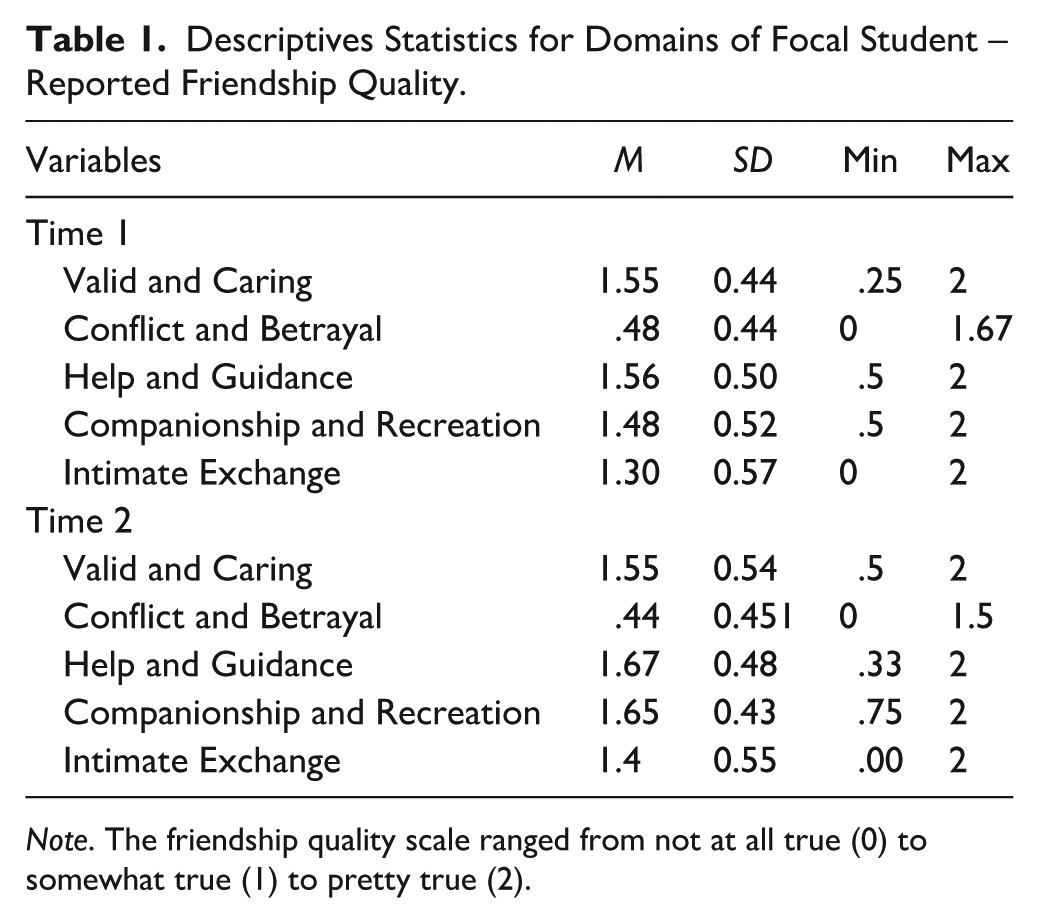
Note. The friendship quality scale ranged from not at all true (0) to somewhat true (1) to pretty true (2).
Descriptive Statistics and t-test Results for Friendship Quality by Reciprocated Versus Unreciprocated Nominations at Time 1.
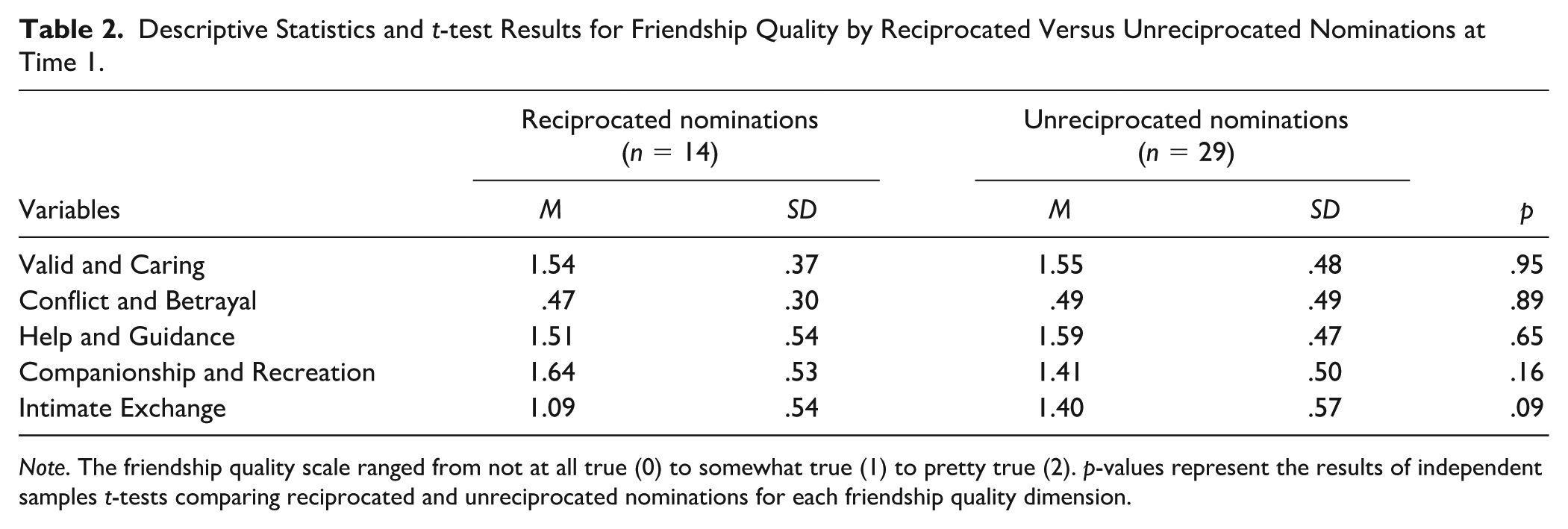
Note. The friendship quality scale ranged from not at all true (0) to somewhat true (1) to pretty true (2). p-values represent the results of independent samples t-tests comparing reciprocated and unreciprocated nominations for each friendship quality dimension.
Next, we examined the percentage of focal student’s best friend nominations that remained present at Time 2. Of the 44 friendship nominations made at the first time point, 21 remained at the second time point. It is important to note that nine of the dyads that were present at Time 1 were unable to be accounted for at Time 2, for five of these dyads this was due to missing or low classroom participation rates (one classroom did not have a second time point of data collection due to COVID-19 related school access and another classroom had a student move which lowered the participation rate to below 40%). In addition, two focal students moved to different schools by Time 2, which removed four of the dyads at Time 2 (two for each focal student). Before calculating the percentage of friendship nominations that were present from Time 1 to Time 2, we adjusted the denominator to account for these classrooms (i.e., 44–9). This resulted in 60% (i.e., 21/35) of friendship nominations that were present at Time 1 retained at Time 2. Figure 1 displays the movement of friendship nominations at Time 1 to Time 2. Of these 21 stable friendships, 10 (48%) were reciprocated. Figure 2 displays the movement of reciprocated and unreciprocated friendships from Time 1 to Time 2.
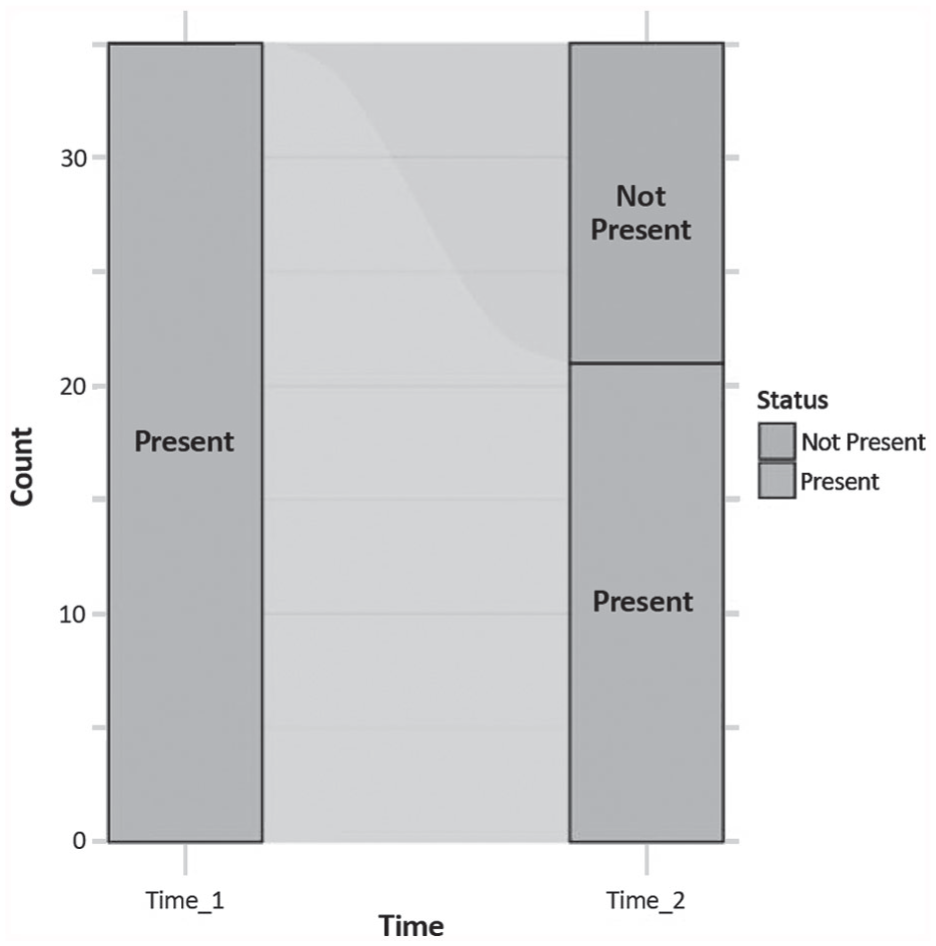
Sankey Diagram Showing the Change in Best Friend Nominations by Focal Students from Time 1 to Time 2.
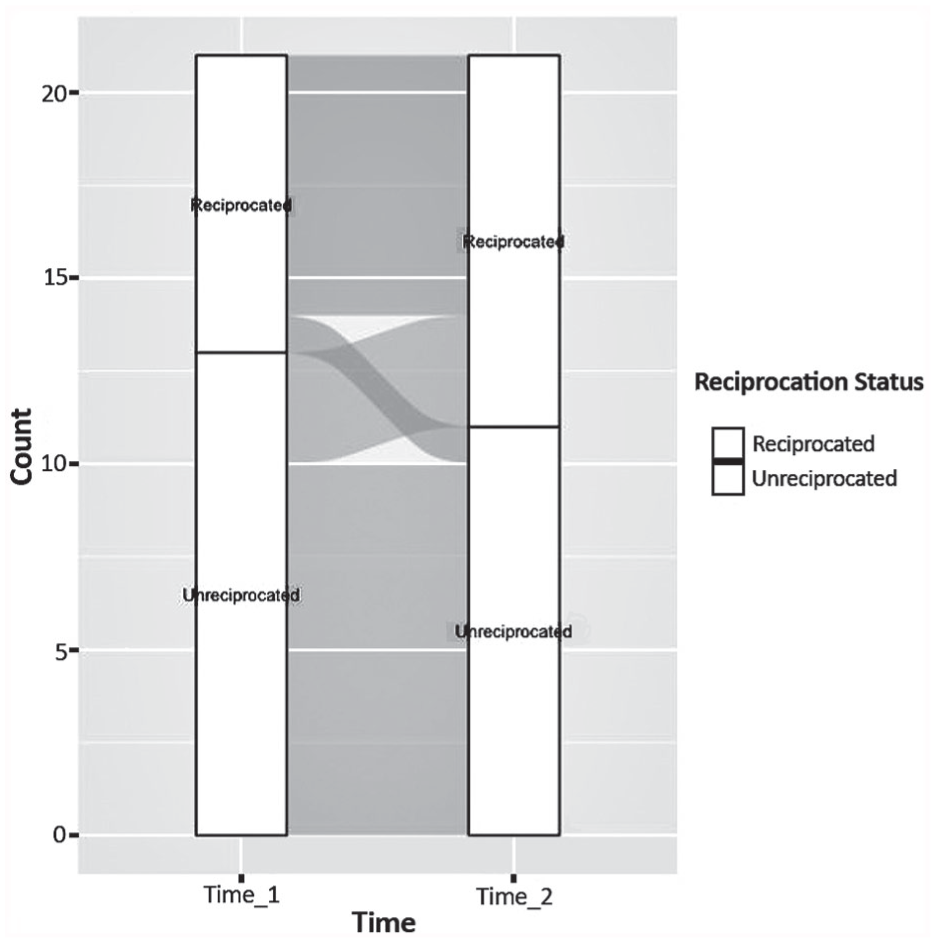
Sankey Diagram Showing the Change in Reciprocated and Unreciprocated Best Friend Nominations by Focal Students From Time 1 to Time 2.
Finally, we examined the extent to which there were differences in focal student’s perceptions of the quality of their best friendship nominations that remained stable from Time 1 to Time 2 and those that did not. T-tests revealed no significant differences between stable and unstable nominations for any of the friendship quality subscales (see Table 3).
Descriptive Statistics and t-test Results for Friendship Quality by Stable Versus Unstable Nominations across Time 1and Time 2.
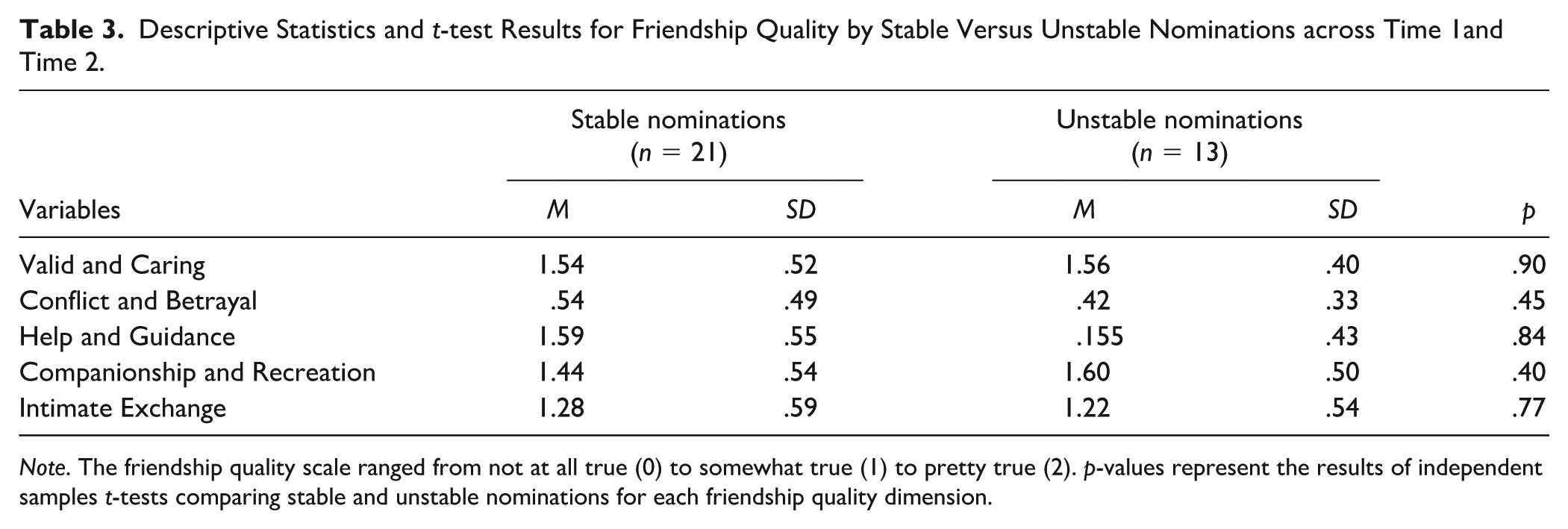
Note. The friendship quality scale ranged from not at all true (0) to somewhat true (1) to pretty true (2). p-values represent the results of independent samples t-tests comparing stable and unstable nominations for each friendship quality dimension.
Discussion
In this study, we investigated patterns in the best friend nominations of elementary students with or at risk for EBD, assessing the formation, quality, and stability of these friendships across two time points during the school year. Our first goal was to examine the proportion of friendship nominations made by students that were reciprocated by their classmates. Findings were aligned with our expectations. Students with or at risk for EBD had only 32% of friendship nominations returned. This finding is consistent with prior work that documents students who display aggression or externalizing behavior have 48% lower odds of having reciprocated friendships than their typical peers (Chow et al., 2023). This may be because children who engage in aggressive, disruptive, defiant behaviors, or emotion regulation challenges may lack social and behavioral skills needed to form close friendships (e.g., Brendgen et al., 2002; Newcomb & Bagwell, 1995). It is also consistent with prior work in samples of children and adolescents with ADHD, who may or may not have co-occurring behavioral challenges, that demonstrates at least half of children with ADHD do not have reciprocal friends (Hoza et al., 2005) and have fewer friends than typical youth (e.g., Bagwell et al., 2001; Blachman & Hinshaw, 2002; Hoza et al., 2005; Marton et al., 2015). In addition, Lee and colleagues (2021) report that ADHD symptoms were associated with higher rates of unreciprocated friendship nominations. The preliminary findings from the current study highlight the significant social challenges faced by students with or at risk for EBD and emphasize the importance of further research to develop targeted strategies that support the formation and maintenance of reciprocal friendships in this population.
Future work should examine which classroom peers are more likely to return focal student’s friendship nominations versus those that are not. As reviewed prior work documents homophily in friendships; individuals are more likely to be friends with those that are like them on characteristics such as sociodemographic facets and behaviors (McPherson et al., 2001). It is also well documented that children affiliate with peers that are similar to them in rates of aggression (e.g., Powers & Bierman, 2013; Snyder et al., 2005). Research on students with ADHD also suggests they often form friendships with peers who share similar characteristics, such as having ADHD, rather than with typically developing peers (Blachman & Hinshaw, 2002; Normand et al., 2019). This highlights the importance of examining such patterns in students with EBD. Moreover, there is limited understanding of the characteristics of peers who choose not to reciprocate friendship nominations from students with or at risk for EBD. For example, these peers may be more likely to be popular, engage in prosocial behaviors, have many friends, have negative perceptions of the focal student behavior, dissimilar interests, or mismatch on demographic characteristics (e.g., gender; DeLay et al., 2013; Guimond et al., 2019; Hafen et al., 2011).
It may also be worth examining the extent to which classroom contexts influence the rate of focal students’ reciprocal friendships. Classroom features such as positive student-teacher relationships, teacher’s use of positive behavior interventions and supports, and classroom climate are shown to influence student’s friendships and classmate’s perceptions of one another (e.g., Chang, 2003; Gest & Rodkin, 2011; Hamm & Hoffman, 2016; Howes et al., 1994). However, the extent to which these features influence friendship nomination reciprocity for students with or at risk for EBD remains an open question. Expanding investigations to focus on these issues, including the mechanisms through which friendship nominations are influenced, will help us develop targeted interventions and supports that promote inclusivity and positive peer relationships for students.
Friendship Quality
Our second goal was to determine if friendship quality differed between reciprocated and unreciprocated nominations. In contrast to our expectations, we did not identify significant differences between the frequency of reciprocated and unreciprocated friendship nominations for any of the friendship quality subscales. This conflicts with prior work that suggests an association between student’s aggressive behaviors and poor friendship quality (e.g., Ackermann et al., 2019; Dryburgh et al., 2022; Flannery & Smith, 2017; Normand et al., 2020). This suggests that focal student’s may not perceive these distinctions in their friendship nominations and may be an indicator of positive illusory bias (Gresham et al., 2000). Interestingly, this finding does align with research showing that aggressive children perceive their relations with both the peer group at large and with their dyadic friends at least as positively as well-adjusted children do (Brendgen et al., 2002; Hymel et al., 1993; Zakriski & Coie, 1996). This finding is also reflected in samples of students with ADHD who often do not report experiencing greater challenges in forming or maintaining friendships compared with their peers (Bagwell et al., 2001; Marton et al., 2015). This over estimation of friendship presence and quality may be protective (e.g., Diener & Milich, 1997). For example, these feelings may help focal students seek out interactions with their peers, maintain positive views of their peers, show enjoyment when being around their peers, and help or support others (Brendgen et al., 2004; Furman, 1996). Indeed, children who overestimate their friendships are more likely to have friendships continue over the course of the school year (Brendgen et al., 2004). However, Brendgen and colleagues (2000) highlight that this bias might indicate differences in interpersonal understanding, interfere with how the students interact with their peers, set the stage for unfulfilled expectations about relationships (e.g., one-sided relationships), or signal that focal children are engaging in interactions and behaviors they perceive as appropriate but are viewed as problematic by peers. In the current study, we did not ask nominated peers about their perceptions of friendship quality. Future research should examine the individual experiences of each student in a dyad given that a nominated peer may have different experiences from those of the focal student. For example, in adolescent samples, prior work on reciprocal friendships shows that the non-aggressive peer in a dyad perceives more aggression and negative friendship features than the aggressive peer (Cillessen et al., 2005). Future work may interview both the focal student and nominated peer to learn about their perspectives of one another. Observational data may also be collected to triangulate the shared and non-shared experiences of each student.
Friendship Stability
Our third goal was to examine friendship stability across time points. Results revealed that more than half (60%) of friendship nominations made by focal students that were present at Time 1 remained at Time 2. This is consistent with prior work, although in typically developing samples of elementary school students, students keep about 50% to 75% of their friendships across a school year (e.g., Bowker, 2011). However, we were surprised by this finding given that these rates are inconsistent with prior work showing that children who behave aggressively have difficulty sustaining their friendships (e.g., Ellis & Zarbatany, 2007; Flannery & Smith, 2017; Poulin & Chan, 2010). In addition, previous research indicates that students with ADHD face challenges in maintaining friendships, with about 25% losing their friendships within 6 months, compared with just 9% of their typically developing peers (Normand et al., 2013). An examination of Figure 2 reinforces that the majority of reciprocated friendship nominations at Time 1 remained at Time 2. However, the majority of the unreciprocated nominations also remained at Time 2, suggesting that focal students’ positive illusory bias may be stable across the year. It is plausible that students who do not experience reciprocation may still perceive these relationships as friendships due to their positive interpretation of ongoing peer-to-peer interactions. This lack of awareness could lead students to continue nominating peers they engage with socially, even in the absence of mutual friendship recognition. As discussed, this overestimation may serve an adaptive function, promoting continued attempts at social connection and reducing feelings of social exclusion despite unreciprocated relationships.
It is interesting to note that one dyad did move from reciprocated to unreciprocated (i.e., lost a friendship), falling in line with prior work that indicates focal students have difficulty maintaining friendships over time. Furthermore, a small number of friendship nominations (n = 3) moved from unreciprocated to reciprocated at Time 2 (gained a mutual friendship). Future work may consider what factors contribute to the development and dissolution of these friendships over time. This work may examine the extent to which child characteristics (e.g., social skills, sense of humor, sharing, racial and dialectical composition), teaching practices (e.g., praise; modeling positive interactions with focal students, amount of free/play/group time), classroom context (e.g., inclusive climate, available resources), and peer group dynamics (e.g., peer norms for prosocial behavior) contribute to helping focal students strengthen their friendships.
Differential Stability as a Function of Quality
Our last goal was to examine the extent to which friendship nominations that were stable (60%) and unstable (40%) between timepoints differed in friendship quality. In contrast to our prediction, there were no statistically significant differences between stable and unstable nominations for any of the friendship quality subscales. This is surprising because friendship quality is shown to be a consistent predictor of friendship stability (Berndt, 2004; Berndt et al., 1986; Branje et al., 2007; Bukowski et al., 1994; Schneider et al., 1997). This finding supports the notion that focal students may not perceive these distinctions in their friendship nominations and may be experiencing positive illusory bias (e.g., Diener & Milich, 1997). Given that this was an initial exploration, we did not have enough participants to examine differences in quality for friendships that moved from reciprocated to unreciprocated and unreciprocated to reciprocated across the time points. Moving forward, future research should aim to explore differences in friendship quality for friendships that transition between reciprocated and unreciprocated states across time, providing deeper insights into the dynamics of friendship stability and perception.
Study Limitations
Although this pilot study has several strengths, including the elucidation of friendship characteristics and patterns of students with or at risk for EBD, it is not without limitations. First, this study is based on a small number of teachers and focal students (n = 24) from a homogeneous sample from one community and as such should be considered preliminary and descriptive. This sample also limits the generalizability of the study findings. Specifically, we do not know the extent to which findings can be extended to other populations of students with or at risk for EBD from different socioeconomic or racial backgrounds. Furthermore, due to the sample size, we did not include covariates when conducting statistical tests. It is important to note that a number of variables may have the potential to influence study findings and should be considered in future work. These include factors such as teaching practices (Gest et al., 2014), teacher-student relationships/interactions (Hendrickx et al., 2017), classroom climate (Pianta, 2013), and family involvement (e.g., Demirtaş-Zorbaz et al., 2019). In larger heterogeneous samples of teachers and students, researchers should also consider controlling for individual child characteristics such as gender and the severity of challenging behavior and classroom contextual characteristics such as grade, peer norms for aggressive behavior, and the density of the classroom friendship network (e.g., how many friendship ties are present in a classroom). Finally, it will be important to consider the characteristics of the nominated friend given that friendships are a dyadic process in which each member contributes to the formation and quality over time (Bagwell & Schmidt, 2011).
Second, students and classrooms with less than 40% participation in peer nominations were excluded to ensure data reliability (Marks et al., 2013), potentially introducing bias. COVID-19-related disruptions and student mobility further reduced the sample size. Given the study’s descriptive nature, missing data were not imputed. Future research should consider strategies to minimize missing data, such as oversampling or designs accommodating mobility, to improve representativeness.
Third, the present study was limited to friendships in the classroom. The experiences of focal students who have close friends in neighborhoods, community centers, or at another school were not captured in this study. This is important to recognize given that aggressive children are more likely than non-aggressive youth to have friends in their neighborhood (Bagwell & Coie, 2004).
Fourth, this study examined friendship patterns across two time points during the school year, approximately 9 weeks apart. Previous work has examined friendship formation, dissolution, and stability across a range of time intervals (e.g., 3 weeks; 6 months; a year; Aboud et al., 2003; Rubin et al., 2006). Future research should consider examining changes in friendships across short intervals and for more than two waves of measurement to comprehensively capture the dynamic nature of friendships and to better understand the factors that influence evolution over time.
Finally, for the present study sample, internal consistency for the friendship quality subscales were acceptable but low. Future work may include observations of student’s interactions with one another as well as teacher and peer reports of student friendship quality. Using multiple reporters would provide a more comprehensive understanding of the friendship dynamics among this population and may also help to explore the role of positive illusory bias in shaping the perceptions and outcomes of peer relationships. However, we maintain that a student’s perception of a relationship is valuable given that these perceptions guide behavior, are connected to student outcomes, and are central to understanding their friendship experiences.
Implications
Preliminary findings from this study suggest that students with or at risk for EBD face challenges in forming and maintaining friendships, highlighting the potential value of targeted classroom interventions to support their social success. Educators can begin by building awareness of the unique social challenges these students encounter and identifying problematic peer relationship patterns early in the school year (e.g., Farmer et al., 2013). With this insight, teachers can implement strategies designed to cultivate positive and inclusive classroom environments while supporting the specific needs of focal students. These strategies could include practices that encourage positive peer relationships by using structured activities and/or peer buddy programs in which students are paired with unfamiliar peers (e.g., Hanish et al., 2023; Ledford & Pustejovsky, 2023; Xiao et al., 2023). In addition, seating chart placements can be used to promote peer proximity, friendship development, and prosocial skills (Braun et al., 2020). Educators can also model positive interactions with focal students and provide error corrections discreetly (when appropriate) to increase peer liking and positive peer reputations (Granger et al., 2025a; Granger et al., 2025b; Hendrickx et al., 2017; Mikami et al., 2022). Finally, educators could include friendship goals into student’s support plans, with progress monitoring and check ins on the classroom social dynamics throughout the year.
As a final implication, although we view this work as initial, we hope it may encourage researchers to embed the study of friendship development within larger, multifaceted research studies. For example, intervention studies focused on enhancing the use of positive behavior management strategies in classrooms (e.g., Sutherland et al., 2020), fostering engaged classroom climates (e.g., Wills et al., 2022), or peer assisted learning strategies (e.g., Fuchs et al., 2002) could provide both theoretical frameworks and empirical evidence for understanding how these elements shape peer relationships. Moreover, longitudinal research could track how changes in classroom environments, teaching practices, or peer dynamics influence friendships over time, providing valuable insights into the developmental trajectories of students with or at risk for EBD. This broader approach could pave the way for evidence-based interventions that address not only the challenges faced by these students but also the systemic factors within classrooms and schools that affect their social experiences.
Conclusion
This study contributes a descriptive picture of the friendship patterns of elementary students with or at risk for EBD. Findings extend on previous work examining the social experiences of aggressive students and indicate that students with or at risk for EBD experience challenges in forming reciprocated friendships and that this group of students may overestimate the presence and quality of their friendships. This insight can guide educators in implementing practices that influence or manage classroom social dynamics and promote the social inclusion and behavioral success of students with or at risk for EBD.
Footnotes
Acknowledgements
The opinions expressed are those of the authors and do not represent views of the Institute or the U.S. Department of Education.
Declaration of Conflicting Interests
The author(s) declared no potential conflicts of interest with respect to the research, authorship, and/or publication of this article.
Funding
Preparation of this article was supported, in part, by the Institute of Education Science, National Center for Special Education Research (Grant No. R324B220003).
