




Abstract
While extensive research shows that Western publics tend to prefer high-skilled immigrants and those from White-majority nations, the relationship between skill and ethnic penalties in immigration preferences remains poorly understood. This research note seeks to clarify this relationship using a pre-registered survey experiment on a representative sample (n = 1216) of (White) British respondents asking them to evaluate South-African visa applicants in two occupations (medical doctors and fast-food employees) whose ethnicity was randomized. Results show evidence of ethnic penalties against non-White applicants when it comes to medical doctors, but not when it comes to fast-food workers. White medical doctors (a high-status occupation) are rated more favorably than Black medical doctors, but White fast-food workers (a low-status occupation) are not rated more favorably than Black fast-food workers. This pattern is particularly pronounced among respondents who display more negative attitudes towards immigration in general. The results are consistent with a mechanism whereby ethnic bias is activated at higher skill levels.
Keywords
Introduction
A large body of recent research has investigated the determinants of individual preferences about immigration (Hainmueller and Hopkins 2014). Beyond analyzing general public support for immigration levels, this research identifies the specific characteristics that citizens in host societies find most desirable among potential immigrants (Bansak, Hainmueller, and Hangartner 2016; Ford 2011; Hedegaard and Larsen 2022; Valentino et al. 2019). Despite significant progress in identifying which immigrant profiles are most accepted by the public, the literature remains incomplete regarding how specific forms of bias jointly influence preferences for the overall makeup of immigration flows.
One consistent finding of this research is that citizens tend to prefer highly-skilled migrants over low-skilled migrants (Ford and Mellon 2020; Hainmueller and Hiscox 2010; Hainmueller and Hopkins 2014). Another is that respondents tend to express a preference for some origin countries, mostly affluent, White-majority countries (Alarian and Neureiter 2021; Ford and Mellon 2020). A common assumption underlying this finding is that citizens prefer immigrants from the same ethnic identity as their own. Ethnic identity, following Chandra (2006, 400), can be defined by “attributes associated with descent,” such as those acquired through genetics (skin color, hair type, hair color, or other physical features), through cultural and historical inheritance (name, language, ancestry) or acquired over one's lifetime as markers of this ancestry. In this article, I use “ethnicity” and “ethnic identity” in line with this definition.
While research has delved into the role of the ethnicity of potential immigrants on immigration preferences (Gordon 2017; Hopkins 2015; Ostfeld 2017; Valentino et al. 2019; Zhirkov 2023), there are still significant gaps as to how the skill and the ethnic bias interact. Does the premium associated with high skills—and therefore higher occupational status 1 —offset the ethnic penalty associated with being non-White? In other words, does the public discriminate less based on ethnicity when evaluating high-status immigrants—such as doctors—than when it comes to immigrants performing low-status, low-skill occupations? Since public discourse against immigration often focuses on low-skilled, non-White immigration as a target of hostility among the public, there is an implicit assumption that immigrants in high-status occupations are less likely to be subject to ethnic prejudice. However, can this be ascertained empirically?
This research note addresses this critical gap by measuring the impact of a potential immigrant's ethnicity on the likelihood that British ethnic majority citizens will support their visa application, and how this effect varies with the applicant's occupational status. Britain serves as a relevant context to investigate the role of ethnicity in immigration preferences due to significant immigration-driven demographic changes in recent decades, and the recent rise of racially charged political discourse. While the election of Rishi Sunak, the UK's first prime minister from an ethnic minority, has been presented as proof of an era of “post-ethnic politics,” the issue of race and ethnicity is simultaneously becoming more prominent in debates about national identity and social change (see, e.g., Ansell 2025; Shrimsley 2025).
To address this question, I conducted a pre-registered vignette experiment with a representative sample of the British population, focusing on respondents who identify as White. Respondents were presented with profiles of two potential immigrants from South Africa, a multicultural African country with a significant White minority. Each respondent reviewed two vignettes, one describing a potential male immigrant employed in a low-status occupation (a fast-food worker) and the other in a high-status one (a medical doctor). Each respondent rated the extent to which they believed each potential immigrant should be granted a visa to come live in the United Kingdom. The ethnicity of each individual presented in the vignettes was randomly assigned and represented using AI-generated images, while all other characteristics were held constant. This design allowed for the measurement of the “net” causal effect of ethnicity, isolated from the influence of the country of origin.
The findings reveal that, while high-status-occupation immigrants of both ethnicities receive significantly higher ratings overall, evidence of ethnic bias is clearer when it comes to applicants with high occupational status. White high-status applicants receive higher ratings than their Black counterparts in the same occupation. No such difference is observable among low-status applicants. More specifically, the medical doctor of African ancestry receives lower ratings than his counterpart of European ancestry, but there is no statistically significant difference in ratings between White and Black fast-food workers. This effect is especially driven by individuals who exhibit a negative attitude toward immigration in general.
This research note makes three contributions to the literature. At the theoretical level, it draws on literature on hiring discrimination in sociology and economics to analyze immigration policy preferences, drawing notably on the idea of the “ethnic discount” of skills in the labor market (Alboim, Finnie, and Meng 2005; Treuren, Manoharan, and Vishnu 2021). Methodologically, it uses image-based treatments to disentangle the role of ethnicity and country of origin on immigration preferences in a context where the literature often conflates these two factors. Empirically, it shows that high-status occupations are not shielded from ethnic prejudice. This is a relevant finding given that high occupational status and skills are sometimes believed to make ethnicity “disappear,” or at least act as a buffer against ethnic prejudice.
Determinants of Immigration Preferences
A growing body of research in political science, economics, and sociology explores the underlying determinants of immigration preferences, highlighting the characteristics of migrants who find the greatest acceptance among citizens. Two broad findings have emerged from this literature: the existence of a “skill premium” and of an “ethnic premium” in immigration preferences (Ford 2011; Ford and Mellon 2020). Specifically, individuals tend to prefer higher-skilled immigrants over lower-skilled immigrants, and exhibit a preference for immigrants from majority-White and affluent countries. However, the relationship between these types of biases remains ambiguous. Besides, ethnic bias is often measured using proxies that may conflate ethnicity with other factors.
The first major finding in the literature is that citizens generally prefer higher-skilled immigrants over low-skilled immigrants (Ford, Morrell, and Heath 2012; Hainmueller and Hiscox 2010; Valentino et al. 2019). This has been demonstrated in both survey research and experimental studies. This preference does not appear to be driven by labour market competition, and is shared by both low- and high-skilled individuals (Hainmueller and Hiscox 2010). Hainmueller and Hiscox argue that it may stem from socio-tropic concerns and be independent from ethnic concerns. High-skilled immigrants are believed to integrate more easily into the host society, to be less likely to rely on taxpayer-funded welfare programs, and to generally contribute more to the economy (Hainmueller and Hopkins 2014). Meanwhile, Newman and Malhotra argue that this preference may be an expression of aversion against stereotypical immigrant groups in the host country, who tend to be low-skilled but also non-White (Newman and Malhotra 2019). This preference for high-skilled immigrants has been consistently observed in surveys conducted in the United States, Japan, and Europe (Bansak, Hainmueller, and Hangartner 2016; Ford and Mellon 2020; Fraser and Cheng 2022; Hedegaard and Larsen 2022).
The second consistent finding is the preference for immigrants from certain countries and cultural backgrounds over others, a phenomenon often linked to, but not limited to, ethnicity. For instance, Bansak, Hainmueller, and Hangartner (2016) found a systematic penalty applied to Muslim asylum applicants, and Hainmueller and Hopkins (2015, 530) find a penalty against Iraqi applicants in the United States. Similarly, Ford and Mellon reported that individuals favor immigrants from European countries over those from non-European countries (Ford and Mellon 2020). In Japan, Fraser and Cheng found that Japanese respondents were significantly less likely to support the admission of Chinese and Syrian immigrants compared to Australian immigrants (Fraser and Cheng 2022).
Measuring Ethnic Bias
A common assumption about the observed preference for certain origin countries in immigration preferences is that it is based on racism or ethnic bias. In fact, a number of articles use origin country implicitly or explicitly as a proxy for ethnicity (e.g. Fraser and Cheng 2022). There are good reasons to make this assumption. Ethnicity has been shown to be related to a whole range of social and economic disadvantages, especially in the United States (Bertrand and Mullainathan 2004; Han 2020; Hersch 2008).
However, conflating ethnicity with the country of birth can conflate some factors that one may want to keep apart: country of origin can be a black box (Hedegaard and Larsen 2022, 721). Methodologically, this choice is understandable, for instance in forced choice experiments where respondents are asked to rate or select one of two candidates to immigration, and in which their characteristics are presented as text in a table. In this format, presenting ethnic attributes (e.g., skin color) directly as text can prime respondents, and entail a strong social desirability bias.
However, to study ethnic prejudice, there are theoretical reasons to distinguish biases based on country of origin from those based on ethnicity alone. Biases based on ethnicity are generally not considered ethically acceptable as a legitimate criterion in immigration policies, while others based on country of origin are routinely defended by political actors. For instance, one could argue that integration is more challenging for immigrants from nations whose customs and levels of economic development are radically different. Consequently, many countries prioritize immigration from nations with historical, linguistic, and cultural ties (e.g., the UK and the Commonwealth) or apply selection criteria that maximize integration prospects, such as skills and language proficiency, which tend to favor wealthier, culturally proximate countries. However, while immigration selection based explicitly on ethnicity was common in early immigration policies (FitzGerald, Cook-Martín, and García 2014), it is widely, and rightly, considered unacceptable nowadays.
Drawing on this, using the country of origin as a proxy for ethnicity is somewhat problematic because, beyond ethnicity, a wide range of other factors are associated with a person's country of origin (Hedegaard and Larsen 2022, 721). For example, British individuals may express greater hostility toward immigration from Afghanistan compared to immigration from Australia because of perceived disparities in values, perceived quality of the education system, and wealth between the two countries, and not only due to ethnic differences (linked to descent).
One question this research note addresses is whether people differentiate between potential immigrants of different ethnicities when these other factors are held constant—for instance, if they come from the same country. Drawing on the idea of in-group bias (Tajfel 1974), the prevailing hypothesis in the literature suggests that people are more likely to oppose immigration from groups that visibly differ from themselves, particularly non-White immigration applicants. Thus, one should expect White immigration candidates to be favored over non-White candidates, even when other characteristics are comparable.
Some research has delved into this question. In the area of immigration, Harell et al. (2012, 515) use skin tone as a treatment on top of country of origin to assess support for access to citizenship and do not find any significant difference by skin tone, while they do for country of origin. Namely, people do not differentiate between, say, dark-skinned and light-skinned Hispanic immigrants. Hopkins (2015) finds that exposing respondents to immigrants with darker skin tones does not yield more negative attitudes.
Skills and Ethnic Penalties
An important question is how ethnic bias, which may manifest itself in immigration preferences, interacts with skill bias. Are low-skilled or high-skilled potential immigrants more likely to face ethnic bias? In other words, do low-skilled White immigrants enjoy a greater advantage relative to their non-White counterparts compared to high-skilled White immigrants? So far, research has mostly looked at how skill perceptions are conditioned on ethnicity. In this paper, I am interested in this relationship the other way around, namely how perceptions of ethnicity can be activated by skill and occupational status.
Newman and Malhotra argue that the preference for high-skilled immigrants has a “racial hue” and is an expression of prejudice against disliked prevalent migrant groups. They find that more racially prejudiced individuals give a higher skill premium to Mexican immigrants compared to Canadian immigrants because they have a mental image of the former as low-skilled (Newman and Malhotra 2019, 161). Fraser and Cheng find that Japanese respondents apply skill requirements differently across countries of origin, placing the skill requirements higher for Chinese and Syrian immigrants (Fraser and Cheng 2022, 2696ff.). Both find that the effect of skill is greater for population groups that are non-White and/or stereotyped as low-skilled. Based on the literature, I outline two mechanisms whereby this relationship may work.
Compounded Disadvantage
A possible hypothesis is that ethnic and skill penalties in immigration preferences are cumulative, and that non-White immigration candidates will be more likely to be discriminated vis-à-vis White candidates if they are low-skilled. Immigration candidates who are non-White and low-skilled may face a “double penalty.”
Since societal debates around immigration often focus on problems attributed to low-skilled, non-White immigration, it is reasonable to expect that low-skilled immigrants will be more likely to face an ethnic penalty. Research on ethnic discrimination in hiring practices can provide some insights. Bertrand and Mullainathan (2004, 1008) find that job applicants with Black-sounding names receive fewer callbacks than White-sounding names, and the difference seems to be greater for secretaries than for executives and managers. Carlsson and Rooth (2007) find a negative correlation between discrimination and skill requirements in the Swedish labor market, showing that discrimination is higher in low-skill occupations. Similarly, Zwysen, Di Stasio, and Heath (2021) find less evidence of ethnic discrimination in high-skill occupations. The odds of ethnic minority candidates being invited for an interview, relative to White British applicants, were higher for accountants and human resources managers than for sales assistants. This suggests that higher occupational status may offset ethnic penalties. In some way, high skills and high occupational status may act as a “shield” against ethnic bias.
Skills and Ethnic Bias Activation
However, it may be that ethnic bias may be more likely at higher skill levels. Literature shows that individuals often undervalue the skills of ethnic minority candidates, possibly leading, therefore, to a wider gap with majority candidates at higher levels of skills. The literature on “skill-discounting” for migrants shows for instance that the skills, qualifications, and work experience acquired by ethnic minorities tend to be undervalued in the labor market compared to those of members of the majority group (Treuren, Manoharan, and Vishnu 2021). A study of Canada shows that foreign work experience is especially undervalued, with a year of experience abroad being worth only about one-third of work experience in Canada (Alboim, Finnie, and Meng 2005, 13). Similarly, foreign education yields lower returns than education obtained in Canada, being valued at roughly 70 percent as much. Drawing on this, Dietz et al. (2015) describe a “skill paradox” whereby migrants may be more subject to hiring discrimination if they are more skilled because of this phenomenon: the greater their skill level, the bigger the “discount” and the gap with native applicants. While this research mainly focuses on immigrants versus natives within domestic labor markets, one can apply the same logic across ethnic groups within the immigration process.
Turning to immigration research, Fraser and Cheng (2022) show that respondents apply stricter skill requirements to potential immigrants from countries perceived as less desirable (China and Syria), while Newman and Malhotra (2019) find that high-prejudice respondents assign greater importance to skills when evaluating (Latino) Mexican immigrants compared to (White) Canadian immigrants. While these studies examine how ethnic bias shapes skill assessments, we can also consider the reverse: how skill level may activate ethnic bias. Specifically, ethnic bias may become more likely at higher skill levels because there is more room for skills to be “discounted” based on ethnicity. This does not necessarily mean that high-skilled non-White immigrants will be rated below low-skilled White immigrants in absolute terms, but rather that the gap between White and non-White applicants can become more likely as skill levels increase.
Method and Empirical Approach
This study employs an experimental survey design to investigate the influence of ethnicity and skill level on support for immigration. The study was pre-registered on August 28, 2024 on the Open Science Framework platform. 2 Respondents were presented with profiles of individuals wishing to obtain a visa to come live in the United Kingdom and asked to rate their agreement with them being granted a visa. The experiment was fielded on a representative sample of the British voting population in terms of age, gender and political preference based on an online panel of the survey company Prolific. To ensure theoretical consistency, the sample analyzed was restricted to respondents identifying as White, resulting in a sample of 1216 respondents after eliminating those who failed pre-treatment attention checks. Analyses including also non-White respondents are shown in the Appendix.
Participants were randomly assigned to evaluate profiles of potential immigrants, with only ethnicity (European or African descent) and skill level/occupational status (high-skilled or low-skilled) being manipulated. Each participant assessed two profiles: one high-skilled-high-status (a medical doctor) and one low-skilled/low-status (a fast-food worker) immigrant, both from South Africa. These two occupations sit at opposite ends of scales of occupational prestige.
3
The ethnicity of the immigration candidates was randomized using AI-generated images (visible in Appendix), ensuring that the only difference between the profiles was their visual representation. Participants were unaware that ethnicity was the manipulated factor in the study. The order of the vignettes was randomized, so that respondents could either see the medical doctor first, or the fast-food worker first. Ordering effects are shown in the Appendix.
Max Botha, born in Johannesburg, South Africa, works tirelessly at a local fast-food restaurant in Cape Town. Born in 2000, he left school at 16 and juggles long shifts to support his family. Despite limited opportunities, Max remains optimistic, valuing every customer interaction while dreaming of someday starting his own small business. Life in South Africa is hard, and he thinks he could have a better life in the United Kingdom.
Dr. Ben Williams specializes in internal medicine. Born in Johannesburg, he pursued his medical degree at the University of Cape Town. Passionate about patient care and community health, he works tirelessly for his patients while mentoring future healthcare professionals. Life in South Africa is hard, and he thinks he could have a better life in the United Kingdom. Imagine that you were in a position to decide whether this person is granted a visa to come and live permanently in the United Kingdom. On a scale from 1 (should definitely not get a visa to come live in the UK) to 10 (should definitely get a visa to come live in the UK), how would you rate this person?Vignette: Low-Status Occupation

Vignette: High-status Occupation

Dependent variable
Data collection was conducted between August 29 and October 13, 2024 through Prolific, an online platform providing a sample representative of the UK adult population based on age, gender, and political preferences in the last election. Initially, the study included 500 participants, resulting in 1,000 observations as each participant evaluated two profiles. Early analyses revealed that the study was underpowered because the potential treatment effect had been overestimated. It was then decided to increase the sample size to 1,500 participants in late August 2024, allowing for the detection of smaller effects, yielding 3,000 total observations, and then limited to White respondents. It must be noted that the sample entails an overrepresentation of higher-educated individuals. According to the ONS Census of 2021, 31 percent of UK-born adults hold a university degree, whereas this share is 50.5 percent in the sample. Because higher-educated respondents tend to hold more positive views toward immigration generally, the overrepresentation of this group in our sample may yield a more conservative estimate of ethnic penalties in absolute terms—that is, the magnitude of penalties observed here may be somewhat attenuated relative to what would be found in a perfectly representative sample. Analyses using weights based on ONS census data are shown in the Appendix but do not alter the results significantly.
Participants rated their level of support for granting a visa to the potential immigrant on a scale from 1 to 10. It was decided not to provide a middle category to force respondents choose between a negative (1–5) or a positive rating (6–10). This rating served as the primary outcome variable. The analysis plan included ordinary least squares (OLS) models with clustered standard errors. OLS analyses were conducted both with and without individual-level controls, such as demographic and attitudinal variables shown in the Appendix. Several robustness tests were conducted (shown in the Appendix) including different specifications (e.g., running the analysis not only on White respondents but on the whole sample and including individual controls, as well as using Tobit models to account for the bounded nature of the dependent variable scale). These checks did not alter the results.
Results
I first present the raw results in Table 1, in a simple crosstab showing the mean rating for visa applicants of African and European descent by skill level, as well as the number of times each vignette was seen by respondents. It must be noted that the average rating for all applicants across ethnicities and skill levels is relatively high at 7.55 out of 10.
Mean Rating of Vignettes by Ethnicity and Skill Level.

The regression analysis with clustered standard errors presented in Table 2 reveals several key patterns. Beginning with the pooled model that includes all immigration applicants, occupation unsurprisingly exerts a substantial and highly significant effect: fast food workers receive ratings that are, on average, 2.326 points lower than medical doctors (p < .001). Controlling for occupation, African ethnicity is associated with a modest but still statistically significant negative effect of −0.182 points (p < .05), suggesting an overall ethnic penalty in visa application assessments.
OLS Results.

Standard errors in parentheses.
* p < .05, ** p < .01, *** p < .001.
The disaggregated models by occupation reveal that this average effect masks heterogeneity across occupations presented in the vignettes. Among medical doctor vignettes, the coefficient for African descent increases in magnitude to −0.302 and achieves higher statistical significance (p < .01), indicating that ethnic penalties are clearly distinct from 0 when evaluating high-skilled applicants. In contrast, when examining fast food worker vignettes separately, the ethnicity coefficient drops to −0.0623 and becomes statistically insignificant (p > .05). It is thus not possible to ascertain that there is an ethnic penalty for fast food workers, and thus that ethnicity does not meaningfully influence evaluations of visa applicants in low-status occupations. The differential treatment of African candidates across occupational categories may reflect floor effects in deservingness perceptions—low-skilled immigrants may already be rated so poorly that there is little room for ethnicity to add further penalty. While a separate analysis presented in the Appendix shows that the interaction term does not reach conventional significance levels—it cannot be formally ascertained that ethnic penalties are higher for doctors than for fast food workers—the pattern of results is nevertheless consistent with ethnic bias operating more clearly when occupational status is high.
While I did not include any hypotheses about heterogeneous effects across respondents in the registration of the experiment, I conducted some exploratory analyses of the interaction of vignette attributes with pre-existing views about the impact of immigration on the host country among respondents. Prior to the experimental treatment, respondents were asked about their opinion of the impact of immigration on the United Kingdom, rating it on a scale from 0 (negative) to 10 (positive).
Figure 1 displays the predicted ratings for the four vignettes across the full range of respondents’ immigration attitudes (0–10 scale). The results indicate a clear pattern of heterogeneity in responses depending on the characteristics of the vignette. For all vignettes, the ratings predictably decline as immigration attitudes become more negative, but the effect varies by occupation. For the fast-food worker, the decline in positive ratings is similar for potential immigrants of both ethnicities, with overlapping confidence intervals. However, for the medical doctor (right panel), there is a sharper decline for the doctor of African descent compared to the White doctor as immigration attitudes become more negative, indicating a significant ethnic gap in evaluations. The somewhat larger confidence intervals at the right end of the scale confirm the idea that the sample in general is rather pro-immigration (the number of respondents with negative views of immigration is small: only 23 percent of the sample thinks immigration has a rather negative impact). While these results were not hypothesized in the original study design, they suggest that pre-existing immigration attitudes shape respondents’ evaluations for high-status occupations like medical doctors. Meanwhile, lower-status occupations such as fast-food workers do not exhibit significant ethnic disparities in ratings.
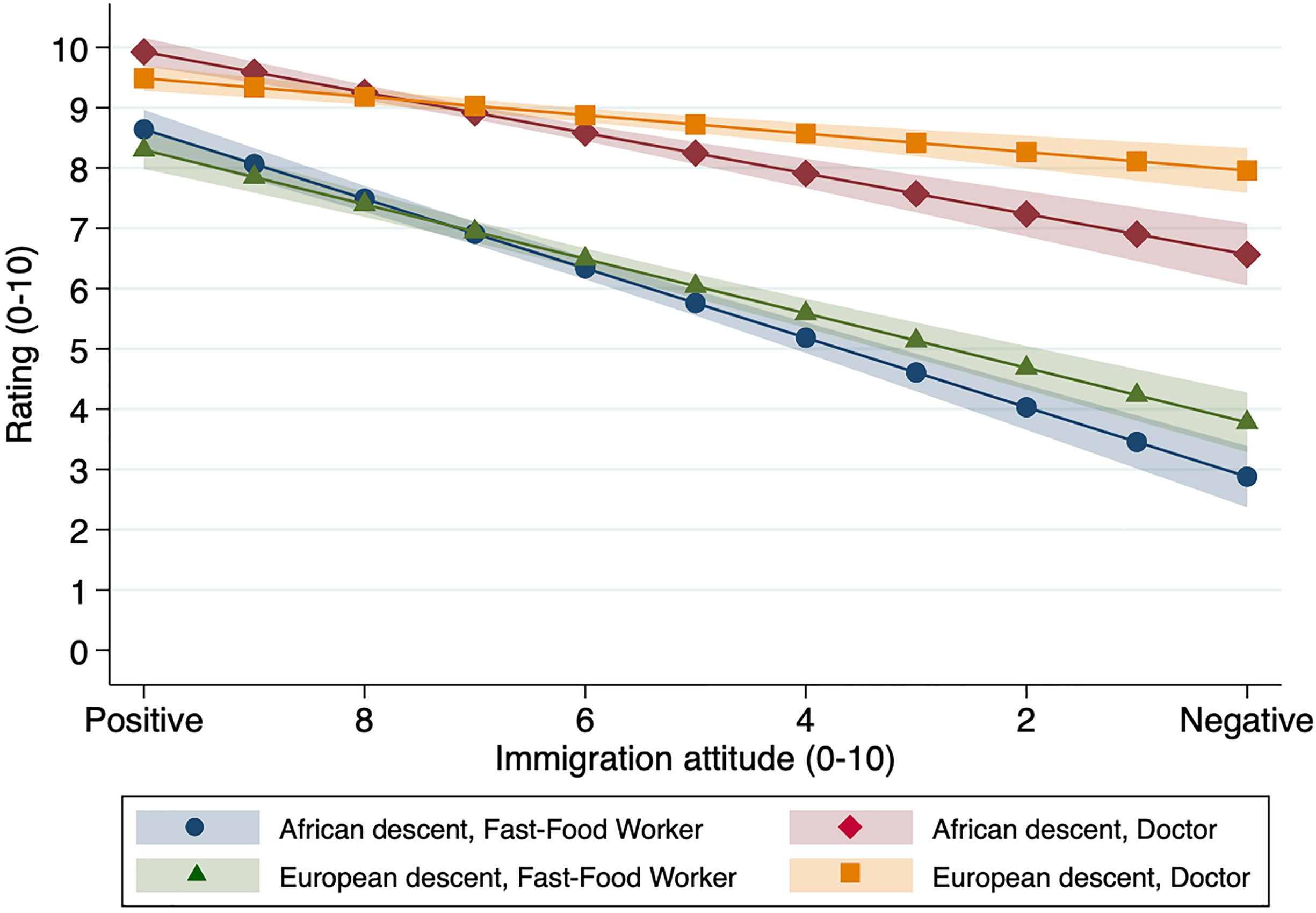
Predicted ratings of vignettes by general immigration attitudes.
A further interesting finding concerns the heterogeneity of the skill effect across respondents’ general immigration attitudes. Figure 1 indicates that the premium associated with high occupational status is not uniform across the population but varies systematically with pre-existing attitudes toward immigration. Among respondents with the most positive views of immigration, the predicted rating gap between medical doctors and fast-food workers is approximately 1.2 points, while it reaches nearly 3.8 points among respondents with the most negative views about the impact of immigration. This contrasts with Hainmueller and Hopkins (2015), who find the skill premium to be relatively uniform across the population.
Conclusion
This research note contributes to the literature on immigration preferences by showing how ethnic and skill biases in preferences interact. The findings show evidence of ethnic penalties in immigration preferences affecting high-skilled immigration applicants, but not low-skilled ones. While no significant ethnic penalty was detected for low-status occupations, highly skilled immigrants of African descent faced an observable penalty compared to their counterparts of European descent. This suggests that ethnic penalties in immigration preferences are not necessarily compounded by low skills but may instead be “activated” when skills and occupational status are high. Moreover, the study highlights that, in line with previous research (Afonso, Negash, and Wolff 2024), pre-existing immigration attitudes play a role in shaping how respondents react to experimental treatments about immigration. Individuals with more negative attitudes toward immigration are significantly more likely to penalize high-skilled applicants of African descent.
Despite its contributions, this study has limitations that open avenues for further research. First, while the experiment isolates ethnicity from other confounding factors, it does not account for intersectional dimensions such as gender, religion, or language, which may interact with ethnicity in shaping immigration preferences. Future studies could extend this approach by testing whether similar biases similarly affect female applicants, or by comparing immigrants from different religious backgrounds.
Second, it must be acknowledged that the AI-generated portraits used in the treatments lacked photorealism and may not have been perceived as real individuals; however, this limitation could imply a conservative test of our hypotheses. The somewhat unnatural quality of the stimuli could have suppressed treatment effects.
Third, external validity may also be limited by the specific parameters of the experiment, and notably the peculiar context of the country used to frame the vignettes (South Africa), as well as the country where it was fielded. For instance, following some media reporting (Reid 2025), respondents could have perceived White visa candidates as an oppressed minority—a narrative notably pushed by the Trump administration in the United States. 4 It is possible that respondents based their judgement on the political situation in that country rather than racial considerations only. However, this should have manifested itself in higher ratings for White applicants in the low-status occupation. This was not the case, however. The British context may also have shaped results, because the potential immigrants depicted in the experiment were not the most widely common in terms of source countries. However, it is reasonable to believe that the findings are applicable to other European countries. It would be interesting to field such an experiment in a context where the racial cues used in the treatment are more directly salient, such as in the United States.
Finally, the results showing an ethnic bias when it comes to medical doctors may be specific to this profession that entails a level of interpersonal interaction with patients, where ethnic prejudice may play a specific role even at the unconscious level (see Howe et al. 2022). It remains to be seen if a similar bias may apply to say, computer engineers where this interaction is limited. Replicating this experiment with a broader set of vignettes or in different national contexts would help assess the generalizability of these findings.
Supplemental Material
sj-pdf-1-mrx-10.1177_01979183261442878 - Supplemental material for Do Skills Protect from Prejudice? Occupational Status and Ethnic Penalties in British Immigration Preferences
Supplemental material, sj-pdf-1-mrx-10.1177_01979183261442878 for Do Skills Protect from Prejudice? Occupational Status and Ethnic Penalties in British Immigration Preferences by Alexandre Afonso in International Migration Review
Footnotes
Acknowledgements
The author would like to thank the participants of the LIMS Seminar at Leiden University, 19.2.2025, and notably Andrew Shields and Marlou Schrover, for useful comments on the paper.

Funding
The author disclosed receipt of the following financial support for the research, authorship, and/or publication of this article: This work was supported by NWO, Grant 016.Vidi.185.159.
Declaration of Conflicting Interests
The author declared no potential conflicts of interest with respect to the research, authorship, and/or publication of this article.
Supplemental Material
Supplemental material for this article is available online at https://journals.sagepub.com/home/mrx.
Notes
References
Supplementary Material
Please find the following supplemental material available below.
For Open Access articles published under a Creative Commons License, all supplemental material carries the same license as the article it is associated with.
For non-Open Access articles published, all supplemental material carries a non-exclusive license, and permission requests for re-use of supplemental material or any part of supplemental material shall be sent directly to the copyright owner as specified in the copyright notice associated with the article.
