




Abstract
Temporary visa programs have become the dominant channel for labor migration to the United States today. The H-1B visa is the largest U.S. work visa program and the primary pathway for high-skilled immigrants to enter and stay in the United States. Despite growing discussions on the H-1B visa program, little is known about the characteristics of H-1B workers, as visa status is rarely captured in nationally representative datasets. Drawing on new administrative records of all individuals who were approved for an H-1B visa between 2014 and 2024 (n = 3,396,170), this study provides one of the first population-level analyses of recent H-1B workers’ characteristics. Administrative records are combined with data from the American Community Survey (n = 3,089,405) to compare H-1B workers with U.S.-born and foreign-born citizen workers who are similarly employed. Findings reveal three key patterns. First, H-1B workers are highly educated and concentrated in computer science and engineering, fields where U.S. citizens are underrepresented. Second, nearly half are overeducated, primarily driven by advanced degree holders employed in occupations that only require a bachelor's degree. Third, H-1B workers earn 10.1 percent less than U.S.-born citizens and 12.9 percent less than foreign-born citizens in comparable occupations. The finding that H-1B workers are more likely than comparable U.S. citizens to be both overeducated and underpaid remains consistent across a range of demographic subgroups and is especially pronounced among Asian migrants. This study points to temporary visa status as a potential axis of labor market stratification in the high-skilled workforce.
Introduction
In recent decades, labor migration to the United States has become increasingly dominated by foreign workers holding temporary visas, with permanent workers making up less than 10 percent of new migrant workers (Costa 2020). Among those admitted to employment-based lawful permanent residency (LPR; i.e., Green Card) each year, consistently more than 80 percent were already residing in the United States and adjusted their status from a temporary visa (Department of Homeland Security 2023). The H-1B visa is the largest U.S. temporary work visa that offers a pathway to permanent residency. Designed for college-educated foreign professionals in specialty occupations, it is now the major pathway for employment-based immigrants to enter and stay in the United States (Connor and Ruiz 2019; Jacobs 2019).
Despite growing national attention to high-skilled immigration, surprisingly little is known about the characteristics of H-1B visa holders. High-skilled migrants command attention, as they are a driving force of technological innovation and entrepreneurship in the United States (Jasso 2009; Bier 2015; Xie et al. 2023). As global competition for talent intensifies, their employment outcomes have taken on new importance amid renewed policy debates over the H-1B program (Hassan and Kavi 2025; The White House 2025). How many H-1B visas are approved each year? Who receive the H-1B visa? Are H-1B workers replacing native workers or filling labor shortages? Although these questions carry significant policy implications, they remain underexplored due to the lack of nationally representative data on H-1B visa holders.
Studying the characteristics of H-1B workers provides important theoretical and empirical contributions to the international migration literature. While existing research has established that legal status stratifies immigrants’ labor market outcomes (Menjívar 2006; Durand, Massey and Pren 2016; Gonzales 2016), it has largely focused on undocumented immigrants or those who fall between the documented and undocumented status. Far less is known about how legal status affects legal migrants. This represents a major theoretical gap, as scholars increasingly recognize the temporality of status (i.e., temporary visa vs. permanent residency) as another key dimension of legal status besides legality (Joseph 2025; Liang 2025). As the transition from temporary visa to permanent residency becomes increasingly prolonged, H-1B workers spend extended time in this liminal status, facing distinct forms of labor market precarity due to their reliance on employer-sponsored visas (Bier 2020). This dependence often results in underpayment, occupational mismatch, and job insecurity and stress tied to temporary legal status (Jasso 2011; Mukhopadhyay and Oxborrow 2012; Jacobs 2019, 2025; Lu and Hou 2020; Banerjee 2022; Gambol, Zvobgo and Sabharwal 2025). By comparing the labor market outcomes of H-1B visa holders with similarly employed U.S. citizens, this study aims to provide quantitative empirical evidence that points to temporary visa status as a source of labor market stratification.
Drawing on administrative records of all individuals who were approved for an H-1B visa between 2014 and 2024 (n = 3,396,170), this study provides one of the first population-level analyses of recent H-1B workers’ characteristics. These administrative records are combined with data from the American Community Survey (n = 3,089,405) to compare H-1B workers with U.S.-born and foreign-born citizen workers who are similarly employed. Results indicate that only 2 percent of H-1B workers are employed in non-college-level jobs, suggesting they do not massively replace lower-skilled U.S. citizens. Instead, they are concentrated in fields where U.S. workers are underrepresented. However, they are significantly more likely than U.S. citizens in comparable occupations to be both overeducated and underpaid. These patterns suggest that temporary visa status may function as a distinct axis of labor market stratification that warrants further research.
Background
The H-1B Visa Program: An Overview
Today, the United States is the world's top receiver of high-skilled immigrants (Connor and Ruiz 2019), driven largely by the expansion of skill-based temporary visa programs over the past three decades (Jacobs 2019). Among these programs, the H-1B visa is the largest work visa and the primary pathway through which skilled migrants transition into permanent residency (Chakravorty, Kapur and Singh 2017; Jacobs 2019). The program allows employers to hire skilled workers with at least a bachelor's degree in specialty occupations. A key feature of this visa is that employer sponsorship is required, which directly ties the legal status of H-1B workers to their employers. H-1B visas are initially granted for three years and may be extended for up to six years. Annual issuances are capped at 85,000. 1 When the number of applications exceeds this cap, visas are allocated through a lottery system that currently selects fewer than 30 percent of applicants.
The expansion of the H-1B visa program reflects a broader shift in the U.S. labor migration system towards reliance on temporary foreign workers rather than permanent immigrants (Costa 2020). This trend originates from the Immigration Act of 1990, which significantly expanded temporary work visa programs. Introduced under this legislation, the H-1B visa program has grown rapidly, with annual issuances increasing nearly fivefold from 44,290 in 1992 to 206,002 in 2022. 2 In contrast, employment-based permanent residency (Green Cards) is capped at 140,000 visas annually, keeping permanent admissions relatively stable despite the rapid expansion of temporary visas.
Temporary Visa Status as A Source of Labor Market Stratification
Research has long identified multiple mechanisms that contribute to labor market disparities between immigrants and native-born workers. Human capital explanations emphasize that education and work experience acquired abroad often fail to transfer fully to the host labor market (Chiswick and Miller 2008). Variations in human capital levels, immigrant selectivity, and processes of assimilation further shape economic outcomes (Borjas 1987; Villarreal and Tamborini 2018; Feliciano 2020). Discrimination based on gender, race and ethnicity, and language proficiency also contributes to these disparities (Schmaus and Kristen 2022). From a signaling theory perspective, foreign education serves as a weaker indicator of productivity, leading employers to discount wages to offset perceived uncertainty (Spence 1978). Beyond these explanations, sociologists further highlight legal status as state-created categories that stratify immigrants’ access to rights and resources, thereby producing unequal labor market outcomes (Massey 1987; Kreisberg 2023; Menjívar 2023; Hall, Olivero and Gleeson 2025).
Temporary visa status has become a growing source of labor market inequality among the high-skilled workforce in the United States. Entry into H-1B status is contingent on employer sponsorship and is administered through a state-regulated petition process: only foreign workers hired and sponsored by an employer are eligible for the visa (Rho and Sanders 2021). This system is characterized by a structural imbalance between the limited supply of H-1B visas and the large pool of prospective migrant workers seeking H-1B sponsorship. In 2025, for example, 479,953 petitions were filed, yet only 28 percent were selected through the state-administered lottery (USCIS 2025). Because the number of available H-1B visas remains far smaller than the number of qualified applicants, entry into H-1B status depends on successfully navigating this competitive, employer-driven entry process. Workers who fail to secure employer sponsorship have to exit the U.S. labor market, while those who succeed are filtered through a process that grants employers substantial leverage over migrants’ legal status (Jacobs 2019).
This entry pathway creates a profound power asymmetry between employers and migrant workers. Because H-1B visa holders have to rely on their employers for visa sponsorship—a process that imposes high costs on firms and has become increasingly burdensome under the current administration's proposed $100,000 sponsorship fee—migrants often prioritize visa sponsorship over career advancement when looking for jobs (Wang 2024). Firms, in turn, may suppress wages to offset sponsorship costs and the perceived risks of hiring foreign workers. Employers thus have access to a compliant and legally dependent workforce, a dynamic often described as a form of “indentured servitude” (Matloff 2002; Chakravorty, Kapur and Singh 2017; Wang 2021). As a result, many visa holders are compelled to accept unfavorable job conditions to maintain employer sponsorship, often taking positions below their qualifications, working excessive hours, and tolerating lower pay than comparable native workers (Mukhopadhyay and Oxborrow 2012; Jacobs 2019, 2025; Banerjee 2022). Because the observed population of H-1B workers consists of individuals who successfully navigated this competitive and restrictive pathway, documented disparities relative to native workers likely represent conservative estimates of the broader inequalities generated by the temporary visa regime.
These disadvantages are further reinforced by job immobility. Visa rules restrict job changes (Gambol, Zvobgo and Sabharwal 2025; Jacobs 2019), and the transition from an H-1B visa to permanent residency can take more than a decade, particularly for migrants from India and China due to national quotas (Bier 2020). Therefore, many workers become locked into long-term employment relationships with their sponsoring firms (Jasso et al., 2010; Gambol, Zvobgo and Sabharwal 2025). This prolonged dependency prevents workers from moving to positions that better match their skills or offer higher pay. Robust empirical evidence underscores the impact of these constraints: obtaining permanent residency is associated with an annual wage gain of about $11,860 for employer-sponsored immigrants (Mukhopadhyay and Oxborrow 2012) and an immediate upsurge in job mobility, largely driven by voluntary job changes that are suppressed during temporary visa status (Wang 2021).
Furthermore, temporary visa status shapes employment outcomes through gendered and racialized processes. About 70 percent of H-1B holders are men, and roughly 72 percent are from India and 12 percent from China (U.S. Department of Homeland Security 2025). Banerjee (2022) shows that visa restrictions on H-1B visa holders’ dependent spouses—most of whom are women—intensify gender inequality by limiting women's right to work. Similarly, Gambol, Zvobgo and Sabharwal (2025) find that Indian women on H-1B visas have to navigate gendered expectations in both the United States and India when deciding whether to return. Country of origin further reinforces these inequalities: migrants from India and China face the longest Green Card wait times due to per-country quotas (Bier 2020), and rising United States–China tensions have made Chinese citizenship a source of heightened precarity (Xie et al. 2023). Together, these patterns indicate that temporary visa status not only produces inequality but also does so along gendered, racialized, and geopolitical lines.
Despite the growing literature on the effect of temporary visa status for high-skilled immigrants, data availability is a crucial limitation. Although shown as a key source of labor market inequality in qualitative studies, temporary visa status is rarely captured in nationally representative datasets. Migration scholars actually know very little about the characteristics of H-1B workers and how they compare to similar U.S. citizen workers. This represents an urgent theoretical and empirical gap, as the H-1B visa program is the primary pathway for high-skilled immigration in the United States today.
Data and Methods
Data
This study draws on administrative records of all individuals who were approved for an H-1B visa between April 30, 2014, and April 30, 2024 (also known as Form I-129 microdata). For H-1B workers, Form I-129 is the employer-filed petition submitted to U.S. Citizenship and Immigration Services (USCIS) after a foreign worker is selected through the H-1B lottery and the Labor Condition Application 3 (LCA) has been certified. I obtained this microdata from the USCIS through a Freedom of Information Act request. This dataset includes all 4,003,846 cases of H-1B visa petitions filed during this period, encompassing both initial and continuing employment petitions. 4 It includes person-level information on key variables such as each applicant's level of education, field of study, job code (three-digit DOT code), annual wage, worksite location, country of origin, and work industry. Information on age, place of education, and school name was not disclosed to the author, as the disclosure of such personal information would “constitute an unwarranted invasion of personal privacy.” Gender information is released only for records from 2018 to 2024. Given the study's goal to examine characteristics of H-1B workers and compare these with U.S. citizen workers in similar occupations, I excluded cases with missing information on the level of education (n = 299,892), job code (n = 253,536), or annual wage (n = 27,574). I further excluded petitions that were denied an H-1B visa (n = 271,644), given this study's focus on those who are approved to work with an H-1B visa in the United States. The final sample of H-1B workers contains 3,396,170 individual petitions approved for H-1B employment.
To compare the characteristics of H-1B workers with those of U.S.-born and foreign-born citizens, I pooled ten years of American Community Survey data (2014–2023). To ensure a comparable sample to H-1B workers, I restricted the analysis to foreign-born and U.S.-born citizens aged 22–55 with at least a college degree 5 who are employed full-time, 6 aligning with the H-1B visa requirement of holding at least a bachelor's degree and maintaining employment while on the visa. This yields a sample of 2,728,786 U.S.-born citizens and 360,619 foreign-born citizens. The foreign-born citizen group represents naturalized immigrants who are not subject to temporary visa constraints. Although I excluded non-citizen immigrants in the main analysis because legal status is not measured in the ACS, I included this group in a supplemental analysis (Online Supplemental Appendix Table 2), which shows that H-1B workers were also disadvantaged relative to other immigrants overall, a pattern that may be especially pronounced among high-skilled legal permanent residents who are not subject to temporary visa restrictions.
Measuring Overeducation
Overeducation is defined as situations in which a worker's education is greater than the education level required to perform the job. Throughout this study, overeducation is operationalized as a vertical mismatch between educational attainment and occupational requirements. Measuring overeducation requires first determining the required level of education for each occupation and then deciding whether each individual's education matches or exceeds that requirement (Lu and Li 2021).
I use two well-established approaches to measure the required education for each occupation. The first approach draws on the U.S. Department of Labor's official Occupational Information Network (O*NET) database (29.1 database), which derives required education for a wide range of occupations from nationally representative surveys of job incumbents and occupational experts who report the level of education typically needed for each occupation. Following previous research, I take the modal level of required education because of its insensitivity to outliers (Lu and Li 2021). I aggregated the job code used in O*NET data (six-digit SOC codes) to three-digit DOT codes to match with the H-1B data, 7 yielding educational requirement for 272 unique occupations. To corroborate the robustness of overeducation rates, I also use an alternative “realized match” approach, deriving the typical level of education for each occupation based on the modal education level among all U.S.-born citizens aged 22–55 in the American Community Survey (2014–2023). Rates of overeducation derived from these two approaches show highly consistent patterns. I use the results derived from the O*NET data in the main findings to avoid the bias from using the ACS data for both defining and measuring overeducation (Li and Lu 2023). Rates of overeducation derived from the ACS data across years are shown in Online Supplemental Appendix Figure A1.
Once information on required education is derived from O*NET data, I then merge it with the analytical sample based on respondents’ occupation. I distinguish between two types of overeducation. The first type refers to situations when individuals with at least a college degree work in occupations that do not require a college degree. The second type refers to situations when individuals with an advanced degree (i.e., master's, doctoral, or professional degrees) work in occupations that do not require an advanced degree. This distinction is important, as the first type indicates the potential displacement of local workers in lower-skilled jobs, whereas the second highlights the underutilization of H-1B workers’ skills among those with advanced degrees. The overall incidence of overeducation is defined as meeting either of these two conditions and is measured as a binary variable (0/1).
To further address the concern that this measure of overeducation does not capture the unobserved complexity of skills required for each specific position, I incorporate an additional measure of skill level officially assigned by the Department of Labor. This variable reflects the relative complexity of skills required for a given position compared to other jobs within the same occupation (see Online Supplemental Appendix B for detailed description). I merge the skill level information from population-level LCA records 8 that employers must submit before filing Form I-129 for H-1B workers. In supplemental analyses, I examine whether the observed rates of overeducation among H-1B visa holders are driven by positions that require more complex skills.
Analytical Strategy
I conduct the analysis in several steps. First, I present descriptive statistics regarding the number of H-1B visa petitions filed and approved each year. Then, I compare the characteristics of H-1B workers, U.S.-born citizens, and foreign-born citizens. Table 1 summarizes the descriptive statistics for H-1B workers, U.S.-born citizens, and foreign-born citizens.
Descriptive Statistics by Immigration Status.
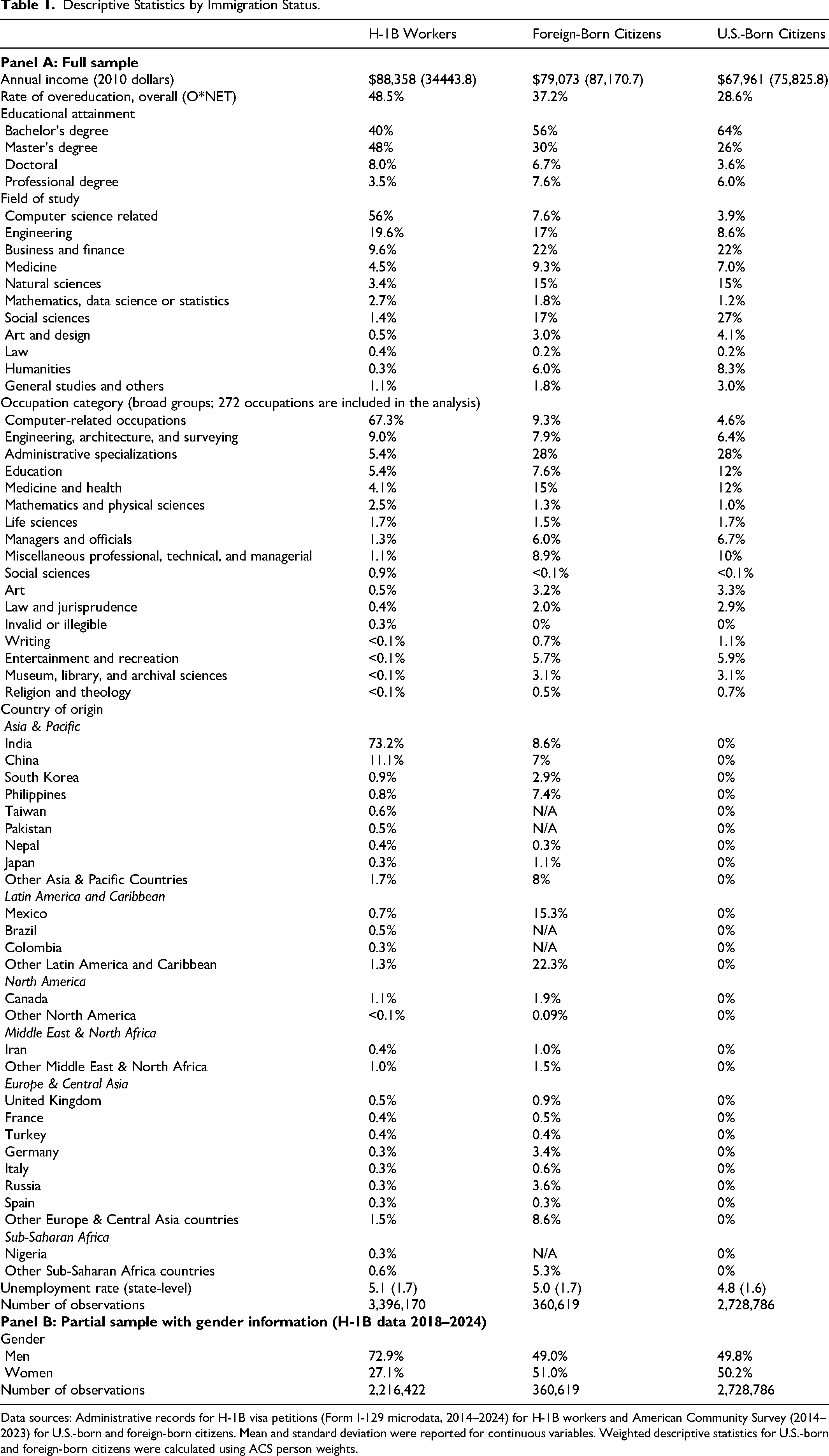
Data sources: Administrative records for H-1B visa petitions (Form I-129 microdata, 2014–2024) for H-1B workers and American Community Survey (2014–2023) for U.S.-born and foreign-born citizens. Mean and standard deviation were reported for continuous variables. Weighted descriptive statistics for U.S.-born and foreign-born citizens were calculated using ACS person weights.
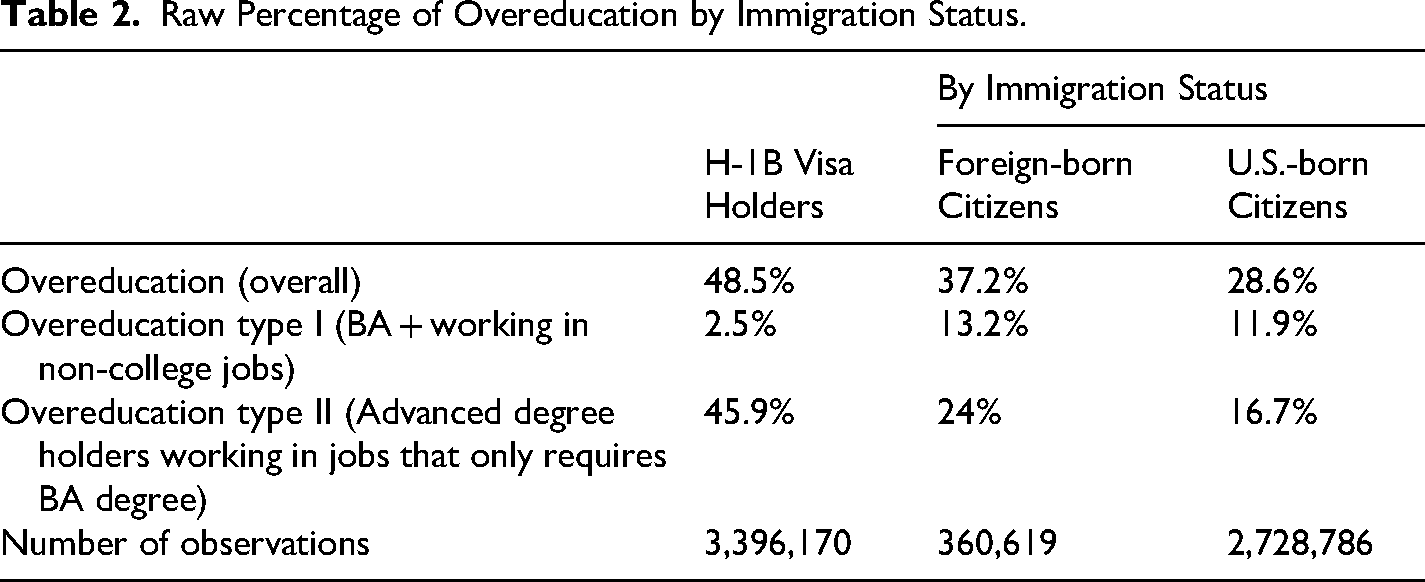
Second, I examine the prevalence of overeducation among H-1B workers, U.S.-born citizens, and foreign-born citizens. I begin by presenting raw rates of two types of overeducation across these groups (Table 2), followed by multivariate analyses estimating the likelihood of overeducation by immigration status 9 using a linear probability model, controlling for demographic characteristics, state, industry, and year fixed effects, and 272 detailed occupation categories (Table 3). A logistic regression model generates highly consistent results (Online Supplemental Appendix Table 3). I further assess how the relationship between overeducation and immigration status varies by country of origin, 10 field of study, educational attainment, and gender 11 through subgroup and interaction analyses (Figure 2).
Raw Percentage of Overeducation by Immigration Status.
Predicting Likelihood of Overeducation by Immigration Status (Weighted).
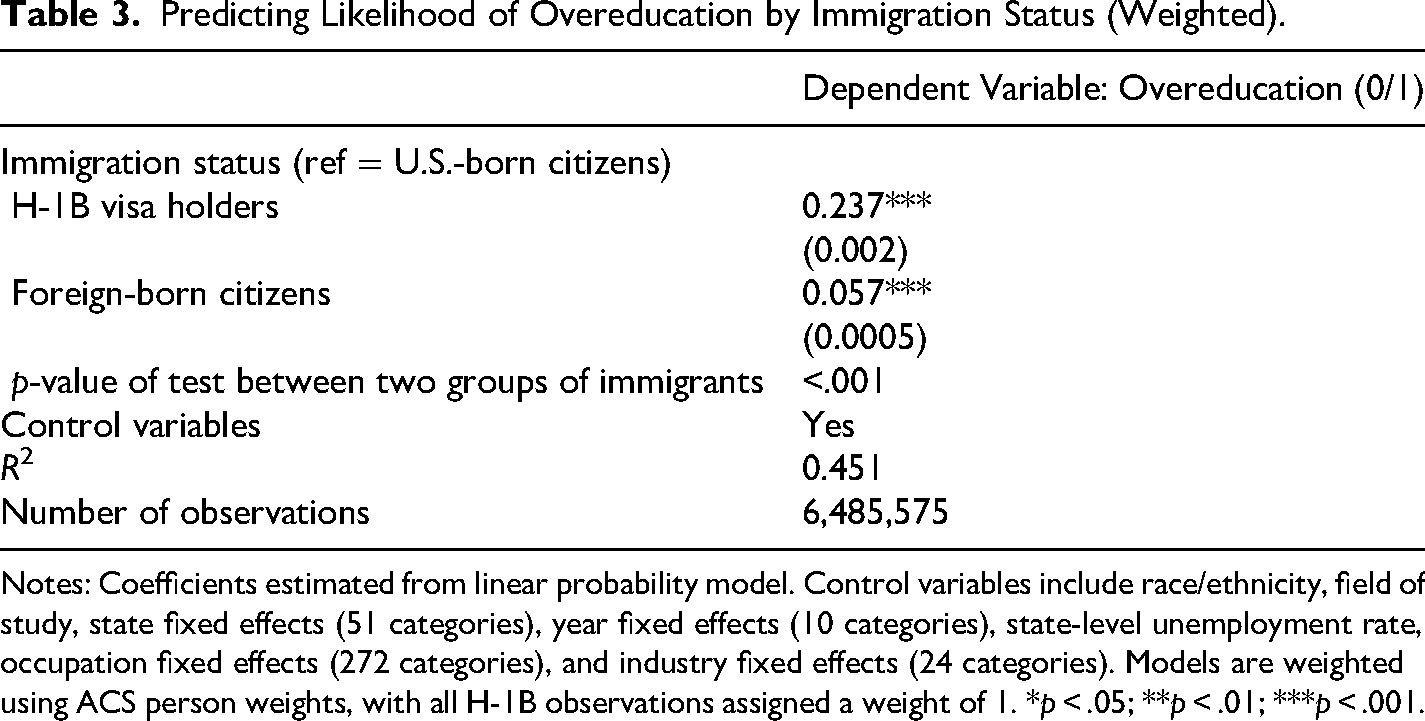
Notes: Coefficients estimated from linear probability model. Control variables include race/ethnicity, field of study, state fixed effects (51 categories), year fixed effects (10 categories), state-level unemployment rate, occupation fixed effects (272 categories), and industry fixed effects (24 categories). Models are weighted using ACS person weights, with all H-1B observations assigned a weight of 1. *p < .05; **p < .01; ***p < .001.
Stepwise Linear Regression Models Predicting Logged Annual Income (Weighted).
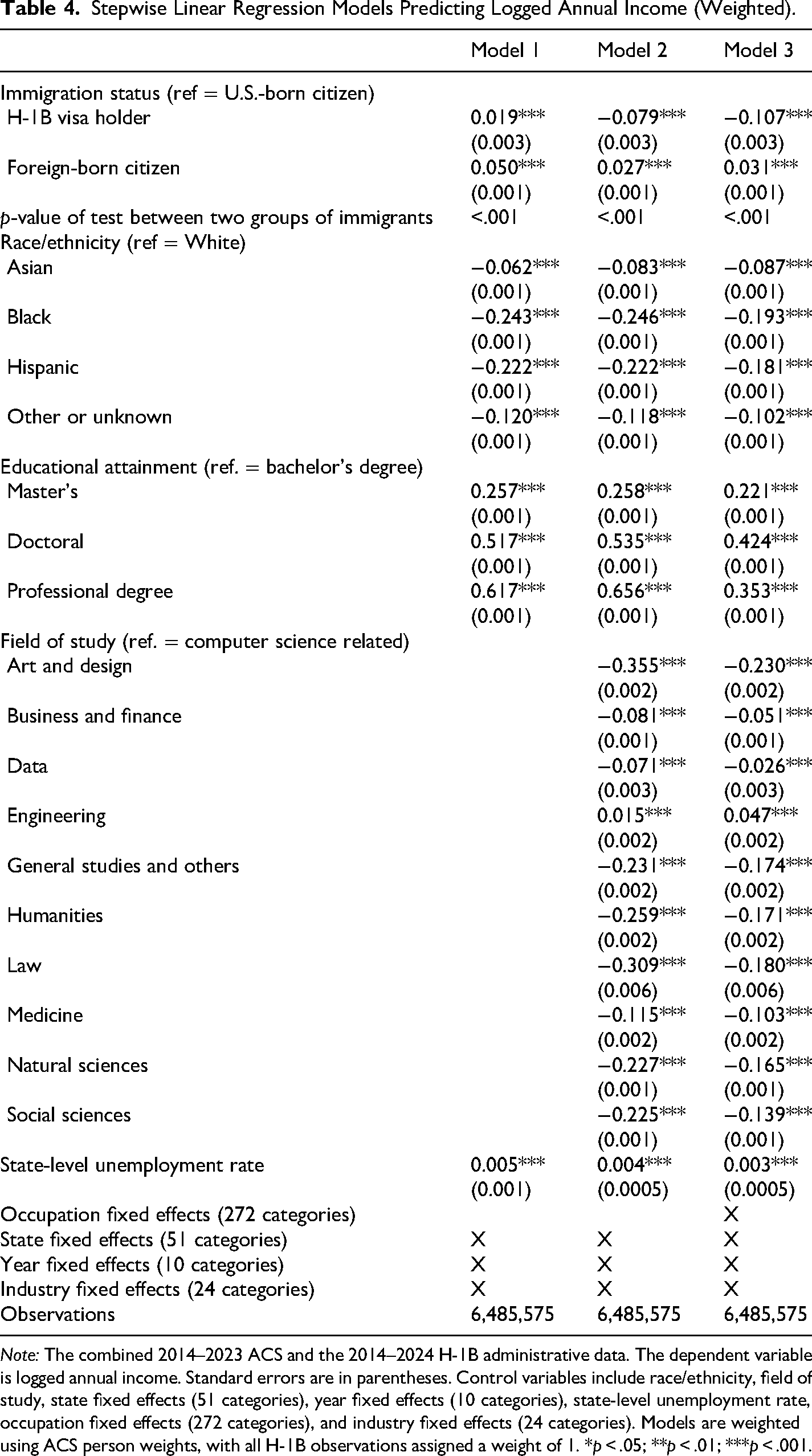
Note: The combined 2014–2023 ACS and the 2014–2024 H-1B administrative data. The dependent variable is logged annual income. Standard errors are in parentheses. Control variables include race/ethnicity, field of study, state fixed effects (51 categories), year fixed effects (10 categories), state-level unemployment rate, occupation fixed effects (272 categories), and industry fixed effects (24 categories). Models are weighted using ACS person weights, with all H-1B observations assigned a weight of 1. *p < .05; **p < .01; ***p < .001.
In the final step, I examine how annual income differs among H-1B visa holders, U.S.-born citizens, and foreign-born citizens. The log transformation of annual income (CPI-adjusted to 2010 dollars) was used as the dependent variable. I consider key covariates including race/ethnicity, 12 educational attainment, field of study, state, year, work industry, and occupation fixed effects. Notably, controlling for occupation is conceptually important because H-1B workers are required to be paid at least the prevailing wage, which is decided based on occupational classification and geographic area. Conditioning on detailed occupation therefore facilitates comparisons among workers within similar job categories. I further incorporate the state-level unemployment rate 13 to account for local labor market tightness in all models (Brunow, Lösch and Okhrin 2022), as the H-1B program is designed to address labor shortages.
To examine how key variables explain the income disparities by immigration status, I estimate a set of stepwise models (Table 4). I begin with a baseline model that regresses logged income by immigration status, race/ethnicity, and educational attainment. I then add the field of study in the second model. The third model additionally incorporates occupation fixed effects. ACS person weights were applied in all models, with H-1B observations assigned a uniform weight of 1, as the H-1B data represent population-level records. Unweighted models predicting income and overeducation, presented in Online Supplemental Appendix Tables 1 and 3, yield highly consistent results. As a final step, I examine how the relationship between logged income and immigration status varies by country of origin, 14 field of study, educational attainment, and gender through subgroup and interaction analyses (Figure 3). It should be noted that this study draws on cross-sectional data and is intended to provide a population-level description of H-1B workers’ labor market outcomes. Accordingly, the analyses document associations rather than causal effects.
Results
H-1B Visa Approval Patterns
Figure 1 presents the annual number of H-1B visa petitions filed and approved from April 30, 2014, to April 30, 2024. The number of petitions increased steadily from 2015 to 2020, dipped in 2021, peaked in 2022, and declined again thereafter. The decline in the approval rate in 2018 reflects a period of heightened regulatory scrutiny and stricter adjudication standards by the USCIS (National Foundation for American Policy 2019). Since H-1B petitions are submitted after applicants are selected in the visa lottery and the LCA approval, most petitions for H-1B visas were approved. In some years, approvals exceeded filings due to petitions submitted in the previous year.
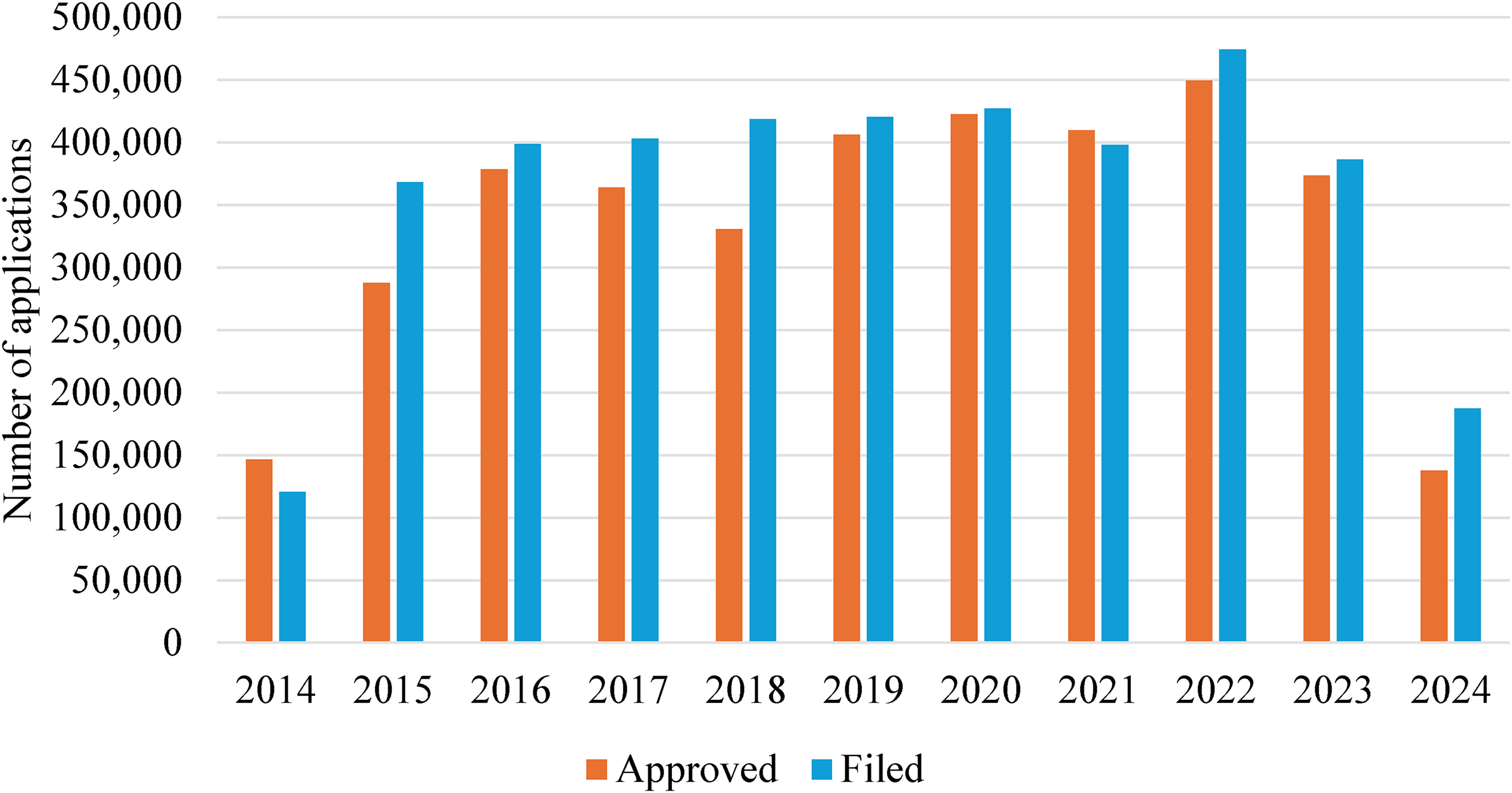
Number of H-1B visa petitions filed and approved by year, April 30, 2014 to April 30, 2024. Data source: Author's calculations from administrative records for H-1B visa petitions (Form I-129 microdata, 2014–2024).
Demographic Characteristics
Table 1 compares the characteristics of H-1B workers with those of U.S.-born and foreign-born citizens who work full-time and have at least a college degree. Without adjusting for control variables, H-1B workers have higher annual incomes than both groups, likely reflecting their concentration in high-earning fields such as computer science and engineering. They also exhibit a higher rate of overeducation, with 48 percent overeducated for their jobs, compared to 37 percent of foreign-born and 28 percent of U.S.-born citizens. Regarding the level of education, more than half of H-1B workers hold an advanced degree, and they are more likely to have a master's or doctoral degree than both U.S.-born and foreign-born citizens.
H-1B workers are concentrated in majors where U.S. citizen workers are underrepresented. Around 56 percent of H-1B workers hold degrees in computer science-related fields, compared to only 7.6 percent of foreign-born and 3.9 percent of U.S.-born citizens. Similarly, H-1B workers are more likely to have majored in engineering but less likely to have studied business or finance, medicine, natural sciences, social sciences, humanities, or arts. Occupational distribution follows a similar pattern, with 67 percent of H-1B workers employed in computer-related occupations, compared to only 9.3 percent of foreign-born and 4.6 percent of U.S.-born citizens. H-1B workers are also more likely to work in engineering, mathematics, and physics than both U.S.-born and foreign-born citizens.
Regarding their countries of origin, those from Asia make up the vast majority of H-1B workers. Seventy-three percent of H-1B workers are Indian citizens, with Chinese nationals coming in second at 11 percent. Other major sending countries of H-1B workers are South Korea, the Philippines, Canada, and Mexico. Analysis of H-1B records from 2018 onward (when gender information is available) shows that approximately 73 percent of H-1B visa holders are men and only 27 percent are women.
Overeducation and Immigration Status
Table 2 reports the unadjusted rates of two types of overeducation among H-1B workers, foreign-born citizens, and U.S.-born citizens. Nearly half of H-1B workers (48 percent) are overeducated. This high rate is driven primarily by Type II overeducation—holding an advanced degree while working in occupations that do not require one. This type of overeducation affects 46 percent of H-1B workers, compared with just 24 percent of foreign-born and 17 percent of U.S.-born citizens. In particular, Online Supplemental Appendix Figure A2 shows an increase in the rate of this type of overeducation among H-1B workers in 2021, likely reflecting limited job opportunities during the pandemic that further constrained immigrants’ ability to obtain positions aligned with their qualifications. In contrast, only 2.5 percent of H-1B workers are overeducated due to employment in jobs that do not require a college degree (Type I). These patterns indicate that the majority of H-1B workers are not displacing lower-skilled native workers but are instead employed in positions that underutilize their advanced qualifications.
Table 3 presents the fully adjusted model estimating the association between immigration status and the likelihood of overeducation. Even after controlling for demographic characteristics, region, occupation fixed-effects, and other covariates, H-1B workers remain significantly more likely to be overeducated than foreign-born and U.S.-born citizens in similar occupations. On average, H-1B visa holders are 23.7 percentage points more likely to be overeducated than U.S.-born citizens within the same occupation (p < .001), while foreign-born citizens are 5.7 percentage points more likely (p < .001) to be overeducated than their U.S.-born counterparts. The difference between the two immigrant groups is statistically significant (p < .001), suggesting that the H-1B visa status is associated with a higher rate of overeducation relative to both comparable U.S.-born and foreign-born citizens, likely reflecting the institutional constraints tied to the H-1B visa status that channel visa holders to jobs below their qualifications.
To assess whether the association between overeducation and H-1B visa status holds across different subgroups, Figure 2 presents the marginal effects of immigration status (relative to U.S.-born citizens) from a series of subgroup and interaction models. Panel A shows that the higher likelihood of overeducation among H-1B workers persists across most countries of origin and is especially pronounced among Asian migrants, particularly those from mainland China, Taiwan, and India, while H-1B migrants from countries such as the United Kingdom and Canada exhibit lower overeducation rates, possibly reflecting closer alignment in educational systems. Panels B and C reveal that H-1B workers exhibit higher overeducation rates across various education levels and fields of study, especially among advanced degree holders and those in business, engineering, and computer science. In contrast, H-1B holders with only a bachelor's degree are less likely to be overeducated, likely because H-1B visa rules require employment in specialty occupations that typically require a college degree. Panel D shows that the pattern holds for both men and women, though the association between H-1B visa status and overeducation is slightly stronger among women.
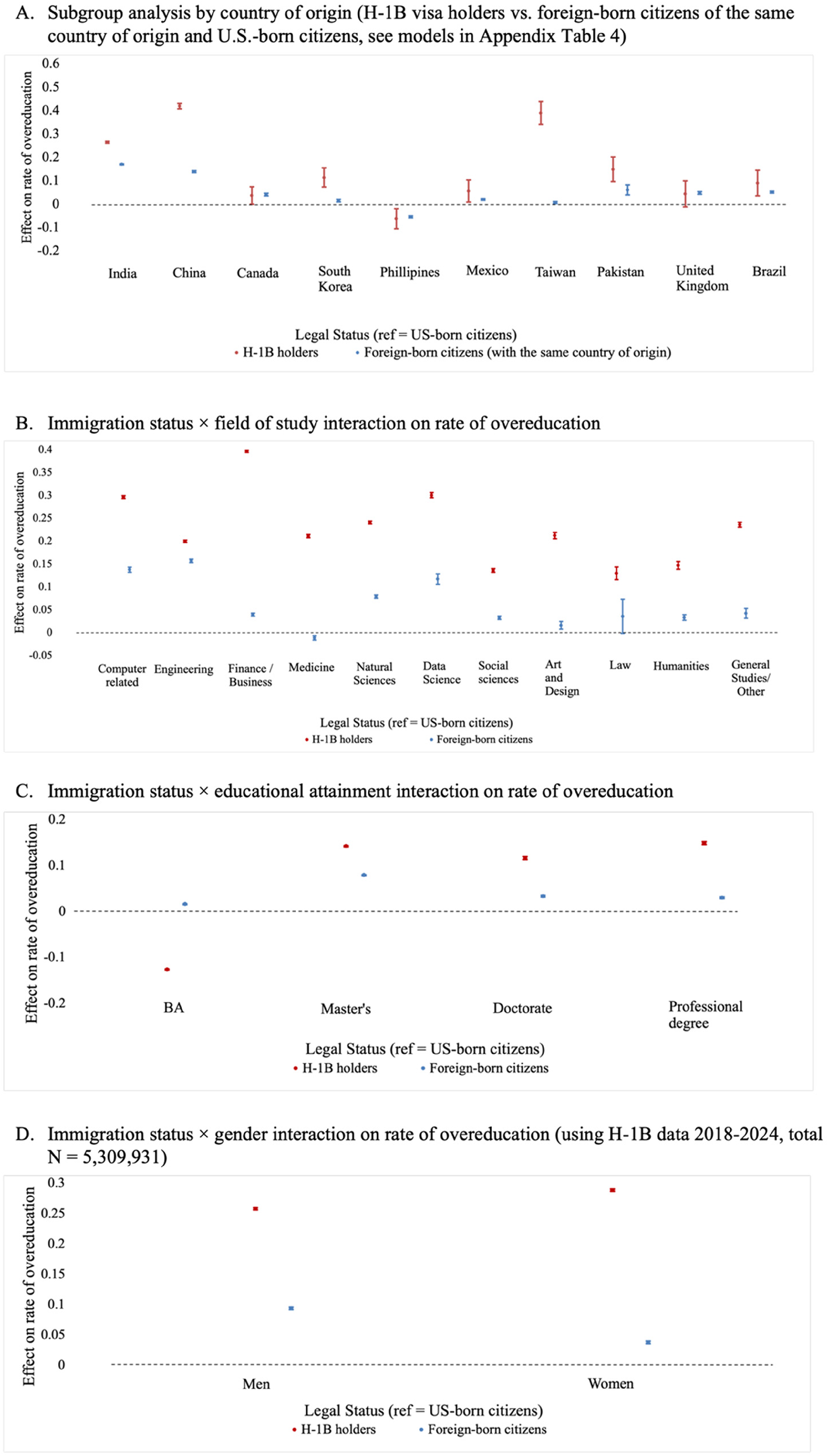
Association between immigration status and overeducation across subgroups and interaction effects. Note: Coefficients are estimated from linear probability models. Panel A plots results from subgroup analyses by immigrants’ country of origin (see all models in Online Supplemental Appendix Table 4). Panels (B)–(D) show interaction effects between immigration status and field of study, educational attainment, and gender, respectively, displaying the marginal effects of immigration status relative to U.S.-born citizens. All models control for race/ethnicity, field of study, state of residence, year fixed effects, occupation fixed effects, industry fixed effects, and the state-level unemployment rate. 95% confidence intervals (two-tailed) are shown.
Wage and Immigration Status
Table 4 reveals significant income disparities by immigration status. In Model 1 that only controls for immigration status, race/ethnicity, and educational attainment, H-1B workers on average earn 2 percent more (calculated as
Income disparities widen further after accounting for occupation. In Model 3 that incorporates occupation fixed effects, H-1B workers earn 10.1 percent less (calculated as
Next, I examine whether the income disadvantage associated with H-1B visa status is concentrated within particular subgroups. Figure 3 presents the marginal effects of immigration status from a series of subgroup and interaction models. Panel A shows that H-1B workers earn significantly less than U.S. citizens across most countries of origin, with the largest income penalties observed among Asian migrants from the Philippines, Taiwan, South Korea, and mainland China. Panel B indicates that the H-1B wage disadvantage persists across most fields of study, except law and art or design. Panel C shows that the negative association between H-1B status and income widens at higher levels of education: H-1B workers with advanced degrees earn substantially less than comparable U.S. citizens, whereas those with only a bachelor's degree have similar earnings, likely due to the H-1B visa rule that requires employment in specialty occupations that demand at least a bachelor's degree, which typically pay higher. Panel D shows that the income penalty holds for both male and female H-1B workers, though the smaller income gap among women likely reflects stronger selection into the male-dominated H-1B program. These subgroup patterns are exploratory and require further theorization in future research to identify the mechanisms underlying cross-national and gendered variation.
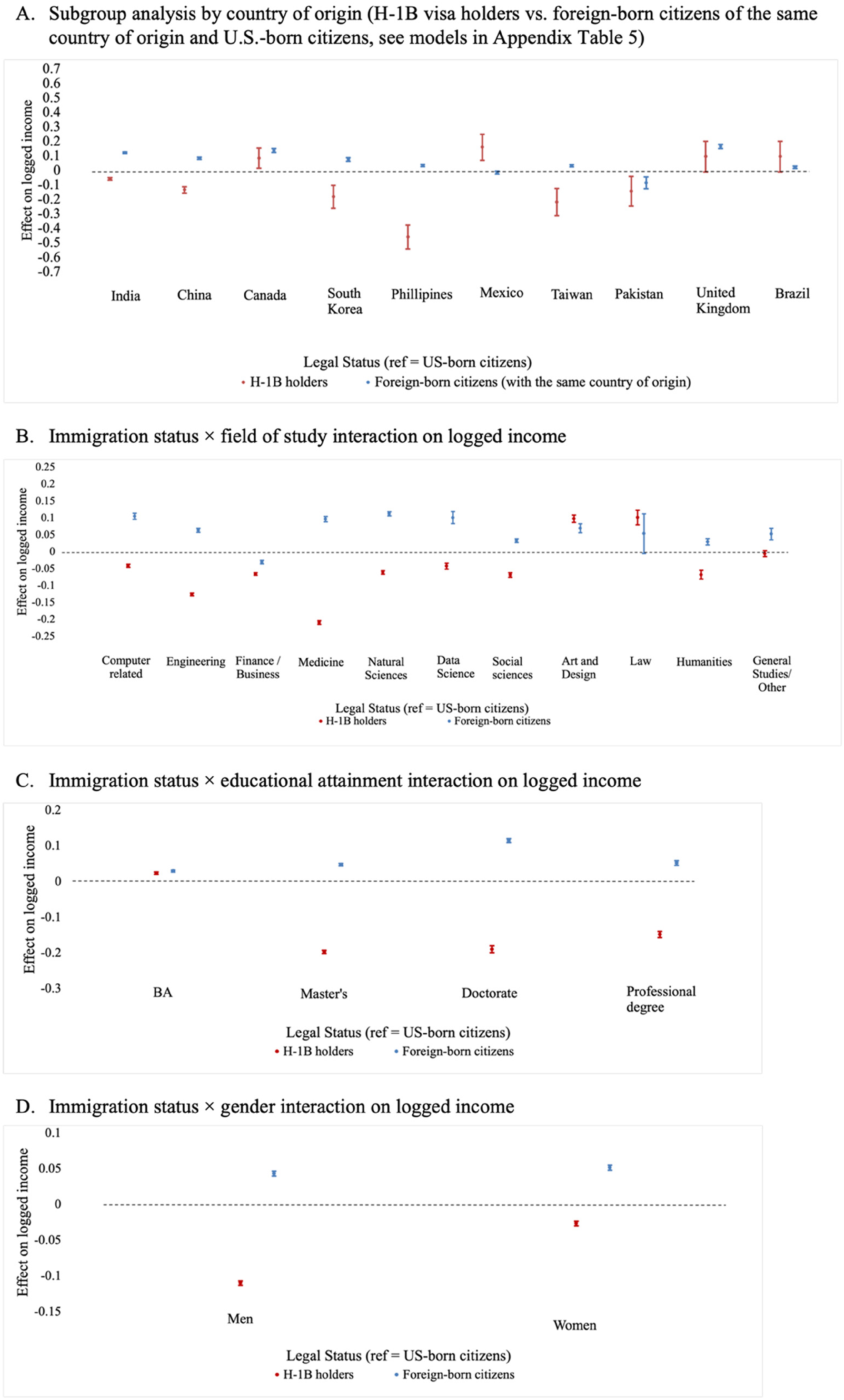
Association between immigration status and logged income across subgroups and interaction effects. Note: Coefficients are estimated from linear regression models. Panel A plots results from subgroup analyses by immigrants’ country of origin (see all models in Online Supplemental Appendix Table 5). Panels (B)–(D) show interaction effects between immigration status and field of study, educational attainment, and gender, respectively, displaying the marginal effects of immigration status relative to U.S.-born citizens. All models control for race/ethnicity, field of study, state of residence, year fixed effects, occupation fixed effects, industry fixed effects, and the state-level unemployment rate. 95% confidence intervals (two-tailed) are shown.
Robustness Checks
The labor market disadvantages associated with H-1B visa status—higher rates of overeducation and lower annual income—remain robust across all alternative model specifications in Online Supplemental Appendix Tables 6 and 7, which predict annual wage and overeducation, respectively. Models A–C account for the age structure of H-1B visa holders. Given that around 80 percent of H-1B visa holders are below 40 years old (U.S. Department of Homeland Security 2025), Model A restricts the U.S. citizen sample to individuals below 40. Models B and C separate H-1B cases into initial and continuing employment petitions, respectively, and weight the U.S.-citizen comparison group by the age distribution of each H-1B group using proportions from official reports (U.S. Department of Homeland Security 2025). Models D and E exclude individuals from India and those with a computer science major to test whether the results are driven by these dominant groups. These robustness checks yield highly consistent findings, which validate the substantive results that H-1B visa status is associated with a higher likelihood of overeducation and lower pay than comparable U.S.-born and foreign-born citizens.
I then examine whether overeducation among H-1B workers is driven by job-level skill complexity not captured by occupation-level measures, using a subsample of cases matched to skill levels from the LCA data. Online Supplemental Appendix Table 8 shows that the share of overeducated H-1B workers remains stable at 45–55 percent across all four skill levels. Online Supplemental Appendix Table 9 indicates that overeducation declines, rather than increases, with rising skill complexity, suggesting that workers in higher-skill positions are less likely to be matched to overqualified positions. I further restrict the U.S. citizen sample to workers who are not overeducated. If the wage gap can be explained by more complex tasks, H-1B workers in these positions should earn more than their non-overeducated U.S. counterparts. However, H-1B workers remain significantly underpaid relative to these matched U.S. citizens (Online Supplemental Appendix Table 10), underscoring that the wage gap likely reflects structural constraints due to visa status.
Conclusion and Discussion
The H-1B program has become the predominant pathway for high-skilled labor migration to the U.S. Nevertheless, the lack of nationally representative data has left much unknown about the characteristics and employment outcomes of work visa holders. Using new administrative records of all approved H-1B visa holders between 2014 and 2024 (n = 3,396,170) combined with American Community Survey data (n = 3,089,405), this study offers one of the first population-level portraits of recent H-1B workers relative to U.S. citizens. Three main findings emerge. First, H-1B workers are highly educated and concentrated in fields where U.S. citizens are underrepresented, especially computer science and engineering. Second, nearly half are overeducated—primarily advanced-degree holders employed in occupations that do not require such credentials—while only 2–3 percent hold jobs that do not require a college degree, challenging claims that they massively displace lower-skilled native workers. Finally, H-1B workers earn 10.1 percent less than U.S.-born citizens and 12.9 percent less than foreign-born citizens in similar occupations. Together, these patterns show that H-1B workers are significantly more likely than comparable U.S. citizens to be both overeducated and underpaid, suggesting that temporary visa status may function as a distinct source of labor market stratification that warrants further research.
This study offers timely insights into ongoing debates on high-skilled immigration and key theoretical contributions to the international migration literature. Public discourse around the H-1B program often centers on two questions: Whether it attracts the “best and the brightest” and whether H-1B workers displace native workers. The findings suggest that H-1B workers are not massively replacing lower-skilled natives but are instead concentrated in fields facing labor shortages, such as computer science and engineering. Yet, their skills remain underutilized, and their earnings suppressed, likely due to the structural constraints of the temporary, employer-dependent H-1B visa. Building on previous scholarship examining the effects of legal status on immigrants’ labor market outcomes (Gonzales 2016; Menjívar 2006, 2023), I argue that temporary visa status is a critical yet understudied dimension that may drive labor market stratification in the high-skilled workforce. By conceptualizing temporary visa status as a mechanism of stratification, this study extends scholarship on immigrant incorporation and reframes high-skilled migration as a case where human capital does not ensure economic integration.
This study has several limitations that point to important directions for future research. First, it is important to note that this study draws on cross-sectional data, and the aim is to provide a population-level description of the H-1B migrant population. Causal interpretations should be made with caution, and future studies can benefit from using longitudinal data to examine the effect of H-1B visa status on labor market stratification. Second, the analysis focuses on approved H-1B visa holders, a highly selected group of foreign workers who successfully navigated a competitive job search, and thus likely provides conservative estimates of the disadvantages faced by visa holders. Third, various unobserved characters—such as place of education, language proficiency, age, and soft skills—could not be included in the current study. However, roughly 70 percent of approved H-1B holders previously held U.S. student visas and thus received some education in the U.S. (U.S. Department of Homeland Security 2025), and the majority of H-1B workers—particularly Indian nationals—are educated in English, reducing concerns about language proficiency and foreign credential recognition. In addition, because this study relies on DOT-based occupational codes provided in administrative records, which reflect an older classification system, aggregation may obscure meaningful within-occupation variation. Finally, this study only considers vertical education-occupation mismatch and does not capture how overeducation may be associated with field-of-degree alignment or work experience, although degree misalignment may be less salient, given that some H-1B pathways require close correspondence between credentials and job content. Some observed overeducation may also reflect educational inflation or education-related migration pathways, through which migrants pursue advanced degrees in the U.S. but face constraints in securing jobs that match their qualifications.
Nonetheless, this study provides robust population-level evidence that H-1B visa status may constitute a distinct axis of labor market stratification. Temporary visa programs that tie immigrants’ legal status to employer control create structural power asymmetries that constrain workers’ bargaining power and contribute to systematic labor market disadvantages (Banerjee, Verma and Zhang 2019; Wang 2024; Gambol, Zvobgo and Sabharwal 2025; Jacobs 2025; Liang 2025). In a political climate that increasingly frames high-skilled immigrants as economic threats, policies imposing restrictive visa quotas (Bier 2019), higher employer-paid fees (The White House 2025), and prolonged transition into permanent residency (Bier 2020) further reinforce migrants’ vulnerability. Such policies are likely to prompt high-skilled migrants to leave the United States at a time when other countries actively implement policies to attract global talent—underscoring the urgent need for immigration reforms.
Supplemental Material
sj-docx-1-mrx-10.1177_01979183261438077 - Supplemental material for Overeducated and Underpaid: Characteristics of H-1B Visa Holders from New Administrative Records, 2014–2024
Supplemental material, sj-docx-1-mrx-10.1177_01979183261438077 for Overeducated and Underpaid: Characteristics of H-1B Visa Holders from New Administrative Records, 2014–2024 by Yining Milly Yang in International Migration Review
Footnotes
Acknowledgement
I am grateful to Grace Kao, Yao Lu, Rourke O’Brien, Yu Xie, and Emma Zang for their support and advice on this project. I also thank the anonymous reviewers and the journal editor for their constructive feedback on earlier drafts. All errors are my own.

Funding
The author received no financial support for the research, authorship, and/or publication of this article.
Declaration of Conflicting Interests
The author declared no potential conflicts of interest with respect to the research, authorship, and/or publication of this article.
Supplemental Material
Supplemental material for this article is available online.
Notes
References
Supplementary Material
Please find the following supplemental material available below.
For Open Access articles published under a Creative Commons License, all supplemental material carries the same license as the article it is associated with.
For non-Open Access articles published, all supplemental material carries a non-exclusive license, and permission requests for re-use of supplemental material or any part of supplemental material shall be sent directly to the copyright owner as specified in the copyright notice associated with the article.
