




Abstract
Emigration concerns a growing number of developing countries, which have experienced a fast pace of urbanization since 1960. Yet we lack evidence about the interlinkages between the two phenomena. Should governments expect large-scale emigration, as ongoing urbanization increases people's aspirations and capabilities to move? We analyze rates of emigration (i.e., movements crossing national borders) from different tiers of the urban hierarchy observed in 40 developing countries spanning the entire spectrum of urbanization. Estimates are obtained by demographic analysis of population censuses fielded between 1970 and 2017. Remote sensing products ensure an internationally consistent definition of cities. Statistical modelling is used to summarize global trends in emigration over the course of urbanization. Results reveal that the propensity to move abroad diffuses down the urban hierarchy. In early stages of urbanization, emigration rates are highest in cities, especially in the largest ones, but subsequently decline. Rural areas exhibit a lagged increase in emigration, first in more densely populated settlements, in the cities’ hinterlands and border areas, and eventually in the sparsely populated and remote countryside. In late stages of urbanization, rural emigration tends to plateau or increase again. There is evidence of a decline only in the remote countryside. Yet the rural rates of emigration remain consistently below the peak levels observed in cities. We interpret these findings with reference to the subnational diffusion of development and discuss implications for international migration and urbanization trends in developing countries.
Keywords
Introduction
Emigration has been a feature of a growing number of developing countries since 1960 (Czaika and de Haas 2014; Abel 2018). These countries have also experienced a sustained increase in the share of population living in urban areas, which is expected to continue in the future (United Nations 2018). However, the interactions between urbanization and emigration are poorly understood, despite their potential implications for the global volume of migration and for demographic and economic change in sending countries. Dynamics typically associated with urbanization—such as improved transport and communication infrastructures, an expansion of higher-level education and rising incomes—broaden the pool of potential migrants and their abilities to cross international borders. At the same time, these dynamics increase the attractiveness of domestic destinations, which may absorb potential emigrants. Sending-country urbanization may increase or decrease international outflows. To address this question, we analyze subnational trends in emigration over the developing countries’ transition from a predominantly rural to an essentially urban society (thereafter also referred to as the urban transition).
Theoretical frameworks, such as the mobility transition hypothesis (Zelinsky 1971; Skeldon 1997), provide compelling models of how spatio-temporal patterns of migration change over the process of national urbanization. However, cross-national and comparative evidence on the urban geography of international outflows is completely non-existent in developing countries (Willekens et al. 2016; Skeldon 2018). We know that cities are key destinations. At the turn of the new century, 19 of the largest urban agglomerations in the world hosted slightly less than one fifth of all life-time immigrants (i.e., residents enumerated in a country other than the one in which they were born; Price and Benton-Short 2007; IOM 2015). Recent estimates of the balance between international in- and outflows in less than 400 urban agglomerations across seven developing countries confirmed a generally positive net migration in large and intermediate-sized cities. Yet this study also highlighted a negative balance in many small cities (Lerch 2020). We do not know whether cities are important sending areas of international migration, when compared with the countryside, and how the outflows evolve over the urban transition.
The lack of evidence on subnational trends in emigration is problematic. Developing countries tend to experience declining international inflows but rising outflows (Czaika and de Haas 2014; OECD and ILO 2018). This matters for development in sending countries. Emigration may be beneficial in relieving pressure on labor markets when large cohorts of children reach adulthood (Bollyky et al. 2022). The migrants’ financial transfers back home (i.e., remittances) also equalize the balance of payments and reduce poverty head counts (World Bank 2006). Yet high levels of international departures from cities—especially among the skilled workers—may deplete domestic human capital and, more generally, the cohorts of young adults working in industry and services (Docquier and Rapoport 2007). This brain drain limits development prospects in sending-countries. At the same time, the international circulation of migrants (i.e., movements back and forth between the origin and destination countries) may provide new skills and work experiences (gained abroad) that drive domestic economic growth (Agunias and Newland 2007). However, theoretical accounts of emigration are skewed toward rural contexts (Lerch 2014). We still lack a clear understanding of how the onset and intensity of international outflows vary between rural and urban areas, as well as between distinct types of settlements within the two residential sectors. To better understand the emigration phenomenon and its societal implications in fast urbanizing countries, we need evidence on how the propensity to move abroad diffuses across different tiers of the urban hierarchy, as defined by the settlements’ population size and density.
There are good reasons for the paucity of subnational evidence on emigration in developing countries (see Willekens et al. 2016; Erlinghagen et al. 2021; Raymer et al. 2022). National population censuses seldom collect information on former residents who moved abroad. Migration registers are either not available or significantly undercount movements. Studies on the determinants of urban and rural emigration (as summarized in the next section) mainly rely on population-based sample surveys in sending countries. However, these underestimate the intensity of flows due to reporting biases and the fact that nobody can testify of the departure of entire households (Hamilton and Savinar 2015). The small sample size also does not ensure robust estimates of emigration at more detailed subnational levels. Moreover, the dominant reliance of researchers on a dichotomous urban/rural classification of territories accounts neither for the diversity of cities in terms of their economic and political importance, nor for the rural areas’ levels of remoteness. These two factors matter in terms of local opportunities for development and emigration (see next section). Finally, international heterogeneity in the definitions of urban areas constrains comparative research and limits the generalizability of the insights from country case studies.
The aim of the present article is to overcome these impediments to comparative evidence on the urbanization–emigration nexus. We test the mobility transition hypothesis according to which emigration transforms from a predominantly urban to a mainly rural phenomenon as countries urbanize over time (Zelinsky 1971; Skeldon 1997). International outflows are indirectly estimated for different tiers of the urban hierarchy in 40 developing countries between 1970 and 2017 by applying demographic analysis. We rely on repeated population censuses, which are combined with remote sensing products to consistently define the spatial extent of cities. Statistical modelling is used to summarize global trends in emigration over the urban transition according to the settlements’ position within the urban hierarchy and their locational advantages. This analysis of past and ongoing mobility transitions aims to help conceiving future trajectories in emigration from today's less urbanized countries.
The next section motivates our working hypothesis on the spatial diffusion of emigration across the urban hierarchy. This is followed by a presentation of the data and methodology. We then describe subnational differences in the starting levels, trends and terminal levels of emigration over the urban transition. We finally discuss the main findings and stress their implications for global migration, urbanization and regional development. In the following, out- and inflows that cross a country border are referred to as emigration and immigration, respectively, while movements within countries are designated as out- and in-migration.
Background
As urbanization and emigration are both conceived as an integral part of socioeconomic development (Bloom, Canning and Fink 2008; de Haas 2010a), we can expect significant interactions between the two phenomena. The hypotheses of a mobility transition (Zelinsky 1971; Skeldon 1997) or “migration hump” (Martin and Taylor 1996) propose a patterned temporal diffusion of emigration over a country's process of economic development and the associated urbanization. The propensity to move is expected to increase in the take-off phase of development and then to decrease. Building on modernization theories from the 1950s, this inverted U-shaped (or hump) trend in emigration is explained by multi-dimensional social transformations that occurred across the globe—including demographic change, economic and technological development, the expansion of higher level education and political changes (de Haas et al. 2020). These transformations change people's aspirations and abilities to move internationally (see Carling 2018; de Haas 2021).
Social Transformations and National-Level Emigration
In less developed countries, high fertility in the past leads to a lagged increase in the number of young adults entering the labor market. This demographic pressure exacerbates competition for jobs and pushes inhabitants abroad (Hatton and Williamson 1998; Kim and Cohen 2010; Clemens 2020; Bollyky et al. 2022). The educational expansion in sending countries increases people's life and career ambitions and, thus, the aspirations to move where these ambitions can be realized (de Haas 2010a). The rise in within-country income inequalities—a common phenomenon in the take-off phase of economic development (Williamson 1965)—further motivates the deprived social strata to find new international sources of livelihood in a quest to reach the living standards demonstrated by the wealthier segments of society (Stark and Taylor 1989; Czaika and De Haas 2012). International income gradients, by contrast, attract migrants abroad toward enhanced opportunities for sustaining a living or diversifying income sources and financial risks (Lee 1966; Stark and Bloom 1985).
While absolute poverty constrains international mobility (Hatton and Williamson 2011), rising incomes enable candidates to meet the costs of information, visas, transport and migrant smugglers. Higher-level education also raises people's awareness and access to information about potential destinations, as well as their employability in more developed and knowledge-based foreign labor markets (Docquier, Peri and Ruyssen 2014; Dao et al. 2018). Moreover, integration into the global economy sustains emigration through improved international connectivity in the economic, political and transport domains (Skeldon 1997; Shrestha 2023). Social networks also play a role. Previous migrants who already settled at destinations help new candidates in the preparation and organization of the trips (Massey 1990). These migrant networks are particularly important for the socioeconomically disadvantaged strata that face high barriers to international mobility (Docquier, Peri and Ruyssen 2014).
However, social and economic opportunities in the sending country become more attractive and international income gradients may shrink at more advanced stages of development. In this context, opportunity costs of moving abroad (i.e., the foregone benefits associated with remaining in the sending country) increase and lead to reduced international outflows (Docquier, Peri and Ruyssen 2014).
Pooled cross-country evidence confirmed an emigration hump over rising gross domestic product per capita (GDPc) or the human development index (de Haas 2010b; Kim and Cohen 2010; Hatton and Williamson 2011; Clemens 2014; 2020). Comparative analyses of these interrelationships within countries over time or among specific population groups, however, found heterogeneous responses of emigration to the development process, including linearly decreasing flows (Berthiaume et al. 2021; Benček and Schneiderheinze 2024) and renewed increases at advanced levels of development (Sanliturk et al. 2023). This diversity in the trends of emigration resonates with Carling's (2018) and de Haa'’s (2021) argument according to which the aspirations and abilities to migrate depend on the macro- and meso-level context. From the perspective of the present study, the macro-level context refers to a country's level of urbanization, which is associated with its development stage and relative positioning within the global economy. The meso-level contexts constitute the subnational tiers of the urban hierarchy, which are differentially endowed with socioeconomic opportunities and constraints. However, we lack theoretical accounts of how social transformations shape subnational trends in emigration.
Subnational Differences in the Drivers of Emigration
Building on the idea that social change spreads from central places toward the periphery of a given country over time (Hägerstrand 1952; World Bank 2009), the mobility transition hypothesis conjectures a diffusion of internal (rural-to-urban) migration down the hierarchy of settlements—from denser to more sparely populated areas—over time (Skeldon 1997). This has been confirmed recently by cross-country studies (Rees et al. 2017; Lerch, Du and Beckendorff 2025). Given the consensus on the commonalities in the determinants of geographic movements within and across national borders (Adepoju 1998; Skeldon 2006; King and Skeldon 2010; Hugo 2016; Bernard and Perales 2022), we expect a similar subnational propagation of emigration. In other words, we conjecture a series of spatio-temporally lagged emigration humps over the urban transition (see Figure 1).
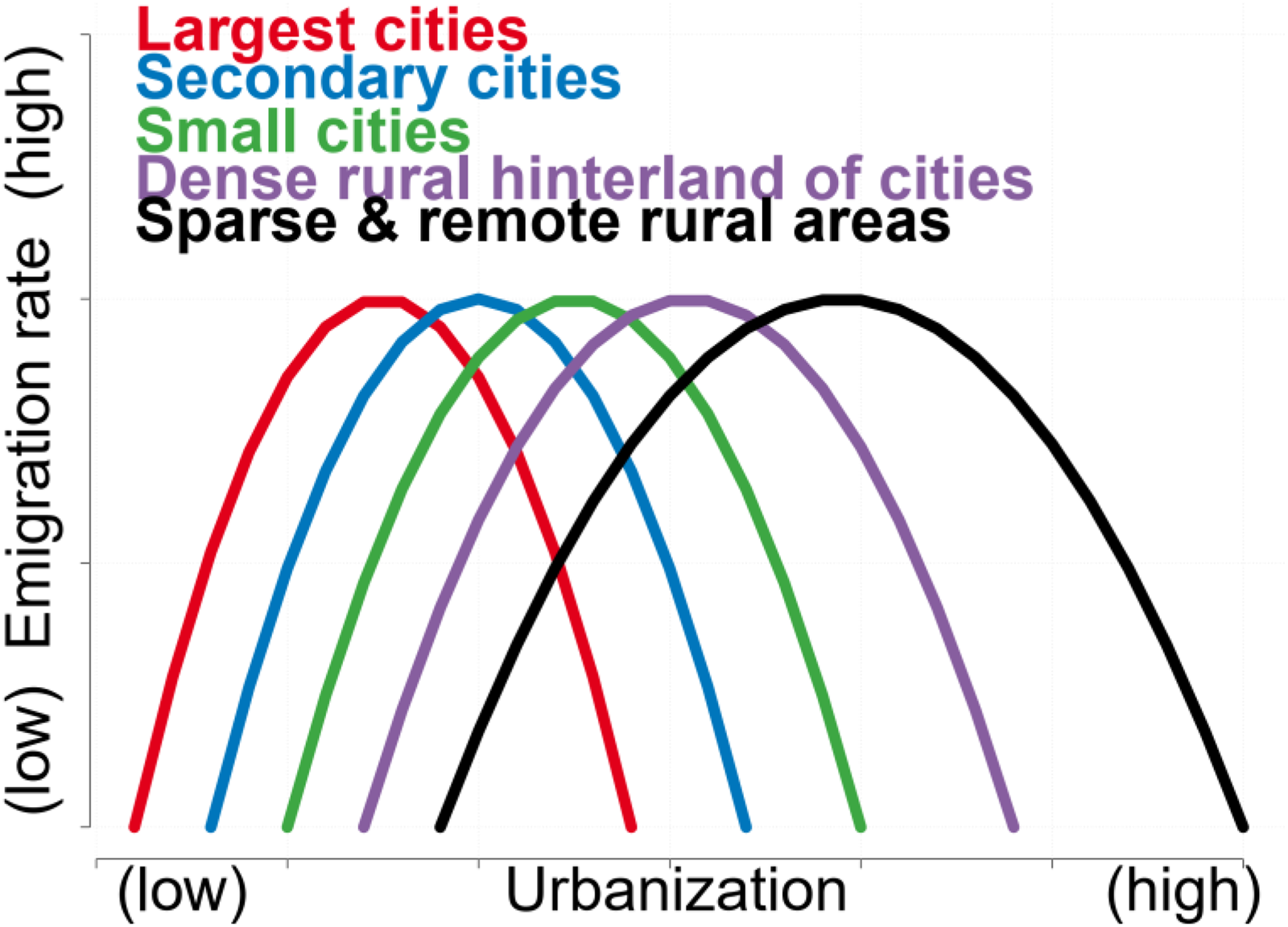
Stylized Trends in Emigration from Different Tiers of the Urban Hierarchy Over the Urban Transition.
The empirical evidence on urban–rural differences in the determinants of emigration, as assessed based on population-based sample surveys, is in line with this hypothesis. In early stages of urbanization, high emigration from large cities can be expected, first, because of an imbalanced development geography. Given the largest-city (or capital-city) bias in foreign direct investments and governmental expenditures (Lipton 1977), inhabitants of these settlements are the first to benefit from social transformations and the integration into the global economy (Brockerhoff and Brennan 1998; Montgomery et al. 2003; Ferré, Ferreira and Lanjouw 2010; Henderson and Turner 2020). With the subnational diffusion of these structural changes in society over time, emigration should increase in progressively smaller cities. Moreover, cities absorb the within-country rural exodus, which inflates demographic pressure on local labor markets and, thereby, may push local inhabitants to move abroad.
A second reason for high urban emigration in the early stages of urbanization is the greater anonymity of urban society, when compared to rural areas. This reduces the number of social bonds that restrain potential emigrants from actually moving (Cirillo et al. 2022). Third, the number, size and development level of cities is limited in less urbanized settings (especially in small countries). This reduces the range of potential domestic destinations for urban migrants, who may find cities in more developed countries more attractive.
Fourth, the rural inhabitants’ decisions to engage in internal or international migration can be interrelated and, thereby, influence the aggregate level of urban emigration. Cities may constitute intermediate residential steps for rural migrants, who wish to accumulate urban work experiences and approach international transport hubs and migrant networks to increase opportunities for leaving their country (Skeldon 2006; King and Skeldon 2010; Hugo 2016). Given access to this economic and social capital, internal migrants in cities (and their families left behind) indeed have a higher likelihood of moving abroad, especially among people from remote areas that face high obstacles to international mobility (Fussel 2004; Villarreal and Hamilton 2012; Lerch 2016; Cirillo et al. 2022). Another reason for urban in-migrants to engage in a secondary move toward foreign countries is their failed integration in the cities’ (formal) labor markets (Villarreal and Blanchard 2013; García and Alfonso 2021).
Over the course of development and urbanization, however, the specialization and diversification of urban labor markets inflate opportunity costs of emigration: wages and career prospects increase alongside new opportunities to spread income sources and financial risks across local economic sectors (Fussel 2004; Hamilton and Villarreal 2011). The anonymous and heterogeneous nature of urban societies also limits the role of migrant networks in perpetuating international outflows (Fussel and Massey 2004). Therefore, we expect urban emigration to decline swiftly in advanced stages of urbanization. Compared to larger urban centers, opportunity costs of emigration may be lower, and society may be more homogeneous in small and economically peripheral cities. This may lead to high levels of emigration over more prolonged periods in secondary or regional urban centers (see Figure 1).
When compared to cities, the emergence of push, aspirational and enabling factors of emigration lags behind in rural areas. Given the later onset of fertility decline, rural areas experience stronger demographic pressure on agricultural economies and labor markets (Lerch 2019). Local employment opportunities are limited, and urban–rural income inequalities tend to widen with national economic development (Dudwick et al. 2011). At the same time, governmental programs in the education and health domains increase individual aspirations to move (Beauchemin 2005; Gibson and Gurmu 2012). Yet the high levels of poverty and poor infrastructure constitute barriers to the realization of intended moves from rural areas. While regional development may eventually lift these constraints, rural inhabitants also rely to a larger extent than urban dwellers on support from migrant networks (Fussel and Massey 2004). As both economic development and migrant networks tend to progressively diffuse from the urban vanguard places to the countryside over time, we expect rural emigration to increase only after the onset of the emigration hump in cities. The limited opportunity costs of mobility and the stronger effect of migrant networks should also lead to prolonged periods of sustained emigration from rural areas (see Figure 1).
The interlinkages between different types of mobility may also shape rural trends in emigration. International migration often constitutes an alternative to the domestic rural exodus in early stages of urbanization, when the number and development level of domestic cities is limited. This substitution of rural emigration for out-migration is particularly important in periods of crises, when foreign destinations become even more attractive (Skeldon 2008). As soon as the growing number of domestic cities start to compete with foreign destinations at advanced stages of urbanization and development, emigration should decline alongside a rise in the within-country rural exodus.
However, the countryside is heterogeneous in terms of locational advantages. In Mexico around 2000, rural areas situated in the immediate urban hinterland exhibited higher international outflows when compared to cities or the remote countryside (Hamilton and Villarreal 2011). Proximity to an urban center implies a high density of information and international transport infrastructure, as well as educational and economic opportunities. This supports candidates in their preparation for a trip to foreign countries. Similarly, small cities and their rural hinterlands situated along national borders experienced particularly high international migration in seven developing countries and Albania (Fussel 2004; Lerch 2016, 2020). Thus, locational advantages inflate emigration from lower-ranked settlements of the urban hierarchy.
Expected Subnational Variations in Emigration Trends
Our objective is to analyze the manifestations of these subnational differences in push, aspirational, enabling and pull factors of mobility in the form of varying subnational trends in emigration over the urban transition. According to the above theoretical developments, emigration should first increase in large urban agglomerations, then in intermediate-sized and small cities, followed by an onset in spatially well-connected and densely populated rural areas, and eventually in the remote and sparsely populated countryside (Figure 1). Emigration from cities should decline more swiftly than from rural areas due to higher opportunity costs of departing. In other words, when emigration in peripheral areas starts to increase, the international outflows from central places may have already begun to decline.
This diffusion down the urban hierarchy of the opportunities to emigrate has been confirmed by longitudinal case studies of Albania and Morocco (de Haas 2005; Lerch 2016). Due to the scarcity of historical data and the reliance on country-specific definitions of urban areas, however, case studies only allow the observation of partial subsequences of the urban transition, and the insights are not generalizable. The emigration hump hypothesis has never been tested at the subnational level from a long-term, truly international and comparative perspective that accounts for the cities’ and rural settlements’ positions within the urban hierarchy and their spatial relationships with central places or foreign countries. To address this gap, we estimate emigration from different tiers of the urban hierarchy in 40 developing countries to analyze variations in levels and trends over the urbanization process.
Data and Methods
Data and Definitions
To estimate emigration from the tiers of the urban hierarchy, we rely on the Urban Demography (URBDEMO) collection of International Public Use Microdata Samples (IPUMS) of national population censuses. The data were compiled by the University of Minnesota (Minnesota Population Center 2020) from national statistical offices and further enriched by an urban perspective at the Urban Demography Lab of the École Polytechnique Fédérale de Lausanne (EPFL). The sample includes 40 less developed countries (as defined in United Nations 2024b). These were selected to span all developing regions and stages of the demographic and urban transition (see Map 1 and Supplemental Appendix Table A1). The second selection criterion was the availability of at least two censuses per country to estimate international migration using demographic analysis (see below). The third criterion was the availability of geographically detailed information on the enumerated individuals’ current and prior place of residence to accurately measure internal migration and immigration and, hence, get subnational residual estimates of emigration (see below). The censuses in the sample have been fielded between 1970 and 2017 and provide geographic information at the third or second administrative level (i.e., localities, municipalities, or districts) in 35 countries and at the first level (i.e., states or provinces) in five (mostly small) countries.
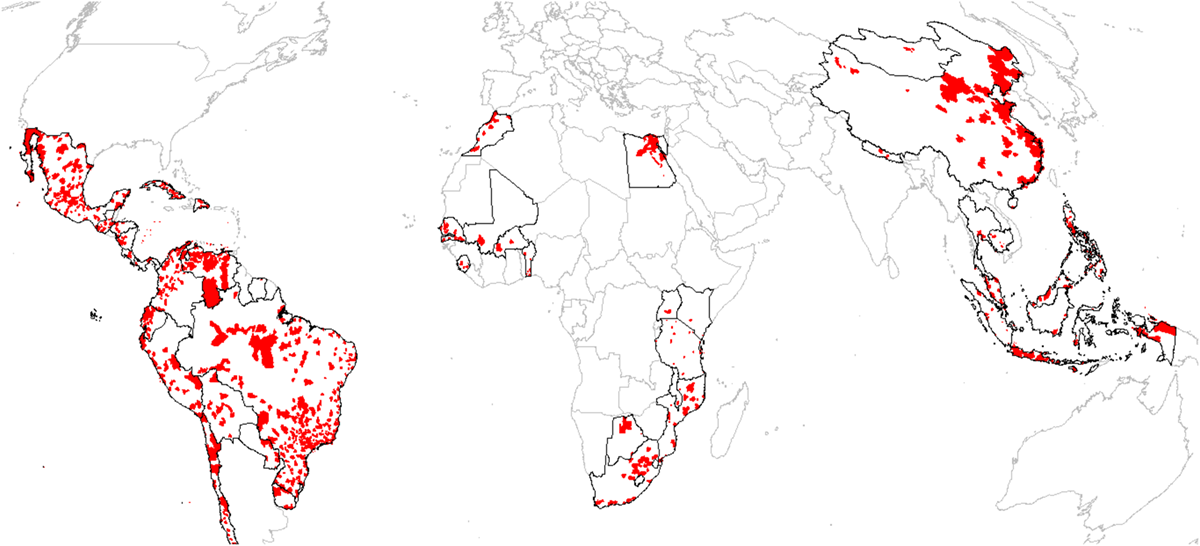
Countries and Functional Urban Areas (In Red Color; Spatial Extent as of 2015) Identified in the URBDEMO Collection, 40 Developing Countries. Sources: URBDEMO Collection of IPUMS (Minnesota Population Center 2020) & GHSL (OECD/European Commission 2020).
To draw the spatial extent of urban agglomerations, we rely on the concept of functional urban areas (FUAs). Using an internationally consistent methodology, FUAs are defined for 2015 in the 2019 version of the global human satellite layer (GHSL) as clusters of densely populated spatial grids of the Earth (i.e., at least 1,500 inhabitants per square kilometer) and their suburban and commuting zones, summing to at least 50,000 inhabitants OECD/European Commission 2020). This functional definition of cities is preferable over country-specific urban/rural classifications, which vary internationally in the criteria and thresholds used to define “urban” areas. Many countries rely on administrative criteria and therefore only consider the centers of cities as urban (e.g., the so-called city-proper; United Nations 2018). The combination of demographic and remote sensing data, by contrast, ensures a people-centered and internationally consistent definition of cities that accounts for urban sprawl beyond official city-borders.
The spatial boundaries of FUAs have been matched with administrative census geographies to combine the administrative units (and their populations) that are part of the same FUA (Du et al. 2025). The spatial matching algorithm identified 992 FUAs (see Map 1). In addition, we designate 210 administrative units as other small cities that could not be linked to an FUA, but in which at least one half of the population is concentrated in densely populated spatial grids according to GHSL. The 7262 remaining administrative units are predominantly rural. Prior to the matching of administrative units to the FUAs, the census geographies were harmonized over successive enumeration rounds in each country.
The tiers of the urban hierarchy are defined by regrouping all FUAs and other cities according to population size (using the United Nations (2018) size-classes; see Table 1). Rural settlements are regrouped in three classes according to country-specific tertiles of their distribution by population density. Moreover, we further disaggregate the three density classes of rural areas according to their spatial relationship with central places. We distinguish settlements that are spatially adjacent to an FUA or other city (thereafter also referred to as the rural hinterlands or vicinity of cities) from those located next to an international border and from the remaining (remotely located) places.
Definition of the Urban Hierarchy.
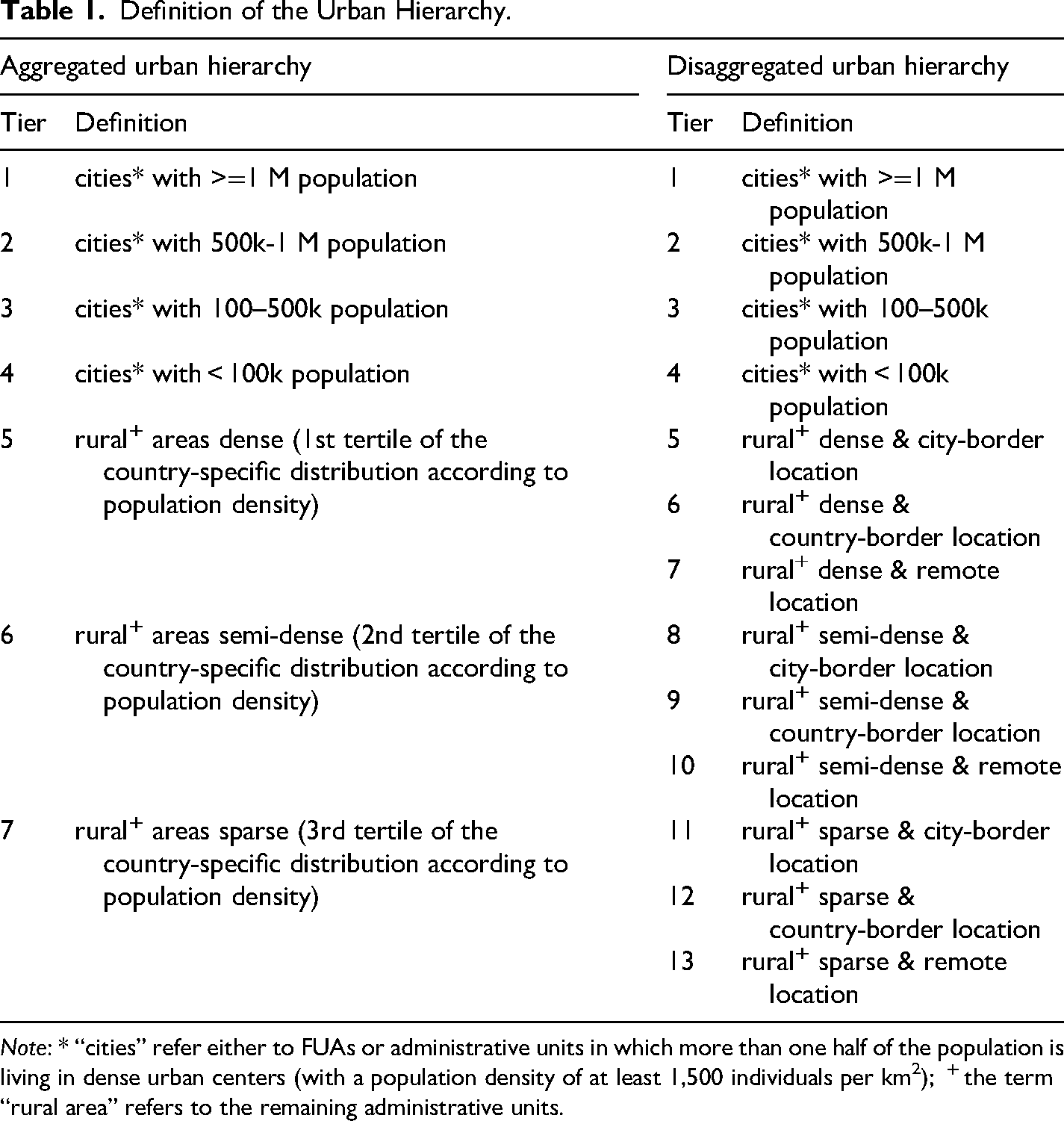
Note: * “cities” refer either to FUAs or administrative units in which more than one half of the population is living in dense urban centers (with a population density of at least 1,500 individuals per km2);
The spatial extent of FUAs, as well as the aggregated and disaggregated urban hierarchies, are defined at the time of the last census round in each country and applied to earlier rounds. On the one hand, this end-of-period approach is imposed by the fact that the OECD/European Commission (2020) defined the FUAs only for 2015. On the other hand, working with stable spatial boundaries over time increases the robustness of our findings because it allows us to avoid biases in intercensal demographic estimations that result from the rural-to-urban reclassification of administrative units as countries urbanize over time.
Estimation Method
Emigration is estimated using the general growth balance method (GGB; Hill 1987; Hill and Wong 2005). This method of indirect estimation is the age-specific equivalent of the fundamental demographic equation (see the Supplemental Appendix for details). We apply equation 1 to each tier of the urban hierarchy observed in the 63 country-periods in the URBDEMO collection (i.e., pairs of subsequent censuses).
Emigration in a given 5-year age-group x to x + 5 between two census dates 1 and 2 (i.e., 5Ex in equation 1) is given by the difference between total population growth during the interval (5N2x – 5N1x), and the sum of the deaths (5Dx) minus (i) the net effect of population aging (i.e., the transitions in and out of the age group; Bx and Bx + 5 respectively), (ii) net internal migration (i.e., the difference between in-migration 5INx and out-migration 5OUTx), and (iii) immigration (5Ix). We rely on the URBDEMO collection of IPUMS data to estimate sex- and age-specific population counts and the rates of the components of population change (i.e., relating the number of events to the at-risk-population). Age-schedules of population counts were smoothed using Arriaga's light smoothing method (as implemented in the DemoTools R-package; Riffe et al. 2019). The age-schedules of migration rates were smoothed using a multiexponential model or the United Nations (1992) standard schedules (see the Supplemental Appendix).
We first estimate (residual) emigration rates (i.e., number of emigrations per person at risk) by sex and age group. The raw age-schedules of rates are then adjusted and smoothed to exhibit age-specific regularities generally observed in migration data, using the United Nations (1992) standard migration rate schedules. The adjusted age-specific rates are finally aggregated at the total population level. This is preferable over directly estimating total emigration rates because it provides opportunities to correct data issues at older ages (see Supplemental Appendix).
Residual estimation methods are widely used when migration data are not available or of poor quality—not only at the country-level (United Nations 2024a) but also at the subnational level (United Nations 2001; Lerch 2014, 2020, 2021; Bocquier and Costa 2015; Bocquier and Bree 2018; Alessandrini, Ghio and Migali 2020; Menashe-Oren and Bocquier 2021). However, the estimates may be biased by differential levels of enumeration completeness (or IPUMS sampling quality) in each pair of censuses, as well as by lack of precision in the measurement of the components of demographic change. Mortality has a negligible impact on the residual estimates—especially in the peak ages of migration. Internal migration estimates are of high quality because we eliminated the confounding effects of territorial reclassification over time (by working with stable geographies) and the patterns are in line with the mobility transition hypothesis (Lerch, Du and Beckendorff 2025).
To limit estimation biases attributable to the differential enumeration completeness of populations (which also affects the measurement of the aging component of the GGB; see Supplemental Appendix), we have adjusted the census counts for empirical levels of the enumeration completeness measured via post-enumeration surveys and compiled in the United Nations’ (2024b) World Population Prospects 2024 Metadata. However, uncertainty remains about subnational differences in enumeration completeness or IPUMS sampling quality between two censuses. We therefore provide confidence intervals for our point estimates of (residual) emigration. These confidence intervals are obtained by replicating the GGB after additionally adjusting the population counts at the second census for a potential level of differential under- and over-enumeration (or sampling) of 3%. Moreover, we estimate (residual) emigration for the combined populations of settlements belonging to the same tiers of the urban hierarchy (by country and period), rather than for distinct cities and villages, which leads to more robust results.
To validate our estimation strategy, we apply the GGB at the country level to measure (residual) net international migration and compare the results with the United Nations World Population Prospects (WPP) figures for the corresponding intercensal periods (United Nations 2024b). It is important to note, however, that the United Nations’ figures cannot be considered as ground truth. These are also residual estimates, and are further adjusted to ensure that global net migration sums to zero (United Nations 2024a). The assessment reveals that in one half of the country-periods, our residual estimates deviate from the United Nations’ estimates by more than one half (see Supplemental Appendix). These country-periods are excluded from our robust sample of estimates used to cross-validate the results.
Analytical Strategy
We analyze how the intensities of emigration vary across different tiers of the urban hierarchy and over the urban transition. Although we only observe short subsequences of that transition in every country, the full sample collectively covers the entire spectrum of urbanization. For a given tier of the urban hierarchy, we therefore plot the period- and country-specific estimates of emigration according to the corresponding stage of urbanization reached in the middle of each intercensal interval to predict an average summary trend through the entire scatter plot (e.g., Figure 2).
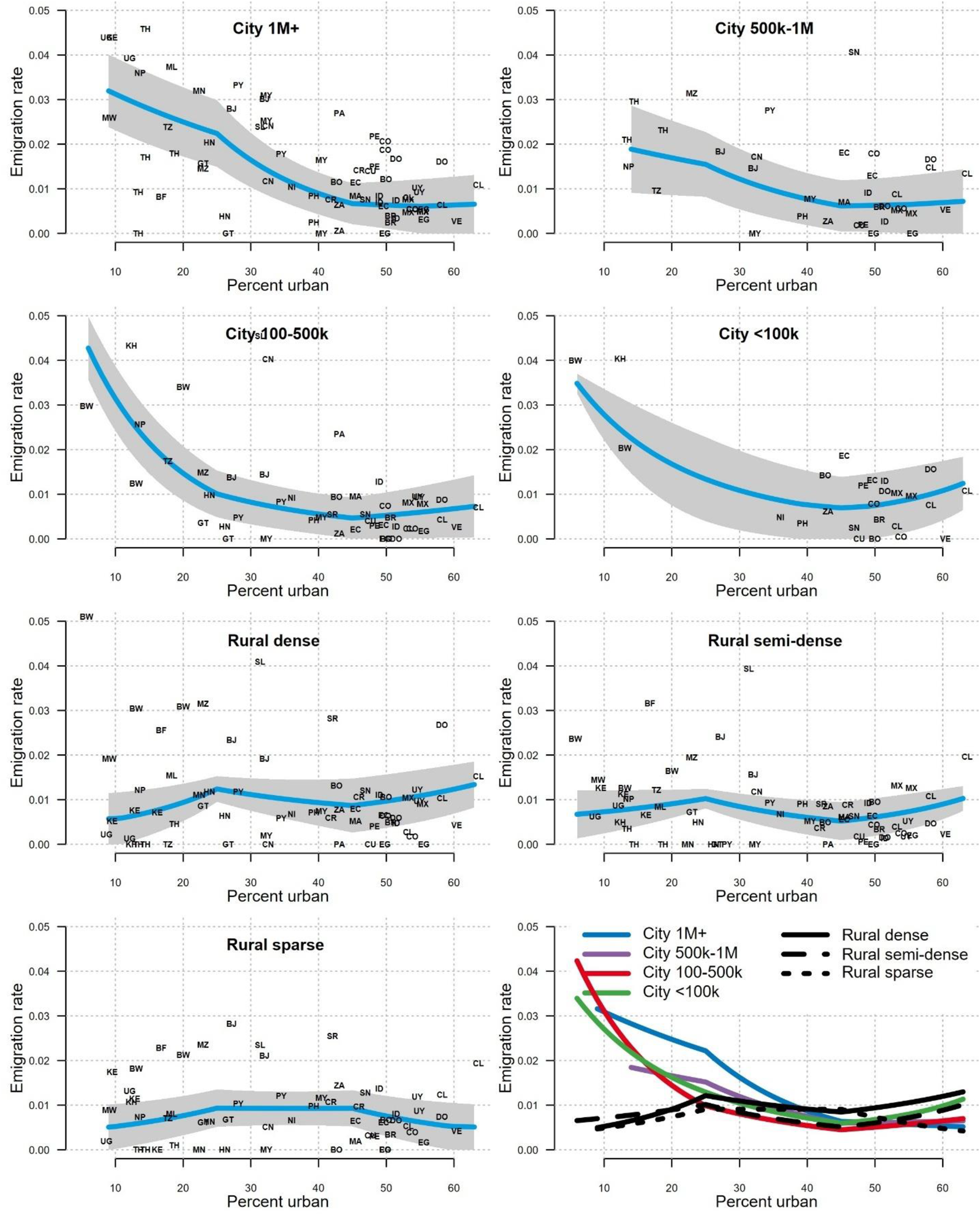
Country- and Period-Specific Estimates and the Predicted Average Global Trends in Annual Rates of Emigration (Events per Person at Risk) Over the Urban Transition by Aggregated Tier of the Urban Hierarchy, 40 Countries 1970–2017. Sources: URBDEMO Collection of IPUMS (Minnesota Population Center 2020) & GHSL (OECD/European Commission 2020). Note: each observation is indexed by the ISO2 country code (see Supplemental Appendix Table A1).
To do so, we specify separate Poisson regression models for each tier of the urban hierarchy (equation 2). The dependent variable is the country- and period-specific number of emigrations. The logged at-risk population is included as a model offset to analyze differences in emigration rates. The independent variable of interest is a linear spline function of the national percentage urban (with knots at 5%, 25%, 45%, and 65%). The use of splines allows the trend in emigration to vary over the urban transition. To ensure international comparability in the definition of the national percentage urban, we compute the share of population living in dense urban centers (i.e., with a population density of more than 1,500 inhabitants per square kilometer) according to the GHSL Degree of Urban Classification version 2019 for the period 1975–2020 (OECD/European Commission 2020). This percentage urban ranges between 6% in Botswana 1981–1991 and 64% in Chile 2002–2017. Official levels of urbanization (based on internationally heterogeneous definitions) range between 13% and 93% in the sample.
In the Poisson models, we adjust the effect of urbanization on emigration (β₁ in equation 2) by accounting for the effect of country population size (introduced as an additional independent variable). When compared to smaller countries, larger countries tend to have lower emigration rates because of a wider range of domestic opportunities and, thus, more internal migration. In all models, we remove the outlier emigration rates, as identified by Bonferroni p-values to test whether each observation is a mean-shift outlier, based on studentized residuals (Yang, Rahardja and Fränti 2021).
Where:
E[EMIG]i is the count of emigrations (from a given tier of the urban hierarchy) in country and intercensus period i,
β₀ is the intercept, β₁ and β₂ are the regression coefficients for the covariates,
The offset is the log of the number of inhabitants (in a given tier of the urban hierarchy) in country and intercensus period i.
We then use the intercept β₀, the coefficients β₁ associated with the percent urban and the coefficients β2 associated with country population size to compute out-of-sample predictions of emigration rates for each tier of the urban hierarchy over a standard urban transition (from 5% to 65% urban with 1 percentage-point increments) in a fictitious country of average size. The uncertainty around this global summary trend is given by the confidence intervals of the predictions from additional models that regress the upper and lower confidence limits of our (residual) emigration rates, instead of the point-estimates.
We have also regressed the country-level rates of emigration. The predicted global summary trend follows a typical inverted U-shaped function over the rising percent urban (although emigration does not level off at the end of urbanization and the confidence intervals are large; see Supplemental Appendix Figure A2). This is reassuring in terms of the reliability of the data and the robustness of the indirect estimation approach.
Results
Figure 2 shows country- and period-specific rates and the global summary (average) trend in emigration over the urban transition from each aggregated tier of the urban hierarchy. The confidence intervals ascertain whether the average rates of emigration from a given tier change over the urban transition and whether the rates differ across tiers at a given stage of urbanization (variations are considered significant if the point estimate of a focus rate does not overlap with the confidence interval of the comparison rate). The detailed regression tables used to predict these summary trends are reported in the Supplemental Appendix Table A3.
At the onset of urbanization, the annual rate of emigration is at least three times higher in cities (i.e., 2.5% or more) when compared to the countryside (<1%). Subsequent trends vary according to the tier of the urban hierarchy. Starting from similar base-line levels of emigration, all city-size classes experience a fast (exponential) decline until reaching among the lowest levels observed across the urban hierarchy at the end of urbanization. Yet the pace of decline is significantly slower in the largest cities, where emigration is the highest in early to mid-stages of urbanization. In terminal stages, by contrast, urban emigration is the highest in the smallest cities.
Unlike in the case of cities, emigration from rural areas tends to at least temporarily increase over the urban transition. When compared to all city-size classes but the smallest one, the rural rates peak later and remain at higher levels at the end of the urban transition. The starting levels of emigration do not differ significantly across the density-classes of rural areas, but the subsequent trends do. In the densely and semi-densely populated countryside, emigration increases and then plateaus. Sparsely populated areas, by contrast, tend to experience a classic emigration hump, including an initial increase, a subsequent plateau and a final decline in the rates (yet confidence intervals are relatively large). At terminal stages of urbanization, emigration is significantly higher in the dense countryside when compared to sparse rural areas, with the semi-dense areas being situated in between. In sum, as countries urbanize, rural emigration converges to the (decreasing) levels observed in cities and eventually tends to cross over those rates in the dense and semi-dense areas (although confidence intervals of the late-transitional rates in cities are large). However, the peak levels of rural emigration consistently remain below the high starting rates observed in cities.
Figure 3 shows the results for the three density-classes of rural areas which are further disaggregated according to locational advantages for moving abroad. At the start of urbanization, the rate of emigration from the dense countryside does not differ according to locational characteristics. This suggests that density generally ensures access to emigration opportunities (as in cities). Yet the subsequent trends in emigration vary. The dense city hinterlands experience a flat trend with a late-transitional decline, as observed in the adjacent cities. The dense countryside located on national borders or remotely, by contrast, experience increasing and subsequently decreasing levels of emigration. The levels surprisingly peak again at late stages of urbanization, particularly in dense border locations.
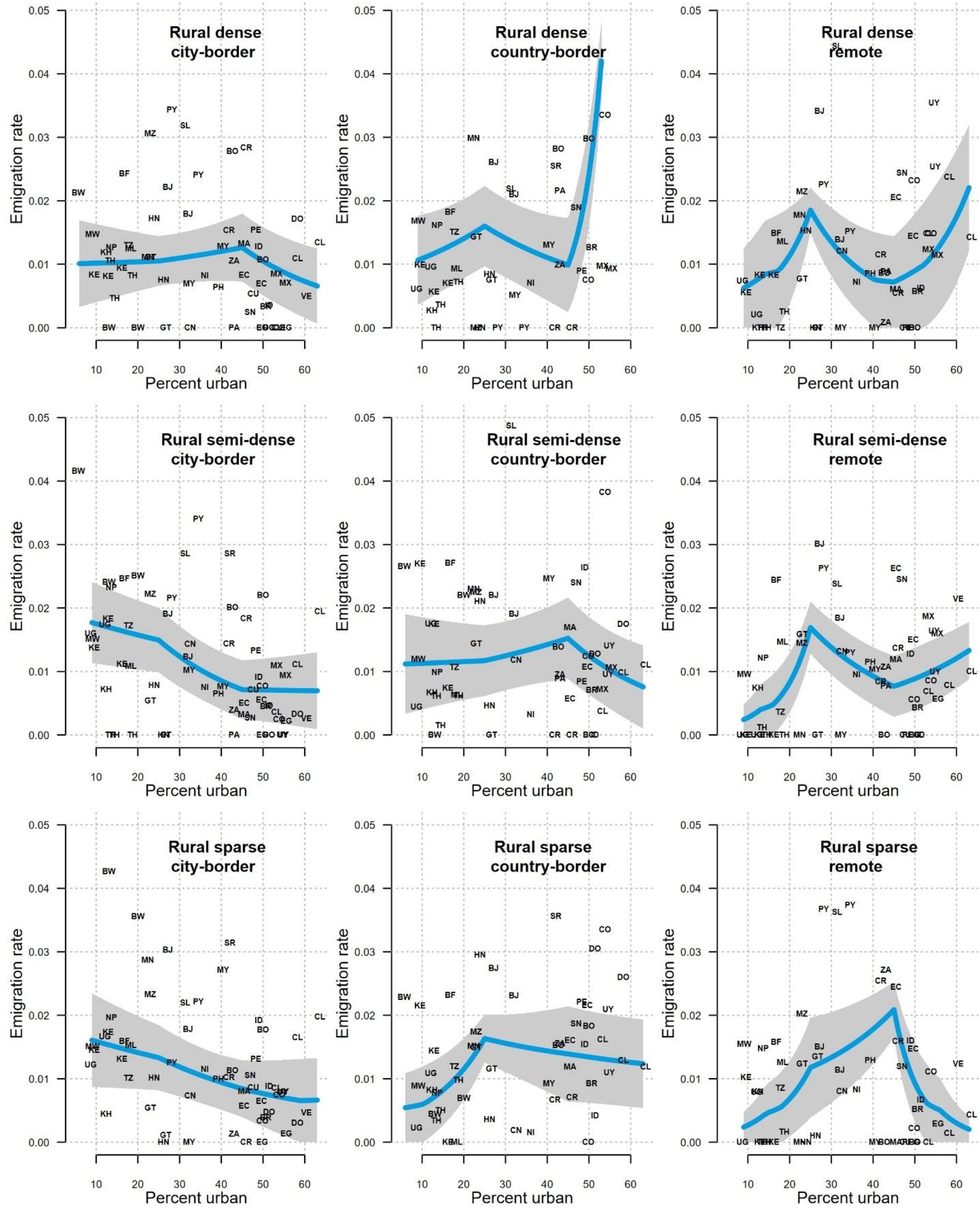
Country- and Period-Specific Estimates and the Predicted Average Global Trends in Annual Rates of Emigration (Events per Person at Risk) Over the Urban Transition by Disaggregated Tier of the Countryside, 40 Countries 1970–2017. Sources: URBDEMO Collection of IPUMS (Minnesota Population Center 2020) & GHSL (OECD/European Commission 2020). Note: each observation is indexed by the ISO2 country code (see Supplemental Appendix Table A1).
Unlike in the case of the densely populated countryside, locational advantages matter for the starting levels of emigration in semi-dense and sparse rural areas. Those located in the city hinterlands exhibit significantly higher emigration when compared to the remote areas. Border areas occupy an intermediate position. The trends differ, too. In the semi-dense and sparsely populated city hinterlands, emigration continuously declines over the urban transition, as observed in the adjacent cities. By contrast, emigration from semi-dense rural border areas first remains stable and declines at advanced stages of urbanization. In sparse border areas, emigration initially increases and subsequently plateaus. The late-transitional levels tend to be higher than those observed in the other types of rural areas.
Finally, the remotely located semi-dense areas experience an initial increase in emigration, a subsequent decline, as well as a renewed increase at the end of the urban transition. Remotely located sparse areas, by contrast, evince a classic emigration hump characterized by a stronger initial increase, a later peak and a subsequent decline to the lowest terminal level observed across all tiers of the urban hierarchy.
Model Fit and Robustness Tests
The stratified regression models explain a larger part of the spatio-temporal variation in emigration from urban areas (especially the largest cities), their hinterlands and the dense countryside, when compared to other rural areas (i.e., the model's pseudo-R2 are above 0.4; see Supplemental Appendix Table A3). This means that urbanization is interacting with emigration most strongly in central places of national geographies. Other (non-accounted) processes of social transformation seem to matter to a larger extent in the remote countryside or border locations.
Results based on the robust sample of emigration estimates show larger confidence intervals but generally confirm the above evidence based on the full sample of country- and period-specific observations (see Supplemental Appendix Figures A3 and A4). There are important deviations only for the sparsely populated countryside. Instead of a classic inverted U-shaped trend of emigration over the urban transition (as shown above), the robust sample indicates a J-shaped trend with a modest starting rate, a slight decrease and a subsequent and sustained late-transitional increase (Supplemental Appendix Figure A3). This essentially concerns the sparse countryside located in the city hinterlands, where emigration even follows a U-shaped gradient (Supplemental Appendix Figure A4). While the initial decrease is surprising, the later increase is congruent to the lagged diffusion of emigration opportunities into sparse areas.
Discussion
The interplay between urbanization and emigration in developing countries attracted increased policy attention in the last decade (IOM 2015; Skeldon 2018). Should we expect a temporary increase in emigration as the urban transition raises people's aspirations and capacities to move abroad? And what are the implications for the sending-countries’ socioeconomic development and their spatial inequalities? Despite the key importance of these questions for fast urbanizing and developing countries, there is a critical lack of comparative evidence on subnational differences in emigration. We have aggregated high-quality international census data according to the tiers of the urban hierarchy and the settlements’ locational advantages, relying on consistently defined urban agglomerations based on global remote sensing products. This enabled us to indirectly estimate emigration and describe subnational differentials in levels and trends over the urban transition.
The results are in line with the spatial diffusion of emigration as conjectured by the mobility transition hypothesis. In early stages of urbanization, emigration is highest in cities—especially in the largest ones—but subsequently declines. Emigration from rural areas remains consistently below the peak levels observed in cities and exhibits a lagged increase. The onset of that increase occurs earlier in dense rural settlements, in the city hinterlands and, to a lesser extent, on national borders, when compared to the remaining countryside. At late stages of urbanization, rural emigration tends to plateau at intermediate levels or to increase again, especially on national borders. In other words, we found subnational evidence for a classic emigration hump only in the remote and sparsely populated countryside (even though the robustness tests challenge this result).
The vanguard role of cities in the developing countries’ emigration corroborates the key importance of international connectivity and social transformations (e.g., economic development and the diffusion of higher-level education) for people's rising willingness and abilities to move. The largest cities are not only the focus of the domestic rural exodus (Skeldon 1997) but also constitute the emigrants’ major springboards to foreign countries. This can be related to the role of cities as nodes between international and national economic geographies. While social transformations tend to spread from more to less developed countries, cities are the outposts for the subnational diffusion of socioeconomic development (Zelinsky 1971) and, therefore, experience a swifter increase in emigration when compared to rural areas. Many urban residents may move abroad, rather than toward domestic cities, because the number and economic attractiveness of the latter are limited at the onset of urbanization. At more advanced stages, by contrast, the observed decrease in emigration from cities and their dense hinterlands is in line with rising local opportunity costs of moving abroad when domestic cities progressively attract internal migrants as well as immigrants. Cities indeed play a pioneering role in the transition from a migrant-sending to a migrant-receiving country, as in the Philippines (Lerch 2020). Our observation of higher terminal levels of emigration from smaller cities, when compared to larger cities, may be related to less developed opportunities for sustaining a livelihood. To verify these theoretical explanations of our descriptive findings, future research should focus on how development trajectories in cities affect the levels of emigration over time and how these dynamics interact with international economic gradients.
The observed diffusion of emigration from urban to rural areas, as well as down the rural settlement gradient according to decreasing population density and spatial connectivity, mirrors the subnational propagation of social transformations. This underlines the importance of access to information, migrant networks, transport infrastructure, economic opportunities and proximity to foreign countries, which help rural migrants in their organization and financing of an international trip. Our results suggest that (like the urban dwellers) the inhabitants in dense rural areas have access to emigration opportunities, whatever their spatial location. Location matters to a larger extent for the sparser populated countryside. On the one hand, proximity to cities plays a major role in inflating emigration in early stages of urbanization, when social transformation did not yet diffuse into remote areas. On the other hand, the relatively high late-transitional levels of emigration from rural border locations suggest a role for intensifying cross-border economic interactions at advanced stages of development. Hence, subnational analyses of the developmental drivers of emigration should account for the mediating role played by geography—especially in less dense rural areas, where socioeconomic and infrastructural barriers to mobility tend to be higher.
At the same time, the persistently lower rates of departure from rural areas than from cities challenge our understanding of emigration as a primarily rural phenomenon. Here, the interlinkages between internal and international migration may play a role. In early stages of urbanization, rural migrants may transit through domestic cities and their hinterlands in a quest to access the newly emerging local opportunities of moving to more developed countries. These stepwise (rural-to-urban and international) migrants inflate the levels of urban emigration. In other words, cities constitute national gateways not only for immigrants from foreign countries (Price and Benton-Short 2007) but also for emigrants from the domestic countryside. At more advanced stages of urbanization and development, however, potential migrants from rural areas may perceive a wider range of attractive destinations within the sending country, when compared to the early emigrants from cities. A significant share of rural migrants may end up moving permanently to domestic cities, rather than abroad. This explanation is in line with the observed late-transitional decline in emigration from the remote countryside, which coincides with an intensification of the domestic rural exodus (see Lerch, Du and Beckendorff 2025). The observed decline in emigration from the city hinterlands in final stages of the urban transition tends to confirm the development of new livelihoods in the adjacent cities. Future studies should specifically address these interactions between internal and international migrations in developing countries to better understand the dynamics in population mobility and urbanization in a relational perspective. The extent of these interactions in part depends on the countries’ positioning within the international development geography and proximity to key destinations (Skeldon 1997). Hence, international positioning may matter particularly for emigration in rural areas.
The last unexpected finding consists in the late plateauing or renewed increase in emigration rates in rural areas that do not border a city. Unabated emigration has been observed in several developing countries, even in contexts of rising domestic wages and shrinking international income gradients (de Haas 2007a, 2007b). De Haas argued that the (relative) improvements in nominal incomes in sending countries may balance out neither the persistent international gaps in social and economic opportunities (e.g., higher-level education and career progression), nor the repulsive effects of poor domestic infrastructure and public services. These conditions for unabated emigration are typically more prevalent in rural than in urban settlements.
This novel and internationally consistent evidence on subnational levels of emigration over the urban transition in developing countries faces some limitations. Although the end-of-period approach in defining settlement boundaries ensures a robust indirect estimation of emigration, it introduces an anticipatory analysis bias due to historical urbanization: some administrative units located at the periphery of urban agglomerations, as defined in 2015, may have been predominantly rural in earlier periods but are not considered as such in our study. This bias is negligible: the population residing in reclassified administrative units (i.e., from a rural to a suburban or urban GHSL degree of urbanization status) represents less than 3.8% of all FUA-inhabitants in the countries and periods concerned. A second limitation is the use of a cross-sectional sample of emigration estimates to infer trends over the urban transition. The underlying assumption is that the (unobserved) historical contexts of urbanization in the highly urbanized countries in our sample are comparable to the (observed) contemporary contexts in low-urbanized countries. Future research should leverage longer time series of emigration in highly urbanized countries to compare true subnational trends over the urban transition.
The insights from the present study have important implications for our understanding of past and future trends in global migration. The emigration hump, as observed at the country level (de Haas 2010b; Clemens 2020), results from the interplay of rural–urban differences in emigration rates and the compositional changes in the sending-population with regards to its residence location. In early stages of the urban transition, the national rate of emigration is low because the levels are negligible among the dominating rural population, while the very high levels among the comparatively small urban populations contribute little. In intermediate stages, urban and rural levels of emigration converge, as do the relative weights of the two subpopulations, leading to peak rates in national emigration. In late stages of urbanization, national emigration declines because the rates are low in the dominating urban population, while the relatively high emigration from the demographically marginalized rural populations hardly contributes anymore to the total outflow. In other words, the global migration rate may decline in the future when all developing countries become predominantly urban. Yet this does not necessarily imply declining numbers of international migrants because the at-risk population increases over the course of the demographic transition that accompanies the urbanization of countries.
The insights of this study also improve our understanding of population redistribution and economic development in urbanizing and international migrant-sending countries. Emigration relieves demographic pressure on urban labor markets. In early stages of urbanization, the high level of urban departures in part compensates for the massive in-migration from the domestic countryside. Later, the increase in rural emigration limits the domestic rural exodus. Yet unabated international outflows from rural areas may lead to a so-called second urban transition (Skeldon 2008). This designates critical situations in which domestic cities are completely short-circuited by rural migrants who persist in their international focus of mobility, despite improved socioeconomic conditions in the sending country. This enduring transfer of potential urban growth toward more developed countries can lead to a slowing down or even a stall in domestic urbanization alongside negative consequences for development. Here, the socio-economic profile of emigrants likely plays a key role. A brain drain would have particularly deleterious effects, which may be mitigated by remittances and the international circulation of migrants. To better understand the developmental implications of the urbanization–emigration nexus, future research may investigate differentials in emigration trends not only according to residence location but also according to socioeconomic status of the at-risk population. Subnational studies of return movements and remittances receipt would also be helpful.
Supplemental Material
sj-docx-1-mrx-10.1177_01979183251384588 - Supplemental material for The Diffusion of International Migration in Cities and Rural Areas of Developing Countries
Supplemental material, sj-docx-1-mrx-10.1177_01979183251384588 for The Diffusion of International Migration in Cities and Rural Areas of Developing Countries by Mathias Lerch, Dorothee Beckendorff and Wenxiu Du in International Migration Review
Footnotes
Acknowledgments
This output is part of a project that has received funding from the European Research Council (ERC) under the European Union's Horizon 2020 research and innovation programme (grant agreement no. MIC-950065).

Funding
The authors disclosed receipt of the following financial support for the research, authorship, and/or publication of this article. This work was supported by the H2020 European Research Council (grant number MIC-950065).
Declaration of Conflicting Interests
The authors declared no potential conflicts of interest with respect to the research, authorship, and/or publication of this article.
Supplemental Material
Supplemental material for this article is available online.
References
Supplementary Material
Please find the following supplemental material available below.
For Open Access articles published under a Creative Commons License, all supplemental material carries the same license as the article it is associated with.
For non-Open Access articles published, all supplemental material carries a non-exclusive license, and permission requests for re-use of supplemental material or any part of supplemental material shall be sent directly to the copyright owner as specified in the copyright notice associated with the article.
