




Abstract
Legal status is increasingly recognized as a hierarchical axis of stratification shaping migrants’ access to employment and rights. The study reported herein examined how three facets of legal status—current categorization, transitions, and initial “starting points”—are associated with the employment conditions of student-migrant-workers (individuals who are on student visas and under post-graduation work permits). Using pooled National Survey of College Graduates (NSCG) data from 2015 to 2021, the analysis employed ordinary least squares and logistic regression models, supplemented by propensity score matching, to assess associations between these legal-status facets and annual earnings and four benefits: health insurance, pension plans, profit-sharing, and paid vacation. Findings show that current student-migrant-workers earned significantly less and had poorer benefit access than their comparable counterparts with temporary work visas, dependent visa, permanent residency, or naturalized citizenship. Transitions from student to other statuses (whether temporary, dependent, or permanent) are associated with improved employment conditions, though the extent varies by destination status. Even after becoming permanent, those who initially entered with student visas continued to earn less than those who initially entered with temporary work visas; this disparity narrows over time, but persists for decades. The study contributes evidence that legal-status categorization, transitions, and starting points operate as stratifying mechanisms of employment even among highly educated migrants.
Introduction
Legal status is a critical but understudied factor of stratification in immigrants’ access to work, rights, and mobility (Anderson 2010; Kreisberg 2019; Robertson 2019; Menjívar 2023; Bialas, Lukate and Vertovec 2025). Scholars have increasingly advocated for viewing legal status as a “dynamic, hierarchical dimension of inequality” (Kreisberg 2019, 871) that continuously stratifies migrants’ access to rights and resources through mechanisms of differential inclusion (Könönen 2018; Robertson 2019; Goldring 2022; Menjívar 2023). Legal status is not static or fixed but conditional, fluid, and shifting, as migrants change statuses throughout their life trajectories, sometimes forward toward permanent residency or citizenship, sometimes laterally or even backward into temporary, dependent, or undocumented statuses (e.g., Schuster 2005; Jacobs 2019; Kreisberg 2019; González 2021; Pila 2021; Goldring and Landolt 2022; Azeredo 2025). Moreover, initial status—one's legal “starting point” (Kreisberg 2019)—functions as a critical stratifying mechanism and has long-lasting consequences for migrants’ lives. The present research is a response to recent calls for more empirical research into the potential stratifying consequences of legal status categorization, legal status transitions, and legal starting points.
This paper focuses on an understudied group within migration literature: student-migrant-workers, those who initially enter on student visas and work after graduation through a post-graduation work permit, such as optional practical training (OPT), without holding a work visa (Maury 2020; Liang 2025; Vosko 2025). They have played an increasingly significant role in the supply of highly skilled labor and the development of high-technology industries in developed countries over the past few decades (Beine, Peri and Raux 2023). Many subsequently become permanent residents and, eventually, citizens, building new and emerging immigrant communities in the host countries. While often classified as “high-skilled” and seen as beneficiaries of talent-driven immigration policies, many student-migrant-workers experience legal and employment precarity (Maury 2020; Coustere et al. 2024; Liang 2025). Although qualitative studies have documented such precarity (Howe 2019; Goyette 2024; Liang 2025), large-scale quantitative research has often overlooked this group, or lumped them into broader categories such as “temporary” or “high-skilled” migrants (Kreisberg 2019; Wang 2021; Lee 2022; Bagheri 2023). Moreover, although recent scholarship has examined the role of legal status transitions and initial entry status in shaping migrant employment precarity (Lindsay Lowell and Avato 2014; Kreisberg 2019; Vosko 2023), little is known about student-migrant-workers’ employment conditions after transitioning to other statuses (both intermediary temporary statuses and permanent statuses), or whether the disadvantages associated with student entry persist after they transition to more stable statuses such as permanent residency.
This study seeks to address three questions: (1) Are legal status categories associated with differences in salaries and access to job benefits? (2) Are transitions from a student legal status to other statuses (both laterally into temporary or dependent statuses, or upward transitions toward permanent residency or citizenship) associated with improvements in salaries and access to job benefits? (3) Among lawful permanent residents (LPRs), does entering on a student visa, versus a temporary work visa, predict lower earnings and poorer access to job benefits? Does this difference persist over time?
The analysis reported in this paper is based on pooled data from the 2015 to 2021 rounds of the National Survey of College Graduates (NSCG). This is a biennial survey collected by the U.S. Census Bureau of individuals holding at least a bachelor's degree and residing in the United States. Using ordinary least squares (OLS) regressions and binary logistic regressions, this study examines how different legal statuses and pathways of legal status transition relate to annual salaries and four types of job benefits, i.e., health insurance, pension plans, profit-sharing, and paid vacation, while controlling for demographic characteristics and employment background. To reduce selection bias on observables, one-to-one nearest-neighbor propensity score matching (PSM) was performed. Following matching, all OLS and logistic regression models were re-estimated on the matched samples to assess the robustness of the results. While the cross-sectional nature of the study does not allow inferences about causality, the results reveal significant statistical associations between employment outcomes and current legal status, legal status transitions, and initial pathways (student vs. work) to LPR. Individuals with student legal status earn significantly less and have lower access to job benefits than their counterparts with other temporary or permanent statuses, even among those with similar demographic backgrounds and educational attainment levels in the same occupations. Transitions from student visas to other statuses (e.g., work, dependent, or permanent residency) are associated with better employment conditions, although the observed employment advantages differ depending on the legal status type transitioned to. Disadvantages linked to student entry status compared to temporary work entry status persist even after obtaining LPR.
The findings lend support to and extend the existing body of research on how legal status categorization serves as a continuous process for stratifying migrant labor market positions (Kreisberg 2019; Robertson 2019; Menjívar 2023). The study highlights how legal categorization, transitions (to lateral or more secure statuses), and legal starting points are each associated with unequal employment conditions, even for highly educated migrants in nominally neutral or favorable legal statuses. This association may reflect both selection mechanisms and institutional effects, though the study does not demonstrate causal directionality. Empirically, the study uses nationally representative data to document the employment disadvantages associated with legal categorization and transitions on an often-neglected population (student-migrant-workers).
Literature Review
Employment Precariousness Among Student-Migrant-Workers: Differentiating from Temporary Migrant Workers
Student-migrant-workers are a unique group within the broader category of temporary migrant workers. While pursuing higher education, they are also actively engaged in the labor market and constitute a flexible, precarious, and exploitable workforce (Robertson 2011; Campbell, Boese and Tham 2016; Maury 2020; Liang 2025). Neilson (2009) introduced the term “student-migrant-workers” and highlighted their crossing the boundaries around the categories of student, migrant, and worker. Liang (2025) defines them as migrants with student visas and pre- and/or post-graduation work authorization. Increasingly, post-graduation work permits have become a common tool to boost competitiveness in the global race for talent (Moltaji 2019; Tran et al. 2022). Such policies effectively transform higher education into a filtering system for a potential pool of high-skilled immigrants. This so-called three-step “edugration” process—graduation from higher education, competing in the labor market for a limited duration, and obtaining LPRs and citizenship—has become a popular and highly-contested concept in immigration policies in countries such as the United States, Australia, and Canada (Brunner 2021; Brunner, Streitwieser and Bhandari 2023).
Admittedly, student legal status and post-graduation work permits are not typically classified as precarious in the same way as non-skilled temporary work authorization and temporary humanitarian status, which is designed for more vulnerable populations. They are generally granted to individuals with higher levels of education and human capital, and generally associated with relatively fewer restrictions on mobility and rights. However, even seemingly stable and impartially constructed legal categories can generate precarity, particularly as migrants interact with the labor market and broader social structures (Menjívar 2023; Bialas, Lukate and Vertovec 2025). Student-migrant-workers with student visas and post-graduation work permits are typical “back door” entrants, who are under a “de facto temporary labor program,” which is characterized by interim employment authorization, dependency on employer sponsorship, and the absence of a straightforward pathway to permanent residency (González 2021; Vosko 2023; Liang 2025). They face a range of intersecting disadvantages in the labor market: Being temporary migrants, meaning their employment choices and job mobility are largely limited by strict visa restrictions; being students or recent graduates, meaning they are less experienced and less desirable for employers; and being foreigners and racial/ethnic minorities, meaning that they may suffer racial discrimination and xenophobia (Liang 2025). Student-migrant-workers often find themselves concentrated in different types of precarious employment (e.g., unpaid, part-time, temporary, agency, or platform work) (Maury 2020; Goyette 2024; Liang 2025), becoming a “legally constructed underclass of workers” (Howe 2019).
Despite their growing numbers and potential to contribute meaningfully to host-country labor markets, student-migrant-workers and their employment remain underexamined issues in migration research. First, student-migrant-workers are often lumped together under the generic term “high-skilled migrants,” which overlooks the distinct and often greater precarity they face compared to their counterparts. Additionally, their being primarily studied as “international students” or part of the broader “education migrants” but not as a part of the labor force has led to a greater focus on their academic achievements or cultural adaptation rather than their employment conditions. Second, there is insufficient quantitative evidence regarding specific comparative employment disadvantages in terms of pay and benefits, particularly compared to other legal statuses. Third, many valuable quantitative studies on immigrant employment often treat student-migrant-workers as either skilled migrants with work visas or undifferentiated “immigrants,” or exclude them from the study altogether. In response to these shortcomings in previous research, the study is designed to advance knowledge of student-migrant-workers’ employment by examining the employment conditions faced by this group. I explicitly differentiate them from other temporary migrant categories (e.g., holders of temporary work visas or spousal visas) as well as from immigrants with more stable legal statuses (e.g., permanent residents and naturalized citizens). Given the numerous disadvantages they face in the labor market, I propose the following hypothesis:
Legal Categorization and the Legal Transitions Toward Permanence
Legal status has increasingly been recognized as part of the “state-created categories and classification systems that determine eligibility for tangible and intangible resources” (Menjívar 2023; Bialas, Lukate and Vertovec 2025). This understanding intersects with the concept of “differential inclusion,” which highlights how legal categories themselves are structured hierarchically and deployed to regulate migrants’ degrees of access and exclusion (Papadopoulos and Tsianos 2013; Könönen 2018; Goldring 2022). Such legal categorizations are intended to “engineer economic growth, ensure national cohesion, and manage security” (Vertovec 2023, 96). Although many categorizations created by the State appear “impartial” and “objective” (as in the case of this study), they can have a profound implication on migrants’ social status, opportunities, and life trajectories (Menjívar 2023; Bialas, Lukate and Vertovec 2025). The outcomes of these hierarchical categorizations have produced what scholars call liminal legalities (Menjívar 2006), legal temporariness (Cook-Martín 2024), and differentiated legalities (Waldinger, Hoffmann and Lai 2024), reflecting how most temporary authorized statuses are positioned outside the boundaries of social and political inclusion and are governed through discourses of merit and flexibility and threat of deportation. A continuum of “liminal” categories is created, with naturalized citizenship at one end and undocumented status at the other, where different legal categories are assigned uneven rights and access to services and protections (National Academies of Sciences and Medicine 2015; Joseph 2020; Rung 2020; Menjívar 2023).
Recent scholarship further emphasizes that legal status categorization should not be viewed merely as the assignment of static legal categories, but as a dynamic, uncertain, and oftentimes staggered and multi-step process, through which migrants transition across legal statuses by holding a series of different visas before gaining full citizenship (Schuster 2005; Jacobs 2019; Robertson 2019; González 2021; Goldring 2022; Goldring and Landolt 2022; Azeredo 2025). Such dynamic and fluid aspect is conceptualized as “precarious legal status trajectories” resembling a game of “chutes and ladders,” (Goldring 2022; Goldring and Landolt 2022) where migrants move up or down through “status-making” and the “work of legal status” (i.e., the sustained investments of time, energy, and financial resources to navigate ongoing interactions with state bureaucracies and employers, in addressing the conditionality of maintaining or transitioning legal status) (Robertson 2019; Goldring and Landolt 2022). Legal status transitions, particularly the transition from a temporary visa to more secure status or permanent residency, represent socially consequential reclassifications that may affect labor market positioning (Jacobs 2019; Goldring 2022; Goldring and Landolt 2022).
Previous research has shown that transitioning from unauthorized to temporarily authorized legal status or even permanent residency can offer migrants short-term protections from being detained or deported, along with increasing access to education and employment opportunities (Goldring 2022). Banerjee et al. (2018) found that migrants in Canada's Live-In Caregiver Program experienced legal and occupational improvement after obtaining permanent residency, though the extent of the improvement may still be limited. Similarly, Wang (2021) found that high-skilled workers in the United States on temporary H-1B or L-1 visas experienced significantly greater job mobility and earning increases after securing permanent residency. This post-adjustment wage growth (referred to as the “green card premium”) benefited not only job movers but also those who stayed with the same employer (Wang 2021). Conversely, remaining on precarious and restrictive temporary visas for years may lead to a “job lock,” where migrants are constrained from seeking opportunities elsewhere, which can result in declining earnings (Wang 2021). These findings suggest that moving towards a more secure legal status can potentially notably enhance migrants’ employment and living conditions.
While previous research has demonstrated that changes in legal status may be associated with labor market and social integration enhancement for migrant workers, much of this work has focused on undocumented individuals and those who entered on a temporary work visa (e.g., Kossoudji and Cobb-Clark 2002; Kandilov and Kandilov 2010). Far less attention was paid to individuals who initially entered on a student visa, although they have actively entered the workforce and moved toward permanent residency and citizenship through legal status transitions and employment sponsorship. Since they do not have a straightforward path to permanent residence, student-migrant-workers are particularly compelled to transition to intermediary temporary statuses (e.g., temporary work visas, spousal visas) before acquiring LPR (Jacobs 2019). However, the associated employment conditions of transitioning into such lateral intermediary temporary legal statuses remain understudied, particularly in comparison to the literature on undocumented-to-documented or temporary-to-permanent transitions. Also, there is limited knowledge about how transitions from student visas to other temporary statuses can be associated with differences in employment outcomes, compared to remaining in student legal statuses (whether it is due to legal transitions’ selection effects or the treatment effects). Therefore, this study seeks to capture the association between employment conditions and both intermediate and permanent transitions from a student legal status. Hypothesis 2 thus tests whether these transitions are associated with improvements in employment outcomes:
The Long-Term Relative Disadvantage of Holding an Initial Student Visa Status
Recent studies have shown that migrants’ initial entry category and their specific pathways (or channels) to permanent residency can have implications on their integration and settlement in the host country. Kreisberg (2019) theorized that initial legal status (which he refers to as “starting points”) produces ordered stratification in labor market outcomes, and such ordered differences persist over time despite all immigrants eventually sharing LPR status. Lindsay Lowell and Avato (2014) found that “initial visa status conditions later earnings growth along visa pathways.” (85). Hou and Bonikowska (2016) found that migrants who entered Canada first as skilled temporary foreign workers and then transitioned to permanent residency have significantly higher initial and long-term earnings than those directly selected from abroad as permanent residents. Menjívar, Agadjanian and Oh (2022) found that immigrants beginning with a temporary protected status may weaken the positive effects of education on occupational attainment and earnings. Lee (2022) found that initial entry status to the United States continues to influence employment behavior even after migrants gain permanency; specifically, immigrant women who entered through family-sponsored immigration programs exhibited the lowest employment probabilities (Lee 2022). Banerjee and Lam (2024) found that initial permit categories under Canada's International Mobility Program produce stratified labor market outcomes even after permanent residency is achieved. All these studies support the notion that migrants’ initial legal statuses leave lasting imprints on their labor market integration.
Despite this growing body of research, few studies have examined whether entering with a student visa was associated with persistent employment conditions—such as earnings and job benefits—after migrants acquire permanent residency or citizenship. Although some studies have found associations between initial legal status and employment conditions, student-migrant-workers are not their focus. For example, Lee (2022) has found that differences in initial entry status continue to affect the employment behavior of those entered with spousal visas, even after they have secured permanent status; however, this finding has not been extended to student-migrant-workers. Wang (2021) examined how obtaining permanent residency affects temporary migrant workers’ job mobility and wages but did not specifically track the conditions of those who began their immigration journey on a student visa. Similarly, Kreisberg (2019) highlights the persistent effects of entering through employment visa, family reunification, refugee, diversity visa, or undocumented pathways, but does not disaggregate or focus on those who initially entered with student visas. An important exception is a study by Lindsay Lowell and Avato (2014), who included those who entered the country on student visas, and found that migrants who initially entered on student visas earn less than those who entered on temporary work visas; though this gap gradually narrows once these two groups of migrants obtain permanent residency. It should be noted that their valuable study has several limitations. First, their analysis relies on data from the early 2000s, which may not reflect current immigration dynamics. Second, their focus is limited to earnings and does not consider access to employment benefits, which are critical indicators of employment conditions. Third, while Lindsay Lowell and Avato (2014) suggest that earnings gaps converge after migrants obtain permanent residency, they do not model earnings trajectories over time since LPR acquisition.
By comparing the earnings and access to employment benefits of permanent residents who originally arrived on student visas with those who entered on temporary work visas, and examining predicted earnings across years since obtaining LPR status, the present study aims to uncover the long-term disadvantages associated with beginning one's immigration pathway on a student visa. The following hypothesis is proposed:
In sum, the central aim of the present study is to fill a gap in the literature on the employment conditions of student-migrant-workers, support and extend current knowledge on how current and initial legal categorization and movement on the categorization continuum (legal status transitions) are associated with employment outcomes.
Case Background: Student-Migrant-Workers in the United States
The NSCG includes several broad categories of temporary visa holders. This study focuses on three: those who entered on a “visa for study or training,” a “visa for temporary work,” or a “visa as a dependent.” While the NSCG does not specify exact visa types, the structure of U.S. immigration and employment systems allows reasonable inference.
Respondents with a “visa for study or training” were most likely former F-1 student visa holders engaged in post-completion OPT. F-1 is the most commonly used student visa in the United States, granted specifically to international students who undertake academic programs. Because the NSCG includes only degree recipients, respondents classified under this visa category are not current full-time students. Instead, they are likely individuals engaged in post-completion employment under OPT—a temporary work authorization provided after their studies are completed. The F-1 visa is not for work or immigration purposes, and without a clear path to permanent residence. However, in practice, many international students engage in the labor market after graduation through the OPT. According to U.S. Immigration and Customs Enforcement (ICE 2023b, 2023a), nearly 1.5 million international students received employment authorization via OPT between 2004 and 2016, and in 2023 alone, 160,627 OPT students with an employment authorization document reported working for an employer. The F-1 visa serves as a key gateway to employment and residency for many, despite not being designed for those purposes. A remarkable 77.2 percent of the recipients of the well-known temporary work visa known as H-1B (who are the predominant group petitioning for employment-based green cards) were former F-1 international students (USCIS 2023).
Respondents with a “temporary visa for temporary work” likely held H-1B or L-1 visas, which are sponsored by an employer and granted permission to foreign-born professionals to work in the United States. Among these, the H-1B visa is the largest skilled work program in the United States and has had the greatest impact on the composition and recruitment of skilled foreign workers (Jacobs 2019). It is also “dual intent,” meaning there is a pathway to permanent residency through employment-based programs (Hira 2017). The F-1 student visa and the H-1B work visa are closely connected: according to data from USCIS (2023), 77.2 percent of initial H-1B applicants in 2023 were former F-1 visa holders. Moreover, the United States annually allocates 20,000 H-1B slots specifically for international students holding advanced degrees from U.S. institutions, thus encouraging F-1 holders to transition to H-1B status.
Respondents with a “temporary visa as dependent” are most likely H-4 or L-2 visa holders (spouses of H-1B or L-1 workers). These visas come with more stringent employment restrictions. For instance, H-4 and L-2 visa holders are eligible for work authorization. Since this study only includes data from those reported as “employed” under the labor force participation category, the “dependent” visa category is more likely to reflect spouses of temporary work visa holders rather than those of student visa holders. For clarity, a summary table of likely temporary visa types and a justification for excluded categories are provided in Online Appendix A.
Additionally, the NSCG data includes categories for “permanent resident” and “naturalized citizen.” Obtaining LPR status represents a significant turning point. Compared with those with temporary visas, LPR holders are granted broader legal rights, including the ability to reside indefinitely, work without restriction, purchase and own property, and apply for naturalization in the future (Obinna 2020). Legal permanency removes the immediate threat of deportation and allows a permanent foothold (Obinna 2020). While it is still important to note that LPR status does not guarantee blanket protections, eliminate the threat of deportation, or ensure a secure and permanent foothold in the United States, status-based vulnerabilities may persist even after formal status transitions (Asad 2020; Díaz McConnell and Martinez 2024). In the main employment-based routes to LPR status, most categories (for example, EB-3 and certain EB-1 and EB-2 visas) require employer sponsorship. A substantial number of international students who originally entered the United States on student visas later apply for professional EB-2 or EB-3 visas after graduation, each of which offers up to 10,000 spots per year. Taken together, these categories account for 29 percent of all employment-based green cards, providing an important avenue for achieving long-term residence in the United States.
Method
Data and Methods
Data
The analysis used a merged dataset from the NSCG from the 2015, 2017, 2019, and 2021 waves. The NSCG is a biennial survey administered by the U.S. Census Bureau, which collects information from college graduates who have earned at least a bachelor's degree, reside in the United States, and are under the age of 76. The analysis for this study was restricted to those individuals who were not U.S.-native citizens (that is, individuals who were either naturalized citizens, permanent residents, or temporary visa holders), employed at the time of the survey, and received a salary, resulting in a total of 79,022 observations. The respondents are at various stages of their careers, not only recent graduates. NSCG is a critical source for “examining the relationship of degree field and occupation in addition to other characteristics of college-educated individuals, including work activities, salary, and demographic information.” It is well suited for this research because it includes legal status indicators (e.g., current visa types, initial entry visa types, years obtaining LPR), detailed employment data (e.g., occupation types, employer size, salary, work benefits), and educational background. It is widely recognized by scholars as one of the most authoritative sources for examining economic outcomes and labor market participation of highly educated migrants.
To assess the association between legal status categorization, legal status transitions, and initial entry categories into LPR on earnings and employment benefits, three main analysis samples were constructed. All three analytic datasets were restricted to respondents who had graduated and reported being “employed” at the time of the survey based on the variable labor force status (employed, unemployed, or not in the labor force). Respondents who reported no annual income or were omitted due to logical skips were excluded. The first analytic sample included respondents who currently hold a student visa, temporary work visa, permanent resident status, or naturalized citizenship, are employed, and receive a salary, for a total of 79,022 observations. The second analytic sample was restricted to individuals who initially entered the country on a student visa, are employed, and receive a salary, with a total of 29,419 observations. The third analytic sample was restricted to individuals who initially entered the country on a student visa or temporary work visa and later obtained permanent residency, are employed, and receive a salary, totaling 12,327 observations.
Measures
Key Variables
Independent Variables
Current Legal Status
Student Status Transition. A five-category variable was constructed to capture those who changed from a student visa to another legal status. Respondents who initially entered the United States on a student visa were categorized into five groups: (1) Those who remained in student legal status, (No Transition Student), (2) those who transitioned to a temporary work visa (Stu-to-Work), (3) those who transitioned to a dependent visa (Stu-to-Depend), (4) those who transitioned to become LPRs (Stu-to-LPR), and (5) those who naturalized as US citizens (Stu-to-Citizen).
Student/Temporary Work LPR Paths. A binary variable was constructed to capture long-term legal status trajectories among migrants who first entered either on a student or a temporary work visa and later became LPR.
Outcome Variables
Log Annual Salary. This is a continuous variable. Annual salary is one of the key outcome variables of interest in this study. Respondents were asked, “What was your basic annual salary on your principal job before deductions?” To account for inflation and inter-year macroeconomic fluctuations during the 2015–2021 survey period, all salary variables were adjusted to constant 2021 US dollars using the consumer price index (CPI). The inflation-adjusted salaries were then log-transformed to reduce the influence of extreme values and to better approximate a normal distribution. The natural logarithm of CPI-adjusted salary was used as the continuous dependent variable in all earnings-related models, allowing for more stable estimation and interpretation of coefficients as approximate percentage differences across legal status groups.
Job Benefits. Access to job benefits was measured using four separate binary variables: (1) Health insurance, (2) pension plans, (3) profit-sharing programs, and (4) paid vacation. These variables were coded as dichotomous (1 = Yes, 0 = No) outcomes.
Control Variables
The following control variables were included:
Age and Age Squared. These are continuous variables, with age squared included because of the anticipated possible non-linear relationship between age and annual salaries.
Years in the United States. This is a continuous variable, which was obtained by subtracting the entry year from the survey year.
Years Since Graduation. This is a continuous variable to account for variation in career stage, which was calculated as the difference between the survey year and the self-reported year of the most recent degree awarded.
Sex. This is a dichotomous variable, which has the value 0 for males and 1 for females.
Race. This is a categorical variable, and includes white, Asian, black, Hispanic, and Others.
Education level. This is a categorical variable, and consists of the highest level of education attained by the respondent (bachelor's, master's, doctoral, and professional degrees).
Country of Origin (Birthplace). This is a categorical variable, and includes India, China, the Philippines, Canada, and Others. These four countries were selected because they represent the most common places of birth among foreign-born respondents in the analytic sample. Including country of origin helps address within-race heterogeneity (e.g., differences between Chinese and Indian migrants, both typically classified as “Asian”).
Employer Size. This is a categorical variable, ranging from 1 to 8, representing the respondent's answer to the question, “How many people worked for your principal employer?” Categories ranged from “10 or less” (1) to “250,000 or more” (8).
Employer Region. This is a categorical variable; categories include the Eastern, Midwestern, Southern, and Western regions in the United States.
Occupation Type. This is a categorical variable to account for sectoral differences. Categories include Computer & Engineering, Life, Health, & Physical Sciences, Management-related, Non-S&E Education, Social Sciences & Humanities, Sales, Services, and Others. This variable was constructed through recoding of NSCG occupation variables using a combination of major (N2OCPRMG), minor (N2OCPRNG), and detailed (N3OCPRNG) occupation codes.
Primary Work Activity. This is a categorical variable indicating the respondent's principal job function. It includes five categories: Research and Development, Teaching, Management and Administration, Computer Applications, and Other.
These control variables were selected based on established findings in migration and labor market research, where age (often modeled quadratically), gender, race, education, occupation types, and employer size are consistently associated with salaries (e.g., Lindsay Lowell and Avato 2014; Kreisberg 2019; Wang 2021; Lee 2022). While some covariates, such as education, occupation, employer size, employer region, or primary work activity, could potentially be correlated with or shaped by legal status, bivariate correlation tests revealed only negligible or very weak correlations between those covariates with both current legal status (all correlation coefficients < |0.20|). These results suggest that the included covariates are not substantively endogenous to legal status and are unlikely to introduce meaningful post-treatment bias.
Models and Analysis Methods
To assess the association of legal status and its pathways on annual salaries and employment benefits, this study uses OLS regression and binary logistic regression.
OLS regression
OLS regressions were used to estimate differences in log-salary across current status groups or transition pathways, first in the full (unmatched) sample and then on matched subsamples, controlling for the above-mentioned demographic and employment factors. To further control for unobserved temporal shocks in specific years, each of the OLS regression models was adjusted for time (survey-year) fixed effects.
Logistic Regression Models
For each benefit (insurance, pension, profit-sharing, paid vacation), binary logistic regressions were employed and reported odds ratios (ORs) with 95 percent confidence intervals (CIs), again comparing unmatched and matched estimates. Binary logistic regression was employed over alternatives such as probit models because its coefficients can be directly interpreted as the logarithms of ORs, making results more accessible to both academic and policy audiences.
Propensity Score Matching
To account for potential selection bias on observables, 1:1 nearest neighbor PSM without replacement (allowing each individual from the control group to be matched only once) was applied, with a caliper of 0.05. PSM is a quasi-experimental technique that allows observational data to perform an impact evaluation (Rosenbaum and Rubin, 1983). PSM was conducted separately for each current legal status (with current student as reference; e.g., temporary work, LPR, naturalized citizen), each transition pathway (with no transition as reference; e.g., student-to-work, student-to-LPR, student-to-citizen), and initial category into LPR (student-to-LPR vs work-to-LPR). In all PSM procedures, the matching covariates were limited to pre-treatment characteristics (variables unlikely to be shaped by legal status at the time of the survey), including age, age squared, sex, race, educational level, and country of origin. This approach minimizes the risk of post-treatment bias by ensuring that matching is based only on background factors that precede legal status acquisition. After matching, all outcome models (OLS for log salary; logistic for benefit access) were re-estimated on the matched samples, now adjusting for the full control set (years in the United States, years since graduation, employer size/region, occupation/sector, primary work activity, etc.) and robust standard errors were reported. PSM reduces the risk that differences in earnings or benefits are driven by background factors rather than by legal status, transition pathways, or initial entry categories.
Limitations
Several limitations of the methods employed should be noted. First, a key limitation of this dataset is its cross-sectional design; the timing of legal status transitions relative to employment outcomes cannot be precisely determined, limiting causal claims about the direction of influence between legal status and employment outcomes. Second, the selection of analytic samples introduces survivorship bias. Since only those currently in the workforce are included, individuals who exited due to visa barriers or job precarity are omitted, potentially underestimating the full extent of disadvantage among student visa holders who failed to transition to more secure statuses. Third, heterogeneity may affect the interpretation of the overall results. While matching balances observable characteristics, individual factors that are difficult to measure, such as employer discrimination, social capital, or informal networks, are not included in the regression models and PSM matching. In the future, more sophisticated statistical methods, such as the instrumental variable method, can be used to adjust for unmeasured confounding. Moreover, due to data limitations, this study fails to take into account nonlinear trajectories across multiple statuses. Fourth, there is the potential for selection bias when comparing the long-term outcomes of LPRs who entered the United States on different initial visa types. While both groups may obtain LPR status through either employment- or family-based channels, individuals who transitioned from temporary work visas may be more likely to have done so via employment-based sponsorship, which involves stricter selection criteria. This difference in likely LPR pathways may partly account for the observed disparities. To partly address this concern, the analysis included a rich set of covariates that partially capture labor market selectivity. Additionally, separate PSM models were estimated to improve comparability between transition groups and reduce observable bias. However, unobserved differences between employment-based and family-based LPRs may still persist and cannot be fully ruled out. Fifth, despite the richness of the NSCG, it lacks several key variables relevant to the analysis. For example, it does not include information on the specific channels through which LPR status was obtained or the total number of years respondents have spent in the workforce. Also, retrospective classification carries the risk of recall bias, especially for migrants with complex legal trajectories. These limitations constrain the ability to fully account for selection processes and cumulative labor market experience. Finally, the dramatic changes in immigration policies in the United States may limit the applicability of the results. Nonetheless, this study provides a critical first step toward systematically examining the association between student legal status (and transitions) and labor market outcomes.
Descriptive Results
Table 1 presents descriptive statistics for the main study variables. Certain patterns begin to take shape. Those currently on student visas report the lowest average annual salary (M = $44,079) and CPI-adjusted annual salary (M = $46,922), despite having similar educational levels (78 percent have at least a master's degree) and having a higher share in STEM fields (81.09 percent). In contrast, migrants on temporary work visas earn more than twice that amount (M = $111,612) and CPI-adjusted annual salary (M = $118,205), and permanent residents and naturalized citizens also have higher earnings. Demographically, student visa holders tend to be younger (M = 29.94) and have spent fewer years in the United States (M = 6.10 years) and after graduation (M = 4.09 years). Female migrants are most prevalent among dependent visas (80.89 percent) and lowest among temporary work visas (26.93 percent). Asian migrants dominate the student, work and dependent categories (67–77 percent), but their representation is lower among those with permanent (48.72 percent) and naturalized (51.76 percent) status. Student visa holders are primarily from China (29.17 percent) and India (18.72 percent), whereas work and dependent visa holders are overwhelmingly from India. Permanent residents and naturalized citizens have a majority coming from countries outside the top four listed. Student visa holders are most concentrated in Computer & Engineering (43.58 percent) and Life, Health, & Physical Sciences (35.75 percent), while work visa holders are even more heavily concentrated in Computer & Engineering (65.90 percent); in contrast, permanent residents and naturalized citizens are more evenly distributed across a wider range of occupations. Student visa holders are predominantly employed in research and development roles (64.07 percent), while work visa holders are more likely to work in computer applications. Across all groups, employment is concentrated in mid- to large-sized firms (500–4,999 employees).
Descriptive Statistics of the Samples and Measures.
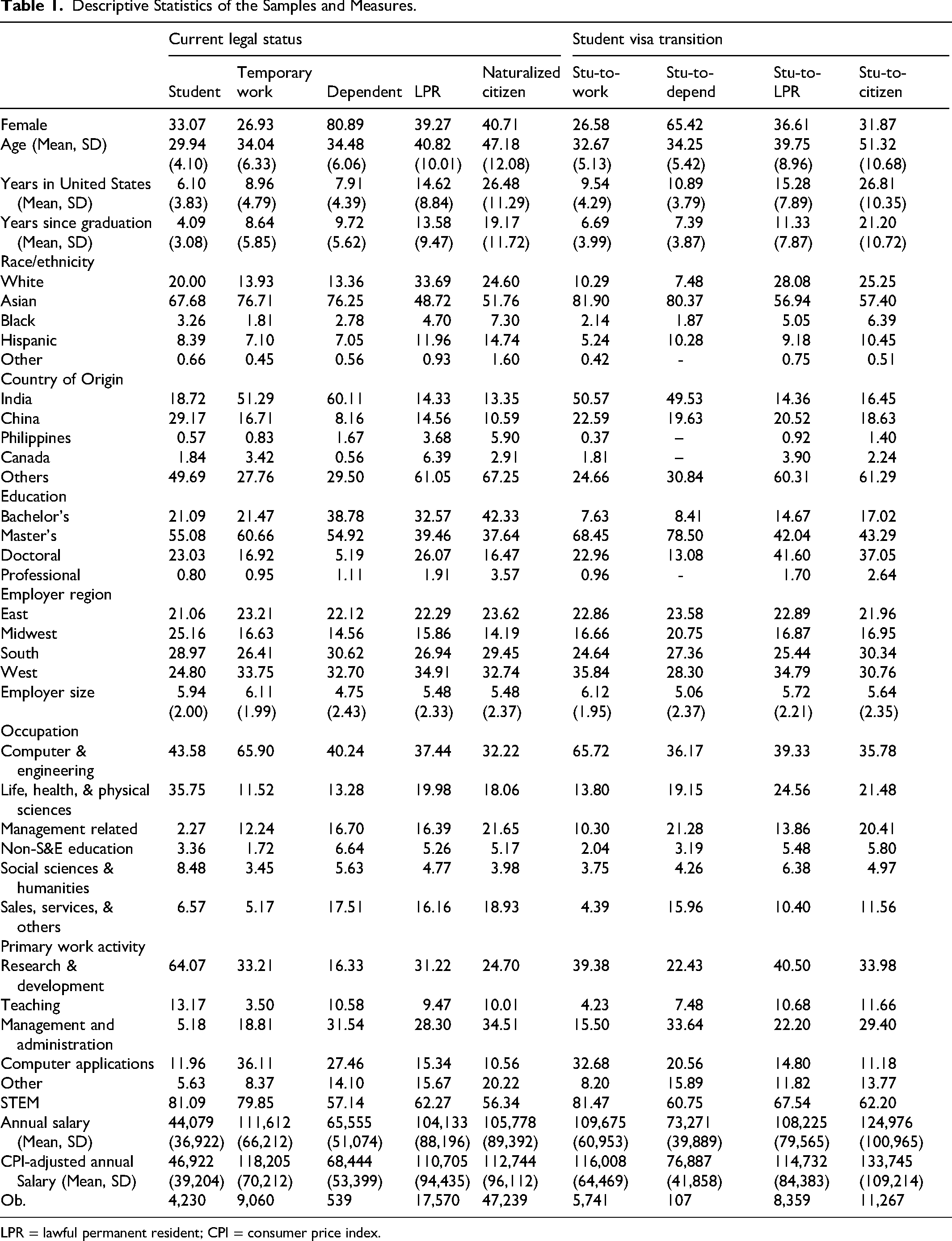
LPR = lawful permanent resident; CPI = consumer price index.
Looking at legal transitions, migrants transitioning from student visas to permanent residency or citizenship are older, have been in the United States longer, and earn significantly more than those who remain in temporary or dependent statuses. Female migrants are most prevalent among those transitioning to a dependent visa (65.42 percent) and least prevalent among those transitioning to temporary work visas (26.58 percent). Asian migrants are highly represented across all transition groups. White migrants are more represented among those who obtained permanent residency or citizenship. Among those who transitioned from student visas, individuals from India and China dominate the Stu-to-Work and Stu-to-Depend pathways, while those who became permanent residents or citizens are more likely to come from a broader range of countries. Doctoral degrees are most common among Stu-to-LPRs and Stu-to-Citizens migrants. Stu-to-Work migrants are concentrated in computing and engineering (65.7 percent) and STEM fields (81.47 percent), while Stu-to-Depend migrants show lower STEM representation. Average annual salaries show clear stratification: Stu-to-Work migrants earn $109,675 (inflation-adjusted: $116,008) on average, while Stu-to-Depend migrants earn considerably less, with an average of $73,271 (inflation-adjusted: $76,887). Those who became permanent residents or citizens have the highest earnings.
Table 2 presents the results from OLS and binary logistic regressions on the association between current legal status and employment conditions (annual salary and job benefits), while controlling for demographic and work characteristics. Table 2, Panel A reports OLS estimates of CPI-adjusted log annual salary with survey-year fixed effects absorbed. In the unmatched sample, temporary-work visa holders earn 0.743 log points more than student-visa holders (≈+110 percent, p < .001); after 1:1 nearest-neighbor propensity-score matching, this premium remains essentially unchanged at 0.737 log points (≈+109 percent, p < .001). Likewise, LPRs and naturalized citizens both enjoy large and highly significant salary advantages relative to student-visa holders, with matched coefficients of 0.5615 and 0.6086, respectively (≈+75 percent and ≈+84 percent, both p < .001). Panels B–E report ORs from binary logistic regressions for health insurance, pension coverage, profit-sharing, and paid vacation. In each case, temporary-work holders, permanent residents, and naturalized citizens are far more likely than student-visa holders to receive these benefits, even after 1:1 propensity-score matching. Figure 1 illustrates disparities in benefit access by current legal status. Together, the unmatched and matched results demonstrate that student legal status is consistently associated with lower earnings and less access to key employment benefits (even among otherwise similar individuals), supporting Hypothesis 1.
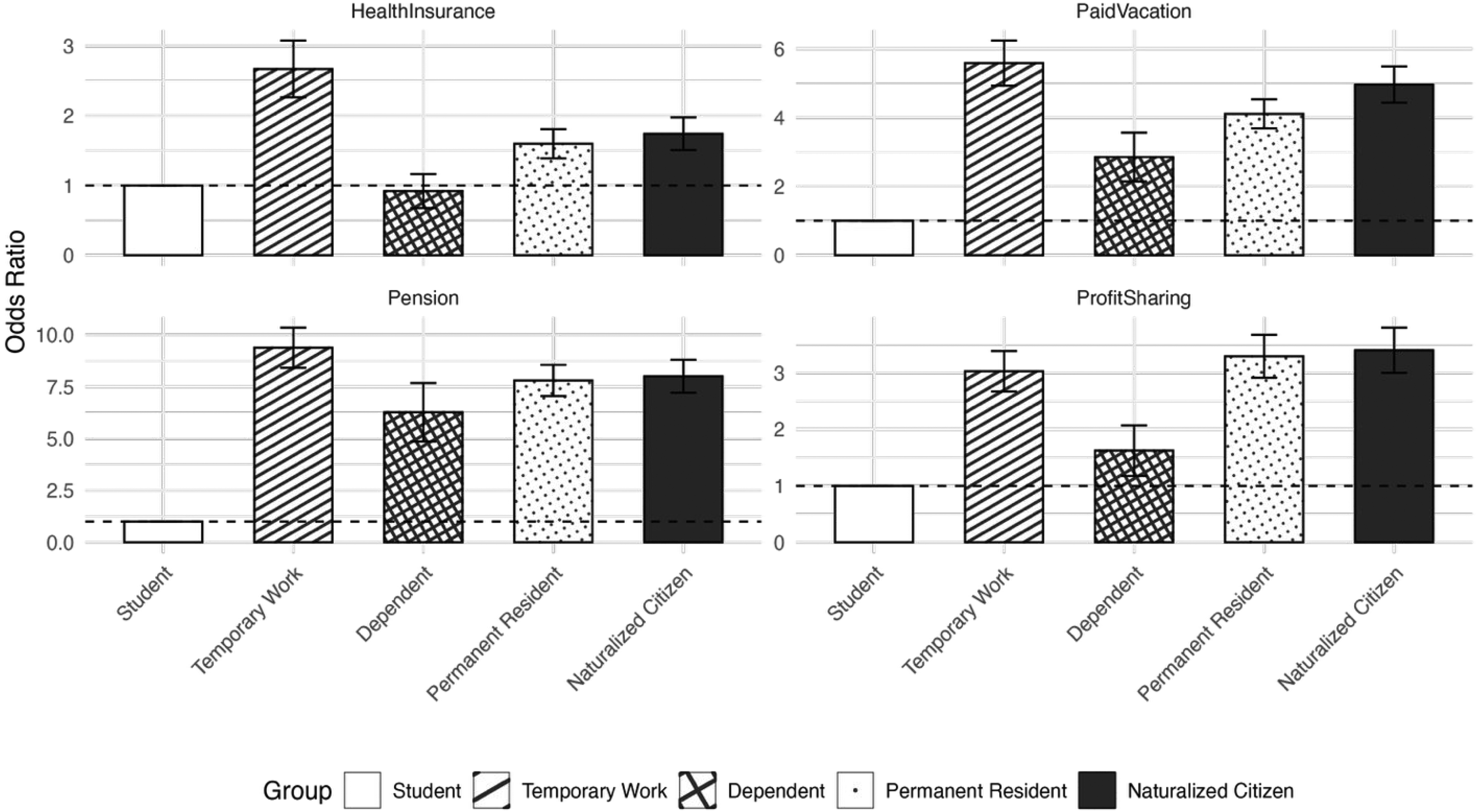
Estimated Odds Ratios of Access to Job Benefits by Current Legal Status.
OLS and Binary Logistic Regression of Association Between Legal Status and Employment Conditions: Unmatched versus 1:1 Matched Estimates.
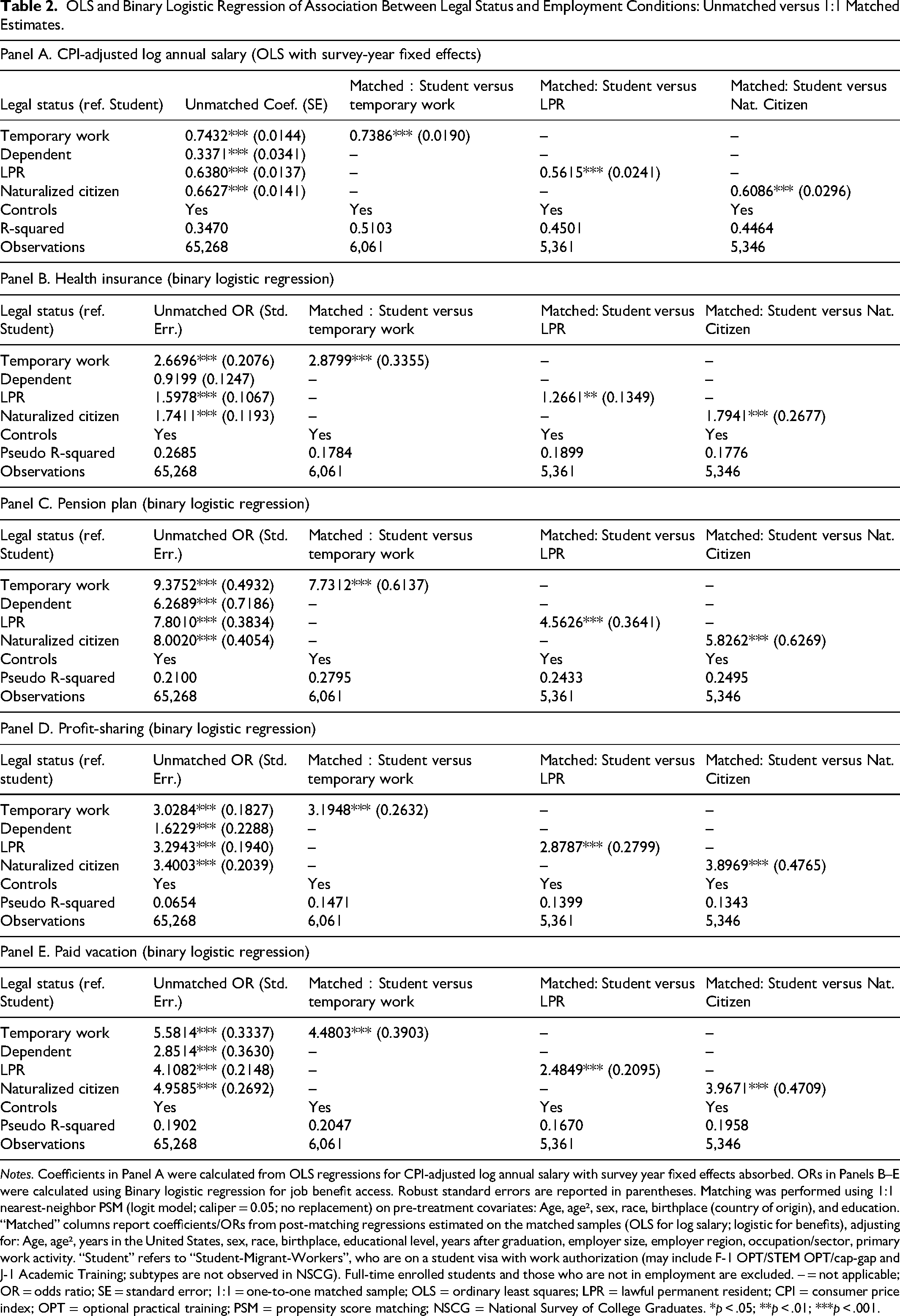
Notes. Coefficients in Panel A were calculated from OLS regressions for CPI-adjusted log annual salary with survey year fixed effects absorbed. ORs in Panels B–E were calculated using Binary logistic regression for job benefit access. Robust standard errors are reported in parentheses. Matching was performed using 1:1 nearest-neighbor PSM (logit model; caliper = 0.05; no replacement) on pre-treatment covariates: Age, age², sex, race, birthplace (country of origin), and education. “Matched” columns report coefficients/ORs from post-matching regressions estimated on the matched samples (OLS for log salary; logistic for benefits), adjusting for: Age, age², years in the United States, sex, race, birthplace, educational level, years after graduation, employer size, employer region, occupation/sector, primary work activity. “Student” refers to “Student-Migrant-Workers”, who are on a student visa with work authorization (may include F-1 OPT/STEM OPT/cap-gap and J-1 Academic Training; subtypes are not observed in NSCG). Full-time enrolled students and those who are not in employment are excluded. – = not applicable; OR = odds ratio; SE = standard error; 1:1 = one-to-one matched sample; OLS = ordinary least squares; LPR = lawful permanent resident; CPI = consumer price index; OPT = optional practical training; PSM = propensity score matching; NSCG = National Survey of College Graduates. *p < .05; **p < .01; ***p < .001.
Table 3 presents results from OLS and logistic regression models estimating the association between legal status transitions from student visas and employment outcomes, while controlling for demographic and work characteristics. Panel A reports OLS estimates of CPI-adjusted log annual salary for individuals transitioning from student status, with survey year fixed effects absorbed. In the unmatched sample, moving to a temporary work visa was associated with a 0.7037 log point gain in salary (≈+102 percent, p < .001), and this association remained stable after matching with 0.6770 log points (≈+97 percent, p < .001). Transitioning to LPR and citizenship also were associated with significant increases in salary of approximately 0.58 to 0.73 log points (all p < .001), while switching to dependent visas was associated with smaller but still statistically significant gains. These results remained stable after matching. Panels B–E present unmatched and matched ORs for four job benefits. Both the unmatched and matched models estimated a higher odds of receiving job benefits transitioning from student visas. For instance, transitioning to a temporary work visa was associated with higher odds of health insurance (OR = 3.48, p <.001) and pension coverage (OR = 9.63, p <.001), with similar odds for receiving profit-sharing and paid vacation. Other pathways, especially to LPR and citizenship, were also associated with significant job benefits, whereas dependent-visa transitions showed more modest results. Figure 2 illustrates disparities in benefit access by student status transitions. Across all models, both unmatched and propensity matched, confirm that legal status transitions from a student visa were substantially associated with increased earnings and benefits, supporting Hypothesis 2.
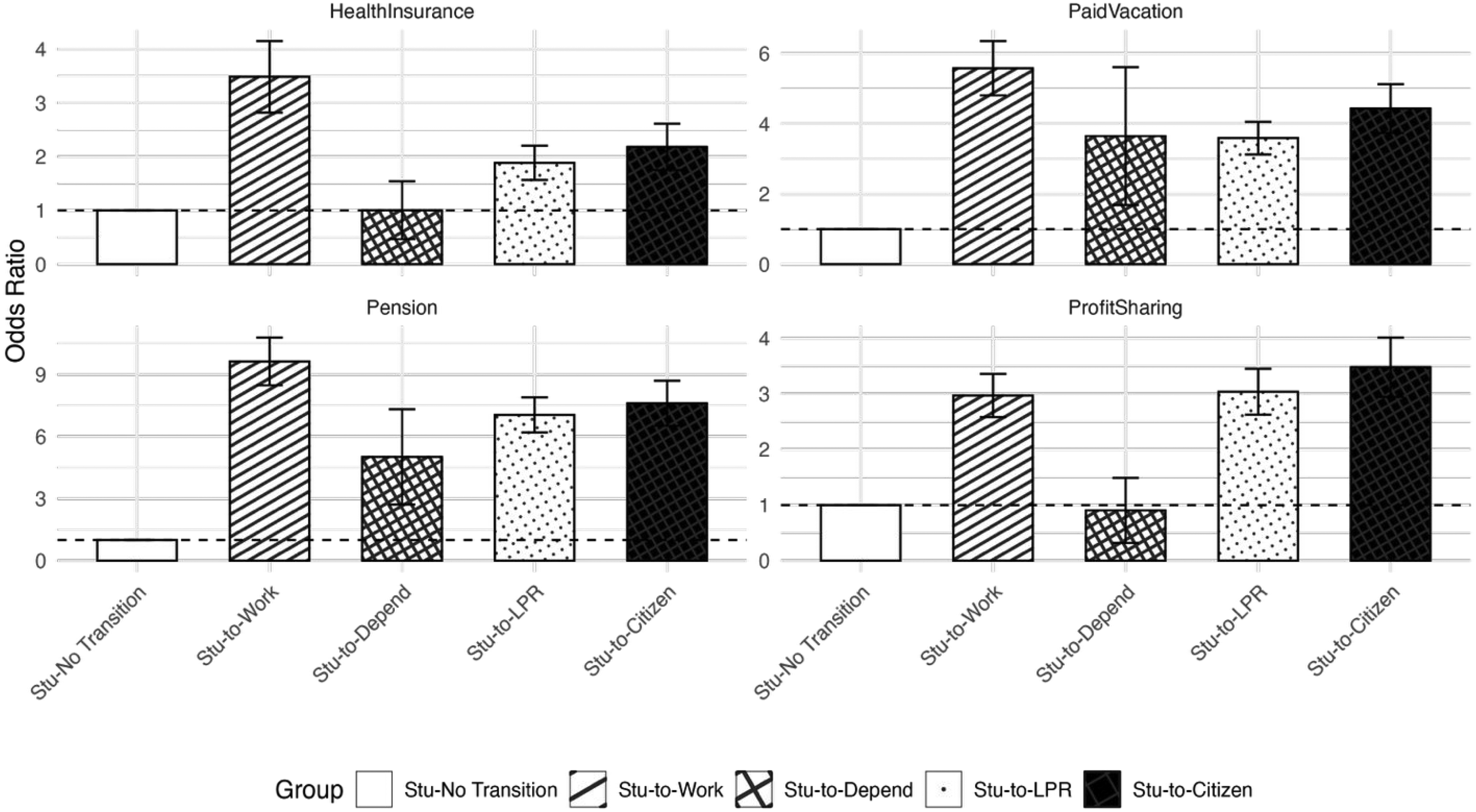
Estimated Odds Ratios of Access to Job Benefits by Student Visa Transition.
OLS and Binary Logistic Regression of Associations Between Student Visa Transitions and Employment Conditions: Unmatched versus 1:1 Matched Estimates.
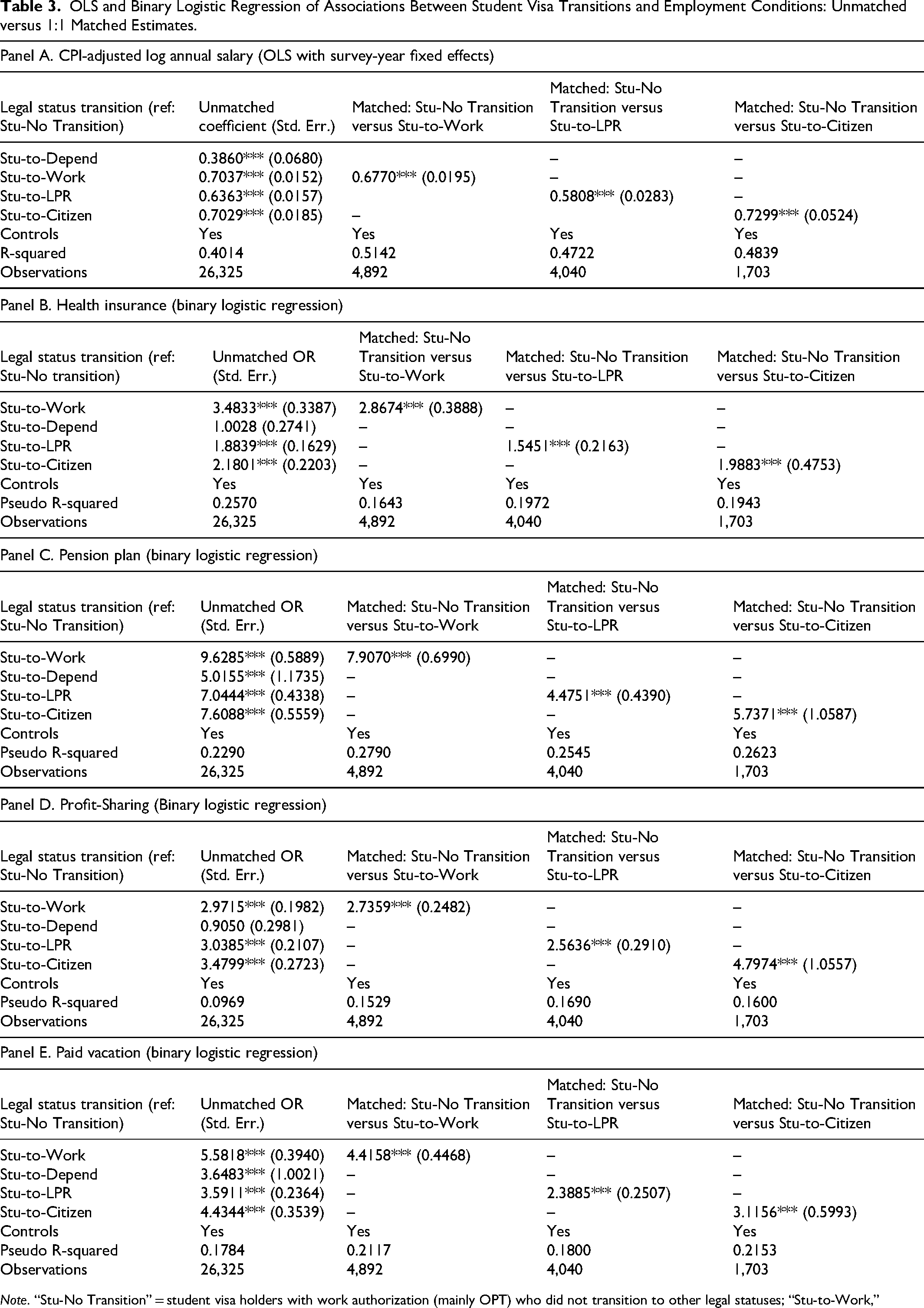
Note. “Stu-No Transition” = student visa holders with work authorization (mainly OPT) who did not transition to other legal statuses; “Stu-to-Work,” “Stu-to-Depend,” “Stu-to-LPR,” and “Stu-to-Citizen” denote transitions from student visa (OPT) to the respective status. OLS = ordinary least squares; LPR = lawful permanent resident; CPI = consumer price index; OPT = optional practical training.
Table 4 presents OLS estimates of CPI-adjusted log annual salary by migrants’ initial entry category into LPR (student vs. work visas), using both full unmatched and 1:1 matched samples, and stratified by educational attainment. Across specifications, migrants who initially entered on work visas consistently earned more than their student-entry counterparts, even after both groups obtained LPR status. In the full unmatched sample, the work-to-LPR group earned 0.170 log points more than the student-to-LPR group (p < .001); this premium increased slightly to 0.177 (p < .001) after PSM. Stratified analyses show that the work-to-LPR premium is 0.160 among bachelor's degree holders (p < .001), 0.162 among master′s degree holders (p < .001), and 0.146 among doctoral recipients (p < .001). Among professional degree holders, the estimate is negative (–0.050) and not statistically significant, likely due to small sample size and wide CIs. These findings provide strong support for Hypothesis 3, suggesting that migrants’ initial visa pathway continues to be associated with disadvantaged economic outcomes even after receiving permanent residency. The consistency of this premium across most educational strata indicates that legal status trajectories (not just final legal status) matter for labor market outcomes.
OLS Regression Results of CPI-Adjusted Log Annual Salary by Initial Entry Category into LPR: Unmatched versus Matched Full Sample and Stratified Models by Education, with Survey Year Fixed Effects.
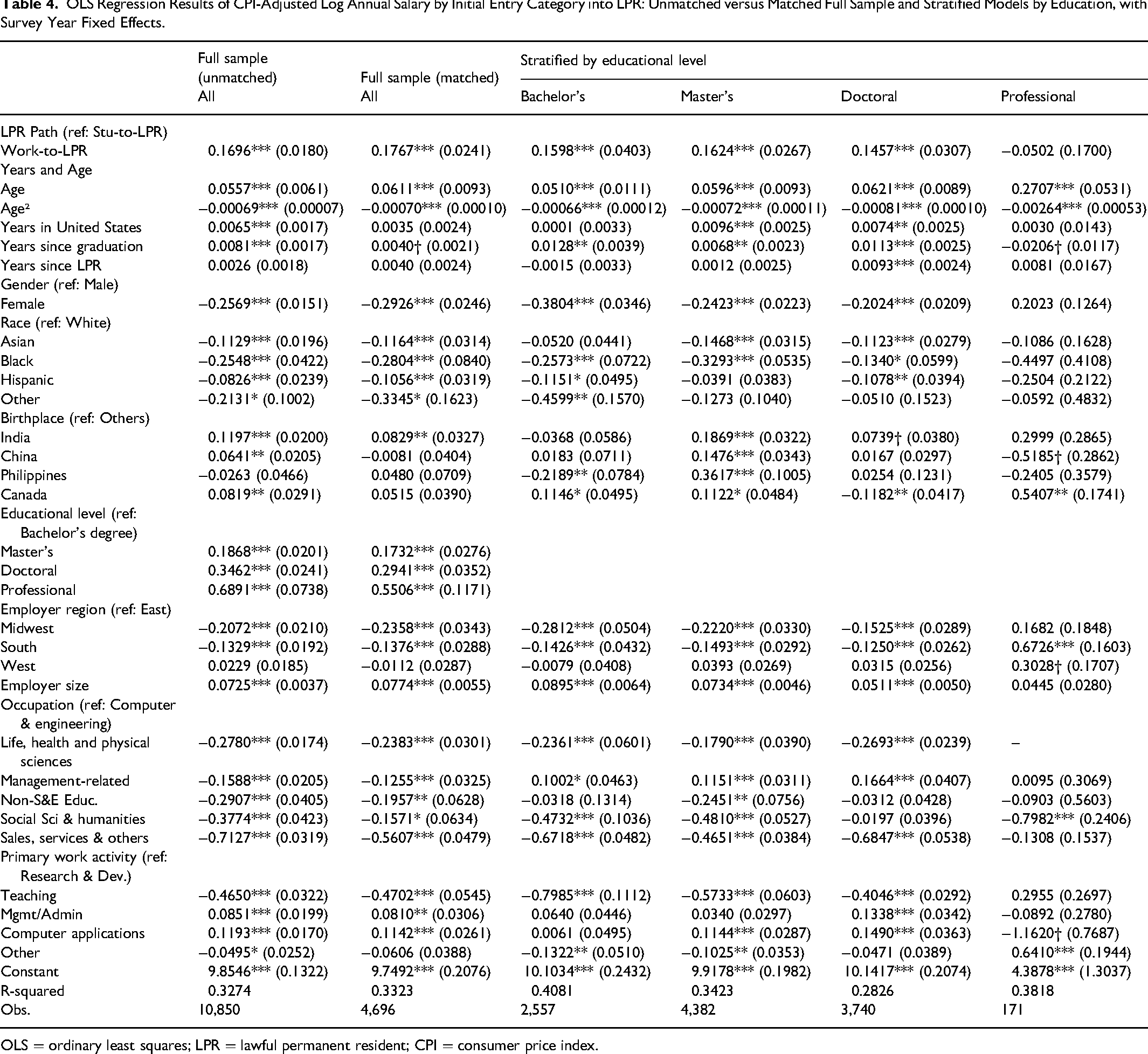
OLS = ordinary least squares; LPR = lawful permanent resident; CPI = consumer price index.
Figure 3 illustrates predicted CPI-adjusted log annual earnings by years since obtaining LPR, disaggregated by LPR pathway (Stu-to-LPR vs. Work-to-LPR). Estimates are derived from OLS regression models that include an interaction between years since LPR and pathway to LPR, adjusted for the same sets of covariates as described earlier. Predicted values are generated holding covariates constant at their mean, and the analysis is restricted to individuals under 60. Consistent with Hypothesis 3, migrants who entered on student visas earned significantly less than their Work-to-LPR counterparts in the early years following LPR receipt. Although the gap narrows gradually, it takes more than two decades for earnings to converge. This pattern highlights how initial legal status, as a “starting point” in the stratification system (Kreisberg 2019), has enduring consequences. Even after achieving the same legal status, migrants’ labor market trajectories diverge based on where they began.
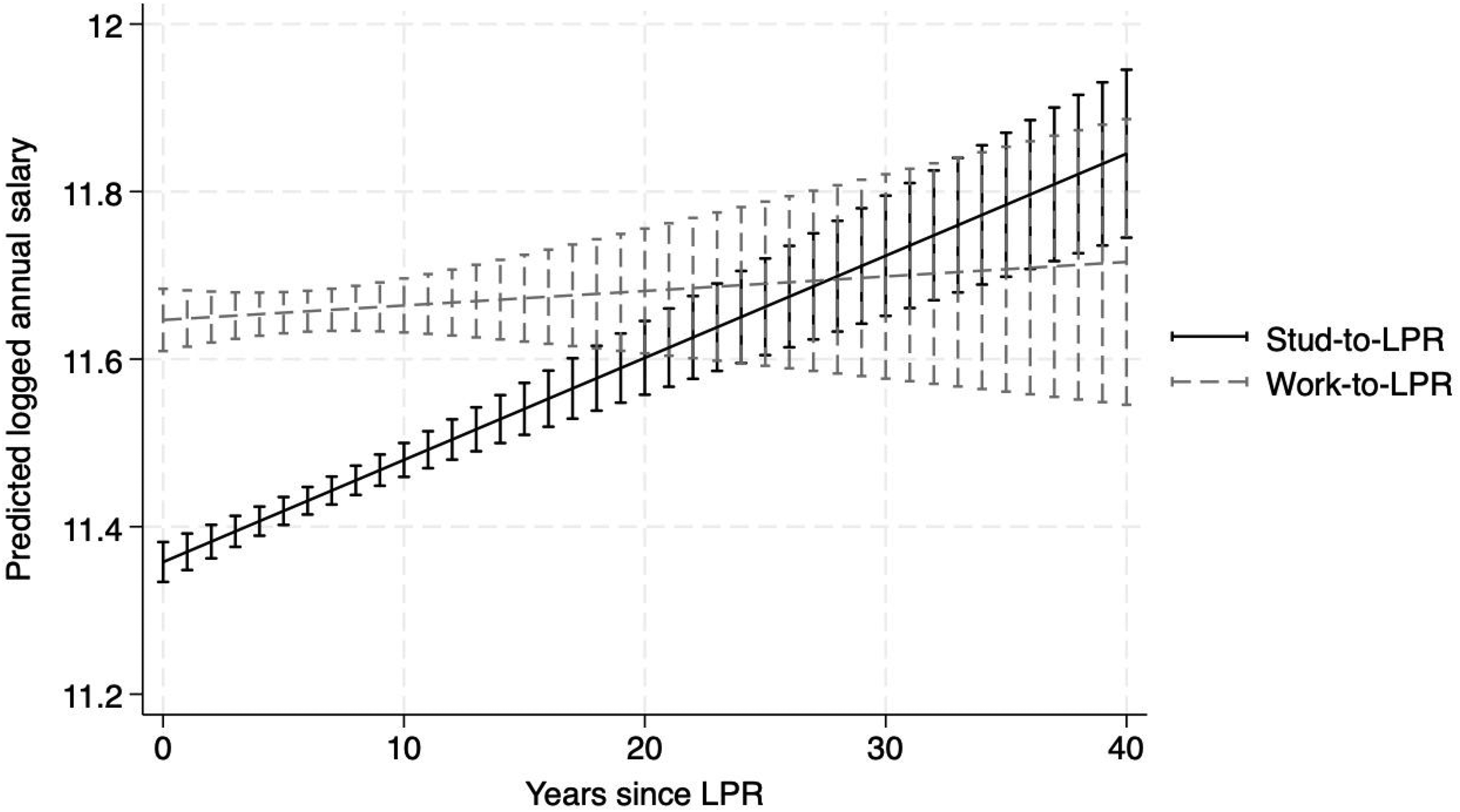
Predicted Logged Annual Salary by Years Since Lawful Permanent Resident (LPR).
Table 5 presents logistic regression analysis results examining the association between access to job benefits and the LPR pathway. Controlling for key demographic and occupational covariates, Work-to-LPR migrants have higher odds of receiving job benefits than Stu-to-LPR migrants. In the unmatched models, the ORs are Health Insurance OR = 1.34 (SE = 0.14, p < .01), Profit-Sharing OR = 1.18 (SE = 0.07, p < .01), and Paid Vacation OR = 1.41 (SE = 0.13, p < .001); the pension difference is small and not statistically significant (Pension OR = 1.12, SE = 0.08). In the 1:1 matched models, these advantages persist or strengthen. These results lend further support to Hypothesis 3, suggesting that even after transitioning to LPR, the initial entry category continues to frame and stratify the employment of migrants.
Binary Logistic Regression ORs for Job Benefit Access by Initial Entry Category into LPR (Unmatched versus 1:1 Matched Estimates).
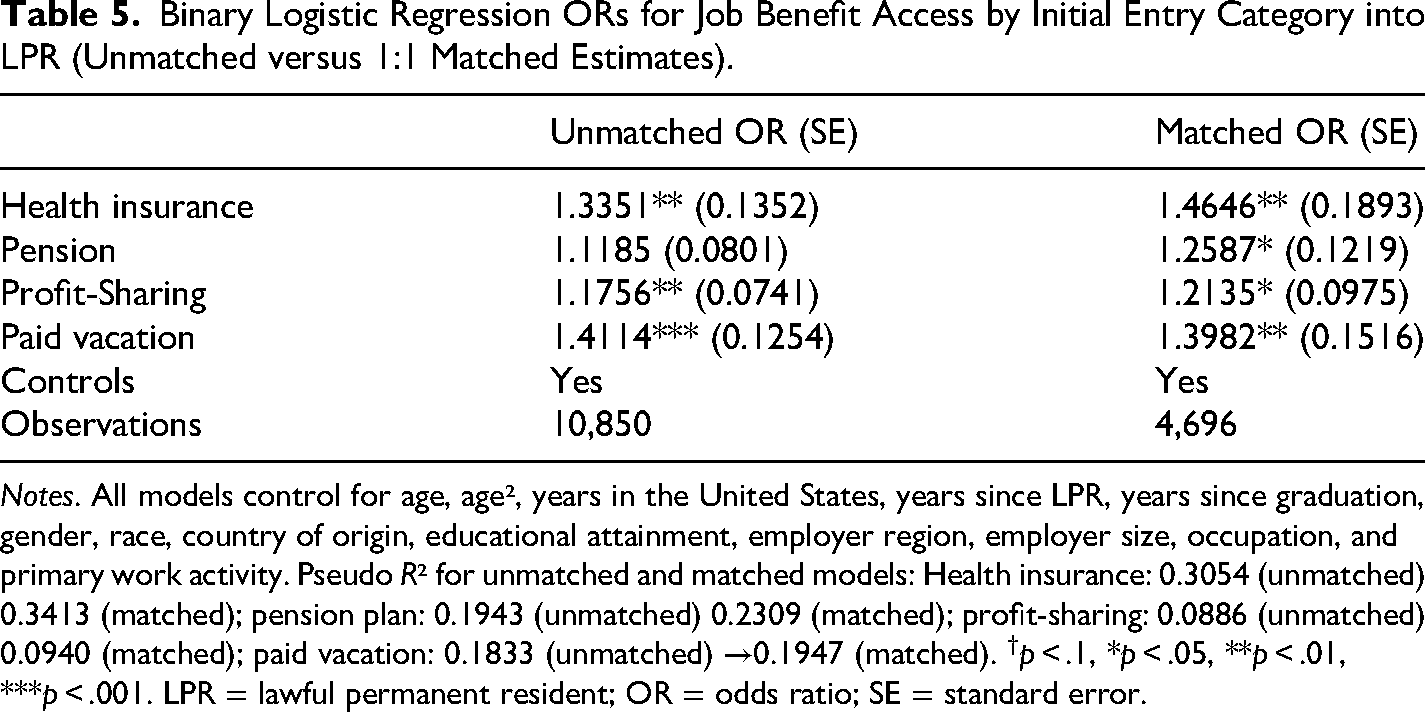
Notes. All models control for age, age², years in the United States, years since LPR, years since graduation, gender, race, country of origin, educational attainment, employer region, employer size, occupation, and primary work activity. Pseudo R² for unmatched and matched models: Health insurance: 0.3054 (unmatched) 0.3413 (matched); pension plan: 0.1943 (unmatched) 0.2309 (matched); profit-sharing: 0.0886 (unmatched) 0.0940 (matched); paid vacation: 0.1833 (unmatched) →0.1947 (matched). †p < .1, *p < .05, **p < .01, ***p < .001. LPR = lawful permanent resident; OR = odds ratio; SE = standard error.
Discussion and Conclusion
This study examined how legal status categorization, transitions to different legal statuses, and initial entry status are highly associated with the employment conditions of student-migrant-workers (holders of both student visas and post-graduate work permits, such as an OPT permit), a group often overlooked in quantitative migration research. Using nationally representative data from the NSCG (2015, 2017, 2019, 2021), this study offers new empirical insights into how legal status serves as a stratifying mechanism that is associated with differentiated employment conditions. It operates not only through current legal categorizations but also via legal status transitions and initial legal starting point, particularly in the case of student-migrant-workers.
There are three main findings. First, student-migrant-workers face employment disadvantage relative to their counterparts with temporary work visas, permanent residency, or citizenship. Even after adjustment for covariates known to influence employment conditions, the results suggest that student-migrant-workers earn significantly less and are less likely to access health insurance, pension plans, profit-sharing, and paid vacation. Propensity score-matched analyses provided similar results. These findings support the repeated observations of employment precarity experienced by student-migrant-workers in qualitative studies. Despite being categorized as “high-skilled migrants,” whose legal statuses are often framed as neutral or even favorable, these individuals experience disproportionate employment disadvantages in the labor market. This supports the view that legal status operates as a form of stratifying state categorization system (Menjívar 2023; Bialas, Lukate and Vertovec 2025), and extends this insight to the underexamined case of student-migrant-workers. It also quantifies the extent of their earnings and benefit penalties relative to other migrant groups.
Second, this study shows that the transitions from student visas to other statuses (work, dependent, permanent residency, or citizenship) are significantly and positively associated with employment conditions. Propensity score-matched subsamples yielded similar results. The findings are in line with prior research documenting a “green card premium” (e.g., Banerjee et al. 2018; Wang 2021). The findings support the conclusion that becoming legally permanent is significantly associated with improved employment conditions. The study also introduces critical nuance by demonstrating that such associations are not limited to transitions to permanent residency or citizenship, but also apply to transitions to lateral intermediate legal statuses, such as temporary work and dependent statuses. However, the improvement in employment outcomes associated with legal status transitions may be unevenly distributed. Student migrants who switched to dependent visas had less improvement in their employment conditions, particularly in terms of access to health insurance and profit-sharing. These findings operationalize the “chutes and ladders” metaphor (Goldring and Landolt 2022) by quantifying the employment outcomes associated with different legal transitions. The findings are also consistent with previous findings that not all legal transitions are equally associated with improved employment outcomes, which are largely determined by the direction of transition and the destination status types.
Third, the study uncovers an association between long-term employment disadvantage and starting with a student visa status that persists even after former student visa holders acquire legal permanent residency. Permanent residents who entered on a student visa earned significantly less than those who entered on a temporary work visa. These results were confirmed in the propensity score-matched analyses. This earnings gap holds across educational attainment levels and is estimated to endure for over two decades after LPR acquisition, though narrowing over the years. These findings are consistent with previous findings that migrants’ initial entry category and their specific legal starting point in the destination country are associated with differentiated labor market positions after becoming permanent (Lindsay Lowell and Avato 2014; Hou and Bonikowska 2016; Lee 2022; Menjívar, Agadjanian and Oh 2022; Banerjee and Lam 2024). They also broaden prior insights about initial entry category and employment outcomes—previously mostly applied to family-sponsored or humanitarian migrants—to the case of student-migrant-workers. Also, the findings add a temporal perspective missing from Lindsay Lowell and Avato's (2014) studies by tracking predicted earnings over time following the acquisition of permanent residency. The results support Kreisberg's (2019) theoretical argument that legal “starting points” are associated with ordered differences in migrants’ labor market positions. The study also extends Kreisberg's (2019) insights by focusing specifically on those who entered with student visas (who were absent from his analyses) and adds a job benefit-oriented dimension to the claim. The “sticky” association of specific visa holders with precarious work (Menjívar, Agadjanian and Oh 2022) may help explain that former student-migrants are socially and economically “typed” into subordinate positions based on their initial entry point.
Empirically, the present study advances our understanding of an important yet understudied population, student-migrant-workers, who have become an integral part of the highly skilled labor force and immigrant communities but whose employment conditions have received limited quantitative attention. Conceptually, this study contributes to the growing literature on the stratifying mechanism of legal status categorization (Menjívar 2023; Bialas, Lukate and Vertovec 2025), legal status transitions (Robertson 2019; Goldring and Landolt 2022), and the legal starting point (Kreisberg 2019). Rather than treating legal status categories merely as fixed administrative markers, the findings support frameworks that view legal status categorization as a continuous stratifying process (whether through selecting or affecting employment conditions) that unfolds over time and across legal transitions (Goldring and Landolt 2022; Menjívar 2023; Bialas, Lukate and Vertovec 2025). The observed associations suggest that both legal categorization, legal transitions, and legal starting points are associated with differentiated employment conditions, and the degree and direction of the association is dependent on both migrants’ initial entry point and the type of legal status they transition to. The act of categorization into a temporary liminal legal status such as student legal status or linked post-graduation work authorization—however “neutral” or “favorable” it may seem—can be associated with durable inequality. Moreover, legal transitions and starting points, whether they appear to operate as selection mechanisms or treatment mechanisms, stratify migrants’ labor market conditions, even among those who are highly educated. The persistent earnings gap between student-to-LPR migrants and those who enter the United States on other types of visas indicates a process of cumulative disadvantage, where initial legal starting points continue to be associated with disadvantaged outcomes long after permanent residency is achieved. Intermediate statuses, such as dependent statuses, may help sustain this disadvantage by extending exposure to precarious conditions.
Although multiple rounds of cross-sectional data were used in the present study, it is essential to acknowledge that the data and method used in the paper do not allow causal interpretation. Legal status transitions and employment outcomes may be endogenous to one another; the bidirectional relationship is a limitation of the current design. It remains unclear whether the observed differences in employment conditions are attributable to selection and sorting processes (where individuals with greater resources, qualifications, or motivations are more likely to transition), or to treatment effects, whereby the transition itself leads to improved employment outcomes. Moreover, the distinction between LPR pathways (e.g., family-based vs. employment-based LPR) is not directly captured in the data, which limits the ability to fully account for the source of heterogeneity within the student-to-LPR group. Thus, while the observed disadvantages among student-to-LPR pathways are robust and policy-relevant, they cannot be interpreted as purely caused by the initial status.
Future research should explore methods that better address selection bias, such as instrumental variables, or panel data with fixed effects, and investigate the timing and sequence of transitions in greater depth. Also, although broad occupational groupings are adjusted, the lack of detailed industry/sector controls may bias estimates if visa pathways cluster within specific industries; documenting and modeling such clustering is a priority for future research. Moreover, future research could stratify the core models by gender, race/ethnicity, field of study, or industry, and examine the interactions among these factors, to see where the student-visa penalty is most acute, and whether some subgroups “catch up” faster than others. Furthermore, while race and birthplace are included as control variables, this study cannot capture the full racialized nature of legal status stratification. Future research should further explore how race and national origin intersect to influence legal status trajectories and labor market incorporation.
Evidence of persistent disadvantage among student-migrant-workers warrants targeted, actionable reforms. For example, time-bounded transitions after OPT would ensure that migrants move promptly toward LPR application, reducing prolonged exposure to intermediary statuses where early wage/benefit penalties accumulate. Moreover, greater sponsorship portability, through extended unemployment grace periods or more flexible labor mobility rules, would limit employer monopsony power and improve migrants’ bargaining leverage. Finally, wage-floor and role-alignment verification at the time of adjustment of status, coupled with transparency and anti-retaliation safeguards, would deter down-skilling, reduce informational asymmetries and the risk of retaliation.
Supplemental Material
sj-docx-1-mrx-10.1177_01979183251381263 - Supplemental material for Legal Status Categorization, Transitions, Starting Points as Employment Stratifying Mechanisms: Evidence from US Student-Migrant-Workers
Supplemental material, sj-docx-1-mrx-10.1177_01979183251381263 for Legal Status Categorization, Transitions, Starting Points as Employment Stratifying Mechanisms: Evidence from US Student-Migrant-Workers by Xiaochen Liang in International Migration Review
Footnotes

Funding
The author received no financial support for the research, authorship, and/or publication of this article.
Declaration of Conflicting Interests
The author declared no potential conflicts of interest with respect to the research, authorship, and/or publication of this article.
Supplemental Material
Supplemental material for this article is available online.
References
Supplementary Material
Please find the following supplemental material available below.
For Open Access articles published under a Creative Commons License, all supplemental material carries the same license as the article it is associated with.
For non-Open Access articles published, all supplemental material carries a non-exclusive license, and permission requests for re-use of supplemental material or any part of supplemental material shall be sent directly to the copyright owner as specified in the copyright notice associated with the article.
