




Abstract
How do states navigate cooperation and coercion in the governance of labor migration? This article introduces a novel framework for understanding strategic behavior in migration diplomacy, grounded in the concept of migration interdependence. It argues that state strategy is shaped not only by material power but also by the distribution of exposure to the consequences of disrupted migration flows. When stronger states are more exposed, cooperation becomes rational; when stronger states are less exposed, or when weaker states possess credible alternatives, coercion becomes viable. The article develops a two-axis typology to explain these dynamics and applies it to four bilateral labor migration corridors: New Zealand–Pacific Islands, Russia–Central Asia, Gulf States–Nepal, and Malaysia–Indonesia. These cases span Global South and South–North relationships, allowing for controlled comparison across varied structural configurations. Methodologically, the article employs a focused comparative approach combining process tracing and a structured typological framework, drawing on primary and secondary sources to triangulate evidence and elucidate variation across migration corridors. It identifies four factors that condition states’ strategic options: remittance dependency, labor market reliance, migration portfolio diversification, and institutionalization. The article advances migration studies by reconceptualizing labor mobility as a site of deliberate, strategic state engagement rather than a passive byproduct of domestic pressures. Simultaneously, it enriches international relations theory by offering a nuanced understanding of how power and migration interdependence intertwine to shape state behavior within asymmetric contexts. By identifying conditions that enable coercion, the article offers a critical policy tool for anticipating and mitigating exploitative practices in migration diplomacy.
Keywords
Introduction
Why do some states cooperate while others coerce in their migration diplomacy? From seasonal worker agreements to visa regimes and deportation threats, states across both the Global South and the Global North are increasingly treating labor migration as a tool of strategic statecraft (Mosley and Singer 2015; Hollifield, Martin and Orrenius 2022; Peters 2022). This shift has become particularly visible in contexts marked by economic asymmetries, authoritarian governance, and postcolonial entanglements, where materially unequal states interact through dense networks of cross-border mobility (Sadiq and Tsourapas 2021, 2023; Lacroix 2022; Money 2025). Yet, prevailing explanations of the international relations of migration continue to rely heavily on regime-level attributes, transactional logics, geopolitical alignments, and material capabilities, particularly in the context of forced displacement. What remains under-theorized is the role of the migration relationship itself as a unit of analysis: how the distribution of risk and reliance within labor migration ties shapes the strategic choices states make in their foreign policy engagement. This article contributes to migration studies and international relations theory by advancing a relational account of power and strategy under conditions of interdependence, bridging insights from economic statecraft, migration diplomacy, and global power asymmetries.
Labor migration remains a central yet under-theorized dimension of international politics. While a growing body of work has addressed its regulatory mechanisms and policy implications (Pécoud 2021; Ersanilli 2023; Chung, Hollifield and Tian 2024), less attention has been paid to the structural dynamics that shape how states pursue strategic goals across labor-sending and receiving contexts. This article builds on existing work on migration interdependence, understood as the mutual but often uneven exposure to the political and economic consequences of labor migration disruption (Tsourapas 2018; Malit and Tsourapas 2021a). It also draws on earlier invocations of interdependence in international migration (Hollifield 1992; Sassen 2013) and international relations theory more broadly (Baldwin 1980; Keohane and Nye 1987), to develop a new framework for explaining variation in state strategy.
The article argues that variation in exposure within migration interdependence (when considered alongside relative material power) fundamentally shapes the strategic options available to states. Where both parties are significantly exposed to the risks of migration disruption, they share incentives to avoid escalation, making cooperation more likely. By contrast, when one state is relatively insulated, particularly if materially stronger, it may pursue coercive strategies, including regulatory restrictions, deportation threats, or conditional labor access. However, coercion is not the exclusive preserve of powerful states: under certain conditions, materially weaker but less exposed states can also assert leverage, using tools such as recruitment moratoria, reputational signaling, or selective engagement to shift the terms of bilateral negotiation in their favor.
In developing this argument, the article contributes to migration studies and international relations theory in three key respects. First, it repositions labor migration as a central arena of state power and foreign policy practice, challenging its marginalization as a largely technocratic concern. In doing so, it adds a missing dimension to the expanding body of migration research that examines power politics primarily by focusing on refugee governance. Second, it advances a relational account of state strategy that moves beyond explanations grounded in regime type, institutional weakness, or material capability, by foregrounding how structural positioning within cross-border migration systems shapes the range of strategic choices available to states. Third, it introduces a theoretically parsimonious framework for analyzing bilateral migration governance; one that is not confined to regions or cases, but that offers a generalizable model for explaining variation in cooperative and coercive strategies across migration relationships worldwide.
The core of this framework is a two-dimensional typology based on the interaction of two axes: the relative exposure of each state to migration disruption and their material power position. Together, these dimensions generate four ideal-typical configurations, each corresponding to a distinct strategic logic of migration diplomacy. When a materially stronger state is embedded in a relationship where it is more exposed, cooperation emerges as the rational strategy (Quadrant I). Where a strong state is less exposed than its weaker partner, asymmetry enables coercion (Quadrant II). Conversely, when a weaker state is more exposed, it is structurally constrained and often forced to accept unfavorable terms of engagement, in what this article terms constrained accommodation (Quadrant III). Yet when a weaker state is relatively insulated from disruption (particularly when it has diversified its migration portfolio or holds strategic alternatives), it may assert leverage over a more dependent, materially stronger partner, engaging in what this framework calls coercive assertion (Quadrant IV). Although empirically grounded, this typology is constructed at an ideal-typical level: it simplifies real-world complexity to isolate the structural logics that shape strategic behavior across migration relationships.
This conceptual model is developed through a comparative analysis of four migration dyads. The first examines the relationship between Aotearoa New Zealand (hereafter New Zealand) and several Pacific Island countries, where labor migration is governed through the recognized seasonal employer (RSE) scheme. Despite New Zealand's economic and institutional prominence in Pacific labor governance, the high degree of institutionalization and mutual benefit fosters cooperative outcomes. A second case, Russia's engagement with Central Asian states, reveals a sharply asymmetric structure, with Russia using visa regimes, deportation threats, and selective enforcement to extract concessions because of Central Asia's deep reliance on remittance income. The third case explores the Gulf Cooperation Council (GCC)–Nepal corridor, where high remittance dependency, limited bargaining alternatives, and weak institutional protections constrain Nepal's ability to exert influence, resulting in a largely accommodationist posture. Finally, the fourth case examines Malaysia–Indonesia migration diplomacy, where Indonesia, though materially weaker, has exercised regulatory leverage through periodic moratoria and policy renegotiations, enabled by its lower exposure and Malaysia's reliance on Indonesian labor in key sectors such as domestic work and manufacturing, even if substitution is possible in others.
All four cases are drawn from high-volume labor migration corridors in the Global South and South–North systems. Each involves state-led governance of migration flows in the absence of robust multilateral frameworks, allowing for a controlled comparison of strategic variation across cases that share institutional and sectoral characteristics. The selected dyads differ in regime type, power asymmetries, geographic location, and levels of institutionalization; yet, the analysis isolates the structure of migration interdependence as the primary explanatory variable. In doing so, the article contributes to a growing body of scholarship that conceptualizes migration not as a transnational externality but as a site of relational power and strategic interaction. It builds on established research on migration diplomacy and extends recent conceptual work on migration power, offering a framework that is both empirically grounded and theoretically generative. The article foregrounds interdependence to advance a new lens for understanding how states govern cross-border labor flows, pursue leverage, and manage exposure in the global migration system.
The argument developed is that cooperation and coercion in migration diplomacy are not determined by material power alone, but by how states are situated within asymmetric or symmetric interdependence structures. The analysis demonstrates that weaker states can at times assert leverage, while stronger states may be constrained by their own exposure. By foregrounding variation in exposure alongside material power, the article offers a generalizable framework for explaining strategic behavior across diverse migration relationships. The remainder of the article proceeds as follows: the next section reviews existing literature on migration diplomacy and relational power in international politics, identifying a gap in theorizing how interdependence conditions state strategy. The subsequent section develops the theoretical framework and introduces the two-axis model of migration interdependence. A fourth section outlines the comparative research design and methodological approach. The empirical core of the article consists of four case studies, each representing one quadrant of the model. A final discussion section examines additional illustrative cases and scope conditions, before the conclusion reflects on the implications of this framework for international relations theory and global migration governance.
Rethinking Migration, Diplomacy, and Power in International Relations
Although international labor migration has long featured in state practice, it has historically occupied a marginal position within international relations theory (Hollifield 2012). Only recently has a growing body of scholarship begun to treat cross-border mobility as a domain of strategic interaction (Quirk and Vigneswaran 2015; Mosley and Singer 2015; Peters 2015), rather than as a low-politics or technocratic issue. States increasingly engage with migration not merely as a matter of demographic management or border control, but as a tool of foreign policy by leveraging mobility flows for influence, reciprocity, and negotiation (İçduygu and Aksel 2014; Carbone 2022). This shift has renewed interest in the foreign policy dynamics of international migration. Yet existing approaches remain largely actor-centered and descriptive, offering limited theoretical leverage for explaining when and why states pursue cooperation or coercion. Most crucially, the structural features of labor migration relationships, particularly the distribution of costs and exposure to disruption, remain under-theorized.
Early contributions to the politics of migration in international relations focused primarily on the instrumentalization of forced displacement. Weiner (1995) argued that refugee flows could be used by sending and receiving states alike to reshape regional alignments (see also: Zolberg 1983; Teitelbaum 1984). Some scholars have advanced the view that forced displacement may be used coercively in international politics, framing such movements as “weapons,” yet this metaphor has been critiqued for securitizing refugee mobility and distorting both agency and policy responses (Marder 2018). These works underscored the strategic potential of mobility, but were grounded in a crisis-oriented understanding of power and centered predominantly on forced migration, an agenda that has picked up since the European refugee crisis (Arar 2017; Geddes 2019; Micinski 2022). As a result, they tended to frame migration primarily as a disruptive threat that demands containment or deterrence (Sharp 2025), rather than as a routine and institutionalized domain of bilateral negotiation, particularly in the context of labor mobility.
Even where the literature has aimed to develop more encompassing approaches that address both forced and labor migration, it has rarely examined labor mobility as a distinct field of strategic interaction in its own right (Micinski 2021; Kent 2021). The dynamics of labor mobility are frequently subsumed within broader categories of “migration,” eliding the specific institutional arrangements, bargaining relationships, and regulatory mechanisms that characterize labor migration governance (Boucher and Gest 2014). In practice, many states, particularly across Europe, link cooperation on irregular migration control to the provision of regular labor channels (Laube 2019; Missbach and Phillips 2020), further blurring the boundary between enforcement and facilitation. This tendency is compounded by legal and policy convergence between labor migration and refugee protection, as states convert international protection frameworks into instruments of migration control (Mourad and Norman 2020). Yet, the two forms of mobility are governed by distinct logics and institutional regimes; the analytical conflation of these categories has hindered efforts to theorize labor migration as a strategic domain in its own right.
The emergence of migration diplomacy as a research agenda has expanded the scope of inquiry beyond crisis and containment logics. Scholars have documented how states deploy a range of migration instruments, including bilateral labor agreements, deportation threats, repatriation policies, and visa regimes, to pursue broader diplomatic aims (İçduygu and Aksel 2014; Oyen 2015). Research has identified how states employ issue-linkage strategies and a mix of cooperative and coercive migration diplomacy to manage cross-border mobility in pursuit of foreign policy goals (Tsourapas 2017). Subsequent analyses of multilateral arrangements, such as those involving the European Union, reveal how migration management becomes embedded in complex diplomatic configurations, where asymmetries of power and competing interests interact to shape outcomes (Ceccorulli 2022; Micinski 2022; Geddes 2019). Others have shown how non-state actors participate in shaping migration policy, especially in highly transactional labor corridors (Malit and Tsourapas 2021a; Bish 2024; Koinova 2025a). Further work has demonstrated how such strategic behavior can generate both zero-sum and positive-sum outcomes across sending, transit, and host states (Adamson and Tsourapas 2019). Empirical studies have also illustrated how states may engage in policy liberalization not solely for normative or rights-based reasons, but as a form of diplomatic signaling: leveraging reform processes to gain international legitimacy, access to aid, or improved bargaining positions with stronger partners (Norman 2020; Fernández-Molina and Hernando De Larramendi 2022). Recent contributions have sought to bridge international relations and migration studies by focusing on foreign policy, externalization, and intergovernmental bargaining (de Wenden 2023; Finotelli and Ponzo 2023; Abbondanza 2025), yet few have conceptualized the structural dynamics that shape variation in strategy across labor migration corridors.
While this literature has significantly advanced our understanding of the political utility of migration, it continues to blur distinctions between migration types and remains largely descriptive. Building on this foundation, recent scholarship has turned toward more explicitly relational approaches, seeking to theorize how power operates not merely through instruments or intentions, but through the patterned configurations of international migration systems themselves (Laube 2019; Koinova 2025b). Rather than treating migration governance as the product of material capabilities or institutional capacity alone, this work emphasizes how power emerges from the configuration of relationships between actors, whether states, bureaucracies, or intermediaries (Axelsson and Hedberg 2025). One contribution has been the conceptualization of migration power as a multidimensional phenomenon, encompassing authority, exposure, and legitimation, and varying across different dyadic contexts (Fernández-Molina and Tsourapas 2024). This perspective shifts analytical focus away from formal power hierarchies and toward how migration relationships themselves shape the strategic space available to actors. It has gained particular traction in studies of migration governance in the Global South, where researchers have examined how domestic institutions, foreign policy imperatives, and transnational networks interact to produce context-specific outcomes (Gazzotti, Mouthaan and Natter 2023; Brumat and Vera Espinoza 2024).
Money (2025) similarly argues for an expansion of theoretical tools that can account for the systemic positioning of states within global migration regimes, calling for a shift away from methodological nationalism and toward frameworks that explain strategic variation across cases. As Tolay (2022) contends, such approaches are essential for recognizing the agency of non-Western states as strategic actors embedded in dynamic fields of migration diplomacy, rather than as passive objects of external influence. Still, this work stops short of offering a generalizable framework to explain variation in strategic behavior: namely, why some states adopt cooperative approaches while others resort to coercion, and under what conditions materially weaker actors can assert leverage. Whereas most accounts of migration diplomacy focus on state capacity or regime type, this article demonstrates that strategic behavior is best understood through the structure of interdependence itself, offering a relational alternative to materialist or institutionalist accounts.
Theoretical Framework: Migration Interdependence, Strength, and Strategic Behavior
International relations theory has long sought to explain state behavior through three dominant paradigms: realism, which emphasizes material power and security interests (Waltz 1979); liberalism, which focuses on institutions, interdependence, and domestic preferences (Ikenberry 2019); and constructivism, which foregrounds norms, identity, and social legitimacy (Wendt 1999). Each offers valuable insights into international migration governance, particularly when applied in combination. Yet these paradigms often focus on macro-level patterns, offering limited traction on how power operates within specific migration relationships. While critical approaches have broadened the field's normative and epistemological range, recent work has begun to reconceptualize migration power through relational lenses, emphasizing how power emerges from the structure of interdependence rather than from material capabilities or normative legitimacy alone (Jackson and Nexon 1999; Barnett and Duvall 2005; Qin 2016). In domains marked by sustained transnational exchange, such as trade, finance, or security, power frequently operates through the ability of one actor to impose costs or extract concessions without incurring equivalent harm. This article advances that insight within the migration domain, arguing for a general framework that explains variation in strategic behavior among states engaged in the governance of cross-border labor mobility. The framework foregrounds strategic action as shaped by both relative capabilities and the distribution of exposure within migration interdependence.
Following Keohane and Nye's (2012) foundational account, interdependence refers to a condition in which states are mutually affected by cross-border flows of goods, people, or capital, and where the costs of disruption are significant. Yet interdependence is rarely symmetrical. When one state is more exposed (be it economically, politically, or institutionally), than its counterpart, the less exposed actor is structurally positioned to exert leverage (Keohane and Nye 1987). As Baldwin (1980) and Copeland (2015) contend, it is precisely these relational asymmetries, not material capabilities alone, that shape how power is exercised under conditions of entanglement, enabling states to influence outcomes even in the absence of overt dominance. Within international migration, this logic has been taken up most notably by Hollifield (2012), who applies complex interdependence theory to argue that states are embedded in dense webs of legal, economic, and political ties that constrain unilateral action and encourage cooperation. This article builds on that foundation while moving beyond it: rather than presuming cooperation as the default response to interdependence, it disaggregates the concept into directional and asymmetrical exposure, asking how these distributions condition the strategic space within which states act.
When applied to labor migration, this framework builds on prior definitions of migration interdependence as a condition of mutual but uneven exposure to the consequences of cross-border mobility (Tsourapas 2018; Malit and Tsourapas 2021b). It refines the concept by emphasizing the direction and intensity of exposure: specifically, which state stands to lose more if migration flows are disrupted, and which can better absorb or exploit such disruption. The goal is to explain how these distributions shape the strategic space within which states can act. 1 Labor-sending states often benefit from remittance income, reduced domestic unemployment, and diaspora networks, while labor-receiving states depend on migrant workers to sustain key economic sectors. Yet the mutual benefits of migration rarely translate into balanced vulnerabilities. Some states are highly reliant on a single partner, while others maintain diversified portfolios; some face domestic political constraints that raise the costs of reform, while others enjoy broader flexibility. This relational framing aligns with broader efforts to disaggregate power beyond material capabilities or institutional capacity. As Guzzini (2000) argues, power is not only exercised through resources or behavior but is also embedded in structures of meaning and social interaction. While the framework developed here focuses on strategic action under conditions of interdependence, it remains compatible with constructivist insights that treat power as relationally constituted and contextually embedded.
Such structural variations are particularly visible in labor migration governance, where exposure is shaped not only by economic flows, but by institutional design (Ruhs 2013), recruitment geography (Collyer 2016), and the substitutability of migration partners (Kapur and McHale 2005). To capture this variation, the framework identifies four factors that structure how migration interdependence is configured and how power is exercised between states.
Sending-State Remittance Dependency: The more a sending state relies on remittance income, the more constrained it is in migration diplomacy. For example, Honduras depends heavily on remittances from its nationals in the United States, which account for over 20% of its GDP. This reliance has contributed to a largely compliant stance in bilateral talks with Washington on deportation, reintegration, and border control, despite domestic pushback (Reichman 2013). Host-State Labor Market Reliance: The more a host state depends on foreign labor, the higher its exposure to supply disruptions. Italy's agricultural sector, particularly in the south, has long relied on seasonal workers; during COVID-19, labor shortages triggered by border closures and administrative delays revealed the vulnerability of Italy's agrifood industry, pressuring the government to regularize undocumented migrant workers and fast-track visas (Corrado, Pisacane and Ferrari 2024). Migration Portfolio Diversification: States that engage in multiple migration relationships, whether by sending workers to a range of destination countries or by sourcing labor from various origin states, are better insulated from bilateral disruption. For sending states, a broad portfolio of host countries enhances credibility in negotiations. Sri Lanka, for example, has cultivated labor markets across the GCC, East Asian, and Southeast Asian states, enabling it to negotiate on migrant rights with more confidence than countries reliant on a single region (Ennis and Blarel 2022). For receiving states, the ability to shift recruitment across multiple countries reduces exposure and strengthens bargaining flexibility. Canada's expansion of its Seasonal Agricultural Worker Program from Caribbean states to include Mexico illustrates how diversification can reduce dependence on a single partner and enhance diplomatic room for maneuver (Hennebry and Preibisch 2012). Institutionalization of Migration Governance: Formalized, rule-bound frameworks mitigate power asymmetries by stabilizing expectations and limiting discretionary action. The UAE–Philippines labor migration corridor exemplifies this dynamic: despite significant material asymmetries, bilateral agreements and the strict licensing of recruitment agencies have institutionalized the migration process, limiting opportunities for unilateral manipulation. The two states engage in regular diplomatic exchanges, including joint committees and high-level consultations, while also participating in broader regional mechanisms such as the Abu Dhabi Dialogue, a multilateral forum for cooperation on labor mobility between Asian and GCC states. These frameworks enable dispute resolution, periodic policy recalibration, and partial protection of migrant rights. While enforcement gaps persist, institutionalization structures the terms of engagement and constrains opportunistic behavior (Malit and Tsourapas 2021a).
2
Each of these four factors contributes to a state's structural positioning within a given migration corridor. While mutual exposure may exist, it is the distribution of that exposure across economic, political, and institutional domains that determines strategic advantage. Crucially, exposure and material capability interact: materially stronger states may leverage asymmetric exposure to coerce weaker partners. Yet under certain conditions, weaker states with low exposure, such as those with diversified portfolios or alternatives, may assert leverage over more dependent but stronger counterparts. Such cases challenge conventional assumptions about hierarchy and highlight the need to examine how interdependence and capacity intersect. Cooperation is most likely where both states face significant costs from disruption. In such contexts, mutual exposure generates restraint, and strategic interests align around institutionalized, negotiated governance. Conversely, when one state is relatively insulated, coercive or unilateral strategies become more viable. The less exposed actor may exploit its position by deploying migration-linked threats or imposing conditional access to its labor market.
The contribution of this framework lies in specifying the causal mechanism linking exposure distribution to strategic behavior, an element often absent from previous accounts of migration interdependence. It explains not only why stronger states do not always coerce, but also how weaker states can, under certain configurations, assert influence over more powerful partners. Thus, the central theoretical claim is twofold. First, migration diplomacy is shaped not only by capacity or regime type, but by the distribution of exposure to migration disruption. Second, it is the interaction between relative power and exposure direction that explains whether states cooperate, coerce, assert, or accommodate. The next section formalizes this logic into a two-axis typology, identifying four ideal-type configurations of migration diplomacy.
The Strategic Logic of Migration Diplomacy
The theory developed above proposes that state strategies in migration diplomacy are shaped by the interaction between two core dimensions: the structure of migration interdependence and a state's relative power position. These dimensions jointly determine the strategic space within which states operate, shaping whether they pursue cooperation or coercion in managing labor mobility. Taken together, they yield a two-axis typology that identifies four ideal-type configurations of migration diplomacy (Figure 1).
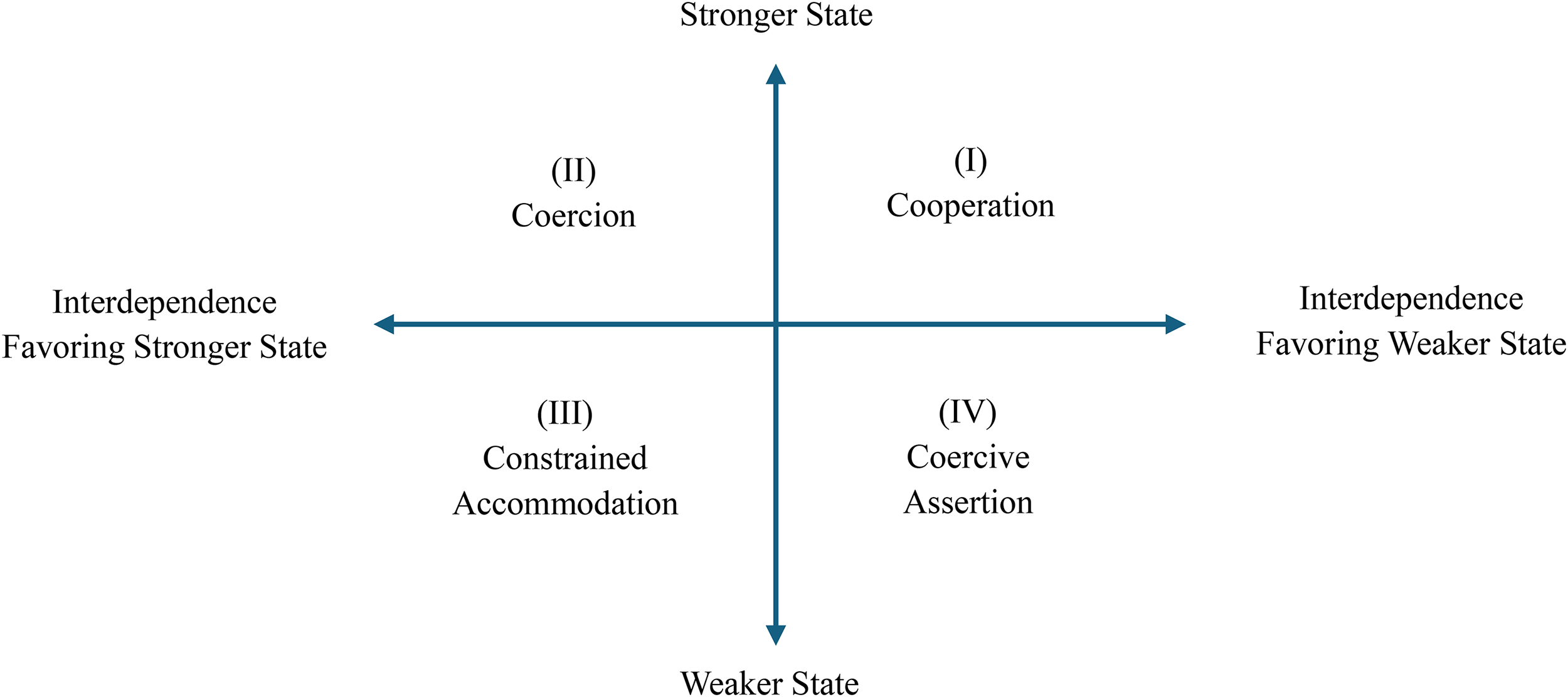
The Strategic Logic of Migration Diplomacy.
The first axis concerns migration interdependence, defined as the distribution of exposure to the political and economic costs of migration disruption. Symmetric interdependence exists where both states are comparably exposed, each dependent on the continuation of labor flows to a similar degree, with shared vulnerabilities that create incentives for collaboration. Asymmetric interdependence arises when one state is substantially more exposed than the other. This imbalance may stem from high levels of remittance dependence, deep labor market reliance, a lack of migration portfolio diversification, or weak institutionalized governance structures. States with diverse migration partnerships, formalized bilateral agreements, or reduced reliance on a single corridor tend to be less exposed and therefore more autonomous.
The second axis concerns relative material power. While this framework emphasizes exposure as the basis of leverage, power remains important in shaping how states translate exposure into strategic behavior. Stronger states often possess greater institutional capacity, diplomatic bandwidth, and enforcement credibility. Yet power alone is insufficient to determine outcomes: materially stronger states may refrain from coercion when their exposure is high, while materially weaker states may act assertively if their own exposure is limited, and the stronger partner is more vulnerable. It is the interaction between these two axes (exposure and power) that determines the strategic logic of migration diplomacy.
Figure 1 presents the theoretical typology developed in the article. The horizontal axis captures the structure of migration interdependence, defined by the distribution of exposure to the disruption of migration interdependence, ranging from interdependence that disadvantages the weaker state (left) to interdependence that disadvantages the stronger state (right). The vertical axis denotes relative material power, from weaker to stronger states. The interaction of these two dimensions produces four ideal-type outcomes: (I) Cooperation, where the stronger state is more exposed and thus disincentivized from coercion; (II) Coercion, where the stronger state leverages its position to extract concessions; (III) Constrained Accommodation, where the weaker state, facing high exposure, prioritizes compliance; and (IV) Coercive Assertion, where a less exposed weaker state can assert pressure on a more vulnerable partner. Each quadrant reflects a distinct strategic logic of migration diplomacy grounded in the structure of migration interdependence.
These dimensions yield four ideal-type configurations: First, when a stronger state is more exposed to the costs of migration disruption, conditions favor cooperation (Quadrant I). Even powerful states, when dependent on labor inflows or remittance-linked regional stability, have incentives to institutionalize migration governance and avoid escalation. Migration diplomacy in this quadrant typically features sustained bilateral engagement, formal labor agreements, and reciprocal adjustment. Mutual exposure disincentivizes coercion, even in the presence of material asymmetries. Second, where interdependence is asymmetric in favor of the stronger state (that is, when the stronger actor is less exposed) conditions favor coercion (Quadrant II). In this configuration, the dominant state can unilaterally alter terms, issue deportation threats, or impose regulatory demands at little cost to itself. Migration flows become instruments of political leverage, used not only to regulate mobility but to shape broader patterns of dependence, alignment, or deference. This strategic logic is particularly visible in hierarchical or regional hegemonic systems.
Third, when a weaker state is more exposed, it typically adopts a logic of constrained accommodation (Quadrant III). Lacking alternatives and highly reliant on a single corridor for remittances or employment, such states face strong incentives to comply with the preferences of stronger partners. Strategic action is limited, and cooperation, when it occurs, is often asymmetrical and shaped by vulnerability rather than mutual adjustment. Finally, when a weaker state is less exposed, either because it has diversified its migration partnerships or because the stronger state is highly reliant on its labor supply, it may engage in coercive assertion (Quadrant IV). Despite its material weakness, such a state can assert leverage through targeted moratoria, policy renegotiations, or reputational strategies. This quadrant reveals how structural positioning can empower weaker states to challenge stronger actors, particularly when their labor is economically indispensable or politically salient. It disrupts the expectation that coercion is the exclusive domain of power, highlighting how exposure asymmetries can invert diplomatic hierarchies.
These four configurations represent stylized ideal types. In practice, migration relationships often fluctuate, exhibit hybrid characteristics, or shift over time. Nonetheless, the typology provides a generalizable conceptual map for analyzing how the interaction of exposure and power conditions strategic behavior in migration diplomacy. It offers a structural, relational framework for explanation, moving beyond descriptive or actor-centric approaches to theorize when and how states cooperate, coerce, or accommodate in managing cross-border labor mobility. The following section outlines the methodological approach through which this framework is operationalized and tested.
Methodology: Comparing Strategic Outcomes in Migration Diplomacy
To assess how migration interdependence shapes strategic behavior in state-to-state migration diplomacy, the article adopts a structured, focused comparison (George and Bennett 2005). This approach enables controlled cross-case analysis of how variation in exposure and relative power produces distinct strategic outcomes: cooperation, coercion, constrained accommodation, or coercive assertion. The logic of comparison follows a most-similar systems design (Gerring 2017), holding bilateral scale and the state-administered nature of labor migration governance relatively constant across cases. All four dyads involve high-volume labor migration corridors governed bilaterally and operating largely outside multilateral regulatory frameworks. This provides a common structural baseline for evaluating how variation along the framework's two axes (exposure asymmetry and relative power) shapes state strategy. The method of inference relies on causal process tracing within each case, allowing for close analysis of how structural conditions translate into strategic choices. This follows the logic of within-case hypothesis testing and mechanism identification as articulated by Bennett and Checkel (2014), enabling the article to trace how exposure and power interact in shaping migration diplomacy across varied contexts.
To capture the full range of theoretical possibilities, one case is selected from each quadrant of the typology. These particular dyads were selected not only for their alignment with the typology's structural quadrants, but also for their broader relevance to contemporary migration diplomacy. Each represents a high-salience labor migration relationship, with sustained policy engagement and significant stakes for at least one party. At the same time, they span multiple world regions and reflect varied political regimes and institutional settings, enhancing the framework's external validity. The selection prioritizes cases where bilateral dynamics are visible and documented, allowing for meaningful comparative analysis across structurally distinct configurations.
The first case, New Zealand–Pacific Island states, illustrates a context of symmetric interdependence in which the stronger actor, New Zealand, remains structurally exposed. Here, cooperation prevails, as seen in the operation of the RSE scheme and the institutionalized management of mobility. The second case, Russia–Central Asia, exemplifies a configuration in which a materially dominant actor exploits asymmetric interdependence to exert coercive pressure, using migration control to extract political and security concessions. The third case, GCC States–Nepal, represents a scenario of constrained accommodation, in which a materially weaker and highly dependent state engages in migration diplomacy from a position of limited bargaining power. Finally, the Malaysia–Indonesia dyad highlights a case of coercive assertion by a weaker but less exposed state, in which Indonesia has used moratoria, regulatory tools, and diplomatic signaling to advance migrant protections despite structural asymmetry in power. While not exhaustive of all global migration relationships, the selected cases offer critical variation along the dimensions of interest, allowing for robust evaluation of the causal mechanisms at the heart of the migration interdependence framework. This comparative design supports a middle-range contribution to theory development.
Each case study follows a common analytical logic. The first step is to assess the structure of migration interdependence: whether exposure to disruption is balanced or skewed, and how factors such as remittance dependency, labor market reliance, migration portfolio diversification, and institutionalization shape that structure. Second, the relative power of each actor is evaluated in terms of material capabilities, regional standing, and institutional reach. Third, the observed strategy, whether cooperative, coercive, assertive, or accommodationist, is identified and situated within the broader diplomatic relationship. The analysis then considers whether the case aligns with the expectations generated by the typology, and explores how contextual variables such as domestic political shifts, transnational lobbying, or global economic changes mediate strategic outcomes. Comparative insights across the four cases are used to identify patterns of convergence or deviation, and to delineate the scope conditions under which the typology holds. Particular attention is given to the sequencing of interactions, the framing of migration-related disputes, and the availability of credible alternatives within each dyad.
Empirical evidence is drawn from a broad range of primary and secondary sources. These include bilateral labor agreements, official policy documents, remittance and migration flow data, and diplomatic communiqués. Reports from international organizations such as the International Labor Organization and the International Organization for Migration provide additional insight into governance frameworks and institutional arrangements. Where formal data are unavailable or agreements remain opaque, findings are triangulated through press coverage, expert commentary, and statements by state officials and policymakers. This task is complicated by persistent data limitations, particularly across Global South contexts where migration is often securitized, policymaking lacks transparency, and regimes may be illiberal or authoritarian. Both migration flows and state behavior are frequently underreported or deliberately obscured, making systematic data collection difficult and process tracing particularly challenging.
Migration Interdependence in Practice: Four Strategic Logics
The typology developed above is now applied to four empirical case studies (Table 1). In each case, the analysis focuses on the interaction between exposure and power, and assesses whether the observed state strategy aligns with the quadrant logic set out in the framework. These are not intended to capture the full complexity of each migration relationship, but to test whether the model's ideal-type categories help explain variation in strategic behavior. The goal is also not to provide exhaustive historical accounts, but to evaluate whether the structural conditions specified in the model generate the patterns of cooperation, coercion, accommodation, or assertion observed in practice. 3
Comparative Case Placement Within Migration Interdependence Typology.
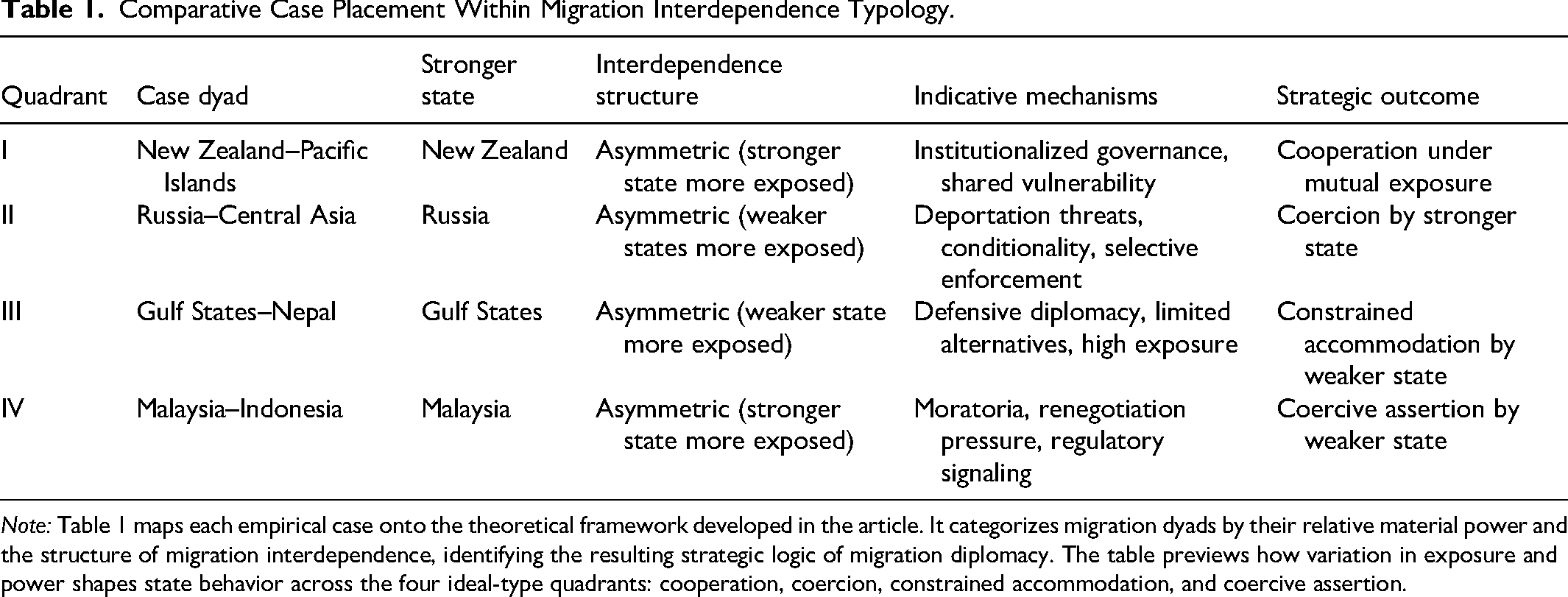
Note: Table 1 maps each empirical case onto the theoretical framework developed in the article. It categorizes migration dyads by their relative material power and the structure of migration interdependence, identifying the resulting strategic logic of migration diplomacy. The table previews how variation in exposure and power shapes state behavior across the four ideal-type quadrants: cooperation, coercion, constrained accommodation, and coercive assertion.
Cooperation Under Mutual Exposure
The labor migration relationship between New Zealand and Pacific Island states exemplifies a case of symmetric migration interdependence. Despite New Zealand's economic and institutional prominence in Pacific labor governance, the high degree of mutual exposure, which includes reliance on Pacific workers for agricultural production and reputational constraints on regional leadership, fosters cooperative outcomes. For their part, sending states such as Fiji, Tonga, Samoa, Vanuatu, and the Cook Islands rely heavily on remittance flows, yet retain access to multiple labor corridors and benefit from a highly institutionalized migration regime. This configuration has enabled a stable, cooperative migration diplomacy strategy, structured not by formal equality but by reciprocal vulnerability.
The core institutional framework is the RSE scheme, introduced by Wellington in 2007. Under the RSE, Pacific workers are recruited for fixed-term employment in sectors facing acute labor shortages, especially horticulture and viticulture (Immigration New Zealand 2025). Although the scheme is unilaterally administered by New Zealand, it is deeply embedded in regional diplomatic norms, development partnerships, and long-standing mobility arrangements, including the Compact of Free Association and bilateral understandings with multiple Pacific Island states. These linkages both formalize and diffuse the migration relationship, reducing the likelihood of politicization or sudden disruption. As the OECD finds: New Zealand's Ministry of Business, Innovation and Employment (MBIE) administers the RSE scheme, with the involvement of other New Zealand ministries – including Housing and Urban Development, Social Development, Pacific Peoples, and Primary Industries. The Ministry of Foreign Affairs and Trade (MFAT) supports Pacific countries to maximize their participation, and New Zealand High Commissions in partner countries help identify challenges or concerns raised by partner country stakeholders and co-ordinate with sending countries. (OECD 2023)
From the perspective of sending states, the benefits are substantial. In countries such as Tonga and Samoa, remittances accounted for 40.6 and 28.4 percent of GDP, respectively, in 2023 (World Bank 2025). Labor migration helps alleviate domestic unemployment, builds transnational social capital, and contributes to household resilience (Asian Development Bank 2022). Yet these states are not narrowly dependent on New Zealand (Guan, Raymer and Pietsch 2022). Many participate in Australia's Seasonal Worker Programme and other labor mobility schemes, and migration networks extend to the United States and beyond (Bedford and Bedford 2023). This diversification mitigates the risk of over-exposure to any single destination, enhancing bargaining resilience even in asymmetrical relationships.
New Zealand, for its part, is exposed to a different form of dependency. The RSE scheme addresses chronic labor shortages in sectors such as fruit-picking and viticulture, which are economically vital and politically salient due to their visibility during harvest crises and dependence on foreign labor. These industries have drawn periodic public scrutiny when labor shortfalls threaten production, exposing the country's reliance on temporary migrant workers (Gibson and Bailey 2021). Pacific migrants are valued not only for their low cost and reliability, but also for their cultural and historical embeddedness within the region, which facilitates logistical coordination and social acceptability. Despite its economic and institutional power, New Zealand has limited substitutability (Collins 2024). Political sensitivities surrounding immigration from South or Southeast Asia, combined with distance and legal constraints, mean that disruption of Pacific labor supply would carry tangible costs (The Ministry for Pacific Peoples 2021). This interdependence generates a structural incentive to sustain cooperation and preserve institutional continuity.
The COVID-19 pandemic provided a stress test of the relationship. Border closures and lockdowns disrupted worker flows, raising concerns among both employers and sending states. New Zealand's border restrictions were among the longest and most stringent globally, lasting nearly three years. These measures significantly deepened the precarity of many low-skilled migrants, including Pacific workers, and prompted sustained protests from migration advocacy groups directed at the Immigration Minister (Arkilic and Sardelić 2023). In response, Wellington implemented policy flexibilities, including visa extensions and chartered repatriation flights, to support thousands of migrant workers and Pacific governments (Bedford 2020). In fact, in September 2021, Immigration New Zealand (INZ) announced the offer of a one-off residence category aiming to clear the backlog and growing numbers of applications that INZ was unable to attend to largely due to the pandemic lockdown (Liu, Ran and Jia 2022). While not immune to frictions, the episode underscored the political salience of the migration relationship and the depth of institutional interdependence. Far from retreating into protectionism or unilateralism, New Zealand reinforced its commitment to mobility partnerships.
Crucially, migration diplomacy in this dyad operates in a low-coercion environment, despite the presence of power asymmetries. This is not the result of benign state preferences or exceptionalism, but of structural constraint. Both parties derive sustained benefit from the relationship, and both would incur material and reputational costs from its disruption. The balance of migration interdependence, combined with institutionalization and limited substitutability, produces a strategic equilibrium in which cooperation is the dominant and stable migration diplomacy outcome. This case confirms the typology's expectations: the stronger state refrains from coercion because it is equally exposed. The weaker states, though dependent on migration income, maintain diversified migration portfolios and benefit from robust institutional safeguards. Strategic behavior is shaped less by hierarchy than by the relational logic of vulnerability. In this sense, the New Zealand–Pacific Islands relationship illustrates how symmetric migration interdependence can sustain stable cooperation even in contexts of uneven material power.
Coercion Under Asymmetric Interdependence
The labor migration relationship between Russia and the Central Asian states, particularly Tajikistan, Kyrgyzstan, and Uzbekistan, exemplifies a case of asymmetric migration interdependence in which the materially stronger state faces minimal exposure and therefore possesses substantial coercive capacity. Although the Central Asian republics benefit from access to Russia's labor market and share deep historical, linguistic, and infrastructural ties due to Soviet legacies, the structural asymmetry in migration interdependence has enabled Russia to systematically use migration policy as an instrument of regional influence.
The exposure of Central Asian states to the Russian labor market is well documented (International Organisation for Migration 2021). In 2023, remittances from migrant workers in Russia constituted 39 percent of Tajikistan's GDP, 22 percent of Kyrgyzstan's, and 15 percent of Uzbekistan's (World Bank 2024). These economies rely on outward migration to offset domestic unemployment, generate foreign exchange, and support household livelihoods (Schenk 2022). Labor mobility also plays a social and political role: migration relieves pressure on local job markets, offers aspirational lifelines for disaffected youth, and is often viewed by ruling elites as a safety valve (Abashin 2014). These states have relatively few viable alternatives: GCC states offer limited language or cultural compatibility, and legal access to Western labor markets remains out of reach (Khashimov et al. 2020).
By contrast, Russia's exposure to Central Asian labor is more selective and limited. While migrant workers are crucial in low-wage sectors such as construction, agriculture, and domestic services, especially in Moscow and other urban centers, Russia draws from a broad migration portfolio that includes Ukraine, Moldova, Belarus, and internal labor reserves (Malakhov 2014). It faces minimal substitutability constraints and benefits from discretionary control over entry, documentation, and enforcement mechanisms (Kuznetsova and Round 2018). This structural asymmetry has allowed Russia to act unilaterally in regulating mobility flows, issuing policy changes with little consultation or transparency (Round and Kuznetsova 2016).
Russia's coercive migration diplomacy has followed two broad patterns: direct retaliation and structural conditionality. In the first category, migration restrictions have been deployed in response to perceived diplomatic slights. Following the 2011 arrest of two Russian pilots in Tajikistan, Russian authorities initiated a mass arrest campaign targeting Tajik migrants, only ceasing once the pilots were released (BBC News 2011). Similarly, Kyrgyzstan has faced selective entry restrictions during periods of political divergence, such as when it delayed accession to the Eurasian Economic Union (Gast 2018). These responses signal the strategic issue linkage of migration to bilateral disputes and reinforce Russia's willingness to impose material costs on dependent states.
The second pattern involves the use of migration governance as a tool for regional integration and political alignment. Russia has offered preferential labor access or legalization incentives to states that join the EAEU or commit to closer foreign policy coordination (Radnitz 2018). Migration diplomacy thus functions as a mechanism of soft conditionality, wherein economic dependence on remittances is converted into political influence (Alturki, Espinosa-Bowen and Ilahi 2009). While such arrangements are framed in developmental or legalistic terms, they serve to consolidate Russia's regional dominance and discourage deviation from its strategic preferences. At the same time, states such as Uzbekistan and Kyrgyzstan have begun diversifying their labor migration portfolios by establishing new corridors with South Korea, the Gulf, and even the United Kingdom as a means of gradually reducing their exposure and reclaiming negotiation space. 4
Institutional mechanisms in this context remain opaque and asymmetrical. Bilateral agreements are typically unpublished, and migration procedures are governed through executive discretion rather than formal dispute resolution. Central Asian states, despite periodic complaints about labor conditions and xenophobic treatment of their nationals, lack effective leverage. While they occasionally attempt to renegotiate terms or protest deportations, their bargaining capacity is limited by structural exposure and the absence of credible alternatives. This case aligns closely with the expectations of the typology. Russia, as the less dependent and materially stronger actor, has repeatedly employed coercive strategies to extract diplomatic concessions, reinforce regional hierarchy, and manage alignment within its geopolitical orbit. Central Asian states, highly exposed and institutionally constrained, have limited capacity to resist. Migration interdependence in this dyad is not reciprocal, but instrumentalized, allowing the stronger state to convert mobility into a source of strategic influence.
Constrained Accommodation Under Structural Exposure
The labor migration relationship between Nepal and key GCC states exemplifies a case of asymmetric migration interdependence, in which a materially weaker state is deeply exposed and structurally constrained. Nepal relies heavily on labor migration to sustain its economy, manage demographic pressures, and maintain political stability (Valenta 2022). Yet its principal migration partners, particularly Qatar, the United Arab Emirates (UAE), and Saudi Arabia, face minimal exposure to Nepal specifically, given their wide access to alternative migrant-sending states (Babar 2020). 5 This imbalance limits Nepal's capacity to assert leverage and results in a largely accommodationist migration diplomacy strategy, focused on access preservation rather than structural renegotiation.
Labor migration has long been central to Nepal's development model. In the past two decades, remittance inflows have accounted for approximately 25 to 30 percent of GDP, with 2023 figures estimating at 25.3 percent placing Nepal among the world's most remittance-dependent economies (World Bank 2025). The six GCC countries (Bahrain, Kuwait, Oman, Qatar, Saudi Arabia, and the UAE) along with Malaysia have consistently hosted over 80 percent of Nepali migrant workers since 2013, underscoring the structural weight of this corridor (Government of Nepal 2022). Migration absorbs surplus labor from a stagnant domestic economy, reduces unemployment among youth, and serves as a key source of household income and foreign exchange (International Organisation for Migration 2019).
Yet despite, and in some respects because of, the scale of this migration flow, Kathmandu's bargaining position is structurally weak. First, the GCC states maintain highly diversified labor import portfolios. South and Southeast Asian states, including India, Pakistan, Bangladesh, the Philippines, and Indonesia, compete to supply low-wage labor, creating downward pressure on origin-country demands (Khalaf, AlShehabi and Hanieh 2015). Second, while Nepal has signed bilateral labor agreements with Bahrain, the UAE, and Qatar, and is in negotiation with Saudi Arabia, these frameworks often lack enforceable protections or robust consultation mechanisms (International Trade Administration 2021). At the same time, the limited institutionalization of the migration relationship, combined with a weak consular infrastructure and under-resourced labor ministries, further reduces Nepal's capacity to monitor conditions or enforce worker rights abroad.
While Nepal has at times attempted to assert regulatory control, such as through a recurring series of restrictions on female migration for domestic work dating back to 1998, or minimum wage thresholds for overseas contracts, these policies have rarely translated into effective migration diplomacy (Shivakoti, Henderson and Withers 2021; Bhagat 2024). The bans have varied in severity and justification over time, often framed as protective but criticized as discriminatory, and have frequently been circumvented through informal channels while triggering little meaningful policy adjustment from host states (McQue 2020; Shivakoti and Brassard 2020). Nepal's efforts to press for stronger protections, particularly following high-profile reports of exploitation or migrant deaths, have tended to be symbolic rather than strategically consequential. Host states have responded by expressing concern but seldom altering their recruitment policies or institutional arrangements (Deutsche Welle 2022). 6
The COVID-19 pandemic further exposed the asymmetry. As GCC states closed borders and repatriated tens of thousands of migrant workers, Nepal struggled to coordinate returns, provide reintegration support, or negotiate wage compensation for abruptly terminated contracts (Thapa, Baniya and Bhattarai 2020). The limited responsiveness of Gulf partners underscored Nepal's exposure and lack of leverage. In some cases, destination states deployed overt or implicit threats: Qatari authorities detained and deported Nepali workers under the guise of COVID-19 testing, while the UAE warned of future recruitment restrictions for countries unwilling to repatriate their nationals (Shivakoti 2020). While civil society actors and international organizations mobilized in response, Kathmandu's diplomatic engagement remained cautious and largely reactive (Upreti and Dhakal 2021).
What emerges from this case is not a lack of awareness or concern on Nepal's part, but a structural incapacity to transform concern into strategy. The overwhelming reliance on remittances, the lack of viable labor alternatives, and the competitive pressures of the regional labor market combine to produce a strategic equilibrium of constrained accommodation. Nepal must maintain its migration corridors even in the face of exploitation or reputational cost, while the GCC states can afford to be selective, unresponsive, or indifferent to Nepal's policy overtures. This case confirms the expectations of Quadrant III in the typology. The weaker state, deeply exposed and institutionally marginalized, negotiates from a position of structural vulnerability. Strategic options are sharply limited. Migration diplomacy becomes a reactive tool aimed at minimizing harm rather than extracting gains. Cooperation, where it occurs, reflects necessity rather than balance.
Coercive Assertion From a Less Dependent Weaker State
The Malaysia–Indonesia migration corridor exemplifies a strategically significant but under-analyzed configuration: a materially weaker sending state that, by virtue of relatively low exposure, exercises assertive migration diplomacy vis-à-vis a stronger but more dependent host. While Malaysia possesses superior economic and institutional capacity, its structural reliance on Indonesian labor, particularly in domestic work, agriculture, and construction, has enabled Indonesia to assert diplomatic leverage over time. This case illustrates how limited exposure and portfolio diversification can enable coercive assertion, disrupting conventional expectations about the constraints facing weaker states.
Indonesia is one of the world's largest migrant-sending countries and maintains a broad, diversified labor export strategy (World Bank 2017). Although Malaysia has historically absorbed a substantial share of Indonesian workers, an estimated 2.7 million, including both documented and undocumented migrants, Indonesia's migration portfolio spans the GCC states, East Asia, and neighboring Southeast Asian economies (International Organization for Migration 2024). This diversification reduces exposure to any single corridor, insulating Indonesia from the kinds of structural vulnerabilities that characterize other major sending states such as Nepal or Bangladesh (World Bank 2023). This strategic dispersion is rooted in both domestic political sensitivities around migrant protection and a broader foreign policy tradition that emphasizes sovereignty and non-alignment (Palmer 2016), and is reinforced by transnational recruitment networks, where returning migrants often facilitate placements for new entrants across multiple destinations.
Malaysia, by contrast, remains highly dependent on Indonesian labor, particularly in sectors with limited substitutability. In domestic work, where Indonesian women constitute the dominant group, the reliance is particularly acute (Killias 2018); a 2011 paper headline marked, “Malaysia needs maids urgently” (quoted in UN Women 2017). Cultural familiarity, linguistic proximity, and geographic accessibility have made Indonesian workers the preferred option among Malaysian employers (Maksum 2022), a dependency that has long been reinforced by practices of documentary fluidity and bureaucratic ambiguity surrounding migrant status (Sadiq 2009). Attempts to replace them with migrants from countries such as Myanmar and Bangladesh have encountered resistance due to mismatched expectations, inconsistent training standards, and limited willingness among alternative governments to engage on Malaysia's terms. Both sending states face intense outmigration pressure and are frequently positioned at the bottom of Malaysia's racialized labor hierarchy, shaping employer and policymaker preferences in complex ways.
This structural asymmetry has enabled Indonesia to adopt a strategically assertive posture despite its relatively weaker material position. Beginning in the mid-2000s, Jakarta implemented a series of deployment moratoria in response to cases of labor abuse, non-payment of wages, and legal impunity in Malaysia (Human Rights Watch 2004). While these suspensions were sometimes temporary and unevenly enforced, they served as credible diplomatic signals, demonstrating Indonesia's willingness to leverage its role as a labor supplier to press for regulatory reforms. The 2009 moratorium, following the widely publicized abuse of an Indonesian domestic worker, led to high-level negotiations and revisions to the Memorandum of Understanding governing domestic employment (Elias 2013). More recently, Indonesia temporarily suspended labor deployments to Malaysia in 2022 over alleged breaches in the protection of domestic workers; it resumed recruitment only after both governments agreed to implement a single-channel system for worker entry, underscoring Jakarta's willingness to leverage regulatory tools in pursuit of migrant protections (Putri et al. 2025).
Beyond these suspensions, Indonesia has unilaterally revised recruitment guidelines, minimum wage benchmarks, and protections for migrant workers through regulatory initiatives, often despite resistance from recruitment agencies and domestic employers (Missbach and Palmer 2018). Though implementation has been inconsistent, these efforts have elicited formal policy responses from Malaysia, including public commitments to improve labor conditions and establish complaint mechanisms, even if follow-through has remained uneven (Spaan and van Naerssen 2018). What makes Indonesia's strategy particularly effective is the structural credibility of its threats: its ability to redirect labor flows elsewhere, coupled with Malaysia's limited capacity to identify equally suitable alternatives (International Organisation for Migration 2010). While such redirection is never wholly under state control and remains shaped by migrant agency and perceived opportunity, Indonesia's diversified portfolio and its rhetorical emphasis on worker protection lend credibility to temporary suspensions and renegotiation efforts.
The Indonesia–Malaysia case aligns closely with the expectations of Quadrant IV in the typology. A state often positioned as the weaker actor within this dyad, due in part to Malaysia's historical agenda-setting role in migration governance, nonetheless asserts leverage by virtue of its low exposure and high substitutability, within a broader context shaped by bilateral tensions, nationalist sensitivities, and regional norms of diplomatic restraint. Coercion in this context does not manifest through overt threats or sanctions, but through credible disruption: the use of moratoria, regulatory pressure, and policy conditionality to shape outcomes. This reflects a form of relational power rooted in asymmetrical autonomy rather than material dominance. The case challenges static conceptions of strength and dependence in migration diplomacy, demonstrating how agency can emerge from structural positioning within migration systems. Under particular configurations, states commonly seen as weaker can transform limited exposure into strategic advantage, exercising migration power from below.
Discussion: Strategic Patterns and Migration Power
The preceding case studies confirm the central claim of this article: variation in state strategies within migration diplomacy is best explained by the interaction of migration interdependence and relative material power. The framework is designed to account for variation under conditions where states behave strategically, responding to the structural distribution of costs and constraints. 7 Taken together, the cases demonstrate that neither cooperation nor coercion follow automatically from power asymmetries, regime type, or geographic location. Rather, strategic behavior is conditioned by how states are structurally situated within migration systems, how exposed they are to disruption, how institutionalized their bilateral arrangements are, and how substitutable their migration partners may be.
In contexts of symmetric interdependence, as illustrated by the New Zealand–Pacific Islands relationship, both parties face credible costs from the breakdown of migration flows. Despite its material superiority, New Zealand's structural reliance on seasonal Pacific labor, especially in agriculture, creates disincentives for coercive tactics. Cooperation in this case is not the result of normative alignment or institutional obligation but emerges from the mutual vulnerability generated by labor migration itself. Strategic restraint is embedded in the structure of exposure. In sharp contrast, the Russia–Central Asia dyad reflects the logic of asymmetric interdependence in favor of a materially stronger state. Russia's limited exposure and the high dependence of Central Asian states on remittance inflows enable Moscow to unilaterally manipulate migration policy as an instrument of geopolitical influence. Deportation threats, visa controls, and selective enforcement of migration rules are used not merely for labor regulation but to extract political concessions. Here, structural asymmetry becomes a mechanism through which coercion is normalized.
When the asymmetry is reversed, where a state that is structurally weaker within the migration dyad is more exposed, strategic options are sharply constrained. Nepal's relationship with the GCC states exemplifies this logic of constrained accommodation. Heavily reliant on remittances, lacking alternative migration corridors, and facing limited bargaining credibility, Nepal is compelled to preserve access at the cost of diplomatic assertiveness. Its cooperation is not voluntary but imposed by structural vulnerability. Despite frequent reports of abuse and systemic rights violations, Nepal's migration diplomacy remains largely reactive and accommodationist. Yet the Malaysia–Indonesia case demonstrates that being the weaker party in a migration dyad does not preclude strategic agency. Indonesia, often perceived as the subordinate actor in this relationship due to Malaysia's host-country control over regulatory frameworks, has nonetheless asserted coercive leverage through the credible threat of labor withdrawal. This is made possible by a diversified migration portfolio and relatively low exposure to the Malaysian corridor. By imposing moratoria, demanding renegotiations, and leveraging reputational pressure, Indonesia has altered the terms of bilateral labor governance. The case demonstrates that coercion is not the preserve of materially dominant actors; under specific structural conditions, states in subordinate positions can assert meaningful influence over more powerful partners.
Across these cases, several structural variables emerge as particularly salient in shaping state strategy. Remittance dependency intensifies vulnerability among sending states, compressing their strategic flexibility and reinforcing compliance with host-country preferences. Substitutability plays a critical role in shaping leverage: where destination states can easily replace one labor source with another, the credibility of sending-state threats is undermined; where alternatives are limited, leverage increases. Institutionalization moderates asymmetries by regularizing expectations, reducing volatility, and constraining unilateral moves. Finally, portfolio diversification enables weaker states to hedge against dependence, enhancing their capacity to maneuver diplomatically.
The India–Nepal open-border arrangement reflects a logic of symmetric interdependence, where shared interests sustain cooperative mobility despite power differentials. Similarly, the UAE–Turkey labor corridor reveals institutionalized cooperation between two non-Western powers that have mutually calibrated their migration policies. On the coercive end of the spectrum, Saudi Arabia's management of Yemeni labor access, especially in contexts of conflict and crisis, reflects unilateralism within an asymmetrical relationship. In the Americas, the United States’ migration diplomacy toward El Salvador, Guatemala, and Honduras aligns with the logic of Quadrant II: a materially dominant state imposing migration enforcement obligations on weaker, highly dependent partners through conditional aid and bilateral agreements.
While the typology holds across the selected cases, the framework inevitably abstracts from internal political dynamics, bureaucratic fragmentation, and transnational actor influence, all of which may mediate state behavior in specific contexts. The model is best understood as a structural heuristic rather than a deterministic predictor, and further research could explore how domestic contestation or diplomatic sequencing shape strategic responses within the quadrants. The typology also invites dynamic and longitudinal extensions. Migration interdependence is not static: states may shift quadrants as their exposure levels, portfolio composition, or diplomatic alignments evolve. Egypt–Qatar, for instance, once approximated a case of symmetric cooperation, but shifts in remittance inflows and broader regional politics may alter the distribution of exposure. Similarly, Bangladesh's recent efforts to reform its recruitment relationship with Malaysia suggest a potential movement away from constrained accommodation toward a more assertive posture.
While this framework is designed to accommodate variation across a wide range of bilateral migration relationships, it is best suited to contexts in which both sending and receiving states possess at least minimal institutional capacity and political interest in managing cross-border labor mobility. It is less applicable to highly informalized or irregular flows involving failed states or non-state actors, where state strategy is either absent or extremely limited. Moreover, the typology focuses on state-to-state dynamics and does not seek to explain intra-state contestation or migrant agency, which may shape outcomes in important ways but lie beyond the present analysis. Finally, the framework carries clear analytical boundaries. It is most applicable to bilateral labor migration relationships that are state-led and weakly institutionalized at the multilateral level. It travels less directly to forced migration or refugee contexts, where humanitarian norms, legal frameworks, and multilateral commitments structure behavior in distinct ways. Nonetheless, even in these cases, the core insight remains analytically relevant: migration diplomacy is shaped not solely by who holds power, but by how interdependent states are, and how that interdependence is distributed.
Conclusion
This article has developed a relational theory of migration power grounded in the structure of migration interdependence. In doing so, it challenges both materialist assumptions and actor-centric perspectives that dominate existing accounts of migration diplomacy. Rather than viewing strategic behavior as a function of capabilities or regime type, the article demonstrates that cooperation or coercion in migration relations emerges from how states are situated within asymmetric or symmetric interdependence structures. When both actors are mutually exposed to the risks of labor migration disruption, cooperation becomes a rational strategy; where exposure is uneven and one actor is less dependent, coercive tools become viable. This framework brings analytical clarity to the structural conditions that shape strategic choice and reveals how, under certain configurations, weaker states may exercise meaningful leverage over stronger counterparts. Through a structured and focused comparison of four cases, New Zealand–Pacific Island states, Russia–Central Asia, Nepal–GCC states, and Indonesia–Malaysia, the article tests the explanatory utility of the proposed two-axis typology. Each case represents one quadrant of the model, allowing for systematic variation in exposure and power. The analysis confirms that cooperation is not reducible to normative convergence or institutional goodwill, nor is coercion limited to materially dominant actors. Instead, both strategies are products of the underlying structure of exposure, substitutability, and institutional embeddedness in labor migration governance.
In advancing this argument, the article makes three key contributions to migration studies and international relations. First, it offers a generalizable theoretical framework for understanding strategic variation in migration diplomacy. It moves beyond empirical catalogues of state behavior to explain the conditions under which tools, moratoria, bilateral agreements, deportation threats, or regulatory coordination, are deployed. Second, it extends foundational insights from the interdependence literature into the realm of cross-border mobility, treating migration not as a humanitarian anomaly or technocratic domain, but as a structured site of international political contestation. Third, it recenters the Global South in theoretical debates on international hierarchy by illustrating how non-Western states engage in migration diplomacy not only as targets of external governance but as strategic actors capable of shaping outcomes through the politics of interdependence.
These findings open several promising avenues for future research. One is the investigation of temporal dynamics; how migration relationships shift over time as states move between quadrants due to economic realignments, changes in governance architecture, or exogenous shocks. Another is the role of regional and multilateral frameworks, which may reinforce, diffuse, or transform the structural asymmetries identified here. A third concerns the role of non-state actors, such as recruiters, brokers, diaspora groups, and international organizations, in mediating interdependence and recalibrating state strategies. Finally, the framework could be extended beyond labor migration to other domains of cross-border mobility, including student migration, climate-induced displacement, and mixed flows, where strategic interactions may follow overlapping or hybrid logics. While the framework centers on state-to-state dynamics, future research might also extend its insights to sub-national contexts, particularly border regions, where local economic reliance and political asymmetries generate distinct patterns of migration governance.
In an era of intensifying migration politicization, understanding how migration power operates through the governance of movement is increasingly vital. Importantly, by pinpointing the structural conditions that enable coercive strategies, the article's framework offers a practical lens for mitigating coercion in migration diplomacy. Reducing states’ vulnerability through diversification of migration portfolios, strengthening institutional governance, balancing remittance and labor market dependencies, and enhancing partner substitutability can collectively limit the opportunities for coercion. Policymakers and international stakeholders can leverage these insights to design interventions that address underlying asymmetries, promote resilience, and foster more balanced, cooperative migration relationships. In doing so, the framework not only anticipates coercive risks but also points toward pathways for cultivating equitable migration diplomacy grounded in shared interests and strategic autonomy. Migration diplomacy is a field of strategic behavior shaped by structural constraints yet not reducible to rationalist utility maximization or constructivist norm-following. The typology offers an analytical middle ground: it foregrounds strategic choice without presuming full instrumental rationality, and it traces power through relational configurations rather than normative commitments or institutional design alone. More broadly, it positions cross-border mobility not as peripheral to international relations but as a core terrain through which power is negotiated and reconfigured.
Footnotes
Acknowledgments
An earlier version of this article was presented at the RIGHTS closing workshop (University of Amsterdam, 14–15 November 2024), organized by Dr. Evelyn Ersanilli. I am grateful to the organizers and participants for their thoughtful engagement. I also thank the editorial team at International Migration Review, especially Dr Holly Reed, for their support and guidance throughout the review process. The anonymous reviewers offered insightful comments that strengthened the manuscript. For valuable feedback on the analysis, I am particularly grateful to Ayca Arkilic, Matthew Heneghan, Antje Missbach, Kamal Sadiq, and Richa Shivakoti.

Funding
The author disclosed receipt of the following financial support for the research, authorship, and/or publication of this article: This work was supported by the UK Research and Innovation [grant reference EP/X019667/1], Migration Diplomacy in World Politics (MIGDIPLO).
Declaration of Conflicting Interests
The author declared no potential conflicts of interest with respect to the research, authorship, and/or publication of this article.