




Abstract
While forced displacement policies are shaped by both international and domestic considerations, little is known about how states navigate conflicting pressures when adopting liberal or restrictive approaches. This article addresses this gap by examining the divergent responses of the two largest recipients of Venezuelan displaced people: Peru under Martín Vizcarra (2018–2020) and Colombia under Iván Duque (2018–2022). Although both Peru and Colombia are middle-income countries with significant emigration and share growing public resentment toward migrants and strained relations with Nicolás Maduro's regime, they pursued opposite policies. In 2019, Peru imposed a visa requirement for Venezuelan migrants, restricting access, whereas in 2021 Colombia created the Temporary Protection Status, allowing for regularization and a path to residency.
Using 65 interviews with policymakers and experts, over 200 statements by public officials, and secondary literature, this study identifies the mechanisms behind these contradictory policies. It argues that whether forced displacement is perceived by executive actors as a foreign or domestic issue shapes the nature of policy in countries that would otherwise be expected to respond similarly. These perceptions are ultimately explained by executives’ need for self-preservation and self-legitimation within strategic political contexts. Four key factors—importance given to Venezuela, international reputation, executive strength, and, to a lesser extent, bureaucratic frameworks—determine whether foreign or domestic logics prevail. By showing how Latin American responses integrate both logics rather than fitting neatly into Global North/South binaries, this study challenges dominant dichotomies in migration scholarship.
Introduction
Forced displacement has both international and domestic dimensions. As individuals cross borders to escape conflict, persecution, or environmental crises, the issue becomes a matter of international relations. The responses of destination states can influence migration flows and the reputation of the country of origin, while also drawing attention from international organizations concerned with refugee protection or from third states that might be impacted (Jacobsen 1996; Mitchell 1989). At the same time, forced displacement significantly affects the domestic landscape. The arrival of displaced populations can trigger public debate on issues such as national security, the economy, public services, social cohesion, and human rights (Jacobsen 1996; Milner 2009; Şahin-Mencütek 2019). Political actors, the media, and interest groups frequently frame these issues in ways that shape public perception and policy (e.g., Eberl et al. 2018).
The existing literature highlights the dual influence of foreign and domestic affairs on forced displacement policies. On the international front, friendly relations between origin and destination countries often lead to restrictive policies to avoid diplomatic tensions, whereas hostility can result in more liberal approaches as a form of political signaling (Abdelaaty 2021; Basok 1990; Moorthy and Brathwaite 2019; Zolberg, Suhrke and Aguayo 1989). Additionally, pressures from third countries to curb migration and from international organizations to uphold human rights often promote more open policies (Jacobsen 1996; Milner 2009; Şahin-Mencütek 2019; Whitaker 2020). Domestically, however, concerns over job security, social cohesion, and public safety frequently fuel more restrictive policies (Basok 1990; Jacobsen 1996; Milner 2009; Şahin-Mencütek 2019).
Despite these insights, there is limited literature on whether foreign affairs or domestic issues take precedence when they push in opposite policy directions. Existing research has primarily examined the shift of forced displacement from a foreign policy issue to a domestic one, attributing it to characteristics of migration flows such as scale, duration, and demographic composition (Aron and Castillo 2022; Malo 2022; Şahin-Mencütek 2019; Zolberg, Suhrke and Aguayo 1989). Additionally, studies have acknowledged the role of structural and institutional factors—such as economic capacity, regime type, bureaucratic and legal frameworks, and historical legacies—in shaping forced displacement policy (e.g., Blair, Grossman and Weinstein 2022; Jacobsen 1996).
The contrasting responses of Peru under Martín Vizcarra's administration (2018–2020) and Colombia under Iván Duque's government (2018–2022) to the Venezuelan displacement, a phenomenon driven by economic collapse, political repression, and humanitarian crisis that has led over 7.8 million Venezuelans to leave the country (R4V n.d.), provide a compelling case for examining the mechanisms explaining forced displacement policies. Both countries, historically migrant-sending nations, are middle-income economies and electoral democracies with hostile relations toward Nicolás Maduro's regime in Venezuela and rising negative public opinion toward migrants (Gissi et al. 2020). Beyond these similarities, they also stand out as the highest recipients of Venezuelan displacement—marked by over 800,000 in Peru under Vizcarra and 1.7 million under Duque (R4V n.d.)—. Yet despite these commonalities, they adopted fundamentally different policies, raising a key question: why did two countries with similar conditions relevant to forced displacement policy adopt such divergent responses to an akin phenomenon?
In June 2019, Peru implemented a restrictive approach by introducing a visa requirement—euphemistically termed the Humanitarian Visa—exclusively for Venezuelan migrants, framing the measure as a national security necessity. This policy significantly limited entry and signaled a shift toward a more exclusionary stance (Aron and Castillo 2022). In contrast, Colombia took a liberal approach. In February 2021, Duque's government introduced the Temporary Protection Status for Venezuelan Migrants (TPS), a 10-year permit allowing for regularization and providing a path to permanent residency (Fernández-Rodríguez and Célleri 2024). Colombia framed its policy as a humanitarian commitment and a political statement against the Maduro regime (Colombia, Cancillería 2021).
Drawing on 65 semi-structured interviews with key policymakers and experts, over 200 statements by public officials, and secondary literature, this article argues that strategic political contexts shape executives’ needs for self-preservation and self-legitimation, which in turn explain why some states adopt liberal forced displacement policies while others implement restrictive ones. Colombia's liberal response is rooted in a foreign policy logic driven by historical ties and security concerns with Venezuela, as well as the executive's damaged international reputation. In contrast, Peru's approach reflects a domestic rationale shaped by executive vulnerability amid a political crisis marked by tensions with the Congress and a weak separation of powers. Bureaucratic frameworks—particularly the allocation of responsibilities—shaped by the strategic political context, mediate these dynamics, reinforcing rather than determining policy direction.
In addition to providing empirical insights about forced displacement policy in Peru and Colombia, this research makes five key theoretical contributions. It (1) emphasizes forced displacement policy as a matter of executives’ self-preservation and self-legitimation, highlighting the importance of strategic political contexts in shaping these specific needs; (2) applies recognized factors (e.g., regime type) to Latin American cases; (3) indentifies new factors not previously emphasized (e.g., executive strength), while establishing connections between factors (e.g., regime type and executive strength); (4) refines theoretical assumptions, including the “illiberal paradox” theory; and (5) challenges the South–North divide by shifting the analytical focus from the Middle East to Latin America (Fernández-Rodríguez and Freier 2024), revealing both cross-regional commonalities and intra-South variation.
This article is structured as follows. First, it examines existing research on the determinants of forced displacement and migration policies across different contexts, before introducing the theoretical lenses used in this study, which center on political survival. After outlining the methodology, it contrasts Colombia's approach to forced displacement policy with that of Peru. Subsequently, it presents four different explanations for dominant and diverging approaches: institutional frameworks, the importance given to Venezuela, international reputation, and executive strength. It concludes by summarizing key findings and theoretical implications.
The Determinants Behind the Nature of Migration and Forced Displacement Policy
The nature of forced displacement policy has been explained through a wide range of political considerations, spanning both foreign and domestic affairs. In the following sections, I first summarize the different interests that shape migration and forced displacement policy, focusing on how political actors at both the international and domestic levels influence policy decisions. I then examine the broader structural and institutional factors identified in the literature as key determinants, including characteristics of migration flows, economic capacity, regime type, bureaucratic and legal frameworks, and historical legacies.
Foreign Policy Interests
Due to the inherently international nature of migration, foreign policy interests play a central role in shaping host states’ responses. The literature suggests that a country's relations with the sending state and the international community are key determinants of its policies. When relations with the sending state are friendly, hosts may impose restrictions to avoid undermining allies, while hostile relations likely lead to liberal policies to delegitimize the sending state (Abdelaaty 2021; Zolberg, Suhrke and Aguayo 1989). Ideology may play a key role in defining these relations (Jackson and Atkinson 2019). Vis-à-vis the international community, states may adopt liberal refugee policies to enhance their global reputation, aligning with international norms of human rights protection (Soysal 1994). External pressures, including financial incentives, can also shape responses, either encouraging openness to secure aid and reduce onward migration or imposing restrictions to comply with border control agreements (e.g., Blair, Grossman and Weinstein 2022; Natter 2018).
Domestic Policy Interests
Migration has significant domestic implications, impacting the economy, public services, and social cohesion, often making it a politically sensitive issue in host societies. As migration becomes politicized, domestic interests shape policy responses (Van der Brug et al. 2015). Host states tend to impose restrictive measures when migrants are perceived as security threats or economic competitors, with these concerns either reflecting real challenges or being strategically constructed by political actors (Aron and Castillo 2022; Jacobsen 1996). Securitization narratives, often amplified by media and opposition parties—including far-right actors in liberal democracies—frame migrants as threats, thereby pushing for restrictions (D’Appollonia 2015; Lazaridis and Skleparis 2016). Conversely, liberal policies are more likely when influential interest groups, such as businesses benefiting from migrant labor, human rights organizations, or diaspora groups, successfully advocate for openness (Freeman 1995; Natter 2018).
Structural and Institutional Determinants
Beyond political interests, structural and institutional factors influence both the weight of different political considerations—foreign and domestic policy interests—and directly determine whether forced displacement policies are liberal or restrictive.
Structural factors are broad socio-economic and demographic conditions that shape a state's predisposition toward certain policy responses. For instance, the scale and duration of displacement are key: large and prolonged displacement increases visibility and the perception of strained resources, heightening the likelihood of negative politicization in domestic spheres (Aron and Castillo 2022; Milner 2009; Şahin-Mencütek 2019). The socio-economic profile of displaced populations also plays a role, with more vulnerable groups facing greater resistance due to fears of economic burdens and social instability (Aron and Castillo 2022). Ethnic affinity between the displaced population and the host society may reduce such resistance (Abdelaaty 2021; Jacobsen 1996; Milner 2009). Perceptions of absorption capacity are also shaped by the broader economic context: low incomes, high unemployment, and job insecurity likely drive restrictive policies, while economic stability may enable more liberal responses (Blair, Grossman and Weinstein 2022; Jacobsen 1996; Milner 2009; Neumayer 2005). Institutional structures also shape policy responses. Democracies, being more accountable to public opinion, often face pressures to impose restrictive measures, while authoritarian regimes may act with greater autonomy, sometimes enacting liberal policies, a phenomenon known as the illiberal paradox (Gibney 2004; Milner 2009; Natter 2018). These regimes may adopt liberal policies to mitigate international criticism over human rights (Blair, Grossman and Weinstein 2022; Drewski and Gerhards 2024). Bureaucratic frameworks matter too: policies led by security-focused ministries tend to be restrictive, while foreign affairs ministries prioritize diplomatic goals, resulting in varied outcomes (e.g., Brumat and Vera Espinoza 2023; Fernández-Rodríguez and Célleri 2024).
Legal norms influence policy choices, especially in states bound by international human rights agreements like refugee conventions, which limit restrictive measures (Hammoud-Gallego and Freier 2023; Soysal 1994). Lastly, historical legacies, including past experiences with refugees and pre-existing legal frameworks, influence responses. States with prior security challenges linked to migration tend toward restriction, whereas those with positive hosting experiences may develop more open policies (Milner 2009; Şahin-Mencütek 2019). Consistent with path dependency arguments, a positive self-image or prevailing public philosophies on migration governance—reflected in general legal norms and institutional frameworks—can reinforce liberal policies (Brumat and Vera Espinoza 2023; Lenner 2020).
While the literature provides useful frameworks to explain forced displacement policy, it falls short in accounting for the divergent responses of Peru and Colombia to a similar phenomenon. Despite sharing key structural and institutional traits—such as economic capacity, characteristics of migration flows, and legal obligations—their policies differ significantly (see comparative model in the Methodology section below). These similarities suggest that existing models may overlook how states prioritize or reconcile foreign and domestic interests. Understanding this variation in interest prioritization is crucial to explaining their contrasting approaches.
Theoretical Lenses: Executive Agency and Strategic Political Context in Forced Displacement Policy
This article adopts an agency-centered approach to explain why states under similar pressures adopt divergent forced displacement policies. Drawing on the broader logic of political survival (Bueno De Mesquita et al. 2005), it conceptualizes forced displacement policy as a strategic instrument employed by executives to maintain power and legitimacy. This article posits that these choices unfold within political contexts that shape and constrain action, influencing how forced displacement is addressed as a foreign or domestic matter. In doing so, this study aligns with scholarship that views migration governance as a field of symbolic politics and executive discretion while affected by the context, where executives mobilize policy choices to signal responsiveness to different audiences (Boswell 2007; Joppke 1998).
This article identifies three factors—the importance ascribed to the state of origin, international reputation, and executive strength—as key components of what it terms the strategic political context. This context refers to the position of the executive—responsible for responding to forced displacement (Fernández-Rodríguez and Célleri 2024)—within a specific configuration of political pressures and incentives that shape how policymakers conceive forced displacement.
While these factors are not typically categorized as determinants by the literature, they emerge from case-based analyses of forced displacement policy. (1) The importance ascribed to the origin country captures how central this is to political agendas. When the country of origin holds strategic or symbolic value, executives are more likely to frame displacement as a foreign policy issue (Zolberg, Suhrke and Aguayo 1989). (2) International reputation is how a state is perceived globally. When at risk, executives may frame displacement as a foreign policy issue to defend their image—a logic often linked to authoritarian regimes (Drewski and Gerhards 2024; Blair, Grossman and Weinstein 2022), but also relevant to democracies. (3) Executive strength primarily refers to an executive's political capital—such as coalition stability or electoral legitimacy—although it can be influenced by institutional capacity, that is, the formal powers held relative to other branches of government. Weaker executives may emphasize domestic logics to appease internal audiences or consolidate authority (Geha and Talhouk 2019).
Finally, bureaucratic frameworks may act as intermediaries: strategic political contexts often shape which agencies lead displacement policy—e.g., foreign affairs or interior ministries—thereby influencing how the issue is framed and addressed (Fernández-Rodríguez and Célleri 2024).
Together, these factors shape whether executive framing is driven more by foreign or domestic logics, helping to explain why policymakers may pursue divergent policy responses even under similar audience preferences and structural conditions. Figure 1 summarizes this theoretical framework, illustrating how the strategic political context—through the lens of executive self-preservation and legitimation—shapes forced displacement policies.
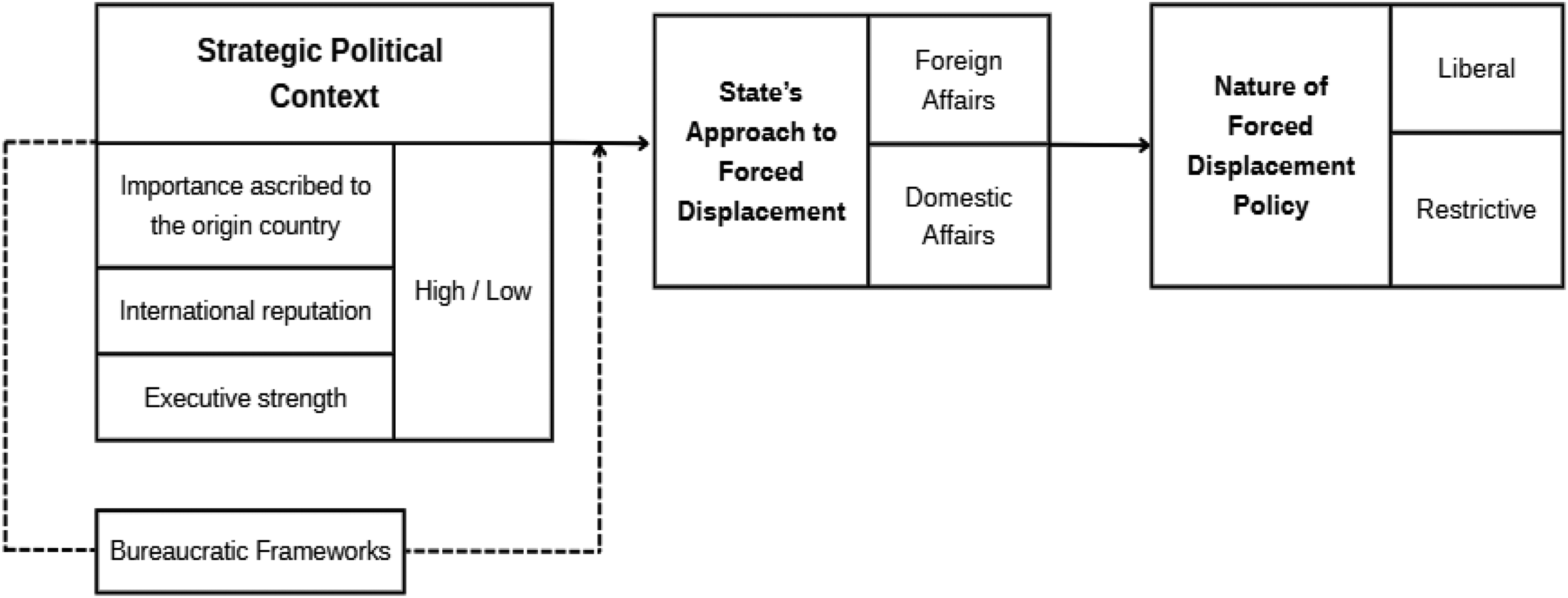
Forced Displacement Policy as a Mechanism of Executive Self-Preservation. Source: Own Research Design.
Methodology
This article employs a comparative case analysis based on the Most Similar System Design (MSSD), which compares cases with different outcomes but similar conditions to control for variables (Mill 1843). In this comparison, Colombia under Duque's administration adopts a liberal policy (the TPS), whereas Peru under Vizcarra's imposes restrictions (the Humanitarian Visa). Both countries faced a large-scale and protracted displacement at the time of adopting the policies, with Colombia experiencing higher numbers and a more prolonged crisis (Acosta, Blouin and Freier 2019; Freier and Luzes 2021; Gandini, Lozano and Prieto 2019). By the time it adopted the TPS, Colombia was hosting over 1.7 million Venezuelans, following a crisis that began in 2015 when a group of Colombian migrants living at the border were deported from Venezuela (R4V n.d.). 1 In contrast, Peru had received 800,000 Venezuelans when it adopted the Humanitarian Visa, with a significant increase in arrivals since 2017 (Dedios and Ruiz 2022). 2 Theoretically, Colombia, facing a larger and more prolonged forced displacement, might have been expected to adopt restrictive measures, but it did not.
Colombia and Peru share economic systems: both have middle-income economies (World Bank Group 2023) and high levels of labor informality (Organisation for Economic Co-operation and Development 2022; Statista Research Department 2023), which may impact their perceived capacity to host migrants. Importantly, from the beginning of the displacement, all governments adopted a confrontational stance toward Maduro's regime (Gissi et al. 2020) and faced growing domestic opposition to liberal policies (Invamer 2021; Pontificia Universidad Católica del Perú 2020).
Both Peru and Colombia are bound by the same international agreements on migrants and refugees, including the Geneva Convention, the Inter-American Convention on Human Rights, and the 1990 International Convention on the Protection of Migrant Workers. They have also incorporated the Cartagena refugee definition into their national legislations (Freier and Fernández-Rodríguez 2021). Under low numbers of immigrants and a negative migration balance in both countries (Colombia–Inmigración n.d.; Perú–Emigrantes totales n.d.), Colombia's migration legal framework was less developed than Peru's. While Peru replaced its restrictive, security-based migration law with a more progressive one in 2017 (Legislative Decree 1350/2017) (Freier and Aron Said 2022), Colombia relied on separate decrees for migration and refugees (Decrees 0834/2013 and 2840/2013), later consolidated into Decree 1067/2015, with a restrictive approach (Caicedo 2022; Ciurlo 2015). Given this legal framework, one would expect Peru to adopt more liberal migration policies than Colombia, yet the opposite occurred. Table 1 outlines the comparative logic underpinning the selection of Peru and Colombia as case studies.
MSSD Comparative Case Analysis.
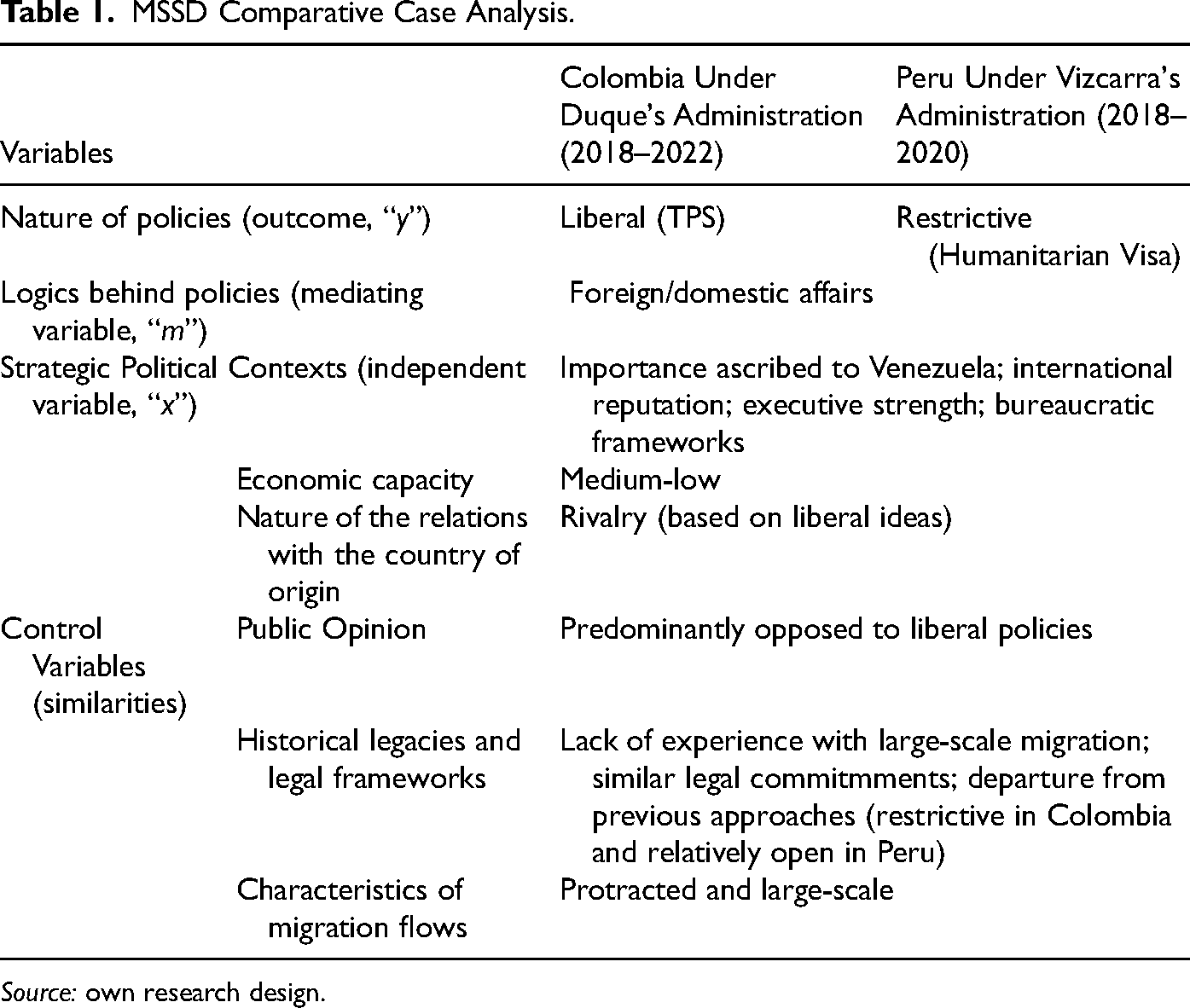
Source: own research design.
To trace the mechanisms behind policies, this research adopts a two-step approach. First, it unpacks policymaking to identify the foreign and domestic logics driving policy considerations. Second, it examines the broader strategic political and institutional context that shapes these logics.
To identify the rationales underlying forced displacement policies, I conducted 38 semi-structured interviews with policymakers. 3 These interviews focused on the considerations guiding policymaking for the TPS in Colombia and the Humanitarian Visa in Peru. Topics included relations with Venezuela and the international community, and the domestic impact of migration on public opinion, security, labor markets, public services, and the economy. Besides those interviews, to understand the strategic political and institutional context, I relied on over 200 statements by public officials on the Venezuelan displacement, gathered from official congressional websites and major newspapers—El Tiempo in Colombia and El Comercio and Ojo in Peru 4 —using search terms like “Venez” and “migr”. I complemented those interviews and statements with 27 expert interviews with members of international organizations and academia, 5 and reviewed legal documents and secondary literature. While the elite interviews provided initial insights into key factors, expert interviews and secondary sources facilitated a deeper exploration of significant factors, such as international reputation.
I analyzed the empirical material using thematic analysis (TA) based on a codebook combining a coding frame with early theme development (Braun and Clarke 2022). I categorized policy responses to Venezuelan displacement as domestic or foreign affairs and identified key considerations (e.g., “relations with Venezuela,” “domestic fears”) and contextual factors (e.g., “bureaucratic frameworks,” “importance given to Venezuela”). For instance, under “importance given to Venezuela,” I included sub-codes like “historical ties” and “security impact.” 6
States’ Approaches to Venezuelan Displacement
Venezuelan Displacement in Colombia as a Matter of Foreign Affairs
The Venezuelan displacement began in 2015 during Juan Manuel Santos's presidency (2010–2018) amid the 2016 peace agreement with the left-wing FARC (Fuerzas Armadas Revolucionarias de Colombia – Ejército del Pueblo), Colombia's main guerrilla group from its armed conflict (1960–present). Despite rising arrivals, Santos avoided confronting Nicolás Maduro's regime, which was mediating the peace process (Gissi et al. 2020). In 2017, his government introduced the PEP (Special Stay Permit) to regularize Venezuelans, granting access to work and services, though more than half remained irregular (Colombia, Presidencia de la República 2020).
The political landscape shifted with the 2018 election of Iván Duque, a right-wing president from the Centro Democrático party led by former President Álvaro Uribe (2002–2010), a critic of the FARC peace agreement. Duque campaigned on welcoming Venezuelan migrants while taking a hard line against Maduro. Despite a sharp increase in arrivals—from 1 million to over 1.7 million in two years—and growing public opposition, with 69% of Colombians expressing anti-migration views by 2021 (Invamer 2021), his government advanced the TPS policy.
The TPS was an effort by Colombia to spotlight the humanitarian crisis faced by Venezuelans while publicly shaming the Venezuelan regime for failing to uphold its citizens’ rights and provide adequate living conditions, thereby forcing them to flee.
7
The former vice chancellor, who took part in the policymaking process, expresses this intention: [With the TPS,] we hoped to exhibit the dramatically poor living conditions that these people had in Venezuela because of a regime which not only does not respect their civil and political rights, but also leaves people in misery and in a humanitarian crisis which forced them to leave the country; it was a call to the international community that we should do something in this regard.
8
Upon the announcement of the TPS, Duque connected humanitarian migration crises with “disgraceful dictatorships” and referred to the Venezuelan displacement as “the most severe migration crisis in the world.” Subsequently, he described the situation in Venezuela leading to the crisis, suggesting the failure of both its political and economic models, as follows: Over 6 million Venezuelans have left the country not only because of [Maduro's] dictatorship, but also because of poverty. We clearly see how in 2020 the inflation was 3,700% […] we see that the minimum wage does not reach 10 dollars, which means poverty for 90% according to certain indicators. We are hurt by these circumstances (Mercado 2021).
Furthermore, the TPS was perceived as a way of strengthening relations with international aid agencies and enhancing the government's global reputation, by setting a compelling example for other nations. For this purpose, the announcement of the TPS was timed to coincide with UN High Commissioner Filippo Grandi's visit in February 2022.
9
Grandi praised the TPS as “an extraordinary and meaningful display of humanity and commitment with human rights” (Echavarría 2021). A former CONPES high commissioner, who also participated in TPS policymaking, highlights this intention: There was an important component [of the decision], which was to give an example to the rest of the region. At that time, other countries were closing their borders in response to a growing influx of migrants. Peru and Ecuador had closed their borders, while Chile was attempting to limit their entries. I clearly recall our deliberations: “Let's implement the TPS,” and the President said: “I want to do it with these characteristics, I want it to be ambitious, I want Filippo Grandi to come. I really want this to be a model for the rest of the world, demonstrating that we can proactively integrate solidarity into our economy through these instruments. Hopefully, it will inspire other nations to approach this with solidarity.”
10
In sum, by approaching forced displacement as a foreign affairs matter, the TPS aimed to embarrass the Venezuelan regime while positioning Colombia as a regional leader in forced displacement policy, thereby enhancing its international legitimacy. While the influence of domestic actors (e.g., diaspora or economic groups) on this policy was explored during interviews, key policymakers described the process as notably hermetic, deliberately insulated from broader societal pressures toward restrictions. 11
Venezuelan Displacement in Peru as a Matter of Domestic Affairs
Peru's approach to Venezuelan displacement shifted from a foreign affairs issue to a domestic one. In 2017, President Pedro Pablo Kuczynski (2016–2018) adopted a welcoming stance, making Peru the first country in the region to issue a permit allowing Venezuelans to work and access public services via the PTP (Temporary Stay Permit). This policy aligned with Kuczynski's leadership in the Lima Group, a multilateral initiative which sought a peaceful solution to Venezuela's crisis and opposed Maduro's regime. 12 After Kuczynski resigned in March 2018 amid corruption allegations and congressional opposition, Vice President Martín Vizcarra assumed office. By July, with nearly 400,000 Venezuelans in Peru (R4V n.d.), public sentiment had shifted against welcoming policies, mirroring trends in Colombia. As arrivals increased and fears intensified, domestic concerns overshadowed foreign policy priorities (Aron and Castillo 2022; Freier and Parent 2019). The decision to impose the Humanitarian Visa in June 2019 reflected an attempt to appease fears and gain political support. 13
A primary concern was the perceived increase in crime, as highlighted by former Vice Minister of Human Rights: “[the Executive] wanted to send a message that Peru will deport criminals and that we are not absolutely open. ‘Let's impose some restrictions.’ That's the message that [the Executive] wanted to send, due to the amount of pressure that the Government received from the Peruvian population and from other sectors.” 14 The president's announcement of the policy at Lima airport—alongside the interior minister and during a migrant deportation—framed it as a measure to “safeguard citizen security,” reflecting its domestic security logic.
Though secondary to security concerns, the Humanitarian Visa also responded to fears of labor market strain. 15 As the former director of migration policy within the Superintendency noted: “One condition that is driving the reformulation of migration policy is definitely the increasing number of migrants […] because many people had the idea that migrants would come to take their jobs.” 16 Such statements reflect perceptions rather than actual impacts, suggesting that restrictions are aimed more to calm fears rather than to solve real problems.
The state adopted the Humanitarian Visa to actively respond to growing demands that emerged from various sectors, including the media, local leaders, and segments of the public. A former officer of the Superintendency of Migration reflected on how the policy was a direct response to media portrayals of Venezuelan migrants as criminals: The media had a lot to do with that [the Humanitarian Visa]. While statistics indicate that violence committed by Venezuelans constituted less than 5% of the total incidents, the media portrayed these crimes in very harsh ways, emphasizing the violence they employed. This fueled widespread fears […] and you know that in politics one must listen at what the media says and respond. Why? Because the media wield considerable influence over public opinion and the collective consciousness.
17
A member of the Equilibrium CenDE think tank similarly emphasized that the Humanitarian Visa aimed to respond to the prevailing negative sentiment among the population, as reflected in public opinion surveys (Alayo Orbegozo 2019): Rather than stemming from political convictions, [the Humanitarian Visa] is a response to societal concerns, particularly regarding criminality, which were deeply ingrained within the population. The measure reflects a reactive stance toward this prevailing sentiment, rather than being driven by actual evidence of criminal behavior among Venezuelans.
18
Yet this policy shift was not only reactive. President Vizcarra may have employed the Humanitarian Visa as a scapegoating strategy, attributing problems such as insecurity and labor informality to Venezuelan migration while diverting attention from pressing issues like corruption. According to some testimonies, his government contributed to fueling existing fears by leaking videos of Venezuelans stealing and killing to the media,
19
as a UNHCR officer described: Crime has always existed […] that made the government, unable to effectively combat common crime—which predominantly involves Peruvians, not just Venezuelans—seek to shift blame. By attributing criminal activity to Venezuelans, they evaded responsibility, claiming: “We cannot do much about those crimes because we do not have their crime records and means of identification.” Vizcarra wanted to downplay his administration's accountability for issues of violence, crime and insecurity, which are major concerns for Peruvians, a big… and this is why the more favorable policies were sidelined.
20
In sum, by approaching forced displacement as a domestic issue, the Humanitarian Visa sought to alleviate public concerns about insecurity and deteriorating job opportunities, while simultaneously enhancing its legitimacy and reputation within the country. Table 2 summarizes the differing objectives of Colombia’s and Peru’s policy responses, highlighting the divergent approaches that underpin them.
Dominant Approaches Behind Forced Displacement Policies.
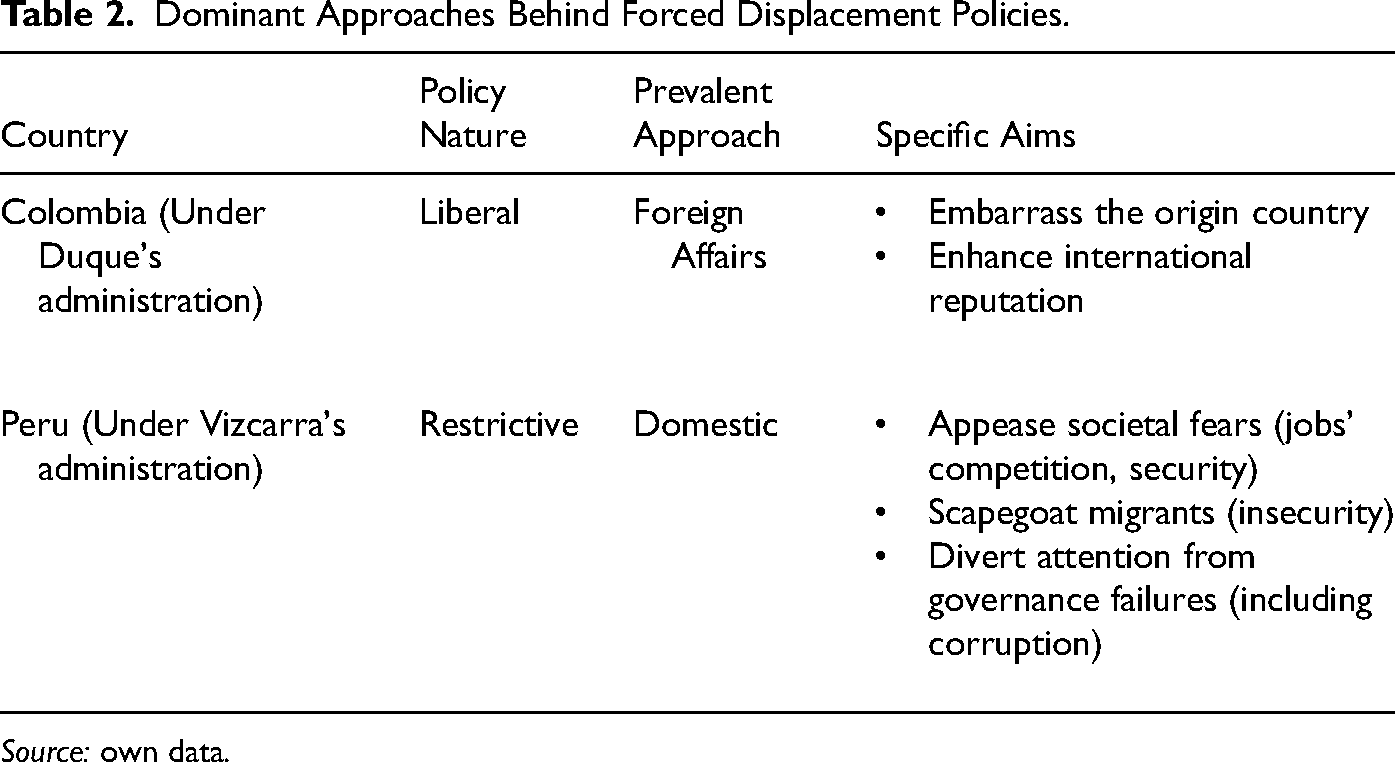
Source: own data.
The Drivers of Diverging Approaches to Forced Displacement Policy
Bureaucratic Frameworks
In Peru, the visa decision was driven by the interior minister, focusing on domestic security, with the foreign affairs minister involved but less influential. 21 In contrast, in Colombia, the Foreign Affairs Ministry, led by the vice minister of multilateral affairs, initiated and shaped the more liberal TPS policy, emphasizing diplomacy. 22 This difference in authority reflects variations in the bureaucratic frameworks of both countries, leading to divergent approaches to forced displacement.
In both countries, the Foreign Affairs Ministry is responsible for the formulation, orientation, implementation, and evaluation of migration policy (as set out in Colombia by art. 4.17, Decree 869/2016 and in Peru by Art. 4 of Law 29357/2018 and Art. of 4.1. Legislative Decree 1582/2017). However, in Peru, the Interior Ministry also has formal responsibilities for migration policy formulation (Art. 4.1 of Legislative Decree 1350/2017), whereas in Colombia its role is limited to issues impacting security and public order (Decree 2893/2011).
Secondly, whereas the operational migration authority in Colombia—Colombia Migration—is part of the Foreign Affairs Ministry (Decree 4062/2011), its counterpart in Peru—the Superintendency of Migration—is located within the Interior Ministry (Legislative Decree 1130/2012). 23 Both operational entities have formal competences regarding migration policy formulation (art. 3 Decree 4062/2011 for Colombia and art. 4.1. Legislative Decree 1350/2017 for Peru) and, given their firsthand experience, they assumed crucial roles in shaping policy following the onset of the Venezuelan displacement. 24
Thirdly, in 2018, Colombia established the Border Management Office (BMO), an institution attached to the presidency responsible for coordinating the response to the Venezuelan displacement. The BMO, by coordinating the needs of various sectors, including domestic security, rendered the Interior Ministry's involvement unnecessary, and its hierarchical position at the presidential level granted it substantial authority above other ministries (Fernández-Rodríguez and Célleri 2024; Selee and Chaves-González 2022).
A former head of the BMO describes how the Colombian bureaucratic framework shaped approaches and resulting policy: The formulation of migration policy is significantly influenced by its institutional placement, with various countries situating migration institutions under the Interior Ministry and others under the Foreign Affairs Ministry. Here, the regulatory focus of the migratory topic was a matter of bilateral relations with Venezuela, so the first respondent was the Foreign Affairs Ministry. Later, it also becomes a challenge for domestic policy, with a limited role played by one unit of the Interior Ministry. However, migration policy was always led more by the Foreign Affairs Ministry and Colombia Migration.
25
The Importance Given to Venezuela
In Colombia, Venezuela occupies a consistently salient role in the political agenda, mainly driven by historic and economic ties between the two countries and its role in Colombia's armed conflict. These relations are central to the dominant approaches behind forced displacement policy.
Sharing a 2,341-kilometer-long border and a history under Spanish colonial rule (1499–1819), as well as the brief existence of Greater Colombia (1819–1831), Colombia and Venezuela have developed a relationship primarily defined by significant commercial and energy cooperation (Arroyave-Quintero 2008). By the 2000s, these economic ties reached new heights, with trade peaking at $7.2 billion in 2008 (Colombia, Ministerio de Comercio, Industria y Turismo 2023). Additionally, strong socioeconomic and cultural relations emerged along their shared border, particularly in cities like Cúcuta (Colombia) and Táchira (Venezuela), forming the most active border in Latin America (Colombia, Cámara de Representantes 2020; Pabón, Bastos and Mogrovejo 2016).
Historically, left-wing guerrilla groups like the FARC and the ELN (Ejército de Liberación Nacional) have used Venezuelan territory as a refuge, supported by the left-leaning governments of Hugo Chávez (1999–2013) and Nicolás Maduro (2013–present). This has made Venezuela a crucial aspect of Colombia's security (InSight Crime 2022) and the nature of relations with Venezuela largely depends on the Colombian government's approach to peace with the guerrillas. As President Santos was oriented toward negotiations, his government sought cooperation with Venezuela, which played a crucial role as mediator during the peace talks with the FARC, resulting in the 2016 agreement (Holguín 2021).
However, under Duque's hardline approach, focused on eradicating guerrilla groups, relations with Venezuela became more confrontational.
26
After Venezuela's 2018 presidential elections, —declared illegitimate by the OAS—, Duque recognized opposition leader Juan Guaidó as interim president (Chiquiza 2019) and coordinated with the Venezuelan opposition and the US to deliver humanitarian aid from Cúcuta into Venezuela, aiming to bolster Guaidó's legitimacy. This culminated in a high-profile concert, Venezuelan Live Aid, attended by Guaidó and right-wing leaders, which escalated tensions. Maduro blocked the aid, broke diplomatic relations with Colombia, and closed land borders. During their mandates, Maduro and Duque repeatedly accused each other of fostering terrorism, reflecting a deep political rift (InSight Crime 2020).
27
In his interview for this research, Duque confirmed Venezuela's importance on his agenda, considering it as a security threat: Maduro is the promotor of terrorism there; he is hosting terrorism. He is involved in very dangerous money laundering. Maduro has worked in espionage against Colombia. The Venezuelan mining arc is now associated with criminality. These actions have an impact on Colombia.
28
In contrast, in Peru, the agenda concerning Venezuela has fluctuated significantly with changes in administration, ranging from high prioritization under Kuczynski to a diminished focus under Vizcarra, for whom, according to former Vice President Mercedes Aráoz, “foreign policy and Venezuela were not central issues.” 29
International Reputation
Duque's government faced significant challenges regarding its international legitimacy. He inherited a fraught image from his predecessor, President Uribe, who was criticized for his stances on the armed conflict, alleged human rights violations, and opposition to the widely supported peace agreement with the FARC. He rejected the characterization of the conflict as an armed one, framing it instead as generalized violence from criminal actors (El Espectador 2011), —contradicting international legal frameworks and damaging Colombia's standing abroad.
His “Democratic Security” policy reduced violence but sparked major human rights concerns, most notably the “false positives” scandal, in which civilians were executed and falsely presented as guerrilla fighters (Saavedra 2021; Vivanco and Pappier 2016). His fierce opposition to the 2016 peace deal and refusal to fully cooperate with the Truth Commission further eroded international trust (Barreto 2014; Duzán 2021). Duque tried to reframe this legacy with his “peace with legality” agenda 30 but was criticized for weak implementation. Rising violence against ex-combatants and social leaders (Pappier 2021; Varela 2022), alongside a hardline approach to the ELN, 31 drew increasing international scrutiny.
Amid strained relations with the international community, the Venezuelan displacement presented an opportunity to improve his international reputation. By spotlighting the country's humanitarian response through the TPS, Duque aimed to redirect international focus from his government's shortcomings to its generosity toward Venezuelans fleeing crisis.
32
A former BMO officer connects Duque's view of forced displacement to his damaged international reputation: Duque's government was receiving a lot of pressure because of the lack of implementation of the peace agreements and the killing of social leaders. I believe that the TPS was a strategic move, a way of shifting the conversation toward protection of migrants. Duque said that the most significant peace gesture by the government was to receive and regularize Venezuelans. This shift aimed to reframe the human rights discourse, highlighting Colombia's efforts to safeguard the rights of Venezuelans within its borders. That gave Duque a lot of international reputation and occurred in a moment when the government was significantly under pressure.
33
In contrast, in Peru, President Vizcarra had a positive international profile inherited from his predecessor. Kuczynski's liberal ideology and criticism of the Venezuelan regime, along with his rejection of military intervention, bolstered Peru's standing as a defender of democratic principles. As a technocrat without party affiliation, Vizcarra focused on strengthening institutional stability while distancing himself from the corruption scandals that had plagued his predecessor and Congressmen (Meléndez 2019). 34 Upon taking office, Vizcarra committed himself to combating corruption and restructuring the cabinet, positioning himself as a reformer in a politically scandal-ridden landscape. His leadership during the Eighth Summit of the Americas, where he promoted measures against corruption, further solidified his international standing. This stable reputation enabled forced displacement to be treated as a domestic policy issue.
Executive Strength
In recent years, Peru has experienced significant political instability, reflected in intense confrontations between the executive branch and Congress, partly stemming from a weak separation of powers. This instability affected the strength of the presidencies of both Kuczynski and Vizcarra, who lacked a parliamentary majority, but it particularly impacted Vizcarra as he was unelected and lacked party affiliation.
Kuczynski's government encountered strong opposition from Congress, predominantly controlled by Fuerza Popular, led by the daughter of former dictator Alberto Fujimori (1990–2000) (Dargent and Rousseau 2021; Meléndez 2019). 35 Between December 2016 and August 2017, Congress dismissed three ministers and the cabinet underwent a reshuffle. Furthermore, Congress attempted to declare presidential vacancy on grounds of “permanent moral incapacity,” a constitutional mechanism originally designed for cases of mental incapacity but abused as a political control tool. In December 2017, Congress accused Kuczynski of receiving illicit funds from Odebrecht, a Brazilian construction company embroiled in widespread corruption scandals across Latin America. Although this attempt failed, it exemplified the ongoing political crisis and diminishing executive authority (Riepl 2017). A controversial decision to pardon Alberto Fujimori, serving a lengthy prison sentence for crimes against humanity, further exacerbated tensions, damaged Kuczynski's credibility, and ultimately resulted in his resignation. Former Vice President Vizcarra assumed the presidency against this chaotic backdrop (Cué and Fowks 2018).
Despite sharing the same ideology, Vizcarra lacked support from PPK members, who distrusted him and suspected his involvement in Kuczynski's fall. His vulnerability necessitated a focus on gaining public support. In her biography of him, Rafaella León (2019) describes Vizcarra's position: In the following weeks the government of Vizcarra was taking shape. The chosen man, whom no one elected, was taking over the role of the President to take note of all that he wanted his administration to be. The Congress group of PPK was deeply divided and distrusted him, so he would not have their support […] The only option was to generate a considerable level of affinity with public opinion, enough to build a new power block that allowed him to make decisions. (103)
Initially avoiding conflict with Congress, in July 2018 Vizcarra shifted to a more confrontational approach after the release of the CNM Audios, which exposed corruption within the judicial system. 36 This change was marked by a public address during national celebrations where he proposed a political reform referendum aimed at fighting corruption and enhancing judicial integrity (León 2019).
This was well received by the public, allowing Vizcarra to build support and secure a vote of confidence from Congress. However, amid increasing political opposition, Vizcarra realized that maintaining public approval was critical to his administration's stability. His perception of forced displacement as a matter of domestic affairs reflected this concern, particularly in light of growing anti-Venezuelan sentiment in the country,
37
as a senior diplomat from the foreign affairs ministry highlighted: The difference between Kuczynski and Vizcarra is that Kuczynski at the beginning of his mandate was an elected president, had all the legitimacy of an elected president. Vizcarra became president when Kuczynski resigned, so he had a weaker position than his predecessor, and the Congress was opposed to his government […] To be more in line with societal sectors and protect himself, he took into consideration domestic politics and adopted restrictions.
38
Colombia has a more robust presidential system, with the mechanisms for impeachment and presidential vacancy in Colombia less politically driven than in Peru. Additionally, President Iván Duque, unlike Vizcarra, enjoyed electoral legitimacy and had significant backing from his predecessor, Álvaro Uribe, and the Centro Democrático party, which maintained a majority in the Senate. Political support allowed Duque to navigate the legislative landscape with more autonomy than Vizcarra, adopting forced displacement policies against public preferences.
Table 3 summarizes the results of the previous empirical sections.
Factors Shaping Diverging Approaches.
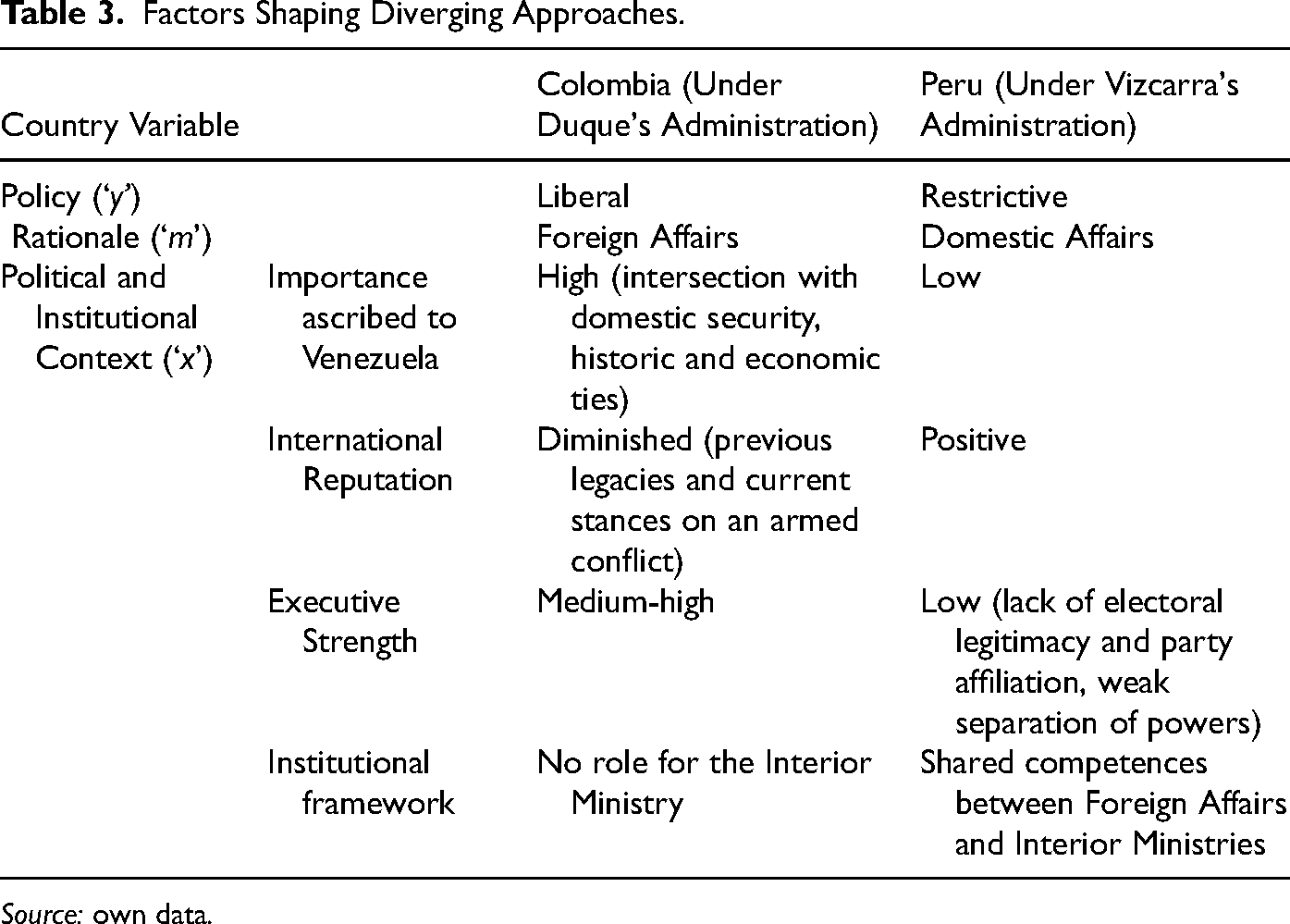
Source: own data.
Discussion
This article has explored the mechanisms and determinants leading to diverging policy responses to forced displacement, whether liberal or restrictive. Regardless of their orientation, such policies serve as tools for the governing authorities to preserve their power and legitimize themselves. The differences between Colombia's and Peru's approaches to Venezuelan displacement highlight how the rationales underlying these measures—rooted in foreign and domestic affairs—are influenced by the strategic political context, which includes the importance ascribed to Venezuela, international reputation, and executive strength.
The importance Colombia gives to Venezuela, along with its diminished international reputation, led the government to view forced displacement through the lens of foreign affairs. Those elements can counterbalance the typical effect of rising migrant numbers and prolonged crises, which often push states to address displacement as a domestic issue, resulting in more restrictive policies (Zolberg, Suhrke and Aguayo 1989). As Colombia's generous policies show, despite the substantial influx of Venezuelans and increasing societal opposition to migration, Venezuela's salience and poor international reputation outweighed immediate domestic pressures for restriction.
Furthermore, this finding offers a deeper understanding of these elements: First, it attributes Venezuela's importance in Colombia to structural relations between origin and destination countries rather than solely to geostrategic alliances and ideologies (Jackson and Atkinson 2019). Additionally, while the connection between diminished international reputation and liberal policies aligns with previous research (Blair, Grossman and Weinstein 2022; Drewski and Gerhards 2024; Natter 2018), it extends this explanation beyond authoritarian regimes to include democratic ones, linking a poor reputation to an executive's stance on armed conflict and legacies of its predecessors.
The research also helps understand how states’ approaches to forced displacement evolve from foreign policy concerns to domestic ones. In Peru, this shift was exacerbated by the executive's weakness during a domestic crisis leaving the government more vulnerable to public sentiment. By contrasting this with the case of Colombia, this research redefines the relationship between regime type and policy, challenging existing liberal/illiberal dichotomies. While existing literature suggests that illiberal regimes are more likely to adopt liberal policies (the so-called “illiberal paradox”) (Milner 2009; Blair, Grossman and Weinstein 2022; Natter 2018), my findings indicate that certain illiberal features (e.g., a weak separation of powers) can lead to political instability, making the governments more susceptible to public opinion and more inclined toward restrictive measures. Thus, executive vulnerability appears to play a more decisive role in determining policy orientation than regime type.
Bureaucratic frameworks do play a role; for instance, without formal competencies, a ministry may struggle to impose its agenda, as seen in Colombia. However, this appears secondary to the political context. Ultimately, the power of authorities in policymaking seems to depend on where the executive's need for legitimacy and preservation is most pressing. In Peru, where both the Interior and Foreign Affairs Ministries have competencies, the more prominent role of the former appears linked to the government's need for domestic legitimacy. However, the cases examined do not illustrate this relationship clearly. Further research could explore scenarios where bureaucratic considerations conflict with political needs to assess their respective influence.
The argument developed here also sheds light on responses in other major Latin American recipient countries. Brazil, under Jair Bolsonaro, adopted a liberal and foreign affairs-oriented approach, offering prima facie refugee status to Venezuelans (Brumat and Geddes 2023)—a move that can be interpreted as an attempt to bolster regional leadership amid reputational decline linked to his far-right positions. In contrast, Ecuador, under Lenín Moreno, adopted a restrictive and domestically driven approach (Malo 2022), imposing a humanitarian visa amid political vulnerability following his break with Rafael Correa—likely aiming to restore legitimacy by responding to public discontent. In these cases, foreign and domestic policy logics may have been shaped by negative international reputation and executive weakness, as seen in Colombia and Peru, respectively. Ultimately, this research contributes to deconstructing the traditional North–South divide in migration policy literature. By demonstrating that both Northern and Southern states are influenced by a complex interplay of foreign and domestic interests, it highlights fundamental similarities that transcend geographical and developmental labels. At the same time, the cases of Colombia and Peru underscore the importance of internal variation within the Global South—particularly the role of international reputation and executive strength—challenging generalized assumptions and revealing the diversity of political logics shaping forced displacement policy responses.
Supplemental Material
sj-docx-1-mrx-10.1177_01979183251365919 - Supplemental material for Foreign or Domestic Affairs? Unpacking Mechanisms Behind Colombia and Peru's Policies on Venezuelan Displacement
Supplemental material, sj-docx-1-mrx-10.1177_01979183251365919 for Foreign or Domestic Affairs? Unpacking Mechanisms Behind Colombia and Peru's Policies on Venezuelan Displacement by Nieves Fernández-Rodríguez in International Migration Review
Footnotes
Acknowledgements
I would like to thank Lukas Schmid for his valuable feedback, Neil Mann for his careful proofreading, Ana María Navarro for her work on the layout and formatting of the manuscript, and Paula Nimbriotis for her assistance in creating the graphs. I am especially grateful to Feline Freier for her ongoing inspiration throughout the development of the results presented in this work.
Declaration of Conflicting Interests
The author declared no potential conflicts of interest with respect to the research, authorship, and/or publication of this article.
Funding
Regarding funding, I gratefully acknowledge the support received from the institution I was affiliated with at the time of conducting the fieldwork: WZB Berlin Social Science Center/SCRIPTS. Open access publication was also generously funded by the WZB Berlin Social Science Center.

Supplemental Material
Supplemental material for this article is available online.
Notes
References
Supplementary Material
Please find the following supplemental material available below.
For Open Access articles published under a Creative Commons License, all supplemental material carries the same license as the article it is associated with.
For non-Open Access articles published, all supplemental material carries a non-exclusive license, and permission requests for re-use of supplemental material or any part of supplemental material shall be sent directly to the copyright owner as specified in the copyright notice associated with the article.
