




Abstract
This study examines the racial/ethnic and socioeconomic composition of schools attended by US Mexican-origin youth. On average, Mexican-origin students are double-segregated in high-minority, high-poverty schools, but the prior literature does not consider how markers of immigrant and residential integration shape differences in school compositional characteristics between Mexican-origin and non-Latino/a white students or how these factors are related to intragroup heterogeneity in Mexican-origin schooling contexts. Using the restricted-use High School Longitudinal Study of 2009 (HSLS:09), we analyze two school compositional characteristics of Mexican-origin ninth-graders: School percent white and school average peer socioeconomic status (SES). We investigate the extent to which observable factors related to immigrant integration explain school compositional differences between Mexican-origin and non-Latino/a white students, and show how school compositional characteristics differ within the Mexican-origin student group by these markers of integration. We find that several observable factors, including household SES, parental race/ethnicity, and school type and location explain around three-quarters of differences in school percent white and school SES levels between Mexican-origin and white students. School percent white and SES levels increase among Mexican-origin students whose households exhibit indicators of integration. One exception to these patterns is for parental nativity, which does not play an important role in explaining school compositional differences between Mexican-origin and white youth, or contribute to intragroup heterogeneity in Mexican-origin school composition patterns, once other markers of integration are considered. In sum, Mexican-origin students whose families exhibit socioeconomic integration, parental racial/ethnic mixing, engagement in school choice, and geographic dispersion attend less minority-concentrated and higher-SES schools.
Introduction
The children and descendants of immigrants in the United States are incorporated into schools that are segregated by both race/ethnicity and socioeconomic status (Orfield and Frankenberg 2014; Owens, Reardon, and Jencks 2014; Reardon and Owens 2014). This pattern of “double segregation” prevails among many Mexican-origin students, the largest national-origin immigrant group in US schools. On average, Mexican-origin students are highly segregated from (non-Latino/a) white students in schools, and exhibit increasing levels of isolation with minority and lower-SES students in schools over time (Gándara and Orfield 2010; García, Yosso, and Barajas 2012; Orfield, Kucsera, and Siegel-Hawley 2012; Fiel 2013; Krogstad and Fry 2014).
These overarching Mexican-origin school segregation and isolation patterns, however, mask considerable heterogeneity among Mexican-origin students in the types of schools that they attend. For all students, school racial/ethnic and socioeconomic composition are related to factors that influence sorting into schools, including household factors related to residential and school choice, such as household socioeconomic status, and contextual factors that facilitate or constrain enrollment in particular types of schools, such as community sociodemographic composition and residential and school segregation patterns (Reardon et al. 2012; Fiel 2013; Lareau and Goyette 2014; Fiel 2015; Owens 2016). Because they are an immigrant-origin group, these factors will be shaped by processes of immigrant and residential incorporation for Mexican-origin students and their families. Given that they are a diverse group, Mexican-origin students should exhibit varying degrees of incorporation, which should influence the types of schools that they attend, which in turn affects differences in school composition with non-Latino/a white students as well as intragroup variation in school composition among this student group.
This study investigates how observable determinants of school racial/ethnic and socioeconomic composition, which we refer to “indicators of integration” for Mexican-origin students, contribute to differences in school compositional characteristics between Mexican-origin and non-Latino/a white students, as well as potentially generate intragroup variation in Mexican-origin school composition. We conduct analyses of the nationally representative High School Longitudinal Study of 2009 (HSLS:09) in order to answer two questions. First, to what extent are differences in school racial/ethnic and socioeconomic composition between Mexican-origin and non-Latino/a white students due to observable factors related to integration that shape Mexican-origin student school enrollment patterns? Second, do Mexican-origin students with indicators of increased integration (socioeconomic, social, and spatial) attend schools with higher percentages of non-Latino/a white and socioeconomically advantaged students?
We draw from both the literatures on immigrant incorporation and racial/ethnic residential attainment and segregation to generate hypotheses about differences in school composition between Mexican-origin and non-Latino/a white students and intragroup heterogeneity in school composition among the Mexican-origin subgroup. We divide these theories into three groups — “integration,” “exclusion,” and “hybrid” perspectives. Theories that emphasize prospects for integration highlight the potential for Mexican-origin students to enroll in less minority-concentrated and impoverished schools through socioeconomic, social, and spatial incorporation (Alba and Logan 1993; Charles 2003; Alba and Nee 2009). Frameworks of exclusion, however, assert that pervasive discrimination in education, labor, and housing markets will limit schooling options for Mexican-origin families, keeping Mexican-origin students isolated in high-minority, high-poverty schools (Portes and Zhou 1993; Portes and Rumbaut 2001; Charles 2003; Massey 2007; Telles and Ortiz 2008). “Hybrid” theories suggest that both perspectives may be true — Mexican-origin students with higher levels of incorporation may enroll in schools with higher concentrations of white and affluent students, but mechanisms of exclusion could place a ceiling on their degree of incorporation in schooling contexts (Bean, Brown, and Bachmeier 2015).
To test the salience of these perspectives for understanding Mexican-origin schooling contexts, we investigate the extent to which six observable markers of integration (a term we use synonymously with incorporation), including parental nativity, household SES, parental race/ethnicity, school type, school urbanicity, and county percent white or median income, explain differences in school racial/ethnic and socioeconomic compositional characteristics between Mexican-origin Latino/a and non-Latino/a white students. Additionally, we assess the extent to which these six observable markers of integration are associated with heterogeneity in school racial/ethnic and socioeconomic composition within the Mexican-origin student group.
Background
Mexican-Origin School Segregation and Isolation Patterns
Over 70 years after the Brown v. Board of Education decision and nearly 60 years after the publication of Equality of Educational Opportunity (the “Coleman Report”), the separation and isolation of students in schools by race/ethnicity and SES remains a pervasive part of the US education system (Orfield, Kucsera, and Siegel-Hawley 2012; Orfield and Frankenberg 2014; Owens, Reardon, and Jencks 2014; Reardon and Owens 2014). It is difficult to find statistics on school segregation and isolation among Mexican-origin students as a national-origin group. The US National Center for Education Statistics (NCES) collects and disseminates counts of student groups that are used to create measures of school segregation and isolation, but does not collect information on Mexican-origin status. Given that two-thirds of the Latino/a population are individuals of Mexican origin and descent (Gonzalez-Barrera and Lopez 2013), existing studies of Latino/a school segregation can provide some insight into Mexican-origin school segregation and isolation patterns.
During the 2009–2010 academic year, the typical Latino/a student attended a school where 57.2 percent of the student body was Latino/a, and 63.5 percent of students were from households in poverty (Orfield, Kucsera, and Siegel-Hawley 2012). Although segregation from white students declined between 1991 and 2009, an estimated 69 percent of Latino/a or white students in 2009 would have needed to move to a different school to ensure an even distribution of Latino/a and white students across schools in that year (Orfield, Kucsera, and Siegel-Hawley 2012). Latino/a isolation with minority and poor students also increased over time, mainly due to changes in student demographic composition (Orfield, Kucsera, and Siegel-Hawley 2012; Fiel 2013; Krogstad and Fry 2014).
Historical and regional studies of Mexican-origin students also find high levels of between- and within-school segregation among Mexican-origin students. In the pre-Brown v. Board era of the first half of the twentieth century, Mexican-origin students in the Southwest faced high levels of school segregation due to overt discriminatory policies and practices among whites, who sought to create separate “Mexican schools” (Ruiz 2001; Gándara and Orfield 2010; García, Yosso, and Barajas 2012). Within schools where white students were present, Mexican-origin students were also isolated in “Mexican rooms” (Gándara and Orfield 2010; García, Yosso, and Barajas 2012), and de facto “Mexican rooms” — such as segregated English Language Development 4-hour blocks away from the general classroom, persist into this century (Gándara and Orfield 2010).
Studies looking specifically at Mexican-origin school composition among Mexican-origin students in nationally representative surveys show high levels of racial/ethnic and socioeconomic isolation among this group. In the Early Childhood Longitudinal Study-Kindergarten Cohort 1998/1999 (ECLS-K), Mexican immigrant elementary school students attended schools where minority representation and the proportion of students in poverty was substantially higher than for white, Asian American, and other Latino/a students, even among a matched sample with comparable background characteristics (Crosnoe 2005). As we will demonstrate, on average, Mexican-origin ninth graders in 2009 in the High School Longitudinal Study of 2009 (HSLS:09) also exhibited high levels of school racial/ethnic and SES isolation.
Prior research on Mexican-origin and Latino/a school racial/ethnic and socioeconomic composition has not scrutinized the extent to which factors related to processes of incorporation, such as parental nativity and socioeconomic status, are correlated with the types of schools that Mexican-origin students attend. One exception is work by Crosnoe (2005), whose findings using the Early Childhood Longitudinal Study-Kindergarten Cohort (ECLS-K) suggest that differences in household SES alone are insufficient for explaining gaps in school compositional characteristics between Mexican-origin students and their peers. The current study builds on Crosnoe's work, but investigates a broader set of measures of incorporation and how they relate to differences in Mexican-origin student schooling contexts with white peers, as well as heterogeneity in school compositional characteristics among Mexican-origin students.
Integration, Exclusion, and Hybrid Perspectives
Theories of immigrant incorporation inform hypotheses about the factors that will account for differences in Mexican-origin and white student school compositional characteristics, as well as highlight which subgroups of Mexican-origin youth should attend schools with higher proportions of white and higher-SES peers. Because the vast majority of children attend “neighborhood schools,” the public schools assigned to them via residence within specific school catchment areas (Grady, Bielick, and Aud 2010), and because residential integration can also be conceptualized as an indicator of immigrant incorporation (Massey and Mullan 1984; Massey 1985), the school compositional characteristics of Mexican-origin youth can also be understood through racial/ethnic neighborhood attainment and segregation models. We refer to these two sets of theories collectively as “integration” or “incorporation” theories. For understanding families’ selection of school contexts, which ultimately shape school compositional characteristics, many of the mechanisms embedded in both the immigrant incorporation and residential integration literatures apply to all students, not just to Mexican-origin students, such as household socioeconomic status. Yet, these theories also reveal underlying factors that are particularly salient in shaping school selection and enrollment patterns among non-white and immigrant-origin students, such as parental nativity, parental racial/ethnic identification, and discrimination.
For immigrant incorporation, these theories can be divided into three major groups: (1) Theories that emphasize mechanisms of integration (Warner and Srole 1945; Gordon 1964; Alba and Nee 2009); (2) Theories that point to mechanisms of exclusion (Portes and Zhou 1993; Portes and Rumbaut 2001; Massey 2007; Telles and Ortiz 2008), and; (3) Theories that take a “hybrid” approach, combining both integration and exclusion perspectives (Bean, Brown, and Bachmeier 2015).
Theories emphasizing mechanisms of integration argue that immigrants and their descendants will experience multiple types of incorporation with duration of residence and with each generation-since-immigration (Warner and Srole 1945; Gordon 1964; Rumbaut 2004; Alba and Nee 2009). In contrast, theories of immigrant racialization and exclusion argue that incorporation is stymied by external constraints in US society, such as historical racism and institutional and interpersonal discrimination (Portes and Zhou 1993; Portes and Rumbaut 2001; Massey 2007; Telles and Ortiz 2008). Lastly, a “hybrid” approach, such as the “Membership-Exclusion” model, argues for combined theories of incorporation and exclusion, with immigrant-origin groups experiencing a degree of incorporation that eventually reaches a “ceiling” imposed by discriminatory structures (Bean, Brown, and Bachmeier 2015).
An exhaustive review of evidence regarding patterns of immigrant incorporation among Mexican-origin families and children is beyond the scope of this study. There is considerable debate over whether the Mexican-origin population is experiencing incorporation (or “assimilation”) versus exclusion and racialization, or a combination of integration and exclusion, with evidence supporting each of these perspectives (Portes and Rumbaut 2001; Bean and Stevens 2003; Perlmann 2005; Massey 2007; Alba and Nee 2009; Bean, Brown and Bachmeier 2015; Feliciano and Lanuza 2016; Tran and Valdez 2017).
Despite the salience of these perspectives for understanding the outcomes of immigrant-origin groups, these theories have not been applied to an analysis of Mexican-origin schooling contexts. Crosnoe (2005) investigated some markers of immigrant integration when analyzing Mexican-origin elementary school racial/ethnic and socioeconomic composition, such as household SES, finding that socioeconomic differences were insufficient for explaining racial/ethnic and socioeconomic isolation of Mexican-origin students in schools. These results speak to the potential validity of the “hybrid” Membership-Exclusion perspective (Bean, Brown, and Bachmeier 2015).
Similar to theories of immigrant incorporation, theories of neighborhood racial/ethnic segregation and attainment also emphasize mechanisms of integration versus exclusion for non-white and immigrant-origin groups when making residential choice decisions, which ultimately affect school choices for the vast majority of children attending neighborhood schools. These theories can be divided into four major groups. The “Big Three” theories of incorporation include the spatial assimilation theory, the place stratification theory, and preferences (Charles 2003). A newer, fourth model, is the social-structural sorting perspective (Krysan and Crowder 2017).
The spatial assimilation theory asserts that racial/ethnic and immigrant/non-immigrant differences in neighborhood attainment are due to differences in income and wealth, and predicts that immigrant minorities will convert household SES and wealth gains (via other mechanisms of incorporation) into residence in neighborhoods with lower proportions of minority and poor residents (Charles 2003). The place stratification theory of residential segregation, on the other hand, hypothesizes that mechanisms of discrimination, including historical overt discriminatory policies (e.g., redlining, housing covenants) and current covert practices (e.g., landlord discrimination, real estate steering, white avoidance), prevent non-white and/or immigrant groups from converting gains in human capital, income, and wealth into residence in neighborhoods with lower proportions of minority and poor residents (Galster 1990; Massey 1990; Yinger 1995; Quillian 2002; Charles 2003; Galster and Godfrey 2005; Hall and Crowder 2014; Elbers 2024). The preferences argument asserts that residential segregation is the result of preferences to live around members of the same racial/ethnic group (Clark 1992; Charles 2003).
Immigrants may choose to self-segregate, for example, to access social and employment networks in immigrant enclave areas (Portes and Rumbaut 2006). Lastly, the social-structural sorting perspective asserts that racial/ethnic and immigrant/non-immigrant inequalities in housing search processes, such as whether a move was intended or unexpected, and knowledge of local neighborhoods and housing options also shape neighborhood attainment and segregation (Crowder and Krysan 2016; Krysan and Crowder 2017).
Studies of Latino/a residential and locational attainment find evidence of spatial integration, but also lingering barriers for Latino/a families, the largest subgroup of which is Mexican origin. The Latino/a population experiences moderate levels of residential segregation from whites based on dissimilarity (Logan and Stults 2021). Segregation from whites is higher among the Latino/a foreign-born than the US-born group, suggesting a degree of Latino/a spatial assimilation (Iceland and Nelson 2008). Some members of the Latino/a group have also spatially dispersed to suburbs and “new destinations,” which have larger non-Latino/a white and higher-SES populations (Lichter and Johnson 2009; Johnson and Lichter 2010; Timberlake, Howell and Staight 2010).
Nonetheless, Latinos/as face many spatial assimilation barriers. Even though Latino/a-white segregation within urban areas has declined, the segregation of these two groups between places has increased over time (Lichter, Parisi and Taquino 2015). Latinos/as are the largest group in the typical Latino/a neighborhood (Logan and Stults 2021). As Latinos/as increasingly enter the suburbs, the suburbs are becoming more diverse on both measures of poverty and racial/ethnic composition (Reardon and Yun 2001; Timberlake, Howell, and Staight 2010; Kneebone and Holmes 2016; Mordechay and Terbeck 2022; Owens and Rich 2023). Similarly, as Latinos/as move into white middle-class areas and new Latino/a destinations, they can face racial/ethnic discrimination and white out-migration (Lewis, Emerson, and Klineberg 2011; Lacayo 2017; Elbers 2024). Finally, Latino/a families may lack information on residential options that feed into more racially/ethnically and socioeconomically integrated schools (De Souza Briggs et al. 2008; Krysan and Crowder 2017).
Intragroup Heterogeneity in Mexican-Origin Schooling Contexts
The Mexican-origin immigrant group has been referred to as a “paradigm” of intragroup heterogeneity (Alba, Jiménez and Marrow 2013). Indeed, because of nearly continuous waves of migration over decades, Mexican-origin students are internally diverse on several measures, including (but not limited to) immigrant generational status, parental intermarriage, household socioeconomic status, and geographic areas of residence (Waters and Jiménez 2005; Vallejo 2012; Alba, Jiménez, and Marrow 2013; Tran and Valdez 2017; Alba 2020). To the extent that Mexican-origin families seek to convert markers of integration, such as increases in socioeconomic attainment, into enrollment of their children in schooling contexts that are less minority-concentrated and impoverished, heterogeneity in Mexican-origin school compositional characteristics should go hand-in-hand with other markers of intragroup heterogeneity. Despite recognition that Mexican-origin group is internally diverse, intragroup heterogeneity in Mexican-origin schooling contexts has not been assessed in prior research on Mexican-origin school composition. We address this gap by investigating variation in Mexican-origin student school racial/ethnic and socioeconomic composition according to six indicators of integration.
Hypotheses
This study evaluates two hypotheses related to Mexican-origin student school racial/ethnic and SES composition, stemming from the integration, exclusion, and hybrid perspectives:
Hypothesis 1: Observed differences in school racial/ethnic and SES composition between Mexican-origin and white youth will largely be explained by observable factors related immigrant and residential integration.
Hypothesis 2: Within the Mexican-origin student subgroup, school racial/ethnic and SES compositional characteristics will vary by factors related to immigrant and residential integration.
The first hypothesis asserts that a large portion of differences in school compositional characteristics between Mexican-origin youth and their white peers are due differences in observable markers of integration for the Mexican-origin group. Once these factors are considered, differences in school compositional characteristics between Mexican-origin and white youth should largely be reduced. This hypothesis is consistent with immigrant incorporation perspectives emphasizing integration over exclusion (Warner and Srole 1945; Gordon 1964; Alba and Nee 2009), “hybrid” immigrant assimilation perspectives (Bean, Brown, and Bachmeier 2015), and residential spatial assimilation theories (Charles 2003).
The second hypothesis addresses intragroup heterogeneity in schooling contexts among Mexican-origin students (Alba, Jiménez, and Marrow 2013). We hypothesize that Mexican-origin students who exhibit indicators of increased integration will have higher percentages of white and higher-SES students in their schools.
For our indicators of integration for both hypotheses, we focus on six measures. For the expected associations between these indicators and our focal outcomes, we use the term “less isolated school contexts” to refer to schools with higher percentages of white students and higher school SES levels. The indicators we scrutinize are as follows: 1. Parental nativity, with less isolated school contexts expected among Mexican-origin students whose parents were born in the United States (versus those with 1–2 foreign-born parents); 2. Household SES, with less isolated school contexts expected when household SES is higher (versus lower); 3. Parental race/ethnicity, with less isolated school contexts expected when at least one parent identifies as non-Latino/a white (versus no parents that identify as non-Latino/a white); 4. School choice, with less isolated school contexts expected when the student attends a private or choice school (versus a traditional public school); 5. School location urbanicity, with less isolated school contexts expected when the school is located outside of a city area (versus in a city area), and; 6. School location sociodemographic composition, with less isolated school contexts expected when the school is located in a county with higher percentages of white and affluent residents.
Methods
Data and Sample
This research uses data from the restricted-use HSLS:09 conducted by NCES (Ingells et al. 2015). The HSLS:09 includes a nationally representative sample of approximately 25,000 students in 940 schools throughout the United States who were ninth-graders in the fall of 2009. 1 The HSLS:09 sample was drawn using a two-stage sampling design. Schools were sampled first using a stratified probability proportional to size approach. Then, approximately 30 ninth-graders were randomly selected from each school, with an oversample of some groups. This study focuses on the base-year sample of HSLS:09, which includes approximately 21,990 students who were ninth-graders enrolled in public and private schools in the fall of 2009. 2
Students are categorized into six mutually exclusive racial/ethnic groups based on self-reports of racial status, Latino/a ethnicity status, and self- and parent-reported national-origin subgroup within the Latino/a population: Mexican-origin Latino/a (n = 1,880), non-Latino white (n = 12,050), non-Latino black (n = 2,290), non-Latino Asian (n = 1,900), non-Latino other race (n = 2,090), and Latino/a- other (n = 1,770). The “Latino/a- other” category includes Latinos/as of any race who are not of Mexican origin. 3 For the sake of brevity, the “non-Latino” descriptor is dropped when referring to white, black, Asian, and other race students. We include subgroups other than the Mexican-origin student group to see if the differences in school composition between white and Mexican-origin students (when testing Hypothesis 1) are unique to Mexican-origin students or are also observed for other racial/ethnic groups.
Measures
Dependent Variables
The main dependent variables are the racial/ethnic and SES composition of schools attended by students in the HSLS:09 in ninth grade. This study focuses on the percent of white students in the school as a measure of racial/ethnic composition, and the average socioeconomic status (SES) of students in the school based on aggregate student characteristics as a measure of school socioeconomic composition.
The percent of white students in the school comes from school administrator reports in the HSLS:09 survey. Administrators reported racial/ethnic enrollment percentages as whole numbers ranging from 0 to 100. To gauge the reliability of these reports, we used data from the 2009–10 Civil Rights Data Collection (CRDC) for public schools. The CRDC is a compilation of statistics from all public local education agencies in the United States, which are required to report enrollment statistics in a biennial survey. As a result, this check on administrator reports of school racial/ethnic enrollment percentages was only conducted for public-school students. We merge these data into the HSLS:09 using the NCES identification codes for schools. Even though public agencies are required to report enrollment statistics, some schools had missing data in the 2009–10 wave of the CRDC. For students with nonmissing values on both the 2009–10 CRDC measure and the HSLS:09 and administrator survey measure, the correlation between the percentage of whites in the school is high (0.96). Thus, we determined that administrator reports of school racial/ethnic enrollment composition were preferable, as they allowed us to include all students in the HSLS:09 in public and private schools, rather than being limited to a public-school sample.
The average SES of students in the school is calculated using in-sample student-level data on household SES to create an aggregate school-level measure that is assigned to students through the school identification number. Each ninth-grader in the HSLS:09 has an SES composite measure that combines information on parental education, occupation, and family income. The school SES variable is a weighted average of this measure for each school. The HSLS:09 does not include a within-school sample weight, so there is no way to determine exactly how many students within a school that each case represents. Base-year student weights in the HSLS:09 are used as an approximation of within-school weights. For each student i in school j, the average SES level of the school is calculated as follows:

One problem with this measure is that, because a student's own SES value is included in the calculation of the school-level SES measure, this school-level measure may be highly correlated with the student's own household SES value. To investigate this premise, we calculated an alternative school SES measure, where each student is given a school SES value that leaves out their own household SES value in the calculation of the aggregate school SES measure (see Equation 1). This alternative measure is highly correlated with the original school SES measure calculated using Equation 1 (r = 0.99). Additionally, the correlation between the original school SES measure (Equation 1), and the students’ household SES values is r = 0.55, and is r = 0.50 for the correlation between the alternative school SES measure and the students’ household SES values. For these reasons, we use the measure described using Equation 1.
We also decided not to use an alternative measure of school SES, free and reduced priced lunch (FRPL) eligibility, for several reasons. First, approximately 10 percent of cases in the base-year HSLS:09 are missing values for this variable, whereas a student-level SES composite is available for all ninth-graders in the sample. Second, eligibility for FRPL can be a problematic socioeconomic status measure because it contains both “false positives” — students who are not eligible for FRPL but are listed as eligible — and “false negatives” — students who are eligible for FRPL but do not apply (Harwell and LeBeau 2010). Variables such as parental education and income are preferable measures of socioeconomic status when compared to measures based on federal cut-off points for poverty status (Hauser 1994). Finally, measures of school SES and FRPL are somewhat interchangeable; the correlation among the sample with nonmissing values for both measures is r = −0.77.
Independent Variables
To test the first hypothesis, regression models examine differences in school compositional characteristics between the five racial/ethnic groups and white students, and adjust for a series of factors related to integration that could explain these gaps. Additionally, to test the second hypothesis, we focus on three household and three contextual indicators of integration, restricting regression models to the Mexican-origin subgroup.
The first three household variables of interest are parental nativity, household socioeconomic resources, and parental race/ethnicity. For parental nativity, students are classified into four categories based on parental country of birth: (1) Both parents (or only reporting parent) born in a foreign country, (2) mixed parental nativity (one parent foreign born and one parent US born), (3) both parents (or only reporting parent) US born, and (4) unknown parent birth location (because of missing parental nativity information). Household socioeconomic resources are measured using the student-level household SES composite variable in the base-year HSLS:09. This variable is a standardized index that combines measures of parental educational attainment, family income, and parent occupation. To consider potential heterogeneity in the racial/ethnic background of students according to their parents’ racial/ethnic status, we use parent reports of their own race/ethnicity to create five parental race categories: (1) Both parents or only known parent are/is Latino/a white, (2) at least one parent is white and not Latino/a, (3) both parents are Latino/a but not white, (4) both biological parents’ information is missing, and (5) all other racial/ethnic mixed statuses. We explored other potential combinations of parental race/ethnicity, but this categorization ensured adequate cell sizes for the Mexican-origin group in each category.
Family composition is also controlled as a factor that may influence the types of schools that children attend. We divide students into five family composition categories: (1) Two parents (both biological or adoptive parents in the household), (2) stepparent (one biological/adoptive parent and one stepparent), (3) mother only, (4) “other” type of family composition (father only, grandparent/s, sibling/s, or other family composition), and (5) unknown family composition. Regression coefficients for family composition variables are not included in the displayed model results, but are available upon request.
We account for several factors related to school type and location. We create a seven-category variable for the type of school the student attended in ninth grade: (1) traditional public school, (2) charter school, (3) magnet school, (4) alternative or vocational school, (5) public school of unknown type, (6) Catholic private school, and (7) non-Catholic private school. We control for school urbanicity, which is a variable in the Common Core of Data (CCD) that is linked into the HSLS:09 by NCES. School urbanicity is defined using four categories: (1) City, (2) suburb, (3) town, or, (4) rural.
We also control for several county sociodemographic characteristics. Using zip codes for schools in the restricted-use HSLS:09, we first assigned schools to counties based on a 2010 zip code to county crosswalk available from the US Department of Housing and Urban Development. We then merged in county-level data on population racial/ethnic composition from the 2010 decennial census and per capita income from the 2007–2011 American Community Survey (ACS), accessed via Social Explorer. We include a continuous measure of either county percent non-Latino white (for models predicting school percent white) or county median household income (for models predicting school SES). We also include the logged county population total (from 2010) in full regression models. State fixed effects are also included to control for unmeasured state characteristics that could influence school composition.
Analytic Strategy
The analysis begins by presenting descriptive results (Table 1). We also include the full weighted means of all variables in the study for the full sample and subsamples of interest (Mexican-origin and all Latino/as) in Supplemental Table A1. We then estimate linear regressions to examine the associations between the focal independent variables and the two school compositional variables. The first sets of models investigate gaps in school composition between Mexican-origin and white students (testing Hypothesis 1; Tables 2 and 3), by estimating a three-model sequence for each outcome. Model 1 predicts school composition by student race/ethnicity, Model 2 adds individual and household characteristics, and Model 3, the full model, adds school type and location variables, and includes state fixed effects.
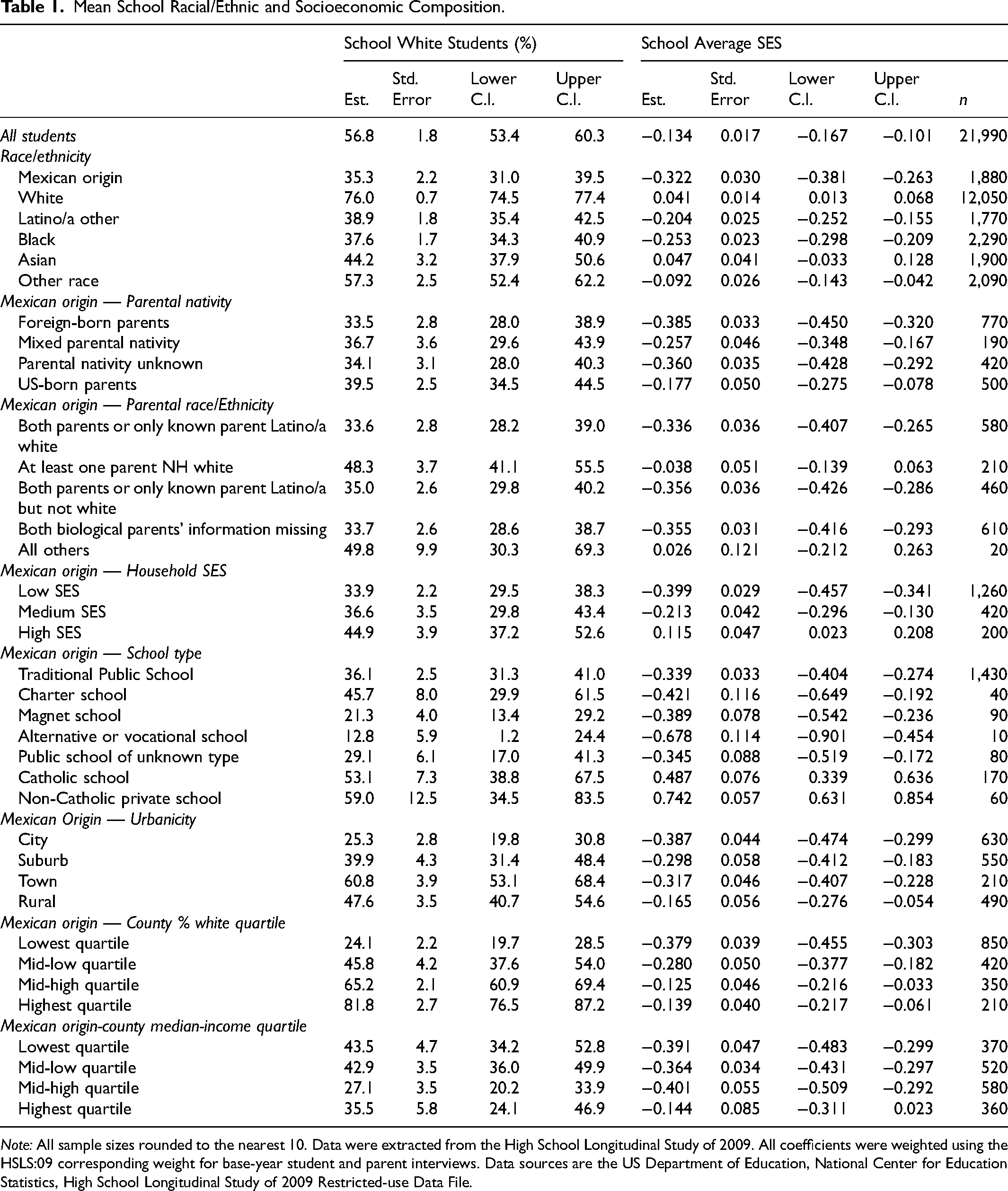
Mean School Racial/Ethnic and Socioeconomic Composition.
Note: All sample sizes rounded to the nearest 10. Data were extracted from the High School Longitudinal Study of 2009. All coefficients were weighted using the HSLS:09 corresponding weight for base-year student and parent interviews. Data sources are the US Department of Education, National Center for Education Statistics, High School Longitudinal Study of 2009 Restricted-use Data File.
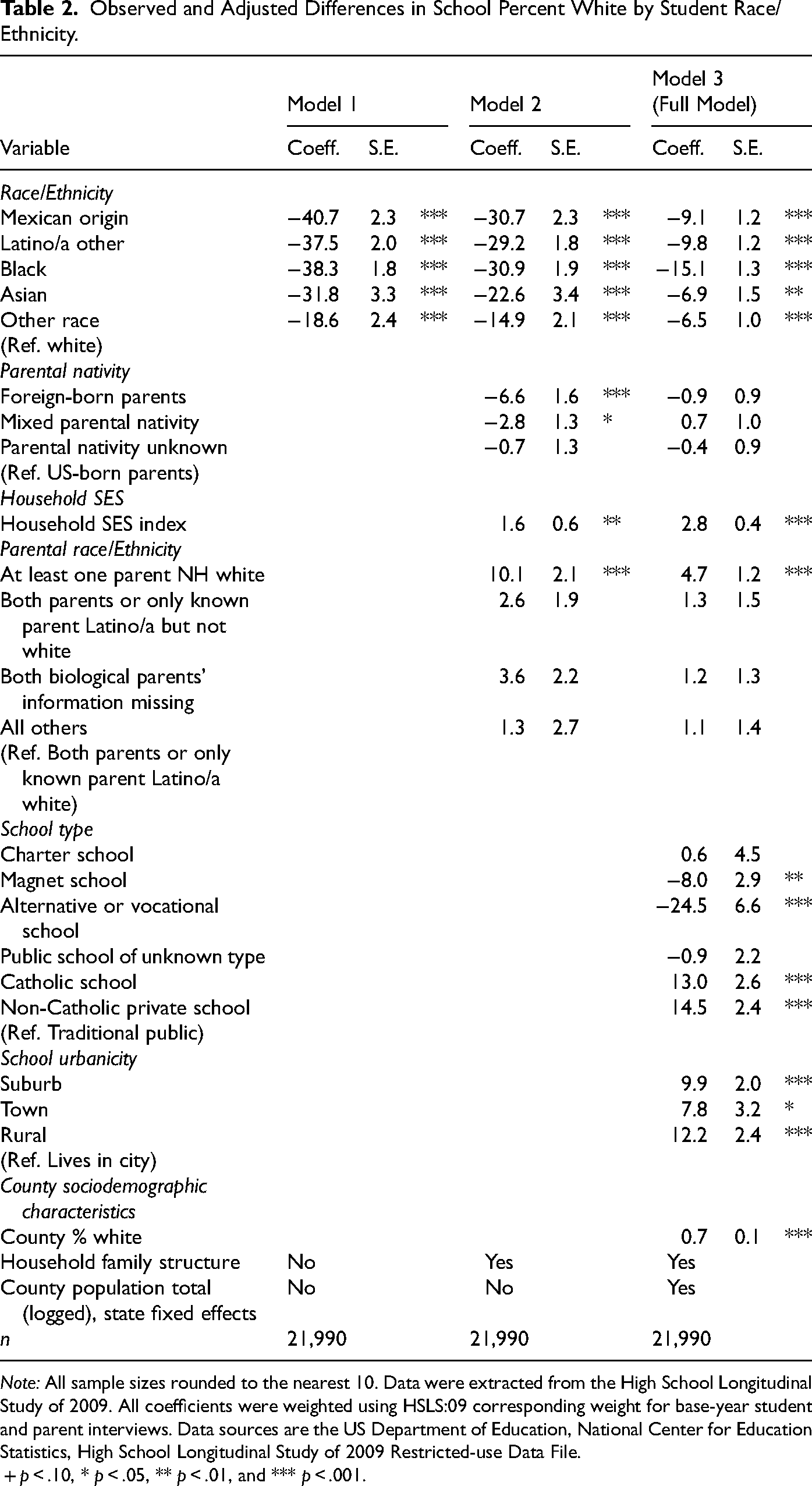
Observed and Adjusted Differences in School Percent White by Student Race/Ethnicity.
Note: All sample sizes rounded to the nearest 10. Data were extracted from the High School Longitudinal Study of 2009. All coefficients were weighted using HSLS:09 corresponding weight for base-year student and parent interviews. Data sources are the US Department of Education, National Center for Education Statistics, High School Longitudinal Study of 2009 Restricted-use Data File.
+ p < .10, * p < .05, ** p < .01, and *** p < .001.
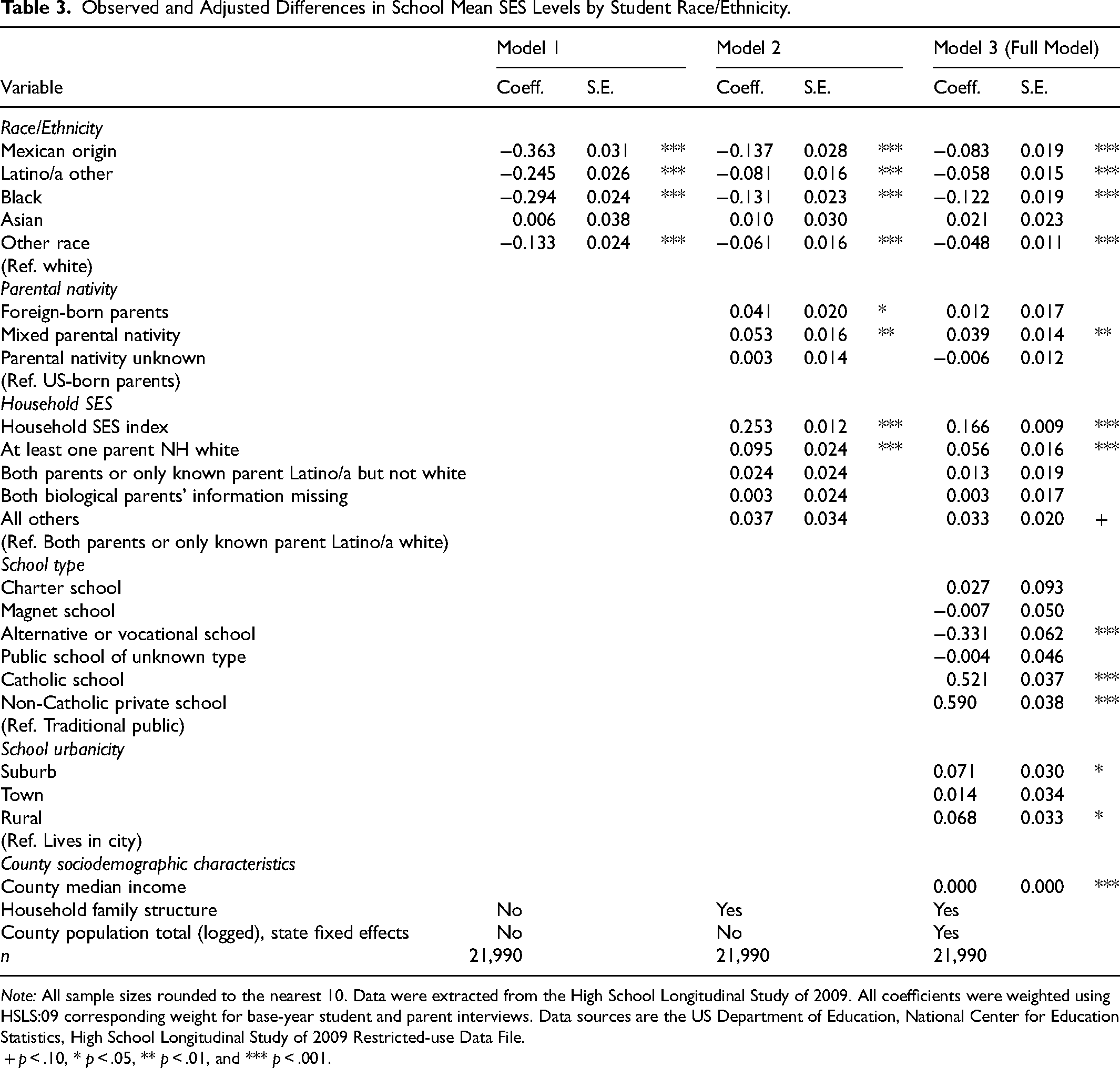
Observed and Adjusted Differences in School Mean SES Levels by Student Race/Ethnicity.
Note: All sample sizes rounded to the nearest 10. Data were extracted from the High School Longitudinal Study of 2009. All coefficients were weighted using HSLS:09 corresponding weight for base-year student and parent interviews. Data sources are the US Department of Education, National Center for Education Statistics, High School Longitudinal Study of 2009 Restricted-use Data File.
+ p < .10, * p < .05, ** p < .01, and *** p < .001.
A second set of analyses builds on the full models (Model 3 in Tables 2 and 3) to consider heterogeneity within the Mexican-origin sample (Hypothesis 2; Tables 4 and 5). These models restrict the sample to the Mexican-origin subgroup (n = 1,880), and show how six indicators of integration are associated with school percent white and school mean SES levels, net of covariates, for the Mexican-origin student subpopulation. We then use these model estimates to predict values of school percent white and school mean SES levels for Mexican-origin students, holding all covariates at their subpopulation mean values. Specifically, we estimate predicted values of school percent white and school mean SES at varying levels of the six focal measures of integration (parental nativity, household SES, parental race/ethnicity, school type, urbanicity, and either county percent white for models predicting school percent white or county median household income for models predicting school SES), while holding all other variables at their means for the Mexican-origin group. For the continuous measure of household SES, we show predicted values at the mean, and 1 standard deviation below and above the mean. For the continuous measures of county percent white and county median household income, we show predicted values at the 25th, 50th, and 75th percentiles. These predicted values are displayed in Figures 1 and 2, with 95 percent confidence intervals.
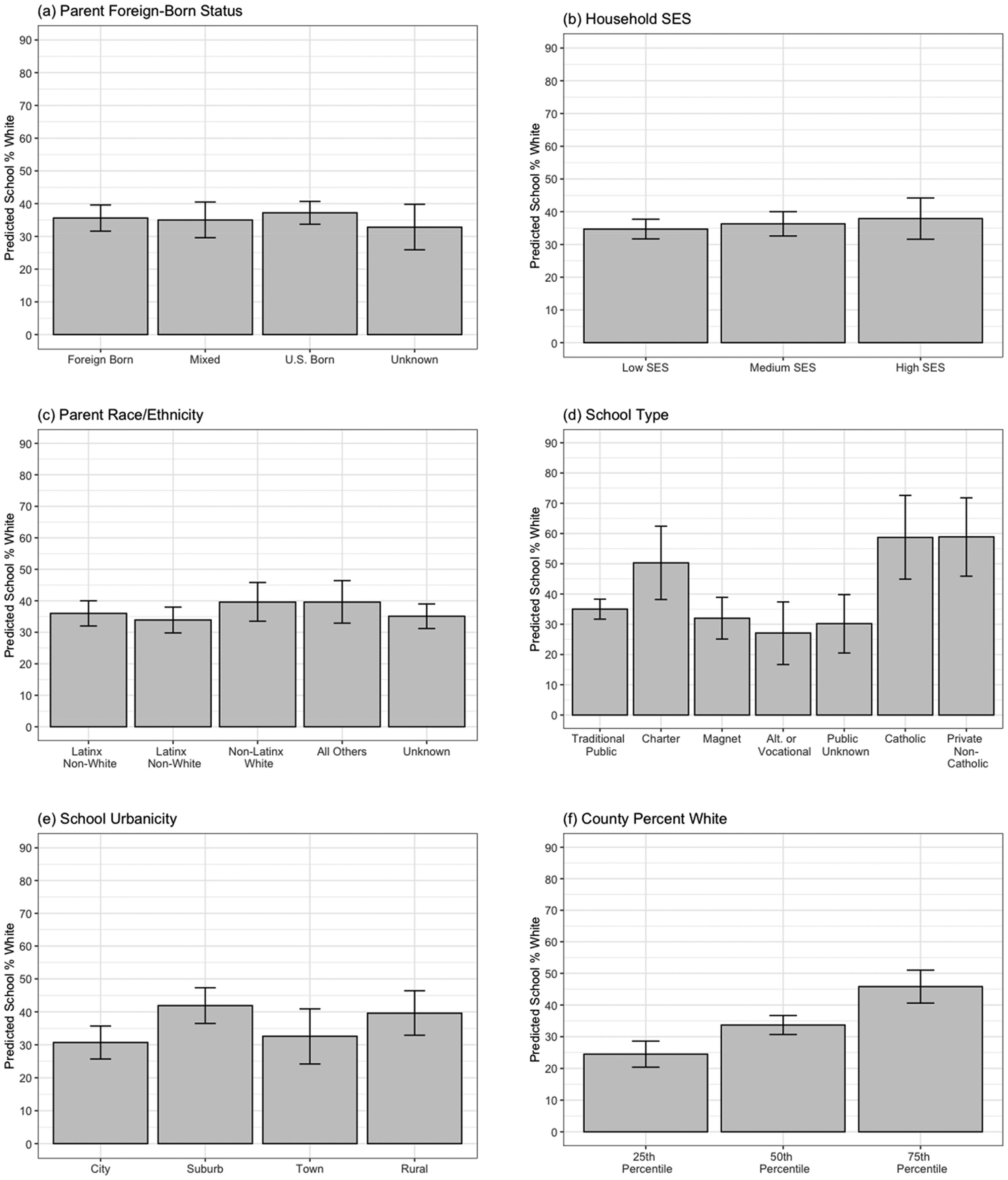
Predicted School Percent White Students among Heterogeneous Groups of Mexican-Origin Students.
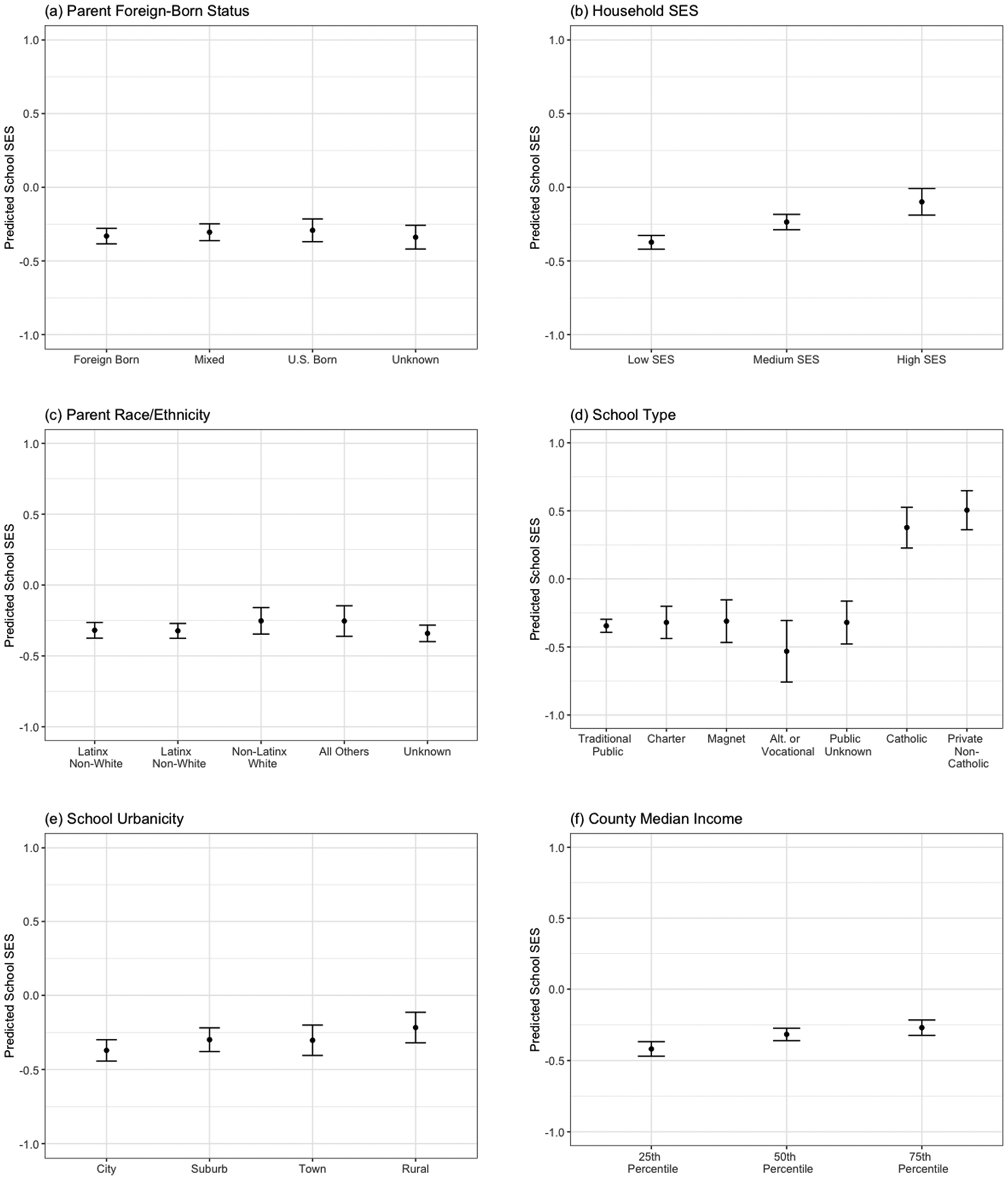
Predicted Mean School SES among Heterogeneous Groups of Mexican-Origin Students.
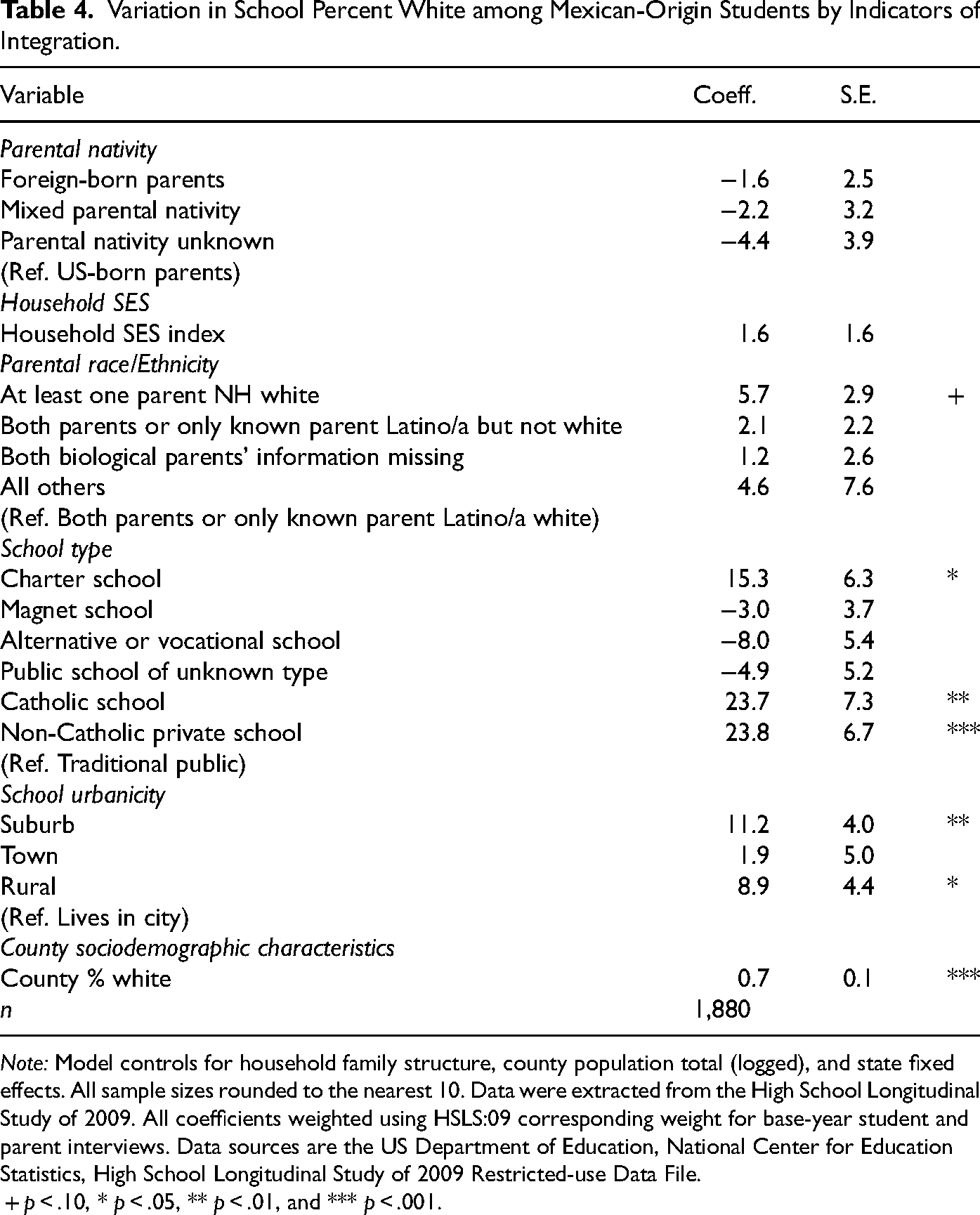
Variation in School Percent White among Mexican-Origin Students by Indicators of Integration.
Note: Model controls for household family structure, county population total (logged), and state fixed effects. All sample sizes rounded to the nearest 10. Data were extracted from the High School Longitudinal Study of 2009. All coefficients weighted using HSLS:09 corresponding weight for base-year student and parent interviews. Data sources are the US Department of Education, National Center for Education Statistics, High School Longitudinal Study of 2009 Restricted-use Data File.
+ p < .10, * p < .05, ** p < .01, and *** p < .001.
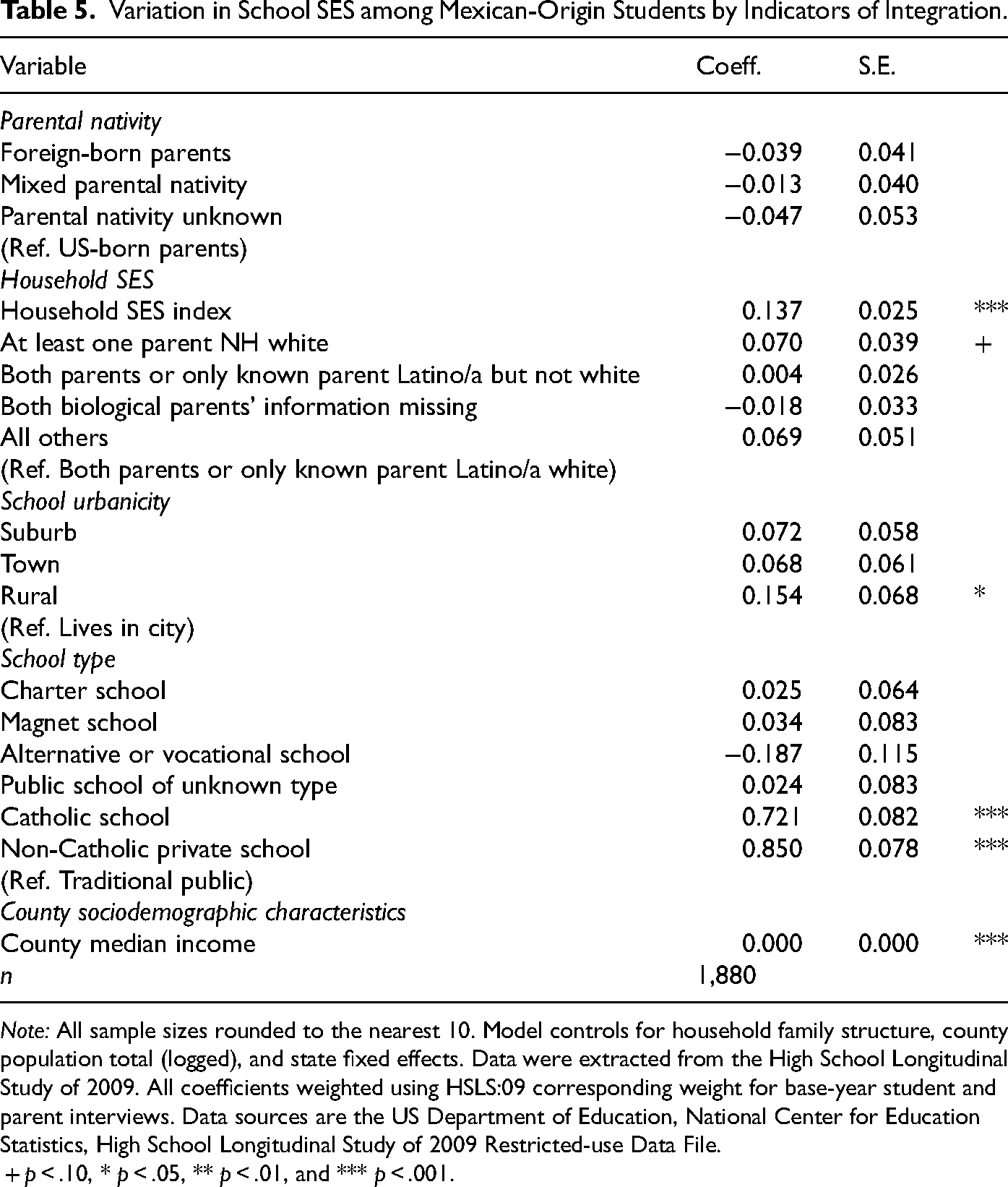
Variation in School SES among Mexican-Origin Students by Indicators of Integration.
Note: All sample sizes rounded to the nearest 10. Model controls for household family structure, county population total (logged), and state fixed effects. Data were extracted from the High School Longitudinal Study of 2009. All coefficients weighted using HSLS:09 corresponding weight for base-year student and parent interviews. Data sources are the US Department of Education, National Center for Education Statistics, High School Longitudinal Study of 2009 Restricted-use Data File.
+ p < .10, * p < .05, ** p < .01, and *** p < .001.
A key question may be whether associations between markers of integration and school racial/ethnic and socioeconomic composition differ for Mexican-origin students relative to other groups. To test this proposition, we returned to the pooled sample (all racial/ethnic groups) and estimated models that interacted race/ethnicity and, sequentially, each of the six focal indicators of integration, controlling for all covariates from the full models. In some cases, associations between the focal indicators of integration and school compositional outcomes differed for Mexican-origin relative to white students. However, most results were consistent with the results in Tables 4 and 5 and the predicted values displayed in Figures 1 and 2. These interaction model results are displayed in Supplemental Tables A2 and A3, and Figures 1A and 2A.
All analyses were conducted with Stata 18.0. All descriptive and regression results use the complex survey design features (primary sampling unit and strata) and base-year weights included in the HSLS:09. Some cases had missing values, and listwise deletion would have resulted in a loss of 12 percent of cases in the pooled analytic sample. To deal with missing values, we conducted multiple imputation via chained equations, resulting in 20 imputed datasets that were analyzed via the “mi estimate” suite of commands in Stata.
Results
The Distribution of Mexican-Origin Students Across Schooling Contexts
The analysis first examines the distribution of Mexican-origin adolescents and their peers across schools by racial/ethnic and SES composition. Table 1 displays the (weighted) mean school racial/ethnic and SES characteristics for each racial/ethnic group of students and school composition across heterogeneous groups of Mexican-origin students. (These estimates for other racial/ethnic groups are available upon request.)
Mexican-origin students are highly concentrated in schools with low levels of white students. On average, Mexican-origin students attend schools where 35 percent of fellow students are white — the lowest percentage of whites in the school of any racial/ethnic group. Low percentages of white students in schools are also observed for black and other Latino/a students, who attend schools that are 38 percent and 39 percent white, respectively. Asian and other race students attend schools with slightly higher percentages of whites (44 percent and 57 percent, respectively). Unsurprisingly, white students attend the most white student-concentrated schools. On average, white students attend schools where 76 percent of fellow students are white.
Mexican-origin students are also concentrated in schools with low average peer SES levels. Recall that the aggregate school SES measure is based on a standardized student-level SES measure with a mean of zero and a standard deviation of 1.0. Mexican-origin students have the lowest mean school SES value of all of the six racial/ethnic groups (−0.32), although their mean school SES levels cannot be statistically distinguished from the school SES levels of black students (−0.25) when uncertainty in the estimates is considered. Latino/as of non-Mexican backgrounds attended schools with slightly higher SES levels than Mexican-origin students. Asian and white students attend the most socioeconomically advantaged schools.
The results in Table 1 also show that school compositional characteristics vary among some, but not all, Mexican-origin subgroups. Somewhat surprisingly, Mexican-origin students attend schools with similar percentages of white students across parental nativity groups and household SES levels when uncertainty in estimates is considered. School SES levels do, however, vary by these factors, with Mexican-origin students with US-born parents attending higher-SES schools than Mexican-origin students with only foreign-born parents. Similarly, Mexican-origin students from higher-SES backgrounds attend schools with higher SES levels than those from lower-SES backgrounds. Heterogeneity among the Mexican-origin subgroup when considering parental race/ethnicity is only apparent for Mexican-origin students with a non-Latino/a white parent. These students attend schools with a higher concentration of white students, and higher SES levels, than Mexican-origin students with only Latino/a white parents, only Latino/a but not white parents, or with unknown parental race.
Turning to heterogeneity in school composition by school context attributes, Mexican-origin students in magnet and alternative or vocational schools attend schools with lower percentages of white students than those in traditional public schools. Mexican-origin students attending a Catholic or a non-Catholic private school attend schools with higher SES levels than Mexican-origin students in any other type of school.
Among residential factors, and perhaps unsurprisingly, Mexican-origin students attending schools in cities have significantly lower percentages of white students in their school than those attending schools in suburbs, towns, and rural areas. Somewhat surprisingly, however, school SES levels do not vary significantly for Mexican-origin students by urbanicity category when uncertainty in the estimates is considered. Finally, school racial/ethnic attributes map onto county racial/ethnic composition in an expected way. Mexican-origin students in the counties in the lowest quartile for percent white population attend schools where 24 percent of students were white, whereas their counterparts in counties in the highest quartile attended schools where 82 percent of the students were white. The county median household income, however, was not associated with different school SES levels for Mexican-origin students when uncertainty in the estimates is considered.
Explaining Gaps in School Racial/Ethnic Composition
We first examine the extent to which school compositional differences between Mexican-origin and white students are explained by individual, household, and contextual factors related to integration (Hypothesis 1). Table 2 presents the results for a model with the percent of white students in the school as the dependent variable. The first model shows that all non-white groups of students attend schools with a lower percent of white students than white peers (Model 1). The difference in the percentage of whites in the school between white and Mexican-origin youth in Model 1 is 41 percentage points. This gap with whites in the percentage of white students in the school is reduced in magnitude (by 10 percentage points; a 25 percent reduction), but persists, when student and household characteristics are added to the model (Model 2).
Model 3 in Table 2 accounts for contextual measures, including school type, urbanicity, and county-level measures, as well as state fixed effects. When controlling for these measures, the difference in the percent of white students in the school between Mexican-origin and white students is further reduced by an additional 22 percentage points, a 70 percent reduction (Model 3 versus Model 2). In the full model versus the base model (Model 3 versus Model 1), the difference in the percentage of white students in the school between Mexican-origin and white students is reduced by almost 32 percentage points, a nearly 78 percent reduction. Controlling for all observable measures of integration (Model 3), the difference in the percent of white students in the school between white and Mexican-origin youth is 9 percentage points (Model 3). Notably, in this full model, all of the other racial/ethnic groups also have significant differences in the percentage of white students in the school, with black students exhibiting the largest negative differences with white students in this outcome among all of the racial/ethnic groups. The (negative) differences with white students in the percentage of white students in the school that are observed for Other Latino/a, Asian, and Other Race students are comparable to the differences with whites in this outcome for Mexican-origin students when uncertainty in the coefficients (i.e., standard errors) are considered.
Explaining Gaps in School Socioeconomic Composition
Next, the same analytic strategy is used to estimate gaps in average school SES levels between Mexican-origin and white students with the addition of control variables (Table 3). Model 1 shows that Mexican-origin students attend schools with significantly lower SES levels than white students (−0.363 units). Controlling for student and household variables reduces differences in school mean SES levels between white and Mexican-origin students by 0.226 units — a 62 percent reduction in the school mean SES difference from Model 1 to Model 2. In the full model adding school type and location variables (Model 3), the difference in school SES levels between Mexican-origin and white students declines by 0.054 units, a further 61 percent reduction in the school SES gap between Model 2 and Model 3. From Model 1 to Model 3, the difference in school SES levels between Mexican-origin and white students is reduced by 0.280 units, a 77 percent reduction. This residual (negative) difference with white students in school SES levels in the full model (Model 3) is also observed for Other Latino/a, black, and Other Race students, and the magnitude of these differences is comparable to the one observed for Mexican-origin students when uncertainty in the coefficient estimates (i.e., standard errors) is taken into account. Asian students are the only outlier group in these models, with non-significant differences with white students in school mean SES levels across all of the models (1–3), indicating that Asian students have comparable school SES levels with white students, even in adjusted models that take differences in background factors and school context into account.
Results Summary for Hypothesis 1
The model results in Tables 2 and 3 show strong support for the first hypothesis that observable factors related to immigrant integration largely explain differences in school composition between Mexican-origin and white students. The observable factors related to mechanisms of integration in the full models substantially attenuate observed differences in school racial/ethnic and socioeconomic composition between Mexican-origin and white students. For both school percent white and school SES, observed differences between Mexican-origin and white students in the base model (Model 1) are reduced by around three-quarters in the full model (Model 3). Still, significant differences in the percent of white students and school SES between Mexican-origin students and their white peers remain in the full models. A similar pattern to Mexican-origin students (i.e., reductions in differences with white students across models and residual gaps with whites in fully adjusted models) is also observed for Other Latino/a, black, Asian, and Other Race students for the school percentage of white students, and for Other Latino/a, black, and Other Race students for school mean SES.
Heterogeneity among Mexican-Origin Students in School Racial/Ethnic Composition
The next set of models investigate intragroup heterogeneity in school racial/ethnic composition among Mexican-origin students. Table 4 displays results for school percent white. Surprisingly, several key household indicators of integration are not significant in this model, including parental nativity and parental SES. Panels (a) and (b) in Figure 1 show this lack of variability in the predicted percentage of white students in the school among Mexican-origin parental nativity and household SES groups. Having at least one parent who is non-Latino/a white increases the percentage of white students at the school, but is only marginally significant (p < .10). In contrast, several school type and location variables are significantly related to the percentage of white students in schools attended by Mexican-origin students. Several school choice options (relative to attending a traditional public school) are associated with higher levels of white students in Mexican-origin students’ schools, including attending a charter school, a Catholic private school, or a non-Catholic private school. Mexican-origin students who attend schools in suburban and rural areas versus schools in cities also have higher percentages of white students in their schools. Finally, Mexican-origin students who live and attend school in counties with higher percentages of white residents also have higher percentages of white students in their schools. Heterogeneity in the percentage of white students in Mexican-origin schools by these school type and location characteristics, holding all other variables at their means, can be seen in Figure 1, panels (d)–(f).
Heterogeneity among Mexican-Origin Students in School SES Composition
Next, we investigate heterogeneity in Mexican-origin school SES composition. The same Mexican-origin sample models as Table 4 are estimated, but with school SES levels as the outcome variable. Model results are displayed in Table 5. Predicted school SES levels among Mexican-origin students, with all covariates held at their means, are displayed in Figure 2. Similar to the results for school racial/ethnic composition (Table 4), parental nativity is not significantly related to the percent of white students in schools attended by Mexican-origin students. However, household SES is an important predictor of school SES, with Mexican-origin students in higher SES households attending schools with significantly higher peer mean SES levels, as can also be seen in Figure 2, panel (b). Similar to the results for school racial/ethnic composition (Table 4), having a non-white parent is positively related to the school mean SES level, but is only marginally significant (p < .10).
School type and location variables are also key determinants of Mexican-origin student school SES levels. Mexican-origin students attending a private school — either a Catholic or a non-Catholic private school — have significantly higher school SES levels than those in traditional public schools, as can be seen in Figure 2, panel (d). Rural school location versus city location is positively associated with school SES levels, as can also be seen in Figure 2, panel (e). Other school choice options (magnet, charter) are not significantly associated with Mexican-origin school SES levels. Lastly, Mexican-origin students in counties with higher median incomes also attend schools with significantly higher mean SES levels, as displayed in Figure 2, panel (f).
Results Summary for Hypothesis 2
The analysis of intragroup heterogeneity in school racial/ethnic and socioeconomic compositional characteristics among Mexican-origin students shows several consistent results. First, parental nativity is not a key predictor of school racial/ethnic or socioeconomic composition, net of other factors, which is a surprising result. Second, having at least one non-Latino/a white parent versus a Latino/a white parent/s is positively related to both the percent of white students in the school and school SES levels, but is only marginally significant. Third, attending a private school — Catholic or non-Catholic — is associated with higher levels of both white and higher-SES students in schools attended by Mexican-origin youth versus those in traditional public schools. Fourth, Mexican-origin students in rural areas have significantly higher levels of white and higher SES students than those in cities. Finally, the broader sociodemographic context of the county matters; Mexican-origin youth in counties with higher percentages of white residents have higher percentages of white students in their schools, and those in counties with higher median incomes attend schools with higher SES levels.
There are also some results that are specific to each outcome. Household SES among Mexican-origin students is not a significant predictor of school percent white, but is positively associated with school mean SES levels, net of other factors. Attending a charter school (versus a traditional public school) and living in a suburb (versus a city) are both associated with higher percentages of white students in the school, but are not significantly associated with school SES levels. In sum, with the exception of parental nativity, there is substantial evidence that several indicators of immigrant integration generate intragroup heterogeneity in Mexican-origin schooling contexts in ways that were hypothesized at the outset of the study.
Conclusion
The segregation of students across schools by racial/ethnic status and SES background is an enduring feature of the US education system, including for Latino/a students, the majority of whom are of Mexican origin (Gándara and Orfield 2010; Orfield, Kucsera, and Siegel-Hawley 2012; Owens, Reardon, and Jencks 2014; Reardon and Owens 2014). A key question in this context is whether Mexican-origin students enroll in schools that are less racially/ethnically and socioeconomically isolated via processes of immigrant and residential integration. To address this issue, this study has investigated how several observable markers of integration contribute to differences in school racial/ethnic and SES compositional characteristics between Mexican-origin and white high school students, and to intragroup differences in school composition among Mexican-origin students.
A main finding is that observable indicators of integration, especially household SES, having at least one parent who identifies as non-Latino/a white, school type, and school location (urbanicity and county sociodemographic composition), explain most, but not all, of the differences in school racial/ethnic and SES composition between Mexican-origin students and their white peers. Specifically, in full models including all focal indicators of integration and control variables, the difference in school percent white and school SES between Mexican-origin and white students is reduced by about three-quarters relative to the base model with unadjusted differences. Surprisingly, parental nativity does not play a major role in explaining differences in school percent white and school SES with white students in fully adjusted models. Additionally, residual differences in school compositional characteristics between Mexican-origin and white students remain in full models taking all observable covariates into account. Notably, the other racial/ethnic groups in the analysis (Other Latino/a, black, Asian, and Other Race students) show similar results, with observable covariates explaining a large portion, but not all, of differences with white students in the two focal school compositional outcomes. One exception is for Asian students, who have comparable school SES levels with whites students in observed and adjusted results.
A second key finding is that, within the Mexican-origin subgroup, a number of markers of integration are associated with heterogeneity in school racial/ethnic and socioeconomic composition. At the household level, Mexican-origin students with higher household SES levels attend higher-SES schools (but not schools with higher percentages of white students), and having one parent who identifies as non-Latino/a white is marginally significant and positively predictive for both outcomes. School type also matters, with Mexican-origin students attending a Catholic or non-Catholic private schools versus traditional public schools having higher concentrations of white and affluent students in their schools. Additionally, Mexican-origin students who are located outside of city areas (in suburbs and rural areas) have a higher percentage of white students in their schools, and those in rural versus city areas also have higher school mean SES levels. Finally, county sociodemographic composition maps onto school composition, with Mexican-origin students who attend schools in counties with a higher percentage of white residents attending schools with more white students, and those living in counties with higher median per capita incomes attending higher-SES schools.
These results provide a more optimistic picture about prospects for Mexican-origin integration across schooling contexts than is revealed by aggregate statistics that show “double segregation” of these students in schools. Many Mexican-origin students in immigrant families occupy a difficult starting position in the US education system, with high levels of socioeconomic disadvantage, racial/ethnic and socioeconomic isolation in the communities where they live, and societal discrimination. The results of this study suggest, however, that processes of integration can facilitate Mexican-origin enrollment in schools with lower percentages of non-white students and higher mean SES levels. In particular, socioeconomic integration, parental inter-racial/ethnic partnering and intermarriage (as proxied by having at least one non-Latino/a white parent), engaging in school choice (such as enrolling in private school options versus traditional public options), and residential diversification (living outside of central city areas and in counties with higher levels of white residents and higher median per capita income levels) play particularly important roles in weakening the “double segregation” of Mexican-origin students in US schools. To be sure, the observable indicators of integration examined here explain a significant share of school racial/ethnic and socioeconomic differences between Mexican-origin and white students, and generate notable intragroup heterogeneity in schooling contexts among Mexican-origin students. Even though the immigrant-origin experience for Mexican-origin students influences these factors, they are also important contributors to school compositional differences with white students for other racial/ethnic groups, including immigrant-origin groups (e.g., Other Latino/a students,) and non-immigrant groups (e.g., black students).
Overall, we argue that these results best support immigrant integration perspectives, including “hybrid” perspectives (Warner and Srole 1945; Gordon 1964; Alba and Nee 2009; Bean, Brown, and Bachmeier 2015), rather than theories that emphasize racialization and exclusion (Portes and Zhou 1993; Portes and Rumbaut 2001; Massey 2007; Telles and Ortiz 2008). Additionally, for the school location variables, the results suggest that Mexican-origin residential dispersion outside of urban enclave areas is associated with higher percentages of white and higher-SES students in their schools, which is consistent with spatial assimilation perspectives (Charles 2003).
Despite these reasons for optimism, a key question remains — which factors explain residual differences in school racial/ethnic and socioeconomic composition between Mexican-origin and white students? One perspective is that these residual gaps represent racialization, discrimination, and white privilege, which are notoriously difficult to observe and measure using large-scale nationally-representative datasets. The Mexican-origin population faces a legacy of historical racism and contemporary discrimination in the US society (Portes and Rumbaut 2001; Perlmann 2005; Massey 2007; Telles and Ortiz 2008; Bean, Brown and Bachmeier 2015), which may place limits on socioeconomic advancement and social and residential integration. Where the Mexican-origin population makes in-roads to school integration, white groups may practice out-group avoidance. For instance, whites may exit previously “white spaces” that Mexican-origin groups are entering (Portes and Rumbaut 2001; Massey 2007; Bean, Brown, and Bachmeier 2015), and white privilege may also allow whites to maintain their “whiter” schools (Roda and Wells 2013). The fact that other groups, including Other Latino/a, black, and Other Race students, also exhibit residual gaps in school compositional characteristics with white students speaks to the potential salience of mechanisms of discrimination, racism, and/or white avoidance in shaping residual gaps in school composition with white students.
Nonetheless, other factors may also be at play in contributing to this residual school composition gap. In-group homophily — a preference to be around families and students with similar backgrounds — may also be salient. Even though they show a lower preference for living near members of the same racial/ethnic group than whites and blacks, Latinos/as still prefer to live in neighborhoods that are around one-third Latino/a (Havekes, Bader, and Krysan 2016). Some Latino/a parents also specifically want their children to attend schools with higher proportions of Latino/a peers (Hailey 2021). There are also a range of unmeasured local contextual and policy factors that could influence Mexican-origin and white student school compositional differences, including housing costs and constraints and the local ecology of schooling options (Bruch and Mare 2012; Rich and Sprague 2024). In sum, while this research shows that a fairly small number of observable variables go a long way in explaining differences in school racial/ethnic and socioeconomic composition between Mexican-origin and white students, a residual gap in these school compositional characteristics merits further scrutiny.
This research has several limitations that must be acknowledged and addressed in future work. First, the HSLS:09 data are from 2009, and thus are somewhat dated for understanding modern school compositional patterns. These results should be validated when a newer NCES dataset on high school students becomes available. Second, even though this research has considered several observable markers of incorporation and intragroup heterogeneity among Mexican-origin students, one key household variable that is missing from the HSLS:09 is authorized/documented status among parents. Having an unauthorized parent/s undoubtedly shapes the process of integration, including in educational domains. For example, parental authorization status, especially mother's status, is related to the number of years of school completed by Mexican American adults (Bean, Brown, and Bachmeier 2015). Therefore, future work should elaborate on how school composition differs among Mexican-origin students by parental authorization status, possibly by using methods to impute this status in the HSLS:09 (Van Hook et al. 2014), or by investigating this topic using localized samples or mixed methods.
The results of this work may also be biased by selective racial/ethnic attrition among Mexican-origin students and families (Duncan and Trejo 2007, 2011, 2015; Groger and Trejo 2002). Mexican-descent children whose parents have intermarried (which is more likely among those with higher education levels) may no longer identify as Mexican-origin Latino/a. To the extent that these students attend schools with higher concentrations of white and affluent students, a degree of Mexican-origin school integration will be unobserved, and the Mexican-origin student school compositional characteristics in this study will be biased downward towards lower proportions of white students and lower mean school SES levels. Additionally, this study does not take the racial identity of Mexican-origin students into account, which could bias the results. Approximately 67 percent of Mexican-origin students in this sample identify racially as white. School composition is largely an outcome of parental decisions about school and residential choice, and thus parental race/ethnicity will be influential in this process, but it's possible that residual differences in school composition observed in the results (either between Mexican-origin and white students or within the Mexican-origin subgroup) could be due to unmeasured heterogeneity in Mexican-origin student racial identification.
Lastly, this research does not examine the impact of school composition on Mexican-origin youth. Prior research suggests that schools with higher proportions of white and higher-SES students present trade-offs for students of Mexican origin — these schools may have higher-quality school resources and access to social networks promoting upward mobility (Coleman et al. 1966; Jackson 2009; Chetty et al. 2022), but may lack group-specific resources (Goldsmith 2004; Potochnick and Handa 2012) and high aggregate levels of immigrant optimism and motivation (Kao and Tienda 1998; Goldsmith 2004; Jiménez and Horowitz 2013). Future work should consider how different school racial/ethnic and SES environments shape Mexican-origin students’ lived schooling experiences and outcomes.
Given persistent segregation in the US school system, the projected growth of the Mexican-origin school-age population, and the geographic diversification of Mexican-origin settlement, it is imperative to continue to research patterns of school segregation and isolation among Mexican-origin students as a subgroup of interest. This analysis has revealed substantial heterogeneity in Mexican-origin schooling contexts, and has shown that several factors related to immigrant and residential integration are associated with Mexican-origin enrollment in schools with higher concentrations of white and affluent students, and with increasing parity in these school compositional characteristics with white students. The results of this study support the idea that Mexican-origin students can attend less minority-concentrated and socioeconomically isolated schools through immigrant and residential integration, but also speak to the importance of investigating intragroup variability to fully understand Mexican-origin educational patterns.
Supplemental Material
sj-docx-1-mrx-10.1177_01979183251359174 - Supplemental material for Integration or Exclusion? The Racial/Ethnic and Socioeconomic Composition of US Schools Attended by Mexican-Origin Youth
Supplemental material, sj-docx-1-mrx-10.1177_01979183251359174 for Integration or Exclusion? The Racial/Ethnic and Socioeconomic Composition of US Schools Attended by Mexican-Origin Youth by Elizabeth Ackert and Matthew Snidal in International Migration Review
Footnotes
Acknowledgments
Dr. Elizabeth Ackert was partially supported by grants from the Eunice Kennedy Shriver National Institute of Child Health and Human Development and the Shanahan Endowment Fellowship, R24 HD042828 and T32 HD007543, awarded to the Center for Studies in Demography and Ecology at the University of Washington. Partial support for Dr. Ackert also came from the National Science Foundation, Award 1810358 (PI: Elizabeth Ackert), and the Institute for Education Sciences, Award R305A150027 (PI: Robert Crosnoe). Partial support for Matt Snidal came from the National Science Foundation, Award 1519686 (PIs: Elizabeth Gershoff and Robert Crosnoe) and the National Science Foundation, Award 1760481 (PIs: Tama Leventhal and Robert Crosnoe). Dr. Ackert and Matt Snidal were also both supported by two Eunice Kennedy Shriver National Institute of Child Health and Human Development grants P2CHD042849 and T32HD007081 awarded to the Population Research Center at the University of Texas at Austin. Thank you to Charlie Hirschman, Stew Tolnay, Kyle Crowder, Mark Long, Rob Crosnoe, and students in GEOG 200C at UCSB for comments on this manuscript.
Declaration of Conflicting Interests
The authors declared no potential conflicts of interest with respect to the research, authorship, and/or publication of this article.
Funding
The authors disclosed receipt of the following financial support for the research, authorship, and/or publication of this article: This work was supported by the Eunice Kennedy Shriver National Institute of Child Health and Human Development, National Science Foundation, Institute of Education Sciences (grant numbers P2CHD042849, R24 HD042828, T32 HD007543, T32HD007081, 1519686, 1760481, 1810358, and R305A150027).

Supplemental Material
Supplemental material for this article is available online.
Notes
References
Supplementary Material
Please find the following supplemental material available below.
For Open Access articles published under a Creative Commons License, all supplemental material carries the same license as the article it is associated with.
For non-Open Access articles published, all supplemental material carries a non-exclusive license, and permission requests for re-use of supplemental material or any part of supplemental material shall be sent directly to the copyright owner as specified in the copyright notice associated with the article.
