




Abstract
South America and Europe have a history of reversals in the directionality of migration. While South America was a major destination for European migrants in the early twentieth century, migration flows have reversed in recent decades, with increasing South American emigration to Europe. However, inconsistencies in bilateral migration data hinder empirical assessments of migration systems between these regions. This study addresses this gap by (1) estimating a complete, comparable, reliable, and consistent time series of bilateral migration flows between South America and Europe from 1985 to 2018 and (2) generating conditional forecasts until 2050. Using a two-level hierarchical Bayesian model, it integrates one-year and five-year transition census data, corrects for undercounting of native-born migrants, adjusts for census approaches and data quality, and incorporates key migration drivers, including demographics, socioeconomic disparities, historical ties, and environmental factors. By producing reliable migration data, this study provides a robust foundation for analyzing the persistence and evolution of migration patterns between South America and Europe across time. It contributes to migration systems theory by integrating theoretical insights with empirical modeling, assessing whether South America–Europe flows form a structured, evolving network, whilst also serving as a valuable reference for analyzing future migration trajectories.
Keywords
Introduction
South America and Europe have a history of reversals in the directionality of migration, shaped by economic, social, and geopolitical factors. Until the early twentieth century, South America was a key destination for European migrants, driven by labor demand and economic expansion (Pellegrino 2004; UNDESA 2020b; De Haas, Castles and Miller 2022). This upward trend reversed in the second half of the twentieth century, with increasing South American emigration to Europe, particularly to countries with long-established cultural, linguistic, and former colonial ties, such as Spain, Portugal, and Italy (Sassone and Yépez del Castillo 2014; FEM & IOM 2022, 2023). The trend intensified after September 2001, when tightened US immigration policies led to a diversification of destinations for South American migrants (Pellegrino 2001, 2004). South-America–Europe migration flows briefly reverse in response to (1) the 2008 economic crisis, which led to a decline in South American migration to Europe and a temporary increase in return migration, and (2) the COVID-19 pandemic, which affected international mobility more broadly (Eurostat 2021).
These shifts are reflected in migrant stock data: South American stocks over the total migrant stock in Europe climbed from 1.5% to 5.7% between 1990 and 2020, the sharpest growth among Latin American countries (LAC) and one of the largest worldwide (UNDESA 2020b). 1 In contrast, European migrant stocks in South America decreased from 41.8% to 12.2% in the same period (UNDESA 2020b). Despite a 29.6% decline in stocks, Europeans remain the second-largest migrant group in South America after other LAC migrants. While these patterns suggest an evolving migration system (DeWaard, Kim and Raymer 2012), empirical validation is needed to assess their persistence and to understand how economic, institutional, and demographic forces shape these flows over time.
This study addresses this gap by empirically testing the extent to which migration between South America and Europe aligns with key theoretical frameworks, particularly migration systems theory, gravity models, and push-pull factors. The research questions are: (1) To what extent do the estimated and conditional forecast flows provide empirical evidence supporting the existence and persistence of a South America–Europe migration system? and (2) to what extent do structural migration drivers, such as economic disparities, demographic imbalances, post-colonial ties, and visa regimes, sustain migration flows over time?
Understanding the functioning of this migration system requires consistent and reliable data on bilateral flows, which remains a fundamental challenge in migration research. Most available migration flow data are incomplete, inconsistent, and incomparable across countries. They are typically aggregated over broad intervals (e.g., five-year periods), limiting their utility for capturing short-term shifts and high-frequency fluctuations in migration (Willekens 2008; Hollifield and Foley 2022; Adepoju 2023). Moreover, definitions of migration vary across data sources, making cross-national comparisons difficult (Abel and Cohen 2019). To overcome these limitations, this research uses incomparable one- and five-year census data to estimate harmonized, theory-driven migration flows, systematically linking empirical analysis to key theoretical frameworks. Specifically, it estimates a complete, comparable, reliable, and consistent annual time series of bilateral migration flows between selected South American and European countries from 1985 to 2018, whilst also providing conditional forecasts until 2050. By creating reliable data, this study offers comparable data to empirically assess the persistence of migration systems between South America and Europe over time. Besides, by integrating theoretical insights with empirical modeling, this study enhances the understanding of migration system dynamics and the factors that correlate with their evolution over time.
This research contributes to migration studies by advancing both theoretical and empirical understanding of migration systems. First, it systematically integrates migration systems theory with gravity models and push-pull factors, combining these perspectives while embedding them into an empirical framework that links theoretical constructs to measurable variables. Rather than simply estimating flows, it examines how key drivers, including gender-specific population sizes, demographic pressures (age dependency ratios), economic disparities (GDP per capita ratios), education levels, visa requirements, environmental factors, and post-colonial ties, sustain and modify migration over time (Samir and Lutz 2017; Vuuren et al. 2017; Lutz et al. 2018). This allows for a direct evaluation of whether persistent South America–Europe migration flows can be considered an evolving migration system, whilst also assessing their correlation with key international migration drivers.
The study employs a two-level hierarchical Bayesian model to estimate migration flows and conditional forecasts. The first level converts five-year transition census data into annual migration flows, correcting for undercounting of native-born migrants, census approaches and data quality. This translation is crucial because, although censuses are the most reliable, complete, comparable, and consistent source of migration data (Bryant and Zhang 2018; Juran and Snow 2018; Rodríguez-Vignoli and Rowe 2018) and a primary data source for migration flow analysis (Rees 1977; Abel and Cohen 2019), they are conducted in different years, rendering unmatched five-year census data incomparable (Aparicio Castro, Wiśniowski and Rowe 2024). Moreover, one-year and five-year migration flow data capture different migration behaviors. One-year transitions often reflect short-term or temporary mobility, while five-year transitions better represent long-term migration patterns (Willekens 2008; Rogers, Little and Raymer 2010; Raftery and Ševčíková 2023). As these time intervals encapsulate different migration dynamics, converting five-year flows into annual estimates requires a careful and systematic approach (Rogers, Raymer and Newbold 2003, 2010; Nowok and Willekens 2011; Dyrting 2018), a process undertaken in the first level of the proposed model.
The second level imputes missing flows for intercensal periods and generates conditional forecasts using shared socioeconomic pathways (SSP) scenarios. The SSPs offer a widely recognized framework for exploring potential futures by combining demographic, economic, technological, policy, and social trends regarding adaptation and mitigation of climate change. They define alternative development trajectories under varying assumptions about economic growth, inequality, governance, and environmental policies, providing a structured approach to assessing long-term migration dynamics. While previous studies, such as those from Kluge et al. (2024), have combined SSP population projections with GDP-based migration models, they often overlook other critical variables central to migration system theory, gravity models, and push and pull factors, including post-colonial ties and demographic pressures. This study advances SSP-based migration analysis by incorporating both time-sensitive variables, such as income, which capture abrupt changes, and stable variables, such as population size, which reduce forecasting uncertainty (Azose and Raftery 2015; Bijak et al. 2019; UNDESA 2020b). This approach not only improves migration estimation methodologies but also enables an examination of how migration systems evolve over time and correlates to sudden changes. Additionally, the study incorporates measures of uncertainty, acknowledging the inherent limitations of long-term migration forecasts (Barker and Bijak 2020; Bijak 2024). These uncertainty measures strengthen the robustness of migration estimates while allowing for scenario-based forecasting that can better inform policy decisions.
The resulting synthetic time series correspond to what we refer to as “true flows”: unobserved but corrected latent bilateral migration flows derived from integrating incompatible census data. In these estimates and conditional forecasts, a migrant is defined as a person whose usual country of residence one year before the census date differs from that at the census date. By producing a harmonized, comparable dataset, this study enables comparisons across countries and underscores the need for robust bilateral migration data to effectively analyze migration systems and their evolution. The time frame from 1985 to 2018 and the annual intervals used in this study are determined by the available census data. The analysis assumes that the migration interval corresponds to the migrant's duration of stay, using the terms time intervals, durations, and timings of stay interchangeably. In addition to estimating migration flows from 1985 to 2018, this paper explores future migration patterns between South America and Europe through conditional forecasting until 2050.
Note that this paper builds upon and improves previous work (Aparicio Castro 2021) in three significant ways. First, it expands the analysis to a broader spectrum of European countries, incorporating additional census data. Second, it extends beyond SSP scenarios by considering additional migration-relevant factors, such as environmental aspects. Third, it adapts a flexible Bayesian modeling approach that accounts for non-linear variation across countries and time.
The remainder of this paper is structured as follows. The next section outlines the conceptual framework, integrating migration systems theory, gravity models, and push-pull factors into the study's empirical strategy. The section following the next details the input census data and modeling framework used to estimate and conditional forecast migration flows. The penultimate section presents the results, evaluating the extent to which the theoretical framework introduced in the second section explains migration patterns in the estimated and conditional forecasted flows, while also discussing their implications and illustrating them with supporting figures. The final section synthesizes the key findings.
Migration and Theoretical Context
Understanding migration flows requires a systematic approach to identifying and analyzing their underlying drivers. This study integrates migration systems theory, gravity models, and push-pull factors into a cohesive framework to estimate and analyze migration between South America and Europe. Migration systems theory identifies persistent and structured flows, gravity models inform the selection of empirical demographic variables, and push-pull factors explain directional variations in migration intensities. Together, these frameworks guide the selection of model covariates and conditional forecasting. By focusing on measurable variables, such as gender-specific population sizes, demographic pressures (age dependency ratios), economic disparities (GDP per capita ratios), education levels, visa requirements, environmental factors, and post-colonial ties, this study addresses key theoretical propositions while tackling operational challenges. The analysis demonstrates how these drivers sustain migration systems, link origins and destinations, and shape flows over time and space.
A central contribution of this research is its focus on quantifiable variables that are both theoretically relevant and empirically feasible, capturing historical, economic, demographic, and institutional dynamics while explicitly linking them to theoretical frameworks. By operationalizing factors such as income, population dynamics, development gaps, post-colonial ties, and demographic pressures, this study systematically examines the drivers of migration and their roles within migration systems theory, gravity models, and push-pull factors.
To situate migration dynamics within broader global scenarios, this study employs SSPs, specifically SSP2, the “middle-of-the-road” scenario. This assumes moderate fertility transitions, life expectancy gains, educational improvements, and stable medium-level migration trends (Samir and Lutz 2017; Lutz et al. 2018; Samir et al. 2024). The SSP2 baseline, implemented using data extracted via the wcde R package (Abel 2022), provides a practical reference for studies requiring balanced projections. By embedding SSP-migration-specific drivers into bilateral flow estimations, this study enhances understanding of the South America–Europe migration system whilst bridging theoretical and empirical analyses, offering novel insights into migration dynamics.
Population Dynamics: Gender and Size
Population size at origins and destinations is a key demographic factor shaping migration flows, with gender-specific dimensions providing deeper insights into migration dynamics (Özden and Schiff 2007; Nawyn 2010; Boyd 2021). In migration systems theory, gendered population structures influence labor market participation, cultural expectations, and migration networks (Ferrant and Tuccio 2015; Bastia and Piper 2024). Women are often linked to care work or family reunification, while men dominate physically demanding industries (King and Zontini 2000; Prieto Rosas and López Gay 2015; Schewel and Debray 2024), reinforcing gendered selectivity in migration decisions (Christou and Kofman 2022).
Under the gravity model, origin population size determines the “population at risk” of migrating, while destination population size reflects both absorption capacity and return migration potential (Newell 1988; Kim and Cohen 2010; Hinde 2014; Simini et al. 2021). The population size at destinations reflects not only a country's ability to absorb migrants but also the presence of a migrant stock, which influences return migration dynamics. A larger migrant stock increases the probability of return migration due to stronger transnational ties, economic reintegration opportunities, and policy frameworks that facilitate return (Newell 1988; Kim and Cohen 2010).
Gender-specific analyses enhance this perspective by accounting for the contrasting migration patterns of men and women (Greenwood 2019; Welch and Raftery, 2022). While men and women may have equal aspirations to migrate, their migration pathways differ due to cultural norms, labor market structures, and gendered societal expectations (King and Zontini 2000; Özden and Schiff 2007; Nawyn 2010).
Push-pull factors also highlight gendered migration decisions. At origins, economic constraints and discrimination act as push factors (Ferrant and Tuccio 2015), while labor demands and social policies at destinations serve as pull factors. For example, male migrants may be drawn to construction jobs in Europe, while demand for care workers attracts female migrants (King and Zontini 2000; Özden and Schiff 2007).
Migration not only responds to population structures but also reshapes them, creating a bidirectional relationship. This interdependence introduces endogeneity, where causality runs in both directions, larger origin populations generate more emigrants, while sustained emigration alters population structures at origins and increases migrant stocks at destinations. As a result, estimating migration flows without addressing this endogeneity may lead to biased results (Hinde 2014). To address this, lagged terms for male and female populations at origins and destinations are incorporated, helping reducing simultaneity bias by ensuring that migration decisions are modeled based on prior demographic conditions rather than contemporaneous population changes.
By linking gender-specific population sizes to migration systems theory, gravity models, and push-pull factors, this study foresees to provide a robust framework for understanding migration flows between South America and Europe, where gendered migration trends play a critical role (Prieto Rosas and López Gay 2015).
Demographic Pressures: Age Dependency Ratios
The age dependency ratio (ADR), defined as the ratio of non-working populations (aged 0–14 and 65+) to the working-age population (15–64), is a key demographic indicator in this study for analyzing migration flows, as it captures the age selectivity of migration (Czaika and Reinprecht 2022). Rogers and Castro (1981) identified age-specific migration patterns tied to the working life cycle, with peaks in young adulthood and smaller surges at retirement age. ADR reflects these dynamics, highlighting how demographic pressures influence migration (Castro and Rogers 1984).
Under the migration systems theory, one could link the ADR to the interconnectedness of origins and destinations, with low ADR at origins driving emigration and high ADR at destinations attracting migrants to address demographic imbalances (Beaton et al. 2017; Carling, Czaika and Erdal 2020; Sanna 2022).
Push-pull theory also highlights ADR's dual role: low ADR at origins, such as in South America, creates economic pressures, pushing working-age individuals to seek better opportunities abroad (Hinde 2014; Simini et al. 2021; Morawska 2022). Contrarily, high ADR at destinations, like aging European countries, pulls migrants to fill labor shortages and sustain productivity (Hunt and Kau 1985; OECD 2018; Marois, Bélanger and Lutz 2020; Zea 2020).
It was expected that by capturing demographic pressures at both origins and destinations, ADR provides critical insights into migration flows, particularly between South America and Europe, where demographic imbalances drive movements of working-age populations (Castro and Rogers 1984; Marois, Bélanger and Lutz 2020; Zea 2020).
Economic Disparities: GDPPP Ratios Between Origins and Destinations
Economic disparities between origin and destination countries, measured by the ratio of gross domestic product per capita (GDPPP) in this study, are a key driver of migration. Migration systems theory explains how GDPPP influences and sustains migration flows by reflecting economic inequalities that encourage movement and reinforcing links through remittances and diaspora networks (Massey et al. 1999; DeWaard, Kim and Raymer 2012; Macaluso 2024). Higher GDPPP at destinations attracts migrants by offering better opportunities, while remittances sent back to origin countries enable further migration, creating a cycle of economic interdependence (Bakewell, Haas and Kubal 2012; Bakewell 2014; Leal and Harder 2021).
By flexibly incorporating GDPPP into gravity models, as suggested by Caballero Reina et al. (2024), migration flows can be understood as being shaped by the economic size of origin and destination countries. In this context, push-pull theory provides valuable insights into GDPPP disparities as dual migration drivers. Higher GDPPP at destinations attracts migrants by offering better earning potential and improved living standards, acting as a pull factor (Cornia 2011; Ortega and Peri 2013). Conversely, low GDPPP at origins signals limited economic opportunities, pushing individuals to migrate (Mayda 2010; Czaika et al. 2022).
While low incomes at origins may restrict migration for some, those with sufficient means are drawn to better prospects abroad (Girma and Yu 2002). This balance between aspirations and capabilities highlights the crucial role of GDPPP in conditioning migration decisions (De Haas 2010; Ortega and Peri 2013), and it was assumed that it would provide insights into the analysis of migration patterns between South America and Europe.
The Role of Education in Migration: Proportion of Educated Population (PPS25–34)
Education is a key factor in migration flows, shaping aspirations, capabilities, and the availability of skilled labor (De Haas 2021; Czaika et al. 2022). Under the push-pull theory, higher education levels at origins expand migration opportunities, particularly among individuals with specific education profiles, leading to the selectivity effect of education on migration (Hunt and Kau 1985; De Haas 2021). Education facilitates skill-matching with global labor market demands (Bodvarsson and Van den Berg 2013; Morawska 2022) and raises perceptions of relative poverty, further incentivizing emigration (Abreu 2012; Geurts, Lubbers and Spierings 2020; De Haas, Castles and Miller 2022). At destinations, education reflects the higher standards and economic opportunities sought by migrants (Czaika and Reinprecht 2022; De Haas, Castles and Miller 2022).
This study incorporates the proportion of the population aged 25–34 with post-secondary education attainment (PPS25–34) at origins and destinations to measure education's role in migration flows. Using proportions rather than counts standardizes population size differences, while the selected age range accounts for the interaction between age and education (Pellegrino 2004; Lutz, Butz and Samir 2017, 2018).
Under migration systems theory and gravity models, education contributes to economic mass and acts as a gravitational pull for developed countries offering career opportunities (Simini et al. 2021; Caballero Reina et al. 2024). For instance, in South America, highly educated individuals often migrate to Europe, where demand for specialized labor sustains systemic migration loops (Pellegrino 2004; Bodvarsson and Van den Berg 2013; Samir and Lutz 2017; Czaika and Reinprecht 2022). Therefore, it was anticipated that the PPS25–34 could enlighten the education selectivity happening between South America and Europe.
Gender Gaps: a Reflection in Education (GGEA25+)
Inequality conditions migration flows by influencing aspirations, opportunities, and structural disparities between origin and destination contexts. As Mazzilli, Hagen-Zanker and Leon-Himmelstine (2024) and Simini et al. (2021) argue, high inequality in origin countries restricts social mobility, pushing individuals to seek opportunities elsewhere, while greater equality in destination countries serves as a pull factor, offering improved social and economic circumstances (Veenhoven 1996; De Haas 2014).
Social and gender inequalities intensify these push-and-pull dynamics. Systemic disparities at origins, particularly for women, drive them to migrate; while destinations with greater gender equality attract migrants seeking fairer labor markets and social environments (Ratha and Shaw 2007; De Haas, Castles and Miller 2022). Migration systems theory suggests that gendered inequalities strenghten migration pathways, sustaining specific flows over time. South American women frequently migrate to Europe to escape educational and occupational disparities, with diaspora networks facilitating their mobility and integration (Carling 2002; López-Roldán and Fachelli 2021; De Haas, Castles and Miller 2022). These flows create feedback loops that sustain migration systems (Ratha and Shaw 2007; Bastia and Piper 2024).
This study examines these dynamics through the Gender Gap in Educational Attainment (GGEA25+), which measures educational disparities among individuals aged 25 and older. It is expected that GGEA25+ could shed light on the correlation between gender inequality and migration, particularly among South American women having an upward mobility in Europe in their pursuit for greater equality (Carling 2002; Schewel 2020; Schewel and Debray 2024).
Visa Requirements and Institutional Barriers
Visa requirements serve as institutional barriers or facilitators that shape migration flows by regulating entry conditions and influencing systemic migration patterns (De Haas 2014; Bertoli and Moraga 2018). When required, visas increase costs and complexity, disrupting migration networks and weakening systemic connections (Massey et al. 1993). Conversely, visa exemptions facilitate movement, reinforcing diaspora networks and supporting remittance flows (De Haas 2014; Villares, Vezolli and Haas 2014). Beyond regulation, visa regimes reflect broader political factors, including migration control policies, diplomatic ties, and international agreements, often signaling a destination country's stance toward specific origins and migrant groups.
Under the gravity model, visa requirements could be seen as institutional frictions and barriers that limit the “gravitational pull” of e.g., high-GDP destinations by restricting accessibility (Ramos 2016; Czaika, De Haas and Villares-Varela 2018). While Europe offers economic opportunities, traditionally, it is assumed that visa restrictions deter migrants lacking resources or qualifications to navigate complex application processes (Song 2018). Preferential agreements can counteract these frictions, bolstering migration corridors through selective visa waivers.
Similarly, push-pull theory views visa policies as intervening obstacles that either amplify or limit migration flows. These policies create differential migration patterns by favoring certain groups based on socio-economic characteristics such as education, gender, or nationality (Münz 2014; Buckley et al. 2016; Freier and Rodríguez 2021; Czaika et al. 2022). For example, visas may facilitate skilled migration while restricting access for lower-skilled workers.
Visa requirements are more than gatekeeping mechanisms; they are politically embedded tools that condition migration systems, feedback loops, and accessibility. As visa policies dictate who migrates, when, and to where (DEMIG 2015; De Haas et al. 2019), this study incorporates them into the empirical modeling. Due to data constraints in long-term projections, visa regimes are considered the key political variable in this study's migration models.
Natural Disasters as Migration Driver
Natural disasters are increasingly recognized as significant drivers of migration, forcing individuals and communities to relocate in response to environmental shocks. Early studies suggested that environment-induced migration primarily occurs within national borders (De Haas 2010), but recent evidence underscores its growing relevance for international migration (IOM 2020). The magnitude of such migration depends on governments’ capacity to mitigate and respond to disasters, highlighting the critical role of institutional factors (EASO 2016).
Disasters displace individuals from high-risk areas, often triggering migration through established systems where diaspora networks facilitate mobility and integration in safer destinations (Carling 2002; De Haas, Castles and Miller 2022). Theory indicates that feedback loops within these systems sustain migration flows over time, which is particularly true in regions where recurrent disasters erode resilience and local adaptation capacities (Ratha and Shaw 2007).
The push-pull theory further elucidates this dynamic. At origins, disasters act as acute push factors, driving migration from vulnerable areas with limited adaptive capacity (Hear, Bakewell and Long 2018; Simini et al. 2021). For instance, floods and droughts directly displace populations, often compelling them to migrate (EASO 2016). In contrast, environmental risks at destinations may serve as intervening obstacles, discouraging migration despite economic opportunities. However, stable institutions and resilience to disasters at destinations can exert a pull, attracting migrants seeking safety and stability (Lee 1966; Hear, Bakewell and Long 2018).
This study employs data on natural disasters from the International Disaster Database (CRED 2023) to examine their impact on migration between South America and Europe. By incorporating these variables into the empirical modeling, this analysis underscores the role of environmental change in shaping migration flows between the two regions.
Language and Cultural Integration
Language acts as a cultural enabler, reducing migration costs and facilitating integration at destinations. Shared language enhances accessibility by easing communication, employment, and access to services, improving migrants’ overall experience. Theoretically, countries with a common language often experience higher migration levels, as linguistic familiarity lowers adaptation barriers in daily life (Özden and Schiff 2007; Adserà and Pytliková 2015; Ginsburgh and Weber 2016). Reciprocally, linguistic differences discourage migration due to increased adaptation costs (Fought 2006; Greenwood 2019; Malmberg 2021). Beyond its practical role, shared language reflects historical ties central to South America–Europe migration patterns (De Haas, Castles and Miller 2022).
Under migration systems theory, language can be seen as factor that strengthens diasporic and historical connections, fostering feedback loops that sustain migration flows and encourage further movement through migrant networks (Ravenstein 1889; Massey et al. 1999; DeWaard, Kim and Raymer 2012). In gravity models, language lowers cultural distance, making destinations more attractive (Capoani 2023). According to push-pull theory, shared language acts as an intervening opportunity, easing adaptation (Greenwood 2019), offering migrants an environment where adaptation is easier. An example of this is reflected in Spanish-speaking migrants from countries like Colombia, Ecuador, and Venezuela, who naturally gravitate toward Spain. A factor that plays an important role is their linguistic familiarity, which accelerates integration and economic participation. Conversely, language differences can act as an intervening obstacle (Mayda 2010; Hear, Bakewell and Long 2018), encouraging migration to destinations perceived as linguistically challenging. De Haas, Castles and Miller (2022) highlight the deep connection between language and historical ties, particularly colonial links between South American countries and Spain and Portugal. Given its significance in South America–Europe migration, this study incorporates language into the empirical modeling.
Data and Methods
Input Census Data
This study estimates bilateral migration flows between South America and Europe using census data, the most reliable, complete, and comparable source of transition-based migration information (Bryant and Zhang 2018; Juran and Snow 2018; Rodríguez-Vignoli and Rowe 2018), and one of the main data sources for migration flows (Rees 1977; Abel and Cohen 2019). While administrative data are more frequently updated, they are often tied to country-specific definitions, affecting cross-national comparability. Census data, collected following standardized principles, minimize these inconsistencies (UNDESA 1998, 2008, 2017).
The study focuses on migration between 10 South American countries (Argentina, Bolivia, Brazil, Chile, Colombia, Ecuador, Paraguay, Peru, Uruguay, and Venezuela) and 20 European countries (Austria, Belgium, Bulgaria, Czechia, Denmark, Finland, France, Germany, Greece, Hungary, Ireland, Italy, Netherlands, Norway, Poland, Portugal, Spain, Sweden, Switzerland, and the UK), implying that the South American-European migration system in this study consists of 30 sending and 30 receiving countries. 2 While a comprehensive analysis would ideally include all EU-27, EFTA, and UK countries, data limitations — specifically, the absence of origin labels at the time of data extraction or missing codes preventing origin identification, required this selection. Based on these countries, this paper examines bilateral migration flows (1) from selected South American countries to Europe and (2) from selected European countries to South America. Migration within the same region is excluded.
South American data come from 28 censuses covering 1986–2018, processed at the Latin American and Caribbean Demographic Center (CELADE) of the UN in Chile, using Redatam7 and Redatam + SP (ECLAC 2019). These include Argentina (1991, 2001, 2010), Bolivia (1992, 2001, 2012), Brazil (1991, 2000, 2010), Chile (1992, 2002, 2017), Colombia (1993, 2005, 2018), Ecuador (1990, 2001, 2010), Paraguay (1992, 2002), Peru (1993, 2007, 2017), Uruguay (1996, 2011), and Venezuela (1990, 2001, 2011).
European data come from Eurostat (2021) and the international version of the Integrated Public Use Microdata Series (IPUMS) (Ruggles et al. 2020). Eurostat provides census data from the 2000 round for 16 countries, including Belgium (2001), Czech Republic (2001), Denmark (2001), Finland (2000), France (2006), Greece (2001), Hungary (2001), Ireland (2002), Netherlands (2001), Norway (2001), Poland (2002), Portugal (2001), Spain (2001), Sweden (2001), Switzerland (2000), and the UK (2001). IPUMS contributes additional data for Ireland (1996, 2002, 2006, 2011), Greece (1991, 2011), Portugal (1991, 2001, 2011), and Spain (2011), covering 1991–2011. Additionally, Austria, Bulgaria, Germany, and Italy are included based on South American census data. European origins with over 20% missing values in South American censuses were excluded (see Supplementary Material, SM A).
In total, this study analyzes migration flows for 20 out of 32 European countries within the EU-27, EFTA, and the UK, alongside 10 South American countries. Each origin–destination pair (i,j), where i≠j, defines a migration corridor, resulting in 400 total migration corridors: 200 South America-to-Europe and 200 Europe-to-South America pairs.
Migration flow estimation is based on census questions regarding residence one or five years before the census. Most South American censuses provide five-year transition data, except for Brazil (1991, 2000, 2010), Colombia (2005, 2018), and Uruguay (2011), which include both one-year and five-year data (Aparicio Castro, Wiśniowski and Rowe 2024). European censuses provide one-year transition data. Given these censuses, this study defines migrants as individuals whose usual residence one year before the census differs from their residence at the census date.
Modeling Framework
This research adapts the modeling framework proposed in Aparicio Castro, Wiśniowski and Rowe (2024) to create a complete, comparable, and consistent time series of bilateral migration flows between South America and Europe from 1985 to 2050. The model consists of two levels that run simultaneously (see Figure 1). The first level corresponds to a Poisson-lognormal data sub-model, whose primary purposes are (1) to translate five-year transition census data into one-year values when necessary and (2) to correct for undercounting of native-born migrants, census approaches, and data quality. The second level of the proposed hierarchical Bayesian model refers to an autoregressive distributed lag sub-model (ADL-M) with repeated measures of order 1 (aka lagged terms by one year), which aims to (1) impute migration flows for the intercensal periods from 1985 to 2018, and (2) conditional forecast these flows on the SSP2 scenario data (Fricko et al. 2017) until 2050.
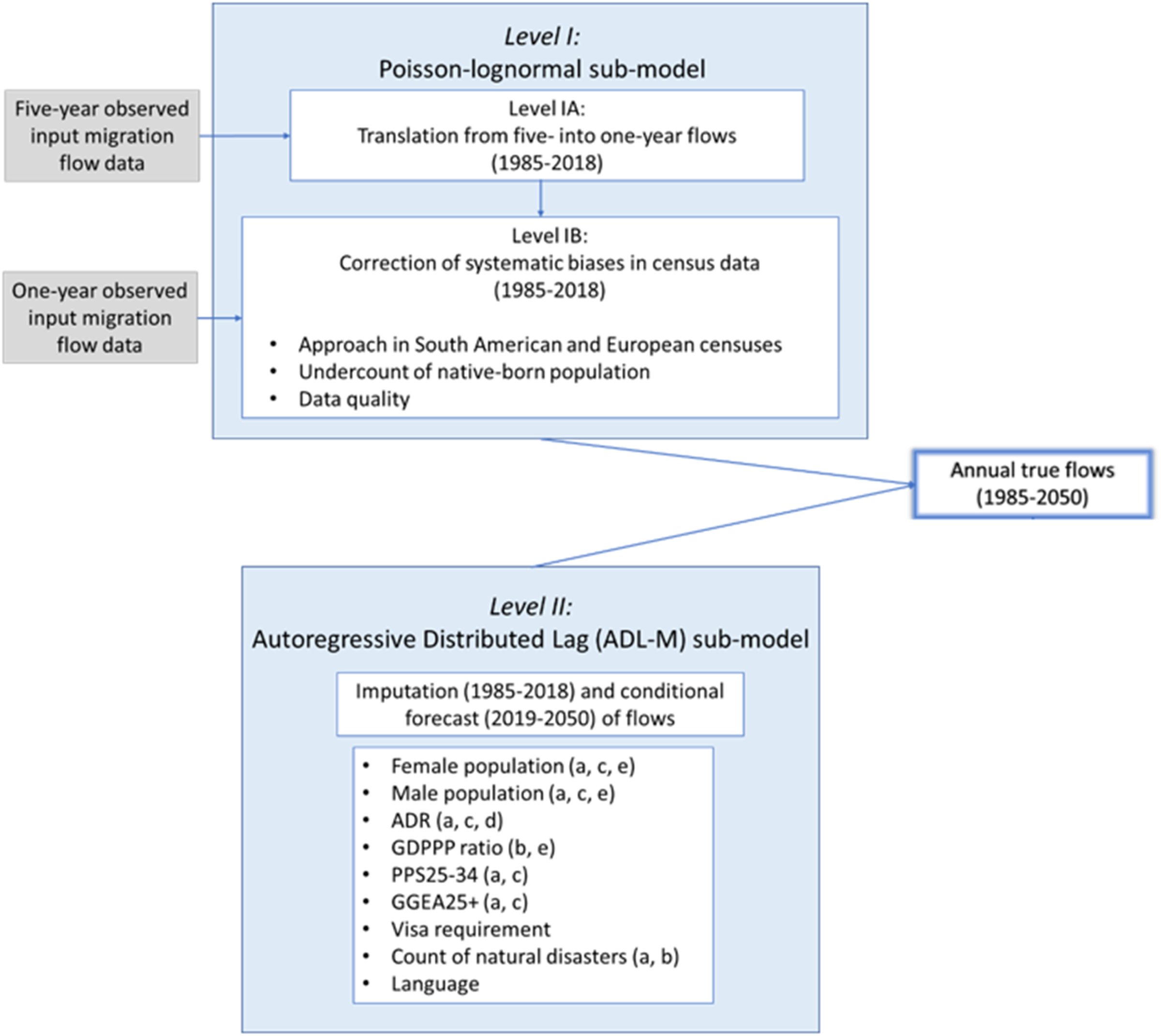
Modeling framework to estimate annual bilateral migration flows between South America and Europe from transition data extracted from censuses. (a) A variable is defined for origins and destinations; (b) both variables at time t and lagged term t–1 are included in the model; (c) only lagged term t–1 is included in the model; (d) ADR (Age Dependency Ratio) is defined as people aged 0–14 plus people aged 65+ over people aged 15–64; (e) natural logarithm transformation is used. LCH factor (Linguistic, Cultural and Historical Factor); GDPPP (Gross Domestic Product per Capita); PPS25-34 (Proportion of the Population Aged 25–34 with Post-Secondary Education Attainment); GGEA25+ (Gender Gap in Educational Attainment of the Population Aged 25 + with Post-Secondary Education).
Poisson-Lognormal Data Sub-Model (Level IA): Translation of Five-Year Data into One-Year Flows
The first level of the Bayesian hierarchical model employs a Poisson-lognormal sub-model to convert five-year migration flows into annual estimates, following the approach in Aparicio Castro, Wiśniowski and Rowe (2024). This process ensures that migration flows derived from different census intervals (one-year vs. five-year) are harmonized, allowing for a temporally consistent dataset. Five-year flows,

Here, it is assumed that the observed five-year flows

Poisson-Lognormal Data Sub-Model (Level IB): Correction of Measurement Errors and Biases in Census Data
The first level of the Bayesian hierarchical model also corrects key measurement errors in South American and European censuses. Following Aparicio Castro, Wiśniowski and Rowe (2024), the expected annual migration flows,

Here,
Autoregressive Distributed Lag Sub-Model (ADL-M, Level II)
While gravity models provide a strong structural foundation for understanding migration patterns, their predictive capacity is limited when external shocks (e.g., economic crises, policy changes) disrupt established migration corridors. To address this limitation, this study integrates ADL models, widely used in migration forecasting for their ability to capture both short-term fluctuations and long-term trends, accommodating stationary and non-stationary patterns over time.
Unlike traditional autoregressive models, ADL models allow for: (1) incorporating lagged covariates to capture immediate and delayed effects of migration drivers; (2) identifying structural breaks introduced by economic and policy shifts; and (3) including past migration flows as predictors, recognizing migration as a path-dependent process where historical trends shape future movements (Bijak 2011; Bijak et al. 2019). This makes ADL models particularly well-suited for migration analysis.
While the Poisson model is employed to disaggregate five-year flows into annual estimates, an ADL sub-model (Aparicio Castro, Wiśniowski and Rowe 2024) imputes migration flows for intercensal periods (1985–2018) and generates conditional forecasts under SSP2 scenario assumptions (Fricko et al. 2017) until 2050. The Bayesian hierarchical model's second level integrates ADL models to reduce uncertainty by incorporating time-sensitive variables (e.g., income fluctuations, natural disasters), non-time-sensitive variables (e.g., linguistic ties), and lagged migration flows, ensuring historical patterns are considered (Kim and Cohen 2010; Azose and Raftery 2015).
By integrating autoregressive lagged terms, this model explicitly accounts for migration persistence, where past migration influences future trends, while also accommodating structural changes caused by external shocks (e.g., policy reforms, economic downturns, crises).
While this model identifies correlations, it does not establish direct causal relationships. However, by combining structural migration theories (gravity models, push-pull factors) with dynamic ADL modeling, this framework provides a more accurate and adaptable approach to predicting and analyzing migration flows.
The model specification is
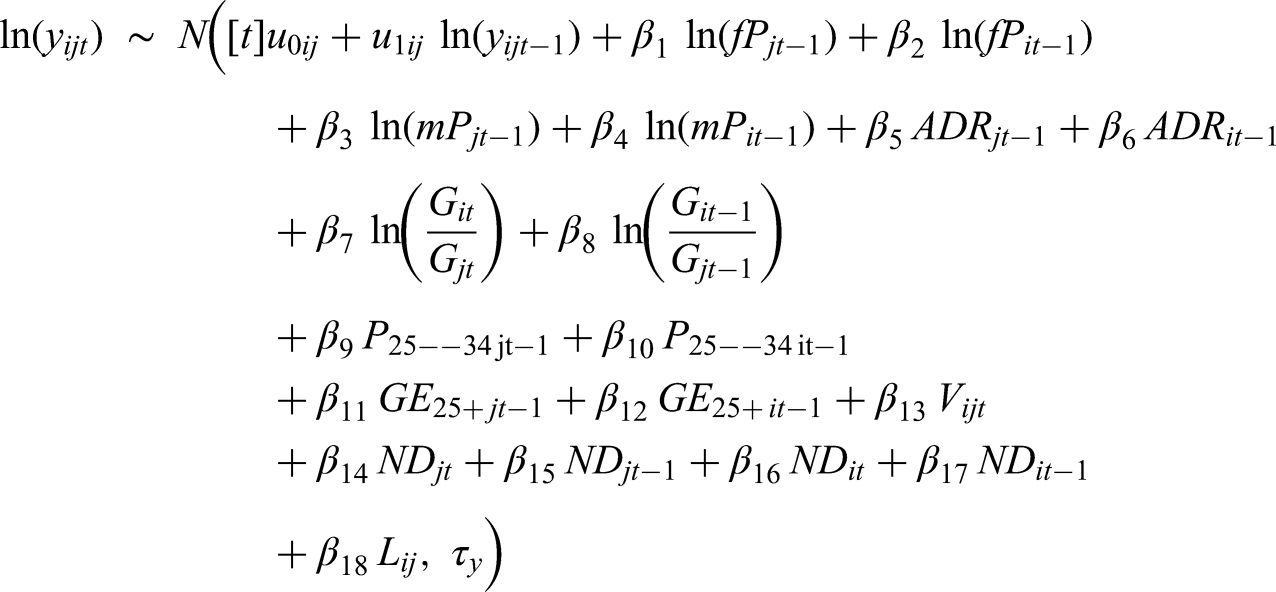
While
Results and Discussion
Understanding migration flows requires a multidimensional theoretical approach. This study integrates migration systems theory, the gravity model, and push-pull factor theory as complementary frameworks to interpret the estimated and conditional forecasted migration flows between South America and Europe. It also examines how demographic, economic, institutional, and environmental factors correlate with these flows. While this paper's models clarify these relationships, they do not imply direct causation. Instead, they provide a structured framework for empirical analysis, identifying patterns and underlying mechanisms that shape migration trends. Detailed results supporting these findings and what is described in this penultimate section can be found in SM C. Notice that values in this part of the part are rounded to the nearest thousand.
Population Dynamics: Gender and Size
Migration flows are conditioned by population sizes at origins and destinations, reflecting both the pool of potential migrants, return migration dynamics (Hinde 2014; Simini et al. 2021) and return migration potential (Newell 1988; Kim and Cohen 2010). The estimated flows demonstrate empirical patterns that align with these theories. For example, Spain resulted with higher migration flows from larger origin populations, such as Colombia (22,000–135,000 annual flows), while smaller origins like Uruguay sent fewer migrants (5,000–26,000 annually). Spain's large South American-born population (e.g., Colombians, Ecuadorians, and Peruvians) fosters both new and return migration through established social networks and economic incentives. Countries with significant diasporas tend to experience higher return migration, as transnational ties facilitate movement back to origin countries.
However, gender modifies the composition of these expected flows, as indicated by the posteriors of β₁-β₄. Migration patterns vary by gender, revealing a gendered dynamic in South America–Europe. The positive effect of female population in origins (β₅) aligns with gendered labor migration theories, indicating that South American women migrate to Europe due to their demand for low-skilled, gender-specific jobs (Chant and Pedwell 2008; Prieto Rosas and López Gay 2015; Buckley et al. 2016). This follows the push-pull framework (Lee 1966; Greenwood 2019), where economic disparities and demand for care and domestic work create strong pull factor for female migration. Conversely, the negative effect of female populations in destinations (β₆) suggests saturation in female-dominated labor sectors, temporarily reducing demand for new migrants.
The positive effect of male population in destinations (β₃) supports gravity models, where larger destination populations attract more migrants (Capoani 2023; Caballero Reina et al. 2024). Male migration is often facilitated by recruitment networks in construction and agriculture. However, the negative coefficient of male population in origins (β₄) suggests that larger male populations do not necessarily drive migration, as migration costs and limited job prospects make male migration more economically selective (Hunt and Kau 1985; De Haas 2021).
While larger populations at destinations attract migrants due to economic opportunities, they also sustain cyclical migration through return flows. Overall, female migration is shaped by labor demand, while male migration depends on economic conditions at destinations, reinforcing the selective nature of migration systems.
Demographic Pressures: Age Dependency Ratios
The ADR, or the ratio of non-working populations (0–14 and 65+) to the working-age population (15–64), is a key determinant of migration, aligning with Castro and Rogers (1984) and Rogers and Castro (1981). Migration systems theory suggests that migration is conditioned by interconnected demographic and economic circumstances, based on which others have suggested that low ADR at origins fuels emigration and high ADR at destinations attracts migrants to balance labor shortages (Beaton et al. 2017; Carling, Czaika and Erdal 2020; Sanna 2022). The positive effect of ADR in both origins and destinations (β₅, β₆) supports its relevance in South America–Europe migration.
Push-pull theory provides further insight into these dynamics. South America's high ADR (M = 0.61, SD = 0.09), largely driven by youth dependency (0.51, SD = 0.12), is associated with higher emigration as young populations enter the labor force amid economic constraints (Samir and Lutz 2017; WIC 2018). Conversely, Europe's lower ADR (M = 0.5, SD = 0.04), where elderly and youth have similar shares (0.23 and 0.27), aligns with migration inflows that help sustain labor markets and social systems (OECD 2018; Zea 2020). The estimates in this study indicate that lower ADR at origins is often observed in contexts of higher emigration. This demographic imbalance reflects age-selective migration patterns, where working-age individuals, often responsible for dependents, are the most mobile (Castro and Rogers 1984). However, while ADR is associated with migration trends, broader economic and institutional factors must also be considered in understanding migration flows (see the third, fourth, fifth, and sixth sub-sections in this penultimate section).
Looking ahead (2019–2050), the ADR imbalance between South America and Europe is expected to intensify, with Europe's ADR rising to 0.68 (SD = 0.1) by 2050, driven by old-age dependency (0.43, SD = 0.1) (Samir and Lutz 2017; WIC 2018). This will likely strenghten migration corridors such as Chilean-French, Colombian-Spanish, and Chilean-British flows, as migrants fill labor gaps. Future research should disaggregate ADR into youth and old-age dependency ratios to refine predictions on how demographic pressures shape South America–Europe migration dynamics.
Economic Disparities: GDPPP Ratios Between Origins and Destinations
This study finds a negative relationship between GDP per capita (GDPPP) and migration (β₇, β₈), indicating that as the GDPPP ratio increases, migration declines. This supports migration-development theories (Clemens 2014; De Haas 2021), which propose an inverted U-shaped relationship: migration rises with economic development but declines once an income threshold is reached, estimated at $5,000 USD.
Between 1985 and 2018, South America's average GDPPP was $11,150 USD (SD = 6,517, min=$2,774 USD), while in Europe it reached $37,053 USD (SD = 17,232, min=$5,951 USD) (Cuaresma 2017). The GDPPP ratio averaged 4.4 (SD = 2.4) for Europe-to-South America flows and 0.31 (SD = 0.2) for South America-to-Europe flows, bolstering financial barriers to migration from South America to Europe.
The negative effect of GDPPP on migration suggests that higher income levels in South American countries do not necessarily lead to increased migration to Europe. Although GDPPP has risen in South America (Cuaresma 2017), international migration trends indicate that more substantial economic growth may be required to significantly drive these movements, as well as maintaining them. Venezuela (1985–2018) illustrates these dynamics. An oil boom temporarily increased GDPPP, attracting European migrants, 32.3% of total South American inflows, primarily from Spain (42.7%), Portugal (24.1%), and Italy (23.6%) (Astorga 2003; Delgado 2018). However, economic instability reversed these flows, demonstrating that short-term GDPPP increases can facilitate migration but do not sustain it. These findings challenge traditional push-pull models that oversimplify income's role in migration (Mayda 2010; Ortega and Peri 2013). Instead, they align with more contemporary views of the migration systems theory, which emphasizes structural constraints and evolving economic and policy contexts (DeWaard, Kim and Raymer 2012).
Conditional forecasts (2019–2050) suggest moderate shifts in GDPPP disparities: the Europe-to-South America GDPPP ratio is projected to decline to 3.9 (SD = 2.4), while the South America-to-Europe ratio is expected to rise to 0.36 (SD = 0.19). Despite these shifts, economic gaps will persist, constraining large-scale migration.
Overall, this section empirically showed the inverted U-shaped migration-development hypothesis. While economic growth can enable migration, it does not necessarily sustain it. As the fifth sub-section of this penultimate part of the current paper will illustrate, this is related to persistent social inequality in certain regions that constrains intercontinental mobility. Future research should consider alternative economic indicators and non-linear models to deepen the understanding of economic drivers in South America–Europe migration.
Education Levels: Proportion of Educated Population
The positive estimates of β₉ and β₁₀ indicate that higher PPS25–34 at origin countries is associated with increased migration, aligning with push-pull theory. Education drives individuals to seek better wages abroad while drawing them toward stronger labor markets (OECD 2017; Morawska 2022). This pattern is evident in the estimated flows. Among South American origins, Brazil, Peru, and Argentina were top contributors to migration to Europe, reflecting higher regional education levels (WIC 2018). Brazil was the largest source of South American migrants, with Switzerland (21.8%), France (14.4%), the UK (12.9%), the Netherlands (9.3%), and Portugal (7.1%) as key destinations, link with education-based migration (Ploner and Nada 2020; Geddes 2021). Peru and Argentina emerged as leading sources of European-bound migrants, both also ranking among the South American countries with the highest PPS25–34 levels (WIC 2018; Sánchez-Alonso 2019; Oso and Dalle 2021).
Migration systems theory assumes that migration flows are self-reinforcing (De Haas 2010). However, highly educated migrants do not necessarily contribute to chain migration in the same way as lower-skilled migrants, as they integrate into competitive global labor markets rather than ethnic enclaves, limiting self-replicating migration patterns. Instead of balanced exchanges, they lead to, e.g., to brain drain (Zea 2020; De Haas 2021), contrasting with the expectation that migration stabilizes through return migration or remittances.
In contrast, a high PPS25–34 at destinations signals economic development and labor market demand, supporting the push-pull theory expectation that migration increases toward countries offering better economic and professional prospects (Bodvarsson and Van den Berg 2013; Capoani 2023). The estimated flows demonstrate empirically these theoretical statements. Countries with high PPS25–34 obtained high flows. For example, France resulted being the primary destination for migrants from Chile and Uruguay and a key destination for Brazil, Colombia, Ecuador, and Venezuela. Germany received the largest share of Paraguayan migrants, while Peruvian and Uruguayan migration remained significant. The UK was the leading destination for Argentina migrants and the third most important for Brazilian flows. These trends are associated with concentration of skilled migration in science and engineering fields (Pellegrino 2004; Varma, Yoon and Froese 2020; European Commission 2022).
The Czech Republic, which contributed the smallest share of migrants to South America (3,000; CI95% 913–11,000), illustrates migration selectivity based on education. Given its economic similarities to South America, migration is limited, corroboratingDe Haas’ (2021) argument that countries with lower education (measured here by PPS25–34 with values <0.3) exhibit reduced migration beyond regional labor markets. This restricts access to non-EU job opportunities, reinforcing the role of education as a migration determinant.
Gendered Educational Inequality and Migration: Insights from GGEA25+
Between 1985 and 2018, South America exhibited a negative GGEA25+ (−0.84%, SD = 3.01%), indicating that men had more schooling than women, while in Europe, a positive GGEA25+ (2.04%, SD = 5.8%) suggested higher female educational attainment, albeit with regional variations.
The posteriors of β₁₁ and β₁₂ suggest a positive effect of GGEA25 + in destinations and a negative effect in origins. Higher female education levels relative to men correlate with increased migration flows, aligning with push-pull theory, where skilled women move to destinations offering better career prospects and gender-equal labor markets (OECD 2017; Dustmann, Kastis and Preston 2022; Morawska 2022). Conversely, greater gender inequality in education at origins appears to limit mobility, reinforcing involuntary immobility (Schewel 2020).
These patterns were reflected in the estimated flows. South American countries with greater gender disparities obtained higher outflows. Paraguay, which emerged as the least attractive South American destination for European migrants (0.72% of total inflows), illustrates this pattern. Its low migration inflows are correlated to structural inequalities, including a negative GGEA25+ (−2.5%), indicating that men are more educated than women. Further research is needed to establish the mechanisms behind this association. In contrast, Bolivia and Peru exhibit different migration dynamics. Despite below-average GDPPP levels, a minor change in GGEA25 + coincides with migration shifts, which may suggest a link between gendered educational attainment and migration opportunities. This supports De Haas, Castles and Miller (2022), who argue that despite socio-economic improvements, countries like Argentina, Brazil, and Chile remained unattractive to migrants until they significantly reduced inequalities in the 1990s.
The estimates indicate that European destinations with high GGEA25 + correspond to higher inflows, strenghtening the idea of the role of gendered labor markets in migration. This gendered educational migration shapes long-term human capital trends. While migration systems theory anticipates migration balancing through return flows and remittances, the continued outflow of highly educated individuals suggests that some origin countries may struggle to retain skilled workers and to enhance social inequality (De Haas 2010). Indeed, the persistence of gendered educational migration intensifies South America's “brain drain.” Rather than sustaining reciprocal flows, the continued emigration of highly educated individuals may widen human capital disparities and create educational imbalances in origins (O’Neill et al. 2017; Zea 2020).
By 2050, migration to South America is projected to increase, partly due to rising GGEA25 + in favor of women in both Europe (mean = -4.5%, SD = 5.8%) and South America (mean = -4.9%, SD = 3.3%). The UK and France are expected to emerge as key destinations for South American migrants, particularly from Chile, Colombia, and Brazil. These shifts underscore the need to integrate gender disparities into migration forecasting models to better understand their role in conditioning long-term mobility patterns (Cuaresma 2017; Samir and Lutz 2017; Leimbach et al. 2017; WIC 2018).
Visa Requirements and Institutional Barriers
Visa policies shape migration by selectively facilitating or restricting flows rather than uniformly increasing movement. While open policies are expected to boost migration by removing barriers (De Haas, Castles and Miller 2022), the posterior of β₁₃ suggests a more complex role. Visas act as institutional filters, enabling specific mobility patterns while deterring others.
Migration systems theory indicates that networks sustain flows over time (Massey et al. 1999; DeWaard, Kim and Raymer 2012), yet visa policies disrupt these feedback loops, reshaping access to sectors and destinations. This study found that eased visa restrictions correlated with increased migration. In the early 2000s, Brazil facilitated high-skilled European migration while limiting inflows from neighboring South American countries, redirecting migration toward targeted industries (Muñoz Bravo 2020). Brazil consequently became the leading South American destination for European migrants (37.3% of inflows) between 1985 and 2018 (Georg Uebel and Prestes Abaide 2017) and a key origin for South Americans migrating to Europe (Ploner and Nada 2020; Geddes 2021). Between 1985 and 2018, an estimated 144,000 Brazilians migrated annually to Switzerland (21.8%), France (14.4%), the UK (12.9%), the Netherlands (9.3%), and Portugal (7.1%). These trends suggest that state policies influence migration systems, rather than flows persisting automatically.
The push-pull model frames migration as a response to economic and social conditions (Lee 1966; Greenwood 2019). However, visa regimes influence which factors become relevant. Brazil's industrial expansion (Lamber et al. 2012) and education-driven migration to the UK, France, and Germany (Pellegrino 2004; European Commission 2022) align with pull factors for high-skilled migrants. Conversely, European visa restrictions limited Bolivian migration, despite economic pressures, establishing institutional barriers as regulators of access to opportunities.
Preferential agreements, such as EU mobility pacts, counteract restrictions by reinforcing corridors through selective waivers. While visas generally act as intervening obstacles (Lee 1966), exceptions exists. Venezuela maintained visa requirements for Europeans for 83% of the period analyzed (1985–2018) (Villares, Vezolli and Haas 2014; DEMIG 2015), yet still received 32.3% of European migration to South America, primarily from Spain (42.7%), Portugal (24.1%), and Italy (23.6%), flows driven more by historical ties than migration policies (Astorga 2003; Delgado 2018).
Legal frameworks also shape migration. Colombia's Schengen visa exemption (2015) coincided with increased migration to Europe, while Bolivia experienced major fluctuations (2005–2007) following EU visa restrictions in 2007, illustrating how legal barriers can override economic factors (Hinojosa and De la Torre Ávila 2014).
Natural Disasters as Migration Driver
Natural disasters are increasingly recognized as key migration drivers, often classified under involuntary mobility (Carling 2002; Piguet, Pécoud and De Guchteneire 2011; Carling, Czaika and Erdal 2020; Schewel 2020). However, this study's estimates show that disasters in origin regions do not immediately increase migration, as evidenced by the negative effect of natural disasters occurring in the same year (β₁₆). This suggests that affected populations may experience involuntary immobility (Black et al. 2011; Schewel 2020), lacking the resources to migrate in the short term, particularly in long-distance migration corridors like South America–Europe. Instead, migration responses tend to be delayed, reinforcing findings that environmental displacement often unfolds gradually rather than as an immediate reaction (McLeman 2013; EASO 2016; IDMC 2022).
The positive effect of lagged natural disasters in origins (β₁₇) suggests that migration increases over time as populations recover financial and logistical capacity. This aligns with push-pull theory (Lee 1966; Massey et al. 1993), where environmental stressors act as a delayed push factor rather than an immediate trigger. Similarly, the positive effect of natural disasters in destinations (β₁₅) highlights how environmental shocks shape migration systems, potentially increasing return migration or influencing relocation decisions within migrant communities. These findings challenge traditional migration systems theory, which assumes that migration flows are primarily sustained through networks rather than reactive to external shocks (De Haas 2010).
Among European countries, France, Italy, and Germany resulted with the highest number of natural disasters, while Brazil, Colombia, and Peru were the most affected in South America. Despite these environmental challenges, Brazil remained the region's largest migration hub, suggesting that economic circumstances and policy frameworks mediate the impact of environmental stressors on mobility patterns. These results underscore the need to incorporate environmental factors into gravity models, acknowledging that natural disasters influence migration not in isolation but in conjunction with economic and institutional contexts.
Overall, this study's findings indicate that environmental hazards shape migration dynamics, but their effects are conditioned by economic resilience and geographic proximity (Cattaneo et al. 2019). While disasters serve as a long-term push factor in origins, they also influence destination attractiveness, showing the need for adaptive migration policies to address climate-induced displacement (Bardsley and Hugo 2010; McLeman 2013).
Language and Cultural Integration
The positive effect of shared language on migration flows, as captured by the language parameter (β₁₈), supports the notion that linguistic commonality reduces cultural distance and facilitates integration by lowering adaptation costs and bolstering migrant networks, as described in gravity models (Capoani 2023). This aligns with migration systems theory, which suggests that migration is self-reinforcing through network effect (Massey et al. 1999; DeWaard, Kim and Raymer 2012).
Migration between Spanish-speaking South American countries and Spain illustrates this pattern. Between 1985 and 2018, Spain was the leading European origin of migrants in South America, with an estimated 463,000 emigrants (CI95%: 192,000–1.82 million). Spain was also the top origin for eight of the ten largest South American countries and received between 19,000 and 660,000 migrants annually. The Instituto Nacional de Estadística (2023) recorded 562,060 migrants from Colombia, Ecuador, Venezuela, and Peru between 2010 and 2018, aligning with these estimates. Forecasts suggest Spain will remain the primary European destination, receiving between 14,000 and 1.3 million South American migrants between 2019 and 2050, particularly from Colombia (28.1%) and Ecuador (22.4%).
As seen, significant uncertainty surrounds these estimates. The widening confidence intervals indicate systemic volatility rather than mere statistical variation, suggesting that migration patterns are not as stable as migration systems theory traditionally assumes. As migration flows are highly susceptible to external shocks, such as economic crises, policy shifts, and geopolitical events, uncertainty in long-term migration projections is inevitable. The confidence intervals reflect not only statistical variation but also the inherent unpredictability of future migration dynamics, reinforcing the idea that migration forecasts must account for structural shifts rather than assuming stability.
Bijak et al. (2019) highlight that large forecast credible intervals serve as a warning sign of instability, reflecting shifts within the migration corridor itself. Historically, migration flows have reversed, from Europe-to-South America in the early twentieth century to South America-to-Europe in recent decades, demonstrating that migration systems evolve in response to external shocks, policy changes, and demographic transitions. To better account for these structural shifts, future research should integrate heavy-tailed distributions, which allow for sudden, unpredictable migration surges that standard forecasting models may underestimate. Despite the inherent uncertainty, the migration trends seen until 2050 provide a useful reference for researchers, allowing them to assess the persistence of migration systems and potential future migration dynamics.
The current results also underscore the complexity of migration determinants beyond linguistic proximity. While language lowers adaptation costs and facilitates integration (Greenwood 2019), it is not sufficient to explain migration. Brazil's ability to attract European migrants despite Portuguese being less widely spoken than Spanish demonstrates the importance of economic incentives and policy frameworks. Its visa facilitation programs for high-skilled workers (Muñoz Bravo 2020) strenghten the role of institutional factors, aligning with findings on the broader impact of political determinants in migration (De Haas 2014). These results demonstrate the complexity and evolving nature of migration systems whilst providing empirical evidence for the persistence of historical migration ties.
Conclusion
Contributions
This study advances the understanding of South America–Europe migration dynamics by providing empirical evidence of its persistence as a migration system and analyzing the drivers sustaining these flows over time.
Empirical Evidence for a South America–Europe Migration System
A central contribution of this study is the systematic estimation of bilateral migration flows between South America and Europe from 1985 to 2018 and conditional forecasts until 2050, generating a complete, comparable, and consistent time series of annual flows. These estimates provide empirical evidence corroborating the existence and persistence of a South America–Europe migration system, demonstrating structured flows that align with migration systems theory (Massey et al. 1999; De Haas 2010).
The study confirms stable migration corridors over decades, particularly from Colombia, Ecuador, and Venezuela to Spain; Brazil and Argentina to Portugal and Italy; and Chile to France and the UK. These self-reinforcing pathways, underpinned by historical, linguistic, and cultural ties, align with the core propositions of migration systems theory, which posits that migration flows evolve through interconnected feedback loops. The persistence of specific corridors, such as Venezuela-Spain and Brazil-Portugal, supports the idea that migration networks sustain flows over time.
The results also confirm that European emigration to South America in the early twentieth century has been replaced by South American emigration to Europe since the late twentieth century, demonstrating an evolving migration system. Conditional forecasts (2019–2050) suggest that these patterns will persist, particularly toward Spain, Portugal, France, and the UK, further reinforcing the structured nature of the system.
While the persistence of migration corridors aligns with migration systems theory, this study also identifies significant volatility in migration estimation. The widening confidence intervals serve as a warning sign of instability, reflecting shifts within the migration corridor itself, highlighting that while migration flows persist, their intensity can fluctuate significantly over time.
Structural Drivers Sustaining Migration Over Time
This study empirically assesses how gender-specific population sizes, demographic pressures measured by the ADR, economic disparities (GDPPP ratios), education levels, visa requirements, environmental factors, and post-colonial ties sustain South America–Europe migration over time. The findings demonstrate that these drivers do not act in isolation but rather interact in complex, non-linear ways, reinforcing or modifying migration patterns.
In terms of economic disparities and migration selectivity, the estimated flows confirm an inverted U-shaped relationship between economic development and migration, where migration initially rises with economic growth but declines once a threshold is reached (Clemens 2014; De Haas 2021). Additionally, migration is constrained by affordability factors, low GDPPP in South America limits emigration, while higher GDPPP reduces migration aspirations as local conditions improve. The Venezuelan case (1985–2018) exemplifies this pattern: a temporary oil boom led to increased European immigration, which reversed as economic instability took hold.
Regarding the demographic imbalances measured by the ADR and labor market dynamics, this study showed how the high ADR in South America is associated with higher emigration as youth enter the labor force amid economic constraints, whilst low ADR in Europe is correlated with increased inflows, sustaining labor markets in aging societies. Conditional forecasts for 2050 suggest these imbalances will intensify, further reinforcing migration corridors such as Colombia-Spain, Chile-France, and Brazil-Portugal.
The post-colonial ties operationalized by sharing a language appeared as a strong empirical aspects that support the South America–Europe migration. Spanish-speaking South Americans overwhelmingly migrate to Spain, while Portuguese-speaking Brazilians migrate to Portugal. These patterns align with gravity models, where linguistic and cultural proximity reduce migration costs and foster integration (Capoani 2023).
The study challenges the assumption that open visa policies always increase migration (De Haas, Castles and Miller 2022). Instead, it finds that visa requirements act as institutional filters, facilitating specific types of mobility while deterring others. Brazil's visa facilitation for high-skilled European migrants redirected flows toward targeted economic sectors. EU visa restrictions in 2007 reduced Bolivian migration despite strong economic push factors, reinforcing the role of legal barriers in shaping mobility. Venezuela presents an exception: despite strict visa requirements, historical ties with Spain, Portugal, and Italy sustained migration, highlighting that institutional barriers do not always override historical migration systems.
Methodological Contributions
By integrating migration systems theory, gravity models, and push-pull factors with a Bayesian hierarchical framework, this study advances migration research in three key ways. First, it empirically tests the persistence of migration flows rather than assuming their continuity a priori. It integrates migration systems theory with gravity models and push-pull factors, systematically linking theoretical constructs to measurable migration determinants. By distinguishing between structural drivers (economic and demographic pressures) that sustain migration and contextual factors (policy changes, environmental shocks) that modify patterns, this study refines the understanding of migration system dynamics.
Furthermore, by harmonizing one-year and five-year transition census data, this study produces a complete, comparable, and consistent time series of migration flows for 10 South American and 20 European countries. It corrects for undercounting of native-born migrants and adjusts for census-based inconsistencies, improving cross-national comparability. This addresses a gap related to the lack of reliable data and validate the robustness of the statistical model proposed in Aparicio Castro, Wiśniowski and Rowe (2024) by demonstrating its applicability to data beyond South America.
Related to the data created in this research, it must be noted that this is a unique set of synthetic migration estimates that bridge the gap between cross-national inconsistencies in migration definitions. While previous research has highlighted the challenge of inconsistent census-based migration data (Abel and Cohen 2019), the synthetic estimates produced in this study provide a more comprehensive and comparable time series of flows. Also, unlike studies such as Rogers, Raymer and Newbold (2003) and Newbold (2001), which focus primarily on internal migration transitions, this research extends these comparability to international flows.
By harmonizing cross-national inconsistencies in census data, this study offers a more comparable, complete, reliable, and consistent migration dataset that can be used in comparative migration system analyses, mitigating definitional discrepancies in migration statistics, as census data collection follows commonly shared guidelines. These synthetic migration estimates allow for historical and prospective analysis of migration corridors, enhancing the comparability of migration trends across countries. Furthermore, these synthetic estimates significantly enhance the granularity of existing datasets on South American migration, such as those from QuantMig (Bijak et al. 2019) and IMEM (IMEM 2013), enabling more detailed cross-country analyses.
Finally, unlike traditional migration forecasts that rely primarily on GDP-based models, this study incorporates demographic, institutional, and environmental factors, reducing long-term uncertainty. This aligns with other work (see Cappelen, Skjerpen and Tønnessen 2015; Bijak et al. 2019), in which the robustness of ADL models in handling non-stationary data for conditional migration forecasting was highlighted. By incorporating key migration determinants, including economic, demographic, institutional, and environmental factors, this model enhances the understanding of migration system dynamics and their evolution over time. In addition, the model advances SSP-based migration analysis by integrating time-sensitive variables (e.g., income fluctuations, visa regimes) with stable variables (e.g., population size, linguistic ties), strengthening the predictive capacity of migration forecast.
Limitations and Future Work
Despite the methodological advancements presented in this paper, several limitations remain. A primary limitation is the reliance on census data, which, while the most comparable and complete source available, carries inherent biases. Future research should explore the integration of census migration data with other sources, such as administrative records, migrant surveys, and digital trace data, to mitigate biases and enhance the reliability of migration flow estimates.
Another limitation is that the present study estimates total migration flows between South America and Europe without accounting for migrant characteristics. Future research should disaggregate flows by migrant type (e.g., native-born vs. foreign-born), age, gender, education level, occupation, and skill level to assess the impacts on labor markets and demographic structures. Such analyses would provide deeper insights into how different migrant groups are affected by migration drivers.
Additionally, expert elicitation could be incorporated to refine model parameters and assess the relevance of corridor-specific variables. This would improve the accuracy and applicability of the resulting estimates and conditional forecasts. Future work should explore the integration of expert-based scenario-building approaches and alternative data sources, such as digital trace data and administrative records, to refine migration forecasts and reduce uncertainty. Moreover, incorporating heavy-tailed distributions in hierarchical Bayesian models could better capture sudden migration shocks. As noted in Aparicio Castro, Wiśniowski and Rowe (2024) and Welch and Raftery (2022), this will be usedul in capturing migration values that deviate significantly from the mean distribution of flows. A potential avenue for future research is therefore the independent modeling of these tail distributions, allowing for improved representation of extreme migration scenarios, particularly in response to crises such as economic downturns, geopolitical conflicts, and environmental disasters. These methodological advancements would enhance the robustness of migration projections and generate policy-relevant insights.
Finally, this study acknowledges the inherent uncertainty in long-term migration forecasts, particularly those extending to 2050. As Barker and Bijak (2020) and Bijak (2024) note, uncertainty increases across time horizons, requiring careful interpretation of projection results. One way to address this challenge is to frame long-term forecasts within a scenario-based approach, where uncertainty bounds define plausible migration trajectories. The integration of migration-specific narratives into shared socioeconomic pathways (SSPs) could enhance the interpretability and policy relevance of these forecasts.
By addressing these limitations and expanding on the current methodology, future research can further advance the empirical and theoretical understanding of migration flows between South America and Europe, supporting the importance of robust, harmonized migration data in global migration research and policy development. Moreover, this study lays the groundwork for future research into how migration systems evolve in response to global economic, environmental, and policy shifts, contributing to broader discussions on international migration governance and forecasting methodologies.
Supplemental Material
sj-docx-1-mrx-10.1177_01979183251352404 - Supplemental material for Estimating and Conditional Forecasting Bilateral Migration Flows Between South America and Europe, 1985–2050
Supplemental material, sj-docx-1-mrx-10.1177_01979183251352404 for Estimating and Conditional Forecasting Bilateral Migration Flows Between South America and Europe, 1985–2050 by Andrea Lisette Aparicio Castro, Arkadiusz Wiśniowski, Dilek Yildiz and Michaela Potančoková in International Migration Review
Footnotes
Declaration of Conflicting Interests
The authors declared no potential conflicts of interest with respect to the research, authorship, and/or publication of this article.
Funding
The authors disclosed receipt of the following financial support for the research, authorship, and/or publication of this article: This work was supported by the European Union’s Horizon 2020 research and innovation programme (grant agreement No. 870649, Future Migration Scenarios for Europe — FUME); by the Economic and Social Research Council (ESRC) through the North West Social Science Doctoral Training Partnership (NWSSDTP, grant number ES/P000665/1); and by additional NWSSDTP funding for an Overseas Institutional Visit at the International Institute for Applied Systems Analysis (IIASA). Part of this research was developed during the Young Scientists Summer Program 2021 at the International Institute for Applied Systems Analysis (IIASA), Laxenburg, Austria.

Supplemental Material
Notes
References
Supplementary Material
Please find the following supplemental material available below.
For Open Access articles published under a Creative Commons License, all supplemental material carries the same license as the article it is associated with.
For non-Open Access articles published, all supplemental material carries a non-exclusive license, and permission requests for re-use of supplemental material or any part of supplemental material shall be sent directly to the copyright owner as specified in the copyright notice associated with the article.
