




Abstract
Much remains unknown about how threat evasion—migration undertaken to escape threats to survival—occurs at the family level. With the phenomenon of threat evasion as our principal focus, we collected and analyzed 65 in-depth interviews and four focus groups (N = 44) among a highly diverse sample of Latin American asylum-seekers and other migrants in need of international protection (MNP) in Costa Rica. Across MNP from diverse backgrounds, family separation emerged as one of the most prominent themes. Family separations were closely related to families’ evolving degrees of agency, which shaped variation in separations’ anticipation and duration. Conceptualizing anticipation and duration as two intersecting continuums, in this article, we describe different types of MNP family separation, link these types to differences and changes in families’ perceived control over the migration process, and illustrate their distinct emotional and practical implications. Our findings deepen understandings of MNP family separation, and at the same time, broaden theories of migration volition to demonstrate their applicability and implications at the family level.
Introduction
Migration scholars frequently contend that migration occurs along a spectrum of volition (Fussell 2012; Erdal and Oeppen 2018; Liberona Concha et al. 2021; Arar and FitzGerald 2023; Weitzman and Huss 2024), with abundant scholarship debating the challenges and stakes of labeling migration as “forced” versus “voluntary” (Piguet 2018; Abdelaaty and Hamlin 2022) or of categorizing individuals as “economic” or “labor migrants” versus “refugees” (Yarris and Castañeda 2015; FitzGerald and Arar 2018). Nevertheless, most theorization and empirical examination of migration volition occurs at the individual level, leaving conceptualizations of family-level volition underdeveloped (see Arar and FitzGerald (2023), 92–103 for an exception). Considering that decisions about migration are often made at the family level (Stark and Bloom 1985), even amid imminent threats (Poole 2022; Arar and FitzGerald 2023, 92–103), it is imperative to examine family migration volition, or in other words, the “voluntariness, choice and alternatives” (Erdal and Oeppen 2018, 982) that families perceive as they contend with threats in countries of origin, navigate the migration journey, and resettle (or not) in new destination(s).
Responding to this need, we analyze highly detailed qualitative data collected from over 100 “migrants in need of international protection” (MNP) (UNHCR 2024b) in Costa Rica to reveal how their perceived control over the migration process is connected to the anticipation and duration of family separations, and in turn, to their emotional well-being and day-to-day life. Globally, an estimated 52 million people are MNP (UNHCR 2024b), including “prospective asylum-seekers, asylum-seekers, recognized refugees and persons with complementary, subsidiary and temporary forms of protection, and others in refugee-like situations,” and people “outside their country or territory of origin…because they have been forcibly displaced across borders [but] have not been reported under other categories” (UNHCR 2024a). Existing scholarship oftentimes refers to this population as displaced persons (Bohra-Mishra and Massey 2011), sociological refugees (Arar and FitzGerald 2023), or forced, involuntary, or humanitarian migrants (De Maio et al. 2014; Gisselquist 2021; Saarela and Wilson 2022). We rely on the term MNP to avoid insinuating a complete lack of agency (e.g., forced, involuntary, displaced) and to sidestep colloquial terms that have specific legal definitions (e.g., refugees, humanitarian visa holders).
We analyze a purposively diverse sample of MNP who originated from numerous countries across South and Central America, fled a multiplicity of threats, have different transnational family structures, and possess a range of legal immigration statuses. Leveraging this diversity to discern central themes and patterns across a plurality of conditions, we make three contributions to existing scholarship. First, by considering family separations among MNP writ large, rather than only among refugees or asylum-seekers, we examine family separation as a function of the process of threat evasive migration rather than as a function of a highly politicized trait (e.g., refugee status). Second, we show how differing degrees of MNP families’ control over the migration process produce two key types of heterogeneity in family separation—anticipation and duration—which fall along continuums. These continuums extend theoretical conceptualizations of migration volition to the family level by illustrating how perceived agency relates to which MNP family members separate and when, how, and for how long. Third, beyond this theoretical contribution, empirically, we demonstrate that the intersection of anticipation and duration informs the perceived emotional and practical implications of family separation.
Family Separation as a Matter of Family Migration Volition
Migration scholars interested in the “continuum between voluntary and forced” migration (Fussell 2012, 40) urge existing scholarship to “move beyond merely accepting that the distinction is complex” (Erdal and Oeppen 2018, 988). Analytically, however, embracing this complexity is challenging (Ottonelli and Torresi 2013; Erdal and Oeppen 2018; Riosmena 2024). Doing so requires taking “a critical approach that questions not simply ‘causes’ but also responses, as they are mediated through migrants’ agency” (Erdal and Oeppen 2018, 984). It further requires examining migration volition as a simultaneous matter of the existence of acceptable alternatives and of migrants’ ability to choose among them (Olsaretti 1998; Erdal and Oeppen 2018) while taking into account both “positive (‘freedom to’) and negative (‘freedom from’) liberties” or lack thereof (de Haas 2021, 17). For instance, migration undertaken to avoid threats is not only motivated by the pursuit of negative liberty, such as freedom from violence, but is also shaped by the availability of positive liberties, such as physical and economic freedom to leave.
Family migration volition is a central, underlying dimension of family separations, which occur through a sequence of decisions (or lack thereof) that families implicitly make (or not) about whether and how to separate and whether and how to reunify. According to the new economics of displacement framework (Arar and FitzGerald 2023, 76–79), and its antecedent, the new economics of labor migration framework (Stark and Bloom 1985), families’ decisions are based on cost–benefit analyses of the risks and opportunities associated with family members staying versus leaving. These include decisions about who in the family should migrate and when, where, and how they should migrate, all of which may differ for different family members (Arar and FitzGerald 2023, 76–108). Each decision can be constrained by the nature of threats families face in their countries of origin and/or by economic or logistical obstacles they face to migrating and resettling abroad. Moreover, families’ migration calculus may shift over time, alongside shifting conditions in their country of origin, on migration routes, and in countries of reception (Arar and FitzGerald 2023; Arriola Vega 2024). In some instances, families might not make any decision at all, but instead, become forcibly separated by outside parties, such as by smugglers or the state (either in sending or receiving contexts) (Nicholson 2021; Estévez 2022).
Examining family separation as a matter of family volition thus not only expands current conversations about the voluntary/forced categorization of migration to the family level but also heeds recent calls to examine co-occurring and interrelated migration mechanisms (Riosmena 2024), of which there are at least four at play. First, MNP family separations can stem from rational choices (Czaika, Bijak and Prike 2021)—even under threat—given families’ cost–benefit analysis of different migration scenarios, such as migrating together, staggering their migration, migrating to different destinations, and/or leaving some members behind (semi)permanently (Ahrens and King 2023; Arriola Vega 2024). Second, when families under threat separate as part of a staggered migration strategy, and thus anticipate reunifying, the migration of trailing family members may be simultaneously motivated by family reunification and by threat evasion. Third, when economic constraints prevent all family members from migrating together, staggered family migration hinges on the ability of “pioneer” family members to cultivate the economic and/or social capital necessary to help family members who remain in origin to outmigrate and join them abroad (de Haas 2010). In this way, “opportunity seeking”—which is oftentimes viewed as conceptually distinct from threat evasion (Van Wijk 2010; Donato and Massey 2016)—can be an intentional family strategy to enable threat evasion. Fourth, over time, separated families’ ability to reunify—when they want to—is indicative of their aspiration-capability (de Haas 2021), meaning their ability to realize a “wish to migrate” (in order to be reunified) (Carling 2002, 5).
Migrants in Need of International Protection Family Separation Processes
Migrant family separation has been the subject of substantial inquiry for several reasons. First, family separation (re)shapes transnational family structures, resulting in family dispersion across borders and the corresponding reformulation of family households in both countries of origin and abroad (Fouratt 2019; Weitzman and Huss 2024). Family separations thus affect migrant family dynamics and incorporation into contexts of reception by way of remittances, cost-sharing, childcare arrangements, and other changes in migrants’ social and economic support systems (de Haas 2010; McNatt and Boothby 2018; Van Hook and Glick 2020). Second, because families constitute one of the main institutions with which people typically interact on a daily basis, being separated from family members portends many mental health repercussions, from stress and anxiety to loneliness, depression, and identity loss (Nickerson et al. 2010; Tinghög et al. 2017; Miller et al. 2018).
Extant scholarship points to several processes that encourage and/or prolong MNP family separation. These processes generally constrain families’ choices in their countries of origin, on the migration journey, and/or in contexts of reception. Thus, implicitly, these processes should shape how much control families wield over their migration process, which may change over time. Correspondingly, and as we later show, they inform how much families anticipate separating and the duration with which they remain separated.
First, MNP leave their country of origin to escape threats to their and their families’ survival—threats that are ostensibly outside of their control (Donato and Massey 2016; Arar and FitzGerald 2023, 79–81; Weitzman and Huss 2024). In Latin America, these threats are diverse and geographically variegated but typically entail gender-based violence (Cook Heffron 2019), gang violence (Baranowski et al. 2019; Inkpen, Pitts and Lattimore 2021), guerilla warfare (Silva and Massey 2015), narcotrafficking (Shultz et al. 2014), political persecution (Benavides and Amador 2022), and/or political and economic collapse (John 2019). Threats like these not only vary from place to place but oftentimes within families. Resultantly, the precipitating events that impel migration may generate a greater sense of urgency for some family members than others (Arar and FitzGerald 2023, 96–100). Moreover, opportunities in countries of origin—which represent potential losses if left behind—can also be unevenly distributed within families, making some members more hesitant to leave than others, even when faced with threats (Arar and FitzGerald 2023, 98–99). As threats escalate, families may feel pushed to make decisions about whether and how to stagger their migration and/or separate indefinitely, sometimes with little ability to plan ahead (Chandler et al. 2020). Moreover, as the nature of threats changes in countries of origin, so too may families’ migration calculus (Arar and FitzGerald 2023, 90–92).
Second, after deciding that migration is necessary for survival, families facing threats may encounter economic constraints to their departure. They may lack the financial resources needed to relocate all family members, afford bureaucratic costs like legal fees, and/or cover living expenses with little to no income abroad. In the face of these economic constraints, families may decide to separate so that at least some members can escape immediately (Arar and FitzGerald 2023, 98). Likewise, families may decide to separate to maintain the assets or income needed to financially support members who migrate abroad (Arar and FitzGerald 2023, 98–99).
Third, once on the migration journey, bureaucratic obstacles and other unanticipated events may separate MNP family members. For instance, procedural issues and expired passports can delay migrants’ departure (Dubow and Kuschminder 2021). When their families are in danger, those without proper travel documentation must choose to either travel without the necessary paperwork or stay behind (at least temporarily) while encouraging family members to leave. Likewise, when unexpected border closings disrupt travel plans (Chandler et al. 2020), family members may decide to split up and take different routes.
Fourth, after migrating abroad, most MNP face difficulties securing asylum or other permanent protected statuses (Selee and Bolter 2020). As a result, they may spend years living in legal limbo (Mountz et al. 2002; Coates and Hayward 2005; Menjívar 2006; Fouratt 2016), obstructing access to the formal labor market, healthcare, and other public institutions, depending on the context of reception (Ortlieb and Knappert 2023; Takenaka 2024). Their corresponding sense of liminality, impermanence, and precarity, in turn, may make some MNP hesitant to have family members join them abroad (Menjívar 2006; Chandler et al. 2020).
In sum, the precipitating threats, economic costs, and bureaucratic or physical obstacles inherent to threat evasion contribute to MNP family separation by shaping families’ perceived risks, opportunities for survival, and constraints on their mobility. Yet, even with some strategizing, who becomes separated, when separation occurs, and how long it persists may not be entirely foreseeable or within families’ control.
Data and Methods
Study Setting
Costa Rica is a small Central American country with roughly five million residents (INECCR 2021) that, for the last half-century, has received MNP from across Latin America (Morales-Gamboa 2008). Between 2017 and 2022, the number of MNP in Costa Rica skyrocketed from approximately 11,000 to >260,000 in 2022, with the majority arriving from Nicaragua (Figure 1). Nevertheless, the number of Venezuelan MNP in Costa Rica has also risen dramatically, the number of Cuban MNP has begun to rise, and the number of Salvadoran and Honduran MNP has remained comparatively smaller but nonetheless steady (Figure 1).
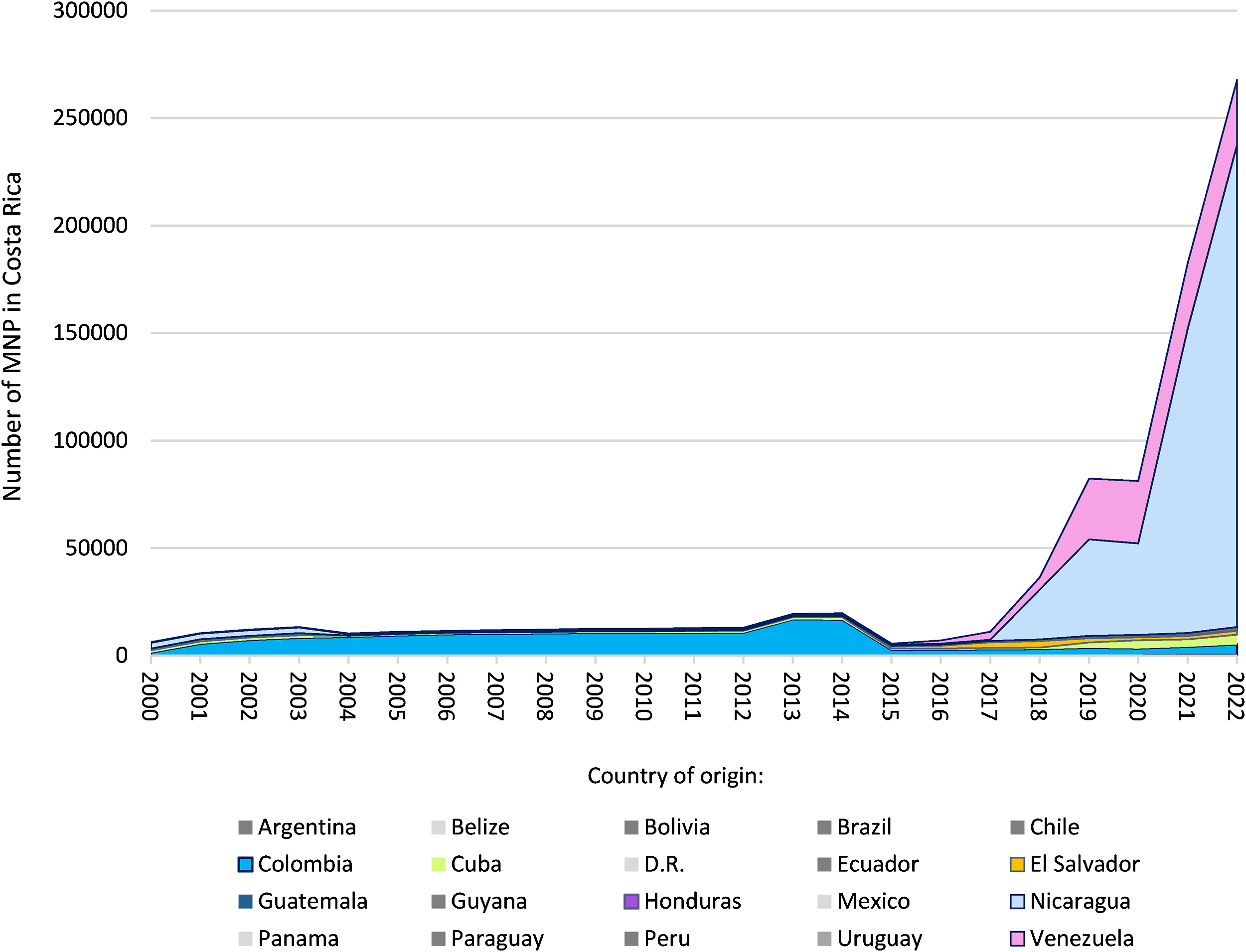
Estimated number of Latin American migrants in need of international protection in Costa Rica, 2000–2022, disaggregated by country of origin.
At the time of our data collection, from 2019 to 2022, asylum-seekers were eligible for work permits while awaiting an asylum interview, but this has since changed (Téllez 2023). All migrant children in Costa Rica are entitled to free medical care along with universal educational access, mirroring the rights of citizens (UNHCR 2023). Once approved for asylum, asylees have the right to family reunification visas for their dependent children, siblings, and parents (UNHCR 2023). Nevertheless, xenophobic sentiments are worsening in legislative developments and the local media, where migrants are increasingly framed as threats to national security and undeserving of public resources (Fouratt 2014; Fouratt and Castillo-Monterrosa 2022). To enter Costa Rica legally, most foreigners need just a passport, with the exception of Nicaraguans, Venezuelans, and several other nationalities. Because Costa Rica maintains one detention center with a maximum capacity of 50 people, migrants are rarely detained, even when they have irregular status (Global Detention Project 2020).
Economically, Costa Rica has been on the precipice of a financial crisis for roughly eight years. High inflation, increased interest rates, and the soaring cost of basic goods such as food and rent make daily life challenging (Ramirez 2024). Moreover, unemployment and informality affect over half the population; and high tax rates, needed to service the country's large national debt, further strain the economy (OECD 2023). These economic conditions make Costa Rica an expensive place to live and a difficult place to find work.
Analytic Sample and Data Collection
We analyze data from focus groups and semistructured, in-depth interviews conducted with adult MNP ≥18 years old. For both, we recruited individuals who had been in Costa Rica for up to five years, which allowed us to inquire about the initial years of incorporation while participants were still amid them. To purposively recruit a diverse sample, we worked with a well-established, local NGO known as Fundación Mujer, whom we asked to identify and help recruit MNP originating from a variety of countries, encompassing different relationship statuses, educational backgrounds, and years in Costa Rica. 1 As intended, this strategy yielded a heterogeneous sample including participants from Nicaragua, Venezuela, El Salvador, Cuba, Colombia, and other countries; and including participants who were married, cohabiting, divorced/separated, single, and widowed; and who spanned the full educational spectrum (Table 1). Given the study's sensitive nature, we did not formally collect additional demographic information. During focus groups and interviews, however, participants openly referenced their and other household members’ immigration statuses, revealing a multitude of statuses within our sample, including asylee, awaiting an asylum interview, appealing an asylum denial, residing without documentation, and in one case, residing with a work visa. All participants were remunerated $20 to offset travel costs and other barriers to participation. Online Appendix A provides a more detailed description of the ethical considerations of this data collection.
Sample Descriptions.
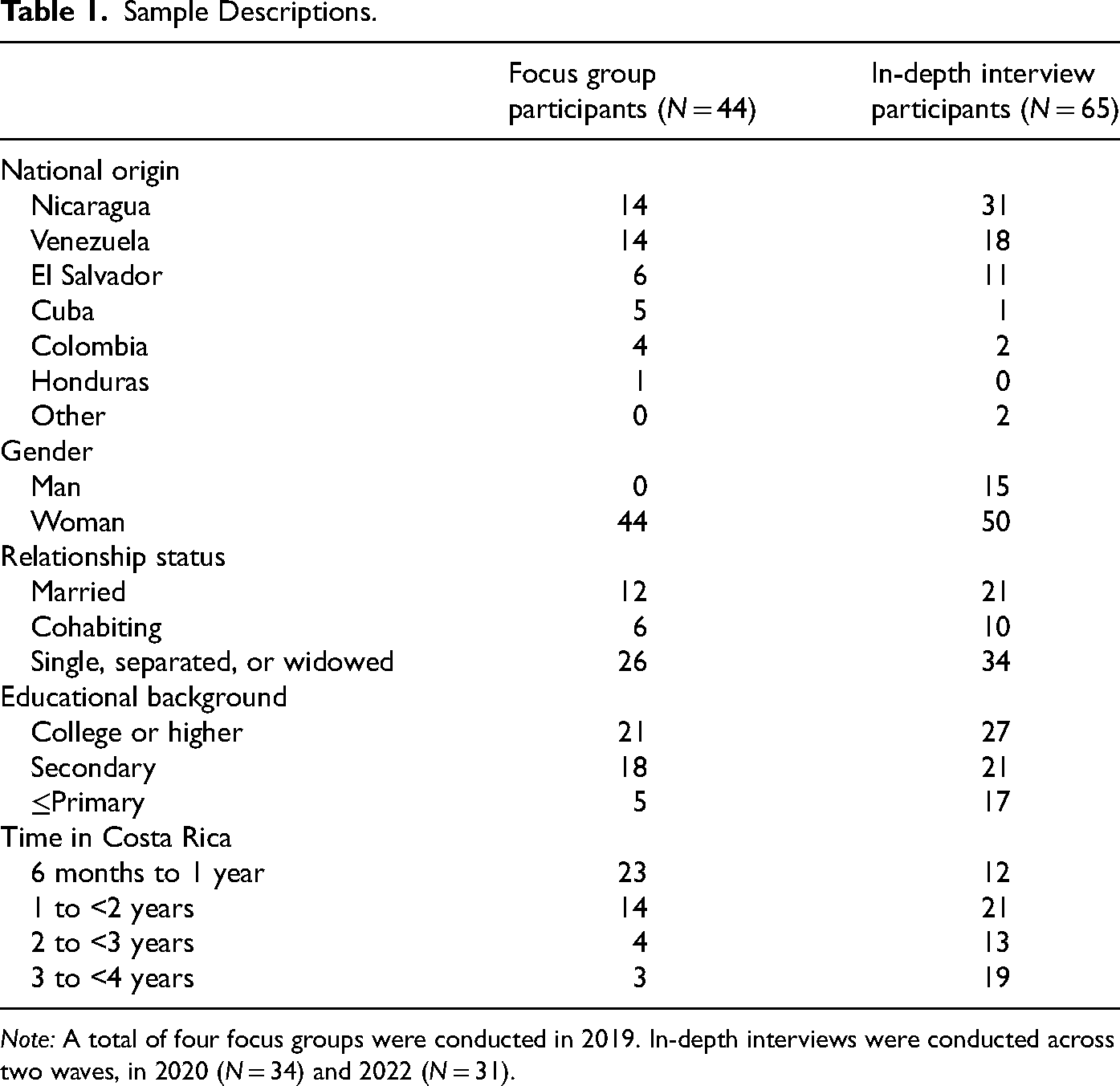
Note: A total of four focus groups were conducted in 2019. In-depth interviews were conducted across two waves, in 2020 (N = 34) and 2022 (N = 31).
Focus groups. In November 2019, we conducted four focus groups consisting of 44 MNP women. All groups took place in Fundación Mujer's office in San José, which was ideal because of its extensive security protocols and central location. Focus group conversations lasted between two and three hours and were led by a trained research assistant, who was a female Costa Rican national. The study PI took notes and asked follow-up questions as warranted. With participants’ informed consent, the ensuing conversations were audio recorded, transcribed, and redacted. To further safeguard participants’ confidentiality, we assigned all participants pseudonyms, which we relied on in analyses.
At the start of each focus group, participants responded to a prompt asking about their current family structure and why they left their country of origin. Afterward, the focus group leader asked a series of open-ended questions about how women and their families came to Costa Rica, the challenges and opportunities they experienced since arriving, and their primary sources of social support.
In-depth interviews. In-depth interviews were conducted in two waves. The first, from January to March 2020, included semistructured interviews with 34 MNP women. The second, between August and December 2022, broadened our sample to include men and interviewed an additional 31 MNP. The majority took place at Fundación Mujer's San José office, though several were conducted in their Upala office (on the Nicaraguan border), and out of necessity, four were conducted via video chat. Each interview lasted from one to three hours and was audio recorded with participants’ informed consent. Interviews were subsequently transcribed and redacted, at which point we assigned participants pseudonyms for record-keeping purposes and analyses. 2
In-depth interviews followed a protocol designed to uncover how the experience of threat evasion, including precipitating events, travel, and incorporation into Costa Rican society, shaped family life and family members’ well-being. We structured the protocol around participants’ life histories, with an emphasis on family dynamics and interpersonal relationships at different points in time. Nevertheless, to improve participant rapport and data quality, interviews were allowed to flow organically rather than follow a rigid line of questioning.
Qualitative Approach
We coded and analyzed focus group and interview transcripts using an iterative approach based on Charmaz (2006). Specifically, we derived theoretical and analytical insights by constructing thematic codes, the broadest of which reflected the overarching topic of inquiry—how family dynamics and well-being evolve throughout threat evasion. More specific codes and subcodes arose inductively. Consistent with this approach, we conceptualized family broadly and analyzed references to separations from any family member—nuclear, natal, or extended (including in-laws).
Considering that in-depth interviews provided uniquely rich accounts of families’ experiences, we use our analysis of these interviews to guide the discussion of our results. Our overall conclusions, however, are bolstered by our focus group data, which highlighted the normativity of different types of family separation. This normativity was evinced by: (1) the prevalence of these types of separation across and within groups; (2) focus group participants’ invocation of assumed or mutually held beliefs about MNP family life when narrating their experiences of separation to other group members; and (3) their affirmative reactions to one another's accounts of family separation.
Results
Continuums of Anticipation and Duration
Every participant in our in-depth interviews referenced family they had been separated from in their migration to Costa Rica, as did most focus group participants. Collectively, their accounts encompassed separations from spouses, children, grandchildren, parents, siblings, nieces, nephews, cousins, aunts, uncles, and in-laws, highlighting the socioemotional salience of separations from a wide array of kin. Many participants had been separated from multiple family members at different points in time. This plurality of within-family separations underscored that migration was often a staggered, dynamic process in which individual family members migrated under different circumstances, at different times, and sometimes to distinct locations.
Although family separation emerged as a universal theme, separations varied in two key dimensions—anticipation and duration. Because of this variability, we conceive of both as continuums (Figure 2). For instance, family members could become separated by smugglers with no warning, or, by contrast, they could plan to separate as part of a staggered family migration strategy. Likewise, separations could range from only a few hours to weeks, months, or years, and some stretched on indefinitely at the time of interview.
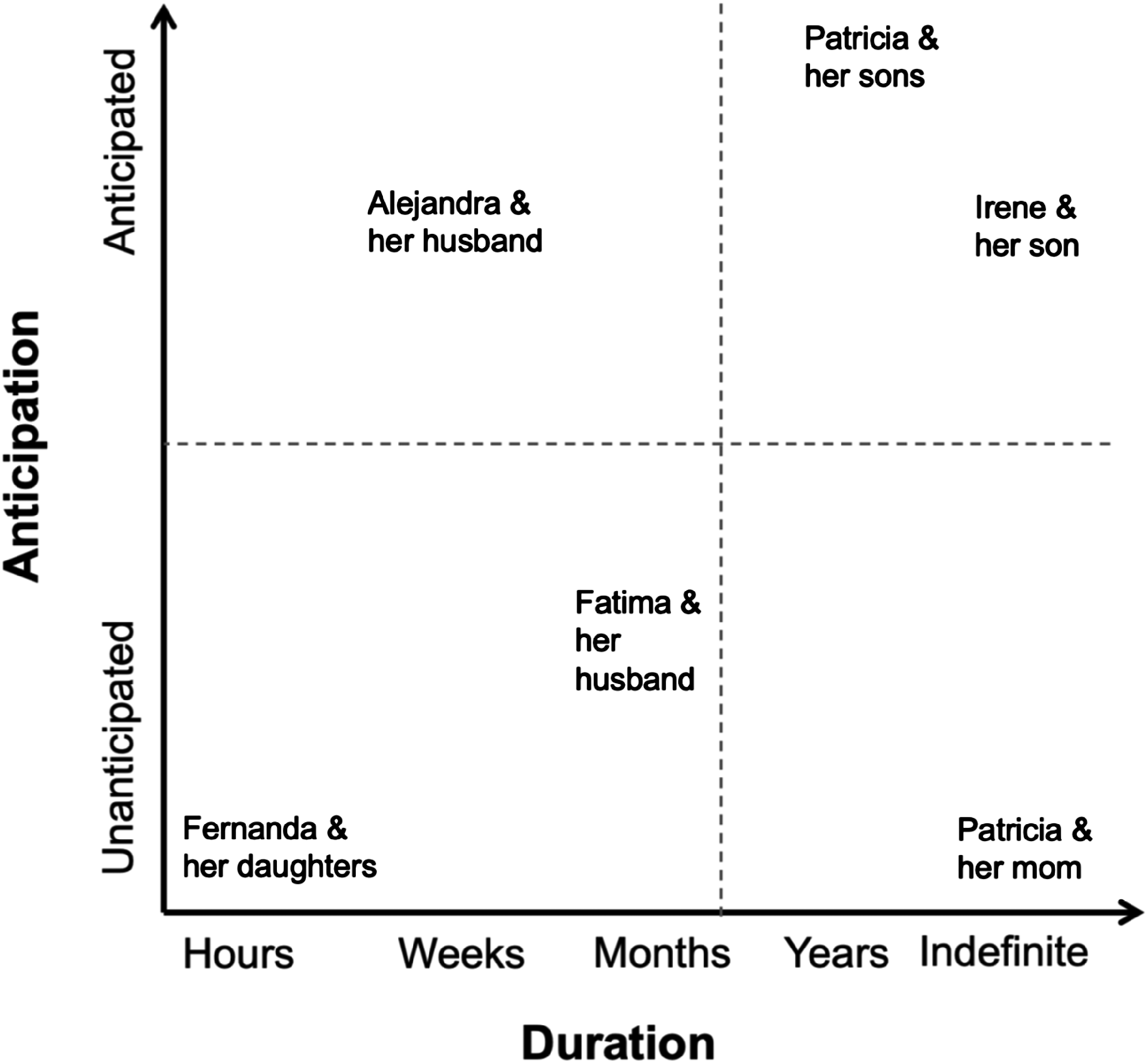
Intersecting continuums of anticipation and duration of family separation.
How much participants anticipated being separated and how long their separations lasted were the products of social conditions that prompted and/or structured their and their family members’ migration. Accordingly, anticipation and duration were closely connected to participants’ evolving sense of control over the migration process. Moreover, the intersection of anticipation and duration yielded different combinations that invoked distinct emotional and practical descriptions of family separation. Below, we detail four combinations—unanticipated temporary, anticipated temporary, unanticipated indefinite, and anticipated indefinite (Figure 2)—in terms of how each combination typically occurred, what it entailed, and its perceived consequences, as recounted to us. Table 2 illuminates the pervasiveness with which participants referenced each combination and the prevalence with which participants referenced multiple different combinations.
References to Family Separations, by Participant.
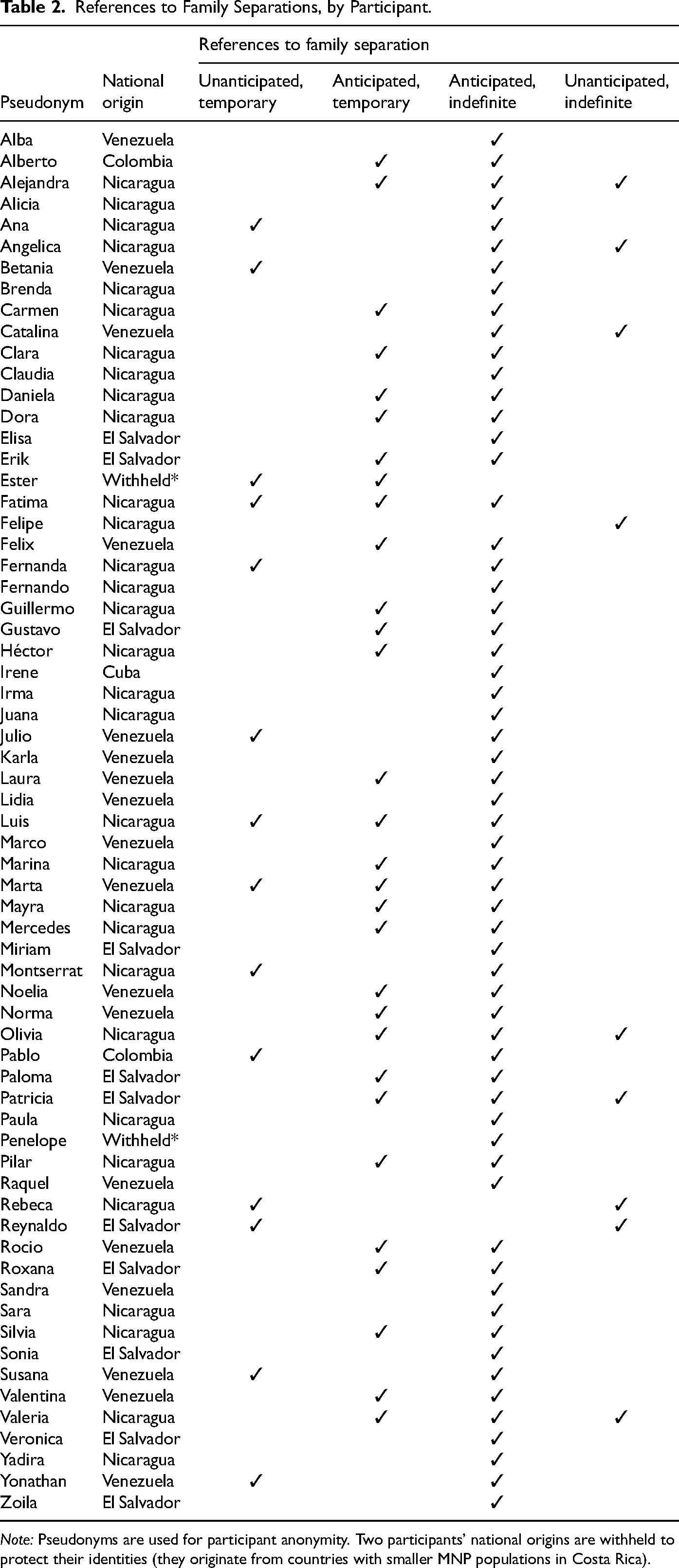
Note: Pseudonyms are used for participant anonymity. Two participants’ national origins are withheld to protect their identities (they originate from countries with smaller MNP populations in Costa Rica).
Unanticipated Temporary Separations
Unanticipated temporary separations were unforeseen and typically short-lived (Figure 2), stemming from dramatically escalating threats, bureaucratic hurdles, and/or chaos along with the migration journey that was beyond participants’ and their families’ control. All unanticipated temporary separations we analyzed occurred between nuclear family members. First, threats that escalated rapidly—within a matter of hours—propelled one or more members into immediate danger, which prompted them to migrate within a matter of hours or days. Such was the case for Fatima's family: Fatima and her partner had been heavily protesting the Nicaraguan government for months but “never” thought about leaving until, during a protest, their friend was shot and killed beside them. As their friend lay dead and the military surrounded their neighborhood, Fatima and her partner made a swift decision that they should flee the area separately. She took their son into hiding while he migrated alone to Costa Rica. In the days that followed, as Fatima prepared to leave with her son, she discovered that her name appeared among hundreds on a government blacklist disallowing specified individuals from leaving the country. Scared for their lives, Fatima covertly worked with a lawyer to have her name expunged from the list before she and her son crossed into Costa Rica—a process that took several months. Once in Costa Rica, they were finally reunited with her partner.
Bureaucratic hurdles, such as the blacklist Fatima faced and government refusals to renew passports, upended families’ migration plans in ways that not only prolonged unanticipated separations but also precipitated them. For instance, Marta and her husband decided to leave Venezuela after being threatened by political groups in their community. They sold their cars to purchase plane tickets, but at the airport, the Venezuelan government refused to recognize or renew her husband's passport, causing him to forfeit his ticket. Faced with the last-minute decision to lose their entire investment in the international migration journey or to separate, they decided Marta should travel alone to Costa Rica to look for work. Marta worried every day about whether and when they would be reunited, but after four months in Costa Rica, she saved enough money to finance a new set of plane tickets and her husband's passport was finally renewed.
Fernanda, too, was separated from family unexpectedly on the migration journey, but in her case, she was separated by smugglers. Prior to leaving Nicaragua, Fernanda was a vocal activist in her community. Targeted by local officials, she was followed, surveilled, and threatened by the government. Like Fatima, Fernanda loved her community and was so deeply committed to staying that she “never” thought about leaving until she was shot at outside her home. She immediately set off to find her daughters and, within hours, fled toward the border, where they joined a group of migrants being led by smugglers into Costa Rica. At the very last moment, however, the group was divided and taken along with different routes, separating Fernanda and her daughters. For a few agonizing hours, she questioned and regretted her decision to leave Nicaragua, but when she arrived at a safe house on the other side of the border, her daughters were there. Fernanda's experience was echoed by several focus group participants who had been unexpectedly separated from family members by smugglers in the Darien Gap (near the Colombian–Panamanian border), and later reunited on the journey.
Like Fernanda's experience, most unanticipated separations ended quickly. Although families who were separated at border crossings were reunited in a matter of hours or days, at the time, they did not know whether or how their reunification would occur. Families, like Fatima's and Marta's, who became unanticipatedly separated because of escalating threats or bureaucratic hurdles, remained separated for longer stretches—weeks or months—as the members who were stuck in origin searched for ways to overcome the obstacles they faced to departing and traveling.
When recounting unanticipated temporary separations, participants described these experiences as anxiety-inducing and further stressed the enduring emotional consequences for children. For example, Fatima's three-year-old had an “emotional crisis” and began biting his fingernails to the point of bleeding when he was unexpectedly separated from his father for several months. According to Fatima, since reuniting, her son has been unwilling to leave his father's side and repeatedly tells him “Daddy, don’t ever leave me again.” Fernanda noticed a similar change in her adolescent daughter, whom she was unexpectedly separated from when crossing into Costa Rica late at night. Though they were reunited after several hours, Fernanda lamented that, in the months since, her daughter has become much less independent and more possessive of her.
Anticipated Temporary Separations
Anticipated temporary separations emerged in half of our in-depth interviews and in all four focus groups. In these cases, participants referenced preparing for or at least anticipating family separation and expected to be separated for only a short period of time (Figure 2). As such, they exhibited comparatively more—albeit incomplete—agency when describing these separations than when describing unanticipated ones. Most, but not all, anticipated temporary separations occurred between nuclear family members.
Anticipated temporary separations typically stemmed from a combination of imminent danger—prompting the desire or need to leave one's country of origin—and economic or logistical constraints that prevented everyone from leaving together. For example, procuring visas, passports, bus or airplane tickets, and human smugglers required more economic and/or social capital than participants had at their disposal. Because most did not know if or when they would find work in Costa Rica, they also worried about financing everyone's survival abroad while unemployed. Families who not only faced danger but also insurmountable economic or logistical hurdles, in turn, felt forced to strategically divide among themselves and send only one or a few members ahead of the others, with an articulated goal of reuniting abroad as soon as possible. Valeria, who separated from her husband and daughter, remembered telling them at the time: “I’ll go there and see what happens…I’ll start to work, maybe I will find work and then it won’t be a problem…let's see what happens and then you all can come.”
Knowing they needed to separate to survive, families that undertook anticipated temporary separations made difficult decisions about who to send first. Participants framed these decisions using three complementary logics. First was who faced the greatest danger. Perceived danger was based on individual members’ experiences of physical or verbal intimidation; levels of involvement or implication in precipitating events, such as political protests; and/or gender. When no one family member seemed in more imminent danger than others, a second rationale came into play—perceived economic opportunities abroad. In Carmen's case, she traveled first because “[people] said that there was, for women, more possibility of finding work.” Given the emphasis on needing to find work to fund the migration of others, age also factored into economic rationale, with children tending to trail their parent(s). Finally, a third and related economic factor was housing: those who had friends, siblings, or relatives to stay with often traveled first.
Alejandra's case illustrates how the confluence of threats, economic constraints, work opportunities, and housing shaped anticipated temporary separations. In Nicaragua, Alejandra lived with her children and husband, who worked for the state. During a time of political turmoil, her husbands’ colleagues invited him to participate in a covert operation. After declining their offer, he and Alejandra were stalked and received death threats. Feeling trapped, they decided to separate and eventually meet in Costa Rica. He relocated within Nicaragua, while she took the children to Costa Rica, where they moved in with her cousin, who helped her quickly find a job. With both a residence and a job secured, Alejandra sent for her husband.
Alejandra's case also illustrates how family reunification hinged on the initial migrant member(s) earning and saving enough money to fund others’ migration journeys. Given this necessity, families undertook anticipated temporary separation without knowing exactly how long separation would last. Depending on their economic opportunities and support systems in Costa Rica, these separations extended from a few weeks to over a year.
Anticipated temporary separations were anxiety-inducing, which participants attributed to their uncertain timetable. Before Valeria's husband and three children could join her from Nicaragua, for instance, she spent months “without appetite; without sleep.” For those who strategically separated and traveled first, like Valeria, the unfamiliarity of being alone was also anxiety-inducing. When asked about her most stressful moments in Costa Rica, Norma pointed to the initial months she spent on her own, which were marked by “not knowing how [to be alone]. Not having the experience of walking alone.” Being alone was also “scary” for Noelia, a Venezuelan mother and grandmother: “When my son told me, ‘Mom, you’ll have to travel by yourself because I have to stay with the kids,’ that for me was extremely hard. ‘By myself?’ I said to him. ‘Son, but by myself?’ I kept saying [laughing nervously].” Although she felt alone, Noelia physically lived with her daughter-in-law in Costa Rica while she waited for her son and grandkids to arrive. Her sense of solitude was especially acute when her daughter-in-law went to work. The first time this happened, Noelia tried to keep herself busy but, after a few hours she entered “a depression. My god! I threw myself on the floor. I took out a sheet from the bedroom and threw it on the living room floor and laid down there. And I’m like, ‘My god! What do I do here all by myself?’”
Anticipated Indefinite Separations
Anticipated indefinite separations arose when some family members—usually natal or extended kin—did not face imminent danger and were rooted in their country of origin for economic or political reasons. Patricia, for example, spent much of her life building a successful business in El Salvador. As her business took off, gang violence began to worsen. By the mid-2010s, security concerns prompted constant closures at the university where her sons were enrolled. Citing both safety and educational concerns, Patricia sent her sons—who were living with her at the time—to Costa Rica indefinitely, where they could continue their university education and start a new life for themselves. Because she did not face imminent danger herself at the time and owned a profitable business that helped fund her sons’ schooling, Patricia decided to remain in El Salvador.
Anticipated indefinite separations also arose when family members were implicitly perceived not to be endangered and too vulnerable and/or costly to travel. Irene, for example, left her young son in Cuba, indefinitely in the care of his grandparents, when her husband, who ran a small business, became targeted and extorted by police officers. Irene, who had traveled by boat, land, and airplane to Costa Rica, deemed the journey unsafe and too costly for children. Moreover, now unemployed, she and her husband did not have the means to support themselves financially and worried that they wouldn’t have enough money to feed or house a young child. In light of both factors, she didn’t foresee bringing her son.
Despite separating without expecting to see one another again, on rare occasions, participants were reunified with family they left behind. In all such cases, reunification was set in motion by violence or a family crisis that propelled family in the country of origin to come to Costa Rica. Returning to the case of Patricia, several years after her sons left El Salvador, her neighborhood fell under gang control and she was forced to pay a monthly extortion fee of $2,000. Patricia managed to pay “la renta” for several months but eventually fell short. No longer able to keep up with these exorbitant charges, armed gang members threatened to kill her. Patricia's husband died during the altercation. The next day, she sold what she could of her possessions and immediately left for Costa Rica. For Patricia, escalating extortion and the death of her husband prompted eventual reunification with her sons.
In other cases, unanticipated reunifications were prompted by a family member's rapidly deteriorating mental health. Valentina, for example, developed severe postpartum depression in Costa Rica. At her lowest point, she attempted suicide. Her husband, who was overcome with worry and unable to look after her and their children while he worked, sent for her mother to join them. Similarly, Catalina's husband—who had experienced repeated traumas in their country of origin—entered an alarming mental state while still in Venezuela: he stopped eating, refused to get out of bed, and at one point tried to kill himself. During a video call, Catalina's brother saw how thin and despondent her husband had become and, at the sight of him, grew overwhelmed with concern. Soliciting funds from various family members, her brother soon sent money to bring Catalina and her husband to Costa Rica.
Among participants who had not been reunited, references to anticipated indefinite separations emanated a profound sense of grief and loss. This grief reflected that participants usually did not know whether or when they would ever see family members they were anticipatedly but indefinitely separated from. Throughout most of his interview, Guillermo remained stoic, but he began to weep when he expressed his deep “need” to be near his grandmother, whom he feared he might never see again. This fear paralleled an unfortunate reality for some: Sonia's parents, for instance, died in the years since she’d left El Salvador.
Beyond grief, participants emphasized the loneliness that accompanied anticipated indefinite separation from natal or extended kin, which fundamentally altered their day-to-day life and atrophied their social networks. Valentina, who fled Venezuela with her partner and three children, told us that the most important difference in her life in Costa Rica is that her family isn’t with her, that she left “everyone” behind. Like Valentina, many participants spoke of leaving behind “all” their family, despite living with some nuclear or natal kin in Costa Rica.
Anticipated indefinite separations not only differed affectively from unanticipated and anticipated temporary separations but also practically: Whereas temporary separations emerged through participants’ retelling of why and how they migrated, anticipated indefinite separations emerged through the narration of daily life in Costa Rica. For instance, anticipated indefinite separations often surfaced in reference to housing. Looking back in time, most participants longed for the housing stability they had enjoyed in their countries of origin, which they largely attributed to their family arrangements. While in Nicaragua, for example, Alicia and her husband and son lived in a family compound with her husbands’ parents, siblings, nieces, and nephews. Their arrangement minimized their housing expenses and enabled cost-sharing in Nicaragua. Now stranded from family networks in Costa Rica, they struggled to pay rent for just one room in a house they shared with strangers.
Participants similarly referenced anticipated indefinite separations when discussing difficulties with childcare. Claudia, a single mother, remembered that in Nicaragua her daughter was “raised with my mom, my sister, my sister-in-law.” There, she could leave her daughter “with whoever was home,” but in Costa Rica, “everything is money.” Like Claudia, many participants explained that, in their countries of origin, they lived with or near natal or extended kin who could assist in childcare both regularly and sporadically. In Costa Rica, however, anticipated indefinite separations from these kin resulted in a lack of social support that left them without anyone to turn to.
Unanticipated Indefinite Separations
Unanticipated indefinite separations emerged seldomly (Table 2) but took two forms: Either a family member's rapid departure from their country of origin led to unforeseen indefinite separations, usually from non-nuclear family members, or anticipated temporary separations stretched on indefinitely because of unforeseen difficulties in Costa Rica, which led family members (mostly nuclear) to worry whether they would ever see each other again. In both scenarios, becoming separated indefinitely was unplanned (Figure 2).
In the first scenario, rapidly escalating threats prompted a family member's immediate, unexpected departure. All resultant separations were unanticipated, but unlike unanticipated temporary separations—where family members reunited—participants did not presume eventual reunification with family members they had become indefinitely separated from. When Patricia fled El Salvador within 24 h of a gang altercation, she “left running from my house. I didn’t even say goodbye to my mother… I used to go see her every weekend… She was 98 years old at the time.” Given her mother's age, and the threats on Patricia's life, she did not expect to ever see her mother again. Patricia also left behind her sister, who lived with and cared for their elderly mother. Her sister discouraged Patricia from ever returning, warning her that she could be followed and put them all at risk. When fleeing El Salvador, Patricia thus unwittingly left behind her family of origin. Although they lived in separate communities at the time of her departure, they were integral to each other's lives: “There was never a weekend that I didn’t go, from Friday to Sunday afternoon, just to be with the two of them. You could say it was like that all my life. All my life.”
In the second scenario, indefinite separations emerged from unforeseen circumstances in Costa Rica that undermined family members’ original plans of reunification. In these cases, family members who had planned to separate temporarily remained separated indefinitely, underscoring the dynamic nature of the anticipation and duration continuums along which separations occur. Catalina offers a case in point. When her husband was threatened by government officials, Catalina's brother—who had already left Venezuela—applied for a loan and pooled funds across multiple family members to help bring Catalina and her family to Costa Rica. Altogether, however, they were only able to afford three tickets. Catalina's nuclear family consisted of four members. Given their circumstances, they opted to leave behind her eldest daughter, a young adult who they believed could look after herself. Yet, almost two years later, Catalina and her husband still had not saved enough money to bring their daughter, lamenting that the international flight alone cost more than $500. Saving that much money felt out of reach because Catalina could not find work and what her husband earned “does not cover everything. What he is earning is practically all going to the rent.” Unable to save any money on their own, Catalina asked her brother to explore the possibility of acquiring another credit line to help bring her daughter. Catalina herself was implicitly ineligible because she “did not bring any of my documents. Here, I’m nobody.” Yet, because her brother was still paying off the original loan that helped to buy the first three tickets for her family, it was unclear whether he would be able to access additional funds for her daughter.
Regardless of how unanticipated indefinite separations arose, participants described them with sadness and a sense of guilt. Patricia cried knowing she would never see her mother again and felt guilty for having left her without explanation: “If she understood why I left, she would only cry, cry, and cry. I have to be strong so she doesn’t realize I’m crying too. I tell her, ‘I don’t want to see you crying. I mean, I’m not there but I’m still with you.’ I call her every day because she is an elderly woman. She needs a lot of care.” Like Patricia, Catalina told us she left her daughter “with all the pain of [her] soul” and felt guilty about remaining indefinitely separated from her “because although I feel she can survive, I still feel she needs me.” At the same time, Catalina struggled with needing her daughter too, who was her primary confidante. When asked about her sources of social support, Catalina emphasized her daughter's absence, even despite an extensive new “nucleus” in Costa Rica, including her brother, uncle, cousins, friends, husband, and son: “These days it has really hit me hard not having my daughter here [voice breaking]… I am the strong one in the house. I cannot sit down and tell my son I feel a certain way because he leans on me. And much less my husband because he is still fragile… I couldn't stand my birthday because my daughter called me that night to sing me ‘happy birthday’ and I collapsed. The only thing is, when I collapsed, later I realized [my husband and son] were both looking at me like ‘It can't be! What do I do?!’ So, I changed [my affect]. I became strong.”
Conclusion
We collected and analyzed highly detailed, qualitative data from focus groups and in-depth interviews among Latin American MNP in Costa Rica. Virtually all participants had been separated from family members, and oftentimes, had been separated from multiple members at different points in time. Collectively, their experiences highlight the complexity of MNP family migration and illuminate a high degree of variability in the anticipation and duration of family separations. Given that anticipation and duration related closely to participants’ and their families’ evolving control over their circumstances, conceiving of this variability as two continuums coalesces with theoretical perspectives that migration occurs along a spectrum of volition (Fussell 2012) and extends these perspectives to the family level. Moreover, anticipation and duration of family separations intersected in ways that shaped their emotional and practical implications. Taking anticipation and duration into account thus promises to improve current conceptualizations of MNP family separation, measurement of its economic and health consequences, and the policy and programmatic recommendations that stem from emerging research on MNP families.
While we focus on anticipation and duration continuums of family separations among MNP, they are not the only migrants whose agency is limited. A wide array of (evolving) circumstances can constrain migration decisions, from state policies to cultural norms to migration costs (de Haas 2021), even when migration is not compelled by imminent threats to survival. Our study thus offers a portable framework for conceptualizing family migration agency and how it shapes family separations in diverse migration scenarios, including beyond threat evasion.
Explicating the continuum of anticipation that belies migrant family separation brings to the fore families’ differing degrees of agency over the separation process. For instance, some unforeseen events outside of families’ control, such as last-minute separations by smugglers on the migration journey, resulted in unanticipated separations. Yet other unforeseen events beyond families’ control, such as rapidly escalating threats or emergent bureaucratic hurdles to departure, resulted in unanticipated separations where families made last-minute decisions to separate. Still, families wielded comparatively more (albeit not total) control over anticipated separations. For instance, although anticipated temporary separations were marked by families’ economic inability to send everyone abroad together—a restriction of their economic agency—those who separated strategically made decisions about who to send first based on perceptions of danger in origin and of economic opportunities abroad. Furthermore, their perceived sense of agency was evinced by their plans to reunify. Similarly, when participants experienced anticipated indefinite separation, it was almost always because members who stayed behind in countries of origin chose to do so (with the exception of young children and the elderly).
Recognizing that MNP family separations occur along a continuum of duration, too, reveals differing degrees of agency over the migration process. Most notably, when participants who anticipated being separated indefinitely suddenly reunified with their family members, their reunification reflected someone's decision to migrate to Costa Rica in response to escalating threats or a family crisis. By contrast, when participants anticipated being separated only temporarily but remained separated much longer—or even indefinitely—this reflected their waning agency amid increasing constraints on their rights and finances abroad. For example, unemployment, the expense of living alone, and other economic hardships inhibited some participants from being able to fund the remaining family members’ migration and hence their reunification. MNP families may also remain separated longer than anticipated because of policy changes in receiving contexts: Shortly after completing our data collection, in February 2022, the Costa Rican government began requiring Venezuelans to obtain visas prior to arrival (Murillo 2022). This policy change was announced just four days before its implementation, undoubtedly delaying or thwarting reunifications for thousands of separated Venezuelan families in Costa Rica.
Examining how anticipation and duration of family separation intersect further elucidates the shortcomings of sharp ontological distinctions between “forced” and “voluntary” migration. Most notably, during anticipated temporary separations, perceived threats generate the impetus to migrate, but economic constraints prevent family members from migrating together. Under these conditions, economic opportunities abroad enable the remaining family members to subsequently migrate. In this way, MNP staggered family migration takes on economic attributes that migration scholarship often connotes with “labor” migration or “opportunity seeking.”
The intersection of anticipation and duration also matters for family separations’ perceived emotional and practical implications. Unanticipated separations—although typically short-lived among our participants—generated intense worry and fear. Descriptions of children's behavior in the aftermath of unanticipated separations also hinted at the possibility that, for some, they may be a source of posttraumatic stress. Meanwhile, anticipated temporary separations, although expected to end relatively quickly, led to anxiety, reflecting the uncertain timetable for family reunification and migrants’ only partial and sometimes diminishing agency over the reunification process. Yet, in contrast to unanticipated separations, the anxiety that accompanied anticipated temporary separations was largely centered around when, rather than if, family members would be reunited. Nevertheless, anticipated temporary separations provoked anxiety because they led migrants to spend more time alone than they were accustomed to, which was uncomfortable; and in some cases, separations that were intended as temporary unexpectedly became indefinite. Anticipated temporary separations differed from anticipated indefinite ones because the latter had no end in sight, which yielded intense grief and mourning. As families adjusted to being separated indefinitely, they also confronted practical challenges in their day-to-day life: Living with fewer family members meant fewer opportunities for cost-sharing and childcare. Resultantly, anticipated indefinite separations potentially restrict the economic agency of MNP.
Our findings have several policy implications, especially given that migrant family reunification is the subject of substantial policy debates around the globe (Heinemann et al. 2015; Hernes 2017; Freier and Gauci 2020). First, by reducing anxiety and emotional discomfort, and bolstering social support systems, family reunification may help alleviate mental health burdens even among families who anticipated separating. This is especially likely given that family separation is among one of the largest predictors of poor mental health, relative to >20 other sources of hardship (Miller et al. 2018). Second, being reunited with family engenders more opportunities for cost-sharing and childcare, which in turn, can help alleviate poverty and improve housing conditions, nutrition, and financial stability. Our findings also have programmatic implications. Namely, they suggest that health practitioners, social workers, and humanitarian aid workers should work to understand the circumstances under which MNP families separated and how long they were, have been, and/or expect to remain separated from family members, as the answers to these questions have different emotional and practical consequences for individual migrants and their families.
These findings should be taken in the context of their limitations. First, accounts of family separation were largely retrospective. Participants may thus have forgotten, misremembered, or altered select details. Second, although we purposively sampled migrants from a diversity of demographic backgrounds and precipitating threats, our samples are not representative of all adult MNP in Costa Rica or elsewhere. The cases we describe thus do not represent the entire universe of possibilities, especially when considering that immigration policies differ across countries of reception, evolve over time, and can divide families and/or impede their reunification (Arar and FitzGerald 2023, 133–166). Our findings nevertheless draw much-needed attention to heterogeneity in the experience of family separation across individuals residing in the same context of reception and even within individuals over time.
Our findings highlight that, among MNP, family separations occur along continuums of anticipation and duration that, together, shape how migrants perceive the emotional and practical implications of being separated. These two continuums, and their intersection, reveal underlying variation in migrants’ control over their families’ migration process and changes in that control over time, as circumstances evolve. These continuums, their underlying causes, and their differing implications underscore the need for more refined demographic categorizations of family separation among MNP, who account for an increasing share of all international migrants with each passing year.
Supplemental Material
sj-docx-1-mrx-10.1177_01979183251333762 - Supplemental material for Family Separation Among Migrants in Need of International Protection: Anticipation, Duration, and Agency
Supplemental material, sj-docx-1-mrx-10.1177_01979183251333762 for Family Separation Among Migrants in Need of International Protection: Anticipation, Duration, and Agency by Abigail Weitzman, Matthew Blanton and Gilbert Brenes Camacho in International Migration Review
Footnotes
Acknowledgments
The authors are grateful to the study's participants for generously sharing their experiences with us and to Fundación Mujer for their instrumental role in the recruitment process. The authors also thank Luis Zayas, Robert Crosnoe, Arodys Robles, Kammi Schmeer, Jeffrey Swindle, and Katarina Huss for their highly instructive comments on this study's development and design.
Declaration of Conflicting Interests
The author(s) declared no potential conflicts of interest with respect to the research, authorship, and/or publication of this article.
Funding
The author(s) received financial support for the research, authorship, and/or publication of this article: This research was made possible with funding from the National Institute for Child Health and Human Development through an early career grant (K01HD099313, PI Weitzman), population center grant (P2CHD042849), and training grant (T32HD007081). The content is solely the responsibility of the authors and does not necessarily represent the official views of the National Institutes of Health.

Supplemental Material
Supplemental material for this article is available online.
Notes
References
Supplementary Material
Please find the following supplemental material available below.
For Open Access articles published under a Creative Commons License, all supplemental material carries the same license as the article it is associated with.
For non-Open Access articles published, all supplemental material carries a non-exclusive license, and permission requests for re-use of supplemental material or any part of supplemental material shall be sent directly to the copyright owner as specified in the copyright notice associated with the article.
