




Abstract
We study the effect of age at migration among immigrants in Sweden on political participation as adults. To identify the effect, we use validated individual turnout data over three elections in Sweden (1994, 2010, and 2018), and compare outcomes among siblings who arrive at the same time but at different ages. We document a clear effect on political participation from early arrival: immigrants arriving in early childhood (ages 0–5) are about 5 to 10 percentage points more likely to partake in national elections as adults compared to immigrants arriving later (ages 12–17) during their childhood. We further show that the effect is partially persistent over the life-cycle.
Introduction
Recent waves of international migration have made issues related to immigrant integration to appear high on the agenda in many countries. Politics is one important area for integration, as the political inclusion of minority groups is considered essential for the legitimacy of liberal democracy (Mansbridge 1999). Yet, there is plenty of empirical evidence that individuals of immigrant background remain politically marginalized in most democracies. Compared to natives, immigrants have been shown to be less likely to carry out both institutionalized and noninstitutionalized acts of political participation (e.g., de Rooij 2012; Ruedin 2018).
Scholars have explored a number of different explanations for the immigrant-native gap in political participation (Dancygier et al. 2015; Wass et al. 2015). A common denominator of most of these explanations is that they focus on the conditions facing immigrants in their new host country. However, as some scholars have argued, immigrants’ premigration experiences may also affect the ease by which immigrants can integrate politically (Black, Niemi and Powell 1987; White et al. 2008). In particular, it has been suggested that individuals who immigrate at an older age will face greater obstacles to take active part in host-country politics, since longer and more extensive political socialization in one's country of birth may make it more difficult to adapt to the political norms and behavior of the new country. In this article, we approach this topic by asking if the age at immigration among migrants in Sweden significantly affects their political participation, as measured by voter turnout in national elections.
The dominant theoretical expectation in the literature is that individuals who migrate at younger ages are more likely to integrate politically in the host country than those who migrate at older ages (Black, Niemi and Powell 1987; White et al. 2008). However, empirical research on the relationship between age at migration and political integration remains limited, and the existing studies report mixed findings. For instance, while Wass et al. (2015) find that immigrants who migrate at an older age have higher voter turnout than those who migrate at a younger age (at least among immigrants from democratic countries), Li and Jones (2020) report a decline in voter turnout with age at migration. Finally, the pioneering study by White et al. (2008) found no relationship between voting and age at migration.
One potential reason for the partially divergent findings in previous empirical research is the methodological challenge of disentangling the effects of age at arrival, age at the time of voting, and length of residence in the host country. For any given immigrant, these three variables are perfectly linearly related, making it difficult to isolate their individual effects. Different studies have employed various strategies to address this identification problem, which may have contributed to the differing results. While Wass et al. (2015) and Li and Jones (2020) choose to disregard the effect of length of residence, White et al. (2008) instead attempts to resolve the multicollinearity issue by log-transforming the variables of interest.
The main contribution of the present study is that it will employ an alternative, and arguably preferable, approach to overcome the challenges when studying the effect of age at migration on political participation. More precisely, we will use population data from Swedish administrative registers to compare the voter turnout of siblings who immigrated to Sweden as children at the same time, but at different ages. A main advantage of the sibling approach is that all siblings of a family will have spent the same amount of time in Sweden at the time of the election. This approach therefore automatically solves the thorny problem of how to differentiate between the impact of age at migration and length of residence. A similar approach has previously been used to consider the effect of age at migration on other outcomes. For example, Böhlmark (2008) studies school performance and Åslund, Böhlmark and Skans (2015) examine immigrants’ likelihood to interact with natives in different areas of society.
Our empirical design also offers a number of additional advantages over previous studies on the topic of political participation. First, by comparing the turnout of siblings raised in the same family we substantially reduce the risk of omitted variable bias. Most importantly, we do not need to worry about the fact that families who migrate when the children are young may be systematically different from those who migrate when the children are older. Moreover, because our analyses of voter turnout rely on validated rather than self-reported data our results will be free from social desirability bias, which could otherwise affect the findings, if age at migration is related to the likelihood to over-report voting. Finally, since our data allow us to follow individuals over time we will also be able to extend previous research in the field by studying how the age at migration effect develops over the life-cycle.
A final contribution of the present study is that it acknowledges that the effect of age on arrival on adult political participation can be channeled through a number of alternative causal pathways, for instance through labor market outcomes or educational attainment (Hermansen 2017). This in contrast to previous studies, which have mainly focused on the political socialization mechanism. We argue that the one-sided focus on political socialization in previous research is problematic because it may lead scholars to underestimate how important age of arrival is for subsequent political integration.
To briefly preview our results we find a clear effect on political participation from early arrival: immigrants arriving in early childhood are about 5 to 10 percentage points more likely to partake in national elections as adults compared to immigrants arriving later during their childhood. The effect is fairly linear, suggesting an increasingly higher likelihood to vote with arrival at younger ages. This result is also fairly persistent, affecting immigrant participation over almost the entire life-cycle. Finally, by controlling for a number of socioeconomic indicators, we show that economic integration induced by early arrival, for example in terms of increased education, is likely not the main channel explaining the effects.
Theory and Previous Research
Most of the previous literature on age at migration has focused on the impact on various economic and social outcomes. There is, for instance, a fairly large literature showing that both language acquisition and school performance tend to decline with age of arrival (e.g., Newport 2002; Birdsong 2006; Böhlmark 2008). Spurred by these results scholars have also gone on to examine how age at migration relates to immigrants’ labor market integration. Available results indicate that immigrants who arrive at a younger age generally performs better in the labor market, both in terms of employment and earnings, than do immigrants who migrate at an older age (Schaafsma and Sweetman 2001; Hermansen 2017). Finally, there is also research that examines the impact of age at migration on the social assimilation of immigrants. One example of this is the study of Åslund, Böhlmark and Skans (2015), which reports that late arriving immigrants tend to experience more segregation in the host country as they are less likely to live close to, work with, and marry native individuals.
In comparison to the sizeable literature that have studied the impact of age at arrival on various economic and social outcomes, the research focusing on political integration is more limited. Among the studies on political outcomes that do exist most have expected early arrival to be beneficial for the political integration of immigrants. This argument is grounded in classical political socialization theory, which posits that political predispositions are formed early in life during the “formative years.” Once the formative years are over, the argument goes, political attitudes and outlooks become fixated and resistant to change (Black, Niemi and Powell 1987).
Based on this resistance theory scholars have hypothesized that immigrants who have spent less time in their country of origin will be more likely to assimilate politically (White et al. 2008). The view expressed by Li and Jones (2020, 63) provides a good case in point: We expect that individuals who immigrated at a young age and spent their formative years in the new country will be most influenced by the new country's political and social environment, and consequently are likely to behave in ways similar to the new country's native-born citizens.
The resistance theory is not without its limitations. First, different scholars tend to locate the formative years at different ages. Because of this, it remains unclear when exactly we should expect the political predispositions of immigrants to crystallize. Second, the resistance theory was originally developed to explain political attitudes, not behavior. As noted by Black, Niemi and Powell (1987), it is therefore not obvious that the theory is equally relevant for understanding immigrants’ political participation. Third, and finally, it is not clear from the resistance theory whether the negative age of arrival effect applies with equal force to all types of immigrants and how persistent the effect is over the life-cycle.
Concerning how the effect differ between types of migrants, Wass et al. (2015), for instance, maintain that age at migration will have opposite effects on turnout among individuals migrating from democratic and nondemocratic countries, respectively. The reason for this, they argue, is that immigrants from nondemocratic countries “must first ‘unlearn’ their previous political dispositions” (Wass et al. 2015, 411), something that becomes increasingly difficult with age. However, their counterparts born in democratic countries can transfer their existing political knowledge and habits to the new context. If a change in political context during the formative years disrupts political socialization, individuals who migrate from another democratic country at an older age may actually have an easier time adapting to the new political system. Wass et al. (2015, 412) therefore hypothesize that “older age at the time of immigration increases voting propensity among voters born in democratic countries but decreases it among those born in nondemocratic regimes.”
On a similar note, we may also ask whether there are reasons to believe that the impact of age of arrival on turnout will vary with the age of an individual (when voting). According to the standard account of the resistance theory this should not be the case. As political socialization is assumed to occur at an early age, any differences in political integration associated with age at migration can be expected to persist over the life-cycle. However, another influential socialization theory, the exposure model, maintains that the political attitudes and behavior of immigrants are more amenable to change and that they become increasingly similar to natives as they spend more time in the host country (White et al. 2008). To the extent that this is the case, the impact of age at migration on political integration should vanish, or at least decrease steadily, over time. That is, since political socialization is an ongoing process, rather than a one-time thing happening in childhood, the integration trajectories of immigrants arriving at different ages are likely to converge with time from migration. Thus, different theories make different predictions about the stability of the age of arrival effect over the life-cycle.
To better understand how age at migration affects political integration, it can therefore be argued that we need to pay more attention to how the effect varies across various groups of immigrants, which has only rarely been done in previous studies on the topic.
In relation to this, it is also important to consider which control variables to include in the model when estimating the effect of interest. Previous research on the topic commonly incorporates controls for various indicators of economic and social assimilation in regression analyses, such as educational attainment, income, occupational status, and the frequency of interactions with members of the majority population (White et al. 2008; Wass et al. 2015; Li and Jones 2020). However, if age at migration influences immigrants’ social and economic integration (Böhlmark 2008; Åslund, Böhlmark and Skans 2015), and if social and economic integration, in turn, drives political integration (Lindgren and Österman 2022), controlling for these variables could lead to underestimating the overall importance of age at migration for immigrant political participation.
One potential explanation for the differing findings in previous research on this topic is that various studies have employed different sets of controls in their analyses. In our main analyses, we therefore exclude all factors that could potentially act as intermediating variables between age at migration and political participation. However, after estimating the overall effect of age at migration, we will also investigate the relative importance of various potential mechanisms, such as an immigrant's degree of social and economic integration.
As noted in the introduction, the conflicting results of previous research may also stem from the methodological challenges involved in distinguishing the effect of age at migration from that of age and length of residence. While previous studies have attempted to address this identification problem by either disregarding the length of residence effect (Li and Jones 2020; Wass et al. 2015) or by imposing strong assumptions about the functional form of the effects of interest (White et al. 2008), we will employ an alternative approach that allows us to relax some of the stringent assumptions used in previous research. Specifically, we will use population data from Swedish administrative registers to compare the voter turnout of siblings who immigrated to Sweden as children at the same time but at different ages. The following sections provide a detailed description of the Swedish context as well as the data and methods used in the analysis.
The Case: Voting and Immigration in Sweden
Elections in Sweden
Parliamentary elections in Sweden take place in September once every fourth year. In these elections, voters choose representatives for (i) the national parliament, (ii) the local (municipal) council, and (iii) the regional council. All three elections take place simultaneously. 1
The Swedish Election Authority compiles electoral rolls based on the Swedish population registers. All individuals included in the electoral rolls get a certificate by post with essential election information, including how, when, and where to vote, as well as which of the three elections they are eligible to vote in. This means that voter registration is automatic. Voters can choose either to vote in person on election day, which is always a Sunday, or in advance — by post or with an election official.
An individual has to be at least 18 years old on the day of the election to vote. Other than the age requirement, eligibility in the three different elections hinges on different prerequisites. Swedish citizenship is required to vote in the national election. 2 In local and regional elections, also noncitizens are allowed to vote. To be eligible to vote in a specific municipality, an individual is primarily required to be a resident in the municipality in question. In addition, citizens of non-EU countries must have been residents in Sweden for 3 years before the day of the election. 3
Immigration to Sweden
Our article takes an interest in electoral participation among immigrants, and specifically among immigrants in the three national elections in 1994, 2010, and 2018. A few basic facts are worth mentioning on the immigrant population over the relevant period. First, the stock of immigrants in Sweden has increased greatly over time. In 1960, about 4% of the Swedish population was born abroad. In 1994, the time of the first election we study, about 10% of all Swedish residents where foreign-born, which can be compared to almost 20% in 2018.
Second, the characteristics of the immigrant population have also changed over time. In the 1950s to 1970s, most of the inflow came from labor market migrants, in line with the experience of many other Western European nations. From the 1980s and onward, immigration has to a larger extent been driven by refugees or families of refugees. Due to this change over time, the reason for immigration, and the characteristics of the migrants, will be slightly different when comparing 1994 to the two later elections (2010 and 2018).
Data and Empirical Method
Sample and Data
We use longitudinal individual-level data, which include the universe of inhabitants with a registered address in Sweden from 1990 until 2018. The data were compiled by Statistics Sweden, and most importantly include (i) information on voter turnout for the general elections in 1994, 2010 and 2018 and (ii) the date of immigration to Sweden. The data also include yearly information on many socioeconomic and demographic characteristics as well as family ties. The rich information allows us to study individual voting as a function of the age at immigration, and to compare outcomes in voting between siblings with the same mother.
The reason for focusing on the three elections in 1994, 2010, and 2018 is data access. For these elections, individual-level data on voter turnout have been made available through the digitization of publicly accessible election rolls. The turnout data cover more than 90% of the electorate for the elections in question and have been shown to be highly reliable (Lindgren, Oskarsson and Persson 2019).
While our choice of elections is driven by data availability, we see no obvious risk that the patterns observed in the 1994, 2010, and 2018 elections systematically deviate from those we would observe if data from additional elections were available. In particular, none of the elections included in our study show any signs of extremity in terms of voter behavior. If we consider the 15 general elections held in Sweden since the adoption of a unicameral legislature in 1973, overall turnout has ranged from 80% to 92%, with an average turnout of 86.6%. In the three elections studied here, overall turnout ranged from 84% to 87%, with an average of 86.2%.
To be able to study voting behavior, a pre-requisite is that individuals indeed have the right to cast a vote. Thus, the natural starting point for our sample is foreign-born individuals who are eligible to vote. In practice, this restriction boils down to foreign-born who have acquired Swedish citizenship in time for the election, as we primarily study participation in the national elections.
The number of eligible voters born abroad is large and has increased over time, from roughly 400,000 in 1994, to 730,000 in 2010, and to 1 million in 2018. Nevertheless, our empirical model relies on family fixed effects, comparing outcomes between siblings within the same family (with the same mother). For this method to work, we must make a number of sample restrictions.
First, we must be able to link the studied individuals to a foreign-born mother. Many foreign-born individuals may have immigrated without their mother or with a mother who is no longer observable to us (e.g., due to death or emigration). Restricting the sample to individuals with an observable (foreign-born) mother eliminates a large part of the original sample (around 70%). We also require the mother to have immigrated only once, which simplifies the assignment of immigration year for the family (whilst loosing relatively few observations). Second, an individual needs to have at least one foreign-born sibling. Without a sibling, we simply cannot compare outcomes within family. Third, we require the individuals in the sample to have immigrated between ages 0 and 17. Individuals with an age at immigration > 17 are increasingly likely to themselves have influenced the decision on migrating, and are therefore dropped. Our restrictions leave us with a pooled sample of 318,489 unique eligible voters. 4
The argument for pooling data across the three elections in our main analyses is twofold. First, pooling helps to average out the impact of temporary, idiosyncratic shocks that might otherwise influence the results. Second, by increasing the sample size, pooling enhances the statistical precision of our estimates, which is particularly needed in a sibling analysis that relies solely on within-family variation in the data. However, to ensure that our decision to pool data does not unduly affect the results, and to examine whether the effect of age at migration varies across elections, we will also present results for each of the three individual elections.
Empirical Model and Identification
We attempt to isolate the average effect of the age at migration on voter turnout by using family fixed effects. We define the age at migration using the immigration date of the mother. For individual i in family j, we have

We can then estimate the effect of age at migration on voting with the following model:

What type of variation are we capturing in equation (2)? Essentially, we consider a family with two or more siblings, where the family members have an immigration year in common, but differ in the age at arrival. Assuming that all children stay in the country up until adult age (almost all do), due to arriving simultaneously, siblings will have been in the country for the same amount of time. Hence, we effectively control for the effect of time spent in the country, and other family influences on children's political participation. As an example,
A remaining problem is that the sibling who was older at the time of immigration will mechanically also be older at the time of the election.
In order to address the effect on political participation from age at voting, we estimate the average rate of voting per age group, among second generation immigrants (defined as being born in Sweden with both parents born abroad) in the respective election year. We define

We use second generation immigrants because we believe it is plausible to assume that the age gradients of the children of immigrants is a better proxy for the age gradient of immigrants themselves, compared to if we were to use all natives. Having performed the suggested operation, we end up with our preferred model specification:

Our approach rests on the assumption that all unobserved predictors of voting are uncorrelated with age at migration within family, conditional on sex, being firstborn and the average tendency to vote among second generation immigrants with the same age. Importantly, since average voting among children of immigrants within the same age group is meant to control for the effect of age on voting, it follows that the age gradient for voting must not be particularly different for immigrants. If the age effect is more important for immigrants than natives with foreign-born parents, in other words if the age gradient among immigrants is steeper, we will bias our estimates toward zero (underestimate the effect). On the other hand, if the gradient is less steep for immigrants, we will tend to overestimate the effect. Given the importance of controlling for age, we will also provide results using all natives as the referenced group of natives. Since the age gradient for immigrants will mechanically reflect also the concepts of time spent in country and age of immigration (which of course are not factors for natives), it is however empirically difficult to assess this assumption with any certainty.
Description of the Data
In Table 1, we include pooled information on the main variables, as well as some interesting socioeconomic and demographic indicators. These indicators are measured in the year of the outcome, which is the election year. Separate information for each election can be found in the Supplemental Appendix, Tables A1–A3.
Summary Statistics for the Pooled Sample.
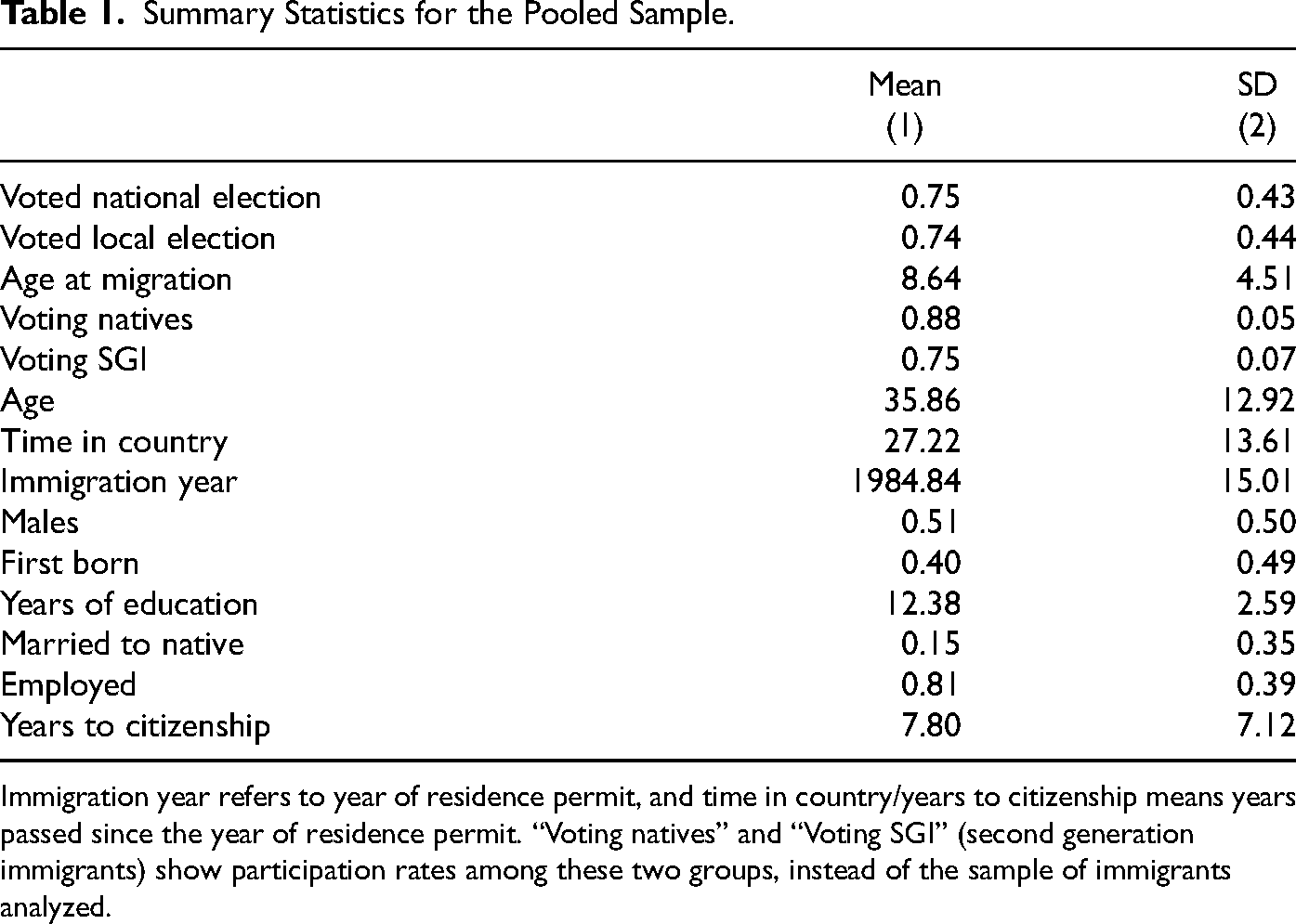
Immigration year refers to year of residence permit, and time in country/years to citizenship means years passed since the year of residence permit. “Voting natives” and “Voting SGI” (second generation immigrants) show participation rates among these two groups, instead of the sample of immigrants analyzed.
The participation rate in the sample is around 75%, which is much lower than the voter turnout among natives (88%), but indeed very similar to the voting among natives with foreign-born parents (75%). The average age at migration is around 9 years of age.
Most of the individuals in the sample have been in the country for an extended period of time at the time of voting (27 years on average). With the extended time in the country it also follows that several indicators of social and economic integration are fairly high: for example, about 80% are employed. The average age of a voter is 36, which follows mechanically from the age at migration and the time spent in the country.
Results
In Figure 1, we plot the OLS estimates for slope coefficients of the 17 age at migration dummy variables from model (4). More specifically, we use pooled data for all three elections and regress voting in the national election on dummies for the age at migration, while including family fixed effects and controls for sex, being first born and the average voting among second generation immigrants in the same age group (at the time of the election). 9
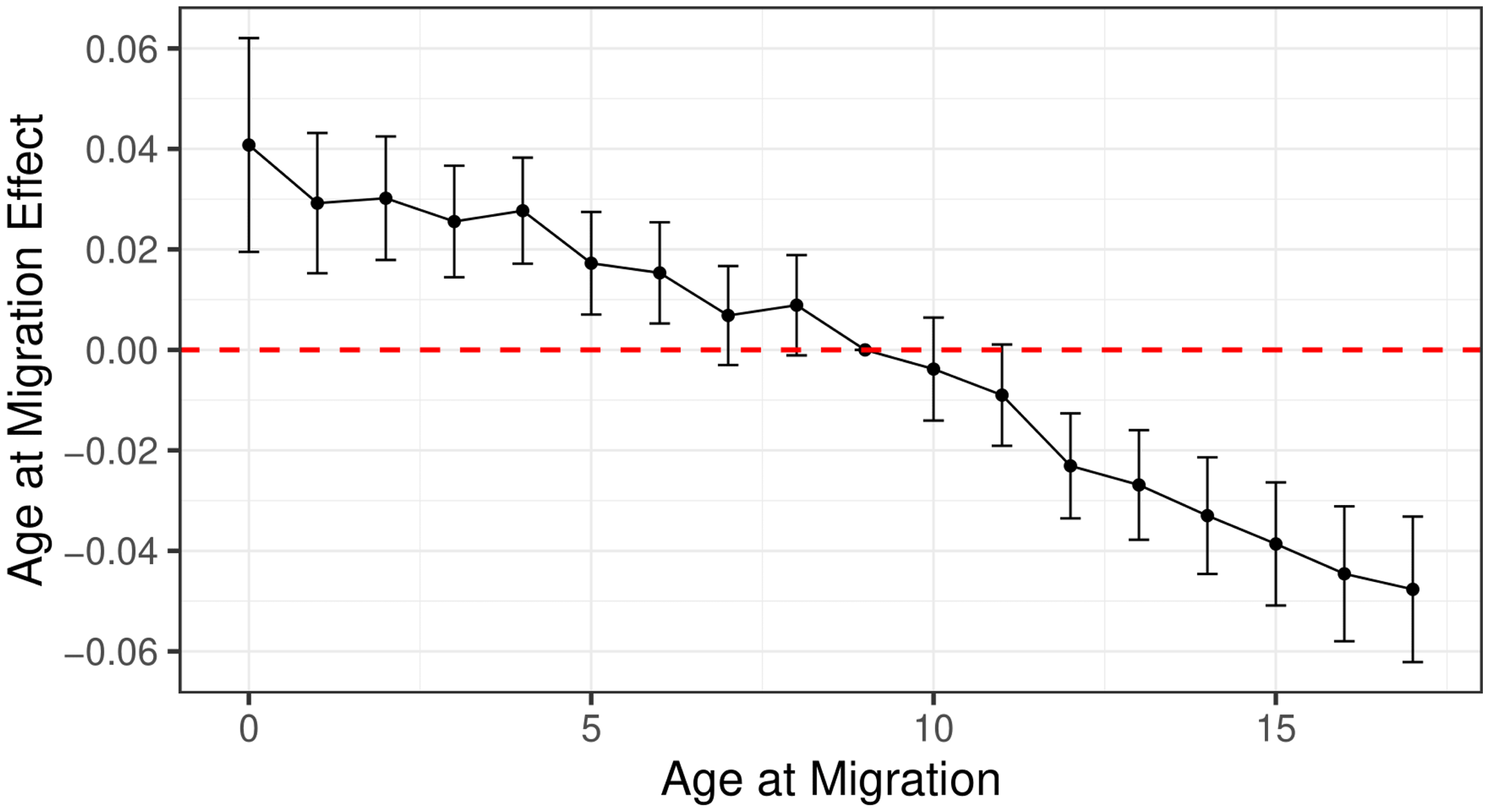
Plotting the effect of age at migration on turnout.
Figure 1 displays a clear gradient: on average, those who arrived as young children vote more as adults compared to their siblings who arrived simultaneously but at an older age. As an example, arriving at 1 to 2 years of age leads to, on average, a 3 percentage points higher likelihood of voting compared to arriving at the age of 9. On the other end, someone arriving at age 15 is on average 4 percentage points less likely to vote compared to those arriving at age 9. The increased likelihood of voting caused by arriving younger drops in a fairly linear fashion. However, the gradient is somewhat steeper for the later years along the x-axis.
We provide several robustness checks to validate the results in Figure 1. First, we change the group used to construct voting within age cohorts to all natives, rather than only second generation immigrants. Second, we change the outcome to voting in local elections, rather than national. Third, to allow for other functional forms, we use either a completely linear specification of age at migration, or a piece-wise linear specification (spline). These results are shown in Supplemental Figures B2 and B3 and Table B1, and corroborate the conclusions from Figure 1.
Finally, in Supplemental Figure B4, we show results for all years separately. In short, the gradient is strikingly similar for all years, however, the level of the estimated effects varies over the outcome years, especially when comparing 2010 to 1994. As we have already alluded to, the composition of immigrants have changed in Sweden over the relevant study period, both in terms of reason for immigrating as well as source regions. It may also be that some cohorts have been in Sweden longer periods of time.
Figure 1 focuses on the absolute increase in participation rate among immigrants themselves. A follow-up query concerns the voter turnout gap between natives and immigrants: do we close some or even the entire gap if immigrants arrive as young children rather than adults? Studying Table 1, and reflecting on the results in Figure 1, we conclude that our estimated effects are not large enough to close the immigrant-native participation gap. Yet, immigrants who arrive as children have very similar rates of participation compared to second generation immigrants. In that sense, any gap between first- and second-generation immigrants in terms of political integration seems to be closed if foreign-born arrive as children.
Is the Effect Persistent?
The individual-level turnout data over several years allows us to ask if the effect of age at migration decreases over time, or if the effect is persistent as individuals grow older. It matters greatly if arriving early increases political integration over the entire life-cycle, or merely over the first elections one can take part in. Theoretically, this question primarily relates to the already alluded to exposure model, which stipulates that immigrants over time converge partially or in full with the behavior of natives.
In Figure 2 we plot estimated age at migration effects for 1994, 2010, and 2018 separately, for a subset of foreign-born individuals who were eligible to vote in all three elections. Thus, we examine the effect of age at migration in different elections for the same individuals. The rationale for this categorization is to maintain a consistent sequence of national elections for all individuals. This ensures that those eligible to vote in, for instance, the 2010 election have been eligible in an equal number of elections between 1994 and 2010. While we hypothesize that the age at migration effect may diminish with each election, indicating a time-dependent factor, it is crucial to control for the constant number of elapsed elections for all individuals. However, it is noteworthy that not all individuals in this subgroup necessarily became eligible for their first election in 1994. For instance, the oldest individual in our sample was 62 years old in 1994, making it highly likely that they were eligible for elections prior to that year, given that our data only encompass individuals who immigrated between ages 0 and 17.
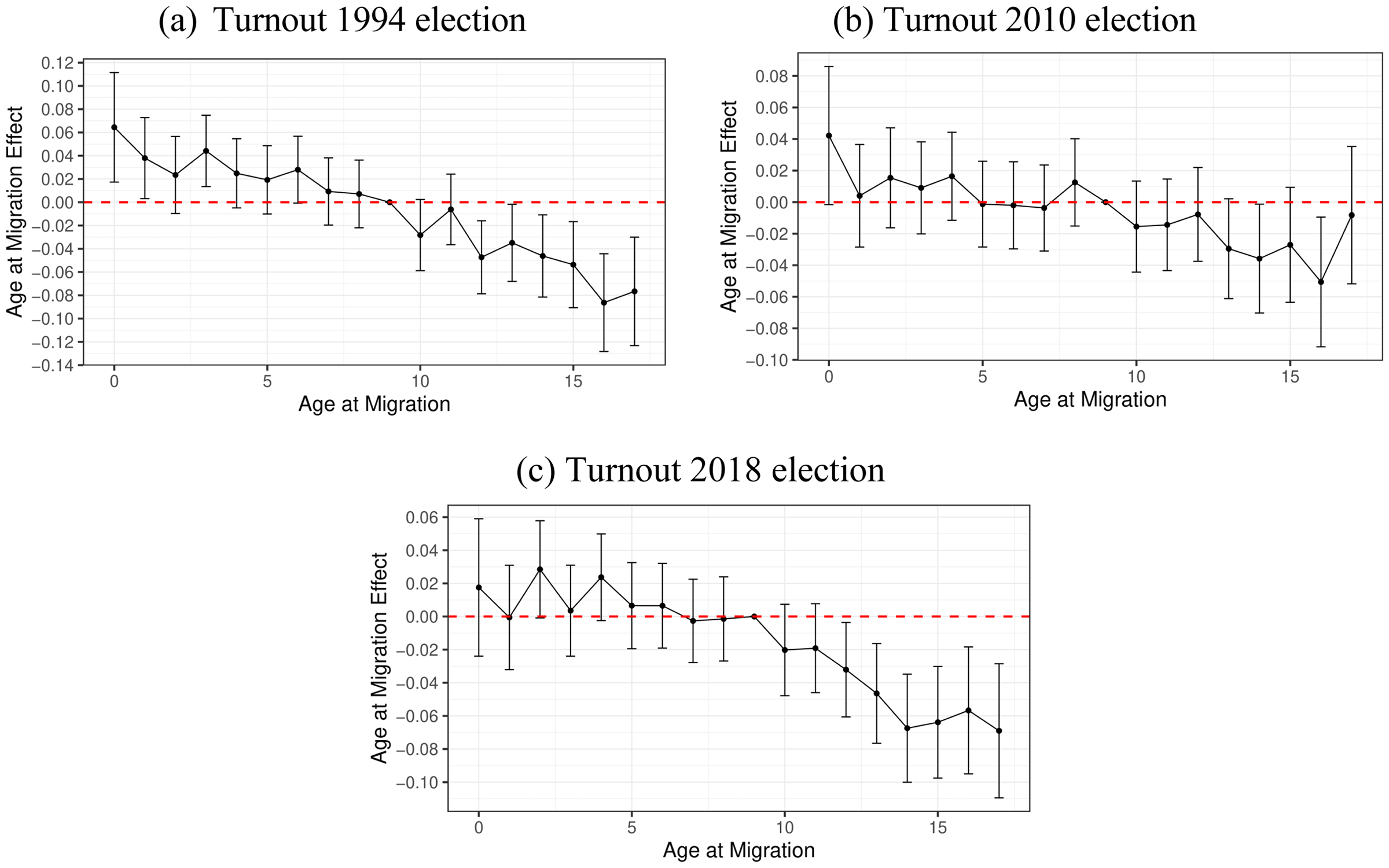
Examining the persistence of the effect of age at migration on turnout. (a) Turnout 1994 election, (b) turnout 2010 election, and (c) turnout 2018 election.
We note at least two things from this exercise. First, the effect is much clearer, in terms of both precision and the steepness of the gradient, for the first of the elections in 1994 (Figure 2a). A plausible interpretation of these results is that the effect of age at migration on political participation (as expected) diminishes somewhat over time. Second, even so, the results for 2010 and 2018 (especially 2018) still suggest that those who arrived at an older age as children vote to a lesser extent as adults than those who arrived at younger ages. This mere fact holds despite that more than two decades, including five national elections, passed between 1994 and 2018. While it seems the effect of age at migration diminishes some with years in the country, it is still striking that any gradient remains over this many years and elections.
Mechanisms
We now provide suggestive evidence on what mechanisms are driving the observed effects. We put our focus on mediators that we have a strong reason to expect are a function of age at migration, as well as in different ways connected to political integration. These include individual socioeconomic indicators, the neighborhood and workplace context, and finally a common measure of social integration: whether or not the individual is married to a native. To implement these analyses, we add the suggested mediators as controls (measured in the year of the election) to the right hand side of equation (4). Should these indicators be important mediating factors, we expect that including them in the model will lead to a decrease in the estimated gradient.
In Figure 3(a) we add controls for the number of years in education, disposable income and an indicator for employment. This causes the estimated effects to drop slightly. In our baseline model (Figure 1), we estimated an 8-percentage points difference between arriving at the age of 0 compared to the age of 15. A similar comparison with socioeconomic status (SES) controls leads instead to a 6 to 7 percentage points difference. In other words, socioeconomic factors likely mediate a small part of the relationship between age at migration and voting as most of the relationship remains intact when these factors are included as controls.
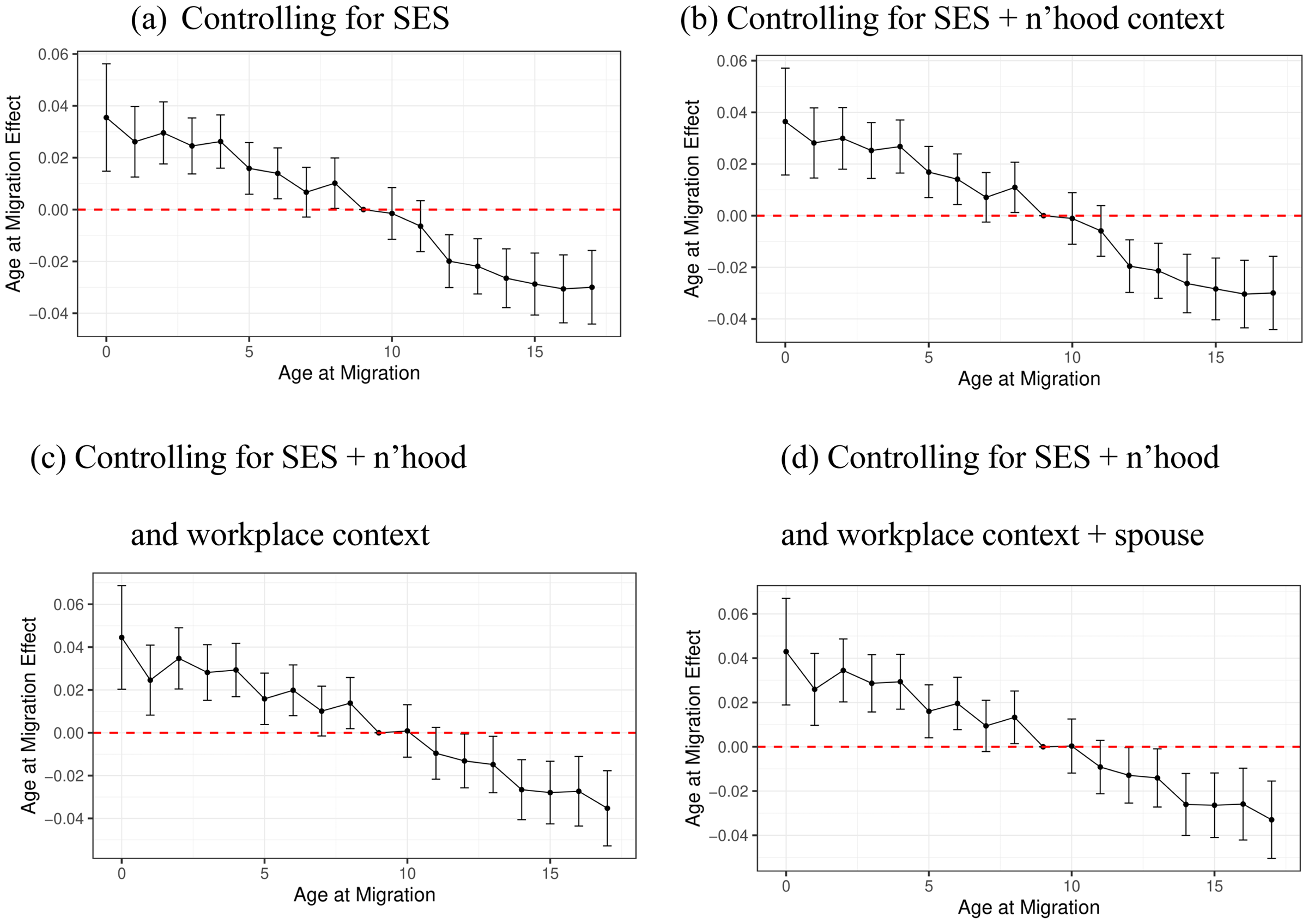
Plotting the effect of age at migration on turnout, controlling for potential mechanisms. (a) Controlling for SES, (b) controlling for SES + n’hood context, (c) controlling for SES + n’hood and workplace context, and (d) controlling for SES + n’hood and workplace context + spouse.
Adding the share of highly educated and Swedish-born in the neighborhood (Figure 3[b]), and in the workplace (Figure 3[c]) changes the gradient very little. The same goes for the final analysis, where we control for being married to a spouse or not. It therefore seems that any effect of age at migration on voting that might be mediated through the neighborhood, the workplace or the spouses background, is already mediated through socioeconomic status.
Heterogeneity: The Importance of Origin Region
To further deepen our understanding of the relationship between age at migration and political integration, it may also be useful to conduct heterogeneity analyses. In our theory section, we briefly discussed the importance of immigrants’ backgrounds before arriving in Sweden. For instance, it has been suggested that the likelihood of political integration in general, and the effect of age at migration in particular, may depend on the political and cultural similarities between immigrants’ countries of origin and their new country. Wass et al. (2015) even suggest that age at migration may be positively related to political participation for individuals migrating from one democratic country to another, while they expect a negative relationship for those moving from nondemocracies to democracies.
Unfortunately, we lack the data necessary to conduct a detailed analysis of this important question. Most importantly, due to confidentiality concerns, we do not know the exact country of birth for the immigrants in our sample — only their region of birth. In many cases, these regions contain considerable variation in both culture and political systems, which limits our ability to conduct a more detailed heterogeneity analysis.
That said, we still believe it is possible to shed some light on the importance of source country background by dividing our sample into three broad regions: immigrants born in (i) Nordic countries, (ii) other European countries, and (iii) non-European countries. The idea behind this classification is simple: we expect the countries in these groups to become increasingly different from Sweden in terms of culture and democracy as we move from the Nordic group to the European group, and finally to the non-European group. Consequently, if the impact of age at migration on political participation varies with cultural proximity and prior experience of democratic institutions, we can expect to find substantial differences in the age-at-migration gradient across immigrants from these three groups of countries.
To test this, Figure 4 provides separate age-at-migration estimates for each of the three country groups. Comparing Figure 4(a) (Nordic immigrants) with Figure 4(b) (European) and Figure 4(c) (non-European), we observe clear gradients for all regions, though the gradient is less steep and more imprecisely estimated for the Nordic countries. The non-European and European immigrants are in turn fairly alike, and very similar to the baseline estimations found in Figure 1.
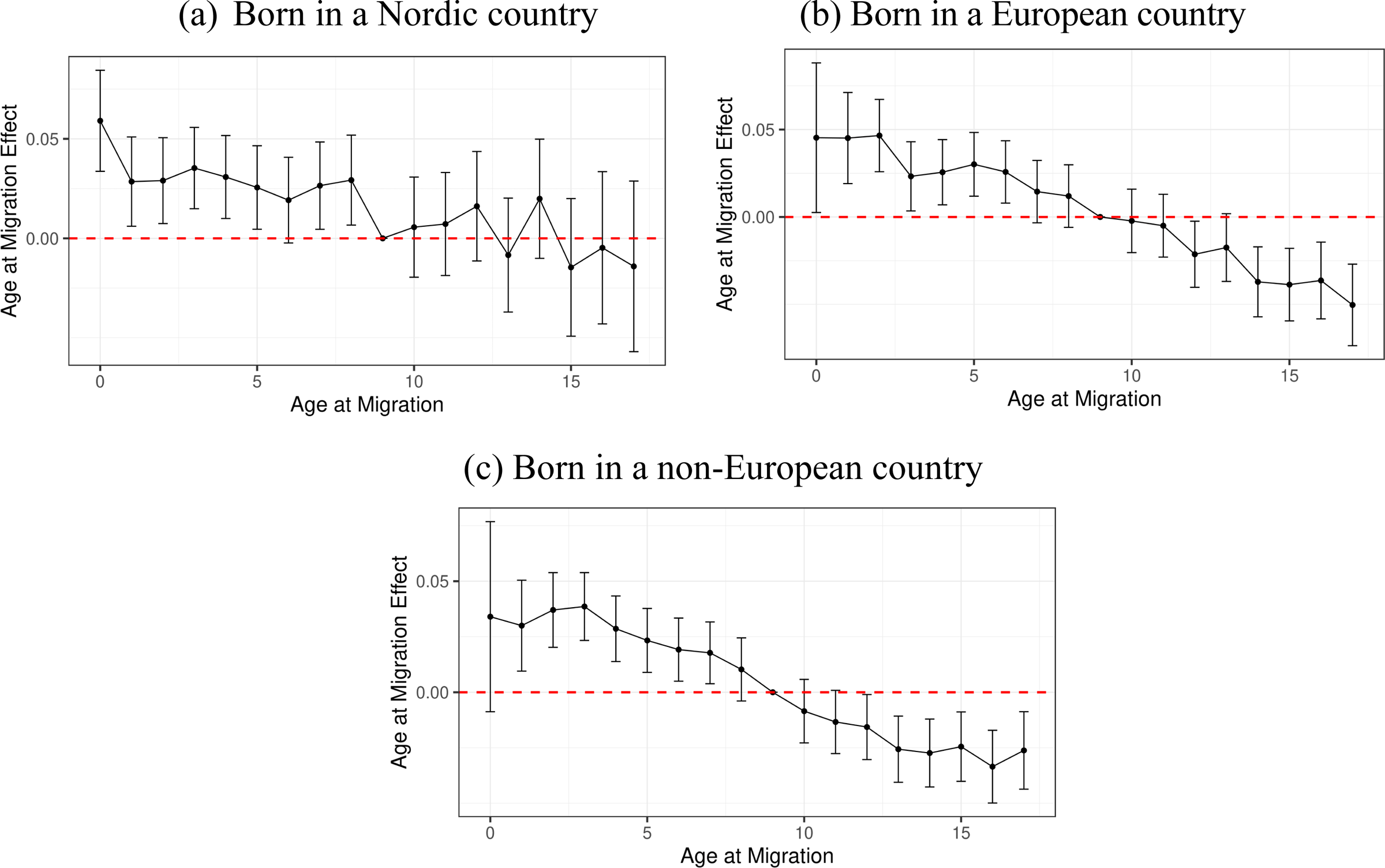
Separate effects depending on region of origin.
How should we interpret these results? Focusing on the Nordic group, an overwhelming majority (>80%) is made up of Finnish immigrants that arrived early on, most of them during the 1960s or earlier. The majority of the European group in turn consists of individuals from the Balkans and Eastern Europe, of whom many arrived during the early 1990s. Finally, the non-European group is predominately made up of refugees from the Middle East and Africa, many arriving from the 1990s and onward. The lower gradient for the Nordics may very well be due to the cultural proximity and the perks of coming from a democratic country. But given that the Nordic immigrants on average have been in the country a longer amount of time, persistence may also play some part in the observed results. Moreover, the fact that we observe very similar patterns for immigrants from European and non-European countries indicates that the negative effect of age at migration on voting is not restricted solely to immigrants from nondemocratic countries that are culturally different from Sweden.
Conclusion
Representative democracy is founded on the principle that all citizens have equal opportunities to participate in politics and influence public decisions. Consequently, the lower level of political participation among immigrants compared to native citizens in contemporary democracies poses a significant democratic challenge. To address this issue effectively, we must gain a better understanding of the mechanisms hindering or fostering immigrant political integration.
The aim of the present study has been to contribute toward this goal by examining how age at migration affects the likelihood of voting in adulthood. Leveraging extensive data from administrative registers, we compared the turnout of siblings immigrating to the host country at the same time, but at different ages. By estimating the effect of age at migration within families rather than between them, we have been able to circumvent many of the methodological issues plaguing previous research on the topic.
The findings from our analyses are striking. Individuals who immigrated at a younger age exhibit considerably higher voter turnout as adults compared to their older siblings who were older when immigrating. According to our results, the expected difference in turnout between immigrating at the age of 1 and the age of 17 is about 7 percentage points, or approximately 9% of the average turnout in the group.
These results thus provide some support for the resistance theory, which claims that individuals who spent their formative years in the host country will find it easier to integrate politically. However, our findings also indicate that the effect of age at migration on turnout is fairly linear, which partly challenges the notion that there is a distinct formative years period after which political integration becomes considerably more difficult. In other words, the impact of age at migration appears to be more gradual than the typical formative years interpretation of the resistance theory would lead us to believe.
Another important finding of our study is that, although the age at migration effect appears to diminish somewhat over time, it still demonstrates great persistence, remaining evident in elections covering a time span of almost 30 years. The political underrepresentation of immigrants arriving at an older age is thus not necessarily something that vanishes with the time spent in the host country, as suggested by the exposure theory. Moreover, the decrease in the effect over time that we observe appears to be mainly driven by individuals immigrating before the age of 9, whereas the effect remains fairly similar across elections for those arriving at an older age. One possible interpretation of these results is that the formative years story discussed above may have a greater bearing on the impact of age at migration in the longer run. To the extent that this is the case, our results suggest that this formative period begins around the age of 8 to 9.
To further deepen the understanding of these results, we also examined potential mechanisms and whether the effect of interest differs for immigrants from different regions. Previous research indicates that age at migration may influence the economic and social integration of immigrants, but we found little evidence that the effect on political integration is mediated through these other types of integration. Controlling for an extensive set of indicators related to the economic and social integration of the immigrants only marginally affected the estimated effect of age at migration on voter turnout.
The fact that only a minority of the relationship between age at migration and voting was channeled via socioeconomic integration could be related to the case we study: Sweden. A defining feature of elections in Sweden is that, compared to many other countries, it is easy to vote. From the latter detail comes a comparatively high rate of voter turnout, which means that socioeconomic status will matter less for turnout. To the extent that age at migration causes voter turnout in other contexts, where casting a vote is harder and participation rates lower, socioeconomic integration may be a more important factor to consider.
Turning to the results related to region of origin, we found a less pronounced but still negative effect of age at migration among immigrants born in other Nordic countries, whereas the effects were of comparable magnitude for individuals born in European and non-European countries. However, we must be cautious when interpreting these results, as the analysis is based on a very coarse categorization of origin regions. Nevertheless, the fact that we observe similar negative effects of age at migration for both European and non-European countries, as well as a negative — though less pronounced — effect among immigrants from other Nordic countries, contradicts the hypothesis of Wass et al. (2015, 412) that age at migration is positively related to voting for immigrants from democratic source countries.
We believe the results have important implications for both research and policy. In terms of research, whereas previous findings on this issue have been inconsistent (White et al. 2008; Wass et al. 2015; Li and Jones 2020), our results provide strong support for the view that political integration may be more challenging for individuals who migrate at an older age. The fact that our sibling approach addresses many of the methodological problems typically associated with these types of studies lends further credibility to these findings.
However, more work needs to be done. In particular, our attempts to identify the causal mechanisms underlying the observed relationship mainly resulted in the elimination of some likely candidates, such as economic and social integration, from the list of potential explanations. Research on alternative mechanisms therefore constitutes an important avenue for future research in the field. One such factor is cultural integration, another that we believe deserves special attention, but which we could not investigate due to data shortages, is language acquisition.
In terms of policy, our findings suggest that efforts to improve the political integration of immigrants should consider that the age at which an individual arrives in the host country during childhood can affect their political engagement as adults.
Footnotes
Declaration of Conflicting Interests
The authors declared no potential conflicts of interest with respect to the research, authorship, and/or publication of this article.
Funding
The authors disclosed receipt of the following financial support for the research, authorship, and/or publication of this article: This work was supported by the Svenska Handelsbankens Forskningsstiftelse, H2020 European Research Council (grant number W18-0028, 683214).

Supplemental Material
Supplemental material for this article is available online.