




Abstract
Family migration constitutes by far the largest form of entry into countries with established democracies. Yet, it remains widely neglected in the literature on public attitudes. One of the key challenges in researching this topic is its inherent complexity. Family migration involves not only the claims of outsiders seeking entry, but also those of insiders wishing to reunite with family members. To address both dimensions simultaneously, we designed a conjoint survey experiment using an innovative dyadic approach. Respondents were presented with hypothetical cases of aspiring family migrants, alongside their respective family members already residing in the destination country. Key attributes, such as financial resources and types of family relationships, were randomized for each pair. We conducted the survey with 5,000 respondents across France, Germany, Italy, Sweden, and the United Kingdom. Our results suggest that respondents pay close attention to the characteristics of the incoming family migrant, such as language skills, while also being concerned with the economic resources of the family member already residing in the destination country. These findings indicate that research on public attitudes cannot treat family reunification as just one among many immigration motives. Study designs must also systematically account for the status of the family member already living in the destination country.
Introduction
In recent years, significant research efforts have been devoted to mapping and analyzing citizens’ attitudes toward immigration. The vast majority of studies in this literature focus on either labor or refugee migration (for systematic overviews, see Ceobanu and Escandell 2010; Hainmueller and Hopkins 2014; Dražanová et al. 2024). In contrast, studies on attitudes toward family migration remain comparatively scarce. This represents a notable knowledge gap, given that family migration is both the largest form of entry in countries with established democracies (OECD 2023, 20) and a highly contested political issue (Eggebø and Brekke 2019).
The lack of prior research on attitudes toward family migration may be due to the inherent complexity of the topic. Family migration involves not only “outsiders knocking at a state's doors and requesting entry,” but also the “moral claims of insiders”—residents seeking to reunite with their families (Bonjour and Kraler 2015, 1412). This “insider-outsider overlap” means that admission requirements can apply to both resident sponsors (the insiders) and incoming family migrants (the outsiders). Conditions, such as income and housing requirements imposed on resident sponsors, thus serve dual purposes: they are both integration policies and immigration control measures (Bech, Borevi, and Mouritsen 2017). The development and diffusion of such dualistic policies is well documented (e.g., Kofman 2018; Charsley et al. 2020; Ahlén 2023). Research on public attitudes, however, typically assesses only the “outsider” dimension of migration (see, e.g., Ceobanu and Escandell 2010; Bansak, Hainmueller, and Hangartner 2016).
Our study addresses this gap in the literature by introducing an innovative dyadic approach. We employ a series of conjoint survey experiments (Hainmueller, Hopkins, and Yamamoto 2014) across five European countries, which simultaneously assess attitudes toward both family migrants and their corresponding resident family members in various institutional settings. This dyadic approach is highly versatile and specifically designed to capture a nuanced understanding of public attitudes toward family migration, reflecting the legal, moral, and political complexity of the issue.
Prior Research
The literature on public attitudes toward migration has expanded rapidly over the past twenty years. Much of the early development in this field was driven by large-scale surveys with standardized questionnaires, such as the International Social Survey Programme (ISSP). Findings from these studies indicate that anti-immigrant attitudes are particularly prevalent among less-skilled workers and individuals with lower levels of educational attainment. Additionally, citizens tend to be more favorable toward individuals of the same ethnic background and those from affluent, liberal democracies. Categories of entry also play a role, as attitudes toward refugee migration tend to be more positive compared to labor migration (for systematic overviews, see Ceobanu and Escandell 2010; Hainmueller and Hopkins 2014; Dražanová et al. 2024).
Research findings of the kind described above are highly valuable in the context of policy-making. In functioning democracies, decision-makers are constrained by the expectations of voters, which limits their range of action. For example, anti-immigrant sentiment can impose significant constraints on policymakers who view migration as a solution to economic or demographic challenges (Ruhs 2022). However, it is not always clear what citizens actually want. Standard approaches to public opinion research often fail to capture attitudes toward the highly complex issues of migration in an accurate and meaningful way (Blinder 2015).
Conjoint survey experiments are specifically designed to address this problem. Respondents are typically asked to compare and choose between several realistic, albeit hypothetical, descriptions of concrete migration cases or policy alternatives. Individual attributes of the presented cases are randomly varied, allowing researchers to capture and aggregate attitudes toward these attributes without needing to ask each respondent about every individual feature (Leeper, Hobolt, and Tilley 2020). This approach also helps mitigate the risk of socially desirable responses, which can be a concern when dealing with the sensitive topic of immigration (Bansak et al. 2021).
Previous conjoint studies suggest that public attitudes are shaped by concerns about the cultural and economic impacts of immigration on the nation as a whole (Hainmueller and Hopkins 2014). This helps explain why, for example, highly skilled immigrants tend to be broadly accepted across various countries and societal groups, while those lacking employment prospects are often viewed as potential economic, cultural, or security threats (Bansak, Hainmueller, and Hangartner 2016).
Family migration is addressed to some extent in existing conjoint studies on attitudes toward migration. For example, Jeannet, Heidland, and Ruhs (2021) use a conjoint experiment to analyze policy preferences concerning asylum and refuge in eight Western European countries. They find that, consistently across countries, citizens are most supportive of family reunification policies that require refugees to cover the living costs of their incoming family members. Similar patterns are found by Allen, Ruiz, and Vargas-Silva (2024), who conducted a conjoint experiment on, among other attributes, admission policies for family migrants to Colombia. Hainmueller, Hopkins, and Yamamoto (2014) also use this method to study attitudes toward migration in the United States. They find that public support is comparatively high for family reunification and international protection (refuge and asylum) but lower for economic migration. Hedegaard and Larsen (2023) find a similar pattern when replicating this conjoint experiment in Europe.
Contributions of the Study
The findings of prior research using conjoint experiments provide some insights into public attitudes toward family migration. However, existing studies typically focus only on the attributes of either incoming family migrants or resident family members as just one among many dimensions of migration. As such, they do not capture the inherent complexity and duality highlighted in previous studies on family migration policies (e.g., Bonjour and Kraler 2015; Bech, Borevi, and Mouritsen 2017; Kofman 2018). Our study aims to break new ground in this regard and systematically advance the current state of research on attitudes toward family migration. We employ conjoint survey experiments to make questions about family migration more tangible for respondents and to mitigate the risk of social desirability bias. This methodological choice is combined with a dyadic approach that presents respondents with concrete (hypothetical) cases involving both parties—the resident family members and the incoming family migrant.
The key contribution of this study is its focus on the insider-outsider dyad of family migration. The individual attributes of the profiles were selected exploratively, guided by the Family Reunification Directive of the European Union. 1 The directive serves as the focal point for all legislation on family migration in the region, applicable both to the Member States of the European Union and to non-EU countries that are integrated into its legal framework through multilateral agreements, such as the European Economic Area and the Schengen Area (Ruffer 2011; Borevi 2018). It provides a reference point for the scope of policy options that legislators could realistically present to citizens. The individual attributes we extracted for this study are discussed in more detail in the next section.
Our study covers five European countries: France, Germany, Italy, Sweden, and the United Kingdom. All five countries have become key destinations for family migration in recent years (OECD 2023, 65). However, they vary substantially in their rules for admitting family members. For example, France and Germany have maintained comparably stringent policies, including language and income requirements, for the past two decades (Joppke 2007; Bech, Borevi, and Mouritsen 2017). The United Kingdom employs similar rules today but adopted them only about ten years ago (Goodman 2014; Wray 2016). In contrast, Italy and Sweden continue to maintain more generous policies (Ahlén 2023), despite the introduction of some stricter requirements in recent years (Solano and Huddleston 2020). Therefore, our case selection allows us to explore public attitudes toward family migration across a considerable variety of institutional settings, all located in close geographical proximity. 2
Method
Our survey experiment was conducted in May and June 2021 with about 1,000 respondents from each of the five European countries (N = 4,954). At that time, border crossings were severely limited due to the COVID-19 pandemic. While the timing of the study was not intended for this purpose, it allowed us to investigate the topic of family migration without concerns about country-specific idiosyncrasies, such as disproportionately high net migration rates at the moment of data collection. However, it also means that the results may not be the same if replicated in another time or place. During this period, migration was not a prominent topic in public debate or media attention. Nevertheless, the backdrop of the pandemic provided a unique opportunity to study attitudes toward family migration.
The sampling procedure for the study accounted for quotas related to gender, age, and education. Low-quality responses were identified and replaced based on response time and the consistency of responses across conjoint tasks (see, e.g., Jeannet, Heidland, and Ruhs 2021; Hultin Rosenberg and Wejryd 2022). Details regarding both the sample and the sampling procedure are provided in the Supplemental Material. The basic design of the experiment follows the pioneering work of Hainmueller, Hopkins, and Yamamoto (2014). Respondents are presented with a list of attributes for two hypothetical cases of family migration and are then asked to select the case they would prefer for reunification in their country of residence. Attributes are randomized, allowing researchers to estimate the weight of one attribute relative to all others on an aggregate level without asking individual respondents which specific attribute informed their choice.
The innovative approach that we developed for this study expands upon the basic setup of Hainmueller, Hopkins, and Yamamoto (2014) to make it suitable for the study of family migration. In our survey, respondents are presented not only with the hypothetical case of an immigrant requesting entry into their country of residence, but also with a corresponding resident family member described by a set of corresponding attributes. This method allows us to systematically capture attitudes that encompass both the “insider” and “outsider” dimensions of family migration across multiple attributes.
We extracted a total of ten attributes from the Family Reunification Directive (see “Contributions of the Study” section). Each hypothetical profile consisted of four attributes describing the incoming family member and six attributes describing the family member already residing in the destination country. Details are listed in Table 1. Translations for each of the five respondent countries are provided in the Supplemental Material. The placement of attributes was randomized to avoid bias induced by the order in which respondents read the profiles. The attribute values were chosen to be distinctive, plausible in all combinations, and to cover a wide range of different backgrounds. Each profile's attribute values were randomized with identical probability for the values within each attribute, and all combinations of attribute values were allowed. These measures aim to reduce correlations between attribute values. Corresponding randomization checks can be found in the Supplemental Material.
Attributes and Attribute Values of the Conjoint Survey Experiment.
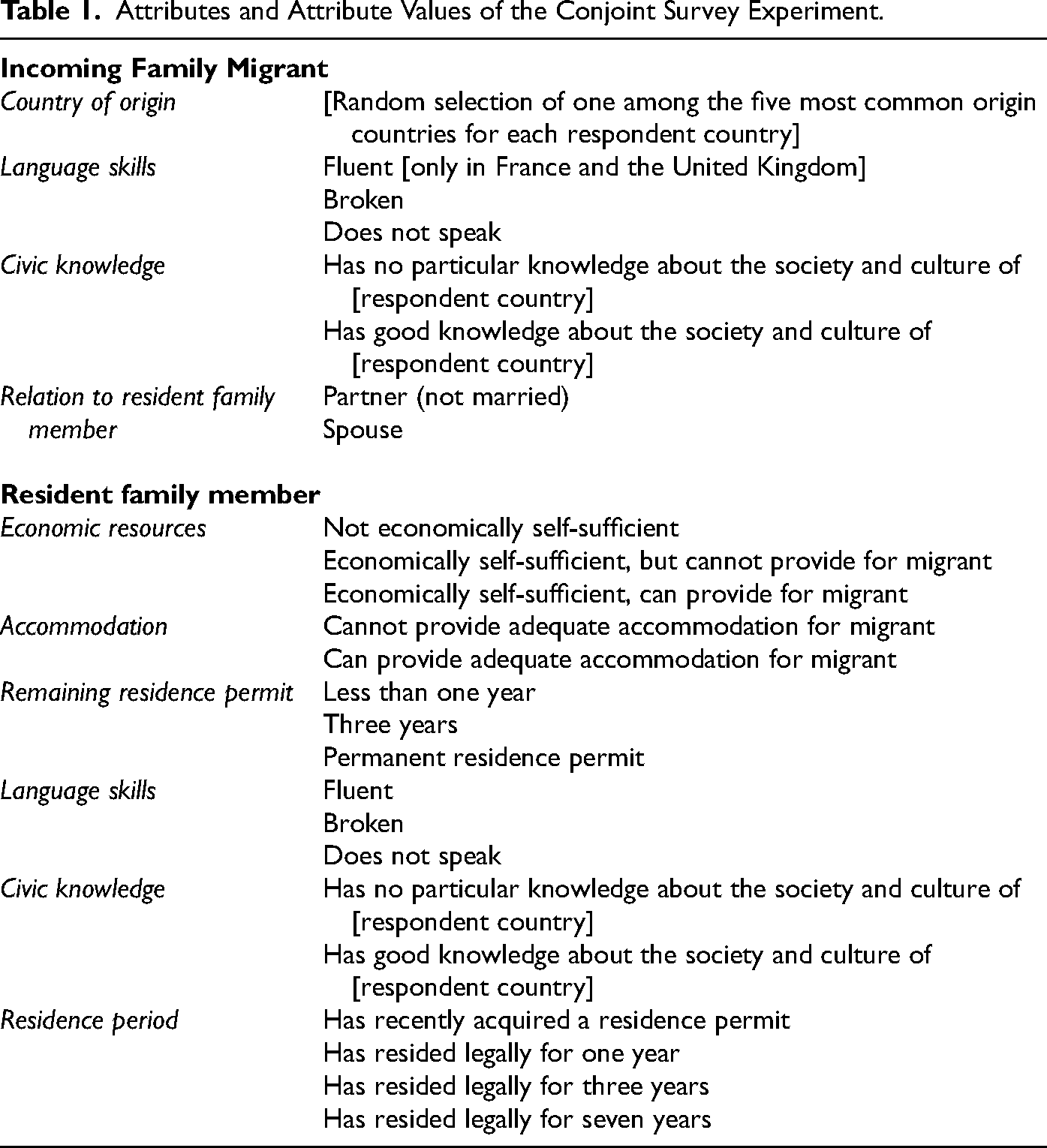
It is important to note that some restrictions were placed on the combination of attribute values to ensure plausibility throughout the survey. The origin of the incoming family member was randomly selected from the five most common source countries for each respondent country. Details of this selection can be found in the Supplemental Material. After data collection, the origin was recoded into a binary distinction between EU citizens and third-country nationals. While this approach ensures plausibility, it also implies that the results of the pooled analyses for this attribute should be treated with caution. Additionally, the value of “fluent” for the language skills of incoming family migrants was not presented to respondents in Italy, Germany, and Sweden. This decision follows from the assumption that it is not particularly plausible for incoming migrants to speak the respective languages fluently prior to arrival.
Respondents were presented with two profiles of hypothetical migrants and their resident family members, followed by two tasks. First, they were asked to select which of the two profiles should be granted family reunification. Next, respondents rated each profile on a scale from one to seven, allowing them to express their attitudes toward each profile independently. This rating task was designed to enhance the respondents’ experience, particularly when they preferred the same decision for both profiles. The combination of choosing and rating also facilitates robustness checks and helps identify inattentive respondents (Hainmueller, Hopkins, and Yamamoto 2014; see also the Supplemental Material). Six pairs of profiles were presented in each survey of the five respondent countries, resulting in nearly 60,000 rated hypothetical profiles.
Results
Attitudes toward family migration are studied for the full sample of respondents across all five countries. A breakdown by respondent country can be found in the Supplemental Material. The weight of each attribute on the overall selection probability is analyzed by estimating average marginal component effects (AMCE). The key advantage of this technique is that it allows us to isolate the contribution of one attribute to any given pairwise comparison relative to the joint distribution of all other attitudes (Hainmueller, Hopkins, and Yamamoto 2014).
Figure 1 provides an overview of the selection probabilities, broken down by the effect of each attribute. Details of the regression results can be found in the Supplemental Material. The upper panel displays the results for the part of the profile describing the incoming family migrant, while the lower panel lists the effects of attributes assigned to the resident family member. All effects are expressed as differences in the selection probability of a profile with a given attribute value relative to a profile with a reference value. Horizontal lines denote confidence intervals at the 95 percent level.
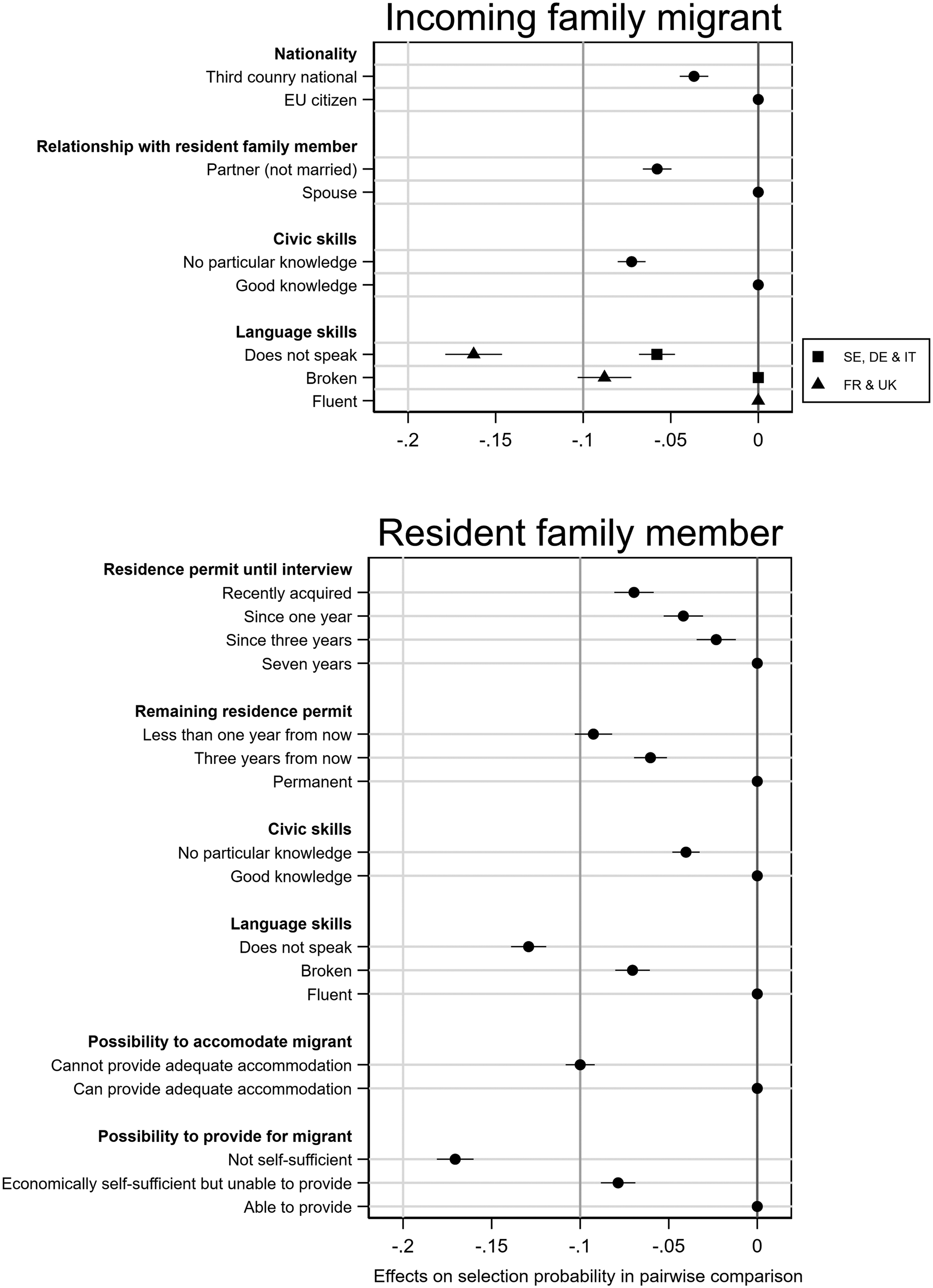
Average marginal component effects (AMCEs) on profile selections.
Language is identified as the most salient attribute concerning the incoming family migrant in the survey experiment. Not speaking the main language of the respondent country reduces selection probabilities by more than 15 percentage points in France and the United Kingdom. Speaking a broken version of the language is associated with a decrease of 5 percentage points in Germany, Italy, and Sweden. The relationship with the resident family member and the migrant's knowledge of the country's society and culture also matter, but to a lesser extent. Additionally, our results indicate a somewhat higher preference for incoming family migrants from other European countries. However, it should be noted that the origin countries differ among respondent countries (see “Method” section).
Turning to the results for the resident family member, we first note that the largest effect is detected for attributes concerning financial resources. Selection probabilities drop by about 10 percentage points if the resident family member is unable to accommodate the incoming family member, and by approximately 17 percentage points if the resident family member lacks the financial resources to support the reunified family. Language acquisition also plays a significant role; not knowing the country's language reduces selection probabilities by about 13 percentage points on average. Other attributes, such as civic skills, 3 length of residency, or legal status, are considered less relevant.
The results of the study are nearly identical for the two types of tasks that respondents performed after viewing the pairs of profiles. Attributes with high salience in the choice-based task are also deemed more important when respondents rate the profiles on a scale from one to seven. Detailed results of the regression analyses for both tasks can be found in the Supplemental Material.
Our robustness checks indicate that the results do not vary significantly across respondent countries. Details of these analyses can be found in the Supplemental Material. We observed a somewhat higher importance placed on economic resources among Swedish respondents and a greater emphasis on language skills in the German sample. However, the overall pattern of attitudes toward family migration appears very similar across all countries. This finding aligns closely with the current state of research. Our analysis further corroborates that attitudes vary more within countries than between them when analyzed using survey experiments (Bansak, Hainmueller, and Hangartner 2016; Jeannet, Heidland, and Ruhs 2021).
Overall, the results of our study indicate that respondents value the economic resources of the prospective household significantly more than formal requirements, such as the legal status of the resident family members. Regarding the incoming family member, language skills are found to be more important than the type of family relation or the civic skills of the hypothetical profile. Additionally, we do not observe any interaction effects between the two dimensions of family migration. For example, the effect of language acquisition prior to immigration is neither amplified nor diminished if the resident family member lacks the means to support the household economically. Hence, our findings suggest that both sides of the family migration dyad have independent value in shaping public attitudes. Details of these analyses can be found in the Supplemental Material.
Conclusions
Our contribution is, to the best of our knowledge, the first comprehensive conjoint study on public attitudes specifically focusing on family migration. Furthermore, it provides an initial analysis of public attitudes that systematically accounts for the inherent duality of family migration as both a reason for immigration (the outsider dimension) and a right to reunification (the insider dimension). This study breaks new ground by combining a state-of-the-art survey technique with a systematic dyadic approach to jointly assess attitudes toward both dimensions of family migration. The results indicate that respondents are primarily concerned with attributes related to the economic resources of resident family members and the language skills of the incoming family migrant. This aligns with existing research on attitudes toward migrants in general, which has shown that perceived economic contributions and cultural compatibility of hypothetical migrant cases are key factors influencing public attitudes (Hainmueller and Hopkins 2014; Hainmueller, Hopkins, and Yamamoto 2014; Hedegaard and Larsen 2023).
Importantly, however, our study also underscores that family migration cannot simply be treated as one among many reasons that make “outsiders” inclined to migrate to another country. Whether the general public is willing to accept this form of entry depends crucially on the “moral claims of insiders,” meaning residents who seek to be united with their families (Block 2015). These results can be interpreted as expressions of general sociotropic concerns about immigration (e.g., Bansak, Hainmueller, and Hangartner 2016) and perceptions of integration being stratified between “insiders” and “outsiders” (Bonjour and Kraler 2015). The two perspectives ultimately complement each other: the more family migration is viewed as a legal claim by fully integrated and economically successful members of society, the more it is perceived as a legitimate form of entry rather than a threat to society as a whole. Lastly, it is noteworthy that respondents are most concerned with attributes typically associated with the “civic turn” in policymaking, such as finding a job and acquiring the main language spoken in the host country (Joppke 2007; Goodman 2014; Bech, Borevi, and Mouritsen 2017). In contrast, other formal membership requirements, such as the legal status of resident family members, seem to play a lesser role.
Utilizing the dyadic approach developed for this study allowed us to address a core research problem by illuminating the complex intersection between immigration and integration that underscores the logic of family migration. While this represents an important advancement in research on the topic, drawing conclusions about societal context based solely on five countries is limited. Although we observe some variation across countries, the small number of country cases prevents us from making meaningful generalizations. Therefore, future research should aim to conduct more extensive comparisons across a broader range of countries.
Furthermore, it remains unclear whether the results of our study reflect attitudes formed “bottom-up” within the general public and subsequently translated into policies, or if they are shaped “top-down” by policymakers who impose stricter conditions for family reunification as a means of controlling immigration while simultaneously enhancing the integration potential of admitted individuals (Goodman 2014). Addressing this question would require a different study design that assesses the impact of cues from elites and media framing (cf. Hellwig and Kweon 2016; Schmidt-Catran and Czymara 2023; De Coninck 2020).
Our findings indicate a connection between public attitudes towards family migration and recent policy developments in this area. Increased conditionality in family migration policies may create an informal selection system that favors “the best and brightest,” while penalizing those with less economic and social capital (Kofman 2018; Ahlén 2023). This raises important questions about the extent to which economic utility or the “capacity” to integrate should determine access to family reunification. We hope that this research note will inspire, inform, and guide future investigations into the mechanisms influencing both public attitudes toward family migration and the development of related policies.
Supplemental Material
sj-docx-1-mrx-10.1177_01979183241293391 - Supplemental material for Uncovering Attitudes to Family Migration—A Conjoint Survey Experiment with a Dyadic Approach
Supplemental material, sj-docx-1-mrx-10.1177_01979183241293391 for Uncovering Attitudes to Family Migration—A Conjoint Survey Experiment with a Dyadic Approach by Lutz Gschwind, Johan Wejryd, Jonas Hultin Rosenberg, Anton Ahlén and Karin Borevi in International Migration Review
Footnotes
Acknowledgements
We would like to express our gratitude to all participants of the conference European Citizens Thirty Years On: Economic Contributors, Political Members, Right-holders? that took place in Uppsala in 2022 and to those attending our presentation at the Annual IMISCOE Conference in Oslo in 2022. We also benefitted greatly from the opportunities to present earlier versions of this manuscript at the Uppsala Immigration Lab and the sub-seminar Political Sociology and Economy at the Department of Government, Uppsala University. The final version of this article was made possible with the help of very constructive and supportive comments by three anonymous reviewers to whom we are most thankful.
Declaration of Conflicting Interests
The author(s) declared no potential conflicts of interest with respect to the research, authorship, and/or publication of this article.
Funding
The author(s) disclosed receipt of the following financial support for the research, authorship, and/or publication of this article: This work was supported by the Swedish Research Council under Grant 2021-02033_VR. Ethics approval for the study was granted by the Swedish Ethical Review Authority on 08 April 2020 (Dnr 2019-05920).

Supplemental Material
Supplemental material for this article is available online.
Notes
References
Supplementary Material
Please find the following supplemental material available below.
For Open Access articles published under a Creative Commons License, all supplemental material carries the same license as the article it is associated with.
For non-Open Access articles published, all supplemental material carries a non-exclusive license, and permission requests for re-use of supplemental material or any part of supplemental material shall be sent directly to the copyright owner as specified in the copyright notice associated with the article.
