




Abstract
The immediate effects of COVID-19 on mortality, fertility, and internal and international migration have been widely studied. Particularly, immigration to high-income countries declined in 2020. However, the persistence of these declines and the extent to which they have impacted different migration flows are yet to be established. Drawing on immigration flows from Eurostat and Autoregressive Integrated Moving Average (ARIMA) time-series models, we assess the impact of COVID-19 on different immigration streams to seven European countries. We forecast counterfactual levels of immigration in 2020 and 2021 assuming no pandemic, and compare these estimates with actual immigration counts. We use regression modeling to explore the role of immigrants’ origin, distance, stringency measures, and gross domestic product (GDP) trends at origins and destinations as potential driving forces of changes in immigration during COVID-19. Our results show that, while there was a general decline in immigration during 2020, inflows returned to expected levels in 2021, except for Spain. However, drops in immigration flows from countries outside the Schengen Area to Europe persisted in 2021. Immigrants’ origin emerged as the main factor modulating immigration changes during the pandemic, and to a lesser extent stringency measures and GDP trends in destination countries. Contextual factors at origin seem to have been less important.
Keywords
Introduction
Demographic components were strongly affected by COVID-19 during the early stages of the pandemic (González-Leonardo and Spijker 2023). Life expectancy dropped in almost all the countries, with important cross-national differences (e.g., Marois, Muttarak, and Scherbov 2020; Aburto et al. 2021; Heuveline and Tzen 2021). Fertility declined in some countries, while it remained constant or variations were not statistically significant in others (e.g., Aassve et al. 2021; Sobotka et al. 2023). Globally, levels of internal migration declined, and mobility patterns changed across the rural–urban continuum. There was an increase in movements away from large cities to areas with lower population densities, coupled with declining inflows to urban centers (e.g., González-Leonardo et al. 2022; González-Leonardo, Rowe, and Fresolone-Caparrós 2022; Stawarz et al. 2022; Rowe et al. 2023). Drops in international migration were also documented (UN 2021), once again showing significant differences among countries (González-Leonardo et al. 2023).
Nonetheless, disruptions to demographic components due to the pandemic seem to have been temporary. Life expectancy tended to pre-pandemic levels already in 2021 (Schöley et al. 2022) and fertility either recovered or exceeded pre-COVID-19 levels over the course of 2021 in countries where a decline was previously observed (Nisén et al. 2021; Sobotka et al. 2023). Internal migration intensities and patterns also seem to have returned to normal in most countries (Wang et al. 2022; Rowe, González-Leonardo, and Champion. 2023; Perales and Bernard 2023).
Previous work documented that immigration flows to high-income countries dropped during the first year of the pandemic (González-Leonardo et al. 2023). Australia, Spain, and Sweden saw the largest declines, totaling 60%, 45%, and 36%, respectively. Reductions from 16% to 27% were estimated in the United States (27.2%), France (26.5%), Norway (25.5%), Italy (21.6%), Canada (20.2%), and the Netherlands (15.5%). Non-statistically significant declines, ranging from 4% to 15%, were observed in Denmark, Ireland, Austria, and Switzerland. However, it remains unknown whether low levels of immigration persisted across countries in 2021, and how different immigration flows were affected during the pandemic.
We could anticipate that immigration flows to high-income destination countries may have recovered to pre-pandemic levels in 2021, as lockdowns and travel restrictions were progressively eased. Nonetheless, different recovery speeds can be expected across migration flows. While travel restrictions within the Schengen Area 1 were quickly relaxed, they were maintained for people arriving from other countries. Therefore, we can expect that the overall intensity of immigration flows recovered to pre-pandemic levels faster in Schengen countries which normally receive a large proportion of immigrants from the Schengen Areas (e.g., Finland or Denmark). In contrast, more pronounced and longer reductions in the overall levels of immigration can be expected in countries with a large share of immigrants from outside the Schengen Area (e.g., Spain or Italy). We could also speculate that long-distance migration (e.g., from Latin America to Spain) may have been more impacted than short-distance flows, showing a slower recovery, as travel restrictions mainly affected air travel, the main transportation for long-distance journeys. So far, the immigrants’ origin and the distance of migration flows as potential driving forces of immigration changes during the pandemic remain unexplored, as other potential driving forces, such as the combining effect of stringency measures and economic trends during COVID-19 both at origin and destination, acting as push and pull factors in the decision to migrate.
Potential effects of stringency measures, particularly international travel restrictions, on slowing international migration levels have been proposed in previous studies (e.g., Guadagno 2020; Martin and Bergmann 2021; Benton et al. 2022). This relationship was empirically tested for overall immigration flows into some high-income receiving countries in 2020 (González-Leonardo et al. 2023). The authors demonstrated that destination countries with great levels of stringency measures recorded sizeable reductions in immigration during 2020. To date, empirical evidence is limited to these destinations for the first year of the pandemic, and the role of stringency measures at the origin in constraining migration flows remains unknown. Different levels of stringency measures in sending countries could have potentially impacted emigration plans and, consequently, immigration to destination countries.
The effect of the varying economic impact of COVID-19 on international migration flows is yet to be established. The economic downturn caused by the pandemic in high-income receiving countries, although generally short-term, could potentially constrain the need for migrant workers (Blustein et al. 2020), therefore affecting immigration flows. Previous studies have demonstrated that immigration flows to high-income countries declined during periods of economic recession (Tilly 2011; Villarreal 2014; Abel 2018). Economic impacts in sending countries could have also affected international migration. For example, the lack of financial resources to migrate due to the economic downturn during the pandemic (Martin and Bergmann 2021), which was usually longer in developing countries than in developed ones (Yeyati and Filippini 2021). Thus, we could expect different levels of recovery across migration flows depending on the economic context during COVID-19, both at origin and destination.
Monitoring international migration is essential to ensure appropriate policies in countries facing birth and labor force deficits. On the one hand, immigration plays a crucial role as the main demographic component to mitigate depopulation by increasing the number of young adults and fertility levels (Wilson et al. 2013; Abel 2018; Newsham and Rowe 2021). On the other hand, it brings the labor force and skills where they are needed (Van Ham et al. 2001), supporting the welfare state and intergenerational transfers by sustaining suitable labor force dependency ratios (Lee et al. 2014).
In this article, we quantify the impact of COVID-19 on immigration flows to Austria, Denmark, Finland, Italy, the Netherlands, Norway, and Spain from the main countries of origin. We estimate the counterfactual levels of immigration in 2020 and 2021 in the absence of the pandemic, using Eurostat data on immigration flows and Autoregressive Integrated Moving Average (ARIMA) time-series forecasting models. We then compare these estimated levels to observed counts. We also seek to identify the associations between immigration changes and various potential driving forces using a linear regression model. Specifically, we test the role of immigrants’ origin (within or outside the Schengen Area), the distance of migration flows, stringency measures and gross domestic product (GDP) trends both at origin and destination. We aim to address the following research questions:
To what extent did declines in immigration persist in 2021? We expect immigration levels to be less affected by the pandemic in 2021 than in 2020 due to the easing of stringency measures. Which immigration flows were more impacted during the pandemic? We hypothesize that immigration flows from outside the Schengen Area were more affected, and displayed slower recovery trends as a consequence of stricter entry restrictions for these countries How does the extent of variation in immigration levels relate to immigrant’s origin, distance, stringency measures, and GDP trends at origin and destination? We speculate that immigrants’ origin and both push and pull factors played a key role in constraining immigration flows.
The rest of the paper is structured as follows: we next explain the data and methods used in this study; we then present our results where, first, we analyze changes in immigration to the seven European states by different counties of origin; and, second, we explore the effect of potential driving forces on immigration changes. Finally, we discuss our results and potential implications.
Data and Methods
Stage 1. ARIMA Models to Assess Changes in Immigration Flows
We collect immigration flow data by country of origin (previous residence) from the Eurostat online database (MIGR_IMM8) between 2012 and 2021 for Austria, Denmark, Finland, Italy, the Netherlands, Norway, and Spain. Only these countries provided a sufficient time series of bilateral flows. The data are based on annual official statistics provided by the statistical offices of European countries. We restrict our analysis to immigration because of high levels of underreporting in emigration (Wisniowski et al. 2013) and a large proportion of missing values in destination countries for emigrants. Immigrants are defined as persons who live or intend to live for at least 1 year in the destination country. It means that individuals who arrived during 2020 and 2021 and stayed in destination countries for less than 1 year were removed from the data.
To assess changes in immigration volumes during the pandemic, we adopt the method used by González-Leonardo et al. (2023). First, we use observed data from 2012 to 2019 and country-specific ARIMA models to forecast the expected overall immigration counts in 2020 and 2021 for each country of destination if the pandemic had not occurred, totaling seven forecasted flows. Second, we forecast the expected bilateral flows to each destination country from the 10 main countries of origin, totaling 70 forecasted flows. Then, we compare the forecasted immigration values to the actual immigration counts in the same years for each immigration stream.
Observed counts included within the estimated 95% confidence intervals (CIs) for predicted flows are considered as not statistically significantly different, as they fall within the uncertainty range of the forecast. Actual counts outside the CIs of predicted flows are considered statistically significant differences. Therefore, the statistical significance is affected by two factors: (a) the extent to which immigration was impacted during the pandemic and (b) the uncertainty range of the forecast. On the one hand, immigration flows that were marginally affected during COVID-19 in 2020 and 2021 are likely to be within the CIs of the forecasted values in the absence of the pandemic. On the other hand, if the forecast in the absence of COVID-19 displays high levels of uncertainty (i.e., large CIs) due to small flows or random observed trends, actual counts for 2020 and 2021 are also more likely to be within the CIs of the predicted values.
ARIMA models include three components: an autoregressive (AR) process, a moving average (MA), and an integrated (I) element. These components capture the long-term, stochastic, and short-term trends of a time series, respectively. The AR and MA components control for temporal autocorrelation in a time series as a result of two mechanisms. The first assumes a variable (Y) at time t (Yt), which is explained by its past values (i.e., yt−1, yt−2,…, yt−p). The second assumes Yt is a function of current and past MAs of error terms (e.g., ut−1 + ut−2 + ⋯ + ut−q). Therefore, current deviations from the mean depend on previous deviations. A general ARMA (p, q) model takes the form of:


We fit specific ARIMA models for each immigration flow based on model-selecting tools which allow us to identify the best model for each trend. We identify the best fitting ARIMA model for each flow using unit root tests to assess for stationarity and the Akaike information criterion to determine the appropriate order of AR, MA, and differencing terms. Models are estimated using maximum likelihood. Through our evaluation, we determine the best-fitting model specifications. To assess the robustness of the modeling strategy, we perform a sensitivity analysis by forecasting 2019 and comparing the results with observed values for the same year (see González-Leonardo et al. 2023 for more details on the sensitivity analysis).
Stage 2. Exploring Potential Driving Forces Using a Linear Model
We use a multivariate linear regression model (see equation 3) to understand the percentage changes of the 70 immigration streams in 2020 and 2021 (140 observations) between forecasted immigration flows if the pandemic had not occurred and actual counts. We seek to understand these changes as a function of immigrants’ origin (within or outside the Schengen Area), the distance of migration flows, stringency measures, and GDP trends both at origin and destination.

We create a Schengen Area variable to capture the effect of variating entry restrictions by country of origin into the Schengen territory, including two categories, 0 (non-Schengen Area) and 1 (Schengen Area). We compute the distance variable of immigration flows in kilometers using the polygon centroid of each country, except for Russia where we use Moscow as the reference point, since most of the Russian population is concentrated in the west of the country. We use the annual mean of the stringency index obtained from the Oxford COVID-19 Government Response Tracker. This composite indicator summarizes the combined effect of nine individual stringency measures, including travel restrictions, mobility restrictions, stay-at-home requirements, school closing, workplace closing, cancellation of public events, restrictions on gatherings, closing of public transport, and public information campaigns. The index ranges from 0 to 100 (see Hale et al. 2021 for more details). We use World Bank data to calculate the percentage GDP change at both origin and destination in 2020 and 2021.
We standardize all continuous explanatory variables by subtracting the mean and dividing by two standard deviations to avoid sensitivity to the scale. We adopt this approach because 95% of the scores fall within two standard deviations of the mean under general normal assumptions (Gelman 2008). To prove the consistency of our model, we test the distribution of our dependent variable, potential collinearity issues using a correlation matrix, the statistical power of the independent variables, and the individual relationships between immigration changes and each explanatory variable (see Supplemental Figures S1–S3 and Table S1) where Yi is the dependent variable (immigration changes), β0 the intercept, Xi the independent variables (distance, Schengen Visa, stringency measures, and GDP trends at origin and destination), βi the slope coefficient for each independent variable, and ε the error term.
Results
Assessing Changes in Immigration Flows to Europe
To assess the impact of COVID-19 on immigration, we analyze the percentage changes between expected immigration flows if the pandemic had not occurred and actual flows in Austria, Denmark, Finland, Italy, the Netherlands, Norway, and Spain. Recognizing that variations in immigration are expected to be country-specific based on migrants’ origin, we further explore immigration changes to the seven European states from the main 10 countries of origin. As mentioned in the Data and Methods section, we focus the analysis on statistically significant changes.
Figure 1 displays the percentage change in overall immigration flows in 2020 and 2021 (see Supplemental Table S2 for observed and forecasted counts). In 2020, the pandemic triggered a general decline in immigration in the seven European countries, except for Finland, although only the results in Spain, Norway, Italy, and the Netherlands are statistically significant. The largest decline occurred in Spain, totaling −45.4%. Norway, Italy, and the Netherlands registered declines of −25.5%, −21.6%, and −15.5%, respectively. In 2021, however, there were no large and statistically significant differences between predicted and actual immigration flows, suggesting that levels of immigration returned to normal in the countries of our analysis. The only exception was Spain, where immigration seems to have recorded a long-lasting decline.
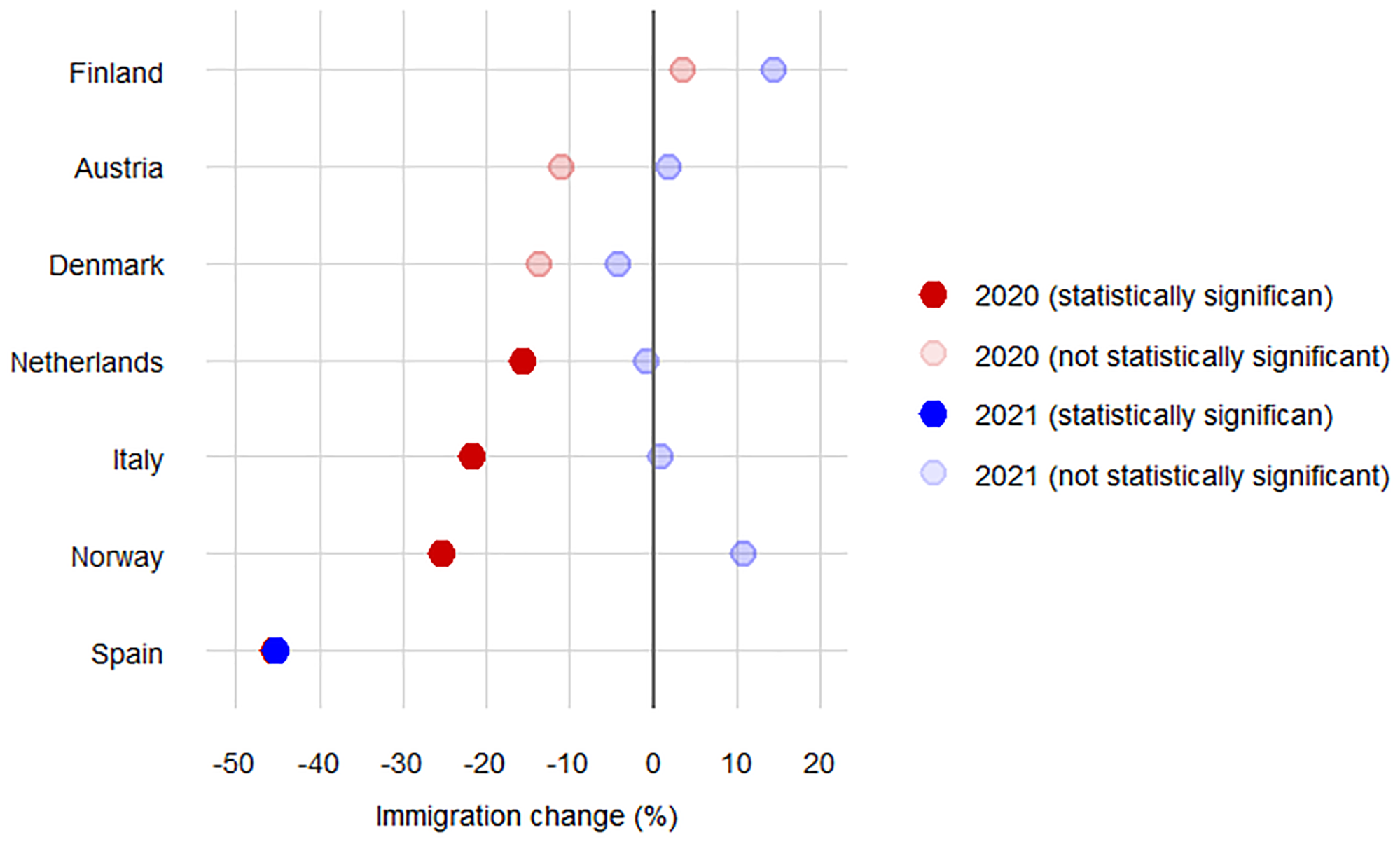
Immigration change between forecasted and observed counts in 2020 and 2021.
We next explore the percentage change between expected and observed bilateral immigration flows in 2020 and 2021 from the main 10 origin countries to Austria, Denmark, Finland, Italy, the Netherlands, Norway, and Spain (Figure 2—see Supplemental Tables S3 to S9 for observed and forecasted immigration counts). In 2020, Figure 2 shows a statistically significant decline in immigration levels in most flows originating from outside the Schengen Area, particularly those directed to Spain and Italy. Inflows from different Latin American countries, Morocco and Romania to Spain dropped between 45% and 60%. Immigration from the Philippines to Norway declined by 60%. Arrivals from Brazil, Albania, Morocco, India, Romania, China, and Bangladesh to Italy decreased by between 38% and 70%. Inflows from India, China, the United Kingdom, and the United States to the Netherlands were reduced by between 20% and 60%. Immigration from Serbia to Austria declined by 24%, and inflows from India to Finland dropped by 37%. Changes in immigration from countries within the Schengen territory were smaller and not statistically different from no change, suggesting that they were much less affected by COVID-19 than those coming from outside the Schengen Area.
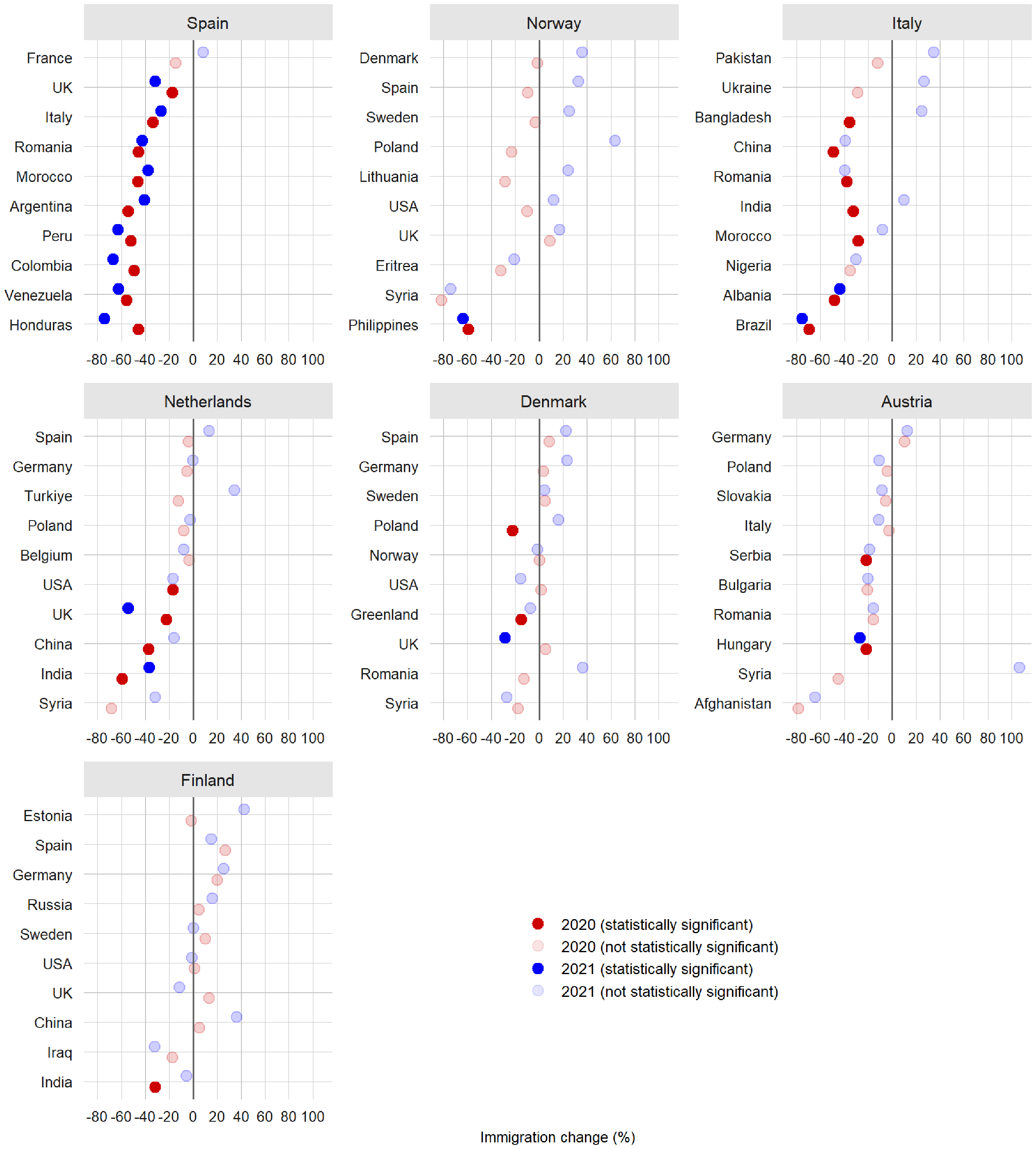
Immigration changes between forecasted and observed counts in 2020 and 2021 by most important countries of origin.
Immigration differences between expected and observed levels were generally lower in 2021 than in 2020 with no statistically significant estimations across most flows, mainly those coming within the Schengen Area. However, we still identify exceptions in several inflows from outside the Schengen territory. Immigration flows to Spain, predominantly from Latin America, stood out, displaying similar declines during 2021 compared to 2020, which explains the consistent overall reduction of immigration levels in this Southern European country. The same pattern is observed in other important immigration flows, such as those from the Philippines to Norway, Brazil, and Albania to Italy, India, the United Kingdom, and the United States to the Netherlands, and the United Kingdom to Denmark.
Exploring the Driving Forces of Immigration Changes
In this section, we explore the effect of immigrants’ origin (Schengen Area or non-Schengen Area), distance, stringency measures, and GDP trends at origins and destinations on immigration changes between forecasted and observed flows during 2020 and 2021 in Austria, Denmark, Finland, Italy, the Netherlands, Norway, and Spain. Table 1 shows the regression results including coefficients, standard errors, CIs, and p-values (see relationships between immigration changes and individual explanatory variables in Supplemental Figure S3).
Linear Model Including Explanatory Variables of Changes in Immigration in 2020–2021.
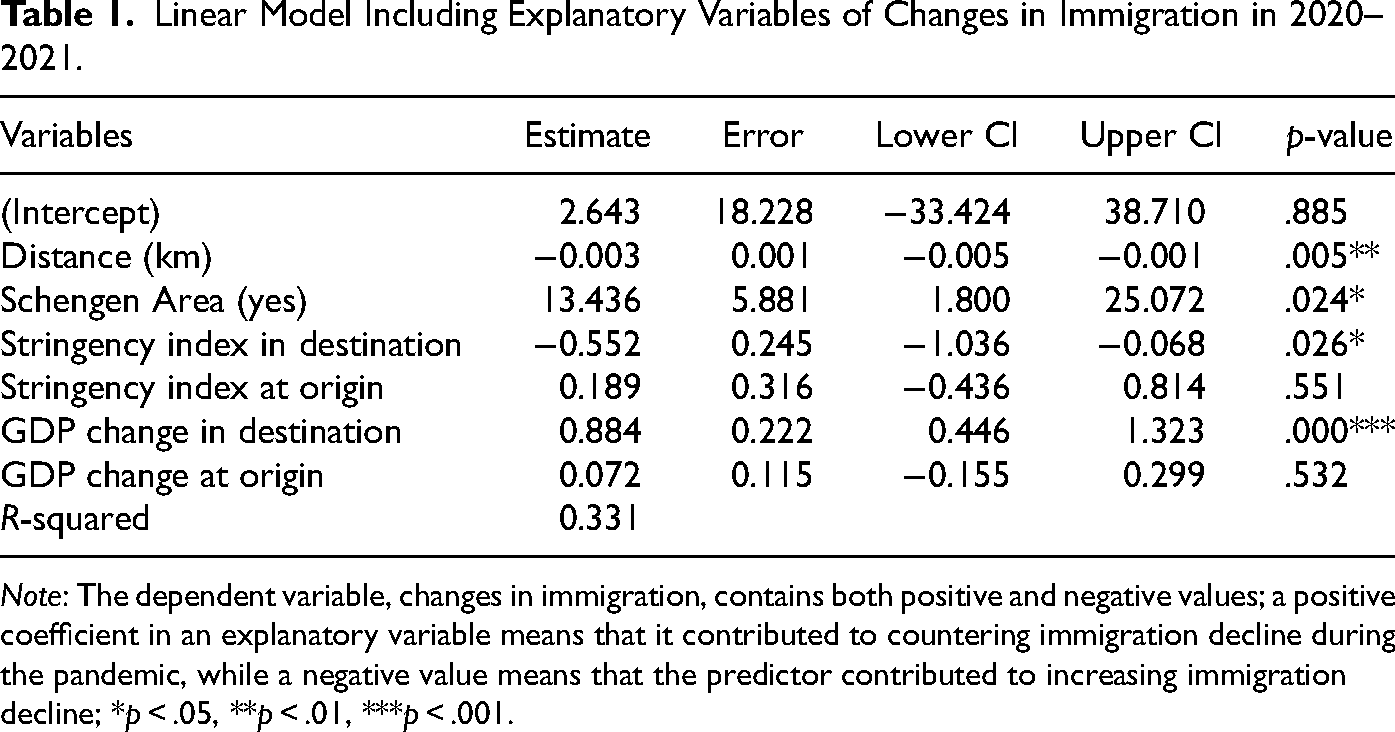
Note: The dependent variable, changes in immigration, contains both positive and negative values; a positive coefficient in an explanatory variable means that it contributed to countering immigration decline during the pandemic, while a negative value means that the predictor contributed to increasing immigration decline; *p < .05, **p < .01, ***p < .001.
We identify the strongest and statistically significant effect of the Schengen Area on immigration changes during COVID-19, with a positive coefficient of 13.44. This result provides a quantification of our findings from the previous section, indicating that immigration from countries outside the Schengen Area experienced the largest drops. It also reflects different entry requirements across countries, as travel restrictions were gradually relaxed within the Schengen Area in 2021, but they remained in place for people from countries outside this area until late 2022. After controlling for the Schengen Area variable, distance shows a small deterrent effect. In the previous section, we observed that inflows from distant countries declined the most. However, our model suggests that immigration from countries far away from Europe did not drop to a greater extent because of the long journeys migrants had to travel in the context of the pandemic, but as a result of visa-related entry restrictions, as distant countries are outside the Schengen territory.
The stringency index at destination countries displays a negative and statistically significant coefficient of −0.55. This finding suggests that inflows tended to drop for destinations with high levels of stringency measures, such as Spain and Italy. GDP change at destination shows a positive and statistically significant effect of 0.884, indicating that destination countries whose economies were less affected during the pandemic tended to register lower declines in immigration flows. It could also explain why immigration flows to Spain and Italy, the destination countries with less developed and more impacted economies during COVID-19, dropped to a greater extent than in other European countries with more advanced and robust economies, such as Finland, Norway, or Austria.
The results of the stringency index and economic conditions at origin are not statistically significant. Therefore, these factors seem to have had a lower effect on modulating migration flows during the pandemic. Our model explains 33.1% of the variance, providing a good understanding of some of the main variables affectining immigration changes during the pandemic. However, we recognize that migration is a multi-factorial phenomenon (Charles-Edwards et al. 2023) and other variables at origin and destination may have also had an impact on the different migration streams to Europe during COVID-19.
Discussion and Conclusion
Our results reveal a pattern of widespread reductions in immigration flows during 2020, followed by a rapid recovery in 2021 to expected levels if the pandemic had not occurred. However, the overall inflow to Spain and immigration flows originating from countries outside the Schengen Area (e.g., Argentina, Venezuela, India, Philippines, or Albania) to Europe showed enduring reductions. Large declines in migration flows from Latin American countries appeared to explain the consistent reduction of immigration levels to Spain until 2021.
Our regression analysis confirms that, indeed, being part of the Schengen Area was a key determinant of the migration-flow-specific levels of immigration change to Europe during the pandemic. The findings indicate that migration originating from Schengen countries was less affected than that from non-Schengen countries. This may be due to the fact that European countries gradually relaxed entry restrictions within the Schengen Area over 2021, while maintaining restrictions for citizenships coming from other countries. Additionally, our results reveal that destination-specific factors were more influential than origin-specific forces in modulating immigration levels. Stringency measures and economic changes at destination countries stood out as key contextual factors shaping immigration levels. This finding suggests that pull factors were more important than push factors in the decision to migrate during COVID-19.
Our results show varied recovery trends: rapid for some and slow for others. However, immigration volumes may have returned to normal since 2022 as COVID-19 stringency measures were completely lifted, and the economy recovered over 2022 and 2023. Recently released Spanish national data align with this hypothesis, since immigration levels in 2022 increased almost to 2019 values (Domingo and Bayona 2024). Yet, international migration is affected by unpredictable macro-level events. The cost-of-living crisis and the stance against immigration (i.e., the rise in xenophobia and far-right political parties) may have reduced immigration, while the spread of political instability and armed conflicts in sending countries (e.g., the enduring war in Ukraine and the mass displacement of Palestinians due to the Israel–Palestinian conflict) may have increased immigration to Europe. Future work is needed to understand the impacts of recent and new potential shocks on the international migration system.
Reductions in immigration flows during short periods or temporary shocks to the international migration system have a small impact on aging levels and the labor market composition of receiving counties, while long-term reductions are likely to affect aging and labor dependency rates (González-Leonardo and Spijker 2023). Monitoring changes in international migration levels and patterns is essential in European countries, given the key role that consistent immigration flows over time play in mitigating depopulation, aging, and workforce deficits. Policymakers should be aware of these changes to implement effective immigration policies.
Concerning the limitations of this work, we focus the analysis on European countries until 2021 and only explore specific factors modulating immigration during the pandemic. A more comprehensive analysis including a global sample of countries, data after 2021, and other explanatory factors is needed to understand the impacts of COVID-19 on the international migration system. Future studies should also analyze how the composition of migrants has changed since the pandemic (e.g., sex, age, and education). COVID-19 may have had differentiated consequences for migration aspirations among different population groups. For instance, reports suggest that the movements of low-skilled workers and international students were hardly affected in 2020 (Gamlen 2020).
Finally, it is crucial to consider that forecasting international migration is challenging due to volatile and complex interconnected drivers at origin and destination, as well as unexpected and rapid changes in response to shocks, such as the COVID-19 pandemic, wars or natural disasters (Bijak et al. forthcoming). This complexity and feedback between drivers result in high uncertainty levels when forecasting international migration, which increases over the projected horizon (Disney et al. 2015; Wilson et al. 2018). With this in mind, we used ARIMA time-series models to forecast immigration only two years ahead (i.e., 2020 and 2021) in the absence of the pandemic. ARIMA models are an appropriate choice for short-term forecasts based on observed historical trends (Bijak 2012). The main criticism of this approach is that the forecasts are based on observed data alone (Disney et al. 2015), while other methods (e.g., probabilistic expert-based forecasts or Bayesian expert based) allow the inclusion of additional deterministic factors (e.g., experts' opinions).
Supplemental Material
sj-docx-1-mrx-10.1177_01979183241242445 - Supplemental material for Assessing the Differentiated Impacts of COVID-19 on the Immigration Flows to Europe
Supplemental material, sj-docx-1-mrx-10.1177_01979183241242445 for Assessing the Differentiated Impacts of COVID-19 on the Immigration Flows to Europe by Miguel González-Leonardo, Francisco Rowe, Michaela Potančoková and Anne Goujon in International Migration Review
Footnotes
Declaration of Conflicting Interests
The authors declared no potential conflicts of interest with respect to the research, authorship, and/or publication of this article.
Funding
The authors disclosed receipt of the following financial support for the research, authorship, and/or publication of this article: The authors gratefully acknowledge funding from IIASA and the National Member Organizations that support the institute.

Notes
References
Supplementary Material
Please find the following supplemental material available below.
For Open Access articles published under a Creative Commons License, all supplemental material carries the same license as the article it is associated with.
For non-Open Access articles published, all supplemental material carries a non-exclusive license, and permission requests for re-use of supplemental material or any part of supplemental material shall be sent directly to the copyright owner as specified in the copyright notice associated with the article.
