




Abstract
The effect of COVID-19 lockdowns on the shift from in-person (offline) social interactions to online interactions and its consequences on social support and stress attracted scholarly attention. However, much less is known about how individuals’ prior mobility experiences have influenced coping with this shift. In the present research, we hypothesized that people with mobility experiences should already be more familiar with, and could profit more from, online social interactions before the pandemic, which might buffer against the negative impact of the pandemic on the emotional social support they obtained and the stress they felt during these interactions. In order to investigate this issue, we collected data (N = 875) in Germany during the lockdown between April and May 2021. We measured mobility by introducing a novel approach that encompasses the act of moving houses (both within a country and internationally), commuting patterns, and nationality (migration background). Participants also reported the frequency of their online and offline interactions (before and during the lockdown), as well as the emotional support they obtained from online and offline interactions and the stress felt during lockdown interactions (as compared to before the lockdown). Results provide quantitative evidence in support of the main hypothesis especially regarding migration background. We discuss the relevance of these findings for research on migration and mobility.
Introduction
Social distancing measures and restrictions on human movements implemented by governments to limit the spread of the SARS-COVID-19 virus drastically reduced mobility (Borkowski, Jażdżewska-Gutta, and Szmelter-Jarosz 2021; Piccoli, Dzankic, and Ruedin 2021) and in-person social interactions with family, friends, and colleagues (Fava et al. 2020). As a consequence, the pandemic increased the risk of suffering from stress and mental health issues (e.g., Bäuerle et al. 2020). However, social support has been identified as a key buffer against these negative consequences of the pandemic (Deimel et al. 2022; Kuhn et al. 2021; Landmann and Rohmann 2022; Szkody et al. 2021).
While lockdowns decreased in-person (offline) interactions, online interactions using information and communication technologies (ICT) such as instant messaging and audio-visual communications drastically increased (Beaunoyer, Dupéré, and Guitton 2020; Guitton 2020; Koeze and Popper 2020; Nguyen et al. 2020). Concomitantly, recent scholarship highlighted the importance of online interactions as a potential substitute for offline interactions, and as an effective way to cope with physical isolation, receive social support, and alleviate stress (e.g., Arpino, Pasqualini, and Bordone 2021a; Arpino et al. 2021b; Gabbiadini et al. 2020; Jang and Choi 2020; Sommerlad et al. 2021; Szalma and Rékai 2020). Specifically, online interactions with close others can reduce stress (Tibbetts et al. 2021), albeit to a lesser extent than offline interactions (Forbes et al. 2023). However, research has also shown that online social interactions can increase stress (Mheidly, Fares, and Fares 2020), especially when interacting with acquaintances and/or strangers (Tibbetts et al. 2021).
Regardless of the pandemic, people with mobility experiences, who are geographically distant from significant individuals in their personal or professional lives often rely on online social interactions to maintain contact (Benítez 2012; Nedelcu 2012a; Nedelcu and Wyss 2016; Ryan, Klekowski Von Koppenfels and Mulholland 2015; Wilding 2006). Thus, based on existing scholarship, we assume that “people with mobility” — defined here as those who have moved houses, who regularly commute, or who possess a migration background — are more likely to gain advantages from online social interactions than “people without mobility,” namely those who have not had these experiences. It is unclear, however, whether compared to people without mobility, people with mobility may have obtained greater emotional support via ICT during this pandemic, and whether the emotional support they obtained via ICT resulted in less stressful interactions. In this study, we therefore examined whether people with mobility were more likely to benefit from online interactions during the pandemic. Specifically, we investigated whether the pandemic affected the quantity and quality of offline versus online social interactions, perceived emotional support, and felt stress, as a function of people's degree of mobility prior to the pandemic.
Theoretical Background
This research seeks to contribute to the literature by linking geographic mobility with social support in online interactions during the COVID-19 pandemic. Past research suggests that, although useful, online interactions provide less emotional support (e.g., focus on empathy, positive feelings, belonging, and emotional reassurance) than offline interactions (Trepte, Dienlin, and Reinecke 2015). Indeed, individuals can feel overloaded with online social demands (Maier et al. 2015), and social technologies can increase feelings of loneliness when used to escape the social world (Nowland, Necka, and Cacioppo 2018).
However, the pandemic created a special, novel situation, as it implied an unprecedented and forceful shift from offline to online interactions. Consequently, recent research highlighted the importance of online social interactions as the de facto substitute in cases where offline interactions were suspended (Beaunoyer, Dupéré, and Guitton 2020). For instance, Kluck, Stoyanova, and Krämer (2021) found “the potential of text-based communication to increase feelings of social support” during the pandemic. Moreover, online social interactions may also mitigate psychological distress resulting from the pandemic, and facilitate proactive coping behaviors (Arpino et al. 2021b; Gabbiadini et al. 2020; Moore and March 2022; Sommerlad et al. 2021).
Despite the potential benefits of online social interactions during the COVID-19 pandemic, ICT does not seem to constitute a general remedy that is available for everyone (e.g., Beaunoyer, Dupéré, and Guitton 2020; Nguyen et al. 2020). Of particular relevance for the present research, we still have little knowledge about the extent to which people with mobility compared to people without mobility use and benefit from online interactions during the pandemic. To the best of our knowledge, only qualitative studies examined this issue either before or during the pandemic. Specifically, Szalma and Rékai (2020) found that nonresident parents living away from their children regularly used online contacts as a complement to personal communication before the pandemic. Furthermore, the study showed that online interactions were crucial during the pandemic, especially when visits were canceled due to mobility restrictions. Furthermore, Jang and Choi (2020) showed that the pandemic led international Chinese students living in South Korea to build an online community of care and solidarity which provided both instrumental and emotional support.
These results are in line with those observed in primarily qualitative research on how transnational families used ICT to communicate with family members living far away before the pandemic. As Nedelcu and Wyss (2016, 211) wrote: “ICT-enabled omnipresent co-presence creates a feeling of continuously being and doing things together, as family interactions do not diminish with distance. Although these interactions develop within situations that do not replace physical co-presence, from a qualitative point of view they are quite similar to those permitted by physical proximity.” Thus, current ICT enable “new ways of living together” or “ordinary co-presence” (Nedelcu 2012b, 1339; Nedelcu and Wyss 2016, 202) or “e-families” (Benítez 2012), and migrants have picked up quickly on the developments of ICT (Wilding 2006). Accordingly, regular online contacts can reinforce the feeling of belonging to a family network despite family geographical distance, thus decreasing feelings of isolation (Nedelcu 2017; Nedelcu and Wyss 2016).
Although ICTs are largely shown to benefit migrants and transnational families, one might expect that they also benefit people with mobility who are frequently or even regularly geographically far from important people on a personal or professional level. Accordingly, as compared to people without mobility, people with mobility may have more experience in establishing and maintaining online interactions, and in obtaining emotional support via these interactions. As a consequence, the greater experience that people with mobility can have regarding online communications might help them feel less stressed during these interactions. However, to the best of our knowledge, no previous research has investigated this issue regarding the COVID-19 pandemic while considering a comprehensive operationalization of mobility which includes international and intra-national house moving, commuting, and migration background based on nationality. Thus, in line with the new mobilities paradigm (Sheller and Urry 2006), the present study addresses how geographical forms of mobility interact with other forms of virtual mobilities enabled by online technologies. We investigate how these virtual mobilities serve as alternatives to physical co-presence and potentially alleviate the adverse effects of COVID-19 lockdown measures on social support and stress levels during social interactions.
Thus, in the present research, we define mobility as individuals moving from one location to another (Last 2007), resulting in a frequent or permanent physical distance between them and the significant individuals they wish or are required to engage with. This notion of mobility encompasses a range of circumstances encompassing intermittent or temporary movements (e.g., commuting for work) as well as more enduring transitions (e.g., changing residences or migration). Our conceptualization of mobility is also based on the understanding that different patterns of geographical mobility and migration are interconnected constructs (Hoffmeyer-Zlotnik 2020; nccr — on the move 2019) and that migration can entail long-term and permanent forms of distancing from significant others. Consequently, these concepts mutually influence one another, as geographical mobility can facilitate or lead to migration, while migration can also impact patterns of mobility (nccr — on the move 2019).
In this study, we propose a comprehensive threefold conceptualization of mobility. First, mobility can result from house moving, which refers to the number of household moves, both domestic and international, that people have had over the course of their lives. Second, mobility can also result from commuting (Nikolaeva et al. 2023), which refers to the frequency with which individuals undertake journeys involving overnight stays for professional or personal reasons. Third, and finally, mobility can result from migration background, which encompasses individuals residing in a foreign country, irrespective of the voluntary or forced nature of their move, as well as the reasons behind their relocation, be it personal, professional, or political. Such migration background often leads to a physical distance from individuals with whom they maintain significant relationships. Thus, whereas commuting and house moving emphasize flows and movement over rootedness, migration, and nationality rather mirror a sense of territoriality and belonging (Cresswell 2006).
Overview and Hypotheses
This study aimed to investigate the consequences of the COVID pandemic on the quantity (estimated frequency) and quality (perceived emotional support) of offline and online interactions, as well as on stress felt during these social interactions, as a function of participants’ mobility. We assessed social interactions for four different types of contacts: partner, close family, close friends, and close colleagues. The analyses reported below are based on average scores across these four contacts. Separate analyses per contact type are presented in Supplement A in the online material.
Building upon the qualitative literature which suggests that individuals with mobility rely on online interactions to maintain connection with their social network (e.g., Nedelcu and Wyss 2016), the first goal of this study was to provide a quantitative assessment of this phenomenon prior to the pandemic. We therefore formulated the following hypothesis:
Second, and given that individuals with mobility were expected to more easily rely on online interactions to maintain their social connections prior to the pandemic, they would have experienced a lesser impact from the implementation of social distancing measures during the COVID-19 pandemic compared to individuals without mobility. Consequently, we formulated a second hypothesis according to which:
Moreover, given the importance of online communication in maintaining social connections during the lockdown, people with mobility should have had a greater ability to receive the necessary emotional support and, as a consequence, report less stress during their online social interactions. Consequently, we expected that, during the pandemic:
Method
Participants and Procedure
We conducted our study in Germany based on two considerations. First and most importantly, Germany was in a lockdown during the time of the survey (between April 28 and May 18, 2021). This allowed us to ask questions about the current pandemic situation and to compare it with the pre-pandemic situation as remembered by the participants. Second, we needed a large enough sample fulfilling our requirements regarding people's mobility, and we could obtain this sample in Germany through Prolific (e.g., Palan and Schitter 2018), a crowdsourcing platform for recruiting participants. We initially recruited a sample of 904 people who participated in an online survey in exchange for financial compensation. Participants could fill out either an English (n = 289) or German (n = 615) version of the questionnaire as long as they lived in Germany, were adults (>18 years), and were fluent either in German or English. Among the respondents, 29 were excluded because they did not complete the whole questionnaire (n = 21), did not provide their consent (n = 6), failed an attention check (n = 1), or took more than 9 h to fill in the questionnaire (n = 1). Additionally, 85 participants were removed from the analyses because they held two nationalities (German and another), and could therefore not be included in one of the two nationality groups (German versus non-German; see below). Finally, 49 participants were removed because they did not respond to one or several variables included in the analyses. Thus, the final sample consisted of 741 participants. Of these, 420 were men and 321 women. Their age ranged from 18 to 69 years (M = 28.60, SD = 7.49). Among them, 449 had a bachelor’s or higher degree at the time of the study, 159 lived alone, 276 lived with someone and 306 lived with two persons or more. Finally, before (versus during) the pandemic, 420 (379) were students and 485 (479) had a waged employment.
Mobility
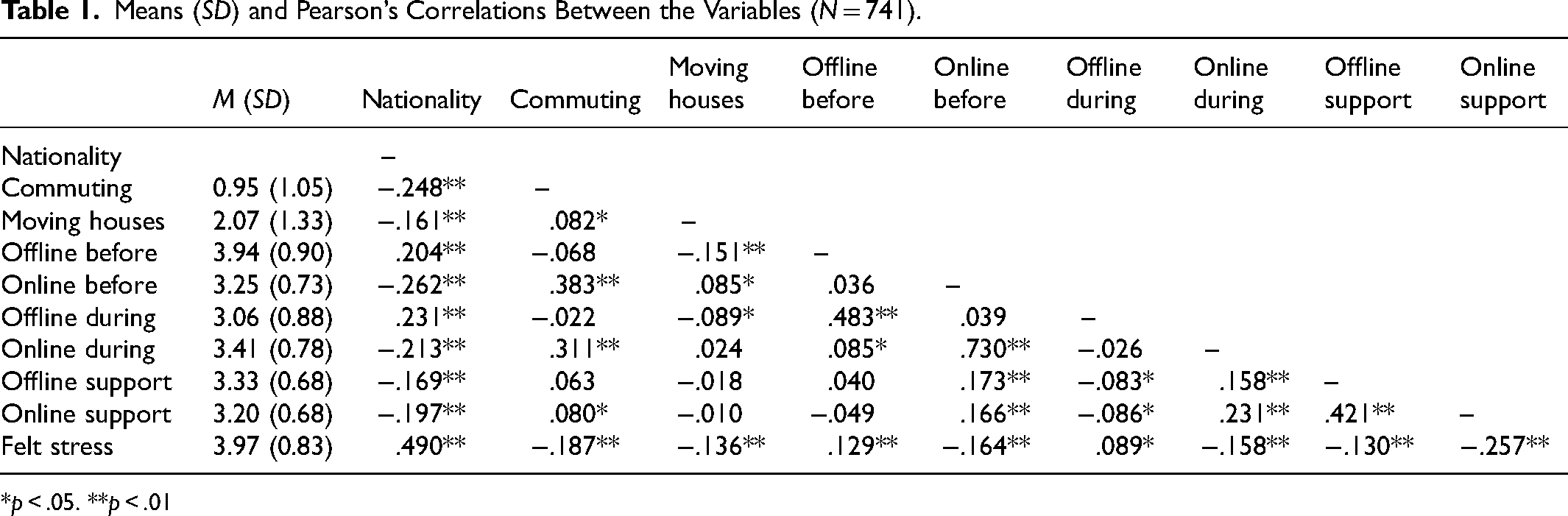
We used three operationalizations of mobility: (a) moving houses internationally and within the same country, (b) commuting, and (c) migration based on nationality. Means, standard deviations, and correlations between all the variables are presented in Table 1.
Means (SD) and Pearson’s Correlations Between the Variables (N = 741).
*p < .05. **p < .01
Main Dependent Variables
Complementary Dependent Variables
The questionnaire included additional measures about the geographical distance of the social network, feelings of isolation versus connection, and the subjective impact of the pandemic. These measures are important to increase our understanding of the three indicators of mobility (moving houses, commuting, and nationality). These results, which support our main findings and interpretations (see Discussion section), are presented in Supplement B in the online material due to space restrictions.
Socio-Demographic Variables
Besides the nationality at birth and at the time of data collection (see Mobility section), we also asked participants to indicate their age, gender, highest education level, current professional status before and during the pandemic, whether they have a partner, and how many people live in their household.
Qualitative Variables
Results
Preliminary analyses indicated that the indicators of mobility were related, yet only weakly, suggesting that these variables indeed measure conceptually distinct aspects of mobility. Specifically, the correlation between nationality and commuting was, r(741) = −.25, p < .01, and the correlation between nationality and moving houses, r(741) = −.16, p < .01, suggesting that non-Germans were, compared to Germans, moderately more likely to move houses and to commute. Moreover, moving houses and commuting were weakly correlated, r(741) = .08, p < .026.
We used two quantitative analytic strategies to test our analyses. If time (before versus during the pandemic) or interaction modality (offline versus online) were assessed through different scales, we ran mixed analyses of covariance (ANCOVAs) in which we included time and/or interaction modality as within-subjects (repeated measure) factors and the three independent mobility variables (centered scores) as predictors in covariate. In this case, we also included the critical interactions between the within-subject factors and each of the three predictors. If changes in time were not assessed, or assessed within a single item, we regressed the dependent variables on the three independent variables. 3
Quantity (Frequency) of Social Interactions Before the COVID-19 Pandemic
We conducted two mixed ANCOVAs on the frequency of either offline or online interactions before the pandemic. The interaction modality (offline versus online) was introduced as a within-subjects (repeated measure) factor, and nationality, house moving and commuting were introduced as predictors in covariate. To test H1 we included the three critical interactions between interaction modality and each of the three predictors.
This analysis showed a main effect of the interaction modality, F(1, 737) = 213.87, p < .001, η2 p = .225: before the pandemic, offline interactions (M = 3.93, SD = 0.89) were overall more frequent than online interactions (M = 3.24, SD = 0.73). Consistent with H1, the three interactions between interaction modality and each mobility factor were significant (with house moving: F(1, 737) = 11.24, p < .001, η2 p = .015; with commuting: F(1, 737) = 43.05, p < .001, η2 p = .055; with nationality: F(1, 737) = 53.10, p < .001, η2 p = .067; see Figure 1). We decomposed these interactions by examining the effect of mobility as a function of interaction modality (offline versus online).
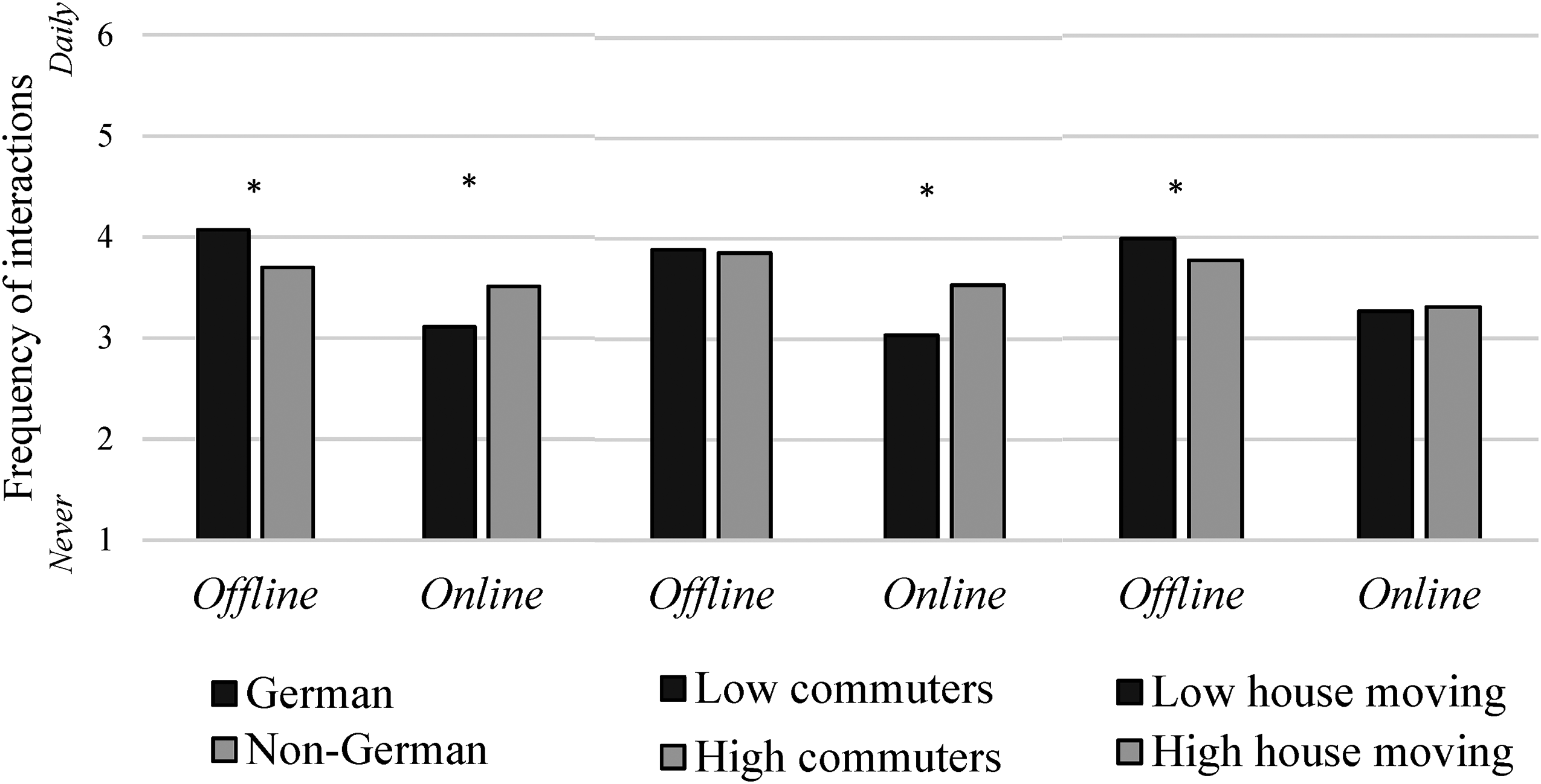
Frequency of offline and online interactions before the pandemic as a function of nationality (German versus Non-German), commuting (−1 SD = low commuters; +1 SD = high commuters), and moving houses (−1 SD = low movers; +1 SD = high movers).
Changes in the Quantity (Estimated Frequency) of Social Interactions During the Pandemic
We conducted a mixed ANCOVA including both time (before versus during the pandemic) and the interaction modality (offline versus online) as within-subjects (repeated measures) factors, and nationality, house moving, and commuting as predictors in covariate. Again, all the interactions between the two within-subject factors and each predictor were included. For simplicity reasons, we only report here the effects that relate to changes over time, to test H2.
This analysis revealed a strong main effect of time, F(1, 737) = 361.15, p < .001, η2 p = .329. As could be expected, the frequency of social interactions was overall reduced during the pandemic (Mbefore = 3.59, SE = 0.02; Mduring = 3.23, SE = 0.02). The interaction between time and interaction modality was also strongly significant, F(1, 737) = 572.26, p < .001, η2 p = .437 (see Figure 2). Compared to before, during the pandemic offline interactions decreased (Mbefore = 3.93, SD = 0.89; Mduring = 3.05, SD = 0.87), F(1, 737) = 644.13, p < .001, η2 p = .466, whereas online interactions increased (Mbefore = 3.24, SD = 0.73; Mduring = 3.41, SD = 0.78), F(1, 737) = 55.21, p < .001, η2 p = .070. As a consequence, offline interactions were more frequent than online interactions before the pandemic, F(1, 737) = 213.87, p < .001, η2 p = .225, but this pattern reversed during the pandemic, F(1, 737) = 111.72, p < .001, η2 p = .132.
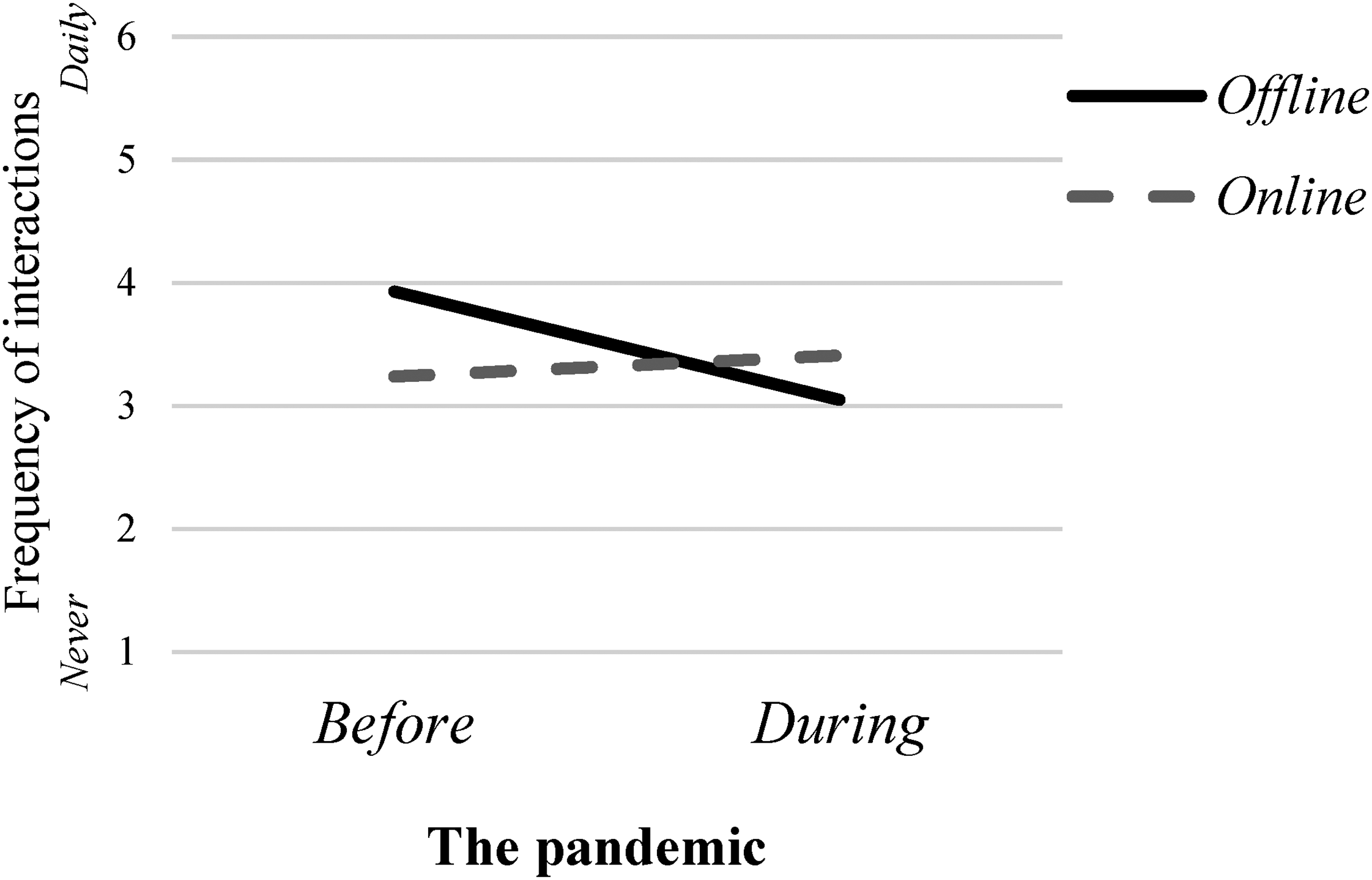
Frequency of interactions as a function of time (before versus during the pandemic) interaction modality (offline versus online).
Finally, the higher-order interaction was significant for house moving, F(1, 737) = 5.47, p = .02, η2 p = .007, yet relatively weak, but non-significant for nationality nor commuting. House moving was not associated to online interactions neither before (B = 0.02), t(737) = 0.85, p > .39, η2 p = .001, nor during the pandemic (B = −0.01), t(737) = 0.63, p = .52, η2 p = .001. However, whereas house moving was associated with fewer offline interactions before the pandemic (B = −0.10), t(737) = 3.33, p < .001, η2 p = .015, during the pandemic this effect was not significant (B = −0.04), t(737) = 1.52, p = .12, η2 p = .003, suggesting that the pandemic reduced the difference between people with mobility and people without mobility in terms of offline interactions.
Quality of Contact During the Pandemic: Perceived Emotional Support Received from Social Contacts
To test H3 we assessed the impact of the pandemic on participants’ perceived changes in emotional support obtained from their different social contacts during the pandemic as compared to before the pandemic (1 = much less and 5 = much more). We conducted a mixed ANCOVA including the interaction modality (offline versus online) as a within-subject (repeated measures) factor, and nationality, house moving, and commuting as predictors in covariate. The three interactions between interaction modality and each predictor were also included.
This analysis showed a main effect of the interaction modality, F(1, 737) = 16.67, p < .001, η2 p = .022. Participants reported an overall increase of emotional support resulting from social contact during the pandemic as compared to before, but even more from offline (M = 3.33, SD = 0.68) than from online interactions (M = 3.20, SD = 0.68). The main effect of nationality was also significant, F(1, 737) = 33.47, p < .001, η2 p = .043. As compared to before the pandemic, during the pandemic non-Germans obtained more emotional (M = 3.44, SD = 0.75) support than Germans (M = 3.18, SE = 0.63).
However, the interaction between interaction modality (online/offline) and nationality was not significant, which means that during the pandemic, as compared to before, non-Germans obtained more emotional support than Germans through both offline interactions (MGerman = 3.24, SD = 0.63, and Mnon-German = 3.49, SD = 0.74), F(1, 737) = 20.22, p < .001, η2 p = .027, and online interactions (MGerman = 3.11, SD = 0.62, and Mnon-German = 3.39, SD = 0.75), F(1, 737) = 26.89, p < .001, η2 p = .035 (see Figure 3). Finally, neither the main effects of commuting and house moving nor their interaction with interaction modality were significant, Fs > 2.24, ps > .13.
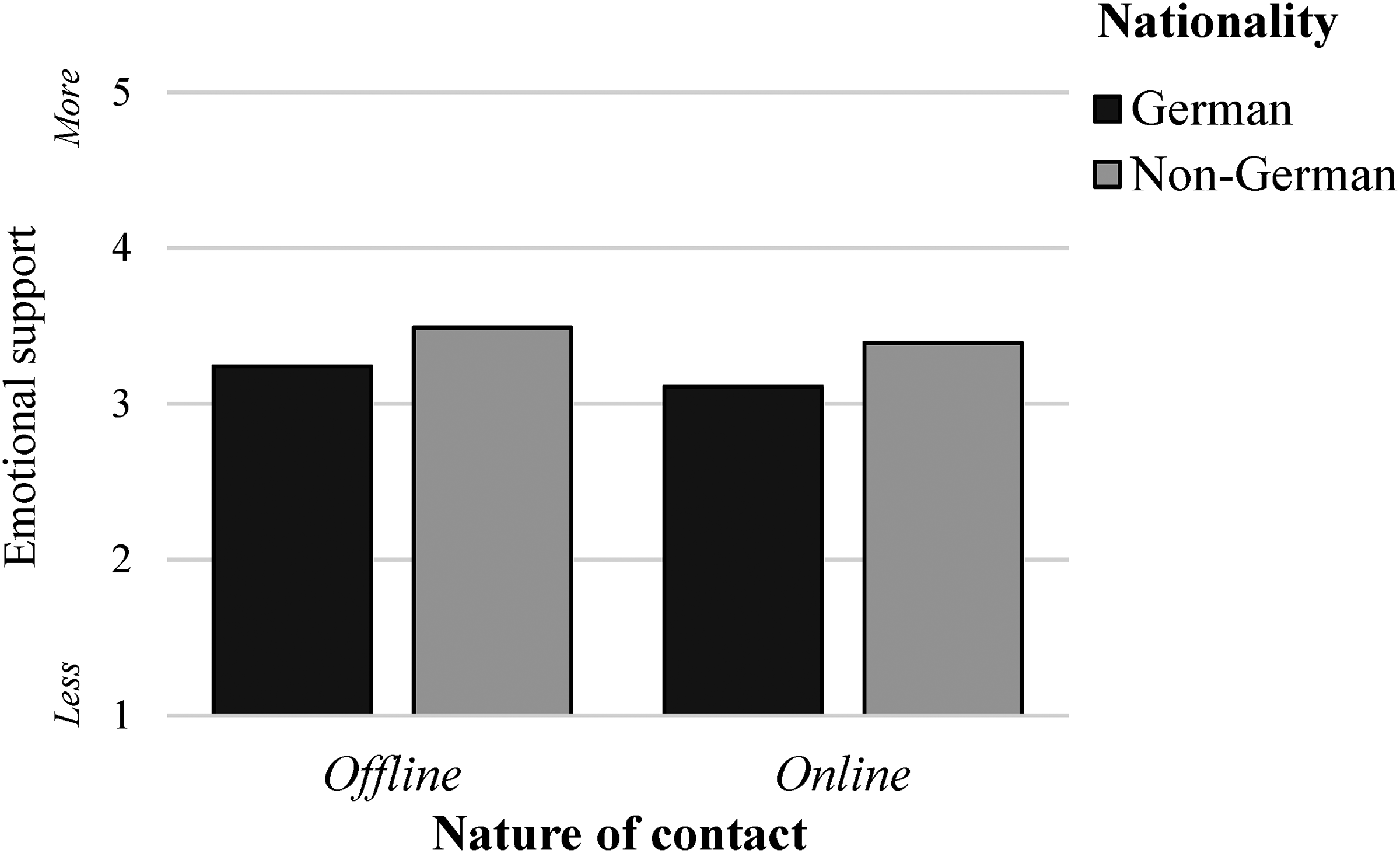
Offline and online emotional support during the pandemic as compared to before the pandemic (1 = much less support and 5 = much more support) as a function of nationality.
Stress Associated with Social Interactions During the Pandemic
To test H4 we regressed perceived changes in stress associated with social interactions during the pandemic, as compared to before the pandemic (1 = much less stressful and 5 = much more stressful), on nationality, house moving, and commuting. The effect of house moving was not significant (βmoving houses = −0.04), SE = 0.02, t(737) = 1.72, p = .085, 95% CI = [−0.099, 0.006], η2 p = .004. However, the main effect of commuting was weak but significant (βcommuting = −0.05), SE = 0.02, t(737) = 2.04, p = .042, 95% CI = [−0.109, −0.002], η2 p = .006: High commuters reported less stressful social interactions during the pandemic, as compared to before. Finally, the main effect of nationality was strongly significant, βnationality = 0.40, SE = 0.02, t(737) = 13.91, p < .001, 95% CI = [0.35, 0.46], η2 p = .208. Compared to Germans (M = 4.26, SD = 0.69), non-Germans (M = 3.41, SD = 0.76) felt less stress associated with social interactions during the pandemic as compared to before the pandemic.
In sum, even though the effect of house moving was not significant, the overall evidence rather provides support for H4, with results showing reductions of self-reported stress associated with social interactions during the pandemic among non-Germans relative to Germans, and to a lower degree as commuting increased.
Indirect Effect of Mobility on Stress Through Emotional Support
Any of the two indirect effects through offline and online support was significant when the predictor was commuting or house moving, which is consistent with the lack of (or only weak) significant effect of these two predictors on the change in stress felt during the social interactions. However, the indirect effect for nationality was significant (β = .027), 95% CI = [0.010, 0.046] (see Figure 4). More specifically, perceived changes in social support mediated the effect of nationality on changes in stress felt during the social interactions. More precisely, changes in online social support (β = .030), 95% CI = [0.013, 0.049], but not in offline social support (β = −.01), 95% CI = [−0.015, 0.009], accounted for the link between nationality and the changes in stress felt during interactions.
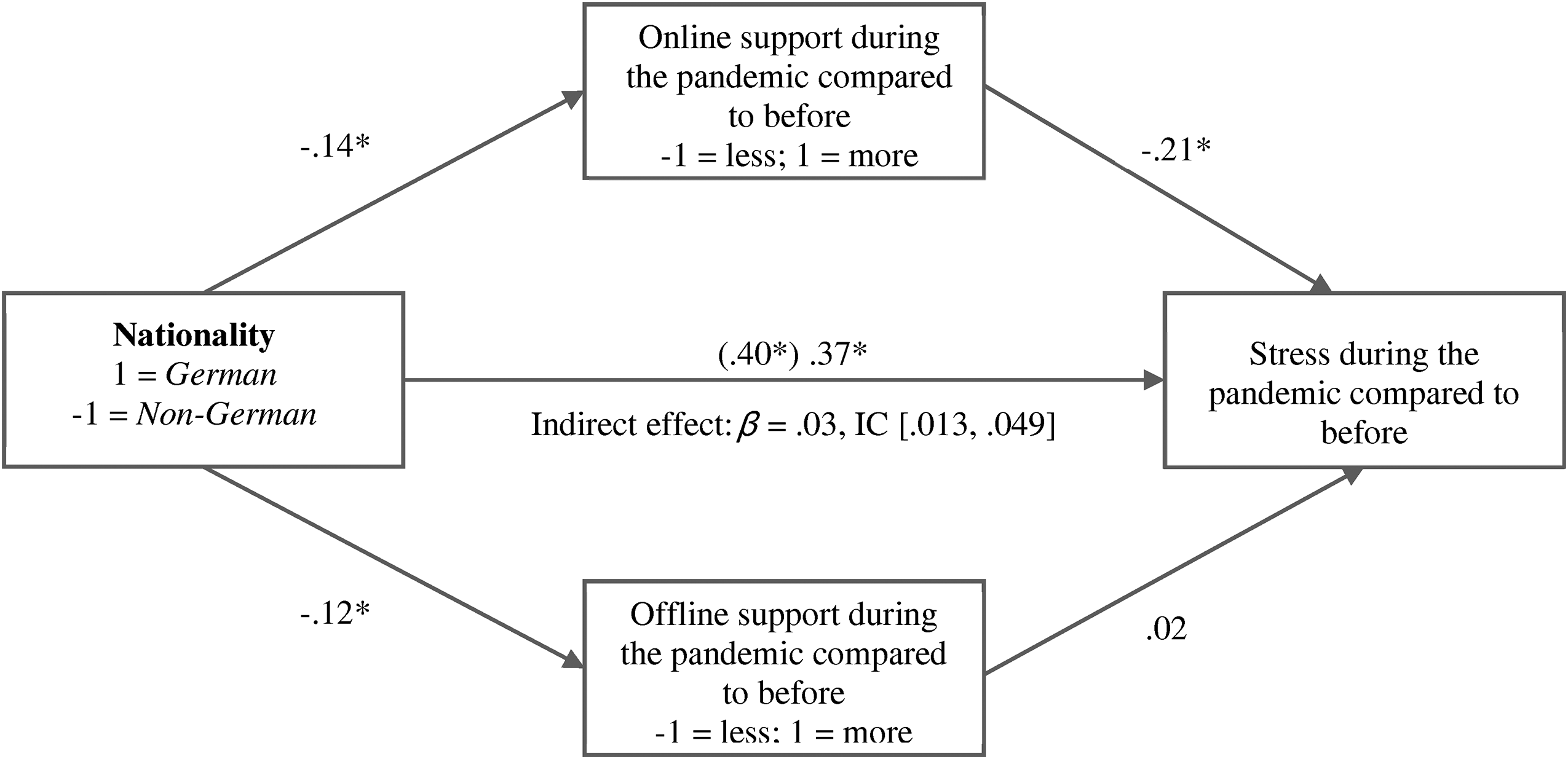
Indirect effect of nationality on changes in the stress associated with social interactions during the pandemic, as compared to before the pandemic (*p < .001).
Put differently, these results are consistent with H5. As compared to Germans (+1), non-Germans (−1) indicated to obtain more emotional support through online social interaction, (β = −.14), t = 5.18, p < .001, 95% CI = [−0.194, 0.087], and this support helped them to feel lower stress during such social interactions (β = −.21), t = 5.03, p < .001, 95% CI = [−0.296, −0.130]. The effect of nationality on offline support was also significant (β = −.12), t = 4.49, p < .001, 95% CI = [−0.176, −0.069], but this support was not related to changes in the felt stress (β = .02), t = 0.57, p = .56, 95% CI = [−0.058, 0.106].
Discussion
Overall, our hypotheses are partially supported by the results. Yet, they also refine them, underlining the relevance of a more differentiated understanding of individual movement, as proposed in this paper via our threefold conceptualization of mobility (house moving, commuting, and nationality).
In summary, the results revealed that people with mobility (non-Germans and high commuters) reported more online interactions before the pandemic than people without mobility. This supports H1 and our expectation regarding the widespread use of ICT by transnational families (Benítez 2012; Nedelcu 2012b; Nedelcu and Wyss 2016). More specifically, before the COVID pandemic, people with mobility actually had less offline but more online interactions than people without mobility. In the qualitative responses, we found that among people with mobility, pre-pandemic online interactions were especially mentioned with family members and friends living outside Germany, as the following quote illustrates: “I am used to indirect contact, as my family is far away and that’s what I use to communicate with them” (Response 698).
Concomitantly, we expected that people with mobility would have experienced a lower increase in online interactions during the pandemic than people without mobility (H2). This hypothesis was not supported by the quantitative results, as the increase in online interactions was equivalent among people with mobility and people without mobility. However, several factors can explain this finding. For instance, as a result of the pandemic, high commuters might have had to work from home and thus increase their use of online communication channels with colleagues. Similarly, people with mobility and especially non-German individuals may have had to cancel travel plans to fulfill professional duties or to spend time with their families and friends abroad. This interpretation echoes qualitative evidence by Szalma and Rékai (2020) who showed that among parents who do not live in the same household as the other parent and their children, online contacts increased as a result of border closing. Furthermore, this interpretation is also consistent with the results of Jang and Choi (2020) which showed that international students established online support networks to connect with one another during the pandemic. Thus, as a result of the lockdown, both people with mobility and people without mobility may have increased their online contacts due to fewer offline contact opportunities. The qualitative responses also provide potential explanations for the overall increase in the frequency of online interactions, regardless of mobility. First, both participants with mobility and participants without mobility mentioned that they experienced a rise in online interactions, particularly for work and study purposes. Additionally, a few open-ended responses indicated that existing online interactions among mobile individuals with family or friends living abroad increased due to concerns and the need for reassurance. For instance, one participant stated, “I have been in more regular contact with my family. We have been anxious about each other so the contact is comforting” (Respondent 417). However, some people with mobility, particularly non-Germans, mentioned that the lockdown did not significantly alter their social relationships with their families and friends because they were already living far away from them. As one participant expressed, “Since I am an expat living in another country, before the pandemic my life with close friends and family was already purely online (via chat, video calls, and phone calls), so these ones did not change” (Response 604).
Moreover, the results partially confirm H3. Non-Germans (but not high commuters and people who moved houses) reported receiving more emotional support via online interactions during the pandemic than Germans. This finding is exemplified in the following quote: “I had to only have indirect contact with many people close to me before the pandemic as we live in different countries, so I am used to not being able to meet, and indirect contact provides enough support for me” (Response 229). However, none of the interactions between modality (online/offline) and mobility was significant (H3). Thus, surprisingly, non-Germans did not only receive more emotional support online, as expected in H3, but even offline. While future research is needed to investigate this finding, it may point to beneficial spill-over or compensation effects of emotional support received via various interaction modalities. It is also worth noting that the lockdown also increased offline interactions within isolation cells (e.g., partner and family) and even among specific subgroups of friends and colleagues, which could explain the unexpected increase in offline emotional support among non-Germans.
While all participants indicated that they felt more stress associated with social interactions during the pandemic, this increase was lower among people with mobility, especially among non-Germans and commuters. Hence, these results support H4, and suggest that mobility “protected” against the stress associated with interactions during the pandemic as compared to before the pandemic. Additionally, the mediation analysis contributes to a better understanding of this effect and provides partial confirmation of the role of online social support in reducing stress during the pandemic (H5; Arpino et al. 2021; Gabbiadini et al. 2020; Sommerlad et al. 2021; Szalma and Rékai 2020). As a result of receiving more emotional support online during the pandemic (compared to before), non-Germans, but not people who moved houses a lot or commuters, felt lower stress during social interactions than Germans. This result adds important group-specific nuances to qualitative research on the positive impact of online support systems during the pandemic (Jang and Choi 2020).
However, it is important to highlight that in the open questions, participants mentioned general stress, isolation, and lack of personal interaction as a consequence of the pandemic. They also described stress due to online interactions, because they found it difficult to read the emotions of their online interlocutor or because of technical reasons. However, a respondent with a distant family also described how online interactions reduced stress in general contacts: “I do feel more comfortable these days using indirect contact [online interactions] overall since it takes away the stress of meeting irl [in real life]” (Response 698). Other qualitative evidence revealed that closeness (offline interactions) could also lead to stress, when spending a lot of time or living together with a partner or family, as in this quote by a mobile German respondent: “There are more arguments within the family, as we are together the whole day” (Response 278).
Finally, additional analyses of complementary measures (see Supplement B in the online material) help to increase our understanding of the effects related to both the impact of the pandemic and individuals’ mobility. For instance, all participants acknowledged that the pandemic increased the geographical distance from their social network. Indeed, they reported that the pandemic increased their social isolation and that they were affected by the shift from offline to online interactions. Nevertheless, these effects varied as a function of mobility. More specifically, while (national and international) house moving was relatively unrelated to these consequences of the pandemic, nationality and commuting were. On the one hand, commuters were already initially more distant from their social network, and the pandemic did not change this distance. However, the pandemic increased their isolation feelings and the perception that they were affected by the social distance measures. Non-German participants, on the other hand, also indicated before the pandemic to have their social network more far away than German participants, and the pandemic increased both this distance and their isolation feelings. However, non-German participants declared to a greater extent to be less affected by the social distance measures that forced people to switch from offline to online interactions. This last result is fully consistent with our overall rationale, and in particular with H3, according to which people with mobility were more used to online interactions, could get more emotional support out of these interactions, and were therefore less affected by the lockdown. Thus, these complementary analyses confirmed our basic assumption regarding the three indicators of mobility, and in particular nationality.
On a conceptual level, these findings contribute to theoretical discussions around migration and mobility, such as the idea that mobility and migration form a nexus whereby one can facilitate the other (Hoffmeyer-Zlotnik 2020), and the call for research that includes a migration and mobilities perspective (Camenisch and Müller 2017). Our study thus proposed a novel threefold conceptualization and measurement of mobility based on three related but independent factors (house moving, commuting, nationality).
The relationship between these concepts is also apparent in our data. Compared to German participants, non-Germans scored higher on commuting and house moving, whereas the link between commuting and house moving was weaker. Thus, participants who moved houses a lot were also more likely to have a migrant background or to have a profession that involves frequent travel. While the relationship between these three concepts can be explained by other factors, such as participants’ age and education (e.g., students and employees might move more frequently), these links suggest that the concepts are theoretically intertwined. Further research on theorizing, conceptualizing, and measuring mobility is therefore needed.
However, while these three conceptualizations of mobility seem somewhat related, the present study indicates they remain distinct and should be treated as such. Indeed, the correlations between the respective measures are relatively low (see Table 1), and we only find consistent evidence supporting our hypotheses regarding migration background (nationality), not house moving or commuting. Furthermore, by considering the three concepts together in the analyses, the effects that were observed for one factor appeared while controlling for the others. In other words, the effects attributed to nationality cannot be accounted for by participants’ residential changes or commuting behavior.
Accordingly, the present results suggest that people with mobility experienced different relational and social situations based on their mobility during the pandemic. For instance, commuters indicated that they were already distant from their social network and that the pandemic increased their isolation feelings (see Supplement B in the online material). Commuting was significantly reduced during the lockdowns, and high commuters started working from home. If they lived with their close social circles (partner, family) during the pandemic, the newly increased offline interactions could also reduce (or further increase) their stress levels. As a consequence, these different patterns among commuters might have dismissed the impact of commuting on the investigated outcomes. This might have been less likely among non-Germans, whose close contacts (e.g., family, friends) lived already further away than Germans (see Supplement B in the online material). Our results further suggest that non-Germans were not only more dependent on online interactions, but might have also increased them to regulate stress when interacting with geographically distant family and friends as mentioned in some of the qualitative responses.
In light of these nuanced findings, we invite future research to develop our threefold conceptualization of mobility further. For example, it might be interesting to include the age of the mobile person or the moment in time when the moves took place. Moreover, some of the answers to the open questions in the survey point to additional possibilities for conceptualizing mobility. There was mention of online social interactions, for example, via gaming communities and that the shift to online interactions during the pandemic was thus not such a great change. The question could therefore be posed, if “online/virtual/digital mobility” might have similar (or even stronger) effects as geographical mobility on the use and potential benefits of online communication during the pandemic.
Limitations of the Study
Certain limitations of the present research are inherent to the survey method we used. We only used self-reported measures of offline and online contacts. Moreover, pre-pandemic measures rely on subjective recalls of past frequency of offline and online contacts, as we could not rely on data collected pre- versus during the pandemic. Moreover, while we collected our data in a period of very high COVID-19 salience (lockdown), it was over 1 year after the pandemic started. Our results might have thus been influenced by the fact that people were already used to the exceptional circumstances of the pandemic. They may therefore represent conservative estimates compared to the early stages of the pandemic.
Other limitations refer to the specific pandemic context in which this study was conducted. Indeed, participants’ responses likely reflect the sociopolitical context of Germany at the time and might have been influenced by the specific COVID-19-related measures or policies that were effective in Germany during data collection. However, when it comes to lockdown measures, most countries in Western Europe adopted, sometimes sooner, sometimes later, very similar policies, which is why we would expect similar effects beyond the German context. The COVID-19 pandemic offered further specific and unique conditions, which cannot be reproduced nor further investigated. Future research is nevertheless warranted to increase our understanding of who profits most from online social support, and how this depends on individuals’ mobility.
Moreover, our measure of mobility fails to capture the determinants that lead individuals to relocate, live in foreign countries, or choose to commute. Consequently, we are unable to account for the social, economic, and political influences that shape mobility decisions. This limitation hinders our ability to differentiate between voluntary mobility and forced mobility, such as in the case of refugees. However, it is crucial to examine the impact of both voluntary and non-voluntary or forced forms of mobility on online interactions within one's social network, emotional support, and stress levels during interactions, particularly in significant events like the COVID-19 pandemic. Notably, refugees may encounter barriers in accessing their social networks through online technologies due to potential security threats to themselves and their relatives. Therefore, it is plausible to consider that the outcomes of our study may be influenced by the voluntary or forced nature of mobility. In sum, further research is needed in order to investigate this issue.
Finally, certain limitations refer to the sample. Indeed, our sample contains a high percentage of highly educated young people and many students. Other age groups or educational backgrounds are underrepresented. Furthermore, as an online survey, it was unable to capture the perspective of those with lower technical abilities and thus more vulnerable to digital inequality (Nguyen, Hargittai, and Marler 2021). Some answers in the qualitative part, for example, point to difficulties in online interaction with small children or with senior citizens. At the same time, relations with the elderly were also described as more concerning during the pandemic.
Conclusion
This study examined how social interactions changed during the COVID-19 pandemic when people switched from offline to online interactions, which, as we hypothesized, affected people differently according to their degree of mobility. To surpass essentialist understandings of people on the move, we introduced a threefold conceptualization of mobility, including house moving, commuting, and nationality.
Our quantitative results confirm our main hypotheses by showing that people with mobility use ICTs more frequently and report less stress in their relationships. This applies especially to non-German citizens, whose close social network is typically further away than Germans, and to a certain extent also to commuters. We also found that the greater benefit of online emotional support can partly explain the lower felt stress among non-Germans.
From an applied perspective, our study shows, on the one hand, that the COVID-19 crisis presents a difficult time of limited and stressful interactions. On the other hand, we see that people with mobility, in particular non-Germans, partly also commuters, bring experiences and skills in terms of “online resources” that were helpful during this crisis. Learning from their experiences of “ordinary co-presence” (Nedelcu and Wyss 2016, 203) through ICT could be beneficial also for those who are forced to adapt to new realities such as social distancing.
Supplemental Material
sj-docx-1-mrx-10.1177_01979183231208429 - Supplemental material for Overcoming Social Interactions Stress During COVID-19 Lockdown: The Role of Individuals’ Mobility and Online Emotional Support
Supplemental material, sj-docx-1-mrx-10.1177_01979183231208429 for Overcoming Social Interactions Stress During COVID-19 Lockdown: The Role of Individuals’ Mobility and Online Emotional Support by Matthieu Vétois, Katrin Sontag, Anita Manatschal, Nelida Planamente, Jinhee Kim, and Juan M. Falomir-Pichastor in International Migration Review
Footnotes
Declaration of Conflicting Interests
The authors declared no potential conflicts of interest with respect to the research, authorship, and/or publication of this article.

Funding
The authors disclosed receipt of the following financial support for the research, authorship, and/or publication of this article: This research was supported by the nccr – on the move funded by the Swiss National Science Foundation (grant number 51NF40-182897).
Supplemental Material
Supplemental material for this article is available online.
Notes
References
Supplementary Material
Please find the following supplemental material available below.
For Open Access articles published under a Creative Commons License, all supplemental material carries the same license as the article it is associated with.
For non-Open Access articles published, all supplemental material carries a non-exclusive license, and permission requests for re-use of supplemental material or any part of supplemental material shall be sent directly to the copyright owner as specified in the copyright notice associated with the article.
