




Abstract
Over the last two decades, ever-increasing numbers of refugees have left their home countries. As of 2022, around 27 million people were registered as refugees with the United Nations High Commissioner for Refugees (UNHCR). While some consider refugees to be a burden on their host countries, there is growing evidence that they make significant contributions to host countries’ economies, with rates of entrepreneurship higher than other migrant groups and host country nationals. To take stock of what is known about refugee entrepreneurship, this article undertakes a systematic review of the refugee entrepreneurship empirical literature. The systematic review provides insights into the factors which shape refugees’ initiation of, engagement in, and performance of entrepreneurial endeavors and identifies gaps and inconsistencies in the current refugee entrepreneurship literature. Based on these gaps and inconsistencies, a future research agenda is proposed. By taking stock of what is known and proposing a future research agenda, this review has scholarly implications for the academic advancement of refugee entrepreneurship. Additionally, this review has policy implications. By better understanding the field of refugee entrepreneurship and its social and economic benefits, government policy-makers will be better positioned to design responsive policies to support refugee entrepreneurs in establishing their entrepreneurial endeavors. Finally, the findings of this review have practical implications for refugee entrepreneurs themselves, for example, by highlighting the resources that will assist entrepreneurs in pursuing entrepreneurship.
Introduction
Over the last decade, the entrepreneurial activity undertaken by people from a refugee background in their host country, hitherto referred to as refugee entrepreneurship, has attracted the growing attention of researchers and policy-makers (e.g., Desai, Naude, and Stel 2021; Heilbrunn 2019). Interest in the topic has increased exponentially since the mid-2010s, when millions fled Syria and Iraq due to internal conflict. As a result, Europe experienced the largest influx of refugees in its modern history (Stockemer et al. 2020). In recent years, there has been a continuing migration of refugees from countries worldwide, such as Afghanistan and Ukraine, as a result of political instability and war (De Coninck 2022). Academic interest in refugee entrepreneurship has also grown, as evidenced by the release of a special section devoted to the topic in the journal Small Business Economics (Desai, Naude, and Stel 2021) and an edited book (Heilbrunn 2019).
In the present article, we undertake a systematic review of prior empirical work on the topic to derive insights from burgeoning research into refugee entrepreneurship. We define refugee entrepreneurs as “individuals conducting business outside their usual country of residence due to having been forced to leave their country to escape war or persecution.” Our definition of refugees encompasses both humanitarian migrants, whose refugee status has been recognized by the United Nations, and people seeking asylum, who have yet to have their refugee claims resolved. It excludes voluntary migrants who have left their home country of their own accord. To review the literature, we draw on Shepherd et al.'s (2019) meta-framework as an organizing framework to synthesize the findings of prior work based on the entrepreneurial outcomes examined — namely, refugee entrepreneurs’ initiation of, engagement in, and performance of entrepreneurial endeavors — and identify the fundamental theories that researchers have adopted to explain their findings.
This approach allowed us to address the following overreaching research questions in the review:
What personal and contextual factors influence refugee entrepreneurs’ a) initiation of entrepreneurial endeavors, b) engagement in entrepreneurial endeavors, and c) performance of entrepreneurial endeavors? What theoretical approaches have been used to examine the personal and contextual factors that influence refugee entrepreneurs’ a) initiation of entrepreneurial endeavors, b) engagement in entrepreneurial endeavors, and c) performance of entrepreneurial endeavors?
Following the review, we articulate a future research agenda that addresses gaps in our understanding and highlights opportunities for theoretical, empirical, and methodological advancement.
It is important to systematically review the literature on refugee entrepreneurship for three main reasons. First, given the recent exponential growth of research on refugee entrepreneurship, it is an appropriate time to take stock of what we know to guide future research. In particular, there is a critical need for enhanced understanding of the theoretical approaches used to examine the personal and contextual antecedents of refugee initiation of, engagement in, and performance of entrepreneurial endeavors. This will allow for the identification of gaps and inconsistent findings in the literature that should be addressed in future research. Second, given that scholars have highlighted the vital contribution made by refugee entrepreneurs to the economies of their host countries (Parsons 2013), the review provides important insights for policy-makers regarding how best to support refugee entrepreneurs. It is hoped this will lead to better-informed and more effective policies related to immigration, integration, and entrepreneurship. Third, the findings from the review will also be useful to refugee entrepreneurs when looking to initiate, engage in, and perform entrepreneurial endeavors. For example, the findings will highlight the resources that will assist entrepreneurs in pursuing entrepreneurship. In summary, the present study makes important contributions to theory, policy, and practice by reviewing extant work on refugee entrepreneurship.
We acknowledge a growing body of empirical work on migrant entrepreneurship, including a recent systematic review that mapped key studies in the area (Dabić et al. 2020). However, we recognize a need to conduct a more focused review on refugee entrepreneurship due to distinct differences between refugee entrepreneurs and migrant entrepreneurs who migrated voluntarily. In particular, refugee entrepreneurs tend to have less social capital in the host country and fewer economic resources, face greater precarity due to their visa situations (e.g., refugees seeking asylum on temporary or bridging visas), and have had more traumatic experiences than voluntary migrants, who tend to have had greater choices on where to migrate, more significant time to prepare for migration, and better access to financial resources (Campion 2018; Colic-Peisker and Tilbury 2006; Hynes 2011). As such, a specific review of the refugee entrepreneurship literature is essential to understand the nuanced experiences of this cohort better.
In the following sections, we discuss the methodology adopted in searching for literature and deciding whether to include the literature identified. We then provide a general review of this empirical work and the research designs adopted in such work and then undertake our review of the factors that influence refugee entrepreneurs’ initiation of, engagement in, and performance of entrepreneurial endeavors. Finally, we reflect on the main insights from the review, develop an agenda for future research, and offer concluding remarks.
Methodology
To identify literature for inclusion in our review, we searched for articles using the Web of Science and Scopus databases with the keywords “refugee,” “forced migrant,” “involuntary migrant,” or “asylum-seeker” combined with the keywords “entrepreneur,” “SME,” or “small business” in the title, abstract, or keywords. We decided not to include conference papers, books, or book chapters in our review, as we could not verify their quality (i.e., whether they had been peer-reviewed). Due to the language skills of the research team, we also excluded articles published in languages other than English as we could not assess their quality. In doing so, we recognize that we may have missed some relevant empirical literature that explored how personal or contextual factors influence refugee entrepreneurs’ initiation of, engagement in, or performance of entrepreneurial endeavors. We did not place a time limit on the literature search and searched for articles published through the end of June 2022.
As our article focuses on what we know about refugee entrepreneurship from empirical research, we did not include conceptual work or discussion papers. We also excluded articles that focused on the entrepreneurship of internally displaced people, defined as people forced to leave their homes but remaining in the same country (e.g., Cheung et al. 2019), and articles that failed to distinguish between refugee entrepreneurs and voluntary migrant entrepreneurs. Articles that looked at the “refugee effect,” which refers to the positive effect of unemployment on self-employment, were also excluded (e.g., Aubry, Bonnet, and Renou-Maissant 2015). The term “refugee effect” can apply to all individuals who start a business due to unemployment. As such, in this context, the word “refugee” has been co-opted to mean something other than its definition (Thurik et al. 2008). Finally, articles that did not focus on entrepreneurship or self-employment were excluded from the review. Two researchers independently screened the articles identified in the initial search as to whether they met our inclusion and exclusion criteria and came to a joint decision on the articles included in the review. Based on the above criteria, we identified 76 empirical articles for inclusion in the review. We then coded the articles based on the outcomes they examined — namely, whether they looked at the initiation of, engagement in, or performance of entrepreneurial endeavors, as specified in Shepherd et al.'s (2019) meta-framework. We also coded the research design and theoretical approach adopted by each study.
General Overview of Papers Included
Our review suggests that refugee entrepreneurship is a relatively underdeveloped research topic, with an overwhelming proportion of scholarship being published in the last decade. Although researchers began to look at the topic of refugee entrepreneurship in the 1980s (Fass 1986; Gold 1988), the bulk of work has been published since the mid-2010s, following the large increase in the numbers of refugees moving into Europe, where entrepreneurship has been floated by researchers as a strategy that refugees might adopt to re-establish their livelihoods in their host countries (Desai, Naude, and Stel 2021). Our review also highlighted the fragmented nature of the field, with articles scattered across a range of disciplines. Of the 76 articles published, only 34 (45%) were published in entrepreneurship journals. Key disciplines where refugee entrepreneurship has also been studied are migration/refugee studies (15 articles or 20% of all articles) and geography (5 articles or 7% of all articles). Other disciplines represented include economics, education, social work, anthropology, and various social science/management sub-disciplines.
Early work on refugee entrepreneurship typically examined the phenomenon of Jewish refugees escaping Eastern Europe or refugees escaping Southeast Asia during or after the Vietnam War (e.g., the Hmong from Laos and Vietnam) and their attempts to re-establish their livelihoods in North America (Fass 1986; Gold 1988, 1992; Scott 1992; Smith, Stephenson, and Gibson-Satterthwaite 2013; Tömöry 2008). In the last decade, most work has focused on refugees escaping persecution in the Balkans, Africa, and the Middle East (especially Syria) (e.g., Alrawadieh, Karayilan, and Cetin 2019; Atasü-Topcuoğlu 2019; Betts, Omata, and Bloom 2017; Klaesson and Öner 2021). Such studies have tended to look at the topic of refugee entrepreneurship among individuals from one ethnic group in European host countries (e.g., de Lange et al. 2021; Embiricos 2020; Freudenberg and Halberstadt 2018; Mawson and Kasem 2019; Meister and Mauer 2019; Obschonka, Hahn, and Bajwa 2018), Africa (e.g., Betts, Omata, and Bloom 2017; Omata 2018; Van Raemdonck 2019), or in countries such as Lebanon, Turkey, and Syria where many refugees live in refugee camps or rented accommodation as they await resettlement or the possibility of returning to their home countries (e.g., Alexandre, Salloum, and Alalam 2019; Alrawadieh, Karayilan, and Cetin 2019; Atasü-Topcuoğlu 2019; Bizri 2017; Harb, Kassem, and Najdi 2019; Jabbar and Zaza 2016; Kachkar 2019; Refai, Haloub, and Lever 2018; Shneikat and Alrawadieh 2019; Shepherd, Saade, and Wincent 2020). Finally, other studies have looked at the topic of refugee entrepreneurship more generally, not focusing on one ethnic or cultural group (Backman, Lopez, and Rowe 2021; Bisignano and El-Anis 2019; Brieger and Gielnik 2021; Eimermann and Karlsson 2018; Huq and Venugopal 2021; Kachkar et al. 2016; Kone, Ruiz, and Vargas-Silva 2021; Lyon, Sepulveda, and Syrett 2007; Wauters and Lambrecht 2006, 2008). Overall, our review indicates that research on refugee entrepreneurship is spread across several disciplines and has investigated refugee entrepreneurship among individuals from a variety of ethnic and cultural groups, across a variety of regions.
Research Designs Adopted in Previous Empirical Work
In line with the relatively underdeveloped nature of the field, our review pointed to mainly exploratory research on refugee entrepreneurship and the adoption of an inductive rather than a deductive approach. For example, a significant proportion of empirical research (36 or 47% of all articles) adopted semi-structured interviews to examine refugee entrepreneurship (e.g., Alrawadieh, Karayilan, and Cetin 2019; Atasü-Topcuoğlu 2019; Bagwell 2018; Bisignano and El-Anis 2019; Eimermann and Karlsson 2018; Embiricos 2020; Fong et al. 2007; Gold 1988, 1992; Halilovich and Efendic 2021; Harb, Kassem, and Najdi 2019; Huq and Venugopal 2021; Idris 2019; Jabbar and Zaza 2016; Kachkar et al. 2016; Lyon, Sepulveda, and Syrett 2007; Mawson and Kasem 2019; Omata 2018; Refai, Haloub, and Lever 2018; Shepherd, Saade, and Wincent 2020; Shneikat and Alrawadieh 2019; Wauters and Lambrecht 2008; Van Raemdonck 2019). Other inductive approaches include the use of case studies (10 articles or 13% of all articles) (e.g., Bizri 2017; de Lange et al. 2021; Freudenberg and Halberstadt 2018; Meister and Mauer 2019; Ritchie 2018; Singh 1994; Smith, Stephenson, and Gibson-Satterthwaite 2013; Tömöry 2008) and ethnographic studies (1 article or 2% of all articles) (e.g., Scott 1992).
The predominant reliance on qualitative research also highlights the difficulty in accessing large-scale samples of refugee entrepreneurs, where theory testing can be undertaken. As a result, comparatively fewer studies adopted deductive quantitative designs using surveys or large secondary data sets. Only nine articles (12%) used a survey design (e.g., Alexandre, Salloum, and Alalam 2019; Kachkar 2019; Obschonka, Hahn, and Bajwa 2018; Wauters and Lambrecht 2006), and eight articles (11%) drew on secondary data (e.g., Backman, Lopez, and Rowe 2021; Brieger and Gielnik 2021; Fass 1986; Johnson 2000; Klaesson and Öner 2021; Kone, Ruiz, and Vargas-Silva 2021; Williams and Krasniqi 2018). A small number of studies used mixed-methods designs combining ethnographic and semi-structured interview designs, semi-structured interviews and secondary data, or semi-structured interviews and survey designs (e.g., Betts, Omata, and Bloom 2017; Chakra and Al Jardali 2022; de la Chaux and Haugh 2020; Heilbrunn 2019; Lee 2018; Luseno and Kolade 2022; Nayak, Salovaara, and Wade 2019; Sahyoun et al. 2019; Skran 2020; Yassine and Al-Harithy 2021). This limited use of quantitative approaches in previous research illustrates the need for additional and broader approaches to offer a fuller picture of refugee entrepreneurship.
Thematic Review of Prior Research
In the following sections, we draw on Shepherd et al.'s (2019) meta-framework to synthesize the findings of prior work based on the entrepreneurial outcomes they examined — namely, refugee entrepreneurs’ initiation of entrepreneurial endeavors, engagement in entrepreneurial endeavors, and performance of entrepreneurial endeavors. As Shepherd et al. (2019) highlighted, these three categories represent an interconnected process of enterprise development. Under each category of entrepreneurial outcomes, we discuss the importance of both personal and contextual factors as antecedents and the main theories used in prior research to explain the link between such factors and outcomes.
Initiation of Entrepreneurial Endeavors
In their framework, Shepherd et al. (2019, 163) define the initiation of entrepreneurial endeavors as “the first steps (cognitively, affectively, and/or behaviorally) of identifying (through recognition or co-creation) and evaluating a potential opportunity before full-scale exploitation.” Variables capturing the initiation of entrepreneurial endeavors include entrepreneurial intentions, entrepreneurial motivation, entry into an entrepreneurial career, and opportunity identification. In explaining how personal and contextual factors influence refugee entrepreneurs’ initiation of entrepreneurial endeavors, researchers have drawn on theoretical perspectives including the Theory of Planned Behavior (TPB) (Ajzen 1991) and the Entrepreneurial Events Model (EEM) (Shapero and Sokol 1982).
The TPB (Ajzen 1991) proposes that an individual's positive attitudes toward entrepreneurship, the subjective norms of significant others toward entrepreneurship (e.g., close family and friends), and their perceived behavioral control (i.e., perceived ease of engaging in entrepreneurial behavior) jointly shape their behavioral intentions to engage in entrepreneurial behavior (Newman et al. 2019). In turn, the TPB states that behavioral intentions are the most proximal determinant of engagement in entrepreneurial behaviors. The EEM (Shapero and Sokol 1982) states that the initiation of entrepreneurial endeavors is shaped by the opportunity's perceived desirability, its perceived feasibility, and one's propensity to act. Other theories used to explain refugee entrepreneurs’ initiation of entrepreneurial endeavors include the social capital/network theories (Jack and Anderson 2002), mixed embeddedness theory (Kloosterman 2010), and social disadvantage theory (Gold 1988). While social network and social capital theories emphasize how social ties both support and constrain refugee entrepreneurs’ entrepreneurial activity, the mixed embeddedness theory highlights the need to recognize that refugee entrepreneurs are embedded in ethnic networks, as well as in their host country's socioeconomic and institutional environment (Kloosterman 2010). Finally, the disadvantage theory, or social disadvantage theory (Light 1979), has been used in several studies to explain why people from a refugee background engage in entrepreneurship (Alrawadieh, Karayilan, and Cetin 2019; Gold 1988). It states that members of destitute ethnic groups often respond to labor market exclusion by engaging in entrepreneurship (Gold 1988; Johnson 2000; Shneikat and Alrawadieh 2019). In the following sections, we examine the theories used to explain different variables linked to various outcomes that capture refugee entrepreneurs’ initiation of entrepreneurial endeavors.
Entrepreneurial Intentions and Motivations
Drawing on psychological perspectives such as the TPB (Ajzen 1991), Social Cognitive Theory (SCT) (Bandura 2001), and the EEM (Shapero and Sokol 1982), researchers have begun to explore the personal and contextual factors that influence the entrepreneurial intentions of refugees. Several studies have identified personal factors, such as self-efficacy and risk tolerance, that shape refugee entrepreneurs’ entrepreneurial intentions. For example, building on the TPB to examine how migration experiences influence the entrepreneurial intentions of Syrian refugees arriving in the United Kingdom, Mawson and Kasem (2019) found that those who arrived independently (i.e., without family) demonstrated more confidence in their abilities and, in turn, stronger start-up intentions. Similarly, drawing on SCT, Obschonka, Hahn, and Bajwa (2018) found that resilience and self-efficacy fostered refugee entrepreneurs’ entrepreneurial intentions by enhancing their entrepreneurial alertness. Drawing on the TPB and EEM, Welsh et al. (2022) found that the entrepreneur's net desire for self-employment, risk tolerance, and self-efficacy was positively related to entrepreneurial intentions.
Other researchers have begun to explore contextual factors that foster entrepreneurial intentions. For example, Sahyoun et al. (2019) found that participation in a community-led kitchen in a Palestinian refugee camp in Lebanon had a positive influence on refugee women's entrepreneurial intentions. Combining insights from the TPB and the EEM with institutional theory, Chakra and Al Jardali (2022) examined the influence of the institutional environment in shaping the social entrepreneurial intentions of Palestinian refugees in refugee camps in Lebanon. They found that although the regulatory dimension did not influence entrepreneurial intentions, the cognitive and normative dimensions did. In particular, they found that the cognitive and normative environment in the camps shaped refugees’ intentions by increasing the desirability and feasibility of entrepreneurship.
Researchers have also begun to explore the factors that shape refugee entrepreneurs’ intentions to participate in entrepreneurial support programs. In line with the TPB, Kachkar and Djafri (2022) found that refugees’ attitudes toward entrepreneurship and perceived control were positively related to their intentions to participate in entrepreneurial support programs. However, contrary to another tenet of the TPB, they found no significant link between refugees’ subjective norms toward entrepreneurship and their intention to participate.
Overall, although findings from empirical work on the personal and contextual factors related to refugee entrepreneurs’ intentions to engage in entrepreneurial endeavors were generally consistent with theoretical perspectives such as the TPB, SCT, and EEM, recent work indicates that subjective norms toward entrepreneurship are not related to refugees’ intention to participate in entrepreneurial support programs. These mixed findings indicate the need for additional work to test the applicability of the TPB to refugee populations.
The personal and contextual factors that shape refugees’ motivation to engage in entrepreneurship are emerging as an area of academic interest among researchers. Barth and Zalkat (2021) found several factors that influence refugee entrepreneurs’ motivation, including personal factors such as previous entrepreneurial experience and contextual factors such as access to niche markets and availability of family and government support. These findings highlight the need for host governments to provide tailored support for refugees to start a business, especially for those with previous entrepreneurial experience, who typically have higher levels of motivation.
Entry into an Entrepreneurial Career
A variety of personal factors linked to the likelihood that people from a refugee background become entrepreneurs in their host country have become topics of academic interest, including whether refugees had entrepreneurial experience in their country of origin and their educational background. In line with the human capital theory, studies have found that those with entrepreneurial experience in their home country were more likely to become entrepreneurs after arrival in their host country (Alexandre, Salloum, and Alalam 2019; Atasü-Topcuoğlu 2019; Gold 1988; Kachkar 2019; Shneikat and Alrawadieh 2019; Wauters and Lambrecht 2006). For example, in a survey of microentrepreneurs in Turkish refugee camps, Kachkar (2019) found that around half had prior entrepreneurial experience, indicating a degree of contextual transferability of entrepreneurial human capital for refugee entrepreneurs.
Alexandre, Salloum, and Alalam (2019) also found that the link between host country experience and entry into entrepreneurship was more pronounced for male refugees in Lebanon. Drawing on the Global Entrepreneurship Monitor data set, which covers a large number of countries, Brieger and Gielnik (2021) found a gender gap in that male refugees, in this case labeled as forced migrants, were more likely to start a business than female refugees. In line with the mixed embeddedness theory (Kloosterman 2010), which posits that immigrant entrepreneurs are embedded in ethnic networks as well as in their host country's socioeconomic and institutional environment, they also found that the gender gap was attenuated when the host country offered supportive economic, social, and institutional conditions. Examining refugee entrepreneurs in Sweden, Klaesson and Öner (2021) found there was a larger gender gap in entrepreneurship among refugees from the Middle East and Balkans than among voluntary migrants and natives. While quantitative studies have consistently confirmed a positive link between time of residence in the host country and rates of entrepreneurship among refugees, there have been mixed findings regarding whether educational qualifications from the home country influence levels of entrepreneurship (Klaesson and Öner 2021; Williams and Krasniqi 2018). Recent research has also confirmed a positive link between refugee entrepreneurs’ business training in the host country and rates of entrepreneurship (Williams and Krasniqi 2018). However, there is consistent evidence suggesting that the inability to speak the host country's language is a significant barrier to business establishment by refugee entrepreneurs (Alrawadieh, Karayilan, and Cetin 2019; Smith, Stephenson, and Gibson-Satterthwaite 2013).
In examining the employment trajectories of people from a refugee background in Sweden, Backman, Lopez, and Rowe (2021) found that individuals who started their own businesses were more likely to have work experience in Sweden than to have established a new business immediately after arriving in the country. However, other studies have shown that a significant percentage of refugees pursue entrepreneurship due to the absence of regular employment opportunities when they arrive in their host country (Embiricos 2020; Johnson 2000; Senthanar et al. 2021; Shneikat and Alrawadieh 2019; Wauters and Lambrecht 2008; Zighan 2021) or to avoid underemployment (Gold 1988). Researchers have typically explained this phenomenon using the social disadvantage theory (Light 1979), which states that members of destitute ethnic groups often respond to labor market exclusion by engaging in entrepreneurship (Gold 1988; Johnson 2000; Shneikat and Alrawadieh 2019). Examining the reasons why Vietnamese and Soviet Jewish refugee entrepreneurs started businesses in the United States, Gold (1988) established that many preferred the autonomy and independence that self-employment brought over working for someone from an unfamiliar culture. Similar findings were seen among Syrian refugees in Turkey (Shneikat and Alrawadieh 2019). Overall, the evidence in support of the social disadvantage theory is mixed, as the findings are inconsistent regarding whether people excluded from the labor market are more or less likely to become an entrepreneur.
The role of family in facilitating or restricting entrepreneurial activity has also received some attention in the literature. In particular, a number of studies have examined whether the family context provides access to resources that individuals can put into entrepreneurship or whether family responsibilities in both the host and home countries motivate or discourage individuals from engaging in entrepreneurship (Alexandre, Salloum, and Alalam 2019; Atasü-Topcuoğlu 2019; Bagwell 2018; Fong et al. 2007; Wauters and Lambrecht 2006). For example, several studies have found that refugee entrepreneurs typically rely on financial support from their immediate family members and other relatives when starting their businesses (Atasü-Topcuoğlu 2019; Bagwell 2018; Gold 1988, 1992; Shneikat and Alrawadieh 2019; Wauters and Lambrecht 2008). Further, both Alexandre, Salloum, and Alalam (2019) and Wauters and Lambrecht (2006) found that those with a family history of entrepreneurship were more likely to become entrepreneurs, indicating that family context can play an important role for entry into entrepreneurship.
Contextual factors can influence entry into an entrepreneurial career. Studies have demonstrated the importance of refugees’ networks with others from the same ethnic background to their entry into entrepreneurship (Atasü-Topcuoğlu 2019; Gold 1992; Shneikat and Alrawadieh 2019; Tömöry 2008; Wauters and Lambrecht 2008; Zehra and Usmani 2021). In doing so, they have typically drawn on theoretical perspectives such as social network or social capital theories (Jack and Anderson 2002). Although these studies suggest that social networks with others from the same ethnic group are an important source of support for entrepreneurs, recent research shows that the concentration of an ethnic group is almost always negatively related to rates of refugee entrepreneurship in Europe, especially at the neighborhood level (Klaesson and Öner 2021). However, the same research found differences at the municipal level depending on whether people came from the Balkans or the Middle East, in that ethnic concentration and segregation were negatively related to entrepreneurship among those from the Balkans but mixed for those from the Middle East. In contrast, Kone, Ruiz, and Vargas-Silva (2021) found that the higher the share of people from the same ethnic background living in the same municipality in the UK, the higher the rates of refugee entrepreneurship. Given the mixed findings in the literature, whether weak social ties with others from the same ethnic group promote or prevent refugees’ initiation of entrepreneurial endeavors remains inconclusive.
Several studies have revealed how the institutional context makes it difficult for refugees to legally establish their own businesses, especially in countries where there is a lack of legal recognition for refugees, particularly those in transitory situations such as refugee camps (Heilbrunn 2019; Kachkar et al. 2016; Refai, Haloub, and Lever 2018). For example, Heilbrunn (2019) found that a lack of institutional support made it difficult for entrepreneurs operating in a refugee camp in Israel. Drawing on the entrepreneurial bricolage theory, she highlighted how refugee entrepreneurs dealt with institutional constraints by engaging in entrepreneurial bricolage. Other research has investigated how refugee entrepreneurs exploit weak institutional contexts. de la Chaux and Haugh (2020) examined how refugee entrepreneurs in refugee camps eroded formal institutions, recombined positive aspects of both formal and informal institutions, and exploited institutional misalignment. Finally, recent research indicates that in many countries, bureaucracy is an impediment to starting a business. For example, Nijhoff (2021) found that the institutional context made it difficult for recently arrived refugees to enter into entrepreneurship in Holland. They found varying levels of service provision across different municipalities that were charged with supporting refugees after arrival. Overall, there is growing agreement that the institutional context is an important factor linked to the likelihood that refugees will start their own business.
Researchers have begun to explore whether people from a refugee background are more likely to enter into an entrepreneurial career than voluntary migrants or those born in the host country. Kone, Ruiz, and Vargas-Silva (2021) found that people who came to the UK from a refugee background were 6 percent more likely to be self-employed than voluntary migrants or those born in the UK. They also found that people from a refugee background were 2 percent more likely to employ someone other than voluntary migrants but that this was no different from those born in the UK. Recent research has explored what leads refugee entrepreneurs to engage in returnee entrepreneurship in their home country. Drawing on social network and institutional perspectives, Williams, Plakoyiannaki, and Krasniqi (2022) demonstrated the importance of historical bonds with individuals in their home country in the pursuit of entrepreneurial opportunities in their home country. In particular, they highlighted how returnee refugee entrepreneurs rely on informal ties in their home countries to overcome institutional voids. Skran (2020) looked at the role played by the United Nations High Commissioner for Refugees (UNHCR) in supporting refugee entrepreneurs returning to Sierra Leone. They found that a significant number of enterprises failed once the UNHCR stopped providing support. Only those that adapted their business model gained ownership of their facilities and changed their management model were able to succeed.
Opportunity Identification
In line with the mixed embeddedness theory, Harima et al. (2021) identified six different patterns in which refugee entrepreneurs drew on their embeddedness in multiple contexts to develop entrepreneurial opportunities: 1) creating value with resources from their home country, 2) acting as intermediaries between their host and home cultures, 3) engaging in social entrepreneurship to support refugee integration, 4) using qualifications and experience gained in their home country to start a business, 5) solving problems in their home country using their experience in their host country, and 6) undertaking creative innovation. Jiang et al. (2021) examined the opportunity production processes of nascent refugee entrepreneurs in their host countries. They found four patterns around how aspiring refugee entrepreneurs moved across the opportunity production stages of conceptualization, objectification, and enactment. These patterns were 1) being stuck in conceptualization, 2) following the opportunity identification process in a linear manner from conceptualization to objectification and enactment, 3) jumping ahead from the conceptualization stage to the enacting stage before iterating back between the enacting and conceptualization stages, and 4) enacting after early iteration between the initial stages of the opportunity production process. In summary, research on refugee entrepreneurs’ opportunity identification demonstrates the importance of their embeddedness in both their host and home cultures and various ways in which they might move across the different stages of opportunity identification and exploitation. However, prior research has not identified the relative importance of personal and contextual factors in fostering opportunity identification.
Engagement in Entrepreneurial Endeavors
In their framework, Shepherd et al. (2019, 167) defined engagement in entrepreneurial endeavors as “the cognitive, affective, behavioral, and/or organizational activities of involvement in the process of exploiting a potential opportunity.” They identify several variables that capture engagement in entrepreneurial endeavors, including resource acquisition, satisfaction and wellbeing, and learning and empowerment. Compared with the other two main categories of initiation and performance of entrepreneurial endeavors, there is limited research on the personal and contextual factors that impact on refugee entrepreneurs’ engagement in entrepreneurial endeavors. In explaining the process by which personal and contextual factors influence refugee entrepreneurs’ engagement in entrepreneurial endeavors, researchers have drawn on several theoretical perspectives, including social capital/network theories (Jack and Anderson 2002), mixed embeddedness theory (Kloosterman 2010), and institutional perspectives. In the following sections, we examine the theories used to explain different variables linked to various outcomes that capture refugee entrepreneurs’ engagement in entrepreneurial endeavors.
Resource Acquisition
Researchers have identified that the lack of clear legal status for those on temporary or bridging visas makes it difficult for entrepreneurs in many countries to obtain access to finance and grow their businesses (Alrawadieh, Karayilan, and Cetin 2019; Kachkar et al. 2016). In addition, the lack of a business track record in the host country and assets for collateral has made it difficult for refugee entrepreneurs to obtain finance (Lyon, Sepulveda, and Syrett 2007). Further, researchers have drawn on social network/capital and mixed embeddedness theories to highlight the importance of co-ethnic social networks to resource acquisition (Atasü-Topcuoğlu 2019; Bisignano and El-Anis 2019; Eimermann and Karlsson 2018; Luseno and Kolade 2022). For example, Bisignano and El-Anis (2019) found that co-ethnic social connections assisted entrepreneurs from a refugee background to source market knowledge, obtain initial financing, and find human resources when establishing a business. Similarly, Eimermann and Karlsson (2018) showed the importance of strong co-ethnic network ties in business start-up and development among refugees in rural areas. In particular, they found that such ties provide access to business advice and human resources. Finally, Bagwell (2018) demonstrates the importance of social capital with individuals in the host and home countries for accessing market intelligence, new business and product ideas, and sourcing goods.
Research has also shown that social networks with people from the host culture (weak network ties) are critical to accessing knowledge about the local market and navigating complex legal and bureaucratic procedures when establishing a business. For example, Luseno and Kolade (2022) found that the social capital inherent in networks with others in the host country is critical to enable access to other resources such as financial and human capital. Research has established that social networks can be developed through work experience in the host culture or through training programs and business incubators run by government, educational institutions, or non-governmental organizations (Atasü-Topcuoğlu 2019; Harima, Freudenberg, and Halberstadt 2020 Meister and Mauer 2019; Nayak, Salovaara, and Wade 2019). For example, Harima, Freudenberg, and Halberstadt (2020) explored the role of incubators in supporting refugee entrepreneurs, finding that incubators supported refugee entrepreneurs to access entrepreneurial knowledge, understand institutional differences, and access social capital in the host country and provided assistance with personal issues. Refugee and government agencies also play important roles in supporting refugee entrepreneurs to establish businesses by assisting individuals to access advice, financial support, and other support to start their businesses (Gold 1988, 1992; Van Raemdonck 2019). Finally, research suggests that mentors from the host community also help by providing market information and other forms of support (Scott 1992). Easton-Calabria and Hakiza (2020) reported that refugee-led microfinance groups enhanced access to funding for refugee entrepreneurs, especially vulnerable groups such as women, single mothers, and unregistered refugees. However, they also revealed that the funding provided by refugee-led microfinance groups was not sufficient to grow their businesses to scale.
Other research has explored how refugee entrepreneurs mobilize new resources in their pursuit of entrepreneurial opportunities after arriving in the host country. For example, Harima (2022) discovered that while the forced detachment from their home country led to loss of certain resources, it provided opportunities for refugees to develop new resources through building networks in their host country. Recent research has begun to examine how the COVID-19 pandemic has impacted refugee entrepreneurs’ resource acquisition. Abuhussein (2022) found that the pandemic negatively influenced female entrepreneurs’ access to funds and business knowledge and training. Overall, prior empirical work highlights the significant resource constraints faced by refugee entrepreneurs and the importance of dealing with these constraints by accessing the social capital inherent in network ties with members from the same ethnic group and the host community.
Satisfaction, Wellbeing, Learning, and Empowerment
The personal and contextual factors that support refugee entrepreneurs’ satisfaction and wellbeing have been the subject of growing research. Regarding satisfaction, Cetin et al. (2022) revealed that individual entrepreneurial motives (i.e., a desire to integrate into the host society and positive attitudes toward entrepreneurship and entrepreneurial ambition) and contextual motives (i.e., a desire to overcome blocked mobility and create a family business) fostered entrepreneurial wellbeing by enhancing entrepreneurial success. Several studies have found that engaging in entrepreneurship is positively linked to refugees’ psychological wellbeing and explored the mechanisms underlying these links (Adeeko and Treanor 2022; Alrawadieh et al. 2021). For example, Adeeko and Treanor (2022) found that refugee women in the UK improved their wellbeing by engaging in entrepreneurship to recreate their identity and reduce the stigma associated with being a refugee. Shepherd, Saade, and Wincent (2020) examined the factors that influenced refugee entrepreneurs’ resilience. They found that Palestinian refugee entrepreneurs living outside refugee camps in Lebanon had higher levels of resilience than those living inside the camps due to differences in affiliation, language use, and social capital development. They also found that entrepreneurial resilience was both an outcome and a consequence of entrepreneurial action. However, contextual factors may undermine the wellbeing of refugee entrepreneurs. For example, Abuhussein (2022) found that in Jordan, the COVID-19 pandemic led women refugee entrepreneurs to experience greater exhaustion and stress, which was exacerbated by the xenophobia and discrimination they faced from the local population during the pandemic.
Researchers have also begun to explore the influence of contextual factors on refugee entrepreneurs’ learning and empowerment. Jabbar and Zaza (2016) found that vocational training programs had a positive influence on the entrepreneurial skills of women from refugee backgrounds. Ritchie (2018) identified the role played by women's associations established by non-governmental organizations in empowering women entrepreneurs. Overall, prior research highlights the importance of engaging in entrepreneurship for the wellbeing and satisfaction of refugee entrepreneurs, especially women, and the role of social support in fostering learning and empowerment. However, it also shows that engaging in entrepreneurship can be stressful and exhausting, especially for women entrepreneurs. However, research on the personal and contextual factors that influence refugee entrepreneurs’ engagement in entrepreneurial endeavors, captured by factors such as wellbeing, satisfaction, learning, and empowerment, is still in its infancy.
Performance of Entrepreneurial Endeavors
There has been burgeoning empirical research on the personal and contextual factors that influence refugee entrepreneurs’ performance of entrepreneurial endeavors. Shepherd et al. (2019, 174) define the performance of entrepreneurial endeavors as “the accomplishments (or lack thereof) from exploiting a potential opportunity or multiple potential opportunities.” The performance of entrepreneurial endeavors has been captured by variables including individual-level accomplishments, such as entrepreneurial success, and firm-level accomplishments, such as firm performance and growth. In explaining the process by which personal and contextual factors influence refugee entrepreneurs’ performance of entrepreneurial endeavors, researchers have drawn on social capital/network theories (Jack and Anderson 2002), mixed embeddedness theory (Kloosterman 2010), and institutional perspectives. In the following sections, we examine the theories used to explain different variables linked to various outcomes that capture refugee entrepreneurs’ performance of entrepreneurial endeavors.
Entrepreneurial Success
Researchers have explored the personal factors that shape entrepreneurial success. For example, Fong et al. (2007) identified the importance of entrepreneurs’ positive psychological characteristics such as persistence, resilience, patience, entrepreneurial self-efficacy, risk tolerance, and reliability for refugee entrepreneurs’ success. Prior entrepreneurial experience has also been identified as a factor contributing to refugee entrepreneurs’ success in several studies (Fong et al. 2007; Idris 2019; Singh 1994). Recent research suggests that refugees from more wealthy backgrounds are more successful, as they have greater resources to invest in developing their businesses (Omata 2018). Researchers are beginning to explore differences in entrepreneurial success between refugees and voluntary migrants. Kazlou and Wennberg (2021) found that while refugees had shorter average self-employment duration than voluntary migrants, refugees with higher levels of family embeddedness were able to maintain self-employment for a longer duration.
Several studies have also demonstrated the importance of contextual factors in shaping entrepreneurial success. Researchers have drawn on social network/capital approaches (Jack and Anderson 2002) to examine the critical role played by social networks between refugee entrepreneurs and other economic entities, such as local governments, micro-lenders, non-governmental organizations, and commercial businesses in supporting entrepreneurial success (Fong et al. 2007; Idris 2019). For example, comparing struggling, coping, and comfortable Syrian entrepreneurs who took refuge in Lebanon, Harb, Kassem, and Najdi (2019) looked at the importance of social networks with government officials for entrepreneurial success. They found that more successful entrepreneurs tended to have strong networks with Lebanese entrepreneurs and government officials, which helped them smooth the process of doing business. Similarly, Yassine and Al-Harithy (2021) found that Syrian refugee entrepreneurs’ cultivation of relationships with the Lebanese host community was critical to their entrepreneurial success. Researchers have also identified family support in the form of providing finance and human resources as a critical factor behind entrepreneurial success (Fong et al. 2007). Overall, the literature highlights the critical role played by social support from family members and the host community for the success of refugee entrepreneurs. It also pinpoints the need for refugee entrepreneurs to focus on the development of positive psychological capacities such as persistence, resilience, and entrepreneurial self-efficacy.
Firm Performance/Growth
Researchers have examined the importance of personal and contextual variables in fostering firm performance and growth. Examining differences between Rohingyan refugee entrepreneurs and those from the host country, Bangladesh, Filipski et al. (2021) found that the performance of refugee-owned businesses was weaker than that of businesses owned by host country nationals due to lower start-up endowments — namely, financial and human capital. Researchers have also shown the importance of financial capital for firm performance and growth (Fong et al. 2007) and begun to explore the importance of access to information communications technology (ICT) to entrepreneurial performance. For example, Brown, Saxena, and Wall (2022) looked at ICT's importance for the growth and expansion of refugee-owned businesses, finding that ICT was only important in the growth phase but not the expansion phase.
Researchers have highlighted the importance of social capital to firm growth. For example, Bizri (2017) showed the critical importance of co-ethnic social capital in the host country for firm growth. Exploring the growth of refugee-owned businesses over a long time period, Ram et al. (2022) categorized businesses based on their growth trajectories, identifying five groups: 1) continuing strugglers, 2) upwardly mobile from struggling, 3) satisfactory but stagnant, 4) upwardly mobile from satisfactory, and 5) riches to richer. They found that businesses’ growth trajectories depended on their structural position, the strategies adopted, and access to resources and business support networks. Overall, prior research demonstrates the importance of financial, human, and social capital to the growth and performance of refugee-owned businesses. However, it is yet to distinguish between different types of financial capital or identify the relative importance of different types of capital.
Economic and Social Integration in the Host Country
Researchers have also begun to explore the personal and contextual factors that influence refugee entrepreneurs’ economic and social integration. For example, Almohammad, Durrah, and Ahmed (2021) found that individual and contextual motives have a strong impact on refugees’ social and economic integration. Research indicates that engaging in entrepreneurship fosters refugees’ economic and social integration by helping them build language skills and relationships with host country nationals (Alrawadieh, Karayilan, and Cetin 2019; Lyon, Sepulveda, and Syrett 2007; Shneikat and Alrawadieh 2019). However, although Betts, Omata, and Bloom (2017) found that entrepreneurs in some refugee communities had higher income levels than others, in other communities, many refugee entrepreneurs continued to live in precarious situations. Freudenberg and Halberstadt (2018) showed that the establishment of businesses by refugee entrepreneurs can assist others from the same ethnic background to integrate by providing them with employment.
Recent work has highlighted the contribution made by returnee refugee entrepreneurs to supporting economic development and fostering social stability in their home countries. Halilovich and Efendic (2021) found that returnee refugee entrepreneurs’ businesses tend to be more ethnically tolerant and inclusive than domestic businesses in their home country and play important roles in fostering peace and stability in previously war-torn communities. Similarly, Lee (2018) found that some refugees engaged in social entrepreneurship in their host country to support their activism in their home country. Overall, prior research indicates that entrepreneurship acts as one mechanism to support the social and economic integration of refugees and their families. It also illustrates the role played by refugee entrepreneurs in supporting the economic integration of other refugees through job creation. In addition, research has highlighted the role played by returnee entrepreneurs in supporting economic and social development in their host countries.
An Integrative Framework of Refugee Entrepreneurship
Based on our review of the literature in the previous sections, we have developed an integrative framework (Figure 1) that shows the personal and contextual factors that influence refugees’ initiation of, engagement in, and performance of entrepreneurial endeavors. The purpose of this framework is to synthesize and elucidate the findings of the review in an interactive and accessible manner.
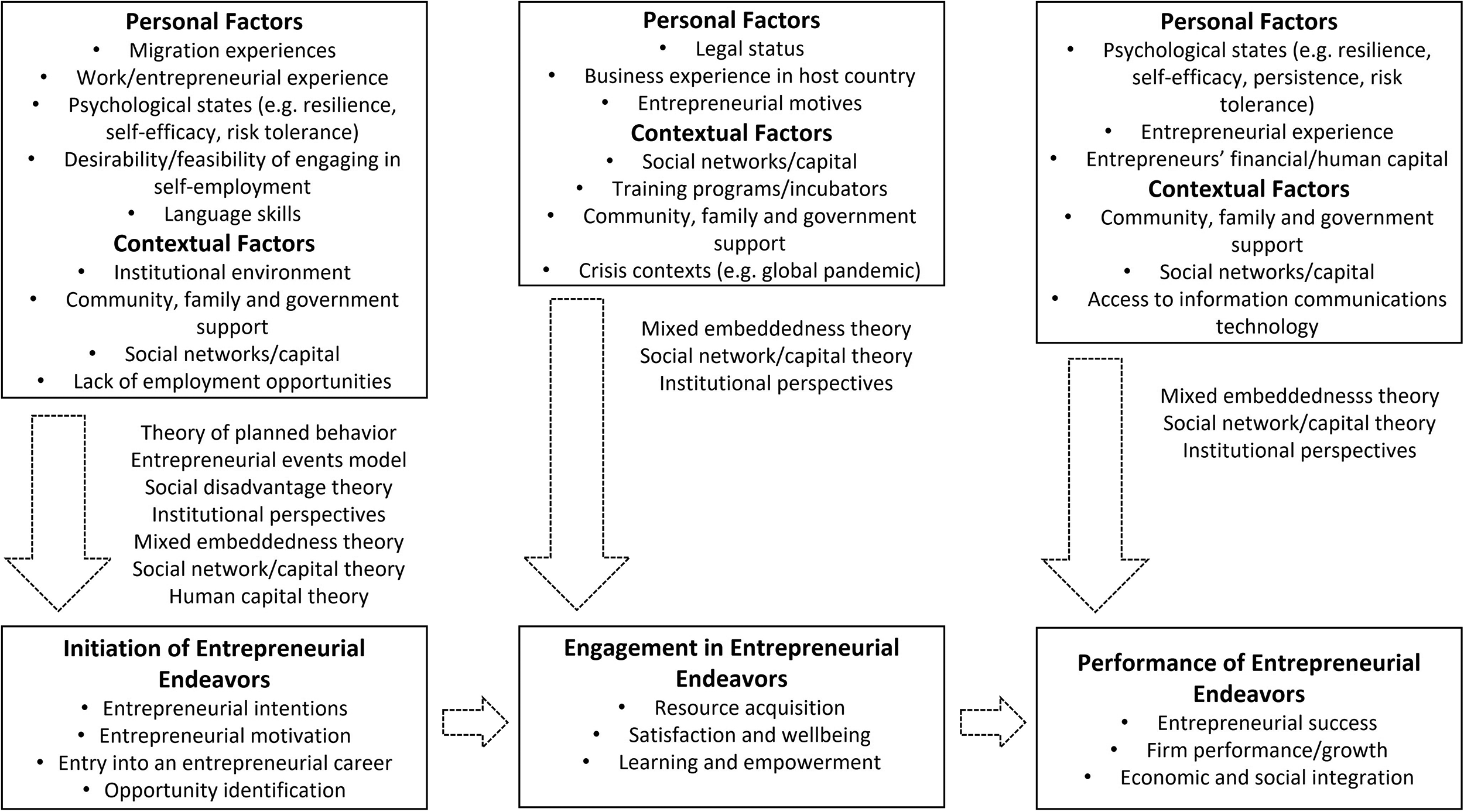
Integrative Framework of Refugee Entrepreneurship.
Key Insights and Identified Gaps from the Review
Several overall observations are clear from our review. First, a great deal of the work on refugee entrepreneurship has been exploratory, drawing on qualitative designs such as semi-structured interviews or case studies. Compared with the larger and more developed migrant entrepreneurship literature (Su, Zhai, and Karlsson 2020), there has been less quantitative work drawing on larger-scale secondary or longitudinal survey data sets that seeks to confirm the generalizability of findings, which limits researchers’ ability to make causal inferences.
Second, although there is a large and growing body of work on the factors linking refugees’ initiation of entrepreneurial endeavors and their entrepreneurial performance, limited work has examined the factors linking refugees’ engagement in entrepreneurial endeavors, especially their satisfaction, wellbeing, learning, and empowerment. This is problematic, as engagement outcomes such as satisfaction and wellbeing are critical factors linked to long-term entrepreneurial success.
Third, limited research has explored the differences between refugees and voluntary migrants in terms of their propensity to engage in entrepreneurship and succeed in their endeavors (Kone, Ruiz, and Vargas-Silva 2021). In particular, there is limited knowledge as to why entrepreneurship rates are higher among refugees than other groups of migrants. Although the social disadvantage theory proposes that the high rates of entrepreneurship among refugees may result from discrimination in the formal labor market, researchers have yet to examine why refugees tend to be more entrepreneurial than voluntary migrants and whether they are more successful in growing profitable businesses in the long term.
Fourth, prior work drawing on the social network theory and the mixed embeddedness perspective has looked at the positive impact of social networks/ties and the social capital inherent in those ties, especially with others from the same ethnic community, on refugee entrepreneurship. As with the wider migrant entrepreneurship literature (Dabić et al. 2020), limited empirical work has examined the constraining nature of such ties, often referred to in the literature as the “dark side” of social capital (Gedajlovic et al. 2013).
Fifth, limited research has examined how policy-makers can support refugees to initiate and engage in entrepreneurial endeavors. In particular, research examining the effect of training and support programs on entrepreneurial intentions and motivation, improved access to resources, and entrepreneurial satisfaction and wellbeing among refugees is lacking, and little research has explored which groups of refugees benefit most from such training programs. Without this knowledge, it is difficult for policy-makers to ascertain how best to utilize limited resources to support entrepreneurial activity.
Finally, in prior research, there has been limited use of theoretical perspectives other than the social network and capital theories and the mixed embeddedness perspective to explore refugee entrepreneurship. Only a small number of studies have adopted psychosocial perspectives to explain the factors shaping entrepreneurial intentions and refugee entrepreneurs’ behavior (Mawson and Kasem 2019; Obschonka, Hahn, and Bajwa 2018). Compared with the wider migrant entrepreneurship literature, the work reviewed here shows only limited use of the institutional theory and cultural theories (Dabić et al. 2020) to examine how rates of entrepreneurship among people from refugee backgrounds differ across countries and regions.
Future Research Agenda
Opportunities for Empirical Advancement
Use of Secondary or Longitudinal Survey Data
As highlighted above, there is limited empirical work drawing on larger-scale secondary or survey data sets to explore the factors that influence the successful creation and growth of refugee-owned businesses. Therefore, we call on researchers to examine secondary data sets from governments to examine how factors such as time spent in the host country, time spent in refugee camps, family situation, prior education and work experience, and the category of visa held influence the likelihood that refugees will start and succeed in growing a business. In addition, researchers could consider using longitudinal survey data to track refugees after they arrive in the host country and explore their experiences of entering the labor market or establishing a business. In doing so, researchers may capture data on factors such as refugees’ entrepreneurial mindset, social networks, and personal circumstances that may impact their decision to engage in entrepreneurial activity in their host countries.
Comparing refugees and voluntary Migrants
Limited work has examined why rates of entrepreneurship among refugees are higher than those of voluntary migrants and whether refugee entrepreneurs are more successful in the long term in growing successful businesses (Kone, Ruiz, and Vargas-Silva 2021). In future research, scholars could examine whether refugees are more likely to engage in entrepreneurship than voluntary migrants and if this is due to being excluded from the formal labor market or whether they are inherently more entrepreneurial as a result of their experiences (i.e., having learned to be resourceful, resilient, and adaptable after leaving their home countries). In examining differences between refugees and voluntary migrants, researchers should be careful not to homogenize refugees into one category and should acknowledge that involuntary migrants have distinctive experiences and unique individual needs that may depend on their mode of arrival, visa category, and social status in their home country (Hynes 2011). For example, those on temporary visas without permanent protection, such as those seeking asylum, may have more limited access to the formal employment market or formal sources of finance with which to establish and grow their businesses.
The dark side of social capital
Our review did not identify much work that looked at the constraining nature of social ties, often referred to as the “dark side” of social capital (Gedajlovic et al. 2013). We call on researchers to examine the constraining nature of social capital, especially that inherent in strong ties with co-ethnics. Drawing on recent scholarship that suggests that social capital may promote inequity among communities due to its unequal distribution (Field 2017), we must recognize situations in which strong ties with more powerful members of the same ethnic group might constrain entrepreneurship. For example, research has shown that settled migrants from the same ethnic group might not always see the arrival of “involuntary migrants” as beneficial, become cautious or even unwilling to assist them in the settlement process, and even actively exclude them from social networks (Castles et al. 2014). Prior research also suggests that more established entrepreneurs tend to take advantage of others from the same ethnic group, preferring to exploit them as cheap labor than encourage them to establish their own businesses (Gold 1988). In examining both the supporting and constraining nature of social capital inherent in network ties with members of the same ethnic group or those of the host community, we call on researchers to draw on social network analysis, which has been widely used to examine the phenomenon of migrant entrepreneurship (Chen and Tan 2009).
Initiation of entrepreneurial endeavors
Our review documented little research on the factors linked to refugees’ engagement in entrepreneurial endeavors compared with their initiation or performance of such endeavors. Future work should identify the personal and contextual factors that influence refugee entrepreneurs’ ability to obtain finance and maintain high levels of satisfaction and wellbeing. In doing so, investigators may draw on theories such as the social network or social capital theory to explore the relative importance of strong and weak network ties and bonding and bridging capital to resource acquisition.
Impact of training and support on entrepreneurial outcomes
In future work, researchers might examine the impact of migrant entrepreneurship training and support programs run by governments and refugee support agencies on rates of entrepreneurial activity and success and the underlying processes explaining the impact of these programs. In particular, researchers should consider which elements of such programs are most effective, including the provision of start-up funding, assistance with business plans, technical assistance, mentoring from experienced entrepreneurs, and networking opportunities. Focusing on entrepreneurship training has the potential to inform policy-makers how to best allocate scarce resources to support entrepreneurial activity among refugee groups.
Opportunities for Theoretical Advancement
Psychosocial Theories
Although recent research has drawn on psychosocial theories such as the TPB (Ajzen 1991) and the EEM (Shapero and Sokol 1982) to explore the factors shaping the entrepreneurial intentions of people from a refugee background (Mawson and Kasem 2019; Obschonka, Hahn, and Bajwa 2018), future research might draw on different psychosocial perspectives to examine what leads entrepreneurs to initiate and persevere with entrepreneurial activity. Drawing on the TPB (Ajzen 1991), researchers could examine the combination of behavioral, normative, and control beliefs that influence the entrepreneurial behavior of refugees. Researchers might also draw on SCT (Bandura 2001) to explain the role of personal and situational factors in fostering refugees’ entrepreneurial activity. This theory highlights four key mechanisms that foster individuals’ entrepreneurial self-efficacy and, in turn, leads them to engage in entrepreneurial behavior: mastery experiences, vicarious learning, social persuasion, and physiological states (Newman et al. 2019). Future research might look at the role played by social support, education, training, work experience, and other environmental factors in shaping refugees’ entrepreneurial self-efficacy and passion and heightening the likelihood they will engage in entrepreneurial behavior.
Institutional and cultural theories
As highlighted in a recent review of the migrant entrepreneurship literature, researchers have drawn widely on the institutional theory and cultural theories to explain migrant entrepreneurship (Dabić et al. 2020). However, our review identified limited work on the impact of the institutional and cultural environment on refugee entrepreneurship. In line with a growing body of empirical work in the entrepreneurship literature (Brzozowski, Cucculelli, and Surdej 2014; Bruton, Ahlstrom, and Li 2010; Churchill 2017; Su, Zhai, and Karlsson 2017), future research could draw on the institutional theory (North 1990) to examine the impact of formal institutions (rules and regulations that control socioeconomic behavior) and informal institutions (societal customs and norms) on refugee entrepreneurship. In particular, researchers could investigate how government policies (e.g., the provision of resettlement support and welfare and access to training and education in the host country) impact rates of entrepreneurial activity and success. In addition, building on work from the wider migrant literature (Basu and Altinay 2002; Chand and Ghorbani 2011), researchers may draw on cultural frameworks (e.g., the Globe and Hofstede frameworks; Hofstede 2001; House 2004) to examine whether the cultural orientation of refugees’ home countries and cultural similarities between their home and host cultures impact the successful creation and growth of refugee-owned businesses. In particular, we expect that refugees in host cultures that are culturally similar to those of their home countries will experience greater rates of success, as they will find it easier to obtain resources and understand the cultural norms of doing business.
Implications for Policy and Practice
Our findings have scholarly implications for the advancement of this field. Importantly, our findings also have implications for policy and practice. Regarding policy, our review highlights the need for host country governments to develop appropriate policies to support refugee entrepreneurship as a means of fostering the social and economic integration of refugees and maximizing their economic contribution to the host country. In light of research showing that personal factors such as entrepreneurial self-efficacy and resilience are linked to refugee entrepreneurs’ initiation of entrepreneurial endeavors (Obschonka, Hahn, and Bajwa 2018; Welsh et al. 2022), host governments may introduce training programs to foster entrepreneurial self-efficacy and resilience among refugee entrepreneurs. This might involve providing them with mentoring, access to local business networks, and training (Hartmann et al. 2022; Newman et al. 2019). In support of this, recent work highlights a strong link between the provision of support by government and the initiation and performance of entrepreneurial endeavors (Barth and Zalkat 2021).
Given extant research highlights a strong association between prior entrepreneurial experience and the initiation of entrepreneurial endeavors (Alexandre, Salloum, and Alalam 2019; Atasü-Topcuoğlu 2019; Gold 1988; Kachkar 2019; Shneikat and Alrawadieh 2019; Wauters and Lambrecht 2006), governments may consider targeting their limited resources to support entrepreneurs with prior experience in their home countries. However, they should also recognize there is also a critical need to support those facing significant disadvantage in the labor market who were not able to engage in entrepreneurship in their home countries due to cultural norms (e.g., women from patriarchal societies in the Middle East).
From a practical perspective, the findings from our research also have implications for refugees looking to initiate, engage in, and undertake entrepreneurial activity. First, the findings highlight the importance of building and maintaining social capital. Co-ethnic social ties are particularly important for both starting up and maintaining a business, in particular in identifying opportunities and accessing financial resources (Atasü-Topcuoğlu 2019; Bisignano and El-Anis 2019; Eimermann and Karlsson 2018; Luseno and Kolade 2022). Research also highlights the utility of building weak network ties with members of the host community, especially in terms of resource acquisition and entrepreneurial success (Luseno and Kolade 2022; Yassine and Al-Harithy 2021). Thus, it is crucial for refugee entrepreneurs to build networks, not only with those from their home country (co-ethnic ties) but also those from their host country to ensure business viability and success over the long term. In addition, recent research suggests it is also critical for refugee entrepreneurs to build strong relationships with government officials in emerging economies to build legitimacy and ensure long-term entrepreneurial success (Harb, Kassem, and Najdi 2019).
Conclusion
Our systematic review of prior work on refugee entrepreneurship shows that researchers have only just begun exploring this field of study, in contrast to the more established field of migrant entrepreneurship, which has tended to look at the experiences of voluntary migrants (Dabić et al. 2020). As well as assessing what is known about refugee entrepreneurship, this review contributes to the literature by identifying gaps in the extant knowledge. Based on these gaps, we propose a comprehensive future research agenda that targets empirical and theoretical advancement of the field of refugee entrepreneurship. This new knowledge will be key in dealing with the grand societal challenges resulting from the increasing numbers of displaced people globally, which are currently at an all-time high and predicted to increase even further (UNHCR, 2022). If people from refugee backgrounds are to be better supported to establish and grow their own businesses and leverage their skills and expertise and have a positive impact on both their host and home countries, knowledge of the factors that promote the successful creation and growth of refugee-owned businesses is essential.
This review also has the capacity to establish a foundation for government policy-makers to design responsive support policies based on need. This is particularly important, given that refugee entrepreneurs have unique needs that differ from those of voluntary migrants. As such, a better understanding of the barriers and facilitators to refugee entrepreneurship, as well as the personal and contextual antecedents for successful refugee entrepreneurship, is crucial for the development of effective support policies. Finally, it is hoped that this review, and the future research it will inspire, will have practical implications for refugee entrepreneurs themselves, especially through a better understanding the social, personal, economic, and political factors that can influence their success.
Footnotes
Declaration of Conflicting Interests
The author(s) declared no potential conflicts of interest with respect to the research, authorship, and/or publication of this article.
Funding
The author(s) received no financial support for the research, authorship, and/or publication of this article.
