




Abstract
Dual citizenship is often seen as an indication that states are adopting more open membership policies. In some cases, however, dual citizenship is imposed because states lay claim to populations beyond their borders, and prohibit the renunciation of citizenship. This research note presents new data to describe which countries prohibit renunciation. First, we find that some states prohibit renunciation in administrative practice, even though national legal frameworks formally allow renunciation. Roughly one in five states — 38 total — prohibits citizenship renunciation in de facto or de jure terms. Second, prohibitions are regionally clustered in Latin America and the Caribbean (13 countries) and the Middle East and North Africa region (11 countries). Third, among the countries that prohibit renunciation, democracies and authoritarian regimes are fairly balanced (17 democracies vs. 21 autocracies). Fourth, democracies are more likely to formally prohibit renunciation, while autocracies also rely on de facto prohibition through administrative barriers, arbitrary procedures, or a failure to process requests. We connect citizenship prohibitions to diaspora governance, discuss its implications for citizens, and propose avenues for further research.
Introduction
The share of countries that permit dual citizenship has increased from one-third to three-quarters in the past decades (Vink et al. 2019). This acceptance of dual citizenship is remarkable against the traditional understanding of nationality as intrinsically singular. The 1930 Convention on Certain Questions Relating to the Conflict of Nationality Law states that “every person should have a nationality and should have one nationality only,” and thus commits states to “the abolition of all cases both of statelessness and of double nationality” (League of Nations 1930). The global rise of expatriate dual citizenship means that nationals residing abroad permanently or for extended periods of time retain the right to return, while they are also able to enjoy citizenship rights in their countries of residence. Dual citizenship has arguably improved the freedom of individuals to choose where to live and to exercise the rights that citizenship confers (Vink 2017). Such cross-border mobility has also prompted states to develop policies for diaspora governance to maintain economic and political ties with expatriate citizens.
While dual citizenship is often seen as empowering, individuals from states that prohibit citizenship renunciation may become dual citizens against their will. Research on nationality has so far tended to focus on citizenship acquisition and “member making” (Alarian and Goodman 2017, 138), rather than on whether and how individuals are able to leave national political communities (Hofhansel 2021, 2). Citizenship renunciation refers to “the loss of citizenship initiated by a declaration or application by the person or his or her legal representative addressed to the relevant authorities expressing his or her intention or desire to give up the citizenship in question” (GLOBALCIT N.d.). This voluntary exit from a political community is distinct from revocation or denationalization, which Gibney (2017, 360) defines as “the non-consensual withdrawal of nationality from an individual by his or her own state.” 1 Whereas denationalization emphasizes the power of the state vis-à-vis the citizen, renunciation empowers the citizen vis-à-vis the state. Yet some states prohibit this possibility, legally or in administrative practice. 2
This research note presents data on which states prohibit renunciation in de jure or de facto terms. Our data show that prohibition of citizenship renunciation is fairly common: roughly one in five states — 38 total — prohibits renunciation legally or in administrative practice. It also affects a large share of global migrants: the list of countries includes five of the 10 largest migration-origin countries (International Organization for Migration 2019, 26). 3 Second, prohibitions are regionally clustered in Latin America and the Caribbean (13 countries) and the Middle East and North Africa (MENA) region (11 countries). Third, among the countries that prohibit renunciation, democratic and autocratic regimes are fairly balanced (17 democracies vs. 21 autocracies). Fourth, democracies are more likely to formally prohibit renunciation, while autocracies also rely on de facto prohibition through administrative barriers, arbitrary procedures, or a failure to process requests. The research note concludes with research questions and avenues for future research that emerge from these empirical patterns.
Why Does Renunciation Matter?
Why does it matter if people can renounce their citizenship? There are several legal, political, and social issues at stake. From a legal perspective, Article 15 of the 1948 Universal Declaration of Human Rights establishes the right to a nationality and the right not to be arbitrarily deprived of a nationality. The same article also recognizes the right to change nationality, which implicitly establishes the right to renounce a (birth) nationality (Manby and Bauböck 2021, 1; Price 2018, 1550). 4 A right to renounce citizenship is consistent with a social contract perspective, in which citizens should be free to leave a political community (Macklin 2015). Yet, this notion of relatively unconstrained renunciation runs counter to three norms in the international citizenship regime: (1) the norm of citizenship as a permanent status, (2) the norm that states have broad authority to determine membership policies, and (3) the norm against statelessness (Spiro 2011; Owen 2018). The right to renounce is relevant for dual nationals or those who wish to renounce their current citizenship in order to acquire a new one. In such cases, renunciation does not render an individual stateless.
Renunciation policies are also politically relevant for states given increasing diaspora governance (Délano Alonso and Mylonas 2019). When sizeable communities of citizens have settled outside a country's borders, prohibition of renunciation for those migrants has implications for how the origin and receiving states engage with the diaspora. In the case of Morocco, for example, five million of the country's citizens live overseas, amounting to 10 percent of the population. If one or both of a child's parents are Moroccan, the child is automatically considered a Moroccan citizen and is unable to renounce this citizenship. 5 In the case of Iran, which estimates that four million citizens live abroad, or nearly 5 percent of its population, citizenship is passed on to the children of Iranian fathers, even if children are born abroad and the father holds another citizenship. Syrian nationality is also passed down through the paternal line without a possibility of renunciation, and following years of civil war, almost half of the country's population resides outside its borders.
If membership is determined based on parentage, this raises the question of whether populations outside the state continue to belong to the nation, and for how many generations they remain members. Children of citizens born abroad may not wish to maintain permanent ties to their parents’ or grandparents’ country of origin. 6 Brubaker (2010, 66) refers to this as the external dimension of the politics of belonging, in which populations outside the state's territory “claim — or are claimed — to belong, in some sense, to that state and to ‘its nation.’” Under international law, states have broad authority to determine who qualifies for citizenship based on jus sanguinis, jus soli, or a combination of both (Spiro 2011; Owen 2018, 303). The stakes of membership are particularly high if countries prohibiting renunciation pursue intrusive policies to engage overseas diasporas, or if they have tense relations with the country of second citizenship. 7 In European democracies, dual nationals of Moroccan, Iranian, and Syrian descent have begun to mobilize and call attention to the ways in which imposed dual citizenship impacts their lives (Belhaj 2008; Hethey 2017; Ezzeroili et al. 2019).
Which States Prohibit Renunciation?
As comparative research has tended to focus on citizenship acquisition, we know fairly little about loss provisions and the different ways in which people can renounce their citizenship. We began exploring renunciation provisions by identifying countries coded in the MACIMIDE Global Expatriate Dual Citizenship Dataset as prohibiting renunciation. These are countries for which the “voluntary acquisition of another citizenship does not lead to the loss of the citizenship of the country of origin and citizens do not have the possibility to voluntarily renounce their citizenship of origin” (Vink, de Groot, and Luk 2015). The MACIMIDE dataset is one of the first efforts to systematically code loss provisions rather than requirements imposed on naturalizing citizens (such as the renunciation of previous citizenships). For 2015, MACIMIDE identifies 20 countries as prohibiting renunciation.
When going through the data, however, we realized that several cases that animated our initial interest was missing from the dataset or appeared to be coded incorrectly. Iran does not appear on the list, but permits renunciation only in theory, not in practice: citizens would have to return to Iran and permission to renounce is at the discretion of a government official (Spiro 2016). Syrian nationals are in a similar position. Renunciation is prohibited for citizens of military service age, but theoretically possible for others. Release requires approval by the minister of internal affairs — yet even prior to the civil war the procedure was so complicated that authorities have advised against even attempting it (United States Office of Personnel Management 2001, 192). Some countries thus allow renunciation in theory, but do not actually process or facilitate renunciation requests. In other cases, the requirements imposed are extremely onerous, or the guidelines on whether or not to grant requests are so vague as to make the decision arbitrary. To get a better sense of the actual possibility to renounce citizenship across countries, we therefore take into consideration formal rules (as defined in constitutions and laws and coded in the MACIMIDE dataset) as well as administrative practice. Jointly, formal and informal norms make up the citizenship regime and determine actual opportunities available to individuals (Vink 2017, 223).
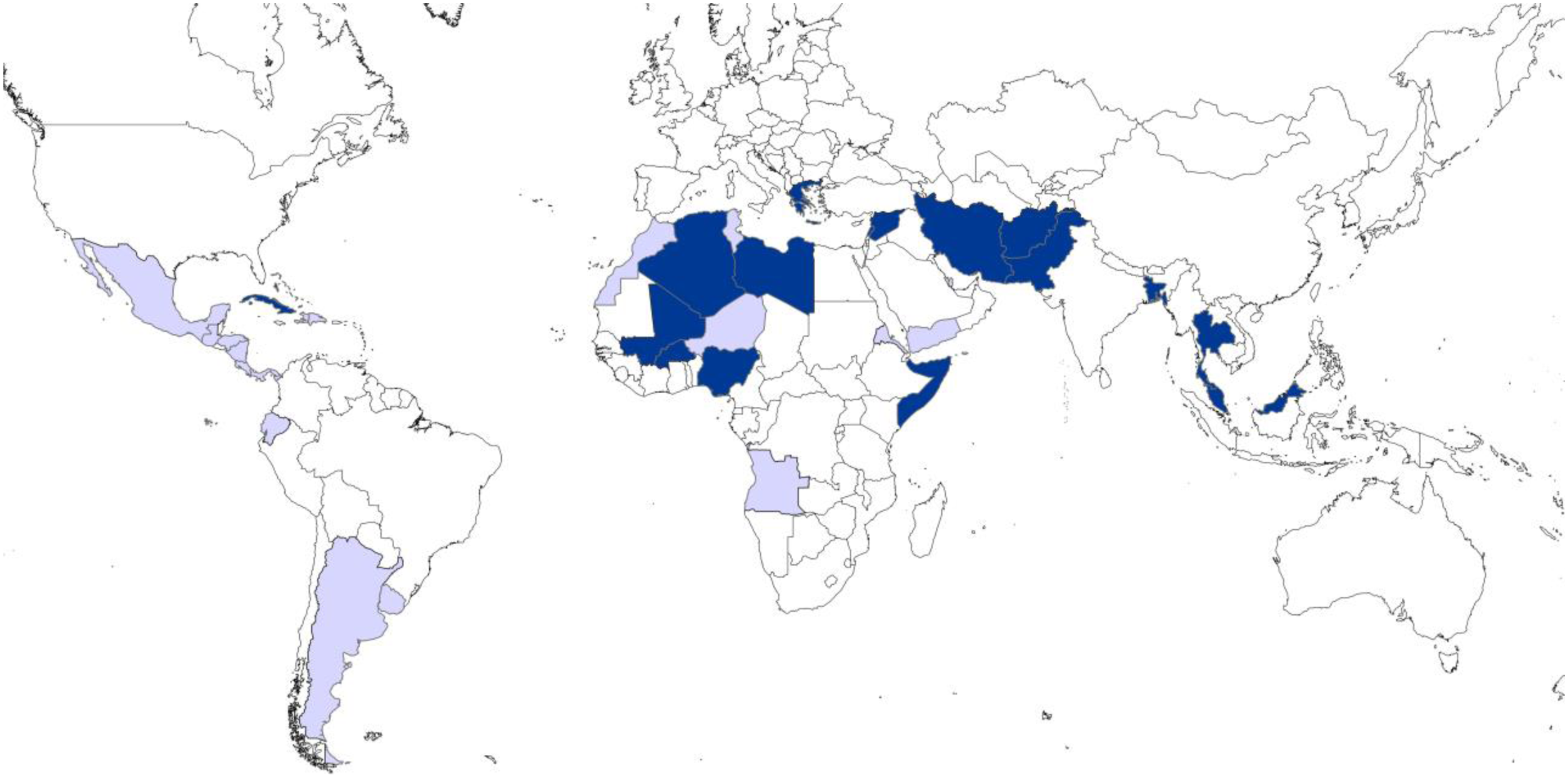
To capture de facto prohibition, we consulted information provided by immigration authorities in two countries that normally require naturalization candidates to renounce their previous nationality: the Netherlands and Germany. Legal frameworks in both countries seek to minimize dual citizenship through naturalization, but also recognize that renunciation may not be possible or impose undue hardship (Alarian and Goodman 2017; Hofhansel 2021). As a result, they developed administrative guidance for how to deal with such situations. This guidance includes lists of countries that either explicitly prohibit renunciation or for which experience has shown that authorities are unable or unwilling to process renunciation requests. 8 Incorporating these data allows us to get a sense of which countries prohibit renunciation in practice. 9 The list of countries prohibiting renunciation in de facto terms is more expansive and allows us to identify 18 additional countries. Notably, it includes the countries that were missing from the de jure list (e.g., Iran and Syria). Figure 1 maps our data.
States That Prohibit Citizenship Renunciation.
The data show that roughly one in five states — 38 total — effectively or legally prohibits citizenship renunciation. The prohibition of renunciation is thus fairly common if we include de facto as well as de jure prohibition. This highlights its relevance as a key aspect of citizenship policy and one that deserves further analysis. Importantly, five of the 10 largest migration-origin countries are on the list (International Organization for Migration 2019, 26), suggesting that the prohibition of renunciation affects a substantial subset of migrants.
The map displays regional clusters in Latin America and the Caribbean (13 countries) and in the Middle East and North Africa (11 countries). The spatial distribution of countries indicates that the prohibition of renunciation is prevalent in a mostly democratic region (Latin American and Caribbean) as well as in one dominated by autocratic regimes (MENA). This is interesting, as we might expect that democratic regimes would be less likely to prohibit renunciation given their commitment to individual choice and empowerment relative to the state. The public discourse surrounding the prohibition of renunciation in Europe has focused mostly on citizens of autocratic regimes, but the map complicates this picture. To further explore the relationship between the prohibition of renunciation and regime type, we merge our list of countries with data from Varieties of Democracy (V-Dem) and, for small countries for which V-Dem data are not available, the Freedom House list of electoral democracies (Freedom House 2015). 10
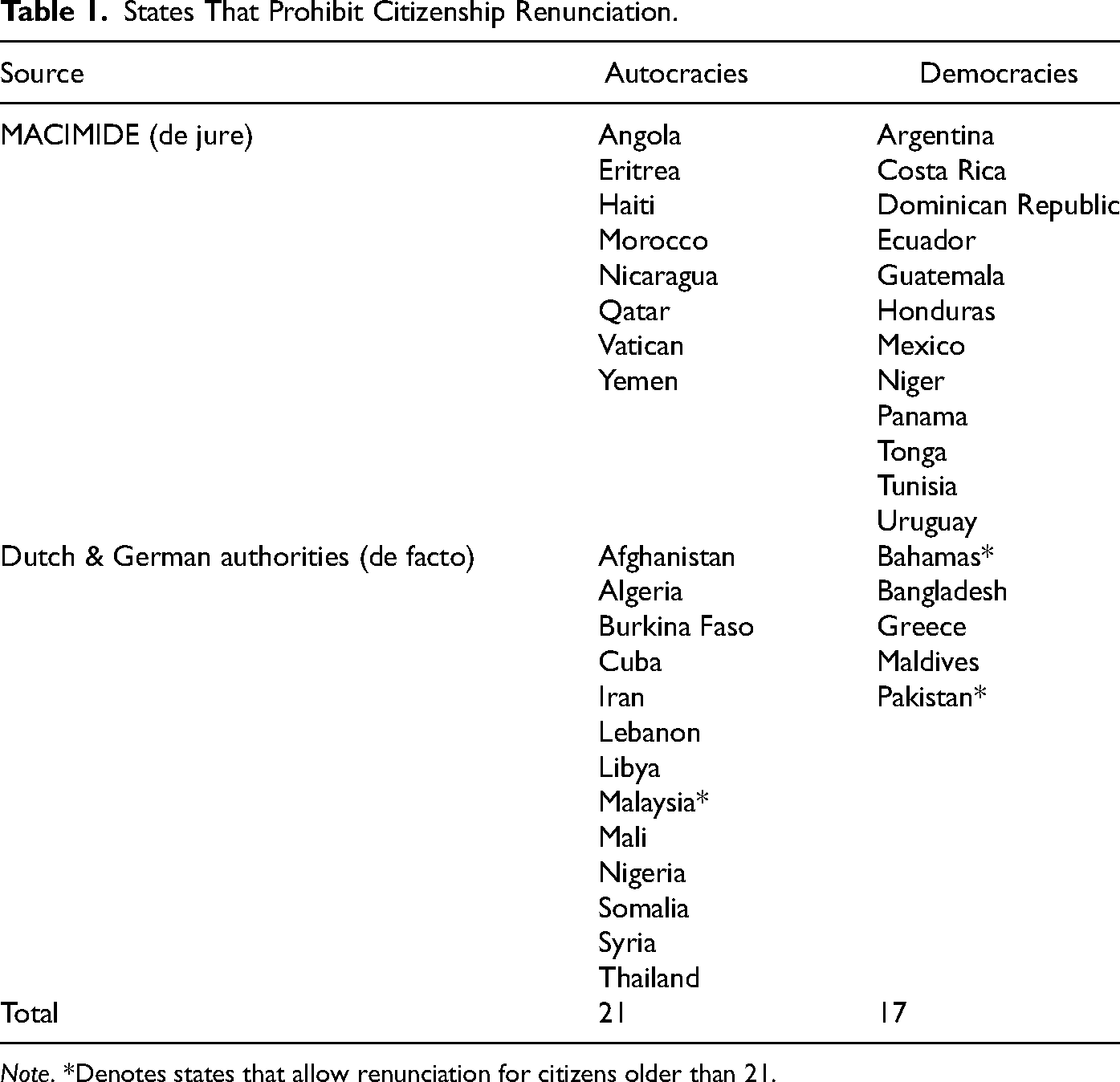
Table 1 displays democratic and autocratic regimes that prohibit citizenship renunciation in de jure or de facto terms. It shows that among the countries that prohibit renunciation, democracies and autocratic regimes are fairly balanced (17 democracies vs. 21 autocracies). Because states are nearly evenly divided between autocracies and democracies around the world today, regime type does not appear to be a determinant of renunciation prohibitions. 11 This is in line with research on the origins of dual citizenship allowance, which has not found democracy to be an important predictor for more permissive policies (Vink et al. 2019). Interestingly, though, among the countries identified in our data, democracies are more likely to formally prohibit renunciation, whereas autocracies also rely on de facto prohibition through administrative barriers, arbitrary procedures, or a failure to process requests.
States That Prohibit Citizenship Renunciation.
Note. *Denotes states that allow renunciation for citizens older than 21.
Renunciation Prohibition as Diaspora Governance
Prohibition of renunciation should be understood in the context of two related developments. The first, as highlighted above, is the rise in dual citizenship regimes. Vink et al. (2019) document how widespread expatriate dual citizenship has become: three-quarters of states now permit it. The second development is states’ investments in diaspora governance (Gamlen 2014; Dalmasso et al. 2017). Ragazzi (2009, 379) defines diaspora policies as state policies that aim at “identifying, gathering, organizing and promoting their ‘diasporas.’” The number of states with formal offices for emigrants and their descendants — or “diaspora institutions” — has increased from only a handful of countries in 1980 to over 100 by 2014 (Gamlen 2014), indicating that all sorts of states have taken interest in their diasporas. How do dual citizenship and diaspora governance relate to prohibitions of renunciation? We suggest that some states use prohibition of renunciation as a tool of diaspora management, which also increases the prevalence of dual citizenship.
States generally maintain economic ties with their diasporas, and remittances frequently constitute an important source of income for migrants (Leblang 2017). Leblang (2017, 87) writes that dual citizenship also “reduce[s] the transaction costs associated with return migration” (see also Mylonas 2013). The prohibition of renunciation means that economic ties to overseas populations are more permanent than they might otherwise be and that they persist across generations.
The adoption of renunciation prohibition can also be seen as an instance of states increasing political ties with the diaspora and even extending political rights to citizens abroad (Bauböck 2005; Whitaker 2011; Wellman and Whitaker 2021). Escobar (2007) finds that as the US adopted restrictions on immigrant residents’ social and civil rights, sending countries in Latin America opted to permit dual citizenship so that emigres could naturalize in the US. Mexico went even further and prohibited renunciation of citizenship, as parties across the political spectrum had strong incentives to support policies that would allow them to mobilize the diaspora politically. 12 Hoyo (2015, 10) explains that the adoption of prohibition was seen as the strongest possible protection for Mexicans in the US, and parties wanted to signal support for potential voters in the US. Escobar (2007) finds evidence of diffusion and policy learning across Latin American democracies, which could account for its prevalence in the region.
Obviously, prohibition of renunciation cannot be traced to democratization in autocratic states. At the same time, as with democratic regimes, diaspora management is likely to play a role in autocratic regimes’ prohibitions. Expatriate citizenship may increase (or be perceived to increase) economic ties and remittances from citizens abroad (Spiro 2011, 735). However, overseas citizens are not only an economic asset, but also a potential political threat by transmitting “social remittances” (Levitt 1998), such as democratic values and attitudes critical of the regime (Pérez-Armendáriz and Crow 2010; Escribà-Folch, Meseguer, and Wright 2015). This creates incentives for autocratic regimes to engage with “their” diaspora politically (Dalmasso et al. 2017; Tsourapas 2021), and the measures that they adopt are likely intended to limit potentially destabilizing social remittances. States’ engagement with overseas citizens, rather than merely descendants of citizens, may be seen as more legitimate by states where citizens reside, and by the diaspora itself.
How Does Renunciation Prohibition Affect Citizens?
Migrants appear to value dual citizenship (Alarian and Goodman 2017). In the case of Mexico, for instance, the prohibition on renunciation was adopted at least in part because of diaspora demand. However, if autocratic regimes have incentives to maintain control of their diaspora populations for regime stability, expatriate citizens of such regimes are likely to experience dual citizenship more negatively than expatriate citizens of democratic regimes. In addition, states of residence may also engage in unequal treatment of dual citizens, even when the second citizenship is unwanted.
Concerns about intrusive diaspora governance appear to be raised predominantly by expatriate citizens of autocratic regimes. For example, Eritrea has created extensive networks to monitor the diaspora and to enforce compliance with the “diaspora tax” it imposes on overseas citizens (Hirt and Mohammad 2018). The extent of coercive control the Eritrean regime seeks to exercise has led to resistance and concern among authorities in Germany and the Netherlands (Botje and Yohannes 2016; Zeit online 2017). Similarly, some Dutch citizens of Moroccan descent have alleged that the Moroccan state has established institutions that aim to spy on, intimidate, and recruit Moroccans living abroad (Belhaj 2008; Ezzeroili et al. 2019). They also claim that the Moroccan state attempts to impose its laws and norms on overseas citizens related to marriage, divorce, travel, same–sex relationships, and inheritance. Some members of the diaspora thus experience the engagement of Morocco with its overseas diaspora as unwanted meddling, rather than supportive outreach. Among activists in the Netherlands who are seeking to renounce their Moroccan citizenship, Berbers are particularly represented. Given the antagonistic relationship between Berbers and the regime in Morocco, they may have a different perspective on retaining citizenship than other migrants (or descendants of migrants) from Morocco. Migrants’ and descendants’ position with reference to the political cleavages in the origin state likely shapes the extent to which overseas citizens experience the prohibition of renunciation as protection or coercion.
Second, dual citizens are sometimes treated differently in their state of residence, which constitutes a breach of the equal treatment principle and can even impede their enjoyment of full citizenship rights. 13 Often, this unequal treatment is justified in terms of national security. The accusation that dual citizenship is associated with “dual loyalty” and thus diminished allegiance can render dual citizens suspect, even in instances where they are unable to renounce their second nationality. Dual citizens often have to undergo additional checks when trying to obtain security clearances for professional opportunities, especially in the security sector. In some instances, dual nationals may not be able to obtain necessary clearances, because the control of another state over them or their family members could make them susceptible to blackmail (Paternotte 2020). The vulnerability to blackmail often comes from the fact that dual citizens have not fulfilled obligations that states impose, such as compulsory military service. The obligations of liberal states toward all their citizens are undermined by the unequal treatment of dual citizens.
Conclusion
This research note describes prohibitions on citizenship renunciation against the backdrop of increasing dual citizenship and diaspora management, highlights geographical patterns, and discusses the implications of these prohibitions for dual citizens. We present data on which countries prohibit renunciation by law or in practice, and find that citizens of 38 states cannot renounce their ties to them. Prohibition thus constitutes an important aspect of the international citizenship regime and one that speaks to emerging scholarship on migration, diasporas, and transnational politics more broadly.
Prohibitions on citizenship renunciation raise several normative and empirical research questions. Here we briefly raise three. First, we find that autocracies and democratic regimes both prohibit renunciation. What explains the logic underlying these policy choices across regime types? We raised some possibilities tied to democratization and control of economic and social remittances, but this is an area for further research.
Second, a vibrant literature on diasporas addresses mobilization and influence on home states (e.g., Délano Alonso and Mylonas 2019). How do diaspora politics shape a state's willingness to permit renunciation? Do the characteristics of a diaspora's states of residence influence such a willingness? For instance, is it the case that regimes attempt to maintain claims on expatriate populations particularly when they resettle in wealthy states to access remittances? As dual citizenship expands among wealthy democracies, should we expect additional states to try to maintain ties with overseas populations by introducing prohibitions on renunciation? We also think it is worth asking which groups within diasporas experience the inability to renounce citizenship as a burden.
Finally, citizenship renunciation could also be considered in comparison with denationalization. Historically, denationalization has been associated with autocratic regimes. Nazi Germany as well as the Soviet Union stripped “undesirable” or “unwanted citizens” of their citizenship. In response to the mass denationalization by totalitarian regimes, a strong international norm emerged against denationalization. This norm was challenged in the aftermath of 9/11, as liberal democracies have begun to employ denationalization as a counter-terrorism strategy (Gibney 2017; Hofhansel 2021). As a result, dual citizens are more vulnerable to denationalization, even if they would prefer to renounce citizenship. Notably, many Muslim-majority states are on the list of those that prohibit renunciation, and given the connections between justifications for denationalization and Islamist terrorism, this is a point of concern. Trends in citizenship acquisition and liberalization have attracted scholars’ attention. We believe that renunciation prohibition is also worthy of further research, and hope that this note contributes to a new research agenda in that direction.
Footnotes
Acknowledgments
Authors listed in alphabetical order. We thank Kamran Hakiman, Anouk van der Lem, and Emily Bloch for excellent research assistance. We also thank members of the Amsterdam Conflict Research Network and the UvA Migration Works-in-progress seminar, as well as Evelyn Ersanilli, Solange Fontana, Turkuler Isiksel, and two anonymous reviewers for insightful feedback on previous drafts.
Declaration of Conflicting Interests
The author(s) declared no potential conflicts of interest with respect to the research, authorship, and/or publication of this article.
Funding
The author(s) declared the following potential conflicts of interest with respect to the research, authorship, and/or publication of this article: This work was supported by a US Department of Defense Minerva (grant W911NF1810089), and a European Research Council grant (CitizenGap # 949795).
