




Abstract
Despite evidence of the impact of adult children's migration on left-behind older parents, the comparison of left-behind older parents’ mental health and psychological well-being between internal and international migration is limited. This article examines how the relationship between adult children's migration and parent's mental health differs according to the migrant's destination — only internal migration, only international migration, or hybrid migration (at least one child who migrated internally and at least one child who migrated internationally). Drawing on a 2019 cross-sectional population-based survey of 697 left-behind older adults (≥ 60 years) in Nepal, we assessed the mental health of older parents, using the 21-item Depression Anxiety Stress Scales and a range of socio-demographic, health, lifestyle, and child-related characteristics. Multilevel mixed-method linear regression was performed to examine the effect of adult children's migration on left-behind older parents’ depression, anxiety, and stress symptoms. Results showed that parents whose children had all migrated internationally were at higher risk of mental health problems, particularly anxiety and stress, compared to parents whose children had all migrated internally. Older parents from the hybrid group (having both internal and international migrant adult children) had higher levels of anxiety, compared to parents whose children had all migrated internally, with no significant difference in depression and stress symptoms. Further, mothers of internationally migrated children were at higher risk of mental health symptoms than fathers. Interventions aiming to improve left-behind older parents’ mental health and psychological well-being should specifically target parents whose children have migrated internationally.
Introduction
Rapid urbanization and industrialization have increased the number of rural people migrating to urban areas across the world (Johnson and Lichter 2019; Tacoli, Mcgranahan, and Satterthwaite 2015). As a consequence, there are higher numbers of young adults migrating both within and outside their home countries. This migration of young adults occurs alongside an increasing aging population in rural areas in both low- and middle-income countries (LMIC) (Davies and James 2016). By 2050, the global population aged 60 years and over will reach 23 percent, accounting for 2.1 billion people, with 80 percent of these older people living in LMICs (WHO 2018), where this population's impact on health and welfare services will be significant. State support for older adults is relatively weak in LMICs, and adult children are often the major source of support for their parents (Feng 2019). Thus, both the aging population and increasing youth migration provide an additional burden on health and welfare services for older adults in these countries (Shen, Li, and Tanui 2012).
The impact of adult children's migration on their left-behind older parents’ health and well-being is unclear. Since the migration of younger adults is common in developing countries (IOM 2019a), it is important to investigate how the migration destination and migrant children's geographical proximity affect their parents’ well-being. The type of migration is an important area of study when considering the effects of migration on left-behind families, as internal and international migration may have different impacts on the left-behind population (Bastia, Valenzuela, and Pozo 2020; de Haas and van Rooij 2010; Arenas and Yahirun 2010). There are limited studies, however, comparing internal and international migration in terms of the impact of children's migration on parents’ well-being. A study conducted among labor migrants in Indonesia (Kumar 2021) found that parents having a child who migrated internally had increased depression symptoms, compared to parents having a child who migrated internationally. The few studies which have considered both internal and international migration of children (e.g., Arenas and Yahirun 2010; Yahirun and Arenas 2018, both in Mexico, and Guo et al. 2018 in China) compared the mental health of older parents with ‘no migrant’ children to that of parents with internally and internationally migrated children but did not distinguish between internal and international migration and, thus, did not explore the effects of migration type. Although previous studies provide valuable insight into the psychological consequences of older parents being left-behind, they have primarily focused on international migration (Antman 2010; Siriwardhana et al. 2015; Thapa et al. 2018), despite high rates of internal migration in the populations examined and the importance of the type of migration on left-behind older parents’ well-being (Bastia, Valenzuela, and Pozo 2020). In this way, the existing migration literature provides limited evidence on the impact of children's internal migration as a separate type of migration on their older parents’ mental health, and hybrid migration (at least one child who migrated internally and at least one child who migrated internationally) has not been considered.
The distinction between children's internal and international migration (and hybrid) and how the type of migration shapes parental mental health are important for several reasons. Children who migrate abroad over long distances are less likely to make frequent return visits to their left-behind parents, and the reduced geographical proximity to their home country may adversely impact those parents’ mental health (Li, Luo, and Li 2021). Older parents with children who migrated internationally may, therefore, be more vulnerable to mental health conditions. However, there may be positive effects, such as remittances, with international migrants providing more financial support to parents than internal migrants (Bhandari 2016; de Haas and van Rooij 2010). Guo et al. (2018), for example, found that parents with internal migrant children were most likely to report financial worries, while those with international migrant children were more likely to worry about lack of care. Hence, there are likely to be different stressors placed on older parents by their children's migration, depending on the type of migration their children undertake.
This article examines the relationship between adult children's migration and parent's mental health (depression, anxiety, and stress) according to the type of migration undertaken: only internal, only international, or hybrid (both internal and international). Building on a 2019 cross-sectional community-based survey conducted among older parents with adult children in Nepal, this article contributes toward understandings of migration's role in the psychological well-being of parents aged 60 years of above. With an increasing proportion of older people and an increasing trend of young adults leaving country for work and study affecting the traditional intergenerational support system among older people (Speck and Muller-Boker 2021), Nepal provides an important context, which may be similar to other LMICs (Gautam 2018).
This article commences with a discussion of the global pattern of migration, with a focus on the type of migration (internal and international). It, then, reviews research on how adult children's migration impacts left-behind older parents’ mental health, followed by a brief description of Nepal. A description of the methods, measures, and data analysis techniques used is, then, presented. The results section describes the sample characteristics, with findings presented on the association between children's migration and their older left-behind parents’ mental health. The final section outlines key findings and their research and policy implications.
The Pattern of Migration
Migration is common across the world, with more than a billion people living and working outside their birth country or in a location other than their birthplace within their home country (McAuliffe and Triandafyllidou 2021). Internal and international migrants comprise an estimated 15 percent of the world population (IOM 2019a). There are an estimated 281 million international migrants, accounting for 3.6 percent of the global population, with 41 percent of these (105.7 million) originating from Asian countries (Black 2021). The number of internal migrants is almost four times the number of international migrants (Skeldon 2018). In most developing countries, however, there is no systematic practice of determining the scale of internal migration (Kuhn 2015). This lack of data is further exacerbated by the absence of nationally agreed definitions of internal migration (Bell et al. 2015). Although work, study, and family are among the major drivers of migration decisions, migration often involves a complex set of economic, social, and cultural factors for migrant-sending families, with dominant factors varying across regions, age groups, and times (Ye et al. 2013).
Research examining migration's impact on migrant-sending households has focused on the role of remittances in increasing household income and avoiding poverty (Ullah and Huque 2019; de Haas and van Rooij 2010; Castles 2015). Migration's impact on left-behind households has generally been examined through the lens of international migration, with the distinction between internal and international migration not fully considered (King and Skeldon 2010). In general, international migrants originate from wealthier households (McKay and Deshingkar 2014; Ebadi, Ahmadi, and Melgar-Quiñonez 2020) and provide higher remittances (Semyonov and Gorodzeisky 2008; Antman 2012). Hence, left-behind family members with international migrants are often in a better financial position with fewer impacts on their well-being, compared to families with internal migrants (Ebadi, Ahmadi, and Melgar-Quiñonez 2020). Estimates of remittances from internal migration are limited, but surveys suggest that internal or domestic remittances also contribute positively to household income and education (Housen, Hopkins, and Earnest 2013; McKay and Deshingkar 2014). In general, international migration may be more beneficial to left-behind household members from an economic perspective compared to internal migration, and thus may have a more supportive effect on the mental health of left-behind family members through financial provision.
Mental Health of Older Left-Behind Parents
Researchers have studied the relationship between children's migration and left-behind older parents’ physical health (Lu 2012; Evandrou et al. 2017), mental health (Song 2017; Wang et al. 2017; Inoue et al. 2019; Mergo 2020), quality of life (Liang and Wu 2014; Ye, Chen and Peng 2017) and overall well-being (Gassmann et al. 2012; Silverstein, Cong and Li 2006). Generally, research on left-behind parents’ mental health has reported increased depression (Cheng et al. 2015; Song 2017; Wang et al. 2017; Zhai et al. 2015), loneliness (Cheng et al. 2015; Liu and Guo 2007; Wang et al. 2017), anxiety (Wang et al. 2013; Arenas and Yahirun 2010), and poorer cognitive ability (Zhai et al. 2015) among older parents with migrant children. Children's migration is also correlated with reduced happiness among left-behind older parents (Scheffel and Zhang 2019; Jones 2014).
By contrast, other studies have found left-behind parents to be at lower risk of developing depression (Abas et al. 2013) and to have higher cognitive functioning compared to non-left-behind parents (Inoue et al. 2019), with a few studies reporting no significant differences (Chang et al. 2016; Li et al. 2016; Ghimire et al. 2018). Yahirun and Arenas (2018) found that older parents with children who migrated internationally had poorer psychological health, while internal migration did not affect parental well-being. Guo et al. (2018) reported lower levels of depression among older parents having all children who migrated internally or having at least one child who migrated (either internally or internationally), compared to older parents with no children who migrated. There was no significant difference in depression scores between parents with no migrant child and with all children who migrated internationally. An integrative review of research on left-behind parents’ mental health found that 10 of 16 studies assessing the effect of adult children's migration on older left-behind parents’ mental health reported poorer mental health for older parents with migrant children, with two studies showing better mental health for left-behind older parents (Thapa et al. 2018). The range of evidence for the effect of mental health of left-behind older parents indicates that a more detailed analysis of migration is required, including internal and international migration, to elucidate the effects on mental health and their causal mechanisms.
Migration's Impact on Left-Behind Older Parents
Several authors have considered the intergenerational solidarity theory (Baykara-Krumme and Fokkema 2019; Li, Luo, and Li 2021; Merz, Schuengel, and Schulze 2007) when addressing the relationship between parents and children, including in migrant families. The theory considers how family members manage their lives to pursue their goals in an intergenerational context (Jaskiewicz et al. 2017). The intergenerational solidarity framework focuses on six solidarity dimensions of the parent-child relationship: affectual (emotional closeness, positive sentiments, and reciprocity); associational (frequency and patterns of contact and interactions); consensual (agreement on opinions, values, and beliefs); functional (exchange of support and resources); structural (opportunities for intergenerational contact facilitated by family size and geographic proximity); and normative (commitment to roles and obligations in compliance with family norms and values) (Bengtson and Robert 1991; Roberts, Richards, and Bengtson 1991). Children's migration may intensify certain aspects of solidarity, such as affectual, functional, and structural, while diminishing other forms, such as associational, consensual, and normative (Baykara-Krumme and Fokkema 2019). The type of migration (whether internal or international) may also have different implications for different dimensions of intergenerational solidarity (Karpinska and Dykstra 2019). The potential for migration's different impacts on aspects of intergenerational solidarity indicates that its effect on left-behind parents should not be considered solely as a negative and that the type of migration must be considered in studies assessing these impacts.
In addition, migration may disrupt the social support networks of older parents who rely on their adult children (Kanaiaupuni 2000; Das et al. 2007). The decrease in older parents’ social contact with their migrant children may prevent children from fulfilling cultural norms of filial support (Vera-Sanso 2006), thereby compromising older parents’ mental well-being (Angel, Vega, and López-Ortega 2017). The increased workload resulting from the absence of an active household member may also adversely affect older adults’ health (Burazeri et al. 2007). Parents may feel lonely or depressed (King and Vullnetari 2006) and worry about their migrant children's welfare, negatively impacting their own mental health and well-being.
International migration may serve as a cushion to absorb and soften economic stress for households in LMICs (Aziz and Mohyuddin 2015). Moreover, temporary out-migration for employment assists with income and, thereby, reduces poverty in sending communities (Adams and Page 2005). At the international level, according to the United Nations, migration is increasingly recognized for its potential to deliver benefits for the population of the sending and receiving countries (UNDP 2009). Despite the distance, children who migrate often support their older parents in their home country, thereby fulfilling filial responsibilities (Miyawaki and Hooyman 2021). The money received from migrant children also supports increased healthcare expenditure (Amuedo-Dorantes and Pozo 2011) and improved family access to healthcare (Ariadi, Saud, and Ashfaq 2019; Hoermann and Kollmair 2009), supporting better health outcomes (Kuhn, Everett, and Silvey 2011; Cao et al. 2019), including mental health, and minimizing the negative mental health outcomes related to poor physical health. Studies have demonstrated that rather than being passive receivers of remittances, older people in migrant-sending families actively provide family support (Földes 2016), care for their left-behind grandchildren (Teerawichitchainan and Low 2021), and manage the remittances received (Vullnetari and King 2011).
Parents may feel pride and prestige for the opportunities and achievements of their migrant children (Shmulyar Gréen and Melander 2018). At the same time, communication technologies have enabled engagement over long distances, and greater access to transportation has contributed to more frequent home visits by migrant children (Abas et al. 2009; Knodel and Saengtienchai 2007). A number of studies have reported on the relationship between parental well-being and the location of their migrant offspring, suggesting that geographical proximity could be beneficial for older parents (Liang and Zhang 2017) by enabling more return visits, more frequent contact, and greater support (Hünteler and Mulder 2020). Song (2017) found that in China, having migrant children all living outside the province negatively affected older adults’ mental health, compared to those who had at least one child who migrated within the province. Chen, Shen, and Ruan (2021), however, found that the quality of the parent–child relationship, rather than the migrant child's geographical proximity, was strongly associated with older parents’ well-being. Hence, how left-behind older parents’ mental health differs according to their adult children's migration destination — internal migration or international migration — is not clear in the existing literature.
Study Context
Nepal has experienced a rapid increase in internal and international migration in recent decades (Sharma et al. 2014). More than 10 million people, accounting for 36.2 percent of Nepal's population, are lifetime (internal) migrants (CBS Nepal 2019). Richer Nepalese households are more likely to have members migrate internally (IOM 2019b). In the past decade, the predominant rural-to-rural stream of internal migration in Nepal has shifted to rural-to-urban (CBS Nepal 2019). Migration in Nepal is often attributed to poverty, income disparities, geographic variation in labor demand, natural disasters, and food insecurity (IOM, 2019b). Laborers travel to other districts and provinces across Nepal to work in construction, garment factories, hospitality, industry, transport services, and agriculture (KC 2020). The Population and Housing Census of Nepal (2021) reports around 2.2 million Nepalis (7.4 percent of the population) living outside the country, with one in every four households having a family member abroad (CBS Nepal 2022). Although men were the majority of international migrants, more recently, Nepal has seen an increase in women seeking to work or study abroad (CBS Nepal 2019).
Since the late 1980s, increased international economic migration in Nepal has resulted in the traditional, agriculture-based economy moving to a remittance-based economy (Kunwar 2015). According to Nepal's Department of Foreign Employment, 3.8 million permits to work abroad were issued between 1993 and 2014, with almost 14 percent of the total population receiving international work permits (Ministry of Labour and Employment Nepal 2016). Most labor migrants from Nepal are unskilled (70 percent) or semi-skilled (27 percent), with the majority unemployed (40 percent) or engaged in agriculture (30 percent), prior to departure (Nepal 2013). The Nepal government supports migration, as remittances lighten its burden regarding care for older people (Sijapati and Limbu 2012). Nepalese migrant workers sent more than US$8 billion home in 2018, accounting for almost 28 percent of Nepal's GDP (Banjara, Karki, and Dumre 2020). In general, Nepalis with limited education migrate to India and the Gulf countries for work, whereas educated and affluent Nepalis prefer to go to more developed countries and regions, such as the United States, Australia, the United Kingdom, and Europe (Thapaliya and Devkota 2018), often for education. Another important characteristic of migration out of Nepal is cross-border migration to India, as seasonal migrants travel to various Indian cities, primarily for domestic and hospitality work (Thapaliya and Devkota 2018). India has historically been the main destination for short-term and seasonal migration from Nepal, facilitated by open borders between the two countries, with these migrations being largely undocumented (Gill and Hoebink 2003).
Nepal, although having a smaller proportion of older people compared to high-income countries, has witnessed a steady increase in the age of its population in recent decades (CBS Nepal 2019). The life expectancy at birth in Nepal reached 71 years in 2019 (UNFPA 2019), up from 60.4 years in 2001. The proportion of adults aged 60 years and over was 6.5 percent in 2001 and had increased to 8.1 percent by 2011 (CBS Nepal 2012) and 11.1 percent by 2018 (CBS Nepal 2019). Hence, as the proportion of older adults in Nepal grows, and migration continues, the effect on the mental health of older persons will become more prevalent.
In Nepal, there is a limited social security system in place for older people, who often depend in later life on their children for income (Rajan 2014). Typically, older parents co-reside with adult children, especially sons, which is a significant cultural aspect of Nepalese traditional family life (Esteve and Liu 2014). Under this family structure, adult children — usually sons, daughters-in-law, and unmarried daughters — take responsibility for caring for older family members (Chalise 2006). There is an element of reciprocity, however, as older parents also provide household support, including care for grandchildren and agricultural work (Chalise et al. 2007). More recently, young couples in Nepal have been seeking employment and education away from their families, often in cities (CBS Nepal 2019). Since city living is expensive, people are having smaller families, and supporting older parents is becoming less of a priority for many (Shrestha 2012). In addition to a changing family structure, migration has directly affected older family members (Limbu 2012), as members of the traditional family unit are no longer close by to care.
Adult children's migration has weakened Nepal's traditional intergenerational support system (Childs et al. 2014; Dhital, Chalise, and Rupakheti 2015), with potentially adverse consequences for parents’ health and well-being (Geriatric Center Nepal 2010; Shrestha 2012). Migration's most evident effect in Nepal is remittances’ impact on migrant-sending households’ economic status (Bam, Thagurathi, and Neupane 2016; Wagle and Devkota 2018; Lokshin, Bontch-Osmolovski, and Glinskaya 2010). Several studies have reported that extra income from remittances increases left-behind family members’ access to healthcare, education, nutrition, and other services in Nepal (Regmi, Paudel, and Williams 2014; Dhungana and Pandit 2014; Kim et al. 2019; Bansak, Chezum, and Giri 2015; Nepal 2016). Tachibana et al. (2019) found that increased international remittances reduced left-behind family members’ psychological distress after the 2015 earthquake in Nepal, but not mental disorders. Little research, however, has examined the consequences of such migration on non-financial dimensions for left-behind families, including the impact of adult children's migration on older parents’ mental health. It is, therefore, important to consider additional aspects of migration's impacts on migrant's left-behind families.
Among the limited studies on migration's health impact on left-behind family members in Nepal, Hoermann and Kollmair (2009) reported that remittances made healthcare more affordable for left-behind family members, giving the poor better access to medical treatment. Ghimire et al. (2018) found that children's migration (both internal and international) resulted in higher levels of loneliness among left-behind parents, but not depressive symptoms. A study in aged care homes in Nepal (Khanal, Rai, and Chalise 2018) found that 78 percent of older people self-reported emotional problems such as loneliness, anxiety, and insomnia, while a much smaller proportion (9.1 percent) reported financial problems, as a result of children's migration. Thus, migration has both positive and negative impacts on the mental health of left-behind parents, and that those impacts may differ according to migration type.
Data, Measures, and Methods
The data analyzed here came from a cross-sectional population-based survey among randomly selected older parents with an adult child, undertaken in May–July 2019, in six municipalities in Arghakhachi and Rupandehi districts of Lumbini province in Nepal. These two districts were among the top 10 in terms of the proportion of households having an international labor migrant (Ministry of Labor & Employment 2018). Participants were selected from a sampling frame, developed from the Nepal Election Commission's voter list, of older people aged 60 years or over living in the selected municipalities. Institutionalized older adults (in a hospital or aged care homes) and those not able to speak Nepali were excluded. Enumerators were specifically trained for the study and collected data through individual face-to-face interviews. Responses were recorded on Android tablets, using Research Electronic Data Capture software, which provided an opportunity for real-time monitoring and feedback to enumerators during fieldwork, thereby ensuring data quality. 1
Measures and Variables
Mental Health — Depression Anxiety Stress Scales (DASS-21)
Older adults’ mental health symptoms were assessed, using the Depression Anxiety Stress Scales (DASS-21; Lovibund and Lovibund 1995), which measures the prevalence of symptoms over the prior week in three domains — depression, anxiety, and stress — and provides a score for each domain. Each subscale has seven items, with responses reported on a four-point scale ranging from 0 (“does not apply to me”) to 3 (“applies to me most of the time”). Domain scores were obtained by summing the individual item scores, with a maximum total score of 21 for each subscale. The final score was obtained by multiplying the score by two to obtain the equivalent score for the DASS-42. The Nepali version of the DASS-21 employed by Tonsing (2014) was refined for use in this study. The scale demonstrated high reliability, with Cronbach alpha values of 0.95 for the overall scale, 0.93 for depression, 0.79 for anxiety, and 0.91 for stress.
Adult Children's Migration
Adult children's migration was defined as having an adult child currently living in another municipality, in another province, or in another country for more than three months preceding the survey. Migration type was, first, defined as a dichotomous variable: whether the children's migration was internal or international. Out of 697 older parents included in this study, 280 (40.2 percent) had only internally migrated children, while the remaining 417 (59.8 percent) had at least one child who migrated internationally. The category of “older parents with children who migrated internationally” may include siblings who did not migrate and/or who migrated internally. Migration type was, then, grouped into three categories: internal, both internal and international (“hybrid” group), and only international migration. 16.5 percent (n = 115) of older parents had only international migrant children, and 43.3 percent (n = 302) were in a hybrid state (with both internal and international migrant children).
Controlled Variables
A range of socio-demographic, health-, lifestyle-, and children-related characteristics (see Table 1) which may act as confounders were measured and included for adjustment. Socio-demographic variables included gender, age, family size, education, marital status, ethnicity, working status, the main source of household income, living arrangement, household wealth quintile, and whether the individual was receiving a pension or an aged care allowance provided by the Nepalese government. Participants’ grand-parenting duties, as well as whether they watched television, read newspapers, had a mobile phone, had experienced adverse life events, social participation, and social support, were also assessed. Health-related characteristics included self-perceived general health status, number of chronic conditions, and functional ability. Lifestyle characteristics assessed were alcohol consumption, smoking, and physical exercise. Child-related variables included the number of children, gender composition of children, closeness to a child, financial support, and frequency of communication and visits of a migrant children with the parent. Closeness to a child, consistent with the Affectual Solidarity Inventory (Mangen, Bengtson, and Landry 1988), measured a “very close” relationship with any child (Yes/No). The frequency of contact was categorized into three groups: daily contact with all children, daily contact with some children, and no daily contact with any children. Children's visit was assessed, using three categories: all children visiting at least monthly, some children visiting at least monthly, and no children visiting monthly. These control variables were identified based on a review of adult children's migration and older left-behind parents’ mental health (Thapa et al. 2018). A detailed description of the variables and their measurements is available upon request.
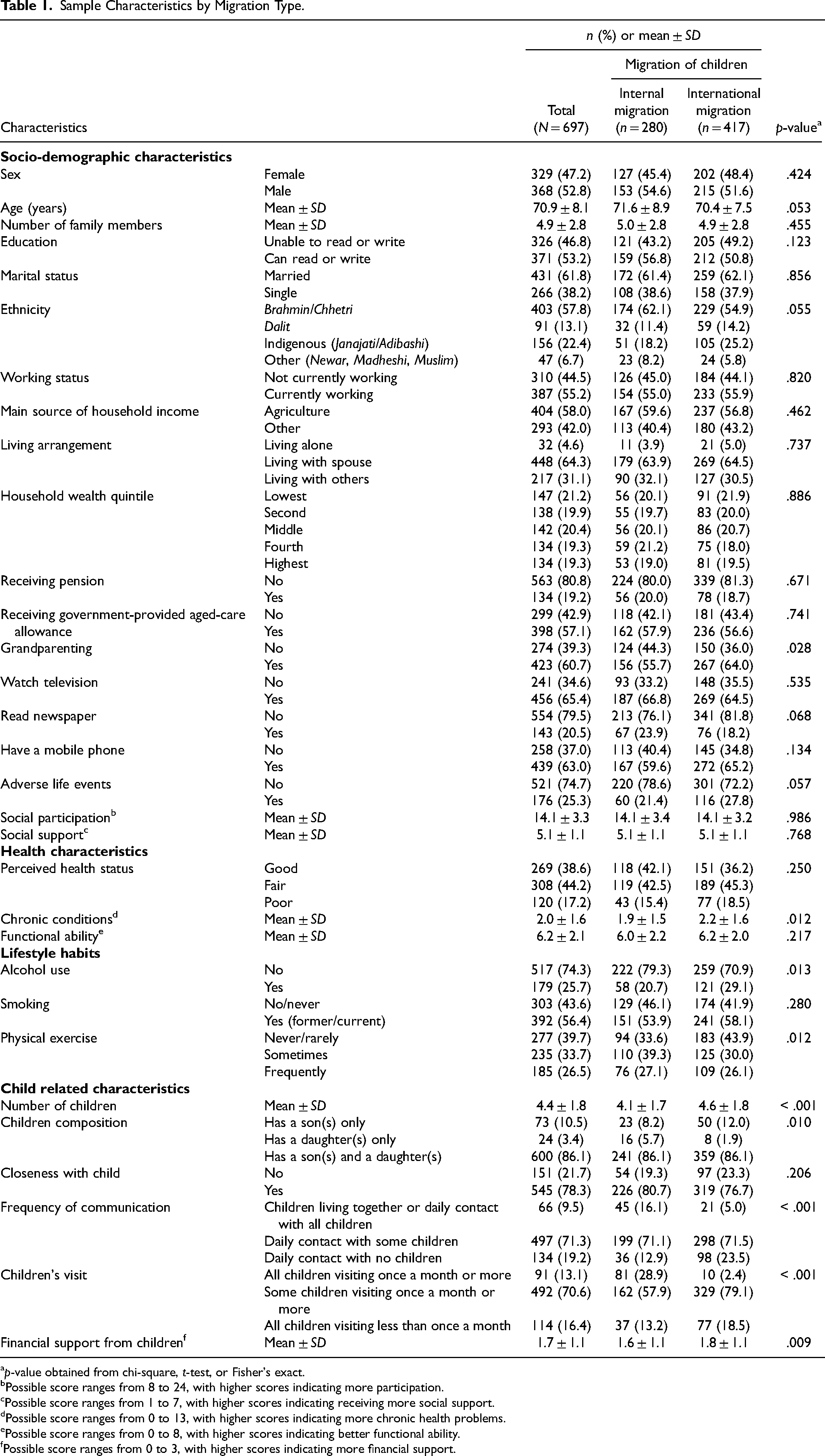
Sample Characteristics by Migration Type.
ap-value obtained from chi-square, t-test, or Fisher's exact.
bPossible score ranges from 8 to 24, with higher scores indicating more participation.
cPossible score ranges from 1 to 7, with higher scores indicating receiving more social support.
dPossible score ranges from 0 to 13, with higher scores indicating more chronic health problems.
ePossible score ranges from 0 to 8, with higher scores indicating better functional ability.
fPossible score ranges from 0 to 3, with higher scores indicating more financial support.
Data Analysis
Socio-demographic and study variables were presented and compared, using descriptive statistics (proportion, mean, and SD), chi-square test, Fisher's exact test, t-test, correlation, and ANOVA. Cohen's d was used to assess the effect size of the difference in mental health symptom scores between internal and international migration. Multilevel mixed-method linear regression assessed the effect of adult children's migration on depression, anxiety, and stress symptoms of left-behind parents, after adjusting for potential covariates. Three-level models were used, as individuals (n = 697) were nested within municipalities (n = 6) and municipalities were further nested within districts (n = 2). We compared older parents having all children who migrated internally with (i) at least one child who migrated internationally, (ii) at least one child who migrated internally and at least one child who migrated internationally (hybrid group), and (iii) all children who migrated internationally. In both cases, we further tested the models for male and female older adults separately. All models were generated, using the backward stepwise selection method, and included different variables for adjustment for the mental health domains. Collinearity among covariates was checked by Pearson's correlation coefficient (|r| > 0.50) while running the models. The reported p-values were two-sided, and < .05 was considered statistically significant. Analyses were conducted using Stata version 16 (StataCorp 2017). 2
Results
Sample Characteristics
Sample characteristics are presented in Table 1. Out of the total sample of 794, 697 participants reported having an adult child (> 18 years) who migrated at the time of the survey and were included in this analysis. The participants’ mean age was 70.9 years. Around half of the participants were female (47.2 percent), half were unable to read and write (46.8 percent), and half were currently working (55.2 percent). Higher proportions of participants were married (61.8 percent), living with their spouse (64.3 percent), receiving an aged care allowance (57.1 percent), and having grandparenting responsibilities (60.7 percent). Two-thirds (64.4 percent) reported watching television, while only 20.5 percent read newspapers.
The average number of chronic conditions was 2.0 ± 1.6. The mean scores were 14.1 ± 3.3 for social participation, 5.1 ± 1.1 for social support, and 6.2 ± 2.1 for functional ability. The average number of children was 4.4 ± 1.8. Few (3.4 percent) had only daughter(s), while most (86.1 percent) had both son(s) and daughter(s). Three-quarters (78.3 percent) reported having a child to whom they felt “very” close. About three-quarters (71.3 percent) reported talking daily with a child (irrespective of migration), and 70.6 percent had a child visit at least monthly. Table 1 presents study variables according to the type of migration. Child migration status was associated with grandparenting (p = .028), number of chronic conditions (p = .012), alcohol consumption (p = .013), physical exercise (p = .012), number of children (p < .001), gender composition of children (p = .01), frequency of communication (p < .001) and visits (p < .001), and financial support (p = .009).
Association Between Migration Type and Mental Health
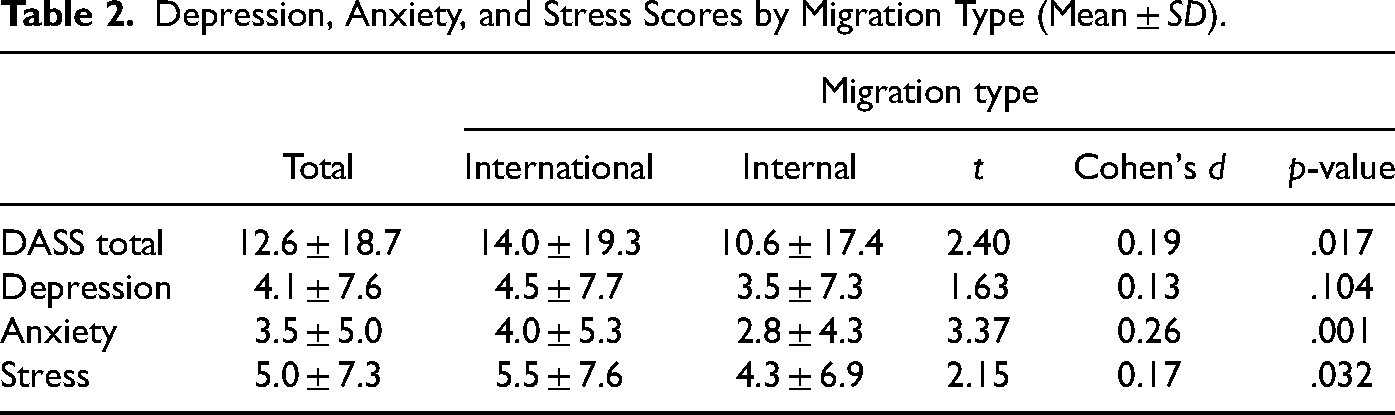
The mean score for the DASS-21 was 12.6 ± 18.7 with domain scores of 4.1 ± 7.6 for depression, 3.5 ± 5.0 for anxiety, and 5.0 ± 7.3 for stress. The Supplemental Appendix presents the mean scores for the DASS domains by study variables and the pairwise correlations among the study variables. A comparison of mental health symptom scores according to migration type (internal and international) showed that the mean DASS score was significantly higher among older adults with children who migrated internationally (p = .017). Across the subscales, scores for anxiety and stress symptoms were significantly higher among older parents with children who migrated internationally (Cohen's d 0.26 and 0.17, respectively; Table 2).
Depression, Anxiety, and Stress Scores by Migration Type (Mean ± SD).
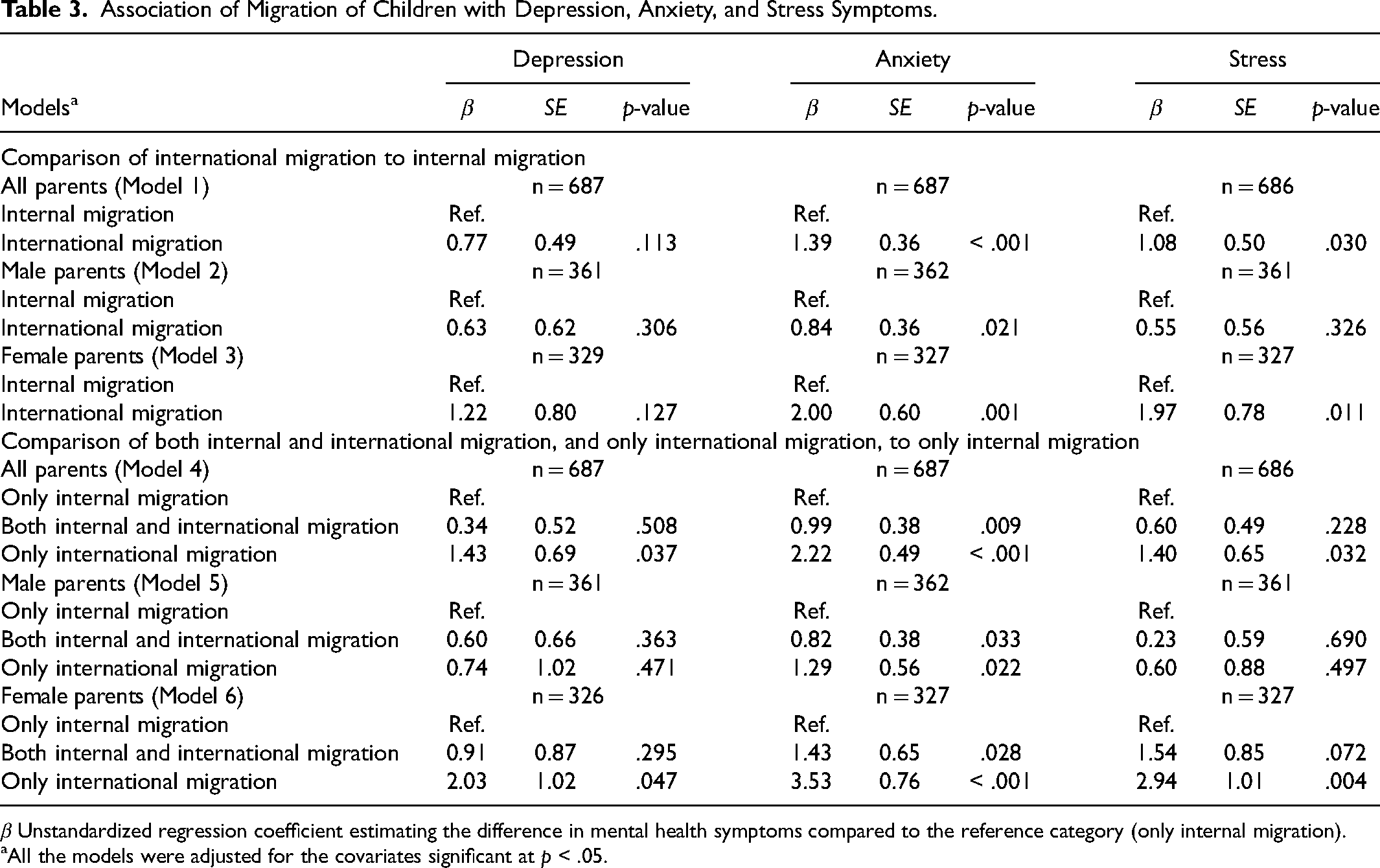
The results of mixed-effects multiple linear regression are shown in Table 3. The independent variable was “type of migration of adult children” (internal as reference), and the dependent variables were the scores for depression, anxiety, and stress symptoms. Six different models for each mental health domain are presented. First, we compared the mental health symptoms of the international migration group with the internal migration group (Model 1). Comparisons were made separately for male (Model 2) and female (Model 3) parents. Second, we compared both internal and international migration (hybrid group) and only international migration with only internal migration (Model 4). The model was also run for male (Model 5) and female (Model 6) older parents separately.
Association of Migration of Children with Depression, Anxiety, and Stress Symptoms.
β Unstandardized regression coefficient estimating the difference in mental health symptoms compared to the reference category (only internal migration).
aAll the models were adjusted for the covariates significant at p < .05.
Scores for all mental health symptoms were higher among parents with internationally migrated children, compared to parents with internally migrated children. The difference was significant for anxiety (p < .001) and stress (p = .030) (Model 1), suggesting that older adults with children who migrated internationally were significantly more likely to experience symptoms of anxiety and stress, with a stronger effect for anxiety. We assessed whether the results varied when only male migrant children were included and when only female migrant children were included (Supplemental Appendix). When only male children were included, the results yielded similar results for depression (β = 0.25, p = .683) and anxiety (β = 1.15, p < .001) symptoms, while in the case of stress, the difference between internal and international migration was not found to be significant (β = 0.48, p = .409). When only female children were included, the results were not significant for any of the mental health outcomes, indicating that female children's migration did not influence older parents’ mental health. When the analyses were conducted separately by gender, male parents within the international migrant group experienced higher levels of anxiety (Model 2), while female parents showed higher levels of anxiety and stress (Model 3).
There was no significant difference in depression and stress symptoms between older parents with all children migrating internally, compared to the hybrid group (both internal and international migration), while symptoms for anxiety were significantly higher for the hybrid group. When mental health symptom scores between internal and international groups were compared (Model 4), all three mental health scores of stress, depression, and anxiety, were higher for the international migration group. Among male older adults, anxiety symptoms were found to be significantly higher for the hybrid group and only international migration groups, compared to only internal migration (Model 5). For female older adults, all three mental health symptoms were significantly higher for the international migration group, compared to the internal migration group (Model 6).
Discussion and Conclusion
This article contributes to the literature on the impact of children's migration on their left-behind older parents by presenting a comparative analysis of internal and international migration. In Nepal, older adults with international migrant children had worse mental health symptoms across all subscales of the DASS-21, with the difference significant for anxiety and stress. Traveling to another country is an unknown experience for most parents (Artiga and Ubri 2017), introducing additional anxieties and distress about their migrant children. Further, our findings showed that older parents with only internal migrant children had a lower risk of mental health symptoms than older parents with only international migrant children. Additionally, older mothers with children who migrated internationally were at higher risk of mental health symptoms than those with only children who migrated internally, consistent with other studies reporting poor mental health and well-being among left-behind mothers (Antman 2010; Mitchell and Lovegreen 2009). Our findings demonstrated the effect of migration type (international, internal, and hybrid) on anxiety and stress symptoms with internal migration having fewer negative impacts on parental psychological well-being.
The results presented here contradict Kumar (2021), who reported in Indonesia, parents with a child who migrated internally had a higher increase in depression than parents with a child who migrated internationally. One possible reason for this difference could be that the material and financial protection of left-behind households by children who migrated internationally does not prevent left-behind family members from experiencing insecurity and loneliness (Khan et al. 2010). Binci and Giannelli (2016) found that domestic, but not international, remittances helped migrant-sending households. Inconsistent remittances from international migration and the time lag in sending remittances from abroad may place left-behind older parents at greater risk of distress. Older parents may also be more anxious and psychologically vulnerable, due to factors such as the high cost and complexities of procedures associated with international migration, worry for their child's safety overseas, and responsibility for left-behind grandchildren (Aminuddin et al. 2019). Our results are consistent with Borraz, Pozo, and Rossi (2008), who found that international migration reduced the happiness of those left behind and that the loss they faced was not compensated for by remittances. Our results also show that left-behind older parents’ mental health was affected by a male child's migration, but not by a female child's migration. In Nepal, it is customary for daughters to leave the family home after marriage (Zharkevich 2019), and this traditional practice may partly account for this finding. The traditional norms of “filial piety” place caregiving responsibilities for aging parents on male children (Chalise 2021). When parents perceive that these cultural norms are being undermined and that their children are not available and/or present when needed, anxiety and distress may result.
Parents’ previous mental health status may have an important influence on future mental health outcomes, as well as on children's decisions on whether and where to migrate (Giles and Mu 2007). Children whose parents experienced poor mental health may be more likely to migrate internationally so that they can provide better financial support through remittances. Attempts to predict left-behind family members’ health effects are prone to “selection bias” and “reverse causality” (Démurger 2015). Given the cross-sectional nature of this study, we cannot distinguish the causal direction of the study results.
The higher mental health risk for parents with children who migrated internationally demonstrates the importance of the structural dimension of intergenerational solidarity theory in the context of migration (Roberts, Richards, and Bengtson 1991), particularly the mental health impacts of cross-border migration and distance to the migration destination. The lower risk of poor mental health for parents with children who migrated internally could be related to the frequent interaction with and return visits from their migrated children, due to geographical proximity. International migrants may make fewer return visits, while internal migration is often seasonal and usually causes shorter periods of separation (Dewind and Holdaway 2008). Hugo (2002) suggested that international migration was more likely to weaken the connection between older parents and their adult migrant children. International migration may have more barriers, including travel costs and difficulties with borders and visas, that limit contact and, hence, can make relationships between migrants and left-behind family members more challenging to maintain (Coe 2011). As the distance to the nearest child increases, older parents are found to be less likely to receive support from their children (Quashie and Zimmer 2013). Future research should explore other dimensions of intergenerational solidarity in the context of internal and international migration and assess how both migration type and destination affect these dimensions, to strengthen understandings of migration's effect on intergenerational solidarity in migrant-sending communities.
The results of this study are consistent with the limited qualitative research conducted in similar settings. For example, Marchetti-Mercer et al. (2020) report complex emotions and relational changes experienced by left-behind older adults in South Africa. While technologies may help bridge the geographical distances between a migrant and their left-behind family members, these technologies did not always address the loss experienced by left-behind parents (Gedvilaitė-Kordušienė 2015). Similarly, left-behind family members in Sri Lanka identified their health, well-being, and family structures as impacted by an absence of support for the left-behind older parents (Siriwardhana et al. 2015). Older parents in Cambodia also reported feeling anxious for their children who had migrated internationally, perceiving a higher risk from international migration than internal migration (Hak et al. 2013). Further qualitative research across countries with similar kinship systems and migration patterns can help triangulate the emerging evidence and further explore the underlying reasons for increased mental health risks among left-behind parents with children who migrated internationally.
The findings presented in this article may be context specific. The literature reports in general, internal migrants, in contrast to international migrants, originate from poorer households and subsequently remit less (Akhter and Islam 2019; Hugo 2016). However, in Nepal, wealthier households are more likely to have family members migrate internally (IOM 2019b), and those with better education and occupational skills are readily able to earn internally (Bohra and Massey 2009). This study was conducted in Nepalese municipalities near big cities, which are the country's major internal migration destinations (KC 2020). Parents in these settings may receive both financial and direct support from their migrant children, thereby improving their mental health. These contextual factors may partly account for the better psychological well-being observed among parents with internal migrant children.
Implications
This article's main policy implication is the importance of creating employment opportunities inside the country to facilitate migration within national borders. When people migrate internally, their left-behind older parents can benefit from domestic remittances, as well as from close contact with their children. The welfare system for older people should prioritize older adults, particularly women, with children who migrated internationally, and who are at higher risk of mental health problems. The impact of children's migration on older left-behind parents may be heterogeneous, depending on children's migration-related variables, such as the migrating child's gender, the duration and reasons for migration, and the number of children who migrated, which warrants further study.
Limitations
This study's cross-sectional design, while providing evidence of a statistical association between the type of migration and left-behind older parents’ mental health, cannot provide evidence for the direction of causality (i.e., whether exposure influenced the outcome or vice versa) (Thapa et al. 2020). The survey was conducted in rural municipalities of a Nepalese province, limiting its wider generalizability. However, the findings presented here could be applied to other migrant-sending countries where both internal and international migration are common. This article considered migration to India to be international migration, but the border between India and Nepal is open; thus, migration to India is different from migration to other countries and may have a different impact on older parents’ mental health. Children's migration-related factors, such as the number of children who migrated, duration of migration, and purpose of migration may influence parents’ mental health and should be assessed in future studies.
By comparing the mental health of older parents with internal and international migrant children in Nepal, these findings contribute to the literature on migration's impact on the left-behind population. Parents with children who migrated internationally were at higher risk of mental health problems, particularly anxiety and stress, than parents with children who migrated internally. Mothers with children who migrated internationally showed higher levels of mental health symptoms than fathers. Internal and international migration can potentially have different implications for older parents’ mental health. The distinction between internal and international migration is important when studying migration's impact on older parents’ left-behind. Results of this study suggest that interventions to improve left-behind older parents’ mental health and psychological well-being should specifically target parents whose children have migrated internationally.
Supplemental Material
sj-docx-1-mrx-10.1177_01979183231154559 - Supplemental material for Internal and International Migration and the Mental Health of “Left-Behind” Older Parents
Supplemental material, sj-docx-1-mrx-10.1177_01979183231154559 for Internal and International Migration and the Mental Health of “Left-Behind” Older Parents by Deependra Kaji Thapa, Denis Visentin, Rachel Kornhaber, and Michelle Cleary in International Migration Review
Footnotes
Acknowledgments
The article is part of the first author's PhD project supported in part by a Graduate Research Scholarship from the University of Tasmania, Australia.
Declaration of Conflicting Interests
The author(s) declared no potential conflicts of interest with respect to the research, authorship, and/or publication of this article.
Funding
The author(s) received no financial support for the research, authorship, and/or publication of this article.

Supplemental Material
Supplemental material for this article is available online.
Notes
References
Supplementary Material
Please find the following supplemental material available below.
For Open Access articles published under a Creative Commons License, all supplemental material carries the same license as the article it is associated with.
For non-Open Access articles published, all supplemental material carries a non-exclusive license, and permission requests for re-use of supplemental material or any part of supplemental material shall be sent directly to the copyright owner as specified in the copyright notice associated with the article.
