




Abstract
National — and local — conversations about immigration are often centered on immigrants’ integration into the US society. One factor that shapes immigrants’ integration is their pre-migration work experience, skills, and training and a series of studies have used “channeling” as a concept to identify immigrants who have worked in the same occupation and/or industry in the destination labor market as they had in the origin labor market, prior to migration. Using the New Immigrant Survey (NIS) and a simultaneous equation model (SiEM) approach, this article expands on this research by exploring the impact of channeling on wages for Asian Indians, Filipino/as, and Mexicans with lawful permanent resident (LPR) status. Contrary to prior findings on the effects of channeling within specific industries, we find that channeling is associated with lower, not higher, immigrants’ wages. The findings are robust to different definitions of channeling, as the negative effects of channeling hold within industrial sectors and occupational groups. Moreover, the results indicate that channeling is not exclusive to the Mexico–US migration stream, but instead may be a feature of various US-bound immigration streams, including those from India and the Philippines.
Attention to immigration in the United States has intensified in recent years following the outbreak of COVID-19, travel bans from Muslim-majority countries, and continued legal challenges to the Deferred Action for Childhood Arrivals (DACA) program. Such attention is often accompanied by mixed public sentiments over immigration's social contributions and challenges (Reyna et al., 2013). In fact, when prompted to name the country's most important problem in a July 2018 Gallup poll, the most common response in the United States identified immigration (22 percent of respondents) (Newport 2018). At the same time, most Gallup respondents have consistently favored either present levels of — or increased — immigration throughout the 21st century (Gallup 2020). Conflicting attitudes about immigrants and immigration are not atypical of the public in the United States (Reyna et al., 2013). Support for immigration reflects deeply rooted beliefs that immigration is an important part of American history, but simultaneously alters the economic and social fabric of American society (O’Connell and Raker 2018).
National — and local — conversations about immigration are often centered on immigrants’ integration into the US society, and integration is the subject of voluminous research across the social sciences. One line of research within this literature concentrates on immigrants’ pre-migration work experience, skills, and training (e.g., Akresh 2006, 2008; Chiswick and Miller 2009; Imai et al., 2019; Lessem and Sanders 2020; Painter and Sanderson 2017; Sanderson and Painter 2011; Warman et al., 2015). An ongoing question garnering increased attention in this literature is whether, and if so how, immigrant integration in the United States is shaped, at least in part, by whether immigrants are able to transfer their skills, training, and work experiences between labor markets. Recently, a series of studies have used “channeling” as a concept to identify immigrants who have worked in the same industry or occupation in the destination labor market as they had in the origin labor market, prior to migration (Lessem and Sanders 2020; Painter and Sanderson 2017; Sanderson and Painter 2011). These studies join with the work, for example, of Hernandez-Leon (2004) and Hagan et al. (2011, 2015) that examine the connections between the United States and Mexican labor markets for the oil and construction industries. Channeling has been shown to characterize Mexican immigration to the United States (Sanderson and Painter 2011), and to bolster immigrants’ income in the United States. That is, Mexican immigrants who worked in the same specific industry before and after migration experienced an income premium over those immigrants who switched industries after migration to the United States (Painter and Sanderson 2017).
This article expands on this research in two key ways. First, existing studies on channeling have almost exclusively focused on Mexican immigration. Immigration from Mexico into the United States is unique in a number of facets (e.g., Sanderson 2014a; Sanderson 2014b). However, it remains unclear whether channeling patterns are similar across immigrant groups from other origin countries. Second, understanding of these patterns is also limited by concerns about potential selection effects, as previous studies could not parse whether income effects associated with channeling were artifacts of immigrant self-selection. These effects, therefore, may be an outcome of human capital differences related to pre-migration characteristics, which could be simultaneously associated with self-selection into migration “channels” in the first place.
We refine and extend previous studies by investigating the impacts of channeling for Asian Indians, Filipino/as, and Mexican migrants in the United States. Migration from India and the Philippines provides a theoretically rich counter case to Mexican immigration in several respects. First, immigrants from both groups are often self-selected into high skilled occupations through domestic policies that focus on filling labor needs in rich democracies (OECD 2012). Second, those that do emigrate abroad often have higher levels of English proficiency due to historical legacies of American and British colonialism (Bleich 2005; Choy 2003). In this regard, both India and the Philippines are often considered “labor brokerage states” because they provide a significant share of high-skilled labor to support labor shortages in areas related to health care, information technology, and engineering (OECD 2012; Ong and Azores 1994; Rodríguez 2010). For instance, Bhargava et al. (2011) find that the US–India, UK–India, and US–Philippines immigration channels accounted for roughly18 percent of all foreign-born physicians (85,894) across 18 host countries, and represented the top three South–North corridors of migration.
To make the above contributions, we employ a broader, more inclusive sample from the New Immigrant Survey (NIS) 2003 than used in previous case studies of channeling (Hagan et al. 2011, 2015; Hernandez-Leon 2004). This dataset consists of approximately 8,500 immigrants who received lawful permanent resident (LPR) status in the early 2000s. Our work joins the recent work of Lessem and Sanders (2020), who also use the NIS, and bolsters the earlier case studies to continue to build our knowledge of connections between the United States and certain sending nations. Together, this body of work provides a critical starting point for asking similar questions about today's migration streams. Not only does this earlier work provide guidance for how to assess channeling today, but it also serves as a baseline body of evidence for evaluating how channeling in the United States has changed over time.
Notably, much has changed in the United States and abroad since the NIS 2003 data were collected. In just the mid-to-late 2000s, for instance, the United States experienced a recession, anti-immigrant sentiment rose, and deportations increased (Massey and Sánchez 2010). Our study, then, must be read in the context and climate of US immigration during the early 2000s period. At the same time, however, some characteristics of the LPR population have remained quite similar over time. For example, the percent of the US population that has LPR status is virtually equivalent between when the NIS was collected (11.5 million individuals; 3.97 percent of the US population) and the latest Office of Immigration Statistics report in January 2021 (13.1 million LPR immigrants; 3.94 percent of the US population) (Baker 2022; Rytina 2005). Further, in 2003, immigrants from Mexico (27 percent), the Philippines (4.5 percent), and India (3.9 percent) constituted the three largest shares of the LPR population (Rytina 2005). In January 2021, Mexico was still the largest (26.6 percent) and the Philippines (4 percent) and India (3.4 percent) were the third and sixth largest contributors to the LPR population, respectively (Baker 2022).
Besides providing invaluable insight into the early 2000s US-bound migration, the NIS has a number of other strengths that has yet been fully leveraged in newer datasets. NIS is a large, nationally representative sample of the LPR foreign-born population that has sizable numbers of Mexican, Filipino/a, and Indian respondents that allow for comparative assessments, which sets it apart from other datasets (Akresh and Frank 2018). With respect to channeling, data requirements are particularly steep. This is mainly because investigating channeling requires detailed information on migrants’ labor market histories in both origin and destination countries and to our knowledge, the NIS data is the only source that provides comprehensive information on binationally harmonized industrial and occupational codes for employment in both prior to, and after, migration to the United States This is in addition to the rich set of demographic and labor market information for three major immigration channels. In this regard, NIS data stands out and allow us to focus on channeling within both industries and occupations so we can more thoroughly disentangle origin and destination employment effects.
Because self-selection is a common methodological hurdle when examining immigration channels from a comparative perspective (Borjas 1990; Constant and Massey 2003; Kwon, Mahutga, and Admire 2017; Kwon and Hughes 2018; McKenzie and Rapoport 2010), we use a simultaneous equation model (SiEM) approach to assess selection factors that might affect the relationship between channeling, both industrial and occupational, and wages. Our results indicate that channeling is not exclusive to the Mexico–US migration stream, but instead may be a feature of various US-bound immigration streams including those from both India and the Philippines. Further, contrary to prior findings from specific industries, we find that channeling within larger industrial sectors and occupational groups is associated with decreases in immigrants’ wages, not increases, in the United States. We discuss the implications for research moving ahead in the context of heightened interest in the benefits and costs of immigration in the United States.
Conceptual Framework
Channeling as a Means of Upward Mobility
A long line of research addresses immigrants’ occupational mobility with the goal of better understanding how mobility, and immobility, over time affects economic integration (Akresh 2008; Chiswick et al. 2005; Imai et al. 2019). A starting premise for much of this research is that immigration is a choice that immigrants make in an attempt to maximize utility (Borjas 1989). From this perspective, channeling is a rational choice because it offers the possibility of maximizing income potential (utility) — and thus, upward socioeconomic mobility — by easing transitions into the destination country's labor market.
The mechanisms behind socioeconomic mobility, however, are complex and a number of factors can shape upward mobility. Nevertheless, the human capital framework remains the central paradigm that runs through this expansive literature, and much of the literature draws upon classical immigration theories that point to the acquisition of country-specific human capital as a catalyst for integration and upward mobility (Chiswick and Miller 2003; Reitz 2001; Villarreal and Tamborini 2018). Although such perspectives have greatly improved our understanding of immigrant integration, they provide an incomplete picture that often overlooks immigrants’ pre-migration work experience, skills, and training. Indeed, as Hagan et al. (2011, 161) observe: “Pathways to economic mobility in the US labor market began in immigrants’ home communities.”
The relationship between wages and immigration has been shown to take a U-shaped pattern (Akresh 2008; Chiswick et al. 2005). Upon migration, immigrants, on average, experience some degree of downward mobility, which places them below the socioeconomic position they occupied prior to migration. Even among more highly skilled immigrants, there is a time lag between the initial job in the United States and the move into more skilled and ostensibly more highly remunerated jobs in the United States (Akresh 2008).
However, the depth and extent of the trough often depend on the transferability of pre-migration skills that immigrants bring to bear in the US labor market. Immigrants with more transferable skills may not only have a shorter decrease in socioeconomic position, but their economic mobility may recover more quickly as well. This is because, for example, they are better positioned to re-skill within the US labor market and/or translate their foreign education and work experience to the United States. Conversely, immigrants with less portable skills can experience a much steeper downgrading, longer durations with lower socioeconomic status, and a slower — if any — socioeconomic recovery (Chiswick et al. 2005).
There are good reasons to believe that immigrants who maintain their pre-migration employment in the same industry after migration to the United States may experience different wage trajectories than those who do not move between analogous sectors. Channeled immigrants often put in considerable investment in human capital and built networks in their industry within their home country. Migration entails career risks that can be mitigated by maximizing these initial investments, resulting in working in the same occupation and/or industry in the United States. Consistent with these insights, prior studies on industrial channeling for Mexican migrants suggest that pre-migration skills and experiences serve to help immigrants avoid steeper, longer downgrades upon arrival to the United States as depicted in the U-shaped pattern of integration (Hernandez-Leon 2004; Hagan et al. 2011; Sanderson and Painter 2011; Hagan et al. 2015; Painter and Sanderson 2017).
For instance, a study using the Mexican Migration Project found that Mexican immigrants who occupied certain occupations in Mexico were unlikely to leave these sectors for different work after migration to the United States (Sanderson and Painter 2011). That is, these “channeled” immigrants remained in occupations and industries related to their pre-migration skill set that included food processing, agriculture, manufacturing/construction/transportation, service, or professional sectors after entering the United States. Building on these findings, a more recent study using the NIS matched the specific industry codes of immigrants’ pre- and post-migration work (Painter and Sanderson 2017). Using this precise measure of employment between specific industries, the study found that channeling between Mexico and the United States positively affected Mexican immigrants’ economic integration, leading to an annual income premium of roughly $5,000 on average among all workers. Other work also uses a precise measure for channeling, but for occupations, linked immigrants’ last job abroad and first US job using the detailed information is available in the NIS (Lessem and Sanders 2020). Their counterfactual analysis found that immigrants who continued working in the same occupation after migration experienced a substantial wage premium upon migration and that this premium largely benefited high-skilled immigrants.
Similarly, other studies of US–Mexico migration also find socioeconomic advantages among channeled migrants in the oil and construction industries. For example, Hernandez-Leon's (2004) study of Mexican immigrants within the oil industry in Houston documents that these migrants had valuable technical training and substantial experience acquired in Mexico, which provided them with the “… industrial background and skills that allowed them to take on jobs as machinists, precision welders, sheet metal workers, and industrial maintenance mechanics’“ (Hernandez-Leon 2004, 131). The same phenomenon has also been observed among skilled workers in the construction industry. Examining Mexican immigrants working in bricklaying and masonry, tile making and installation, and carpentry in North Carolina, Hagan et al. (2011, 2015) found that migrants were able to use their specialized skills that they acquired in Mexico within the US labor market. When asked where they learned the skills for their new job, several migrants replied that they “yo traje la técnica” (I brought the method with me.) (Hagan et al. 2011, 161).
Taken together, this work suggests that industry- and occupation-specific skills, knowledge, and abilities might be more likely to laterally transfer into the US labor market and financially benefit channeled immigrants. This might be especially the case where demand for immigrant labor is high, such as in the particular industrial and occupational niches documented by Hernandez-Leon (2004) and Hagan et al.(2011, 2015). These initial investments in pre-migration human capital seem to shape post-migration outcomes and are important drivers of upward mobility and subsequent integration into the United States. In this sense, channeling effectively eases the career costs associated with moving and the transfer of these skills into the US labor market, allowing immigrants to capitalize on their source country training and skills, and more quickly improve their socioeconomic standing relative to other immigrants who are not channeled after arrival. Consequently, studies find income premiums associated with channeling (Hernandez-Leon 2004; Hagan et al. 2011; Sanderson and Painter 2011; Sanderson 2014a, 2014b; Hagan et al. 2015; Lessem and Sanders 2020). And therefore, we expect that:
Immigrants who are channeled will have higher wages than immigrants who are not channeled.
Binational Channeling Between Mexico, India and the Philippines and the United States
Despite early results that suggest that channeling facilitates socioeconomic integration, few studies examine outcomes between different immigrant groups or across a broader range of industries. And, the few studies that have investigated pre-migration employment suggest that channeling facilitates socioeconomic mobility, but they almost exclusively focus on the Mexico–US immigration stream. Mexico–US migration, however, is unique relative to other migration streams and includes a higher concentration of pre-migration employment in a limited number of occupations and industries related to food processing, agriculture, and construction (Massey, Durand, and Malone 2002; Mize and Swords 2010). Here, comparisons with Asian Indian and Filipino/a immigrants present a theoretical opportunity to enrich our understanding of channeling.
In the immediate years following the passage of the 1965 Hart–Celler Immigration Act (HCIA), employer demand for high skilled labor in healthcare, information technology, and engineering both encouraged and constrained Asian Indian migration in unique ways (Purkayastha 2005). For one, the elimination of restrictive national quotas of Asian migration and the expansion of temporary skilled worker programs substantially increased Indian immigration. Demonstrating the importance of this change is that in 1960, only 12,296 Asian Indian immigrants resided in the United States. This became 51,000 in 1970 and grew to 1,022,522 in 2000, an increase of over 1,900 percent in those ensuing 30 years (Chakravorty et al. 2017). Over the same time period (1970−2000), a total of 777,980 Indian-born individuals attained LPR status. However, alongside this dramatic population increase, employer preferences strongly restricted immigration to select migrants with high levels of educational attainment, which are reinforced through immigration policies (Chakravorty et al. 2017; Purkayastha 2005). For instance, subsequent US immigration policies, specifically the subsequent passage of the 1990 Immigration and Naturalization Act (INA) and the creation of the H1-B visa program, further favored “specialty” workers in industries considered to be highly skilled by the US employers (e.g., STEM fields).
Under the INA, H1-B visa holders can adjust their status to that of LPR, and in the absence of a point-based system (e.g., Canada and the United Kingdom), the H1-B program has shaped both the contours of the US STEM workforce and of Asian Indian migration to the United States more generally in the decades since (Kerr and Lincoln 2010). For instance, in places like Silicon Valley, Asian Indian immigrants accounted for nearly a quarter of the foreign-born engineering work force (Saxenian 2002). For some scholars, selective migration among Asian Indians is the most salient factor that explains the overrepresentation in STEM fields (Min and Jang 2015). This selective migration has been conceptualized as a “triple selection” process, with two selections taking place in India prior to migration and the third being the US immigration system that preferences individuals with particular skills (Chakravorty et al. 2017). In India, the social system and then an examination system results in a group of individuals that are disproportionately more highly educated, from urban areas, and who are members of higher castes—similar factors that have historically explained more favorable post-migration integration outcomes of Jewish and Korean-American immigrants in the United States (Brodkin 1998; Yoon 1997). Together, these three processes of selection result in an Asian Indian immigrant population in the United States that has a high level of educational attainment and specific technical skills that are concentrated within particular sectors, like science and technology (Chakravorty et al. 2017). In recent years, Asian Indian occupational and industrial concentration has expanded; for example, South Asians (including Asian Indians) own and operate a disproportionate share of the Dunkin’ Donut franchises (Rangaswamy 2007) and motels (Dhingra 2013) in the United States.
Alternatively, exploitative colonial ties between the United States and the Philippines have facilitated the socioeconomic selection of highly skilled workers in healthcare, nursing, and teaching industries (Choy 2003; Dunn 2013; Parreñas 2001). The institutional and cultural influences of US colonialism ultimately “‘prepare’ members of the colonized society to migrate…[p]otential migrants in these societies possess cultural and institutional familiarity with the colonizing nation long before crossing international borders” (Ocampo 2014, 428). This includes high levels of English fluency and a credentialing system that is similarly organized within the United States. Combined with the allure of a higher wages and the “American Dream,” filling labor shortages in the United States has become a domestic development strategy to support remittance streams (e.g., Philippine Overseas Employment Agency) (Rodríguez 2010; Yang 2011). However, the costs for labor brokerage states can be steep. For instance, Dunn (2016) finds that approximately 16,000 teachers from the Philippines enter the United States each year to fill positions in struggling school systems in rural and central cities, leaving a student-to-teacher ratio of nearly 45:1 in the Philippines.
As with Mexican and Asian Indian migration, Filipino/a immigration has been substantially shaped by US immigration policy over time. After the United States annexed the Philippines in 1899, the first migrants arrived to work in agriculture, including fruit/vegetable farms along the West Coast and sugarcane fields in Hawaii (Baldoz 2004; Gallardo and Batalova 2020). Low, but steady, migration was reduced to a maximum of 50 migrants per year by the 1934 Tydings-McDuffie Act. After World War II, Filipino/a migration increased due to Filipina wives returning with US soldiers, military recruits, and students coming to the United States to study healthcare and then staying (Gallardo and Batalova 2020). The HCIA further opened up migration between the two nations with state policies in the Philippines encouraging migration (Asis 2006, 2017; Guevarra 2009, 2014; Rodríguez 2010). In 1960, there were approximately 105,000 foreign-born Filipino/as in the United States, which increased to almost 1.4 million in 2000, an increase of slightly over 1,200 percent (Stoney and Batalova 2013). Further, between 1970 and 2000, an additional 1.4 million Filipino/a immigrants obtained LPR status (US Department of Homeland Security 2004).
These selection dynamics have shaped the socioeconomic integration of Filipino/a Americans. Filipino/a Americans are more highly educated than whites among young and middle-aged adults (Takei et al. 2013). And when compared to average Americans, Filipino/a Americans are more likely to graduate from high school and substantially more likely to hold college degrees (Yasmane 2002). However, within the US labor market, Filipino/a Americans encounter substantial discrimination that is shaped by gender, region of residence, and educational attainment (Yasmane 2002). This leads to Filipino American men, but not women, having lower earnings than white men (and women, respectively) even when controlling for the typical factors associated with income, like education, labor force participation, English language proficiency, etc. (Takei et al. 2013; see also Yasmane 2002).
The sizable share of foreign-born Asian Indians in the US educational institutions, pre-migration selection on high skilled labor (including engineering, nursing, teaching, and computer science and technology), and high levels of English fluency position these immigration channels differently than US–Mexico migration (Choy 2003; Dunn 2013; Kato and Sparber 2013; Purkayastha 2005). In terms of the impact on industrial channeling, greater familiarity along cultural, educational, and linguistic lines may facilitate skill transfer (Painter and Sanderson 2017). And thus, a more circumscribed version of hypothesis one suggests:
Channeled foreign-born workers from India and the Philippines experience greater wage premiums than channeled foreign-born workers from Mexico.
Rethinking the Benefits of Channeling
The research thus far on channeling indicates that there are economic advantages in maintaining continuity in industries and occupations upon arrival to the United States. Yet there are potential frictions that could constrain, or mitigate against, the income-maximizing effects of channeling that are less discussed.
Channeling is a binational phenomenon, involving dynamics in both origin and destination countries that might impinge upon the utility-maximizing choices of immigrants. As countries are increasingly interconnected through an international division of labor, more competitive and less profitable production processes or services are increasingly outsourced to lower-income countries (Gereffi et al. 2005; Mahutga, Roberts, and Kwon 2017). Simultaneously, the most profitable and technical processes or services remain concentrated in more affluent countries. A key concern is whether channeling then reinforces differentiated types of country-specific and specialized forms of human capital that may have less resonance in the US labor markets (Becker 1993). That is, the knowledge, skills, and abilities that new migrants acquired in their country of origin may be too specialized, especially when firms in home and host countries in the same industry often emphasize different types of skills because each occupies a different role in the globalized production/service network (Mahutga 2012). As a result, it is possible that immigrants who stay within pre-migration industries and occupations may be more likely to become stuck, or trapped, because of their specialized, industry-specific human capital than immigrants who branch out into different forms of employment upon arrival.
Rather than experience upward mobility, channeled migrants in industries that require significant pre-migration human capital investments may then experience deskilling. Contrary to prior studies, channeling may, in this sense, limit immigrants’ ability to move up and out of specific jobs, and in the process, prolong their time at the bottom of the U-shape or the “trough” of the mobility pattern. For instance, Korzeniewska and Erdal (2021) find that while the pre-migration educational and work experiences of Filipino/a nurses allowed them to practice in the industry in host countries, their employment was limited to the fringes of the profession and concentrated in more menial and routinized tasks. These processes are often intensified by accreditation regimes and/or licensing requirements, as new migrants engage in survival employment while navigating complicated immigration and credentialing requirements (Kleiner 2000; McElmurry et al., 2006; Creese and Wiebe 2012; but see Lessem and Sanders 2020, p. 4). Licensing requirements, however, are not restricted to just high-skill occupations or industries, but often also exist in lower-skill occupations such as cosmetology (Kleiner 2000). Channeling, then, may capture a dynamic related to the convergence of immigrant self-selection and the structure of human capital rewards for immigrant skillsets in destination labor markets. If channeling is a choice, it may be that immigrants with either, or both, lower levels of human capital and/or more specialized skillsets are more likely to self-select into channeling as a means of accessing a foreign labor market. If so, these channeled immigrants may indeed find it easier to enter the destination labor market, precisely because their skills are applied initially. However, over time, the very skills that eased their transition into the destination labor market also trap them in forms of employment that are detrimental to their wage-earning potential. In short, channeling may facilitate access but hinder upward mobility. And thus, it may be that channeling actually works against immigrants’ utility-maximizing choice:
Wages will be lower among immigrants who are channeled than among immigrants who are not channeled.
Data and Methods
Data
The NIS generated a nationally representative dataset of immigrants gaining LPR status in 2003 from data gathered via a multi-cohort prospective–retrospective longitudinal panel (Jasso et al. 2005). In 2003, the year the first data collection wave of the NIS was completed, 705,827 immigrants received lawful permanent residency (Rytina 2005). Of these, a little more than half (358,411) applied as “new arrivals” to the United States while the remainder had their status changed or adjusted from a nonimmigrant status. Mexico was by far the largest sending nation, constituting slightly more than 16 percent (115,864) of all LPRs in this year. India (7.1 percent or 50,372) and the Philippines (6.4 percent or 45,397) were the next two largest sending nations. These patterns have been largely stable over time. In 2017, approximately 1.1 million individuals obtained LPR status and again about half were new arrivals (Witsman 2018). Mexico-originated migrants represented 15 percent (170,581) of LPR recipients, followed by China (6.3 percent or 71,565) and Cuba (5.8 percent or 65,028). India (5.4 percent) and the Philippines (4.4 percent) were the fourth and sixth largest sending nations, respectively, in 2017.
The NIS 2003 contained 8,573 LPR immigrants who were at least 18 years of age when they received their LPR status. We used these data because no other dataset contained such a large number of the LPR foreign-born population (Akresh and Frank 2018) and met the substantial data demands of our study. The size of the sample and the detailed information on immigrants’ jobs before and after migration were critical for ensuring there were enough immigrants to facilitate our analysis. Moreover, the NIS had detailed information on respondents’ migration history and education (both in the sending country and the United States), as well as important measures like English language proficiency.
Our primary sample included 3,199 immigrants who were currently living in the United States and had valid responses on both the industry code of their last job prior to migration and their first job after arrival in the United States. 1 Respondents who were not in the labor force, reported an uncodable industry, or were in the armed forces were excluded. We also analyzed subsamples of immigrants who met the above requirements from the three largest countries of origin in the NIS: Mexico (N = 354), India (N = 306), and the Philippines (N = 214). Our second sample was constructed to the same specifications but with valid responses on both the occupation code of their job prior to migration and their first job after arrival (N = 3,263). For our country subsamples, they were 358 for Mexico, 317 for India, and 214 for the Philippines.
Measures
Outcome variables: We used three sources of information from immigrants’ first US job to calculate immigrants’ wages. First, we summed four income sources that reflected respondents’ labor market activities from the past year: self-employment income, wages and salary, income from a professional practice or trade, and income from tips, bonuses, and/or commissions. Notably, if respondents did not provide a valid response to the income questions, the NIS used a folding bracket technique that asked respondents whether they thought their income was less than, about, or more than a series of stated amounts. We then used the midpoints from these questions to fill in the missing responses. Next, we divided respondents’ income by the product of the number of weeks they usually worked at the first US job and their estimate of how many hours they usually worked to arrive at hourly wages. In doing so, wages are adjusted for the number of hours and weeks worked. Lastly, we logged the wages variable to correct for skew.
Explanatory variables: Our primary explanatory variables were measures of channeling. First, for industrial sector channeling, we used the NIS-provided 2003 Census four-digit industry code for respondents’ last job held abroad and first job in the United States to assign immigrants to one of three industry sectors: primary or extractive/harvesting (e.g., agriculture, forestry, fishing, and mining), secondary or manufacturing (e.g., utilities, construction, and manufacturing), and tertiary or services sectors (e.g., retail, transportation, information/communications, and education). 2 We then created a dichotomous variable that was equal to one if immigrants were employed in the same industrial sector before and after migration to the United States (0 if their post-migration industry sector differs from that prior to migration).
Our second focal explanatory variable was a measure of occupational channeling. Here, we followed the same procedure as above in that we used the NIS-provided 2003 Census four-digit occupation codes to assign respondents to one of 10 occupation groups: management, business, and financial (“management” hereafter); professional; service; sales; office and administrative support; farming, fishing, and forestry (“agriculture” hereafter); construction and extraction; installation, maintenance, and repair (“maintenance and repair” hereafter); production; and transportation and material moving (“transportation” hereafter). 3 A dichotomous variable captured whether immigrants worked in the same occupation group before and after migration to the United States (1 = yes; 0 = no).
We also included a number of variables that represented respondents’ characteristics prior to LPR receipt. These included the number of years of foreign education, the number of years at the last job abroad, and a dichotomous variable for whether an immigrant ever entered the United States without documentation. A series of three dichotomous variables captured the largest countries of origin in the NIS: Mexico, India, and the Philippines (the reference category is the remaining counties).
Next, we included variables that reflected respondents’ US-based characteristics, which were the amount of US education (in years), immigrants’ work experience at their first job in the United States (in years), and how long an immigrant had lived in the United States (in years). We used a dichotomous variable for how immigrants attained LPR status: via adjustment of status or new arrival (reference category). We also had a dichotomous variable for immigrants’ class of admission (1 = employment preference). Variables for industrial sector (reference is the third sector) and occupation group were coded to reflect our description above. The reference category for occupation group within the full sample model was service occupations and we combined categories to create a reference group for the country subsample analyses because some categories had few respondents (Table 3).
Last, control variables included dichotomous measures of English language proficiency (1 = speaks English “not well” or “not at all”; 0 = native-English speaker or speaks English “very well” or “well”), sex (1 = female), and marital status (1 = married). Age was a continuous variable, measured in years.
Analytic Approach
To examine the relationship between wages, channeling, and our other variables, we used SiEM with two equations. Within the SiEM framework, we created a system of equations whereby channeling was an outcome variable in the first equation and wages was the outcome in the second equation. Figure 1 presents a conceptual diagram for our approach, where both wages and channeling are outcome variables in their respective equations and the explanatory and control variables are represented by the broad labels of pre-LPR characteristics, US-based characteristics, and controls. Channeling, which is the outcome variable in the first equation, is an explanatory variable in the second equation for wages. Our approach can also be illustrated by the following equations:

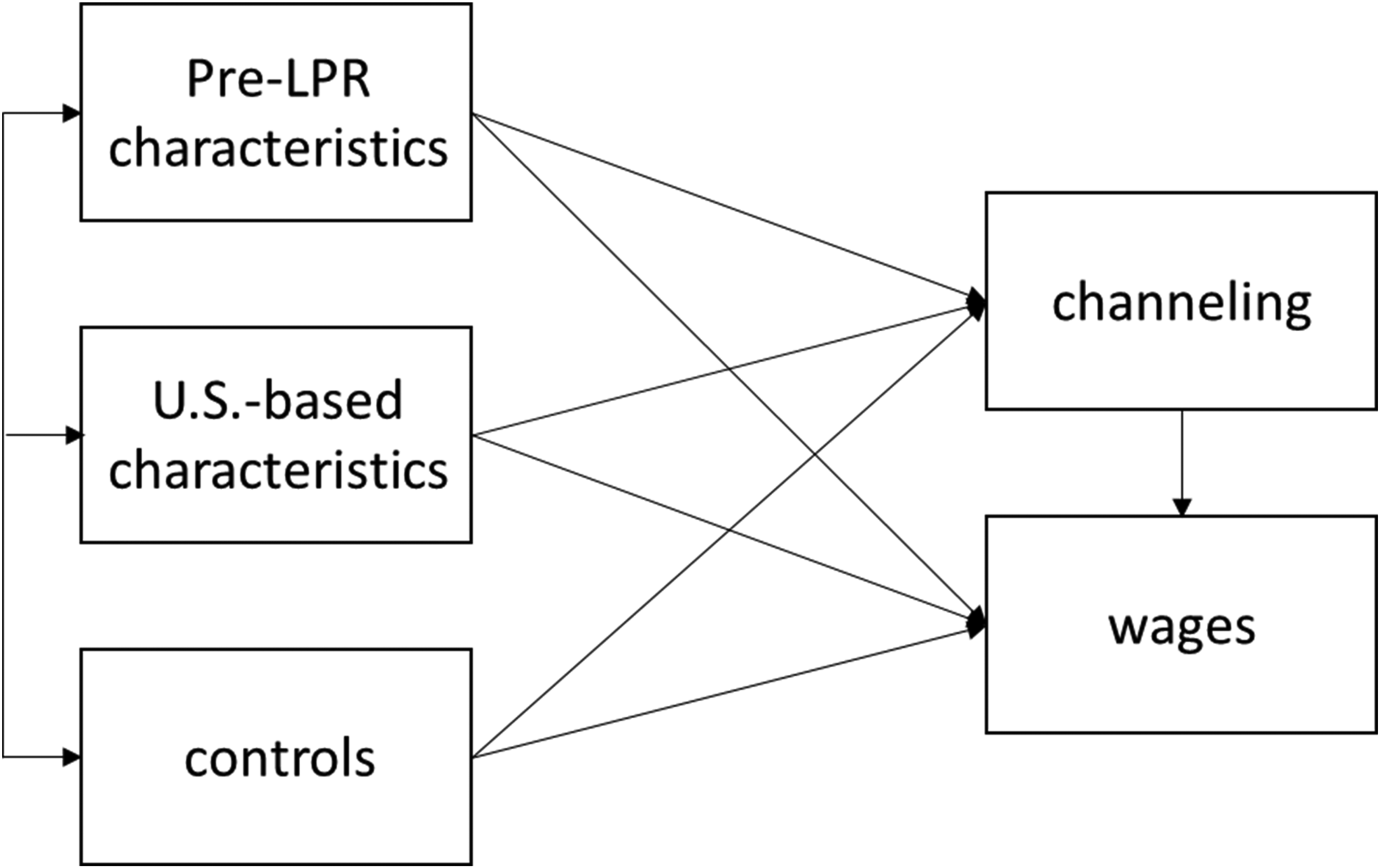
Conceptual Diagram of Simultaneous Equation Model (SiEM) for Channeling and Wages.
In these equations, the subscript i refers to an individual, CHAN refers to channeling, α is the intercept, and ε is the error term. Xi denotes a set of explanatory variables and wi is a set of control variables. The parameters β and γ are regression coefficients representing the change in the likelihood of channeling and the change in log wages associated with differences in the explanatory and control variables, respectively.
We estimated our model with a full information maximum likelihood (FIML) technique using Proc Calis within SAS 9.4. The advantage of a FIML approach was that it used information from all equations within a model to derive estimates for all of the parameters. Following previous work that used the NIS, our analyses are unweighted (Han 2020). We used multiple goodness-of-fit statistics to assess the model. In addition to R2 values for each equation, we used four goodness-of-fit statistics that reflected several different approaches to model fit and, together, provided a good representation of how well the system of equations aligned with the data. We used the chi-square test, where a nonsignificant value indicated good model fit. Notably, this test statistic is considered quite restrictive as it assesses exact or perfect model fit. Therefore, we also used two incremental fit indices: the comparative fit index (CFI) (Bentler 1990) and the non-normed fit index (NNFI) (Bollen 1989). Values above .95 were considered to indicate good fit. Last, we reported the root mean squares of error approximation (RMSEA) where a test value below .05 indicated good fit (Browne and Cudeck 1992).
Our presentation and discussion of results take the following approach. Table 1 has means and standard deviations for the full sample and for subsamples of immigrants with and without industrial channeling, our primary focal variable. We use t-tests to explore differences between these groups. Table 1 also has descriptive statistics for the country subsamples. Table 2 contains the results from the first equation from our SiEM analyses for both industrial sector and occupational group channeling for the full samples and the subsamples of Mexican, Indian, and Filipino/a immigrants. Table 3 has the results from the second equation, for wages, and follows the same approach used in Table 2.
Means and Standard Deviations, New Immigrant Survey (NIS).
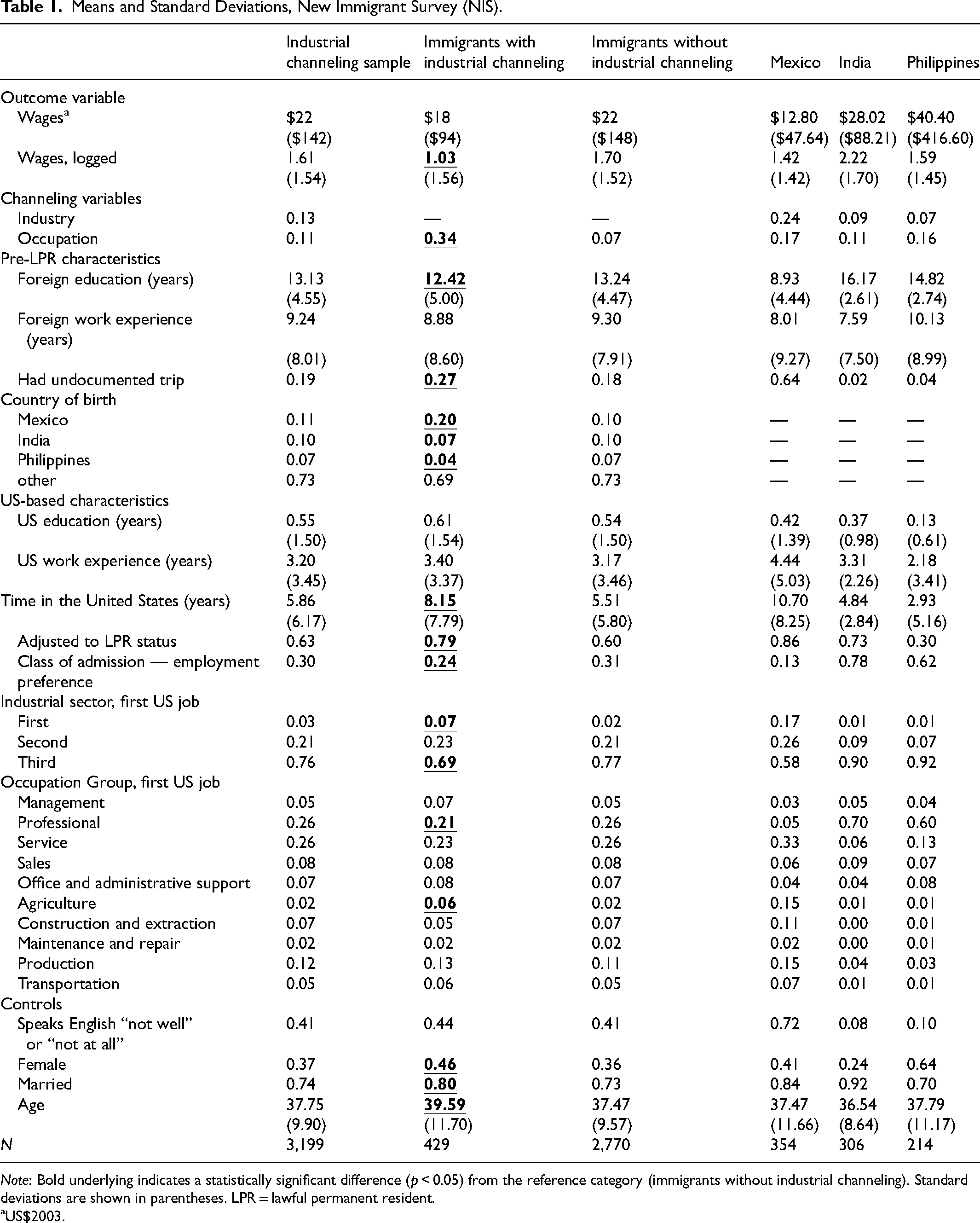
Note: Bold underlying indicates a statistically significant difference (p < 0.05) from the reference category (immigrants without industrial channeling). Standard deviations are shown in parentheses. LPR = lawful permanent resident.
US$2003.
Regression Estimates From Simultaneous Equations for Likelihood of Industrial and Occupational Channeling, NIS.
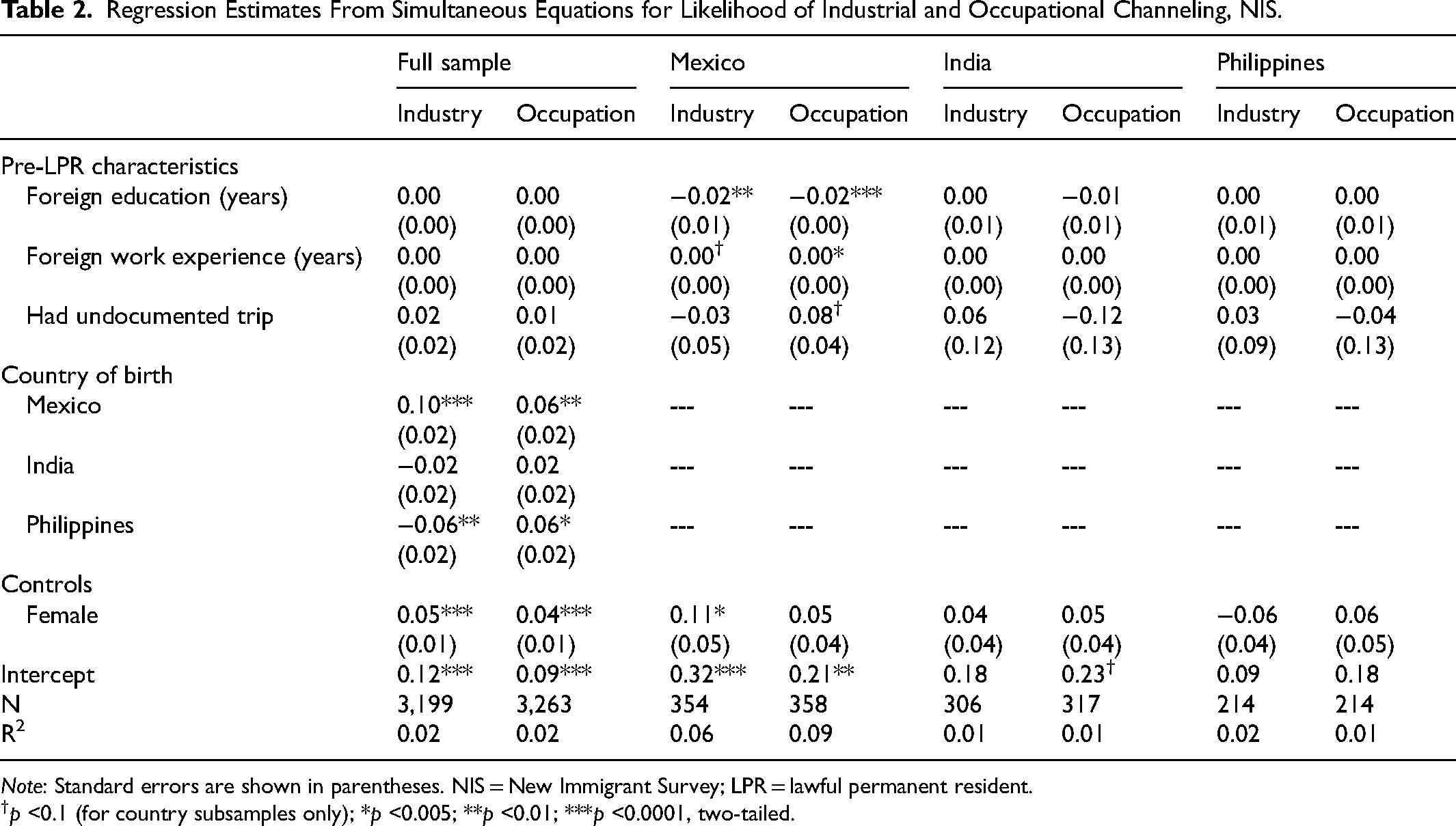
Note: Standard errors are shown in parentheses. NIS = New Immigrant Survey; LPR = lawful permanent resident.
†p <0.1 (for country subsamples only); *p <0.005; **p <0.01; ***p <0.0001, two-tailed.
Regression Estimates from Simultaneous Equations for Channeling and Logged Wages, NIS.
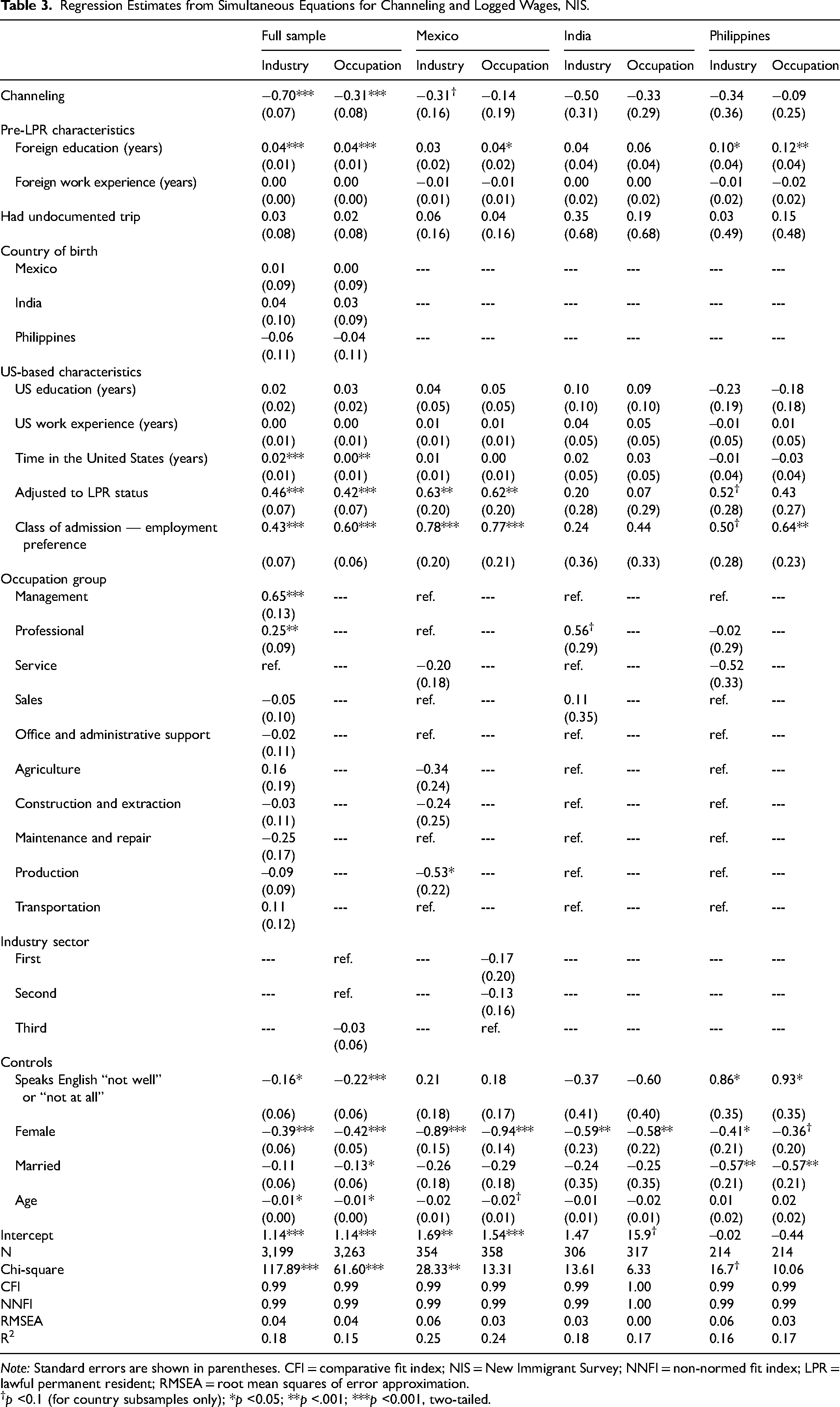
Note: Standard errors are shown in parentheses. CFI = comparative fit index; NIS = New Immigrant Survey; NNFI = non-normed fit index; LPR = lawful permanent resident; RMSEA = root mean squares of error approximation.
†p <0.1 (for country subsamples only); *p <0.05; **p <.001; ***p <0.001, two-tailed.
Results
Descriptive Results
Table 1 presents descriptive statistics for our primary sample, where immigrants have valid responses on both the industry code of their last job prior to migration and their first job after arrival to the United States. Average wages are about $22 with 13 percent of new immigrants working in the same industrial sector before and after migration. Eleven percent of new immigrants experience channeling within their pre-migration occupation group. Among the pre-LPR characteristics, immigrants have, on average, slightly more than 13 years of education and over nine years’ worth of work experience in their home country. Nineteen percent completed an undocumented trip to the United States and approximately equal proportions are from the top three sending nations.
For immigrants’ US-based characteristics, LPR immigrants have, on average, less than a year of US education and have worked slightly more than three years in the United States. Immigrants have spent almost six years in the United States with about two-thirds adjusting to LPR status and approximately a third using the employment class of admission. About three-fourths of the sample worked in the third industrial sector and almost half worked in either a professional or service occupation.
Table 1 also shows descriptive statistics for two subsamples of immigrants: those who experienced industrial channeling and those who did not. T-tests reveal several key differences. First, immigrants with industrial channeling average significantly lower logged wages. Immigrants who are industrially channeled are also more likely to experience occupational channeling. Channeled immigrants have less home country education and a greater percentage have completed an undocumented trip. A statistically significant greater proportion of these immigrants, on average, migrated from Mexico, while fewer channeled immigrants originated from India and the Philippines. Among the US-based characteristics, immigrants with industrial channeling had more time in the United States and, correspondingly, had a higher proportion adjust to LPR status. Interestingly, a lower proportion used the employment class of admission to obtain LPR status. Channeled immigrants, on average, worked in the first and third sectors of the economy.
Regression Results from SiEM
Table 2 contains the results from the first equation in our SiEM, for both industrial and occupational channeling. These analyses assess the factors that shape whether immigrants are channeled or not.
For industrial channeling within the full sample, three variables influence channeling: being born in Mexico and female increases the likelihood of working in the same industrial sector before and after migration while being born in the Philippines reduces the likelihood. A similar pattern is evident for occupational channeling, though there is a positive relationship between being born in the Philippines and working in the same occupational group before and after migration.
Our next analysis in Table 2 focuses on the subsamples of immigrants from the three largest sending nations in the NIS. Similar patterns are again present in the Mexico subsample for both industrial and occupational channeling. Foreign education is negatively associated with channeling, suggesting that more foreign education reduces the likelihood of channeling between Mexico and the United States. Foreign work experience displays the opposite pattern with greater work experience in Mexico being positively associated with both industrial and occupational channeling into the United States. An undocumented trip is positively associated with occupational channeling while female is positively associated with industrial channeling. In contrast to the Mexico subsample, there are no factors that reach statistical significance for the Indian and Filipino/a subsamples, which likely reflects their smaller sample sizes for these country-specific samples.
Table 3 presents the regression results from the second equation, for log wages, in our SiEM for both industrial and occupational channeling. 4 Beginning with an assessment of goodness-of-fit for industrial channeling with the full sample, the metrics indicate that the model fits the data very well. While the chi-square test is significant and a nonsignificant test indicates good fit, this is a strict test of model fit. Both the CFI and NNFI are well above their thresholds of .95 and the RMSEA is below the cut-off for determining good model fit of .05.
Channeling is a statistically significant factor for wages, even when accounting for the variables that predict channeling in the first equation (Table 2). Here, the percent change associated with channeling for wages is a reduction of approximately 50 percent [ = 100*[exp(−0.70)−1]. This provides support for Hypothesis 2. Alongside channeling, immigrants who speak English “not well” or “not at all,” women, and older individuals earn lower wages. Increases in wages are associated with foreign education, US duration, adjusted status, the employment preference, and working in the management or professional occupation groups.
For occupational channeling in the full sample, the model again fits the full sample data very well. The chi-square test is significant, though the other indicators are above and below their respective cut-offs. The pattern of results for wages with occupational channeling is similar to that for industrial channeling. Working in the same occupation group both before and after migration is negatively associated with wages and the percent change is −26.4 percent [ = 100*[exp(−0.31)−1], which again provides support for Hypothesis 2. As for industrial channeling, foreign education, US duration, adjusted status, and the employment preference are positively associated with wages. The control variables of lower English language proficiency, female, married, and age are all negatively associated.
For the county-specific subsamples, both industrial and occupational channeling is consistently negative with the channeling coefficient significant at the .1-level for industrial channeling with the Mexico subsample. Given the consistently negative effect of channeling and the small country subsamples (only one-quarter of the Mexico subsample is channeled and it is less than 10 percent for the India and Philippines subsamples), we use a .1 level of statistical significance. Overall, these findings provide some support for Hypothesis 2.
Within the Mexican subsample, the goodness-of-fit statistics indicate good fit for industrial channeling and excellent fit for occupational channeling. There is largely consistency in the results for the Mexican subsample, whether focused on industrial or occupational channeling. Adjustment to LPR status and the employment preference class of admission are both positively associated with wages while female is negatively associated.
The results for the Indian subsample are interesting as gender is the only factor that affects wages and the goodness-of-fit statistics are strong. For the Filipino/a subsample, foreign education, adjusted status, the employment preference, and controls affect wages. 5 The fit statistics for the Philippines subsample are also strong.
Discussion
This study contributes to a developing line of research that interrogates how immigrants’ employment continuity affects their transitions into destination labor markets and their financial well-being after arrival. Using NIS data, we assessed the effects of industrial and occupational channeling on wages for LPRs. This is an important group to study as LPR immigrants currently constitute approximately 13.1 million of the almost 45 million immigrants living in the United States (Baker 2022; Budiman et al. 2020). Importantly, LPR status opens a number of new opportunities. These include the ability to work and own property, receive financial assistance for higher education, serve in the Armed Forces, sponsor migration for certain family members, and naturalize (Department of Homeland Security 2020). And, notably, the NIS is the only dataset that permits analysis of such a large group of LPR immigrants (Akresh and Frank 2018).
Our study made two contributions. First, we expanded the channeling literature's focus to include Asian Indian and Filipino/a immigrants, two of the top three sending countries for LPR immigrants to the United States in 2003 and countries that remain among the six largest sending countries today. Further, these three countries provided contrasting cases to more comprehensively test hypotheses about immigrant channeling compared to previous studies. In contrast to immigrants from Mexico, which were the focus of earlier research, Asian Indian and Filipino/a immigrants are more likely to be highly educated and trained to work in highly skilled occupations. Based on prior literature, we expected that channeled immigrants would be associated with a wage premium (Hypothesis 1) and that, reflective of the differences in the immigration stream, Asian Indian and Filipino/a immigrants would enjoy a larger premium (Hypothesis 1a). At the same time, we offered an alternative hypothesis that channeling within broad industrial sectors could economically “trap” immigrants and would be associated with lower wages (Hypothesis 2). As a further contribution, we developed models that tested for observed selection factors for channeling, and we were able to parse selection effects from the hypothesized relationship between channeling and wages.
Counter to our expectations (and Hypotheses 1 and 1a) from the nascent literature on channeling, employment continuity was negatively associated with wages. And this pattern was remarkably consistent, whether channeling was measured within broad industrial sectors or occupational groups, as well as across three countries. Indeed, among the three countries in this analysis, the evidence clearly indicated that channeling was negatively associated with wages, with the coefficient for immigrants from Mexico approaching conventional thresholds for determining statistical significance.
For Mexican immigrants, these results were particularly interesting given results from prior research, which identified an income advantage for Mexican immigrants who were channeled within a specific industry (Painter and Sanderson 2017). Immigrants who were able to continue to work within a particular industry in the United States after migration likely benefited from a combination of their specialized human capital, their social networks, and larger economic forces. Indeed, both Hagan et al. (2011, 2015) and Hernandez-Leon's (2004) studies suggest this as an outcome of channeling. Mexican immigrants with particular skillsets — construction (Hagan 2011, 2015) and oil refinery (Hernandez-Leon 2004) — were able to use their social networks to identify opportunities to continue work within their particular industry and trade after migration. In this way, these immigrants may be the exception to the rule: the portability of their specialized human capital — and the financial premium associated with it — was possible because of their social networks and the information about US employment opportunities it contained. It follows, then, that if Asian Indian and Filipino/a immigrants were also using social networks and US-specific employment knowledge to transfer their specialized human capital within specific industries, they too would be likely to have a financial premium associated with the channeling of their employment. Supporting this perspective are the counterfactual models from Lessem and Sanders (2020), which demonstrated a wage premium for LPR immigrants who were channeled within specific occupations. Future research should pursue this hypothesis for Asian Indian and Filipino/a immigrants.
In contrast to previous research on channeling, the results of this study suggest that specialized human capital associated with broad industrial sectors and occupation groups — likely in the absence of such readymade work opportunities in the United States — is detrimental to Mexican immigrants’ economic status as well as Asian Indian and Filipino/a immigrants’ economic well-being. The knowledge, skills, and abilities acquired from work within a particular industrial sector (for example, utilities, manufacturing, and construction industries within the second sector) or occupational group appear to limit immigrants’ capacities to increase their earning power by switching to different work after the migration. Immigrants who are able to switch industrial sectors or occupational groups with migration may possess more general forms of human capital; that is, they may have skills and abilities that are more widely valued and/or can be transferred between broad sectors, and, subsequently, can easily be used within a new sector. These immigrants are able to use their move to the United States as a lateral — or even upwardly mobile — step, which would greatly improve their economic integration into US society. In this way, these immigrants’ integration trajectories may more closely resemble the “shallow” U-shape posited by Chiswick et al. (2005).
Alongside the contributions of this study, we note again that the NIS is a sample of migrants who have attained lawful permanent residency in 2003 Though the NIS is the only dataset that we are aware of that allows for a broader and more inclusive analysis of channeling among new immigrants, the data were collected during a time period when economic conditions, immigrant sentiment, political rhetoric, etc., were different than today. It falls to future research to collect data that allow for continued analysis of channeling so that we can better understand how channeling has changed over time. Also, LPR immigrants are a sizeable and important group within the US society and yet it is not representative of all migrants living in the United States. Relatedly, although we were able to model channeling for more sending countries than prior studies, our findings remains confined to these three sending countries. In 2003, when the NIS data were collected, these countries represented the top three sending nations and approximately 35 percent of all LPRs (Rytina 2005). More recently, Mexico remains the top sending nation and both India and the Philippines are still in the top six among all LPR immigrants (Baker 2022; Witsman 2018). Future research would benefit from data that allow for the connection of pre- and post-migration employment experiences across a wider array of countries and for a broader sample of immigrants.
One of the policy implications of our study is that there is a need for multifaceted policy approaches. Clearly, US immigration policy making efforts could be more effectively designed to assist immigrants in transitioning their pre-migration human capital into the US labor market. The data we compiled suggests that, to a significant degree, pre-migration work experience and educational attainment does not often translate easily in the US labor market for channeled immigrants. Yet, policies designed to maximize immigrants’ abilities to translate their generalized human capital into the US labor market would also allow for movement into a different industrial sector — where they could attain higher wages and income — compared to their counterparts who remain within their pre-migration industrial sector and/or occupation group. Because host countries are increasingly dependent on the labor of foreign-born populations as new taxpayers, rapid socioeconomic integration would likely have benefits for sustaining costly welfare programs (i.e., social security) (e.g., Auerbach and Oreopoulos 2000). At the same time, care is needed to ensure that immigrants, as a group, would benefit from such policies while avoiding further inequities. For example, policies could not only ensure a better match between immigrants’ pre- and post-migration occupations, but also provide the ability to upgrade their skills as quickly as possible without disproportionately benefitting higher-skilled immigrants (Lessem and Sanders 2020).
Footnotes
Declaration of Conflicting Interests
The author(s) declared no potential conflicts of interest with respect to the research, authorship, and/or publication of this article.
Funding
The author(s) received no financial support for the research, authorship, and/or publication of this article.
