




Abstract
This article analyzes the role of ideas, domestic actors, and international influences in migration policy change (MPCh) in Argentina, Brazil, and Chile. Building on 67 in-depth interviews with key actors in migration governance, public declarations of government representatives, and relevant legislation, we argue that the increased power of “securitist” actors within national bureaucracies shaped MPCh in all three countries. Between 2015 and 2019, these actors promoted a set of programmatic ideas and policy proposals that linked migration to security issues and distinguished between “good” and “bad” immigrants, emulating Global North countries. This set of ideas resulted in policy change at the country level, but at the same time, national-level policy change coexisted with continuity at the regional level. This article contributes to the literature on migration governance, first, by extending the geographical focus of migration policy studies, which frequently focus on party politics, coalitions, and public opinion, beyond the Global North. Second, we further current explanations of MPCh and policy contradictions by differentiating between continuity and change in programmatic ideas, policy proposals, and public philosophies. Third, we advance the regional migration policy literature by distinguishing between different groups of actors within national bureaucracies and enhancing understanding of these actors’ roles at both the national and international levels. Across its sections, this article shows that policy ideas—where and from whom they come—matter. By unpacking the different types of ideas that influence policy shifts and the actors who promote them, we can better understand apparent contradictions in migration policy.
Introduction
In the context of South America, scholars have labeled both individual countries’ immigration policies and the region's migration regime as “liberal” (Cantor, Freier, and Gauci 2015) and “progressive” (Acosta 2018) and ranked the latter as one of the most developed worldwide, after the European Union's (EU) free movement regime (Geddes et al. 2019; Lavenex 2019). However, scholars have also noted the continued existence in the region of a national security paradigm, which coexists with the “liberal/progressive” migration regime (Domenech 2007; Menjívar 2014). This coexistence of a national security paradigm and a liberal/progressive migration regime results in the implementation of migration policies and laws that juxtapose control-focused and rights-based approaches (e.g., Margheritis 2013; Acosta 2018; Finn and Umpierrez de Reguero 2020). Who are the actors promoting these apparently contradictory policies? When and how do these contradictions arise? A restrictive policy shift within South America's policy liberalization in the last two decades offers a unique opportunity to study the determinants of migration policy change (MPCh) and to understand the apparent contradictions in migration policy in the Global South. In this article, we study restrictive policy shifts, and the actors, ideas, and international influences that inspired them, in three South American countries, selected as extreme cases: Argentina, Brazil, and Chile.
Throughout the 2000s, most South American countries adopted liberal and progressive national policies and discourses centered on expanding individuals’ access to social rights (Freier 2015, 119) 1 and the importance of migrants’ human rights, regularization efforts, and the need to de-criminalize migration (Acosta 2018; Brumat 2020). At a regional level, multilateral organizations, such as the Southern Common Market (Mercosur), 2 the Andean Community (CAN), 3 and the South American Conference on Migration (SACM), 4 created a facilitated mobility and residence regime for intra-regional migrants (Acosta 2018). The Residence Agreement of Mercosur (RAM) 5 provided a regional right of residence with a simplified procedure for the regularization of regional migrants (Jubilut, Vera Espinoza, and Mezzanotti 2021). Both Mercosur and CAN created mechanisms for facilitated border crossings within member-states’ borders (Brumat 2020), and the SACM declared the right to migrate and to free movement for all persons in the world (Acosta 2018). Moreover, South America has become an important actor in migration-related international fora, contesting some of the increasingly restrictive stances on migration governance held by Global-North countries (Brumat and Freier 2021). For example, during negotiations for the Global Compact for Migration (GCM) in 2017, 6 South American countries called for global recognition of the right to migrate, universal migrants’ rights, and migrant regularization, instead of expulsions, as solutions to irregularity (SACM 2017).
Ranking among the top migrant-receiving countries in South America, 7 Argentina, Brazil, and Chile played key roles in developing the “liberal/progressive” regional migration policies in the early-twenty-first century (Acosta 2018; Brumat, Vera Espinoza, and Acosta 2018). In the early 2000s, these countries spearheaded a common position on migration issues at the regional and global level (Geddes et al. 2019). For example, in regional negotiations within Mercosur, Brazil not only supported Argentina's migration-related initiatives but also presented various proposals to facilitate intra-regional border crossings and deepen Mercosur's free movement agenda (see Brumat 2020). As part of the meetings of the Cartagena Declaration review process, Brazil also led regional efforts on forced migration (Jubilut, Andrade, and Marques Gilberto 2016), including the implementation of the solidarity resettlement program (Vera Espinoza 2018) and the hosting of the 2014 meeting that led to the adoption of the Brazil Declaration and Plan of Action (Jubilut, Vera Espinoza and Mezzanotti 2021). Chile had an influential role in the 2004 Santiago Declaration on Migratory Principles, which set the basis for South America's current mobility regime (Brumat 2020). Chile also actively participated in the SACM's creation (a Regional Consultative Process, RCP), hosting key events like the regional meeting where the common Latin American position for the GCM was adopted (interview with officials of the Ministry of Foreign Affairs of Chile, June 2016 and August 2017).
Between 2015 and 2019, Argentina, Brazil, and Chile, however, adopted increasingly restrictive national immigration legislation and discourses that seemingly challenged, but did not directly contest, the liberal/progressive regional migration policies in place (Brumat, Vera Espinoza, and Acosta 2018). 8 For example, the RAM, the SACM declarations, and the facilitated mechanisms for border crossings were not altered at the regional level (Brumat, Vera Espinoza, and Acosta 2018; Brumat 2021), but restrictive policy shifts occurred at the domestic and international level, feeding the juxtaposition between human rights-based and control-focused approaches.
At the domestic level, the three countries adopted more restrictive immigration legislation between 2015 and 2019. In 2017, Argentina adopted an Executive Decree that eased the expulsion of irregular immigrants (Courtis and Penchaszadeh 2019). That same year, Brazil's then-President Michel Temer vetoed some of the most progressive articles of the new national migration law (Vedovato and Assis 2018). In 2018, Sebastián Piñera's Chilean government announced a restrictive migration reform that expedited the process of adopting the new immigration law (Thayer 2019), which was finally enacted in 2021 (Doña Reveco 2021). At the international level, both Brazil and Chile decided to leave the GCM after having actively participated in the negotiation rounds and in the adoption of a common South American position (Brumat 2019). Argentina, on the other hand, did not leave the agreement (García 2019) because, in contrast to Brazil and Chile, its public philosophy of being a “country of immigration” prevailed in the decision-making process, partially explaining the persistence of certain elements of the “liberal/progressive” migration regime in South America. Against this scenario of policy shifts, this article explores the role of domestic dynamics and international influences in MPCh in Argentina, Brazil, and Chile by using a mixed-methods approach that combines elements of process-tracing and discourse analysis (Acosta and Freier 2015).
Our analysis differentiates between three main types of policy ideas: (1) programmatic ideas; (2) policy proposals; and (3) public philosophies. The first type—programmatic ideas—defines problems, while the second—policy proposals—encompasses suggestions and recommended solutions to a problem (Schmidt 2011, 2008). Both programmatic ideas and policy proposals are generally technical because they diagnose problems and potential solutions—tasks usually performed by specialized officials within national bureaucracies (Schmidt 2011, 2008). They can also be subject to frequent modifications, as bureaucrats’ perceptions of problems and solutions can change or because the power structure within a national bureaucracy changes, with some groups of actors being more influential than others. The third type of policy idea—public philosophies—involves fundamental and “unquestioned” sets of ideas and frames through which people see the world and which are generally stable because they are sustained throughout time and by a wide range of actors (Schmidt 2011, 2008). For this reason, public philosophies “underline” most programs, policy ideas, and policy proposals in any one area and organize ideas, values, and principles of knowledge that “underpin” policymakers’ visions of the world (Schmidt 2011, 2008).
We argue that policy ideas—where and from whom they come—matter. As this article shows, restrictive policy shifts in South America were driven by the increased power of securitist groups within national bureaucracies (domestic actors), whose policy ideas were heavily influenced by Global-North countries, particularly the United States (international influence). Between 2015 and 2019, these securitist groups promoted a set of programmatic ideas and policy proposals that linked migration to security issues and that distinguished between “good” and “bad” immigrants, emulating Global-North countries in an attempt to reinforce relations with “the West.” Alongside these restrictive immigration measures and discourses, we show that apparent contradictions between restrictive and progressive policies are partly explained by the persistence, albeit at different degrees, of relatively stable liberal public philosophies rooted in Argentina, Brazil, and Chile's national history and imaginaries as “countries of immigration” (see Cantor, Freier, and Gauci 2015; Acosta 2018). More specifically, Argentina's public philosophy of being “open to immigration” suggests a more liberal approach to migration governance than Brazil's or Chile's. While the latter countries sought to promote migrants’ rights, their public philosophies pointed to openness specifically toward controlled migration. This openness toward controlled migration gave them more flexibility to endorse or reject, international agreements that promoted more progressive migration policies.
This article makes four theoretical and empirical contributions to the literature on migration governance and public policy. First, we extend the geographical scope of extant studies, which mostly focus on party politics, coalitions, and public opinion, beyond the Global North (Natter 2021a). Going beyond mainstream studies that focus on the Global North is relevant because by shedding light on the policymaking dynamics in “limited” democracies (Gardini 2010), we expand studies on the various influences in migration policymaking. Second, we go beyond existing explanations of MPCh in South America, which mostly attribute increasingly restrictive policies to executives’ right-wing orientations (e.g., Zapata and Fazito 2018; Courtis and Penchaszadeh 2019). In doing so, we open up the “black box” of the state by not studying states as unitary actors with harmonious interests (Axelsson et al. 2021; Geddes 2021) and, instead, explore the role of influential actors’ policy ideas within national bureaucracies. Third, our differentiation between types of policy ideas that change (programmatic ideas) and persist (public philosophies) helps explain apparent contradictions in policy, like the coexistence of restrictive and human-rights approaches (Brumat 2021), and expands the pioneering literature on the ambiguities of migration policies in Global-South countries (Natter 2021b) by adding the ideational dimension of policymaking and policy change. Fourth, by showing how securitist actors emulated Global-North countries’ legislation and discourses, we expand emerging studies on the international dimension of migration policies (e.g., Adamson and Tsourapas 2019; Norman 2020) and the “unintended” role of external political units in migration policymaking in the Global South (e.g., Brumat and Freier 2021).
To develop these ideas, this article is divided into four sections. The first discusses theoretical approaches to migration policy change (MPCh) and proposes an alternative explanation for MPCh in South America. We, then address the methodology and data that informed our analysis. The third section turns to our empirical analysis of the three country cases: Argentina, Brazil, and Chile. We conclude by summarizing our findings and proposing future lines of research.
Migration Policy Change
While the literature on migration policy-making is vast (Freeman 1995; Breunig and Luedtke 2008; Abou-Chadi 2016; Geddes 2021), the same cannot be said for theoretical and empirical studies on the causes of MPCh. Most existing explanations of MPCh can be found in the interdisciplinary literature on migration policy-making (e.g., Meyers 2000; Freeman and Kessler 2008). Czaika and Haas (2013) and Rosenblum and Cornelius (2012) show that migration policies have two main dimensions: domestic and international. The former comprises “the rules (i.e., laws, regulations, and measures) that states define and implement with the (often only implicitly stated) objective of affecting the volume, origin, direction, and internal composition of immigration flows” (Czaika and Haas 2013, 489). The latter is materialized in actions exercised by national governments in the international arena, such as declarations in regional and international fora (Rosenblum and Cornelius 2012). Broadly speaking, MPCh takes place when one or more policy instruments (laws, regulations, and measures) in the domestic dimension, or actions in the international dimension, vary.
The literature studying specific cases of MPCh has typically centered on Global-North countries, particularly in Europe and North America (e.g., Martín-Pérez and Moreno-Fuentes 2012; Kolb 2017; Laubenthal 2017; Caponio and Jones-Correa 2018). This literature frequently includes state-centered, interest group, and institutional approaches (e.g., Freeman 1995; Massey 1999; Abou-Chadi 2016), all of which see policies as a result of domestic pressures and interactions by diverse interest groups, party politics, state institutions, and public opinion (Freeman 1995; Joppke 1998; Breunig and Luedtke 2008; Hollifield, Martin and Orrenius 2014; Abou-Chadi 2016). This narrow geographical focus limits the explanatory power of existing theoretical explanations of MPCh, which are consequently centered on party politics, coalitions, the influence of public opinion, and migration flows (Laubenthal 2017; Giugni and Grasso 2021). Global-South countries, however, often have different political dynamics (Sadiq and Tsourapas 2021; Natter 2021a, 2021b) and are more subject to the influence of external political units (Acharya and Johnston 2007; Adamson and Tsourapas 2019). Structural approaches to MPCh provide some insights into the influence of external factors like security concerns (Adamson 2006; Hollifield 2012), international human rights norms (Hollifield 2012), and global economic trends (Massey 1999), as well as the influence of macro changes like social transformation and population dynamics (Castles, Haas, and Miller 2014; Hollifield, Martin, and Orrenius 2014). The literature on structural explanations, however, rarely studies external actors’ “unintended” influence on domestic policy decisions, even if these dynamics are more evident in Global-South countries (Brumat and Freier 2021). Thus, by looking at the indirect influence of Global-North policy ideas on three Global-South countries, we broaden the study of structural approaches to migration policymaking and MPCh.
In recent years, there has been increasing scholarly interest in the direct (Adamson and Tsourapas 2019; Norman 2020) and “unintended” (Brumat and Freier 2021) influence of external political units in migration policymaking and policy change in the Global South. As these studies show, decision-makers in Global-South countries can learn from, emulate, or oppose Global-North migration policies, with powerful impacts on the openness or restrictiveness of their migration governance (Adamson and Tsourapas 2019; Norman 2020; Brumat and Freier 2021). In Latin America, domestic, foreign, and regional politics are very much influenced by the role of informal norms and institutions that reflect certain power relations within bureaucracies and by a relative lack of autonomy vis-à-vis international actors (Franceschet and Díez 2012). As a result, the role of party politics, coalitions, and public opinion is less relevant in Latin America than in the Global North (Riggirozzi and Tussie 2012; Mazzuca and Munck 2020; Natter 2021).
In recent years, there has been a growing body of literature on MPCh in South America, and this work typically examines single policies in one country, including Argentina (Penchaszadeh and García 2018; Courtis and Penchaszadeh 2019; Odriozola 2019), Brazil (Zapata and Fazito 2018; Vedovato and Assis 2018; Marques de Oliveira and Sampaio 2020), and Chile (Concha Villanueva 2018; Doña Reveco 2021). This literature mostly consists of legal analyses that emphasize normative concerns and attribute MPCh to the right-wing orientation of new governments in Argentina, Brazil, and Chile (e.g., Penchaszadeh and García 2018; Zapata and Fazito 2018; Doña Reveco 2018; Courtis and Penchaszadeh 2019; Odriozola 2019). To date, it has not explored the common patterns and explanations of MPCh in these countries.
The literature on South American migration governance has also acknowledged the coexistence of both control-focused and human rights-based immigration policies and discourses in the region (e.g., Margheritis 2013; Acosta and Freier 2015; Acosta 2018; Finn and Umpierrez de Reguero 2020), with scholars maintaining that these contradictory policy-making practices are the result of diverse actors with conflicting interests within national bureaucracies (Acosta 2018; Domenech 2018; Brumat, Vera Espinoza, and Acosta 2018). For example, policymaking in South America is distinctive because bargaining processes take place in limited democracies, where institutional structures privilege certain actors (i.e., executive power and the military) over others and where public opinion often plays a limited role in influencing governments’ decisions (Gardini 2010). While certain actors can place their demands on states’ agendas (Hoffmann 2019, 33), leading to tensions and contradictions, scant studies have attempted to explain who comprises these so-called diverse actors and when and how these contradictions arise.
To begin to address this lacuna, we apply an institutional framework to MPCh and draw on the literature on South American regional and national governance, which posits that collective actors within bureaucracies play crucial roles in migration policymaking (Riggirozzi 2015; Agostinis 2019; Hoffmann 2019). More specifically, Carstensen and Schmidt (2016) argue that collective actors “think, speak and act collectively to (re)construct the structures by which they may be constrained or appear to be determined” and that by thinking, speaking and acting collectively, groups of actors can exert influence over domestic policymaking “through the use of ideational elements” (320).
In South America, there is a group of actors, whom we call “securitist,” who mostly consist of bureaucrats within their countries’ Ministries of Interior, Security and Defence (see also Brumat forthcoming). These groups are part of a power structure with historical roots in the region and actively influence restrictive policy-making practices (Pérez 2017). Their privileged positions can be traced back to the military's role in forming South American states (Rouquié 1984). Relatedly, Acosta (2018) argues that restrictive and exclusionary migration policies in South America date back to the late-nineteenth century and set the stage for the exclusionary migration policies adopted by dictatorial regimes in the 1970s and 1980s (Acosta 2018). Building from the three types of policy ideas proposed above (Schmidt 2008, 2011), we suggest that members of securitist groups have distinctive programmatic ideas that frequently link migration and security issues. These actors identify problems in the migration agenda and consequently propose policy solutions that, as we show in this article, emulate the ones adopted by Global-North countries. By framing their proposals in terms of domestic interests (e.g., increased security) and international practices, they legitimize their power position (Brumat forthcoming).
Methodology and Data
To find common patterns of MPCh in the region, we examined key policy decisions in Argentina, Brazil, and Chile at both the domestic and international levels between 2015 and 2019. The rationale behind this selection is two-fold. First, during this time period, all three countries made decisions that substantially modified their national migration legislation (Brumat, Vera Espinoza, and Acosta 2018). Second, two out of the three countries modified their position on a relevant multilateral agreement on migration, shifting an international aspect of their migration policy. In late 2018 and early 2019, the GCM was approved, with Argentina choosing to remain in the agreement and Brazil and Chile opting out.
Regarding key policy decisions, we adopted Kay and Baker's (2015) approach to policy analysis, following certain epistemological and methodological elements of process-tracing analysis to (1) empirically identify and describe key parts of the sequence of policy events being studied (the adoption of new legislation and the decision to stay or leave the GCM) and (2) identify the common mechanisms that shape the conditions under which these events took place. Following Beach and Pedersen (2019), we further unpacked the decision-making process and the policy outcome (policy change toward more restrictiveness) separately within each country to identify when and how the coexistence between openness and restrictiveness emerged. We combined this approach with discourse analysis to inductively identify the common programmatic ideas in the legislation and the discourses that had an effect on policy change (Zittoun 2009).
Overall, both types of analyses are based on four types of sources that allow us to better observe the “empirical fingerprints” left by each actor in each step of the policy change process (Beach and Pedersen 2019, 38). First, we analyzed 67 semi-structured interviews 9 with key government and non-government actors within the framework of the Prospects for International Migration Governance (MIGPROSP) project. 10 As part of the MIGPROSP project, we did two rounds of interviews: one in 2015, when left-wing political parties were governing the three countries, and the second in 2017, when right-wing governments were in office in Argentina and Brazil. For interviews, we selected key government actors working, in both political and technical roles, in the main ministries involved in migration policymaking: the Ministries of Interior (Ministry of Justice, in the case of Brazil), Foreign Affairs, and Labour. To crosscheck governmental actors’ claims, we also interviewed representatives of international organizations (the International Organization for Migration [IOM]; the United Nations High Commissioner for Refugees; the International Labour Organization [ILO]) and of the main civil society organizations (CSOs) that deal with migration in Argentina, Brazil, and Chile.
During interviews, we asked participants about their professional backgrounds, their understanding of policy problems and solutions, their reasons for adopting specific legislation, which varied between countries and interview rounds, and their interactions with other national actors in the area of migration. We, then, analyzed interview transcripts, using the ATLAS.ti 7 data analysis software. In our coding, we inductively identified the prevailing programmatic ideas and policy proposals that led to MPCh in the three countries.
As a second main data source, we selected public declarations by government officials in Argentina, Brazil, and Chile between 2015 and 2019. We chose declarations in which politicians and policymakers explained their reasons for adopting the three pieces of legislation under study (Decree 70/2017 in Argentina, the Presidential vetoes to Law 13445 in Brazil, and Decree-Law No. 1094 of 1975/Law 21325 of 2021 in Chile) and for leaving or staying in the GCM. These declarations came from local newspapers, media interviews, and National Ministers’ Twitter accounts. Third, we reviewed the national legislation and policies that were subject to change in Argentina, Brazil, and Chile. Fourth, and finally, we briefly discuss the reference to migration made in each country's National Constitutions, which are the main legislative guidelines in each country and which help uncover public philosophies on migration.
Understanding MPCh in Argentina, Brazil, and Chile (2015–2019)
Between 2000 and 2015, migration governance appeared in South American migration agendas as something that was inherently positive and that had the potential to contribute to all receiving societies (Brumat forthcoming). National and regional policy proposals, thus, focused on the promotion and protection of migrants’ human rights (Geddes and Vera Espinoza 2018). However, between 2015 and 2019, securitist groups increased their power within national bureaucracies, predominantly under right-wing presidencies (Diamint 2018), and shaped MPCh in Argentina, Brazil, and Chile.
As the analysis shows, these securitist groups successfully promoted a set of programmatic ideas and policy proposals (Schmidt 2011, 2008) that linked migration to security issues and that distinguished between “good” and “bad” immigrants, emulating countries of the Global North, specifically the United States, in an attempt to reinforce relations with “the West” (see Figure 1). Despite these restrictive immigration measures and discourses, our results also point to the persistence of a relatively stable liberal public philosophy (Cantor, Freier, and Gauci 2015) in Argentina, which was rooted in the country's national history of being “open to immigration,” and a less open, more unstable public philosophy in Brazil and Chile that emphasized control while sustaining migrants’ rights. The next section provides empirical evidence of the coexistence of restrictive elements in the programmatic ideas and policy proposals that inspired MPCh in Argentina, Brazil, and Chile between 2015 and 2019 and liberal/progressive ideas in these countries’ public philosophies.
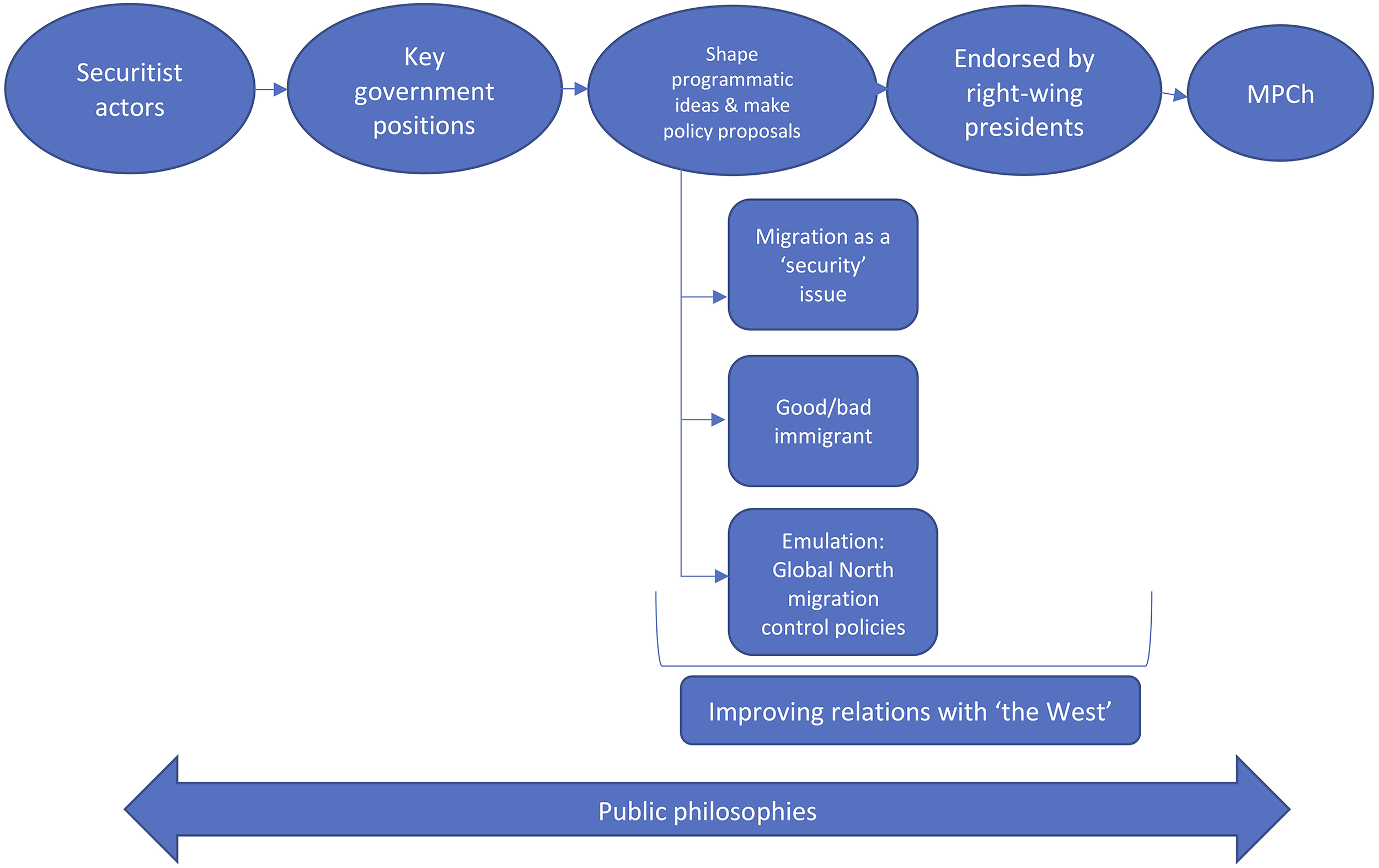
Migration policy change process in Argentina, Brazil and Chile (2015–2019). Source: Authors’ own elaboration.
Argentina
Argentina inaugurated a “liberal/progressive” approach to migration governance in 2004 when it became the first South American country to adopt a human rights-based migration law and broke with the dictatorial era's restrictiveness (Acosta 2018). Law 25,871 was the world's first national migration law to include the “right to migrate” among other basic human rights for migrants (Hines 2010). Argentina was also the first country to change its migration policy during the study period. In January 2017, however, the Argentine government decided to amend the 2004 Law via an Executive Decree (Decree 70/2017), which was adopted under an urgent procedure, and, thus, avoided any involvement from the National Congress or non-governmental actors in its drafting (Penchaszadeh and García 2018). Among other restrictive measures, the 2004 decree extended migrants’ detention times, facilitated the expulsion of irregular immigrants, and obstructed the process of obtaining permanent residence permits (see Penchaszadeh and García 2018).
As stated in the 2017 Decree's preamble, the new migration norm was justified on the grounds of fighting organized crime, particularly drug trafficking, and the supposed difficulty of expelling foreign-born criminals under the 2004 legal framework (Poder Ejecutivo Nacional 2017). The Decree added that immigrants comprised a significant proportion of the prison population (Poder Ejecutivo Nacional 2017). While CSOs, the media, and scholars denounced the use of false data in the Argentine government's official statements (Penchaszadeh and García 2018), these complaints were supported by Argentine courts (Judicial Power of the Argentine Nation 2017). 11
The reasons for the adoption of Decree 70/2017 by the center-right government led by Mauricio Macri are intertwined with the enhanced role of two key securitist actors in migration issues: the Argentine Ministry of Security
12
and the National Migration Directorate (DNM, for its Spanish acronym). The DNM's securitist character was reinforced by the Macri government, which appointed a new DNM Director whose professional career developed in the area of national security.
13
Leading officials in the Ministry of Security even linked specific nationalities (e.g., Bolivians, Paraguayans, and Peruvians) with drug trafficking (Dos Líneas 2017) to justify enhanced security measures and harsher border-control measures (Jastreblansky 2018). In our second phase of fieldwork, we identified an emerging programmatic idea within the DNM that distinguished between “good” and “bad” migrants and defined the latter as part of a security problem: I think that what we are currently doing in Argentina is mixing up the people of good will, who come to the country to work, with people that come with twisted interests (Official, DNM, July 2017).
This programmatic idea distinguishing between “good” and “bad” migrants was very similar to that of former US President Donald Trump, whose discourses and policies not only differentiated between immigrants and the white American majority (Shertzer and Woods 2020) but also contrasted “good” and “bad” immigrants, for instance, when he signed Executive Order 13769 in 2017, which banned the entrance of persons from seven Muslim-majority countries (de Morais and Ferreira 2021). The so-called “Muslim ban” implicitly suggested that people from some Muslim-majority countries were a threat to national security while people from other Muslim-majority countries were not (Chacon 2017). This political and discursive differentiation between “good” and “bad” migrants is part of a broader US trend that gained force in the early 2000s and framed immigrants in binary terms as either “good” or “bad” (Andrews 2018). These framings were used to justify Trump's restrictive immigration policy decisions (Alamillo, Haynes, and Madrid 2019). According to Argentine securitist actors, the “right” policy solutions to the “bad migrant” problem were the ones adopted by some Global-North countries: Had we had a true control, all individuals having entered into the country would be good people because the rest would have, of course, been denied entry. This is what countries in the world do….The New Zealanders, Canadians, Australians are not different (from us). They have a system (Official, DNM, July 2017).
This admiration and emulation of Global-North countries’ restrictive immigration policies responded to the Macri administration's foreign policy orientation, which was based on the premise that Argentina needed to be “reinserted” into the world (Listrani Blanco and Zaccato 2018). According to this logic, Argentina had been isolated from the Global North in previous years (Listrani Blanco and Zaccato 2018). Thus, the government designed a “concentric circles” strategy that included countries and regions that it intended to keep “close.” According to this strategy, the first circle was South America, followed by Europe and the United States (Sanahuja and Comini 2018). To be “closer” to the latter two, however, Argentina prioritized cooperation in the area of security, drug trafficking, and terrorism (Listrani Blanco and Zaccato 2018). It also tended to agree with US positions in multilateral fora (Listrani Blanco and Zaccato 2018).
Unlike Brazil and Chile, however, Argentina did not leave the GCM. When the Director of the DNM explained the decision to stay in the GCM, he explicitly said that in Argentina, “(we) were, are and will be a land of immigrants” (García 2019), thus evoking Argentina's public philosophy as a “land of immigration,” enshrined in the Preamble of its National Constitution, which enumerates a set of benefits and freedom “for all the men of the world who wish to dwell on Argentine soil” (Argentine Republic 1994). Argentina's self-identification as being “open to immigration” was widely shared by policy-making actors, including securitist actors, as shown in interviews with representatives of the Ministries of Security, Foreign Affairs, Labour, and Justice (Interviews in Buenos Aires, December 2015, May and July 2017). As an official from the Macri administration pointed out, “we are a country of migrants … Argentina has always been an open country. In Argentina nobody cares where people come from, but what they do in this country. If they mean well, our doors are open” (interview, July 2017). Since Argentina ratified all core UN human rights treaties and included them in its National Constitution (Argentina.gob.ar 2017), leaving the GCM would have broken with a long-standing foreign policy tradition of promoting international law (del Pilar Bueno 2014) in which the country's public philosophy of being “open to immigration” played a key role.
Brazil
Brazil's Migration Law (13445/2017) was approved in April 2017 by an overwhelming majority in Parliament (Marques de Oliveira and Sampaio 2020). Similar to its Argentine counterpart, Brazil's 2017 Migration Law replaced the 1980 Foreigner's Statute adopted by the military government, which was widely considered a restrictive norm based on the principle of national security (Ribeiro de Oliveira 2017). The new law was put together through a participatory process with a wide range of ministries, scholars, and CSOs (Marques de Oliveira and Sampaio 2020). Highlights included the non-criminalization of migration, changes to the regularization process, the inclusion of migrants’ rights in relation to citizenship and political participation, and the consolidation of ad-hoc measures, such as humanitarian visas (Presidência da República 2017). However, a month after the new law's approval, then center-right president Temer vetoed 20 of its most progressive points (Vedovato and Assis 2018). On November 20, 2017, the Brazilian government officially published Decree 9199 regulating the law's implementation. Some analysts have argued that the law's final version shifted the focus from “migrant rights back to dictatorship-era national security concerns’ (Wejsa and Lesser 2018).
Our second phase of fieldwork coincided with discussions surrounding the new law's implementation; thus, interviews offer insights into the political dynamics shaping Brazilian migration governance under the Temer administration, as well as the programmatic ideas that shaped changes to this law. During discussion of the law's implementation, it was clear that the Presidential vetoes and closed-door discussion of the regulatory decree responded to concerns voiced by collective securitist actors including the Ministry of Defence, the Institutional Security Cabinet, and the Federal Police (Uribe and Boghossian 2017). These organizations presented at least six of the vetoed articles (Uribe and Boghossian 2017), which were primarily based on concerns about Brazilian borders’ supposed weakness and the Law's potential effect on increased “bad migrants” promoting gun and drug trafficking into the country. As one interviewee emphasized, One of the big pressures was national security concerns, and this influenced the vetoes in the [migration] law. We had this discourse saying that terrorists and traffickers will come to the country. This puts a lot of pressure on us. Our system includes the Federal Police, the Ministry of Defence, and intelligence bodies. All these were against some of the points in the law, generating great resistance (Parliament Advisor, August 2017).
Interviewees also mentioned the salient role of the Executive Office, which is led by the Chief of Staff, the president's most senior aide. The Executive Office was never mentioned as playing any role in migration governance during the 2015 interviews. By contrast, in 2017, interviewees referred to this entity as having the “last word on migration issues,” as the Executive Office increased its power in migration governance: The Ministry of Foreign Affairs and the Ministry of Labour are not subordinate organs of the Ministry of Justice. Within the administrative sphere, they have the same degree of importance and responsibilities. Therefore, situations will certainly occur in which the understanding and decisions between these organs will be divergent. And the Executive Office is superior to all ministries and is the organ that is going to decide the best interpretation (Civil Servant, August 2017).
After Temer's administration, Jair Bolsonaro's government pulled out of the GCM as soon as he took office (Brumat 2019). Brazil participated in the GCM's 18-month negotiation process and approved the agreement in Marrakech (Brumat 2019). As the then Minister of Foreign Affairs, Nestor Aráujo, disclosed, the country's rejection of the agreement was justified on the grounds of very similar programmatic ideas as the ones that drove the vetoes of the 2017 law: sovereignty, national interest, rejection of “indiscriminate” migration, and desires to secure Brazilian citizens against attempts at “treating migration as a global issue” (Aráujo 2018). These programmatic ideas were almost identical to those expressed by the US government to justify pulling out of the GCM in 2018: The United States proclaims and reaffirms its belief that decisions about how to secure its borders, and whom to admit for legal residency or to grant citizenship, are among the most important sovereign decisions a State can make, and are not subject to negotiation, or review, in international instruments, or fora (United States Mission to the United Nations 2018).
Brazil's rationale for withdrawing from the GCM was two-fold. First, it was rooted in the premise that “immigration is welcomed, but it should not be indiscriminate” (Aráujo 2018), meaning that Brazil was open to controlled immigration. This claim followed Brazil's public philosophy on migration, which, as we claim, was liberal but less open and more unstable than Argentina's. One root of Brazil's less open and more unstable public philosophy on migration was its 1988 Constitution, which does not include Argentina's openness to immigration and whose only explicit reference to migration is in article 5, which guarantees equal rights between Brazilian nationals and non-nationals (Marques de Oliveira and Sampaio 2020). Furthermore, in interviews, policymakers described Brazil as a country that was “open” to immigration but no longer a country of immigration and that for this reason, immigration had been a topic of relatively low importance in the national political agenda in recent decades (Parliament Advisor, November 2017; Civil Servant, November 2017; high-level official, November 2017). In other words, public philosophies on migration in Brazil varied over time. Second, Brazil's withdrawal from the GCM was connected to its foreign policy strategy of rapprochement with the United States under the Bolsonaro administration (Stuenkel 2018). Bolsonaro declared that he “admired” Trump (Gearan 2019), with whom he shared many programmatic ideas (Gratius 2018), and made clear that he wanted Brazil's foreign policy to go in the same direction as the Trump administration on many core issues (Frenkel 2018).
Chile
Chile is the most recent South American country to promulgate a new Immigration Law (21,325/2021), which replaces Decree-Law No. 1,094 of 1975 that was enacted under Augusto Pinochet's military dictatorship. As noted by Stang (2016), several changes in the country's migration policies and discourses over the last 30 years have contributed to Chile's securitist approach to migration management. More specifically, Thayer (2019) identifies three recent migration policy periods in Chile: the “default” policy period (1992–2002); the “ad-hoc” policy period (2002–2017); and the “clean up the house” policy period (2018–2021). The changes analyzed here correspond to the last period, which started during the second Piñera presidency. However, the inclusion of migration issues within his political agenda should be contextualized regarding the inability of his own previous administration (2010–2014), and of Michele Bachelet's government (2014–2018), to modify the outdated immigration law. The new immigration law promulgated by the Piñera administration built on 89 amendments to a migration bill proposed during his previous government in 2013 (Proyecto de Ley de Migración y Extranjería No 8970–06) (see Stang 2016; Doña Reveco 2018).
In April 2018, just a month after taking office, Piñera installed migration as one of his administration's priorities, announcing a series of immigration-related measures (Acosta, Vera Espinoza, and Brumat 2018; Finn and Umpierrez de Reguero 2020). The programmatic idea, in this context, was the perceived “chaos” created by the previous government's “absence of policy” (Thayer 2019), and this idea was linked by Piñera's administration to the noticeable increase of immigrants in Chile, particularly between 2015 and 2018. 14
Piñera's “migration reform,” which was based on the idea of “cleaning up the house” (Thayer 2019), proposed to deal with “almost a third of that [migrant] population that is in an irregular situation” and the “urgent” need for new legislation (Prensa Presidencia 2018a). As he stated in a 2018 speech, the reform aimed to get “modern legislation that opens the doors to those who are good to our country, but that closes the door to all who could cause harm to the Chilean people” (Prensa Presidencia 2018a), distinguishing between “good” and “bad” immigrants. Piñera's migration reform followed similar programmatic ideas to the ones identified in Brazil, positioning the country as “open to regular and orderly migration.” The bill also paved the way for the creation of a National Migration Service modeled on Global-North countries’ migration policies (Bellolio 2018). Discussing the adoption of Global-North countries’ policies, the Head of the Department of Foreigners and Migration emphasized, “I’m thinking of a Migration Service that competes with New Zealand, that competes with Canada” (Bellolio 2018). The draft migration bill was approved by the Deputies Chamber in January 2019 (Ministerio del Interior y Seguridad Pública 2019). In May 2020, amid the COVID-19 health crisis, Piñera's government declared the discussion of a new migration bill in the Senate to be “urgent,” and the Chilean Congress approved the bill in December 2020 (Freier and Vera Espinoza 2021). While the law was promulgated in April 2021, it only entered into full effect in 2022, after the implementation regulations were defined (Doña Reveco 2021).
Another key MPCh under Piñera's government was evident in Chile's last-minute decision not to sign the GCM, despite its active role in the Pact's negotiation days before the meeting to sign the declaration in Marrakesh in December 2018 (Brumat 2019). In fact, two months before this meeting, Piñera reinforced Chile's commitment to the GCM during a speech at the 73rd Session of the United Nations General Assembly (Prensa Presidencia 2018b). His government's position, however, changed radically two months later, when he argues that the GCM “contradicts some of the objectives and principles of our immigration policy” (Prensa Presidencia 2018c). According to Piñera, the GCM's “principles [and] content promote irregular migration, create new obligations for the Chilean state, restrict our sovereignty” (ibid.).
Akin to the Brazilian case, the rationale for Chile's decision to withdraw from the GCM was two-fold. First, the Piñera administration rendered migration an “internal” matter (United Nations 2018) and used similar language and arguments to those wielded by the United States to “object to the adoption” of the GCM (United States Mission to the United Nations 2018). As recounted by senator and former general secretary of the Organization of American States (OAS) José Miguel Insulza, “What happened is that they have been talking with the Trump administration and probably they wanted… to join this group of [right-wing] countries” (Insulza 2018). Chile's alignment with the United States was not new. 15 As Wehner (2020) notes, since its return to democracy, Chile has made a strong effort to become the “partner of the US in South America” as part of its globalist foreign policy strategy.
Second, local analysts and newspapers (see Ferrer 2018) pointed to a key securitist actor, the Ministry of Interior and Public Security, as the main driver of the Chilean government's U-turn vis-à-vis the GCM. In effect, the decision to pull out of the GCM was made by the Ministry of Interior but was unknown to the Ministry of Foreign Affairs until the last minute (Ferrer 2018), showing how under Piñera's government, the former institution controlled the country's migration agenda. As several interviews noted, long-term tensions between these two key actors were pivotal in explaining MPCh in Chile (interviews with officials of the Ministries of Interior and Foreign Affairs, July 2015 and August 2017).
Thus, these programmatic ideas and policy proposals were legitimized by Chile's liberal, but unstable, public philosophy, which positioned the country as being “open to regular and orderly migration” (Finn and Umpierrez de Reguero 2020). As several public officials pointed out, although Chile “is a country of immigration,” “we don’t have the capacity to absorb all this population,” so “countries have the right to put restrictions… which are functional for regularisation” (interview with officials of the Ministries of Social Action, September 2016, Ministry of Interior August 2017). Unlike Argentina, Chile's 1980 Constitution does not contain explicit reference to immigration or include UN human rights treaties (Mayorga McDonald 2021). These characteristics of the Chilean Constitution and the statements made by key Chilean policymaking actors meant that Chile's public philosophy on migration issues was less open than Argentina's.
Conclusion
Between 2015 and 2019, the increase of securitist actors’ power within national bureaucracies shaped MPCh in Argentina, Brazil, and Chile. These groups successfully promoted a set of programmatic ideas and policy proposals that broadly linked migration to security issues and that distinguished between “good” and “bad” immigrants, emulating the migration policies of Global-North countries, especially the United States. More specifically, the proposed policy solutions were premised on preventing “bad” migrants from entering the country or on simply deporting them. These ideas, and the actors that enacted them, are not new in the region (Acosta 2018). What is relevant in the three cases analyzed here is that these securitist actors were able to gain ground by placing themselves in key factions of the governments (e.g., Ministries of Interior and Foreign Affairs). By looking at the ideas of powerful decision-making actors and their emulation of US policies, we shed light on the “unintended” role of external political units in immigration policy-making (Brumat and Freier 2021). Furthermore, our study of the key influence of powerful collective actors within bureaucracies extends understandings of the actors behind MPCh in South America beyond the executive's political orientation, which is the focus of most research on South American migration governance (e.g., Courtis and Penchaszadeh 2019; Doña Reveco 2018; Odriozola 2019; Penchaszadeh and García 2018; Vedovato and Assis 2018; Zapata and Fazito 2018).
Despite the implementation of increasingly restrictive migration policies and discourses, the three countries studied here did not entirely abandon the regional “liberal/progressive” South American mobility regime because they did not withdraw from or revise the RAM, the SACM, or any core regional norm related to human mobility (see Brumat 2020). This continuity can be partly explained by the fact that the prevailing public philosophy in the three countries was that they all considered themselves “open to immigration.” However, they were “open to immigration” in different ways. These different public philosophies allow us to further understand persistence and change and apparent contradictions between control and human rights-oriented policies by looking at the ideas that were “unquestioned” and, thus, more likely to persist (Schmidt 2008, 2011). On the one hand, Argentina's public philosophy was explicitly one of being “open to immigration” in broad terms and played a key role in its long-term foreign policy vision of promoting international human rights law and justified their decision to stay in the GCM. Brazil and Chile, on the other hand, declared being open to more controlled migration. These countries’ decisions not to sign the GCM did not necessarily break with their public philosophies of being “open to regular and orderly migration” (Aráujo 2018; Piñera 2018). Rather, these actions were consistent with securitist actors’ programmatic ideas and policy proposals and helped sustain MPCh at the domestic level through an emphasis on regularized and orderly migration.
This article has shed light on the domestic and international dynamics that influence MPCh in South America. New lines of research in South America can expand on the role of key actors other than national bureaucracies participating in the political process in different time periods, as well as on their interactions with executive and legislative powers. Beyond the region, explanations that look at changes in domestic bureaucracies’ power structure and at different types of policy ideas could enhance understandings of MPCh in other Global-South countries.
Footnotes
Acknowledgment
We would like to thank three anonymous reviewers and IMR Editor Jamie Winders for their helpful comments. We would also like to thank Feline Freier and Andrea Kvietok for their comments on earlier versions of this article. We would also like to acknowledge that Professors Andrew Geddes and Diego Acosta participated in the fieldwork in South America that informed this article, as part of the MIGPROSP project.
Declaration of Conflicting Interests
The author(s) declared no potential conflicts of interest with respect to the research, authorship, and/or publication of this article.
Funding
The author(s) disclosed receipt of the following financial support for the research, authorship, and/or publication of this article: This work was supported by the European Research Council (grant number 340430). The authors thank the Department of Innovation, Research and University of the Autonomous Province of Bozen/Bolzano for covering the Open Access publication costs.

Notes
Correction (April 2024):
Article updated to include the acknowledgment and funding information.