




Abstract
In many European countries, immigrants tend to view vocational education and training (VET) programs as less desirable for themselves and their children. Students with migration background, therefore, show stronger preferences for academic education over VET programs. This article contributes to the literature on immigrants’ educational choices by investigating whether their educational preferences change as foreign-born students live in Switzerland for longer periods. Using data of the Programme for International Student Assessment (PISA) of ninth-grade students between 2000 and 2012, our results confirm that the probability to prefer a VET program, conditional on cognitive ability, increases for foreign-born students the longer they have been in Switzerland. By exploiting variation in students’ knowledge level at the time of immigration, we provide a tentative test for whether differences in the level of knowledge on the host country's education system influence immigrants’ educational choices. For students born in a country with a similar VET system and for students with a parent born in Switzerland, the preference for VET programs did not increase with the time spent in Switzerland. These findings suggest that a lack of information about the Swiss education system biases immigrants’ educational preferences and this bias can lead to suboptimal choices. Thus, policymakers should ensure that immigrant students early receive information about the host country's education system.
Introduction
Vocational education and training (VET) programs combine the teaching of occupation-specific skills with some general education and can provide practical training in addition to classroom education (OECD 2010). According to the OECD, these programs facilitate migrants’ integration in both the society and labor market (Bergseng, Degler and Lüthi 2019; Jeon 2019). Moreover, in Switzerland, they benefit especially disadvantaged students (Balestra and Backes-Gellner 2017). However, studies in multiple countries have shown that immigrants prefer general education to VET programs and that students with migration background are less likely than natives to choose VET programs, even after controlling for ability (e.g., Jonsson and Rudolphi 2010; Kilpi-Jakonen 2011; Tjaden 2017; Wolter and Zumbuehl 2017b; Abrassart et al. 2018). The question, therefore, arises as to how policy makers can counteract these educational preferences so that VET programs can unfold their potential for integrating young immigrants.
The literature on immigrants’ educational choices discuss three channels through which migration background affects students’ educational preferences: immigration optimism, anticipated discrimination, and lack of information on the education system's functioning (e.g., Tjaden and Hunkler 2017; Wolter and Zumbuehl 2017a). By affecting immigrant students’ valuation of VET programs, an information deficit not only influences the educational options that a student considers but may also include misperceptions of these options regarding the expected costs, benefits, and chances of success (Barone et al. 2017).
Given that migration background influences students’ educational preferences, the question is whether these preferences also change with their length of stay in the host country. However, there is only scarce and inconclusive evidence on whether the effect of migration background on educational preferences changes with a longer stay in the host country, as existing studies mostly look at generational differences (e.g., Hupka-Brunner, Sacchi and Stalder 2010; Barban and White 2011; Kilpi-Jakonen 2011; Wolter and Zumbuehl 2017a).
We complement the literature on immigrants’ educational choices by investigating whether the effect of migration background on preferring a VET program decreased with more time spent in Switzerland. Specifically, we analyze whether foreign-born ninth-grade students’ probability of preferring an upper-secondary VET program rose when more time had passed since their arrival in Switzerland, while controlling for cognitive ability by their test scores in the Programme for International Student Assessment (PISA). As only the Swiss PISA survey asks about each student's prospective education program at the upper-secondary education level, we focus on Switzerland. In Switzerland, about two-third of each cohort enter a upper-secondary VET program and these programs both have a high quality and lead to favorable labor market outcomes (Dubs 2006; Aepli, Kuhn and Schweri 2021).
Our results suggest that the probability of preferring a VET program conditional on ability and social origin rose with foreign-born students’ increasing time since arrival in Switzerland. Thus, migration background's effects on educational preferences decreased and foreign-born students’ valuation of VET programs increased with their time spent in Switzerland. This finding did not hold for students born in countries with an education system that is similar to the Swiss system and for foreign-born students with at least one parent born in Switzerland. These results provide tentative support for the information deficit channel according to which differences in the level of knowledge on the host country's education system influence immigrants’ educational choices, in favor of the immigrant optimism and anticipated discrimination channels. Thus, informing immigrant students on the particularities of a host country's education system—especially in those with a high stratification and complexity—at a young age may reduce the effect of migration background on educational preferences.
This article proceeds as follows. The “Theoretical Considerations on Immigrants’ Educational Choices” section discusses the theoretical considerations on immigrants’ educational choices, and the “Empirical Evidence on Immigrants’ Educational Choices” section presents the empirical evidence thereof. The “Upper-Secondary Education in the Swiss Education System” section gives an overview on the Swiss context, especially its upper-secondary education programs. The “Methodology” section explains the data and analytical strategy used to investigate our research question on whether the effect of migration background on preferring a VET program decreases with more time spent in Switzerland. The “Results” section presents our empirical findings on the effect of time since arrival on foreign-born students’ educational preferences and of the tentative empirical tests for the different effect channels. The “Conclusion” section concludes and discusses our findings’ limitations, generalizability, and implications for both the study of international migration and education and migration policy.
Theoretical Considerations on Immigrants’ Educational Choices
According to Boudon's (1974) model of educational attainment, social origin affects educational attainment through primary effects and secondary effects. Primary effects refer to the effect of familial activities and resources on student performance and, hence, on educational attainment. Secondary effects refer to all other effects of social origin, which mainly affect students’ preferences. Thus, educational choices at given levels of performance reflect secondary effects.
Scholars argue that migration background affects educational choices through both primary and secondary effects, in addition to the effects of social origin (e.g., Heath and Brinbaum 2007; Van De Werfhorst and Van Tubergen 2007; Kristen and Dollmann 2010; Cebolla-Boado 2011; Griga and Hadjar 2014; Fernández-Reino 2016). One example of migration background's primary effects is language proficiency: for immigrants, the host country's official language is mostly not their native language or the one spoken at home (Esser 2006). Consequently, migration background affects language skills in the official language, which is essential for learning at school and, thus, for educational success (Esser 2006).
Secondary effects refer to differences in students’ educational preferences (Hillmert 2013). Among other factors, the secondary effects mainly depend on students’ intrinsic preferences and instrumental considerations about the expected costs and benefits of an education program and their probability of succeeding (Breen and Goldthorpe 1997; Becker and Hecken 2009; Barone et al. 2017).
The literature on immigrants’ educational choices suggest three channels of secondary effects through which migration background influences educational choices: information deficit, immigrant optimism, and anticipated discrimination (e.g. Tjaden and Hunkler 2017; Wolter and Zumbuehl 2017a).
The first channel, information deficit, states that immigrants lack knowledge about the host country's education system (e.g., Kao and Tienda 1998; Kristen 2008; Kretschmer 2019) and that their lower socio-economic status, less profitable social networks, and lower levels of native language skills contribute to that information deficit (Kretschmer 2019). Especially in the Swiss education system with its specificity and high diversification, immigrants may not have full information on their options and VET programs’ profitability (Kristen, Reimer and Kogan 2008; Wolter and Zumbuehl 2017a).
Additionally, the low valuation of VET programs in immigrants’ origin countries may bias the perceived profitability of these programs. Accordingly, several scholars argue that in these countries, society perceives VET programs as less desirable because they view them as appropriate only for students from low socioeconomic backgrounds or students who failed academically (e.g., Billett 2014; Mourshed, Patel and Suder 2014; Howard and Rimini 2016). Thus, the information deficit not only affects students’ educational choices through their restricted knowledge of the full range of options and of the functioning of the placement in different programs but also biases their perception of different programs’ average returns and creates inaccurate assessment of school performance (e.g., Relikowski, Yilmaz and Blossfeld 2012; Salikutluk 2016; Tjaden and Hunkler 2017).
The second channel, immigrant optimism, denotes immigrant families’ low risk aversion and high level of motivation for upward mobility (e.g., Kao and Tienda 1995; Tjaden and Hunkler 2017; Wolter and Zumbuehl 2017a; Cebolla-Boado and Soysal 2018). Immigrant optimism means that immigrants have a high motivation for upward mobility through educational success, either because they are a positively selected group with low risk-aversion and high education expectations or because their migration experience is associated with higher educational expectations (Cebolla-Boado and Soysal 2018). These high aspirations contribute to immigrant students favoring general education programs that enable direct access to higher academic education (Jonsson and Rudolphi 2010; Jackson, Jonsson and Rudolphi 2012; Fernández-Reino 2016).
The third channel, anticipated discrimination of immigrants in the labor market, affects immigrants’ educational choices in three ways. First, discrimination is less likely in higher skilled labor markets (Salikutluk 2016). Consequently, immigrants invest more into education than natives (e.g., Heath and Brinbaum 2007; Salikutluk 2016). Second, immigrants might perceive staying in education as an alternative to being unemployed or precariously employed (Fernández-Reino 2016). Third, immigrants may anticipate that companies discriminate against their applications for apprenticeship positions (e.g., Diehl, Friedrich and Hall 2009; Imdorf and Scherr 2015). Consequently, anticipated discrimination can also increase immigrants’ preferences for general education over VET programs.
Taken together, these channels may dissuade immigrant students from choosing a VET program. The research question examined here is how these educational preferences change with the time that foreign-born students have spent in the host country. Regarding the information deficit, we argue that immigrants become more familiar with the Swiss education system over time and learn about VET program's direct labor market benefits with more time spent in the country. Thus, their preferences may adjust to those of natives. For immigrant optimism, we state that this channel should not change with more time in the host country. If immigrant students and their parents came to Switzerland for upward social mobility, this aspiration does not change with their longer stay in the host country, as evidence for second-generation immigrants’ high upward mobility suggests (e.g., Schnell and Fibbi 2016). How the time that immigrants spent in Switzerland affects the anticipation of discrimination remains unclear. On one hand, with an increased stay in Switzerland, immigrant students may have experienced more discrimination. On the other hand, immigrant students who have spent more time in Switzerland may be less likely to face discrimination because they have adapted to the local culture. Based on expectations regarding the information deficit channel, we, therefore, hypothesize that immigrants’ preferences for general education versus VET programs decrease with their length of residence in Switzerland (H1).
Furthermore, we argue that immigrants differ in their valuation of VET programs. As Austria and Germany have VET programs comparable to the ones in Switzerland, we argute that students who are born in these countries have better knowledge of such programs. We, therefore, expect these students to be more familiar with the VET system in Switzerland and hypothesize that immigrants’ preferences for general education versus VET programs decrease less over the time spent in Switzerland for students born in Austria or Germany than for students born in other countries (H2).
Furthermore, we argue that foreign-born students with parents born in Switzerland will be more familiar with the Swiss education system at the time of immigration. According to Kristen (2008), parents’ experience acquired within the host country may reflect, among other things, familiarity with the host country's education system, and their perception is important for immigrant students’ educational preferences. Thus, we hypothesize that immigrants’ preferences for general education versus VET programs decrease less over the time spent in Switzerland for foreign-born students with at least one parent born in Switzerland than for those without a parent born in Switzerland (H3).
Empirical Evidence on Immigrants’ Educational Choices
Studies analyzing the educational choices of students with migration background conditional on ability in Switzerland suggest that they prefer general education to VET programs (e.g., Tjaden and Scharenberg 2017; Wolter and Zumbuehl 2017a). Scholars corroborate this finding for a number of European countries, educational transitions, and immigrant populations (e.g., Kilpi-Jakonen (2011) for Finland; Kristen, Reimer and Kogan (2008), Tjaden (2017) and Tjaden and Hunkler (2017) for Germany; Jonsson and Rudolphi (2010) for Sweden). Likewise, Cattaneo and Wolter (2013) and Abrassart et al. (2018) show that the valuation of VET programs is lower among foreign residents in Switzerland than among Swiss citizens.
So far, however, there is scarce and inconclusive evidence on how migration background's secondary effect on educational preferences changes with the length of residence in the host country. Hupka-Brunner, Sacchi and Stalder (2010) show that for Switzerland, young people who have recently immigrated to Switzerland are the least likely to pursue a VET program in the form of an apprenticeship, whereas they find only a small effect for second-generation immigrants with both parents born abroad and no effect for those with one parent born abroad. Wolter and Zumbuehl (2017a) confirm that immigrants show a greater propensity to choose a general education program than natives but find a stronger effect for the second generation than for the first one. Also for Switzerland, Abrassart et al. (2018) find that first-generation foreigners exhibited stronger preferences for academic education, whereas second-generation foreigners’ preferences did not significantly differ from those of Swiss citizens. Kilpi-Jakonen (2011) provide evidence that children of immigrants in Finland tend to be more likely to choose a general education program, and these findings apply especially to the second generation, although they find variation depending on the origin country. In contrast, Barban and White (2011) find that for Italy, both students who immigrated before school age and those who immigrated recently are more likely to pursue a VET program than natives and second-generation immigrants.
Few studies look at the channels that explain why immigrants’ educational preferences differ from those of natives. For the information deficit, evidence on the effect of immigrants’ knowledge about the education system on educational preferences or choices is inconclusive (e.g., Kristen 2008; Kristen, Reimer and Kogan 2008; Relikowski, Yilmaz and Blossfeld 2012; Salikutluk 2016). By comparing immigrants from both different migration waves and different cultural and language backgrounds, Wolter and Zumbuehl (2017a) find patterns that confirm an information gap between immigrants and natives. Kristen (2008) shows that immigrant families with less information on school types and choice options often consider only a single school, instead of the full range of options. Kristen, Reimer, and Kogan (2008) find that students who expected higher occupational returns with a tertiary versus vocational degree were more likely to enter higher university education. Based on qualitative interviews, Relikowski, Yilmaz, and Blossfeld (2012) show that immigrants’ information deficit regarding the education system affected their children's educational choices. In contrast, by considering immigrants’ knowledge of the German VET system (Salikutluk 2016) or the available information resources (Tjaden and Hunkler 2017), other studies do not support the information deficit explanation. Analyzing immigrants’ overestimation of their own skills and their access to information and contacts, Tjaden (2017) shows that information deficit explains only a small part of the differences between natives and immigrants’ educational preferences.
Regarding immigrant optimism, various scholars provide evidence for immigrants’ higher educational aspirations, which lead to more ambitious educational choices (Brinbaum and Cebolla-Boado 2007; Kristen, Reimer and Kogan 2008; Fernández-Reino 2016; Salikutluk 2016; Wolter and Zumbuehl 2017a; Tjaden 2017; Tjaden and Hunkler 2017; Tjaden and Scharenberg 2017). However, different scholars show that these aspirations vary among students from different countries of origin (e.g., Fernández-Reino 2016; Salikutluk 2016). The scarce empirical literature on the effect of anticipated discrimination on educational preferences uses different measures but provides no evidence for this channel (Brinbaum and Cebolla-Boado 2007; Kristen, Reimer and Kogan 2008; Fernández-Reino 2016; Salikutluk 2016; Wolter and Zumbuehl 2017a; Tjaden 2017; Tjaden and Hunkler 2017; Tjaden and Scharenberg 2017).
Evidence on the relative relevance of the different channels is ambiguous. Tjaden and Hunkler (2017) and Fernández-Reino (2016) demonstrate that families’ optimism is the main reason for immigrant students’ high educational aspirations. But Tjaden and Hunkler (2017) also show that both information deficit and anticipated discrimination can reinforce the immigrant optimism effect. Consequently, all three channels are relevant for understanding immigrants’ higher educational preferences (Blossfeld, Relikowski and Schneider 2009; Relikowski, Yilmaz and Blossfeld 2012; Tjaden 2017).
Upper-Secondary Education in the Swiss Education System
In Switzerland, students transition to an upper-secondary education program after completing nine years of compulsory education (SCCRE 2014). These upper-secondary programs prepare students either for higher academic education (general education programs) or for direct labor market entry (VET programs) (SCCRE 2014). While general education programs are further divided into programs at an academic upper-secondary school and an upper-secondary specialized school, VET programs are delivered as either an only school-based VET program or a combined school- and work-based VET (dual VET) program (KOF 2015). Given restricted access to baccalaureate schools, VET programs in Switzerland account for about two-thirds of upper-secondary qualifications, the majority of which are through dual VET programs (SCCRE 2014). Dual VET students sign an apprenticeship contract with firms, where they spend three to four days per week, receiving on-the-job training and gaining work experience (KOF 2015). To learn occupation-specific theory and receive more general education, they spend the remaining weekdays in a vocational school (KOF 2015). 1
According to Billett (2020), VET programs are held in relatively high esteem in Switzerland. Not only do the high enrollment rates, a measure commonly used to assess an education program's standing (e.g., Cedefop 2014; Lasonen and Gordon 2009), indicate a good public perception of VET programs in Switzerland, but its high quality, close cooperation between public and private partners (Dubs 2006), and strong linkage between the education and employment systems (Bolli et al. 2018) underline VET programs’ high reputation in Switzerland (Stalder and Lüthi 2020).
Moreover, in contrast to many other countries, Swiss VET programs also attract students with high cognitive abilities and are not only seen as an option for low-ability students and those coming from a low socio-economic background (Bolli, Rageth and Renold 2018). In addition, in Switzerland, VET graduates have a comparably higher labor force participation and low unemployment rates, and their salaries are comparable to general education graduates (Aepli, Kuhn and Schweri 2021). The returns to VET programs are particularly high for individuals with relatively low ability (Balestra and Backes-Gellner 2017). Nevertheless, surveys among the Swiss population show that the prestige of VET programs is lower than that of general or academic education (Cattaneo and Wolter 2016), especially among foreign residents (Cattaneo and Wolter 2013; Abrassart et al. 2018).
Switzerland is an ideal site for our research question for a number of reasons. First, the Swiss PISA data provide us with the unique opportunity to analyze students’ educational plans shortly before their transition to the next education level, while controlling for cognitive ability. Second, previous research on immigrants’ educational choices shows a strong secondary effect of social origin and migration background on educational attainment in education systems with early tracking and high differentiation, like that of Switzerland (e.g., Coradi Vellacott et al. 2003; Pfeffer 2008; Griga and Hadjar 2014). Third, the particularity of the Swiss VET system allows us an in-depth examination of the information deficit channel (Wolter and Zumbuehl 2017a; Abrassart et al. 2018). As few countries have VET systems that are comparable to the one in Switzerland, most immigrants are not familiar with the kind of VET programs Switzerland offers at the time of immigration. Fourth, Switzerland has a comparably high rate of immigration: The share of residents with migration background, including those who are naturalized and have Swiss-born parents, was 38 percent, the one of first-generation immigrants (those without a Swiss-born parent) 30.8 percent (FSO 2021). For the permanent resident population aged 0–14, the share of persons born abroad was 9.9 percent in 2020, of whom 19.2 percent were Swiss and 80.8 percent were foreigners (FSO 2021).
Methodology
Data and Variables
To investigate how immigrants’ educational preferences change with time spent in the host country, we study foreign-born students in Switzerland at their transition to the upper-secondary education level. These students are in grade nine and their age varies between 14 and 20 years due to class repetition and variation in the school starting age. These foreign-born students were born outside Switzerland and had spent between one and maximally 16 years in the host country before making this educational transition. 2 The transition from compulsory to upper-secondary education is also a stepping stone on students’ educational career toward higher education and labor market credentials (SCCRE 2014).
Our empirical analysis is based on cross-sectional data from the PISA sample, which is representative of Switzerland's ninth-grade student cohort—students at the end of compulsory education—who were selecting their upper-secondary education program (PISA.ch 2008). Due to missing values in key variables in 2006, we use data for foreign-born students in Switzerland in the PISA waves for 2000, 2003, 2009, and 2012 pooled across time (PISA.ch 2004, 2011, 2012, 2016). Thus, as the sample of the individual waves are not big enough for separate analyses, our results show an average effect over all waves.
Our interaction approach, which the following subsection introduces, differentiates between students born in a German-speaking country (which has long-established dual VET programs) and those born in other countries. This interaction approach requires a sufficient number of observations of foreign-born students from German-speaking countries. As in our data, this group is negligible in the French- and Italian-speaking parts of Switzerland, we restricted our sample to German-speaking Switzerland (representing 63.0 percent of the Swiss population). 3
In this PISA sample, 11.3 percent of students were born outside Switzerland, and 22.5 percent of these foreign-born students had at least one Swiss parent. The immigrant shares in our PISA sample are similar to those of Switzerland's 2020 permanent resident population aged 0–14, of whom 9.9 percent were born abroad (FSO 2021). Of those born abroad, 19.2 percent were Swiss and 80.8 percent foreigners (ibid.). In our sample, 16.0 percent of the immigrant fathers are born in a country that borders the German-speaking part of Switzerland, namely Austria, Germany, or France. This share is somewhat lower for students with only one foreign-born parent (19.3 percent). For the mothers, the share of those born in a bordering country is 18.7 percent for all immigrant mothers and 31.1 percent for the mothers of those students who have only one foreign-born parent.
For the dependent variable, we use the information on the upper-secondary education program that students in our sample planned to pursue. We group the possible post-compulsory educational choices into four programs: dual VET (40.3 percent), school-based VET (2.8 percent), general education at a baccalaureate school (19.9 percent), and general education at an upper-secondary specialized school (1.8 percent). The remaining third of the ninth-grade cohort either chose an interim solution (grades 8–9, gap year, other education, or paid job) (31.1 percent) or had not yet decided in spring when the PISA surveys were conducted (4.1 percent). Data from the “Transition from Education to Employment” (TREE) survey, 4 a longitudinal follow-up survey to PISA 2000, show that PISA data on the prospective education program had a correlation of more than 0.8 with the chosen education. In our analyses, we include only students who directly transitioned into either a VET program or a general education program. 5
The time that foreign-born students had spent in Switzerland since their arrival before making their educational choice is our main explanatory variable. We operationalize cognitive ability by using the plausible values 6 for reading and mathematics from PISA tests (OECD 2009; Von Davier, Gonzalez and Mislevy 2009). In the multivariate analysis, we use the detailed background information that PISA offers about tested students and their families for our control variables. According to the theoretical framework on educational choices (Barone et al. 2017), we control for students’ socio-demographic variables (age and gender), socioeconomic background, and familial resources (father's socioeconomic status, mother's educational background, number of books at home, and family structure) (e.g., Clarke 2018).
In addition, both having at least one parent born in Switzerland or the Principality of Liechtenstein 7 and fixed effects for the students’ and parents’ birth countries capture ethnic origin. As the education systems’ institutional characteristics, such as the degree to which educational opportunities and selection procedures differ, affect both a students’ educational options and the inequalities between migrants and natives (e.g., Pfeffer 2008; Hillmert 2013; Griga and Hadjar 2014), we also control for regional opportunity structures (urban or rural school location and residence canton). Table 1 provides the descriptive statistics for all variables.
Summary Statistics
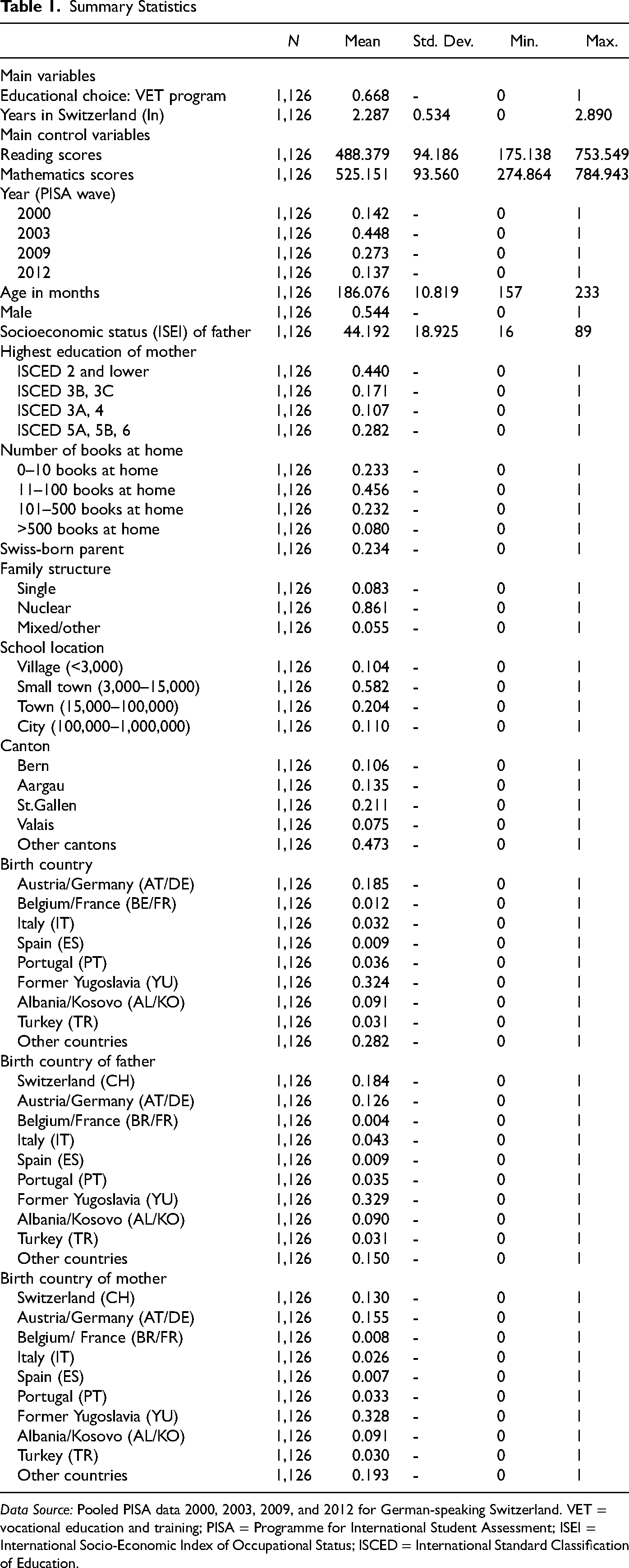
Data Source: Pooled PISA data 2000, 2003, 2009, and 2012 for German-speaking Switzerland. VET = vocational education and training; PISA = Programme for International Student Assessment; ISEI = International Socio-Economic Index of Occupational Status; ISCED = International Standard Classification of Education.
In addition, Figure 1 shows that the share of foreign-born students choosing a VET program increases along time since arrival in Switzerland, which we grouped in categories of five years. This figure provides descriptive evidence that the share of foreign-born students choosing a VET program increased with more time spent in Switzerland, although these shares are not conditional on other variables (such as ability) that affect educational choices. We find the highest share of students preferring a VET program among those foreign-born students who had spent 15 years or more in Switzerland and the lowest among those who had arrived recently (i.e., less than five years before the educational decision).
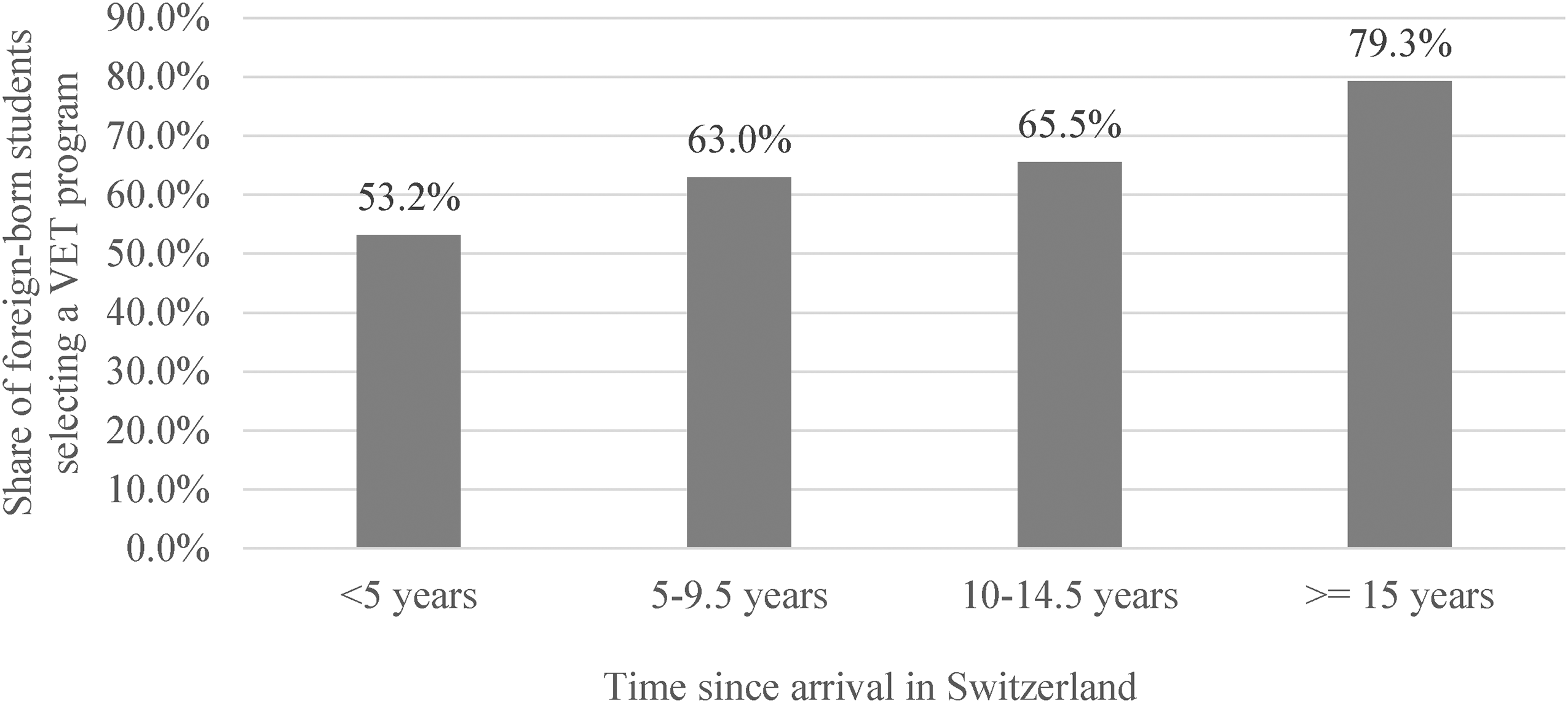
Share of foreign-born students choosing a VET program by time since arrival in Switzerland. Data: Pooled PISA data 2000, 2003, 2009, and 2012 for German-speaking Switzerland; N = 1,126. VET = vocational education and training; PISA = Programme for International Student Assessment.
Analytical Strategy
We employ a multivariate analysis that allows us to account for any potential endogeneity of the estimates from unobserved heterogeneity. We estimate the probability that student i preferred a VET program to a general education program, conditional on observed cognitive ability
8
with the following probit model with robust standard errors:
The main concern in identifying
To improve our identification strategy, we further test our hypothesis with two interaction approaches. First, we exploit our observations of the educational choices of students born in Austria and Germany, which have VET programs comparable to the ones in Switzerland. As we, therefore, expect these students to be familiar with the VET system in Switzerland, we argue that the valuation of VET programs and thus the probability of preferring such a program should increase less for students born in Austria or Germany than for students born in other countries.
Second, we build on the distinction between foreign-born students with a parent born in Switzerland and those without, thus analyzing the effect of time since arrival of first-generation immigrants compared to the rest of our sample (foreign-born students with a Swiss parent). We argue that parents born in Switzerland are more likely to be familiar with the Swiss education system at the time of immigration. Thus, we expect the valuation of VET programs to increase less over the time spent in Switzerland for foreign-born students with at least one parent born in Switzerland than for those without a Swiss-born parent. The following estimation combines the two interaction approaches to test our hypothesis:
The two interaction approaches not only improve our identification strategy but also help investigate the different channels through which secondary effects may affect foreign-born students’ educational choices. As students born in Austria or Germany and those with at least one Swiss parent had greater knowledge about the Swiss education system, we argue that their educational preferences should change less with time since arrival. Based on this argument, we expect a negative sign for both interaction terms
Considering the previous theoretical arguments, we argue that the information deficit channel becomes less relevant with time spent in Switzerland, while we state that the change is unclear for the immigrant optimism and anticipated discrimination channels. Nevertheless, we provide two additional tentative tests on whether immigrant optimism or anticipated discrimination confound the effect of time spent in Switzerland by including further variables in our baseline estimations. Regarding the anticipated discrimination channel, scholars argue that immigrant students anticipate ethnic labor market discrimination, an anticipation that also applies to dual VET students who need to apply to firms for an apprenticeship contract (Teney, Devleeshouwer and Hanquinet 2013; Fernández-Reino 2016; Tjaden and Hunkler 2017). As anticipated discrimination affects the effort that students put into accessing upper-secondary education, we control for how many times a student applied for a planned upper-secondary education program, which students participating in PISA indicate at the same time as their educational preferences. As information on the number of applications at schools and firms, respectively, is only available for the PISA 2000 sample, we must reduce the sample when including these additional variables. If anticipated discrimination is the reason why immigrants’ educational preferences change with the time since arrival in Switzerland, controlling for the number of applications at schools and firms reduces this effect.
Immigrant optimism is based on the argument that migration is associated with high motivation and lower risk aversion and, thus, that immigrants are a positively selected group in terms of personal characteristics (Kao and Tienda 1998). Our estimates account for both PISA scores and a wide range of observable characteristics, as well as for unobserved heterogeneity in terms of settlement patterns, by controlling for school canton and birth country fixed effects. Arguing that we can use punctuality as a tentative proxy for high motivation, we investigate this channel by including punctuality as an additional control variable. Thus, if immigrants’ motivation drives the increase in foreign-born students’ preferences for VET programs, we expect that controlling for punctuality will reduce the effect of time since arrival on their educational preferences.
Results
Effect of Time Since Arrival on Foreign-Born Students’ Educational Preferences
Table 2 illustrates the results of our baseline approach in which the first estimates present the simple correlation of time since arrival in Switzerland and the probability of choosing a VET program, conditional on PISA reading and mathematics scores (Model 1). Model 2 further controls for observable characteristics. Models 3 through 6 account for unobserved heterogeneity across cantons (Model 3), plus birth country fixed effects (Model 4), plus birth country of father and mother fixed effects (Model 5), and plus birth country wave trends (Model 6).
Baseline Approach for Foreign-Born Students’ Probability of Preferring a VET Program
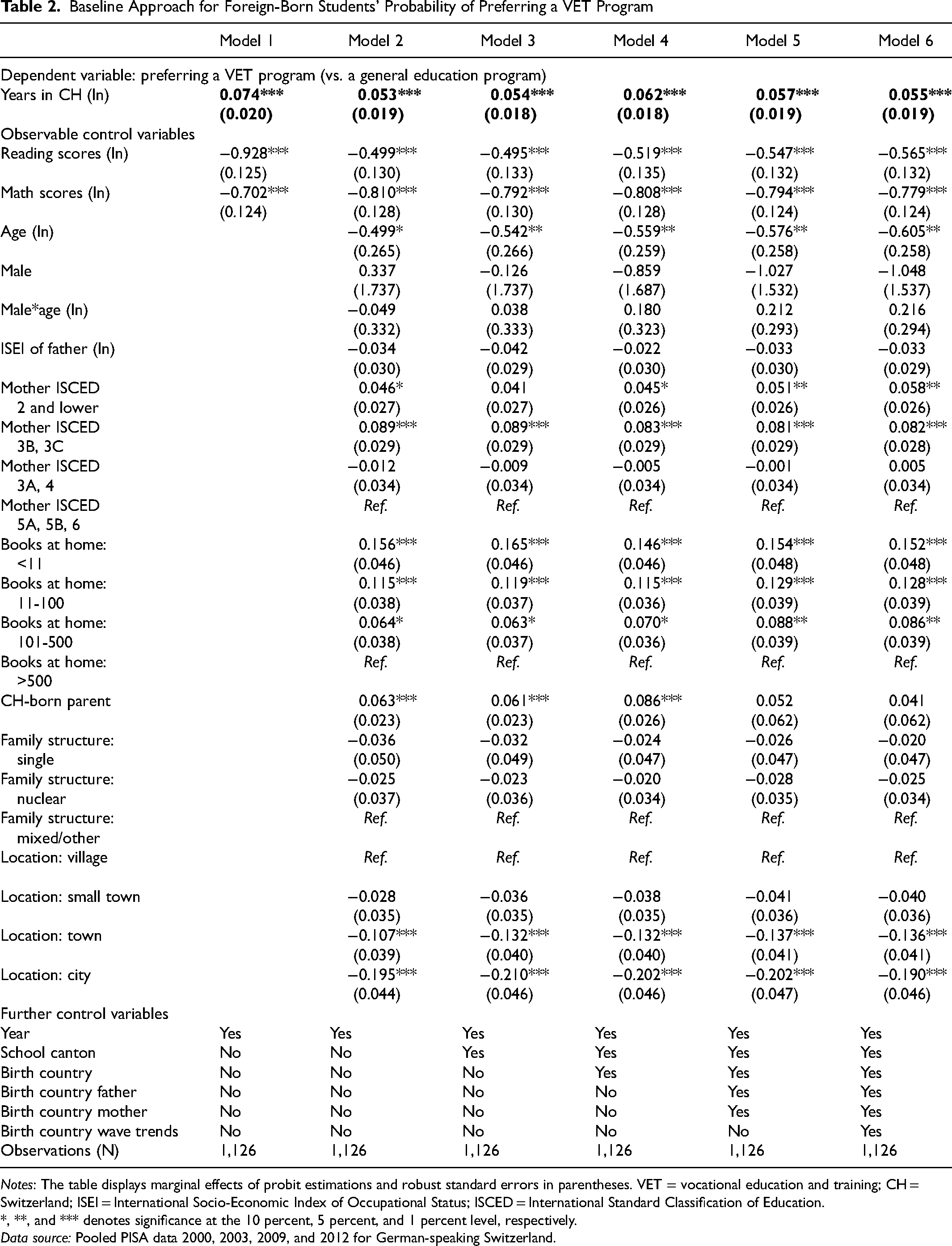
Notes: The table displays marginal effects of probit estimations and robust standard errors in parentheses. VET = vocational education and training; CH = Switzerland; ISEI = International Socio-Economic Index of Occupational Status; ISCED = International Standard Classification of Education.
*, **, and *** denotes significance at the 10 percent, 5 percent, and 1 percent level, respectively.
Data source: Pooled PISA data 2000, 2003, 2009, and 2012 for German-speaking Switzerland.
Table 2 indicates that time since arrival in Switzerland (Years in CH) increased the probability of preferring a VET program, conditional on cognitive ability measures, thus confirming H1 that foreign-born students’ preferences for general education versus VET programs decrease with increasing time since arrival in Switzerland. Being in Switzerland one additional year led to a 1 percent increase in the probability of choosing a VET program instead of a general education program, as Table 2 shows. This finding holds when we include control variables and remains remarkably stable when we introduce fixed effects for school canton, birth country, and birth country of father and mother. Therefore, an increase in foreign-born students’ time since arrival in Switzerland raised their valuation of VET programs and, thus, their probability of preferring such a program, if everything else remains constant.
The empirical evidence also supports our argument that foreign-born students’ preferences for general education versus VET programs decrease with length of residence in Switzerland due to a decrease in lack of information, in immigrant optimism, or in anticipated discrimination (Tjaden and Hunkler 2017; Wolter and Zumbuehl 2017a). However, the literature on immigrants’ educational choices provides different explanations for migration background's secondary effect on educational choices (e.g., Brinbaum and Cebolla-Boado 2007; Kristen 2008; Kristen, Reimer and Kogan 2008; Salikutluk 2016). The information deficit should decrease with more time in Switzerland, as foreign-born students and their parents become more familiar with the Swiss education system, whereas we expect no change for immigrant optimism and an unclear development for anticipated discrimination.
As our findings provide tentative support for the information deficit channel, we further test this channel by exploiting variation in the knowledge level at the time of arrival. Table 3 summarizes the regression results with the two interaction approaches, and Table A1 in the Online Appendix reports the full estimates.
Interaction Approach With Birth Country and Parent Born in Switzerland for Foreign-Born Students’ Probability of Preferring a VET Program
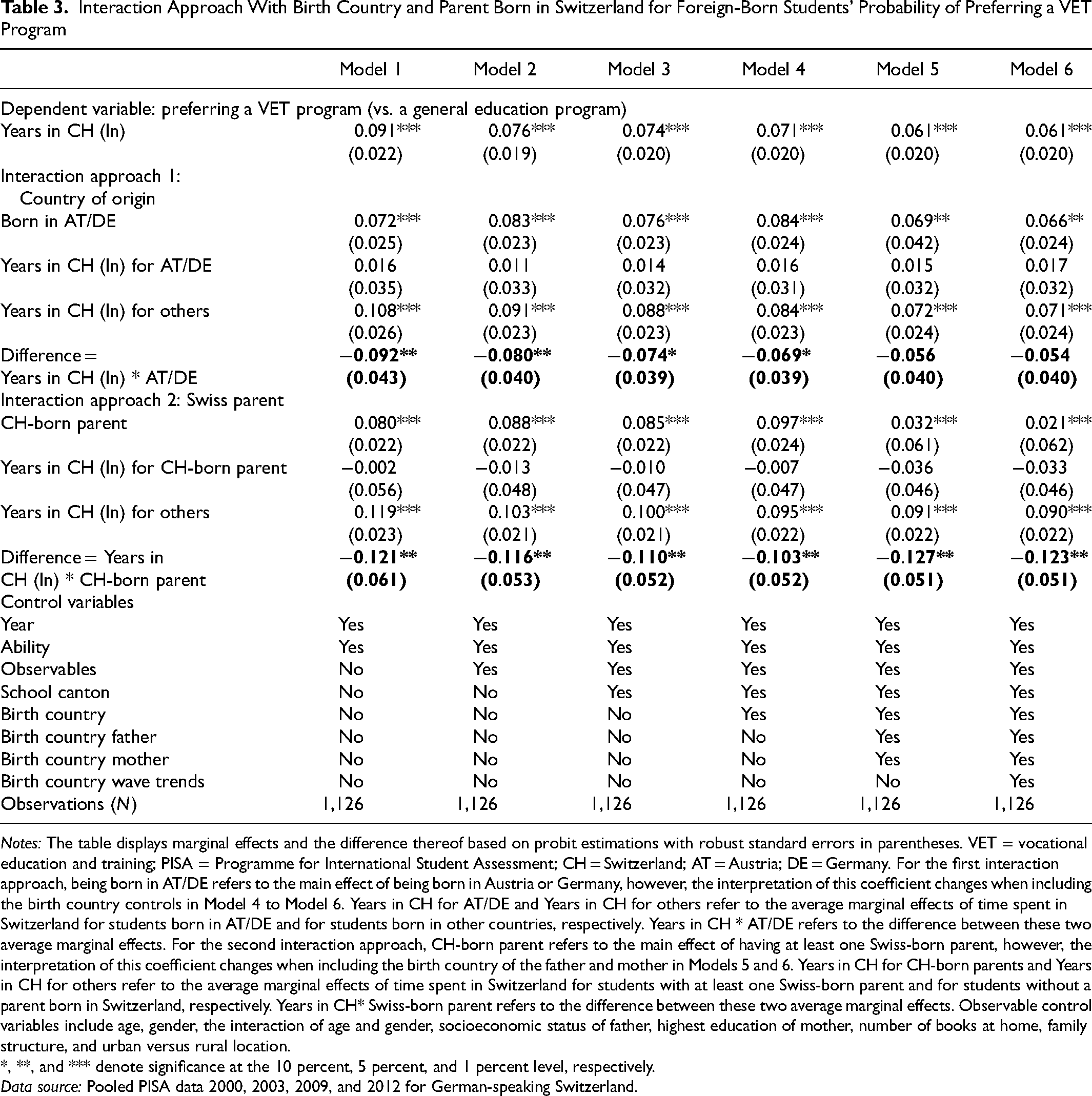
Notes: The table displays marginal effects and the difference thereof based on probit estimations with robust standard errors in parentheses. VET = vocational education and training; PISA = Programme for International Student Assessment; CH = Switzerland; AT = Austria; DE = Germany. For the first interaction approach, being born in AT/DE refers to the main effect of being born in Austria or Germany, however, the interpretation of this coefficient changes when including the birth country controls in Model 4 to Model 6. Years in CH for AT/DE and Years in CH for others refer to the average marginal effects of time spent in Switzerland for students born in AT/DE and for students born in other countries, respectively. Years in CH * AT/DE refers to the difference between these two average marginal effects. For the second interaction approach, CH-born parent refers to the main effect of having at least one Swiss-born parent, however, the interpretation of this coefficient changes when including the birth country of the father and mother in Models 5 and 6. Years in CH for CH-born parents and Years in CH for others refer to the average marginal effects of time spent in Switzerland for students with at least one Swiss-born parent and for students without a parent born in Switzerland, respectively. Years in CH* Swiss-born parent refers to the difference between these two average marginal effects. Observable control variables include age, gender, the interaction of age and gender, socioeconomic status of father, highest education of mother, number of books at home, family structure, and urban versus rural location.
*, **, and *** denote significance at the 10 percent, 5 percent, and 1 percent level, respectively.
Data source: Pooled PISA data 2000, 2003, 2009, and 2012 for German-speaking Switzerland.
For the first interaction approach, Table 3 shows that students born in Austria or Germany were more likely to choose a VET program than a general education program compared to those born in another foreign country (Born in AT/DE). Moreover, the effect of time since arrival in Switzerland on the probability of choosing a VET program differed between students born in Austria or Germany and those born elsewhere. As this coefficient had the expected negative sign and was significant, except for the last two models, the effect of time spent in Switzerland was lower for foreign-born students coming from a country with a similar VET system (Difference = Years in CH * AT/DE). Moreover, the effect of time since arrival in Switzerland on the probability of choosing a VET program for students born in a country without a similar VET system (Years in CH for others) showed the expected positive sign, whereas there was no effect for students born in Austria or Germany (Years in CH for AT/DE). Thus, our findings are in line with the literature on immigrants’ educational choices (e.g., Tjaden 2017; Wolter and Zumbuehl 2017b; Abrassart et al. 2018) and support our H2 that immigrants’ preferences for general education versus VET programs decrease less over time spent in Switzerland for students born in Austria or Germany than for those born elsewhere.
To test the first interaction approach's validity, we apply a placebo test. We form other groups of foreign-born students according to birth country, instead of looking only at those born in Austria or Germany. By showing that the effect of time spent in Switzerland for students born in other countries did not significantly differ, Table A2 in the Online Appendix supports the validity of this approach.
For the second interaction approach, Table 3 shows that foreign-born students with at least one parent born in Switzerland had a higher probability of choosing a VET program than a general education program compared to those without a parent born in Switzerland (CH-born parent). Furthermore, the difference in the effect of time spent in Switzerland between foreign-born students with a Swiss-born parent and those without was significantly negative (Difference = Years in CH * CH-born parent). This finding indicates that the effect of time since arrival in Switzerland on the probability of choosing a VET program was smaller for foreign-born students with a parent born in Switzerland. Furthermore, the estimated effect of time since arrival in Switzerland for foreign-born students without a parent born in Switzerland (Years in CH for others) remained significantly positive in all estimations. In contrast, we find no significant effect of time since arrival in Switzerland on the probability that foreign-born students with a Swiss-born parent (Years in CH for CH-born parent) chose a VET program.
The two interaction approaches support the information deficit explanation: Students born in a country with a similar VET system (i.e., Austria or Germany) and those with a parent born in Switzerland had better knowledge of VET programs in Switzerland. For these two groups, the preference for VET programs did not increase with time spent in Switzerland, suggesting that familiarity with VET programs increased these programs’ valuation.
Tentative Tests for Confounding Effect of Other Channels
This subsection discusses additional robustness tests that examine whether other channels confound the time-since-arrival effect and thus provide more indirect evidence of an information deficit effect. For the second channel—immigrant optimism—scholars argue that immigrants are a positively selected group in terms of personal characteristics and especially have high motivation and a low-risk aversion, (Kao and Tienda 1998). To consider differences in these personal characteristics, our estimates account for PISA scores, a wide range of observable characteristics, and unobserved heterogeneity in terms of settlement patterns. Table A8 in the Online Appendix additionally includes punctuality as a control variable accounting for motivation and yields qualitatively the same results. This tentative test suggests that when foreign-born students spent more time in Switzerland, immigrant optimism did not drive the increase in their preferences for VET programs.
For the third channel—anticipated discrimination, scholars argue that anticipated discrimination against immigrants may explain differences in educational choices (Teney, Devleeshouwer and Hanquinet 2013; Fernández-Reino 2016; Tjaden and Hunkler 2017). By controlling for how many times a student applied for a planned upper-secondary education program, Tables A9 and A10 in the Online Appendix present a tentative test for the anticipated discrimination channel. Including the number of applications at schools reduced the effect of time spent in Switzerland, but the estimates remained positive, although not significant, in all models. Including the number of applications at firms did not affect the baseline estimates. Thus, this tentative test provides no support for the anticipated discrimination explanation.
Conclusion
This article investigated whether foreign-born students’ preferences for VET programs increased with more time since arrival in Switzerland. We provide evidence that the valuation of VET relative to general education programs rose as foreign-born students lived in Switzerland for longer periods. Our results show an average effect from 2000 through 2012 and analyzing this effect's heterogeneity across waves is beyond the scope of this article. We dealt with unobserved heterogeneity in terms of migration waves and settlement patterns by controlling for school canton and birth country fixed effects and with two alternative interaction approaches. Nonetheless, some concerns remain about endogeneity due to unobserved heterogeneity, for example, in terms of characteristics of migration waves, non-cognitive skills, intrinsic preferences, or peer group influences. Thus, future research should exploit quasi-experimental variation to confirm our empirical findings.
Moreover, our results may reflect a decrease in immigrants’ probability of leaving Switzerland with time spent there. As people who intend to leave Switzerland focus on the value of VET programs abroad, such emigration plans also affect students’ educational choices (e.g., Urban 2012; Wolter and Zumbuehl 2017a). Thus, the assumption that the probability of leaving Switzerland decreased with time spent in Switzerland suggests that the objective value of VET programs increased at the same time. Furthermore, individuals who increasingly liked the Swiss education system and, thus, perceived VET programs as having higher value may be more likely to stay longer in Switzerland. This selection problem would also bias our results upwards.
Understanding whether and through which channels an increase in time spent in the host country affects first-generation immigrants’ educational preferences can help policy makers counteract biases that dissuade immigrants from choosing a VET program. We argue that evidence on generational differences may underestimate the information deficit that exists immediately after immigration. Hence, the relevance of informing immigrants about the host country's education system may be underestimated. Furthermore, if policy makers focus only on second-generation immigrants, children of first-generation immigrants may make misinformed educational choices, which policy makers can avoid by taking measures at an earlier stage.
Theoretical considerations and our tentative empirical tests of the possible explanations suggest that knowledge about the education system appears the most plausible explanation for our findings. However, we cannot fully disentangle and identify the channels through which time since arrival in the host country affected foreign-born students’ educational preferences. In addition to the immigrant optimism and anticipated discrimination channels, social networks and socialization (e.g. Vang and Chang 2019; Guhin, Calarco and Miller-Idriss 2021) are possible mechanisms that we did not test. Regarding social networks, a longer stay in Switzerland may equip students with contacts that help them find an apprenticeship position in a firm (Lamamra and Duc 2021). Regarding socialization, we can argue that punctuality serves as a proxy for foreign-born students’ adaptation to Swiss values and that including this additional control variable does not change our findings (see Table A8 in the Online Appendix).
To better identify the mechanisms underlying preference changes, future research could establish more precise measures for the different channels. Furthermore, more research is needed on the reasons for differences in the valuation of VET programs, even for people from other countries with similar VET systems. How much, for example, is this valuation linked to the range of occupations for which VET programs prepare students or to income and career prospects associated with these occupations?
Assuming that the change in the valuation of VET programs results from immigrants’ growing knowledge of the education system as they spend more time in Switzerland, policy makers should ensure that immigrant students receive information about the Swiss education system at a young age. Such information provision can include personalized career guidance and mentoring services that allow immigrant adolescents to learn sooner about the value of VET programs, instead of allowing a secondary effect to distort their educational choices. This provision is especially important in strongly stratified and complex education systems, such as Switzerland's, and at branching points in school careers when knowledge can be crucial for making advantageous choices. As foreign residents in Switzerland attribute a lower labor market value to VET relative to general education programs than Swiss citizens, information campaigns targeting immigrants are particularly important (Abrassart et al. 2018).
Informing immigrants may not have the same relevance across countries. Assuming that information about the specifics of the Swiss VET system drives our results, these results are particularly important in countries that have relatively similar education systems, such as Austria and Germany. However, the valuation of VET programs may also depend on the education system's permeability, specifically whether the program offers access to further education and training (Chankseliani and Anuar 2019). Since this access varies substantially across countries and is difficult to gain information about (OECD 2015), these results also matter for international migration.
The results presented in this article further matter for educational reforms and new education programs. We argue that immigrants’ low initial knowledge level is comparable to that of citizens in countries just introducing new education programs, thus such reforms should, from the start, be complemented by information, for example through guidance or counseling systems. The aim of such information provision is to optimally equip students “to understand and assess their learning and career opportunities to make more informed choices about the pathways to take” (Lasonen and Gordon 2009: 54). Thus, this article contributes not only to the empirical evidence on immigrants’ educational choices but also has implications for international migration as well as education and migration policy.
Supplemental Material
sj-docx-1-mrx-10.1177_01979183221139137 - Supplemental material for Does Time Since Arrival have an Effect on Immigrants’ Preferences for Vocational Education and Training Programs in Switzerland?
Supplemental material, sj-docx-1-mrx-10.1177_01979183221139137 for Does Time Since Arrival have an Effect on Immigrants’ Preferences for Vocational Education and Training Programs in Switzerland? by Thomas Bolli and Ladina Rageth in International Migration Review
Footnotes
Acknowledgments
The authors gratefully acknowledge the financial support of the Hirschmann Foundation. We thank the editor and anonymous reviewers for their careful reading of our manuscript and their valuable comments and suggestions. For helpful feedback on earlier versions, the authors thank Prof. Ursula Renold, Prof. Andreas Diekmann, Prof. Jan-Egbert Sturm, and the participants of all conferences and seminars in which we presented this paper. We further thank FORS Lausanne for providing the data. For language consulting, we thank Natalie Reid. All responsibility for remaining mistakes lies with the authors.
Data Availability Statement
The micro data used in this study are available from the FORS Lausanne. Restrictions apply to the availability of these data, which were used based on a user contract for this study.
Declaration of Conflicting Interests
The authors declared no potential conflicts of interest with respect to the research, authorship, and/or publication of this article.
Funding
The authors disclosed receipt of the following financial support for the research, authorship, and/or publication of this article: This work was financially supported by the Hirschmann Foundation, with the ETH Foundation as an intermediary.

Notes
References
Supplementary Material
Please find the following supplemental material available below.
For Open Access articles published under a Creative Commons License, all supplemental material carries the same license as the article it is associated with.
For non-Open Access articles published, all supplemental material carries a non-exclusive license, and permission requests for re-use of supplemental material or any part of supplemental material shall be sent directly to the copyright owner as specified in the copyright notice associated with the article.
