




Abstract
Immigrant integration scholarship increasingly discusses integration as a multidimensional process. Yet there is considerable inconsistency in how that multidimensionality is conceptualized. This article posits that there are two different logical approaches by which multidimensional frameworks of integration tend to outline their dimensions: the “thematic” (or conceptually driven) approach and the “empirical” approach. We contend that these two approaches lead to differently structured multidimensional frameworks of immigrant integration. To demonstrate these points, we, first, review different conceptualizations and approaches to multidimensionality in prior immigrant integration research, focusing largely on Europe. Through a synthesis of these prior approaches, we outline eight thematic dimensions of integration prevalent in the existing literature. Second, we conduct an original study with cross-European data on first- and second-generation migrants (ESS7 2014-15, N = 1,066) to outline a multidimensional framework based on empirical patterns of co-variation (or distinction) among integration-related outcomes. Our factor analysis of 18 common indicators of integration reveals five main dimensions of integration, with some items relating strongly to more than one dimension. These five “empirical” dimensions (economic/structural integration; health; subjective well-being; cultural assimilation and civic/political integration; and minority socialization) differ from the eight typical “thematic” dimensions identified in existing scholarship in key respects, which we discuss alongside potential connections between integration aspects as suggested by our findings (e.g., between economic and civic/political or between civic/political and cultural aspects). Overall, our article advances migration studies by helping us think more critically about the multidimensionality of immigrant integration and contributes to an emerging literature on integration's multidimensionality.
Introduction
Over the past decade, immigrants and their descendants have come to represent a growing population across European countries (OECD/EU 2019; OECD 2021). Migration scholars and policymakers routinely stress the importance of successfully integrating these immigrant groups for the future of European societies (Alba and Foner 2015; OECD/EU 2019; European Commission 2020; Platt, Polavieja, and Radl 2021). Indeed, immigrant integration receives considerable attention in political rhetoric and media headlines across Europe – an attention focused overwhelmingly on immigrants’ cultural assimilation (e.g., Ruthven 2017; Boffey 2020; Burnett 2021; Rosman 2021). Yet research from Western Europe suggests that the general public views immigrant integration as a more multifaceted process also involving social, economic, and political aspects, for instance (Sobolewska, Galandini, and Lessard-Phillips 2017). Rhetoric aside, European countries’ integration policies tend to target immigrant inclusion and integration in multiple domains, even if levels of governmental involvement can be uneven across different dimensions (Solano and Huddleston 2020). Indeed, defining immigrant integration as a multidimensional phenomenon has become common in academic and policy literatures on immigrant integration in Europe (e.g., Grzymala-Kazlowska and Phillimore 2018; Ndofor-Tah et al. 2019; OECD/EU 2019), and multidimensional frameworks of integration abound (e.g., Entzinger and Biezeveld 2003; Esser 2004a; Heckmann 2006; Penninx and Garcés-Mascareñas 2016; Spencer and Charsley 2016; Ndofor-Tah et al. 2019).
Still, multidimensional immigrant integration continues to be a slippery concept, as there is no ‘standard’ multidimensional framework of integration (Lessard-Phillips 2017; Harder et al. 2018). This lack of consensus results in a lack of consistency in how immigrant integration is conceptualized and measured in an otherwise-rich body of European literature on immigrant integration (e.g., Entzinger and Biezeveld 2003; Esser 2004a; Heckmann 2006; Bean et al. 2012; Crul, Schneider, and Lelie 2012; Alba and Foner 2015; Penninx and Garcés-Mascareñas 2016; Spencer and Charsley 2016; Ndofor-Tah et al. 2019). Beyond issues of consistency, questions concerning how different dimensions of integration relate to one another also tie into long-standing theoretical assumptions and debates on the nature and specifics of the process of immigrant integration itself (Gordon 1964; Gans 1992b; Portes and Zhou 1993). Ultimately, we believe that a critical appraisal of immigrant integration's (multi)dimensionality is essential to developing more coherent and robust frameworks for the study of immigrant integration in Europe and beyond.
With this article, our aim is not to outline a single “correct” multidimensional framework of integration but, rather, to strengthen the conceptual and empirical basis behind these frameworks. Following this aim, we structure this article around three objectives. First, we provide an overview of different conceptualizations of immigrant integration dimensions identified in the existing literature and the vast range of domains upon which these different frameworks touch. Through a closer look at various taxonomies of integration dimensions, we identify what we see as major common themes. Second, we review perspectives on how different aspects of immigrant integration may relate to one another, based on prior theoretical and empirical research, placing particular emphasis on works from or about Europe. This section underscores the relevance of multidimensional integration frameworks that engage with the empirically observable concurrence and divergence of integration processes across different domains of integration. Third, noting shortcomings in that empirical knowledge base, we conduct an empirical exploration of inter- (and intra-) dimensional linkages between various indicators of integration, using European survey data on first- and second-generation immigrants. Together, we believe these elements help us move toward more consistent and nuanced multidimensional approaches in the study of immigrant integration.
I. Dimensionality in Immigrant Integration: A Conceptual Overview
We view the question of dimensionality as an intrinsic element of any concept of immigrant integration. Our own definition of integration, for instance, is centered on a notion of equality, inclusion, and acceptance in broader society for migrant-background residents 1 (Heckmann 2006; Alba and Foner 2015; Penninx and Garcés-Mascareñas 2016). Yet, to be analytically useful, a definition of integration must also be specific about the domains to which this notion applies, as well as the indicators and benchmarks used to measure progress toward it. It is vis-à-vis these conceptual elements that defining integration becomes particularly contentious. As several critics have pointed out (Spencer and Charsley 2016; Schinkel 2018; Favell 2019; Hadj Abdou 2019), depending on the choice of indicators and benchmarks, integration concepts can effectively be just as exclusionary and ethnocentric as the assimilation concepts they were originally meant to replace as more inclusive and pluralist alternatives. 2 This inevitable subjectivity and normative potential are partly why we see such variation among approaches to dimensionality in integration research. In what follows, we provide an overview of the most common indicators of immigrant integration and their categorization into dimensions. The section concludes with our attempt at a comprehensive multidimensional framework, drawn from a synthesis of prior conceptualizations.
Starting at the most fundamental level, immigrant integration literature tends to differentiate between two main dimensions of integration: the sociocultural and the structural (e.g., Fokkema and de Haas 2011). Though terms and definitions of these dimensions vary, the core logic of this dichotomy is fairly consistent within immigrant integration scholarship, following a distinction between processes of acculturation and of socioeconomic assimilation that was popularized by the “grand theories of assimilation” (Portes and Zhou 1993; Alba and Nee 2003; Crul 2016, 2). Moving beyond this basic dichotomy to more detailed breakdowns of immigrant integration dimensions, we note a variety of approaches. In Table 1, we contrast some of the most prominent attempts at multidimensional frameworks in recent European literature, along with Gordon’s (1964) seminal first framework, whose influence remains apparent in many modern approaches (e.g., Entzinger and Biezeveld 2003; Esser 2004a; Penninx 2005, Heckmann 2006; Spencer and Charsley 2016). As Table 1 shows, conceptualized dimensions of immigrant integration have varied in both terminology and content – that is, the specific aspects or indicators encompassed by each dimension. Indeed, once we look at the specific aspects or indicators included in each framework, common themes and outliers start to emerge. The rest of this section discusses these themes in turn.
A Comparison of Prior Categorizations of Integration Dimensions, Including Attached Aspects/Indicators.
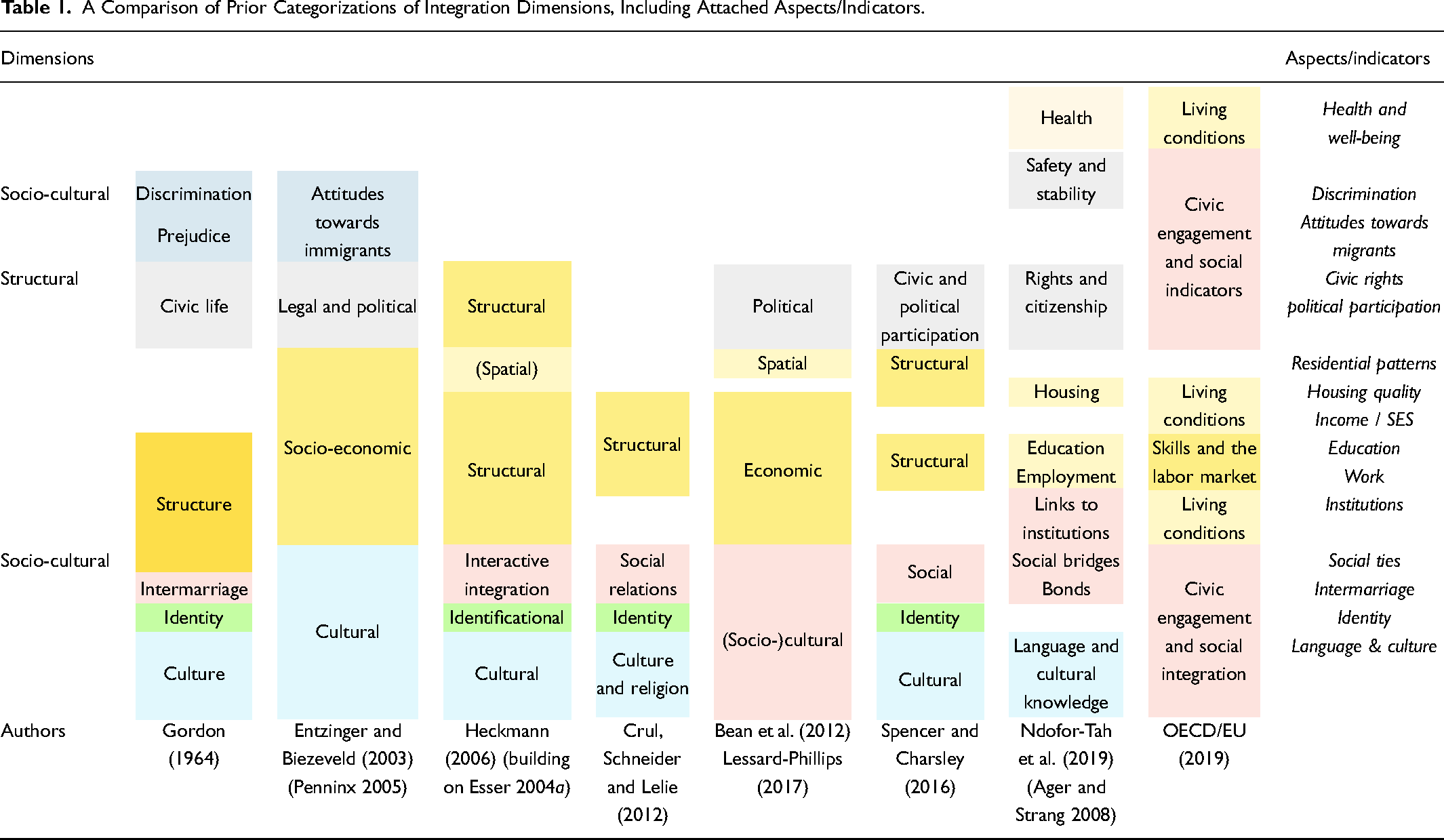
The broad realm of immigrant sociocultural integration is arguably the most subjective and contested dimension of integration, where the conflict between assimilationist and pluralist or multicultural approaches plays out (Kivisto 2005). We see this duality in all the sociocultural dimension's major areas, starting with the cultural domain. In the classical assimilation-oriented perspective, cultural integration is essentially synonymous with immigrants’ cultural conformity, with the immigrant group changing its “cultural patterns to those of host society” (Gordon 1964, 71). To this day, commonly considered facets of cultural integration include language, religion (e.g., Warner and Srole 1945; Heckmann 2006; Crul, Schneider, and Lelie 2012), norms, attitudes, and values (e.g., Entzinger and Biezeveld 2003; Heckmann 2006; OECD/EU 2019). From a less normative and more functional perspective, instead of the above aspects, we may consider the acquisition of cultural knowledge as a competency necessary for immigrants and their descendants to ‘get by’ in broader society (Ager and Strang 2008). Similarly, frameworks might focus on language fluency (i.e., the ability to communicate effectively in the host country's primary language(s)) (Heckmann 2006; Ager and Strang 2008) or, from a more assimilationist perspective, the dominant use of the host-country language over the ‘origin’ language in places like the home (Alba and Nee 2003; Lessard-Phillips 2017).
The aspect of identity has also been present in frameworks since the earliest conceptualizations of immigrant integration (Park and Burgess 1921; Gordon 1964). Building on classical assimilation perspectives that viewed (national, ethnic, etc.) identity as a matter of competing loyalties (ibid.), identificational integration is often understood as the replacement of minority (or origin) identity with some form of majority-society identity (e.g., Esser 2010). More recent pluralist perspectives, on the other hand, reject a zero-sum view of identity (Platt 2014, 47) and maintain that minority and majority identities can coexist nested within each other (Berry 2001). Moreover, we note a growing practice of observing sense of belonging (Heckmann 2006; Schneider et al. 2012; OECD/EU 2019), as opposed to national identity, reflecting a shift in focus from immigrant “loyalty” to immigrant inclusion in the host society.
Social integration has traditionally been thought of as a move from the co-ethnic community into “mainstream” society, however defined (Gordon 1964; Gans 1997; Esser 2010). Informed by this perspective, immigrant integration researchers often measure social integration via indicators of social mixing such as interactions and social relationships with members of the majority society and membership in “majority-society” organizations (Entzinger and Biezeveld 2003; Esser 2004a; Heckmann 2006). Intermarriage was once seen as the ultimate indicator of social mixing and, thus, social integration, both signaling and perpetuating the lessening of social distance between groups (Warner and Srole 1945; Gordon 1964). Intermarriage remains a popular immigrant integration indicator in contemporary integration literature (Alba and Nee 2003; Heckmann 2006; Hamel et al. 2012; Alba and Foner 2015), though its validity as “the ultimate litmus test of integration” has been contested by some scholars (Song 2009, 331). In social mixing-focused approaches to social integration, “majority” socialization is often measured relative to co-ethnic socialization, making the latter a negative measure of social integration (e.g., Crul, Schneider, and Lelie 2012; Chiswick and Wang 2016; Lessard-Phillips 2017; Fajth and Bilgili 2018). Conversely, some recent frameworks present co-ethnic relationships (“social bonds”) as complementary to majority ties (“social bridges”) in their role in immigrant integration (Ndofor-Tah et al. 2019). Others consider aspects of local social capital (or social isolation) in general, without an ethnic distinction (OECD/EU 2019; Lessard-Phillips, Fajth, and Fernández-Reino 2020). Another critique of social-mixing measures argues that the traditional focus on the social lives of immigrants, as opposed to natives, 3 effectively blames immigrants for patterns of social exclusion enacted by natives (Schinkel 2018). Indeed, the diversity of majority-society members’ socialization patterns can also be considered an indicator of immigrant integration (Huijts, Kraaykamp, and Scheepers 2014; OECD/EU 2019; Lessard-Phillips, Fajth, and Fernández-Reino 2020).
Another way to involve the side of “majority” society in studies of immigrant integration is to look at the openness of their attitudes and the prevalence of their discrimination toward immigrant(-background) groups (Entzinger and Biezeveld 2003; OECD/EU 2019). The notion of host-society attitudes and behavior as benchmarks of social integration appears in the literature as early as Gordon (1964) but is surprisingly uncommon in later frameworks (e.g., Esser 2004a; Heckmann 2006; Bean et al. 2012; Spencer and Charsley 2016), many of which consider discrimination only as a potential obstacle to immigrant integration, not as an indicator of its state. Once again, the relative rarity of including native attitudes and behavior toward immigrants as a measure of immigrant integration reflects the tendency to consider the degree of integration a characteristic of immigrants, not society as a whole (c.f., Schinkel 2018).
Moving to the structural realm, the main dimension of interest tends to be economic integration (e.g., Portes and Zhou 1993; Waters and Jiménez 2005; Fokkema and de Haas 2011; Koopmans 2016; Drouhot and Nee 2019; Heath and Schneider 2021). Broadly speaking, economic integration encompasses immigrants’ and/or their descendants’ socioeconomic position (e.g., income, poverty indicators), labor market characteristics (e.g., unemployment, occupational skill level, educational attainment), and other aspects of living conditions (e.g., housing) (Heath, Rothon, and Kilpi 2008; Ndofor-Tah et al. 2019; OECD/EU 2019; Heath and Schneider 2021). While less contentious than the sociocultural aspect, notions of economic integration or assimilation have also drawn criticism and evolved over time (see Klarenbeek 2019; Alba and Foner 2015 for recent debates). In the early assimilation literature, the expectation was that immigrants would enter an imagined “mainstream” constituted by the white middle class, and this research often overlooked the fact that host society itself was socioeconomically fragmented (Portes and Zhou 1993). Still, even the present practice (e.g., Alba and Foner 2015; OECD/EU 2019) of comparing “group averages” between immigrant and non-immigrant groups can be misleading when relevant compositional factors (e.g., class background, education) are not taken into account (c.f., Heath, Rothon, and Kilpi 2008). Alternative indicators such as inter- or intra-generational social mobility or rates of overqualification, for example, can help with comparability (Hermansen 2016; Li and Heath 2016; OECD/EU 2019).
Another key dimension of immigrant structural integration is civic-political integration (e.g., Bean et al. 2012; Wright and Bloemraad 2012). Integration in the political sphere typically refers to immigrants’ acquisition of political and civic rights, as well as participation in political processes and institutions (Penninx 2005; Bean et al. 2012; Wright and Bloemraad 2012). Common indicators include rates of citizenship/naturalization (which may determine access to political participation), electoral and non-electoral participation in politics, and activity and membership in political associations and civil society (Entzinger and Biezeveld 2003; Heckmann 2006; Penninx and Garcés-Mascareñas 2016; Spencer and Charsley 2016; Ndofor-Tah et al. 2019; OECD/EU 2019).
Spatial integration typically refers to residential patterns, particularly the residential segregation or concentration of immigrant minorities, and sometimes includes socioeconomic segregation and/or housing quality (Entzinger and Biezeveld 2003; Heckmann 2006; Bean et al. 2012). We note that much of the interest in spatial integration involves its links to other aspects of immigrant integration: on the one hand, residential segregation may be a result of broader processes of socioeconomic inequality and discrimination, as well as general social distance, and residential characteristics themselves may influence socioeconomic opportunities and socialization patterns (Bolt, Özüekren, and Phillips 2010; Bean et al. 2012; Fajth and Bilgili 2018). On the other hand, residential concentration can sometimes be a preferred strategy of immigrant minorities, due to factors such as hostility from majority residents and the benefits of an “immigrant enclave” (e.g., access to community support and the ethnic economy) (Logan, Zhang, and Alba 2002; Fajth and Bilgili 2018). Depending on the perspective, spatial integration may, therefore, be considered a relevant aspect of integration per se, a reflection of integration in other dimensions, or neither (if it is considered neither an expression nor a prerequisite for successful integration).
Beyond the long-established areas of integration listed above, we note some emerging areas in the literature, which typically address other aspects of well-being. The area of health, for instance, encompassing health outcomes and access to healthcare, has started to appear in recent immigrant integration frameworks (Ager and Strang 2008; Bean et al. 2012; Ndofor-Tah et al. 2019; OECD/EU 2019; Solano and Huddleston 2020). As analyzes of the COVID-19 pandemic shed light on the increased health vulnerability of immigrants and ethnic minorities (Guadagno 2020), this area's salience will likely continue to grow in the future. Beyond physical health, measures related to mental health and subjective well-being (e.g., life satisfaction) are also increasingly present in frameworks and empirical studies of immigrant integration, especially those using a well-being centered concept of integration (Safi 2010; Levecque and Van Rossem 2015; La Parra-Casado, Stornes, and Solheim 2017; Ndofor-Tah et al. 2019; Gkiouleka and Huijts 2020). All in all, immigrants’ mental and physical well-being is becoming increasingly established as dimension of immigrant integration.
To summarize, beyond the basic sociocultural–structural dichotomy, we identify eight themes within the existing conceptual and empirical literature on migrant integration: culture, social life, identity, discrimination, economic, civic-political, spatial integration, and health and well-being. Table 2 summarizes these main (thematic) dimensions, along with commonly considered aspects within each dimension. 4
A Summary of Common Integration Dimensions and Related Indicators.
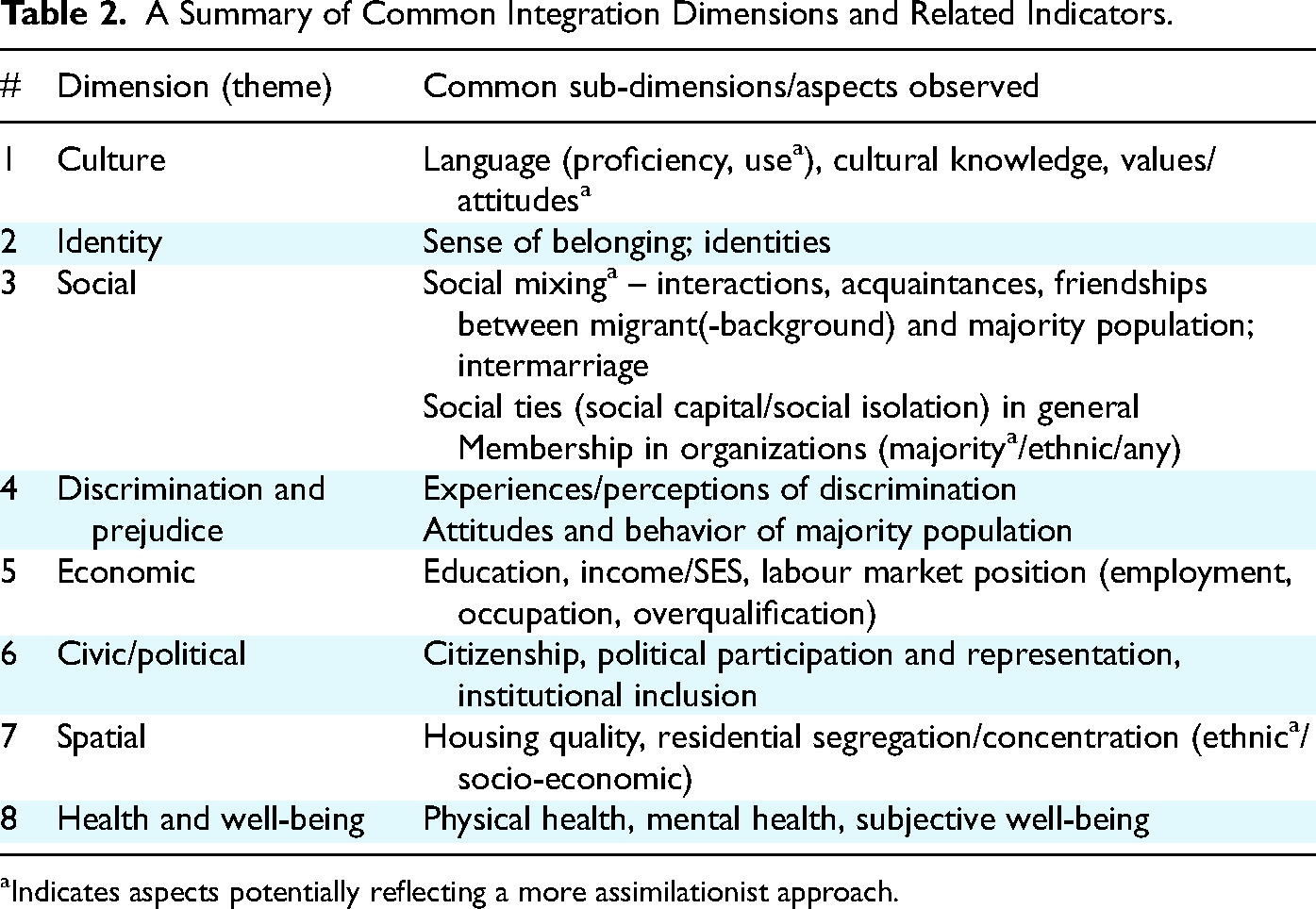
Indicates aspects potentially reflecting a more assimilationist approach.
On a final note, we gather that characteristics such as generational status, age, gender, race and ethnicity, and reason for migration (to name a few) can also influence the salience of particular domains of immigrant integration. Achieving progress in some indicators of integration (e.g., obtaining fluency in the host country's language or gaining citizenship) may be a long process for first-generation immigrants, while much easier to achieve, if not automatic, for their native-born children (Penninx 2005). Due to such intergenerational differences in starting points, indicators within particular domains may carry different meaning as markers of the integration process for different generations of immigrants. Labor market outcomes may have different relevance for individuals in different age groups or between male and female immigrants (Fleischmann and Dronkers 2007); likewise, the domain of discrimination may hold particular relevance for immigrants who belong to a racialized group in the host society, as may the feeling of safety for refugee populations (Ager and Strang 2008). Though some of the above-cited integration frameworks are specific to, for example, the second generation (Bean et al. 2012) or refugee populations (Ager and Strang 2008), most do not distinguish by generational status or other background factors. This specificity is worth keeping in mind when using existing multidimensional frameworks or developing new ones.
II. Relationships Between Dimensions
Looking at the broader immigrant integration literature, we notice that there are, in fact, two different approaches to delineating integration dimensions (even if they are sometimes combined) (see Heckmann 2006 or Entzinger and Biezeveld 2003 vs. Bean et al. 2012 or Lessard-Phillips 2017). First is what we call the “thematic” logic. Most of the above-discussed frameworks seem to follow this logic, outlining their integration dimensions along the lines of some intuitive themes (i.e., what we think of as different domains) that, at times, correspond to academic disciplines (e.g., economics, sociology, political science, geography) or policy areas (e.g., labor market, legal/civic, cultural) (Penninx 2005; Bean et al. 2012). The second motivation to distinguish between different dimensions of integration may come from the empirically observed divergence between some integration-related processes and outcomes. We call this distinction between dimensions the “empirical” multidimensionality of immigrant integration. Indeed, the recognition that immigrants may not be integrating uniformly across different domains (i.e., one may learn the language but not have a job, and vice versa) has played an important role in the move from unidimensional to multidimensional perspectives in integration research (Lessard-Phillips 2017). From a methodological perspective, if immigrant integration consisted of uniformly developing, fully connected processes and outcomes, there would not be a need for multidimensional frameworks; by observing one aspect, we could draw conclusions about the state of immigrant integration as a whole. Conversely, the more independently different facets of immigrant integration develop, the greater the degree of complexity and nuance that is required in multidimensional analytical frameworks. In other words, the question of how, and whether, different facets of immigrant integration are empirically linked is fundamental to how we conceptualize integration's dimensionality and, therefore, critical to consider in more depth. In this section, we review knowledge on the linkages between (and within) dimensions of immigrant integration from the prior theoretical and empirical literature.
Returning to the basic dichotomy of sociocultural and structural integration and following different theoretical strands within integration research, we identify four hypothesized scenarios concerning how different dimensions of immigrant integration relate to one another. The first scenario, characteristic of what was later named “straight-line”assimilation theory (Warner and Srole 1945; Gans 1992a), envisions a uniform process developing across generations in which sociocultural and structural aspects of the integration progress are in sync, being strongly and positively related. A second, revised version of the first scenario acknowledges the possibility of one area lagging behind another, although it still views the sociocultural and structural dimensions of integration as fundamentally linked (e.g., language fluency, social/residential mixing, socioeconomic advancement, etc.) (Alba and Nee 1997; 2003; Gans 1997). The perspective of new assimilation theory, for instance, notes potential delays and divergence across groups but still largely envisions an overall trend of assimilation in both regards (Alba and Nee 1997, 2003; Gans 1997; Waters and Jiménez 2005; Bean et al. 2012). In line with this perspective, several European studies (e.g., Bisin et al. 2011; Fokkema and de Haas 2011; Chiswick and Wang 2016; Koopmans 2016; Mendoza, Bertran, and Pàmies 2021) find a positive link between sociocultural and economic integration, suggesting at least a common co-occurrence, if not necessarily a causal relationship.
The perspective of segmented assimilation (Gans 1992b; Portes and Zhou 1993; Portes, Fernández-Kelly, and Haller 2009), on the other hand, outlines three possible paths for the second generation: one of joint acculturation and economic integration (in line with the former perspectives); one of limited acculturation but successful economic integration; and one of strong acculturation but at the cost of unsuccessful economic integration. Moreover, a multicultural perspective posits that in tolerant societies, the lack of sociocultural assimilation on the part of immigrants should not necessarily thwart their structural integration (Bean et al. 2012; Wright and Bloemraad 2012). These frameworks lead us to the third and fourth scenarios: one in which sociocultural and structural integration are not related (and, thus, may develop independently of each other) and one in which sociocultural and structural integration have a negative relationship in which progress in one area results in a trade-off with another (e.g., Aparicio 2007; Maxwell 2012; 2013).
Further, there may be divergence within the major dimensions of sociocultural and structural immigrant integration. As mentioned earlier, multicultural frameworks have long argued that in aspects of sociocultural integration such as language, culture, identity, and socialization patterns, ethnic cultural retention and host-country acculturation are not mutually exclusive and that multiple adaptation scenarios are possible (Berry 2001; Bean et al. 2012). As emphasized by Bean et al. (2012), post-industrial perspectives have also shed light on the fluidity of sociocultural identities, processes, and outcomes, building on the notion that “advanced societies increasingly do not require that given ethnoracial identities, sexual orientations, marital statuses, religious preferences and family behaviors bundle closely together” (Soysal 1994; citing Kymlicka 1995; Parekh 2006; see also Nguyen and Benet-Martínez 2010; Bean et al. 2012, 184). Empirical findings from the superdiversity (Crul 2016) and transnationalism literatures (Bilgili 2014) offer further evidence of heterogeneity within immigrant integration's sociocultural dimension. Immigrant integration research from recent decades also suggests that the connection between economic mobility and spatial (residential) integration is less straightforward than assumed (Musterd et al. 2008; Bolt, Özüekren, and Phillips 2010; Murdie and Ghosh 2010; Fajth and Bilgili 2018), as is the relationship between citizenship status and labor market integration (Peters and Vink 2016). Economic marginalization may both motivate and alienate immigrants from participating in the political process (Bean et al. 2012; Heath et al. 2013; Maxwell 2013). Even within the economic domain, aspects of education, employment, or occupational status may each paint a different picture of second-generation integration (Heath, Rothon, and Kilpi 2008). Finally, little is known about how closely we might expect newer sub-areas of integration, such as health and subjective well-being, to bundle with structural or sociocultural integration dimensions, although there is some evidence of linkages between health and life satisfaction with socioeconomic status (Gkiouleka and Huijts 2020) and discrimination (Safi 2010), for example. 5
We are aware of two papers that attempt an overarching empirical assessment of multidimensionality in integration-related outcome patterns. Bean et al. (2012) compare how closely different indicators of incorporation for the second generation bundle together in 13 US and European cities with “more” versus “less inclusionary” policy environments, using factor analysis methods. In the more inclusive contexts, they find three distinct dimensions of integration: economic/political, spatial, and sociocultural/linguistic. In the less inclusive contexts, they find only two distinct dimensions of integration: economic/political/spatial and sociocultural/linguistic (a distinction that echoes the classic dichotomy discussed above). Using similar methods, Lessard-Phillips (2017) looks at outcome patterns of immigrant and immigrant-background ethno-racial minorities in Britain across a range of typical adaptation indicators and finds that integration-related outcomes may be grouped into four distinct dimensions: spatial, socioeconomic, political, and sociocultural adaptation. Moreover, outcomes across these four dimensions do not follow one universal pattern but, rather, four types of configurations based on specific, mostly cultural trade-offs; importantly, specific configurations are characteristic of particular ethnic and generational groups, suggesting that dimensions of integration may not relate to one another the same way for all groups (Lessard-Phillips 2017).
In conclusion, since the early days of immigrant integration and assimilation research, integration scholars have come to view immigrant integration as a multifaceted phenomenon that is best understood as consisting of multiple, potentially distinct dimensions. Our review highlighted that while this multidimensional feature of integration is widely recognized, categorizations and definitions of those multiple dimensions vary considerably across the literature. In an effort to synthesize these different approaches, we reviewed and identified eight main themes of integration dimensions drawn from multidimensional conceptual frameworks on integration.
Theory concerning whether and how these dimensions of integration are connected is mixed, but recent discourses largely emphasize the possibility of divergence, both across and within broad thematic categories, as we outline below. Focusing on Europe, empirical evidence on the matter is limited, as the majority of existing studies tend to have a narrow scope in terms of areas considered, origin groups, and/or geographical context (e.g., Musterd et al. 2008; Safi 2010; Lancee and Hartung 2012; Maxwell 2012; Cheung and Phillimore 2014; Chiswick and Wang 2016; Koopmans 2016; Lessard-Phillips 2017; Fajth and Bilgili 2018; see also Heath, Rothon and Kilpi 2008), making it difficult to compare or synthesize their findings. This gap in generalizability is especially pertinent as the few existing cross-dimensional analyzes suggest that patterns of bundling and divergence among integration dimensions can differ across policy contexts (Bean et al. 2012), ethnic groups, and immigrant generations (Lessard-Phillips 2017).
To strengthen the empirical evidence base underlying dimensional typologies of immigrant integration and to examine potential differences between thematically and empirically derived dimensional distinctions, further evidence is needed. Specifically, we note the need for a comprehensive examination of the system of interrelationships among a broad-ranging set of integration dimensions, with attention to divergences across contexts and groups, ideally with a cross-country scope. While the lack of appropriate data prevents us from undertaking a truly comprehensive analysis at this point, in the second half of this article, we attempt to empirically examine the structure of linkages between a multidimensional set of integration-related outcomes on available cross-European data. Though admittedly limited, this initial analysis yields some noteworthy new findings and hopefully paves the way for future, more widely representative analyzes of cross-dimensional linkages in immigrant integration.
III. An Empirical Exploration of Multidimensionality
Data & Methods
We set out to explore how different aspects and dimensions of integration for first- and second-generation immigrants in Europe relate to one another, relying on data from the European Social Survey Round 7 (ESS7, ed. 2.2) (European Social Survey 2018). 6 The ESS is a biannual cross-sectional survey measuring social indicators among the resident population in countries across Europe. ESS7 is the best currently available dataset for our purposes in terms of first- and second-generation sample size (and the identifiability of these populations), geographical scope, and broad thematic coverage. Nevertheless, it has some limitations, chief among them that it is not fully representative of immigrant-background populations, which are only included via random sampling. 7 We focus on Round 7, conducted in 2014 and 2015, because it features the broadest coverage of the domains in which we are interested.
We limit our sample to first- and second-generation immigrants, identified as foreign-born respondents and native-born respondents with at least one foreign-born parent. Since integration outcomes might take some years to develop, we exclude immigrants who have been in the country for less than five years. Driven by our aim to achieve wide coverage of commonly studied aspects, we limit our sample to respondents who are ethnic/racial minorities in their respective countries of residence so that we can use ESS variables on minority socialization and neighborhood presence as inverse measures of social and spatial assimilation (see Online Appendix Table A3 for variable construction details). We also exclude respondents under 18, full-time students, and respondents with missing observations on key variables. Our final sample includes 1,066 respondents in a total of 19 European countries (Online Appendix Table A1; see Online Appendix Tables A8.1–8.2 for origin-country breakdown). All our analyses apply the post-stratification and population size weights included in the ESS.
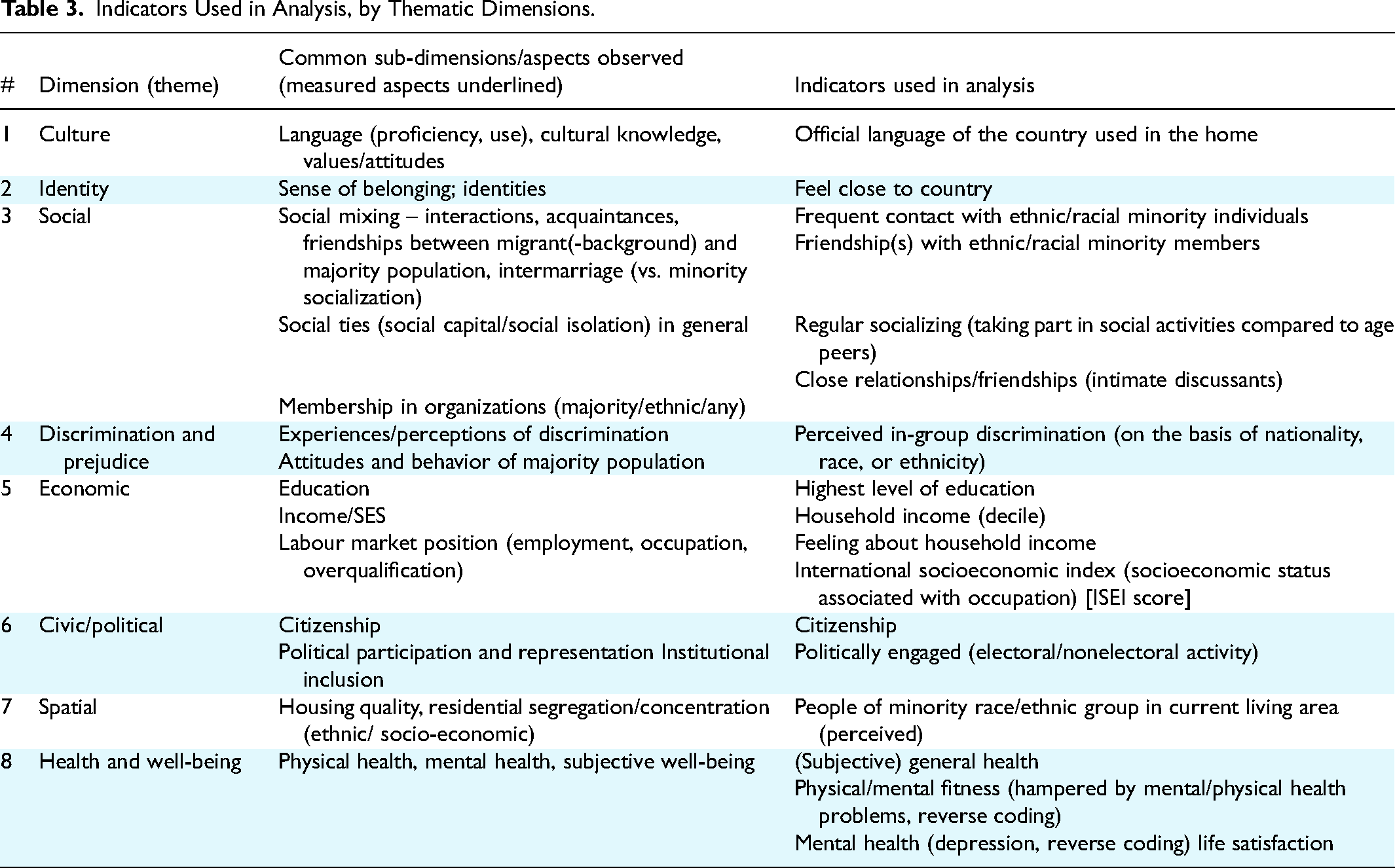
Though our coverage of aspects and dimensions of immigrant integration is far from exhaustive, we include one or a few typical indicators for each of the eight main thematic dimensions outlined, as shown in Table 3. Some indicators are consistent with the approach of assimilation, which is not equivalent to our own concept of integration. We include them because our goal is not to measure integration per se, but to test common theoretical–conceptual assumptions about the interconnection of aspects and dimensions of integration. Such assumptions, as discussed above, have often been conceptualized from the perspective of assimilation. Specifically, our 18 variables measure linguistic assimilation (within the domain of cultural integration); sense of belonging (within the domain of identity); minority socialization as an inverse measure of social assimilation and general socialization (within the domain of social integration); education, income, and socioeconomic status (ISEI), 8 based on occupational status (within the domain of economic integration); minority residential concentration as an inverse measure of spatial assimilation (within the domain of spatial integration); and measures of physical health, mental health, and life satisfaction (within the domain of health and well-being). For more details on variable construction, see Online Appendix Table A3. For simplicity's sake and in keeping with earlier practice by Bean et al. (2012) and Lessard-Phillips (2017), we code our indicators on socioeconomic status and different aspects of well-being such that higher scores imply more favorable outcomes, which, in this case, we interpret as positive from the perspective of immigrant integration (for summary statistics, see Online Appendix Table A2).
Indicators Used in Analysis, by Thematic Dimensions.
We examine outcome patterns across this set of variables with the method of factor analysis. Factor analysis uses the correlation matrix of a set of variables (“items”) to obtain a reduced set of latent constructs (“common factors”) that account for the pattern of variation observed among the variables (Allen 1973; Fabrigar and Wegener 2012). We rely on exploratory factor analysis in particular, as this method maintains the possibility of a relationship between any item and factor (Mooi, Sarstedt, and Mooi-Reci 2018). The theoretical interpretation of a factor is inferred from the cluster of items that load most highly on it, indicating a strong relationship (Acock 2008). Following in the footsteps of Bean et al. (2012) and Lessard-Phillips (2017), we use factor analysis to learn more about the underlying structure of associations among the variables and to identify some distinct dimensions of immigrant integration.
Proceeding with the analysis, we, first, produce a (weighted) correlation matrix for our items, using the polychoric command in Stata by Kolenikov and Angeles (2004). Based on this matrix, we, then, identify the number of underlying dimensions in our data, using Horn’s (1965) parallel analysis (Mooi, Sarstedt, and Mooi-Reci 2018). Once the number of dimensions is determined, we run a principal factor analysis, rotating results for interpretability. We use the resulting table of factor loadings to interpret the dimensions and observe association patterns. Additionally, we are interested in whether the revealed structure of associations between areas is fundamentally different across generational lines (e.g., first- vs. second-generation immigrants) and in more versus less inclusive policy contexts. 9 To examine these potential discrepancies in association patterns, we perform a set of additional separate analyses for first- and second-generation subsamples, as well as more and less inclusive contexts. Due to smaller subsample sizes, these results should be interpreted with caution and serve mainly as a robustness check.
Results
As outlined above, we, first, produced a correlation matrix for our 18 items on the overall sample (N = 1,066) (available upon request). A subsequent parallel analysis suggested five main underlying dimensions among our items. 10 Therefore, we performed a principal-factor analysis specifying five factors to be retained; the factor loadings for each of our 18 items are presented in Table 4 (varimax-rotated solution with Kaiser normalization; items are ordered by strength of loading for main associated factors, with loading values over 0.3 considered high).
Factor Loadings from Factor Analysis on Overall Sample (Factor Analysis with PF Method, 5 Factor Solution, Kaiser Varimax Rotation; N = 1,066).
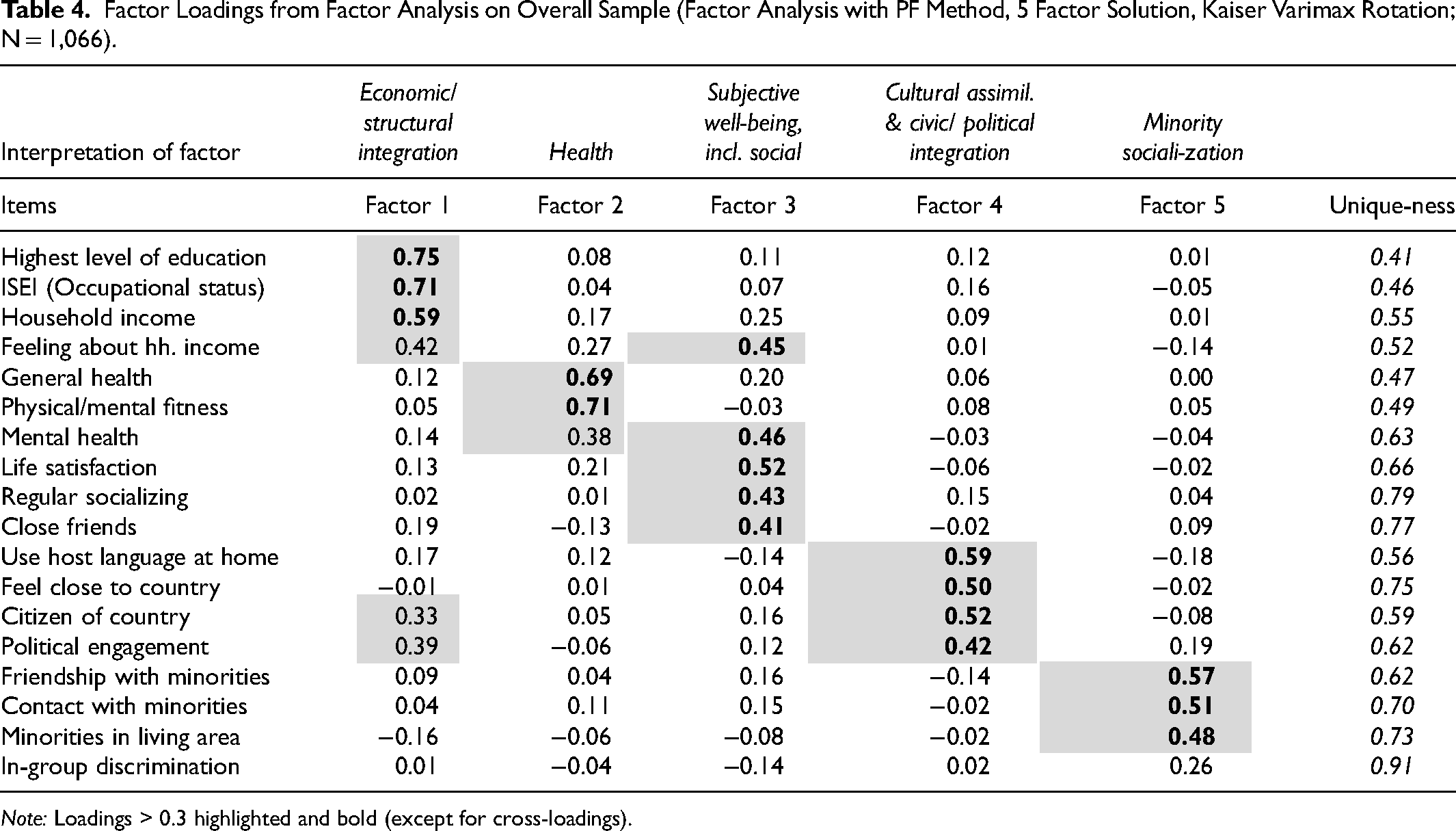
Note: Loadings > 0.3 highlighted and bold (except for cross-loadings).
The pattern of factor loadings in Table 4 suggests five fairly distinct dimensions of immigrant integration. The first factor seems to capture economic or structural integration, with highly loading items including education, ISEI/occupational status, household income, feeling about household income, political engagement, and citizenship. The second factor focuses on aspects of health (general health, mental/physical fitness, and mental health load highly), while a separate third factor gathers items related to subjective well-being, including the social aspect (life satisfaction, mental health, feeling about household income, taking part in social activities, and close friendships). The fourth factor seems to represent a joint dimension of cultural assimilation and civic/political integration (use official language at home, citizenship, feel close to country, and political engagement), distinct from a fifth factor that focuses on minority socialization (friendship with minorities, everyday contact with minorities, minorities in living area, and, less strongly, perceived in-group discrimination).
Several of the aspects examined relate strongly to more than one dimension, suggesting potential overlaps across integration dimensions. Aspects of civic-political integration, for example, cross-loads on the economic/structural dimension, while the subjective well-being dimension has highly loading items in common with the economic dimension (feeling about income) and health dimension (mental health). Importantly, no item with a strong positive correlation to one factor has a strong negative correlation to another. Turning to the ways in which aspects are not connected, the perception of in-group discrimination shows a strikingly high uniqueness value (0.91), indicating that the item does not relate very strongly to any factor identified and is quite distinct in its variation. We also note weak correlations, for example, between aspects of minority socialization and economic integration.
An additional look at how the results of such an analysis diverge for particular subgroups in our sample revealed largely similar factor structures to the one above, save for a few notable discrepancies mostly concerning the civic/political/cultural and subjective well-being dimensions. 11 (See Online Appendix Tables A4-A7 for factor loadings.) For instance, in the second-generation subsample, items of minority socialization cross-loaded, in the opposite direction, on the cultural assimilation dimension; moreover, the civic/political aspects loaded, not with the cultural aspects, but primarily on the economic/structural dimension. The first-generation subsample showed a similar factor structure to the joint-sample one. Turning to the country-group breakdown, two observations stand out. First, for the subgroup of respondents in “High MIPEX score” countries, cultural (linguistic and identificational) integration fell into the economic/structural dimension. Second, for the “Lower MIPEX score” countries, in-group discrimination had a strong negative correlation with the subjective well-being dimension (which includes social well-being). Nevertheless, these latter results should be interpreted with caution, given the smaller (N≈500) sample sizes of these analyses.
Discussion and Conclusions
This article set out to help develop a more consistent and nuanced incorporation of multidimensionality into the study of immigrant integration. To do so, it (1) provided an overview of the different conceptualizations of immigrant integration dimensions and related indicators in the prior immigrant integration literature and (2) shed light on inter- and intra-dimensional linkages from the existing literature, as well as through (3) an original study on European survey data. In the following, we summarize the main takeaways from each of our article's three sections.
The first section gave an overview of prior conceptual frameworks of immigrant integration to catalog and summarize the different dimensions and related aspects of integration. Starting from the basic dichotomy of sociocultural and structural dimensions, we proceeded to identify eight main (thematic) dimensions of integration emerging from the immigrant integration literature – culture, identity, social integration, discrimination and prejudice, economic integration, civic/political integration, spatial integration, and health and well-being – which we discussed, along with some of their most frequently observed aspects. We concluded with a table summarizing the most common dimensions and aspects of immigrant integration, which may be used for reference, as a conceptual framework in its own right, or as a starting point for more sophisticated future frameworks.
The second section looked into potential relationships between the above dimensions. Reviewing prior theoretical and empirical works, we identified four potential scenarios, with dimensions progressing (a) jointly, in sync; (b) generally in the same direction, though not necessarily simultaneously; (c) independently from one another; or (d) in opposite directions, in a trade-off dynamic. Concerning the relationship between sociocultural and structural integration, more recent theories and empirical works have emphasized the possibility of divergence, not only between these two main domains, but also within them. Though empirical evidence on the matter is still fragmented, it is becoming clear that immigrant integration outcomes may vary in complex ways across thematic dimensions (e.g., economic, spatial, cultural, social etc.) and even within them (e.g., education, occupational status). Further complicating the picture, the available evidence on multidimensionality suggests that the way in which dimensions of immigrant integration relate to one another may differ across ethnic groups, immigrant generations, and policy contexts (Bean et al. 2012; Lessard-Phillips 2017).
In reviewing different typologies of immigrant integration dimensions, we also noted two different logical approaches to multidimensionality: the “thematic” logic (in which integration dimensions are categorized by themes, e.g., based on different domains) and the “empirical” logic (in which different dimensions have an empirically observed divergence in outcomes). Our review of linkages across and within thematic dimensions of immigrant integration underscored the conceptual relevance of these relationships for multidimensional frameworks while also highlighting shortcomings in the related empirical knowledge base.
This article's third section presented an original empirical exploration of how different aspects of immigrant integration bundle together or diverge, aiming for broader thematic and geographical coverage compared to earlier studies, though facing our own set of limitations (discussed below). In a case study of Europe, we conducted a factor analysis of 18 indicators on varied domains from the eight thematic dimensions outlined above, using ESS7 data from first- and second-generation respondents across 19 countries, all of them ethnic/racial minorities in their respective societies (we exclude recent immigrants). An analysis of the correlation matrix of our 18 indicators revealed five underlying dimensions: (1) economic or structural integration; (2) health; (3) subjective well-being, including social well-being; (4) cultural assimilation and civic/political integration; and (5) minority socialization.
Comparing this empirically based five-dimensional integration framework to the eight thematic dimensions derived from the prior literature and outlined above, we note some interesting differences and similarities. For instance, drawing on earlier discussions, we might have expected aspects under the broad “sociocultural” theme to bundle together (e.g., Portes and Zhou 1993; Fokkema and de Haas 2011). However, in our empirical analysis we found the items of cultural (linguistic) assimilation and identificational integration not to bundle with the social aspects. Instead, items of cultural and identificational assimilation bundled with aspects of civic and political integration. Our analysis points to an interesting potential connection between acculturation and political integration, which is worth further examination. Civic and political integration items also cross-loaded with economic aspects on the structural/economic dimension, an association consistent with some prior integration frameworks joining economic and civic/political integration aspects into a single “structural” dimension of immigrant integration (e.g., Heckmann 2006).
Furthermore, our items relating to immigrants’ socialization patterns (minority socialization and general socializing) fell into two separate dimensions. Our social assimilation measures (minority socialization) formed a distinct dimension, joined by spatial integration. This finding is consistent with prior approaches in the integration literature (e.g., Alba and Nee 2003; Esser 2004b) that discuss social and residential mixing or, conversely, embeddedness in co-ethnic social networks and neighborhoods as going hand in hand (often discussed in terms of the “ethnic enclave”). Interestingly, we found discrimination to be quite distinct from other aspects in general, although it showed some connection to the minority socialization dimension of integration. General socialization, meanwhile, fell under the dimension of subjective well-being, which, in turn, was separate from the dimension of (physical) health. Given the less-established status of health and subjective well-being aspects among immigrant integration frameworks, these results offer some interesting initial evidence on their position within the broader multidimensional structure of immigrant integration.
As an interesting side note, the fact that the item of citizenship in particular appeared in dimensions alongside economic/structural integration indicators, as well as aspects of acculturation, may be interpreted as support for earlier research showing citizenship's wide-ranging effects as a facilitator, or even foundation, of integration (Ager and Strang 2008; Vink 2021). That said, citizenship's linkages to cultural and structural were likely also driven by the fact that in several European countries, a high level of integration (in terms of employment, education, language, etc.) is a prerequisite for immigrants seeking to naturalize (Bauböck et al. 2013).
An additional analysis of subgroups by generational status and policy contexts revealed largely similar structures, though with some differences in the spheres of cultural-political integration and subjective well-being. Most notably, when looking only at the second generation, we observe a joint “sociocultural assimilation” dimension in which minority socialization related negatively to cultural assimilation (in terms of language and identity, but not for the first generation, whose patterns mirrored those of the joint sample). Yet these results were conducted on relatively small subsamples (N < 500, in the latter case) and should, thus, be interpreted with caution.
Though our results are not directly comparable to prior cross-dimensional analyzes by Bean et al. (2012) and Lessard-Phillips (2017), since we use a different (and generally broader) set of indicators, we do see some noteworthy differences and overlaps. First, our main results do not suggest a distinct spatial dimension, which could be due to the limitations of our spatial assimilation measure (which is subjective and not very specific). Political engagement loaded highly with the economic dimension in our results, echoing Lessard-Phillips's results (2017) and Bean et al. (2012) results for Europe. Similar to findings in Lessard-Phillips (2017), identificational integration was tied to civic-political integration in our results, although linguistic and social assimilation only formed part of the same dimension for our second-generation subsample.
Concerning the hypothesized cross-dimensional linkage types discussed in our review, our main results largely point to positively, though not necessarily very strongly, connected dimensions (e.g., the economic/structural and cultural/civic-political domains and the economic/structural, health, and subjective well-being domains), as well as some relatively independent dimensions of integration (e.g., social (non-)assimilation and economic integration). Importantly, we do not find evidence suggesting any strong trade-off dynamics between different aspects of immigrant integration. All in all, then, the findings of our brief empirical analysis join an emerging literature in underscoring the possibility of divergence across and within main thematic dimensions of immigrant integration (e.g., between the economic and cultural domains or within the broad socio-cultural domain).
Our empirical results’ robustness and generalizability are limited by the already-mentioned sampling shortcomings, missing data, and the nature of some variables that required us to restrict our sample to ethnic/racial minorities to make them meaningful measures (in fact, our constructed ethnic/racial minority variable may itself be a source of imprecision). Future studies could take this line of investigation into more robust territory, given key data availability improvements. Such improvements may include, for example, a more populous and representative first- and second-generation immigrant sample, a wider coverage of European contexts, and more pointed variables on social mixing and residential integration. Data permitting, research identifying and confirming causal relationships between different dimensions and aspects of integration would be particularly relevant.
Notwithstanding these limitations, the empirical investigation presented in this article contributed much-needed evidence concerning the structure of cross-dimensional linkages within a multidimensional framework of immigrant integration. It is the first empirical examination of multidimensionality featuring a cross-European scope, first- and second-generation immigrants, and a wide-ranging set of indicators reflecting recent multidimensional frameworks. Our empirical investigation highlighted that thematic and empirical approaches to outlining integration dimensions lead to somewhat differently structured multidimensional frameworks, underscoring the need for critical consideration of the empirical basis when applying a multidimensional lens to immigrant integration. Together with our comprehensive overview of (multi)dimensionality and related concerns in integration research, this article makes key contributions toward the development of a more consistent and nuanced multidimensional approach to integration research and paves the way for future research seeking to improve understandings of immigrant integration.
Supplemental Material
sj-docx-1-jpx-10.1177_01979183221084329 - Supplemental material for Transnational Social Stratification? Legal Status of Immigrant Parents and the Educational Achievements of Mexican Children
Supplemental material, sj-docx-1-jpx-10.1177_01979183221084329 for Transnational Social Stratification? Legal Status of Immigrant Parents and the Educational Achievements of Mexican Children by Kyle E. Waldman in International Migration Review
Footnotes
Acknowledgments
We are grateful to Dr. Ingrid Storm, Dr. Zhaoya Gong, Dr. Miguel Ribeiro Ramos, and three anonymous reviewers as well as Dr. Jamie Winders for their valuable comments on earlier drafts of this paper. We would also like to thank Dr. Johannes Karl and Dr. Roland Fischer for their helpful methodological assistance for group invariance testing in R. Finally, this research would not have been possible without the generous support of the Global Challenges Scholarship at the University of Birmingham.
Declaration of Conflicting Interests
The author(s) declared no potential conflicts of interest with respect to the research, authorship, and/or publication of this article.
Funding
The author(s) disclosed receipt of the following financial support for the research, authorship, and/or publication of this article: This work was supported by the University of Birmingham.

Supplemental Material
Supplemental material for this article is available online.
Notes
References
Supplementary Material
Please find the following supplemental material available below.
For Open Access articles published under a Creative Commons License, all supplemental material carries the same license as the article it is associated with.
For non-Open Access articles published, all supplemental material carries a non-exclusive license, and permission requests for re-use of supplemental material or any part of supplemental material shall be sent directly to the copyright owner as specified in the copyright notice associated with the article.
