




Abstract
The interdependence of migration and family formation has been studied extensively, but studies that consider the embeddedness of this interdependence within gender and class relations are less common. Most existing research on family and migration treats gender and social class as separate determinants of family events or transitions, instead of analyzing how the intersections of both shape full family formation trajectories, defined as all partnership and childbearing statuses throughout an individual life course. We overcome this gap by using an intersectionality framework to analyze trajectories of family formation and migration collected by the Mexican and Latin American Migration projects (1982–2016). Using retrospective information, we reconstruct full family formation and dissolution trajectories (i.e., individuals’ marital statuses and number of children born from ages 15 to 39) for 16,000 individuals and apply sequence and cluster analysis to define a six-category typology of ideal family formation trajectories. Next, we associate this typology with individuals’ sex, age at migration (domestic, international), and educational attainment as a way to measure individuals’ social class position. Our results suggest that the relationship between migration and typical family trajectories depends on the intersection of individuals’ social class and gender. Previous studies have neglected this intersection by overly focusing on the “average” migrant's experience. Migration research must acknowledge and account for migrants’ heterogenous experiences and pay more attention to how intersecting social categories mediate the relationship between migration and other demographic processes.
Introduction
Family formation and migration are interrelated processes, embedded in gender and social class relations. This article examines these two processes -- family formation and migration -- during the second half of the twentieth century in Latin America to broaden understandings of the region's history and to encourage further social class- and gender-based research in migration. A key insight of scholarly work on family dynamics is that the interdependence of life events (e.g., entering a union, having children) contributes to the perpetuation of social inequalities across the life course (Furstenberg 2008; McLanahan and Percheski 2008). In addition, decades of research on migration in the Americas have underlined the fact that migration and family formation should be examined jointly (Sana and Massey 2005; Coubes, Solis and Zavala de Cosio 2016). While it is well known that, in Latin American and Caribbean (LACar) societies, the unequal unfolding of family and migration events contributes to widening gender gaps and class distances (Frank and Heuveline 2005; González-Ferrer et al. 2018), scholars’ capacity to frame these two life-course processes - family formation and migration trajectories - as embedded in social class and gender relations jointly is less advanced. The lack of a systematic analysis of family formation and dissolution trajectories, defined as all union formation and childbearing statuses throughout an individual life course (family trajectories, hereafter), is partly responsible for this gap in the literature.
The explanatory frameworks adopted by previous studies on migration and family focus on homogeneous or “mean” social outcomes by testing a set of explanatory hypotheses on how migration relates to family patterns: socialization, selection, disruption, and assimilation/adaptation (Adserà and Ferrer 2015). Due to their widespread use in the literature, we refer to them as common explanatory hypotheses (Lindstrom, Hernandez-Jabalera and Saucedo 2021). This deductive approach overlooks heterogenous paths and vulnerable groups that can be identified by intersecting social categories (e.g., adolescent migrants who drop out of the formal educational system). Thus, instead of testing deductively defined hypotheses, we rely on intersectionality theory (e.g., Choo and Ferree (2010)) to develop a bottom-up, inductive analysis of family trajectories that links the interdependence of life events with social class and gender differences in family and migration patterns in LACar rural and urban areas and the main receiving countries of LACar international migrants (i.e., the US, Canada, and Spain).
Intersectionality theory, we argue, offers a conceptual framework to explain how gender and social class relations jointly shape the interdependence of family formation and migration trajectories (Crenshaw 1991). Specifically, we focus on four key concepts of intersectionality: inequalities and complexities of the family formation process, relationality among social categories, and power relations underpinning these intersecting social categories (Hill Collins and Bilge 2016, chap. 2).
We examine the existing heterogeneity in family trajectories by looking at sequences of marital status and the number of children born from ages 15 to 39 among individuals born in the LACar region. These sequences allow us to study processes, as opposed to single events, and to highlight the complexity of the life course, instead of mean/modal outcomes. Understanding family formation dynamics as complex life-course processes reveals their cumulative nature and helps us better understand how gender and social class differences in family formation trajectories emerge, unfold, and persist throughout the life course. This focus on the complexity of family trajectories is arguably a more realistic understanding of individuals’ lives than one centered on average or modal measures, such as the mean ages at migration, union formation, marriage, and childbearing.
To maximize the heterogeneity of migration experiences (i.e., the timing and type of migration and the destination) and family formation patterns in our analytical sample, we pool all waves of the Mexican and Latin American Migration projects (MMP and LAMP) with harmonized information on family and migration up to 2016. These data are well suited for our analysis, as they provide rich retrospective information on family and migration for a large number of men and women from diverse origins. The data cover eight countries and more than 200 local communities and collect information on migrants in the United States, Spain, and Canada.
Because family formation and migration are structurally different for men and women, we analyze them separately and focus on the interaction of multiple socioeconomic and migration variables, such as age at migration, type of migration, and educational attainment. The interaction of these variables allows us to study groups with different degrees of intersecting vulnerabilities/disadvantages, ranging from adolescent women with low educational attainment who migrate to escape poverty to adult migrants whose migration trajectories are associated with higher education and specialized training (Donato 2010; Zenteno, Giorguli and Gutiérrez 2013). This multiple-intersecting-categories approach reflects the relational aspect of intersectionality thinking (Choo and Ferree 2010) and is in line with multivariate approaches to social class in LACar countries (Castro Torres 2020). According to these two frameworks, intersectionality theory and multidimensional social classes, what matters most in understanding the significance of a phenomenon (e.g., family formation trajectories) is how it occurs differently across the intersection of social categories that are relevant for a particular context and how these differences reflect power relations.
Combined, these data and approaches allow us to answer the question of how family trajectories vary by social class and gender in the context of LACar domestic and international migration during the second half of the twentieth century and to reveal the stratified and gendered nature of interrelated migration and family formation process in the LACar region. In doing so, our article's contribution is twofold. First, our in-depth description of family trajectories in LACar countries reveals hitherto-neglected heterogeneity in family formation trajectories and shows how this heterogeneity relates to migration, gender, and social class. Ours is one of the first studies that analyze full family trajectories in several LACar countries. Second, we provide an intersectionality-driven interpretation of the relationships between migration and family trajectories. We use this interpretation for two purposes. First, we reassess the scope of the so-called common explanatory hypotheses used by migration scholars to explain family patterns among migrant populations (e.g., Lindstrom, Hernandez-Jabalera and Saucedo (2021)). Second, we change the overarching narrative, implied by previous scholarly work, from a discussion of the mean differences in family events by separate socioeconomic and demographic variables (e.g., the examination of the “average migrant”) to an analysis of a heterogeneous spectrum of relations among gender, social class, and migration. We draw this second idea from De Haass (2014) critique of the excessive focus on the “average migrant” for understanding differences in socioeconomic outcomes between migrant and native-born populations, particularly in studies of South-North migration (e.g., LACar migrants in North America and African migrants in Europe).
This article is organized as follows. In the background section, we discuss social class and gender differences in family and migration trends in LACar countries for the study period (1950–2000) and the origin, uses, and limitations of the above-mentioned “common explanatory hypotheses.” Next, we present the assumptions made to develop our analytical strategy and the hypotheses we are testing. In the data and method section, we describe the MMP and LAMP data and the statistical methods we use to analyze them. This section also presents the link between intersectionality and a relational measurement of social class (e.g., Weininger (2005)) and the relevance of these theoretical connections for understanding the LACar context. Finally, the last two sections present the results and conclusions and discuss their implications for migration studies in both LACar countries and other contexts.
Background
Gender and Class Difference in Family and Migration Patterns in LACar Countries
Family change in LACar countries during the second half of the twentieth century was extensive and uneven (Guzmán et al. 2006). From 1950 onward, LACar countries experienced significant fertility decline, growing cohabitation, and marital instability (García and de Oliveira 2011). These changes were related to several factors, including women's increasing participation in domestic and international migration flows (Donato 2010). Despite these fundamental changes, the relationship between social class and family trajectories in the LACar region persisted. Early- and high-fertility trajectories continued to be associated with low socioeconomic status, low educational attainment, and limited upward social mobility. The reverse is true for family trajectories of delayed and low fertility (Juarez and Gayet 2014). This strong connection between family trajectories and social classes is largely due to the limited scope of LACar educational expansions (Sánchez-Ancochea 2021). LACar educational systems have failed to provide universal coverage beyond primary education, and, due to quality differentials (e.g., between rural and urban schools), high educational attainment does not always translate into better socioeconomic conditions virtually in all countries of the region (Torche 2014).
Likewise, gendered differences in the timing of family formation persisted through the second half of the twentieth century in LACar societies (García and de Oliveira 2011). According to the Latin American Demographic and Health Surveys, the country-level average of the proportion of couples where men were at least five years older than women was 59 percent in the 1990s and 61 percent in the 2000s (Measure DHS 2020). By starting families later, men had more time to accumulate assets, labor market experience, and educational degrees compared to women (Singh and Samara 1996; Juarez and Gayet 2014; Allendorf et al. 2017). Once part of a couple, women are expected to undertake most of the care work at home and are often underemployed; men, by contrast, are responsible for the household's financial support, typically have better jobs, and enjoy a privileged status within marriage/union regarding inheritance rights (Deere and Leon 2003; Urdinola and Tovar 2019).
In terms of migration, during the 1960s and 1970s, rural-to-urban migration dominated domestic migration flows in LACar countries (Rodríguez Vignoli and Busso 2009) and was a primary factor in fertility decline (Guzmán 1996). As the urbanization process consolidated, however, the relevance of rural-to-urban migration decreased, and international migration started to take off (Fussell 2010). Emigration rates from LACar countries to the United States, Canada, and some European countries grew sustainably from 1960 onward, fueled by salary gaps between origin and destination countries and international migration policies such as the Bracero program, which positively influenced Mexican emigration rates well beyond its official termination year (1964) due to the family reunification that followed after the program's end (Clark, Hatton and Williamson 2003; Castles, De Haas and Miller 2014). Both domestic and international migration flows were also fueled by internal armed conflicts in Colombia, Nicaragua, and Mexico (Massey and Capoferro 2006; Alvarado and Massey 2010; Donato et al. 2010).
Persistent economic development gaps between origin and destination countries and migratory regulations (sometimes designed to curb migration) helped consolidate these migration streams before the turn of the century and fostered more balanced (less male-dominated) sex ratios in migration flows, particularly in the context of international moves (Donato 2010; Massey, Durand and Pren 2014, 2015; Castro Torres and Canal Laiton 2018). Women's higher participation in migration created complex gender relations, as women gained financial independence from men and were exposed to relatively more gender-egalitarian contexts compared to their origin communities (e.g., cities in the United States, Europe, and the LACar region vs. rural and migrant-sending areas in LACar countries) (Pedraza 1991; Herrera 2008).
These relatively more egalitarian migration contexts and opportunities for women should not be exaggerated. For most of the twentieth century, international mobility was more restricted for women than for men (Kanaiaupuni 2000; Curran and Rivero-Fuentes 2003; Donato 2010); when women intend to migrate, they typically depend more on family and kinship networks than do men (Curran and Rivero-Fuentes 2003). Hagan (1998) showed that, among Mayan migrant domestic workers in Houston (United States), residential isolation prevented them from developing horizontal relationships with non-Mayan individuals, which translated into less social and cultural capital to interact with the local community and institutions. This residential isolation did not occur among men, who were disproportionately employed in occupations that allowed them to develop horizontal networks with native-born men. These gender differences are present in virtually all dimensions of the migration experience, including migration's timing and destination and a household's decision-making and labor division (Massey, Fischer and Capoferro 2006; Donato 2016). Although there are instances when migration favors women's empowerment and financial independence (Hondagneu-Sotelo 1992; Parrado and Flippen 2005), aggregate trends at origin and destination suggest that negative consequences override positive ones, translating into worse socioeconomic and labor conditions for women, especially those from lower socioeconomic backgrounds (Sassen-Koob 1984; Herrera 2013).
Due to the chronological preeminence of domestic migration over international migration and global concerns about high fertility in low- and middle-income countries during the 1960s and 1970s (Clark, Hatton and Williamson 2003; Rodríguez Vignoli and Busso 2009), scholarly theories about how migration related to family dynamics initially focused on fertility among rural migrants in urban contexts (e.g., Goldberg 1959; Zárate and Unger De Zárate 1975; Hervitz 1985). These studies developed a set of hypotheses that have been gradually adapted to analyze other family-related dynamics and contexts, such as union formation/dissolution among international migrants (e.g., Kulu 2005; Kulu and González-Ferrer 2014; Parrado 2015), therefore becoming common explanatory hypotheses in the migration and family literature.
Uses and Limitations of “Common Explanatory Hypotheses”
Scholarly work on fertility among rural migrant women in LACar and other low- and middle-income countries was instrumental in developing the four main hypotheses explaining fertility differentials between domestic migrants and stayers (Macisco and Myers 1975). This literature documented almost universally that rural migrants’ completed fertility ranked between the fertility levels of rural and urban stayers (Zárate and Unger De Zárate 1975; Bach 1981). Scholars explained this result in terms of four hypotheses: selection, socialization, disruption, and assimilation/adaptation.
The selection hypothesis posits that fertility is lower among rural-to-urban migrants than non-migrants at origin because the former are a specific group whose fertility behavior and preferences resemble those of the destination population (Hervitz 1985). In the adaptation/assimilation hypothesis, lower fertility among migrants is considered to be the result of different living and working conditions at destination, such as the higher opportunity cost of childbearing compared to labor market participation (Chattopadhyay, White and Debpuur 2006). However, fertility among rural migrants is never so low as that of urban stayers (Brockerhoff and Yang 1994). Hence, in the socialization hypothesis, the origin's social environment influences fertility behavior (Schkolnik and Chackiel 2004). Finally, the disruption hypothesis suggests that migration interferes with the realization of migrants’ fertility preferences, due to family separation (Jelin 1977).
Research on family and international migration finds that migration and family formation are connected and that the four explanatory hypotheses are complementary (Kulu 2005). Lindstrom and Giorguli-Saucedo (2007), for example, have documented how the temporal separation of Mexican couples, due to migration, depresses fertility by disrupting family formation schedules. Parrado (2011) has shown that period fertility rates overestimate Hispanic fertility, due to the connection between migration and the transition to first birth. However, he also showed that differences in completed fertility between foreign- and native-born women of Hispanic origin are negligible, meaning that there are indications of assimilation/adaptation. Adserà and Ferrer (2014) have demonstrated that, in Canada, married women's fertility rates are low before migration and high one year after, signaling that migrants delay fertility, depending on their migration plans. Although these studies all find evidence of disruption and adaptation, differences across migrants’ origin have also led some authors to give validity to the socialization hypothesis, as is the case with African groups in Spain and some LACar women in the United States (Stephen and Bean 1992; Parrado and Morgan 2008; Kulu and González-Ferrer 2014; González-Ferrer et al. 2017).
Despite these explanation's overall consistency, what is misleading about understanding the relationship between migration and family dynamics in terms of the relative validity and complementarity of these four hypotheses (i.e., a deductively built narrative) is the disconnection of individuals from their gender and social class and the lack of attention to the intersection of these two factors in influencing family formation and dissolution trajectories. As noted by De Haas (2014) and Garip (2012), hypothesis-driven accounts about migrants reconstruct the story of an “average” individual, paying little attention to the fundamental markers of migrants’ social position.
Analytical Approach
In this article, we rely on two assumptions, one general hypothesis (H1), and two secondary hypotheses (H1.1 and H1.2) that incorporate multiple relations between family and migration. Our assumptions are based on our broad understanding of the above-cited literature about migration and family, particularly on the studies about LACar societies and migration trends. Our main hypothesis refers to the overarching patterns in the relationships between migration and family by social class and gender in the LACar region. Furthermore, our bottom-up statistical approach makes our analysis partially inductive and, thus, fundamentally different from deductive approaches to hypothesis testing (e.g., Kulu (2005)).
Assumptions
Our primary assumption is that migration and family formation are embedded in social class and gender relations. Whether family formation occurs before or after migration and how a family trajectory unfolds vary across both social classes and gender because both processes are influenced by individuals’ opportunity structures (Hondagneu-Sotelo 1994; Van Hear 2014). Class-specific family trajectories may preclude or encourage migration as much as class-specific migration opportunities delineate the family trajectories of potential migrants.
This assumption implies that the family strategies that migrants follow to cope with new living conditions at destination vary according to their social class and gender. As family formation occurs earlier among women than men, especially among those from lower social classes, women's migration could further accentuate social class differences among them. An important branch of the literature on gender and migration in LACar countries has shown that lower-class women migrate before age 18, without being fully supported by their parents, if they are married to an older male migrant (Herrera 2012). Their life experiences and opportunities are substantially different from those of higher-class women who migrate as daughters within economically and socially advantaged families (Sassen-Koob 1984; Herrera 2012; Donato 2016). Thanks to their families’ support, this latter group has better socioeconomic opportunities before, during, and after migration.
Our second assumption states that international migration is more disruptive and riskier, requires more resources, and implies more contextual changes than domestic migration, at least for the LACar context during the period of analysis. Therefore, international migration may imply more extended periods of separation from family members and more uncertainty within couples. Formal marriage may facilitate international migration or be a requirement for family reunification. In contrast, domestic migration is less affected by high risks and costs, since in principle, distances are shorter, return migration more affordable, re-migration less risky, and family reunification subject to fewer or no legal constraints (Curran and Rivero-Fuentes 2003). Well-established migrant networks may decrease the cost and risk associated with international migration and even facilitate circular migration (Massey 1990; Fussell 2010); however, these lower risks and costs do not negate the main difference between domestic and international migration.
Hypotheses
Our hypotheses describe the expected associations between socioeconomic (dis)advantages along lines of social class and gender and the disruptions implied by domestic and international migration to individuals’ family formation trajectories.
Data and Methods
Data Sources and Comparability
For our analyzes, we combine data from the Mexican and Latin American Migration projects (MMP and LAMP). 2 These two projects’ shared methodological and theoretical basis makes them highly comparable (D. Massey and Zenteno 2000; Riosmena 2016). Their most substantial advantage is their ability to capture the history and heterogeneity of migration dynamics across LACar countries, particularly with regards to international migration (Massey and Riosmena 2010). The LAMP in South America collects information about migrants in Spain, Canada, and the United States. In this migration stream, Spain is the most common destination. The MMP and LAMP in Central America collect information on migrants in Canada and the United States, with the United States being the most significant destination for Mexican and Central American migrants. The Mexican and Central American migration streams are larger than the South American streams, particularly the Mexico-US migration flow, which is the largest and oldest of all country-specific migration flows in the region (Donato et al. 2010).
Hence, the combined use of these data is based on the “maximum differences” design (Przeworski and Teune 1982). Patterned relations between migration and family trajectories that appear among migration streams of different size and stages of development imply greater significance than patterned relations among a more homogeneous set of migration streams (e.g., if we had focused only on Mexican data). Family and migration trajectories across these LACar countries are comparable, given their relative uniformity in terms of overarching family patterns (Esteve and Lesthaeghe 2016), class structures (Portes and Hoffman 2003), and position within worldwide migration systems (Organization of American States 2011). A recent study on family formation, fertility, and migration, for example, has proven the fruitfulness of pooling data across these migration streams (Lindstrom, Hernandez-Jabalera and Saucedo 2021).
Data collection years and sampling areas vary across countries. The MMP has run on a yearly basis since 1982 and had a rural focus during its first few years. However, some urbanized areas (e.g., from the Mexican state of Jalisco) were included in the project as early as 1982. The LAMP samples spanned 1999 to 2016 and, for South America, are mainly derived from urban areas. We use the Mexican data until 2016. The other countries (waves) with harmonized birth and marital histories for household heads and migration histories for household heads and spouses/partners are Colombia (2008, 2016), the Dominican Republic (1999, 2000), Ecuador (2012), Guatemala (2004), Nicaragua (2000, 2002), and Peru (2001, 2005).
Finally, the MMP's and LAMP's local representativeness requires some comments. A fraction of households in the sample were randomly selected from local communities with high emigration rates in origin countries. Among these randomly selected households, data were collected during the end of the year, when migrants were likely to be visiting their families (Massey and Zenteno 2000). The remaining households were incorporated into the data through a snowballing sampling strategy at destinations. Due to these collection strategies, the data are biased toward returning migrants with strong family ties and presumably more stable family trajectories, which implies that our results may overstate the significance of family stability among migrants.
Family Formation and Dissolution Trajectories
Our outcomes of interest are sequences of individuals’ family statuses from ages 15 to 39. Family statuses are the combination of four marital status categories (never married, married, cohabiting, and separated/divorced/widowed) and four groups according to the number of children born: zero, one, two, and three or more (i.e., parity groups). Table 1 displays the number of individuals for whom family trajectories are available by sex, type of migration (domestic vs. international), and age at migration.
Analytical Sample by sex, Type of Migration, and age at Migration.
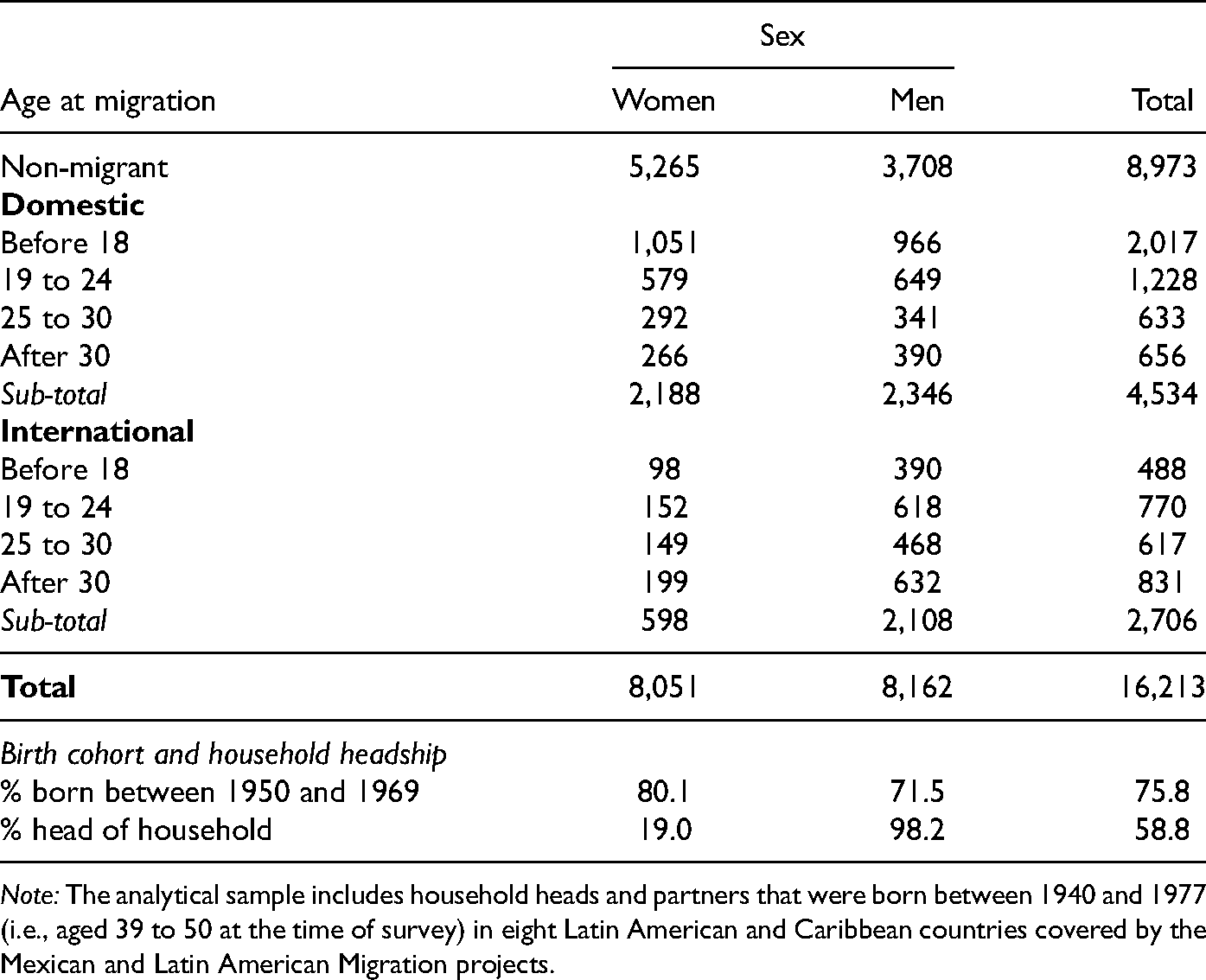
Note: The analytical sample includes household heads and partners that were born between 1940 and 1977 (i.e., aged 39 to 50 at the time of survey) in eight Latin American and Caribbean countries covered by the Mexican and Latin American Migration projects.
Due to differences in the years and frequency of data collection across countries and to increasing sample sizes over time, most individuals in the sample were born between 1950 and 1969 (lower panel in Table 1). 3 The family trajectories among the 1950–1969 birth cohorts are more comparable than the overall sample because family patterns were relatively homogeneous among these birth cohorts (Fussell and Palloni 2004). Thus, our results are unlikely to be driven by differences between older (<1950) and younger (>1970) cohorts. Robustness checks are included in the Online Appendix.
Because we do not have the marital and birth histories of household heads’ partners/spouses (81 percent of the women and 1.8 percent of the men, according to Table 1), we assume that they had the same family trajectory as their partner/spouse who was the household head, only adjusting their age difference. This assumption is not problematic for individuals who entered marriage/union at early ages and did not divorce/separate, as they share family trajectories. In our sample, 88 percent of individuals did not report divorces or separations; the median age at marriage was 21 for women and 24 for men (unweighted). These low divorce/separation prevalence and median age at marriage mean that, for a large share of our sample, the assumption of shared family trajectories is not problematic.
In the remaining 12 percent of cases, where individuals reported divorce, separations, and/or remarriage, assuming shared family trajectories between household heads and spouses/partners may be incorrect. First unions/marriages and divorces/separations may not be included in the data, and a stable family trajectory may be incorrectly assumed. Hence, these spouses/partners’ family paths are biased toward more stable family trajectories. Additionally, given that most household heads were men, assuming shared family trajectories between household heads and spouses may undermine gender differences. These two potential biases make our results a conservative estimate of actual differences by gender. We conducted a separate analysis of the family trajectories of household heads (1,526 women and 8,013 men), and the results were consistent.
Explanatory Variables and Individuals’ Social Position
The explanatory variables used in this analysis are type of migration, age at migration, and educational attainment. We analyzed men's and women's data separately and interpreted both sets of results jointly to illuminate gendered differences. Individuals are classified as non-migrants if they did not report domestic or international moves. We classify international trips as migration moves if they lasted at least three months and involved work or an active job search. We sum the time of all such trips for each individual; if the cumulative time spent abroad was at least 12 months, we classify the individual as an international migrant. 4 For domestic moves, we rely on information about the year of occurrence and duration of the first move. We calculate the age at migration as the difference between the year of first migration and the year of birth and code it into four groups: <18, 19–24, 25–34, and 34 + .
Individuals who reported both international and domestic migration are considered international migrants for two reasons. First, international migration has greater implications for family trajectories than domestic migration (Paul 2011). These greater implications are associated with the distance between the countries, the costs of migration, and the legal requirements for migrating, returning, and staying (Arango 2000). Second, the sample size does not allow us to separately analyze individuals who migrated both internationally and domestically (1,010 men and 233 women - see Table A1). Additionally, only in 25 percent of these cases did domestic migration occur after international, suggesting that domestic moves were the first step in an international migration trajectory (Figure A1).
Educational attainment is separated into four categories of years of schooling (y.s.): 0–4 (lowest), 5–8 (low), 9–12 (medium), and 13 + (high). Fewer than four years of schooling only ensure basic literacy and numeracy skills, while five to eight years imply basic competence for manual jobs (Donato et al. 2010; Sánchez-Ancochea 2021). Nine to 12 are roughly equivalent to high-school completion in the United States system, and more than 12 years indicate at least some college education. Due to the characteristic of LACar educational systems mentioned above, this variable is a good measure of individuals’ social position within stratification systems beyond the mere account of human capital accumulation. Moreover, there is a strong correlation between educational attainment and class position in LACar countries (De Ferranti et al. 2004: 6), and we observe this correlation in our data. For example, most women with fewer than four y.s. were out of the labor force (68 percent), potentially working in the informal economy. This figure was only 24 percent among women with at least 13 y.s. For men, the modal occupations for each educational attainment group were primary occupations in agriculture and mining (0–4 y.s.), skilled manual occupations (5–8, and 9–12 y.s.), and education and professional (13 + y.s.).
We interacted our explanatory variables as means to measure intersectional social categories that are relevant for both the context (LACar societies) and the phenomena (migration and family trajectories) we are studying. We argue that the resulting categories of this multiple interaction provide a relevant measure of the opportunity structure that individuals face for migrating and forming families (i.e., their social class position vis-à-vis migration and family formation opportunities). Because the interacting variables measure several dimensions of individuals’ vulnerabilities (e.g., adolescent migration) and socioeconomic privileges and disadvantages (e.g., access or lack thereof to higher education), their interaction measures individuals’ social position within LACar stratification systems. Although the interaction of these variables is not a direct measure of social class in the classical sense (e.g., based on occupational status or income level), it is consistent with relational approaches to social class that define it as the set of relationships that determine individuals’ opportunity structure (Bourdieu 1996; Weininger 2005). This approach based on variables’ interactions is also fully in line with the foundations of intersectional analysis (Bauer et al. 2021).
Intersectional Social Categories and Data Analysis Steps
We follow a three-step partially inductive data analysis strategy. First, we use sequence and cluster analysis (SA/CA) techniques to create a family typology that minimizes the within-category variance of individual family trajectories and makes categories maximally distinct (i.e., maximizes between-category variances). Specifically, we apply the Ward method to a pairwise individual-level dissimilarity matrix calculated via Optimal Matching (OM). To account for the timing of union formation/dissolution, childbearing, and qualitative differences across family statuses, we adjust OM measures, using Lesnard’s (2010) and Gower’s (1971) approaches, respectively (Studer 2013). 5 We chose a six-group partition based on the proportion of explained variance and consolidated this clustering, using the K-means algorithm (Kaufman and Rousseeuw 1990).
Second, we use multinomial models to estimate the family typology's conditional distribution across the 72 groups resulting from the interaction of our explanatory variables (type of migration, age at migration, educational attainment, and sex). We control for birth cohort groups (<1950, 1950–59, 1960–69, and >1970) and regions (Central America, South America, and Mexico) to account for changes over time and differences across regions and migration streams in family patterns and sample sizes. We use the expression “family profiles” to refer to these conditional distributions. 6 In the third step, we extract and display the main patterns and uncertainty among family profiles by applying a Principal Component Analysis to a table that appends 500 replications of the 72 family profiles. The replications are based on the predicted probabilities and standard errors estimated by the multinomial models.
Despite the limitations of our data and methods, our approach is in line with four core concepts of intersectionality: SA/CA accounts for the complexity of the family formation process and maximizes the inequality between family trajectory types. Additionally, the PCA plots emphasize relationality and power and ultimately show where socially disadvantaged and socially privileged categories (e.g., migration at young ages vs. migration during late adulthood) stand with respect to one another based on their multinomial model propensities to follow certain family paths, thus offering a visual representation of the social relations underlying family formation dynamics. This approach to operationalize these concepts helps us understand migration's implications beyond the description of the “average migrant's” experience.
Results
Prevalence of Migration by Sex and Educational Attainment
According to the left panel in Figure 1, emigration rates from LACar countries to Canada, Spain, and the United States have been growing since 1970, particularly among our countries of focus (colored-bolded lines). Emigration rates were higher in Central America and Mexico than in South America, due to the long history of migration streams in the former, but South American nations display very similar growth trends over time. As for the migrant population's gender composition (right panel), South American migration flows changed from being male dominated in 1960 to slightly female dominated in the 2000s. The opposite trend is observed in Central America, with the exception of the Dominican Republic, where women outnumbered men throughout the study period. These growing and diversifying trends speak to the diversity of international migration flows in LACar countries.
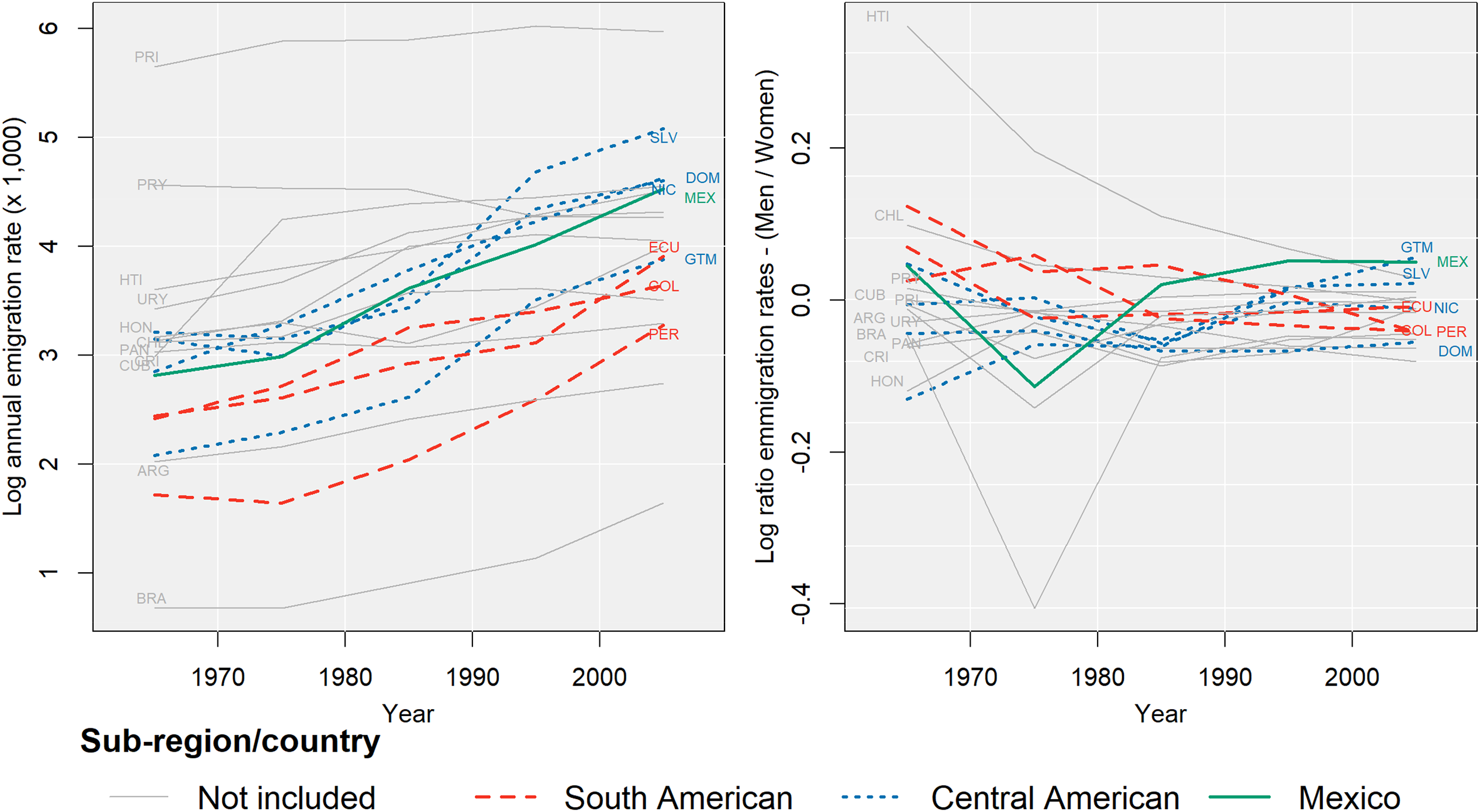
Time trends in emigration rates and emigration sex ratios to the United States, Spain, and Canada from eight latin American and Caribbean countries in the natural logarithm scale. Note: Migration data come from the World Bank – Global Migration Database. Population data come from the United Nations Population Prospects (2017). Countries are labeled as Argentina (ARG), Brazil (BRA), Chile (CHL), Colombia (COL), Costa Rica (CRI), Cuba (CUB), Dominican Republic (DOM), Ecuador (ECU), El Salvador (SLV), Guatemala (GTM), Haiti (HTI), Honduras (HND), Mexico (MEX), Nicaragua (NIC), Panama (PAN), Paraguay (PRY), Peru (PER), Puerto Rico (PRI), Uruguay (URY).
According to Table 2, gender differences in international migration prevalence are greater in the MMP and LAMP samples than in the overall population (Figure 1), reflecting the gendered nature of mobility in LACar emigration communities. Table 2 shows that only 12 percent of women migrated to another country, whereas roughly one in three men did so (p-value < 0.01). In contrast, the prevalence of domestic migration (approximately 27 percent) is indistinguishable between men and women.
Migration Prevalence and Educational Attainment by sex and Type of Migration – Bolded Values Indicate Statistically Significant Differences Compared to Non-Migrant.
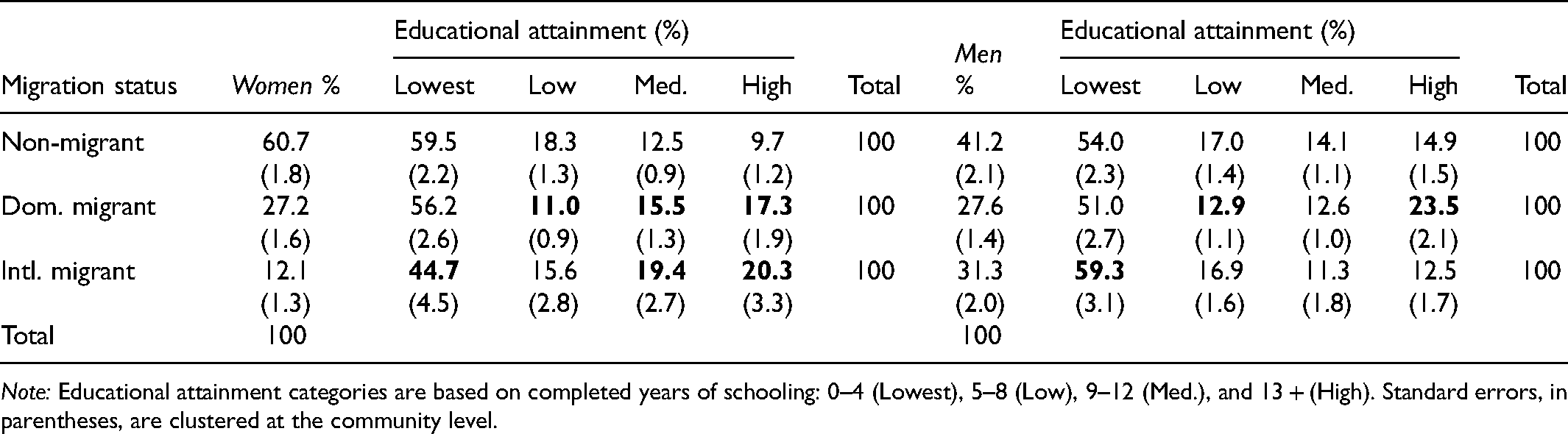
Note: Educational attainment categories are based on completed years of schooling: 0–4 (Lowest), 5–8 (Low), 9–12 (Med.), and 13 + (High). Standard errors, in parentheses, are clustered at the community level.
The pattern of statistically significant differences (bolded values, Table 2) in educational profiles by migration status suggests that migrants are positively selected, meaning that their socioeconomic conditions at origin were more privileged than those of non-migrants. As most domestic moves occurred before age 25 (approximately 70 percent), domestic mobility was positively associated with better educational opportunities at destination.
Gender differences in educational attainment are apparent among both migrants and non-migrants, but the direction of the gap differs between domestic (favorable to men) and international migration (favorable to women). Among non-migrants, the gender ratio in the proportion of individuals with higher education is 14.9/9.7 = 1.53 (p-value < 0.01), meaning that men were 53 percent more likely to pursue higher education than women. Among domestic migrants, this ratio is smaller, 1.36 (p-value < 0.01), but still favors men. In contrast, for international moves, gender differences in the flow selection favor women: 20.3 percent of international migrant women had at least 12 y.s. (versus 12.5 percent among men). Men were negatively selected in international migration flows, with 59.3 percent having only up to four y.s. This different selectivity implies that migrant women were more likely to be from families with higher socioeconomic status, compared to both men and non-migrants. These selection patterns reappear across age-at-migration groups, particularly among young adult migrants (see Table A2).
Family Typology and Family Profiles
The family typology's six categories differ in terms of number of events (unions, births, separation/divorces), something we refer to as intensity, and in the degree of deviation from a “normative” family path (i.e., early transition to a unique and stable marriage). By using the term “normative,” we emphasize that there is a large group of individuals with family trajectories of unique and stable marriages, which makes the phenomenon a tacit societal norm.
Figure 2 displays individual family trajectories and typologies for women and men. The distribution of men and women in this typology represents the family profile of the LACar communities studied.
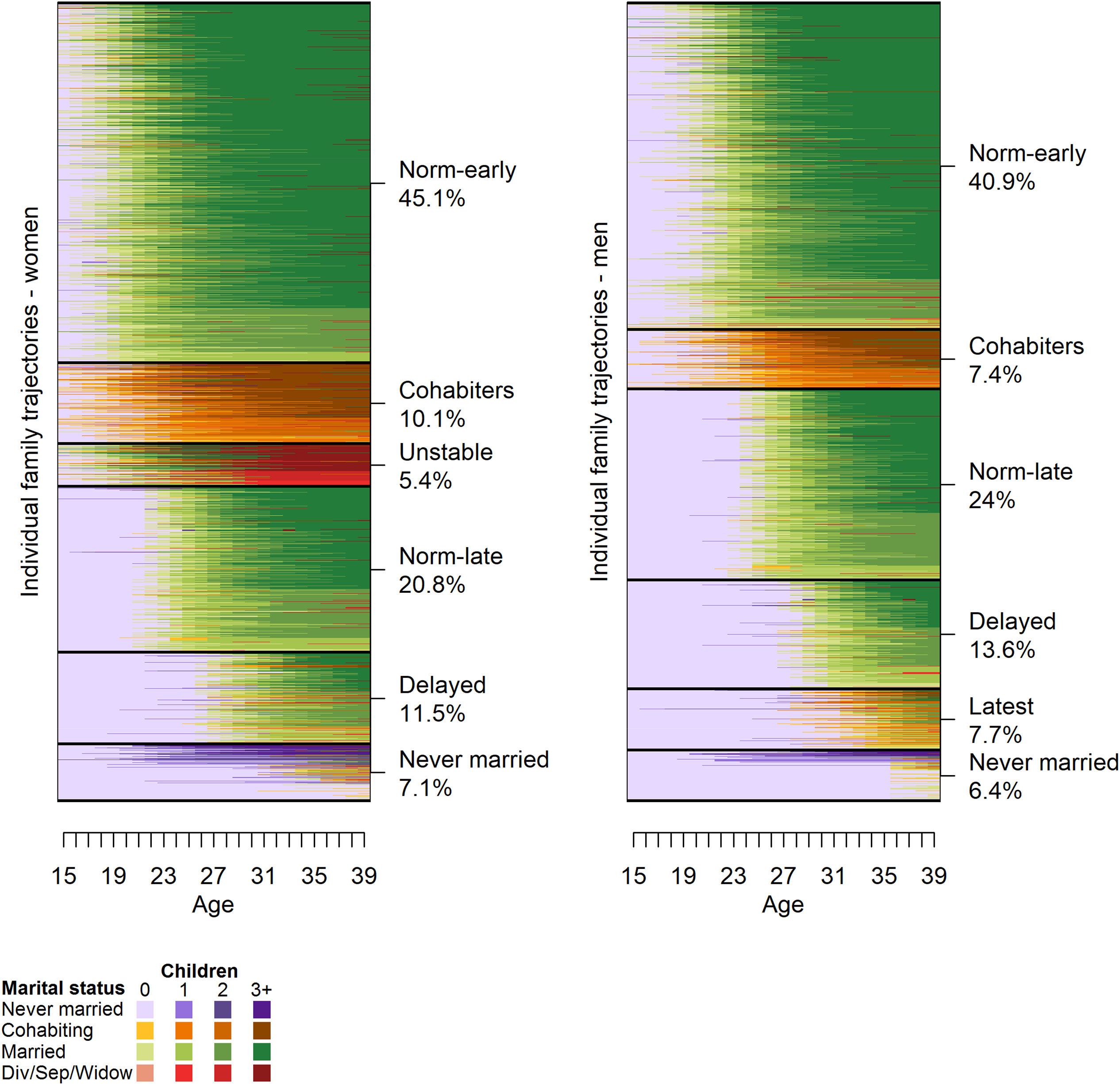
Individual family trajectories and family typology by sex and percentages by region. Note: Individual trajectories are sorted by completed fertility within each family category. Even though figures account for sample weights, interpretations should be cautious due to overplotting.
The plot's bottom area contains the three categories of low-intensity family events and delayed transitions to union formation and childbearing (i.e., lower prevalence of marriage and union formation, late marriage, and low fertility). The top area comprises the one category of high-intensity family events (multiple births, divorces, and marriages). The central area includes two “atypical” family trajectories (unstable and lifelong cohabitation).
These typologies account for 84.5 and 85.8 percent of the total variance in individual family trajectories of women and men, respectively. These two percentages are high compared to the proportion of explained variance by educational attainment categories (less than 3.5 percent, see Figure A4 for a visual comparison). Thus, our SA/CA successfully creates internally homogeneous and externally distinct groups.
Accounting for 7.1 percent of women, “Never married” is a category of singleness and single motherhood. Only a small number of women in this category entered unions during the observation period. For all other categories, the transition to union formation is universal and occurs later among the 11.5 percent of women in the “Delayed” category and earlier among the 20.8 and 5.4 percent of women in the “Norm-late” and “Unstable” categories. Virtually all women in the “Unstable” category were separated or divorced by age 39, and all women in the “Cohabiters” category cohabited for most of the observation time. Women in the top group (“Norm-early”) moved to union formation very early and had the highest completed fertility of all categories. We label this group “Norm-early” because it included 45.1 percent of women in the sample and was characterized by early, universal, and stable marriages. Divorces among this group were infrequent, and, when they occurred, women tended to remarry.
Among men, there was no “Unstable” category; instead, an additional category of very delayed transitions to union formation and low fertility was added (“Latest”). The overall delayed schedule and the absence of the “Unstable” category among men are potentially consequences of gender differences in the age at union formation, marriage, and childbearing. In other words, by age 39, men and women had had completely different family formation experiences, particularly in terms of early transition and union instability.
To assess how this typology and the differences by gender may be driven by the assumption about the shared family trajectories of household heads and spouses/partners, Table 3 contrasts the typology for the entire sample (rows) and the typology obtained only for household heads (columns). This table also displays the proportion of household heads in each family category. Despite substantial differences in household headship by gender (98.2 percent for men and 19.0 percent for women), correlations between the typologies are remarkably high for both groups, suggesting that the role of this assumption is relatively unimportant for women and negligible for men.
Comparison of Family Typologies for all Individuals and Household Heads and Proportion of Household Heads in Each Family Category by sex.
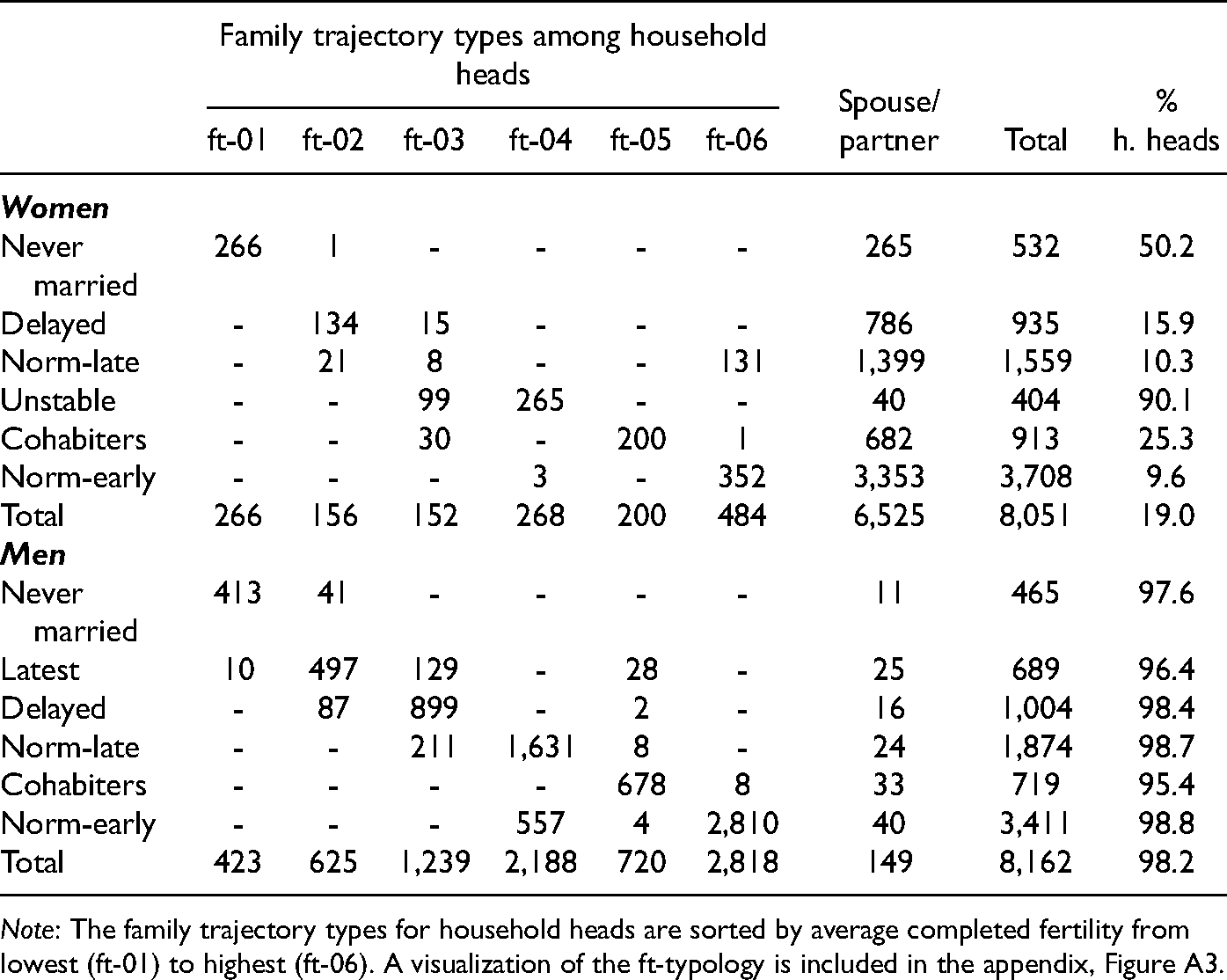
Note: The family trajectory types for household heads are sorted by average completed fertility from lowest (ft-01) to highest (ft-06). A visualization of the ft-typology is included in the appendix, Figure A3.
There are, however, two important differences between the typologies among women. First, the “Unstable” category is split into two categories (ft-03 and ft-04, see Figure A3). This discrepancy is not problematic because 90.1 percent of women in the “Unstable” category were household heads, meaning that their family trajectories were observed. A visual inspection of Figure A3 confirms that the difference between ft-03 and ft-04 is that the former category contains cohabiters who separated, whereas the latter groups contain women who were married and then divorced. In short, the “Unstable” category is a valid descriptor of the life-course family experiences of women.
Second, the “Norm-late” category is merged primarily into ft-06. The absence of the “Norm-late” category among household heads is problematic. These women could have been married or in unions before marrying their current partners (i.e., the household head from whom we borrow the family trajectory). These previous marriages and unions are impossible to observe, which biases women's family paths toward stable and delayed trajectories and downplays gender differences. We take this bias into consideration when interpreting the multivariate results.
An important aspect of this typology is its variation across regions, as displayed in Table 4. This table validates the typology's categories, in the sense that it does not contradict what we know about family systems in LACar countries, while also adding important aspects regarding the unfolding of family events during individuals’ life courses (Quilodrán 2011; Esteve, Lesthaeghe and López-Gay 2012). The aforementioned high prevalence of marriages in LACar countries is split into four categories that differ in terms of the timing of marriage (early vs. delayed), stability of unions/marriages (early-unstable vs. stable), and fertility levels and timing (high vs. delayed-low). Likewise, the pattern of early union formation among “Cohabiters” suggests that the so-called dual regime of unions and marriages in LACar countries, where these two types of unions are treated as equal, may only be true for certain sub-population groups, rather than for the entire population.
Marginal Distribution of the Family Typology by Regions for Women (top) and Men (Bottom).
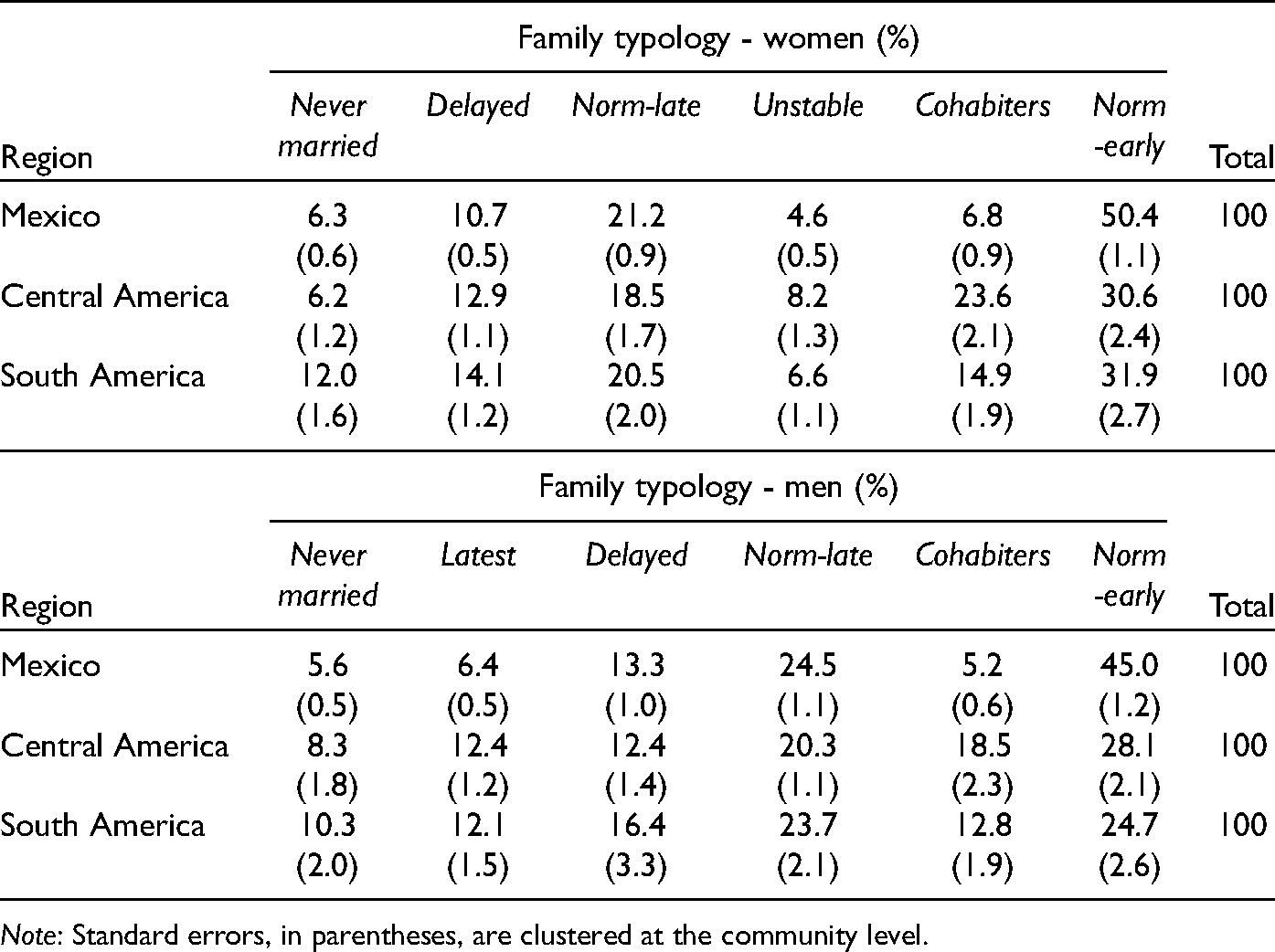
Note: Standard errors, in parentheses, are clustered at the community level.
According to Table 4, the main difference across Mexican, Central American, and South American family profiles is the proportion of the “Cohabiters” and “Norm-early” categories, reflecting the higher prevalence of marriage in Mexico compared to the other two regions. The highest proportion of “Cohabiters” is observed in Central America. South America displayed larger proportions of women and men in the “Delayed” and “Latest” categories compared to Mexico. Differences in the other categories are smaller and non-statistically significant. These differences and similarities among Mexican, Central American, and South American family profiles and the differences in the urbanization levels of sampling areas between regions require controlling for region when estimating family profiles by age at migration and educational attainment.
Intersectional Heterogeneity
Figures 3 and 4 display the first two factorial axes of the PCA on the 500 replications of the family profiles 7 and summarize 55 and 52 percent of the variance of the replicated family profiles of women and men, respectively. We separate domestic (left) and international (right) migrants for clarity. Both planes contain the non-migrant group and are interpretable jointly. Because this type of plot is not common in family and migration research, we include some comments on how to interpret it.
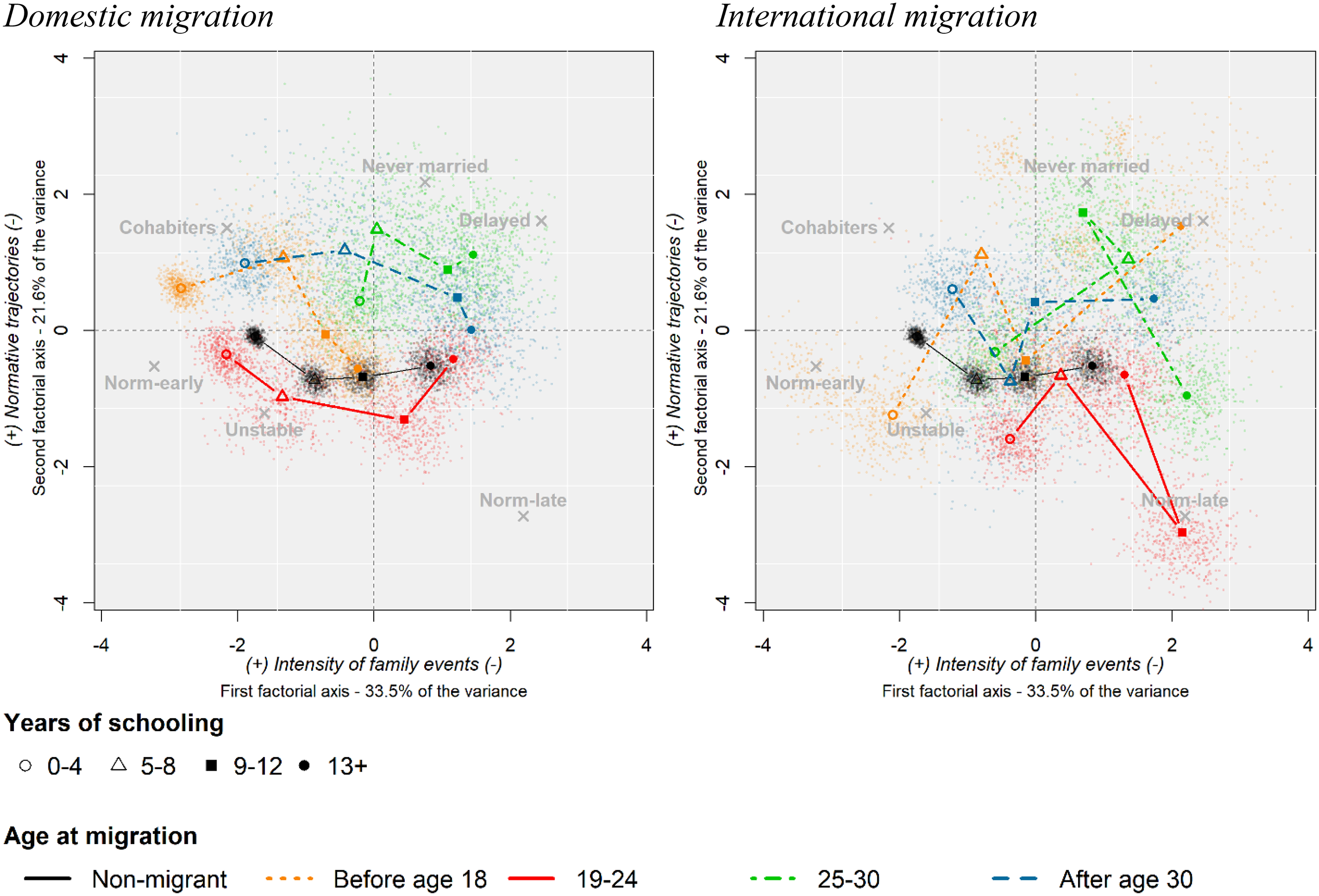
Family profiles’ factorial coordinates by type of migration, age at migration, and educational attainment for women. Note: The mean family profile is Never married (10.7%), Delayed (18.2%), Norm-late (23.8%), Unstable (5.8%), Cohabiters (7.2%), and Norm-early (34.2%). White background lines are separated by one standard deviation of the factorial coordinates.
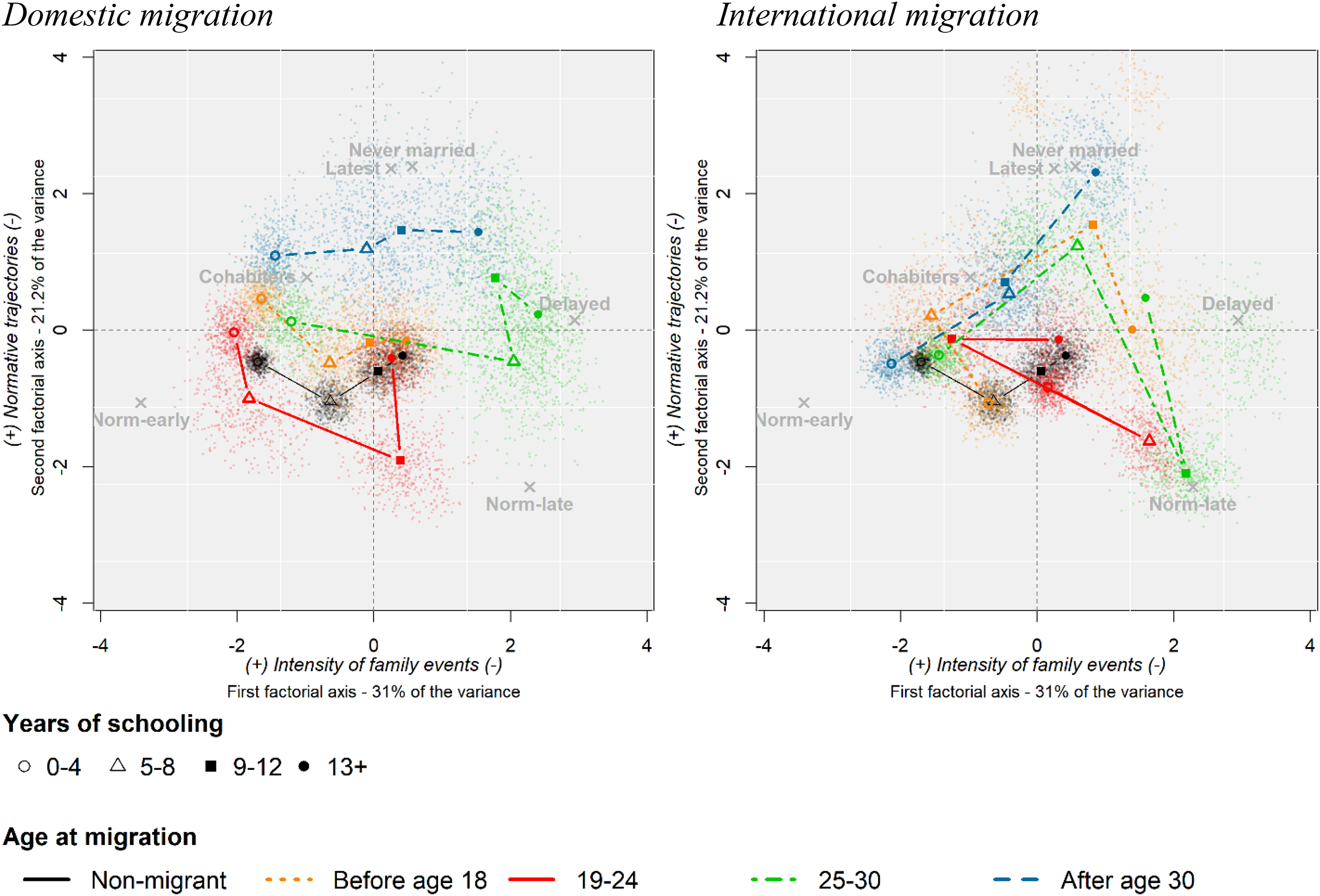
Family profiles’ factorial coordinates by type of migration, age at migration, and educational attainment for men. Note: The mean family profile is Never married (8.4%), Latest (8.9%), Delayed (16.9%), Norm-late (25.8%), Cohabiters (6.5%), and Norm-early (33.5%). White background lines are separated by one standard deviation of the factorial coordinates.
The plot's center represents the marginal distribution of the family typology, as estimated by the multinomial model. The categories of the family typology and the family profiles of all educational attainment and age at migration groups are represented by markers (
For the family profiles, the proximity between a group and a family category implies positive association; distance/separation implies the opposite. Therefore, if two groups are close to each other, their family profiles are similar; if two groups are far from each other, their family profiles differ. Non-overlapping distributions of dots provide a sense of the statistical significance of the differences in groups’ family profiles, and lines connecting educational attainment levels depict educational gradients.
Thus, higher education among women is associated with low-intensity and non-normative family trajectories (“Never married,” “Delayed,” and, to a lesser extent, “Norm-late”). Low educational attainment is associated with the “Unstable,” “Cohabiters,” and “Norm-early” family trajectories. The clouds of points of the highest and lowest educational attainment groups do not overlap. Importantly, these differences in family profiles across educational attainment groups are greater among domestic migrants than among non-migrants, the only exception being women who migrated between ages 25–30. For them, family profiles had higher proportions in the “Never married” and “Delayed” categories for all educational attainment groups. Domestic migration also separates the family profiles of young adult migrants (19–24) from those of adult migrants. The former group was strongly associated with traditional family trajectories (bottom area) and the latter with less traditional ones. This pattern holds for all educational attainment groups.
Overall, international migration was negatively associated with cohabitation: only two of the 16 groups of international migrants appeared in the same quadrant as the “Cohabiters” category. Additionally, family profiles among international migrant women displayed more significant and less patterned deviations across educational categories compared to domestic migrants, meaning that international mobility was more disruptive than domestic and that disruptions were more heterogeneous in the former case. As educational attainment is a strong predictor of family outcomes, the disruption of educational profiles among international migrant women signals the importance of the migration experience for family trajectories. For example, among women who migrated as adolescents (<18), the distance between the family profiles of the low and highly educated is the greatest. This separation suggests the existence of two distinct family migration paths. On one side, lower-educated women who did not finish high school, probably because they migrated independently, are associated with “Norm-early” and “Unstable” trajectories. On the other, women who also migrated as adolescents but had at least some higher education are associated with the “Never married” and “Delayed” family trajectories.
Women who migrated between ages 19–24 were more likely to be in the “Norm-late” category. Among these women, union formation, union stability, and migration were strongly intertwined, potentially because marriage and migration occurred very close to each other in women's lifetimes. Family profiles for women who migrated between ages 25–30 were strongly disrupted. These women were more likely to follow low-intensity and non-normative family paths, with the exception of those who had higher education. The last age-at-migration group displays more modest deviations compared to non-migrants.
As seen in Figure 4, the factorial axes also separate low-intensity family trajectories (right) from high-intensity ones (left), as well as normative from less/non-normative trajectories along the vertical direction. However, the distribution of family profiles in the plot differs between genders, underlining the significance of gender relations in influencing individuals’ probabilities to follow certain family trajectories in the context of migration. These correlations are extremely apparent in the analysis of our sample because, even though men and women's family trajectories are not fully independent, the results differ by gender.
Family profiles, in the context of domestic migration, display less disruption among men than women, with three critical similarities. First, differences across educational attainment levels follow the same direction for both genders: higher education was accompanied by lower-intensity and less normative trajectories. Second, late migration was associated with less intense and less normative family trajectories. Third, migration between ages 19 and 24 was strongly associated with normative trajectories.
In the international migration context, men's family profiles were strongly disrupted and less patterned than those of women, as hypothesized above. There are, however, three distinguishable patterns. Compared to their social class counterparts who migrated domestically (i.e., men with similar educational attainment who moved within the country), international young adult migrants (19–24) were more likely to fall into the “Norm-late” category. If we compare this result to that for young adult migrant women with low educational attainment (Figure 3), we see that the association between this group and the “Norm-late” category is not so strong as it was for men. Indeed, young adult migrant women with the lowest educational attainment were associated with “Norm-early” and “Unstable” family categories, emphasizing that similar social class backgrounds and age at migration may have had different implications for men and women.
Migration between ages 25 and 30 was associated with the most considerable educational differences, separating highly educated men in “Delayed” category from lower-educated men, who tended to follow “Norm-early” and “Cohabiters” trajectories. Finally, men with low educational attainment who migrated after age 30 displayed almost identical family profiles as those who did not migrate. By contrast, highly educated men who migrated late were substantially more likely to be in the “Latest” and “Never married” categories, compared to their non-migrant class counterparts. These patterns are very similar to those observed in the analysis of the 1950–1969 birth cohort. Although smaller sample sizes yield greater uncertainty in the estimates (i.e., more dispersed clouds of points), the overarching patterns in Figure A4 are highly consistent with those in Figures 3 and 4.
Conclusions and Discussion
The literature introduced in the first part of this article shows that the development of international and domestic migration streams during the postwar period in LACar countries was part and parcel of major societal transformations in the region (Portes 1989; Rodríguez Vignoli and Busso 2009; Donato et al. 2010). We capitalize on the diversity of these migration streams to uncover patterns and relationships between the migration experiences and family formation trajectories of more than 16,000 individuals from eight countries. The LACar case is an illustrative example of why we must examine how the relationship between migration and family formation varies by type of migration, in terms of both gender and social class (understood from a relational perspective and proxied by the interaction of our explanatory variables). Deductive research designs that overly focus on testing competing/complementary hypotheses have been unable to analyze these patterns (e.g., Lindstrom, Hernandez-Jabalera and Saucedo (2021)). Here, we propose a partially inductive approach, informed by intersectionality theory, to understand the concrete circumstances that make the adaptation, assimilation, disruption, and socialization hypotheses valid or not in the case of LACar countries. Moreover, we derive some implications for studies of international migration in other world regions.
Our main conclusion is very straightforward: migration is not associated with a unique family trajectory or with changes in a specific direction (e.g., delayed or accelerated family formation, higher or lower fertility, more or less marital stability). Instead, migration and family formation are tied in several ways, depending on individuals’ social class and gender positions. Migration can partially transform the influence of social class and gender, without eliminating their structural roles. Indeed, in several cases, migration can reinforce the inequality in opportunities at play due to social class and gender. This conclusion suggests that migration studies itself could benefit from examining how the interaction of these two factors matters for migrants’ socioeconomic and demographic outcomes, including, but not restricted to, fertility and family formation. We, of course, are not the first to notice the need to use the concepts of social class and gender in migration studies (Kanaiaupuni 2000; Herrera 2012; Van Hear 2014). However, we are the first to emphasize the full potential of investigating their intersection for understanding family trajectories, using quantitative data.
The intersection of social class and gender helps us make sense of the variety of patterns that emerge when migrants’ family trajectories are inductively analyzed. Some of these patterns fit into the narratives of the socialization, selection, disruption, and adaptation hypotheses, while others do not. Instead, from an intersectional perspective, social class and gender relations are structural factors that shape individuals’ opportunities and aspirations to migrate and form families (and potentially achieve other socially desirable goals). Hence, differences in the opportunity structures of people across the social spectrum imply that there is no one unique socialization experience, but several, depending on individuals’ social class and gender. These social class- and gender-specific socialization experiences shed light on why the overall pattern of family profiles by educational attainment is rather similar across age at migration groups and also why differences by gender are so apparent.
Similarly, gender differences in migrants’ educational selectivity are the byproduct of gendered gaps in accessing education and prevailing gender norms in LACar countries that make migration more restrictive for women than for men (Curran and Rivero-Fuentes 2003; Juarez and Gayet 2014). Gender norms in LACar countries associate women with family care and domestic work, for which neither higher education nor migration experience is necessary (Massey, Fischer and Capoferro 2006; Donato 2010). In other words, migrant women's stronger positive selection in terms of educational attainment shows that it is more difficult for women to migrate internationally, compared to men. Likewise, men's negative selection is associated with recruitment policies that targeted men with lower educational attainment, encouraging them to migrate to the United States as agricultural workers, during the 1960s and 1970s (Garip 2017). This reversed-flow selection by gender in international migration emerges from the higher constraints on women's mobility and the more favorable migration channels offered to men with low educational attainment.
As for the hypotheses regarding disruption and adaptation/assimilation, our intersectional lens reveals that family trajectories among socially and economically privileged individuals were not affected by migration so much as they were among disadvantaged populations (e.g., young uneducated migrant women), underlining the role of power imbalances between classes and genders. To the extent that some of these specific trajectories (e.g., “Early-norm” and “Unstable”) were associated with worse socioeconomic outcomes for migrants, class- and gender-dependent disruption and adaptations contribute to widening class and gender differences.
Despite its disruptive nature, domestic migration did not erase class and gender differences in family profiles; if anything, it accentuated them among young migrants. This conclusion does not hold, however, for international migration. Class differences in family profiles among international migrants were disruptive and displayed a significant qualitative difference by gender. For women, class differences were heightened if migration took place before age 18 and diminished when migration occurred between ages 19 and 30. For men, patterns across ages at migration and educational attainment were more erratic, reflecting men's privileged position in the realms of family and migration. Simply put, men's family trajectories were less affected by their social class and migration history than women's. This result suggests that current scholarly hypotheses depicting specific relations between men's family profiles and their socioeconomic and demographic characteristics are still far from becoming an explanatory frame that fully addresses the gender perspective for men (Kanaiaupuni 2000; Lindstrom and Giorguli Saucedo 2002; Parrado and Flippen 2005).
These gender differences have significance beyond the LACar case. In most countries with negative migration balances since the 1950s, men and women do not have the same opportunities to form families and migrate (Donato 2016). Family formation starts considerably earlier for women than men, and women need more resources to be able to undertake international migration (Curran and Rivero-Fuentes 2003; Juarez and Gayet 2014). These differences impact the reproduction of gender gaps in socioeconomic outcomes because women have considerably less time available for the accumulation of educational degrees and assets valuable for the labor market, a difference that is further increased by disparities in the distribution of care work. To the extent that migration is also a time- and resource-consuming process, women may face twofold disadvantages, as migration-related disruptions affect a smaller baseline of their time and resources compared to men. The implications of these differences can be greater for women from low- and middle-low social classes because the timing of family formation among these two groups is the earliest.
Although we observe these patterns only for migration streams from LACar sending communities, rising levels of economic inequality, sustained gender inequality, and the increasing diversification of migration flows worldwide (Bauman 1998; England 2010; Pikkety 2019) suggest that our conclusions may apply to any migration system involving men and women from diverse socioeconomic and cultural backgrounds. Narratives based on the experiences of the “average” migrant have neglected the heterogeneity of the association between migration and family formation and, therefore, overlooked its implications (Portes 2010). Acknowledging this heterogeneity and the relevance of intersecting social categories yields a more holistic and nuanced narrative on how migration and family relate to each other. Although this alternative narrative could be seen as less straightforward than the so-called “average-migrant” narrative, highlighting the diversity of experiences and the multiplicity of relationships between demographic phenomena could be the basis for differentiated family and migration policies. We hope this article further encourages more scholarly migration research on how intersecting forms of inequality shape demographic processes.
Supplemental Material
sj-pdf-1-mrx-10.1177_01979183211067768 - Supplemental material for Gendered and Stratified Family Formation Trajectories in the Context of Latin American Migration, 1950 to 2000
Supplemental material, sj-pdf-1-mrx-10.1177_01979183211067768 for Gendered and Stratified Family Formation Trajectories in the Context of Latin American Migration, 1950 to 2000 by Andrés F. Castro Torres, Edith Y. Gutierrez-Vazquez in International Migration Review
Footnotes
Acknowledgments
We are thankful to the Population Association of American for awarded the Best Poster Award to an earlier version of this work during the 2018 Annual meeting in Denver, Colorado. We also thank the French National Institute for Demographic Studies (Ined) in Paris and the Center for Demographic Studies at the Autonomous University of Barcelona for allowing us to present this work as it progressed.
Declaration of Conflicting Interests
The author(s) declared no potential conflicts of interest with respect to the research, authorship, and/or publication of this article.
Funding
The author(s) received no financial support for the research, authorship and/or publication of this article.

Supplemental Material
Supplemental material for this article is available online.
Notes
References
Supplementary Material
Please find the following supplemental material available below.
For Open Access articles published under a Creative Commons License, all supplemental material carries the same license as the article it is associated with.
For non-Open Access articles published, all supplemental material carries a non-exclusive license, and permission requests for re-use of supplemental material or any part of supplemental material shall be sent directly to the copyright owner as specified in the copyright notice associated with the article.
