




Abstract
Countering linear acculturation theories, the adoption of Western European gender customs over time differs across migrant groups. This diversity implies that acculturation into support for gender equality is context dependent. However, little quantitative scholarship has identified what sort of contexts strengthen or impede acculturation. This article investigates one source of context-dependent acculturation: exclusionary contexts. I build and test a context-dependent exclusions framework that proposes that contexts that exclude non-Western migrants hamper their acculturation into support for gender equality in the labor market in Western Europe. Empirically, I synchronize European Social Survey, European Values Study, and Eurislam data on over 11,000 non-Western migrants in Western Europe. Cross-classified models show that non-Western migrants’ support for labor-market gender equality is, indeed, lower in exclusionary contexts, for instance, in destinations with stronger anti-migrant sentiments. Pivotally, the impact of destinations’ gender customs on migrants’ gender values differs across destination, origin, and community contexts. For instance, in destinations with stronger populist right-wing parties, migrants internalize destinations’ gender equality less. Altogether, non-Western migrants’ acculturation into support for labor-market gender equality is highly dependent on contextual exclusions, which means that populist claims about non-Western migrants’ universal lack of acculturation into support for gender equality should be viewed cautiously.
Introduction
In Western Europe, with immigration on the rise, questions are swirling about whether migrants, especially non-Western migrants, integrate culturally (Van Tubergen, Maas, and Flap 2004; Norris and Inglehart 2012; Van der Zwan, Bles, and Lubbers 2017). Most acculturation debates portray non-Western migrants as having strongly traditional gender norms that, among other things, see women's place as in the home (Ghorashi 2010; Spierings 2015). Such debates argue that non-Western migrants’ supposed lack of support for gender equality in the labor market hampers female migrants’ structural integration, while also putting additional pressure on Western welfare states (Bejarano, Manzano, and Montoya 2011; Kavli 2015; Kretschmer 2018).
This article explores non-Western migrants’ acculturation in Western European societies by investigating their support for gender equality in the labor market. I develop a context-dependent exclusions framework, which emphasizes that contexts that exclude non-Western migrants hamper their acculturation and block their support for gender equality in the labor market. In doing so, I address two lacunae that limit current understandings of non-Western migrant acculturation.
First, this article identifies spatiotemporal circumstances (i.e., contextual characteristics), rather than individual attributes, that may ease non-Western migrants’ acculturation into support for gender equality in the labor market. The vast majority of existing studies of support for gender equality focus on individual characteristics (see Spierings 2015; Glas 2021). Acculturation has, for instance, been shown to be dependent on individuals’ gender (Röder and Mühlau 2014) and religiosity (Van Klingeren and Spierings 2020), but far less is known about how contextual factors shape to what extent non-Western migrants adopt destination societies’ norms. However, scholars of structural integration have shown that integration outcomes are shaped by origin contexts (the countries from which non-Western migrants originate, such as Pakistan), destination societies (the countries in which non-Western migrants live during a particular year, such as France in 2016), and communities (origin-destination pairs, such as Pakistani migrants in France in 2016) (Van Tubergen 2006). This article starts to unpack how contexts affect acculturation by identifying contextual characteristics that facilitate or impede non-Western migrants’ adoption of Western European societies’ labor market gender norms.
Second, this article also theorizes and tests a more nuanced view of acculturation than the linear acculturation theories often applied in quantitative explorations of non-Western migrants’ support for gender equality (e.g., Inglehart and Norris 2003; Norris and Inglehart 2012; Kavli 2015). Most contemporary public opinion research argues that migrant groups acculturate to or adopt their destination society's gender customs gradually over time, without paying attention to group differences (see Bejarano, Manzano, and Montoya 2011; Spierings 2015). However, not all migrant groups acculturate equally, and acculturation differs between contexts (Portes, Fernandez-Kelly, and Haller 2005; Bernhhardt, Goldscheider, and Goldscheider 2007; Röder and Lubbers 2015). Although acculturation's context dependency was observed by scholars as early as the 1990s (Berry 1992; Portes and Zhou 1993), large-N scholars have made little progress in identifying what contexts facilitate or fuel acculturation (c.f., Donato et al. 2006). To date, for example, no quantitative study has addressed contextual characteristics beyond gender customs in the destination country (Röder and Mühlau 2014; Breidahl and Larsen 2016; Pessin and Arpino 2018). This article, thus, theorizes and tests under what circumstances non-Western migrants adopt their destination societies’ labor-market gender customs.
The overarching question here is what contextual factors affect non-Western migrants’ acculturation into support for labor-market gender equality. However, this article does not explore each and every contextual characteristic that might shape acculturation but, instead, zooms in on contexts of exclusion. Integrating insights from qualitative gender studies (e.g., Le Espiritu 2001), quantitative migration studies (e.g., Wimmer and Soehl 2014), and social identity theory (e.g., Tajfel and Turner 1979) that all emphasize exclusions, I develop and test a context-dependent exclusions framework proposing that non-Western migrants acculturate less in contexts that exclude them more. If this context-dependent exclusions framework proves useful, current public debates that portray non-Western migrants as a stubbornly traditional group separate from native-born Europeans may themselves hamper greater support for gender equality among non-Western migrants (Ghorashi 2010).
This article views “support for gender equality” as an overarching concept consisting of different dimensions that are likely to be affected by different mechanisms. However, it does not deal with all these dimensions of gender equality. Rather, for reasons given below, the focus is on non-Western migrants’ attitudes toward women working outside the home, as these attitudes have been the topic of only a handful of studies so far (as also noted by Breidahl and Larsen 2016; see also Röder and Mühlau 2014). Additionally, because the context-dependent exclusions framework hinges on migrants being perceived as a group that is fundamentally different from native-born Europeans, this article focuses on migrants from non-Western countries in Western European societies. Public debate in Western Europe has coalesced around this group, and it is unclear whether “Western” migrants are similarly constructed as an essentially different “other” (Padilla and Perez 2003). To address acculturation in distinct gender-egalitarian contexts, this article applies a narrow definition of “Western European countries” – namely, the EU-15 plus Norway, Iceland, and Switzerland. 1
This article continues as follows. I start my deductive theory section by outlining existing insights on linear acculturation. Then, I describe how my framework differs from linear acculturation and clarify what a context-dependent exclusions framework entails in overarching, meta-theoretical terms. The theory section, then, derives concrete hypotheses that I deduce from my overarching framework by determining what contexts specifically manifest as more or less exclusionary. The second half of this article assesses whether the hypotheses hold up to empirical scrutiny by estimating cross-classified models. I conclude that acculturation does seem to depend on the extent to which contexts are exclusionary.
Theory
Linear Acculturation
Most contemporary public opinion studies on migrant support for gender equality use linear acculturation theories (e.g., Inglehart and Norris 2003; Norris and Inglehart 2012). Though specific interpretations of the theory vary, all propose that over time, migrant groups conform to their destination societies (Bejarano, Manzano, and Montoya 2011; Spierings 2015); in more gender-egalitarian destination societies, migrants are expected to be exposed to and consequently to internalize gender egalitarianism more than in less gender-egalitarian destinations (Bolzendahl and Myers 2004; Norris and Inglehart 2012). Recent studies support this claim. For instance, Röder and Mühlau (2014) found that migrants in destination countries with greater participation of women in public life were more gender egalitarian than migrants in destination countries with lower participation of women in public life. Breidahl and Larsen (2016) and Pessin and Arpino (2018) report similar findings concerning migrant support for gender equality in the labor market. I, therefore, expect non-Western migrants to be more supportive of gender equality in the labor market in destination countries with labor forces that are closer to gender equality (Hypothesis 1a).
Socialization always requires exposure; in this case, non-Western migrants must be exposed to destination societies’ gender customs (Bolzendahl and Myers 2004). Women's participation in paid employment is more outwardly visible to larger publics than, for example, task divisions inside the home (Saraceno 2011; Constantin and Voicu 2015), which is one reason I focus on gender equality in the labor market. For similar reasons, I focus on actual gender equality in labor markets rather than on native-born Europeans’ views on gender equality in the labor market (following Röder and Mühlau 2014). However, it can be argued that gender equality in the labor market does not necessarily indicate women's emancipation, as women may have to work for financial reasons. Empirically, therefore, I include native-born Europeans’ gender values as a robustness test.
Building on the assumption that non-Western migrants’ support for gender equality in the labor market is a result of internalized norms, gender equality in the origin country cannot be overlooked as influencing non-Western migrants (Bernhardt, Goldscheider, and Goldscheider 2007; Wimmer and Soehl 2014). Yet remarkably few studies examine gender equality in origin countries, as noted by Spierings (2015). Socialization mechanisms suggest that non-Western migrants who were exposed to more gender-egalitarian origin countries will have internalized greater support for gender equality. As my framework focuses on the labor market, I expect non-Western migrants from origin countries with labor markets closer to gender equality to support gender equality in the labor market more than non-Western migrants from origin countries with less gender-equal labor markets (Hypothesis 1b).
At the same time, the few recent quantitative studies that have examined gender equality in origin countries report small and inconsistent effects (Röder and Mühlau 2014; Pessin and Arpino 2018). These disparities might be due to selection effects concerning who migrates or because migrants forge new identities after migration, as qualitative scholars have argued (e.g., Huisman and Hondagneu-Sotelo 2005; Pande 2017). Female migrants in particular may let go of their origin countries’ gender regimes, as they obtain paid jobs after migration and consequently adjust their attitudes on labor-market gender equality. However, qualitative scholars argue that employment after migration may not foster support for gender equality because female migrants’ jobs tend to be in line with their pre-existing gender values (or are renegotiated to be so) (e.g., Lan 2003). Altogether, then, the relationship between origin countries’ gender customs and non-Western migrants’ support for gender equality, as proposed by socialization theories, remains an open question, which this article addresses empirically.
Context-Dependent Acculturation
To this point, this article has outlined linear acculturation theory's core prediction that non-Western migrants adopt their destinations’ customs over time – a prediction used by quantitative scholars of non-Western migrants’ support for gender equality (as argued by Spierings 2015). Nonetheless, quantitative migration research has not consistently borne out the linear argument that exposure to destination societies’ gender ideologies causes their adoption among all migrant groups in the same way (e.g., Kavli 2015; Breidahl and Larsen 2016; Glas 2021). Indeed, various theoretical works raise doubts about this presumption (Berry 1992; Portes and Zhou 1993; Wimmer 2008). Therefore, this article asks a follow-up question: Under what circumstances do non-Western migrants adopt their destination countries’ labor-market gender customs?
More specifically, my framework focuses on contextual exclusions and proposes that the answer is, “in contexts that do not exclude non-Western migrants.” The section below deduces more concrete expectations from this general framework by specifying what sort of contexts are more exclusionary (anti-migrant value climates; colonial histories; the strength of populist right-wing parties; and Muslim-majority origins, as argued below). Meta-theoretically, I expect that non-Western migrants’ support for gender equality in the destination labor market depends on the extent to which their context excludes, or “others,” them as non-Western migrants (Ghorashi 2010). The concept of “othering” entails viewing non-Western migrants as fundamentally different from native-born Europeans (Said 1979; Ghorashi 2010). Contexts that “other” more, thus, at their core, socially construct non-Western migrants more as an “other” group, completely separate from native-born Europeans (Ghorashi 2010). Because othering entails social constructions, which are context bound, it is inherently context dependent, suggesting the need to pay attention to characteristics of contexts (c.f., Wimmer 2008). Altogether, the meta-theoretical expectation of my context-dependent exclusions frame is that in contexts that “other” non-Western migrants more, non-Western migrants are expected to be more excluded from native-born Europeans’ customs, including gender egalitarianism.
Crucially, contemporary Western European public debates often portray non-Western migrants as strangers with traditional gender values (Ghorashi 2010). Due to the current Western European emphasis on gender equality, this “othering” likely has an especially strong impact on non-Western migrants’ views on gender equality (Spierings 2015). I expect that migrant support for gender equality in the labor market is affected by two mechanisms of othering: passive blocks and active withdrawals (Figure 1a).
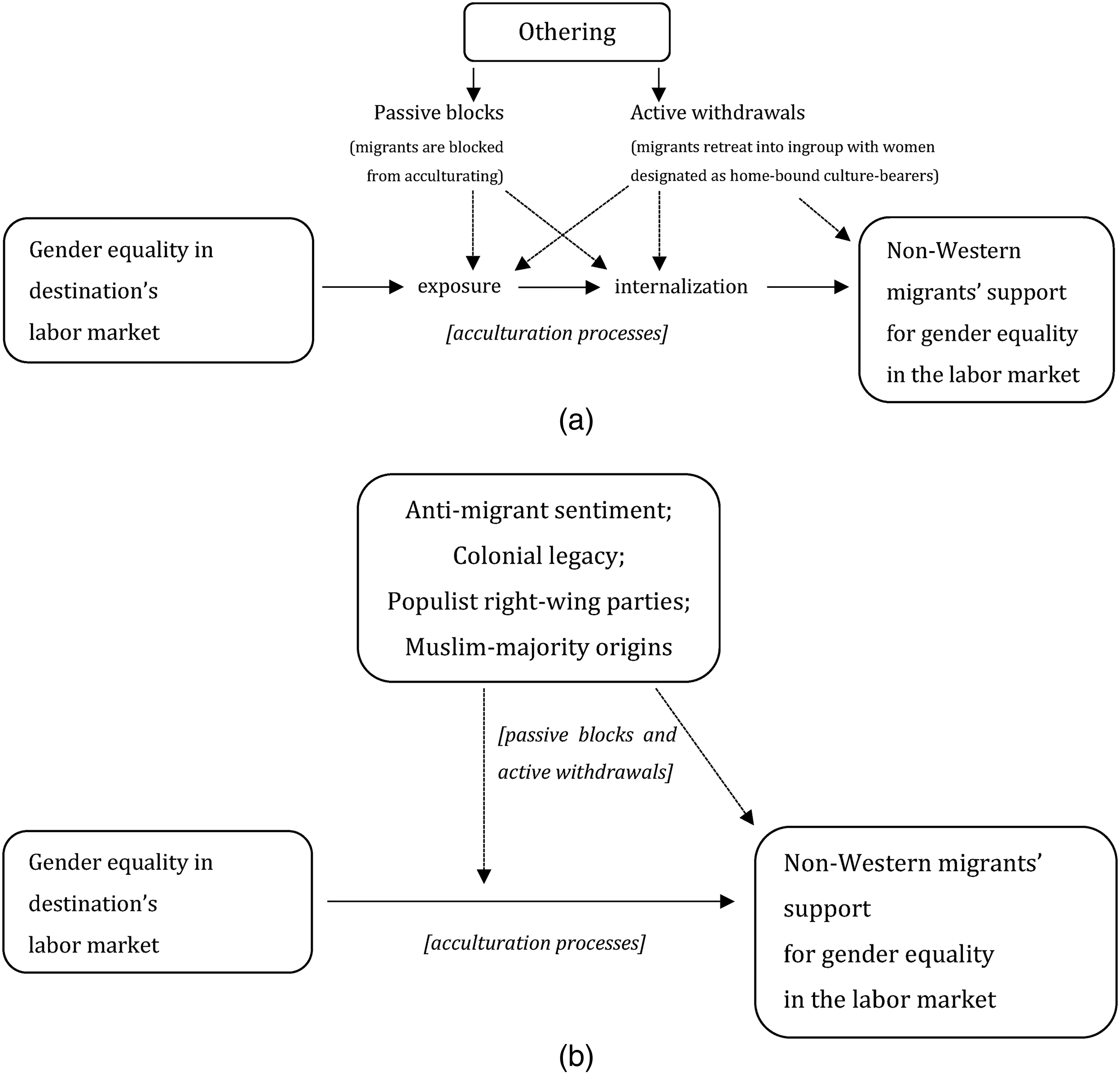
(a) Overview of the context-dependent acculturation-othering framework. (b) Application of context-dependent acculturation-othering framework.
Before delving into these mechanisms, four clarifications are in order. First, both passive blocks and active withdrawals lead to the same contextual characteristics and probably reinforce each other as well. Therefore, I do not aim to decisively conclude whether othering mechanisms are mainly passive blocks or active withdrawals. Second, although a number of the mechanisms discussed below could also pertain to other dimensions of gender equality (e.g., equality in the division of household chores and in educational attainment), some of the theoretical mechanisms I refine and apply below (building on Ajrouch 2004; Le Espiritu 2001) are specific to gender equality in the labor market. This specificity is partly due to the mentioned public visibility of labor-market activity, but there are additional reasons to expect othering to particularly affect labor-market gender equality, as is discussed below. Third, the present section remains meta-theoretical, and why certain contextual characteristics (anti-migrant value climates; colonial histories; the strength of populist right-wing parties; and Muslim-majority origins) emanate exclusions is detailed in the next section. Fourth, and relatedly, this section outlines a theory to be tested in this article's empirical part and, thus, does not make empirical claims.
Passive Blocks
In contexts that “other” non-Western migrants more, I expect that non-Western migrants are passively blocked from acculturation (e.g., Alba and Nee 2003; Haller, Portes, and Lynch 2011; Wimmer and Soehl 2014). In other words, if non-Western migrants are designated as fundamentally different from native-born Europeans’ norms, they may be impeded from adopting such norms. First, the common argument in quantitative studies is that non-Western migrants may be less exposed to native-born Europeans’ customs (Bolzendahl and Myers 2004). For instance, native-born Europeans may avoid interacting with non-Western migrants, limiting non-Western migrants’ exposure to the destination country's gender customs. I expect that lower exposure to the dominant society's gender customs consequently reduces non-Western migrants’ acculturation.
However, it could also be argued that marginalized groups are usually very familiar with dominant norms, even if those norms exclude non-Western migrants. Therefore, I also offer a second and more novel mechanism – namely, that non-Western migrants may internalize the destination country's gender customs less, even if they are exposed to them. If native-born Europeans portray non-Western migrants as an inherently different group, native-born Europeans imply that their customs do not belong to non-Western migrants (Ghorashi 2010). Hence, non-Western migrants are blocked from taking on destination-country customs, which are portrayed by native-born Europeans as being inapplicable to non-Western migrants. Simply put, in meta-theoretical terms, I propose that when native-born Europeans more strongly signal that their customs are exclusively their own, non-Western migrants adopt them less. I, thus, theorize that non-Western migrants might be passively blocked from adopting the destination country's prevailing gender customs.
Active Withdrawals
Contexts that “other” non-Western migrants more may lead non-Western migrants to actively retreat into their own groups (Branscombe, Schmitt, and Harvey 1999). Extending insights from social identity theory (Tajfel and Turner 1979) and qualitative gender studies (e.g., Le Espiritu 2001), we might expect non-Western migrants to reject native-born Europeans’ customs, rather than try to fit into a society that views them as inferior strangers. With this active withdrawal into their own groups, non-Western migrants can create new and positive identities (Padilla and Perez 2003; Wimmer 2008; Glas 2021). Thus, in active withdrawals, I expect that non-Western migrants do not acculturate but, instead, turn away from native-born Europeans’ customs and toward their own groups.
Such an active retreat from native-born Europeans’ customs may shape non-Western migrants’ support for gender equality in various ways. First, non-Western migrant groups may revert to their origin societies’ on-average more traditional gender norms. However, they do not necessarily straightforwardly incorporate origin countries’ norms. Rather, social identity theory proposes that non-Western migrants exaggerate differences between themselves and native-born Europeans; whenever a dominant group excludes an outgroup, outgroup members are expected to try to preserve a positive group identity (Tajfel and Turner 1979; Ghuman 1998; Branscombe, Schmitt, and Harvey 1999) by, for example, revaluing the customs, deemed negative by the dominant group, as positive. Thus, native-born Europeans’ negative perceptions of non-Western migrants’ presumed strongly traditional gender norms might lead non-Western migrants to create more radically traditional gender values. This active retreat into their own communities may even affect non-Western migrants’ gender values independently of gender customs in the origin country.
While passive blocks may extend to all kinds of values (e.g., Alba and Nee 2003; Haller, Portes, and Lynch 2011; Wimmer and Soehl 2014), there is reason to expect that non-Western migrants’ active retreatment into their own groups particularly affects support for gender equality in the labor market. According to qualitative gender scholars (e.g., Giuliani, Olivari, and Alfieri 2017), the creation and maintenance of a group is gendered, and women are often designated as the bearers of its culture (e.g., Ajrouch 2004). Active withdrawals, thus, place new demands on women specifically, as “the burdens and complexities of cultural representation fall most heavily on immigrant women and their daughters” (Le Espiritu 2001, 421). Moreover, retreating into groups often implies traditional roles for women inside the home because the home tends to be the site where group identity is performed (Le Espiritu 2001). Simply put, whether group identity is manifested by, for instance, passing group values onto children or preparing traditional dishes, women are the ones assigned these tasks (Ajrouch 2004; Giuliani, Olivari, and Alfieri 2017; Glas 2021). These tasks, moreover, take place within the home and outside of careers outside the home (Glas et al. 2019). Because women are relegated to home-bound culture-bearer roles, I expect that active withdrawals particularly hamper non-Western migrants’ support for gender equality in the labor market. The presented framework, thus, cannot be instantly applied to other dimensions of support for gender equality.
Manifestations of Exclusionary Contexts
Up to now, I have outlined a meta-theoretical framework that draws on mechanisms concerning passive blocks and active withdrawals, which leads me to the overarching expectation that non-Western migrants’ acculturation and support for gender equality in the labor market are dependent on the extent to which their (destination, origin, and community) contexts exclude them. But what sorts of contexts specifically exclude non-Western migrants? This section deduces testable hypotheses by specifying what contexts emanate exclusions.
Most obvious perhaps is anti-migrant sentiment within a destination society. Thus, othering is expected to be stronger in societies with stronger anti-migrant sentiment. In such contexts, I expect that non-Western migrants internalize native-born Europeans’ gender customs less and are less supportive of gender equality in the labor market (Le Espiritu 2001; Padilla and Perez 2003; Wimmer and Soehl 2014). The mechanism of passive blocks, then, adds that native-born Europeans exclude non-Western migrants more and portray local customs more as their own. Non-Western migrants might, therefore, internalize native-born Europeans’ customs less, even if non-Western migrants are familiar with dominant norms. Moreover, through the mechanism of active withdrawals, migrants are expected to retreat from native-born Europeans’ customs in such societies and to turn inward, creating a positive group identity, which women are largely tasked to perform from the home. I, thus, expect support for gender equality in the labor market to be lower among non-Western migrants in destination countries with a strongly anti-migrant climate (Hypothesis 2a). I also expect the relation between gender equality in the destination-society labor market and non-Western migrants’ support for gender equality in the labor market to be weaker in destinations with a strongly anti-migrant climate (Hypothesis 2b).
Although the influence of an anti-migrant climate is the most straightforward application of my context-dependent exclusions framework, this theorization includes three assumptions. The first is that native-born Europeans “other” non-Western migrants consciously and, thus, that othering can be gauged using explicit questions in large-scale surveys. The second assumption is that othering is spearheaded by the “ordinary masses,” instead of elites. Third, this expectation assumes that a destination society is likely to other all non-Western migrants equally, as one group. In the following, I scrutinize these assumptions, deriving additional hypotheses from the presented theoretical framework.
Implicit Othering: Colonial Legacies
Othering involves constructing boundaries between one group (i.e., native-born Europeans) and another (i.e., non-Western migrants) (Wimmer 2008; Ghorashi 2010). However, such lines can be applied without being consciously drawn, especially when lines were drawn long ago and have become “matter of fact” (Bourdieu and Wacquant 1999). In lieu of large-scale data on native-born Europeans’ implicit biases, I scrutinize the first assumption on the consciousness of othering by drawing on qualitative studies that argue that colonial legacies are an important driver behind latent othering (e.g., Ghuman 1998).
Western European colonial powers portrayed colonized non-Westerners as radically different others who oppressed women (Hesse and Sayyid 2006; Olsson 2009). This pervasive boundary might still implicitly structure how native-born residents of former colonial powers view non-Western migrants (see Bourdieu and Wacquant 1999). For instance, Hesse and Sayyid (2006, 18–20) argue that “despite the eradication of juridical and political institutions of colonialism, colonial practices and discourses continue to proliferate” and “to underwrite liberal-democratic administrations of racially polarised, gendered, sexualised ‘non-European-Otherness’” (see also Ghuman 1998, 241).
As stated in the previous section, othering is expected to curtail non-Western migrants’ acculturation and support for gender equality. To reiterate, in exclusionary contexts, native-born Europeans portray their gender customs as their own and as not pertaining to non-Western migrants. Non-Western migrants are, then, less likely to internalize destination countries’ gender customs. Non-Western migrants may also actively withdraw from native-born Europeans and focus on their own communities. To create a positive identity, non-Western migrants may even turn the tables and assert the desirability of strongly traditional gender roles. Altogether, then, I expect support for gender equality in the labor market to be lower among non-Western migrants from communities that were colonized longer by their destination country (Hypothesis 3a). I also expect gender equality in the destination country's labor market to have weaker effects on non-Western migrants from origin countries that were colonized longer (Hypothesis 3b).
Nonetheless, because colonized societies could have internalized colonizers’ gender equality customs, Hypotheses 3a-b can be accepted as confirmed only if colonized societies’ actual levels of gender equality are accounted for. Moreover, it could be expected that people who migrate to their ex-colonizer are more in tune with that society's institutions and customs – they may even share a mother tongue. However, these migrants might still be excluded once they reach their destination. How a history of colonization affects non-Western migrants’ acculturation, thus, remains an open empirical question, which this article examines.
Elite Othering: Populist Right-Wing Parties
I now turn to questioning the second assumption that non-Western migrants are most overtly excluded by the general populace, rather than by elites. Given their power and visibility, elites could be in a better position than ordinary people to reinforce boundaries between non-Western migrants and native-born Europeans. Politicians, in particular, may be influential in setting discourses on immigrant acculturation (Wimmer 2008).
Recently, many Western European countries have seen a rise of populist right-wing parties that portray “ordinary native people” as one group and non-Western migrants as unwelcome strangers (Mudde 2013). Thus, I expect that populist right-wing parties intensify elite discourses that “other” non-Western migrants. In accordance with the othering mechanisms outlined above, such discourses are expected to block non-Western migrants’ acculturation and to cause them to turn away from the destination society's customs. I, therefore, expect non-Western migrants to be less supportive of a gender-equal labor market in destination countries where populist right-wing parties have more seats in parliament (Hypothesis 4a). Furthermore, I expect gender equality in the labor market to be less influential in shaping non-Western migrants’ attitudes in destination countries where populist right-wing parties have more seats in parliament (Hypothesis 4b).
Community-Specific Othering: Islam
Addressing the third assumption that all non-Western migrant groups are excluded equally, not all migrant groups may be othered to the same extent. Exclusions may depend on the particular boundaries that are salient in a destination society's collective consciousness (Wimmer 2008). In Western Europe in recent decades, Muslim migrants have been othered more than non-Muslim migrants (Ghorashi 2010; Glas 2021). Muslim migrants are portrayed by destination societies not only as strangers but also as a group that unilaterally and stubbornly opposes the fundamental values of Western European democracies, including gender-equal labor markets (Ghorashi 2010). However, in othering, perceptions are more important than reality (Wimmer 2008). I, thus, do not expect non-Western migrants to be excluded based on their actual religion, which is not always visible. Rather, exclusions are likely to be based on whether native-born Europeans perceive a non-Western migrant as Muslim. Thus, non-Western migrants originating from regions where Islam is the dominant religion are more likely to be othered. If these migrants perceive this exclusion, it will likely block their acculturation and cause them to turn away from the destination society's customs, as outlined in the previous section. Therefore, I expect support for gender equality in the labor market to be lower among non-Western migrants from Muslim-majority origin countries (Hypothesis 5a). I also expect the impact of gender equality in the destination country to be weaker among non-Western migrants from Muslim-majority origins (Hypothesis 5b).
Note that Hypotheses 5a-b are not based on an individual's actual denomination but on their denomination as perceived following their origin contexts (Glas 2021). Hypotheses 5a-b should, thus, hold regardless of an individual's religiosity or actual gender equality in the origin society, which may also influence non-Western migrants’ support for gender equality, but via different mechanisms. In model terms, these hypotheses should be accepted if being from a Muslim-majority country is of importance after controlling for individuals’ religiosity and origin countries’ gender customs.
Methods
I combined data from the European Social Survey (ESS), the European Values Study (EVS), and Eurislam. 2 Specifically, I used the ESS 2004, 2008, 2010, and 2016, which included information on labor market gender equality; EVS 2008; and Eurislam 2011 and 2012. Since I combined surveys, I controlled my estimations for survey type. Additional robustness tests interacting my independent variables with survey type show that my main effects were not significantly different across surveys. Only gender equality in the destination society was significantly moderated by survey type, but the effect did not change direction. Thus, conclusions were similar across the EVS, ESS, and Eurislam.
The ESS and EVS are conducted via face-to-face interviews in all 18 Western European countries (the EU-15 plus Norway, Iceland, and Switzerland). However, they do not target migrants specifically and administer questionnaires only in the national language. Therefore, it remains unclear whether these data represent migrant populations generally and whether highly integrated migrants are oversampled. Thus, caution is advised in generalizing the results. Still, these data do include many migrants in diverse contexts, they have been widely used, and they are even argued to represent migrant populations well (Reeskens and Wright 2014; Van der Zwan, Bles, and Lubbers 2017). Nonetheless, to these data, I added Eurislam, which targets non-Western migrants specifically and administers questionnaires in languages of migrant origin. However, Eurislam only includes a subsample of this article's target population, which is Turks, Moroccans, Algerians, Tunisians, Pakistanis, Bangladeshis, and ex-Yugoslavs in Belgium, Germany, France, the Netherlands, Switzerland, and the United Kingdom.
I selected only first-generation non-Western migrants and excluded native-born Europeans, migrants whose origins were unknown, and “Western” migrants from the 18 destination countries and units related to them (e.g., Liechtenstein), as well as the United States, Canada, Australia, and New Zealand. I excluded second-generation migrants because they may lack strong links to the origin country and perhaps never even visited there, precluding the socialization mechanism that I seek to test. I focused on only non-Western migrants because it is unclear whether migrants from Western countries are similarly othered, which creates non-falsifiable expectations about Western migrants, as the context-dependent exclusions framework can account for both replicated and different effects among Western migrants. My final sample consisted of 11,373 migrants (90.9 percent of the original sample) in 2,273 migrant communities from 139 origin countries in 114 destination societies (country-years). Table 1 presents the descriptive statistics.
Descriptive Statistics (Nindividual = 11,373; Ncommunity = 2,273; Ndestination = 114; Norigin = 139).
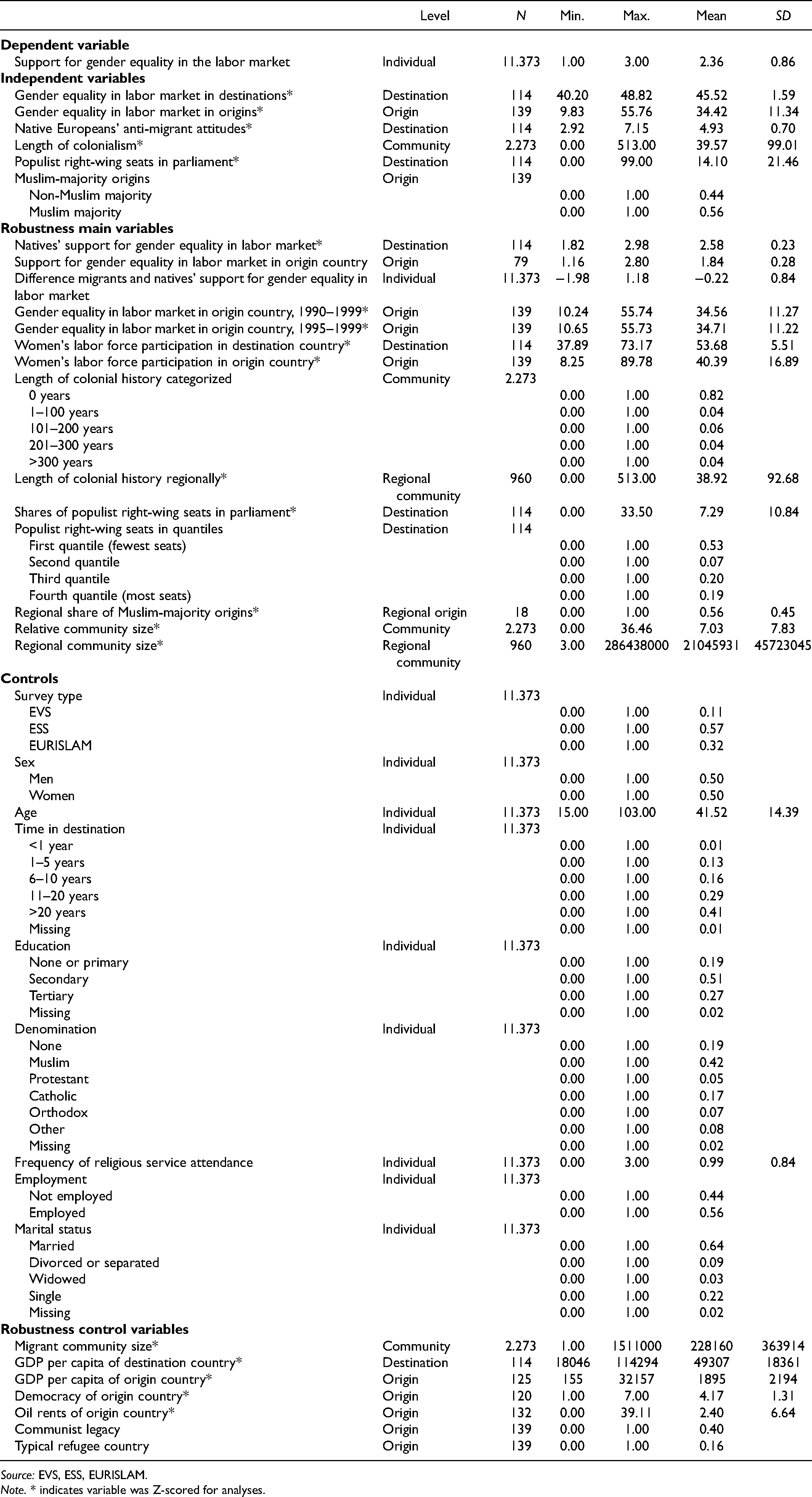
Source: EVS, ESS, EURISLAM. Note. * indicates variable was Z-scored for analyses.
Dependent Variable
Support for gender equality in the labor market was measured by respondents’ agreement with the statement, “when jobs are scarce, men should have more right to a job than women.” The EVS and Eurislam provided three answer categories: “agree” (1), “neither agree nor disagree” (2), and “disagree” (3). The ESS provided five answer categories, which I harmonized by coding “agree strongly” and “agree” as (1), “neither agree nor disagree” as (2), and “disagree” and “disagree strongly” as (3) (although my results were robust when I did not shorten the ESS scale, see Online Appendix Table A2). Note that, in line with my framework, this item was used only to measure gender equality in the labor market. It does not pertain to all dimensions of gender equality. Ideally, multiple items would be used to gauge support for gender equality in the labor market. It would have been especially interesting, for example, to have items that tap attitudes toward working mothers, given the contention on this topic (e.g., Grunow, Begall, and Buchler 2018). However, my data prohibited the use of multiple items, although they did provide a large array of origin and destination countries. Most importantly, the item used taps my main theoretical focus – support for gender equality in the labor market – and has been widely used in previous studies (e.g., Röder and Mühlau 2014; Pessin and Arpino 2018).
Independent Variables
Gender equality in the labor market in destination and origin countries was measured by the percentage of the labor force that was female, excluding unpaid and family workers. This measure fittingly taps the outwardly visible characteristic of women's participation in the labor market and gender equality (i.e., exposure to women vs. men in the formal labor market). To assess whether female role models matter, I included women's labor force participation – that is, the percentage of women aged 15 and older who participated in paid employment. Also, I included native-born Europeans’ average support for gender equality and support for gender equality in the origin country as robustness tests, which yielded similar results (see Online Appendix Table A4).
Destinations represent countries in the survey year. For origins, the average values for 1990, 1991, 1992, 1993, and 1994 were included, as the mean year of migration in my sample was about 1991, the mode 1990, and the median 1993. Unfortunately, no data were available prior to 1990. Still, existing studies code the survey year, in which respondents did not live in their origin countries and which may be impacted by outlying values (i.e., really high or really low gender equality) in one particular, aberrant year (Röder and Mühlau 2014; Pessin and Arpino 2018). Using the 1990–1994 average, thus, at least advances existing strategies. As robustness tests, I coded the 1990–1999 and 1995–1999 averages.
Native-born Europeans’ anti-migrant attitudes were gauged using a different sample of ESS data including only native-born residents between 2002 and 2016. I included the following items with 11-point scales: would you say that “it is generally bad [10] or good [0] for the economy that people come to live here from other countries?,” “[this country's] cultural life is generally undermined [10] or enriched [0]” by migrants, and “[this country] is made a worse [10] or better [0] place” by migrants. These three items measured one latent construct reliably over all surveys and per destination country (factor loadings > 0.8; CAs > 0.7). Respondents’ answers were averaged and then aggregated to the country-year level.
Length of colonialism (in years) was coded using expert judgments on what origin countries were colonized in what years by destination countries (mostly Olsson 2009). Colonial history is a community-level variable. For instance, Pakistani migrants in Norway were coded 0, but Pakistani migrants in the UK were coded 197. As a robustness check, I also categorized my measure (0 years, 1–100 years, 101–200 years, 201–300 years, and > 300 years). Also, theoretically, native-born Europeans may lump origin countries together when they “other" migrants, so a “community” may pertain to a larger region (e.g., Latin American migrants in Spain) (c.f., Padilla and Perez 2003). Therefore, I also coded supra-national regional colonialism by grouping origin countries into 18 regions, following the United Nations geoscheme (see Online Appendix Table A1) and averaging the years countries were colonized per region (results are robust; see Online Appendix Table A2).
Political parties were considered populist right-wing following experts (mainly Armingeon et al. 2018; Hakhverdian and Koop 2007; Mudde 2013). Populist right-wing seats refers to the absolute number of seats that populist right-wing parties held in parliament in the survey year, as reported by the Manifesto Project (Volkens et al. 2020). This measure was also categorized in quantiles to discern whether outliers skewed results. I considered agenda-setting best captured by absolute numbers, as media was deemed likely to over-report on controversial politicians. As a sensitivity check, I included the shares of populist right-wing seats relative to the total number of seats (results are robust; see Online Appendix Table A2).
Muslim-majority origins were coded as countries in which the largest religion was Islam (1) or not (0). As a sensitivity check, I aggregated my measure to the regional level, using a continuous scale for regional shares of Muslim-majority origins ranging from (0) no country in region is Muslim majority to (1) all countries in region are Muslim majority (results are robust; see Online Appendix Table A2).
Controls
I controlled for sex (0: men; 1: women), age (in years), and non-Western migrants’ time in destination country (in the ESS categories: arrived within the last year, 1–5 years ago, 6–10 years ago, 11–20 years ago, >20 years ago, and a missing values dummy). 3 I also included respondents’ highest completed education level (none or primary school, secondary school, tertiary education, and a missing values dummy). Religiosity was tapped using respondents’ denomination (none, Muslim, Protestant, Catholic, Orthodox, other, and missing) and frequency of religious service attendance (never (0), less than once a week (1), once a week (2), and more than once a week (3)). Finally, I controlled for respondents’ employment status (0: non-employed, 1: employed) and marital status (married, divorced or separated, widowed, single, and missing).
Analytic Strategy and Robustness Tests
Because respondents were embedded in 139 origins and 114 destinations, but origins and destinations are not hierarchically nested, I used linear cross-classified models (see Van Tubergen 2006). Thus, my in-text models nest respondents in communities (origin and destination combinations, e.g., Turkish migrants in the Netherlands in 2011, ICCcommunity = 0.03) and nest those communities in both origin countries (e.g., Turkey, ICCorigins = 0.03) and destination country-years (e.g., the Netherlands in 2011, ICCdestinations = 0.06).
Besides the alternative operationalizations discussed above, I tested sensitivity by varying modeling procedures and inclusion of variables and cases. Model-wise, I also estimated four-level cross-classified models nesting destination country-years in countries and three-level ordered logit models, given my three-category dependent variable. Because results were similar, I present the linear cross-classified models, which are more parsimonious and easier to understand. I also included context-level controls: (i) migrant community size, GDP per capita of (ii) destination countries and (iii) origin countries (between 1990 and 1994); (iv) origin countries’ average democracy between 1990 and 1994, according to Freedom House's “Freedom in the World”; (v) origin countries’ average oil rents (percentage of GDP) between 1990 and 1999; (vi) whether origin countries were (1) or were not (0) communist or former communist; and (vii) whether origin countries were (1) or were not (0) “typical refugee-sending countries,” that is, whether they were among the thirty countries from which most refugees originated between 1990 and 2000. 4 Additionally, per-sex models established that my conclusions held for both men and women, although I do not seek to explain gender differences here. Overwhelmingly, all robustness checks yielded similar results (see Online Appendix Table A2). I generally only discuss them in the text if results diverged.
Results
Descriptive Analyses
To what extent do the sampled migrants in varying destinations and from different origin countries support gender equality in the labor market? Figures 2 and 3 show that non-Western migrants’ support for gender equality varies markedly between contexts. Immigrants in Greece and Italy are, on average, least supportive of gender equality in the labor market, while migrants in Scandinavia are relatively highly supportive. Origin-wise, migrants from (Muslim-majority) Asia, Northern Africa, and (ex-Yugoslavian) Southern Europe are, on average, less supportive of gender equality. On the other hand, my sample shows migrants from Central Latin America and southern sub-Saharan Africa are relatively gender egalitarian. 5 This wide variation in support for gender equality in the labor market across different origin and destination countries signals the importance of paying close attention to not only the individual but also the contextual forces that shape non-Western migrants’ gender attitudes.
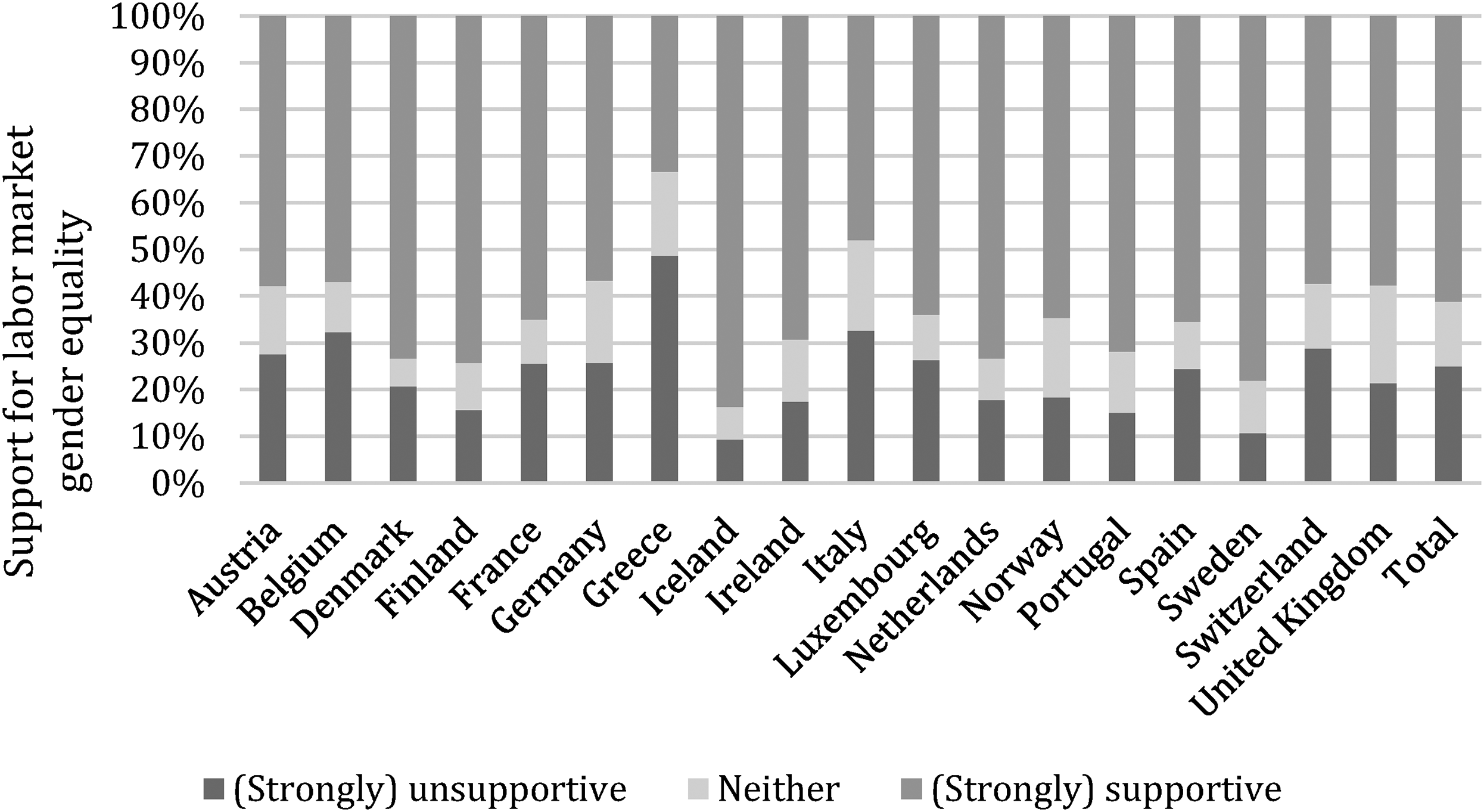
Support for gender equality in the labor market among non-Western migrants by destination country.
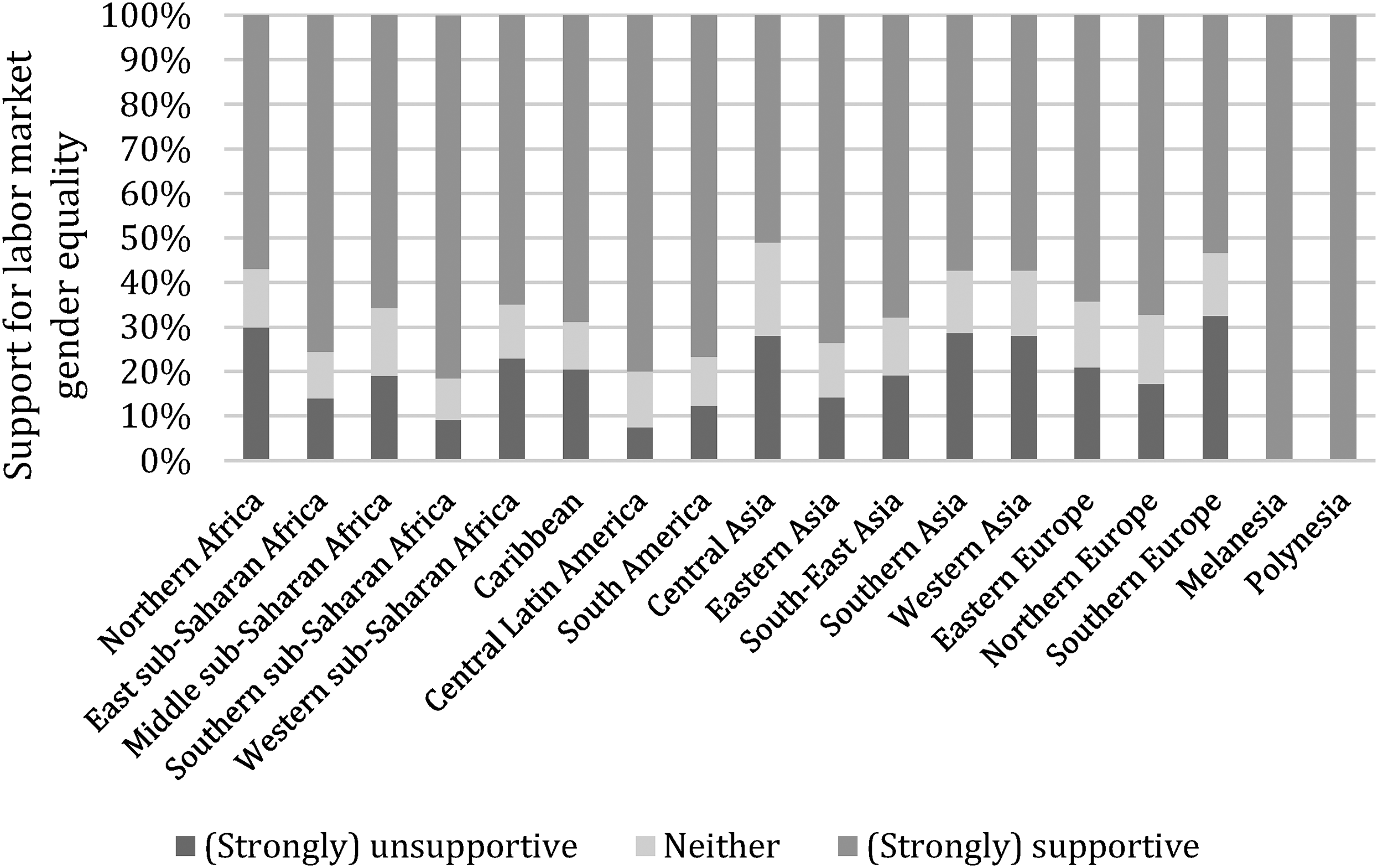
Support for gender equality in the labor market among non-Western migrants by region of origin.
Figure 4 presents the average support for a gender-equal labor market among the three largest non-Western migrant groups per destination country. The data show marked differences between migrant groups, even those exposed to the same destination society or originating from the same country. For instance, in Finland and Ireland, Turks are, on average, most supportive of labor-market gender equality and Moroccans least, but this hierarchy reverses in Norway and Belgium. Altogether, these results imply that interplays between origins and destinations (i.e., migrant communities) are highly relevant in shaping non-Western migrants’ values (see Van Tubergen 2006). Thus, previous works which focused on only one destination country (e.g., Bernhardt, Goldscheider, and Goldscheider 2007; Maliepaard and Alba 2016; Kretschmer 2018) or one origin country (e.g., Huschek, de Valk, and Liefbroer 2011) may yield insights that cannot be translated beyond those contexts, again signaling the importance of focusing on diverse origins and destinations.
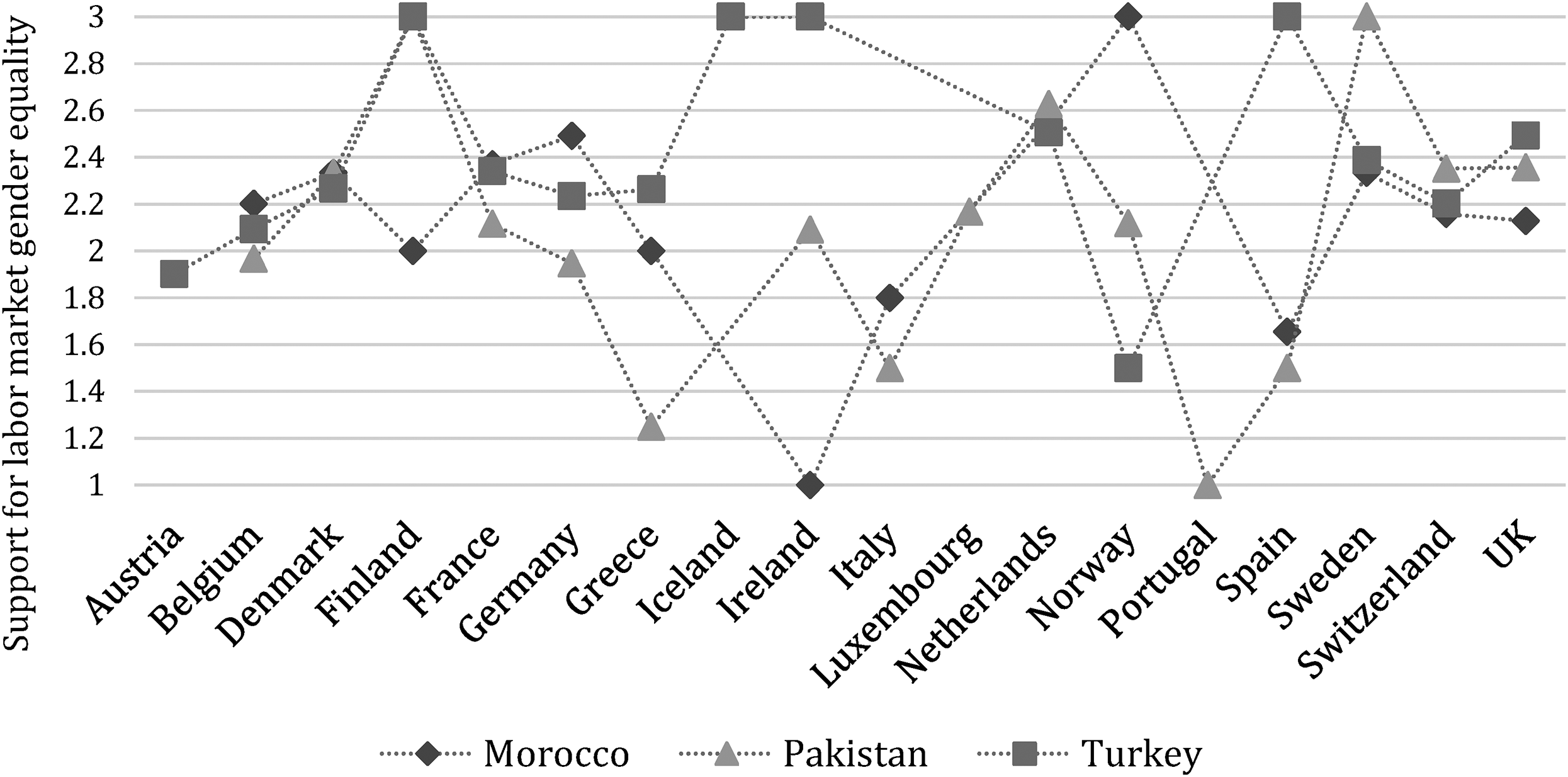
Mean support for gender equality in the labor market among the three largest non-Western migrant groups per destination.
Explanatory Analyses: Linear Acculturation
To start explaining these seemingly context-dependent patterns in non-Western migrants’ support for labor-market gender equality, Table 2 presents the cross-classified model that includes all independent variables. All models also include all control variables, which mostly show the expected relation to non-Western migrants’ support for gender equality. For instance, Muslim migrants and those who attended religious services more often are less supportive of labor-market gender equality. Additionally, although women, on average, support gender equality more than men, my contextual characteristics relate to support for labor-market gender equality similarly among men and women (see Online Appendix Table A2). Finally, employed migrants support a gender-equal labor market more than non-employed migrants. However, both employed and non-employed migrants are similarly affected by the gender equality in their destination countries’ labor markets (see Online Appendix Table A3).
Cross-Classified Models of Support for Gender Equality in the Labor Market (N = 11,373).
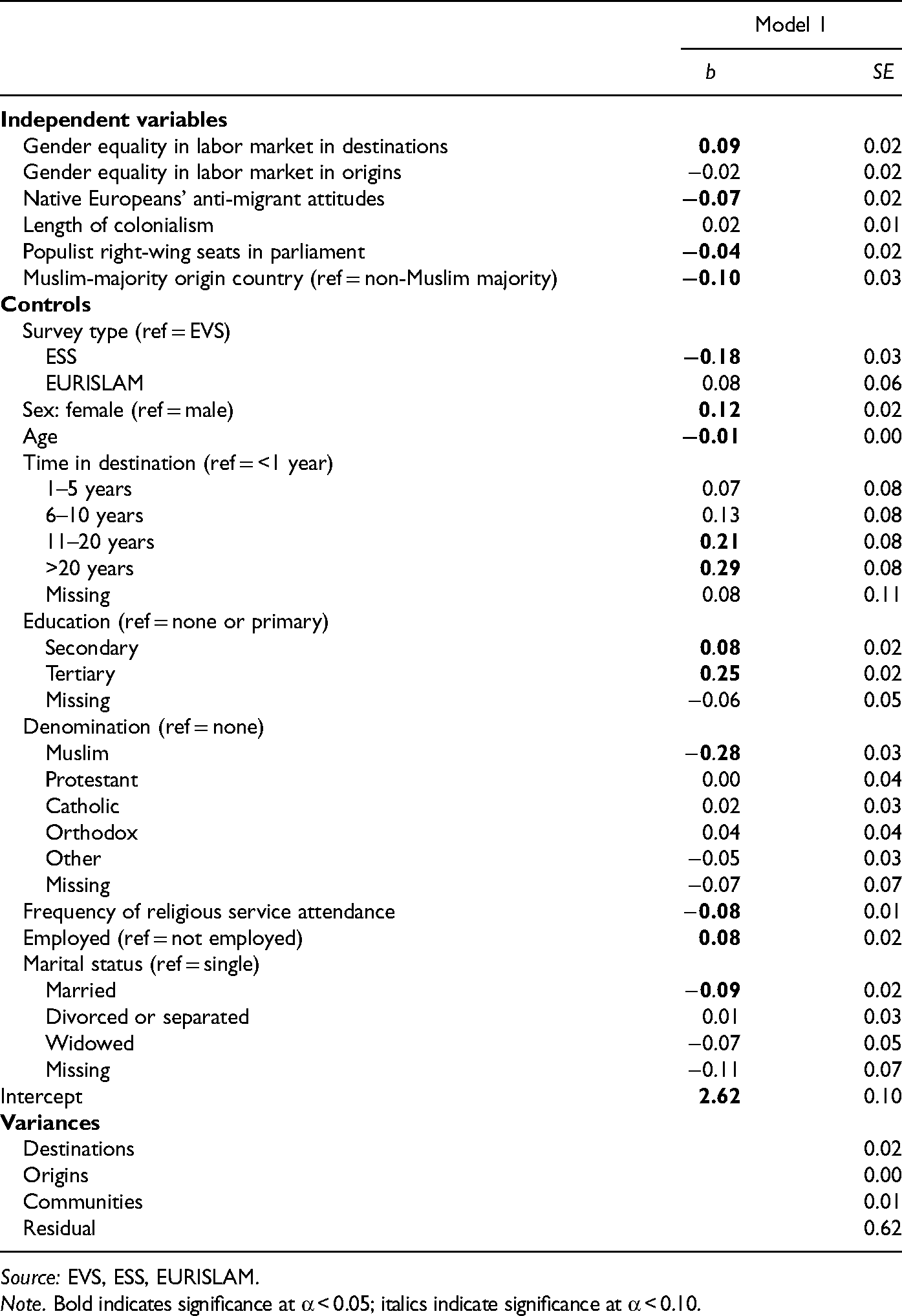
Source: EVS, ESS, EURISLAM. Note. Bold indicates significance at α < 0.05; italics indicate significance at α < 0.10.
Moving to my main focus, non-Western migrants in destinations with a labor market closer to gender equality are significantly more supportive of labor-market gender equality, confirming Hypothesis 1a. Moreover, my results show similar positive and significant relations across robustness tests, including when native-born Europeans’ support for gender equality is studied, rather than destination societies’ actual levels of gender equality (see Online Appendix Tables A2 and A3). These findings are in line with the linear acculturation perspective's proposition that non-Western migrants internalize their destination countries’ gender customs (e.g., Bolzendahl and Myers 2004; Bejarano, Manzano, and Montoya 2011; Norris and Inglehart 2012).
Remarkably, however, I find no such socialization patterns concerning gender equality in the origin country. Migrants from countries with a more (nearly) gender-equal labor market are not significantly more supportive of gender equality in the labor market. This nil finding was replicated throughout sensitivity checks, including for average support for gender equality in the origin country (see Online Appendix Table A2), leading me to reject Hypothesis 1b. Although these findings are unexpected, other studies report similar non-effects of gender equality in the origin country's labor market (Pessin and Arpino 2018; see Röder and Mühlau 2014 for second-generation migrants). This nil finding might indicate that most non-Western migrants in my sample were disconnected from their origin societies and perhaps chose to leave (He and Gerber 2019). Although I cannot test this selectivity directly, I still find non-significant relations when I control for typical refugee-sending countries.
Nevertheless, even if my results only hold for, for instance, non-refugees, in light of current debates on failed integration (Ghorashi 2010; Pinkster, Ferier, and Hoekstra 2020), it remains striking that non-refugee, non-Western migrants do adopt their destination countries’ gender customs and might even be completely disconnected from their origin countries’ gender customs after migration. Tentatively, these results are in line with qualitative studies’ assumption that migrants forge new group identities after migration that nullify origin socialization (e.g., Huisman and Hondagneu-Sotelo 2005; Pande 2017). However, further research is needed to assess whether origin socialization is, indeed, nullified and whether this nullification holds for other dimensions of support for gender equality as well.
Explanatory Analyses: Othering
Othering also seems to play a role in non-Western migrants’ gender attitudes. Non-Western migrants’ support for gender equality in the labor market is significantly diminished in destination countries with a stronger anti-migrant climate and more populist right-wing seats in parliament. Actually, native-born Europeans’ anti-migrant sentiments are about as detrimental to non-Western migrants’ support for gender equality as destination countries’ gender equality is beneficial. Likewise, support for labor-market gender equality is significantly lower among migrants from Muslim-majority origins. Note that native-born Europeans’ perceptions seemed to hamper non-Western migrants’ support for gender equality, irrespective of migrants’ individual religiosity. Migrants from Muslim-majority origins support gender equality less, regardless of their faith, religious service attendance, origin countries’ gender equality, or origin countries’ communist legacy. Altogether, these findings support Hypotheses 2a, 4a, and 5a; in contexts in which non-Western migrants are more excluded, non-Western migrants support gender equality in the labor market less.
To further ascertain whether these patterns reflect exclusionary processes, I conducted two additional robustness tests (in subsamples, see Online Appendix Table A3). First, if contextual forces, indeed, inhibit support for gender equality by causing non-Western migrants to retreat into their communities, differences from native-born Europeans should be enlarged. Additional analyses show that, indeed, differences between non-Western migrants’ and native-born Europeans’ support for labor-market gender equality are significantly larger in more exclusionary contexts (destinations with stronger anti-migrant sentiment and greater populist right-wing party presence and Muslim-majority origin countries).
Second, although othering is more complex than discrimination, when contexts “other” non-Western migrants more, non-Western migrants should perceive greater discrimination. Therefore, perceived discrimination should be linked to both the contextual exclusion characteristics and non-Western migrants’ support for gender equality. My results show that, indeed, native-born Europeans’ anti-migrant attitudes, populist right-wing seats, and Muslim-majority origins are correlated with perceived discrimination among non-Western migrants and that perceived discrimination, in turn, is linked to reduced support for gender equality. 6 Altogether, then, these contextual patterns seem to signal that othering processes, rather than different underlying mechanisms, explain why non-Western migrants’ support for gender equality is lower in destinations with stronger anti-migrant climates and populist right-wing parties and among migrants from Muslim-majority origins.
Simultaneously, othering seems to operate through explicit exclusions and less via historically engrained biases. Migrants from origin countries that were colonized for longer by their destination countries are not less supportive of gender equality in the labor market, leading me to reject Hypothesis 3a. Additional results tentatively suggest that such migrants may support gender equality more (see Online Appendix Table A2). An obvious explanation is that colonizers succeeded in transferring gender egalitarianism to the colonized communities. However, because gender equality in the origin country's labor market was controlled for, those transferals cannot explain my results. Alternatively, those who migrate to the ex-colonizer may be more strongly “pro-Western” from the get-go, rendering their stronger receptiveness to gender equality a selection effect. Similarly, rather than being more strongly excluded, migrants from ex-colonies may experience less exclusion, as their origins may make them more in tune with the destination society's institutions, and they may even share a language. Still, these mechanisms remain conjecture. Presently, I can only conclude that othering does not seem to follow the lines of colonial power, which may imply that non-Western migrants’ support for gender equality is blocked only when non-Western migrants are othered consciously by native-born Europeans.
Explanatory Analyses: Conditioned Acculturation
The models in Table 3 include the moderated effects. Generally, the results indicate that acculturation is, indeed, context dependent. The positive relations between gender equality in the destination society and non-Western migrants’ support for a gender-equal labor market are conditioned by origin countries, destination countries, and migrant communities (see Online Appendix Table A4 for similar results for native-born Europeans’ support for gender equality). Simultaneously, the moderators’ effects are not always in the expected direction, so although othering may block acculturation in certain ways, contextual characteristics may, nonetheless, fuel non-Western migrants’ adoption of destination societies’ gender customs. 7
Cross-Classified Moderations of Support for Gender Equality in the Labor Market.
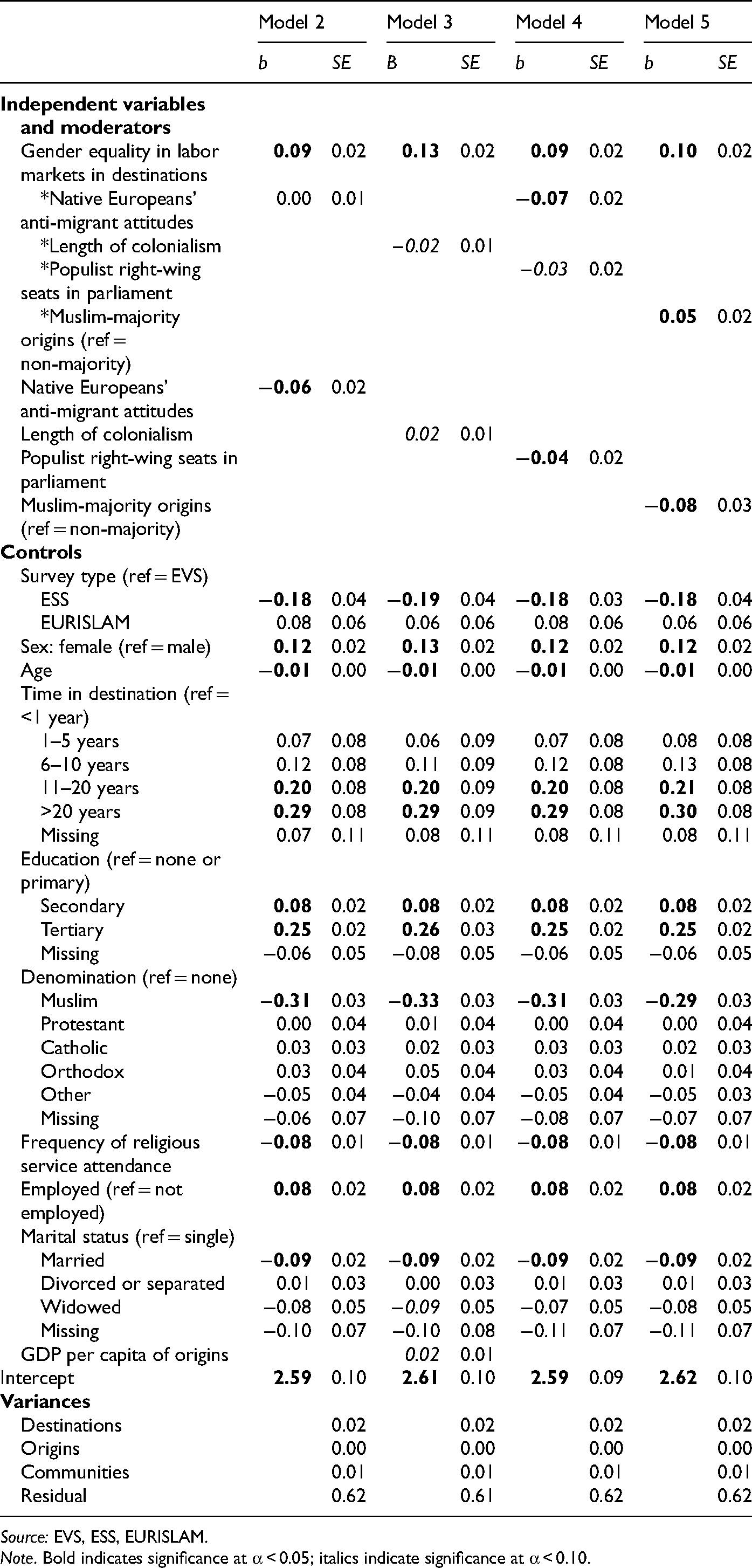
Source: EVS, ESS, EURISLAM. Note. Bold indicates significance at α < 0.05; italics indicate significance at α < 0.10.
First, one contextual factor – native-born Europeans’ anti-migrant attitudes – does not significantly block or boost the impact of destination societies’ labor markets on support for gender equality, leading me to reject Hypothesis 2b. It seems that while non-Western migrants are less supportive of gender equality in contexts where majorities hold more strongly anti-migrant attitudes, non-Western migrants do not internalize their destination society's gender customs less under these circumstances.
Second, as expected, the impact of gender equality in the destination society's labor market is significantly weakened by the duration of colonization by European host societies and the number of seats that populist right-wing parties held in parliament (see Figure 5). These results support the context-dependent exclusions framework and Hypotheses 3b and 4b. Recall that migrant communities from countries that were colonized for longer were not less supportive of gender equality and were, in some cases, stronger supporters of gender equality. These communities might be particularly egalitarian. Therefore, colonialism's weakening of the impact of destination countries’ gender-equal labor markets may suggest that othering even affects more progressive migrant groups. Tentatively, othering may hinder adoption of destination countries’ gender customs, even among non-Western migrants who were originally more in tune with those customs. Concerning populism, a larger number of parliamentary seats held by populist right-wing parties both directly blocks non-Western migrants’ support for gender equality and hampers their internalization of gender customs (also when controlling for migrant community size, see Online Appendix Tables A2 and A3). It, thus, seems that these parties, which generally are the staunchest supporters of strict assimilation, are more likely to hinder non-Western migrants’ acculturation than to help it.
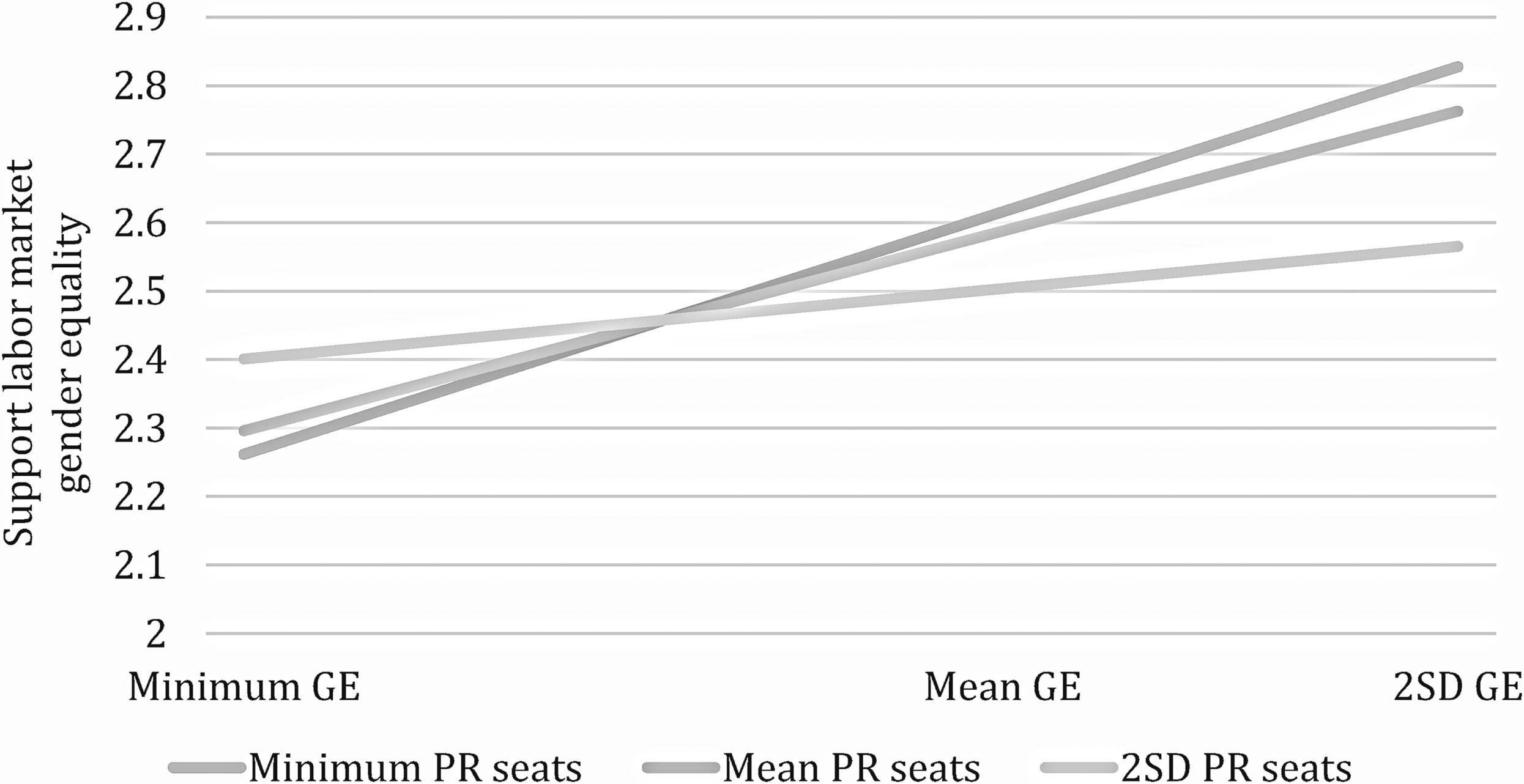
Relations between destinations’ gender equality in labor markets and non-Western migrants’ support for gender equality in the labor market by seats held by populist right-wing parties in destinations.
Third, and finally, Muslim-majority origins condition the adoption of the destination society's gender customs, but not in the expected direction. Contrary to Hypothesis 5b, the relationship between gender equality in the destination society's labor market and non-Western migrants’ support for a gender-equal labor market is significantly stronger, not weaker, among migrants from Muslim-majority origins (see Figure 6). Moreover, non-Western migrants express more similar support for a gender-equal labor market in destination countries where the labor market is more (nearly) gender equal. In fact, in destinations where about as many women as men have jobs, non-Western migrants express strong support for gender equality, regardless of their origin country's majority religion. Acculturation is particularly varied in destinations that are not strongly gender equal. Perhaps, in less strongly gender-equal destinations, it is more socially acceptable to be tentative toward gender equality. In less strongly gender-equal destinations, non-Western migrants would, thus, have greater room to maneuver concerning their support for gender equality, and that space seems to be used by strongly othered migrants in particular.
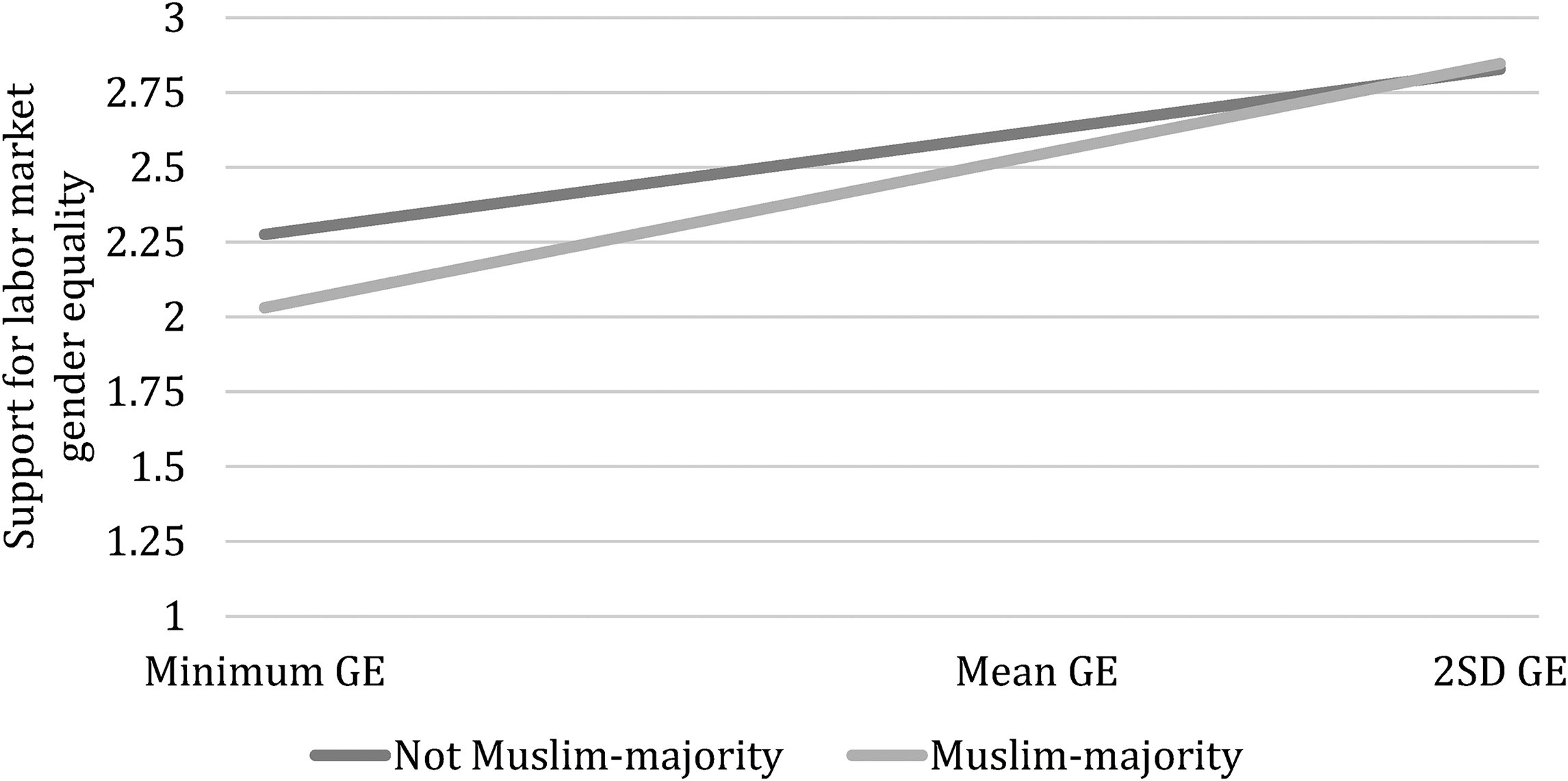
Relations between destinations’ gender equality in the labor market and non-Western migrants’ support for gender equality in the labor market by origin country's major denomination.
Conclusion
Most quantitative studies on migrants’ support for gender equality argue that migrants adopt their destination countries’ gender customs over time (e.g., Inglehart and Norris 2003; Norris and Inglehart 2012; see Spierings 2015). Indeed, the public opinion literature on migrant support for gender equality has focused overwhelmingly on linear acculturation theories and on individual characteristics (Bolzendahl and Myers 2004; Bejarano, Manzano, and Montoya 2011; Norris and Inglehart 2012). However, not all migrant groups acculturate equally to every destination country (Berhnhardt, Goldscheider, and Goldscheider 2007; Röder and Lubbers 2015). Migration scholars not focused on gender have argued that, to fully understand acculturation, we must study the characteristics of destination societies, origin countries, and specific migrant communities (Berry 1992; Van Tubergen 2006). However, to my knowledge, no quantitative study identifies what contexts facilitate or frustrate non-Western migrants’ adoption of destinations’ labor-market gender customs.
This article advances current understandings of non-Western migrants’ support for gender equality by deducing a context-dependent exclusions framework. Refining and synthesizing insights from quantitative migration studies (e.g., Wimmer and Soehl 2014; Spierings 2015), qualitative gender research (e.g., Le Espiritu 2001), and social identity theory (e.g., Tajfel and Turner 1979), this framework stresses that non-Western migrant groups are less keen to adopt native-born Europeans’ gender customs in contexts that “other” non-Western migrants more. In contexts that portray non-Western migrants as a separate group of unwelcome strangers, non-Western migrants are expected to be passively blocked from internalizing labor-market gender customs (Alba and Nee 2003). Additionally, if they are excluded, non-Western migrants might actively reject native-born Europeans’ labor-market gender customs and assert the desirability of strongly traditional values (Le Espiritu 2001; Padilla and Perez 2003; Wimmer and Soehl 2014).
Empirically, I estimated cross-classified models and synchronized data from the ESS, EVS, and Eurislam, covering more than 11,000 non-Western migrants from 139 origin countries in 114 destinations. The results, first, show that, on average, non-Western migrants did acculturate to their destination societies; non-Western migrants in destinations with a labor market that was closer to gender equality expressed greater support for a gender-equal labor market. Second, my results show that exclusionary contexts were associated with reduced support among non-Western migrants for a gender-equal labor market. For instance, non-Western migrants were less supportive of gender equality in destinations where native-born Europeans expressed stronger anti-migrant sentiments. These results suggest that non-Western migrants’ support for a gender-equal labor market depends not merely on their individual characteristics but also on contextual factors. In contexts that “other” migrants more, non-Western migrants were less supportive of gender equality, regardless of their individual characteristics. More broadly, these findings imply that current Western European public debates that emphasize non-Western migrants’ traditional attitudes and failed integration are likely to dampen non-Western migrants’ support for gender equality in the labor market, rather than to promote it (Ghorashi 2010; Pinkster, Ferier, and Hoekstra 2020).
Pivotally, my results, thirdly, suggest that acculturation depends on the degree to which contexts are exclusionary. The extent to which non-Western migrants adopted destination societies’ customs was shaped by their contexts. For instance, non-Western migrants internalized the destination society's labor-market gender equality less in contexts where populist right-wing parties were more powerful. This result counters contemporary quantitative studies which argue that all migrant groups similarly adopt destinations’ gender customs over time (e.g., Inglehart and Norris 2003; Norris and Inglehart 2012). I found that acculturation was not a universal process and, instead, was shaped by origins, destinations, and migrant communities. These results imply that the insights of previous studies which examined one destination (e.g., Bernhardt, Goldscheider, and Goldscheider 2007; Maliepaard and Alba 2016; Kretschmer 2018) or one origin (e.g., Huschek, de Valk, and Liefbroer 2011) might be specific to the migrant communities studied.
Future work would benefit from broader panel data to assess whether non-Western migrants’ gender values change in new contexts or whether migrants were a selective group to begin with. Currently, panel data are available only for particular communities, whereas this article suggests that more diversity of contexts is necessary (see Van Tubergen 2006). Also, survey experiments could provide more specific measures of implicit othering. This analysis used colonial history, so the tentative finding that a lengthier colonial history increased, rather than decreased, migrants’ support for a gender-equal labor market may reflect a selection effect, rather than native-born Europeans’ implicit biases. Additionally, support for gender equality in the labor market should be gauged with more items, if they become available. Items that tap attitudes regarding working mothers, particularly those with young children, could especially broaden understandings of migrant support for gender equality. Working mothers with young children can be a rather contentious issue (Grunow, Begall, and Buchler 2018). It would be interesting to assess whether and how acculturation also occurs regarding issues on which native-born Europeans hold diverse stances. Similarly, as non-Western migrant groups that are supportive of gender equality in the labor market may still be strongly traditional concerning other dimensions of gender equality, future studies might assess whether acculturation is context dependent for other dimensions of support for gender equality as well.
There are also two broad avenues for future research on migrants’ acculturation. First, an unanswered question is under what circumstances migrants detach from their origin socialization. The analysis presented here found that migrants from more (nearly) gender-equal origin countries were not, on average, more supportive of gender equality. Detachment from origin socialization may, thus, differ between contexts, which has not been studied. Second, it would be theoretically interesting to assess whether othering blocks non-Western migrants from acculturating or whether non-Western migrants themselves actively turn away from native-born Europeans. However, it is difficult to imagine a research design that could adequately address this question, as perceptions of discrimination among migrants could reflect either mechanism.
Still, to my knowledge, this article is the first to identify how contexts shape acculturation into support for gender equality. Not all migrant groups adopt their destination societies’ labor-market gender customs equally. Rather, whether non-Western migrants acculturate depends on to what extent they are excluded in their destination societies, which has implications for related fields, too, such as the study of migrants’ feelings of belonging and structural integration. This article has laid bare real differences in non-Western migrants’ acculturation processes; thus, any universal claim about non-Western migrants’ (lack of) acculturation into support for gender equality should be viewed with extreme caution.
The project was funded by NWO (406-16-517).
Footnotes
Declaration of Conflicting Interests
The author(s) declared no potential conflicts of interest with respect to the research, authorship, and/or publication of this article.
Funding
The author(s) disclosed receipt of the following financial support for the research, authorship, and/or publication of this article: This work was supported by the Nederlandse Organisatie voor Wetenschappelijk Onderzoek (grant number 406-16-517).
