



Abstract
Muslim migrants and their descendants in Western Europe have consistently been shown to hold more negative attitudes toward homosexuality, the more religious they are. In this article, we go beyond this mono-dimensional view of religiosity and develop a theoretical framework that combines (a) the role of different dimensions of religiosity in anchoring cultural attitudes and (b) the potential impact of destination hostility and discrimination on the retention of cultural attitudes toward homosexuality among Muslim migrants in Western Europe. For the analysis, we use eight rounds of the European Social Survey, enriched with country-level data. Findings indicate that Muslim migrants’ mosque attendance, as a dimension of religiosity, has the negative effect that was expected. Particularly, Muslims who grew up in Western Europe are negative about homosexuality if they attended mosque regularly, whereas among first-generation Muslim migrants, origin-country norms are a strong predictor of attitudes toward homosexuality. In addition, we find that perceived group discrimination drives the maintenance of negative attitudes toward homosexuality, especially among mosque attendees. These results imply that the development of more liberal attitudes among European Muslims is held back by a combination of socialization in conservative religious communities and hostility from host-country populations.
Introduction
Migration scholars often identify Islam as a “bright boundary” between mainstream European society and the religious Muslim “other” (Alba and Nee 2003; Drouhot and Nee 2019; Foner 2015). This perceived boundary is perhaps most prominent in relation to debates around cultural and sexual attitudes. Both media and politicians in many Western European countries, particularly from populist anti-immigrant parties (Spierings and Zaslove 2015), frequently frame these debates in terms of unchangeable Islamic backwardness among Muslim citizens (Saeed 2007; Mepschen, Duyvendak and Tonkens 2010). However, research on migrant assimilation in Europe shows that cultural attitudes among migrants appear to move toward those of host populations over time and across generations, lending support to the general tenets of acculturation theories (Fitzgerald, Winstone and Prestage 2014; Röder 2015; Röder and Lubbers 2015, 2016; Banfi, Gianni and Giugni 2016; Soehl 2017; Kogan and Weißmann 2020; Van Klingeren and Spierings 2020). Still, this research also highlights that having a Muslim background is a strong predictor of negative attitudes toward homosexuality, which can be explained only partially by origin-country norms, Muslims’ higher religiosity, or their economically more marginal position (Lubbers, Jaspers and Ultee 2009; Van der Bracht and Van de Putte 2014; Röder 2015; Soehl 2017; Spierings 2018).
Assimilation scholars argue that religiosity serves as an anchor to origin-country cultural beliefs, leading to less acculturation and greater maintenance of attitudes prevailing in the origin country among migrants (Van der Bracht and Van de Putte 2014; Röder 2015; Soehl 2017). This literature, however, does not unpack or analyze this “anchoring” role of religiosity further, despite its assumed importance for differential acculturation pathways, nor does it link this logic to the notion of retention, which implies that migrants and their descendants are pushed back, figuratively, to attitudes and norms from their origin society in destination environments that are hostile toward them (Diehl, Koenig and Ruckdeschel 2009; Connor 2010; Verkuyten and Yildiz 2010; Spierings 2015).
This article's main theoretical contribution is, therefore, to formulate and refine a framework that combines, on the one hand, an understanding of the relationship between different dimensions of Islamic religiosity and cultural attitudes among Muslim migrants and their descendants with, on the other hand, the role of destination-society hostility as a driver of retention, with particular focus on attitudes toward homosexuality. We propose an acculturation perspective that incorporates the impact of cultural anchors and retention processes and consequently allows us to understand differential acculturation pathways better than existing studies (e.g., Lubbers, Jaspers and Ultee 2009; Röder 2014; Van der Bracht and Van de Putte 2014; Soehl 2017; Spierings 2018).
Specifically, we first argue that mosque attendance in European destinations is more likely to serve as an anchor for prevalent norms in the origin country than other dimensions of religiosity because it is linked to exposure to such norms through the religious sub-community (Guveli 2015; Guveli et al. 2016; Glas, Spierings and Scheepers 2018; Glas et al. 2019). This is because mosques in Europe typically maintain a conservative stance in their teaching on homosexuality (Hekma 2002; Laurence 2012; Baker, Gabrielatos and McEnery 2013). For individual religiosity, on the other hand, it is also plausible that some people deviate from dominant religious norms while maintaining a high level of religiosity by re-interpreting some aspects of religion (see Röder 2014; Van Klingeren and Spierings 2020 for gender-role attitudes). Such a process of “de-coupling” of religiosity from cultural attitudes could lead to a more liberal form of Islam that deviates from conservative religious teachings, particularly vis-à-vis gender and sexuality, as has happened to, for example, Catholicism in the recent past (Ó Féich and O'Connell 2015).
Second, we argue that when discussing Islam and acculturation, one should not ignore the high degree to which attitudes around sexuality and gender have become core markers of cultural differences in destination environments in Europe (Roggeband and Verloo 2007; Spierings and Zaslove 2015; Shield 2017; Spierings, Lubbers and Zaslove 2017; Drouhot and Nee 2019). Previous work examining the link between destination hostility and acculturation has shown that experiencing a hostile environment can lead to greater retention of origin-society norms and values and, consequently, to the rejection of destination-society dominant norms, although empirical results are mixed (Tajfel et al. 1979; Tzeng and Jackson 1994; Brown 2000; Diehl, Koenig and Ruckdeschel 2009; Verkuyten and Yildiz 2010; Spierings 2015). We argue here that this retention is reinforced by mosque attendance because such attendance strengthens Muslim migrants’ social integration into the origin community and increases exposure to dominant origin-society norms. Thus, retention of traditional cultural attitudes, and negative views on homosexuality in particular, are mainly prevalent among regular mosque attendees, instead of among Muslims more generally.
Empirically, our article's core contribution is that we provide a first examination of the differential impact of individual religiosity and mosque attendance on attitudes toward homosexuality among Muslim migrants in Western European destination societies, how this impact of individual religiosity and mosque attendance differs by migrant generation, and whether this impact is conditional on destination-country hostility. The few prior studies on Islam and attitudes toward homosexuality in Western Europe predominantly focus on denominational differences between Islam and other religions, include religiosity uni-dimensionally, and often only as a control variable, and do not assess the role of destination-society hostility (Röder 2014; Soehl 2017; Spierings 2018). To assess whether the hypotheses derived from our theoretical reasoning hold up under empirical scrutiny, we apply multilevel models with micro-level and cross-level interaction terms to a pooled dataset of eight rounds of the European Social Survey (ESS) (2002–2018). From these data, we select 2,973 Muslims with a migration background, living in 17 different Western European countries. The ESS is the only dataset that includes sufficient numbers of host countries to systematically test effects at this level, while also including adequate numbers of European Muslims with a migration background and relevant variables on attitudes toward homosexuality and religiosity. To assess the role of origin and destination societies, the ESS data are enriched with aggregated attitudes toward homosexuality and country-level information on the institutionalization of Lesbian, Gay, Bisexual and Transgender (LGBT) emancipation.
In the following, we provide a background to this article's main contribution by briefly discussing Islam and homosexuality and how our analysis of attitudes toward homosexuality links to acculturation processes more generally. Then, we focus on our core contributions by outlining how Islamic religiosity can serve as a cultural anchor, the effect of which might be strengthened by hostility in the destination country. Results show that destination-country norms and religiosity are linked to Muslim migrants’ attitudes toward homosexuality across generations. However, mosque attendance in particular anchors those who grew up in Western Europe into the cultural attitudes dominant in their origin societies and communities, leading to more conservative attitudes toward homosexuality among this substantial sub-group of regular attendees. Moreover, the effect of attendance is strongest among those who experienced group discrimination in the destination society in which they live. A better understanding of acculturation processes, we argue, requires consideration of which (religious) anchors underpin the maintenance of traditionalism and how destination-society hostility can further reinforce this process.
Theoretical Background
Islam and Homosexuality
The relationship between Islam and homosexuality is far more complex than a simple prohibition (Zanghellini 2010). Nevertheless, there is overwhelming empirical evidence that public opinion and normative views within legal and political institutions are not very permissive of homosexuality in Muslim-majority societies (Nahas 2001; Inglehart and Norris 2003; HRW 2008; Dibi 2015; ILGA 2017; Glas & Spierings 2021). At the same time, people in many of these societies combine their Muslim identities with their homosexuality (Arib 2011; Schmitt and Schifter 2013), Islamic and Muslim social movements, such as the UK's ‘New Horizons for British Islam’ and the Dutch ‘Maruf’ Foundation, fight for a better position of Lesbian, Gay, Bisexual and Transgender (LGBT) people (Arib 2011; Shield 2017), and there are religious authorities doubting the dominant interpretation of Islamic religious sources as forbidding homosexual acts 1 (Nahas 2001; Dibi 2015). LGBT Muslims and alternative interpretations of Islamic scripture, however, receive little attention in the media or among Muslim communities in Europe (Hekma 2002; Baker, Gabrielatos and McEnery 2013). The discursive space for alternative views on Islam and homosexuality is marginalized by the dominant debate in media and politics across Western European countries, which portrays Islam as strongly opposing homosexuality. As a result, in Western Europe, a setting has been created where “homosexuality has become one of the principal battlegrounds over which normative contemporary Western identity and its Muslim counterpart are being enacted and consolidated” (Zanghellini 2010, 269; see also Dudink 2017; Spierings, Lubbers and Zaslove 2017).
Acculturation and Dissimilation
Acculturation is a process in which immigrants adopt ideas and behavior associated with the dominant culture in the destination society (Gans 1997). Acculturation can be facilitated by assimilation into the destination society (i.e., by becoming part of the (in)formal ‘non-ethnic’ networks in that society) but can also precede assimilation (ibid.). In line with this general concept, different variants of acculturation theory focus on the question of whether and under what circumstances immigrants adopt views that follow dominant contextual norms within a society (Gans 1997; Alba and Nee 2003). The most basic assumption in relation to this process of adaptation is that exposure to a normative surrounding shapes migrants’ ideas, images, and views (Gans 1997; Guveli et al. 2016). Part of this process is unconscious (as are many forms of socialization), but acculturation can also be partly conscious (Chirkov 2009), as a strategy whereby people adjust their behavior and ideas to fit with their new surroundings. Particularly during a person's formative years, surrounding norms are said to shape attitudes (e.g., Berry 1997; Inglehart 1997; Arends-Tóth and Vijver 2003; Bolzendahl and Myers 2004). Parents play an important role in transmitting such norms (Bandura 1977), but in a migration setting, discrepancies between the family context and, for instance, education contexts can lead to weaker intergenerational transmission of origin-society norms (Spierings 2015) and lend further support to the argument that the societal context at large matters for migrants’ attitude formation.
Based on an intergenerational acculturation logic, and in line with results of prior empirical studies (e.g., Van der Bracht and Van de Putte 2014; Röder 2015; Soehl 2017), we expect that Muslims who grew up in Europe (1.5- and second-generation migrants) hold more progressive attitudes toward homosexuality than their first-generation counterparts who migrated to Europe at a later stage in life. In contrast to previous research (e.g., Diehl, Koenig and Ruckdeschel 2009; Röder 2014, 2015; Röder and Mühlau 2014; Spierings 2015), we expect the main difference in attitudes to be between those who spent their formative years in Europe and those who did not, rather than between those who had their own migration experience and those who are descendants of migrants (i.e., first and 1.5 generation vs. second generation). Furthermore, we expect that Muslims who live in Western European countries with the most progressive norms and discourses on homosexuality are also most progressive in their views on homosexuality. This influence of destination context should be stronger for those who spent their formative years in this environment.
Similarly, migrants not only acculturate into a destination society but also dissimilate from their origin context (Guveli et al. 2016, 2017). The stronger that the origin-country institutional setting condemns homosexuality, however, the more likely that a migrant has internalized negative views about homosexuality (Van den Akker, van der Ploeg and Scheepers 2013). Accordingly, several studies of migrants’ attitudes toward homosexuality show systematic differences by origin country (Norris and Inglehart 2011; Van der Bracht and Van de Putte 2014; Röder 2015; Soehl 2017). In line with this well-researched generational acculturation logic, we argue that coming from an origin country that condemns homosexuality leads to more homonegativity among migrants in a given destination country. The origin country's effect will be strongest for those who had their early-life socialization in that country. As we study Muslim citizens, rather immigrant citizens more generallly, it is necessary to focus on, and measure, differences in origin countries’ (institutionalized) treatment of homosexuality, unlike previous research (e.g., Norris and Inglehart 2011; Van der Bracht and Van de Putte 2014; Röder 2015; Soehl 2017)- the largest differences in both attitudes toward and the institutional treatment of homosexuality are typically found between Muslim and non-Muslim societies (Norris and Inglehart 2011).
The Anchoring Role of Religiosity
Religiosity has long been argued to have the potential to insulate people from broader cultural changes in their environment, thus supporting the maintenance of traditional attitudes (Inglehart 1997). Applying this logic to acculturation processes, religiosity can support the maintenance of origin-country norms and values, preventing or slowing down the adoption of host-country norms (Lubbers, Jaspers and Ultee 2009; Van der Bracht and Van de Putte 2014; Röder 2015; Soehl 2017); we call this process “anchoring” (see also Soehl 2017), as it creates a lasting connection between where people come from and themselves, wherever they are, preventing them from moving too far from that position. However, we know little about what aspects of religiosity drive this anchoring effect and whether its impact differs across contexts, even though the literature on acculturation and assimilation suggests that integration in social organizations matters (Gans 1997). We, therefore, propose a finer-grained theoretical framework to explain the link between religiosity and acculturation by differentiating two core dimensions of religiosity – individual religiosity and mosque attendance - and considering relevant contextual effects.
Mosque attendance, in particular, is expected to have a stronger anchoring effect for attitudes toward homosexuality than individual religiosity. While mosques serve different functions and Islamic clerics differ in which norms and values they preach (Dibi 2015; Oskooii and Dana 2018; Moutselos 2020), most mosques in Western Europe still rely on dominant canonical religious interpretations of the Koran (Hekma 2002; Baker, Gabrielatos and McEnery 2013). Consequently, mosque attendance is generally theorized (and empirically shown) to relate negatively to liberal attitudes and behaviors, particularly vis-à-vis gender and sexuality (Röder 2014; 2015; Glas, Spierings and Scheepers 2018; Glas et al. 2019; Kogan and Weißmann 2020; but see Glas and Spierings 2021). 2 In the case of homosexuality, the mainstream view in Islamic teaching does not consider homosexuality as condoned in Islam (Nahas 2001; Dibi 2015), and while not the only view, this view is widespread not only in Muslim-majority countries but also in mosques across Western Europe (ibid.). Mosque attendees are, thus, more strongly exposed to these views than Muslims who practice their religion privately, reinforcing commitment to the in-group and lowering support for behavior that violates group norms (Beller, Kröger and Hosser 2019). Moreover, mosque attendance is a social activity which allows Muslims with a migration background to stay connected with their origin community (Guveli et al. 2016; Van Klingeren and Spierings 2020). Social integration in a more conservative origin community is likely to prevent adoption of the destination societies’ dominant cultural values. Attendance in turn strengthens this socialization in a community in which conservative views are more prevalent (Maliepaard and Phalet 2012).
This general anchoring effect, however, should be theorized in light of people's migration background and early-life socialization. Here, we draw from studies on the Middle East and North Africa (MENA) region, which have shown that mosque-attending Muslims tend to be more conservative, although by varying degrees (Glas, Spierings and Scheepers 2018; Spierings 2019a), and more specifically that this effect is stronger among groups that diverge from their (sub)community's dominant norms (see Glas, Spierings and Scheepers 2018). Generally, many first-generation immigrants are socialized in the origin country, where the same norms as those central in mosque services are prevalent. Mosque attendance is, thus, likely to reinforce origin-society norms already prevalent among the first generation. Attendance will be even more influential for those who migrated at a young age or were born in the host country because mosques will be one of the main places of exposure to values and norms linked to the origin country, which differ substantially from the norms to which these migrants have been exposed in the destination societies, such as the education system, during their socialization process. Thus, we hypothesize that
Following the logic of anchoring effects suggests that this process is actually weaker for individual religiosity because individual explorations of religious beliefs allow more easily for deviations from the norms of a religious community (Guveli 2015; Guveli et al. 2016; Glas, Spierings and Scheepers 2018). While conservative interpretations in relation to homosexuality are dominant in Islamic dogma and teaching (Hekma 2002; Baker, Gabrielatos and McEnery 2013), Muslims may find ways to combine their religious identities with values beyond the dominant teachings of religious authorities or come across alternative interpretations when exploring their religion individually. While this potential “de-coupling” of religiosity and cultural attitudes has gotten little attention in the Islamic attitudes literature (c.f., Glas, Spierings and Scheepers 2018; Glas et al. 2019 for gender equality), such effects have been observed, for example, in the emergence of “liberal Catholics” in countries like Ireland (Ó Féich and O'Connell 2015). Similarly, a class of “liberal Muslims” might have come into existence in Western countries, among whom religiosity and conservative attitudes toward homosexuality are decoupled, leading to a more diverse European Islam beyond predominant doctrines preached at many mosques (Cesari 2009, 2015).
Considering the above argument, we still expect individual religiosity to have an overall negative impact on progressive attitudes toward homosexuality among Muslims, but socialization in relatively liberal and secular norms in the receiving countries might offer the opportunity to question and perhaps distance oneself from some religious teachings at an individual level without losing one's religion altogether. Put differently, among those who grew up in the host country, the linkage between individual religiosity and traditional attitudes toward homosexuality is expected to be weaker. Thus, our second hypothesis is
Retention as a Response to Hostile Environments?
So far, we have followed the dominant core assumption in acculturation theory (e.g., Gans 1997; Alba and Nee 2003) – namely, that migrants tend to acculturate into the destination society, albeit to different degrees among different groups. However, this line of argument does not consider that the destination context can be rather hostile toward migrants, particularly for Muslim migrants (Bleich 2009; Adida, Laitin and Valfort 2010; Ponce 2019) and those strongly embedded in their ethnic and religious community (Lindemann and Stolz 2021). The Muslim/non-Muslim distinction, in fact, has become a key barrier to acculturation and assimilation processes among Muslim migrants in Europe (Drouhot and Nee 2019), and we argue that this hostility may feed into migrants’ retention of origin-country norms.
The idea of retention implies that migrants and their descendants are driven back by something in the destination society, figuratively, to attitudes and norms from their origin society (or a romanticized version thereof), based on the time they lived there or the stories they hear about that origin society (Diehl, Koenig and Ruckdeschel 2009; Connor 2010; Verkuyten and Yildiz 2010; Spierings 2015). Below, we further theorize this mechanism for views on sexuality and the role of religiosity within this process. Given that sexuality is a core element of the Muslim/non-Muslim distinction (see Inglehart and Norris 2003; Spierings and Zaslove 2015; Spierings, Lubbers and Zaslove 2017; Puar 2018), we expect that retention is particularly likely when looking at attitudes toward homosexuality.
Building on elements from the Rejection Identification Model (RIM) (Tajfel et al. 1979; Tzeng and Jackson 1994; Branscombe, Schmitt and Harvey 1999; Brown 2000), we argue that retention of origin-country norms is a plausible outcome in relation to Muslims’ attitudes toward homosexuality, due to the politicized environment that Muslim migrants and their descendants encounter in Western European countries (Roggeband and Verloo 2007; Spierings and Zaslove 2015; Shield 2017; Spierings, Lubbers and Zaslove 2017). RIM's central argument is that a group's well-being is damaged when it experiences discrimination and hostility (i.e., outgroup rejection) (Branscombe, Schmitt and Harvey 1999). To restore a more positive sense of self and suppress discrimination's negative effects, minority group members emphasize their group identity by considering their group's distinguishing characteristics more positively, by dis-identifying with the majority group, and by valuing the homogeneity of their minority group (Schmitt, Spears and Branscombe 2003; Giamo, Schmitt and Outten 2012; Ramos et al. 2012; Bobowik et al. 2017).
Translated to the issue at hand, destination-society hostility toward Muslims regularly features attitudes toward homosexuality as a cultural marker of difference, with Muslims being portrayed as intolerant (Zanghellini 2010). This hostile discourse homogenizes Muslim migrants and is accompanied by high levels of discrimination (Roggeband and Verloo 2007; Blommaert and Spierings 2019). In a context in which Muslim migrants and their descendants are held accountable for a ‘backwards position on homosexuality’ (Hekma 2002; Spierings, Lubbers and Zaslove 2017), RIM's logic leads to the prediction that the subordinate or minority group re-evaluates the hierarchy in which it finds itself by turning the measuring stick around (here, the moral position on homosexuality) and contesting the assumption that the majority has the superior position. In other words, in a hostile environment, it is more likely that minority-group members emphasize a traditional position as morally superior. Conservative attitudes toward homosexuality, then, become a dimension of positive identification with the in-group, around which in-group homogeneity might be increased (Brown 2000; Connor 2010). We, therefore, expect both the general hostility to migration at the country level and perceived group discrimination at the individual level to make retention of origin-country norms among Muslim migrants more likely and pose our third hypothesis.
As a next and last step, we connect this reasoning with the above theorizing on religiosity and conceive mosque attendance in terms of social integration into the origin community and its ability to facilitate exposure to and consumption of canonical views on in-group morality - in this case, traditional attitudes toward homosexuality. Considering this exposure to traditional norms, mosque attendance can serve as an important conduit for the retention process sketched above, as it reinforces group identification and in-group understandings of morality. The negative impacts of mosque attendance and hostile environments on attitudes are expected to further reinforce each other, as our fourth and final hypothesis suggests.
Data and Methods
Data
To test our hypotheses, we use the European Social Survey (ESS) rounds 1 through 8, which cover the timeframe from 2002 to 2018. The ESS includes information on attitudes toward sexuality, religiosity, perceived discrimination, and the origin country of first- and second-generation migrants. Moreover, it covers more origin and destination countries and years destination contexts (country-years) than other cross-national datasets, such as the EURIslam data, which focuses on Muslims but covers only six countries in one round (see Carol and Milewski 2017; Eskelinen and Verkuyten 2020). Given our theoretical focus, we selected respondents who lived in Western Europe, who identified as Muslim, and who were born abroad or had parents born abroad. Below and in Table 1A (Online Appendix), more information is provided on the origin and destination countries included, the number of respondents per country, and the largest origin group per destination country. In total, respondents with valid scores on the independent and dependent variables form a sample of 2,973.
Dependent Variable
The dependent variable is based on an item, with a five-point scale, that asked whether ‘gay men and lesbians should be free to live their own life as they wish.’ While it would be preferable to have several items to measure attitudes toward homosexuality, studies that compare several scales show that while sub-dimensions can be differentiated, they are generally highly correlated and consistent in terms of their validity, with high correlations reported between the ESS item and those used in other cross-national surveys (Grey et al. 2013; Takacs and Szalma 2013; but see Glas and Spierings 2021). We recoded the variable to run from 0 to 4, with a higher score indicating more tolerance toward homosexuality. Descriptive statistics of all individual-level variables are provided in Table 2A (Online Appendix).
Core Micro-Level Variables
Generation – Based on the birth country of the respondent and parents and age at migration, we established whether the respondent was a first-generation migrant (born abroad and migrated at a later age), a 1.5-generation migration (born abroad but grew up in the destination country), or a second-generation migrant (born in the destination country to parents born abroad). We put the cut-off point between first and 1.5 generation at having migrated before the age of 13, which corresponds with being highly likely to have received at least some primary and most secondary education in the destination country. Except in ESS Round 1, the exact age at migration was included. Round 1 included age at migration in five categories; here, we used the average age so that measurement error is not biased in one particular direction (i.e., if the respondent migrated between six and 10 years ago, we deducted 8 from the age; if the result was 12 or lower, we consider the person 1.5 generation). We excluded a small number of respondents for whom age at migration could not be established and respondents with one foreign-born and one native-born parent. This group is relatively small, as intermarriage between Muslim migrants and natives appears to be quite rare in this cohort.
Religiosity – In line with the more recent literature (Glas, Spierings and Scheepers 2018; Beller, Kröger and Hosser 2019; Van Klingeren and Spierings 2020) and our theoretical perspective, we distinguish between individual religiosity and mosque attendance. For individual religiosity, we rely on the item, “How religious are you?,” with responses ranging from 0 (not at all religious) to 10 (very religious). Mosque attendance, which is at the core of our anchoring logic, was investigated through the question, “How often do you attend religious services apart from special occasions?” After inversing, responses ran from 0 (never) to 6 (every day). We know that mosque attendance declines by generation, as assimilation theory predicts (e.g., Guveli et al. 2016; Van Klingeren and Spierings 2020), but our data show that 31 percent of our total sample visited the mosque at least weekly (among the 1.5 and second generation specifically, this figure is 29 percent), while 23 percent said they never did. The correlation between these two dimensions of religiosity is <0.4, 3 which indicates that they measure distinct concepts, as is also shown in the results section by their different effects on the dependent variable. Moreover, their influences are not multicollinear, and rerunning our models with only one dimension at a time led to the same overall results. 4
Perceived discrimination – The ESS includes the question, “Would you describe yourself as being a member of a group that is discriminated against in this country?” If respondents answered this question with yes, they were then asked, on what grounds. This variable helps assess, at the individual level, the retention logic we proposed above. We coded a person as 1 if they agreed to at least one of five forms of ethno-religious discrimination (“colour or race,” “nationality,” “religion,” “language,” and “ethnic group”). This grouping reflects that the literature on Muslim discrimination has found that markers of ethnicity and religion overlap when it comes to respondents’ experience of being discriminated (Roggeband and Verloo 2007; Shield 2017). Our data back up this observation, as the five items show a Cronbach's alpha >0.6 and all load on one factor in an additional factor analysis. 5
Destination and Origin Variables
For each respondent, we know where they lived at the time of the interview; therefore, country-year combinations are used as destination context. For each country-year, we aggregated the ESS data to establish the destination country's collective attitudes regarding homosexuality and the level of hostility toward migrants, which is the focus of our hypotheses derived from the notion of retention and RIM theory. The scores are based on the centered averages of the full ESS sample per country-year for the item measuring tolerance toward homosexuality, as discussed above. To measure destination societies’ hostile climate, we aggregated and inverse-centered the item asking how many immigrants of a different race or ethnic group than the majority population should be allowed to come and live in the country (‘allow none,’ ‘allow a few,’ ‘allow some,’ and ‘allow many’). We could not include hostility toward Muslims specifically here, as such an item was not available across all ESS waves. Previous research on attitudes toward different migrant groups has shown, however, that in Western Europe, hostility toward migrants of different race/ethnicity might be somewhat weaker than hostility toward Muslim migrants, but countries are ranked similarly on their degree of hostility regardless of whether race/ethnicity or Muslim migrants is used as groups toward which hostility is measured. (Ponce 2019). Additionally, we assessed the validity of our measurement using World Value Survey data and data from the 2014 round of the ESS (see Tables 3A and 4A, Online Appendix), which show strong correlations between intolerance toward Muslims and migrants in Western European societies. Moreover, to assess our results’ robustness, we reran the same models with populist radical right vote-shares and seat-shares as alternative indicators of hostility (Tables 5A and 6A, Online Appendix).
Existing survey data on attitudes toward homosexuality do not provide representative national samples for all relevant origin contexts included here. Therefore, we created a new measurement by coding the norms toward homosexuality as reified in the legal penalization of homosexuality across all Muslim origin countries and regions in our sample. We created a four-point scale, based on information provided by the International Lesbian, Gay, Bisexual, Trans and Intersex Association (ILGA) (2017), which regularly collects detailed data on the treatment of sexual minorities across the globe, including information on both relevant laws on homosexuality and the actual application of these laws in practice. We differentiate along the following characteristics: people are arrested for homosexuality, and the death penalty was applied in a particular country (3), people are arrested, but no death penalty has been applied (2), homosexuality is illegal, but no actual arrests have happened (1), and homosexuality is not illegal (0). To allow us to model these origin effects adequately in a cross-classified model, origin countries with too few respondents were merged into regions (see Table 1A, Online Appendix). The regional scores are respondent-weighted averages of the countries grouped. 6 All scores are based on 2017 data, which we consider a proxy for the more general long-term differences between countries because these policies have strong historical path-dependencies, have been rather stable over the last decades, and have only changed minimally without much impact on our coding (HRW 2008; Han and O'Mahoney 2014; ILGA 2019). This variable captures the dominant norms toward homosexuality in the society in which the respondent was socialized.
Control Variables
Models are controlled for standard covariates related to attitudes toward homosexuality and our explanatory variables. Gender is measured dichotomously. Age and its quadratic terms are included in number of years, starting at 0 for 15-year-old respondents (the youngest respondent in the sample). Education is coded as years of full-time education completed. Marital status is included in four categories: married or in civil partnership, separated/divorced, widowed, and never married or never in civil partnership. Employment status is included in four categories: employed, homemaker, unemployed, and other non-employed. Additionally, we included income. As income was measured differently across ESS rounds, the within country-year z-scores are used, and missing values (23%) are mean imputed. 7 The degree of urbanization of place of living is measured by respondents’ description of their place of residence based on five categories (farm/countryside; country village; town or small city; suburbs/outskirt big city; and big city) and is included as an interval variable.
Models
All models are estimated as cross-classified multilevel regressions with random intercepts at the level of the destination country, the destination country-year, and origin country. This model specification means that the influences of origin- and destination-context variables (and interaction terms including these variables) are estimated correctly, and it takes into account that the statistical power at the context levels is much lower than at the individual level. In other words, we avoid drawing false positive conclusions.
Findings
Table 1 presents the core models, with Models 1 and 2 focusing on the main acculturation and dissimilation effects (Section 2.2) and religion's anchoring role (Section 2.3; Hypotheses 1 and 2) and Models 3 and 4 including the variables that assess how hostile environments affect attitudes, as theorized in terms of retention (Section 2.4; Hypotheses 3 and 4).
Cross-Classified Multilevel Regression Models on Attitudes Toward Homosexuality (0–4).
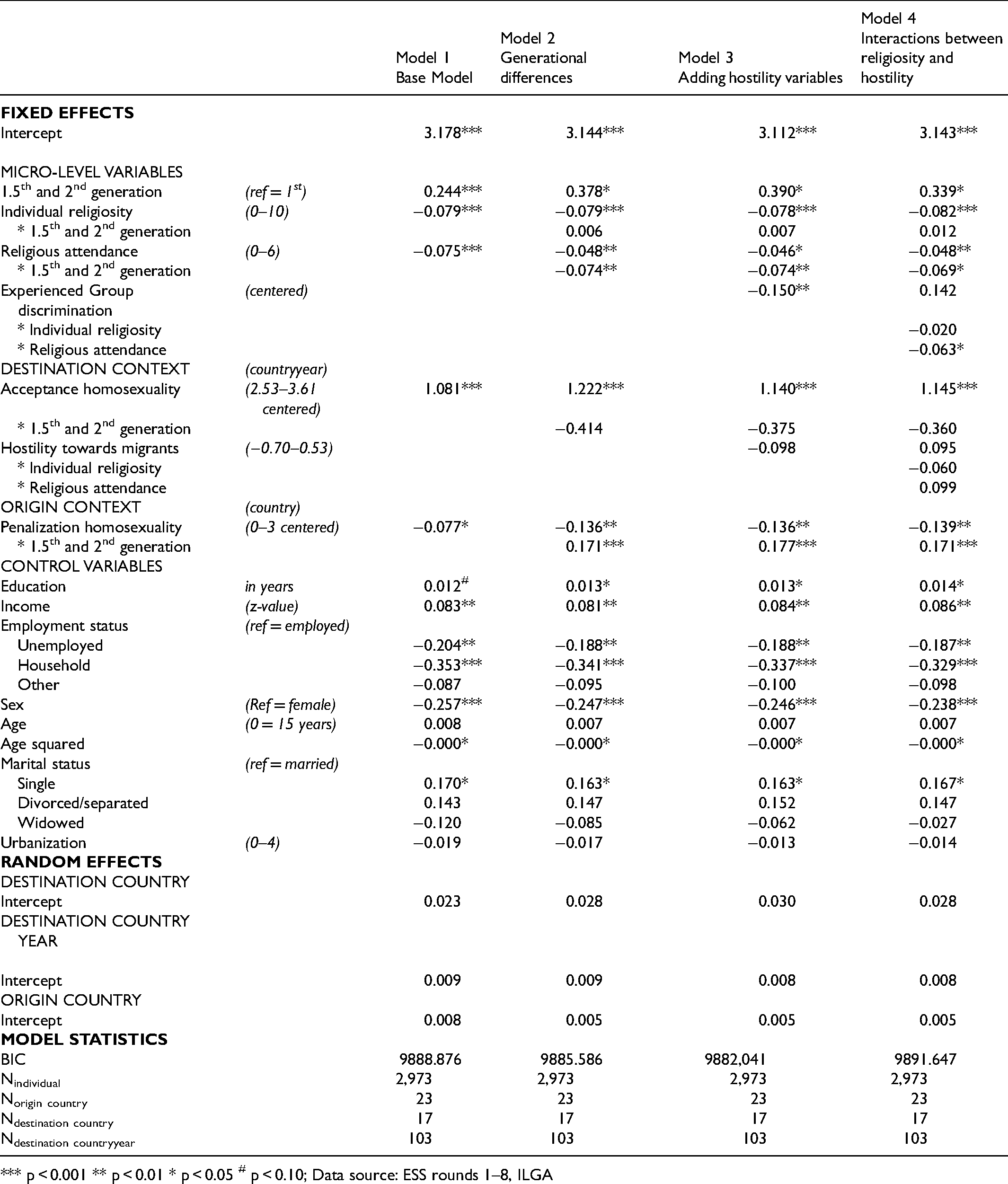
Cross-Classified Multilevel Regression Models on Attitudes Toward Homosexuality (0–4).
*** p < 0.001 ** p < 0.01 * p < 0.05 # p < 0.10; Data source: ESS rounds 1–8, ILGA
We start with the general origin- and destination-society effects, which form thebackdrop of our core contributions. In line with the existing literature (Röder 2015; Soehl 2017), Model 1 shows that Muslim respondents held more progressive attitudes if they grew up in Europe (1.5- and second-generation migrants), compared to first-generation migrants. 8 Model 1 furthermore shows that living in a Western European country in which the people were, on average, more progressive is reflected in Muslim migrant communities’ attitudes. The degree to which homosexuality was penalized in the origin context also shaped respondents’ attitudes toward homosexuality, though only among first-generation respondents, as indicated by the significant interaction term of growing up in Western Europe and origin-country context (Model 2). To better illustrate the size of this effect, we compared the coefficients for a first-generation migrant respondent from the country with the strongest penalization of homosexuality with one from the most liberal origin country. This difference of 0.41 corresponds roughly to the difference between a single woman and a married man.
Regarding acculturation and dissimilation, these models reflect and refine results found in previous studies (Röder 2015; Soehl 2017): in line with that work, we find that norms toward homosexuality in both the origin and destination country matter for the attitudes of migrants living in Western Europe. For first-generation migrants, origin-country effects were most important, while respondents socialized in Western Europe during their youth (1.5 and second generation) were more progressive overall and hardly influenced by origin norms. In contrast to previous studies (Diehl, Koenig and Ruckdeschel 2009; Röder 2014, 2015; Röder and Mühlau 2014; Spierings 2015) we show that the relevant differentiation is between first- and 1.5-generation respondents, not between those born abroad (first generation and 1.5 generation) and those born in the host country (second generation).
Testing the Anchoring Role of Religion
Models 1 and 2 also present the role of mosque attendance and individual religiosity in shaping Muslim respondents’ attitudes toward homosexuality. Based on the anchoring logic developed above, Hypothesis 1 on mosque attendance expected a negative impact (1a) but one that was stronger among 1.5- and second-generation migrants than among first-generation migrants (1b). Both parts are supported by our results. Model 1 shows that mosque attendance had a negative impact on attitudes toward homosexuality (−0.075). Model 2 shows that this negative impact was present among all generational groups but significantly stronger among 1.5- and second-generation migrants, as indicated by the interaction coefficient and illustrated in Figure 1. 9 As Figure 1 shows, higher mosque attendance closed the gap between generations: frequent attenders did not differ in their attitudes across generations.
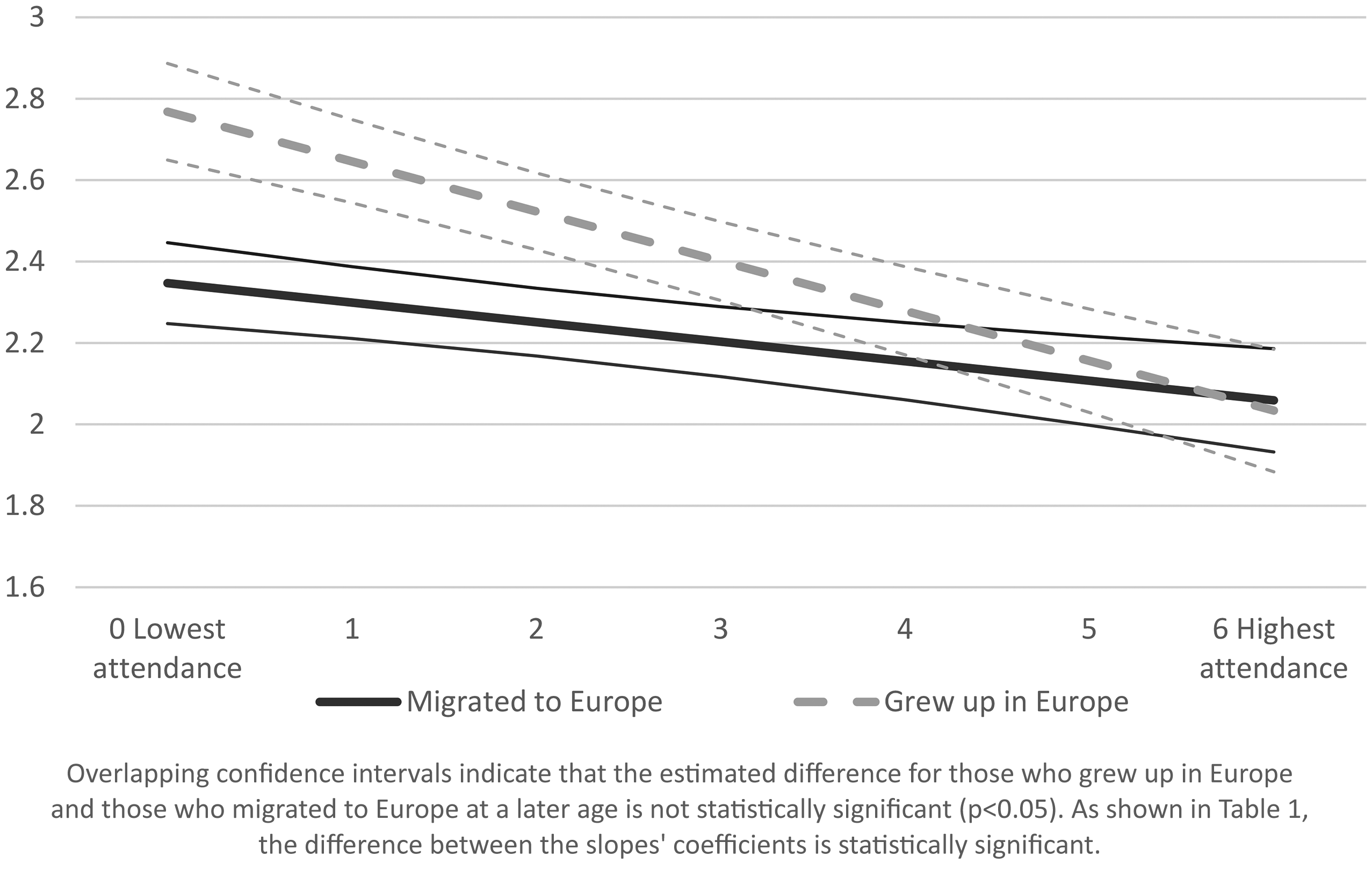
Predicted liberal attitudes toward homosexuality (scale 0–3) by mosque attendance and migration background.
Hypothesis 2 on individual religiosity expected a negative effect (2a) that would be weaker among the 1.5 and second generation (2b). The first part of H2 is corroborated by our results, but the second is not. As Models 1 and 2 show, more religious respondents were, on average, more negative toward homosexuality, but the interaction term with growing up in Western Europe was small and not statistically significant.
Overall, then, our analysis confirms that the more religious Muslim respondents were, the more likely they were to have less tolerant attitudes toward homosexuality. This negative effect held for individual religiosity and mosque attendance, but divergent generational effects indicate that individual religiosity and mosque attendance tapped into different processes. Mosque attendance's effect was particularly strong among those who grew up in Western Europe and seems to serve as an anchor connecting these migrants to their origin community's more conservative norms.
In Section 2.4, based on the logic of retention, we formulated the expectation that an environment hostile toward Muslim migrants feeds into these same Muslim migrants’ more negative attitudes toward homosexuality. Hypothesis 3 distinguished society-level hostility (3a) and individual-level hostility in the form of perceived group discrimination (3b). Moreover, combining the logic on hostility's impact with the above anchoring logic, we argued that these effects would be stronger among respondents who were frequent mosque attendees (H4a/b). Hypothesis 3 is tested in Model 3 and Hypothesis 4 in Model 4. The results support Hypotheses 3 and 4 only in relation to an individual person reporting that they felt part of a discriminated group (H3b and H4b), but not for hostility measured at the country level as a societal characteristic (H3a and H4a).
To assess individual-level effects of a hostile environment, we focus on whether someone reported having experienced ethno-religious discrimination. As Model 3 shows, there was an overall negative effect: respondents who felt discriminated against based on their ethno-religious identity tended to be more negative toward homosexuality, providing evidence for a retention effect. Model 4 and Figure 2 show that this effect was strengthened, the more often respondents went to the mosque. Among those who did not attend mosque regularly,no statistically significant differencewas found between those who experience deiscrimination and those who do not. Only among those who went to mosque at least monthly was a significant retention effect found. Individual religiosity showed no significant interaction effect with perceived discrimination.
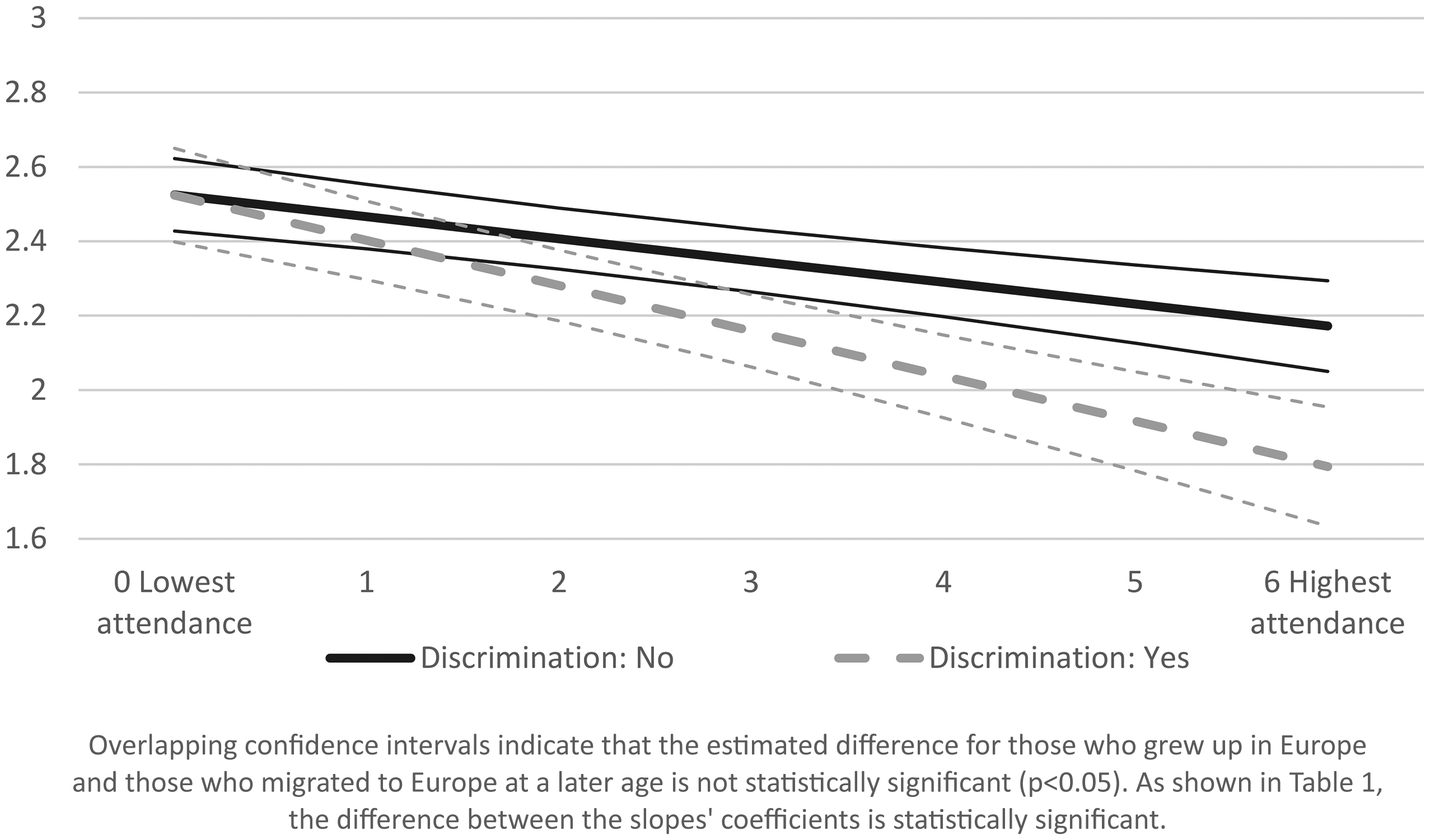
Predicted liberal attitudes toward homosexuality (scale 0–3) by mosque attendance and experienced discrimination.
At the macro level, the degree of natives’ hostility toward migrants showed no significant effect in the general Model (3) nor in combination with religiosity (Model 4). Moreover, using alternative measurements, such as the strength of populist radical right parties, did not lead to any statistically significant relationship. In short, these results show that it is, in particular, a combination of mosque attendance and perceptions of ethno-religious discrimination that feeds into respondents’ negative attitudes toward homosexuality.
To sum up, our results show that mosque attendance had the expected negative effect, which was stronger for Muslim respondents who grew up in Western Europe (supporting H1a and H1b), while individual religiosity had a similar negative effect on all generational groups (supporting H2a, but not H2b). Perceived group discrimination had the expected negative effect, which was stronger for frequent mosque attenders (supporting H3b and H4b). No such effects were found when hostility was measured at the societal level (H3a and H4a not supported).
Previous research (e.g., Fitzgerald, Winstone and Prestage 2014; Röder 2015; Röder and Lubbers 2015, 2016; Banfi, Gianni and Giugni 2016; Soehl 2017; Kogan and Weißmann 2020; Van Klingeren and Spierings 2020) shows that acculturation occurs among migrants in relation to cultural attitudes, while also highlighting that Muslim migrants hold substantially more negative attitudes toward homosexuality across generational groups than other migrants, a trend which is partly linked to their religiosity (Röder 2015; Soehl 2017; Spierings 2018). In this article, we focused on religiosity's role in acculturation processes and developed a theoretical framework that combined the idea that religiosity serves as an anchor to origin cultural norms (Van der Bracht and Van de Putte 2014; Röder 2015; Soehl 2017) with the notion of retention as the mechanism by which an unwelcoming environment leads migrants and their descendants to stick to the cultural attitudes dominant in their origin country - in this, case to more negative attitudes toward homosexuality. As this theoretical framework helps us see, the anchoring effect of religiosity, particularly of mosque attendance, is likely to be strengthened when the destination society is hostile toward migrants and when migrants experience discrimination based on their migration background by the destination societies’ members.
In line with existing research on migrants more generally (e.g., Röder 2015; Soehl 2017), we find that among Muslim respondents, first-generation migrants held more traditional views on homosexuality than those who grew up in Western Europe and that these attitudes toward homosexuality reflect the dominant norms associated with their origin countries. We additionally show that the relevant generational distinction is not between first and second generation, but between those who grew up in the destination country (i.e., 1.5 and second generations) and those who spent their formative years in the origin country and migrated as adults (first generation). This finding confirms that for attitudes related to gender and sexuality, early socialization experiences appear to be crucial (Alwin and Krosnick 1991; Inglehart 1997; Pettersson 2008).
Having established these general patterns among respondents, we moved to the core contributions of our analysis: the multidimensional impact of religiosity and how that impact is conditional on migration generation and destination-society hostility. While it is well established that individuals with higher religiosity tend to hold less progressive views on homosexuality (Lubbers, Jaspers and Ultee 2009), the central argument developed here is that in relation to acculturation, different dimensions of religiosity must be considered separately because they might not have the same impact in general or for different migrant generations.
Our findings confirm our expectations on the negative link between both more frequent mosque attendance and individual religiosity and less progressive attitudes toward homosexuality. While the effect of mosque attendance differed across generational groups and had a stronger negative effect on attitudes toward homosexuality among the 1.5 and second generation than among the first generation, no generational difference in the effect was found for individual religiosity. Mosque attendance, thus, appears to serve as an anchor to norms and values dominant in origin societies (Guveli 2015; Glas et al. 2019), especially for the 1.5 and second generation. In fact, for those who attended mosque most frequently, no generational difference in attitudes can be observed in the data at all: those who grew up in Western Europe and attended mosques very frequently were just as negative in their attitudes toward homosexuality as very frequently attending first-generation migrants.
Results on individual religiosity indicate that there is little evidence of a “de-coupling” of religiosity and attitudes toward homosexuality among Muslim migrants and their descendants in Western Europe (Röder 2014; Glas et al. 2019; Van Klingeren and Spierings 2020). While other studies and theoretical discussions (e.g., Nahas 2001; Dibi 2015; Glas and Spierings 2021) suggest that individual religious explorations may lead to more liberal interpretations of religious teachings, our results indicate that on the issue of homosexuality, individual religiosity is not a main pathway by which acculturation to host-society norms occurs among Muslim citizens with a migration background. The observation that the impact of individual religiosity is similar among Muslim migrants who grew up in Western Europe and among Muslims who migrated at a later age is in line with observations from the literature studying discourses prevalent in European mosques, where alternative understandings of Islamic scripture do not appear to have had a widespread impact (Hekma 2002; Baker, Gabrielatos and McEnery 2013).
Our theoretical framework also consideres the way in which the often-hostile environment Muslims face in Western Europe affected acculturation. Building on the Rejection Identification Model (Tajfel et al. 1979; Tzeng and Jackson 1994; Brown 2000), we argued that Muslim migrants’ negative experiences in terms of public hostility or experiences of discrimination should lead to retention of more negative attitudes toward homosexuality among Muslim migrants, which is only confirmed in our findings in relation to individual perceptions of ethno-religious discrimination. Additionally, we found that the negative effect of discrimination on Muslim migrants’ attitudes is further reinforced by frequent mosque attendance. As always with cross-sectional data, we must be careful in interpreting the causal direction of this link. While we theorized that discrimination leads to retention, it is also plausible that those with more conservative attitudes experienced (or perceived) greater discrimination as a result. The negative effect of hostility was less clear when measured as general society-level hostility toward ethnic-minority migrants in a country, regardless of the different measurements (negative attitudes toward migrants or Muslims among the majority population or support for Populist Radical Right parties) used to check the robustness of these results. Together, these findings suggest that subjective perceptions of discrimination provide a stronger explanation of attitudes toward homosexuality than do indicators of actual hostility, at least to the extent that the latter can be assessed here.
Considering that not all aspects of the proposed theoretical framework could be confirmed in this analysis, our work opens several avenues for further research. Religiosity's role in shaping cultural attitudes should be studied in more detail, for instance, with data that capture a wider range of sub-dimensions, such as religious orthodoxy and the nature and composition of religious congregations. To conduct such studies, specific immigrant surveys, preferably longitudinal surveys, will be required, rather than general population samples. Immigrant surveys typically do not include as many destination and origin countries as the data used here, but they do allow for more in-depth analysis as they generally include more specific items on religiosity, experiences of discrimination, and integration in migrant communities, as well as other potential drivers of anchoring and retention (Carol and Milewski 2017; Eskelinen and Verkuyten 2020).
Taken together, our results indicate that the general picture of intergenerational acculturation of attitudes toward homosexuality among the Muslim population in Western Europe can be confirmed. Origin-country norms mainly shape attitudes among the first generation, while those who spent their formative years in the host country hold more tolerant attitudes toward homosexuality compared to the first generation, relatively independently of where in Western Europe they lived or where their parents were from. For a fuller understanding of the dynamics at play, however, we must realize that religiosity can serve as an anchor that maintains an enduring connection between migrants and the values dominant in their origin society. This anchoring logic can be further explored in future work and theorized beyond religiosity. Such further theorizing should also take into account under which circumstances such effects occur. Our analysis puts forward that particular, mosque attendance acts as an important anchor to origin country norms among Muslims in Western Europe, and this effect becomes stronger when coupled with perceived discrimination. This suggests that the experience of hostility drives retention of origin-society norms in relation to homosexuality, especially among those that are strongly embedded in their religious community through mosque attendance. Uncovering such an interplay between hostility and religiosity is one of this article's main contributions, and better understanding of this interplay refines our knowledge of retention processes more broadly. Hostility toward Muslims among the native population in Western Europe, thus, not only appears to lead to a greater maintenance of religiosity itself (Connor 2010), but also strengthens the role of religiosity for anchoring cultural attitudes in the case of homosexuality. These forces should be considered more centrally in the acculturation literature, as they are likely to also be at play for other domains of acculturation and among other immigrant groups whenever there are strong controversies pitching “us” versus “them” in relation to particular norms, values, and behaviors. It is, thus, not only religiosity per se that slows down intergenerational acculturation among Muslims in Western Europe but also a combination of exposure to conservative religious congregations and retention processes triggered by a hostile environment.
Footnotes
Declaration of Conflicting Interests
The author(s) declared no potential conflicts of interest with respect to the research, authorship, and/or publication of this article.
Funding
Antje Röder received no financial support for the research, authorship and/or publication of this article. For Niels Spierings, working on this research and publication was linked to receiving funding from the Dutch Research Council (grant number: VI.Vidi.191.023).

Supplemental Material
Supplemental material for this article is available online.
Notes
References
Supplementary Material
Please find the following supplemental material available below.
For Open Access articles published under a Creative Commons License, all supplemental material carries the same license as the article it is associated with.
For non-Open Access articles published, all supplemental material carries a non-exclusive license, and permission requests for re-use of supplemental material or any part of supplemental material shall be sent directly to the copyright owner as specified in the copyright notice associated with the article.
