




Abstract
This article examines the association between accented speech and the formation of friendships and partnerships among immigrants and native-born majority residents in Germany. Drawing on the sixth wave of the German extension of the Children of Immigrants Longitudinal Survey in Four European Countries, we analyze a neglected aspect of language — pronunciation — and find that speaking with a foreign accent is a more important correlate of the incidence of interethnic partnerships than of interethnic friendships. We argue that beyond its primary function of understandability, accented speech possesses socially communicative power. Accent transmits signals of an individual’s foreignness and cultural differences and, thus, becomes an additional marker of social distance. Such signals serve as a greater obstacle to more consequential intimate interethnic relations such as partnerships. Our findings extend the scholarly debate on the role of symbolic boundaries in social interactions between ethnic groups by yet another important boundary maker — accent.
Social integration, particularly the formation of interethnic friendships and partnerships, is an obvious sign of immigrants’ successful incorporation into receiving societies. Unsurprisingly, research in this area has flourished (Stevens and Schoen 1988; Sigelman et al. 1996; Lievens 1999; Fong and Isajiw 2000; Klein 2001; Quillian and Campbell 2003; Kao and Joyner 2004; González-Ferrer 2006; Lucassen and Laarman 2009; Martinovic, van Tubergen, and Maas 2011; Huschek, de Valk, and Liefbroer 2012; Carol, Ersanilli, and Wagner 2014; Bohra-Mishra and Massey 2015). Previous studies have demonstrated that interethnic contacts function as a stepping stone for immigrants’ successful economic integration and help familiarize them more quickly with host-country customs and traditions. Interethnic encounters also help bridge ethnic and religious divides between immigrants and the majority population, overcome prejudices, and prevent conflicts.
Existing research has underscored the importance of opportunity structures, as well as cultural factors like religion, cultural worldviews, or cultural consumption, in shaping intergroup friendship and partnership choices (Lizardo 2006; Vaisey and Lizardo 2010; Cheadle and Schwadel 2012; Carol, Ersanilli, and Wagner 2014; Leszczensky and Pink 2017). Language is another prominent cultural factor that influences social interactions (Maynard and Peräkylä 2003). A necessary productive communication resource in social interactions that fosters positive interpersonal relationships, language also has an important signaling function: it can symbolize belonging to a nation, region, ethnic, or social group (Esser 2006). Thus, the way a language is spoken can signal a speaker’s social identity above and beyond language’s primary function as a means of exchange and communication.
Due to the paramount importance of language proficiency for immigrant integration in general and social integration in particular, research on this topic has been thriving (Stevens and Swicegood 1987; Stevens 1992; Carliner 2000; Chiswick and Miller 2001; Alba et al. 2002; Esser 2006; van Tubergen and Kalmijn 2009; for a review and research desiderata, see Drouhot and Nee 2019). Notwithstanding existing scholarship, which largely comes from the field of social psychology (Ryan, Hewstone, and Giles 1984; Cargile 2000; Deprez-Sims and Morris 2010, 2013; for a review, see Gluszek and Dovidio 2010), one aspect of language — accent — has received far less theoretical or analytical attention in the context of immigrant social integration (for sociological research on accent’s role in the labor market, see Hwang et al. 2010; Timming 2017). This article seeks to fill this gap by examining the association between accented speech and the formation of friendships and partnership among immigrants and majority native-born residents in Germany. On an analytical level, we are interested in whether accent is a prominent element of social interactions and to what extent its role differs between interethnic partnerships and interethnic friendships. On a more conceptual level, we theorize about two distinct functions of language proficiency in social interactions. We propose that, beyond its primary function of understandability, accented speech transmits signals of an individual’s foreignness and, thus, becomes an additional marker of social distance from native-born majority inhabitants of a country. Such signals are likely to serve as a greater obstacle to more consequential interpersonal relations such as partnerships.
Before laying out our hypothesis on the association between foreign accent and interethnic friendships and partnerships, we first define accent conceptually and discuss the implications for our research question. We then review a number of mechanisms potentially responsible for the association between accent and friendships/partnerships. After presenting the data, methodology, and results, we discuss the theoretical and empirical implications of our key findings for the wider study of international migration.
Theoretical Framework and the Study’s Expectations
Major Definitions
Language proficiency is composed of several building blocks, including vocabulary and pronunciation (Foley and Thompson 2003). On the one hand, both vocabulary and pronunciation can be consciously learned and, thus, represent an intentional investment, as is the case with second language (L2) acquisition in adulthood (Esser 2006). On the other hand, the learning process can occur unintentionally or indirectly through listening and reading, as is often the case with first language (L1) acquisition or language learning among children (Esser 2006). High levels of non-native L2 language proficiency can, therefore, be characterized by sufficiently rich vocabulary and native-like (accent-free or nearly accent-free) pronunciation.
Accent is commonly understood as a unique mode of sound production in a spoken language, which is influenced by a person’s geographical origin, social status, or mother tongue (Edwards 1997; Lippi-Green 1997). This definition implies that individuals born and raised in a country are not necessarily and, according to Agha (2007), rarely accent free. In fact, speakers’ regional accents or sociolects reflect their regional or social status differences; non-native/foreign accents are rather common among L2-speakers. 1 Accent is related to, but conceptually distinct from, language competence, which is the extent to which one has an extended vocabulary, uses correct grammar, and formulates syntactically correct sentences (Deprez-Sims and Morris 2013). Individuals speaking with an accent can master the standard form of language at other linguistic levels (e.g., grammar, syntax morphology, or lexicon) at sufficient or even high levels (Giles 1970).
As a feature of oral language proficiency, accents are salient in social interactions (Massey and Lundy 2001; Deprez-Sims and Morris 2010). Since non-native accents might substantially deviate from standard speech patterns, other speakers of the language might find it difficult to understand them. Strongly accented speech might, thus, be detrimental to comprehension and, hence, complicate the basic communication process (Deprez-Sims and Morris 2013).
Despite having a noticeable accent, many non-native speakers can communicate fluently and effectively. Native speakers’ speech perceptions are also flexible enough to adapt to pronunciation patterns that deviate from the standard pronunciation, as Bradlow and Bent (2008) demonstrate in a series of experiments. Yet, native speakers might still discriminate against speakers with foreign accent. The latter tend to be evaluated differently from native speakers on a number of traits (Dailey, Giles, and Jansma 2005), including those that are considered important for interpersonal relations, such as warmth, trust, friendliness, or dynamism (for an overview, see Giles and Billings 2004). Another explanation for possible discrimination is that accented speech is equated with a lack of communication skills (Deprez-Sims and Morris 2013). It has further been contended that a speaker’s accent functions as a symbol of cultural affiliation (Kinzler et al. 2009; Deprez-Sims and Morris 2010), providing cues about the speaker’s foreignness, recentness of immigration, and ethnic origins (Fuertes et al. 2012). As a result, foreign accent might indicate cultural and social distances and even trigger stereotypes associated with particular ethnic groups (Cargile and Giles 1998; Cargile 2002; Lindemann 2005). To sum up in Kinzler et al.’s (2009, 624) words, “spoken language…has a socially communicative power beyond the literal information it conveys.”
Accent in Interethnic Interactions: A Theoretical Framework
How and through which mechanisms does foreign accent affect interethnic interactions? Our point of departure in addressing this question is an established theoretical framework which underscores the importance of (1) opportunity structure for intermarriages and interethnic friendships, (2) third parties’ influences, and (3) personal preferences (aligned with individual resources; Kalmijn 1998).
The first factor in this framework is relevant insofar as processes of friendship and partnership formation are embedded within existing structures and structural constraints might decisively hinder any type of social interaction. Research shows that intergroup prejudice is reduced by intergroup contacts (Allport 1954; Pettigrew and Tropp 2006). Such contacts are more likely if immigrants or ethnic minorities meet and interact with the majority population (Martinovic, van Tubergen, and Maas 2011). Thus, for example, individuals residing in racially and ethnically mixed neighborhoods are more likely to develop friendships and partnerships with people of other races and ethnicities than those living in segregated neighborhoods (Mouw and Entwisle 2006). Recent research also suggests that diversity within educational institutions (e.g., classrooms) or workplaces potentially contributes to bonding across ethnic groups (Juvonen, Kogachi, and Graham 2018; Lessard, Kogachi, and Juvonen 2019).
Second, third parties, including family, religious and ethnic communities, and other relevant individuals, influence friendship and partnership choices through norms and social sanctions (Merton 1976; Kalmijn 1998). The role of families and friends deserves particular attention in the analysis of partnership formation. With the ultimate goal of ethnic community cohesion, homogeneity, and family integrity (Kalmijn 1998; Casier et al. 2013), some families engage in setting up meeting opportunities for young people, providing advice and opinions regarding potential candidates (Kalmijn 1998; Maddox 2019) and penalizing for nonconformity with family and community norms (i.e., when young people choose a partner from the “wrong” ethnic origin; Güngör 2008; van Zantvliet, Kalmijn, and Verbakel 2014). In Europe, families’ active engagement in offspring partnership formation has been found among immigrants from Turkey (van Zantvliet, Kalmijn, and Verbakel 2014) and other collectivistic countries (Buunk, Park, and Duncan 2010). Also, friends influence partnership formation, mainly by providing opportunity structures for encounters and social interactions (Connolly, Furman, and Konarski 2000; Mollenhorst, Völker, and Flap 2008; van Zantvliet and Kalmijn 2013). Furthermore, by having co-ethnic friends who maintain contacts across ethnic group boundaries — a phenomenon known as an extended contact — individuals might improve intergroup attitudes (Zhou et al. 2019) and potentially increase intergroup encounters.
Third, desirable individual characteristics, such as socioeconomic status or physical attractiveness, are shown to be relevant when choosing partners and friends (Blau 1994). Scholars unanimously agree that the cornerstone of social interactions is a preference for homophily in interpersonal relations (Lazarsfeld and Merton 1954; Kalmijn 1998; McPherson, Smith-Lovin, and Cook 2001; Lizardo 2006); that is, people favor interactions with individuals who are similar to them. Cultural similarity is a foundation of homophily (Kalmijn 1998). In social interactions, cultural similarity operates through two distinct mechanisms. First, it facilitates mutual understanding and personal attraction, as suggested by scholars working with the similarity–attraction paradigm (Byrne and Nelson 1965; Byrne, Ervin, and Lamberth 1970; Byrne 1971). Second, cultural similarity is a basis for social categorizations, as postulated in the social identity approach (Tajfel et al. 1971).
According to the similarity–attraction paradigm, interactions among culturally similar individuals are easier because such individuals are more likely to find common ground on a broader set of issues (Byrne 1971). Exposure to values and attitudes that coincide with one’s own leads to the establishment of positive emotional reactions and a solid basis for a relationship, particularly in situations that challenge these attitudes and beliefs (Byrne and Clore 1967). Moreover, sharing common attitudes and beliefs is likely to be associated with reciprocal experiences among (potential) friends or partners, and individuals tend to feel more affection toward people who they believe are like them (Backman and Secord 1959; Aronson and Worchel 1966). This similarity argument is also relevant for communication skills, since relationships with people who have a different interpersonal communication style tend to be less satisfying and less likely to last (Burleson 1994; Duck and Pittman 1994). In fact, social preferences for similarly sounding individuals have been reported for five-year-old children in a set of experiments by Kinzler et al. (2009) and is, according to the authors, an evolutionary phenomenon.
Unlike the similarity–attraction hypothesis, the social identity approach maintains that individuals who are similar to one another belong to the same social category, the in-group, whereas those with other social identities form the out-group (Tajfel et al. 1971; Tajfel 1981; Tajfel and Turner 2008). In a similar vein, sociologists proposed a distinction between “us” and “others,” stressing the importance of group boundaries and social closure (see Lamont and Molnár 2002; Alba and Nee 2003; Alba 2005; Qian and Lichter 2007; Wimmer 2008, 2013; Lichter and Qian 2018). For the sake of social belonging and identification, persons hold more positive views toward in-group members and more negative views toward out-group members. In-group favoritism and out-group repulsion are also reflected in patterns of social interactions, in which partners from one’s own group are preferred and outsiders are rejected (Billig and Tajfel 1973). Since accented speech is immediately recognizable in social interactions and has a strong symbolic connotation of “otherness,” it serves as a salient cue by which individuals are categorized as belonging to the out-group (Massey and Lundy 2001).
Differences in Accent’s Role in Interethnic Friendships and Partnerships
We have established thus far that, based on the similarity-attraction approach and social identity theory, foreign accents should be considered a meaningful underlying factor for homophily in social relations, including friendships and partnerships. In this article, we advance the idea that based on the assumption of larger homophily in closer social relationships, accent should be considered a stronger signal when it comes to the initiation of more intimate and consequential social relations, such as partnerships, than friendships. The above-mentioned assumption rests on Bogardus’s (1925) notion of social distance in general and its area-specific manifestations. In her application of Bogardus’s influential framework to the German case, Steinbach (2004) has demonstrated that individuals tend to perceive more pronounced distances between the in- and out-group in more intimate relationships. Having an immigrant as a work colleague or a neighbor was more eagerly acceptable for majority native-born Germans than being friends with an immigrant. Respondents were least likely to accept immigrants into the family, which obviously includes cross-group marriages.
Decisions regarding marriage and partnership formation, however, are costlier and are associated with potentially longer-term consequences, compared to friendship decisions (Alba and Golden 1986). Such consequences often include, for example, starting a joint household, being integrated in the partner’s extended family, and having children. Therefore, the partner selection requires a more thorough decision-making process. Each signal or marker potentially easing uncertainties associated with the lack of information in the matching process is valuable. The idea of symbolic markers, which serve to identify group members and, therefore, to protect social group boundaries, has been developed by Wimmer (2013). Accent might be one such marker, which is likely to be taken into consideration more in partnership decisions than in friendship formation.
Specific circumstances of migration to Germany shed light on the nature of possible signals associated with foreign accent among immigrants and their offspring. Major waves of immigration to Germany encompass guest worker migration from the Mediterranean countries in the 1950 through the 1970s and, related to that wave, family reunifications (Hatton 2004; van Mol and de Valk 2016). Germany has also absorbed several refugee migrations. In the late 1980s and early 1990s, refugees from the former socialist countries in Eastern Europe and war refugees from ex-Yugoslavia arrived (Kogan 2007), and in more recent years, Germany has accepted unprecedentedly large numbers of newcomers from the Middle East and Turkey (OECD 2017). The Soviet Union’s disintegration in the early 1990s further led to the return of ethnic German diaspora migrants (Kogan 2011). Finally, Germany hosts significant numbers of EU citizens, who in recent years have come predominantly from Eastern European Member States (Bundesministerium des Innern, für Bau und Heimat and Bundesamt für Migration und Flüchtlinge 2020).
Numerically, most immigrants to Germany came from more traditional and collectivistic societies than Germany (Inglehart and Baker 2000; Oyserman, Coon, and Kemmelmeier 2002; Kalter and Granato 2007; Kogan 2011). As non-native accents stand for foreignness and recentness of migration, native-born majority Germans might, on the one hand, equate accent with non-native speakers’ individual orientations toward the heritage country’s norms, values, and cultural practices. On the other hand, foreign accent might reflect immigrants’ language usage patterns in their family of origin and, hence, also proxy for family’s cultural orientations. Taken together, accent proxies for potential cultural differences in the relationship, whereas most individuals prefer to keep cultural differences in intimate relations at a minimum. Foreign accent, as a signal of both individual and family or collective foreignness, is, therefore, likely to deter some majority native-born individuals from dating immigrants with non-native accents. By contrast, befriending someone with a foreign accent would not necessarily activate comparable stereotypes and, hence, should be less detrimental for this type of social interactions.
Considering the arguments outlined above, we hypothesize that foreign accent in Germany should possess a stronger signal in more consequential types of social relations (i.e., partnerships) than in friendships. We, therefore, expect a residual effect of accent, at a given level of language proficiency, to be larger in interethnic partnerships than in interethnic friendships. As a symbolic boundary maker, accent would reinforce social distances and activate stereotypes and is, thus, likely to deter some native-born majority individuals from intimate partnerships with members of ethnic minorities.
Research Methodology
Data
The data for the following analyses were collected in 2016 within the sixth wave of the German extension of the Children of Immigrants Longitudinal Survey in Four European Countries (CILS4EU-DE; Kalter, Kogan, and Dollmann 2018, 2019). This wave surveyed a national, representative group of 19–22 year olds (n = 5,820). The sample consists of two subsamples. The first subsample, which is about 40 percent of the overall sample (2,307 cases), had been surveyed since 2010. In the first wave, 14- to 15-year-old students were interviewed at the end of 2010 and beginning of 2011. They were reached via a school-based nationwide sampling of ninth graders in Germany. First-stage sampling units were schools encompassing the relevant target grades, which were sampled with probabilities proportional to their size. Prior to sampling, schools were assigned to a strata according to the proportion of students with an immigrant background to oversample schools with a large share of students with immigrant backgrounds. The second-stage units were classes within target grades in sampled schools, from which two classes were selected at random. Finally, the third-stage sampling units were students from classes in which all students were included in the sample.
During the sixth wave of CILS4EU-DE, a refreshment sample was drawn to compensate for panel attrition from the initial sample, as described above. The respondents in this refreshment sample (n = 3,513), who were surveyed for the first time in the CILS4EU-DE sixth wave, constitute the second subsample of our analyses. In the refreshment sample, respondents were selected at the municipality level. Using lists of residents from the sampled municipalities obtained through local registration offices, an onomastic screening of names was undertaken (i.e., individuals’ first and last names were analyzed and assigned to specific ethnic and/or geographical origins with a certain probability; Humpert and Schneiderheinze 2016). Respondents identified through this procedure as having a high probability of an immigrant background were consequently oversampled.
The oversampling strategies in both subsamples resulted in an immigrant proportion of approximately 53 percent in the final sample of wave 6. We use design and nonresponse adjustment weights to account for differences in sampling approaches (CILS4EU 2016; Schiel et al. 2016). We focus on respondents with an immigrant background, defined as individuals who either migrated to Germany themselves or were children or grandchildren of immigrants (up to the 3.75th generation; see Dollmann, Jacob, and Kalter 2014 for the classification procedure).
We use data from the survey’s long version, which was administered face to face and contains unique information on measured accents. 2 Of the total sample of 5,074 relevant individuals, we only consider respondents with an immigrant background (n = 2,662), of whom 2,037 consented to be recorded for the accent measure. Participants who refused to be recorded were less likely to have friends and partners among native-born majority Germans. Such participants also tended to be negatively selected on characteristics that theoretically lead to a stronger accent (i.e., those who arrived at later ages, those with a less advantageous social background, and those from linguistically more distant countries; results available upon request). Thus, our analysis tends to deliver conservative estimates for the accent effects.
Variables
We examine two dependent variables: incidence of friendships and partnerships among adolescents in Germany. Information on friendships with native-born majority Germans is captured with the question, “How many of your friends have a German background” (almost all or all; a lot; about half; a few; none or very few; I do not have any friends [the latter category has two cases, which were dropped from the analyses]). For our analyses, we transform a five-category scale into a percentage scale to match the coding of the dependent variable pertaining to the share of partners who are native-born majority Germans, 3 which is extracted from information from a Life History Calendar and coded in percent. 4 For first-generation migrants, we excluded information on all relationships that started prior to moving to Germany (i.e., until the birthday month at the age at which they migrated). As many as 589 respondents (out of 1,823) reported not yet having a partner, an issue we address in the auxiliary analyses below.
The survey’s sixth wave contains a number of instruments relevant to examining empirical associations between language proficiency and interethnic partnerships/friendships. The key independent variable is a foreign accent’s strength when reading in the German language. In line with Deprez-Sims and Morris (2013), accent strength is defined as the extent to which a person uses a language feature, such as a stress pattern, that is different from native speakers of the language. The more different the stress pattern is, the stronger the accent. The instrument used to capture a foreign accent’s strength was developed together with phoneticians and linguists at the University of Halle-Wittenberg and consists of two parts (Weißmann und Dollmann 2019; Dollmann, Kogan, and Weißmann 2020). The first part pertains to reading aloud a text that was specifically designed to reveal accented pronunciation in German. In the second part, respondents were asked to reflect on their impressions from the interview. The aim was to encourage extemporaneous speech. Both parts were audio-recorded and subsequently rated by specially trained student research assistants with a background in linguistics (for similar rating methodologies, see Nikolov 2000; Bongaerts et al. 1997; for a discussion of the method’s (dis-)advantages, see Flege et al. 2006). We use only the accent scores for reading in our analyses, as this part of the measurement is the most standardized. Furthermore, although all 2,037 respondents agreed to read the text, some refused to participate in the conversation. The results remain largely stable when using the measurement based on extemporaneous speech or a combined measure (reading and speaking) as a dependent variable (results available upon request). Individual accents were rated from 1 to 9, which we subsequently recoded to a scale from 0 to 8 (Southwood and Flege 1999; for the distribution of this variable, see Online Appendix Figure A1).
Based on the distribution of accent strength, we probed two alternative classifications for accented speech. Instead of the original fine-graded, nine-point scale preferred by phoneticians, we coded pronunciation into three broad categories, which seems a more suitable categorization for the strength of foreign accent among interlocutors who do not specialize in phonetics. The first alternative is: (1) no accent (rating of 0 on the accent scale), (2a) weak accent (rating of 1), and (3a) strong accent (2–8). The second classification is: (1) no accent (0), (2b) weak accent (1–2), and (3b) strong accent (3–8). 5 For the sake of robustness, in the following, results for all three classifications are presented when possible.
Another central independent variable is the richness of a respondent’s vocabulary. To measure this factor, a verbal part of the KFT (Kognitiver Fähigkeitstest, translated from German as cognitive ability test) was used (Heller and Perleth 2000; for an application, see Dollmann 2017). Individuals were requested to select a synonym for 25 words out of four possibilities. Resulting answers were coded into a variable ranging from 0 to 1, which captured the share of correct answers to the vocabulary test (for the distribution of this variable, see Online Appendix Figure A2).
In line with Kalmijn’s (1998) theoretical arguments pointing to the importance of individual characteristics, parental influence, and local opportunity structures, we control for several relevant variables. We distinguish between immigrants or children of immigrants arriving from (1) Turkey (reference category in multivariate analyses), (2) Southern Europe, (3) the former Social Federal Republic of Yugoslavia, (4) the former Soviet Union and Eastern Europe, (5) Northern and Western Europe, and (6) other (about 40 percent of this group are from the Middle East and Northern Africa). These groups represent the major sending regions of contemporary immigration flows to Germany and reflect immigrants’ main linguistic and cultural groups.
Figure 1 illustrates how pronounced foreign accents are across six origin groups of young people in the CILS4EU-DE sample. Considerable variation across groups is immediately noticeable. Whereas over 85 percent of young people from Northern and Western Europe spoke without any noticeable foreign accent, only 45 percent youth of Turkish origin were accent free. Over 75 percent of young people with origins in Southern and Eastern Europe (including the former Soviet Union) spoke without any accent, whereas much fewer — about 60 percent — of young people with origins in countries which once constituted the Socialist Federal Republic of Yugoslavia and the rest of the world had no foreign accent. Respondents also differed regarding the strength of their foreign accent. Very few individuals in the sample possessed a very strong accent (“4–8” on the nine-point scale), but a meaningful proportion had a weak accent (“1” on the scale). For the analyses, we should bear in mind that very few Western and Northern Europeans spoke with strong foreign accent.
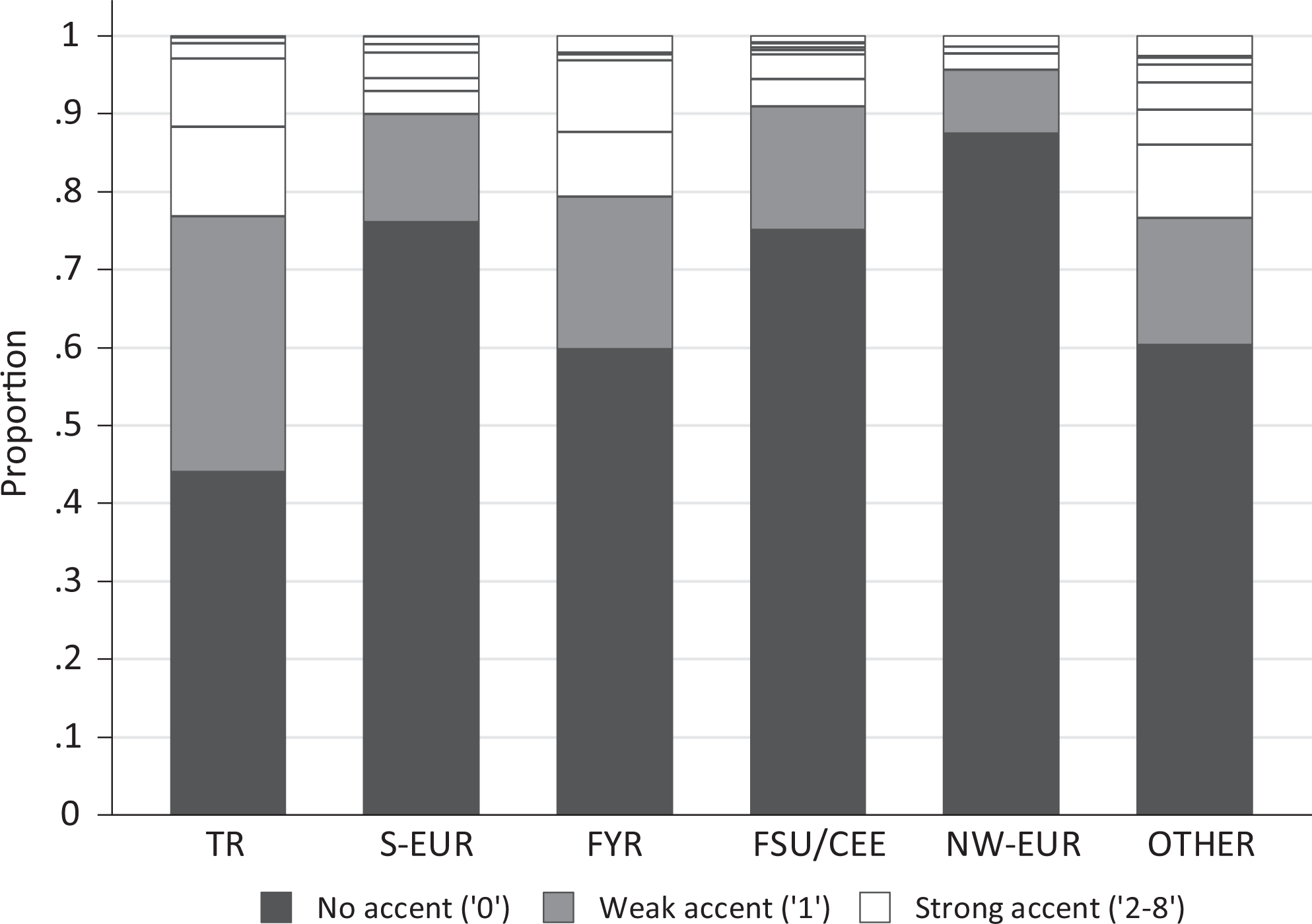
Distribution of the strength of foreign accent by origin groups (Specification 1). Note: Data — CILS4EU, waves 1–3 (versions 1.2.0, 2.3.0, 3.3.0); CILS4EU-DE, wave 6 (version 4.0.0); results design-weighted.
We further control for demographic characteristics, such gender and respondents’ age at the time of the survey. We also include migrant generation. We define first-generation immigrants as immigrants who arrived after the age of 15 (i.e., which in Germany roughly coincides with the end of compulsory schooling). This group of immigrants had been in Germany for a relatively short period of time and hence had fewer opportunities to develop meaningful social interactions with the native-born majority population. We further label individuals who were born abroad but arrived between age 0 and 15 (i.e., corresponding to before and during compulsory education in Germany) as 1.5-generation immigrants. Individuals who were born in Germany to immigrant parents or had immigrant grandparents are referred to as the second/third migrant generation. Figure 2 illustrates how pronounced foreign accents are across the migrant generations in our sample. Whereas over 70 percent of first-generation migrants possessed a strong accent, over 70 percent of second- or third-generation immigrants had no foreign accent at all. About 20 percent of 1.5-generation immigrants had a strong accent, and 30 percent had a weak accent.
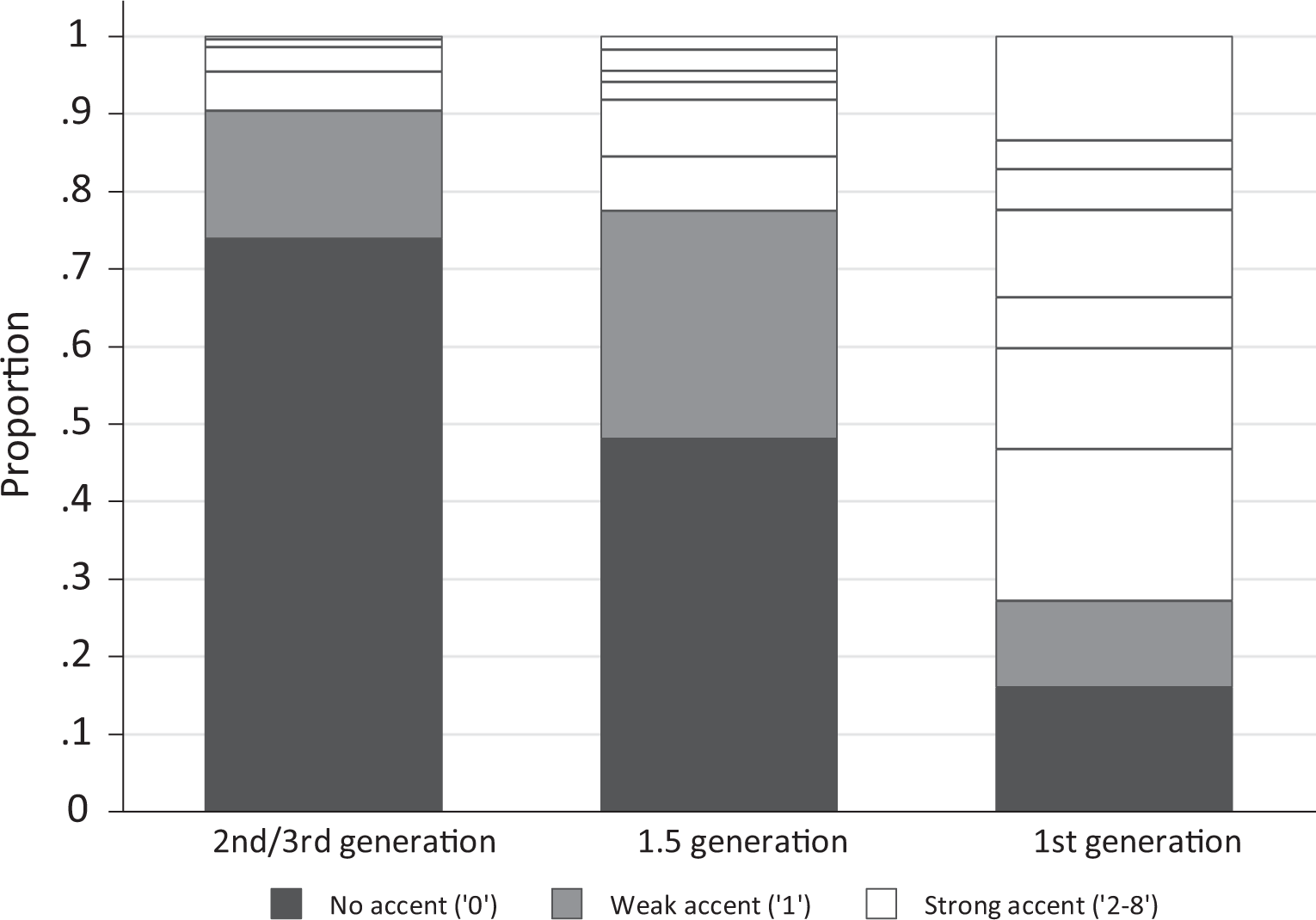
Distribution of the strength of foreign accent by migrant generation (Specification 1). Note: Data — CILS4EU, waves 1–3 (versions 1.2.0, 2.3.0, 3.3.0); CILS4EU-DE, wave 6 (version 4.0.0); results design-weighted.
To account for adolescents’ cultural resources, we control for respondents’ education level and religious background. Individuals’ highest education level is categorized as lower-secondary degree, intermediate-secondary degree, applied upper-secondary degree, and upper-secondary degree (reference category). These categories reflect the structural division within the German secondary education system between Hauptschule (lower secondary), Realschule (intermediate secondary), and Gymnasium (upper secondary, existing in both a classic form leading to the Abitur and a more applied form leading to the vocational Abitur). We further mark individuals still in education and those with no degree or missing information on completed education with separate dummy-coded variables.
Religious background is captured using a number of dummy-coded variables pertaining to Christians, Muslims, other religions (of which the three major religions are Yazidism with 42.5 percent, Hinduism with 27.5 percent and Buddhism with 15 percent of all respondents), and no religious affiliation (reference group). Religiosity is captured with the question “How important is religion to you?” with answers ranging between 0 (religion is not at all important) and 3 (religion is very important).
An adolescent’s family is one of the most important sources of influence in life of young people (Kalmijn 1998). To capture parental background, we control for the family’s socioeconomic characteristics, which reflect the structural and cultural conditions in which adolescents grew up. These characteristics include parents’ highest education level, differentiating between lower-secondary, intermediate-secondary, upper-secondary, and tertiary education levels (reference category). In addition, we include a dummy variable capturing individuals without information on parental education and parents without an educational degree. Parental occupational status is represented by the highest ISEI (International Socio-Economic Index of Occupational Status; Ganzeboom, De Graaf, and Treiman 1992) score of both parents.
We further account for young people’s living arrangements (residing with parents or alone) and parents’ migration experience. We differentiate between (1) individuals living with one or both parents who themselves were born in Germany (the reference group in this set of dummy-coded variables); (2) individuals living alone but whose parents were born in Germany; (3) individuals living alone with one or both parents born abroad; (4) individuals living with one or both parents who themselves are immigrants, and (5) individuals living with both parents of mixed origin. Data about living arrangements add information on the potential usage of the heritage language at home in communication with parents.
Finally, we control for adolescents’ opportunity structure, using two measures. First, we account for the share of individuals with German background in adolescents’ main activities. 6 The second measure of the opportunity structure pertains to the share of majority native-born Germans in respondents’ immediate neighborhood, ranging from zero to one. To obtain this information, respondents’ addresses were geocoded and merged with data gathered by a geo- and micromarketing company (“Microm”). These data provide information on neighborhoods with an average size of about 500 households (Microm 2017). For this article, we use information on neighborhoods’ ethnic composition according to name-based classifications of the members of each household in a specific neighborhood (see Mateos 2007), which has proven to work quite well in a German context (Schnell, Trappmann, and Gramlich 2014). 7
As with all surveys, we face the problem of missing values due to item nonresponse. After listwise deletion of cases with missing values, we ended up with an analytical sample of 1,866 respondents for the friendship analyses and 1,234 cases for the partnership analyses. Descriptive statistics for all independent variables included in our analyses are presented in Online Appendix Table A1. Correlations between the dependent variables and key independent variables can be found in Online Appendix Table A2.
Modeling Strategy
To estimate associations between accent and incidence of friendships/partnerships with majority native-born Germans, we run a stepwise multivariate OLS regression. We first introduce measures for the strength of a respondent’s foreign accent separately and then add the measure for the richness of his/her vocabulary as predictors of partnerships and friendships to scrutinize both aspects of language proficiency simultaneously. Subsequently, in accordance with the theoretical framework, we add controls related to individual characteristics, parental influences, and opportunity structure, while simultaneously monitoring the development in the coefficient related to accented speech. The focal coefficients are then compared with the help of the one- and two-sided t-test, as well as by means of seemingly unrelated estimations across both models: one related to friendships and one related to partnerships. In the sensitivity analyses, we alternatively treat both dependent variables as binary dichotomous variables and accordingly estimate linear probability regression models, which delivered comparable results (results available upon request).
We further carry out a number of auxiliary analyses addressing several issues related to (1) the patterns of selectivity of individuals into partnerships, (2) the importance of heterogeneity between origin groups and migrant generations regarding accent’s role in the incidence of partnerships and friendships with majority native-born Germans, and (3) the issue of reverse causality. The methodology of each auxiliary analytical step will be discussed in the respective section.
Main Findings
Figures 3 and 4 document a clear-cut association between accent strength in the German language and the proportion of majority native-born Germans among friends (to the left) and among partners (to the right). Figure 3 applies a classification with weak accent encompassing cases scoring 1 on the strength of foreign accent measurement and strong accent with scores between 2 and 8. Figure 4 plots results from an alternative classification with weak accents capturing cases with the scores of 1–2 on the accent scale and strong accents with scores of 3–8. Both figures suggest that the association between accented speech and partnerships with majority native-born Germans is somewhat stronger than that between accented speech and friendships with Germans. For partnerships, the gap between individuals with no accent and a weak accent is more pronounced than for interethnic friendships.
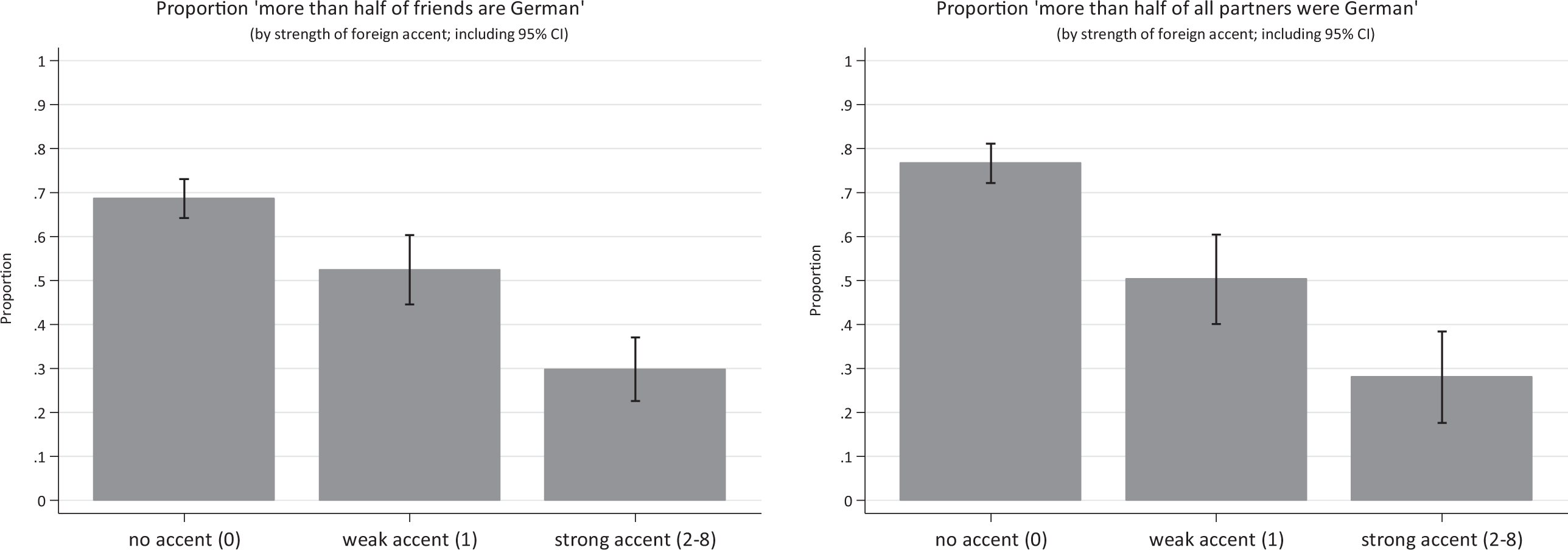
Strength of foreign accent and incidence of friendships (figure to the left) and partnerships (figure to the right) with majority native-born Germans (Specification 1). Note: Data — CILS4EU, waves 1–3 (versions 1.2.0, 2.3.0, 3.3.0); CILS4EU-DE, wave 6 (version 4.0.0); results design-weighted.
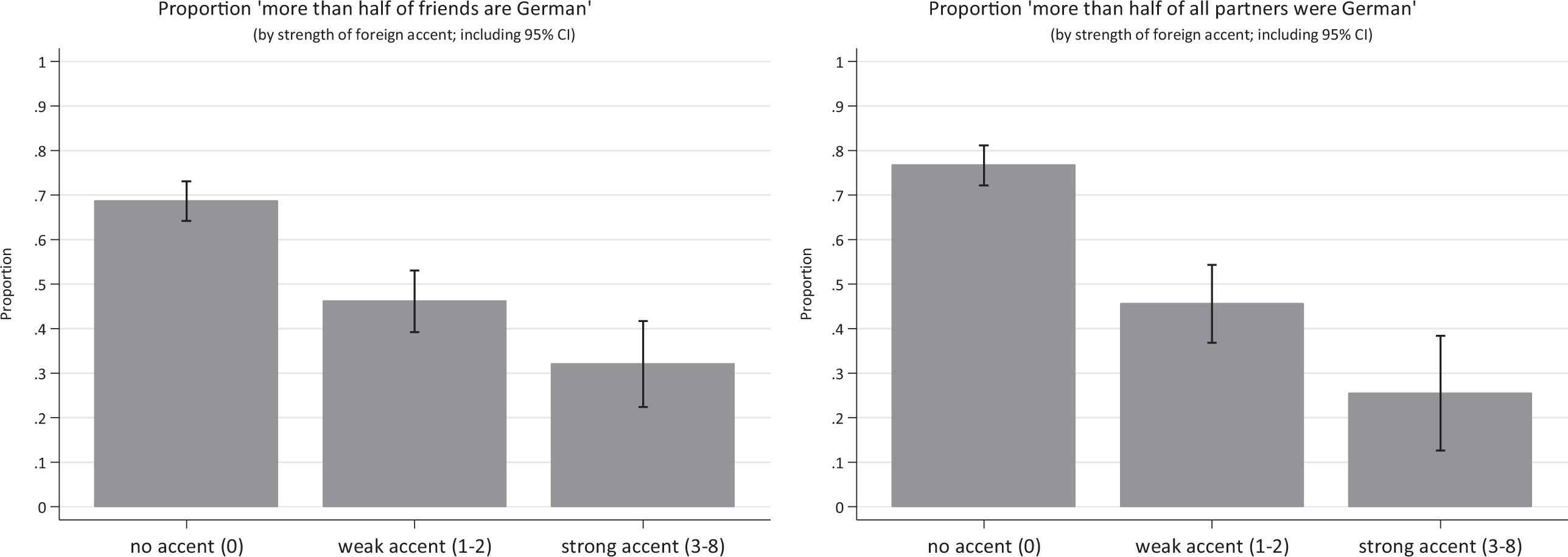
Strength of foreign accent and incidence of friendships (figure to the left) and partnerships (figure to the right) with majority native-born Germans (Specification 2). Note: Data — CILS4EU, waves 1–3 (versions 1.2.0, 2.3.0, 3.3.0); CILS4EU-DE, wave 6 (version 4.0.0); results design-weighted.
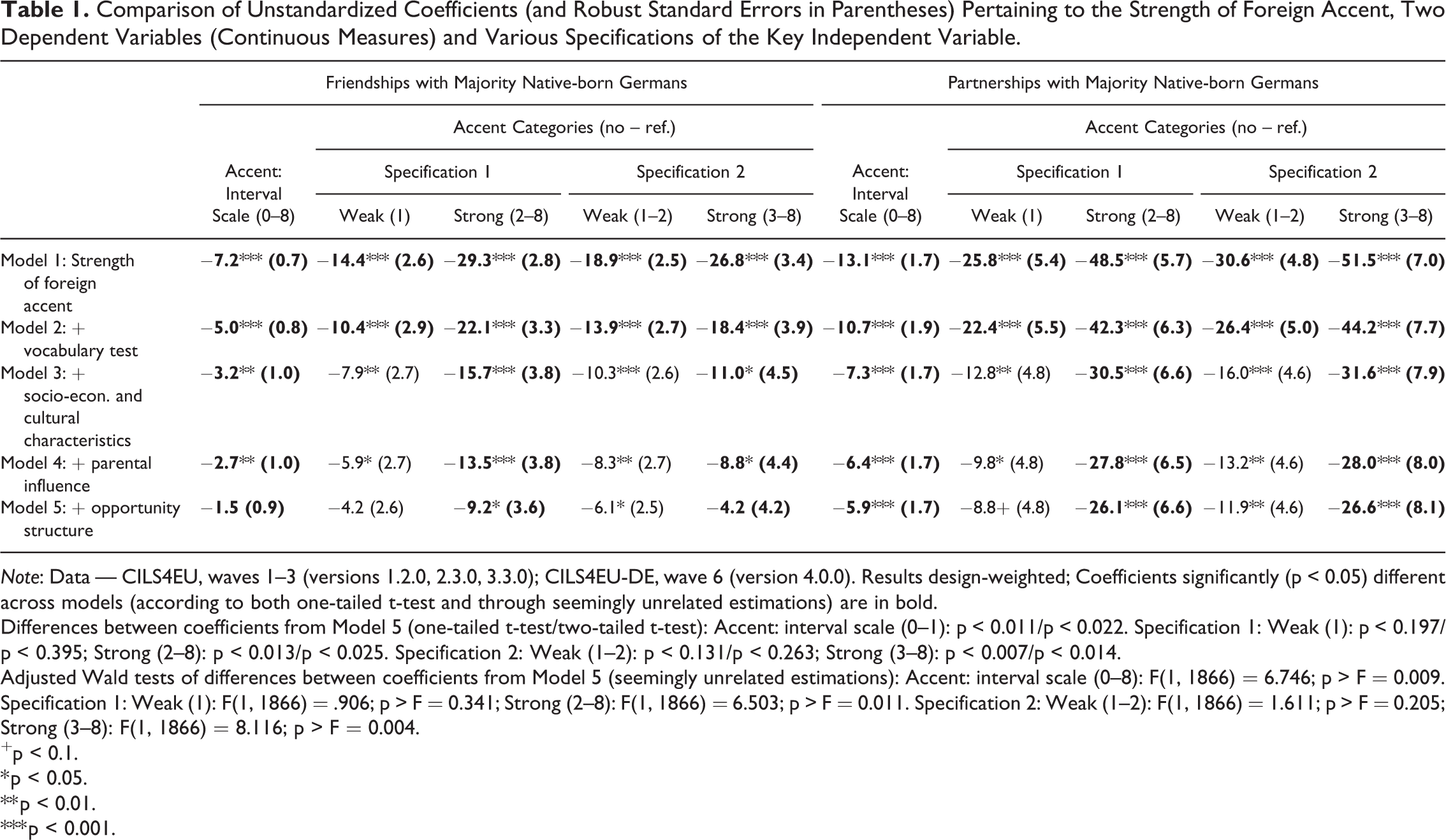
Table 1 presents selected results (the unstandardized coefficients for the focal independent variable “accent”) of the multivariate analysis of the association between accent and the incidence of friendships and partnerships with majority native-born Germans. 8 The parameters for foreign accent strength are presented in the original operationalization of the dependent variable (on the 0–8 scale) and in two specifications as a set of dummy-coded variables with three categories. The coefficients for accent strength can be traced through the five models and compared across both dependent variables. For comparison of the difference in coefficients across the models, we carry out one- and two-tailed t-tests, as well as adjusted Wald tests for seemingly unrelated estimations. The coefficients that vary significantly across the estimated models for both dependent variables are marked in bold (p < 0.05), based on the overlapping results of the one-sided t-test and the adjusted Wald test. Exact test results for the final model are found in the notes to the table. Results of the full set of test results, including the more conservative two-sided t-test, are available upon request.
Comparison of Unstandardized Coefficients (and Robust Standard Errors in Parentheses) Pertaining to the Strength of Foreign Accent, Two Dependent Variables (Continuous Measures) and Various Specifications of the Key Independent Variable.
Note: Data — CILS4EU, waves 1–3 (versions 1.2.0, 2.3.0, 3.3.0); CILS4EU-DE, wave 6 (version 4.0.0). Results design-weighted; Coefficients significantly (p < 0.05) different across models (according to both one-tailed t-test and through seemingly unrelated estimations) are in bold.
Differences between coefficients from Model 5 (one-tailed t-test/two-tailed t-test): Accent: interval scale (0–1): p < 0.011/p < 0.022. Specification 1: Weak (1): p < 0.197/p < 0.395; Strong (2–8): p < 0.013/p < 0.025. Specification 2: Weak (1–2): p < 0.131/p < 0.263; Strong (3–8): p < 0.007/p < 0.014.
Adjusted Wald tests of differences between coefficients from Model 5 (seemingly unrelated estimations): Accent: interval scale (0–8): F(1, 1866) = 6.746; p > F = 0.009. Specification 1: Weak (1): F(1, 1866) = .906; p > F = 0.341; Strong (2–8): F(1, 1866) = 6.503; p > F = 0.011. Specification 2: Weak (1–2): F(1, 1866) = 1.611; p > F = 0.205; Strong (3–8): F(1, 1866) = 8.116; p > F = 0.004.
+p < 0.1.
* p < 0.05.
** p < 0.01.
*** p < 0.001.
The first model presents the unstandardized coefficients for the strength of foreign accent only. We first examine the coefficient from the 0–8 scale measurement of foreign accent. The coefficient is significantly stronger in the equation modeling partnerships than in the equation modeling friendships. In Model 2, when both accent and richness of vocabulary are included in the model simultaneously, the negative association between accent and partnerships with majority native-born Germans is again significantly stronger, both substantively and in terms of statistical significance, than the comparable association between accent and friendships with majority native-born Germans.
Model 3 includes a first set of relevant explanatory variables — individual socioeconomic and cultural characteristics — to forecast various types of cross-group interactions. Accent’s “effect” is partially explained by individuals’ sociodemographic characteristics (e.g., ethnicity, education), migration-related attributes (e.g., age at migration), and religious affiliation (e.g., religion and religiosity). Apparently, the extent to which one speaks with a foreign accent is correlated with the characteristics (e.g., age at migration or education) that are also associated with the incidence of interethnic relations. Including parental characteristics in Model 4 further reduces the strength of the associations between accent and the incidence of friendships and partnerships, but the relevant coefficient for accent strength remains statistically significant. However, its magnitude is statistically different across both equations in both Models 3 and 4.
In Model 5, we account for opportunity structures for cross-group relations. Whereas the coefficient pertaining to accent further diminishes (and is no longer statistically significant) for the incidence of friendships with majority native-born Germans, it is statistically significant when modeling partnership formation with majority native-born Germans. Both coefficients are significantly different from one another, according to the two sets of provided tests.
A closer look at the two categorical specifications of foreign accent reveals that the largest differences in the incidence of social interactions are observed between individuals with no/weak and strong accents. The difference in the role of strong foreign accent in partnerships, as opposed to friendships with majority native-born Germans, is statistically significant across all estimations. The relationship between having a weak accent and the incidence of partnerships versus friendships with majority native-born Germans, on the other hand, is not statistically different once we take into account individual socioeconomic and cultural characteristics, parental influence, and the opportunity structure. Our results are robust to the choice of the cut point between weak and strong accent (at either Category 2 or 3 on the 0–8-scale).
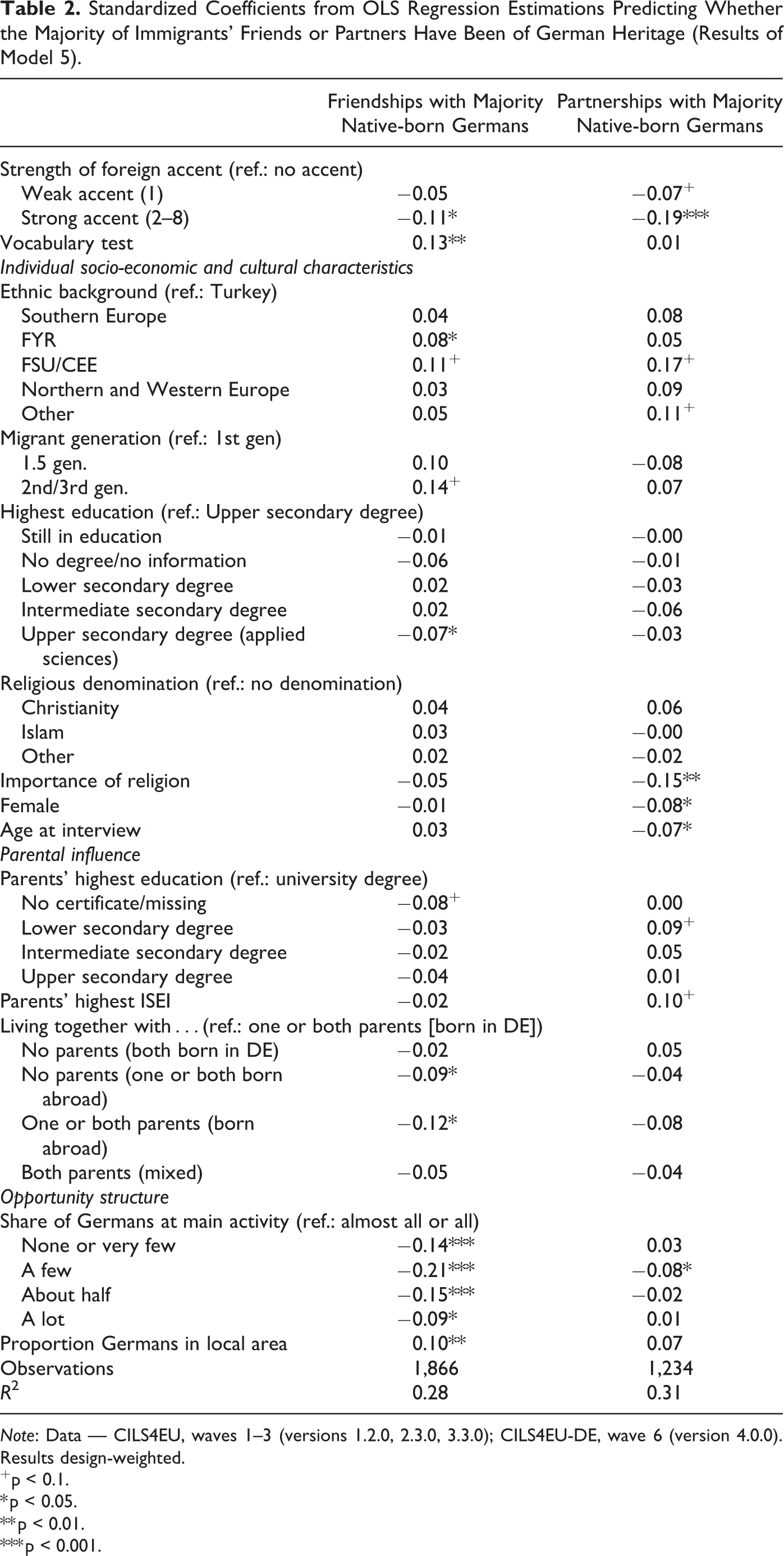
Table 2 contains the full set of results (standardized coefficients) from the final model for both OLS regression estimations of friendship and partnership incidence as dependent variables (a full set of unstandardized coefficients from the stepwise modeling is available upon request). It allows for examining and comparing the strength of coefficients not only for the accent measure but also for all control variables considered in the models. One notable finding is the statistically significant association between the richness of vocabulary and the incidence of friendships with majority native-born Germans. In contrast, there is no statistically significant association between the richness of vocabulary and the incidence of partnerships with majority native-born Germans, all other things equal.
Standardized Coefficients from OLS Regression Estimations Predicting Whether the Majority of Immigrants’ Friends or Partners Have Been of German Heritage (Results of Model 5).
Note: Data — CILS4EU, waves 1–3 (versions 1.2.0, 2.3.0, 3.3.0); CILS4EU-DE, wave 6 (version 4.0.0). Results design-weighted.
+p < 0.1.
* p < 0.05.
** p < 0.01.
*** p < 0.001.
Also worth mentioning are the differences across migrant generations and origin groups regarding social contacts with majority native-born Germans. Partnerships with majority native-born Germans appear to be more frequent among second- or third-generation than among 1.5-generation immigrants. At the same time, friendships with majority native-born Germans are more likely among second- or third-generation than among first-generation immigrants (significant at the 10 percent level). Compared to young people of Turkish origin, youths with a former Yugoslavian origin and, to some extent, youths with an Eastern European origin (significant at the 10 percent level) are more likely to befriend majority native-born Germans. We further observe that immigrants from Eastern Europe and other countries tend to enter partnerships with majority native-born Germans more frequently; the coefficients are, however, significant only at the 10 percent level. 9
So far, our key findings accord with the expectation of a higher correlation between foreign accent strength and partnerships as opposed to friendships with majority native-born Germans. The size of the coefficients for accent in models predicting incidence of partnerships with majority native-born Germans is comparable to the size of the coefficients for some ethnic origins or migrant generations. But could there be a selection bias due to the fact that fewer individuals reported having partners than friends in this age group? Do differences across origin groups exist in the role accent plays in social interactions, or are accent “effects” uniform across origin groups? Finally, do we have any indication that the detected correlation between accent and partnership incidence is indeed causal?
Auxiliary Analyses
Selection into Partnerships
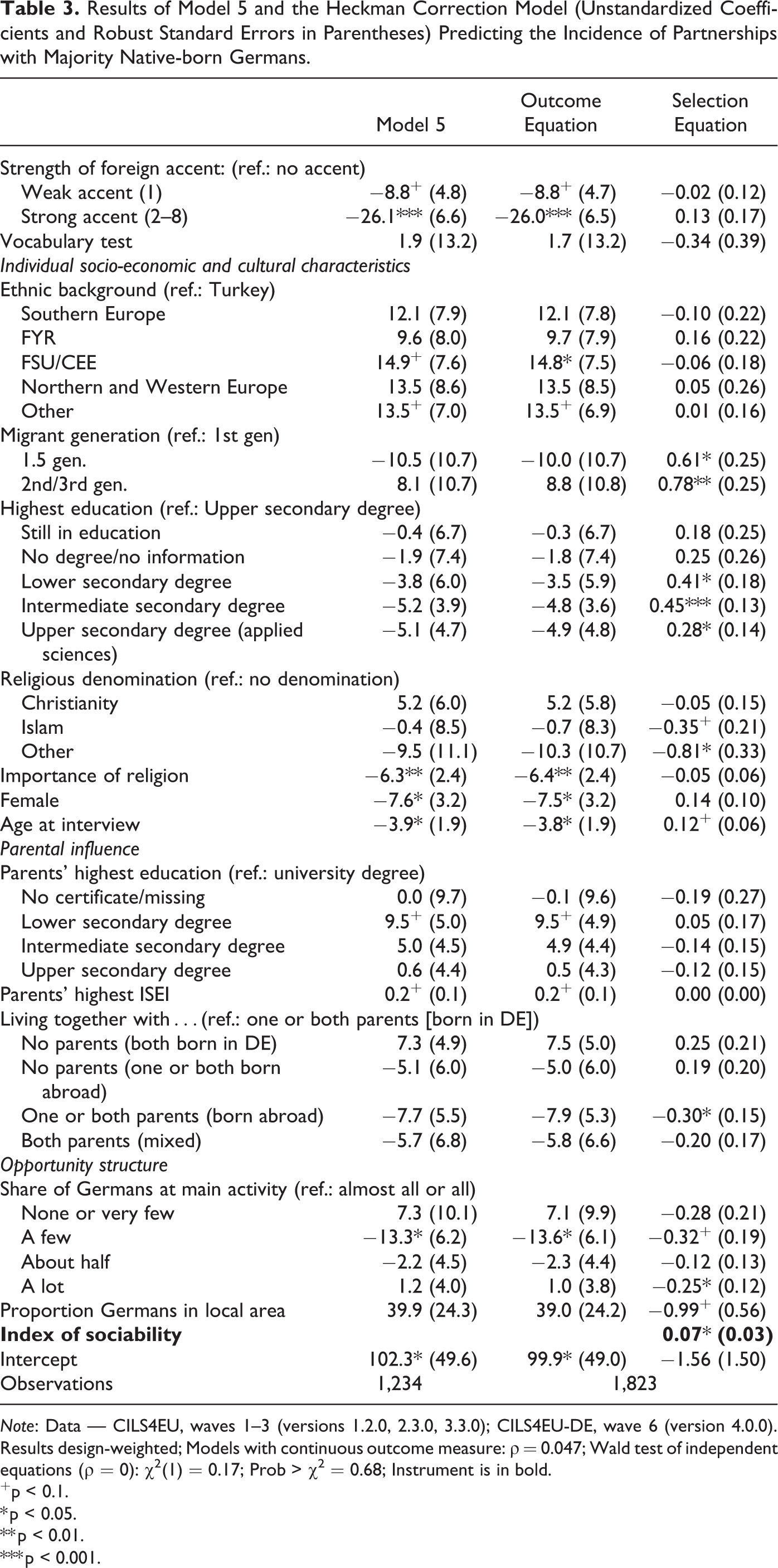
The dependent variable pertaining to the incidence of partnerships with majority native-born Germans contains a substantial number of respondents who reported not having had any partnerships yet. Excluding these individuals might introduce bias into our estimations if accent appears to play a role in predicting not only the incidence of partnership with majority native-born Germans but also the probability of having a partner in the first place. To address this possible selection bias, we ran the Heckman’s sample selection correction using Stata 16, which involves simultaneously estimating the selection and outcome/response equations. In the selection equation, the probability of having a partner is estimated using a probit model (maximum likelihood estimation) as a function of a number of independent variables, which in our case mimic the ones used in the main equation (see the above discussion on variables). In addition to all variables introduced in the outcome/response equation, the selection equation also includes an interval scale variable capturing individual sociability. This variable is the sum score of two items: frequency of visiting a pub/bar/nightclub/party and a sports/music/drama/other club (every day, once or several times a week, once or several times a month, less often, never). This variable meets the necessary condition of a significant correlation with the dependent variable in the selection equation but not in the outcome equation.
Table 3 contains a full set of estimates from the Heckman’s sample selection correction model alongside the results from Model 5 of the main analysis. Correcting for selection does not alter this article’s main conclusion that foreign accent is a significant correlate of the incidence of partnerships with majority native-born Germans. Furthermore, the ρ estimate, which indicates the correlation between error terms of the selection and outcome equations, is almost equal to zero, whereas the Wald test indicates that this correlation is not statistically significant. Hence, even after correcting for possible selection, accent remains a significant predictor of interethnic partnerships.
Results of Model 5 and the Heckman Correction Model (Unstandardized Coefficients and Robust Standard Errors in Parentheses) Predicting the Incidence of Partnerships with Majority Native-born Germans.
Note: Data — CILS4EU, waves 1–3 (versions 1.2.0, 2.3.0, 3.3.0); CILS4EU-DE, wave 6 (version 4.0.0). Results design-weighted; Models with continuous outcome measure: ρ = 0.047; Wald test of independent equations (ρ = 0): χ2(1) = 0.17; Prob > χ2 = 0.68; Instrument is in bold.
+p < 0.1.
* p < 0.05.
** p < 0.01.
*** p < 0.001.
Heterogeneous “Effects” of Foreign Accent
A question obviously arises as to whether all non-native accents are evaluated similarly by German listeners or whether we observe certain heterogeneity related to the extent to which certain accents are ranked on the traits considered desirable in close social relations. The existing research findings are equivocal. Some scholars demonstrate that not all non-native speakers are evaluated similarly (Cargile and Giles 1998; Cargile 2002; Lindemann 2003, 2005). Others contend that listeners are highly sensitive to the differences between native and non-native accents but less sensitive to differences within non-native accents (Atagi and Bent 2017). Also, for Germany, Roessel, Schoel, and Stahlberg (2018) point to the existence of generalized negative stereotypes associated with non-standard accents but find no group-specific stereotypes.
Illustrations provided in Figure 5 (predicted incidence of friendships with majority native-born Germans) and Figure 6 (predicted incidence of partnerships with majority native-born Germans) are based on model estimations, which include interaction effects between foreign accent strength and origin groups. Online Appendix Tables A3 and A4 present selected unstandardized coefficients and standard errors for interaction effects between accent and origin group, allowing for assessments of the statistical significance of differences between groups. Similar to the experimental study by Roessel, Schoel, and Stahlberg (2018), our analysis does not detect any statistically significant interaction effects between foreign accent strength and origin group regarding the incidence of partnership with majority native-born Germans. A single exception is a group of young people of former Yugoslav origin, who seem to have a lower incidence of interethnic partnerships once they have a heavy accent; the interaction effect is, however, statistically significant only at the 10 percent level and only in comparison to the groups of young people of Turkish or other origin. Regarding the incidence of friendships with majority native-born Germans, more heterogeneity by origin and accent strength is noticeable. Thus, we observe that Eastern Europeans with strong accents had a significantly lower incidence of friendships with majority native-born Germans than did young people of Turkish origin. The interaction effects for Southern Europeans and representatives of other origins are also negative but statistically significant only at the 10 percent level (in comparison to Turkish youths). Additionally, the interaction effect for strong accented speech is statistically significant for Western Europeans, but knowing that they are a particularly small and selected group, we abstain from interpreting significant interaction effects in their case.
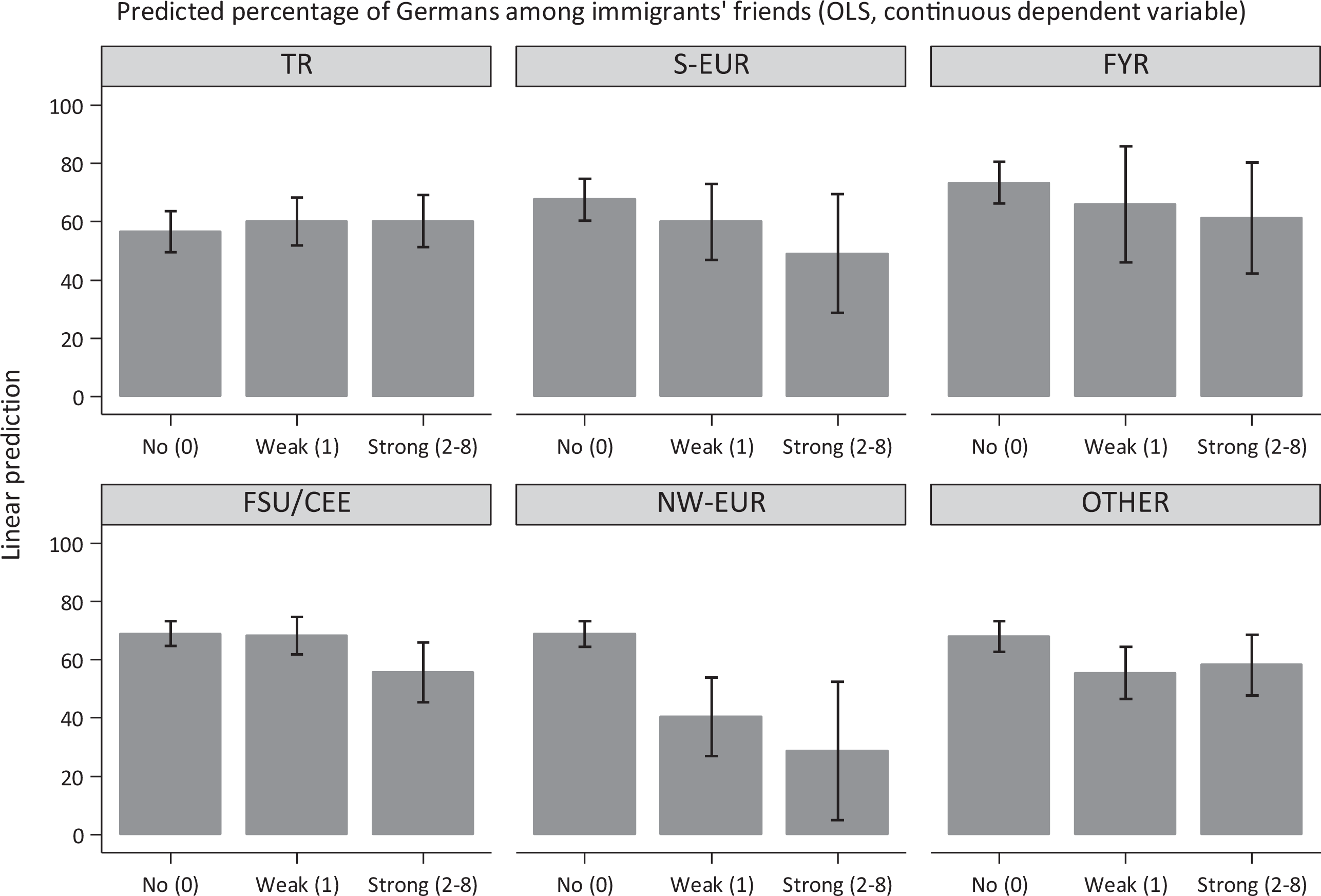
Predicted incidence (percentage) of friendships with majority native-born Germans by the strength of foreign accent and immigrant origin (Specification 1).
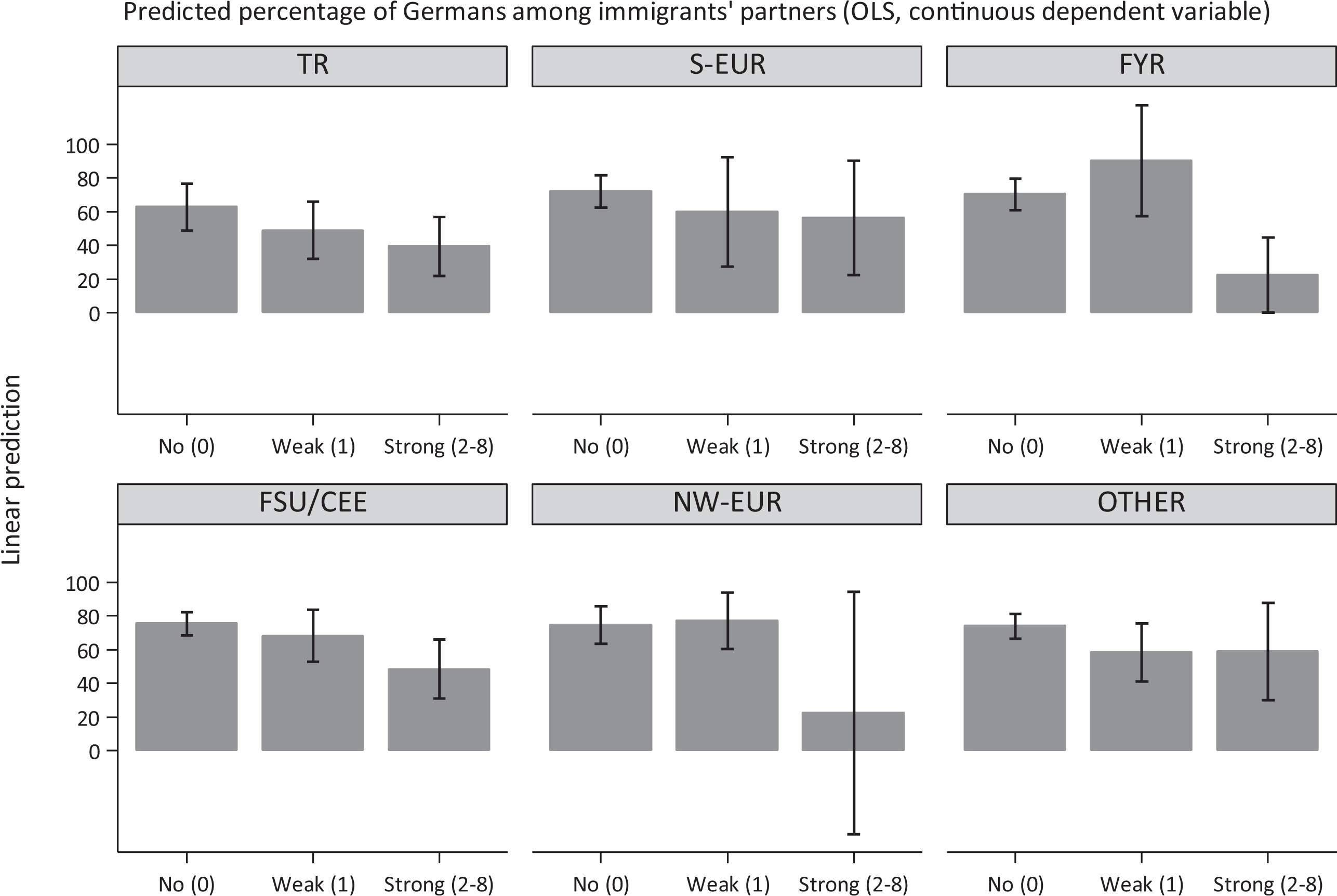
Predicted incidence (percentage) of partnerships with majority native-born Germans by the strength of foreign accent and immigrant origin (Specification 1).
In the second step, we explore the heterogeneity of accented speech’s effect on the incidence of friendships and partnerships with majority native-born Germans across individuals belonging to different migrant generations (see Figure 7 for predicted incidence of friendships with majority native-born Germans and Figure 8 for predicted incidence of partnerships with majority native-born Germans; for selected unstandardized coefficients and standard errors of interaction effects between accent and migrant generation, see Online Appendix Tables A5 and A6). To this end, we compute a number of interaction terms between the dummy-coded variables capturing migrant generations and accent. Our results demonstrate that individuals whose parents or grandparents were migrants and who themselves happened to have strong accents had a significantly lower incidence of friendships with majority native-born Germans than those without any accent. Strong accent does not penalize the 1.5 generation to the same extent when it comes to friendships with majority native-born Germans. Speaking with a strong accent, however, prevents first-generation immigrants from partnerships with majority native-born Germans to a larger extent than it does for the second and third generation. Among the first and 1.5 generations, but not the second and third generations, speaking with a weak accent is already an obstacle for partnerships with majority native-born Germans.
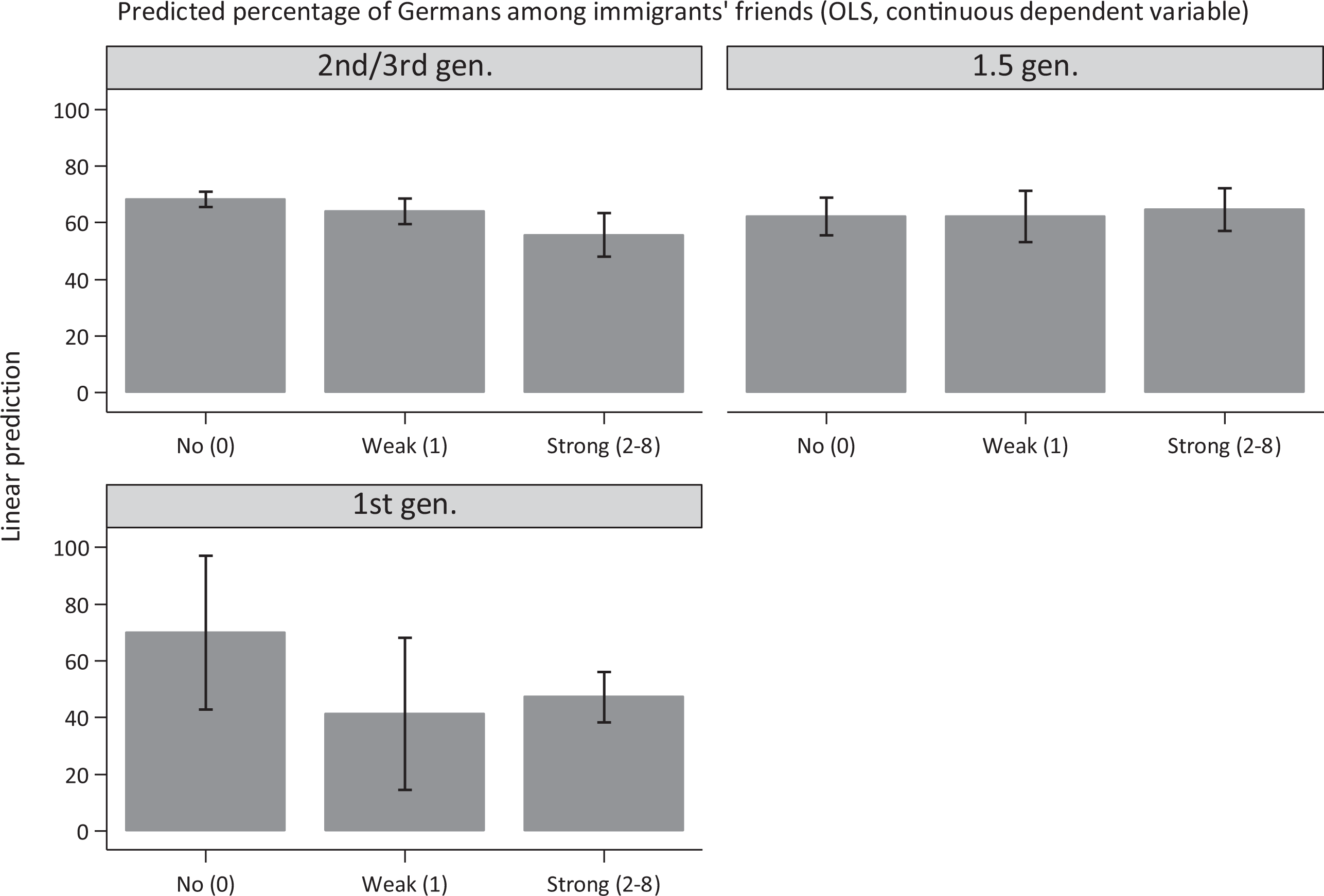
Predicted incidence (percentage) of friendships with majority native-born Germans by the strength of foreign accent and migrant generation (Specification 1).
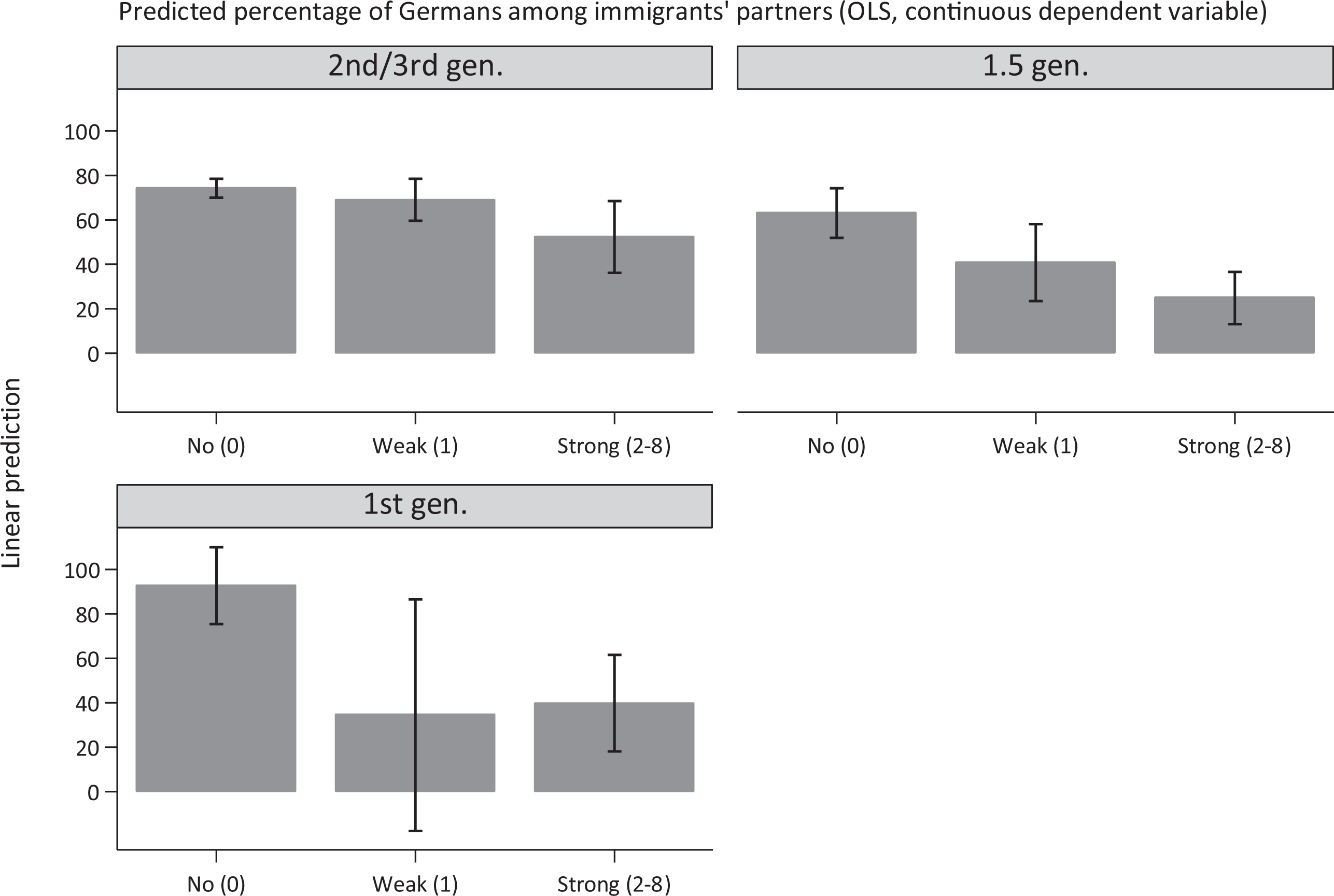
Predicted incidence (percentage) of partnerships with majority native-born Germans by the strength of foreign accent and migrant generation (Specification 1).
Is the Accent “Effect” Causal?
Violation of the assumption about accent’s exogeneity underlying the OLS estimates may lead to biased parameter estimates. 10 First, unobserved heterogeneity may be correlated with both social interactions and accent. Second, the relationship between accent and various forms of social interactions might not be unidirectional. To the extent that accent influences one’s chances of forming interethnic friendships or partnerships, intensive social encounters with native speakers (including interethnic friendships or partnerships) might also influence immigrants’ language proficiency, including foreign accent reduction.
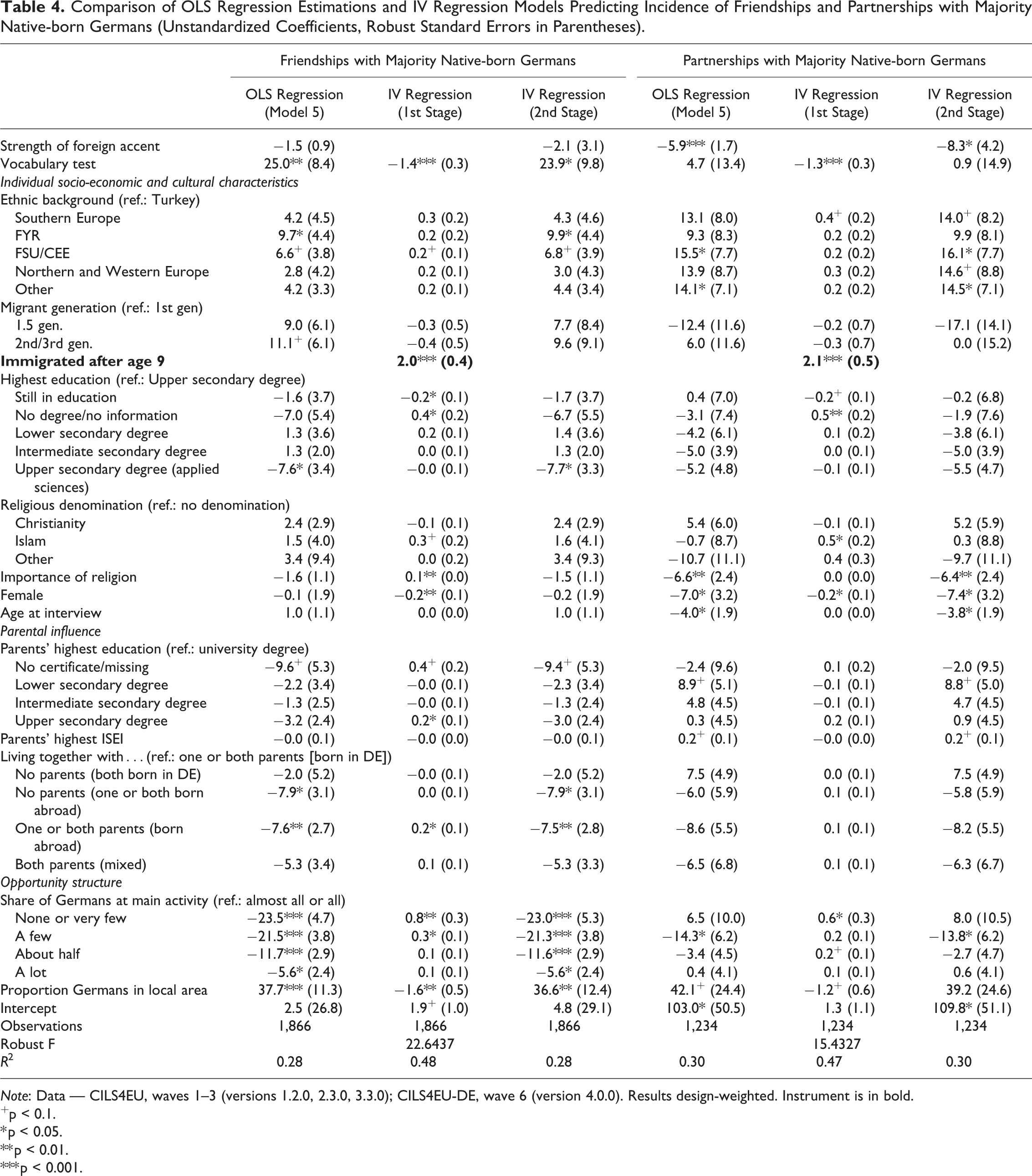
To correct for these potential biases, we apply an instrumental variable approach (Yao and van Ours 2015). We choose the instrumental variable in accordance with the critical period (CP) hypothesis in language learning, which posits that until the beginning of puberty, individuals are likely to acquire language skills comparable to those of native speakers (Ioup et al. 1994; Flege et al. 2006). Scholars argue that the accentedness of speech is especially affected by the starting age of learning the second language after the CP (Scovel 1988; Bongaerts 1999; Moyer 2014). Based on the same dataset used in this analysis, Dollmann, Kogan, and Weißmann (2020) show that respondents arriving in Germany after the age of 10 were rated significantly higher with regard to the strength of their foreign accents than those who immigrated at an earlier age or were born in Germany to parents or grandparents with immigrant background, other things being equal. Therefore, in this article, we adopt an instrument that is a dummy variable indicating whether a person migrated at age 10+. This variable meets a key requirement for a satisfactory instrument: it is significantly correlated with a foreign accent’s strength (see Column 2 in the analysis of friendships and partnerships with majority native-born Germans presented in Table 4). At the same time, it is not associated with either outcome — the incidence of partnerships or friendships with majority native-born Germans — other things being equal. We further assume that the instrument is uncorrelated with the dependent variables’ residual. The instrumental variable’s F-statistics in both equations are larger than 10, indicating that the maximum bias in IV estimators should be less than 10 percent (Staiger and Stock 1997).
Comparison of OLS Regression Estimations and IV Regression Models Predicting Incidence of Friendships and Partnerships with Majority Native-born Germans (Unstandardized Coefficients, Robust Standard Errors in Parentheses).
Note: Data — CILS4EU, waves 1–3 (versions 1.2.0, 2.3.0, 3.3.0); CILS4EU-DE, wave 6 (version 4.0.0). Results design-weighted. Instrument is in bold.
+p < 0.1.
* p < 0.05.
** p < 0.01.
*** p < 0.001.
Table 4 allows us to compare the coefficients for foreign accent strength measured on the interval scale estimated in the OLS regression framework (Model 5 of the main analysis, see the first column in both the friendship and partnership analyses) and the second stage of the IV regression model (see Column 3). The patterns detected with the OLS regression analyses are similar to those reported with the IV estimations, enabling us to cautiously conclude that foreign accent’s effect on partnerships with majority native-born Germans might be causal. In contrast, we could not detect any statistically significant effect of foreign accent (measured on the 0–8 scale) on incidence of friendships with majority native-born Germans.
Summary and Discussion
Europe in general and Germany in particular have recently become key destinations for refugees and immigrants from the Middle East and Northern Africa (OECD 2017). The humanitarian migration channels, including family reunifications, are likely to further increase the number of newcomers to Germany in the future (Hatton 2020). These developments, together with the growing proportion of immigrant offspring among the youth cohorts of German residents (Lochner 2020), call for a thorough examination of the social integration prospects of these population groups. Previous studies have repeatedly shown that interethnic marriages between culturally distant minority groups and the majority native-born population in Germany are still uncommon (Klein 2001; González-Ferrer 2006; Schroedter and Kalter 2008; Kalter and Schroedter 2010; Carol, Ersanilli, and Wagner 2014). Until now, the role of language proficiency in general and accented speech in particular in interethnic social interactions has not been much examined.
Building on a large body of sociological, demographic, sociopsychological, and sociolinguistic research (e.g., Lamont and Molnár 2002; Maynard and Peräkylä 2003; Kinzler et al. 2009; Gluszek and Dovidio 2010; Wimmer 2013; Lichter and Qian 2018), this article examined the association between accented speech and the formation of friendships and partnerships among immigrants and majority native-born Germans. We reveal that foreign accent matters in the formation of both interethnic friendships and partnerships. The underlying theoretical mechanism behind this finding is homophily, which is driven by the attraction of similar individuals, in- and out-group divisions in a society, and social group boundaries, with accent serving as an important marker of one’s social and cultural identity. Most importantly, our analyses show that immigrant offspring with a stronger non-native accent are less likely to find partners among the majority native-born German population, and this result holds when accounting for sociodemographic and cultural characteristics, as well as other factors related to the opportunity structure for social encounters. Speaking with an accent, on the other hand, appears to be less an obstacle to interethnic friendships.
We propose that a possible mechanism behind this finding is accent’s signaling function. Foreign accents transmit signals of individuals’ and their families’ foreignness, cultural orientation, and recentness of migration and, therefore, become additional markers of social distance. Such signals are more likely to hinder interpersonal relations across group boundaries when such relations are particularly consequential, as is the case with partnerships.
A definitive answer to the question on whether the accent effect is causal is not entirely possible due to the non-experimental design of our analysis and the data’s cross-sectional nature; a repeated measurement of accent and social relations would be needed, which is not available. The instrumental variable approach adopted here has, however, indicated that foreign accent’s statistical “effect” on incidence of partnerships with majority native-born Germans might indeed be causal. Tests with alternative instruments are advisable to ensure the estimated effect’s robustness. Further, additional analyses based on data with larger samples would be needed to reconfirm the validity of accent’s heterogeneous effects across migrant generations and ethnic origins.
Nonetheless, the pronounced difference in the strength of the coefficient for accent in the models predicting interethnic partnerships and the models predicting interethnic friendships, as well as the robustness of the results in light of various operationalizations of the accent measure and various model specifications, give us confidence in our two key findings: first, that foreign accent is important in social interactions and, second, that it matters more in the establishment of more intimate social relations across minority and majority ethnic groups.
These findings contribute to socio-linguistic and psychological research, suggesting that beyond its primary function of understandability, language in general and accent in particular possess socially communicative power (Kinzler et al. 2009). Accented speech conveys additional cues about the interlocutor, which are likely to disclose her/his foreignness or recentness of migration, to proxy for his/her own and family cultural differences, and to signal orientation toward the heritage country. This article also contributes to sociological debates on symbolic boundaries (Lamont and Molnár 2002; Wimmer 2013), extending them to yet another important boundary maker — accent. We propose that accent is a symbolic marker that exacerbates perceptions of otherness, accentuates social and cultural distances between ethnic groups, and thus creates additional obstacles for intimate cross-group social interactions and boundary blurring in a society as a whole (Alba and Nee 2003; Alba 2005).
Footnotes
Acknowledgments
We would like to thank participants of the following events for their helpful comments: Seminar at the Research Centre on Migration and Mobility at the Chinese University of Hong Kong (January 2018), 26th Annual Workshop of the European Research Network on Transitions in Youth (TIY), MZES (September 2018), Research Alumni Meeting of the University of Konstanz and University of Tel Aviv (September 2017), Empirical Research Colloquium, University of Frankfurt (June 2017), ECSR 2017 Conference, Bocconi University (September 2017), and Spring Seminar at the University of Amsterdam (May 2017). Our heartfelt thanks go to the IMR editorial team and three anonymous reviewers for their insightful comments.
Declaration of Conflicting Interests
The author(s) declared no potential conflicts of interest with respect to the research, authorship, and/or publication of this article.
Funding
The author(s) disclosed receipt of the following financial support for the research, authorship, and/or publication of this article: This study was supported by Deutsche Forschungsgemeinschaft.
