




Abstract
During the recent inflow of asylum seekers from the Middle East and North Africa to Europe, the native population in Greek frontier islands largely offered humanitarian assistance to these immigrants, while support for their permanent settlement in the area was low. To explain this discrepancy, we investigated whether sympathy toward asylum seekers, perceptions of threat posed by asylum seekers, and asylum seekers’ perceived societal contributions relate differently to native Greeks’ self-reported provision of humanitarian assistance and to their support for asylum seekers’ permanent settlement in Greece. Using data from a representative sample of 1,220 Greek participants, we found that Greeks who showed more sympathy toward asylum seekers were more likely to report having offered humanitarian assistance. Further, participants who felt more sympathy and those who perceived higher asylum seekers’ contributions were more positive toward asylum seekers’ permanent settlement, whereas participants who perceived more threat from asylum seekers showed less support for their permanent settlement. We conclude that policies geared toward motivating people to provide humanitarian aid to asylum seekers should focus on generating sympathy, whereas policies geared toward increasing long-term acceptance of asylum seekers need to additionally consider lowering threat perceptions and highlighting asylum seekers’ contributions.
Keywords
“We are not fascists, nor violent! The opposite! We have even helped many people who were coming out from the boats to the coast.”
1
(Psarra 2017)
Introduction
In the period between 2015 and 2020, about 1.2 million asylum seekers have fled to Europe via Greek frontier islands of Lesbos, Samos, and Chios. The largest share — approximately 860,000 people — arrived in 2015, followed by 173,000 in 2016 and 130,000 between 2017 and 2020 (UNHCR 2020). These people have risked their lives in the Mediterranean Sea to seek shelter on the Greek islands, and some of them remain in camps on the islands, with extremely poor living conditions and limited services (UNHCR 2018).
In these difficult conditions, the local Greek population has responded to asylum seekers in various ways. In particular, inhabitants of islands closer to the Turkish border have reported higher perceived threats and more negative attitudes toward the arrival and settlement of asylum seekers (Hangartner et al., 2019). For example, in Samos Island, according to a report in a local newspaper, some Greek citizens harshly disagreed with the idea that asylum seekers should be allowed to live in apartments located in the area (Psarra 2017). As explained by the representative of one village, citizens’ opposition to renting apartments to asylum seekers cannot be equated with racism since many local residents rescued asylum seekers at sea (Psarra 2017). Indeed, as another local representative argued, natives’ disagreement with renting apartments to asylum seekers was based on the idea that asylum seekers’ presence on the island would pose serious threats to their society: “The benefits for our society will be small and short, while the damage will be bigger” (Psarra 2017).
However, local residents have also expressed great solidarity regarding asylum seekers’ immediate needs. For example, 60 percent of the population in Lesbos reported having helped asylum seekers, mainly by offering food, medicines, and clothes (Rontos, Nagopoulos, and Panagos 2017). Yet, only 38 percent of the same sample accepted these migrants’ permanent settlement on the island. In short, it can be observed that local residents in the Greek islands tend to support the first reception of asylum seekers but do not seem particularly willing to accept their permanent stay.
This article uses nationally representative survey data collected by the public research institute Dianeosis in 2016 to examine if these contrasting reactions also exist at the national level in Greece and, if so, how they can be explained. By doing so, we extend the literature on public attitudes toward forced immigrants (for a review, see Esses, Hamilton, and Gaucher 2017) and, in particular, toward Europe’s recent ‘migration crisis’ (Czymara and Schmidt-Catran 2017; Dinas and Fouka 2018; Yitmen and Verkuyten 2018; Becker et al. 2019; Hangartner et al. 2019; Hasbún López et al. 2019) in three ways.
First, we examine Greek natives’ self-reported provision of humanitarian assistance to asylum seekers (Yitmen and Verkuyten 2018; Becker et al. 2019) and support for asylum seekers’ permanent settlement (Czymara and Schmidt-Catran. 2017; von Hermanni and Neumann 2019; Steele and Abdelaaty 2019) in tandem because both represent important aspects of responses to the arrival of asylum seekers. Forced to leave their origin countries and, therefore, less prepared for the migration journey (Dustmann et al. 2017) and more in need of help upon arrival, asylum seekers are more vulnerable than economic or family migrants. Furthermore, return to the origin country is, for many asylum seekers, not a viable option (Esses Hamilton, and Gaucher 2017), and delays in granting residency and refugee status can have negative impacts on their lives (Steel et al. 2006). For these reasons, it is relevant to examine the discrepancy between host society members’ provision of humanitarian assistance and attitudes toward asylum seekers’ permanent settlement.
Second, we examine whether a willingness to provide humanitarian assistance and support for asylum seekers’ permanent settlement are driven by different motivations and concerns. We focus on three factors previously identified in the literature on reactions to immigrants — namely, sympathy, perceived threat, and perceived contribution (Montada and Schneider 1989; Tartakovsky and Walsh 2016) — and study whether these factors differently matter for the provision of humanitarian assistance and attitudes toward permanent settlement. Whereas we consider sympathy toward asylum seekers to be a driver of both the provision of humanitarian assistance and attitudes toward permanent settlement, we argue that perceived threat and asylum seekers’ perceived societal contribution matter only for attitudes toward permanent settlement. Such a pattern of findings would have different implications for policies geared toward motivating people to engage in humanitarian aid and toward increasing long-term acceptance of asylum seekers.
Third, ours is one of the first studies to examine self-reports of helping behavior in relation to asylum seekers. Past research on helping behavior in the context of immigration has mainly measured willingness or intention to help (Rudolph et al. 2004; Schindler and Reese 2017; Yitmen and Verkuyten 2018; Becker et al. 2019). However, asking about helping intentions is not necessarily an accurate indication of whether people will actually provide help (Elshoff 2016). A recent study looking at actual helping behavior (Böhm et al. 2018), for example, showed that helping increases as asylum seekers’ neediness increases, but this study was a game-theoretical simulation of a real-life situation. In our research, we analyze the self-reported provision of humanitarian assistance to asylum seekers and do so in the context of a real-life humanitarian crisis.
To develop these ideas, we first introduce and contrast the concepts of provision of humanitarian assistance and attitudes toward permanent settlement of asylum seekers, before theorizing about the role of sympathy, perceived threat, and perceived contribution in explaining these two types of reaction to asylum seekers. Then we zoom in on the Greek context to show why this country is a particularly salient case for the present research. Next, we present our data, measures, and results, and conclude by discussing the scientific and societal implications of our findings.
Provision of Humanitarian Assistance and Attitudes toward Permanent Settlement
The provision of humanitarian assistance to asylum seekers and attitudes toward their permanent settlement both fall under the broader notion of reactions toward immigration. Gorodzeisky and Semyonov (2009) suggest that immigrant exclusion, or conversely, inclusion, proceeds in two stages: exclusion from or inclusion in the “social system” by denying or granting access to and residency in the country, followed by exclusion from or inclusion in the “system of rights and privileges” for those who have settled in the country. Provision of humanitarian assistance and attitudes toward asylum seekers’ permanent settlement, in our view, both belong to the former stage, as they respectively tap into denying or granting “access” to the country (i.e., rescuing asylum seekers from the sea and bringing them to the shore) and denying or granting “residency.”
However, provision of humanitarian assistance and acceptance of permanent settlement differ in terms of the duration and extent of inclusion. Humanitarian assistance is a form of helping behavior and, thereby, a sub-category of pro-social behavior (Schroeder and Graziano 2015). Pro-social behavior refers to a wide range of voluntary acts that are positively evaluated by society and aim to benefit others (Hogg and Vaughan 2009). Providing humanitarian assistance means attending to asylum seekers’ basic needs, usually immediately after their arrival in the destination country (UNHCR 2016). Permanent settlement, on the other hand, implies a long-term exposure to this group of newcomers and requires a more demanding level of commitment from the host society. For instance, asylum seekers whose request for refugee status has been approved are usually granted additional rights, such as access to welfare (Sales 2002). Furthermore, research in the United States has shown that Americans oppose refugee resettlement within their own communities more than resettlement elsewhere in the country (Ferwerda, Flynn, and Horiuchi 2017). Due to these differences between the provision of humanitarian assistance and attitudes toward permanent settlement, we argue that these two types of response to the arrival of asylum seekers might be driven by different social-psychological mechanisms.
Explaining Provision of Humanitarian Assistance
To the extent that asylum seekers are seen as innocent victims of conflict, helping them by providing food, clothes, and medicines is argued to be an act of solidarity driven by humanitarian concerns and caring for another human being (Nickerson and Louis 2008; Yitmen and Verkuyten 2018). The interpersonal theory of motivation states that people are motivated to act based on their emotions (McClelland, Koestner and Weinberger 1989; Schmalt and Sokolowski 2000), and that positive feelings can often result in helping others (Weiner 2000). As such, the provision of humanitarian assistance might be motivated by positive feelings toward asylum seekers.
In this article, we focus on feelings of sympathy. The word “sympathy” originates from the Greek word “sympatheia” and refers to liking but also to understanding others’ feelings (Foolen et al. 2012). As such, it resonates with both affection and empathic concern. The latter implies “feeling for the other” and has been identified as a main source of altruism (Batson and Ahmad 2009). Empathic concern is based on identification with the unfortunate situation of others and is more likely to arise when people’s neediness is perceived to be beyond their control (Betancourt 1990; Batson 1998), which is often the case in the context of involuntary migration.
We propose that sympathy motivates people to engage in helping behavior toward asylum seekers. A body of research has shown that sympathy is positively associated with helping behavior (e.g., Rudolph et al., 2004). Individuals who feel sympathy or empathic concern sense others’ suffering and behave in a pro-social way by helping them (Betancourt 1990). For example, a study focusing on inter-group affection and liking found a positive relationship between liking and helping behavior (Pandey and Griffitt 1974). Furthermore, Montada and Schneider (1989) found that Germans who sympathized with immigrants tended to support pro-social activities. In line with interpersonal theory of motivation and previous empirical findings, we expect that sympathy will be positively associated with Greek natives’ self-reported provision of humanitarian assistance to asylum seekers (H1).
Explaining Attitudes toward Permanent Settlement
Just like the provision of humanitarian assistance, support for asylum seekers’ permanent settlement is a positive inter-group attitude that could also be stronger among natives who sympathize with asylum seekers. Research on inter-group relations in general has shown that higher levels of sympathy among adolescents predict more inclusive attitudes toward other adolescents who are considered an out-group (Grütter et al 2018). Further, there is evidence that sympathy among White Americans predicts greater support for policies benefiting African Americans (Iyer, Leach, and Crosby 2003). With respect to involuntary migrants, feelings of sympathy among host-society members in the Netherlands have been shown to be associated with higher support for policies assisting political refugees (Verkuyten 2004). Additionally, a recent US-based experimental study (Adida, Lo, and Platas 2018) has shown that perspective-taking — a form of empathy that involves imagining how one would feel in another person’s shoes (Batson and Ahmad 2009) — promoted inclusionary behavior toward Syrian asylum seekers. American participants who had engaged in a perspective-taking task that involved imagining they were asylum seekers were more likely to write a letter to the next US president arguing for admitting Syrian asylum seekers into the country (Adida Lo, and Platas 2018). These findings suggest that sympathy is a motivational mechanism behind positive inter-group attitudes. Therefore, we expect sympathy to be positively associated with Greek natives’ support for asylum seekers’ permanent settlement (H2).
Whereas provision of humanitarian assistance is expected to be motivated primarily by feelings of sympathy, we argue that other factors — namely, perceived group threats and perceived benefits (Tatarkovsky and Walsh 2016) — come into play when considering permanent settlement. Accepting others as permanent members of one’s society entails an element of competition for limited resources and may challenge the established status quo, potentially leading local residents to think that their group’s social position and security can be undermined. Thus, host-society members, on top of feelings of sympathy, might also consider societal threats and benefits when forming their attitudes about asylum seekers’ permanent settlement.
There is extensive evidence that perceptions of threat play important roles in intergroup relations. Realistic group conflict theory states that individuals might perceive ethnic out-groups as threatening, due to realistic competition over limited resources, such as jobs or housing (Sherif 1966; Blalock 1967; LeVine and Campell 1972; Bobo 1988). Whereas competition takes place on the macro level and can be captured by an increase in the number of immigrants entering the country or deterioration of the country’s economic situation (Semyonov, Raijman, and Gorodzeisky 2006; Meuleman, Davidov, and Billet 2009), it is ultimately individuals’ perception of immigrants as posing a threat to their in-group 2 that shapes their attitudes toward immigration (Semyonov et al. 2004). Previous research has demonstrated that perceived threat is associated with negative attitudes toward immigrants (see Ceobanu and Escandell 2010 for a review). A study in several European countries, including Greece, found that threat was the most important predictor of exclusionist attitudes toward immigrants (Scheepers, Gijsberts and Coenders 2002) and that threat was also a mediating mechanism in the relationship between national identification and immigrant exclusion across national contexts (Caricati 2018). There is also experimental evidence that threat causally triggers opposition to policies favoring minority out-groups (Sawires and Peacock 2000; Renfro, et al. 2006). In relation to asylum seekers in particular, perceived realistic threat was related to negative attitudes toward this group in Australia (Schweitzer, et al. 2005; Louis et al. 2007) and in Europe (Hercowitz-Amir, Raijman, and Davidov 2017), as well as to a lower approval rating of asylum applications (von Hermanni and Neumann 2019). Based on realistic group conflict theory and previous empirical findings, we expect native Greeks who perceive more threat to be less willing to endorse asylum seekers’ permanent settlement (H3).
Apart from perceived threat, natives might also view asylum seekers as contributing to the host society. According to the threat–benefit model put forward by Tartakovsky and Walsh (2016), immigrants can be seen as both threatening and beneficial to the host society. Whereas past literature has extensively focused on the intergroup consequences of perceived threat (e.g., Semyonov et al. 2004; Lucassen and Lubbers 2012), relatively little is known about intergroup consequences of immigrants’ perceived contributions (c.f., Teng and Leong 2017; Tartakovsky and Walsh 2019). Considering the lack of literature on perceived contributions and the related one-sided emphasis on negative threat perceptions, we propose that it is also important to examine the implications of viewing asylum seekers as a potential asset.
The few empirical studies using the threat–benefit model have shown that perceiving immigrants as beneficial to the host society is related to more support for immigration policies that defend immigrants’ rights and to less support for policies that defend the state (Tartakovsky and Walsh 2016, 2019). Besides the threat–benefit model, research on perceived functional indispensability shows that natives are more accepting of immigrants when they perceive them as contributing more economically to the host society (Guerra et al. 2015; Mepham and Verkuyten 2017). Furthermore, there is related, though preliminary, experimental evidence in line with the equity model (Adams 1965) suggesting that immigrants are viewed more negatively when they are presented as being just as successful as natives but as contributing less than natives – a situation considered inequitable by the native population (Teng and Leong 2017). Based on these theoretical and empirical insights, our expectation is that the more native Greeks believe that asylum seekers contribute to the host society, the more supportive they will be toward asylum seekers’ permanent settlement in the country (H4). All hypotheses are presented in Figure 1.
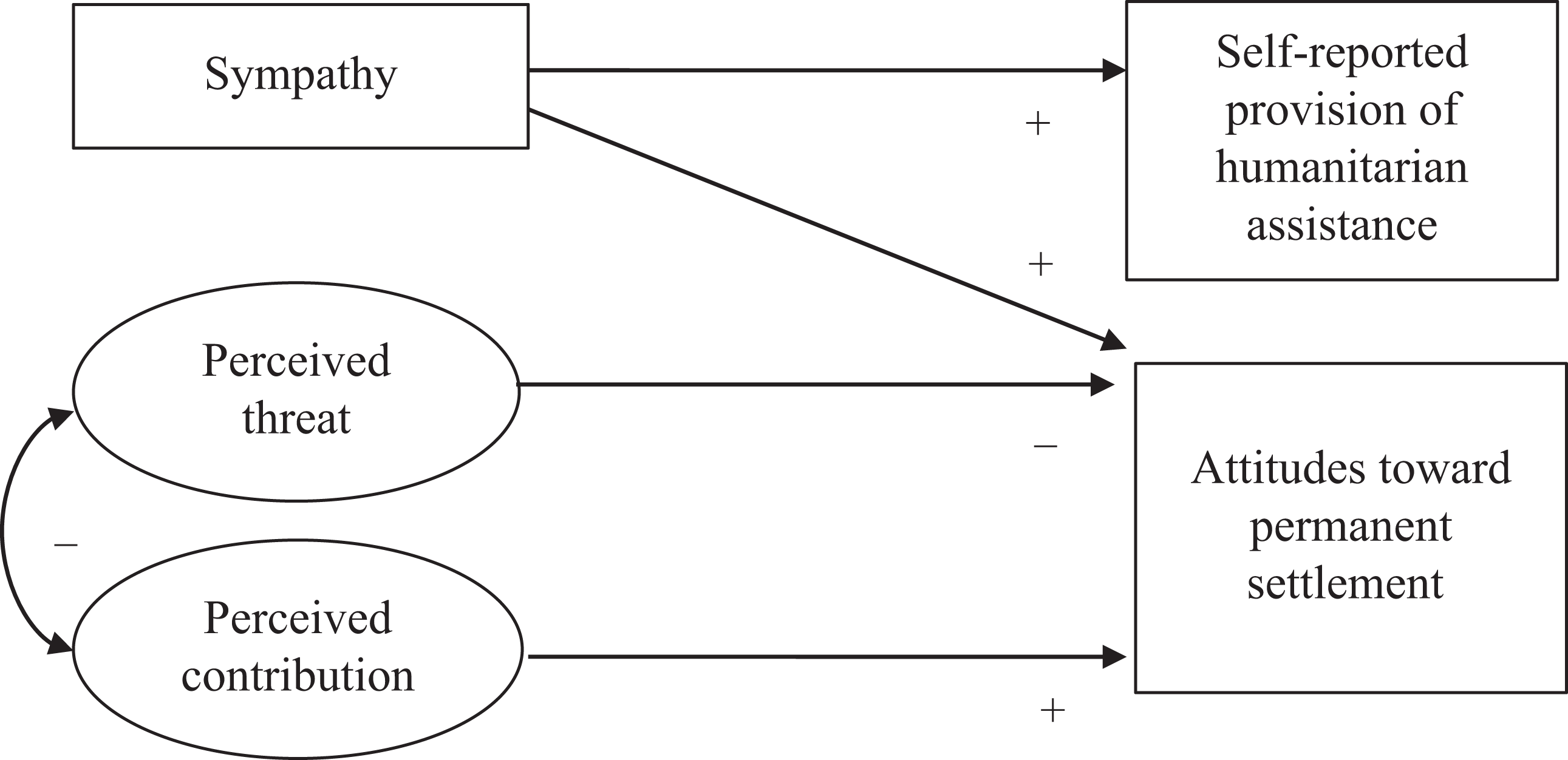
Conceptual Model with Expectations Regarding the Associations of Sympathy, Perceived Threat, and Perceived Contribution with the Outcomes Self-Reported Provision of Humanitarian Assistance and Attitudes toward Permanent Settlement of Asylum Seekers.
The Context of Greece
We tested our hypothesis in Greece, which served as the main entry point for asylum seekers during Europe’s recent “migration crisis” (Kalogeraki, 2018). Greece is often considered a country of transition, not the final destination, for asylum seekers (Lafazani, 2018). Many asylum seekers themselves do not want to permanently stay in Greece because of limited opportunities in the labor market, and plan to move to other European countries (Gkionakis 2016). Being a country of transition might position Greece as mainly responsible for asylum seekers’ first reception rather than permanent settlement, and might be reflected in Greek people’s attitudes toward these two issues. Hence, Greece may be a context where readiness to help asylum seekers and attitudes toward their permanent settlement diverge more than in Western European countries.
Furthermore, Greece’s historical and socioeconomic context might play a role in these diverging reactions to asylum seekers’ basic and long-term needs. Almost one-third of the current Greek population has refugee origins from Asia Minor, where the Greek population was displaced in 1922 due to a conflict with Turkey (Dinas and Fouka 2018). These refugee origins may make helping behavior toward asylum seekers especially salient in Greece, and a recent experimental study has shown that reminders of similarities between Greek people’s past forced displacements and Middle Eastern people’s present forced displacement increased donations and sympathy for asylum seekers among Greeks with forcibly displaced ancestors (Dinas and Fouka 2018). What is more, Greece has recently been hit by a severe financial crisis (Karanikolos et al. 2013), which might have sensitized and motivated many people to work together in helping one another. For instance, in the period between 2010 and 2015, there was a strong increase in solidarity initiatives organized by nonprofit organizations, charities, and volunteers in Greece (Vathakou 2015). In such a context, people might be particularly helpful toward others in need, especially asylum seekers.
On the other hand, Greece’s precarious economic conditions might present a barrier to accepting asylum seekers’ permanent settlement. Many Greek people have recently experienced difficult financial conditions and economic insecurity due to the financial crisis (Karanikolos et al. 2013). Accepting asylum seekers as permanent residents implies that they will need to be provided with proper accommodation, education and language training, and integration in the labor market. Some Greek people may reason that Greece cannot afford to provide permanent shelter to asylum seekers, since there are limited resources available even for the Greek population. Indeed, a recent study conducted on the Greek island of Lesbos (Rontos, Nagopoulos, and Panagos 2017) reported high levels of perceived realistic threat (e.g., limited access to the health-care system) in reaction to asylum seekers’ arrival. All these considerations make Greece a particularly salient case for examining the provision of humanitarian assistance and attitudes toward asylum seekers’ permanent settlement.
Method
Data and Participants
The data analyzed here were collected through a public opinion poll with the title “Greeks and the Issue of Refugees.” 3 The research institute Dianeosis conducted telephone interviews in mid-January 2016, and the data were published online on February 28, 2016 (Dianeosis. 2016). The dataset consists of 1,220 native Greek adults. The sample was drawn with the method of stratified multistage sampling. All Greek geographical regions and municipalities were included in the data collection process, resulting in 63 percent of participants from urban areas and 37 percent from smaller towns and rural areas. Furthermore, the sample included both lower-educated (55 percent) and higher-educated participants (45 percent), with the latter group having completed higher technical or university education. Forty-eight percent of participants were men, and the age of the sample ranged from 18 years to 65 years or higher. 4 The survey response rate was 20 percent, which is not high, but is similar to other surveys conducted by this research institute. Moreover, the dataset was representative of the Greek population in terms of age and gender. 5
Measures
Dependent variables
Self-reported provision of humanitarian assistance was measured with a question on whether participants had helped asylum seekers by offering provisions or services: “Personally, did you recently do something to help asylum seekers?” Participants could indicate that they had helped by giving “food,” “clothes,” “money,” “offering volunteering work,” etc. and could choose only one of the aforementioned types of help. Moreover, there were the answer options “No” and “I don’t know/I don’t want to answer.” A dummy variable was created in which (0) indicated “no help” and (1) indicated that respondents engaged in any of the abovementioned types of humanitarian assistance. 6 Answers “I don’t know/I don’t want to answer” were coded as missing data, resulting in four missing values.
Attitudes toward permanent settlement were measured by asking participants the following question (similar to Czymara and Schmidt-Catran 2017): “Personally, would you like asylum seekers to settle permanently in Greece?” The answer categories were “Rather yes,” “Rather no,” “It depends,” and “I don’t know/I don’t want to answer.” Given that the response category “It depends” expresses ambivalence, we considered an ordinal scale with 1 (Rather no), 2 (It depends), and 3 (Rather yes) so that higher values indicated more willingness to accept asylum seekers. Responses “I don’t know/I don’t want to answer” were coded as missing, resulting in six missing values (see Table 1).
Independent variables
Sympathy is usually measured with items for sympathy and compassion (Harth, Kessler and Leach 2008), while Verkuyten (2004) used items referring to sympathy, compassion, empathy, and admiration. Based on the meaning of the term “sympatheia” in modern Greek language (see theoretical introduction), we used one item reflecting sympathy/liking. More precisely, participants were asked, “In general, how much sympathy do you feel towards asylum seekers? Would you say that you like them?” The use of this rather simple and straightforward question reduces the problem of meaning and interpretation inherent in more complex measures, and such simple questions have been shown to have adequate validity and reliability in measuring psychological constructs such as group identification (Postmes, Haslam, and Jans 2013) and generalized trust (Lundmark, Gilljam, and Dahlberg 2016). The answer options were 1 (A lot), 2 (Somewhat), 3 (Not so much), and 4 (Not at all). The scale was reverse coded so that a higher value indicated more sympathy. There were in total 29 missing values.
For perceived threat, we used four items regarding Greek natives’ perception of asylum seekers posing threats to safety, resources, and Greek people’s general welfare (Stephan et al. 2002; Stephan and Renfro 2002): “Asylum seekers will increase the crime rate in our country,” “Asylum seekers will increase the probabilities of terrorist attacks in Greece,” “Asylum seekers will steal jobs from Greek people,” and “Asylum seekers will be a burden for the public health and the educational system.” Answer options ranged from 1 (Strongly agree) to 5 (Strongly disagree). Forty-seven participants had missing values on all four items. The items were reverse coded so that a higher number indicated more threat.
Perceived contribution refers to native Greek people’s perceptions of asylum seekers’ contributions to Greek society with regards to the economy, culture, and demography, and was measured with the following three items, similar to those used by Tartakovsky and Walsh (2016): “Asylum seekers will help our economy,” “Asylum seekers will enrich our culture,” and “Most asylum seekers are young, and they will help solving the demographic problem in Greece.” Answer options ranged from 1 (Strongly agree) to 5 (Strongly disagree) (N missing values = 81). The scale was reverse coded so that a higher score indicated that participants perceived higher contribution by asylum seekers.
Control variables
We controlled for sociodemographic characteristics based on previous research indicating that men, lower-educated people, older people, and poorer people tend to have more negative attitudes toward immigrants (Ceobanu and Escandell 2010). Gender was used as a dummy variable (0 = male, 1 = female), and age was measured with the following six categories: 18 years to 24 years old, 25 years to 34 years, 35 years to 44 years, 45 years to 54 years, 55 years to 64 years, and older than 65 years (reference category). Educational level was captured with the following three categories: compulsory lower secondary education (reference category), upper secondary education, and tertiary education. Monthly household income was captured with the following categories: no income, up to 500 euros, 501–1,000 euros, 1,001–1,500 euros, 1,501–2,000 euros, 2,001–3,000 euros, and above 3,000 euros (reference category). By controlling for education and income, we take into account participants’ socioeconomic vulnerability (Gorodzeisky and Semyonov 2016) that might otherwise confound the effects of perceptions of threat.
In addition, to account for the fact that reactions to asylum seekers in Greece might be less pro-social or accommodating to the extent that one thinks that the European Union (EU) is already contributing a lot to this issue (see Schindler and Reese 2017) on social loafing in the refugee crisis), we also controlled for participants’ opinion on support provided to Greece by the EU. Participants were asked to evaluate the “response of the EU on the issue of asylum seeker reception in the Aegean islands.” Answer options were 1 (EU supports Greece a lot), 2 (EU supports Greece enough), 3 (EU supports Greece a little bit), and 4 (EU does not support Greece at all). The scale was reverse coded so that a higher score indicated higher perceived support by the EU. Valid sample sizes for all variables are displayed in Table 1.
Descriptive Statistics (N = 1149).
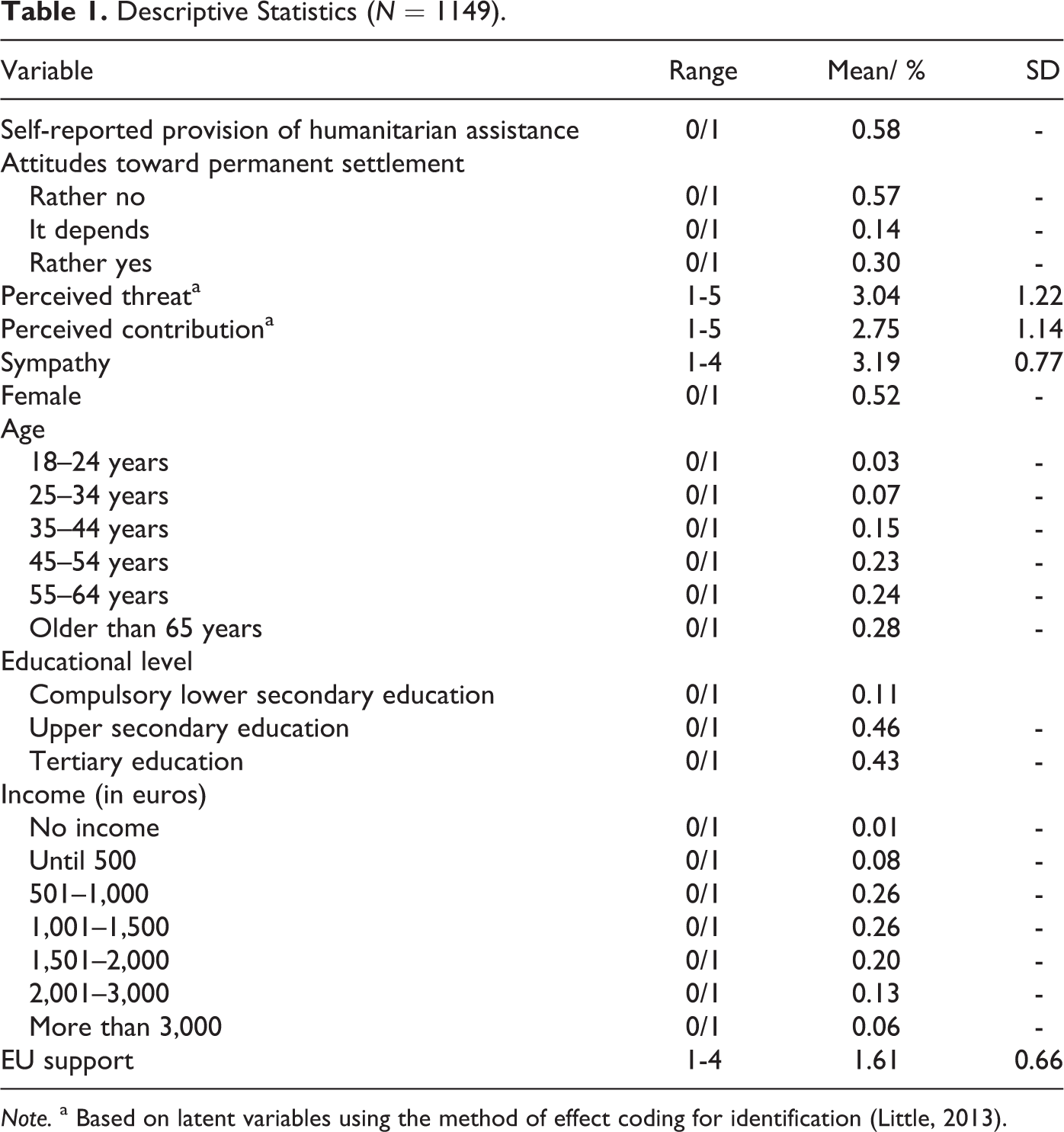
Note. a Based on latent variables using the method of effect coding for identification (Little, 2013).
Method of Analysis
For preliminary data handling, we used the Statistical Package for the Social Sciences (SPSS) version 21. For confirmatory factor analysis (regarding latent variables perceived threat and perceived contribution) and for hypothesis testing, we used structural equation modeling in Mplus version 7.3 (Muthén and Muthén 2012). Structural equation modeling combines regression modeling with measurement models, accounting for measurement error that would otherwise bias model results. The analysis consisted of four steps. First, we fit the measurement model. Second, we obtained the descriptive findings. Third, we tested our hypotheses by estimating the structural model. Finally, sensitivity checks were conducted to examine whether the results could be replicated with different operationalizations of the dependent variable attitudes toward permanent settlement and whether multicollinearity played a role in the estimation of the effects of perceived threat and perceived contribution.
Results
Measurement Model
A series of models was fitted to inspect the measurement of perceived threat and perceived contribution with four and three items, respectively (see Table 2 for model fit indices). We conducted confirmatory factor analysis by fitting a model that forced perceived threat and contribution to load on the same factor. The one-factor model (Model 1) had an acceptable fit. Model 1 was tested against Model 2, which considered threat and contribution as two separate factors. As expected, the two-factor model had a better fit, as indicated by a significant Chi2 difference test. 7 Thus, threat and contribution were treated as two distinct latent constructs.
Fit Statistics of the Measurement and Structural Models.
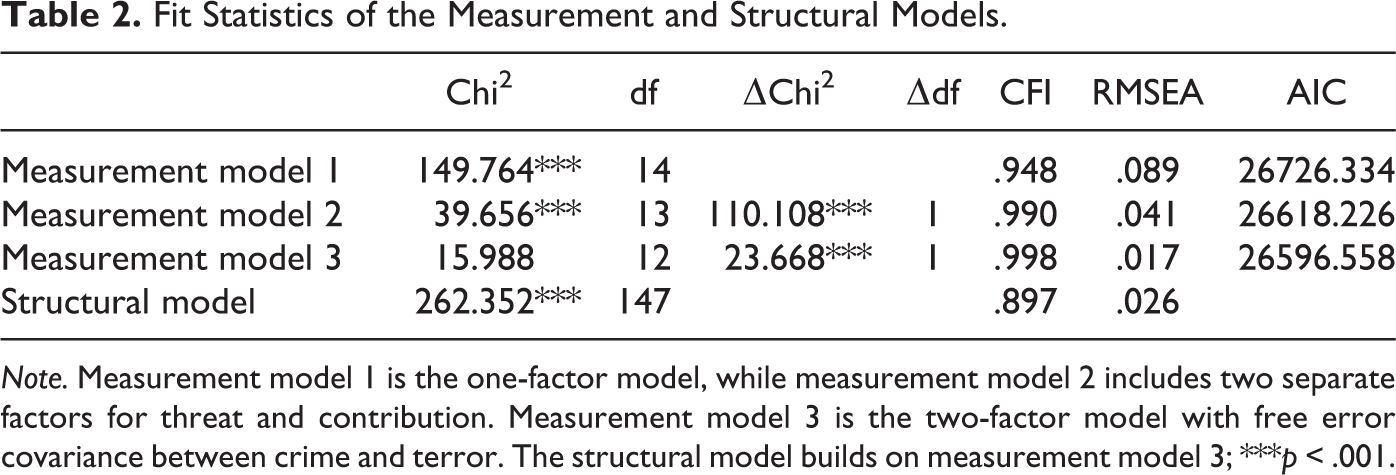
Note. Measurement model 1 is the one-factor model, while measurement model 2 includes two separate factors for threat and contribution. Measurement model 3 is the two-factor model with free error covariance between crime and terror. The structural model builds on measurement model 3; ***p < .001.
The modification indices obtained suggested that the model fit could further improve after freeing the error covariance between two items of perceived threat: “Asylum seekers will increase the crime rate in our country” and “Asylum seekers will increase the probability of a terrorist attack.” Freeing this error covariance made sense theoretically since the two items refer to crime and terrorism, and these phenomena are conceptually close (Makarenko 2004). This modified model yielded better fit indices and a significantly improved model fit; therefore, Model 3 was selected as the final measurement model. The composite reliability of the scales for perceived threat and perceived contribution was adequate, ρ = .80 and ρ = .76 respectively, and the correlation between the two latent constructs was negative and significant, r = -.74, p < .001.
With regards to missing values, the analyses in Mplus dealt with missing data by using full information maximum likelihood, assuming that these values are missing at random (Muthén and Muthén 2012). Missing values on the dependent variables and latent factors, which are by default endogenous variables, can in this way be included in the model’s estimation. The exogenous single-item predictors must be endogenized first to be able to estimate the model on the full sample. We endogenized sympathy by correcting for measurement error that can occur due to using a single indicator for sympathy. 8 In this way, we turned sympathy into a latent variable. We relied on a previous study conducted in the Netherlands (Elshoff, 2016) in which sympathy was measured with a multiple-item scale that was in terms of content similar to our single item for sympathy (e.g., “I feel sympathy for asylum seekers”). This scale showed a reliability of α = .89, and this value was used to estimate the reliability of our single item for sympathy, which turned out to be ρ = .50. The latter value was then used to correct for measurement error in our analysis. 9 Endogenizing the categorical control variables led to estimation issues. Therefore, we had to exclude from the analysis 71 cases with missing values in the control variables, leaving us with a final analytical sample of 1149 participants.
Descriptive Findings
To get a sense of how participants responded to the questions, we turn first to the descriptive statistics displayed in Table 1. Fifty-eight percent of participants reported that they had offered humanitarian assistance to asylum seekers, whereas 30 percent agreed that asylum seekers should be allowed to stay permanently in the country. On average, participants expressed high levels of sympathy toward asylum seekers (Wald Chi2 (1) = 1029.26, p < .001). The mean score of perceived threat was not significantly different from the midpoint of the scale (Wald Chi2 (1) = 1.18, p = .28), while the mean score of perceived contribution was significantly lower than the midpoint of the scale (Wald Chi2 (1) = 40.21, p < .001). Both dependent variables, self-reported provision of humanitarian assistance and attitudes toward permanent settlement, were positively correlated with sympathy and perceived contribution, and negatively correlated with perceived threat (see Table 3). Threat and contribution were negatively correlated, and sympathy showed a negative correlation with threat and a positive correlation with contribution.
Correlations Between the Main Constructs.
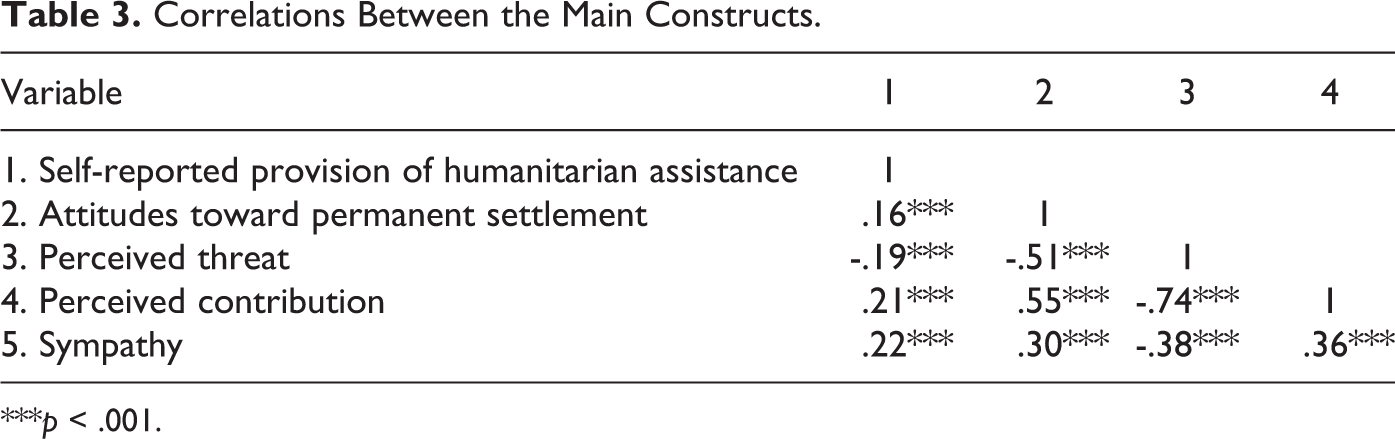
***p < .001.
Explaining Provision Of Humanitarian Assistance and Attitudes toward Permanent Settlement
We regressed two dependent variables, provision of humanitarian assistance (observed binary variable) and attitudes toward permanent settlement (observed ordinal scale), on three latent independent variables: perceived threat (four items), perceived contribution (three items), and sympathy (one item, corrected for measurement error). The independent variables were allowed to covary with one another, as were the dependent variables. We controlled for the effects of gender, age, educational level, monthly household income, and opinion on EU support. The model was estimated using the WLSMV estimator, 10 which is the most efficient estimator for modeling categorical or ordered data (Brown, 2006). Based on the values of the comparative fit index (CFI) and root mean square error of approximation (RMSEA), the structural model had a good fit (see Table 2).
Table 4 presents the unstandardized coefficients obtained from the structural model. To get a sense of the size of the coefficients related to provision of humanitarian assistance, we calculated “marginal effects at the mean” (MEMs). 11 MEMs are then interpreted as the absolute change in the average person’s probability to provide help if an independent variable increases by one unit. We found that participants who felt more sympathy were more likely to provide humanitarian assistance to asylum seekers, in line with H1. A one-unit increase in sympathy was related to a 20 percentage point increase in an average person’s probability to provide assistance. Perceived threat and perceived contribution were, as expected, not related to provision of humanitarian assistance. 12
Regarding the control variables, the probability to provide humanitarian assistance was nine percentage points higher for women than for men and also nine percentage points higher for participants with tertiary education compared to those with compulsory lower secondary education. Income showed a negative trend, with poorer people being less likely to offer aid, but the differences were not significant. Opinion about the EU’s role also did not matter for the provision of humanitarian assistance. The model explained one quarter of the variance in humanitarian assistance (R2 = .24).
Moving on to attitudes toward permanent settlement (see Table 4 for the unstandardized coefficients), we found that sympathy was related to more positive attitudes, in line with H2. Furthermore, and in support of H3 and H4, perceived threat was related to less positive attitudes, whereas perceived contribution was related to more positive attitudes. Given that this dependent variable is an ordinal measurement of a continuous underlying scale and given that the response categories do not represent qualitatively different choices or behaviors, MEMs are a less meaningful interpretation. Instead, to get a sense of the effect sizes, we report the variance explained in the dependent variable by the model as a whole and compare the standardized coefficients for the hypothesized paths with one another. The model explains half the variance in attitudes toward permanent settlement (R2 = .53). 13 Perceived contribution (β = .335) matters more than perceived threat (β = -.133): a one-unit increase in perceived contribution has two-and-a-half times the impact on attitudes toward permanent settlement as a one-unit increase in threat. Sympathy, however, has an effect size (β = .325) comparable to that of perceived contribution. As to the control variables, younger participants were more in favor of permanent settlement, with 18–24-year-olds being particularly and significantly more accepting than those above 65 years (β = .163). Poorer participants reported less positive attitudes about permanent settlement, with those with monthly income up to 500 euros or between 501 and 1000 euros being more negative about this issue compared to the richest income category (β = -.198 and β = -.170, respectively). 14 Gender, education, and opinion about EU support were not related to attitudes toward permanent settlement.
Explaining Self-Reported Provision of Humanitarian Assistance and Attitudes toward Permanent Settlement of Asylum Seekers (N = 1149).
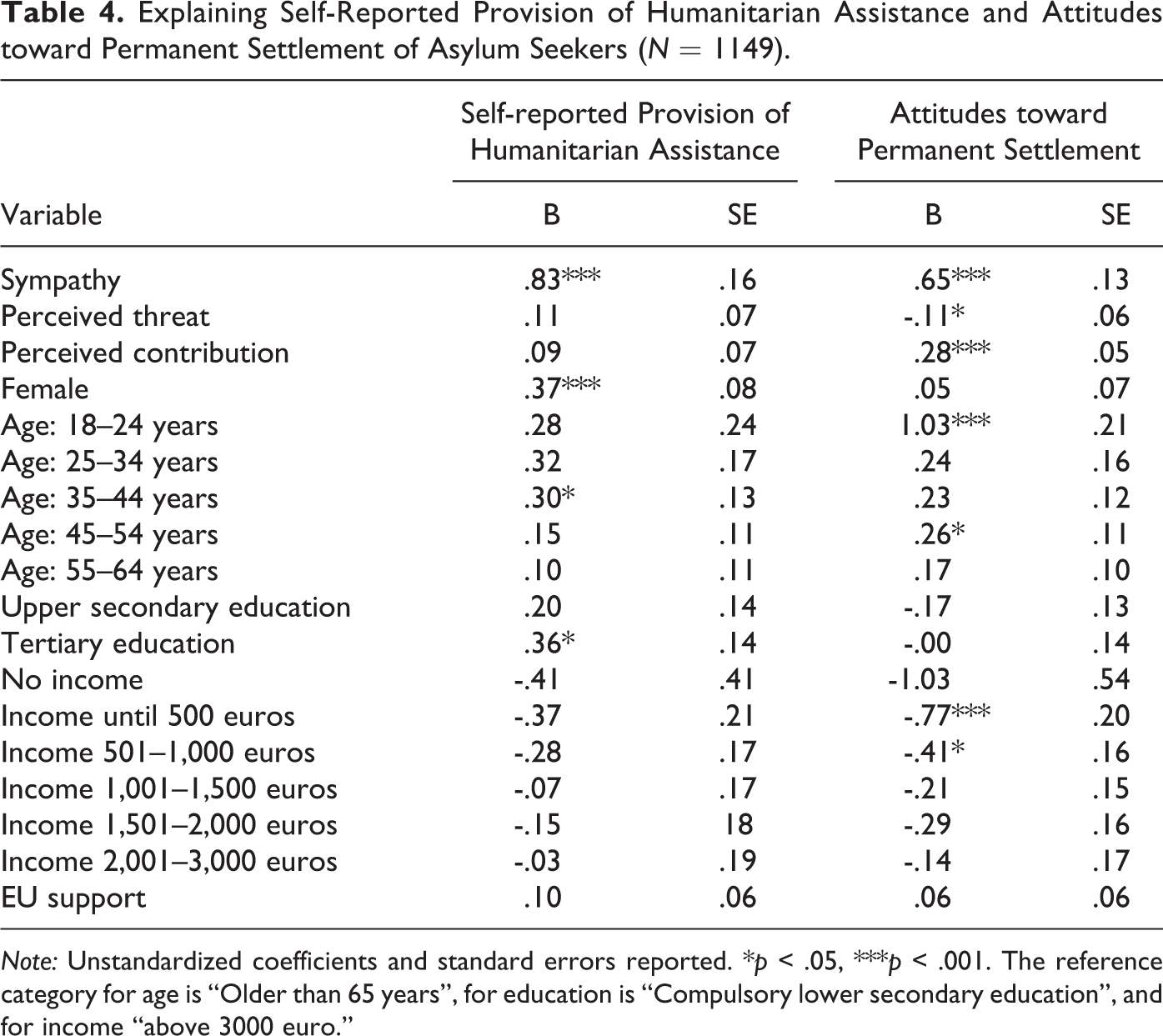
Note: Unstandardized coefficients and standard errors reported. *p < .05, ***p < .001. The reference category for age is “Older than 65 years”, for education is “Compulsory lower secondary education”, and for income “above 3000 euro.”
Alternative Models
To check the robustness of our results, we estimated four sets of alternative models (see Supplemental Tables). 15 First, we tested whether an operationalization of attitudes toward permanent settlement as a dummy variable would provide substantively the same results as the original model. We used this operationalization because the meaning of the middle category, “It depends,” was somewhat unclear. Therefore, it was important to test whether the coefficients were affected by collapsing the middle category with either the lower or the higher category, respectively. Additionally, we tested whether results were affected by coding the middle category as missing. Indeed, the findings were substantively the same as in the main model, indicating that the results were robust (see Supplemental Tables A1, A2, and A3). Altogether, testing the hypothesized relationships by using a dummy variable, instead of an ordinal variable with three categories, confirmed the main results.
Second, we fitted a model considering attitudes toward permanent settlement as a continuous variable, allowing us to account for measurement error in the single item. The item we used was similarly phrased with items from Banting and Kymlicka (2017). They measured whether newcomers were accepted in Europe (α = .89) by asking questions such as “To what extent do you think that the country where you live should allow few or many people of a different ethnic group to come and live here?” Based on this scale, we estimated the reliability of the single item for permanent settlement, using the same approach as for the single item of sympathy (see earlier), which turned out to be ρ = .80. We continued to correct for measurement error for the single item for sympathy. This model showed an acceptable fit to the data, and effect sizes were substantially the same as those in our main model (Supplemental Table A4), indicating that the results were robust with regards to this operationalization.
Third, given the substantial correlation between threat and contribution, we re-estimated the model by retaining one of these two predictors at a time. The findings for threat and contribution were confirmed, and effect sizes were substantially the same as in our main model (Supplemental Table A5 and A6). Fourth and finally, we report the findings from a model in which we treated the control variables age, education, and income as scales. This approach allowed us to endogenize the control variables and retain participants with missing values, thereby estimating the model on the complete sample (N = 1220). Supplemental Table A7 shows that the main conclusions are the same. The model fit indices for the alternative models are summarized in Supplemental Table A8.
Discussion
We investigated self-reported provision of humanitarian assistance and opinions about asylum seekers’ permanent settlement in Greece by analyzing data collected in 2016 among a large and nationally representative sample of native Greeks. To our knowledge, our research is one of the first to examine both types of critical responses to asylum seekers, and to do so in relation to feelings of sympathy and perceived societal contribution, in addition to the much-researched role of perceived threat (Schweitzer et al. 2005; Louis et al. 2007; Hercowitz-Amir Raijman, and Davidov 2017; von Hermanni and Neumann 2019). Moreover, in contrast to previous research on helping intentions (Rudolph et al. 2004), we focused on self-reported humanitarian behavior. We expected that provision of humanitarian assistance would be guided only by feelings of sympathy, whereas attitudes toward permanent settlement would additionally depend on perceived threat and perceived contribution.
All our hypotheses were confirmed. Both provision of humanitarian assistance and support for permanent settlement were explained by feelings of sympathy. This finding resonates with interpersonal theory of motivation (Weiner 2000) and previous empirical studies linking sympathy to helping behavior (Betancourt 1990; Rudolph et al. 2004; Hogg and Vaughan 2009) and to positive attitudes toward out-groups (Iyer Leach and Crosby 2003; Verkuyten 2004; Grütter et al. 2018). Furthermore, in line with the realistic group conflict theory (Sherif 1966; Bobo 1998), the threat-benefit model (Tartakovsky and Walsh 2016), and previous studies on threat (Scheepers, Gijsberts and Coenders 2002; Semyonov et al. 2004; Caricati 2018), we found that perceived group threat was related to less willingness to accept asylum seekers’ permanent settlement. Moreover, in agreement, the threat–benefit model (Tartakovsky and Walsh 2016) perceived contribution promoted stronger support for permanent settlement. Thus, we provide first evidence that the provision of humanitarian aid in response to asylum seekers’ arrival is motivated by sympathy only and is unrelated to perceptions of their threat and contribution, whereas thereat and contribution, on top of sympathy, do matter when it comes to asylum seekers’ permanent acceptance.
This pattern of findings demonstrates the rather nuanced and complex reactions that people can have toward asylum seekers, which helps us understand Greeks’ seemingly inconsistent responses to asylum seekers’ arrival in terms of offering immediate help but denying permanent acceptance. Permanent settlement implies long-term considerations, while the provision of humanitarian assistance is based on immediate concerns about the fate of innocent victims of conflict and disaster (Nickerson and Louis 2008). Greek natives extended humanitarian assistance to asylum seekers and, thus, covered their basic human needs, regardless of whether they perceived future threats and contributions from asylum seekers. However, perceived threat and contribution did play a role in Greek natives’ decision on whether to accept asylum seekers’ permanent settlement in the country. Considering that perceived contribution is much less examined than perceived threat (Tartakovsky and Walsh 2016) yet can offer an effective strategy for promoting asylum seekers’ long-term acceptance, future research should not only examine perceived threat but also pay more attention to perceived contribution.
Although this article sheds more light on the reasons behind the provision of humanitarian assistance and attitudes toward permanent settlement, there are some limitations. First, the analysis is correlational, and no causal conclusions can be drawn. Therefore, future research should further test the associations found here by using experimental or longitudinal designs. Second, although participants in this study were drawn from a nationally representative sample of Greeks, the response rate was rather low (20%), and it is possible that those who responded to the questionnaire were more open to asylum seekers. Therefore, mean scores on the measures presented in this article should be taken with some reservation. Additionally, since this analysis focuses only on Greece, generalization of its findings to other national contexts is limited. Thus, we encourage future research to replicate our research design in other European and non-European countries. For instance, it would be interesting to examine the provision of humanitarian assistance and opinions about asylum seekers’ permanent settlement in financially more prosperous countries, which are also considered final destinations for asylum seekers (i.e., Germany, the Netherlands, and Sweden).
Previous research in different contexts with large refugee populations (i.e., Jordan and Turkey) has shown that it is important to facilitate not only the provision of urgent humanitarian aid but also asylum seekers’ permanent settlement (Abisaab et al. 2014; Kirişci 2014). For instance, a report on Syrian asylum seekers in Jordan (Abisaab et al. 2014) stresses that humanitarian assistance is not effective for their long-term survival and that to achieve economic self-reliance, asylum seekers must be granted legal permission to settle and work in the country hosting them. In the Turkish context, Kirişci (2014) argues that the host society must move beyond hospitality and facilitate asylum seekers’ successful integration and permanent settlement in Turkey. Our study goes one step further by showing that the psychological motives behind support for short-term hospitality and long-term acceptance are different. Identifying this distinction helps us think more systematically about effective and targeted ways to engage people in initiatives that try to provide humanitarian assistance to asylum seekers and initiatives that try to generate support for their permanent settlement.
This article also has important societal implications with regards to future media campaigns. Understanding some of the reasons behind the willingness to provide humanitarian assistance, as well as behind support for asylum seekers’ permanent settlement, can be particularly useful for policymakers and activists organizing social sensitization campaigns. Donation campaigns for asylum seekers are often based on statements stimulating empathy and sympathy, 16 while anti-immigration movements spread messages that mainly focus on perceptions of threat. 17 According to Esses, Medianu, and Lawson (2013), threat is often spread by media appealing to people’s suspicions, and uncertainties about how to view and treat immigrants and asylum seekers. They found that highlighting potential threat (i.e., terrorist attacks) might result in the dehumanization of asylum seekers and hostile attitudes toward them. We suggest that stimulating feelings of sympathy can be a fruitful strategy for media campaigns aiming to promote the provision of humanitarian assistance to asylum seekers. However, if the goal is to promote asylum seekers’ acceptance in the long run and to provide a viable alternative to anti-immigration discourse, feelings of sympathy might not be enough. It may be beneficial to also address threat perceptions and to portray asylum seekers as being able to make a contribution to society.
Supplemental Material
Supplemental Material, Online_appendix,_final_version - Humanitarian Assistance and Permanent Settlement of Asylum Seekers in Greece: The Role of Sympathy, Perceived Threat, and Perceived Contribution
Supplemental Material, Online_appendix,_final_version for Humanitarian Assistance and Permanent Settlement of Asylum Seekers in Greece: The Role of Sympathy, Perceived Threat, and Perceived Contribution by Elisavet Thravalou, Borja Martinovic and Maykel Verkuyten in International Migration Review
Footnotes
Acknowledgements
We are grateful to Jeroen Weesie for his help with the interpretation of the effect sizes in our model with ordered dependent variables.
Declaration of Conflicting Interests
The author(s) declared no potential conflicts of interest with respect to the research, authorship, and/or publication of this article.
Funding
The author(s) received no financial support for the research, authorship, and/or publication of this article.

Supplemental Material
Supplemental material for this article is available online.
Notes
References
Supplementary Material
Please find the following supplemental material available below.
For Open Access articles published under a Creative Commons License, all supplemental material carries the same license as the article it is associated with.
For non-Open Access articles published, all supplemental material carries a non-exclusive license, and permission requests for re-use of supplemental material or any part of supplemental material shall be sent directly to the copyright owner as specified in the copyright notice associated with the article.
