




Abstract
Cities claim an ever-larger role in migration governance, often by means of progressive policies that “decouple” the local from the national. The literature on this “local turn” has generally failed to recognize how this decoupling increasingly takes place within the context of Transnational Municipal Networks (TMNs). On the basis of a database of the 20 most important TMNs in refugee and migrant welcome and integration in Europe and additional empirical research, this article identifies and analyzes their main characteristics, composition, and activities in a multiscalar context, thus contributing to a better understanding of migration governance. It argues that these networks, by means of a wide variety of activities, serve a practical but also a symbolic and jurisgenerative purpose. These implicit and explicit objectives of city networking also account for the proliferation of TMNs witnessed across Europe since 2015. In “teaming up,” European cities not only share practical experiences but also develop narratives about migration that counter national, more restrictive discourses and contribute to the global legal framework, as was the case with the Global Compact on Refugees and Migrants. It is this practical, symbolic, and jurisgenerative role of TMNs, in times of increasingly restrictive national policies, that makes these networks key actors in contesting but also improving global migration governance.
In the days before the 2018 Intergovernmental Conference to adopt the Global Compact for Safe, Orderly and Regular Migration, over 150 mayors and their delegates from all over the world met up in Marrakech, Morocco. They did so in the context of the 5th Mayoral Forum on Mobility, Migration and Development, a dialogue founded by the United Cities and Local Government network but with a strong presence from the Global Parliament of Mayors, another network of mayors representing large and medium-sized cities from all over the world. During the Marrakech meeting, attendees founded the Mayors Migration Council, which — recognizing cities’ key role in welcoming refugees and migrants — seeks to offer expertise to cities and city networks “so as to enhance their voice, action and influence on migration and refugee issues.” 1 In addition, participants adopted a declaration in which they expressly committed to the Global Compacts on Migration and on Refugees and to undertaking a wide range of actions in the field of immigrant reception, inclusion, and collaboration (Mayoral Forum 2018). A striking element at the Marrakech meeting was the presence of a number of mayors and city representatives from countries that had withdrawn from the process, like Italy and the United States.
This unprecedented local engagement with an — already rather unique — intergovernmental meeting and process on migration and refugees illustrates the themes addressed in this article. One such theme concerns the “local turn” frequently noted in discussions of migration management in which cities increasingly are given and claim a central role in migrant reception and integration (Zapata-Barrero, Caponio, and Scholten 2017). Another theme that has received much less scholarly attention concerns the degree to which local authorities who claim center stage in migration management do so in the context of an ever-increasing number of transnational municipal networks, often with overlapping membership and competences (Caponio 2018; Heimann et al. 2019). Understanding what these transnational municipal networks (TMNs) add to local activity in, for instance, migrant reception and integration and to migration management in general helps identify the dynamics behind the rising relevance of local authorities. It also provides insight into the potential of such networks to contribute to one of today’s main global challenges: enabling safe, orderly, and regular migration and ensuring migrant human rights in places of arrival. This article’s objective is, thus, to describe the rise of TMNs in the field of migration and to analyze both their main activities and the reasons behind their proliferation. As this analysis, with a focus on Europe, will show, cities are not only “decoupling” local policies from those developed nationally but also “teaming up” to contribute to contemporary migration management at a transnational scale. 2
One illustration of what is at stake in this teaming up across cities is the interplay between Italian and Spanish cities in receiving the Aquarius, a ship carrying 629 forced migrants from North Africa and barred in June 2018 from entering any Italian harbor by the newly elected right-wing Italian minister Salvini. 3 In response, Italian cities like Palermo and Spanish cities like Barcelona offered vehement opposition. Barcelona mayor Ada Colau, for example, took the lead in successfully pressuring the Spanish government to offer refuge to the migrants, stating that “cities want to fulfill human rights” and were currently doing so with their own funds (El Espanol 2018, 40). What is relevant here is not only the difference between local policies of welcome and the national closing of borders but also the fact that all cities involved in the saga were active TMN members. Barcelona is officially part of 41 TMNs, including Eurocities, Mayors for Peace, and United Cities and Local Governments (UCLG), a founder of the Cities of Refuge network and driving force in the Human Rights Cities movement — all networks with refugee welcome as a key concern. 4 In similar fashion, the Palermo mayor is a key member of the Global Parliament of Mayors and a driving force behind the 2015 Charter of Palermo, which presents mobility as an inalienable human right (Città di Palermo 2015). As a result of these cities’ pressure, the Aquarius was finally taken into Spain in June 2018.
TMN membership, as will be set out in this article, strengthens cities like Palermo and Barcelona in obtaining practical support for their open attitude toward refugees and symbolically provides an alternative narrative to changing global and local norms concerning migration. Many European TMNs were formed, or changed focus, during Europe’s “refugee crisis,” which has been widely recognized as being, primarily, a crisis of governance (Hampshire 2016; Betts 2018). This recognition, in turn, has strengthened the urgency of developing “a deeper understanding of how immigration is governed and framed by political actors across different territorial levels, and to explore the degree of cooperation and contestation between these levels” (Hepburn and Zapata-Barrero 2014, 5). In response, a number of recent studies have sought to theorize the variety of actors involved in migration policy (Filomeno 2016; Scholten and Penninx 2016). Such literature, however, has only recently, and indecisively, started to address the particularities and potential of transnational networks for the governance of migration. Agustin and Jørgensen (2019), for instance, wonder whether upscaling local solidarity within city networks can actually forge trans-local solidarity. Heimann et al. (2019), calling networks “a glimmer of hope in the deadlocked controversy on refugee reception,” also wonder about their effectiveness and the consequences of network proliferation.
In providing a more systematic exploration of TMN activities, their proliferation, and their contribution to migration management, this article examines 20 networks primarily based in Europe. 5 The database underlying the analysis was compiled by desktop research, in combination with participant observation at 10 network meetings and 31 interviews with key participants, as is described in more detail below. This article focuses on European networks for three main reasons. First, the “refugee issue” has become one of the most salient issues in national politics throughout Europe, often leading to a cleavage between national and local policies (Glorius and Doomernik 2017). Second, the research underlying this article shows that these TMNs have proliferated across Europe since 2015. One reason for this proliferation could be that the European multilevel legal order, in which EU law and international human rights and refugee law are equally important, creates additional policy opportunities for the formation and funding of such networks. Finally, a focus on TMNs active in Europe is of interest to a wider audience because while these networks often originated in Europe, they operate internationally.
This examination of European TMNs starts with a focus on the dynamics of decoupling, the processes by which cities disengage from national policies to take their own positions toward refugee and migrant reception and integration. Given the lack of literature on city networks in the field of migration studies, I draw from the more general literature on TMNs, in particular on climate change, to strengthen a theoretical understanding of the dynamics of disengagement. The next section offers a description of 20 European TMNs focused on migration and refugees and their activities. These activities, as will be argued, serve a practical, but also a symbolic and a jurisgenerative, purpose, thus contributing to strengthening the welcoming and integration of migrants, to adding legitimacy to migration policies, and to setting norms to improve the current migration regime. “Teaming up” in TMNs, thus, can help cities contribute to more effective and legitimate management of migration.
The Dynamics of Decoupling
Since the start of Europe’s refugee “crisis,” many European cities, large and small, have distanced themselves from national policies (Gebhardt 2016). In cities of arrival and transit, like Athens, Milan, and Hamburg, local administration and civil society have teamed up to provide emergency assistance under the premise that “It may be that states grant asylum, but it is cities that provide shelter” (Eurocities 2016, 7). Once, in the course of 2015, it became clear that many refugees would be granted asylum, many local authorities explicitly sought to surpass national standards in providing more and better assistance in supporting migrant integration, as well as in access to housing and work (Ibid.). In addition, they developed policies toward those who did not receive asylum and other irregular migrants that directly challenged national policies, as is the case with the Bed–Bath–Bread provision in Amsterdam (Mamadouh and Wageningen 2017; Oomen and Baumgartel 2018).
These local policies deviate from those developed nationally either by taking a different stance on refugee welcome and integration or by explicitly contravening national laws and policies concerning, for example, undocumented migrants. Scholten and Penninx (2016, 976) have labeled such frame divergence “decoupling” — a process by which “in a single policy domain, there may be policies at different levels that are dissociated and may in fact even be contradictory.” That such decoupling need not always emphasize refugee welcome was set out by Ambrosini (2014), who described the policies of exclusion with which many Northern Italian cities deviated from national policies of welcome.
Put together, these works illustrate the “local turn” that migration governance and, by extension, migration research both have taken in recent years (Caponio and Borkert 2010; Jørgensen 2012; Zapata-Barrero, Caponio, and Scholten 2017). From a normative perspective, migration scholars have come to consider cities important loci for migrant integration, either because of their pragmatism toward policy making (the local pragmatist thesis) or because of the differences between localities (the localist thesis) (Emilsson 2015; Scholten and Penninx 2016). More empirically, scholars have sought to identify the factors that explain why certain cities take a more progressive stance while others do not, pointing to the relevance of political orientation (Cappiali 2016; Triviño-Salazar 2018), city size, economic capacity, actors involved (Ambrosini and van der Leun 2015), and urban diversity (Filomeno 2016, 6). This research, thus, not only explores why cities decouple their migration policies but also which cities are more prone to do so.
While this local turn constitutes an important departure from the “methodological nationalism” that previously characterized migration studies (Wimmer and Glick Schiller 2002), it fails to capture the complex interplay between actors and institutions positioned at different levels and in different places that characterizes migration governance today. Recognition of refugee status and subsequent integration in a region like Europe, after all, involves an amalgamation of international, regional, national, provincial, and local actors ranging from the United Nations High Commissioner for Refugees (UNHCR) and the European Asylum Support Office to local mayors and nongovernmental organizations (of international, transnational, national, and local origin) and private companies (to whom key services in this field are increasingly outsourced) (Geddes and Taylor 2016). In terms of their normative commitments, these actors operate in a situation of legal pluralism, with frequently overlapping or contradictory international, European, national, and local laws and regulations (Michaels 2009). From its state-centered origins, refugee governance clearly has moved up, down, and out or, following Guiraudon and Lahav (2000, 164), “upward to intergovernmental fora, downward to local authorities, and outward to nonstate actors.”
These shifts in governance have often been analyzed by invoking the concept of multilevel governance, with its emphasis on policy making within different levels of government (Scholten and Penninx 2016; Zapata-Barrero, Caponio, and Scholten 2017; Panizzon and van Riemsdijk 2019). Such an understanding, however, fails to capture the degree to which the relations between different actors and their normative commitments explain why, for instance, some local authorities are much more open than others (Scholten 2015; Filomeno 2016). The rising role of international, supranational, and subnational organizations in migration governance has “been a source not only of contradictions, conflicts and diverging results, but also of remarkable innovations” (Ambrosini and Boccagni 2015, 38). To fully capture the processes at work, scholars have proposed a “comparative relative scalar perspective,” which is not “a top-down analysis or one that separates the local, national, and the global but one that allows us to trace their mutual constitution of globe-spanning hierarchies of power” (Glick Schiller 2012, 896; Glick Schiller and Çağlar 2016). Such a multiscalar perspective focuses on the constitution of social processes via both institutionalized and informal networks and enables comparison of local contexts within and across national borders (Ellis and Almgren 2009). In doing so, it also draws attention to the “soft forms” of knowledge transfer and policy making that are key features of contemporary governance, including the field of migration governance (Stone 2004). In addition, such a multiscalar perspective helps us understand the forces at play in the formulation, interpretation, dissemination, and implementation of global norms like human rights (Merry 2006a; Goodale and Merry 2007).
It is clear, then, that institutionalized networks, like national and transnational city networks, can contribute to strengthening and questioning the hierarchies of power and social processes of refugee reception and integration (Bauder and Gonzalez 2018). In the United States, for example, a “sanctuary cities” network of states and counties has been active for many years but has gained particular traction in opposing President Trump’s clamp-down on undocumented immigration (Lee, Omri, and Preston 2016). Bauder (2017) points at the variety of functions that such networks have in migration governance, arguing that urban sanctuary policies have discursive, identity-formative, scalar, and legal aspects. In refusing to hand out detainers to facilitate deportation, the Californian city of San Francisco, for instance, received support by means of a court ruling. 6 In Europe, Germany’s Sanctuary Cities and the UK’s Shelter Cities take similar approaches, even if they seek to advocate and take a more welcoming stance toward refugees in different ways and in different constitutional settings (Darling 2016). The Sanctuary City network in the United Kingdom, Scotland, and Ireland, to give another example, includes about 90 towns and cities and seeks to create a “culture of welcome and hospitality for people seeking safety.” 7 In Germany, welcoming cities are united via the “Save me Campaign,” which strengthened practical support for refugee resettlement in 56 cities. 8 Such national networks are also often connected to activists elsewhere, thus forming the basis for transnational networking (Lippert and Rehaag 2012; Bauder 2017, 10).
These national city networks arguably perform functions that differ from those of transnational municipal networks in this field. Caponio (2017), in one of the few studies on TMNs in the field of migration, distinguishes between horizontal and vertical functions of Italian cities’ participation in European networks. Horizontally, she argues, networks lead to policy learning and the exchange of best practices. Vertically, they enable access to funding and lobbying vis-à-vis the EU decision-making agenda. This observation is in line with earlier research that showed TMNs’ role in exchanging best practices and ensuring access to European funding (Penninx 2015). In a study of Milan and Turin, however, Caponio (2018) argues that for these two cities, the main function of TMN participation was symbolic and included legitimizing local policies and strengthening their identities, thus pointing out that not all networking activity has tangible outcomes. Heimann et al. (2019) emphasize how networks contribute to scaling out in terms of capacity building and scaling up via city diplomacy. In all, then, the scarce research on TMNs’ contribution to migration governance points in different directions.
To develop a more systematic understanding of TMNs’ key characteristics and potential contribution to migration governance, inspiration can be drawn from research on city networks in general and climate change in particular (Aust 2018). Acuto and Rayner (2016), for instance, analyzed 170 city networks, finding that half were national, 21 percent regional, and 29 percent international. Such networks had very different memberships, from those with only cities to those with cities and associations of cities to those including NGOs and businesses. The majority of these networks focused on multiple issues (71%), with the rest working on one theme ranging from healthy cities to children’s rights (Acuto and Rayner 2016, 1153; Oomen, Davis, and Grigolo 2016). In zooming in on transnational municipal networks, it is striking how many are concerned with climate change, including C40, the Climate Change Alliance, and the World Mayors Council on Climate (Acuto, Morisette, and Tsouros 2017). Such networks seek to influence the global debate on climate protection and to stimulate actions toward this objective, thus functioning as “pioneers for pioneers,” setting global standards, and inspiring other cities (Kern and Bulkeley 2009; Bulkeley and Schroeder 2012). Empirical analysis of key TMNs in climate change has also focused on their representativeness and effectiveness, showing an overrepresentation of European and North American countries, a lack of firm commitments from the cities that participated, and limited monitoring of results (Bansard, Pattberg, and Widerberg 2017). In terms of activities, a recent study of climate change networks shows that network membership enables local mobilization, helps formulate emission reduction goals, institutionalizes climate trajectories, enables direct exchange, and leads to project support, all influencing local climate governance and thus engaging in city diplomacy (Busch, Bendlin, and Fenton 2018; Acuto et al. 2018). Given the fact that both climate change and migration are issues of global concern that call for global cooperation and local action, these findings on the membership and focus of climate networks lead to the question of whether TMNs in the field of migration hold similar characteristics and perform similar functions.
To answer this question, let us now turn to an empirical assessment of 20 such networks based in Europe. The following sections first provide a description of the main characteristics of TMNs in the field of migration, before zooming in on those cities that are the most active network participants. Subsequently, I provide an analysis of what I identify as TMNs’ three main functions in the field of migration — practical, symbolic, and jurisgenerative — and discuss how network proliferation relates to these functions.
Transnational Municipal Networks in the Field of Migration and the Cities That Join Them
In assessing the wealth of TMNs in the field of (forced) migration in Europe, this research concentrated on those transnational networks whose core constituency was local authorities and whose main focus was strengthening migrant or refugee welcome and integration. I omitted one-off initiatives, like Fearless Cities, a network that defines itself as a “global municipalist movement” standing up to defend human rights, democracy, and the common good because of its lack of permanence. 9 To qualify for inclusion in the database, networks needed a certain form of organization, for instance via a lead partner, secretariat, or yearly conference. An exhaustive search of municipal networks in Europe led to a set of 20 TMNs, which were then analyzed to assess their focus, composition, and activities by means of research into their websites, newsletters, and policy documents; grey and scholarly literature; social media usage by and on the networks; Eurostat statistics on city characteristics; and general media reporting on the networks concerned. This desk research was supplemented by attendance at 10 network meetings between 2016 and 2018, where I conducted semistructured interviews with politicians and civil servants who took part in the networks and engaged in participant observation. In addition, I interviewed 31 policymakers and politicians involved in networks outside the meetings. The information obtained was analyzed qualitatively in Nvivo by means of grounded theory (Charmaz 2006) and quantitatively in Excel. What, on the basis of this information, can be said about how these networks are composed, who initiates them, what their focus is, which types of cities participate, and which types of cities are active in multiple networks?
In terms of network composition, local authorities — understood in the legal sense as the lowest tiers of public administration — but also actual cities or those with a formal role within them (e.g., mayors, local politicians, or bureaucrats) might form the core constituency of most TMNs, but cities need not be the only actors in the networks. Many TMNs under examination here have a mixed membership that includes international or regional organizations, NGOs, businesses, or research centers (see Table 1). The Hague Process on Refugees and Migration, for example, started in 2002 with a strong focus on states but now explicitly also works with and for cities and prides itself in involving business as well (Hinrichs and Juzwiak 2017). In many cases, civil society is a partner, as is the case in the UCLG Global Platform for the Right to the City (an action-oriented advocacy network) in which local authorities team up with worldwide civil-society grassroots movements. Additionally, universities or individual academics often play key roles in bringing and keeping cities together, like Ryerson University in Cities of Migration or Benjamin Barber, the late author of If Mayors Ruled the World, in creating the Global Parliament of Mayors (Barber 2013). Next to membership, networks’ sizes also differ substantially. At the time of this writing (July 2019), Eurocities unites 191 of Europe’s largest cities, whereas the Urbact arrival cities network consists of only 10 cities.
Transnational Municipal Networks in Refugee and Migration Policy in Europe.
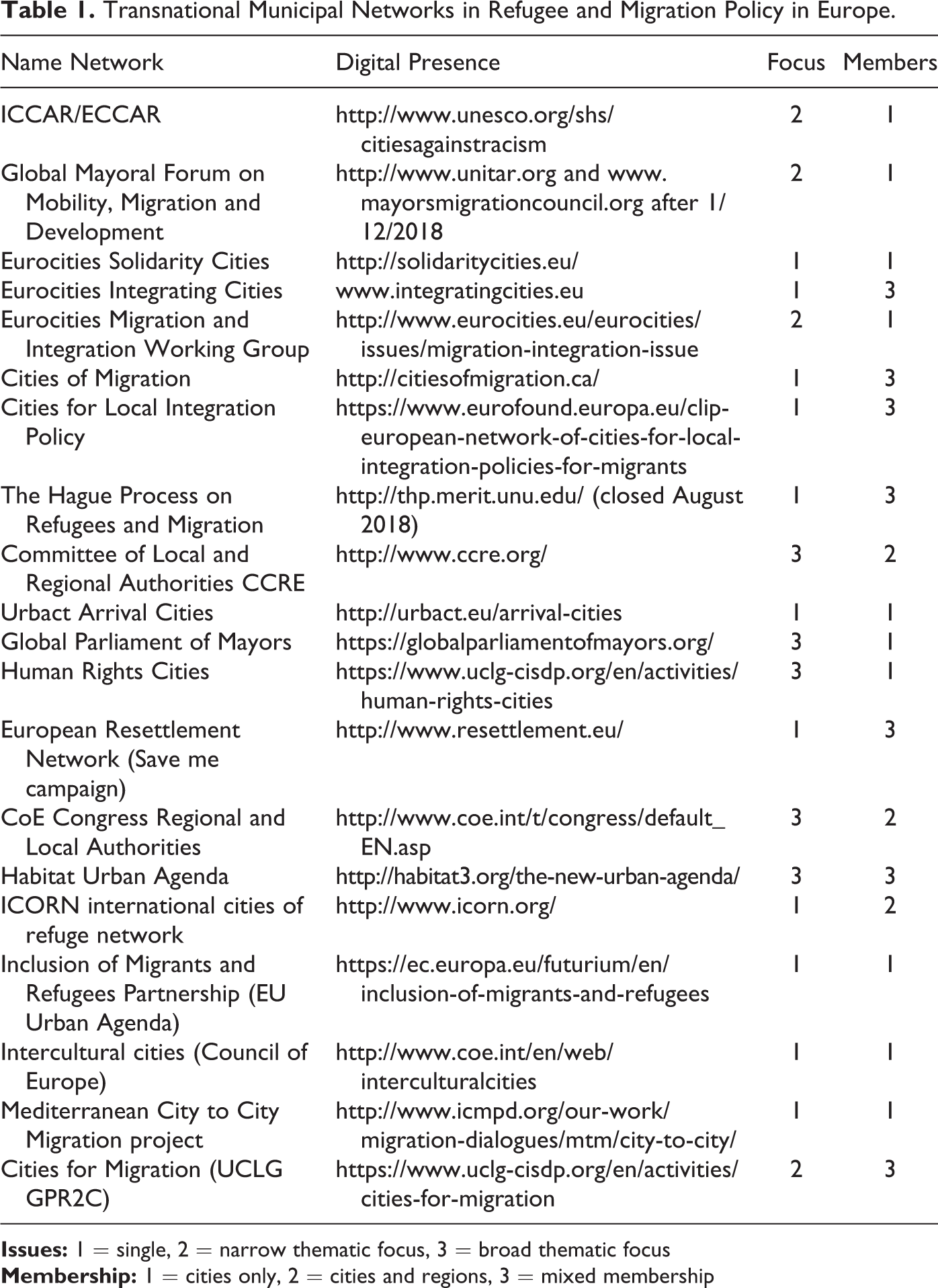
More often than not, international or European organizations take the initiative for city networks, as is the case with UNESCO’s International Coalition of Cities against Racism, the UNITAR Annual Mayoral Forum on Mobility, Migration and Development, the ICMPD Mediterranean City to City migration project, and the UCLG Global Platform for the Right to the City. Most networks examined were initiated at the European level, as is the case with Eurocities (and its offspin Solidarity Cities and Integrating Cities), the Council of Europe’s Intercultural Cities, the Save Me Campaign of the European Resettlement Network, the Arrival Cities, and the Partnership on the Inclusion of Migrants and Refugees. Only a few networks could be considered truly “horizontal,” with no regional or international partners, such as Global Parliament of Mayors, the Annual Mayoral Forum on Mobility, Migration and Development, and the World Mayors Foundation.
In terms of thematic focus, some TMNs focus specifically on refugees, whereas others have a broader migration and integration focus. Europe’s refugee influx also caused a number of networks that were previously focused on migration in general to add a specific focus on refugee integration. This shift in focus after 2015 was clear in networks such as Integrating Cities, Cities of Migration, the Council of Europe’s Intercultural Cities, and UNESCO’s Global Network of Learning Cities. A number of other preexisting networks, like the UCLG, Eurocities, the Habitat network, the EU Committee of the Regions, and the Congress of Regional and Local Authorities, responded to Europe’s refugee influx by initiating subnetworks and bringing together interested cities in conferences and working groups specifically concerned with refugees. The networks that focus on refugees only, such as Solidacities, Eurocities Solidarity Cities, the cities united in the Hague Process for Refugees and Migration, and the Arrival Cities Network, often still differ from one another in emphasis. The International Cities of Refuge Network, as a specific example, concentrates only on offering shelter to threatened writers, with the Freedom of Expression in Article 19 of the Universal Declaration of Human Rights as the normative basis.
The literature on decoupling in migrant policies often suggests that it is mostly left-wing, progressive cities that seek to decouple their local policies from national policies in this field (de Graauw and Vermeulen 2016; Filomeno 2016, 11). This political dimension can be difficult to assess; however, a mayor’s and municipal council’s political background can differ, and many municipal councils and executives consist of a variety of political parties and change over time, even as network membership remains. Nevertheless, an analysis of local election results over the past 10 years in the 29 cities most active in TMNs shows that 14 were predominantly and consistently run by social democrats and only four by parties classified on the center-right, whereas 11 cities showed such political flux that it was impossible to classify them as consistently left- or right-wing (Table 2). More progressive cities, thus, do seem more prone than more conservative cities to join TMNs.
The Attributes of the 29 European Cities to Participate Most Actively in TMNs in Refugee and Migration Policies.
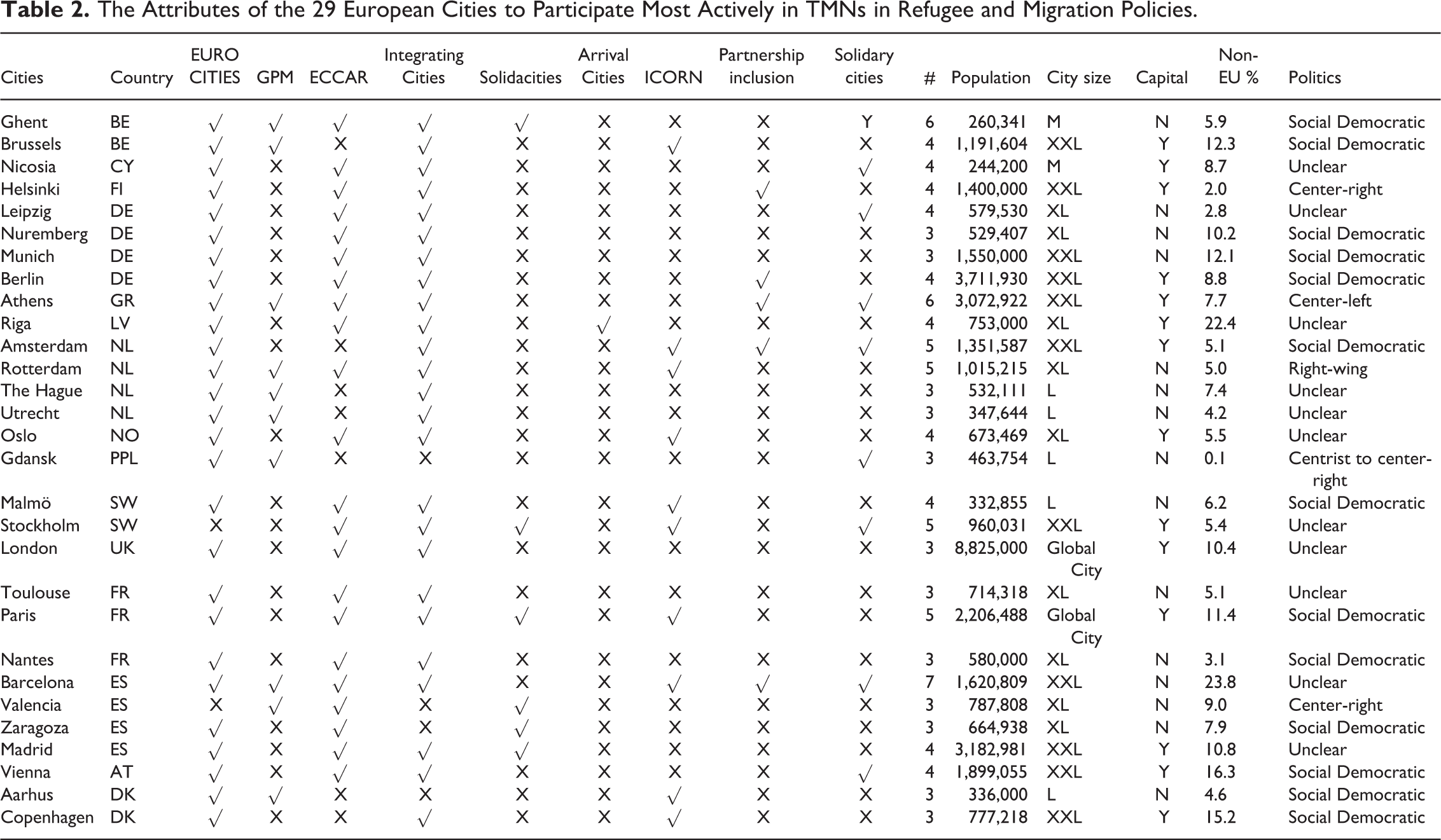
Let us now move from TMNs’ composition and thematic focus to their proliferation. In spite of large differences between networks, it is clear that more and more European cities and other actors with a focus on the locality are not only teaming up in these transnational networks, many of which formed in recent years, but also opting to simultaneously participate in multiple networks. This choice, that cities have, of participation in multiple TMNs caused the Athens vice-mayor to lament: “There are simply too many networks.” 10 To understand which type of cities are most active in the networks we studied, we zoomed in on a subset of nine networks that were most active in the field of refugee welcome and integration. Within this subset, we mapped relationships between cities by means of UCINET, software for social network analysis, and related network membership to data pertaining to city size, diversity of the population, and political composition of the local authority (Borgatti, Everett, and Freeman 2002). Within the set of cities that are members of a TMN, 29 cities participate in three or more such networks (see Table 2). Barcelona could be considered the most networked city in this field, as it is part of seven networks, followed by Athens and Ghent (6) and Amsterdam, Rotterdam, Paris, and Stockholm (5). Figure 1 indicates the most centrally positioned cities and the density of connections within these networks. These highly networked cities might differ in size but are all considered larger cities, with an average size of 1.5 million, ranging from Nicosia and Ghent (around 250,000 inhabitants) to London and Paris (8.8 and 2.2 million inhabitants, respectively). Interestingly, there is no correlation between city size and the number of networks in which a given city participates. This finding contrasts with the literature on city diplomacy, which tends to take global cities as its point of departure, and shows how the rise of TMNs not only concerns global cities but also smaller places (Acuto et al. 2018). Interviews with network participants, both during network events and separately, indicate that cities that have participated in one network are often approached to become a member of other networks and have by then experienced the advantages of network membership.
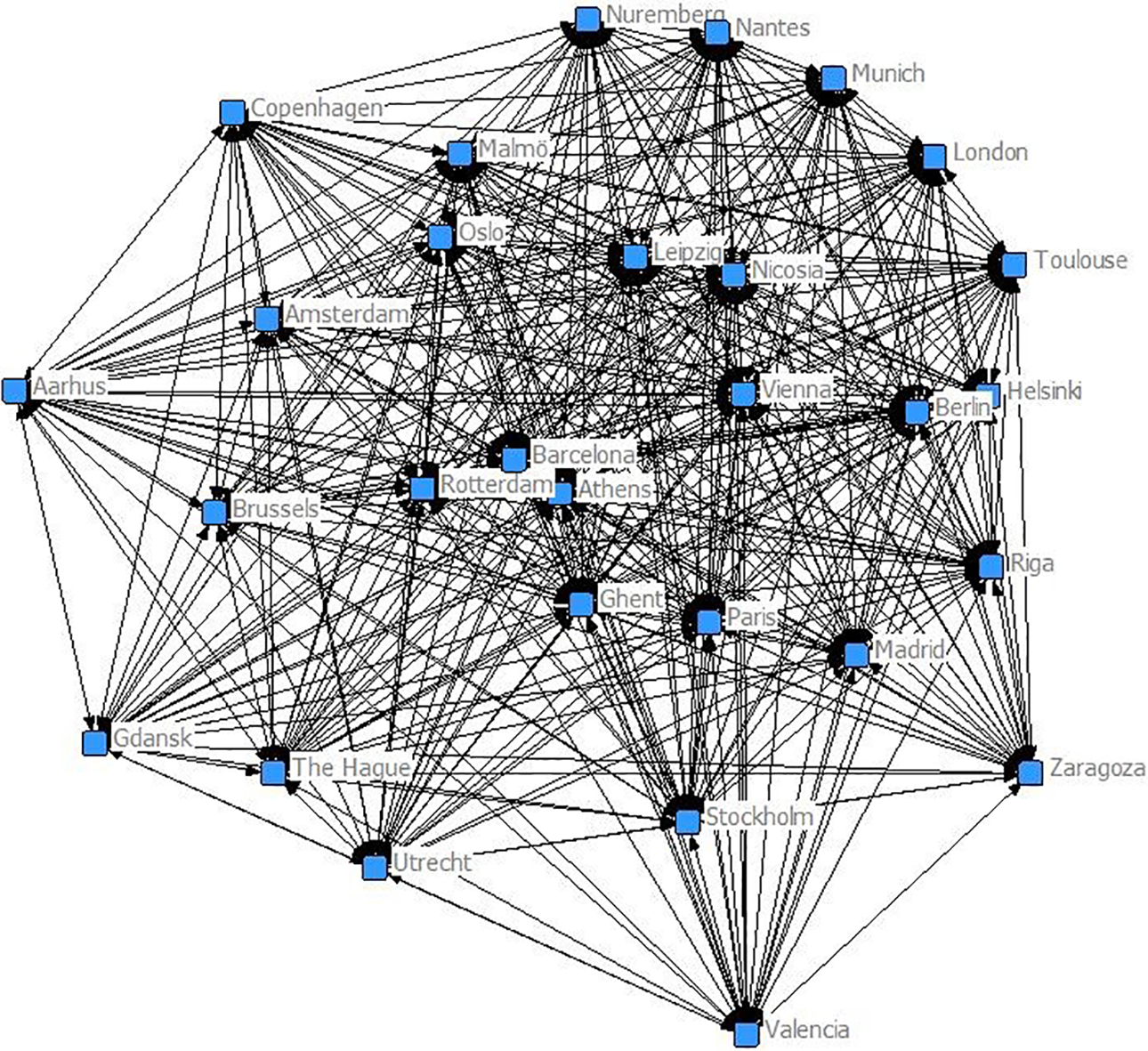
TMN centrality: the most networked cities in Europe.
TMNs can also be categorized in terms of their focus and intended audience (Table 1). In terms of focus, the object of TMN activities can be refugee reception and integration alone or a wider set of migration and inclusion-related concerns. Such a more general focus on migration (including, for instance, labor migration) enables the network concerned to use wider insights developed in the field of inclusion for refugee reception and integration. In addition, networks’ target audience can differ, moving from a main focus on local authorities to national governments to European and international constituencies. This distinction between TMNs focused on refugees only and on migrants in general and on local versus global audiences leads to a further distinction between and among multipurpose networks with a global outlook, multipurpose networks with a local focus, specialized networks with a global focus, and specialized networks with a local focus (see Table 1).
The Functions Served by Teaming Up and Network Proliferation
Now that I have provided a general description of TMNs and the cities that join them, it is time to turn to the purpose of both teaming up as such and of network proliferation. What are the key activities of European TMNs in the field of refugee and migration management? What functions do these networks serve? What explains their proliferation since 2015? Careful analysis of documentation on the networks, the content of their meetings, and interviews with key players in them shows a distinction between explicit, stated functions and those that remain implicit but nonetheless important for understanding TMNs’ added value to migration governance (see also Caponio 2018). Better put, for many TMNs, a first set of network activities is stated explicitly and serves a practical purpose like sharing best practices or seeking financial and other forms of support. A next set of network activities remains more implicit and includes activities like showcasing, storytelling, and even shaming national governments, all of which serve a symbolic purpose. Finally, and largely unnoticed by scholars, TMNs also set local norms and contribute to global ones, thus serving the jurisgenerative purpose of amending refugee and migration law to suit local challenges. In each case, TMNs’ proliferation seems to add to these implicit and explicit functions.
Practical: Sharing Information and Seeking Support
A first and explicitly stated function of TMNs is purely practical: sharing information and seeking support (Penninx 2015; Caponio and Jones-Correa 2017). Virtually all networks are primarily geared toward sharing information, exchanging best practices, providing overviews of the challenges involved and specific policies in other cities pertaining to refugee transit, and answering questions related to migrant integration via housing, education, the labor market, and intercultural dialogues. The Athens vice-mayor, for instance, states how “we received a large deal of practical support from our network partners when we suddenly saw thousands of migrants a day passing through Athens, this made us feel less alone.” 11 The Hague Process on Refugees and Migrants, to offer another example, produces reports on how to enhance the role of business in migrant integration, providing examples meant to offer inspiration to cities in this network (Hinrichs and Juzwiak 2017). 12 The Integrating Cities network carves out a role for cities as policy makers, service providers, employers, and buyers of goods and services and stimulates commitment to strengthening migrant integration in each separate field, thus enabling member cities to learn from one another — for instance in a field like housing policy (Eurocities 2015). In line with current governance trends, TMNs tend to emphasize evidence-based learning and policy making, as is clear in the Intercultural Cities network that uses an index to assess member cities’ performance in relation to a specific intercultural integration model. 13 Such evidence can also emphasize the need for targeted policies: the Barcelona Refugee city website provides data on asylum applications in Europe but also offers a comparison of the costs of deportation versus reception. 14 All these examples show how TMNs seek to offer tangible and practical support to local policy-makers, who often have limited time. 15
The best practices shared within networks often concern ways to sustain more open policies in times of increasingly restrictive national rhetoric and practices pertaining to migration. The Cities of Migration network, for instance, provides examples of, and a webinar on, cities and the inclusion of migrants with an irregular status (Cities of Migration 2018). One example shared in network seminars and in the webinar is that of Utrecht, the Netherlands, which is committed to being a “human rights city” and has a “Bed bath bread” policy offering irregular migrants access to healthcare, employment, education, and legal advice (van den Berg 2016; Oomen and Baumgartel 2018). Utrecht develops and shares these policies in the context of the City Initiative on Migrants with an Irregular Status, which involves 11 European cities (Spencer and Hughes 2015). Another key actor in such exchanges is Barcelona, where irregular migrants receive the status of neighbor and are included in the civil register, enabling access to local services like sports, public facilities, libraries, schools, language classes, and healthcare.
Next to sharing information, TMNs play a key role in seeking material and other forms of support from funders and regional and international organizations. Eurocities, for instance, calls for more direct and faster access to EU emergency funds and direct access to the Asylum Migration and Integration Fund for its member cities. The EU Partnership for the Inclusion of Migrants and Refugees lobbies for earmarking an even wider range of European funds and aligning EU funds with municipalities’ needs. 16 A number of TMNs are made possible by European and international funds, like the Arrival Cities program funded by the EU’s Urbact and the Mediterranean City-to-City Migration Project funded by the EU’s Directorate General for Neighbourhood and Enlargement negotiations and co-funded by the Swiss Agency for Development and Cooperation. The 30 Cities for Local Integration Policy, to offer another example, were brought together by a €1.6 million EU grant but continued to work together after the five-year program’s end. Eurocities’ Integrating Cities network, in turn, is funded by the European Integration Fund in the context of the Mixities project. As European funds are often only available to consortia of cities from different countries, cities “teaming up” is the only way to increase funding for local activities that support refugees and migrants.
The fact that TMNs are about seeking support also explains their proliferation. Different thematic networks enable different types of membership and the sharing of different experiences. Central cities in TMNs also form new networks to open avenues toward new sources of funding, as funders, especially the EU, are generally inclined only to support new collaborations. In this way, although the proliferation of networks can be harmful in forcing cities to spread resources (membership fees, participants’ time) thinly, it can also generate additional resources.
Symbolic: Showcasing, Storytelling, Shaming
Caponio (2018), in her study of two Italian cities’ networking activities, argues that the main function of network participation is symbolic. This emphasis on networking activities’ symbolic role is in line with the results of my analysis of networks’ activities and implicit purpose. These activities include showcasing best practices but also “storytelling” (providing new narratives) and shaming national governments, in an effort to aid the decoupling of local migration policies from national dynamics and the strengthening of those local policies’ legitimacy. Let us first consider these three activities (showcasing, storytelling, and shaming), before assessing how network proliferation can aid this underlying, implicit purpose of networking activity.
TMNs seek not only to exchange best practices but also to showcase them to the world at large. In 2017, for instance, the UCLG Committee on Social, Inclusion, Participatory Democracy and Human Rights held two sessions at a conference on Cities and Migration organized by multiple stakeholders, in which local leaders “effectively showcased local practices (such as local identity cards, decentralized cooperation initiatives or municipal offices for tackling discrimination).” 17 This information was then shared, as is often the case, via social media (under the hashtag #Cities4Migration). Digital media, in fact, play a key role in showcasing: virtually all TMNs have webpages with examples of city activities, and many add videos, webinars graphics, and Twitter and Facebook accounts. Some do not have a website but, instead, flag physical meetings via Twitter, like #solidacities. Others produce extensive reports, like the Eurocities report on refugee reception and integration in cities or the UNESCO report on cities welcoming refugees and migrants (Eurocities 2016; UNESCO 2016). The use of social media clearly enables ideas to travel quickly, be shared, and be included at a high pace. It also contributes to city-branding, as illustrated by the general Eurocities site, which promises that network participation “provides a high-profile international platform for ambitious, outward-looking cities…and enables you to showcase your achievements to your peers as well as to influential stakeholders.” 18 Showcasing local activities, thus, becomes a means to strengthen legitimacy for local policies.
Another implicit TMN activity could be labelled “storytelling,” the search for an alternative narrative on migration that sets the city apart from restrictive national policies and contributes to its identity. In a policy domain subject to heated local and national debates, urban actors often actively search for a narrative to convince those opposed to the need to strengthen refugee welcome and integration (Graham et al. 2016, 181; Bauder 2017). Such a narrative, according to many mayors, couples local culture and tradition to wider global struggles and objectives. 19 Genoa, for instance, shares via the Integrating Cities network how “Diversity is embedded in Genoa’s heritage and history as a city on the sea. Local media often publishes the mayor’s statements reflecting his commitment to continue this tradition” (Integrating Cities 2014, 6). The degree to which this discursive role is subject to contestation is illustrated by Mechelen’s mayor, who received the World Mayor Prize for his leadership in integrating newcomers and stated: “We’re still doubting what to call Mechelen — a human rights city, a just city, a city of refuge. Each title has advantages and disadvantages.” 20
Oftentimes, the narratives cities develop are related to normative global frameworks. A number of networks, for instance, employ a rights-based approach, centering their activities around the right to the city, with the UCLG Committee on Social Inclusion, Participatory Democracy and Human Rights as the main example (Harvey 2012, UCLG Committee of Social Inclusion 2012). Other networks, like UNITAR’s Annual Mayoral Forum on Mobility, Migration and Development, take inspiration for their activities from the UN’s Global Sustainable Development Goals (SDGs), which include “Sustainable Cities and Communities” as one of 17 objectives seeking to make cities “inclusive, safe, resilient and sustainable.” Other discursive strategies can focus on refugees’ importance for local economies. The Habitat III urban agenda was strongly influenced by the UCLG Committee on Social, Inclusion, Participatory Democracy and Human Rights, arguing that “although the movement of large populations into towns and cities poses a variety of challenges, it can also bring significant social, economic and cultural contributions to urban life” (United Nations 2016, 28). TMNs can also emphasize the cultural enrichment that comes with open local policies, as is the case of Cities of Refuge network, which emphasizes how the writers and artists they support “represent a rich resource for the entire network of cities. They bring new impulses to the cultural life of each city; they contribute to enhancing knowledge about different cultures in your city.” 21
By showcasing their activities and providing narratives that differ from the dominant ones in the field of refugee welcome and integration, TMNs also seem to seek to shame national and, to a lesser degree, European and international governments. One of the earliest municipal networks in this field, CLIP, for example, states how “For us, City Diplomacy and networks such as CLIP are a visible counterbalance to what used to be called just a few years ago ‘Fortress Europe’,” with the term ‘Fortress Europe’ easily recognized amongst Europeans as a derogatory term for a region purportedly priding itself on open borders (at least within its territory). 22 Part of the proposition of several municipal networks is a critique of the nation-state as unable to handle key global challenges and the need for cities to take up their role in this field (Barber 2013). At a Solidacities conference in October 2016, organized by European parliamentarians of the left, politicians like Elly Schlein stated how “there is another face of Europe, the face of many cities, municipalities, civil society organizations that are doing their best to welcome refugees, to give the answer they need, to provide services, to help them live in dignity.”
These more symbolic activities, in the form of showcasing, storytelling, and shaming national governments, all contribute to strengthening local authorities’ independence vis-à-vis national governments and to legitimizing their approach to migrant welcome and integration. As I. Daalder put it during a Global Parliament of Mayors meeting, “Cities need a place in international debates, in particular when national leaders are moving in the opposite direction.” 23 In seeking to understand the role of TMN proliferation in this process, it is clear that some networks take more outspoken positions than others on, for instance, undocumented migrants’ rights. Starting a new network could thus possibly also lead to assembling those cities that want to be even more explicit “pioneers for pioneers.” In this way, new networks could allow for new narratives to be tested and provide a fresh opportunity to distance local action from national politics.
Jurisgenerative: Setting Standards
Another key set of TMN activities lies in the application, but also the generation, of norms in the field of migration and integration. These jurisgenerative activities serve to strengthen migration law and bring it more in line with local needs. Working horizontally, TMNs set standards for themselves, which can often be considered local translations and concretizations of international law (Merry 2006b). More vertically, they generate joint declarations, charters, and common standards or call for changes in (inter)national or European law (Koh 2005; Levit 2007). These activities, classified by Acuto (2013) as the “promotion of regimes for regulation and collective action,” frequently move beyond the realm of soft law into formal agreements. Picking up on the comparative relative scalar perspective proposed by Glick Schiller and Çağlar (2009), these jurisgenerative activities show how the interplay beween the global and the local works toward the mutual constitution of normative frameworks.
In terms of horizontal standard-setting, there are many examples on offer. UNESCO’s International Coalition of Cities against Racism, for instance, works toward the production of a comprehensive framework guidance handbook on combating racism. It also adopted a Declaration in this field with a 10-point action plan in which signatories pledged to take actions like establishing “formal mechanisms of collecting data and information on racism and discrimination” and “disciplinary measures within the routine functions of city authority in regards to racist acts or behavior by city employees.” The Cities of Migration website offers a diagnostic tool for cities to assess the quality of inclusion within their urban landscape. The Eurocities Integrating Cities Charter combines benchmarking and peer reviews on the progress made on issues like facilitating engagement from migrant communities in policy-making processes and removing barriers to participation titled “implementoring” (Eurocities 2015a). In all these cases, TMNs play key roles in translating abstract global norms to local settings where they can tangibly improve migrants’ lives.
In addition to translating global norms into local settings, cities increasingly contribute to developing international standards themselves. As one Eurocities member put it, “Working with other cities brings opportunities to influence the European debate.” 24 An instance of TMN contribution to global norm-setting is that of UCLG and its Committee on Social Inclusion, Participatory Democracy and Human Rights, which successfully lobbied to see the right to the city included in the UN Habitat New Urban Agenda and ensured inclusion of provisions like “We commit ourselves to ensuring full respect for the human rights of refugees, internally displaced persons and migrants, regardless of their migration status” (United Nations 2016, 28). 25 Another example is the Palermo Charter, which considers mobility “an inalienable human right,” thus going further than existing international law. The way in which TMNs translate global standards to local settings and contribute to the actual formulation of these standards could be considered the “glocalization” of the refugee rights regime (Oomen 2018; Stürner and Bendel 2019). In line with multiscalar approaches to the study of migration governance, this concept is often invoked to show how globalization involves the creation and incorporation of locality — “processes which themselves largely shape, in turn, the compression of the world as a whole” (Robertson 1995; Bauman 1998). TMNs play a key role in these processes, which hold the potential to strengthen both the normative protection of the migrant rights regime and its implementation in a wide variety of local contexts.
The proliferation of networks enables cities involved in TMNs to engage with different international and regional organizations. In the Mannheim mayor’s words, “The supranational organizations are our most important partners, because they realize the power of cities more and more.” 26 In recent years, these organizations have developed a great deal of interest in working directly with cities and their networks in the field of human rights in general and migrant rights in particular. In 2015, for instance, the UN issued a report on local government’s role in the protection of human rights, calling for guiding principles for local government and human rights (United Nations 2015). 27 More specifically, the UN Global Compact put in place a “Cities challenge,” engaging the private sector, civil society, and local government in achieving the Sustainable Development Goals and the New Urban Agenda (see also Thouez 2018). 28 Similarly, the EU increasingly reaches out directly to local authorities, for instance in the EU Urban Agenda that includes refugees and migrants as a main theme. The Council of Europe, as a final example, had refugee reception and integration as a key theme during its 2017 Congress and issued a report on the matter (Congress of Local and Regional Authorities 2017). Different networks can, thus, engage with these different international organizations, ensuring further development of the pluralist legal framework and stronger applicability to local challenges (Avbelj and Komárek 2012). In all, then, TMN activities serve a practical, but also symbolic and even jurisgenerative, purpose: strengthening local activities in the field of migration, seeking support for them, and contributing to the global and local norms that underpin them.
Conclusion
Cities are increasingly claiming a key role in the welcome and integration of refugees and migrants. This “urban activism” holds great potential: most migrants live in cities, and many of the main means of migrant integration, like access to housing, education, and work, are in the realm of local government competences. 29 While this “local turn” in migration management has received ample scholarly attention (e.g., Caponio and Borkert 2010; Jørgensen 2012; Zapata-Barrero, Caponio, and Scholten 2017), the complex governance arrangements within which “pioneering cities” take up responsibility in this field have received less academic attention than their importance merits. With this in mind, this article set out the main characteristics of the 20 most important TMNs in Europe and the cities that join them, particularly their activities and the reasons behind their proliferation.
In considering the main characteristics of these TMNs, it is clear that most have a mixed membership consisting not only of cities but also of international or regional organizations, NGOs, businesses, research centers, and international and regional organizations — with the latter often taking the initiative to establish the networks themselves. The TMNs also differ considerably in size and focus, ranging from a narrow focus on refugees to much wider attention to all aspects of migration. The cities that participate in these networks are predominantly governed by progressive parties but, in contrast to what existing scholarship reports (e.g., Acuto 2018), not exclusively so. Cities, large and small, often start by becoming members of one network and then expand network membership, with cities like Barcelona and Athens participating in as many as seven networks. These networks can be oriented toward different audiences, from network partners to supranational organizations.
In addition to considering what TMNs are, I also looked at what the networks do, and why. At an aggregate level, the networks serve a pragmatic, symbolic, and jurisgenerative function with respect to migration governance. Cities “team up” to share experiences but also to seek support, often by means of funding. This form of working together enables them to improve the way they welcome and integrate refugees and migrants. Networking also serves more symbolic purposes; showcasing what they do, communally searching for narratives on migrant welcome, and shaming governments, TMNs help cities decouple their local policies from those developed nationally and seek legitimacy for their approaches. A final purpose, rarely discussed in the literature but evermore prominent, is jurisgenerative. TMNs set standards and agree to forms of monitoring in the field of migrant welcome and integration in a horizontal manner but also seek to influence international processes of standard setting by introducing norms like “the right to the city” or adding specific content to the right to housing. It is in these processes that the multiscalar character of migration governance becomes apparent, as a “glocalization” of norms related to migrant welcome and integration takes place.
Network proliferation, theoretically, can support all these objectives. Starting a new network can pragmatically open avenues toward new sources of funding or network members. It can also help strengthen the symbolism in cities working together, for instance, by introducing a new frame (“fearless cities,” “solidarity cities”) or uniting cities that are willing to decouple their policies even more strongly (e.g., in the field of undocumented migrants). In terms of standard setting, different networks can appeal to different audiences. That said, a number of respondents lamented the proliferation of networks as leading to mixed messages and a too-heavy appeal on the often-limited resources of network participants. The added value of the proliferation of TMNs thus deserves more research.
With migration considered to be both one of the most salient political issues and one of the largest practical challenges of our times, TMNs clearly have solutions to offer: in sharing best practices in fields such as housing, education, the labor market, and intercultural dialogues, setting standards, and securing funding. Teaming up in the context of networks allows cities to decouple their local policies from those developed nationally, and their pragmatic, symbolic, and jurisgenerative activities enable them to better manage migration, to contest the current migration regime, and to even modify it. The proliferation of TMNs, while lamented by some participants, also serves to strengthen each of these activities, for instance through securing additional resources and allowing for the creation of a group of “pioneers for pioneers” (c.f., Bulkeley and Schroeder 2012). In all, then, those seeking solutions for the global challenge of migration are well advised to follow the lead of these networks: start locally and jointly work toward common solutions from there onwards. For the wider study of international migration, understanding these new dynamics requires a shift of focus away from the international, the national, or the local alone and toward the ways in which these scales are connected and with what consequences for the governance of migration.
Footnotes
Author's Note
Earlier versions of this article were presented at the International Conference of the Instituto Cervantes in Utrecht, the Law & Society Association annual conference, and the ECPR annual conference in 2018. Responsibility for the contents is, of course, hers alone.
Acknowledgments
The author wishes to thank those present, as well as Martha Davis, Dirk Gebhardt, Colleen Thouez, Jaume Puig pins, Anna Triandafyllidou, the Cities of Refuge team (Moritz Baumgärtel, Elif Durmus, Sara Miellet, Tihomir Sabchev), and Moon van der Pas and Gladys Ngare as research assistants.
Declaration of Conflicting Interests
The author(s) declared no potential conflicts of interest with respect to the research, authorship, and/or publication of this article.
Funding
The author(s) received financial support for the research, authorship, and/or publication of this article: The research for the article was funded by the Netherlands Organization for Scientific Research/Nederlandse Organisatie Voor Wetenschappelijk Onderzoek (Vici 2017/BOO/00205724) as the ‘Cities of Refuge' research.
