




Abstract
Intra-EU migrants have traditionally faced few pressures or incentives to formalize their “permanent” residence or to naturalize in their EU host countries. Focusing on the United Kingdom and combining an analysis of secondary administrative data and primary online survey data (N = 1,413), this article examines practices and attitudes toward such legal integration in the context of the 2016 EU Referendum among five major EU nationality groups. The analysis reveals that British citizenship is the main legal mechanism of integration among intra-EU migrants in the United Kingdom and that while there is continuity in this respect with pre-Brexit processes, Brexit also has a strong but differential effect as a driver of legal integration. The article identifies some of the main decision-influencing factors shaping legal integration, making a significant contribution to understanding the complexities of integrative processes in times of radical structural change.
Introduction
Over the past two decades, “the emergence of a new European migration system” (Favell 2008b), reliant on the policy of free movement of people within the European Union, has paralleled a “renewed emphasis on assimilation and citizenship” in policy and public discourse on non-EU immigration (Joppke and Morawska 2003, 1). Intra-EU “movers,” in both theory and practice, enjoy the liberty to “keep their options deliberately open” with respect to plans of settling in the host EU Member State, moving to another EU country, or returning to their origin country (Eade, Drinkwater, and Garapich 2007, 11; Favell 2008a). Furthermore, supranational EU citizenship rights afford them similar treatment in most aspects of life to those enjoyed by national citizens of the EU countries in which they live, regardless of the length of their residence and future migration plans. Consequently, there have been few pressures on or incentives for mobile EU citizens to enter a formal path to permanent settlement and naturalization — what we here call “legal integration” — in their host countries.
This article questions whether such detached attitudes toward “legal integration” still prevail among intra-EU migrants. It was argued previously that the changing political climate of the post-Euro-crisis years has been increasingly turning mobile EU citizens “into immigrants who no longer enjoy unconditional European citizenship; migrants who are no longer free to be just European residents, and whose tolerated presence may be henceforth conditional on their willingness to integrate” (Favell 2013, 57). Graeber (2016, 1671) has tested statistically the consequences of this trend, and his analysis “reveals that the Euro crisis and its economic and political consequences seem to be reincentivizing intra-EU migrants to acquire citizenship in other member states, despite the rights and benefits derived from EU citizenship.” Others, like Dubucs et al. (2017, 592), whose work describes the “complex modes” of structural and sociocultural integration prevalent among EU movers engaging in “mobile lifestyles” as well as in “multiple forms of embeddedness,” also feel obliged to ask “whether dramatically changing macrocontexts in Europe – like Brexit and the rise of anti-EU nationalism – do alter this general picture and impose onto migrants more traditional forms of integration into host societies.” In this article, we address precisely this question.
We examine the case of the United Kingdom, where the politicization of intra-EU free movement in recent years culminated in a referendum vote to leave the European Union in June 2016 (Glencross 2016). Since the 2004 EU enlargement, 1 the United Kingdom has welcomed to its workforce over five million new EU nationals. 2 Around three million EU nationals were estimated to be living in the country at the time of the EU Referendum and, thus, faced with the possibility of a dramatic change to their legal rights (Office for National Statistics 2016). Since the legal dimensions of residence and integration are in this case the processes most immediately affected by the unfolding events, we are interested here in examining EU movers’ presumed detachment vis-à-vis legal integration.
Our main aim is twofold: (1) to test whether the “re-incentivizing of citizenship” identified by Graeber (2016, 1687) is a broader phenomenon pre-dating Brexit, and (2) to assess Brexit’s effect on legal integration. To do so, we combine a statistical analysis of administrative data on in-migration and legal integration trends over the past decade (Home Office 2018a, 2018b; Department for Work and Pensions 2018) and cross-sectional data on future legal integration plans from a purposefully designed online survey conducted in the three months before the EU Referendum. This approach allows us to examine the phenomenon of legal integration from two complementary perspectives. Given that our data originate from a strategic point in time when the United Kingdom had not yet formally exited the European Union, we define “Brexit” broadly as an emotionally charged discursive historical moment of heightened uncertainty, fit to explain social attitudes and behavior in conditions of radical sociolegal transformation.
To capture possible differences based on origin country, we focus on a selected quantitative sample of five indicative nationality groups: Polish, Hungarian, Romanian, Portuguese, and German citizens (N = 1,413). Related to our main aim, we also test the significance for legal integration of various factors identified in the broader empirical literature as contributing to settlement practices. Our analysis shows that several sociodemographic variables are significant in shaping stated plans of legal integration, which is an important finding that points to the social roots of legal integration choices. By bridging the gap between social and legal processes of migrant integration, the article makes a significant contribution to understanding the complexity of integrative processes in times of radical sociolegal change.
Our main argument is that national citizenship returns as — or remains — the main legal mechanism of integration among EU movers in the United Kingdom and that this development has pre-Brexit roots. The leading factor in naturalization plans and practices is often the mere eligibility to apply for citizenship, and the motivations probably derive from pre-Brexit failings in the lived experience of supranational citizenship. At the same time, Brexit is an even stronger driver of legal integration among those who were previously engaged in more “mobile lifestyles,” and this finding also reflects important differences between nationality groups. Overall, the article identifies the perceived weakness of EU citizenship as the main guarantor of long-term residence and settlement rights and, through an original dataset and rigorous quantitative analysis, makes a significant early contribution to emerging empirical research into what might be called sociolegal de-Europeanization.
Before describing our data and methods in more detail and discussing our findings, we briefly outline the conceptual and policy framework of legal integration within the EU and review the empirical literature on the social factors influencing migrant settlement.
Settlement and Integration: Legal Framework and Social Factors
The question as to whether EU movers will settle long-term or permanently in their countries of residence raises many empirical and conceptual difficulties. For one, EU movers may not feel compelled to formulate clear plans of return or settlement at any stage of their migration, and those who do will just as often see them changed as any other migrant group (Ganga 2006; Ryan and Mulholland 2014; Drinkwater and Garapich 2015; Ryan 2015). Furthermore, the increasingly common social experience of living transnationally and in super-diverse settings renders concepts such as “settlement” and “integration” overly narrow and inflexible (Grzymala-Kazlowska and Phillimore 2018). Instead, migration scholars have adopted conceptual tools of higher complexity to describe the lived experiences of integration and settlement in terms of social “embedding” (Ryan and Mulholland 2014; Ryan 2018), “emplacement” (Glick Schiller and Çağlar 2013; Wessendorf 2018), or “anchoring” (Grzymala-Kazlowska 2016, 2018). Through these concepts, they describe migrant strategies as variably “anchored” on a “continuum of emplacement” that runs through degrees of social embeddedness and residence plans “from temporary, short-term through to longer-term, without migrants ever formally making the decision to settle permanently” (Ryan and Mulholland 2014, 598).
Much less attention has been paid to legal mechanisms of integration. To some degree, individual statuses could also be mapped on a so-called “continuum of legal emplacement.” Meissner (2018), for example, has charted the extent of “legal status diversity” in the United Kingdom’s immigration law, and Wessendorf (2018) has emphasized the determining influence of different legal statuses on processes of settlement and socioeconomic integration. Kubal (2012) has shown that the experience of migrants from “new” EU Member States has been one of “gradual” legal integration rather than undifferentiated status privilege. Nevertheless, at the time of the EU Referendum debates, the legal status of most EU movers in the United Kingdom was less differentiated, offering two main legal mooring points on the emplacement continuum: formal permanent residence and naturalization as British citizens. For simplicity, we refer to these two primary status options as legal “integration.” We acknowledge, however, that the diversity of individual circumstances significantly complicates access to and attitudes toward these statuses and that in many cases, they effectively serve as modes of legal “anchoring,” helping establish legal “footholds which allow migrants to acquire a relative socio-psychological stability and function effectively in new life settings” (Grzymala-Kazlowska 2018, 255).
Examining legal integration in cases where it is not a formal requirement, as in the case of intra-EU mobility, can provide an important complementary viewpoint to social practices and experiences leading to long-term settlement, and the two may intersect in various ways. We are primarily interested in exploring these intersections empirically, as a first step toward a more unified conceptual approach to sociolegal integration. In the following we first briefly outline the legal dimensions of EU movers’ long-term settlement in the United Kingdom, before reviewing some of the sociodemographic factors commonly associated with long-term settlement in the broader migration literature.
Legal Perspectives on Long-Term Settlement
The legal rights to settlement of intra-EU migrants in their countries of residence derive from their supranational EU citizenship rights. According to the EU Citizenship Directive (2004/38/EC), “Union citizens who have chosen to settle long term in the host Member State” have an automatic right to enjoy permanent residency in that country, following five continuous years of legal residence. The EU legal framework is meant to ensure that obtaining permanent resident status does not require any declaration of intention or an application procedure, although a certifying document must be issued by host Member States upon request by a qualifying person. The possession of a certifying document, however, “may under no circumstances be made a precondition for the exercise of a right or the completion of an administrative formality” (Art. 25 [1]). In other words, these measures are explicitly meant to shield intra-EU migrants from any pressure of national legal integration in the host Member State, while ensuring that their social, economic, and political rights are guaranteed.
Although the transposition and implementation of the EU Citizenship Directive has not always been straightforward and although several countries continue to adopt unduly restrictive interpretations of EU law (Shaw, Miller, and Fletcher 2013; Mügge and van der Haar 2016), until recently there have been few incentives for EU movers to formalize their long-term settlement within the legal systems of host countries. The potential benefits of legal integration defined in these terms manifest only under certain personal conditions, since EU citizenship has never been able to unambiguously guarantee certain social rights, particularly those related to family life, even for highly skilled and economically advantaged EU movers (Favell 2008a; Ryan and Mulholland 2014). However, amidst an increasingly hostile anti-EU-migration public discourse and growing concerns about the changing relationship between the United Kingdom and the European Union, this structure of incentives is arguably undergoing significant change (Graeber 2016).
In response to this new sociopolitical context, mobile EU nationals who have chosen to settle long term in the United Kingdom have the option to formalize their legal entitlement to permanent residence within the United Kingdom’s national immigration framework through two related measures of legal integration: they can either obtain a Permanent Residence Certificate (PRC) or become naturalized as British citizens. As of November 2015, obtaining a PRC was also a formal requirement before an application for British citizenship; and while obtaining a PRC does not require any significant financial investment or assimilatory commitment, naturalizing as a British citizen sets the same requirements for EU and non-EU nationals alike. 3
Since the United Kingdom’s vote to leave the European Union, the PRC is no longer merely a selective mechanism in the transition to naturalization but has become the only available legal measure for securing one’s rights to long-term settlement. As a good reflection of the legal uncertainty facing intra-EU migrants during the Brexit transition, at the time of writing, the official governmental advice stated that “if you already have a permanent residence document it won’t be valid after the UK leaves the EU” but that “a new scheme will be available for EU citizens and their family members to apply to stay in the UK after it leaves the EU” (Home Office 2018c). Nonetheless, holding a PRC allows you “to apply for British citizenship after you’ve lived in the UK for 6 years,” 4 and the latter status will not be affected by the United Kingdom’s exit from the European Union.
Social Determinants of Long-Term Settlement
The empirical literature has primarily approached the question of settlement by highlighting factors that have proved conducive to putting down social roots in a host country (Ryan 2018). Here, we summarize some of the most commonly cited rooting factors: family ties, gender, employment status, education, language proficiency and bridging social capital, length of stay, original migration plans, stigma, and the political climate.
Family ties in the host country, especially having children, are most commonly associated with long-term settlement plans (Ganga 2006; Ryan et al. 2009; White 2011; McGhee, Heath, and Trevena 2012; Landesmann, Leitner, and Mara 2015). With respect to gender, women have been traditionally suggested to be more inclined toward permanent settlement than men (Pessar and Mahler 2003), and this assumption has received some moderate and inconclusive confirmation in correlational analyses of intra-EU migration (Drinkwater and Garapich 2015; Landesmann, Leitner, and Mara 2015; Snel, Faber, and Engbersen 2015).
Being employed has been shown to positively influence the likelihood of permanent settlement (Wessendorf 2018), although under conditions of free movement, this finding has been qualified with respect to the socioeconomic status of the job, suggesting that association with highly skilled professions makes temporary migration more likely (Landesmann, Leitner, and Mara 2015). Similarly, more highly educated migrants have been shown more likely to return, although education may again relate to mismatch with the performed job (Dustmann and Weiss 2007; Drinkwater and Garapich 2015).
Language proficiency and bridging social capital have been identified as highly important for successful labor market and sociocultural integration (Ryan et al. 2008; Cook, Dwyer, and Waite 2011; Knight, Lever, and Thompson 2014; McGhee, Trevena, and Heath 2015), which, in turn, favor settlement plans (Constant and Massey 2002; Snel, Faber, and Engbersen 2015). The length of time spent in the host country is an important factor in the development of language skills and social ties, although authors have recently highlighted the limitations of a simple linear and progressive understanding of temporality in this respect and described more dynamic processes associated with the life cycle (Ganga 2006; Hunter 2011; Ryan and Mulholland 2014; Ryan 2016). Conversely, original intentions and plans at the early migratory stage have been shown to impact subsequent integration outcomes and longer-term settlement (Mara and Landesmann 2013). Luthra, Platt, and Salamońska (2016, 30) suggested that particularly under EU free movement conditions, “preferences are more strongly linked to outcomes” than in visa-controlled types of migration.
Stigmatized migrant identities can become an incentive for both return plans and sociocultural integration (cf. Moroşanu and Fox 2013). There is a perceived “clear hierarchy between EU citizens from the West and those from Eastern Europe” (Mügge and van der Haar 2016, 82–83), shaped by what Bolognani and Erdal (2017, 354) call “political climate” — “political rhetoric, media representations and resulting public perceptions.” We also know that certain migrant groups have been exposed to more negative media representations than others (Allen 2016), with Romanians in particular being portrayed as “socio-political and cultural ‘problems’” (Mădroane 2012, 120). There is already emerging qualitative evidence that Romanian nationals are using naturalization as a method of status enhancement in the face of perceived nationality-based discrimination (Paraschivescu 2016).
Our aim in this article is to test whether these sociodemographic and interpersonal factors identified as shaping practices of long-term settlement also affect aspirations of legal integration. Doing so allows us to address our main research questions concerning the re-incentivizing of citizenship within intra-EU migration and Brexit’s effect on legal integration in a more complex empirical framework and lay the basis for a more unified conceptual understanding of sociolegal integration.
Data and Methods
Our analysis relies on two quantitative data sources: (1) secondary administrative data on National Insurance Number (NINo) registrations and applications for PRC and British citizenship over the past decade (Home Office 2018a, 2018b; Department for Work and Pensions 2018) and (2) an original online survey carried out in the three months leading up to the United Kingdom’s referendum on EU membership. Although we aim to relate the results from the two data sources, we give due consideration to the fact that they measure different phenomena: responses to our survey reflect attitudes and self-declared future plans rather than concrete past behavior.
The administrative data not only provide a contextual overview of actual legal integration patterns but also help address our first research question of whether a “re-incentivization of citizenship” was already noticeable in the pre-Brexit years (see Graeber 2016). This question will be explored through a bivariate correlational analysis. The survey data then allow a more detailed cross-sectional assessment of subjective attitudes toward legal integration, and of the various factors affecting these attitudes, through a series of multiple binomial and multinomial regression models. Before presenting our analysis and findings, we provide a brief overview of the survey design and the variables employed in multivariate statistical models.
Survey Design
The online survey was conceived and conducted as part of a broader research project, with data collection taking place between March 2 and June 2, 2016. Questionnaires were translated into several languages and targeted some of the most numerous EU national groups from different EU Accession waves living in the United Kingdom. They were administered through various online platforms — mainly nationality-specific Facebook groups — following a strategy of “appropriate targeting” by which we actively engaged in inviting participants from targeted communities (see Miller and Sønderlund 2010; McGhee, Moreh, and Vlachantoni 2017).
For our current aims, we restrict our analysis to a sample of 1,413 respondents comprising five national groups: Polish (N = 965), Hungarian (N = 128), Romanian (N = 128), Portuguese (N = 120), and German (N = 72) nationals. Due to the nature of our research questions, we have excluded current full-time students from our sample and those who already held British citizenship. The choice of the five national groups is meant to provide representation of both “old” Member States (EU15) and “new” 2004 (EU8) and 2007 (EU2) Central-Eastern European Accession countries, while making sampling concessions based on convenience considerations. Thus, while the Portuguese, Poles, and Romanians are the largest national groups representing the three different EU Accession groupings, respectively, at the time of the survey. 5 Hungarians were included because of existing evidence regarding their relatively different mobility patterns compared to other EU8 citizens (Moreh 2014; Luthra, Platt, and Salamońska 2016), as well as the availability of linguistic resources for conducting a targeted data collection in Hungarian. On the other hand, German nationals are included because of expectations of different mobility trajectories between those from northwestern Europe and those from the southern European countries most acutely affected by the enduring Euro-crisis (see Graeber 2016), even though German nationals were targeted through their respective online communities with an English-language questionnaire only.
Consequently, our sample is not representative of the whole EU migrant population in the United Kingdom, and the generalizability of our analysis is in this respect restricted. However, our aim is not to provide generalized conclusions but to assess certain trends and enable the formulation of working hypotheses for further research. Nevertheless, through appropriate targeting we did aim to achieve as representative a sample as possible in respect to sociodemographic characteristics (Miller and Sønderlund 2010). As a basis for assessing our sample’s sociodemographic representativeness, Supplemental Table S1 (available in the online version of this article) offers a comparison with the Labour Force Survey (LFS) sample for the same approximate period (April–June 2016), broken down by selected nationality groups. Although the LFS itself suffers from several limitations, especially underrepresentation of recently arrived migrants, the comparison can nevertheless offer a valuable understanding of the limitations of our own survey sample. The most significant difference is in the over-representation of women in our sample (64% vs. 54% in LFS). Overall, however, our data collection method proved to yield a generally even sample comparable to those obtained through traditional methodologies such as the LFS. 6 In light of the gender imbalance, however, we strive in our analysis to employ variables that can reduce the bias caused by disparities related to gender.
Dependent Variables
The survey asked about subjective attitudes toward naturalization in general and legal integration plans under two scenarios still available at the time of the survey: under the United Kingdom’s continued EU membership and in the eventuality of Brexit. Survey questions were formulated as follows: “Regardless of the EU referendum, what is your most likely plan for the next 5 years?” “If the UK votes to leave the EU, what will your most likely action be?” “At any point in the future, are you planning to apply for British citizenship?”
The first two questions concerning medium-term future plans and Brexit-scenario short-term actions shared the same six response options (“return,” “re-migration” to either another EU or non-EU country, “no plan/action,” “PRC,” and “naturalization”), which can be grouped together to reflect three general residence-related options: (1) to leave the United Kingdom in the short to medium term; (2) to settle long-term in the United Kingdom — in the phrasing of the EU Citizenship Directive — by simply planning to remain in the United Kingdom for longer than five years and deriving residence rights directly from EU citizenship; or (3) to formalize their long-term residence status within UK immigration law via legal integration measures such as a PRC or naturalization. For simplicity, we refer to these options as “exit,” “derived permanent residence” (DPR), and proactive “legal integration” plans, respectively.
In regression models, the first question is operationalized as a dependent variable with three levels measuring medium-term plans under a no-Brexit scenario. The individual change between five-year plans and Brexit-scenario actions is then operationalized as a dichotomous independent variable (“Changed plans in case of Brexit”) to measure which medium-term plan is most likely to be affected (i.e., altered) by Brexit. Essentially, this analysis provides a statistical measure of Brexit’s possible effect on existing plans of legal integration.
The third survey question asking about general future naturalization plans was a simple yes/no item in a later section of the questionnaire. It provides a dichotomous dependent variable meant to assess factors related to general attitudes toward naturalization, as well as to test the relationship between the formalization of permanent residence and naturalization plans. This analysis can therefore provide an understanding of whether PRC is more likely to be perceived as a step toward citizenship than a legal integration status in its own right.
Independent Variables
Table 1 presents descriptive statistics for our sample’s main sociodemographic, interpersonal, and attitudinal characteristics. These reflect the factors that emerged from the literature review as likely to shape migrants’ settlement and serve as the main independent variables in our statistical analysis. Examining the effect of these factors contributes to our understanding of the broader relational and motivational structure underpinning subjective attitudes toward legal integration.
Descriptive Statistics of Independent Variables.
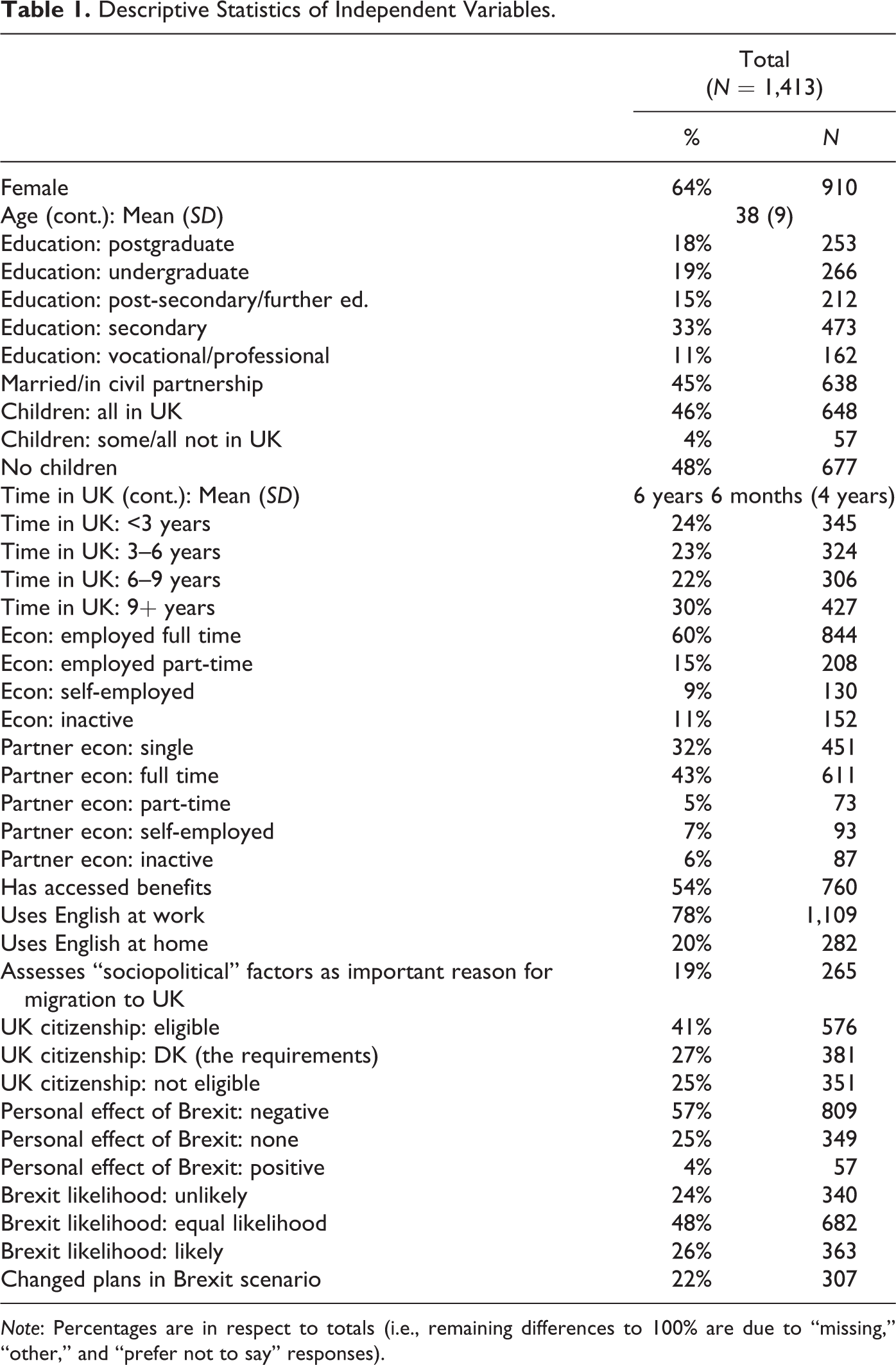
Note: Percentages are in respect to totals (i.e., remaining differences to 100% are due to “missing,” “other,” and “prefer not to say” responses).
The basic sociodemographic variables considered are sex, age (<40 versus 40+), educational qualification, marital/partnership status, parental status, years spent in the United Kingdom (<3, 3–6, 6–9, and 9+), the employment status of the “economic unit,” and nationality. With respect to parental status, although our data differentiate between having dependent children who live in the United Kingdom and who live in a different country (see Table 1), the low number of the latter does not allow its effective use in a regression analysis, so we treat parental status as a simple dichotomous category.
“Economic unit” is derived from two variables, one referring to the respondent’s employment status and another to the employment status of the respondent’s partner. Given the general overrepresentation of women in our sample among those “looking after family,” this derived variable provides a more nuanced understanding of employment conditions that may influence decision-making within partnership units rather than individually. We consider the “unit” to be in full-time employment if the respondent is either single and employed full-time or in a long-term partnership with both partners being employed full-time. We further differentiate if only one partner is in full-time employment, if at least one is self-employed, and if both partners are either inactive or working at most on a part-time basis.
Three further variables reflect more complex social and interpersonal characteristics: use of welfare benefits and exposure to English language at home and in the workplace. We measure whether a respondent had accessed any of the most common welfare benefits relating to employment, housing, disability, and family life during his or her residence in the United Kingdom through a dichotomous variable. We would expect that engagement with the British welfare state has an emplacing effect due to facilitating interaction with state institutions. Use of English at home and in a workplace environment (both coded as dichotomous) is the closest approximation of “sociocultural” integration we have available in our dataset, the expectation being that exposure to the English language would increase the likelihood of long-term settlement through legal integration.
A final set of variables represents further factors potentially affecting legal integration: original migration intentions, eligibility for naturalization in the short term, and anxiety about Brexit. To estimate the role of original migration intentions on future legal integration plans, we include a dichotomous variable denoting whether sociopolitical reasons played an important role in choosing the United Kingdom, rather than another EU country, as a destination. This variable was derived from a 10-item question block following a principal components analysis (PCA) that showed reasons such as “better medical care,” “more political/civic freedom,” “better schooling for children,” and “better social benefits” as reliable for our purposes (Cronbach’s α = .75) (Cortina 1993). Following the PCA, we constructed a scale measure based on these four sociopolitical reasons items, which we then dichotomized for our analysis (for a detailed description of the PCA procedure and results from preliminary tests of suitability, see PCA in the Supplemental Material, available in the online version of this article).
Self-declared civic status in respect to British citizenship estimates awareness of “eligibility” for naturalization within one year. While eligibility may limit one’s legal integration options in the short term, awareness of the legal requirements for naturalization hints at a more basic interest in acquiring British citizenship. The variable denoting “anxiety about Brexit” is derived from two items: perceived likelihood of a Brexit outcome in the EU Referendum and the expected personal effects of a Brexit vote. Brexit anxiety reflects the attitude of those who felt that there was at least “an equal probability” of a vote in support of leaving the European Union, while at the same time considering that a possible Brexit would have a “very negative” or “somewhat negative” effect on their lives and the lives of their family members.
To save space, we present full details of our survey questions, response categories, and derived variables in Supplemental Table S3 (available in the online version of this article). Supplemental Table S2 (available in the online version of this article) also provides a more detailed version of Table 1, with data broken down by nationality groups.
Analysis and Findings
Mere Eligibility? Legal Integration Trends between 2002 and 2017
As a first step in our analysis, we gauge the magnitude of migratory and legal integration practices of EU nationals in the United Kingdom. One available, although imperfect, 7 method of measuring migration inflows is NINo allocations. Figure 1 shows the evolution in the number of NINos allocated to EU27 nationals yearly between January 2002 and January 2018 and, within that, to nationals of the origin countries included in our survey.
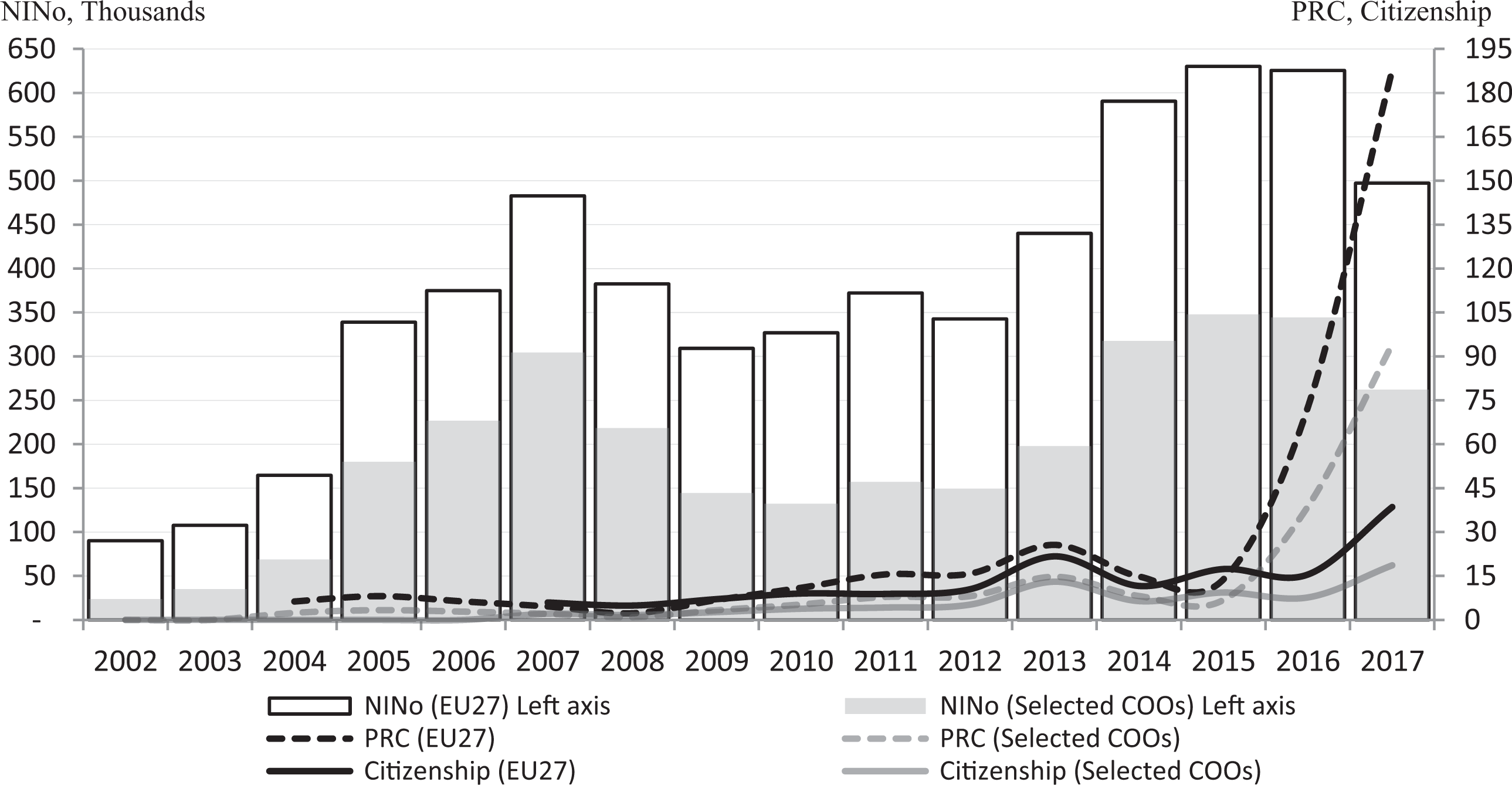
NINo allocations, permanent residence certificate applications, and British citizenship applications (2002–2017).
Figure 1 also presents the number of processed PRC applications (PRC) and applications for British citizenship (Citizenship) in each year for which data are available (right axis). We find that NINo numbers peaked in 2007 but have plateaued at record heights since 2014, following the lifting of transitional restrictions for EU2 nationals. 8 At the same time we see an increase in both PRCs and naturalization applications in 2013, followed by a sudden soar particularly in PRCs during 2016 and 2017. This 10-fold increase of PRCs to almost 190,000 (compared to the average of around 17,000 in any five-year period prior to 2016) is undoubtedly caused by the combined effect of the EU Referendum outcome and the previously mentioned November 2015 introduction of the requirement to obtain a PRC before making an application for British citizenship. However, the 2013 peak in PRCs and citizenship applications must be explained by other factors. Given that most EU nationals exercising Treaty Rights in the United Kingdom become eligible for naturalization as British citizens after six years, one obvious hypothesis is that the 2013 peak in citizenship applications correlates with the 2007 peak in NINo allocations, which would mean that an important driver of naturalization prior to Brexit was the mere eligibility to apply. 9
To test this hypothesis, we performed a correlation analysis between the number of allocated NINos in year t — as a proxy for arrival year — and the number of citizenship applications in year t+6, with data allowing the consideration of 10 such year-pairs (2002/2008 to 2011/2017) (Figure 2).
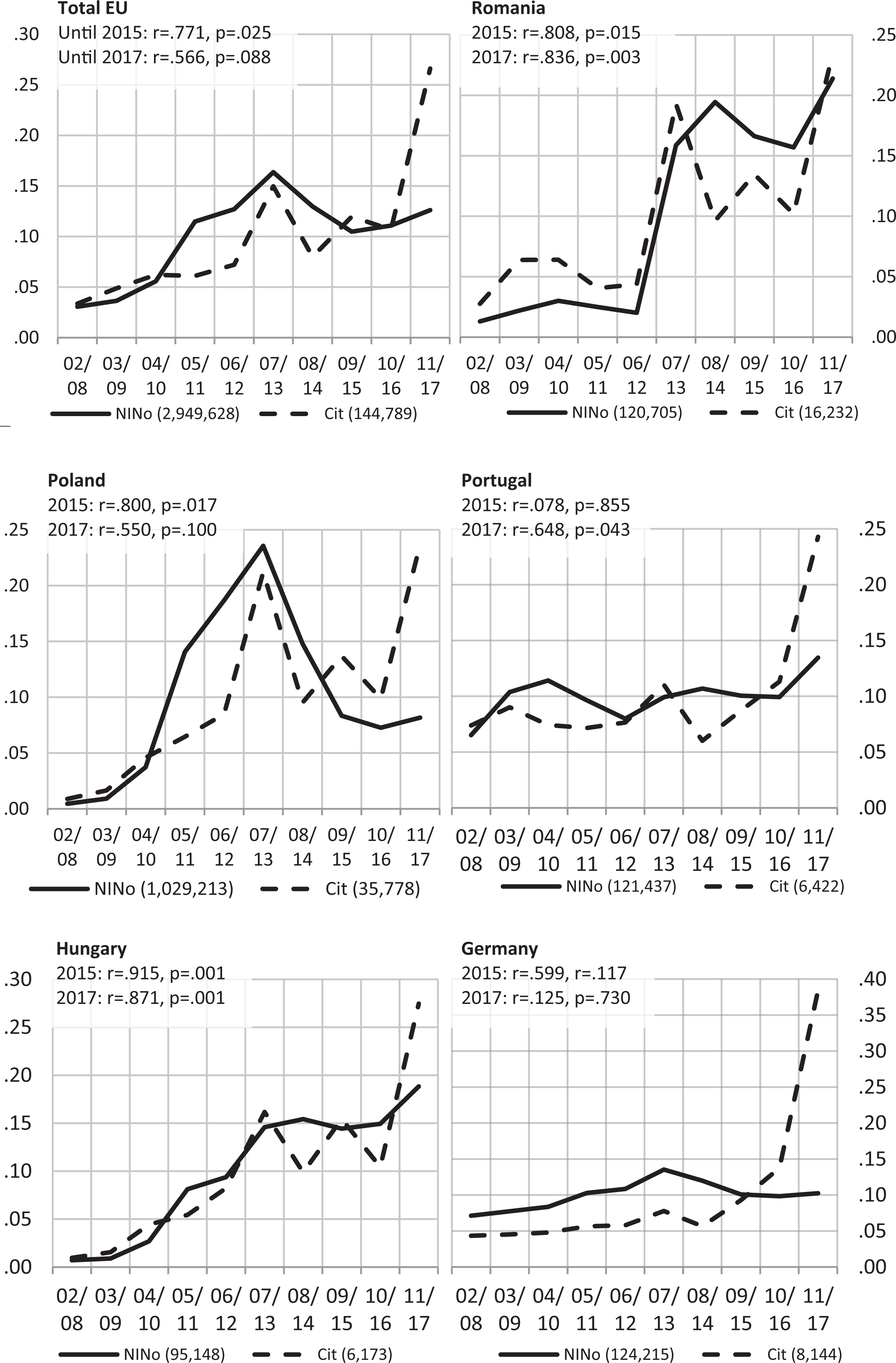
Correlation between NINo allocations (2002–2011) and citizenship applications (2008–2017) (year-paired by six-year lapses).
We are primarily interested in the period up to the 2009/2015 year-pair because it predates the start of the EU Referendum campaign and is, thus, telling of pre-Brexit processes. A statistically significant correlation would indicate that naturalization, despite its high associated costs, had carried incentives even before Brexit. For this period, we indeed find a strong and statistically significant correlation for the entire EU migrant population (r = 0.771, p = 0.025), as well as for nationals of the selected post-2004 Accession countries (Figure 2). The relationship is not statistically significant, however, in the case of Portuguese and German nationals. If we extend the analysis to the Brexit period and include the 2010/2016 and 2011/2017 year-pairs, the correlation breaks off in most cases, except for groups that have arrived more recently — like Romanians, Hungarians, and Portuguese — in whose case NINo allocations themselves peaked in 2011. These results provide some support for the “mere eligibility” hypothesis but at the same time highlight important differences based on nationality. Furthermore, the sudden rise in naturalization rates during 2016 and 2017 shows, as we would expect, that Brexit provides a much stronger motivation for legal integration than “mere eligibility” previously had.
Future Plans of Legal Integration: Descriptive Results
Data obtained from our survey allow a more detailed cross-sectional understanding of the plans of selected intra-EU migrants during the months before the EU Referendum. Based on the above findings, we expect a strong inclination toward naturalization and legal integration in general, since naturalization strategies based on “mere eligibility” might be enhanced by the possibility of a Brexit. It is important to reiterate at this point that even when our survey question inquired about plans under a no-Brexit scenario, these plans may still be influenced by the uncertainty and anxiety caused by the broader discursive moment of the EU referendum. We test this assumption later through a multivariate analysis.
The distribution of answers to our three central survey questions is presented in Figure 3, broken down by nationality groups. These results confirm our initial expectation for strong legal integration plans. We find that 35 percent of respondents were considering applying for PRC and 33 percent for British citizenship as a five-year plan “regardless of the EU referendum,” while 5 percent of respondents already held a PRC and were planning to remain in the United Kingdom without planning to naturalize (Figure 3A). Only 9 percent were planning to leave the United Kingdom within five years (6% to “return” to their origin countries and 3% to “re-migrate” to a third country), while 18 percent considered remaining in the United Kingdom relying on their DPR rights (i.e., without legal integration plans). In case of a Brexit vote (i.e., as a more short-term strategy), 48 percent would opt for PRC and only 21 percent for naturalization, while a slightly higher proportion than otherwise would re-migrate (6%) and only 14 percent would not take any proactive measure of legal integration (Figure 3B). Overall, under both scenarios posited in our survey, combined legal integration plans amount to 68 to 69 percent (Figures 3A and 3B), and general plans for naturalization “at any point in the future” show a comparable result of 65 percent (Figure 3C).
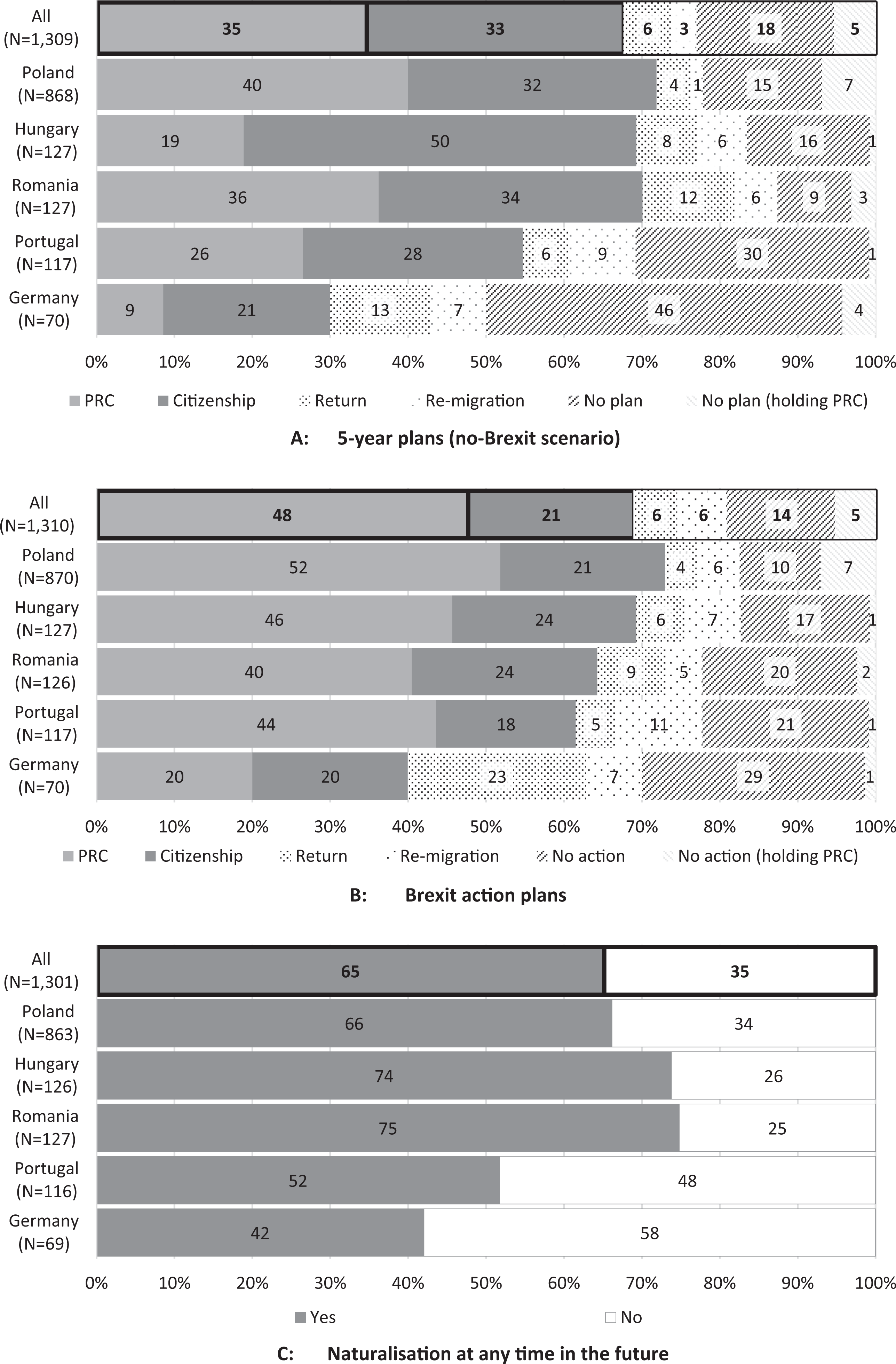
Legal integration plans — distribution of answers to three survey questions, by nationality group (percentages).
Shifts between the two legal integration action plans — PRC and naturalization — under the different scenarios can therefore be better explained through the “eligibility” hypothesis, assuming that fewer respondents would be eligible for naturalization as British citizens in the immediate aftermath of a Brexit vote (especially since PRC is now a prerequisite for a citizenship application). If we examine the direction of individual changes, rather than the aggregate statistics presented in Figures 3A and 3B, we find that 75 percent of those who would change their stated five-year plans away from naturalization in the more immediate event of a Brexit vote would change to PRC; conversely, of those who said they would change their five-year plans away from PRC, 57 percent would change to naturalization and 36 percent would, or rather could, take “no action.” Arguably, this is also reflected in the much greater increase in actual PRC applications than in naturalizations over the past two years that we saw earlier in Figure 1.
Some of the differences between nationality groups can also be interpreted as supportive of the eligibility hypothesis. Hungarian and Romanian respondents in particular stand out in Figures 3A and 3B. Hungarians show the greatest overall shift from naturalization to PRC plans in case of Brexit, while Romanians are the only group to exhibit a significant shift toward “no action” under a Brexit scenario. Considering that Hungarians and Romanians in our sample have the lowest average lengths of residence in the United Kingdom (four years, three months; and three years, nine months, respectively — see Supplemental Table S2); and furthermore, that despite their time of arrival, many Romanian respondents may not have had access to NINo and formal employment until 2014 (and therefore are not eligible for a PRC), their patterns of likely change between the available strategies under the two scenarios become easier to interpret in line with the eligibility hypothesis.
At the same time, the general differences in attitudes toward legal integration between the various nationality groups also reinforce the findings highlighted in the previous section: German and Portuguese nationals show the least interest in legal integration across all scenarios. Conversely, not only do Hungarians and Romanians declare the most interest in naturalization (74% and 75%, respectively; Figure 3C), but their actual naturalization patterns even before the EU Referendum showed the strongest and most stable alignment with the “mere eligibility” hypothesis, as can be inferred from the correlation coefficients shown in Figure 2.
Sociodemographic and Interpersonal Determinants of Legal Integration Preferences
Having established the strong overall preference for legal integration strategies in descriptive terms, the next step is to examine what factors may influence these preferences. To do so, we first performed a multinomial logistic regression on a dependent variable grouping five-year plans in the three broader action-categories of “exit,” DPR, and legal integration, with the latter being the reference category (Model 1, Table 2). Those who already held a PRC and were not planning either “exit” or naturalization were excluded from this part of the analysis, due to their different legal status. Second, we ran a binomial logistic regression on the variable assessing whether the respondent is planning to naturalize “at any point in the future” (Model 2, Table 2). We discuss relevant results from these regression models in parallel.
Sociodemographic and Interpersonal Determinants of Legal Integration (Multinomial and Logistic Regression Models, Odds Ratios).
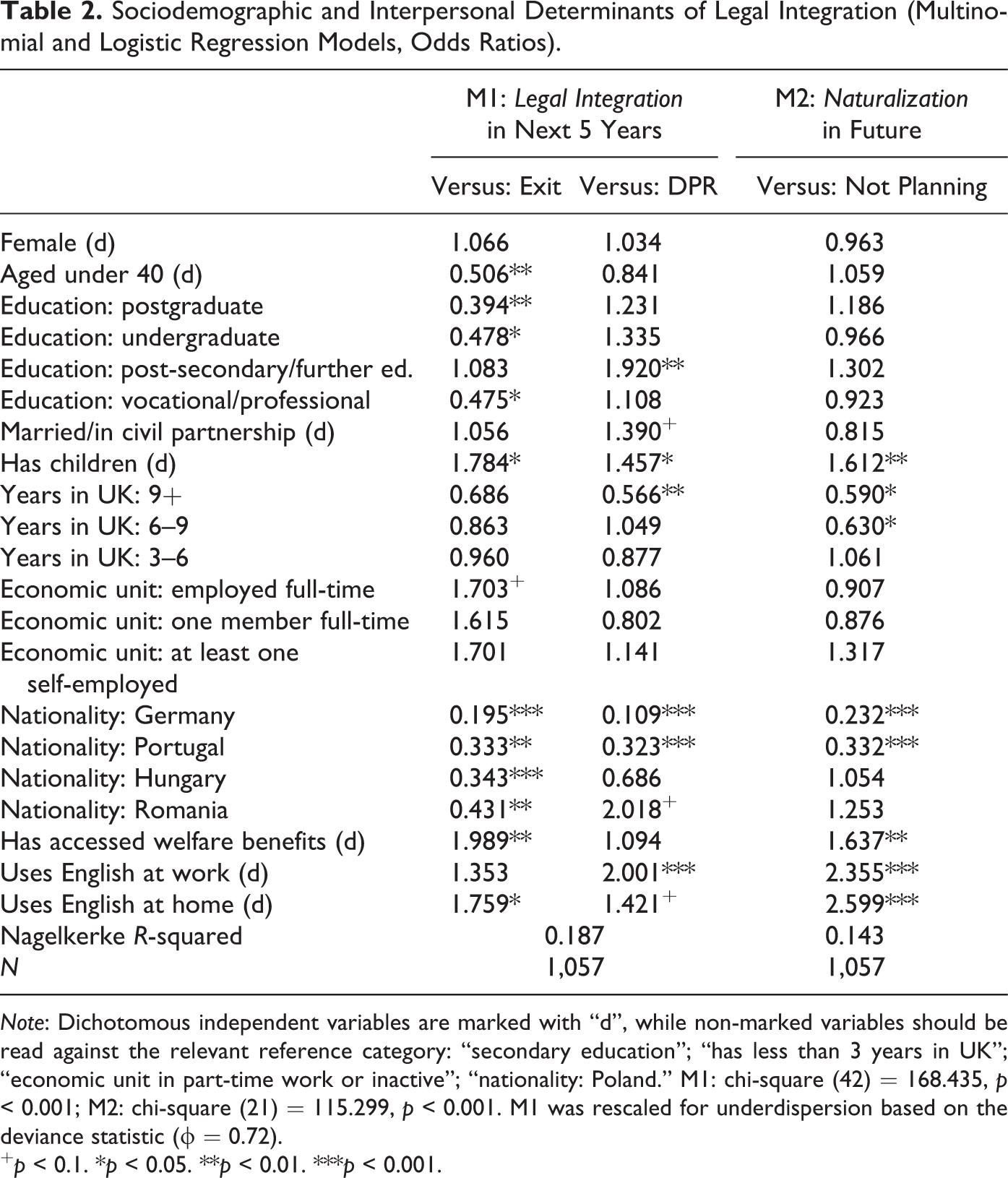
Note: Dichotomous independent variables are marked with “d”, while non-marked variables should be read against the relevant reference category: “secondary education”; “has less than 3 years in UK”; “economic unit in part-time work or inactive”; “nationality: Poland.” M1: chi-square (42) = 168.435, p < 0.001; M2: chi-square (21) = 115.299, p < 0.001. M1 was rescaled for underdispersion based on the deviance statistic (ϕ = 0.72).
+ p < 0.1. *p < 0.05. **p < 0.01. ***p < 0.001.
The used measure of age proved significant in respect to mobility, with those under 40 being around twice as likely to prefer “exit” than legal integration in the medium term, even when all other variables were held constant (M1; odds ratio [OR] = 1/0.51). Young adults, we could conclude, are more likely to be mobile than are the middle aged, as would be expected based on our knowledge of the life cycle of social ties in migratory settings (Ryan 2016) and psychosocial development in general (Erikson and Erikson 1997). Age, however, does not seem to have an influence on the legal aspects of integration.
Education level has a more ambiguous effect. Those educated to university or post-graduate level are more than twice less likely to say that they are planning to undergo legal integration than to leave the country, compared to those educated to secondary school level. This finding gives partial support to observations that highly skilled individuals tend to take “fuller advantage of free mobility within the EU” and show “less attachment to a particular country” (Landesmann, Leitner, and Mara 2015, 23; see also Dustmann and Weiss 2007; Drinkwater and Garapich 2015). However, the same effect stands for those with vocational/professional qualifications below secondary level, which probably signals that those in more elementary trade occupations see their migratory careers as similarly transitory. Those with post-secondary/further education degrees, on the other hand, are the only ones to be significantly more inclined to legal integration than to rely on DPR rights, compared to those educated at secondary level (M1; OR = 1.92).
Having children favors legal integration by contrast to both “exit” and DPR options, as well as with respect to general naturalization plans. Those with children are 61 percent more likely to plan naturalization at one point in the future (M2; OR = 1.61), 46 percent more likely to undergo some form of legal integration within five years than rely on DPR (M1; OR = 1.46), and 78 percent more likely to legally integrate than to leave the United Kingdom within five years (M1; OR = 1.78). However, parental status is also highly correlated with having “accessed welfare benefits,” which in the majority of cases represents childcare-related benefits (see Supplemental Table S3); and the latter variable has an even stronger legally integrative effect with respect to medium-term mobility plans (M1; OR = 1.99) and indefinite naturalization intentions (M2; OR = 1.64). Thus, those with children are more likely to plan to stay in the United Kingdom and eventually apply for citizenship but are even more likely to do so if they have engaged with the British welfare state.
With respect to the length of residence, we generally find that those who have lived in the United Kingdom for over nine years are less likely to opt for legal integration than those with less than three years in the country. Although this observation does not lend itself to a straightforward explanation, it may highlight that those who have arrived most recently are more skeptical about the ability of EU-derived rights to safeguard their access to long-term residence, a possible effect of the political climate (Favell 2013; Bolognani and Erdal 2017).
The employment status of the “economic unit” did not prove significant; however, speaking English in a workplace environment has a strong legally integrative effect both in contrast to DPR in the medium term (M1; OR = 2.00) and with respect to indefinite naturalization intentions (M2; OR = 2.36). A similar analysis (not reported here) on respondents’ individual employment status, as opposed to that of the “economic unit,” highlights that employment only gains significance if it takes place in an environment where English is spoken and is thus conducive to the enhancement of bridging social capital (see also our related analysis on the Polish sample in McGhee, Moreh, and Vlachantoni 2017). This finding adds further nuance to the straightforward assumption that “migrants with full-time jobs or self-employed migrants tend to favour permanent settlement” (Landesmann, Leitner, and Mara 2015, 22). Using English at home similarly makes one 2.6 times more likely to declare naturalization plans at one point in the future (M2; OR = 2.60) and 76 percent more likely to be planning legal integration in the medium term as opposed to leaving the United Kingdom (M1; OR = 1.76). It is also less likely that those using English at home rely on DPR; however, the statistical effect in this case is not significant at the 0.05 level.
Finally, the effect of nationality shows a somewhat complex picture when accounting for other variables but essentially confirms what emerged from the descriptive analysis (Figure 3). As the largest group of intra-EU migrants in the United Kingdom (and in our sample), Polish nationals were designated as the reference category, and, compared to them, all other nationality groups proved significantly more likely to be planning to leave the United Kingdom than to legally integrate (M1). At the same time, German and Portuguese nationals are nine and three times less inclined, respectively, to say that they would undergo legal integration within five years than to rely on DPR (M1) and less likely to plan naturalization at any time in the future (M2). Romanians are an interesting case. Although, compared to Poles, their likelihood to prefer legal integration over DPR in the medium term is not statistically significant at the p < 0.05 level in Model 1, if we do not control for the two “use of English” variables, the effect is significant (p = 0.024) and shows Romanians as over twice as likely to plan legal integration. Overall, these effects support the hypothesis that those from the pre-2004 Member States are less attracted by integration within the United Kingdom’s legal structures, while Romanian migrants, under certain circumstances, are particularly open to legal integration, perhaps motivated by a desire to enhance their civic status in the face of perceived discrimination (Paraschivescu 2016).
To conclude, several sociodemographic factors identified in the broader literature as conducive to socially emplacing migrants — such as parental ties, linguistic exposure, time spent in the United Kingdom (albeit counterintuitively), or education level (Dustmann and Weiss 2007; Ryan et al. 2009; White 2011; Landesmann, Leitner, and Mara 2015, McGhee, Trevena, and Heath 2015) — have proved significant in determining stated plans of legal integration in the medium term and naturalization in the more distant future. This finding is important, since these factors would not necessarily play an important role in the mobile lives of EU movers, were it not for pre-Brexit practical failings in the lived experience of EU citizenship (Favell 2013; Graeber 2016). As such, they intimate that legal integration preferences may be rooted in broader relational and motivational structures than in the United Kingdom’s potential departure from the European Union.
The Brexit Effect on Legal Integration
Having established the relevance of certain sociodemographic factors in shaping legal integration preferences, this section aims to assess more directly the degree to which Brexit affects practices and aspirations of legal integration. For this purpose, we expand the regression models discussed above with four variables of interest. Table 3 presents regression coefficients for these additional variables, while also controlling for the sociodemographic and interpersonal variables included in Table 2.
Further Factors Affecting Legal Integration (Multinomial and Logistic Regression Models, Odds Ratios).
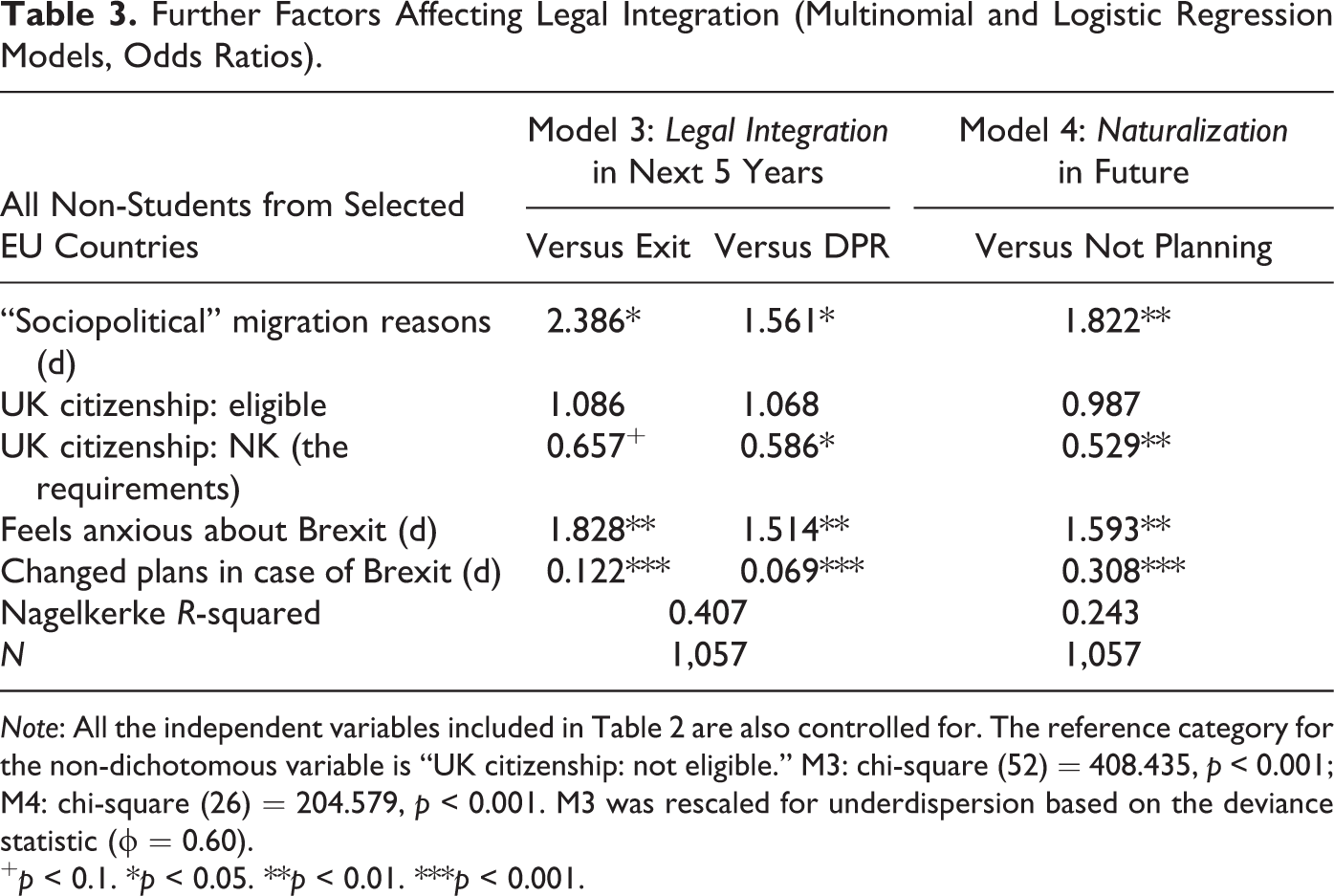
Note: All the independent variables included in Table 2 are also controlled for. The reference category for the non-dichotomous variable is “UK citizenship: not eligible.” M3: chi-square (52) = 408.435, p < 0.001; M4: chi-square (26) = 204.579, p < 0.001. M3 was rescaled for underdispersion based on the deviance statistic (ϕ = 0.60).
+ p < 0.1. *p < 0.05. **p < 0.01. ***p < 0.001.
As the literature review established, original intentions behind migration can affect return and settlement practices (Mara and Landesmann 2013; Luthra, Platt, and Salamońska 2016). Although capturing the complexity of original intentions is never straightforward and always difficult to operationalize, any particular measure of intentionality is expected to highlight that long-term settlement is at least partly driven by long-term settlement plans at the time of initial migration. In our model, we expect that those who had migrated for sociopolitical reasons, rather than merely to achieve an economic aim, had already been determined to settle in the United Kingdom and undergo legal integration (see Supplemental Table S3 for a derivation of the variable). One-fifth of our sample had assessed “sociopolitical” factors as relevant to their decision to migrate to the United Kingdom instead of another EU country (19%; see Table 1). We find that having had sociopolitical migration reasons significantly increases the likelihood of legal integration plans: those with sociopolitical migration reasons are 82 percent more likely to be planning naturalization in the future (M4; OR = 1.82), 56 percent more likely to take measures of legal integration in the next five years instead of relying on DPR (M3; OR = 1.56), and 2.4 times more likely to legally integrate than to be planning to leave the United Kingdom in the medium term (M3; OR = 2.39).
Another variable measured the effect of self-declared civic status with respect to British citizenship. Rather than a reliable measure of eligibility for naturalization, this variable denotes awareness of, and consequently interest in, eligibility requirements. We indeed find that self-declared eligibility does not significantly determine one’s plans but that awareness of the requirements significantly increases the likelihood of individual preferences for legal integration: those avowedly unaware of the requirements are almost twice less likely to hold future naturalization plans (M4; OR = 0.53), and over 70 percent less likely to plan legal integration than DPR in the medium term (M3; OR = 0.59), than those aware of their ineligibility for naturalization within one year.
This finding could mean that an initial interest in one’s legal options is conducive to legal integration plans, although we cannot unambiguously resolve the question of causation between the two: we have no way of checking whether the political climate of EU Referendum debates actually stirred that interest or whether it truly preceded the anxieties caused by the possibility of the United Kingdom leaving the European Union. However, it is informative to note that when running the same regression model on the Brexit scenario as the outcome variable (not shown here), unawareness of eligibility criteria loses its statistical significance, while actual self-declared eligibility significantly increases, by a measure of two, the likelihood of legal integration over “no action” (OR = 1.96, p = 0.007). In other words, in case of Brexit, those who are unaware of the criteria for naturalization are no longer less likely to opt for legal integration than those who are aware of the criteria and know that are ineligible for naturalization. We can interpret this finding in line with our earlier conclusions that Brexit seems to have had a strong legally integrative effect on those who had previously not planned legal integration measures but not necessarily on those whose plans had already been shaped.
As a dispositional measure of the EU Referendum’s psychological impact, we included a variable testing the effect of Brexit anxiety on reported legal integration plans (see Supplemental Table S3). Overall, 43 percent of respondents were feeling anxious about Brexit, and this anxiety significantly increases both medium-term legal integration plans regardless of the EU Referendum (M3) and indefinite future naturalization intentions (M4), even when all other variables are accounted for. We could interpret this situation as signaling that Brexit’s discursive context may have also left its imprint on planning for a future in a no-Brexit scenario. However, the direction of causality remains a black box in this case too, and it may be that those who already hold legal integration plans are more likely to be concerned about Brexit, rather than the other way around.
A more direct measure of Brexit’s potential effect on professed future plans is to assess whether planned actions under the Brexit scenario differ from planned actions in a medium-term no-Brexit scenario. As shown in Table 3, those who change their plans in case of Brexit are 3 times less likely to have planned to naturalize at one point in the future and in the medium term 8 times more likely to have planned “exit” (OR = 1/0.12) and 15 times more likely to have been planning DPR as opposed to legal integration (OR = 1/0.07). In other words, those entertaining legal integration plans (i.e., over two-thirds of our sample) are less likely to have their plans changed because of Brexit. Their motivations must have at least in part been motivated by factors other than the EU Referendum, and Brexit may primarily accelerate their legal integration apace with increased anxiety about the negative effects of a foreseeable Brexit vote.
Finally, it is important to consider whether those who are planning to apply for a PRC do so with the aim of naturalizing as British citizens in the future. We could hardly talk of a “return of citizenship” otherwise. We have seen from the administrative data that the EU Referendum’s actual outcome has had a very noticeable influence on legal integration practices — primarily on PRC applications, but PRC is now a requirement for naturalization, and citizenship applications themselves reached their highest levels during 2017 (Figure 1). We have also seen from the descriptive statistics of our survey data that the relative majority (35%) of respondents were planning PRC in the next five years regardless of the EU Referendum, and almost half (48%) would apply for a PRC in case of a Brexit vote (Figure 3). The difference between the two scenarios, as we have noted, is due partly to the fact that 75 percent of those planning naturalization in the next five years would, in case of Brexit, first apply for a PRC. Apart from this latter group, however, the question remains whether the PRC — a legal tool still regulated by EU law — is an end in itself or merely a transition to full citizenship. We attempt to elucidate this through Models 5 and 6 (Table 4) on a subset of our sample, including only those planning either PRC or DPR in the next five years (N = 656) and in case of a Brexit vote (N = 763), respectively.
The Relationship between Permanent Residence and Citizenship (Logistic Regression Models, Odds Ratios).
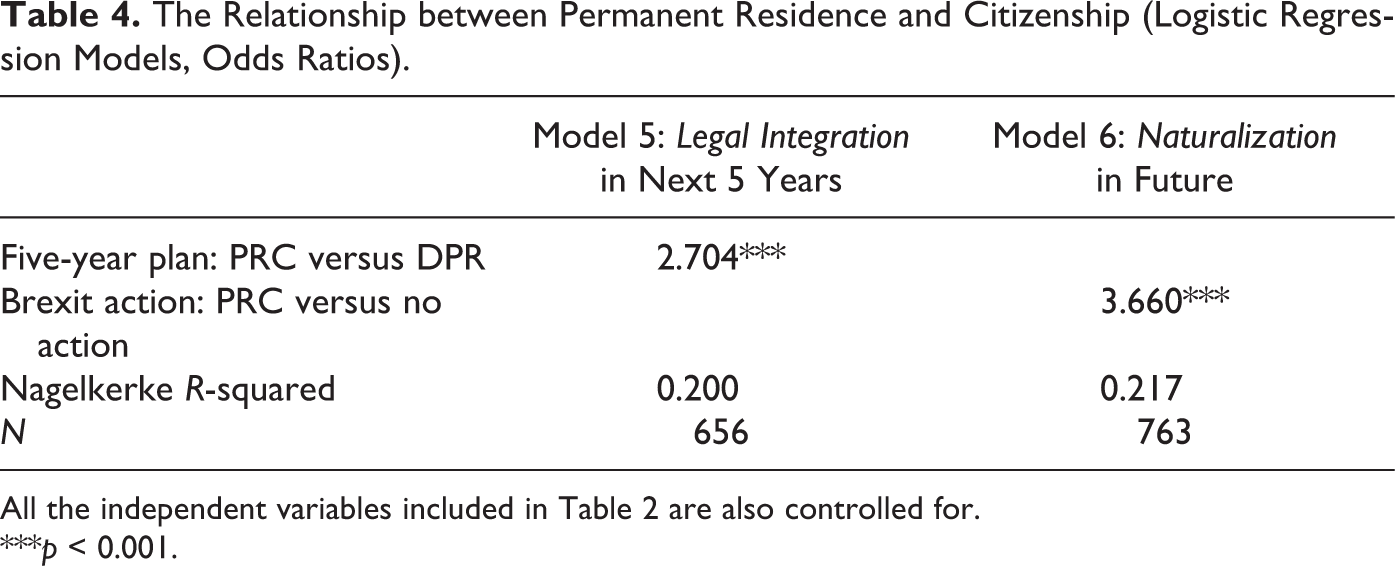
All the independent variables included in Table 2 are also controlled for.
***p < 0.001.
We find that those planning for PRC, as opposed to DPR, in the next five years are 2.7 times more inclined to be planning naturalization at some point in the future (M5) and that those with similar plans in case of Brexit are 3.7 time more likely to plan naturalization in the future. When speaking of legal integration, we could therefore conclude that we see the return of citizenship as a legal status to be aimed at through formalizing one’s permanent residence rights. As noted earlier, while the latter is still a process derived from EU legal norms meant to reduce any assimilatory expectations raised by Member States, naturalization imposes the full set of civic integration requirements (Goodman 2012; Joppke 2017) through which EU “movers” are indeed “turning into immigrants” (Favell 2013, 57).
Conclusions
Combining a statistical analysis of data from secondary administrative sources and an online survey, this article examined patterns of legal integration among intra-EU migrants in the United Kingdom as a broader process predating the EU Referendum and assessed Brexit’s effect on attitudes to legal integration. It has four main findings. First, we argue that national citizenship is the main legal mechanism by which intra-EU migrants seek to integrate within the United Kingdom’s legal framework and that this was the case even before the EU Referendum. We show that naturalization intentions are often shaped by the mere entitlement to apply for citizenship and that initial reasons for migration and interest in legal integration options, leading to a higher awareness of such options, are also factors driving a preference for legal integration. This finding substantiates Graeber’s (2016) observations concerning the “re-incentivizing of citizenship” in intra-EU migration.
Second, the article highlights Brexit’s strong but differential effect on legal integration plans. Anxiety about Brexit is strongly associated with plans for legal integration, even in a scenario in which the United Kingdom remains in the European Union and when other sociodemographic and attitudinal variables are held constant. Yet as discussed, the causality in the relationship is hard to determine. Overall, Brexit affects disproportionately those who had previously planned to rely on EU citizenship as the main guarantor of their long-term residence and settlement rights.
Third, our analysis highlights significant differences between the selected nationality groups in respect to both practices and attitudes toward legal integration and, consequently, in Brexit’s effect on their plans and actions. Those from pre-2004 EU Member States are much less likely to have planned to legally integrate before the EU Referendum and, thus, see their plans as affected by Brexit to a greater degree. Findings concerning differences between nationality groups, however, must be considered in the context of our limited and unbalanced nationality sample. Nevertheless, they are useful for helping formulate new hypotheses for a more structured comparative analysis.
Fourth, several sociodemographic variables described in the broader migration literature as shaping migrants’ social “embedding” (Ryan 2018), “emplacement” (Glick Schiller and Çağlar 2013), or “anchoring” (Grzymala-Kazlowska 2016) in countries of residence have proved significant in shaping attitudes toward legal integration. On the one hand, this finding, again, signals that preferences for legal integration are partly rooted in broader social and interpersonal processes beyond the Brexit factor. On the other hand, it highlights an intersection between legal and social forms of integration that needs further elaboration and disambiguation.
These findings make a significant contribution to beginning to grasp the complexity of integrative processes in times of radical sociolegal transformation. They place Brexit within a broader set of phenomena that could be summed up as sociolegal de-Europeanization: a loss of faith in the strength of supranational rights, materialized in both bottom-up and top-down attitudes and behaviors. Thus, this article makes a significant early contribution to the understandings of these phenomena.
The sociolegal aspects of integration are becoming ever more important following the Brexit vote, and there are several dimensions in this respect that our research was not equipped to address. We highlight but two. To start, future research must examine further the qualitative lived experience of naturalization and national citizenship as balances between providing a legal “anchor” to achieving “sociopsychological stability” while leaving open “various possibilities” (Grzymala-Kazlowska 2018, 255) and serving the more assimilatory purposes of “integration through citizenship” (Hansen 2003, 89). From a legal perspective, we also need a better understanding of how the citizenship laws of origin countries — particularly with respect to holding dual nationality in a non-EU country, which the United Kingdom becomes following Brexit — may affect migrants’ attitudes and practices. In effect, these two research directions will involve developing a more unified focus on the stratification of legal transnationalism within the web of transnational social and interpersonal relationships.
Supplemental Material
Supplemental Material, MRX809924_Supplemental_Material - The Return of Citizenship? An Empirical Assessment of Legal Integration in Times of Radical Sociolegal Transformation
Supplemental Material, MRX809924_Supplemental_Material for The Return of Citizenship? An Empirical Assessment of Legal Integration in Times of Radical Sociolegal Transformation by Chris Moreh, Derek McGhee and Athina Vlachantoni in International Migration Review
Footnotes
Authors’ Note
Chris Moreh is now at York St John University. Derek McGhee is now at Keele University.
Declaration of Conflicting Interests
The author(s) declared no potential conflicts of interest with respect to the research, authorship, and/or publication of this article.
Funding
The author(s) disclosed receipt of the following financial support for the research, authorship, and/or publication of this article: This research was supported by Economic and Social Research Council, United Kingdom. Grant number: ES/K007394/1.
Supplemental Material

Notes
References
Supplementary Material
Please find the following supplemental material available below.
For Open Access articles published under a Creative Commons License, all supplemental material carries the same license as the article it is associated with.
For non-Open Access articles published, all supplemental material carries a non-exclusive license, and permission requests for re-use of supplemental material or any part of supplemental material shall be sent directly to the copyright owner as specified in the copyright notice associated with the article.
