




Abstract
This article argues that an “invisibility bargain” constrains migrants’ identities and political participation, demanding their economic contributions plus political and social invisibility in exchange for tolerance of their presence in the host country. In response, migrants negotiate their visible identity differences, minimize social distance from the host population, and build informal coalitions with non-state brokers to avoid citizen backlash against overt political activism. Examining Colombian forced migrants in Ecuador, the article challenges state-centric governance approaches, underscoring migrant agency in negotiating identity to influence social hierarchies, coexistence, and human security. Its findings advance the broader understanding of migration in the Global South.
For many international migrants, ascriptive differences from their host society shape not only negotiation of their identity but also the degree to which they are able to integrate successfully into the host society and the social and cultural capital they can mobilize in it (Van Meeteren, Engbersen, and van San 2009; Landau and Duponchel 2011). Integration, in turn, affects their resilience or vulnerability to discrimination and violence (Maisonneuve and Testé 2007; Korovkin 2008). This article examines how discernible markers of difference that distinguish out-group individuals from the in-group affect the host population’s perceptions of migrants as participants in a shared political and social space. It also seeks to untangle the intersections of race, class, gender, and nationality (marked by accent or language) that influence migrants’ coping strategies and complicate their ability to participate in the decisions affecting their own lives. As it argues, these negotiations of identity and political participation are shaped by the host society’s expectations of migrants’ economic contribution and political and social invisibility, a combination which I refer to as the “invisibility bargain.”
This argument builds on existing work on identity and political bargaining related to migration (Coutin 2003; Bail 2008; Engbersen and Broeders 2009; Polzer 2009) to develop a more nuanced explanation of migrant integration through the case of Colombians in Ecuador, a major receiving country of South–South forced migration that is also a migrant-sending country (Korovkin 2008). In doing so, the article offers a new framework for understanding the connections between identity negotiation and integration in which the combination of weak state governance and racialized social hierarchies often found in the Global South requires an analysis of expectations and practices more than of formal immigration laws.
Using evidence from interviews and survey data on mutual perceptions between Ecuadorians and Colombian forced migrants, I show how the invisibility bargain provides analytical leverage on the negotiated coexistence of the two groups. I find that Colombians’ markers of difference, especially accent and race, exacerbate the discrimination and xenophobia that they experience. Class and gender also channel how discrimination is experienced and to what types of vulnerabilities migrants are exposed. In response, Colombian migrants employ strategies to reduce social distance, minimize difference, and build relationships and coalitions that allow them to negotiate informally with non-state allies and intermediaries in the host society.
Migrants whose visible characteristics and practices violate norms that the host society deems to be acceptable or who engage in overt political claim-making on the state often risk sparking a nativist backlash (Thomsen, Green, and Sidanius 2008; Hopkins 2015). Many choose instead to change or minimize these identity differences or withdraw from public spaces altogether, seeking refuge in invisibility by reducing their interactions with others (Coutin 2003; Maisonneuve and Testé 2007; Engbersen and Broeders 2009; Bohman 2015). Given intersecting social hierarchies of race, gender, class, and nationality, these identity-shaping strategies have different stakes for migrants depending on the subgroups to which they belong. Migrants facing such social challenges have also pursued political strategies that rely on informal networks and negotiation with local non-state actors, rather than on overt public contestation and demands on the government (Polzer 2009). The examination of such informal strategies offered in this article 1 is critical to understanding how non-state actors help migrants access protection from discrimination, rights violations, and violence. In particular, in the Global South, personal relationships and social hierarchies may influence power and participation more than formal institutions and policies (Landau and Duponchel 2011), and the legal distinction between refugees and other migrants is often lost in practice. In these instances, the formal institutions of democratic states fail to provide security for everyone living in their territory in their responses to constituent pressure to scapegoat migrants. This dilemma underscores this article’s challenge to traditional assumptions about state-centric governance by illustrating the importance of social and institutional relationships among migrants and native citizens, informal networks that link state and society, and especially migrants’ own agency in negotiating protection and integration.
Theorizing Migrant Integration
Formal citizenship laws governing migrant rights are only part of the story explaining how migrants experience political inclusion, participation, and protection, or not. In the Global South, there is often a significant difference between the rights and protections guaranteed by law and their implementation in the everyday lives of migrants and other minority groups (Landau and Duponchel 2011). In many parts of Latin America, for example, a state project of mestizaje has projected a homogenizing national identity that denies the existence of domestic racial discrimination (Dulitzky 2005) and excludes indigenous and black minorities from decision-making spaces and full belonging in society. This pattern has been replicated in migrant-receiving communities across Latin America, as foreigners become the new “out-group,” confronting the same gap between formal rights and de facto exclusion (Kushner 2012). The unwritten set of expectations and racial hierarchies that accompanies the formal citizenship regime in such contexts shapes the opportunities and challenges for migrants attempting to gain access to rights and protections.
The existing migrant integration literature has offered two major clusters of explanations for how racial, national, and other forms of difference influence the negotiation over belonging between the host population and migrants and the likely outcomes for migrant political participation. These two schools of thought focus on the social construction of identity and the deployment of political bargaining strategies, respectively. A brief review of these works provides a helpful starting point for my argument, which seeks to better understand the integration and participation of forced migrants across multiple identity boundaries and through informal networks in the Global South.
The first cluster of scholarship, denoted here as the identity explanation, is organized around the ideas of belonging and intersectionality (Crenshaw 1991), which is “the relationship among multiple dimensions and modalities of social relations and subject formations” (McCall 2005, 1771). Intersectionality attempts to transcend separate analyses of race, nationality, gender, class, and other sources of identity to highlight the compounding and interlocking effects of multiple forms of difference on social and political marginalization and to better understand “the ways in which people become socially defined as ‘other’” (Berger 2006, 4). In the context of migration, intersectionality illuminates the complex reality of migrants seeking to control their identity and negotiate their relationship with dominant social and political groups (see, e.g., Herrera, Cristia, and Alicia 2005; Theiss-Morse 2009; Anderson 2013). Intersectionality as an analytical approach avoids essentializing differences and deepens analyses of the ways identities, social position, and political strategies are negotiated and mutually constituted, potentially liberating subaltern communities from rigid categorizations (Jordan-Zachery 2007). Citizenship, defined here as inclusion as full members of society, often requires that those who are marginalized claim, fight for, and perform citizenship through their everyday practices at home and work. They must negotiate with both the state and society how their own identities shape their access to rights and protections, rather than relying on formal legal equality (Caldwell et al. 2009).
Empirical studies on migration have often examined race, religious practices, and accent/language simultaneously to better understand the interactions of these markers of difference with host society acceptance or rejection of migrant populations (Zolberg and Long 1999; Hainmueller and Hopkins 2015). An experiment of citizen reactions to a migrant speaker where race and accent were varied, for example, suggested that antimigrant attitudes were not simply the result of discernible differences, such as foreign accents (Hopkins 2015). Rather, social sanctions are often triggered when the behaviors and values of migrants who are marked as different are perceived to contradict host society expectations (McLaren 2003). Different “symbolic boundaries,” in other words, take on more or less significance as divisions across which membership and belonging are negotiated (Bail 2008). This social process influences political participation, as the construction and legitimization of the nation state itself depend on defining what Bridget Anderson calls a “community of value” that is
composed of people who share common ideals and (exemplary) patterns of behavior expressed through ethnicity, religion, culture, or language… Part of being an outsider is not sharing the same values–which easily becomes not having the “right” values… Those who are not firmly established in the community of value, must endlessly prove themselves, marking the borders… The (racialized) foreign born are often only contingently accepted. (Anderson 2013, 2, 6–7)
In this negotiation of the community of value, nationality is not only a binary category of citizen and foreigner but also a hierarchy of sorts. Citizens of some nationalities are perceived as more “valuable” than others, and this differential value shapes the context within which specific migrant groups are accepted or excluded. The social construction of migrant identity and its relationship to the community of value are both negotiated through Zolberg and Long’s (1999) three processes: boundary crossing, boundary blurring, and boundary shifting between host and migrant groups. The meaning given to migrant markers of difference is a key factor in these boundary negotiation strategies and in migrants’ success or failure in accessing recognition and protection.
The second cluster of work on migrant integration and belonging, which I call the bargaining explanation, emphasizes the negotiation of institutions and formal policies by different groups within society (Engbersen and Broeders 2009; Van Meeteren, Engbersen, and van San 2009). Much of this literature argues that the availability of electoral power, political allies, and other formal institutional sources of political leverage are key determinants of migrant inclusion, participation, and security, as these resources delegitimize xenophobia and provide institutional paths for contestation (Dancygier 2010; Okamoto and Ebert 2016). My work departs from this focus on formal institutions and strategies for two reasons.
First, the nature and dynamics of migration within the Global South problematize a universal focus on formal institutions. South–South migration now accounts for a larger proportion of global migration than South–North flows, especially for refugees, 86 percent of whom are in the Global South (Rango and Laczko 2014). Equally important, governance in the Global South affects migrant behaviors differently than in the Global North. This is true in large part because informal strategies may influence human security in the Global South more than do formal legal protections that have little impact in the hands of a weakly institutionalized state (Polzer 2009).
Second, visible political participation strategies by migrants in a range of receiving contexts may spark a backlash that can escalate conflict, creating a dilemma for migrants and allies alike concerning which strategies to pursue. Allies among the host population and NGOs can act as brokers between migrants and the state, providing important resources while avoiding or diminishing the backlash that might accompany more overt direct migrant participation and contestation (De Graauw 2016). Competing pressures on democratic host states for nationalistic exclusion policies and for economic inclusion are frequently balanced through the acceptance of migrants’ informal status, tolerating their de facto presence while denying their formal entitlements to rights (Sassen 2000; Engbersen and Broeders 2009). Building on these two literatures, then, this article seeks to understand how migrants negotiate identity differences that set them apart from the dominant society and adapt informal modes of coexistence and participation through networks and non-state brokers.
Invisibility bargain
To reconcile competing host society desires for social exclusion and economic gain in relation to migration policy, I argue, migrants and citizens live with a de facto “invisibility bargain,” an unwritten set of expectations in which the host state and society implicitly accept the presence of foreign migrants, as long as these migrants are seen to bring economic benefits to the country and maintain political and social invisibility. By political invisibility, I mean that migrants are expected not to make claims or political demands on the government, especially using public, collective action to demand rights to which they claim to be entitled because of international treaties, domestic law, the constitution, moral claims, or other reasons. I propose the term social invisibility to refer to the expectation that migrants’ characteristics and practices that are distinct from the norms defined by the host society — including language, religion, customs, or even visible racial differences — should be minimized or hidden in public. A violation of these expectations is likely to result in greater hostility and sanctions from the host population toward migrants. The controversy over the public wearing of headscarves by Muslims in France is an obvious example of this phenomenon (Saas 2001). The more visible the markers of difference that set migrants apart from the host population and contradict acceptable norms of behavior (Hainmueller and Hopkins 2015), the more likely they will result in exclusion from the host society (Thomsen, Green, and Sidanius 2008).
Under this invisibility bargain, social judgments about migrants’ actions and identities determine their relationship with the state and their right to exist in peace. In place of the social contract of citizenship, the informal relationship of mutual dependence that connects migrants to the host state affects their safety, livelihood, and acceptance as members of the political community (Bosniak 2006). Susan Coutin observes,
According to this implicit contract, when migrants contribute to a society through their labor, the society incurs certain obligations to them, such as the obligation to recognize them as full social and legal persons. Through various forms of social participation (going to school, having a family, obtaining an address, working), migrants “imitate citizens” and thus act on the rights that this implied contract promises. (Coutin 2003, 189)
By performing the actions expected of valued members of the political community, migrants seek to gain full community membership, or at least an approximation of such membership, through de facto acceptance by the host population (Anderson 2013). These actions sometimes legitimate migrants’ presence (Coutin 2003) but may also precipitate a backlash from the host population and a hardening of the social boundaries between insiders and outsiders (Bosniak 2006; Adida 2014). In a country where hard work is considered essential to being a “good citizen,” for example, allies might emphasize migrants’ hardworking nature to justify why they deserve to be accepted, at the same time that the visible presence of migrant laborers awaiting day jobs in a hardware store parking lot might attract verbal criticism and attacks from some members of the host community who perceive a competitive threat.
In sum, migrants who are seen as distinct from the host population by differences of accent, language, race, or cultural practices often face a set of informal expectations in the host society that attempt to exploit their economic capacity while making other aspects of their identity invisible, especially social practices and political claims. Faced with this reality, migrants often minimize the markers of difference that set them apart from the host society to integrate more easily into the “community of value” (Anderson 2013), try to reduce social distance between themselves and the host population, or withdraw from social space altogether. The remainder of this article develops this argument through the empirical case of Colombian forced migrants in Ecuador, an important example of South–South migration.
Colombian Migrants in Ecuador
Ecuador is a small country of 16 million people in the Andes between Colombia and Peru and the largest recipient of refugees and asylum seekers in Latin America (UNHCR 2016). The vast majority of forced migrants in Ecuador (more than 95%) come from Colombia, having fled the violence there since 2000, when Plan Colombia, a US military assistance package, escalated the fighting in rural areas near Ecuador (Korovkin 2008). Given Venezuela’s and Panama’s restrictive migration policies and remote border crossings with Peru and Brazil, Ecuador was the most inviting destination for Colombians fleeing threats from the leftist guerrillas or remnants of paramilitary groups, especially as its border policies were relatively more progressive. 2 Because Colombian migrants are associated with the conflict in their home country, they commonly confront fear and assumptions of criminality in Ecuador, where people do not always distinguish between Colombian perpetrators and victims in their perceptions. 3 There are no refugee camps in Ecuador, so most forced migrants from Colombia settle either in cities in the Andes — Quito, Ibarra, and Tulcán — or in rural provinces near the Colombian border — Sucumbíos in the Amazon jungle and Esmeraldas on the coast (Ortega and Ospina 2012).
Economic migration between Colombia and Ecuador predates this refugee surge, as Ecuadorian cities like Santo Domingo and Quito have hosted Colombian merchants and entrepreneurs for many years. 4 Colombian businesses and microenterprises have proliferated, leading to a widespread perception among Ecuadorians of Colombians as savvy businesspeople (Zepeda and Carrión 2015). Ecuador’s dollarized economy also serves as an economic draw for Colombians seeking to capitalize on currency differences. The unprecedented escalation of Colombian human mobility over the past 15 years, however, is attributed mostly to the increase in forced migration resulting from the conflict (UNHCR 2016).
During the same period that it became a primary Latin American receiving country for forced migrants, Ecuador was also a major sending state of emigrants. A financial crisis in 1999 compelled over 10 percent of the Ecuadorian population to emigrate, mostly to Europe and the United States (Herrera, Cristia, and Alicia 2005). This complex migration experience and the political incentives that accompanied it have influenced Ecuador’s policy process and the politics of migration. Ecuador’s experience, thus, provides useful lessons for other countries in the Global South that are struggling to host large migrant and refugee groups while dealing with their own governance and economic challenges, as well as out-migration.
The Ecuadorian government under Rafael Correa (2007–2017) promoted a discourse of universal citizenship, under which migrants are provided a basis to claim protection and a say in the decisions that affect them by virtue of their humanity, rather than by virtue of their physical presence or legal status in their country of origin or destination (Moreno Defiende 2008). The 2008 Ecuadorian Constitution prohibited discrimination based on migration status and guaranteed refugees many of the same rights as Ecuadorians (Constitución del República de Ecuador 2008). This “open borders” rhetoric promised a commitment to human security above national security and promoted a reciprocal international norm of “universal citizenship” that would protect Ecuador’s large diaspora in Spain and the United States from discrimination (Moreno Defiende 2008; Pugh 2017).
Over the past decades, the Ecuadorian state has also employed a boundary-blurring strategy that extends autonomous group rights to indigenous and Afro-descendant populations and a boundary-shifting strategy to redefine individuals in these groups as rights-bearing members of the community of value. The Correa government extended these efforts to the new migrant population as well, although discrimination and exclusion for all three groups remain rampant (Martínez Novo 2014). In fact, underlying assumptions of whiteness and mestizaje seem to define Ecuador’s community of value, which lead to Ecuadorian populations of color being invisible and to Afro-descendent Colombian migrants in particular finding it difficult to integrate. Even with formal protections in the Constitution and in law, the practical implementation of migration policy and societal behavior both reflect a contingent acceptance of Colombians, especially those whose “otherness” is magnified by race or class differences, more than the formal promises of universal citizenship (Balyk and Pugh 2013).
Methods and data sources
This article draws on data from five surveys carried out in Ecuador and described in Table 1, in addition to extensive qualitative data. The combination of different data sources — multiple surveys of Colombians and Ecuadorians plus interview and focus group responses — provides empirical richness and depth complemented by more systematic evidence of how broadly various attitudes and experiences about migration apply within the two populations.
Survey data sources
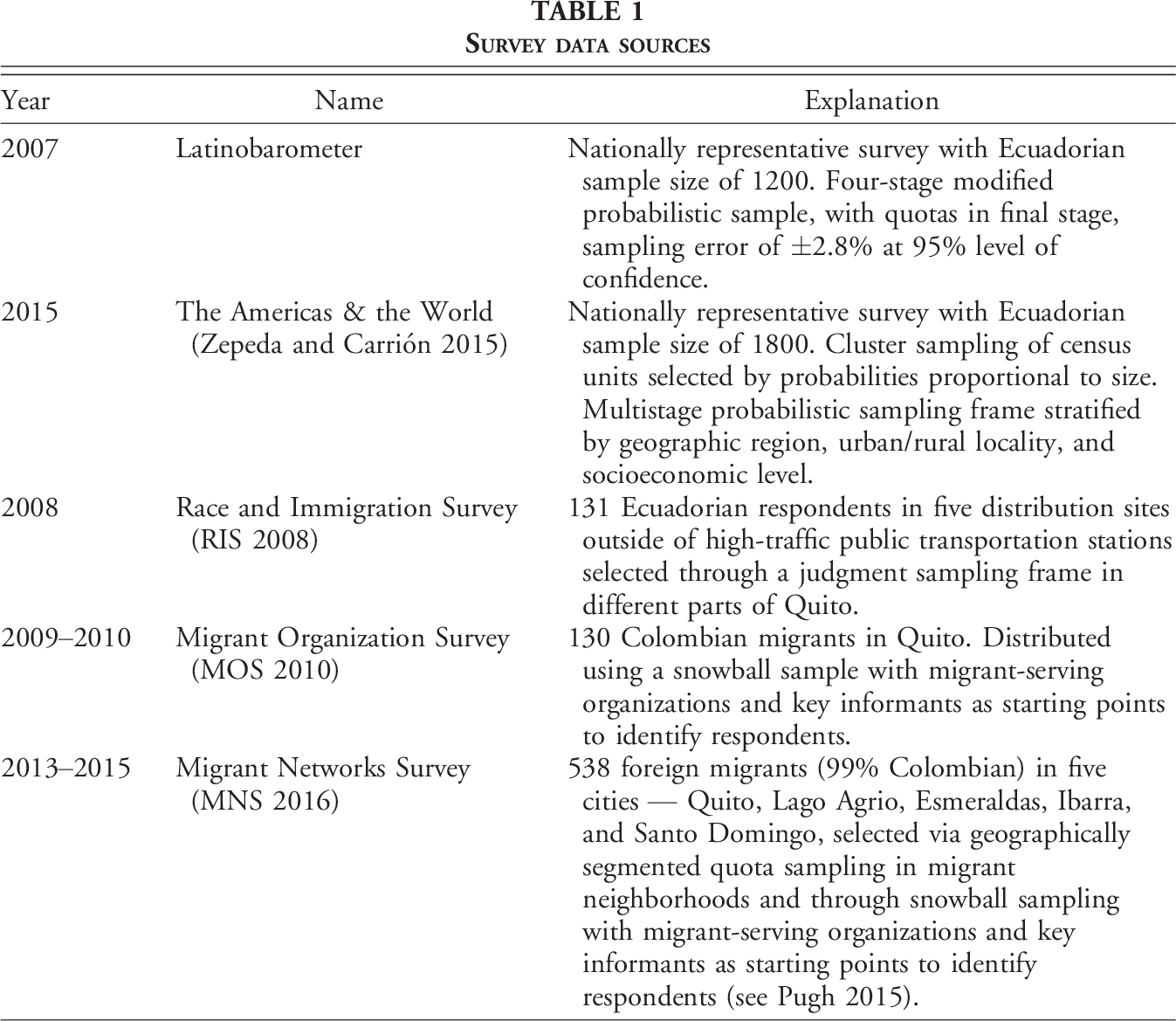
As part of a larger project, I conducted more than 130 interviews with migrant leaders and officials of NGOs, state agencies, and international organizations (plus two focus groups of forced migrants in Quito) during 14 months of fieldwork spanning 2007 to 2015. In addition to these qualitative data, I draw on data from the surveys summarized in Table 1, two of which were carried out by others and three of which were conducted by my research team. The large national surveys conducted by Latinobarometer (2007) and Zepeda and Carrión (2015) offer snapshots of Ecuadorian public opinion. Both surveys are conducted regularly, but these specific years were selected because of the number and relevance of immigration-related questions. My Race and Immigration Survey (RIS 2008) 5 of Ecuadorian respondents is limited by a small sample size and implementation only in Quito, but its questions allow for deeper engagement with race and identity vis-á-vis migrant experiences than either Latinobarometer (2007) or Zepeda and Carrión (2015). My original Migrant Networks Survey (MNS 2015) provides detailed evidence about the self-reported attitudes and experiences of a larger sample of migrants in Ecuador, at least 95 percent of whom were Colombian. The MNS 2015 survey was carried out in field visits of 1–2 weeks each in the capital cities of five provinces in Ecuador’s northern border region: Quito, Lago Agrio, and Esmeraldas in 2013, Ibarra in 2014, and Santo Domingo in 2015. The questions 6 used in this survey were developed and validated with feedback from refugees, NGO leaders, and other stakeholders. Migrant respondents were recruited in each town to complete the MNS survey, with the help of local organizations and by identifying neighborhoods with high concentrations of migrants.
Evidence from the MNS survey and from interviews in the provinces provides a more complete picture of migrant integration in both Quito and smaller border towns than do national aggregate data, as social and political expectations can differ across these localities. The data on Colombian migrant perceptions are much harder to collect than Ecuadorian attitudes, so drawing on multiple sources helps compensate for some of the limitations of any one survey, particularly small and non-random samples 7 resulting from the trade-offs involved in surveying difficult-to-reach populations under the constraints of limited resources (Bloch 1999).
The Invisibility Bargain in Ecuador
The data described above illustrate how Colombians are expected to contribute economically to Ecuadorian society, while remaining socially and politically invisible to avoid negative social sanctions and backlash. As the surveys in particular show, Ecuadorians’ perception of foreigners’ economic contribution is relatively positive, with 73 percent of respondents in a national survey carried out by the Latin American Social Science Faculty (FLACSO), a university in Quito, believing that immigrants contribute economically to Ecuadorian society (Zepeda and Carrión 2015). 8
Both Ecuadorians and Colombians face difficult economic conditions, with many working in the informal sector for low and unstable wages, but the scope of the problem is much worse for Colombians. Eighty percent of surveyed migrants who worked full time reported that they earned less than Ecuador’s legal minimum wage (MNS 2015). In comparison, 43 percent of full-time Ecuadorian workers earn less than minimum wage (Marinakis 2014). Partly because of the scarcity of formal employment, the violence that precludes the option of returning home, and the fact that Colombia’s minimum wage is much lower than Ecuador’s, many Colombian migrants work hard for lower wages, representing an attractive labor source for Ecuadorian employers. 9 Other Colombians are entrepreneurs who start their own small businesses, which may create additional jobs for Ecuadorians (Negocios 2005). 10 All of these factors contribute to the relatively positive perception of Colombians’ contribution to the Ecuadorian economy, fulfilling the “economic contribution” expectation of the invisibility bargain.
The expectation of political invisibility underlies the strategies that migrants choose in attempting to meet their collective needs. Advocacy by Colombian migrants during the constitutional assembly in 2007-2008 was important in achieving progressive policy gains and protections, but much of this negotiation involved migrants sharing testimonies or providing input at hearings with agendas set by the state, the United Nations, and Ecuadorian NGOs, according to a leader of the Association of Colombian Refugees in Ecuador (ARCOE). These political strategies did not violate the invisibility bargain because they took place behind closed doors and relied on host society NGO allies for political cover. In contrast, those migrants with more visible differences or whose political demands were more overt have had less success. Among Colombian migrants, organized self-advocacy seems to have declined since 2010, due to resource constraints, the transience of leaders, and the fear of engaging in visible collective action, as leaders of multiple refugee organizations noted. 11 Many Colombian migrants I interviewed, especially Afro-Colombians participating in a July 2013 focus group in Quito, said that they avoided involvement in politics because they did not want to be “mixed up in problems.”
The political invisibility expectation also influences the Ecuadorian host society reaction to these strategies. Some Ecuadorians, for example, frame any overt Colombian involvement in politics as inappropriate and as a presumptuous sign of ingratitude. A local official on the Parish Board of Mompiche, in Ecuador’s coastal region, explained to me in a 2012 interview,
Colombians have started getting involved in politics, because they are smart and well-prepared… I think they are ungrateful, coming to our country, being welcomed, and then taking over. We as Ecuadorians are the ones who have the right to decide how we will be governed.
Similar sentiments were articulated by Ecuadorians in 2007, when a large group of Colombian farmers crossed the Ecuador-Colombia border into the town of San Lorenzo to demand that the Ecuadorian government criticize Colombian glyphosate spraying in the region. In response, the director of the Ecuadorian Civil Defense, General Carlos Vasco, stated, “This has been a slap in the face… They took advantage of our generosity, but this display of political interests cannot continue affecting the Ecuadorian state” (Pactan 2007).
In Ecuador, the host population’s implicit tolerance sometimes turns toward a more active attempt to control or remove Colombian migrants when they are perceived to violate social invisibility. According to Michelle Arevalo-Carpenter, former director of Fundación Asylum Access in a 2007 interview, such violations might take the form of speaking loudly with foreign accents or, for women, dressing in “provocative” ways that some Ecuadorian women fear will lure away their men. In part because there is a higher percentage of Afro-Colombians than there is of Afro-Ecuadorians (21% versus 7%), race is a marker of difference which can identify Colombians and mark them for exclusion. By contrast, there is a larger proportion of indigenous Ecuadorians than indigenous Colombians, 12 which means that indigeneity has not been a major marker of difference influencing the host society’s reception of Colombian migrants. 13 Racialized and indigenous identities, of course, are already laden with meanings in Ecuador, including permissions or prohibitions to act in particular ways (Cervone 1999). The same behavior that would be ignored or excused for a mestizo Ecuadorian, for example, might result in social rejection or trigger persecution if done by a Colombian, even more if the person is Afro-Colombian. In communities in which racially distinct foreigners quickly diversify a previously homogenous society, migrants’ visibility is likely to be heightened and the pressure for them to assimilate intensified. 14
As suggested in subsequent sections of this article, Colombian migrants quickly learn the invisibility bargain’s spoken and unspoken rules, adapting their coping strategies and forms of political bargaining to this reality. The same coping strategy may take on different meanings, however, depending on the context, personal characteristics, and social capital of those carrying it out. The ways in which the social invisibility expectation is navigated across multiple forms of difference are discussed in the next section, which traces the connections among race, class, gender, and accent to analyze their role in shaping migrant acceptance and integration in the host society.
Constructing Markers of Difference in Ecuador
In Ecuador, social hierarchies are reproduced in everyday practices, and racial relations in particular are characterized by an internalized set of rules that privilege those in power by helping them find employment and housing, move freely, participate politically, and exist in public space without their visible differences inhibiting success (Cervone 1999). The recent phenomenon of large-scale immigration into Ecuador adds additional marginalized social categories to the existing categories of indigeneity and race and complicates the negotiation of ethnic identity and political agency by minority groups. Such negotiations, of course, have long and deep historical roots (De la Torre 2006). Ecuador’s colonial legacy and history of haciendas relegated indigenous and Afro-descendent populations to manual labor in rural areas. The large cities, in contrast, became spaces that concentrated political and economic elites who constructed an exclusive community of value that implicitly linked whiteness and mestizaje with political power and legitimacy. Combined with a state project of mestizaje and “whitening” of Afro populations to promote a homogenous and “civilizing” national imaginary, the state relied on labor segregation and the occlusion of subaltern bodies that did not conform to this dominant narrative (De la Torre 2002). This remains true today for Afro and indigenous Colombian migrants, who experience marginalization along and across lines of race, class, and nationality when they come to Ecuador.
Given these intersecting forms of difference and the stigmatization of Colombians in Ecuador, how does one tease out the relative importance of these factors in their experiences of belonging and exclusion? In other words, if the invisibility bargain demands “social invisibility,” which markers of difference provoke the strongest reaction by Ecuadorians against Colombians? Compared to other social categories, migrants are the target of particular distrust in Ecuador. Ecuadorian Latinobarometer respondents (2007), for example, reported lower levels of trust toward foreigners than toward indigenous people, Ecuadorian nationals, or poor people. When trying to tease out the weighting of different forms of difference within the migrant population, however, economic class takes on more importance. Latinobarometer respondents were asked how many foreign migrants of the same race as the country’s dominant group should be let into Ecuador, how many of a different race, and how many from a poorer country. Although most respondents believed that few or no migrants should be allowed to enter, these exclusionary attitudes were most acute toward migrants from poorer countries (Latinobarometer 2007), confirming the invisibility bargain’s expectation of economic contribution.
Ecuadorians surveyed by Zepeda and Carrión (2015) also distinguished among migrants of different nationalities, reporting more positive views of US, European, and Chinese migrants compared to Latin American migrants, and especially to Colombians, of whom Ecuadorians had the most negative perceptions. Colombians are often stigmatized as being associated with crime and conflict while US, European, and Chinese migrants are associated with investment or tourism. Although Colombians are more similar to Ecuadorians by phenotype, language, geographic proximity, and religion than these other groups, negative stereotypes associated with their nationality seem to be more salient in producing social exclusion. This variation in host society treatment of different groups reveals that the boundaries of the “community of value” are shaped by a range of intersecting factors, especially race, class, and nationality (marked by language or accent). The next two sections attempt to tease apart the ways in which accent and race interact with gender and class to shape the possibilities for social inclusion or marginalization of Colombian migrants in Ecuador.
Nationality Marked by Accent and Style of Speech
Language and accent are key markers of difference that set migrants apart in many countries, although there is a debate about whether the presence of a different accent or language, or the values and social meaning given to it, increases prejudice and discrimination (Munro 2003; Hopkins 2015). In my MNS 2015 survey, 73 percent of migrant respondents in Ecuador reported that they had felt discriminated against while living in Ecuador. When asked on what basis they had been discriminated against, accent was second only to “being Colombian” as the most often mentioned reason for discrimination. 15 Such experiences are also deeply gendered. Compared to Ecuadorian responses to migrants from other places such as the United States, Europe, or China (Zepeda and Carrión 2015), sexualized stereotypes of women and perceptions of threatening male criminality provide nationality-specific emotional baggage that becomes attached to Colombian accents. A Colombian woman in Esmeraldas, for example, reported in a 2013 interview that when she was out to dinner with friends and dressed in business attire, a man at the restaurant heard her accent and asked how much she charged per hour, implying that she was a prostitute. Notably, this woman was a college-educated consultant working for an international organization. As this example shows, negative nationality and sexualized stereotypes can be activated by accent markers that cut across class lines.
Although these stereotypes apply across classes, their consequences for migrants’ livelihoods are more severe for poorer migrants, who have access to fewer resources in the face of discrimination, or for women, who are more likely than men to face discrimination manifested through sexual assault or harassment (Santacruz and Vallejo 2012). These sorts of responses to different accents frequently lead Colombians to stay at home, to communicate mostly with other Colombians, or to remain silent in public, especially in close proximity to police and other state agents (Korovkin 2008). According to one female Colombian asylum seeker in a 2013 interview in Quito,
I stopped selling empanadas in the streets because I am afraid. The migration police would often come by, and if they hear a Colombian accent, they would ask to see our documents. The photocopy of my asylum seeker document that I carry serves very little use. They often claim that these documents are fake and detain Colombians anyway. When I go out, I try to keep my mouth shut.
Echoing Engbersen and Broeders’s (2009) discussion of the interactions between state attempts to identify and categorize migrants and migrant efforts to avoid identification, this social silence strategy results from fears of the state and of host society discrimination. These strategies, however, also further isolate migrants from potentially useful social networks and organizational allies, making it more difficult for Colombian migrants to access the rights, resources, and protection they need to live in dignity in Ecuador (Pugh 2016).
Disentangling Race, Class, and Gender
Race has always been a prominent marker of difference in Ecuador, as indicated by the historical experience of indigenous and Afro-descendent minority groups (De la Torre 2002, 2006). Both groups have been the target of economic and social exclusion, but indigenous groups have been more successful in organizing a viable political movement (Pugh 2008) by engaging in boundary-shifting work to redefine Ecuadorian national identity as “plurinational.” Whereas the indigenous origins of most Ecuadorians have been incorporated into the national ideology of mestizaje, Afro-descendants have not been what Jean Muteba Rahier calls an ingredient in “the ideological biologies of national identity” (2012, 1). Instead, they have been excluded from the national fold and are frequent targets of fear and negative stereotypes (Beck, Mijeski, and Stark 2011). At the same time that Afro-Ecuadorians have been hidden by and in national identity discourses, however, they have also organized around informal, non-state organizations and kinship networks to gain access to resources and local political spaces (Whitten 1965).
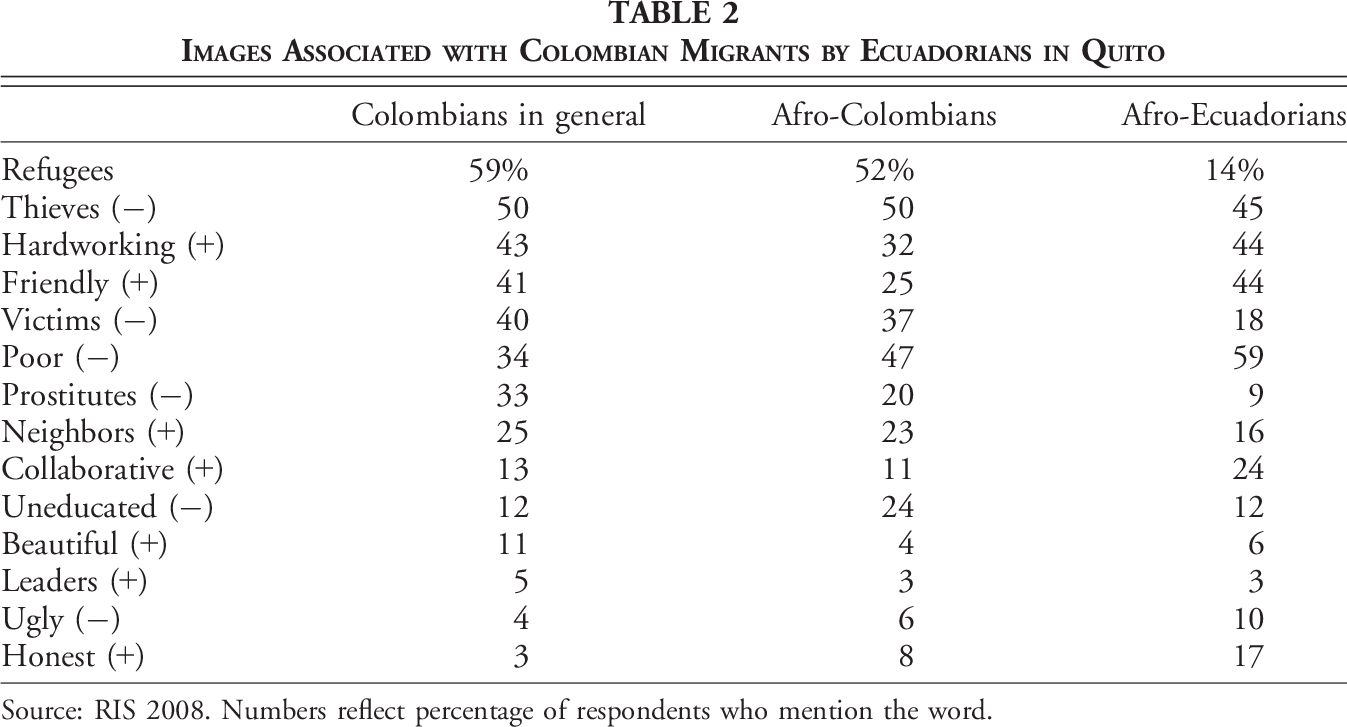
As there is a high level of baseline racism toward Afro-descendents in Ecuadorian society, it can be tricky to tease apart a generalized racial prejudice from that which is specific to Afro-Colombian migrants. To disaggregate Ecuadorians’ views of each group, the RIS 2008 survey asked respondents to select from a group of 14 words the images they most associated with Afro-Colombians, Colombians in general, and Afro-Ecuadorians. Table 2 summarizes the percentage of respondents selecting each word by identity group. These results provide evidence on how negative and positive images are applied to groups separated from the dominant Ecuadorian mestizo population by differences in race, nationality, or both.
Images Associated with Colombian Migrants by Ecuadorians in Quito
Source: RIS 2008. Numbers reflect percentage of respondents who mention the word.
Survey participants associated all three groups with a stereotyped view of criminality, with “thief” being the second most common image linked to each one (although the percentage mentioning this image for Colombians of all races was higher than for Afro-Ecuadorians). Colombians also confront other images such as “victims,” “poor,” “prostitutes,” and “uneducated,” in addition to more positive perceptions like “hardworking” and “friendly.” Afro-Ecuadorians are not associated with criminality to the same extent as Colombians, with positive characteristics like “collaborative” and “honest” mentioned more frequently than for Colombians (suggesting greater nationality in-group trust). The results for Afro-Colombians, however, show how racial, national, and class differences reinforce each other, with negative characteristics being mentioned more often than for the other two groups. For example, “uneducated” is mentioned twice as often for Afro-Colombians as it is for either Colombians in general or Afro-Ecuadorians. Poverty and class, in contrast, seem to be linked more strongly to race than to nationality, with 60 percent of respondents associating “poor” with Afro-Ecuadorians, more than Afro-Colombians or Colombians in general. These subtle variations in the behavioral and class perceptions of different groups suggest that simple positive/negative dichotomies are too crude to understand the social evaluations of outgroups, which may be influenced by whether the negative traits are perceived to result from the person’s external circumstances or choices.
In this survey, sexual stereotypes were triggered by national difference more than by racial difference, with “prostitute” associated most often with Colombians in general, less often with Afro-Colombians, and least often with Afro-Ecuadorians. 16 “Beautiful” was mentioned more often for Colombians than Afro-Ecuadorians but least often for Afro-Colombian, suggesting that race and nationality can have compounding effects on gender-based stereotypes. Given the similar language and race of most Ecuadorians and Colombians, one Quito NGO leader who was asked in a 2007 interview how people distinguish between the two groups replied, somewhat tongue-in-cheek, “Colombians are perceived to be sexier.” 17 Her description of both male and female sexualization reinforces the survey evidence that sexual stereotypes are more strongly associated with Colombian nationality than with race.
Evidence from both the interviews and the MNS 2015 survey extends and deepens the analysis derived from the RIS image association question to show the intersections of race, class, gender, and nationality. In the MNS survey, a higher percentage of white Colombian migrant respondents (81%) reported having experienced discrimination in Ecuador than any other migrant group (compared to 72% of Afro-descendent and mestizo respondents and 67% of indigenous respondents). This difference in perception may point to the important role of expectations and relative deprivation (Gurr 1970). Respondents likely compared the forms of privilege and discrimination they experienced in Colombia with those they now experience in Ecuador. Because markers of difference take on new meanings in different contexts, there is a possible negativity bias: whiteness was a source of privilege in Colombia, but the racial privilege of whiteness is overridden in Ecuador by discrimination based on nationality. Blackness, by contrast, resulted in discrimination in both Colombia and Ecuador, so there was less surprise among Afro-Colombians that they experienced discrimination in Ecuador, which they may attribute more to nationality than to skin color. This common experience of social exclusion in Ecuador can help activate a shared Colombian identity and foster intra-group solidarity between mestizo/white and Afro-Colombians in the host country that may have been missing in their country of origin. A white, highly educated Colombian woman working in a Quito university echoed this national solidarity logic: “When you have a reason like discrimination, you have a reason to come together. I know with my own experience I have felt that.” 18
While common experiences of discrimination may strengthen a shared Colombian identity that is more salient than their racial subgroup to migrants’ identities, the intensity of the invisibility bargain and its stakes for survival and security are not the same across differences of race, class, and gender (Santacruz and Vallejo 2012). An Afro-Colombian woman in a 2015 focus group in Quito, for example, recalled the experience of going with a white Colombian friend to inquire about an apartment listed for rent. The landlord asked who would be the tenant. When they said both would live there, he said he would rent to the white Colombian woman, but not the black woman.
In the same focus group, two university-educated Colombian women shared their personal testimonies. One was a white researcher who had migrated to Ecuador on an economic visa and later naturalized as a citizen; the other was an Afro-Colombian social worker who had fled death threats and was living in Ecuador as a refugee. Both women described incidents of discrimination and xenophobic comments triggered by people hearing their accents, as well as sexualized comments about prostitution that responded to gendered stereotypes of Colombians. The Afro-Colombian woman, however, responded to her compatriot’s story by saying that the consequences of their experiences were very different because her precarity as a refugee meant that housing or job discrimination could put her life at risk if she had to return to Colombia or was “outed” in public to armed actors who might threaten her. Her race added an additional visible target that increased the likelihood that social discrimination would lead to such consequences. Xenophobic comments, then, represented a greater threat to her livelihood and survival than to the other woman (and the white participant agreed). In this case, race, and potentially class differences, raised the stakes of harm. The two Colombian women’s common educational level may have influenced the likelihood that they would offer resistance and understand that their formal rights were violated, but the Afro-Colombian refugee, marked with greater difference, confronted steeper social sanctions with higher personal costs.
Race, class, nationality, and gender, then, represent both forms of difference and systems of power that mutually constitute each other (Herrera, Cristia, and Alicia 2005) and influence whose bodies belong in the “community of value.” As detailed in the next section, migrants who are expected to remain socially invisible often adapt to these power relations in the conception and presentation of their own identities. Their strategies to survive, thrive, and participate politically seek to avoid a violation of the invisibility bargain that might result in a nativist backlash against them.
Coping Strategies under the Invisibility Bargain
This research identified three key strategies that Colombian migrants often employ to overcome the negative effects of the social invisibility expectation: (1) reducing social distance by developing meaningful relationships with Ecuadorians, (2) minimizing differences by trying to become more like Ecuadorians or by avoiding Ecuadorians altogether, and (3) forming coalitions and networks with Ecuadorian NGOs and returned emigrant allies. Together, the strategies expose a paradox: Greater interaction between host and migrant populations can improve inter-group relations but is also difficult to achieve as the invisibility bargain itself produces self-censorship and isolation from the host society by those with visible differences. This dilemma is central to understanding both migrants’ apparent avoidance of visible political organizing in favor of informal strategies and the persistence of anti-immigrant prejudice in many host societies.
Reducing Social Distance
Migrants whose differences are stigmatized by Ecuadorians face challenges in developing meaningful relationships with their citizen peers. This phenomenon can be understood through the concept of social distance, which refers to the ascribed differences that separate groups within society and regulate at what level of intimacy their cross-group interactions can occur and still be socially accepted (Bogardus 1925). The difference between intimate space, personal space, social space, and public space, and which groups are invited to interact in each space, influences social hierarchies and the negotiation of membership within society (Hall 1990).
A rich literature on contact theory has found that anti-immigrant attitudes are often moderated at the individual level when members of the host society develop friendships and other close relationships with migrants in personal and social space (McLaren 2003; Bohman 2015). Frequent, meaningful, and equal-status interaction can remind a person of the humanity and individuality of members of the other group, making it more difficult to maintain stereotyped images or discriminatory behavior and increasing the likelihood of constructive migrant integration (Berry 2001). A meta-analysis of over 500 studies on contact theory by Pettigrew and Tropp (2008) provides further evidence for this finding, with a reduction of anxiety about inter-group interaction and an increase in empathy and perspective-taking being the most important mediating mechanisms through which interaction leads to less prejudice. It is much easier to maintain negative stereotypes of the out-group when one has few or no in-depth personal inter-group interactions (Pettigrew 1998).
The evidence from Ecuador shows that the frequency and quality of interaction between Ecuadorians and Colombians seem to influence their attitudes toward one another. In the RIS 2008 survey, 59 percent of Ecuadorian respondents who did not know a Colombian personally supported a policy of deporting all Colombian migrants to their country of origin, while only 27 percent of those who reported knowing a Colombian personally supported deportation. If we treat support of deportation as a proxy for hostile attitudes toward migrants more generally, this finding implies that social boundary crossing by migrants or Ecuadorians is an important factor in shaping migrants’ reception.
Likewise, MNS 2015 migrant respondents were asked how frequently they interacted with Ecuadorians and what their general perception was of Ecuadorian people. Migrants reporting daily interaction with Ecuadorians had nearly double the level of positive perceptions of the native population compared to those who interacted less frequently. The results for quality — where the surveyed Colombian migrants in Quito most often interacted with Ecuadorians — were similar. Those who had no interaction with Ecuadorians reported more negative perceptions (71%) than those having interacted in public spaces (50%) or in personal and social spaces (16%) (MOS 2010). 19
Migrants’ ability to form social ties to the host community is affected by various markers of difference. The combined stigma of being both Colombian and a minority race, for instance, can cause difficulties establishing harmonious relations with Ecuadorians (Korovkin 2008). Migrant respondents’ racial identities correlated with their frequency of interaction with Ecuadorians in the MNS survey. Mestizo migrants, who are most similar to the majority Ecuadorian population, interacted more frequently with Ecuadorians than did Afro-descendent, white, or indigenous migrants. 20 White, mestizo, and to a lesser extent indigenous migrants also reported accessing more types of assistance from a larger number of organizations than did Afro-descendent migrants (MNS 2015).
From the perspective of the Ecuadorian host community, racial group identity can also intersect with nationality to limit inter-group trust and social interaction. When Ecuadorian Latinobarometer (2007) respondents were asked how much trust they had in foreigners, Afro-Ecuadorian and indigenous respondents reported less trust in migrants than did other racial groups. 21 This observation highlights the challenges that indigenous and Afro-Colombians confront when trying to establish social ties on the basis of a shared racial identity with indigenous and Afro-Ecuadorians, as inter-group distrust toward other nationalities seems even stronger for these racial subgroups than for Ecuadorians in general.
The degree to which Afro-Colombians form closer social ties through kinship to Afro-Ecuadorians, rather than through co-nationality with mestizo Colombians, varies somewhat by region. In large cities like Quito, Colombians of all races often confront similar patterns of social exclusion that may lead them to interact more with each other than with Ecuadorians (Santacruz and Vallejo 2012). In the coastal border province of Esmeraldas, in contrast, fluidity across the border with Colombia, a history of cross-border family ties, and a larger Afro-Ecuadorian population lead to a greater likelihood that Afro-Colombians will form social ties with black Ecuadorians (Pugh 2016; Pugh, Sulewski, and Moreno 2017). Here, they may seek to reduce anti-Colombian bias toward themselves by “blending in” more with black Ecuadorians in this region, an option that is less available in Quito. According to an NGO worker who has carried out mediations with Colombians in both Quito and Esmeraldas:
We noted a cultural clash related to the ways in which people coexist here in Quito more than in Esmeraldas because there the cultures are a bit more similar. Refugees who arrive in Esmeraldas are also looking for a society that is more similar to themselves, and there are a lot of Afro people there, so that helps them to become somewhat more invisible, and that is a strategy that they use to be able to better integrate themselves into society.
22
The identity groups that become most salient in different contexts, thus, influence migrants’ ability to form social ties (Greer 2013), which are key resources used to build coalitions to help migrants participate politically without violating the invisibility bargain (De Graauw 2016).
Minimizing Difference
Like migrants elsewhere (Maisonneuve and Testé 2007), many Colombians living in Ecuador try to balance maintaining their own identities with assimilating into their host society. To minimize difference from the host society, they employ two main strategies: reducing the visible/audible markers that distinguish them from Ecuadorians and reducing their level of contact and interaction with Ecuadorians altogether. Demonstrating the first of these strategies, many Colombians who successfully integrate into Ecuadorian society make a conscious effort to “unlearn” their accent, speak more softly and slowly, and use diminutive forms of speech to fit in better with Ecuadorians. According to David Shenk, the coordinator of the Colombian Refugee Project in the Mennonite church of Quito during a 2013 interview,
There are certain survival tools that allow some Colombians to blend in better, doing things the way Ecuadorians do them, and they tend to have an easier time than those who do not have these tools. Those who can do it, and feel comfortable doing it, will tend to have an easier time finding a job, getting housing, and building constructive relationships with Ecuadorians.
As many Colombian migrants in Ecuador have discovered, their success in accessing rights, protection, and resources often depends on becoming less visible (and audible) as Colombian.
The second strategy that many Colombians use to minimize the differences between themselves and those around them is to avoid contact with Ecuadorians in favor of interacting primarily with other Colombian migrants. Given the difficulty of hiding differences marked by phenotype, this strategy of isolation was chosen more often by racial minority migrants. Afro-Colombians were less likely than mestizo Colombians, for instance, to live in neighborhoods with mostly Ecuadorian neighbors and nearly three times more likely to live in neighborhoods with mostly Colombian neighbors (MNS 2015). While some Colombian interviewees in a 2013 focus group in Quito pursued this strategy because of fear or distrust of Ecuadorians, others claimed that it was more the result of rejection from the Ecuadorian public sphere, which left other Colombians as the only social network available to them.
This isolation strategy seemed less effective in giving migrants access to protection than did the strategy of minimizing differences. Avoiding public and social space allowed migrants to hide differences from the host population, but it also removed them from potential spaces where they could negotiate access to rights, protection, and resources and develop personal relationships with Ecuadorians to help mitigate the prejudice underlying the invisibility bargain’s social sanctions. As a result, Colombian migrants choosing isolation may be less resilient against attacks or discriminatory behavior because they lack a support network that stretches into the host society. Under the invisibility bargain, meaningful inter-group relationships are key protective resources for migrants, but they are also difficult to achieve.
Informal Bargaining through Allies and Intermediaries
To build coalitions with potential allies in the Ecuadorian host society, some migrants have employed a more sophisticated strategy that emphasizes the similarity between the experiences of Ecuadorian emigrants to Europe and Colombian immigrants in Ecuador. The fact that Ecuador, a major migrant-sending country, has simultaneously become a major migrant-receiving country (especially of forced migrants) since 2000 allows migrants and their allies to deploy the argument that Ecuadorians should protect the rights of Colombians in their country just as they would like to have rights guaranteed for their relatives living abroad (Herrera, Cristia, and Alicia 2005). Thus, policy entrepreneurs in Ecuador propose a boundary-blurring strategy to strengthen norms recognizing migrant rights everywhere and legitimize migrants’ political participation in countries of both origin and residence. This coalition invokes President Correa’s rhetoric of “universal citizenship,” in which every person has a right to migrate and should therefore have access to basic rights (Pugh 2017). 23
NGOs and migrants in Ecuador have intentionally created migrant coalitions that advocate for the shared interests of immigrants, refugees, and returned Ecuadorian emigrants. In particular, they have enlisted the support of Ecuadorians with personal ties to Colombians (Pugh, Sulewski, and Moreno 2017), providing additional economic and political leverage in Ecuador and political cover to prevent a host population backlash. 24 As a UN official interviewed in Quito in 2015 explained, “In the border region, there are many [Ecuadorian] people who have Colombian friends and family. We are trying to take advantage of these connections to counterbalance the opposition of some local politicians for their own electoral purposes.” Guillermo Rovayo, Executive Director of the Jesuit Refugee and Migrant Service in Quito, said in a 2009 interview that his organization had deployed reciprocity arguments strategically to emphasize similarity and social capital between migrants to Ecuador and migrants from Ecuador. This strategy, he argued, has been somewhat effective in increasing the political space and perceived legitimacy of migrant rights. As these examples show, the social and political sanctions against difference contained within the invisibility bargain can be modified and loosened by building new solidarity networks and emphasizing reciprocity. In the process, informal networks and coalitions can act as brokers through which migrants participate politically without incurring a nativist backlash.
Conclusion
This article has introduced the concept of the invisibility bargain as the set of unwritten, but enforced, expectations and rules that underlie a host population’s tolerance for the physical presence of a large migrant population within its country. According to these rules, the migrant population is expected to contribute economically to the host country but also maintain political and social invisibility. In the social invisibility expectations, social hierarchies of race, gender, class, and nationality shape the negotiation of identity and belonging between citizens and migrants, marking Colombian bodies as more or less easily accepted into the community of value and influencing migrants’ attempts to integrate peacefully and participate politically in society. As the norms legitimized in Ecuador reflect those of the historically dominant identity groups concentrated in cities, the price of admission for Colombian migrants seeking full membership in the community of value seems to require approximation of mestizo traits, which creates particular challenges for Afro-Colombians.
This case study illustrates the invisibility bargain’s utility for understanding how intersecting forms of difference complicate the negotiation of belonging in migrant-receiving states in the Global South. The argument introduced here provides a nuanced understanding of the informal expectations that produce vulnerability, the ways in which nationality, race, class, and gender can compound this marginalization, and the strategies migrants use to access the protection and resources they cannot claim directly from the state. Just as migrants and the host population negotiate categories of membership and the meanings given to them, they also negotiate rules and expectations for the participation and social integration of migrant groups, whose claims to these forms of inclusion are not guaranteed by the formal status of citizenship.
Like other marginalized groups whose safety and livelihoods seem contingent on abiding by dominant-culture rules in public, migrants have developed innovative strategies to survive and coexist. Recognizing that identity and power shape both the community of value and migrants’ strategies for entering it, this article argues that in the Global South, migrants’ relationship building through the informal networks outlined here may be just as important as good policies and strong governmental institutions. In this way, it provides a new framework, applicable to other cases beyond Ecuador, for understanding the social negotiation of migrant inclusion, migrant agency in developing coping strategies in a context of weak governance, and the role of identity in activating informal networks that act as intermediaries between migrants, society, and the state.
Footnotes
Thanks to Kara Cebulko, Ling Chen, Erin Chung, Michael Hanchard, Luis Jimenez, Julia Jordan-Zachery, Margaret Keck, Noora Lori, Renee Marlin-Bennett, Cecile Mouly, Consuelo Sanchez, Mark Sawyer, the UMass Boston IR Faculty Group, and the IMR editors and anonymous reviewers for helpful comments on previous versions of this article. I appreciate research assistance from Ruth Álvarez, Luz Marina Caicedo, Sergi Cardona, María Paz Dávila, Emily Ginsberg, Lizeth Gonzalez, Indira Martinez, Sharon McCoy, Maribel Melo, Christopher Monteiro, Daniela Moreira, Julie Moreno, Adriana Rincón, Omar Rodríguez, Emily Schkeryantz, Martin Secaira, David Sulewski, Casondra Turner, and Michael Zhang. Any errors are my responsibility.