




Abstract
“Gap,” “split,” and “divide” are just a few among many words used in publicizing the divergence of literature on internal and international migration. In this paper, we empirically test what has so far been just a conjecture. Using Web of Science data and bibliometric techniques, we, first, provide quantitative measures of the size of the proclaimed gap. Second, we inquire into the existing conceptual overlap between the two strands of academic literature. Third, we search for channels through which research on internal and international migration can potentially blend into becoming a single, more holistic area of study.
Introduction
Isaac Newton once wrote that he owed the ability to see further than other scholars of his times to “standing on the shoulders of giants.” This metaphor has been the point of departure for numerous researchers studying the development of science and transfer of ideas through academic publications (Merton 1993). Indeed, relying on existing scientific works generally enables us to broaden our knowledge. Is it possible, however, that in some cases relying on the works of predecessors may restrain the advancement of an academic discipline? In our paper, we argue that this is the case in the field of migration studies. It appears that rather than creating an extensive network of minds, we tend to entrench ourselves in a relatively narrow channel of thought.
More than a century ago, a British geographer, Ernest George Ravenstein, formulated his “laws of migration,” which are perceived as the theoretical foundation of contemporary migration studies (Ravenstein 1885, 1889). His paper was published at the time of great population movements during the first wave of globalization after the Second Industrial Revolution. A variety of people were on the move, and it soon became clear that the phenomenon is much more complex than geographers could describe. Migration began to attract economists, demographers, sociologists, political scientists, and psychologists.
Despite the integrating and interdisciplinary character of migration studies, since the very beginning they developed within two almost separate traditions. In their 2010 paper, King and Skeldon (2010, 1619) complain that “[t]he interdisciplinary field of migration studies is split into internal and international migration, characterized by different literatures, concepts, methods and policy agendas.” Surprisingly, this fact has been for a long time rarely noticed (Speare 1974; Pryor 1981). The general term “migration” has been used to mean either “internal migration” or “international migration,” depending on the author’s provenance (e.g., Ravenstein 1885; Sjaastad 1962; Castles and Miller 1993; Brettel and Hollifield 2000). According to Korcelli (1994), the lack of communication among scholars resulted in almost non-overlapping vocabularies developed to describe these two types of population flows. This status quo persists, although nowadays internal migration and international migration become more and more similar in many respects (Blanchard and Katz 1992). Although the substitutability of both kinds of population flows is not perfect (Thomas 1954; Baines 1985), in general they share determinants and some of demographic, economic, and social consequences. King and Skeldon claim that, nonetheless, there are only few studies in which they have been put into one conceptual framework (Thomas 1954; Wolpert 1965; Zelinsky 1971; De Jong et al. 1983; Baines 1985; Skeldon 2006).
Having the above facts as a point of departure, in this paper we attempt to solve three emerging research problems. First, we aim to describe and measure the gap between two migration literatures by applying statistical methods and tools of network analysis. By doing so, we test King and Skeldon’s (2010, 1619) impression that “too often one [migration literature] is studied without reference to the other.” As one of the results of this analysis, we indicate papers that play a role of “bridges” between the two literatures but have not been considered by King and Skeldon (2010) in their state of the art. Second, we examine the observation that internal and international migration scholars apply entirely different theoretical concepts, raise different research problems, and use different terminologies. We do so by tracing specific keywords that describe papers belonging to the two migration literatures and try to assess to what extent the research fields in internal and international migration studies overlap. Finally, we consider the possibility of knowledge transfers between internal and international migration studies by indicating authors who conduct research in both fields and journals which publish papers from both domains.
Literature Review
Origins of the Internal–International Divide
Researchers have been interested in the determinants and structures of migration processes since Ravenstein’s publications in the late nineteenth century. The division into internal and international migration seems to prevail ever since. A number of authors observed, though, that the processes of internal and international migration share significant commonalities which do not legitimize the divide existing in the academic discourse. State-of-the-art bibliographic analyses enable us to quantitatively assess the extent of this divide and draw conclusions concerning the cognitive structure of studies on migration processes.
In Ravenstein’s (1885, 167) pioneering work on the laws of migration, we find a simple yet very telling statement in light of the subsequent developments in the field of migration studies: “I shall confine myself in what follows to migration going on within the limits of the United Kingdom, reserving for a future occasion a consideration of the same subject in connection with foreign countries.” This intention is seconded by Ravenstein’s (1889) discussants and carried out in his second paper, in which he recognizes both internal and international migration flows. Although throughout the paper Ravenstein makes a clear distinction between the native and foreign “element,” in his final remarks he admits that the line between the two is a fine one: “Italians, […] Spaniards, Southern Frenchmen, and Greeks […] reached their present homes [in Northern Africa] in the normal course of migration, that is to say, they are ‘short-journey’ migrants [resembling intra-state or even intraprovincial mobility — Authors’ own interpretation]. In exchanging their native land for the new country in which they have settled down, they underwent no violent alterations of climatic conditions, and we are justified in asserting that they will thrive and flourish there, instead of perishing prematurely, as have long-journey migrants, who left Alsatia and Germany for Algeria” (ibid., 288–89). Although strongly embedded in the sociopolitical context of his times, Ravenstein’s remark provokes thinking about internal and international migration in a coherent manner, albeit only in terms of lifestyle and health considerations related to changing one’s place of residence (and in a colonial discourse). Nonetheless, this observation has not been followed upon by his contemporaries.
Nowadays, in general, migration scholars tend to maintain the distinction between internal or international migration processes and there seem to be several good reasons to do so. First, especially in quantitative studies, there is the issue of data sources. As data sources most often differ for internal and international mobility, it only seems fair that we are explicit about the scope of the study. Second, distinguishing between internal and international mobility may be related to recognizing the limits of jurisdictions, with internal processes being those happening within one jurisdiction or without legal barriers and international migration happening across different jurisdictions or with legal barriers (see, e.g. Adepoju 1998). This approach might hence prevail especially in the field of political science or law. Third, differentiating between internal and international mobility allows to incorporate into the analysis the notion of a nation-state as a socioeconomic, geographic, and political entity which creates the structure for migrants’ decision-making. Fourth, some researchers have claimed that internal and international migrants are two substantially different groups of people (cf. Zolberg 1989; Lindstrom and Lauster 2001; Ersanilli, Carling, and de Haas 2013); hence, analyzing them jointly may blur the “true” picture of the nature and mechanics of either internal or international migration processes.
Although recognizing internal and international mobility seems necessary when it comes to describing empirical data, we find it worthwhile to review this approach when it comes to conceptual frameworks of migration studies and, consequently, the external validity of conclusions obtained from specific analyses. Some phenomena could be better described when called by their right name. Rather than classifying specific movements into the much broader categories of internal and international migration, we could just as well retain the more precise nomenclature originating from law or political sciences. If by internal and international mobility we in fact mean unrestricted and restricted mobility, respectively, why not use the latter terms? Especially, the idea of internal mobility, which is more restricted than international migration, is not unheard of, in which case the terminology might be misleading. The emergence of transnational relationships and practices that take place “[…] despite great distances and notwithstanding the presence of international borders (and all the laws, regulations, and national narratives they represent) […]” (Vertovec 1999, 2) also makes the line between internal and international migration a fine one.
Research that has already made an effort to narrow the conceptual gap between internal and international migration can be classified into two categories based on the approach it presents in relation to the notion of substitutability, that is, the possibility of replacing one type of migration with the other. The first approach involves a classical economic understanding of substitutability, that is, consideration of substitutes as competing strategies in a given point in time (Korcelli 1994; Adepoju 1998; Okólski 2001; Kupiszewski 2010), and was derived from the hypothesis of the mobility transition (Zelinsky 1971). The second approach relates to the idea of substitutes as replacements considered over time (Korcelli 1994; King and Skeldon 2010). In case of the substitutes as competing strategies approach, Kupiszewski (2010, 22), who studies emigration from Polish regions over the years 1946 to 2003, hypothesizes that there exists a “process of substitution of commuting and internal migration with various forms of international migration.” His supposition finds support in aggregate data and can be explained by the political and economic circumstances accompanying the observed trends. Kupiszewski (2010) assigns the fact that in the 1990s, Poland has experienced a significant decrease in internal migration flows from rural areas and small towns (and a decrease in internal mobility in general) to the introduction of a free market economy, the mechanisms of which made such population movements unviable. In case of the substitutes as replacements approach, King and Skeldon (2010) show that internal and international migration pathways intersect over one’s life cycle. In this sense, they are substitutes that are both viable strategies for an individual over the life course. The authors also give examples of internal migration leading to international migration (and vice versa) on an aggregate scale. In the latter case, internal and international migration may concern different entities though (“different cohorts of migrants”; ibid., 1624). Hence, they could be inscribed into the notion of substitutes as replacements yet only when internal and international migration “strategies” are considered from a macro-regional perspective.
With a multitude of papers maintaining the internal–international divide and yet some managing to overcome this dichotomy, the question of the actual size of the gap proclaimed by King and Skeldon (ibid.) called for an empirical investigation.
Mapping of Fields of Science
In an attempt to determine whether internal and international migration scholarship are truly disjointed strands of academic inquiry and measure King and Skeldon’s “gap” (King and Skeldon 2010), we turn to bibliometric techniques. The available set of tools, such as co-citation, co-word, co-author, or bibliographic coupling analyses, allows for uncovering the cognitive structure of any given field of study. Such analyses have been conducted for, among others, subdomains of philosophy (Kreuzman 2001; Ahlgren et al. 2015), AIDS literature (Macias-Chapula and Mijangios-Nolasco 2002), the humanities versus social sciences (Mañana-Rodriguez and Giménez-Toledo 2013), or behavior research (Gonzalez-Teruel et al. 2015).
The bibliometric study by Kreuzman (2001, 258) is especially relevant for our research, as it seeks to provide a quantitative examination of the “generally recognized division between epistemology and philosophy of science,” an objective that is directly transferable to our aim of inquiring into the gap between internal and international migration research. In his work, Kreuzman (ibid.) employs author cocitation analysis; that is, he determines how often two given authors are both cited in existing publications. The fact that two authors are both cited in a publication is indicative of the fact that their work is interconnected. Regardless of whether their ideas are presented as confirming or opposing each other, they can be treated as belonging to the same discourse. The strength of Kreuzman’s study lies in providing an empirical typology of research and only then determining whether this typology mirrors the divisions observed by means of anecdotal evidence. At the same time, though, the research makes an arbitrary decision about which authors (and what time span of the publication years) to include in the co-citation analysis. It seems that the results could vary strongly depending on who (and when) is considered. To avoid this problem, we propose an alternative (opposite) research strategy. We take the division into internal and international migration as given and empirically search for interconnections between them considering all appearing authors and available publication dates. We consider this trade-off beneficial as it makes our study replicable based on criteria which are not selected at the discretion of the researcher.
In terms of specific bibliometric techniques, we have applied analytical methods that have been successfully used in similar studies, adapting them to suit our empirical approach and data limitations. For example, Ahlgren et al. (2015) have conducted a network co-citation analysis (similarly to Kreuzman 2001) on papers cited within two strands of philosophy. Co-citation takes an integrative perspective, however. It indicates the frequency with which two different publications are both cited by one other publication; that is, it focuses on those works that are being combined in a single discourse (paper). Our initial standpoint was the opposite. We start from the view that internal migration and international migration are in fact disjoint areas of study. Hence, we have applied bibliographic coupling rather than a co-citation analysis. Bibliographic coupling indicates the frequency with which a single paper is cited by two other papers, in our case belonging to two different discourses. If two works relate to the same source, it can be considered highly probable that they fundamentally relate to the same subject matter. The implication of co-citation analyses and bibliographic coupling is thus the same, yet the latter seems to better suit the study of the development of migration scholarship that can be traced to a common core (ref. previous section). In search for commonalities between internal and international migration, we also revert to other measures of the co-occurrence of certain terms in these two strands of literature. From Macias-Chapula and Mijangios-Nolasco (2002) and Gonzalez-Teruel et al. (2015), we take the methodology for performing occurrence counts of names of authors, keywords, or journal titles. We improve this type of analysis, however, by conducting correlation analyses between the number of times a given term appears in internal literature and the number of times it appears in international literature to determine the extent of the co-occurrences on top of a simple occurrence count.
Based on bibliometric analyses, we are able to determine whether or not and to what extent scholarship classified into the internal or international category actually relates to each other and/or to similar concepts, and whether specific authors or journals can serve as channels through which knowledge transfers between internal and international migration scholarship can occur.
Data and Methods
Two major databases, the Web of Science (WoS) and Scopus, have been considered for the purpose of this study. Each of them has its upsides and downsides (Neuhaus and Daniel 2008; Vieira and Gomes 2009; Bartol et al. 2014). An initial search revealed that Scopus does cover more publications of interest, but that at the same time, it provides complete references only for post-1996 works. A project, the aim of which is to add cited references for pre-1996 content, is in progress, but even these are to go back only to 1970 (Elsevier 2014). At the moment, it remains unclear to what extent database entries have been already enhanced. Moreover, given the nature of our inquiry, we anticipated that pre-1970 references might comprise important common ground for contemporary publications in internal and international migration scholarship. Hence, we opted for WoS as the source of our data due to the availability of references for all records.
To recognize publications in the fields of internal and international migration in WoS, we have used the topic criterion. A topic term is searched for in the titles, abstracts, author keywords, and keywords plus (WoS expert keywords) of all publications. For publications on international migration, the topic was defined as “‘international migration’ AND NOT ‘internal migration.’” The opposite defined publications in internal migration. We have also created a separate category of publications concerning both fields, the topic of which was defined as “‘international migration’ AND ‘internal migration.’” All three searches were further refined by the following criteria: database (WoS Core Collection), research domains (Social sciences or Arts and Humanities), document types (article or book), and language (English; for a discussion of this restriction, see Conclusions). The time span covered all available years (1945–2015). The three obtained subsets of publications (also termed as clusters, domains, categories, or strands of literature) have been labeled as the internal, international, and both.
Our search has resulted in the following picture of the evolution of the number of papers that concern both internal and international migration in comparison with the number of papers which represent only one or the other field (Figure 1).
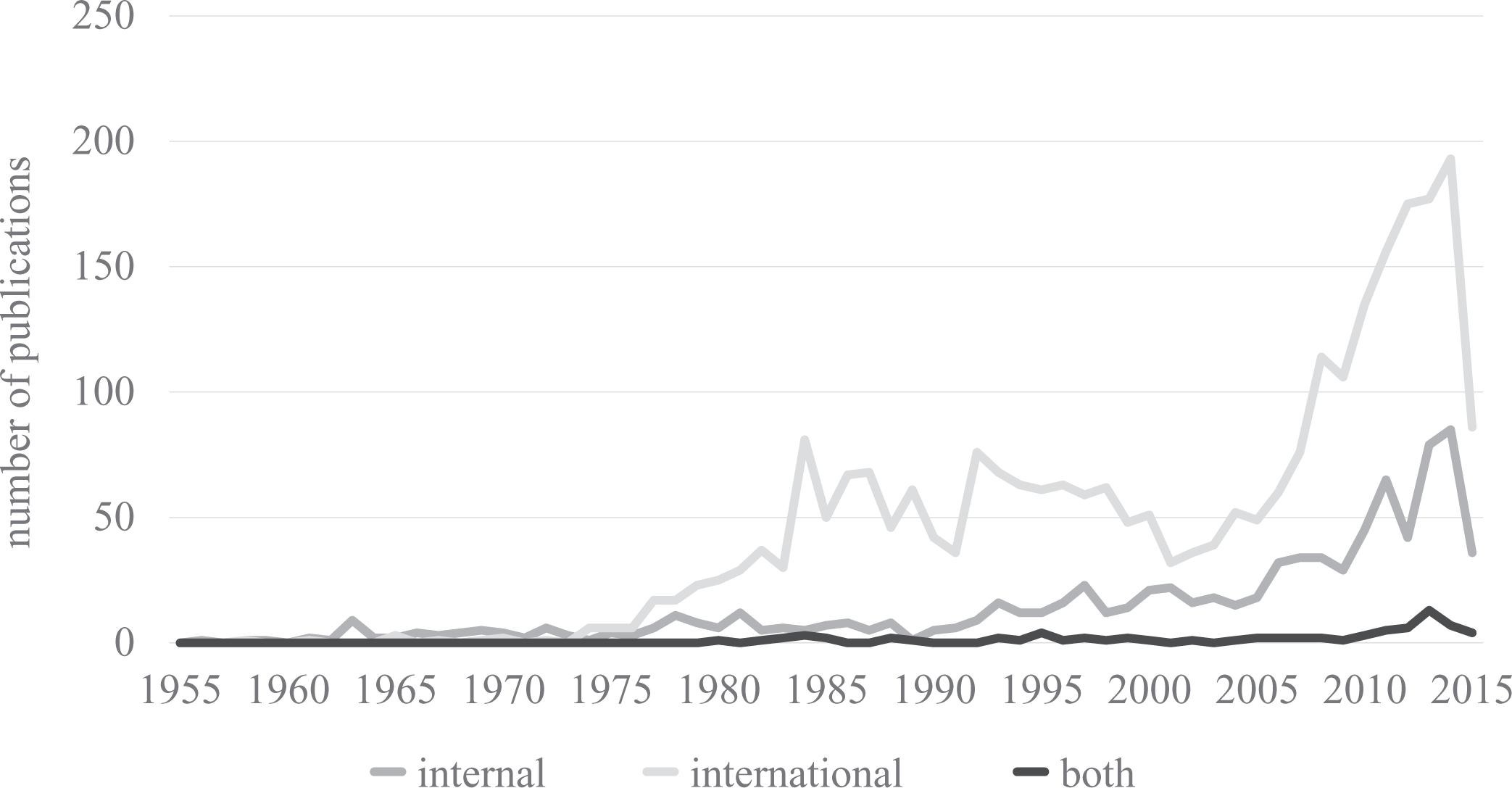
Evolution of International, Internal, and Both Clusters over Time.
From Figure 1, it stands out that despite a visible rise in the number of publications (classified in WoS) in the field of international migration starting in the late 1970s, and an increase in publications on internal migration since the early 2000s, the number of publications concerning both international and internal migration does not exhibit such a boom at any point until now. The relation between internal and international papers may also be puzzling given that globally internal migration is estimated at numbers far larger (318 million; Esipova, Pugliese, and Ray 2013) than international movements of people (232 million; UN 2013). These initial observations led us to realize that an empirical investigation of the overlap between internal and international migration scholarship would not only allow to research the development of the field as such, but indirectly also lead to a better understanding of migration processes in general.
Our subsequent analyses comprised various methods and measures of interlinkages between publications which were grouped into three clusters (hereafter also termed as domains, categories, or strands of literature) — internal, international, and both. First, we performed a network analysis of citation links among WoS records by means of which we established the degree of connectivity between the clusters. We then moved to co-author and co-word analyses (cf. Cobo et al. 2011) that juxtaposed the frequency of occurrences of particular authors, keywords, and journals in the three domains. Based on this exercise, we also ran correlation analyses between the frequency of occurrences of given terms in one cluster and the frequency of their occurrences in another cluster. Last, we applied bibliographic coupling to look at common references of publications on internal and international migration. In our work, we have relied on the BibExcel (Persson 2014) and Pajek (Mrvar and Batagelj 2015) software packages.
Depending on the research question, our input dataset was transformed to suit the adequate bibliometric technique. Table 1 presents the data used for specific analyses.
Data Used for Specific Analyses.
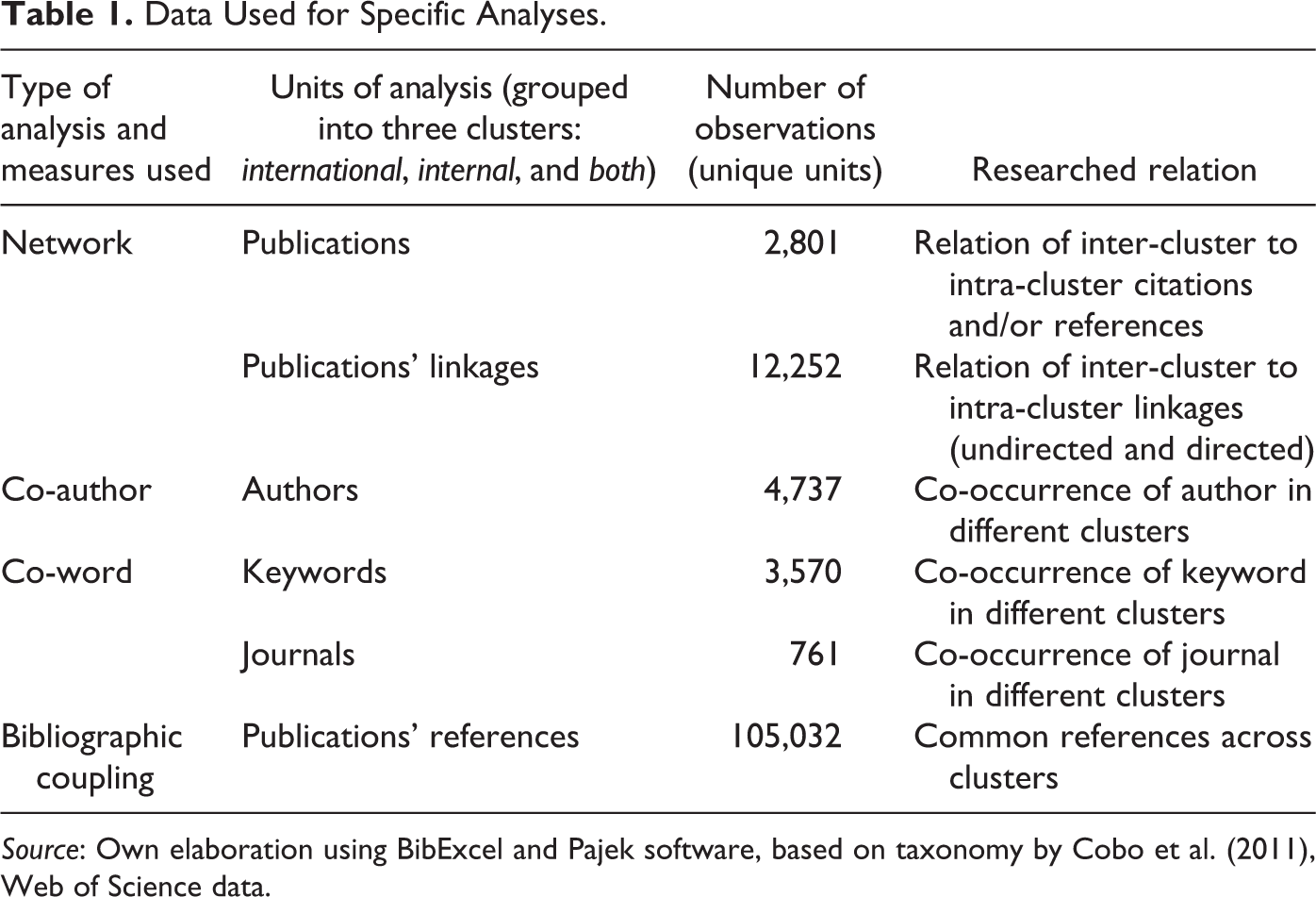
Source: Own elaboration using BibExcel and Pajek software, based on taxonomy by Cobo et al. (2011), Web of Science data.
Regardless of type of analysis, we had to deal with the most common sources of bias in bibliometric studies (Erman and Todorovski 2015). As both too lax and too restrictive identification of unique units of analysis (publications) may lead to erroneous results, we have described the observations in our samples by means of the following criteria: name of first author, year of publication, volume number, and first page number to identify publications (including references); last name and first initial for authors; and exact full wording for keywords and journals (both categories have been manually cross-checked for homographs and synonyms). Given the scale of our study, we were not able to control for all possible sources of bias. Nevertheless, we have no reason to believe that any errors appear non-randomly across the constructed clusters. As long as there are no systematic differences in the scale in which any of error appears in the international or internal migration literature, we remain satisfied with the quality of the data used.
Results
Size of the Gap
Our first objective was to quantify the postulated gap between internal and international migration literature. Our first indicator was simply the relative size of the cluster comprising publications classified as both on internal and international migration. In our study, these publications constituted 2 percent of all considered works. This measure is demanding, though, as it requires that the author explicitly integrated both strands of literature into one paper. In an attempt to relax this requirement, we have relied on several measures concerning solely internal or international migration publications. All of these were developed by, first, identifying the interlinkages between these publications in our sample using BibExcel and, second, transferring the network data to Pajek for further analyses. Our primary indicator was a measure of degree centrality of each vertex (publication). We have computed the number of intra- and inter-cluster connections — edges (undirected) and arcs (directed) for each paper or book in the sample. After aggregation, this allowed us to compute the degree of connectivity of each cluster.
Out of 2,750 papers in our study which constituted the internal and international clusters, 766 papers (28%) cited and/or were cited by a paper from the cluster different than their own. This concerned every fifth publication from the international cluster (454 papers, 21%) and every other publication in the internal cluster (312 papers, 51%). For an average international publication, the share of connections to internal publications was 25 percent. For an average internal publication, the share of connections to internal publications was 45 percent. Clearly, internal migration papers were relatively more strongly connected to international migration papers, than the other way around. The share of links (edges) between the internal and international publications relative to the total number of links between and within these two clusters amounted to 10 percent. This implies that 90 percent of links to or from international or internal publications are between publications in the same cluster.
Inquiring into the direction of these interlinkages, we looked at the relative number of out-connections (cited publications) leading from the international (internal) cluster to the internal (international) cluster for each vertex. This measure shows the degree to which one strand of literature is inspired by the works from the other strand of literature. Out of all papers in either internal or international migration, 2,220 were cited by another publication in the sample. For every 100 citations, an average international migration publication had four internal migration publications (Table 2, row 1, column 2). An average internal migration publication had 25 percent of international migration publications among its cited papers (Table 2, row 2, column 1). All the directed dependencies between the publications in our sample are described in Table 2.
Interconnectivity between Clusters (Directed Links).
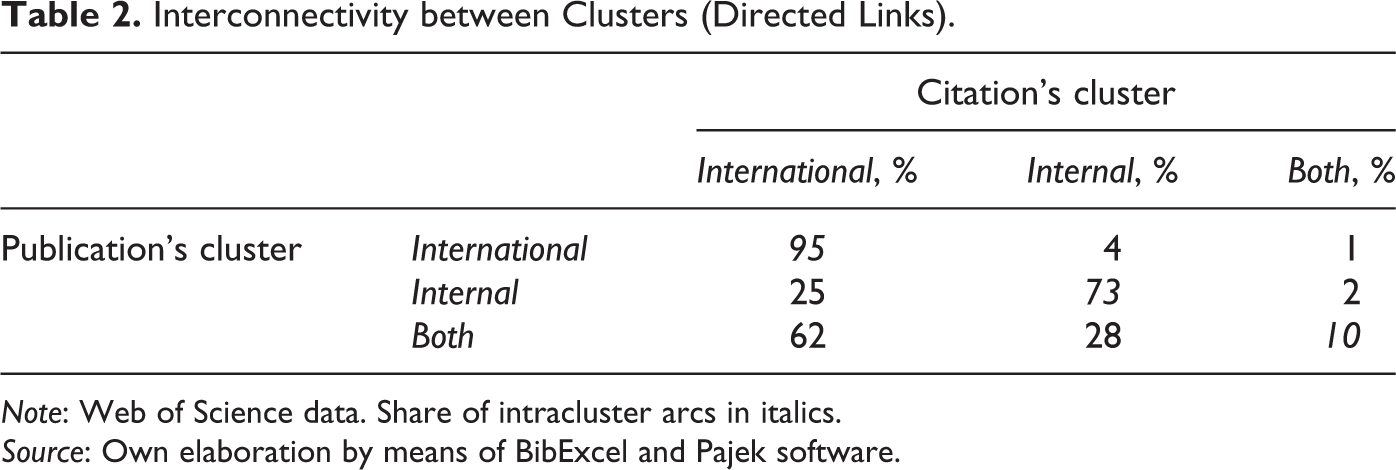
Note: Web of Science data. Share of intracluster arcs in italics.
Source: Own elaboration by means of BibExcel and Pajek software.
From the analysis of Table 2, we can conclude that the estimated size of the gap between internal and international migration literature is between 73 and 95 percent; that is, it amounts to the share of intracluster publications. The category referring to both, the international and internal literatures, is evidently highly connected to the former (62% of citations) and the latter (28% of citations). It presents as a special case by definition, though. Looking at the directed connections confirms our initial finding that it is the internal publications that have a more extensive outreach toward international publications, than the other way around. We did not find any fundamental reasons for which this asymmetry could have occurred. It may be explained simply by the fact that the boom in research on international migration has taken place at a time when the tradition of research on internal migration was already well established. Thus, relatively more academics had the opportunity to switch from research on internal migration to research on international migration and to rely on their previous work.
Given that the above-mentioned data comprise those authors who make attempts to reflect on works outside of their field as well as those who do not cite any papers from the other strand of literature, we have refined our results to account for this selectivity effect. We have computed the shares of inter-cluster citations disregarding those papers that did not cite any work from the other cluster. For an average international publication that does cite an internal publication, 31 percent of the papers it is citing come from the latter strand of literature. For internal migration publications, the respective percentage is 52. This result leads us to think that if only we considered reaching beyond our narrow field of research, the size of the internal–international gap could be much smaller. Apparently those authors who do stand on the shoulders of the other giants find quite a few inspirations for their work, most probably with great benefit for the development of migration studies in general.
Conceptual Overlap
Having estimated several measures of the size of the divide between international and internal migration literature, we have moved to computing the size of conceptual overlap between the two. In doing so, we have taken advantage of the fact that the research fields of internal and international migration studies may be described by tags that authors use as keywords in their papers. The WoS database also comprises additional keywords assigned to each publication by a group of experts. In our analysis, we have used both the “Author Keywords” (DE field in WoS) and “Keywords PLUS” (ID field in WoS) as sources of information on the content of papers and books. In effect, we received two lists of tags, one for the field of internal migration and the other for the field of international migration studies. The lists have been cross-checked for possible synonyms that occurred such as: differences in British and American spelling (e.g., urbanisation versus urbanization); using both singular and plural form (e.g., migrant versus migrants); using dashes where one or two words could be used (e.g., United-States versus United States).
The corrected list of tags for internal migration studies comprised 2,190 items and was almost by half shorter than the list of tags for international migration studies (3,884 items). Three of 10 top keywords are the same in both lists, however, and apart from the name “United States,” these are rather general terms (i.e., “migration” and “immigration”). It seems that researchers in the field of international migration find the United States as an interesting case for their studies. They also seem to approach the migration phenomenon from a variety of perspectives (“globalization,” “gender,” “policy,” “family,” “networks”). At the same time, researchers investigating internal migration are interested in US, Chinese, and British mobility and look at the migration predominantly as if it was a part of a strictly economic process (“earnings,” “growth,” “unemployment”; see Table 3). The overlap is visible in the correlation between the frequencies of specific keywords, which is positive (Pearson’s R equal to 0.69 with p-value lower than 0.001; the most frequently used keywords in the internal and international clusters, that is, “internal migration” and “international migration,” respectively, have been excluded from the correlation analysis).
Top 20 Keywords Describing Papers from Two Clusters.
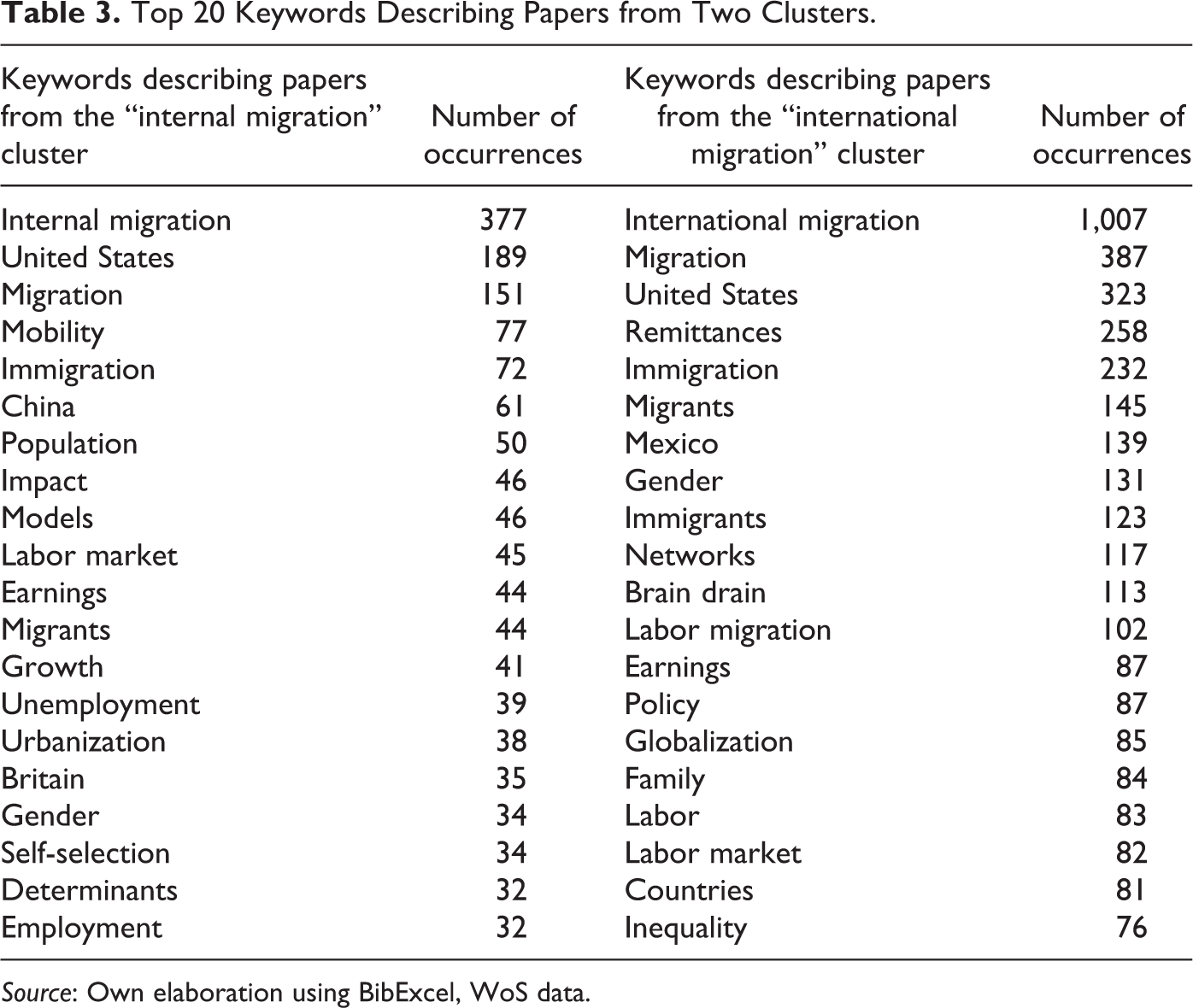
Source: Own elaboration using BibExcel, WoS data.
Table 3 also reflects the distribution of publications in our sample over time (cf. Figure 1). Terms such as “gender,” “globalization,” or “brain drain” have been incorporated into the mainstream of migration research relatively recently. The table above also speaks to the most popular disciplines that papers from these two clusters come from. An analysis based on the research area classification (“SC” field) in WoS shows that papers concerning internal migration issues have been most frequently classified as either economic (18%), geographic (16%), demographic (13%), or environmental studies (10%), whereas papers from the international cluster are most likely to be labeled as demographic (31%), economic (16%), geographic (8%), or sociological (6%). Despite these slight differences, migration is a subject of interest of scholars from similar disciplines as the correlation between the above-mentioned frequencies is relatively high and equal to 0.83 (p-value < 0.001).
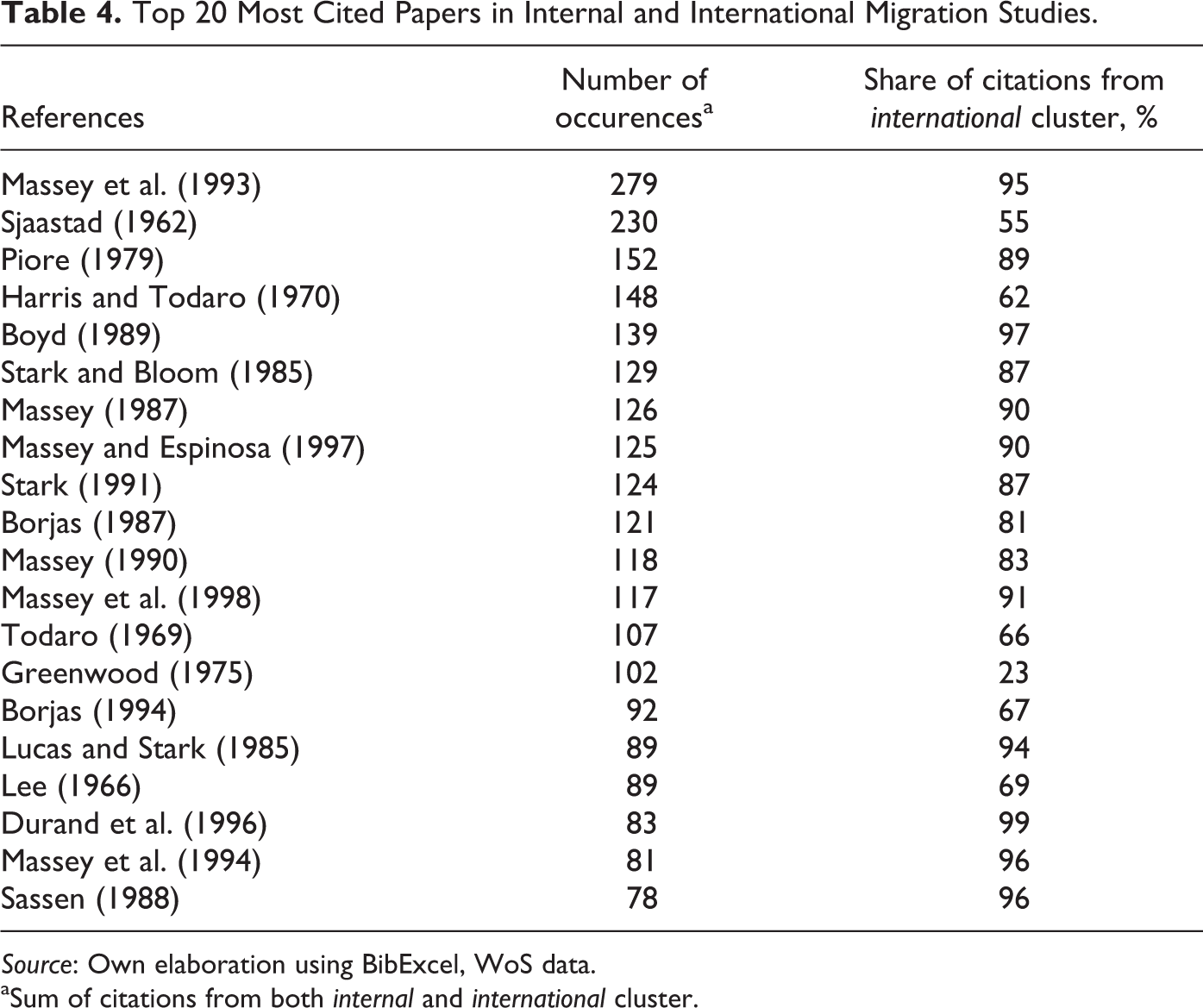
We considered not only the co-occurrence of keywords and scientific fields across the internal and international clusters as measures of conceptual overlap, but also the scale of bibliographic coupling, that is, the extent to which internal and international publications have common references. The correlation between the frequencies of particular papers referenced in the internal and international cluster was 0.39 (p-value < 0.001). This result shows that migration scholars in both domains rely to some extent on similar sources. When inquiring into particular papers, though, the results are not as promising and indicate that internal and international scholars still tend to diverge in delimiting the frameworks for their studies. Among the top 20 most cited papers (Table 4), there are only five which can truly be considered as popular in both the international and internal cluster with the share of citations from one particular cluster lower than 80%; these are Sjaastad (1962), Lee (1966), Todaro (1969), Harris and Todaro (1970), and Borjas (1994).
Top 20 Most Cited Papers in Internal and International Migration Studies.
Source: Own elaboration using BibExcel, WoS data.
aSum of citations from both internal and international cluster.
Apart from Lee’s general push–pull model of migration, the “bridging” publications are economic papers related to labor market economics, theory of international trade, or the human capital approach in decisionmaking processes. Notwithstanding these few exceptions, most papers with the highest scientific impact remain almost entirely utilized by authors from either the internal or the international migration field. This conclusion holds even if we narrow the list of references to papers which have been published only recently (post-2000). Two of the 20 top-cited post-2000 publications which have been recognized by scholars from both strands of migration literature were as follows: another work of Borjas (2003) with 33 percent citations from the internal cluster, and David Card’s (2001) paper on intercity mobility of immigrants in the United States cited almost as frequently by internal scholars as by international scholars.
In search for common inspirations for scholars from internal and international migration, we have also looked at papers which bridge the two strands of literature, that is, which have many citations (at least 20) and appear equally often in international and internal migration publications (share of citations from the internal cluster was 46–56% see the highlighted points inside the black frame in Figure 2).
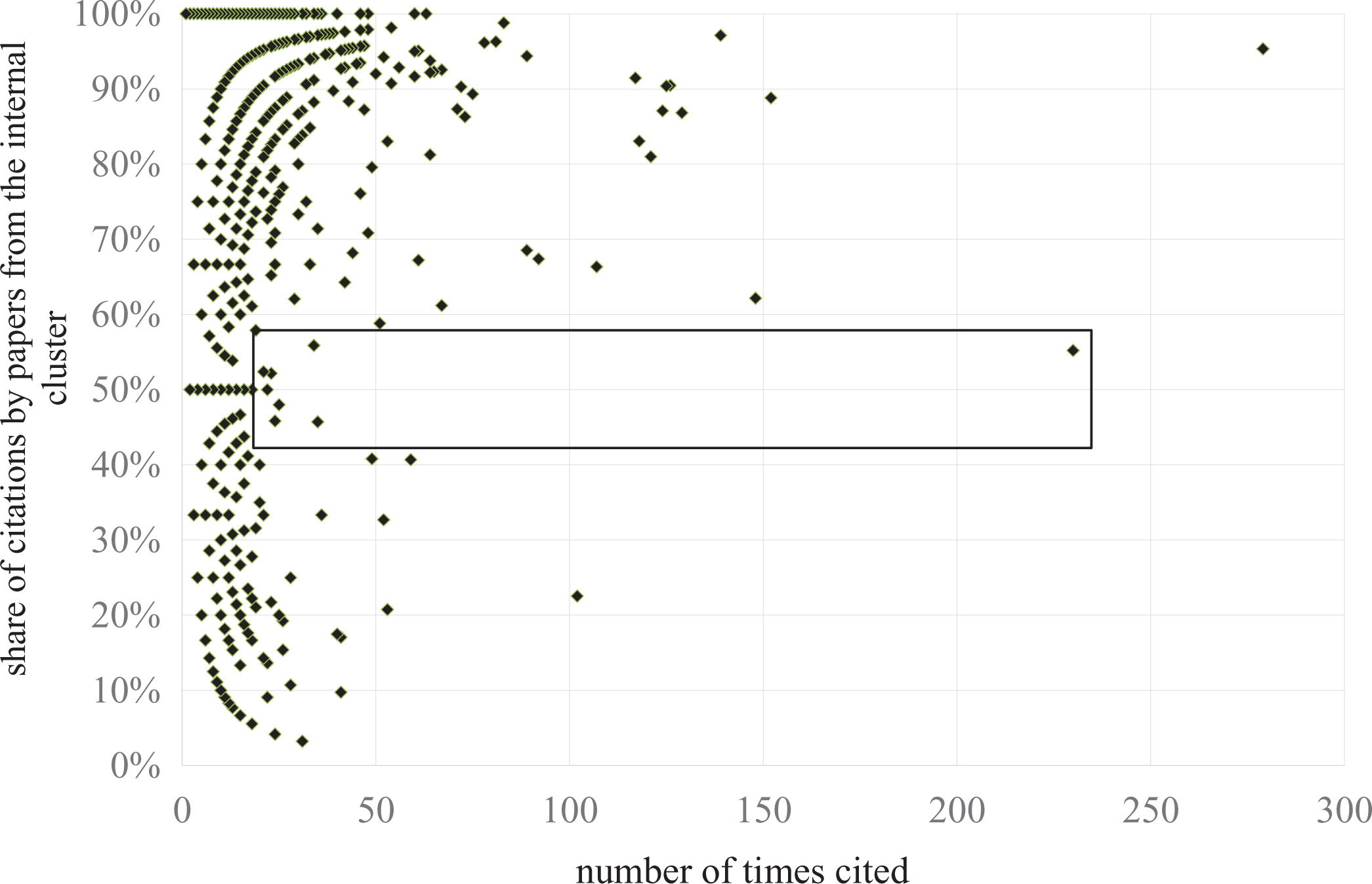
Relation between the Number of Times Cited and the Share of Citations by Papers from the Internal Cluster.
Half of the “bridging” publications concern various aspects of substituality of native and immigrant workers and investigate possible causation/linkages between international and internal population flows (Lewis 1954; Grossman 1982; Altonji and Card 1991; Friedberg and Hunt 1995; Borjas, Freeman, and Katz 1996); another three investigate a situation of different groups of migrants living in the United States from mixed sociological and economic perspective (Bean and Tienda 1987; Massey and Denton 1993; Portes 1995). None of them have been mentioned by King and Skeldon in their state of the art in the area of studies with the potential to integrate both strands of migration literature, possibly because these are relatively old publications (34 years old on average) and this potential has been exhausted to a large extent. However, as all of them refer to the population of the United States, they may be treated as a model or inspiration for empirical research in other parts of the world (e.g., the current situation in the European Union with a common labor market and intensive immigration from Africa and Asia becomes similar to the situation of the United States; Blanchard and Katz 1992).
Potential Knowledge Transfers
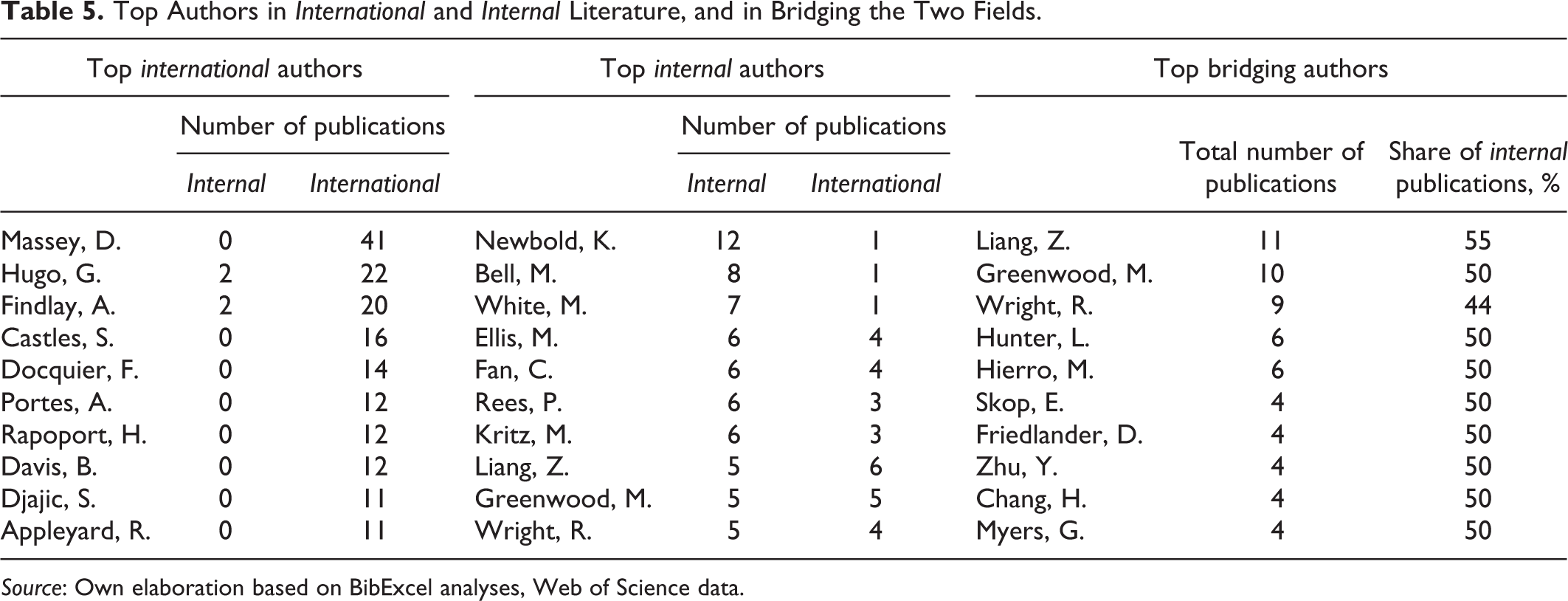
Our last research question concerned the possibility of knowledge transfers between the literatures on internal and international migration. When it comes to authors as possible engines of knowledge transfers, we have looked at the frequency of appearance of particular scholars in the international and internal domains. Out of 4,569 authors in our database who published on either internal migration or international migration, 206 published in both fields. When to this number we add the 141 authors who had a publication in the both cluster, it turns out that around 8 percent of all authors in our sample dealt with both internal migration and international migration in their oeuvre. The authors who most frequently appear in international and internal publications are listed in Table 5, followed by the authors who have the most publications and appear equally often in international and internal migration publications.
Top Authors in International and Internal Literature, and in Bridging the Two Fields.
Source: Own elaboration based on BibExcel analyses, Web of Science data.
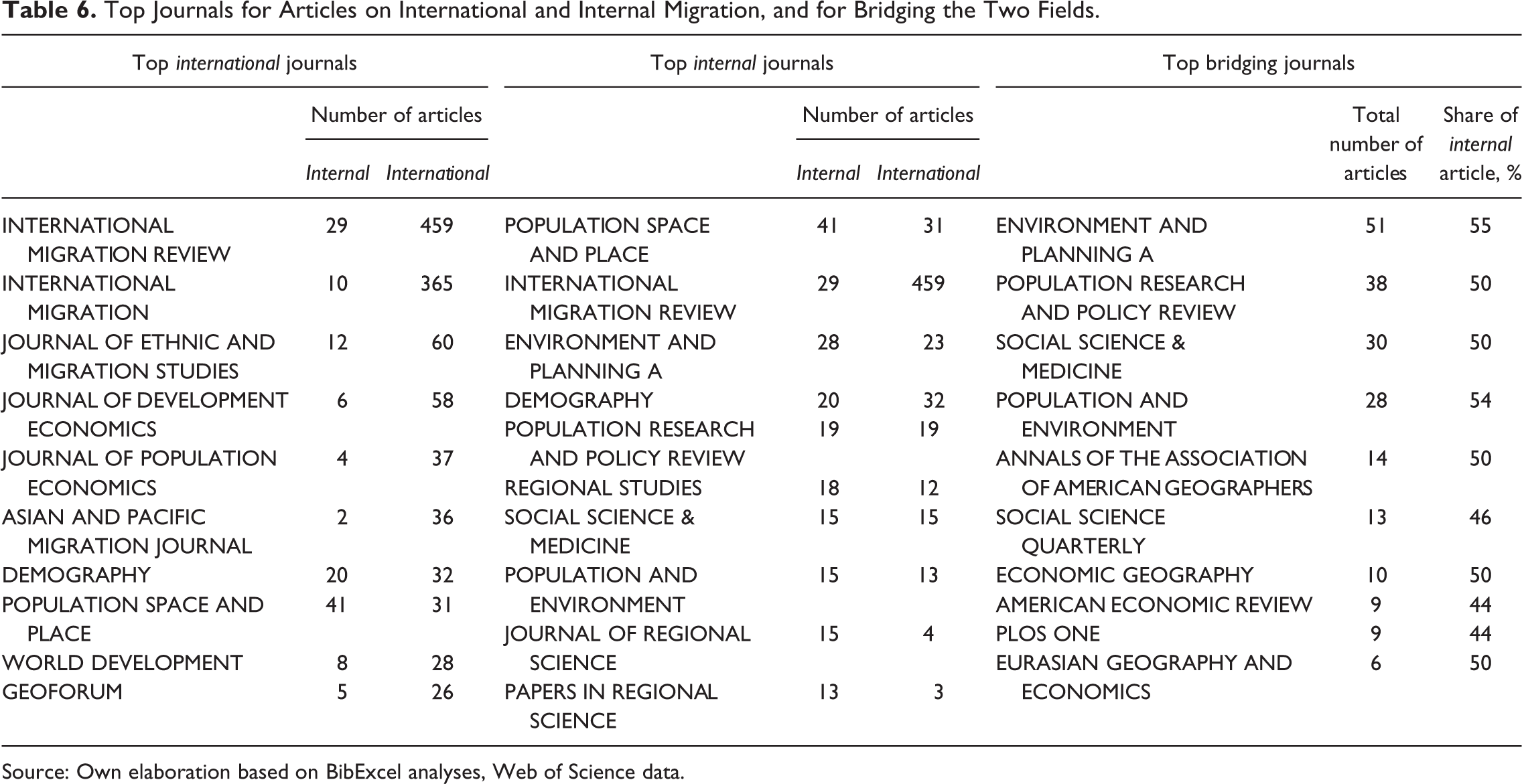
Visibly, the frequency of occurrence of most productive international authors in internal publications is close to zero. Internal authors seem to publish on international migration slightly more often. Pearson’s correlation coefficient between the frequencies of an author’s occurrence in international and internal literature is 0.13 (p-value < 0.001), leading us to conclude that, in general, authors tend to remain in the realm of their domain. The names in the last section are of main interest to our study, however, as we consider them not only to be very prolific authors, but also those who in their work manage to merge topics, concepts, and methods others do not combine. A similar analysis to the one above has been conducted on journals which published articles on internal or international migration. The most popular for academic debate on the former and the latter are listed in Table 6.
Top Journals for Articles on International and Internal Migration, and for Bridging the Two Fields.
Source: Own elaboration based on BibExcel analyses, Web of Science data.
Pearson’s correlation coefficient between the number of international and internal articles in the 761 journals in our sample is 0.44 (p-value < 0.001). This leads us to conclude that journals are indeed a medium that is only intermediately partial when it comes to discriminating against internal or international articles. Assuming that scholars read or at least monitor all publications that appear in certain research outlets, journals allow scientists to come across a variety of topics related to their field of interest, including both internal and international migration issues. The outlets that we classified as bridges between internal and international publications (Table 6, column 3) interestingly do not concern migration per se. Hence, we conclude that it is not that internal and international scholars do not meet in international journals, but that they do not meet in the core of the academic debate on migration.
Discussion and Conclusions
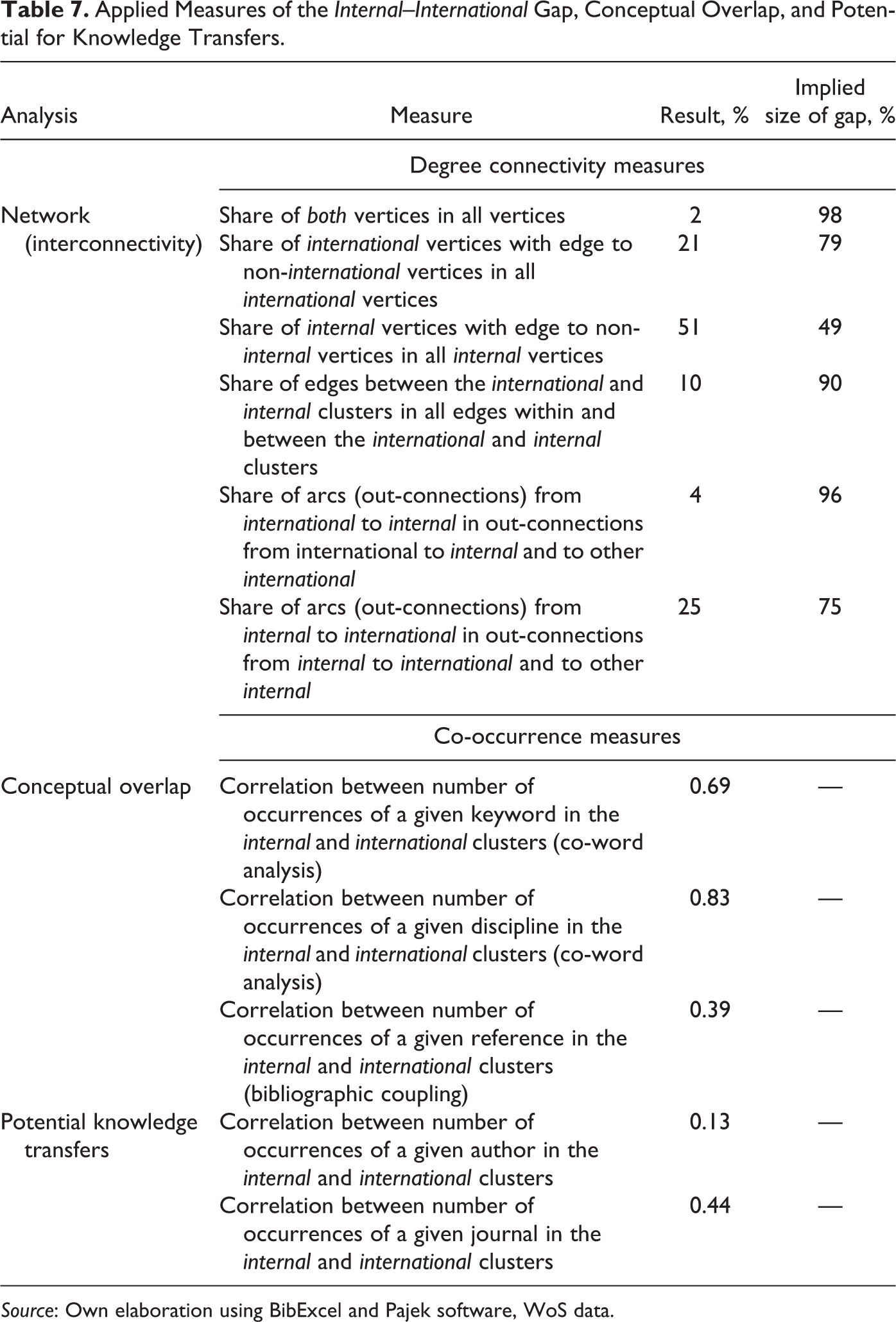
The objective of our study was to quantitatively assess the size of the gap (King and Skeldon 2010) between the literature on internal migration and the literature on international migration. We have approached this task from three angles that are reflected in our research questions: (1) What is the degree of interconnectedness between publications in internal and international migration? (2) What is the scale of the conceptual overlap between the two strands of literature? and (3) What is the scale of the potential of the two to integrate in a common research framework? In search of answers to these questions, we have classified all publications in our sample to one of three clusters: international, internal, or both. In answering each research question, we have provided a number of measures, all of which are summarized in Table 7.
Applied Measures of the Internal–International Gap, Conceptual Overlap, and Potential for Knowledge Transfers.
Source: Own elaboration using BibExcel and Pajek software, WoS data.
Looking at the above-mentioned table, we find it safe to estimate the size of internal–international gap, as described by King and Skeldon (2010), at 49 to 96 percent depending on the measure applied. The large uncertainty results from the very different findings we obtain when analyzing the gap from the perspective of internal and from the perspective of international publications. Publications concerning internal migration cite (as defined by the degree of interconnectivity) international publications much more often than is true for international publications citing internal works. In our analyses, we have also found that: International migration publications concern a wider variety of aspects (as defined by keywords) than internal publications. Papers on internal and international migration tend to be positioned within the same academic disciplines. Most papers with the highest scientific impact (based on analysis of bibliographic coupling) remain almost entirely utilized by authors from either the internal or international migration field. In general, authors tend to publish in the realm of their domain. Certain academic journals do create a forum for a scholarly debate without distinguishing between internal and international migration, yet these are not necessarily the ones which are at the core of the academic debate on migration.
The validity of our results holds as long as we have no reason to believe that potential biases affect internal and international literature differently. Nonetheless, there are certain features of our sample, which should raise caution. Although their effects on our study are difficult to assess, intuition suggests that they could bias our results both upward and downward, and even then to a very small extent.
As stated in the “Data and Methods” section, our sample has been limited to the set of papers described by three combinations of two specific terms, that is, “internal migration” and “international migration.” We did not take into account publications for which the WoS topic was the general term “migration” (the term “mobility” will be discussed later). Omitting these papers in the analysis could have biased our results as it may have been hypothesized that by intentionally not distinguishing between internal and international migration, their authors intended to fill the gap between the two strands of literature. A search for publications with the keyword “migration,” refined by the same criteria as used in the initial version of the paper, that is, database (WoS Core Collection), research domains (Social sciences or Arts and Humanities), document types (article or book), language (English), and time span (1945–2015), gave 30,557 publications, out of which 27,021 were classified as concerning “‘migration’ AND NOT ‘international migration’ AND NOT ‘internal migration,’” 1,060 explicitly concerning “internal migration,” 2,561 explicitly concerning “international migration,” and 73 explicitly concerning “‘international migration’ AND ‘internal migration.’” The 27,021 publications that concerned “‘migration’ AND NOT ‘international migration’ AND NOT ‘internal migration’” were our major concern as these are the ones that have not been included in our primary database that relies on the “internal migration” and “international migration” keywords (WoS topics). The classification of each of these papers as belonging to a given strand of literature (i.e., the internal cluster, the international cluster, or the both cluster) presented itself as a Herculean task as it would require a qualitative assessment of the contents of all the publications. Hence, to test for the representativeness of papers included in our analyses and, consequently, the robustness of our results, we reverted to analyzing a random sample of 100 of the 27,021 identified migration publications. The qualitative examination of these works led us to conclude that the proportion of papers from each cluster in our original database was satisfactory and does not yield significant selectivity. The original vs. estimated shares of internal, international, and both publications were 22 versus 24 percent, 76 versus 72 percent, and 2 versus 3.2 percent, respectively.
We have also considered the terms “mobility” and “population redistribution” as possible WoS topics which could have been attributed to scholarly works relevant to our analysis. The former term presented a challenge even greater than the case of migration papers. In fact, even after limiting the articles and books to those published within the fields of the arts, humanities, and social sciences, a number of publications were not related to human mobility understood as movement across geographies. For example, among the top-cited works on “mobility,” several papers concerned occupational mobility (without a migration component). Hence, even if we examined a sample of these data, we would not be able to make any conclusive statements about the share of internal and international migration publications, as we would expect a large proportion to be irrelevant given the scope of our inquiry. When it comes to the WoS topic being “population redistribution,” we found only 139 publications that were not simultaneously inscribed into the “internal migration” or “international migration” studies, that is, ones which would not have been captured in our initial database. They could not have meaningfully impacted our results.
Further selectivity within our sample could have come from the fact that we have focused only on English-language publications while it seems reasonable to suppose that many works on internal migration are addressed to national audiences and hence are published in national languages. In a citation study, limiting the analysis to one language is necessary, though. Otherwise, we would not be able to assure that the potential link between any of two publications was possible and its nonexistence was not a result of limited language skills of the authors. Had we included publications in other languages than English, some connections we are not capturing right now would certainly have appeared, presumably to a greater extent in the internal cluster. Not being able to judge whether such papers had a real chance to be connected to all the other papers, estimating the size of the gap (difference between actual and potential connection) would be impossible, however.
We were also unable to control for whether the authors’ perspective was that of a sending or receiving country. This issue may cause concern as the mechanisms of internal migration in receiving countries (e.g., the United States) are probably different than in migrant-sending countries (e.g., Ireland or Great Britain until the 1980s). In the former, internal mobility is not an alternative for emigration, while the contrary is true for the latter. However, it is hard to judge whether the links between the internal and international literature would be stronger in one case or the other.
Finally, our method of classifying publications into internal and international excludes those which do not explicitly relate to international or internal migration in their title, abstract, or keywords at least once. This could have deprived our analyses of certain works, for example, in the domain of political science, where analyzing international migration seems to be self-evident. In such a case, authors might refer to, simply, migration or other related concepts such as “citizenship” or “nationality.” It is possible that this specificity would increase the estimated size of the gap. Nonetheless, such papers constitute just a part of migration scholarship; thus, the possible bias remains relatively small.
Having in mind the above considerations, in conclusion, we find that there are significant commonalities between scholarly works on internal migration and international migration when it comes to the journals in which they are published, the academic disciplines they relate to, or the keywords by which they are defined. At the same time, however, it becomes visible that authors tend to remain in the realm of one domain and rarely cite papers from the other strand of literature. Why?
Footnotes
Declaration of Conflicting Interests
The author(s) declared no potential conflicts of interest with respect to the research, authorship, and/or publication of this article.
Funding
The author(s) disclosed receipt of the following financial support for the research, authorship, and/or publication of this article: This work was supported by the Polish National Science Centre [Narodowe Centrum Nauki] research project “Substituality of internal and international migration” (grant number 2013/09/N/HS4/03618).