




Abstract
Based on a mixed-methods approach using the 2006–2007 Morocco Living Standards Measurement Survey and qualitative interviews, this article examines the distinct roles that international migration and remittances play in female labor force participation (FLFP) in origin-country households and discusses the implications in terms of women’s empowerment. We find that having an emigrant among household members increases FLFP for a given household, while receiving remittances decreases it. However, these effects are significant only for unpaid family work, that is, a category of work unlikely to lead to any form of economic empowerment. Although previous studies sometimes hypothesized that emigration could drive gender-sensitive development at origin, the quantitative and fieldwork findings suggest that, while paid work remains a route to female empowerment, predominantly male emigration is unlikely to play a positive role in supporting women’s access to income-generating activities in a society characterized by strong patriarchal gender norms and poor job opportunities.
Introduction
Gender has increasingly been integrated into the ever-growing literature on migration and development in the past 20 years. While this literature on gender and migration has long been biased toward the figure of the female migrant (Hugo 2000), female relatives of migrants who stay in the origin communities — henceforth referred to as “women left behind” — progressively garnered more attention throughout the 1990s (e.g., Brink 1991; Hoodfar 1997) and the 2000s (e.g., Hadi 2001; Sadiqi and Ennaji 2004; Menjívar and Agadjanian 2007). If the study of this population initially suffered from a negative portrayal of these women as passive and “involuntary immobile” actors (Carling 2008), socio-anthropological studies have explored the hypothesis that male emigration could lead to female empowerment in the origin household. Among the multiple channels through which these changes may occur, particular emphasis has been put on the consequences of male emigration on the gendered division of labor within and outside the home, on decision-making power and control over financial resources (e.g., Hoodfar 1997; Hadi 2001; Menjívar and Agadjanian 2007; de Haas and van Rooij 2010; Lenoël 2017), and to a lesser extent on female mobility (McEvoy et al. 2012).
At the same time, a growing economics literature has interrogated the impact of migration and/or remittances on the labor-market participation of male and female members of left-behind households in contexts of large emigration countries like Mexico (Amuedo-Dorantes and Pozo 2006; Cox Edwards and Rodríguez-Oreggia 2009), Nepal (Lokshin and Glinskaya 2009), Albania (Mendola and Carletto 2012), or Egypt (Binzel and Assaad 2011). However, the implications of these findings in terms of female empowerment — understood here as the process enhancing women’s “ability to formulate strategic choices and to control resources and decisions that affect important life outcomes” (Malhotra and Schuler 2005, 73) — are rarely discussed. More generally, engagement in paid work is seldom conceptualized in these studies as an indicator of the level of autonomy enjoyed by women left behind (Yabiku, Agadjanian, and Sevoyan [2010] being a notable exception), which is somehow surprising. Indeed, although the empowering potential of paid work is subject to debate due to the poor conditions and low wages characterizing women’s work in much of the developing world (Pearson 2004), participating in the labor market remains one of the main routes to women’s empowerment, besides being a necessary livelihood strategy to many. Paid employment outside the home can provide women with economic independency, self-esteem, and fulfillment, thus enhancing their bargaining power within the home and their ability to define and act upon their goals more generally (Kabeer 2012). While such benefits are less likely to be derived from poorly paid activities under exploitative conditions, they will be completely denied to those involved in unpaid family work, 1 a category which subsumes work activities performed while contributing to the running of a productive unit owned by a related person. Yet, women in the developing world tend to be overrepresented in this latter category of work (Beneria 1999; Pearson 2004).
This article seeks to contribute to the debates on the migration–development nexus by bridging the gap between research on the empowerment of left-behind women and research on their labor-market participation. Understanding how emigration affects both female labor force participation (FLFP) in the country of origin in general and women’s engagement in paid and unpaid activities more specifically is of particular relevance to Middle East and North Africa (MENA) countries, where women enter the labor market at half the average global rate (World Bank 2013). This article focuses on a leading emigration country in this region: Morocco. With a diaspora estimated at around four million, representing over 10 percent of its total population (34 million in the 2014 Census), and as the third largest remittance recipient in the MENA region (after Lebanon and Egypt; Sirkeci, Cohen, and Ratha 2012), Morocco is deeply affected by international migration. Historically, emigration flows from Morocco have been composed mainly of men heading to Western Europe, a pattern that intensified after the country’s independence in 1956. This out-migration has had profound impacts on origin families and communities in Morocco (Berriane, De Haas, and Natter 2015), especially the wives, mothers, daughters, and sisters who stay behind and often rely on migrants’ remittances for a living (Lenoël 2017). At the same time, Morocco remains characterized by low rates of female economic activity, despite important investments in human capital and improved legislation, which should have facilitated women’s entry into the labor market (Alami Mchichi 2014). Morocco ranked 139th of 145 countries on the Gender Gap Index in 2015 (and 140th in the dimension of “economic participation and opportunity”; WEF 2015). Investigating the relationship between emigration and FLFP is thus highly relevant in this context.
How do emigration and remittances affect FLFP in Morocco, and what are the implications of both for women’s empowerment? A lack of available quantitative data often stands in the way of addressing such a research question, especially in MENA countries, 2 and in Morocco in particular, where — to our knowledge — this issue has never been addressed through nationally representative data. In this article, we address this gap using data from the nationally representative 2006–2007 Morocco Living Standards Measurement Survey (MLSMS), which allows us to differentiate between the effects of migratory and monetary flows on various labor-market outcomes. Specifically, we seek to investigate whether the assumptions and findings from the labor economics literature and from more qualitative studies on the link between migration and the work performed by migrants’ wives in Morocco (Steinmann 1993; de Haas and van Rooij 2010) are verified at the national level. To do so, we focus on two types of labor activities: income-generating and unpaid family work. More broadly, our approach endeavors to bridge the epistemological gap that tends to separate the literature on empowerment on the one hand and that of the FLFP of left-behind women on the other hand, by adopting a mixed-methods approach. To complement our quantitative analyses, we draw on a 2012 qualitative case study undertaken in a rural town in southern Morocco’s Souss–Massa Drâa region (Lenoël 2017). This study consisted of interviews with women who had stayed behind following the departure of a male relative (a husband generally), participant observation, and review of information about migration and the local labor market. These qualitative data were used at two distinct stages of the research: (1) when developing the hypotheses and choosing the controls for the econometric models and (2) when interpreting the data. Regarding this latter stage, we used an explanatory mixed-methods design (Creswell and Plano Clark 2011), which involved analyzing the 2006–2007 MLSMS first and then explaining, contextualizing, and expanding on these quantitative results with qualitative data. This design allowed us to address some of the limitations of survey data in answering our research questions. For instance, it provided insights into the mechanisms underlying women’s decisions to join the labor market (including the constraints they face) in a context of poor employment opportunities, into the importance for women of specific types of activities (such as animal husbandry), and into emigration’s different impacts on women, depending on their family relationship to the migrant.
The remainder of this article is organized as follows: The Impact of International Migration and Remittances on Female Employment Patterns in the Country of Origin section presents our conceptual framework by briefly reviewing the literature on how international migration and remittances impact female employment in countries of origin, with a special focus on the MENA region. The Migration and Female Labor-Market Conditions section in Morocco provides contextual information about Moroccan migration and the situation for women in the labor market. The Empirical Approach section describes the quantitative dataset and case study, before providing descriptive statistics and the empirical strategy. The Results section presents the quantitative results, which are illustrated, expanded on, and discussed in light of the interviews and fieldwork observations associated with our qualitative research. Our concluding remarks discuss the implications of our findings for women’s status in communities of origin and for the literature on the migration-development nexus more generally.
The Impact of International Migration and Remittances on Female Employment Patterns in the Country of Origin
The link between emigration and the employment patterns of women in origin households has attracted increased academic attention in recent years, with the focus being mainly on the impact of male emigration on women’s FLFP (e.g., Desai and Banerji 2008; Lokshin and Glinskaya 2009; Binzel and Assaad 2011). As this literature shows, international migration can influence the labor-market participation of household members left behind through two main channels: migration-induced labor reallocation and migrant remittances (e.g., Amuedo-Dorantes and Pozo 2006). These factors can have direct consequences for the household, as well as indirect effects mediated through other dimensions such as rural–urban mobility (de Haas 2008) and productive investments (Binzel and Assaad 2011).
The first direct channel through which a household member’s migration affects those staying behind is the need to reallocate labor within the household to replace the migrant’s labor and/or income. This outcome of the migration decision reflects a household strategy of maximizing its utility, as conceptualized in the New Economics of Labor Migration by Stark (1991). In the case of male-dominated migration, family members who stay behind are often female, which necessarily implies transferring tasks previously regarded as male to women. In rural Morocco, Sorensen (2004) argues that harvesting — a typically male task in the 1950s — has progressively been feminized following male emigration, eventually coming to be seen as women’s work and to be shunned by many young men. In a context where international migration has been linked to increased levels of land and livestock ownership (Steinmann 1993; Chigueur 2007), the need to replace migrants’ work may result in an increase in women performing unpaid family work in rural areas. In other words, women may have to compensate for the lost labor while continuing to assume their domestic role.
This effect is, however, likely to be found only where men play an important role in agriculture. Interview data collected by de Haas and van Rooij (2010) in Morocco’s Todgha Valley, for example, did not indicate significant increases in the household workload of women living in nuclear households, as they were already responsible for many agricultural tasks before their partners’ migration and could ask other men for help or hire laborers to do the tasks generally attributed to men. This suggests that migration-induced labor reallocation is probably limited in societies characterized by strict gender roles (Binzel and Assaad 2011). In this respect, the labor-market response to migration in Morocco may be similar to that seen in Egypt, where female labor supply is relatively unresponsive to changes in the labor supply of male household members (Binzel and Assaad 2011). Binzel and Assaad argue that if FLFP changes occur, they are most likely to affect unpaid family and subsistence work, as these are less subject to restrictive social norms and easier to combine with domestic work and childcare duties. Because these types of employment are more common in rural areas, women’s labor-supply response to male migration is likely to be stronger there.
The lost labor effect, however, may be partially or completely offset by remittance flows that can ensue from the migration of household members. First, remittances may offset the labor reallocation effects by allowing women to hire workers and thus buy time away from unpaid and subsistence work. In Morocco’s Todgha Valley, de Haas and van Rooij (2010) observed an important workload decrease for women in households with male migrants, as they could hire laborers for agricultural work. This labor demand was fulfilled by the wives of nonmigrants or internal migrants, the latter having the heaviest workload due to the combination of the man’s absence and lower levels of remittances (see also Steinmann 1993).
Second, remittances may also decrease FLFP by increasing the reservation wage (i.e., the minimum increase in income that would make a person indifferent to working or not working; Cox Edwards and Rodríguez-Oreggia 2009). Indeed, because of the much higher earnings of international migrants, their remittances are generally regarded as a source of nonlabor income for recipient households, not as a replacement for the income the migrant would have contributed to the household had he stayed (Cox Edwards and Rodríguez-Oreggia 2009). By lifting budget constraints and increasing the reservation wage, remittances can decrease not only the likelihood of waged work in the formal economy but also the hours worked in the remittance–recipient households (Amuedo-Dorantes and Pozo 2006). Arguably, the effect would be even stronger for women in environments that tend to discourage female waged work in the first place, as is the case in Morocco (El Harras 2006). This common assumption of labor migration economics has been confirmed by empirical research that analyzed data from various countries, with different studies finding a negative relationship between remittances and adult female participation in the external labor market: Amuedo-Dorantes and Pozo (2006) in Mexico; Binzel and Assaad (2011) in Egypt; Mendola and Carletto (2012) in Albania; and Lokshin and Glinskaya (2009) in Nepal. Nonetheless, the decrease in paid work that is assumed by this model applies only to waged work and not to unpaid work. Regarding the latter, the lost labor effect may therefore prevail and lead to an increase in unpaid work, as observed by Mu and van de Walle (2011) and Chang, Dong, and MacPhail (2011) in rural China and by Mendola and Carletto (2012) in Albania.
This literature review has suggested that the impact of migration and remittances on female labor-market participation varies according to the location (urban/rural) and the type of activity (paid/unpaid) of the women “left behind.” If a decrease in female formal labor supply may be directly attributed to the reservation wage hypothesis, an increase in unpaid family work may result from the need to replace the migrant’s labor. An important caveat here is that these mechanisms have been described in the literature mainly in relation to migrant’s wives. Thus, there may be some variations associated with the specific relationship to the migrant. These mechanisms do not operate in a sociocultural vacuum and must be interpreted in light of local gendered divisions of labor, social norms regarding women’s employment, and the availability of skilled and unskilled jobs to women, as will be discussed in the Migration and Female Labor-Market Conditions in Morocco section.
Migration and Female Labor-Market Conditions in Morocco
Morocco is one of the world’s leading emigration countries (Berriane, De Haas, and Natter 2015), and international migration is a pervasive phenomenon in many of its regions, especially in the Rif Mountains, the Souss, and the Southern Oases. Moroccan emigration remains male-dominated. In the 2006–2007 MLSMS, for example, 70 percent of current migrants were males, and if we focus only on labor migration, the percentage reached 90 percent. Although since the 1980s, Moroccan women have emigrated in larger numbers, the most common pattern remains one of wives, mothers, daughters, and sisters being left behind and dependent on migrants’ remittances for a living.
This pattern is congruent with the traditional gendered division of labor characteristic of Moroccan Islam, society, and the Arab patriarchal order (Joseph 1996) more generally. While patriarchy can be understood as a system of social structures and practices in which men dominate women, Arab patriarchy specifically puts great emphasis on the justification of this order by kinship values and religion (Joseph 1996). In Muslim Arabic systems, families are the basic social and economic units, and kinship determines women’s social position and represents their primary source of economic security (Joseph 1996). Traditionally, women are considered bearers of the family honor, and female confinement to the domestic and reproductive sphere is regarded as a way to maintain this order, especially in rural areas (Sadiqi and Ennaji 2004). By way of compensation, women receive the right to be supported by their husbands or male relatives, even if they can provide for themselves (Hoodfar 1997). Wives are entitled to their husband’s support — called nafaqah 3 — while single or divorced women can expect support from fathers, brothers, or sons.
While Moroccan women can theoretically rely on this religiously sanctioned right and be discouraged from taking part in income-generating activities, an increasing number of women have entered the Moroccan workforce in the past few decades (Mejjati Alami 2004). Investments in human capital, increased levels of female educational attainment, and delayed age of first marriage have made women more employable, especially in urban areas (ibid.). The lifting of many legal barriers has also facilitated women’s participation in the Moroccan labor market, with gender equality now enshrined in labor law and the 2011 Constitution (Alami Mchichi 2014). Despite such progress, rates of female economic activity remain low in Morocco: 27.1 percent in 2007 (year of the survey we use in this article) and 24.7 percent in 2012 (HCP 2013). 4 This situation is often referred to as the “MENA paradox” (World Bank 2013) because it is common across the region. In Morocco, the female employment situation also differs considerably between urban and rural areas. In urban areas, only 17.6 percent of the female working-age population was economically active, with 80.1 percent of them salaried and 11.9 percent self-employed in 2012. In rural Morocco, however, 35.6 percent of working-age women were economically active, with 73.6 percent concentrated in unpaid family work and 19.3 percent self-employed (HCP 2013).
The first work category mentioned above, salaried work in the formal sector, is often regarded as the main route to economic empowerment for women all over the world (Kabeer 2012). However, the difficulty of entry into the labor market, gender discrimination, and poor working conditions often mean that salaried job opportunities are scarce or unattractive for many Moroccan women. Although women with a higher education degree participate slightly more in the labor market than do those without one (the participation rate was of 34 percent for those having higher education in 2012), they also face much higher unemployment rates than their male counterparts (33% vs. 12% for men in 2012) (HCP 2013). In a context of increased economic liberalization, Moroccan women suffer more than men from difficult integration into the labor market and job insecurity, and their employment opportunities tend to be part-time, flexible, and situated at the lowest ends of the occupational and salary scales (Belghazi and Baden 2002; Belarbi, Achy, and Ksikes 2013). In this context, workforce feminization cannot readily be interpreted as progress toward economic empowerment for women. 5
These difficulties in the formal employment sector often leave women with little alternative than the informal labor market, which in Morocco is quite large (Douidich 1998; Mejjati Alami 2004). This is visible in the high frequency of unpaid family work and, to a lesser extent, self-employment. Unpaid family work is the employment category in which women are most represented in Morocco. In 2009, this type of work comprised about three-quarters (75.6%) of the actively employed female population aged 15 and over in rural areas, most of whom worked in the agricultural sector (HCP 2013). Given claims about official statistics inadequately recording such activities (Sadiqi and Ennaji 2004), women’s actual involvement in unpaid and informal work is probably even larger. In rural areas, women play an important part in planting, harvesting, and transforming the crops, as well as in raising livestock (CERED 1998). This type of activity, generally performed by illiterate women who start working at a very young age, is regarded as an extension of domestic work and unlikely to lead to any form of economic empowerment. In fact, it may have the opposite effect of maintaining these workers in situations of vulnerability and dependence vis-á-vis their parents and spouses (Belarbi, Achy, and Ksikes 2013).
In these ways, although female paid employment is a necessary livelihood strategy for many families, it can be discouraged by the numerous obstacles women face when pursuing work in Morocco. Despite the importance of changing gender norms, sociocultural factors continue to shape Moroccan women’s low levels of labor-market participation (Sadiqi and Ennaji 2004; Belarbi, Achy, and Ksikes 2013). Traditionalist views of women’s role and resistance to their working for a wage outside the home are still potent in Moroccan society, especially in rural areas (Belarbi, Achy, and Ksikes 2013). These norms help explain why women’s work outside the domestic sphere is often construed as a sign of poverty. As in other contexts (Menjívar and Agadjanian 2007), a migrant’s success abroad is often judged by whether his wife works outside her home or is looking for work.
This overview of female work in Morocco highlights the many constraints likely to affect both the labor demand and supply driving FLFP. It follows that understanding the complexity of women’s decision to join the labor market and the reality of women’s activity, beyond official statistical definitions, may require more qualitative and contextualized accounts than what survey data can provide. For this reason, we adopt a mixed-methods approach, which is specified in the next section.
Empirical Approach
A Mixed-methods Approach
To assess the impact of migration and remittances on the labor-market outcomes of women staying behind, we adopt an explanatory mixed-methods approach (Creswell and Plano Clark 2011) in which we analyze nationally representative survey data and use insights from a qualitative study conducted in southern Morocco to explain and expand on findings from the survey. Our quantitative analysis draws on the 2006–2007 Morocco Living Standard Measurement Survey (Enquête Nationale sur les Revenus et les Niveaux de Vie des Ménages), which was conducted by the High Planning Commission (HCP). The initial sample is nationally representative and consists of 7,062 households. The survey includes modules on the sociodemographic characteristics of household members, their labor status, expenditures, and income sources. Unfortunately, questions related to the labor market were limited to the status and type of labor and wages; thus, we are unable to include issues such as informality or the number of hours worked. The survey also includes modules on migration and remittances, 6 both past and present, although it did not address the year of migration. As we are interested in the impact of having a migrant as a former member of the household and receiving remittances, we build our variable of interest at the household level. We define a household’s migration status according to whether at least one former member, male or female, is currently living abroad and according to whether it has received remittances from abroad in the past 12 months. 7 The hypotheses tested in this model built on the labor economics literature highlighted in the Impact of International Migration and Remittances on Female Employment Patterns in the Country of Origin section and the review of the qualitative data.
The quantitative analysis sheds light on how FLFP is affected by the migration of former household members and remittances, as well as other factors. Findings from our qualitative fieldwork help explain these results, provide insight into the interactions between different factors (e.g., household migration status and women’s marital status), and serve to illustrate how these mechanisms work in a rural town characterized by a traditional sociocultural background and poor job opportunities for women. The case study on which we draw consists of semi-structured interviews, conducted with the help of an interpreter, with 12 women aged 31 to 65 living in international migrant households (10 of whom were currently or previously married to a migrant) recruited through purposive and snowball sampling. The interviews took place in spring 2012 in a town in the Anti-Atlas Mountains, which is a Berber region of historic emigration to France. This study uses the pseudonym Tazat to refer to the town, and pseudonyms are also used for all participants, whose consent was secured prior to conducting the interviews. The life narratives collected from migrants’ spouses focused on their marriages, family dynamics, household decision-making, relation to their migrating husbands, and daily activities.
Situated at the nexus between the urban and rural, Tazat offers an interesting opportunity to study the effects of emigration on women’s employment, because its labor market exhibits the characteristics of both contexts. As is the case elsewhere in Morocco, women’s FLFP is low in Tazat (15% in 2004). Aside from the few jobs offered in administrations or development associations and accessible only to the highly educated, wage employment opportunities are mostly unattractive because of their low pay and poor working conditions (e.g., day laborers in the region’s fruit farms 8 ). Historical emigration to France is visible in Tazat’s many estate and business investments, but only a minority of households are directly affected by international migration these days: In 2012, less than one-fifth of its households had a current or returned international migrant. 9
2006–2007 MLSMS Descriptive Statistics
Starting with the 2006–2007 MLSMS data, we observe that only 38 percent of women aged 15 to 65 participate in the Moroccan labor market (against 84% of men). We thus endeavor to analyze the determinants of women’s low labor participation and whether their household’s migratory status has an impact on their labor outcomes. Ideally, we would have liked to study these outcomes for women by differentiating their family link to the migrant, that is, wives or daughters, as did de Haas and van Rooij (2010) or Desai and Banerji (2008), or by whether they are the direct recipients of remittances, as did Binzel and Assaad (2011). However, our database does not allow such a fine level of detail.
Using the definitions of household migratory status presented above, we first conduct a descriptive analysis. Given that migration and remittances might have different impacts on FLFP, we aim to understand whether there are differences between women living in households with and without migrants, as well as between those who do or do not receive remittances. Thus, we distinguish among women living in different types of households: Type 1: those with neither international migrants nor remittances (86.3% of all households); Type 2: those with international migrants but no remittances (2.5%); and Type 3: those with both international migrants and remittances (11.2%).
Table 1 presents some of the descriptive characteristics of our sample, with the average value of outcomes for the Type 1 households in Column 1 and, in the following columns, the mean differences for the other two categories with respect to the first one. We observe that women living in Type 2 households (migrants but no remittances) are significantly more literate and educated compared to those living in Type 1 households (no migrants, no remittances). We found no such difference, however, for women living in households with migrants and remittances (Type 3 households). Furthermore, women from Type 3 households are significantly older and, if married, less likely to live with their mothers-in-law. The differentiated characteristics between women living in migrant households 10 with and without remittances appear even more clearly when we look at the household type in terms of cohabitating generations. When compared to women in Type 1 households, women in Type 2 households appear to cohabitate less often with two generations and more often with three generations and are more often part of a complex household. Women in Type 3 households, by contrast, are more likely to live in a one-generation household, often alone, or in a single-headed nuclear household. This points to a certain degree of independence, whether voluntary or involuntary, among women in Type 3 households. Regarding labor-market outcomes, women in Type 3 households are also more likely to have a production unit. 11 Importantly, their rate of labor-market participation is significantly lower than that of women living in Type 1 households (no migrants and no remittances) and, to some extent, than that of women in Type 2 households (migrants but no remittances).
Mean Differences between Women Living in Different Types of Households According to Migratory Status.
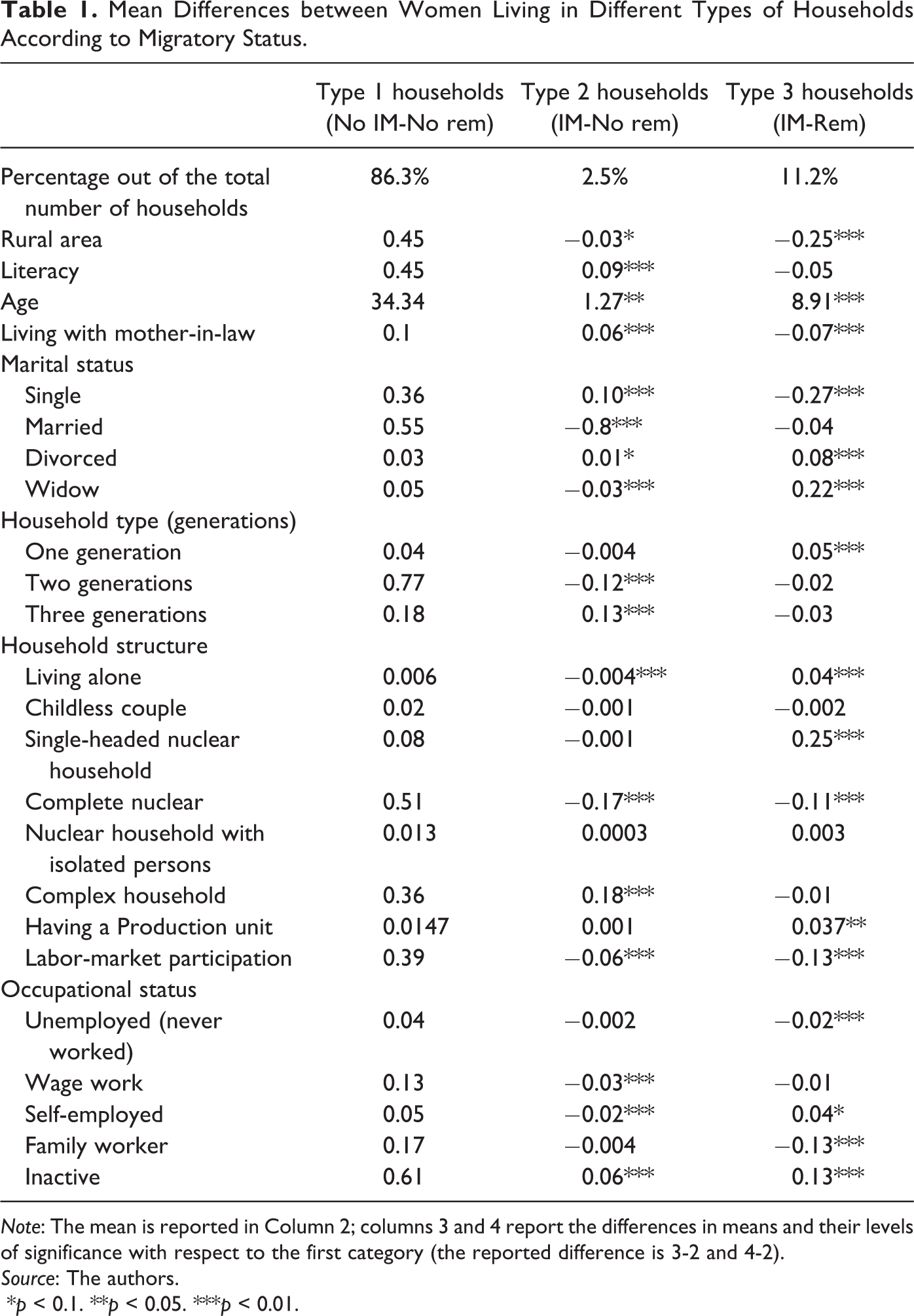
Note: The mean is reported in Column 2; columns 3 and 4 report the differences in means and their levels of significance with respect to the first category (the reported difference is 3-2 and 4-2).
Source: The authors.
*p < 0.1. **p < 0.05. ***p < 0.01.
If we scrutinize occupational status, more differences appear. Women in Type 3 households are less likely to have never worked or to be a family worker and more likely to be self-employed or inactive than women in Type 1 households. Women in Type 2 households are on average less involved in wage work and self-employment and more prone to be inactive, again in comparison with women living in Type 1 households. From this first simple analysis, we can observe significant differences in labor-market outcomes between women living in households with or without migrants and with or without remittances. In the next section, we try to determine to what extent the household’s migratory status impacts women’s labor-market outcomes.
Empirical Strategy
Our first approach to the question of whether the household’s migratory status impacts FLFP is to use labor-market participation as a dependent variable and to estimate the model described below. Here, labor-market participation is a dummy variable which takes a value of 1 for those who declared they had a waged or nonwaged activity and those who were unemployed and looking for a job at the time of the survey. We later use a similar model in which we replace the dependent variable with the specific statuses of unpaid family work and income-generating (salaried or self-employed) activity:

In this equation, Migrant is a dummy variable indicating whether the household has an international migrant among its members; Remittances is the log of the amount of remittances received by the household; and X is a set of control variables that includes age, marital status, presence of an internal migrant, number of children aged under six in the household, type, and structure of the household, and indicators of nonlabor income such as owning land and livestock or having a production unit. To control for province-specific economic context, we also control for the provincial poverty and vulnerability rates and the regional unemployment rate. We add regional dummies to control for any indirect effect of migration on any potentially durable change in the economic and labor-market environments at origin (Mendola and Carletto 2012), specifically those, such as long-term droughts, that affect even households without migrants. In rural Morocco, examples of such effects include land price inflation and a progressive shift in agricultural investment from less to more fertile regions, which result in local job losses and a boom in construction (Steinmann 1993).
It is important to note that the concept of labor-market participation covers very heterogeneous situations. For instance, most economically active women declared that they were unpaid family workers (44.6%), and another 10 percent were unemployed and had never worked. Both of these statuses are unlikely drivers of enhanced economic status and greater decision-making power for women, as highlighted in the literature review. It is therefore necessary to differentiate between categories of labor-market participation. Because of the very different implications of these types of work for women’s economic empowerment, we run separate regressions on the probability of being an unpaid family worker and of having an income-generating activity. While the literature review highlighted how wage and self-employed female workers were often at a disadvantage in the labor market due to being overrepresented in low-paid and precarious jobs, income-generating activities nevertheless remain an important route to gaining the resources necessary for exerting greater agency. On the other hand, unpaid family work (defined in the 2006–2007 MLSMS as household members who work for the profit of the household itself or one of its members) is often regarded as an extension of a woman’s domestic role and, as such, does not yield positive outcomes in their capacity for making strategic choices in their lives (Kabeer 2012). Contrasting these two types of activity therefore gives us an indication of the role played by international migration in the lives of women staying behind, particularly whether it can lead to any changes in the traditional gendered division of labor and increased female autonomy.
Identification
An additional consideration for our analysis is that migration is an endogenous variable with respect to labor-market outcomes (e.g., Acosta 2006). Indeed, when estimating migration variables’ impact on labor-market behavior, one source of endogeneity is the issue of reverse causality (McKenzie and Sasin 2007). This means that the migration outcome we observe can be the result of the decision to participate or not in the labor market. In our case, it means that a woman’s decision to join the labor market may have resulted in the migration of one or more family members. Although this issue was never mentioned in practice or in interviews, we cannot fully discard the presence of reverse causality. Moreover, the data do not allow us to clearly distinguish the timing of the migration decision or labor-market participation. Another source of endogeneity with which we must deal is omitted variables. Here, this issue comes down to supposing that women’s labor-market participation and household members’ migration outcomes are both determined by unobservable characteristics that will bias our results. These unobservable characteristics could, for instance, be linked to family dynamics or family culture and could jointly determine the dependent and independent variables. Again, we cannot reject the existence of such a bias.
To correct any bias that could be due to this endogeneity issue, we use an instrumental variable approach, as is common in the migration literature (McKenzie and Sasin 2007). This consists of finding an independent variable which will serve as an instrument for the supposed endogenous variables and which cannot be correlated with the error term of the equation. As we are interested here in potentially two endogenous variables (having an international migrant and receiving remittances), we need two instruments. The traditional instrument, used by Binzel and Assaad (2011) and Lokshin and Glinskaya (2009), is the share of international migrants in the population for each province, and it serves as a proxy for migrant networks at the community level, which can provide information to potential migrants and lower their cost of migration. However, we argue that the migration share at survey time is correlated to labor-market conditions. For instance, a high migration rate might be the result of a negative income shock at the province level, which might also act as an incentive for women to join the labor market. As we do not have a previous survey that we can use to construct retrospective migration rates, we rely on data from the Association Marocaine d’Etudes et de Recherches sur les Migrations (AMERM), which classifies provinces according to their emigration rates between 1994 and 2004. From these data, we thus construct a variable for “migration intensity,” whose values range from 1 for very low intensity (<0.08) to 4 for high intensity (more than 3.6), and as an instrument for the probability of having an international migrant. To correct for remittances’ endogeneity, we rely on the instrumental approach used by Taylor, Rozelle, and Brauw (2003), who argue that remittances received by the household are influenced by the village norm. Thus, we used the average level of remittances among households in the geographical unit 12 (dropping the observed household) as a proxy for the village remitting norm. To confirm the effects observed through the quantitative analysis, we conducted robustness checks relative both to the potentially endogenous control variable and to the specific case of households with migrants and no remittances. The test, included in Appendix, shows no change in the coefficients of our variables of interest.
Results
Table 2 presents the main results for the determinants of FLFP (columns 1–4), of the probability of being an unpaid family worker (columns 5 and 6), and of the probability of having an income-generating activity (columns 7 and 8). Below, we discuss in turn the influences on these employment outcomes arising from international migration, remittances, and sociodemographic characteristics, as well as from other control variables. To illustrate and complement this discussion, we draw on observations from our qualitative fieldwork.
Determinants of Labor-market Outcomes.
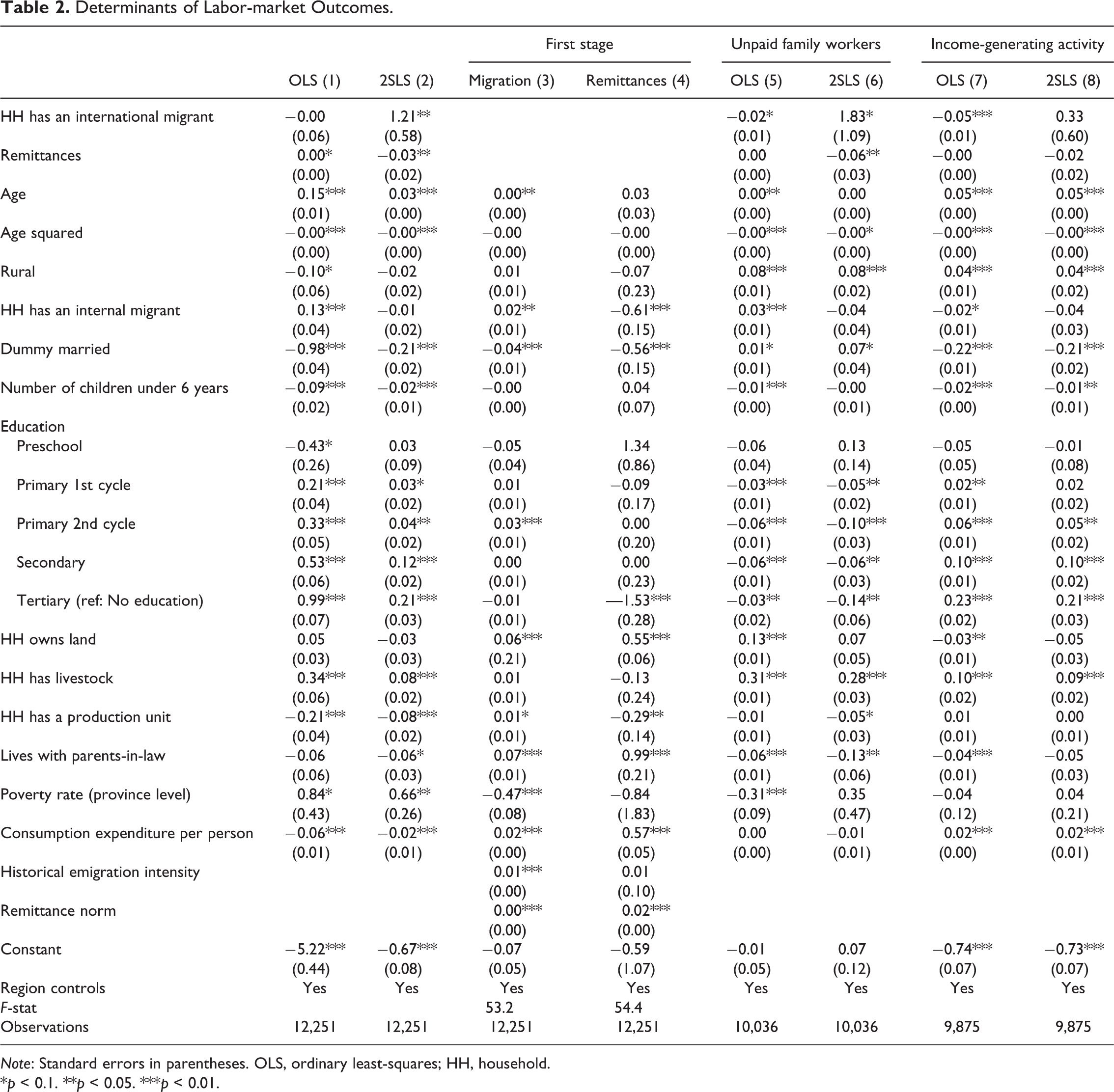
Note: Standard errors in parentheses. OLS, ordinary least-squares; HH, household.
*p < 0.1. **p < 0.05. ***p < 0.01.
The Effects of Migration and Remittances on Overall FLFP, Income-generating Activities, and Unpaid Family Work
In Table 2, the ordinary least squares (OLS) 13 results in Column 1 suggest that the only role played by international migration in FLFP is through remittances, which seem to increase the activity rate. This finding is in contrast with other studies from the labor economics literature, which tends to show a decrease in FLFP resulting from remittances (e.g., Amuedo-Dorantes and Pozo 2006; Binzel and Assaad 2011). Column 2 presents the results of our instrumented regression, where we try to correct for the endogeneity bias of international migration and remittances. In this model, migration and remittance coefficients are now statistically significant and have the expected signs according to the theoretical literature: The probability of joining the labor market increases when one of a household member is abroad and decreases with remittances receipt.
The increased FLFP resulting from having a migrant abroad is consistent with the migration-induced labor reallocation mechanism outlined in the Impact of International Migration and Remittances on Female Employment Patterns in the Country of Origin section. However, this mechanism supposes a certain degree of substitutability between women and men in the labor market, which is more likely to happen in unpaid family work than income-generating activities in Arabic Muslim countries (Binzel and Assaad 2011). Using the instrumented model, we also notice that the effect of having an internal migrant disappears, suggesting a correlation between internal and international migration. Indeed, as was shown in de Haas (2006), internal migration often facilitates international migration. As internal migration is not our focus and as we do not have a reliable instrument for the probability of having an internal migrant, however, we do not analyze its coefficient but instead use this variable to control for any household migration pattern not captured by the international migration variable.
As mentioned above, the significant negative effect of remittances on FLFP observed in Column 2 is consistent with the literature (Acosta 2006; Amuedo-Dorantes and Pozo 2006; Binzel and Assaad 2011). Indeed, receiving remittances releases the income constraint and allows women to withdraw from the labor market, where they face poor working conditions and low wages (Belarbi, Achy, and Ksikes 2013). The first-stage regressions show that the historical emigration intensity and remittance norm at the district level are strong determinants of, respectively, migration and remittances. We tested alternative instruments, such as the share of returnees per province, using the 2004 census and database on the density of money transfer offices, but none prove to be strong enough.
The results presented in Table 2’s last four columns confirm our intuition that effects observed for the overall FLFP are driven by the considerable share of unpaid family workers in the sample. Indeed, the coefficients for migration and remittances remain significant for unpaid family workers, while they are not significant for the probability of having an income-generating activity. Thus, having a migrant among former household members increases both the workload for remaining members and a woman’s probability of becoming an unpaid family worker, as previously observed by Mu and van de Walle (2011) and Chang, Dong, and MacPhail (2011) in rural China and by Mendola and Carletto (2012) in Albania. On the other hand, receiving remittances allows the family to work less, thus decreasing women’s employment. Our interpretation of the results is that the probability of being an unpaid family worker is labor-supply driven and can thus be impacted by migration, while the probability of having an income-generating activity is labor-demand driven, with migration channels having no impact.
Women’s Unpaid Family Work and Animal Husbandry
The saliency of unpaid family work for rural women — particularly for those living in international migrant households — came out strongly in both the quantitative and qualitative data, and we decided to delve further into the analyses of this type of work. Using the MLSMS data, we added to our models dummies for owning livestock and having a production unit to control for the family’s income while also taking into account the substitution that might occur between joining the labor market and performing domestic work outside the house. We find that owning livestock increases FLFP. While this relationship is also observed for income-generating activities, it is strongest for the unpaid family workers who are very often in charge of the household’s livestock. Indeed, animal husbandry is culturally regarded as women’s work in Morocco and remains an enduring practice (Nassif 2008). In contrast, owning a production unit decreases the probability of FLFP and of being involved in unpaid family work, probably through the added income effect generated by the production unit. This shows that female household members are generally not involved in the running of these units. This finding is interesting for international migration studies because the differentiated impact of these two variables suggests that, in a given country, the choice of the types of economic investments made in migrant households can lead to different labor-market outcomes for women, depending on their traditional role in the local gendered division of labor.
Fieldwork confirmed the importance of unpaid work to Moroccan rural women, even among migrants’ spouses. All interviewees had worked as helpers on their families’ farms or land at some point in their lives, although moving from their remote villages to the town of Tazat allowed many of them to withdraw from the most strenuous tasks of fetching water and working the fields. In rural areas, unpaid family work is usually agricultural, in the form of working in the fields and taking care of livestock, both of which are seen as normal activities for women. However, as suggested in Table 2, land and livestock did not have the same importance to women’s workloads and livelihoods. In Morocco, male emigration in the 1960s and 1970s was often associated with land purchases, the intensification and modernization of agriculture, and increased livestock production at origin (Steinmann 1993), all of which are likely to lead to an increase in female agricultural employment. However, the results in the right panes of Table 2 and our interviews suggest that the probability of being an unpaid family worker does not increase much for women living in households owning land. This weak relationship has been previously explained by the fact that women in nonmigrant or internal migrant households took up the additional workload in exchange for cash or inkind payment (fodder or milk), as observed by Steinmann (1993) and de Haas and van Rooij (2010) in the Todgha Valley. In Tazat, international migrants have likewise invested in land and possessed most of the cultivated area, but these investments were no longer seen as profitable due to the low outputs. Therefore, many plots remained uncultivated, and women in international migrant families were not much involved in this type of work and did not seem to benefit much from female labor exchange systems, unlike what Steinmann (1993) and de Haas and van Rooij (2010) observed.
In contrast to land cultivation, animal husbandry appeared to be a more substantial source of income for local women, including those in international migrant households. As suggested by the strong correlation indicated in Table 2 between household livestock ownership and female engagement in unpaid family work, women play a critical role in the livestock production systems of Morocco’s arid and semi-arid regions, where they work as unpaid labor on small-scale farms (Nassif 2008). Far from diminishing, this role is reinforced by the effects of climate change and the increased labor requirements of intensive animal husbandry. Traditionally a female activity, livestock rearing is considered a form of savings and risk mitigation strategy, as well as a source of cash whenever needed (Nassif 2008). This can explain the emphasis placed on this activity in households affected by predominantly male emigration (Steinmann 1993). Interestingly, and although this activity did not appear as a crucial component of the overall household subsistence, animal husbandry was an enduring practice in international migrant households, where most of the interviewed women continued taking care of a few animals (usually sheep, chickens, and cows). Beyond the mere economic necessity, the interviews suggested that the women were particularly attached to an activity that represented something of a personal safety net and insurance against the vagaries of life, one they could mobilize at times of crisis. Moreover, this activity seemed to serve another — and perhaps more symbolic — level by giving them a sense of actively contributing to the household livelihood by providing means of subsistence and occasionally a bit of cash and, hence, relieving their complete dependence on remittances and other cash income. The effects of emigration and remittances therefore appeared to have very differentiated effects on FLFP in Morocco. As presented in the following sections, however, women’s sociodemographic characteristics such as age, level of education, and, most importantly, marital status are also crucial in understanding women’s engagement in paid and unpaid economic activities.
Age and Education
The LSMS analyses showed that FLFP is strongly influenced by age and education, as previously observed in Morocco (Taamouti and Ziroili 2011). For the different employment outcomes, activity rates increase with age and decrease with its quadratic term. We also find that education increases FLFP and the probability of being involved in incomegenerating activities. Our coefficients for the education dummies indicate that the probability of participating in the labor market decreases for lower levels of education compared to higher education. The direction of the relationship between levels of education and the probability of being engaged in unpaid family work is reversed; however, confirming that this type of activity is performed mainly by poorly educated rural women who may not have other options. In line with this observation, we note that despite important progress in female literacy among Tazat’s younger generations, most women — including migrants’ wives — tended to have very low levels of literacy. For this reason, and due to the lack of unskilled paid work opportunities in the area, most had never worked for a wage, despite extensive involvement in unpaid family work.
Marital Status as a Strong Predictor of FLFP, Especially in Migrant Households
Table 2 shows that being married decreases the overall FLFP and, more specifically, the probability of being involved in income-generating activities. This relationship is also confirmed by Figure 1, where the vertical line indicates the average age at the time of marriage. We see that labor-market participation starts to decline after marriage, which is a result found also by Assaad and Krafft (2014) in Egypt. This strong effect of marital status is not surprising in a context where the wife is entitled to her husband’s support according to Islamic rules (the nafaqah mentioned in the Migration and Female Labor-Market Conditions in Morocco section) and where she may have to obtain authorization from her husband to engage in paid work outside the house. In addition, she may be discouraged by scarce and unfavorable labor opportunities, as well as by the fact that employed women continue to take on the bulk of domestic work (El Harras 2006). This relationship is, however, not observed for unpaid family work, which is understandable, because this type of work is regarded as an extension of a woman’s domestic tasks.
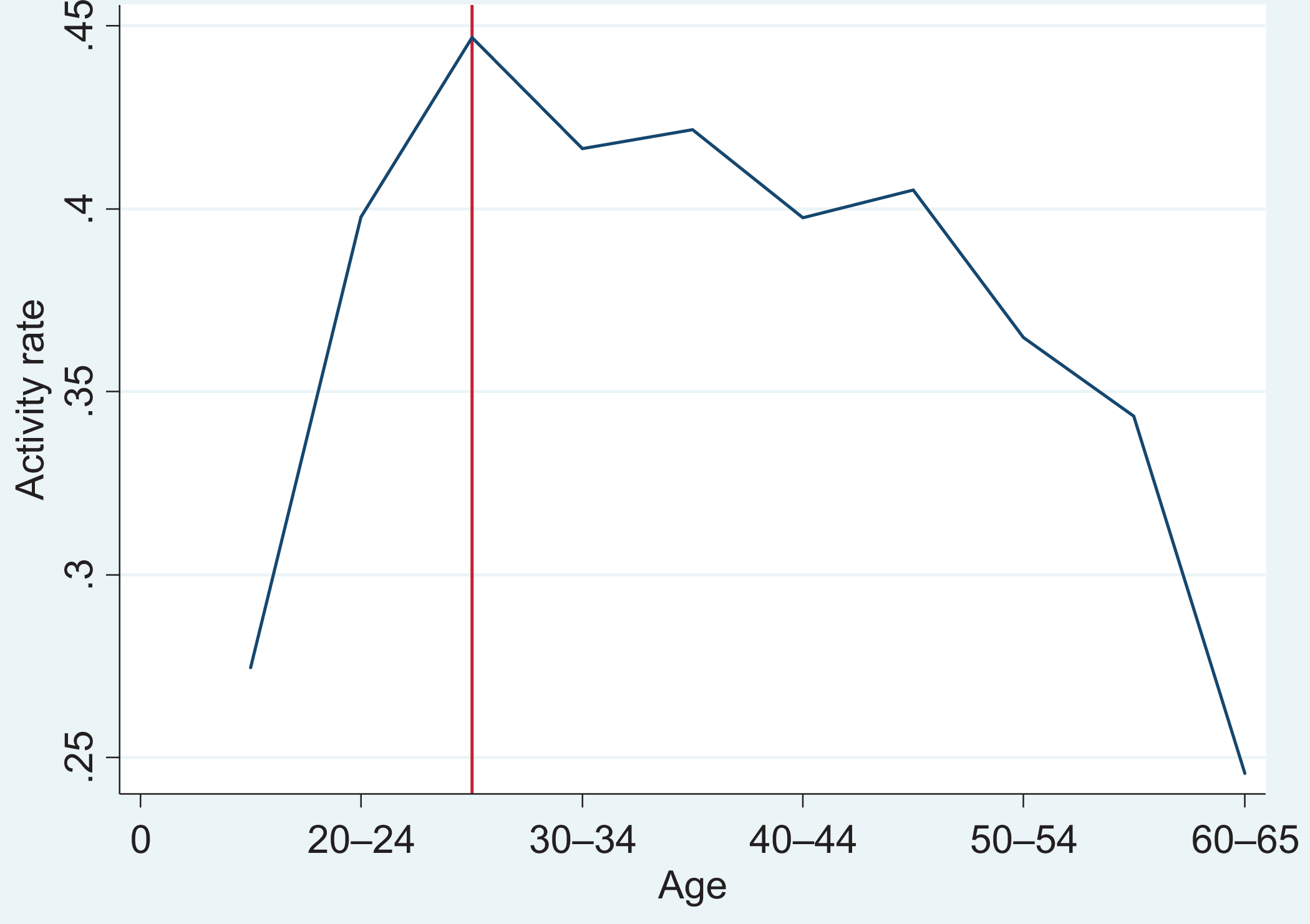
Probability of Participating in the Labor Market for Each Age Category and Average Age at the Time of Marriage.
Our qualitative fieldwork confirmed the saliency of marital status as a factor in explaining FLFP and further revealed how living in an international migrant household could accentuate this effect. None of the wives of current or past international migrants we interviewed had ever worked for a wage. Thanks to remittances, they were spared the necessity of taking part in paid activities, which were usually done by those with no other options, and could, instead, comply with the more traditional and valued role of a housewife who looked after her home and the numerous subsistence activities for which rural women are usually responsible.
Furthermore, interviews also highlighted that this withdrawal from income-generating activities cannot be explained solely by the higher living standards that remittances allow. Indeed, the amounts remitted by migrants were usually modest (around 1,000 dirham
14
per month), and wives were not necessarily the direct recipients of this money, especially if they lived with in-laws. This was the case of Leila (59), a migrant’s wife who spent two decades living with her brother-in-law and his family and who recalled, Every time I asked him [the brother-in-law] for money […], he would always say no and would reply, “Wait for the idiot you married. When he comes, he’ll buy you everything you want!” He received the money from my husband, but he would not give me any. Just food, that’s it.
In these conditions, the benefits that individual women can draw from their husbands’ emigration should not be exaggerated, and other considerations may explain these women’s relative withdrawal from the labor market. Indeed, in a context where a woman’s engagement in paid work is likely to be interpreted as a sign of her husband’s inability to provide for his family, wives can be deterred from looking for work in order to spare their spouse and family from criticism and mockery in the community. This can be accompanied though, with concern and regret over their financial dependency and inability to earn their own income. As Rokia (31) explained, I would have liked to work because when you earn your own money, you can buy whatever you want, like clothes, for you and for your children. It is not normal to have to ask for money every time you need something. It is not normal to always wait and not to have even one dirham on you. But my father and then my husband, they never wanted me to work. You do the housework, and that’s it […] The people from our village, they are like that. Even if they don’t have anything, they are proud, and they prefer their women to stay at home.
This social pressure to maintain a certain status is particularly strong for international migrant households, whose living standards and activities tend to be scrutinized and commented on in the communities. As a result, the wives of international migrants generally remained financially dependent on their migrant husbands. This represents not only a situation of heightened vulnerability but possibly also a necessary condition — if not a strategy — for strengthening their claim on the migrant’s money. As previously highlighted by Hoodfar (1997) in relation to urban married women in Egypt, maintaining financial dependency on a migrant spouse can be a way for women to enforce compliance of Islamic obligation of financial support over their husbands and to ensure the continuation of remittance flows. Our fieldwork therefore suggested that while the effect of marital status is crucial to explain women’s engagement in the labor market, it may differ slightly between migrant and nonmigrant households.
The case study also showed that in contrast to migrants’ spouses, unmarried adult daughters and sisters (especially if single or divorced) living in migrant households were likely to perform waged activities, although not necessarily in the least-paid and most strenuous jobs. This fact hints at a differentiated impact of remittances, according to the relationship to the migrant, as has been previously observed in qualitative studies in Morocco (Sadiqi and Ennaji 2004; Bourqia et al. 2007). Labor-market participation in left-behind households is largely dependent on who receives the remittances and handles the household budget, as well as how secure and sustainable this source of funding seems to be for individual women. Due to the cultural inappropriateness of childless women living on their own, unmarried adult daughters and sisters tend to stay with their families and may therefore benefit from remittance money. However, economic dependence is unsustainable for them, as they cannot claim financial support as strongly and convincingly as migrants’ wives or mothers. Thus, they may have no other choice but to contribute their own income to the household budget to survive economically and assert their position in the household hierarchy. The need to take on such paid activities often arises following a change in household circumstances, such as a decrease in the level of remittances or the migrant’s return. The latter is illustrated by the case of Zineb (27), who decided to resume her studies in hopes of eventually finding a job because her returned migrant father stopped spending much money on his family beyond subsistence. While our dataset did not allow us to investigate this dimension further, more research is needed on the gender-differentiated impact of emigration according to family relationship.
Regarding other family-related determinants of female employment outcomes, Table 2 also shows that the number of young children in the household decreases both FLFP and the probability of performing an income-generating activity, indicating a trade-off between caregiving and working outside the home. Similarly, we observe that living with parents-in-law has a negative effect on the probability of joining the labor market. This result can indicate both the higher caregiving needs that working-age women must satisfy in extended households and the stricter supervision and regulation to which they are often subjected when living with in-laws (Lenoël 2017). The fact that women generally remain responsible for all domestic care work, even when working outside the home, is undoubtedly a great disincentive to join the labor market and points at the importance of the household structure in explaining their labor-market outcomes. While no longer the dominant family structure in Morocco, the extended patriarchal household and its traditional distribution of power along gendered and generational lines continue to affect female members and the extent to which they can engage with the community, especially in rural areas (El Harras 2006; Lenoël 2017).
Discussion and Conclusion
This article has provided the first-ever study of the impacts of emigration and remittances on women’s labor-market participation in Morocco based on nationally representative data and a mixed-methods approach. Its analysis has distinguished between two types of activities that have markedly different implications for women’s economic empowerment: income-generating and unpaid activities. In doing so, it contributes to the debates over whether emigration can promote a gender-sensitive development at home. After analyzing the 2006–2007 MLSMS while controlling for endogeneity, we find that having a migrant among the former members of the household increases FLFP, while remittances negatively impact it. Such findings are broadly consistent with the previous literature. However, further investigations showed that the labor-market participation results are driven mainly by one particular status — that of unpaid family workers, in which Moroccan women are overrepresented. The results show that migration increases a woman’s probability of being an unpaid family worker, reflecting the need to compensate for a decrease in labor supply, although it has no significant impact on the probability of women having income-generating activities. The latter, in fact, is mainly determined by the factors extensively described in the literature on FLFP — namely education, age, marital status, and family characteristics — and by structural factors linked to labor demand.
These empirical findings are further supported by the interview data collected from women in international migrant households in southern Morocco. These testimonies confirmed the crucial role of marital status in determining women’s engagement in work, but also showed how migration could interact with this status. Interview data highlighted how the mechanisms whereby migration impacts women’s employment at origin operate very differently, depending on both the structure of the household in which the woman lives and the family relationship between the woman and the migrant. These complementary findings call for the use of appropriate qualitative and quantitative surveys in future research on the differentiated impact of migration and remittances, specifically according to the sex of the migrant, the sex of the recipient, and the nature of their relationship. Most importantly, the qualitative fieldwork indicated that while patriarchal attitudes are an important factor in women’s low levels of engagement in paid activities, the most compelling explanation for this situation probably lies in the lack of good job opportunities for women, especially in rural areas. If remittance income acts as a disincentive to work outside the home, for many Moroccan women, it is mainly a resource which spares them from having to resort to the least attractive and low-paid jobs that are locally available. Overall, this mixed-methods study does not support the hypothesis that emigration leads to increased economic empowerment for left-behind women by enhancing their access to paid employment, although remittances may have a positive effect on their lives.
In the context of the highly debated question as to whether international migration and remittances can bring about gender-sensitive and longterm development, our findings suggest the limited transformative potential of migratory flows shaped by a patriarchal order and the importance of development at origin. It is often argued that development in migrant-sending regions may be a prerequisite for return and investment rather than a consequence of migration (de Haas 2009). A similar argument applies to the economic participation of women. While paid work might seem an important route to women’s economic empowerment, international migration is unlikely to play a positive role in supporting their access to cash-earning opportunities in the absence of more favorable labor-market conditions at origin. In Morocco, female access to quality jobs remains hampered by high unemployment, strong social norms discouraging female paid employment, and women’s role as the main care providers even when working outside the home. Poor provision of services likely to lead to higher FLFP, such as affordable childcare, compounds this situation. Emigration is unlikely to affect these structural factors, nor is likely to change the view on women’s paid work at origin. Indeed, while more progressive ideas about gender roles may be channeled through the flows of ideas, behaviors, and social capital that migrants transfer to their origin communities through visits and communication, these “social remittances” (Levitt 1998) are unlikely to result in major normative shifts at origin in the context of a migratory system shaped by a patriarchal order, where migrants may be wary of challenging the societal norms they leave behind for fear of appearing as “forgetting where they come from” or, in Carling’s (2008) words, failing to “repay the gift of communality.”
In this context, remittances sent by international migrants are more likely to lead to women’s withdrawing from the labor market altogether. On the one hand, this can be regarded as a positive outcome for those concerned, if we follow Sen’s definition of development (2001) as the ability to exert economic choice by withdrawing from arduous paid (or unpaid) work. On the other hand, international migration and remittances may reinforce a traditional patriarchal gender order at origin, which could include encouraging women to rely on men’s religiously sanctioned economic responsibilities toward them. In the context of a male emigration system that is itself predicated on a patriarchal gender order, women’s access to remittances and their claim for support depend on their ability to fulfill their traditional roles. Thus, they may choose not to depart from these roles in order to avoid jeopardizing their positions.
As this study shows, emigration does not necessarily lead to gendersensitive development at home even if it improves the living standards of many women. Migration and remittances may even provide the resources for conservative forces to resist progressive changes at home in terms of gender equality and status. Future research is warranted on the relationship between migration-induced changes and the evolution of social norms within origin countries. It should also investigate how the changing composition of migratory flows (especially the feminization of economic migration) may have a different impact on population at origin. Given the complexities of such issues and the current data limitations, these questions are best approached using mixed methods.
Footnotes
Appendix: Robustness Checks
Acknowledgments
We want to thank Jackie Wahba, Frédéric Docquier, Alice Mesnard, Hillel Rapoport, Philippe De Vreyer, Hein de Haas, Sorana Toma, Cris Beauchemin, and David Owen, as well as the International Migration Review editors and six anonymous reviewers for helpful comments and suggestions on earlier drafts of this article.
Declaration of Conflicting Interests
The author(s) declared no potential conflicts of interest with respect to the research, authorship, and/or publication of this article.
Funding
The author(s) disclosed receipt of the following financial support for the research, authorship, and/or publication of this article: We gratefully acknowledge the support of the Economic and Social Research Council in funding this research (ES/I901884/1).
