




Abstract

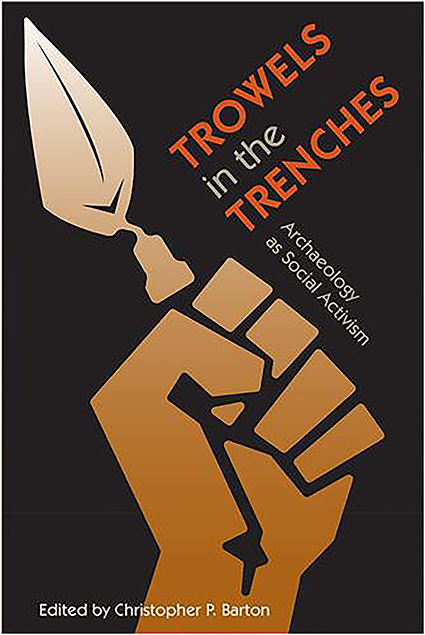
Trowels in the Trenches is a welcome cornucopia of chapters that demonstrate how and why archaeology can be socially activist, if practised in collaborative ways that are explicitly anti-racist and open to developing new public archaeological methods and practices. It follows in a burgeoning genre of books on archaeology as social activism (e.g., McGuire 2008, Stottman 2010, Battle-Baptiste 2011, Kiddey 2017), which call for archaeology to positively affect social, political, and environmental change in the present, for the future. From the preface and throughout, this book has integrity.
Chapter 1 (Barton) identifies ways in which contemporary issues to do with poverty and racism are inextricably linked to historic processes and events, which can be explored archaeologically. Before briefly introducing the 10 chapters and conclusion which follow, Chapter 1 argues that an important reason to democratise archaeology is not just to include others in research design and interpretations but to empower audiences to think critically for themselves. Chapter 2 (Klembara) is a sophisticated discussion of the author's use of queer theory in interpreting Upper Palaeolithic European art. Klembara argues robustly, but playfully, that better understanding of sexual and gender identities in the deep past can help to make the world a safer place for LGBTQ+ people today. Chapter 3 (Somerville) focuses on human remains from Fort Laurens, Ohio. The chapter links historical networks and violence to increased acts of violence based on perceived racial ideologies. It is a serious chapter that unpacks the ways in which the violent colonial frontier of America remains active in present day ideological arguments and lasting inequalities. Chapter 4 (Keita, Tessougue, Fane) discusses important work by archaeologists from Mali to document the destruction of cultural heritage sites by jihadist occupation of Timbuktu in 2012. The chapter describes a very recent socio-political context fraught with apparently more immediate concerns than how to save archaeology from destruction. The authors make the point that such sites “tell us where we came from and who we are,” and that, as such, it is local communities who must play important roles in protecting such places because “they are the ones on the ground who can make the most meaningful impacts” (pp. 80). Chapter 5 (Fryer, Diserens Morgan) focuses on the authors’ work in Quintana Roo, Mexico. They operate at the intersections of archaeology, heritage, and tourism, as these things relate to potential ways to relieve the region, known for the Maya Social War or Caste War (1847–1901), from ongoing marginalisation. Collaborating in creative ways with local contemporary communities, Fryer and Diserens Morgan are clear that an economy based on tourism has directly removed control from local (primarily, Indigenous) people and exacerbated social inequalities.
Chapter 6 (Brighton, Webster) presents findings from their work on the archaeology of Skibbereen, County Cork, Ireland, which they argue can be useful in addressing social justice in the present. Discussion includes the use of single-room rock cabins inhabited by some of the most marginalised people of the early nineteenth century, but this chapter falls down theoretically. Of more than sixty-five references, only seven were published after 2011! There is a wealth of literature on how history and archaeology continue to affect contemporary political and social life in Ireland and the chapter would have been more meaningful for engaging with it. Chapter 7 (Barton) discusses relationships between gender, class, and race through analysing “topsy-turvy dolls” that were common in the American South following the Civil War. Dolls were typically made from cloth, with the head and torso of a Black doll attached to the waist of the head and torso of a white doll. The dolls were used to instruct white children about race, disenfranchising and dehumanising Black people at the same time. Barton draws on sociological experiments and published works by Dr Kenneth and Mamie Clark – Black academics in the 1940s. This important chapter is enriched by highlighting the historic Black scholarship that first identified the specific ways in which the dolls contributed to racism and to Black children having negative self-worth.
Chapter 8 (Means, Nautiyal) discusses the use of digital practices to record threatened sites of cultural heritage in Uttarakhand, India. The rich discussion of the use of 3D scanning technologies and useful conversation about how international universities collaborated marks this chapter as a model for future similar collaborations. Chapter 9 (Camp) is a powerful discussion of the value of digital databases in not just preserving and recording, in this case, the archaeology of Kooskia Internment Camp (Japanese internment camp, Idaho), but also, in making raw archaeological data publicly available, thus paving the way for more democratic interpretations of the past. As Camp notes, digitisation is often seen pejoratively – no one wants to pay for it, it is unglamorous and laborious – but this chapter is an excellent example of how digitisation can be radically activist.
Chapter 10 (Matthews) draws elegantly on his work with Native American and African American communities in Setuaket, New York, to explore environmental racism – the ways in which environmental degradation often affects people of colour more profoundly than white people. He argues that historical archaeological perspectives on such matters can inform present day injustices.
Chapter 11 (Thompson, Marek-Martinez) discusses cultural resource management and social justice in relation to the Navajo Nation. This chapter is necessarily complex. It navigates ways in which hierarchical structures of compliance leave many community members isolated from decisions about heritage issues, ensuring that this chapter has applicability across the globe. The final chapter is by Joe Watkins, a foremost scholar on social activism in archaeology. Watkins defines activist archaeology and calls for it, discussing a variety of examples of engaged archaeological practice.
Trowels in the Trenches will certainly make its way to the recommended reading lists of archaeology courses around the world, and for good reasons. These include its impressive diversity – case studies and contributors are from India, Mali, Mexico, as well as Europe and the United States. Black, Indigenous, and queer scholars are represented. My only criticism is that while welcome diversity exists among case studies and contributors, several chapters in the book cite scholarship by long established, white academics at the expense of equally valuable, more recent work by scholars who are also Indigenous, people of colour, or women. Barton's chapter on race and toys (this volume) stands out as being radically socially activist for the way it highlights how Black people have often had to undertake the work of anti-racism themselves. We must recognise that being actively anti-racist – or any other kind of ‘socially active’ - requires us to read and cite our Black, Indigenous, and queer colleagues far more, because it matters who said what, where, and when.