




Abstract
Strategic ambiguity increases an organization's scope for action. Ambiguous statements are, among other things, easier to deny; they also facilitate change. Strategic ambiguity has long been a theoretically well-established practice in organizational communication research. To date, the substantial number of theoretical and conceptual contributions has been contrasted by relatively few empirical studies of strategic ambiguity. This is the starting point of the present paper, which provides answers to the following research questions: How are the use and diffusion of strategic ambiguity perceived? What goals are pursued with strategic ambiguity? What ambiguous practices are used in strategic political communication? And finally: How is strategic ambiguity assessed ethically? To answer the research questions, semi-structured interviews were conducted. In addition to political PR practitioners, political journalists were also interviewed in order to contrast the self-assessments of PR practitioners with the external assessments of journalists. The results show that strategic ambiguity is perceived as very common in the field of politics. From an ethical perspective, strategic ambiguity is evaluated ambivalently: Protective motives, which are evaluated as legitimate, are contrasted with deliberately deceptive motives, which are evaluated as illegitimate.
Keywords
Introduction
Strategic ambiguity has been a well-known and theoretically well-founded practice in organizational communication research for many years. Ambiguous statements are, among other things, easier to deny; they also facilitate change (Eisenberg, 1984), thus increasing an organization's overall scope for action. To date, this has been described for various fields and in some instances has also been investigated empirically. For example: companies talk vaguely about their sustainability goals (Christensen et al., 2015; Guthey & Morsing, 2014); ambiguously formulated strategies facilitate organizational change (Gulbrandsen, 2019; Leitch & Davenport, 2002); in international politics, strategic ambiguity reduces the risk of conflict (Tekin, 2022; Thiessen, 2022; Zhongqi, 2003); and in political communication research, model-theoretical approaches have described the chances of success of ambiguous strategies (Asako, 2019; Meirowitz, 2005). In contradictory and polarized societies, strategic ambiguity seems to be a promising practice as a means for organizations in various different fields to avoid disappointments and conflicts and to facilitate change.
The large number of theoretical and conceptual contributions is in stark contrast to the relatively few empirical studies of strategic ambiguity to date. As with many practices of strategic communication, this may be due to the problems of empirical access. Content analyses may reveal ambiguity, but the possible intentional character remains a blind spot. Experimental studies can examine the effects of clear and ambiguous stimuli, but they are also blind to the possible intentional character. Ultimately, only communicator studies can reveal motives and use, although the price of social desirability is paid for this advantage and it gives rise to new problems. However, these problems of empirical research apply not only to the topic of strategic ambiguity, but ultimately to almost all deception practices and, thus, to broad areas of strategic communication research. Therefore, the results of studies on deception practices should always be interpreted cautiously and with restraint. Existing interview studies on strategic ambiguity in the field of strategic communication research are either simple case studies (Leitch & Davenport, 2002) or are interested in the development and use of strategy papers (Gulbrandsen, 2019). In this study, PR practitioners were interviewed about how and why they use strategic ambiguity in strategic communication. In addition, journalists were interviewed in order to contrast the PR practitioners’ self-assessments with the journalists’ external assessments.
The lack of empirical studies means that there are hardly any empirical findings even on fundamental questions. This is the starting point of the qualitative study and provides answers to the following four research questions. First, the perceived prevalence of strategic ambiguity is examined. How are the use and diffusion of strategic ambiguity perceived? Next, the motives for using strategic ambiguity are examined. While previous studies for the most part limited themselves to the omission of concrete figures or the use of metaphors when examining concrete practices (Carmon, 2013; Contractor & Ehrlich, 1993; Leitch & Davenport, 2002), this study follows a broad understanding of strategic ambiguity and considers various different dimensions or practices (Hoffjann, 2021), which are then investigated in the third research question. Finally, the focus is on ethical reflection: How is strategic ambiguity evaluated in the ethical context?
The paper focuses on the use of strategic ambiguity in political communication. If the function of the political system is the production of collectively binding decisions (Luhmann, 1995), political communication can be defined in a broad sense as communication of the political system and, thus, as communication in the medium of power. Since this understanding also includes private political discourse, the definition needs to be narrowed down even further. Political communication is understood in a narrow sense as strategic organizational communication of political organizations. Strategic communication in contrast to recent narrower understandings (Zerfass et al., 2018) should be defined in a broad sense as “purposeful use of communication by an organization to fulfill its mission” (Hallahan et al., 2007). Similar to strategic ambiguity, strategic communication has always been viewed critically. With Jürgen Habermas, this first becomes apparent in the distinction between communicative and strategic action. While communicative action is value-oriented and focused on the common good, strategic action is power-oriented and serves the interests of an individual or a group, whereby “the actor is supposed to choose and calculate means and ends from the standpoint of maximizing utility or expectations of utility” (Habermas, 1985, p. 85). In addition, Habermas (1989) had already made public relations responsible for the refeudalization of the public sphere in his book “Structural transformation of the public sphere,” stating that PR reinforces existing power structures and prevents social change.
Strategic Ambiguity: The Concept
The postulate of clarity is still considered the “gold standard” (Abdallah & Langley, 2014, p. 237), especially in instrumental approaches to strategic communication (Riel & Fombrun, 2007). In order to present an organization as a distinct, coherent, and credible entity (Christensen & Cornelissen, 2013), several prescriptive concepts, such as that of integrated communication, have been developed (Kliatchko, 2005).
With the rise of the interpretive paradigm, ambiguity-focused approaches have gained increasing attention in recent years. They often derive their plausibility from criticisms of the postulates of clarity and consistency (Christensen et al., 2008, 2015). The pioneer of strategic ambiguity to this day is Eric M. Eisenberg (Eisenberg, 1984). He understands ambiguity not as a feature, but as a relational variable as a combination of source, message, and receiver factors. Thus, ambiguity refers to the coexistence of different points of view and divergent perspectives on the world; it does not refer to a false understanding of how the world really is (Guthey & Morsing, 2014).
While the clarity- and ambiguity-focused approaches are interested only in the advantages of one side, integrating approaches have also been introduced in recent years (Gulbrandsen, 2019; Hoffjann, 2021). According to such approaches, organizations oscillate between predominantly clear and ambiguous content and forms. In strategic organizational communication, the communicator discusses and balances the intended effects against the background of clarity and ambiguity. In the case of strategic ambiguity, information or the form of the message is specified only to the extent that this appears indispensable for securing follow-up behavior. Strategic ambiguity in strategic organizational communication can thus be defined as (a) the deliberate use of (b) potentially ambiguous information or forms, (c) which are intended to be interpreted differently by different addressees or ambiguously by one addressee, (d) especially in order not to disappoint contradictory expectations and thus to ensure follow-up behavior toward strategically relevant goals. (e) Whether strategic ambiguity is also understood in this way in strategic communication is a matter of attribution or understanding and thus depends on the addressees (Hoffjann, 2022).
Analytically, a distinction can be made between two causes for the attribution of ambiguity (Hoffjann, 2022). In the case of vagueness, a situation appears to be underdetermined due to a lack of more concrete information necessary to be able to determine something unambiguously. In mixed messages, several clear but contradictory statements lead to the attribution of ambiguity (Sohn & Edwards, 2018).
The concept of strategic ambiguity has been taken up many times to date (Johansen, 2018). Eisenberg already spoke in 2006 of hundreds of citations in the field of communication and organization research (Eisenberg, 2006). Applications range from studies of strategic ambiguity in mission statements (Carmon, 2013) to change situations in public sector organizations (Leitch & Davenport, 2002). It has been applied particularly intensively in research on crisis communication (Kline et al., 2009). Strategic ambiguity has experienced a similarly intensive reception in the communication of values or in the context of corporate social responsibility (CSR) (Christensen et al., 2015; Scandelius & Cohen, 2016).
Relevance of Strategic Ambiguity (RQ1)
While the relevance and prevalence of strategic ambiguity is still largely a blank space in empirical research, its relevance has been explored theoretically many times (Christensen et al., 2015; Hoffjann, 2021; Luhmann, 1995). Its plausibility and, thus, its relevance are often derived from the critique of the postulates of clarity and consistency. On the micro level, the postulate of clarity is countered with the peculiarities of the “inherently symbolic and thus potentially vague, ambiguous and polyphonic” (Christensen et al., 2015, p. 9) human communication. Therefore, ambiguous messages are more promising.
At the macro level, the contradictions of plural societies are the focus of analysis. This began with the functional differentiation of modern societies (Luhmann, 1995), in which the equal coexistence of perspectives replaced the clear distinction between top and bottom. The price for this freedom of modern societies is the loss of a central social perspective. The loss of social clarity through equal coexistence was so painful that even modern societies tried to hold on to clarity at least until the middle of the twentieth century (Bauman, 1991; Beck & Beck-Gernsheim, 2002). Approaches such as postmodernism (Bauman, 1991) or second modernity (Beck, 1992) ultimately describe a departure from the ideal of clarity. In his theory of reflexive modernization, Beck recognizes above all the emergence of delimitations, pluralization, ambivalences, and the “as well as” (Beck & Beck-Gernsheim, 2002). Bauman (1991) views this as the end of the state as gardener: the wild growth is inevitable.
This proliferation leads to contradictions between institutional expectations that organizations face at the meso level (Brunsson, 2003). The contradictoriness results in the need to decouple activities and formal structure, which neo-institutionalist organization theory has intensively investigated (Meyer & Rowan, 1977). One of several decoupling possibilities is vague—and thus ambiguously formulated—goals. Strategic ambiguity cannot resolve conflicting environmental expectations into harmony, but it can help to ensure that contradictions are perceived as less serious, so that conflicts do not erupt openly but remain latent. Social developments suggest that strategic ambiguity can be a promising practice for avoiding conflicts in plural societies. Therefore, it can be assumed that practices of strategic ambiguity will be used increasingly often. However, the question as to the prevalence of strategic ambiguity is still an empirical blank. Therefore, the first research question is: How are the use and diffusion of strategic ambiguity perceived?
Functions of Strategic Ambiguity (RQ2)
Strategic ambiguity is therefore a way for organizations to deal with contradictory social expectations by increasing the probability of expectation fulfillment and thus ensuring follow-up behavior. (Luhmann, 1995). In the three dimensions of meaning, the function can be described more specifically as follows. In the social dimension, strategic communication is more accessible to different people and groups. Here, the lower risk of disappointment is reflected in the fact that diverse groups with conflicting expectations can be addressed. Eisenberg called this unified diversity (Eisenberg, 1984). In the time dimension, strategic ambiguity is also more connectable at later points in time and thus facilitates change, for example. Finally, in the factual dimension, ambiguous strategic communication is more amenable to different interpretations, easier to deny, and thus also ensures freedom of action.
This is contrasted by the advantages or functions of strategic clarity. In the short term, ambiguous strategies can avoid conflicts, but since they do not resolve them, this often leads only to a temporal postponement of the conflicts. (Abdallah & Langley, 2014). Clear practices can thus bring about the resolution and thus clarification of a conflict or a political issue. Moreover, Eisenberg (1984) has already stated that for people with lower credibility, clear communication is the only way to improve their image. In the context of the political sphere, one could add: While well-known and popular incumbents can remain ambiguous in election campaigns, lesser-known and less popular challengers have to become more concrete and clear in order to win supporters. For the study, this leads to the question of whether this assignment is also confirmed for the relationship between government and opposition. In a content analysis, Bräuninger and Giger (2018) came to the conclusion that government parties formulate somewhat more clearly than opposition parties and suspected that: “One might argue that what government parties promise is more rooted in reality or more constraint by the status quo than what the opposition proposes” (Bräuninger & Giger, 2018, p. 541). Or is the situation in fact the other way around, namely that the opposition tries to attract attention with clearer statements? This leads to the second research question: Why or with what goals is strategic ambiguity used and in which situations is communication deliberately clear?
The question of how journalism deals with strategic ambiguity arises from the functions and the tendency of organizations to employ strategic ambiguity. Journalism has a special role to play in recognizing ambiguity, critically questioning it, addressing it and, if necessary, scandalizing it, as well as demanding clarity. To date, this topic has also been largely neglected in research. This is not surprising, since even the findings on decision-making processes in the general handling of PR content have so far been quite manageable (Godler, 2020). One exception is a content analysis of press coverage in Denmark on CSR. The key finding: The ambiguity of the CSR concept was picked up, reflected upon and ultimately even reinforced by journalists (Guthey & Morsing, 2014).
Practices of Strategic Ambiguity (RQ3)
What specific practices of strategic ambiguity can be found in strategic communication? Previous studies were interested mainly in ambiguous wording (Contractor & Ehrlich, 1993; Eisenberg & Witten, 1987) e.g., in goals or mission statements (Carmon, 2013; Gulbrandsen, 2019), the use of metaphors (Leitch & Davenport, 2002; Scandelius & Cohen, 2016) and mixed messages (Sohn & Edwards, 2018). Obviously, ambiguity has so far been reduced to singular aspects at the messaging level.
If ambiguity is understood broadly as the attribution of a coexistence of different points of view and divergent ways of looking at the world (Guthey & Morsing, 2014), this coexistence of different points of view can refer to further dimensions or practices. The variety of dimensions can be systematized according to the elements of the communication process and whether a dimension primarily refers to the sender, the message or the addressee (Hoffjann, 2021). In addition, there are metadimensions that relate to the strategic character and its identifiability. This relates to communication about the strategic framework. Nine dimensions will be briefly explained below.
In the case of the communicator, strategic clarity and ambiguity initially refer to the (1) organizational profile as the totality of all planned self-descriptions. Should the organization be perceived by addressee groups as clear or ambiguous? If the metadimension refers to the strategic character of the situation, this is concretized at the sender by the (2) sender transparency or identifiability of the strategic communication character.
At the level of the message, in the case of strategic clarity and ambiguity, following Kohring and Matthes (Kohring & Matthes, 2007), a differentiation can be made between topic, information, assessments, and the truth claim. In the case of the (3) topic, the fundamental question is whether a topic should be clearly identifiable or whether mutual transfer effects should be created by combining it with other topics. The (4) information has—as explained earlier—hitherto been the focus in the mentioned works on strategic ambiguity. In the case of (5) assessments, clear strategies can be found in concrete assessments, e.g., on future prospects, while ambiguous assessments deliberately leave this open. Finally, in (6) truth claims, the focus is on the classical truth norm. Clear-cut strategies are truthfulness and lying, because in both cases the organization commits itself. An ambiguous strategy is so-called bullshit (Frankfurt, 2009), in which the bullshitter claims something to be true despite the fact that he is indifferent to the truth of his claim, but hides this indifference from the addressee. In the messages, the metadimension refers to the (7) media schema. Media schemas are collectively shared expectations of media offerings, e.g., with regard to reality, topics, esthetics and style (Schmidt, 1989). A commercial in a classic advertising esthetic is an example of strategic clarity in this dimension, while strategic ambiguity is present when elements of multiple schemes are deliberately used, such as is the case in so-called advertorials.
In the case of the addressee, the first question is (8) addressing. In the case of clear addressing, it should be immediately recognizable to the addressees whether or not they belong to the target group addressed. In ambiguous addressing, this is deliberately kept vague. Finally, the addressee-related metadimension contains statements on (9) target transparency and thus on the recognizability of the intended follow-up action. This is categorized as a metadimension because it either makes the intended effect transparent (e.g., Buy this product! Vote for this party!) or, in the case of strategic ambiguity, only hints at it Figure 1.
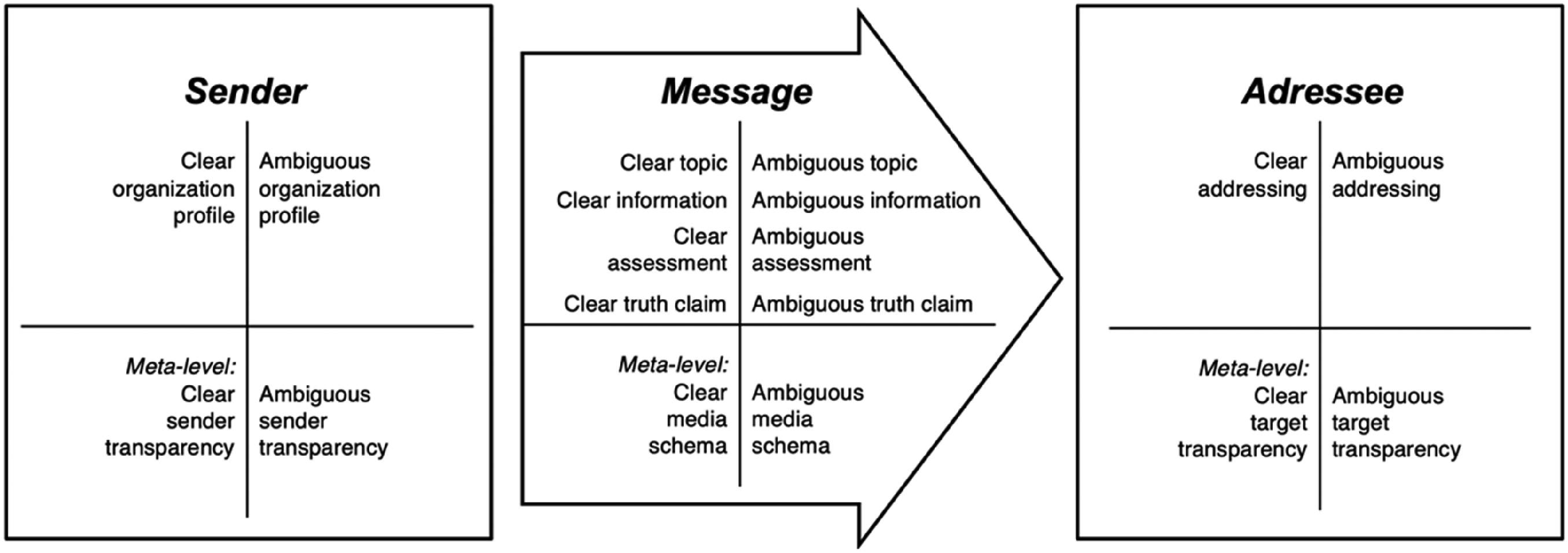
Dimensions of strategic clarity and strategic ambiguity (based on Hoffjann 2021, p. 295).
Such a broad understanding of strategic ambiguity with the practices outlined is the focus of the third research question: What ambiguous practices are used in strategic political communication?
Ethics of Strategic Ambiguity (RQ4)
These various practices of strategic ambiguity finally lead to the ethics of strategic ambiguity and thus to the fourth research question: How are ambiguous practices ethically evaluated? The relevant literature on strategic ambiguity is ambivalent here. From an ethical perspective, the advantage of strategic ambiguity is that the statements are not false, but merely deliberately ambiguous. The advantage of this for ethical discussions is obvious: “the deniability of ambiguous communications allows senders to avoid responsibility for their communications” (Paul & Strbiak, 1997, p. 150). The strategic use of ambiguity “minimizes the importance of ethics” (Eisenberg et al., 2007, p. 33). Strategic ambiguity thus remains a powerful instrument of management, a rhetorical resource that can be used by various actors to assert their respective interests and enable manipulation (Christensen et al., 2021; Jarzabkowski et al., 2010; Sillince et al., 2012; Ulmer & Sellnow, 2000). Nevertheless, strategic ambiguity is often associated with lies and intent to deceive (Dulek & Campbell, 2015). Thus, strategic ambiguity can lead to cynicism, alienation, and apathy in situations in which clarity is expected (Christensen et al., 2021; Morsing & Spence, 2019). Neo-institutionalist authors take a less critical view of strategic ambiguity (Meyer & Rowan, 1977). They evaluate strategic ambiguity as a self-defense measure for organizations to survive in a society full of conflicting expectations.
A more nuanced assessment is possible following Christensen et al. (2021) on aspirational talk. They do classify aspirational talk as a form of hypocrisy when a CEO describes their company as ecologically responsible even though they know that this is not appropriate at that time. If, however, they want to express a vision that the company is striving for, this would not be objectionable from an ethical perspective. If, on the other hand, the CEO does not intend to achieve this goal at all and only tries to conceal their less environmentally friendly actions behind this lie, this would be reprehensible.
Accordingly, strategic ambiguity would be considered ethically questionable if a communicator deliberately acts ambiguously, suggesting an interpretation by the addressee that is favorable to him but, in his opinion, incorrect, while at the same time assuming that he can reject a possible accusation of deception by referring to what he considers to be the equally plausible correct interpretation. For example, a CEO might vaguely promise a sustained increase in profits and speculate that investors will understand this as reinforcing a profit maximization strategy. The organization could refute any possible accusation of deception by pointing to the profits actually achieved, albeit not increased. Strategic ambiguity, on the other hand, can be considered ethically unproblematic if a communicator deliberately acts ambiguously in strategic communication in order to make it easier for different groups of addressees to select different interpretations which are particularly suitable for them in each case, while at the same time believing in the correctness or legitimacy of all possible interpretations known to him.
Method
To answer the four research questions, semi-structured interviews were conducted with experts. The method of expert interviews was appropriate for several reasons. Firstly, the topic of strategic ambiguity and, in particular, the various dimensions and their practices have not been widely known in communications practice to date. It was therefore to be expected that follow-up questions would be asked in order to reveal the implicit knowledge of the interviewees in this way. Therefore, the qualitative approach also seems appropriate and necessary for the first research question on the perceived prevalence of strategic ambiguity. Secondly, the goal of identifying motives and functions beyond those mentioned in the literature spoke in favor of an explorative approach (Galletta, 2013).
Six PR practitioners (PR) and six journalists (J) were interviewed, so that the journalists’ external assessments could be compared with the PR practitioners’ self-assessments. The PR practitioners work in ministries, parties or parliamentary groups in Bavaria, while the journalists report on Bavarian state politics from Munich. The interviewees thus all deal professionally with the same subject matter and have personal dealings with each other. With a population of around 13 million, Bavaria is the second-largest state in Germany. In the federally organized Germany, many important political decisions are made at the state level, so regional and sometimes national media report extensively on these discussions and decision-making processes. A comparative study for Germany (Hoffjann & Lohse, 2016) showed that there are no significant differences in the culture of political relations in the various German states and also at the federal level. The PR practitioners interviewed were specifically selected from among the spokespersons of Bavarian ministries, parties or parliamentary groups, in order to ensure that representatives of the opposition and government were interviewed and that as many parties as possible were represented. For the interviews with journalists, the experts were selected at random from among all Bavarian parliamentary journalists. In both groups, attention was also paid to a balanced gender representation.
For practical research reasons, all interviews were conducted by telephone, especially since some experts preferred this method to video interviews. The interviews were conducted between May and July 2022; an interview lasted about 35 min on average. All interviews were conducted in German; quotes from the experts have been translated by the authors.
Afterwards, the recordings of the interviews were transcribed for analysis. The interviews were then analyzed using MAXQDA software. The dimensions for the subsequent analysis were initially developed from the literature. In particular, the nine dimensions already presented above could be used for the practices of strategic communication. Finally, the analysis was based on the four research questions. The overarching categories were (frequency of) use of strategic ambiguity (RQ 1), goals and functions of strategic ambiguity (RQ 2), practices of strategic ambiguity (RQ 3), and ethical evaluation (RQ 4). The other codes were developed from the material during coding and analysis (Roulston, 2014, p. 305). The presentation of the data and the interpretation of that data are “supported by direct quotations from interview transcripts” below (Roulston, 2014, p. 305).
Relevance of Strategic Ambiguity (RQ1)
When asked about the terms ambiguity and strategic ambiguity, some interviewees were initially uncertain about the meaning of the terms. Not all interviewees could immediately think of examples of practices of strategic ambiguity. Therefore, a definition was given early on to create a common understanding for all interviews. In the course of the interviews, however, it became apparent that all interviewees have at least implicit knowledge of strategic ambiguity and can name many examples. Indeed, almost all interviewees describe these practices as commonplace. For example, PR practitioners in particular say that strategic ambiguity is “daily business in politics” (PR1: 19), that “politicians have always spoken vaguely” (PR5: 29) or “almost everyone actually does that” (PR5: 15). These statements exemplify that the use of ambiguous statements is seen as common practice. Journalists express very similar views. For example, they say here: Ambiguity “is actually daily business” (J1: 43), “Vagueness is part of the political craft” (J4: 31) or “especially the ambiguous practices, i.e., obfuscations, they have always existed” (J2: 95).
The answers to the question of how the use of ambiguous practices has changed in recent years provide a less clear picture. Neither among PR practitioners nor among journalists as observers of political communication does a clear trend emerge. Some PR practitioners and journalists are noticing an increase in ambiguous communications. For example, one PR practitioner explains: “I think it has increased massively. Because […] especially the speed in […] social media and the general pressure to react quickly have led to sending a lot more vague and unverified statements into the world.” (PR4: 19). A second group, on the other hand, does not identify any changes. A third group includes representatives who perceive an increase in clear communication in recent years: “recently, it has become less so. Debates […] about the authenticity of candidates or the recognizability of parties have made it more important again to make people a clear offer” (PR6: 30).
Functions of Strategic Ambiguity (RQ2)
In the literature review, the general function of strategic ambiguity was described as reducing disappointment and thus increasing the probability of expectations being fulfilled. In the interviews, this general function for PR practitioners and journalists is concretized primarily in keeping options for action open. The time dimension dominates here: Not committing too early when processes have not been completed and information is lacking is often the reason for vague communication, according to the experts. “Yes, they are always ambiguous when they don't know how it will turn out. So they don't know whether what they do will be successful, whether what they say will happen […] That's actually the main problem.” (J1: 103) This approach serves as a protection against criticism, because one does not promise too much as long as it is unclear what can be implemented. One PR practitioner explains his motives as follows: “I think it's just to make yourself somewhat independent of criticism and to avoid making early commitments that you may not be able to keep” (PR6: 25). Another journalist states, “From a politician's point of view, of course, it provides room for maneuver. If I announce something vaguely, I have a lot of room to maneuver in the implementation and I can still say I fulfilled it yes” (J3: 57).
In the social dimension, the greater scope for action leads to addressing broader groups of addressees. In order not to disappoint the diverse and sometimes contradictory stakeholders and thus avoid contradictions in the factual dimension, it is not always possible to commit oneself. This is all the more true the more broad the target group of a political actor. “The parties that tend to be clear are those that are relatively narrow in their thematic portfolio […] The broader a party is thematically positioned and the more voter groups it wants to address, the more ambiguous it becomes” (PR6: 28). Journalists also mention this motive for vague communication: The school minister “drives journalists crazy because he never takes a clear position. But when you see the stakeholders he has to deal with—parents’ associations, school representatives, teachers’ associations, his ministry—then I understand that again” (J3: 77).
In addition, there are two motives or functions that previous research has largely neglected. The first is the protective function. There are situations in which information is not made public because, for example, the privacy of individuals needs to be protected (PR2) or because the information is relevant to security, for example in the case of intelligence information (J6). In these cases, information may not be released for publication at all. However, the protective function also includes situations in which political actors have little or no knowledge (yet) about a topic and they therefore make vague statements. “One is vague because, for example, he doesn't want to say that a company is doing badly, and the other is vague because he has no idea” (J1: 168). The protective function can also be understood as part of the aforementioned general function of strategic ambiguity because it seeks to avoid disappointment.
A second function, which has received less attention to date, is opinion or mood building. In these cases, ambiguous generalizing statements or so-called bullshit are used to generate attention or to fuel one's own political agenda or reputation. While this has not yet played a role in the discourse of strategic ambiguity, research on populism has for some time been addressing the ambiguity of provocations (Wodak, 2020). For example, one PR practitioner observes “that the opposition very often makes policy with unverified statements” (PR4: 17). It turns out that it is possible to attract attention not only with clear claims, but also, for example, with ambiguously sweeping and thus ambiguous statements.
This brings us to the question of whether strategic ambiguity is used more by the government than by the opposition. A minority of the interviewees held the opinion that ambiguous practices are more likely to be used by the opposition to create attention, as explained. A majority attributes strategic ambiguity more to the government. After all, governments “have to justify a decision. And then they try to express themselves as vaguely and complicatedly as possible so that the attacks come to nothing. On the other hand, the opposition is generally perceived only when it is as pointed as possible. A very vague press release from an opposition would hardly resonate. Of course, it has to be more pointed” (J6: 41). Thus, according to the interviewees, clarity in statements can attract attention more easily. In addition, the opposition does not have to stand up for its demands and promises like the government does: “as an opposition party, you can make very specific demands because you are not obliged to implement them” (PR6: 26). While Bräuninger and Giger (2018) concluded in a content analysis that government parties formulate more clearly than opposition parties, the scales in our qualitative study tend to tip in the other direction.
Finally, we will briefly discuss journalists and how they deal with strategic ambiguity. It turns out that there are no explicit programs for this. All journalists follow the basic rules of journalistic work: Clean research, questions in the absence of clarity and transparent work are cited as more or less standardized procedures. Dealing with strategic ambiguity is thus at best implicitly regulated. For example, one journalist points to the editorial guidelines: “It explicitly states that vague and ambiguous statements […] are to be avoided at all costs; you have to write clearly what is meant” (J2: 61). In none of the newsrooms where the experts work are there any recommendations for dealing with strategic ambiguity. According to the interviewees, discussions on the topic are also extremely rare.
Practices of Strategic Ambiguity (RQ3)
To answer the question about the ambiguous practices used, the dimensions introduced served as a framework. The experts were asked to what extent practices from these dimensions were used from their point of view and whether they could give an example from political communication. Questions about organizational profile (1), media schemes (7) and target transparency (9) were explicitly omitted because it could be assumed that the interviewees would hardly be able to say anything about these in the context of political communication. While examples relating to deliberately ambiguous topics (3) were not mentioned, the use of all other practices was perceived in the interviews for the field of study.
The interviewees can give only a few examples of the lack of sender transparency (2). As a rule, the role in which political actors appear is clear. However, there are also exceptions: For example, in some appearances by ministers or the prime minister, it is not clear whether they are appearing as representatives of the government or their party.
The avoidance of concrete figures or the use of deliberately vague information (4) is mentioned by all interviewees as a particularly frequently used strategy. For example, PR practitioners say: “That is certainly the case with us, also because sometimes we are not allowed to say things concretely at all […] if they are still classified as secret” (PR4: 9). A classic example in this dimension is concrete and clear information about political projects. This starts with missing measures: “a politician professes a political goal, but does not say, for example, how he wants to achieve this goal, he does not say, for example, whether he wants to achieve it at all” (J1: 71). This continues with ambiguous information that suggests a political claim that did not exist at all. For example, the program “Bavaria barrier-free 2040” suggests that all of Bavaria should become barrier-free in 2040. In the end, it turned out that it was only about the accessibility of state buildings (J3). Several journalists named empty phrases or “babbling” as a particularly pronounced form in this dimension. One journalist, for example, speaks of “excesses of euphonious talk” (J4: 52).
Deliberately vague assessments (5) are addressed by both sides. For example, a PR practitioner explains: “If we only quote figures, this is viewed critically. But if we say this is better than expected or more than could be expected at this point, then we can frame the number […] better. In those cases, though, we don't want to keep it vague, we want to give it a political spin” (PR3: 17). Metaphors or frames were also mentioned in this context. They already give a certain interpretation or narrow a topic to a subarea or subproblem. The particular advantage of these ambiguous assessments is that they make it possible to suggest a certain interpretation without being accused of deception.
Much rarer, according to the experts, are ambiguous truth claims (6) in the sense of unverified statements that could be true, so-called bullshit (Frankfurt, 2009). PR practitioners in particular are very clear in their rejection here: “No, we don't do that kind of thing. If we don't know if it's like that, then we say we don't know that it's like that” (PR3: 23). While this practice is vehemently denied within their own ranks, PR practitioners observe it quite frequently with the political opponent. The right-wing populist Alternative für Deutschland (AfD) is mentioned several times in this connection.
With regard to vague or no addressing (8), the interviews again revealed a fairly clear picture. Similar to sender transparency, this practice is less common; as a rule, the parties state very clearly whom they are addressing.
Ethics of Strategic Ambiguity (RQ4)
Finally, the question as to the ethical evaluation of ambiguous practices is answered. Surprisingly, there was no difference between the statements of the PR practitioners and the journalists. Strategic ambiguity was “human” (J2: 65), “understandable” (J3: 93) and “part of the business” (PR3: 67). While the various practices are not evaluated any differently in ethical terms in the various dimensions, journalists and PR practitioners make their ethical evaluation dependent on the motive in a manner similar to that outlined in the literature chapter: Protective motives evaluated as legitimate are contrasted with deliberate deceptive motives evaluated as illegitimate.
As examples of deception, the interviewees mention lies and deliberately intended misinterpretations of information. These are rated negatively by all interviewees. If, on the other hand, the aim is to protect information or people, possibly also to protect oneself because one may not (yet) have the relevant information, PR practitioners and journalists do not criticize evasive or vague communications and sometimes even rate them as necessary. For example, one journalist defends politicians with regard to the complexity of reality: “vague communication is just very negatively loaded, as if it were always intentional to deliberately obscure things. But sometimes things are simply complex […] We always want to keep it short and crisp and to the point so that we can make a good headline out of it […] It's just incredibly difficult with many topics […] to get to the point […] There is not always a bad intention behind it” (J6: 121).
As with many contentious strategic communications practices, this study revealed a third-person effect in many responses. Many PR practitioners were very reluctant to report examples from their own work. If they did, they repeatedly pointed out the constraints (e.g., lack of information, protection of third parties) and emphasized the legitimacy of their actions. Far more frequently, they provided specific details of practices of strategic ambiguity, in particular deceptive practices, citing examples of third parties, especially political competitors.
Conclusion
In the interview study, many fundamental issues of strategic ambiguity were examined empirically for the first time. All PR practitioners and journalists perceive that strategic ambiguity is widespread in political communication. Almost all interviewees stated that they were confronted with it again and again in everyday life. Although an interview study can at best produce subjective perceptions, this result is one of the first empirical findings on the prevalence of strategic ambiguity in strategic communication. No clear trend emerges in terms of an increase or decrease in practices. However, changes are seen in the conditions for political communication. The main factors they cite are the increasing direct communication from political actors to their stakeholders and the speed with which information is disseminated nowadays on the Internet. Among the functions of ambiguous practices, two additional motives or functions have been found in addition to those known from the literature: While the protection of information and persons can still be subsumed under the established function of reducing disappointment, opinion and mood making, especially for gaining attention, represents a new aspect that has received little attention so far.
Among the practices used, the omission of concrete information and the use of vague assessments are mentioned most frequently. It is striking that the PR practitioners justify vague communications as necessary in many cases. Ambiguous truth claims were observed above all for the right-wing populist party. The study thus confirms earlier assumptions that populists in particular use bullshit (MacKenzie & Bhatt, 2020). In contrast, the interviewees were unable to name any or only a few examples for sender transparency, ambiguous topics, and vague addressing. Although examples were not given for all dimensions in the study, the plausibility of this extended understanding of strategic ambiguity has thus been proven. Focusing on ambiguous information in terms of missing measures and numbers and vague statements seems under-complex and hides relevant ambiguous practices.
The ethical evaluation of the practices shows, on the one hand, that they are seen as part of the business: As long as no one is harmed and there is no active deception, the practices are hardly evaluated negatively, often even as necessary. On the other hand, the observed third-person effect shows that strategic ambiguity is at least ethically controversial. This may also have led to many socially desirable statements, which are a first limitation of the study.
Despite the widespread occurrence of strategic ambiguity, journalists have not developed any specific rules for it, but rather follow general journalistic guidelines. Even if the journalists themselves did not perceive this as a problem in the study, this finding is nevertheless sobering when the ubiquity of strategic ambiguity is stated at the same time. It shows the necessity for journalism research to deal with the editorial handling of strategic ambiguity.
What are the implications of the study for theorizing strategic ambiguity? First, the study has been able to demonstrate the extent to which all strategic communication is an interplay or oscillation between deliberately clear and ambiguous practices. As widespread as strategic ambiguity seems to be in Bavarian political communication, strategic political communication cannot do without clear practices. In relation to theorizing, this implies the need to keep in mind the interplay between clear and ambiguous practices (Gulbrandson, 2019; Hoffjann, 2021). Second, the moral Janus-facedness of strategic ambiguity becomes clear. The use of strategic ambiguity can be considered ethically positive if it is intended to grant freedom to the addressees. On the other hand, it is ethically problematic if, for example, it is used to conceal a lack of knowledge. This demonstrates the need for more in-depth ethical reflections on strategic ambiguity. Third, the broad understanding of strategic ambiguity has proven to be effective. Therefore, it appears critical that strategic ambiguity is no longer focused solely on information or evaluations, and that the broader dimensions and implications are also taken into consideration.
Some limitations emerged in the course of the implementation of the study. First, only the perceived use of strategic ambiguity in strategic political communication was qualitatively examined. It is to be expected that the use of strategic ambiguity in strategic communication differs not only in different social spheres (e.g., sports vs. culture vs. science), but also in different fields of, for example, business (e.g., CSR communication vs. investor relations). In addition, there is the limitation to Bavarian state politics: particularities that apply to state politics in Bavaria do not necessarily apply to other states or to federal politics—even if a comparative study (Hoffjann and Lohse, 2016) suggests this. A particular problem is the aforementioned social desirability, which was particularly evident in the responses of PR practitioners to the question concerning ambiguous truth claims. An additional limitation for journalists is that they can only guess whether politicians or political PR practitioners are deliberately speaking ambiguously.
The results of the study represent an important addition to the hitherto predominantly theoretical discussion of strategic ambiguity. For the first time, the perceived use of ambiguous practices and their diffusion have been investigated. Further research now appears useful and necessary in two dimensions in particular. First, from a comparative perspective, examining the dissemination of different practices in different fields or cultural contexts, from the comparison of different social spheres to differences between different countries, appears to be a promising line of investigation. In a second dimension, a greater variety of methods would be desirable. Despite the problems of social desirability and attributional nature, quantitative surveys of PR practitioners could yield further findings on dissemination. Effect studies could examine the reception and effects of ambiguous and clear PR stimuli. Finally, combinations of methods (e.g., interviews and content analyses) could be used to compare intentions to act and concrete actions in order better to identify the extent of socially desirable responses.
Footnotes
Declaration of Conflicting Interests
The authors declared no potential conflicts of interest with respect to the research, authorship, and/or publication of this article.
Funding
The authors received no financial support for the research, authorship, and/or publication of this article.
