




Abstract
Conspiracy theories and their effects have greatly proliferated during the COVID-19 pandemic crisis. As in various countries, so in Cyprus, a mobilization of anti-vaxxers organized mainly through Facebook, violently attacked the largest media group of the island, “Sigma”. Taking into consideration local peculiarities and historical contexts, a qualitative research was conducted on comments posted on Sigma Live's Facebook page, spanning between August 2020 and June 2021.The article illustrates how cultural, political, and historical peculiarities are instrumental in the formation of anti-vax movements, and how conspiracy theorizing in general is inextricably bound to such peculiarities. We demonstrate how new publics in social media platforms may dispute media outlets’ representations through using the official channels of these outlets, highlighting an understudied facet of participatory media. The paper advocates for more context-bound theoretical analyses of conspiracy theorizing, which delve deeper into the meaning-making, interpretative, and discursive practices of conspiracists against media outlets.
Keywords
Introduction: The Cypriot Context
This article demonstrates that the social, political and historical context is an important factor that determines not only the existence of “Conspiracy Theories” (CTs), but also their “targets” and claims. Through a qualitative analysis of comments on the Facebook pages of prominent mainstream media organizations, we illustrate the ways in which the context in question is inextricably bound with the nature, target and formulation of CTs. We conducted our research during 2021, when the COVID-19 pandemic was taking its toll globally. Our research focused on the official Facebook pages of major news outlets in Cyprus, scrutinizing the sense-making processes implemented by Facebook users and their discourses, which are usually formulated as counter-narratives to the mainstream media's narratives on the pandemic. This section presents the context in which the research took place, while the next illustrates how we conceptualize CTs, through a concise literature review.
On March 11, 2020, the World Health Organization (WHO), declared the spread of the SARS-CoV-2 virus and its epidemiological characteristics as a global pandemic. Shortly after the announcement, various CTs began to emerge within social media outlets about COVID-19, questioning even its existence; is COVID-19 a scam? Is the virus an experiment, and if so, was it released by accident or intentionally? Is it a forceful tool to practice power? In such uncertain times, an “affective” polarization diffused through mainstream media (online and offline) between believers and non-believers. Cyprus could not be left unharmed by COVID-19. Between March 13, 2020 and March 19, 2020, the President of the Republic Nicos Anastasiades, the Minister of Health, and the Minister of Labor, Welfare and Social Insurance, addressed the Cypriot people on the issue of coronavirus as well as provided guidelines concerning the symptoms of the virus and the emergency support measures applied.
Amidst these times of risk and uncertainty, on October 12, 2020, news surfaced that the government was entangled in corruption scandals, thus triggering a number of significant negative consequences for the country's image in Europe and beyond. The government seemed to be not only struggling against a health crisis but also a legitimacy crisis. The scandal was brought to light by Al Jazeera, uncovering that the Cypriot government was “selling” passports to many foreigners who had been previously accused of having criminal records and being involved in numerous illegal activities (Al Jazeera, 2020). Specifically, Al Jazeera published a video supporting that more than 1,400 passport applications had been endorsed by the government between 2017 and 2019, hence signifying the disastrous effects of the Cyprus Investment Programme (ibid). The controversy became known as the “Golden Passports scandal”. As a result, on October 14, 2020 protesters gathered outside Philoxenia Conference Centre in Nicosia calling on House Speaker Demitris Syllouris to resign after Al Jazeera's evidence of his involvement. The demonstrators started shouting slogans against the country's systemic failures and the corruption allegations involving officials, lawyers and businessmen, such as “Syllouris resign, clean up now,” “enough is enough,” “we say NO to corrupted politicians,” and “you had your fun, now that's enough.”
Similar protests followed suit, against both government corruption and the coronavirus restrictions (lockdowns, social distancing measures, etc.), that raided the Cypriot economy. The most successful protest was organized by left-wing and anti-fascist activists, who began to use social media platforms to organize street actions in different cities. During the peak period, a Facebook group was created, titled “os dame” [meaning ‘Up to here’, or ‘We’ve had enough’], and gained support from thousands of Cypriot FB users. Notably, the particular group had taken the initiative to organize different events during Covid times in Cyprus, with the collective acts being mostly centered around the government's scandals, alongside claims against police violence toward anti-corruption protesters and migrants.
Subsequently, other smaller-scale movements started appearing, most of which were centered around “conspiracy theories”, opposing vaccines, pandemic related restrictions, and corruption. Most importantly, these movements opposed the mainstream media as being corrupt and guided by the corrupt government. The similarity with os dame was that they were organized mostly around social media; these smaller movements differed, however, in that their organizers were in most cases influenced by alt-right political forces. Conspiracy theorizing has a long tradition in Cyprus, especially after the division of the island. Before describing the history of conspiracy in Cyprus, a short outline of the recent historical events is deemed necessary.
In 1878, the Ottoman Empire ceded Cyprus to the United Kingdom, and in 1914, the UK annexed the island. During the early twentieth century, Greek and Turkish nationalisms spread in Cyprus (Bryant & Papadakis, 2012, p. 4). The Greek-Cypriot (GC) leadership (approximately 80% of the total population) demanded Enosis, the union of Cyprus with Greece, while Turkish-Cypriot (TC) leadership, 18% of the total population) sought taksim, the division of Cyprus based on ethnicity. Eventually, the island became an independent republic in 1960, the Republic of Cyprus (RoC), with the two communities still aspiring to achieve enosis and taksim respectively. Enosis gradually started to fade as an aspiration of most Greek Cypriot leaders, especially after 1967. At the same time, EOKA B, a small group of GC right-wing extremists, emerged still bent on enosis. In July 1974, EOKA B organized a coup against the President of the Republic of Cyprus, Archbishop Makarios, and Turkey responded by launching a military offensive in Cyprus that divided the island, justified as stemming from its constitutional rights as “guarantor power” of the RoC's independence. Nearly 45,000 TCs were displaced from the island's south to the north, and 165,000 GCs were displaced from north to south (Bryant & Papadakis, 2012; Stergiou, 2019). Since then, Cyprus has been divided with the southern part controlled by the (Greek-Cypriot run) RoC and the northern part by the (internationally not recognized and TC administered) Turkish Republic of Northern Cyprus (TRNC).
Conspiracy theories that exist about Cyprus can be summarized in depicting it as an innocent island with an idle population that has fallen victim to international powers. The merits of this view are obvious: if there was a conspiracy, the sole responsibility for the Cyprus problem rests with aliens; those who do not wish to engage in discussions about the wrongdoings of Cypriots themselves, are absolved (Asmussen, 2011).
Conspiracy Theorizing as Sense-Making
Although related to “fake news”, which involves the (deliberate) production and circulation of misinformation, we approach conspiracy theories as narratives that claim to reveal “invisible” machinations (Byford, 2011). In line with Harambam, who defines conspiracy theories as “explanations of social phenomena involving the secret actions of some people trying to bring about a certain desired outcome” (2017, p. 4), we do not consider conspiracies as marginal, necessarily false narratives, but rather as a sense-making mechanism. Most studies on CTs have tended to focus on discursive strategies emanating from state institutions and political figures without accounting for the ways conspiratorial narratives are engaged with and perceived by ordinary actors in the everyday, or how their very circulation can generate sociopolitical aftereffects. Sociopolitical problems, exacerbated by the unprecedented visibility and credibility of conspiratorial narratives across the globe, seem to reflect the “crisis of truth” (Levy, 2019). Baffled by their emergent effects on the media and politics, many established news agencies, for instance, have unveiled fact-check initiatives to “promote truth” (Spivak, 2011) while regulatory mechanisms have been suggested for online platforms (e.g. Facebook) that are widely used to circulate conspiracy theories.
Modern perspectives view conspiracy theories as rational attempts to understand social reality (e.g. Birchall, 2006; Knight, 2000), reflecting a wider anxiety surrounding the disintegration of the presumed authority of scientific-moral truth (Marres, 2018). Although conspiracy theories have long been perceived as antagonistic to scientific truth (e.g. Popper, 2011), researchers across disciplines have taken an interest in the subject – particularly since the 1990s – and have attempted to capture how such narratives affect the ways we make sense of the world, how politics operates and how we articulate our relations with others (e.g. Hellinger, 2019; Konda, 2019; Lagalisse, 2019).
Central to our understanding of CTs is Popper's influential concept of the “conspiracy theory of ignorance”. According to this concept, CT s are based on the idea that our ignorance is deliberately caused by some conspiring power that obscures the truth (Popper, 2002, p. 4), a view far from inexplicable. The conspiracy theory of ignorance explains why we do not know why things happen: someone (journalists, the clergy, etc.) is actively conspiring to keep the truth from us, something that further reinforces the example of Iraq's (inexistent) weapons. This theory, Popper argues, is “the almost inevitable consequence of the optimistic belief that truth, and therefore goodness, must prevail if only truth is given a fair chance” (Popper, 2002, p. 10). In addition, Luhmann argues that CTs are a means of reducing complexity (Renard, 2015). Once we have lost our trust in experts, scholars, teachers, media, politicians and politics, we need something else in their place, since “distrust is not the opposite of trust: Individuals cannot psychologically exist in a permanent situation of unrest and anxiety. Distrusting individuals must also resort to complexity-reducing strategies” (Renard, 2015, p. 108).
West and Sanders (2003) argue that conspiracy theorizing can be seen as a means to contest the rationales of often corrupt or secretive political institutions that operate “behind an impenetrable façade” (West & Sanders, 2003, p. 16). The authors argue that the creation of conspiracy theories is a tool of social empowerment of the relatively powerless in relation to the (false) claims of transparency and accountability that have become the legitimizing tropes of modern political power (ibid., p. 16). Making conspiratorial inferences builds one's social capital by demonstrating a capacity for discernment and cementing social allegiances, while also serving as a way of stretching one's critical thinking muscles (Sobo, 2019).
CTs are “attempts to explain the ultimate causes of significant social and political events and circumstances with claims of secret plots by two or more powerful actors” (Douglas et al., 2019, p. 4). Such attempts often appear immune to empirical evidence or to superior alternative explanations. According to Huneman and Vorms (2018) classification, some CTs refer to general or global plots (i.e. various secret societies controlling the world) while others target specific events (e.g. the assassination of JFK, the death of Princess Diana); some may or may not refer to science (i.e. anti-vaxxers, COVID-19), some might have an ideological bias, and others still, may occur at institutional or informal/anti-institutional levels; finally, some provide alternative explanations to official accounts, while others simply deny them.
Conspiratorial Narratives and Social Media Platforms
Conspiracy theories are deeply mediatized. Despite their suspicion of mass media, conspiracists depend on such media to formulate and communicate conspiracy theories to a larger audience. Conspiracy theories can be latent assumptions or unstable rumors (Aupers, 2020). This article provides an example of how CTs are formulated around the role of mainstream media, by using the platforms of the media themselves, therefore tactically using the proper of their opponents (De Certeau & Mayol, 1998).
Contemporary media represent a particularly fertile ground for conspiracy theories (Craft et al., 2017). While in the past it was difficult to disseminate alternative views of important events (Olmsted, 2011), advances in technology have made it relatively easy for people to disseminate a variety of narratives and points of view, thus fueling the proliferation of conspiracy theories, along with the public's belief in such theories (cf. Einstein & Glick, 2015; Jolley & Douglas, 2014a, 2014b; Mulligan & Habel, 2013; Swami et al., 2016).
Given that this article emphasizes the local context as central in the CT interpretation and circulation processes, anthropological understandings of CTs are fundamental in illuminating interpretation and meaning-making. Through an anthropological study in the town of Trabzon, northeast Turkey, Saglam (2020) delves deep into the conspiratorial narratives and their co-emergence alongside a specifically masculine political subjectivity. He argues that, Trabzon being a kernel of nationalist tendencies and sentiments, it is associated with various acts of violence and vigilantism against intellectuals, Christian clergy, minorities, and any group or individual considered as “subversive”. Saglam (2020) concludes that all forms of conspiratorial narratives constitute attempts at the illumination of covert machinations that supposedly fuel overt and observable issues. For Saglam (2020), it is not merely the content of conspiratorial narratives, but their very circulation as symbolic means – their enunciative and performative functions – that render the former agentic. Through their circulation, such narratives enable the formation of “those who know” (Saglam, 2020, p. 20), who are aware of what really drives social, political, and economic misfortune.
A similar tendency has been observed within social media platforms where users are unable to distinguish between what is true and what is fake (Bantimaroudis et al., 2020). Bantimaroudis and his colleagues argue that social media have gradually gained users’ trust, and are increasingly perceived as more reliable sources of information than mainstream media, thus reinforcing conspiracism as a sense-making practice. Such an observation clearly confirms Đorđević et al.'s (2021) findings, regarding conspiracy beliefs. The authors argue that endorsement of belief in conspiratorial narratives is negatively correlated with trust in governmental institutions (Đorđević et al., 2021).
In their attempts to rationalize what is often inexplicable, conspiracists utilize narratives to convey information. Yet, a tendency of belief-reinforcement is observed within conspiracy-based communities. As Bantimaroudis et al. (2020) note, “[i]ndividuals remain close to their community, seeking information that reinforces their pre-existing views” (p. 120). It is within the confines of such communities that phenomena such as agenda-melding occur. Agenda-melding refers to the act of “melding” one's individual agenda upon entering a group, to the agenda of that group (p. 121). By means of a survey involving 476 students from four European universities, the authors were able to discern that conspiracism and conspiratorial narratives are positively correlated with distrust towards mainstream media.
Đorđević et al. (2021) have found that active social media use may indeed serve as a mitigating factor between belief in conspiratorial narratives and institutional distrust, thus contracting the conspiratorial imaginary in toto. The authors thus argue that “[a]mong those who strongly endorsed conspiracy theories, its negative effect on trust was cushioned when the individual actively used social media to engage in the community and to participate in the public debate” (Đorđević et al., 2021, p. 16)
With regard to the interpenetration of the covid-19 pandemic and conspiratorial narratives regarding 5g technology, Bruns et al. (2021) argue that as official news and government information often seems suspicious and contradictory, “citizens are more likely to supplement their new diet with unverified information from less reliable sources, and may favor information that aligns with their pre-existing worldviews” (Bruns et al., 2021, p. 13). The authors’ findings seem to confirm that a proliferation of conspiratorial narratives did in fact take place in Facebook spaces (public groups and profiles, that is).
At the core of conspiratorial thought, lies a relation of alterity, that is, the construction of Other(s), who is conceived as the primary actor and operates in secret, unbeknownst to the public. Naturally, the very ambivalence inherent in this relation gives rise to various sense-making practices (Kou et al., 2017), that aim “to contest the rationales of often corrupt or secretive political institutions” (Pelkmans & Machold, 2011, p. 73). “In the absence of credible information” Kou et al. argue, “rumours serve as a means of collective sensemaking through which people cope with ambiguous situations” (p. 61:3). The authors’ findings only confirm those of Bruns et al. (2021) regarding the role of social media in the dissemination of conspiracy theories. In studying conspiratorial narratives on Reddit regarding the Zika virus, the authors conclude that “[t]he discursive process of theorizing about Zika virus was shaped by the particular structural characteristics of the Reddit interface” (p. 61:16). The authors add that it was precisely the often-insufficient information provided by mainstream media that drove people to social media, to seek alternative information, and which “[…] helped create and spread conspiracy theories” (p. 61:18).
While the existing literature does illuminate the interpenetration of the above-mentioned factors to a significant degree, there still remain areas which are unclear regarding our understanding of the relation between social media and conspiracy theories. Therefore, our research questions seek to investigate those facets of this relationship which, we believe, will render it more comprehensible. More specifically, our empirical inquiry poses two research questions: first, which types and forms of conspiratorial narratives do users evoke within Facebook media pages as a response to media representations, and second, whether conspiratorial narratives are associated with feelings of in-group threat, feelings of a low level of control over the social and political world, or phenomena of corruption. Ultimately, we want to unveil the relationships between prevalent CTs and the local social, historical and political context, and to examine the impact of this context in the ways CTs are articulated, adapted and circulated. Our emphasis is to uncover the degree to which the prevalent conspiracy theories observed are related to the historical and sociocultural context of Cyprus. The last research question, offers a methodological contribution as well. While it may appear particularistic, it is likely to offer new insights and directions on the ways in which scholars have previously studied CTs in the realm of social media, by adding the role of context more decisively into the mix.
Methodology
Sampling
The sample consists of users’ comments posted on the official Facebook pages of the five most widely read Cypriot newspapers. The sample was drawn from the official Facebook pages of each medium selected to capture a general picture of users’ comments and avoid biases induced by website-specific characteristics. The news outlets selected for this analysis were the ones that have an active Facebook page, regularly publish news articles written by professional journalists, and contain open and visible comment sections for all users. The sample of news outlets included five newspapers with a global audience: Philenews, Dialogos, Politis, Kathimerini and Sigmalive. To select a sample of the groups that were returned by the search engine, five criteria were applied. Namely, Facebook pages were selected if they (a) had more than 50 members or likes, (b) were public and posted the media articles of their webpage daily, (c) contained a written description of the news media outlets, (d) contained more than 50 posts and comments, and (e) were active during the periods selected for data collection (Papa, 2017). The final sample consisted of 5 Facebook pages related to the news media outlets.
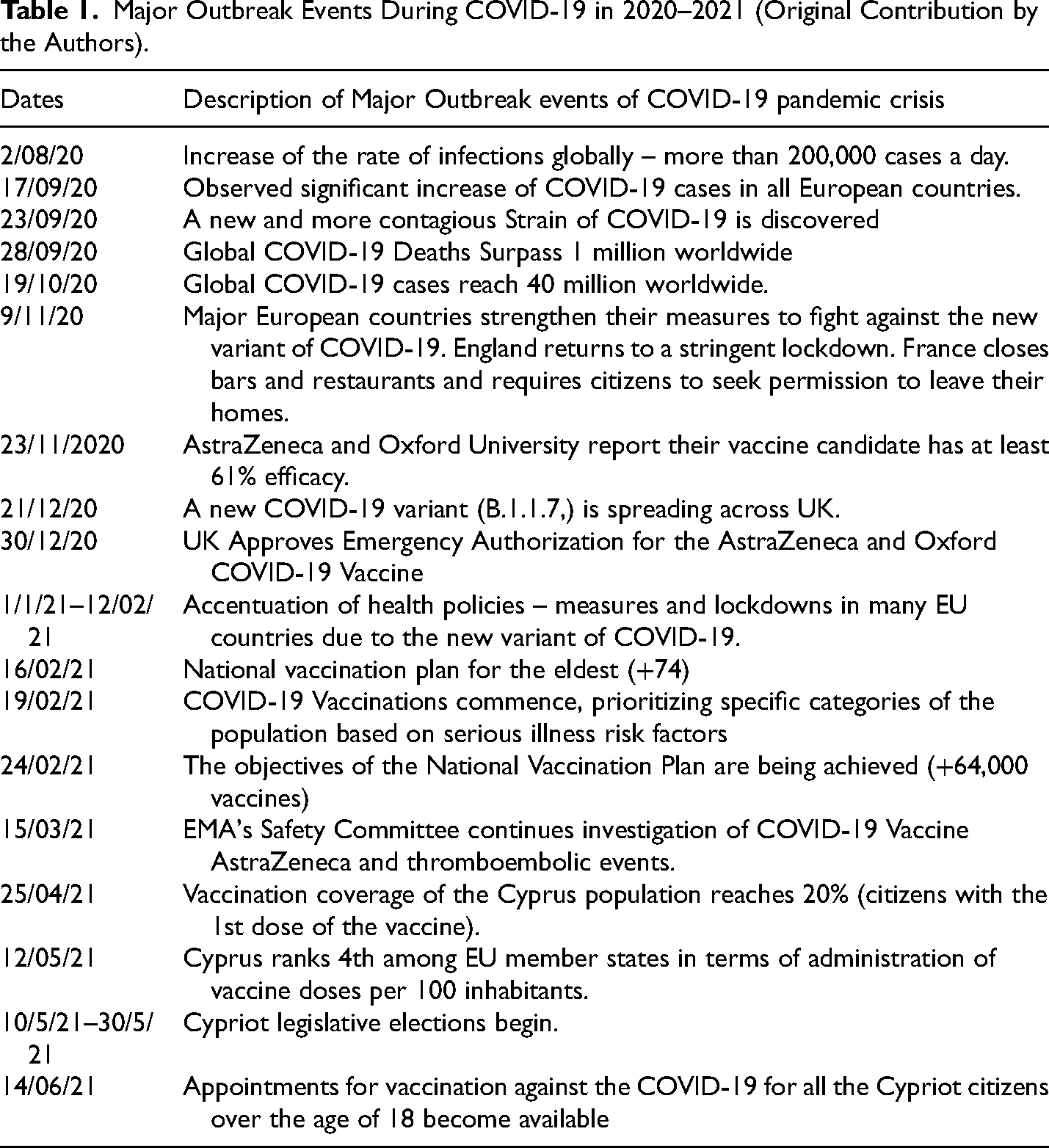
An important task before the collection of Facebook comments attached to the media articles in question was the delimitation of COVID-19 events in time (dates) and space (countries of interest) (Koopmans & Rucht, 2002). This was accomplished by mapping the global outbreak trajectory of COVID-19 to select the major events between December 2020 and June 2021 (see Table 1). The events follow three basic criteria: (a) the calendar of events published by the WHO, b) the major political and social events which took place in Cyprus, and (c) the degree of media coverage. Table 1 and Table 2 illustrate the major global outbreak events during which the posts and comments were collected (2020–2021). The total posts analyzed from the four Facebook pages of selected news media outlets were 1500.
Major Outbreak Events During COVID-19 in 2020–2021 (Original Contribution by the Authors).
The posts were collected only between the above-mentioned dates, excluding other media content found online. To select the most appropriate material for further analysis, the Facebook filter was applied in each of the selected Facebook pages of news media outlets, using the following keywords: COVID, COVID19, Coronavirus, 5G, εμβόλια (‘vaccination’), Αεροψεκασμοί, ΜΕΘ (‘Intensive Care’), Νεκροί (‘Deaths’), Κίνα (China), Γιουχάν (Yuhan), Pfizer, Astrazeneca, Johnson & Johnson, Moderna, Bill Gates, Κρούσματα (‘cases’), CovidFree, Safepass, Εκλογές (‘elections’). Although the data do not cover COVID-19's entire trajectory in Cyprus, we are confident enough that the sample corresponds to the major outbreak events related to COVID-19. For the collection of the posts, a data mining technique was applied using the software “export comments”. This is an open-source analysis software used primarily for network analysis, discovery, and exploration of particular social media spaces. The particularity of this software is that it has a modular architecture which allows for the extraction and importation of network data from specific dates and specific Facebook pages onto excel sheets.
The collected posts were analyzed via thematic content analysis (Ahuvia, 2001). The analysis focused on identifying nodal points – the core signs within COVID-19 users’ discourses that are crucial for indicating the meanings in the discourse; these can be understood as the key concepts or vocabulary of the discourse. Through repeated readings, distinct lines of argumentation were identified (Ahuvia, 2001). Extracts for the analysis were selected rigorously by three researchers, depending on whether they fulfilled the criteria regarding content, length, variety, structure, clear argumentation, ideas and meaning.
Research Results
The categories of users and conspiratorial narratives identified in our study enable us to determine how these types of narratives collectively adapt and flourish in a social networking sphere. The resulting empirical evidence documents that while the former may vary according to their focal points and their ideological origins, the narratives share a common underlying principle: corruption. By the latter we do not suggest that this principle is either determinant of such narratives, or even that the narratives in question originate from such a principle – these narratives emerged through an ensemble of multi-faceted factors which do not solely relate to the current Covid-19 crisis. In other words, our study indicates that users’ shared narratives related to “corruption” are not reducible to any particular phenomenon per se.
Mainstream Media as the Government's Mouthpiece
Our first category is concerned with a type of conspiratorial narrative targeted against the specificities of discourse of the Cypriot mainstream media institutions within the COVID-19 pandemic crisis. Unsurprisingly, the media are here presented as “secret-agents”, working for the government and the public officials, politicians, and police, along with the Cypriot scientists within the local and global contexts. Within this context, then, users conceptualize dominant narratives around Covid-19 vaccination as intended to divert public attention from what really matters: government corruption. Such a narrative is particularly fertile in this regard, since it emerged amidst one of the greatest scandals to ever occur in modern Cypriot history – the government-sanctioned and often illegally-facilitated issuing of “golden” passports to foreign investors, through the citizenship by investment scheme.
Official Covid-19 narratives, therefore, are not attacked directly, but rather dismissed as machinations on the part of media institutions to contain popular discontent. As a FB user writes, “conspiracists are not as dangerous as the conspirators we saw in the Al Jazeera video”, while another user observes that “they do anything they can to distract people from their scandals and corruption”. Users have taken the opportunity to activate troubled thoughts and pessimistic sentiments around “local criminal cases and political scandals”, alongside uttering their simmering anger towards the governing elite in Cyprus. In this context, the Cypriot news media outlets (online and offline), are represented as ‘puppets’ of the system and/or competing players; the power of the latter depends on whether they control such narratives, by means of hiding or revealing (their) political transgressions. These narratives in turn reflect the public's anxieties regarding the nature of media concentration as well as broader systemic failures in Cyprus, which were illuminated during the Covid-19 pandemic.
Others have clearly expressed their mistrust towards political elites by addressing the latter directly, and stating that “whatever you say, after so many lies, we will not believe you”, and that they’d prefer for “corruption to cease instead of conspiratorial narratives”. Notably, strong criticism towards the country's structural forces reflects an overall social insecurity, underlining people's declining levels of trust in the government, the media and towards scientists’ inefficiency to respond to the current pandemic crisis. Blame is attributed here via phrases like “you are used to eating with golden spoons” as well as a series of other buzzwords that users posted on Facebook to capture inequality and the difficult life conditions during Covid-19 times. Nevertheless, both of the above-mentioned versions of government corruption are perceived to be reflections of state authoritarianism, with most of the FB users strongly believing that politics in Cyprus has always been driven by those involved in scandals. At the same time, although corruption is certainly a major issue, what such an approach achieves is, among other things, a displacement of individual responsibility onto the lying local elites, the media, and the equally corrupt scientific community. For instance, a user states: “stop the confrontations already, the situation is clear, this is a form of terrorism, a charade for them to impose an order that’ll make life agonizing from now on. It is imperative that we fight together now!”.
A second significant type of narrative observed is the negative perception of media credibility (traditional and alternative media alike), precisely when discussing developments related to the COVID-19 pandemic crisis. The users actively sought to construct and spread some common narratives that indicate their low trust in the news landscape. Despite the fact that all the shades of (dis)trust observed vary according to the dominant areas of public discontent which fuel them, the focal point here is common: media corruption. Frustration is clearly directed towards publishers and journalists who are covering COVID-19-related news and stories, with the former often being qualified as: gatekeepers of misleading news, traitors, profit-actors spreading fear, influencers and experts who are more interested in the metrics rather than the quality of news. More importantly, they are often perceived as allies of the (corrupt) politicians and conspirators, who consciously try to divert public attention from corruption scandals. These actors are perceived by the public as incapable or even unwilling of selecting and presenting reliable information to their audiences.
Related to such claims of “poor” media performance, is a second common narrative founded on the notion that media coverage around the pandemic tends to be overly emotional, hence indicating a Covid-19 cultural and identity bias. As a user writes, to achieve the public's consent around the newly implemented measures all the media news outlets in Cyprus “start their news with headlines of India's, explosive outbreak of Covid-19. Ok, India's mass Covid-19 cremations are fake. So, stop panicking, these are just fake deaths”. Similarly, another user ironically writes “this was pre-planned, burning logs and piles of ash have made their way to make us sit in front of the tv and watch the news tonight”. Thus, accusations of corruption – themselves fueled by a generalized mistrust towards official institutions (Bantimaroudis et al., 2020) – are also directed towards mainstream media, which are conceptualized as propagandistic instruments of the authoritarian state: “Venal Media, go ahead and tell us how many of those who have been vaccinated actually died. But these aren’t the orders you received. You are unethical”
Who's Behind of it All? Government Corruption and Conspiracies
This section is concerned with what is perceived to be the government's terroristic approach. Like in the previous section, and as made evident by the comments presented below, this particular approach manifests itself in a variety of ways, all of which have a common denominator: it is associated with, and in fact enabled by, pre-existing and widespread corruption within official state institutions.
Apart from local elites and institutional corruption, certain users establish associations between elites on a transnational level. Given the existing relationship between Cyprus and Greece, the latter is naturally the first to be swept by the sub-tendency within covid-19-related conspiracies. After an official announcement about a new set of measures, a user writes: “same day as Greece! COINCIDENCE?? They had EVERYTHING settled up: consent forms, publications, etc”. “Whatever Mitsotakis says or does, you simply reproduce it President. You need to pick another role model”, others bitterly comment. Correspondingly, others made it clear that they are not surprised with the way Cyprus is handling the overall pandemic situation. Such narratives portray that the Covid-19 measures are part of an experiment taking place all over the world; with some accusing the European Union (EU) and the WHO of imposing its ‘will’ and ‘hegemony’ upon struggling peripheral economies, including, among others, Cyprus and Greece. In this regard, posts like: “wake up, they are using the pandemic for profit", “all of you must listen to the anti-fascist Bella Ciao song”, “we are against fascism, let's fight together for freedom”, have managed to gain great momentum on the FB news media pages (in terms of likes, shares, comments).
Additionally, these types of narratives could be seen as a contribution to the general political trend that neo-liberalism has brought forth many years ago, since moves towards governments’ ‘openness’ and global corporations has tightened states’ independency and secrecy (Crouch, 2004, 2016). Against this background, narratives centered upon the machinations of the corrupt elites at a global level, often culminate in discussions (either metaphorical or literal) of an impending Third World War. “Guys, a WORLD WAR is coming”, a user warns. As expected, such warnings are further localized, in such comments as “Out of all European countries, Cyprus and Greece are seen as an experiment. Foreigners really do think of us as sheep after all.”
Following a series of local (instead of universal) lockdowns, and the far from unexpected waves of outrage in Cyprus, a user writes: “Have you got no shame, liars, Pharisees, hypocrites, most cases are currently recorded in Nicosia and Larnaca and you’re acting as if everything's fine, and you blame Limassol and Paphos because that's where [your] interests lie, I despise you, liars”. Biblical references such as that to the Pharisees may not, in and of themselves, denote that the individual is a religious fundamentalist; yet they do point to a dialectical late-modern phenomenon: the dissolution of meta-narratives and universal truths (Lyotard, 1984), along with the accompanying relativization of world-views facilitates, at one and the same time, an active (since uninhibited by such universals) proliferation of conspiratorial narratives, and a (re)invigoration of religious discourses which actively seek to reinstate the ontological stability which the now dissolved universals once provided.
Other references to terrorism are centered upon the notion that an omnipotent, corrupt government is sacrificing the people, of which only a few individuals are able to see what is truly taking place: “Straight to the altar of bribing and microchips”, a user writes, “all of you who believe the big reptiles will be exterminated”. Explicit references to state terror go as far as comparing the current configuration with the Fascist regimes of the twentieth century: “They will implement all fascist policies until they eventually kill you”, writes a particular user, while another refers to “indirectly obligatory vaccination” as “unconstitutional”.
Historical and Cultural Associations
The third shared narrative relates to historical sentiments, specifically emphasizing the Cyprus problem: the overall historical events in the years 1950–74 that led the island to the current stalemate and the status quo with two separate communities, after the Turkish invasion of 1974. Whilst Cyprus has been observed as an ideal base for the dominant powers in the region (Ottoman Empire, United Kingdom), shared narratives were here constructed around historical beliefs, along with those factors that constituted the creation and the continuation of the conflict, but this time within the country and between the Greek Cypriots. Who to trust and who not to believe has become a dominant narrative amongst the users who clearly observe their overall experiences of suffering or injustice as a facet of human life for the Greek Cypriots. Under this context, psychological behaviors like fear, alienation, and feelings of deprivation that emerged after the outbreak of COVID-19 are largely informed by political and historical factors, which in turn lead citizens to experience psychological situations surrounded not only by despair and agony but also habit.
In Cyprus, citizens’ strong adhesion to their ethnic/national identities could not have led them to collaboration, but rather competition and conflict. As a user writes, “We, need to show our identity card to cross the green line, they divided our island, what else do you want from us. No! Stop the divisionist virus. Re-open the borders, our businesses and the schools now!”. Such narratives provide the means for understanding the way that historical and political settings (re)produce the means and ways of facing crisis conditions, constructing social groupings or categories, and analysing the effect of this (re)production on the particular subjects of a given “habitus” (Bourdieu, 1977). Sentiments of this type are therefore centered upon beliefs that social groupings lead to intergroup conflicts (clash between Covid-threat believers and non-believers).
Another theme we identified is concerned with conspiratorial narratives specifically fueled by religious sentiments and beliefs. Before elaborating further, it is important to prefix our analysis with two qualifying remarks: a) religiosity per se is not our object of analysis. Rather, we are here concerned with users’ sense-making activity which their religiosity enables, even though the subjective religiosity of Greek Cypriots is high by any standard (Kouros & Papadakis, 2018). This is not to say that belief in, and indeed devotion to a given monotheistic religion is inconsequential with regard to conspiratorial narrative formation. Yet, this question is beyond the scope of the current paper. For the purposes of this study, we will have to limit ourselves to the conceptualization of religiosity as an instrument (rather than an actual cause) which facilitates conspiratorial sense-making practices; b) given the actual socio-cultural configuration under examination, namely, the Cypriot society, religiosity is often inextricably bound with nationalist tendencies. The interweaving of religious and nationalist narratives, then, is not infrequent.
Furthermore, a certain degree of overlap with the category related to government corruption is inevitable, since here too, the dialectic between the need for long gone universals on the one hand, and the concurrent proliferation of conspiratorial particulars on the other, is present. In the following quote, sin is introduced as the criterion of condemnation of the “lies” which governments spread: “Do they not realize that what they’re doing is a sin? With all the misinformation… with the shows they put on, of MPs getting the AstraZeneca vaccine and making fools out of ordinary people… (if we are to believe that they actually get vaccinated)”. Others are still more blunt: with regard to churches not being allowed to operate during Easter, a user states that “the church is God's house, and it is there for Orthodox Christians, anti-Christians may stay home”. Another user urges us: “everybody to the churches, to our Christ the real God, to praise him. It is time we wake up”. “If you believe that by entering the house of God you will become ill then not even God himself has any trust in you since you show your mistrust to him”, another user claims. “[I]n the past there used to be so many diseases, deadly too, and people would run to the Lord's house to find mercy, consolation, and to heal…so many calamities were overcome through the help of our merciful God and now, because of a virus (whose existence is undeniable and I understand that it is dangerous for people with health issues) […] we have shut down the churches in fear of spreading the virus!!! […] The Lord's wrath is near, woe unto us!!!”
Discussion
Regarding the sociopolitical factors fueling users’ conspiratorial narratives, we have already exemplified that all categories share a common (though not exclusive) point of contention – namely, governmental and media corruption. Popular discontent around corrupt practices by official authorities primarily manifests itself in accusations that government officials, and scientists alike, are lying. This conviction on the part of users that they’re being lied to, seems to be echoing the argument put forward by West and Sanders (2003) and the “impenetrable façade” which users are attempting to contest. The conspiratorial narratives evident in users’ comments, then, may well be conceptualized as distorted and misplaced responses to an otherwise undistorted awareness that something is particularly wrong: that the transparency and accountability claimed by governments are often non-existent. Such responses also indicate an awareness of users’ powerlessness, and an attempt at overcoming it, which often leaves the content of conspiratorial narratives intact. When, as mentioned earlier, a user writes that “[c]onspiracists are not as dangerous as the conspirators we saw in the Al Jazeera video”, they are expressing exactly that. This particular CT is not entirely untrue. It may be explained with Popper's (2002) idea of ignorance: someone – in this case journalists and the government – does not want us to know, and is actively conspiring to keep the truth from us. Users often accuse both of these institutions for concealing the truth and actively trying to divert public attention from “what really matters”, what is “really a conspiracy”, that is, the “golden passports business”. As demonstrated in the Al Jazeera video, indeed, a range of different political and financial actors not only knew about the corruption, but also conspired to conceal it. (Popper, 2002, p. 10).
Furthermore, the particular manifestations of this anti-corruption sentiment are, to a significant degree, informed by socio-cultural determinations – namely, nationalist and religious-fundamentalist tendencies. This is the case, for instance, when a user (quoted above), claims that Cyprus and Greece (specifically) are about to become Europe's “experiment”, and that “foreigners” treat the populations of these two countries as sheep. As regards religious fundamentalism, it is quite evident that religious narratives are implemented by users as means to challenge and even reject official narratives around Covid-19. A user also quoted above, makes references to past pandemics and calamities, and to how in each of those instances people sought refuge in the churches. They juxtapose this approach to the measures taken by the government during the Covid-19 pandemic, which involved the closing of churches. Through this narrative they are essentially attempting to downplay the impact of Covid-19, by establishing a vulgar relativism which claims that since we’ve already overcome so many diseases through prayer, we shall do so again and there is therefore no reason to shut down churches.
One could argue that, through their adoption and dissemination of various conspiratorial narratives, users become empowered. Whether the empowerment in question is objective, in the sense that it effects a transformation of users’ actual conditions of existence, or whether this is a false, subjectively hallucinated sense of empowerment, which users merely seek in order to counterbalance the all too real disempowerment which they experience, is beyond the scope of this study. However, a word must be said about the unifying effects that CTs may, and often do bring about. This is mostly evident in such comments as “[i]t is imperative that we unite and fight”, where a user calls for people to unite and resist the new terroristic order being imposed by the authoritarian state. According to the findings of the current study, nevertheless, a sense of empowerment is far from easy to identify among users’ comments. While such instances are observable (as with the comment above), the prevailing tone is one of victimhood, occasionally underlined by notes of confidence resulting from the apparently deeper comprehension of events which CTs make possible.
Our most important finding concerns the “contextualization” of global CTs, that is, their adaptation to the local cultural, historical, political and societal context. We demonstrated this through the common references of conspiratorial arguments to local issues, scandals of corruption, and so forth. Moreover, in a state where the line between conspiracy and truth is often blurred – as demonstrated with the case of the golden passports – CTs find a fertile ground for their articulation and circulation. Most importantly, we firmly believe that the success of a particular CT may often depend on its adaptability in local contexts, that is, its ability to respond to local claims to transparency, sense-making and truth.
Footnotes
Acknowledgments
The authors would like to thank the anonymous reviewers and the editor for their feedback and support.
Declaration of Conflicting Interests
The author(s) declared no potential conflicts of interest with respect to the research, authorship, and/or publication of this article.
Funding
This research was funded by the University of Cyprus, grant number 3731/2019 (Data and Algorithms).
