




Abstract
The interruption of natural gas flows via pipeline to Europe in 2022 has demonstrated that supply crises pose a threat. Although member states have demonstrated unity and solidarity, they could be better prepared to respond to such challenges. Currently, member states fill their natural gas storages independently. Cooperation and solidarity could deliver better outcomes by allowing the accumulated reserves of one or more members to be potentially redistributed to help others in need. In this paper we propose some possible guidelines for a potential solidarity framework based on voluntary participation. We argue that the proposed framework can mitigate the risk of supply-disruption of participants and formalize a game-theoretic model in order to capture the basic features of the problem. We demonstrate the operation of the approach using a simple example with risk-averse participants.
1. Background
In 2022, the EU experienced its first energy crisis since the oil price crisis during the 1970s. One of the key fuels in European energy consumption is natural gas, a significant part of which is imported. Natural gas can be stored and thus potentially compensate for seasonal demand imbalances. During summer (usually with lower prices than in winter) natural gas is accumulated in storage facilities from where it is withdrawn during the winter period to meet higher demand for heating. Storage typically provides 25 percent to 30 percent of natural gas consumed in the EU during winter, however the extent to which storage is used in EU member states differs significantly. This is due to heterogeneous size of storage infrastructure capacities, the corresponding difference in technically available working gas capacities, and the different amplitudes of seasonal swing (i.e., less need for heating in southern countries). In addition, not only do sizes of storage capacities vary from zero to twenty-four bcm (Germany) among EU member states, but also owenership. The current European regulatory framework (amended in 2022) allows Member states to regulate third party access to storage facilities (negotiated or regulated). Hence, although third party access is compulsory it rarely delivers “market” outcomes in practice. This holds especially in a crisis situation when short-term action is required. In some countries, all facilities are operated by independent companies (Belgium) others are state-owned (France, Denmark) and in some countries, both public and private companies are active (Germany; IEA 2022). In Italy, around 90 percent of total storage capacities are controlled by the state. In France, there is neither public nor strategic storage. In Spain, 90 percent of capacities are independent. In Hungary, all commercial facilities are state-owned, while in Poland around 72 percent are state-owned and 28 percent of PGNiG are independent. In Germany, the largest player in terms of size, around one quarter is state-controlled (the Government recently expropriated Gazprom and took over their capacities).
During the first year of war it seemed possible (if not likely) that most of European gas storages would be depleted during the winter period and several European countries would not be able to re-fill during summer 2023 to levels necessary to ensure security of gas supply for Winter 2023/2024 (Zeromski, Watine, and Reberol 2022). As of date there exist no official guidelines on cooperation mechanisms between Member States and efficient utilization of underground storage facilities in order to ensure security of supplies during crisis. While there are multiple gas exchanges (like TTF, the Dutch Gas exchange or THE, the German gas exchange) and other decentralized trading mechanisms in place in the EU, in the time of crisis, supply typically drops significantly at these trading platforms, preventing member states in need from procuring the required gas quantities at reasonable price. In this paper we propose a framework, in which participants agree on guidelines of redistribution and compensation before the onset of the shortage.
It is worth noting that both the share of natural gas in primary energy, and the distribution and use of storage capacities, vary considerably across Member States. Whereas storage capacities were filled at almost 95 percent on average in the EU at the beginning of November 2022, 14 percent were left unfilled in Hungary. 1 Hence, in the case of emergency and the need for solidarity it would be useful to have a transparent mechanism in place. Such mechanism should be based on optional participation and designed such that it is sufficiently attractive (beneficial) for decision makers to cooperate. The related literature for such a mechanism is scarce. While there are several examples for the application of game theoretic methods for oil and gas related problems (see, e.g., Araujo and Leoneti 2018; Hubert and Cobanli 2015; Jafarzadeh et al. 2021; Roson and Hubert 2015; Toufighi 2022), and for quantitative models describing the role of underground storage on the dynamics of competitive markets (see, e.g., Rubaszek and Gazi Salah 2020) quantitative models related to the coordinated use of storage in crisis in the EU are—to the best of our knowledge—lacking. Although there exist models describing reservoir operation in the context of economic implications of CO2 storage (Schaef et al. 2014; Zhang et al. 2007), the literature on the concept of storage facility sharing is very scarce. Holland (2009) and Holland and Walsh (2013) consider the sharing of a single reservoir while taking into account characteristic technological features, but there are no analyses of sharing of multiple storages in a networked setting under uncertainty. Kiely (2016) investigates accumulation and redistribution whilst taking into account risk-pricing related to natural gas storage. Janjua et al. (2022) analyze redistribution and present an asymmetric hybrid bankruptcy and Nash bargaining model for natural gas distribution. Schitka (2014) and Rey (2020) capture the simultaneously competitive and cooperative aspects of gas-related issues.
The goal of this paper is to provide a framework for a supply security cooperation mechanism assuming voluntary participation and financial compensation. For this we formulate and analyze a stylized cooperation model. Although we account for financial compensation in the model, we assume that compensation prices are inherently determined by the parameters defined by the participants at the beginning of the cooperation and are not affected by actual prices at the time of the crisis when the potential redistribution takes place. We demonstrate the operation of the proposed mechanism under the assumption of risk-averse participants and discuss possible critical issues related to implementation possibilities.
2. The Proposed Solidarity Mechanism
In this section we present the underlying key assumptions of the proposed mechanism, introduce the formal game and the corresponding network model.
2.1. Basic Assumptions
We study the interaction of strategic decision makers of countries, who aim to cover the energy demand of the country’s economy. These entities, who will correspond to the players of the implied game, may be best interpreted as state-owned national energy companies, who have access to storage facilities. These companies are also for-profit firms, but their decisions are subject to governmental policies.
The proposed solidarity framework is interpreted in an environment where every potential participant (player) individually bargains with external suppliers in order to fill its storage capacity for the winter period. However, the success of this bargaining is (at least partially) uncertain at the time of solidarity contracting.
According to the proposed framework, solidarity contracting, which represents the first phase of the mechanism, takes place in the spring period, before any player would begin to gather resources. In this period, every player has to decide whether or not to participate in the proposed cooperation framework. The voluntary aspect of the proposed mechanism implies that each participant has the exclusive right to determine this value
Phase two of the mechanism, when the redistribution and the connected compensation takes place, corresponds to the winter period, when higher demands and potential resource shortages arise. We assume that at the beginning of the second phase, the following factors, which are still uncertain in phase one, are already determined and known for all participants: (1) The quantity of accumulated resource available to individual participants and (2) the actually available network transmission capacities. In the second phase, resources are redistributed among participants with non-zero participation levels, according to individual needs, to previously determined levels of participation and considering the available transmission capacities. In other words, resources subject to the solidarity mechanism are routed to those participants who are in the highest need according to the demand data reported in phase one, taking into account network constraints. Decision variables of this phase are line flows and consumption/injection values at each of the nodes of the network. Players who have chosen not to participate in phase one do not receive any additional resource during the redistribution process, but can fully use their accumulated resources. Furthermore, if any non-zero redistribution transactions take place, the participants from whom resources are reallocated to other players are financially compensated, and the compensation price is determined according to the previously reported (inverse) demand functions.
The solidarity mechanism may be viewed as a special secondary market with obligatory participation by those players who decided to declare a nonzero level of participation. In the following we show how the elements of the above solidarity mechanism may be formalized using a computational model, and how such a model may provide insight into the potential operation of, and strategic decisions in, the framework.
2.2. Formal Game Theoretic Model
It is easy to see that the participation levels and demands reported by other players affect the potential benefit the solidarity mechanism provides to any single player (e.g., if only a single player participates, no redistribution may take place). Thus, the proposed supply-security related accumulation-redistribution process can be formally described as a game. For this we define the class of transaction-constrained resource-redistribution games under uncertainty (TCRRGU), and demonstrate the operation using an example. The proposed TCRRGU framework is based on a strategic game in which the strategic decisions of the players correspond to the choices of
The redistribution process in phase two, which determines the outcome of the game, depends on the determined participation levels, on the accumulated resources and also on the available transport paths, which are subject to uncertainty at the time of solidarity contracting in phase one. For our model we assume that the nature and parameters of uncertainty are known to every player during the bargaining process (i.e., the uncertainty is structured, as described in subsection 2.2.3). In addition, as described earlier, a compensation process is defined related to the redistribution process.
2.2.1. Network Model
The natural gas network is represented by a directed graph with
The differentiation of transfer capacity over edge directions makes it possible to describe direction-dependent transfer capacity of pipelines, which may, for example, depend on the presence of compressor stations along the pipeline.
2.2.2. Consumer Demand
We assume that the piece-wise constant inverse demand functions reported by the players are composed of
2.2.3. Uncertainty
We take uncertainty into account on two levels. First, we assume that resource accumulations by players between phase 1 and 2 are uncertain. Second, we assume that available capacities for redistribution in phase two are also uncertain because of technological factors (e.g., completion or delay of projects or possible faults) and external flows might limit the redistribution of resources. Flows are “external” when they are not related to the supply-security cooperation.
Uncertainty is represented in the model by a finite number of “states of nature” or “scenarios,” one of which is randomly realized at phase two. The total number of scenarios is equal to
2.2.4 The Redistribution Process
Let us assume that the vector describing the levels of participation, denoted by



The variable vector

The objective function, described by (1), where
Constraint (2) describes that the difference of the total inflow and outflow of any node is constrained by the respective participation level
2.2.5. Compensation
During the redistribution process (if the outcome is non-trivial, that is, a nonzero redistribution takes place, producing flows in the network), the reserves (and thus the consumption utility) of some participants are decreased, while those to whom the gas is redistributed gain additional consumption utility. The resulting consumption utility

The proposed framework assumes that players receiving additional gas during the redistribution have to financially compensate those suffering a decrease in reservoir levels Accordingly, the financial utility of player
2.2.6. Risk Measurement and Aversion
Let us emphasize that the model elements described up to this point are the principles, which may serve as the basis for a voluntary redistribution mechanism (based on the choice of
3. Example
Figure 1 depicts the network of the considered simple example, with
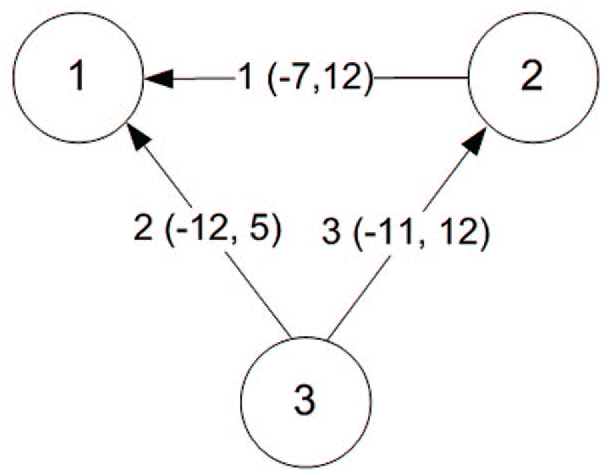
Simple example network network. Edges are labeled with their index
The parameters of the demand functions used in the example and depicted ion Figure 2 are summarized in Table 1.
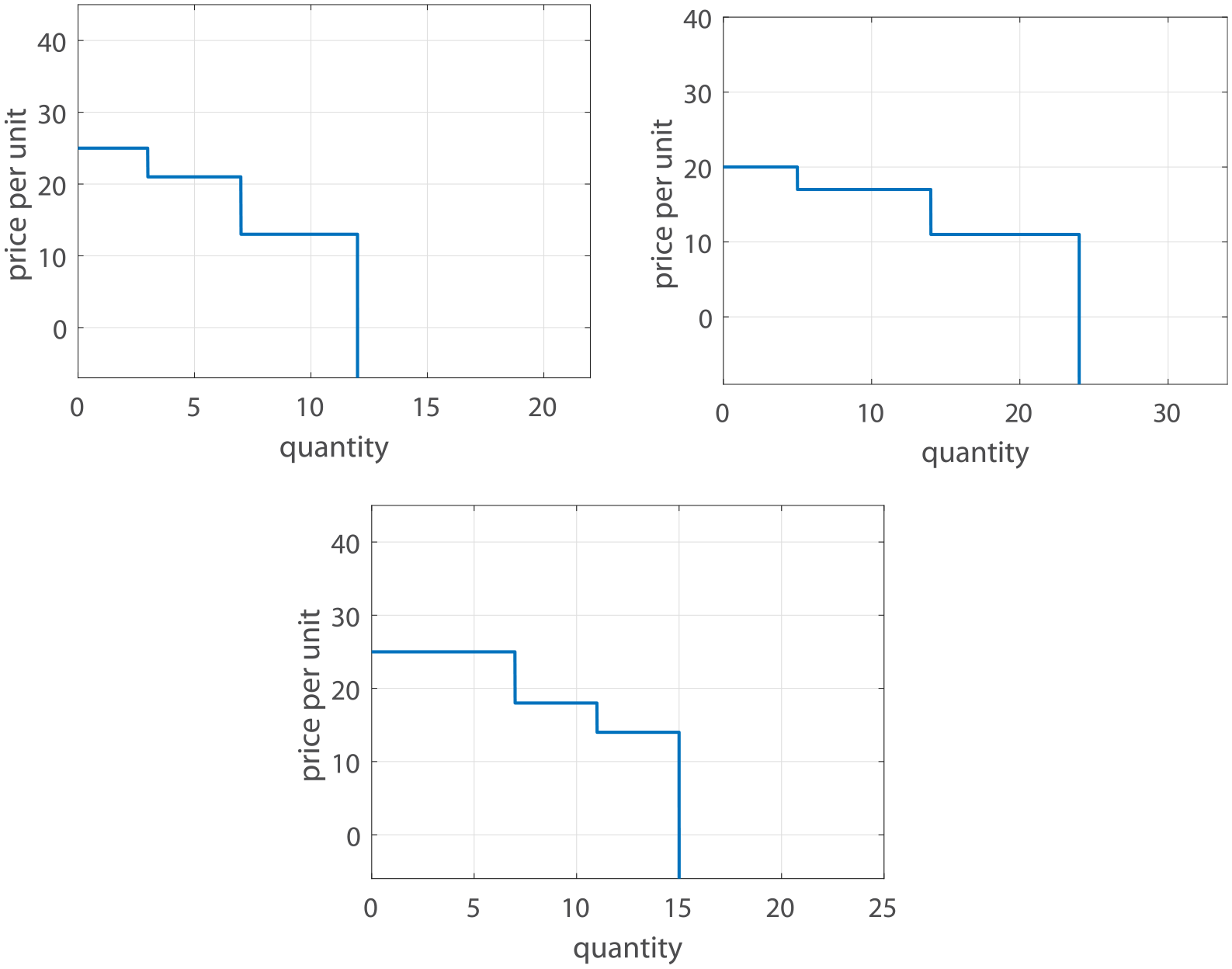
Inverse demand functions of consumers.
Parameters of the Inverse Demand Functions Considered in the Example.

To represent the uncertainty in our simple example, assume
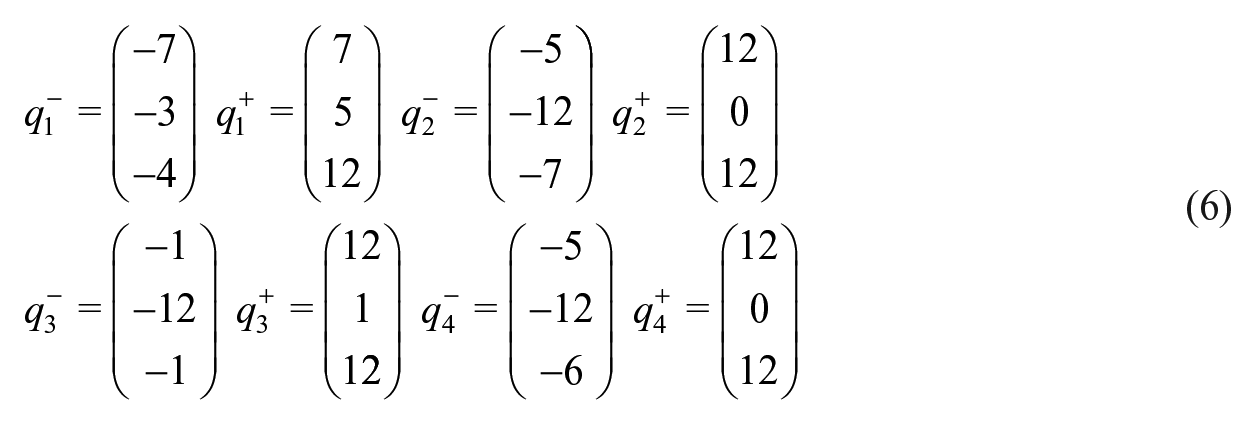

To give an example for the calculations of the compensation mechanism, assuming the inverse demand functions depicted in Figure 2 and summarized in Table 1, if player 3 had originally five units of gas in the case of scenario

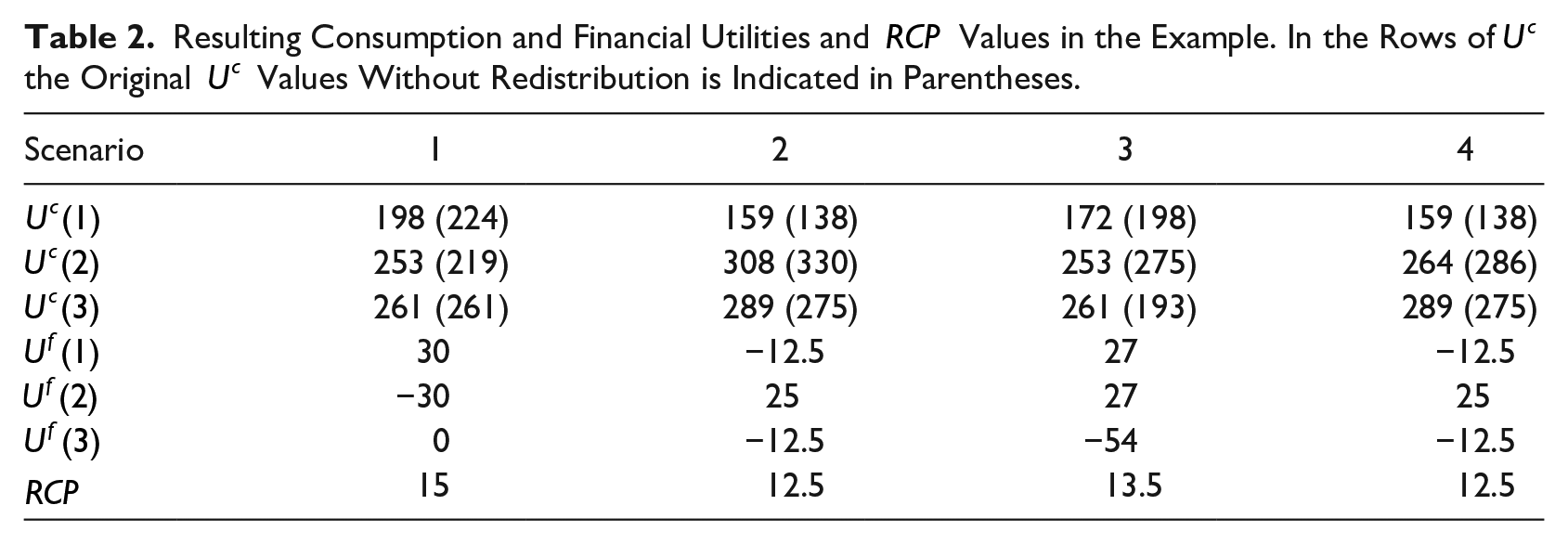
Thus, the financial utilities of players, denoted by
3.0.1. Example Scenario Calculation
Before we discuss the questions related to the determination of
We may calculate the other scenarios similarly. In scenario 2, two units of gas are redistributed from player 2 to players 1 and 3 (one unit for each), implying a resulting
Resulting Consumption and Financial Utilities and
Turning to the risk measure defined in subsection 2.2.6, we assume that the players consider the value of
We may compare the ES values of players, without or with cooperation, assuming
3.0.2. The Implied Strategic Game
Are the values
4. Discussion
4.1. Equilibrium Aspects
The reader may ask how the equilibrium point of the example has been determined, or in general, how is it possible to determine equilibrium point(s) of the implied non-cooperative game. Although a deep discussion of the equilibrium properties of the non-cooperative game class implied by the TCRRGU problem is beyond the scope of this article, we can make some observations.
Since the expected benefit of participation in the mechanism strongly depends on the defined participation quantities of other players, an iterative scheme (repeated game) may be used for the definition of the
The iterative application of best-response strategies (see, e.g., Csercsik and Sziklai 2015) potentially leads to equilibrium. In the case of the proposed example, the initial
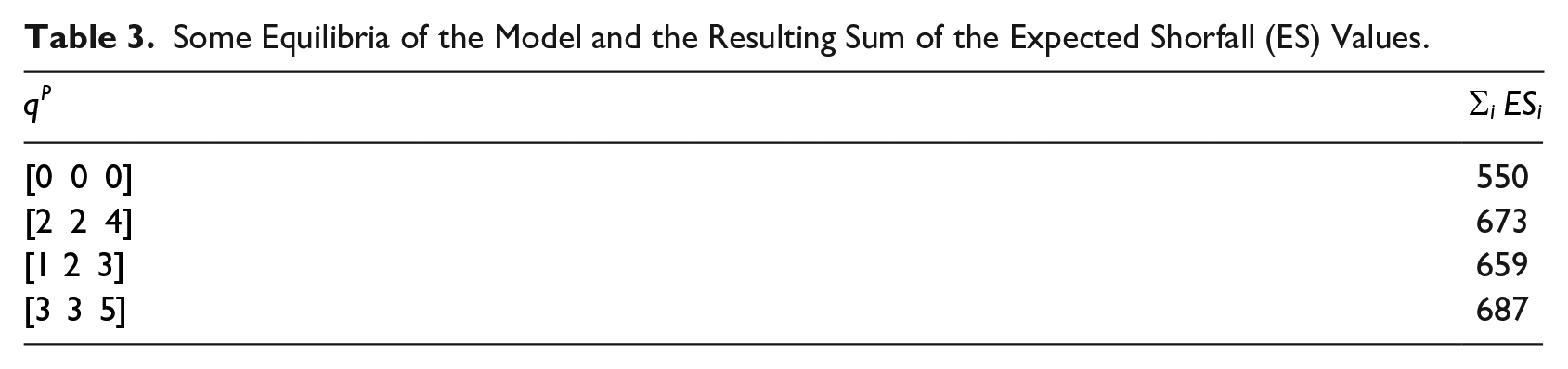
Even in the case of the proposed simple example, this equilibrium is not unique. As Table 3 shows, several other equilibria of the implied strategic game exist and they may correspond to lower or higher values of the total expected shortfall, that is, they are differently efficient in the context of risk reduction.
Some Equilibria of the Model and the Resulting Sum of the Expected Shorfall (ES) Values.
4.2. On incentive Compatibility
Let us return to discuss a key assumption of the proposed framework. The cooperation framework is based on the reported inverse demand functions, which are used in the objective function of the optimization steps. It is easy to see that a player submitting an inverse demand function with high price parameters is likely to gain gas in most of the scenarios. However, the RCP is also determined by marginal utilities, and such a strategy will likely result in a higher RCP, implying greater loss for the player through
4.3. Potential Practical Implementation
The proposed model made the further simplifying assumption that the possible scenarios and their realization probabilities are determined and known for each player. In practice, the uncertainty is much less exactly defined, various players potentially have different beliefs about it, and they calculate their risk measures and strategies according to these individual considerations. In other words, an abstract game such as the one proposed will never be realized in practice, which also implies that the theoretical properties of the proposed formal model briefly discussed above (equilibrium aspects and incentive compatibility) would have moderate significance in the case of a potential real-world application. Nevertheless, some elements of the proposed model and its solution concepts (like reporting of inverse demand functions, iterative determination of the levels of participation) may represent useful approaches in the process of designing realistic mechanisms in the future.
Our main aim in this article was to show that under textbook-like simplifying assumptions, such a mechanism based on voluntary participation may indeed work and could have practical value. The more fundamental question one would like to answer is “How can supply-security related cooperation of the EU-member countries be improved, and the more (internationally) efficient usage of storage facilities be enabled.”
5. Conclusions
There are two possible ways of using storage facilities to enhance the supply security of the EU in future years. (1) Constitute EU-level reserves and redistribution mechanisms, which aim to help the member states in potential future need. Since under the current circumstances, the construction/exploitation of new reservoirs and gas for this aim do not seem to be realistic in the short term, this approach would require the partial expropriation of national gas reserves and/or storage capacities. Such centralized approaches are likely to meet resistance by countries who consider that they previously sacrificed more than others to ensure their own supply security. We do not argue that such initiatives are necessarily doomed, but it is possible that obtaining sufficient political support for such a regulation framework will be challenging. (2) The EU might also act as a catalyst of voluntary supply security cooperations by defining the appropriate transparent and predictable regulatory frameworks. Such approaches may complement or maybe even partially substitute for the initiatives of the first type to further enhance the dynamism and flexibility of the reaction of the Union in the case of an emergency event. Based on simple computational modeling studies, this paper argues that multilateral voluntary supply security cooperation mechanisms may have significant potential in encouraging voluntary participation and reducing the individual risk of participants.
Supplemental Material
sj-docx-1-enj-10.1177_01956574241253982 – Supplemental material for A Solidarity Mechanism to Allocate Stored Natural Gas in Crisis
Supplemental material, sj-docx-1-enj-10.1177_01956574241253982 for A Solidarity Mechanism to Allocate Stored Natural Gas in Crisis by Dávid Csercsik and Anne Neumann in The Energy Journal
Footnotes
6. Appendix
Table 4 summarizes the abbreviations and notations used throughout the mathematical formalisms of the paper.
1
Note that in June 2021 Hungary’s capacities were filled at almost 58%, the average European level was only 38% (Gas Infrastructure Europe, AGSI
2
Note that revealing such information may negatively affect bargaining potential of participants in latter transactions. Thus, these reported data should be handled as confidential.
3
Taking into account a sign convention, i.e. the maximal transferable quantity of edge
Declaration of Conflicting Interests
The author(s) declared no potential conflicts of interest with respect to the research, authorship, and/or publication of this article.
Funding
The author(s) disclosed receipt of the following financial support for the research, authorship, and/or publication of this article: This work has been supported by the Hungarian Academy of Sciences under its Momentum Programme LP2021-2.
Supplemental Material
Supplemental material for this article is available online.
References
Supplementary Material
Please find the following supplemental material available below.
For Open Access articles published under a Creative Commons License, all supplemental material carries the same license as the article it is associated with.
For non-Open Access articles published, all supplemental material carries a non-exclusive license, and permission requests for re-use of supplemental material or any part of supplemental material shall be sent directly to the copyright owner as specified in the copyright notice associated with the article.
