




Abstract
Introduction:
Advanced practice nursing is well established in many countries. However, in Mexico the role has not been implemented. The aim of this paper was to establish consensus, via expert stakeholder engagement, on the priorities to develop advanced practice nurse (APN) roles nationally in Mexico.
Methods:
A 2-round Delphi technique was employed. Along with using data from in-depth interviews with health care professionals in Mexico, a review of the published literature was also undertaken. A total of 25 statements using a Likert scale from not important (1) to very important (4) were developed for round 1. Those working in positions with an interest in advanced practice nursing were invited to participate. A context index validity of 0.8 was applied for round 1, and those that scored above 0.8 were used for round 2 where participants were asked to rank the statements in order of priority.
Results:
Thirty-one experts participated in round 1 and 14 in round 2. A total of 12 statements were scored with a content validity index above 0.8, and these were ranked for round 2. The statements reflected key areas around advanced practice nursing from workforce issues to regulation, education, and career progression. The key priorities were the need for a national regulatory framework and clear definition of APN roles.
Conclusions:
These statements will now be used to support the case for how advanced practice nursing should be developed in Mexico at a national level addressing the health care needs of the population and help toward building a strong APN workforce.
Worldwide, advanced practice nursing has been established for over 50 years with differing rates of implementation. The ICN defines advanced practice nursing as a registered nurse “who has acquired, through additional education, the expert knowledge base, complex decision-making skills and clinical competencies for expanded nursing practice, the characteristics of which are shaped by the context [and/or country] in which they are credentialed to practice.” 1 (p.9) In the United States, advanced practice is a recognized licensed role with over 385 000 nurse practitioners (NPs) while Canada has 7400 NPs. 2 The NP role is regulated in both these locations and are a key part of the workforce in Australia, New Zealand, and Ireland, for example. 3 In the United Kingdom, advanced practice has been expanded to include allied professionals and is known as advanced clinical practice (ACP), although, unlike other countries, it is not a licensed/regulated role nor is ACP a protected title. 4 In terms of nursing education, in Mexico there are 3 levels of nursing training: (1) assistant, corresponding to a basic level with training from 6 months to 1 year; (2) technical, corresponding to an intermediate level with training of 3 years; and (3) licentiate, corresponding to a 4-year training, plus 1 additional year of social service (corresponding to a period of continuous practice over 1 year). The licentiate level is certified by a university degree. Only those who have this degree can access postgraduate studies in nursing or other areas. 5
The benefits of advanced practice roles are documented in the literature in acute and community settings.6-10 However, the development of the role across Europe remains inconsistent. 11 Other countries have more recently developed the NP model while many geographical locations do not have advanced practice nurse (APN) roles in place, including Mexico. In Mexico, there are several attempts to expand the role of nursing in hospital and primary care environments but without a central coordination. They include maternal and childcare, diabetes and hypertension control, wound care, and catheterization. These initiatives show the interest of different areas of the health system to upgrade the capacity of nurses to perform expanded roles with the role’s benefits in terms of quality of care and efficiency. In 2019, the Mexican Ministry of Health launched a formal policy for training and development of advanced practice nursing with the participation of a broad group of public institutions. 12 The Metropolitan Autonomous University (UAM) was the first educational institution to provide APN training and is a Masters’ level program that recruited its first class of advanced practice nursing students in 2021. 13 Currently 2 universities offer the advanced nursing program in Mexico. 14 For the graduates of the program, it will be a great challenge to open up spaces within the labor market that will enable them to exercise the role for which they were trained. Although progress in advanced nursing practice in Mexico has been erratic and diffuse, the fact of having graduates from these programs represents a solid step for the advancement of nursing and for real proposals of human resources starting to align Mexican health policies to global strategies such as universal health coverage and development goals.
Within the Mexican context, a previous gap analysis was undertaken in 2020 and highlighted 4 major issues that were identified as impacting advanced practice nursing development. 15 The issues were categorized as workforce related, organizational and institutional, regulatory and legal, and academic and educational issues. The conclusion of the gap analysis was that stakeholders needed to reach key agreements to establish rigorous frameworks to support advanced practice nursing development in Mexico. 15 Therefore, the aim of this paper was to establish consensus on the priorities to develop advanced practice nursing nationally in Mexico via expert stakeholder engagement.
Methods
Study Design and Setting
A 2-round Delphi technique was employed with the aim of establishing consensus on the priorities for the development of advanced practice nursing in Mexico (using the advanced practice nursing definition from the International Council of Nurses) and as a policy. 16 This Delphi study was developed, conducted, and reported using best practice Guidance on Conducting and Reporting Delphi Studies (CREDES). 17 Figure 1 presents an overview of the Delphi method process utilized within this study. The Delphi technique incorporates iterative rounds to explore divergence as well as consensus from an expert panel, and although there are no recommendations on panel size, representation from a wide range of those related to the specialist topic (ie, advanced practice nursing) is appropriate and will produce reliable results. 18
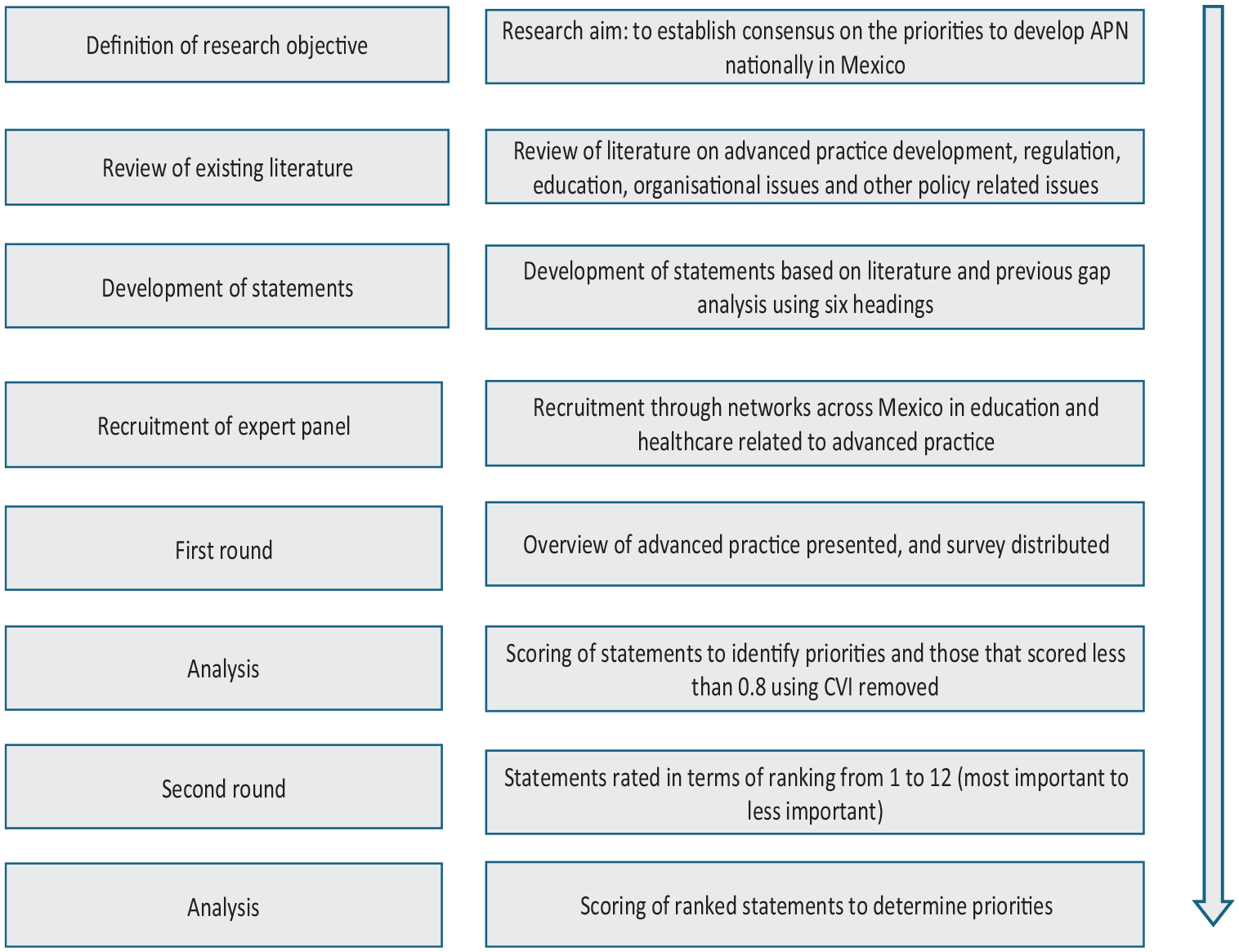
Process map for Delphi method.
Development of Delphi Statements
Prior to undertaking this Delphi study, in-depth interviews were carried out with 29 nurses in Mexico (including state directors of nursing, directors/deans of nursing schools, and primary care nurses). These interviews revealed 4 major themes that impacted on the development of advanced practice nursing in Mexico: (1) workforce, (2) organizational and institutional, (3) regulatory and legal, and (4) academic and educational. 19 The statements were categorized under 6 headings, including the 4 identified from interviews, along with government and policy issues and career progression for qualified APNs. These themes were used to inform the development of the statements for the Delphi study along with a review of the published existing literature. The justification for this approach was that unstructured first rounds can result in poorly defined and ambiguous information, 20 and the reactive Delphi (ie, building on previous work) has previously been effectively applied to advanced practice. 21 In terms of number of rounds, there are no strict requirements and in some instances 2 rounds may suffice, whereas other more complex work may require 10 rounds. 22 However, each time a round is created, it increases the risk of attrition and participant fatigue. 23
The expert consensus panel was constructed from 3 international advanced practice experts from the UK and Australia who were qualified advanced practitioners who held doctorates and had experience of working clinically in APN roles as well as undertaking research on advanced practice nursing. The rationale for international experts is that advanced practice nursing is not developed in Mexico, and there are currently no APNs working in the country. As the international experts were working as APNs, they had knowledge of the APN role in terms of educational requirements, clinical skills, and regulatory requirements. The panel determined the content validity index (CVI), which was set at 0.80 or above. This was deemed acceptable for consensus on each statement where the CVI would be calculated from the percentages of responses with a rating of 4 (“very important”). 24
An initial draft of Delphi statements was written and reviewed by 2 local experts in Mexico and the international expert panel. Further refinement of the statements by an iterative process was undertaken, and consensus on the final statements for the first round agreed by the lead researcher as well as the Mexican and international collaborators.
Delphi Study Participants and Consent
Given the highly specialized topic of advanced practice nursing, the initial aim was to identify 20 to 40 individuals from Mexico and to recruit them to the study prior to round 1. Taking the potential loss to follow-up into account, we anticipated 10 to 20 participants completing round 2. Initial recruitment was undertaken by the Faculty of Nursing and Obstetrics (FENO in Spanish) working group at the Universidad Nacional Autónoma de México (UNAM) through clinical partners in public and private health care, academics from universities with an interest in advanced practice nursing, relevant societies and associations related to advanced practice nursing in Mexico, as well as government officials from the Secretariat of Health. Nurses who were not aware of advanced practice nursing and members of the public were excluded from study participation. These identified individuals were sent an e-mail inviting them or a representative to the stakeholder meeting at UNAM in Mexico City. Recruitment was undertaken over a 2-week period in June 2024. At the meeting, prospective participants were provided with a 30-minute presentation with an overview of advanced practice nursing (including the definition of advanced practice nursing from the International Council of Nursing) and describing scope of practice and an overview of the thematic analysis identifying the issues from previous interviews that were undertaken as part of the gap analysis. Following the presentation, there was a 30-minute discussion among participants and researchers, and the Delphi survey was then outlined. Although this approach is not conventional for Delphi studies, given that advanced practice nursing is not established in Mexico, we wished to ensure that participants had a good overview of advanced practice nursing within the Mexican context and a presentation of work to date along with an overview of advanced practice nursing was determined to be appropriate.
Participants were made aware that consent was assumed by submission of the questionnaire at each round. At the stakeholder meeting, basic demographic data were collected including role, highest education level, and previous knowledge of advanced practice nursing. Withdrawal of data was possible after the submission of a questionnaire. The study was approved by FENO/UNAM.
Development of the Survey
The questionnaire development processes took place over 2 rounds of this Delphi study. All statements were developed and presented through an electronic Word document. The process was led by authors G.L. and G.N. and all statements were developed iteratively through a process of consultation and feedback between authors. To ensure consistent high quality within the survey instrument, questionnaires at all rounds were piloted and revised with feedback from the international expert panel (n = 3). This group piloted each questionnaire and provided feedback on the comprehensibility of the questionnaire and usefulness of the response options.
Round 1
Round 1 in the first round included 25 statements under the headings:
1. Workforce related (6 statements)
2. Organizational and institutional (4 statements)
3. Government and policy issues (4 statements)
4. Regulation (4 statements)
5. University and education (4 statements)
6. Career progression for qualified APNs (3 statements)
Participants were asked to rate each statement in terms of its importance in relation to developing advanced practice nursing in Mexico using a 4-point Likert scale from 1 to 4 (1 = “Not important,” 2 = “Somewhat important,” 3 = “Important,” and 4 = “Very important”). The survey was distributed at the stakeholders’ meeting in June, and further copies were e-mailed to those who could not attend in person but wished to participate. Those who attended were also asked to identify others who would potentially be interested in the survey and provided the authors with their contact details to ensure as many potential stakeholders were contacted. Any disagreement between findings were discussed between authors G.N. and G.L. and an agreement achieved.
Round 2
After reviewing the collated survey results using the CVI of 0.8, a total of 12 statements were used for round 2. For this round, participants were asked to rank the statements from 1 being (key priority) to 12 (lowest priority).
Data Analysis
Descriptive analysis was used for round 1 using numbers and percentages for each statement under the 4 Likert headings, and CVI was calculated. Descriptive statistical analysis was undertaken after the first round with the median and interquartile range (IQR) as well as the mean to show the average score.
Results
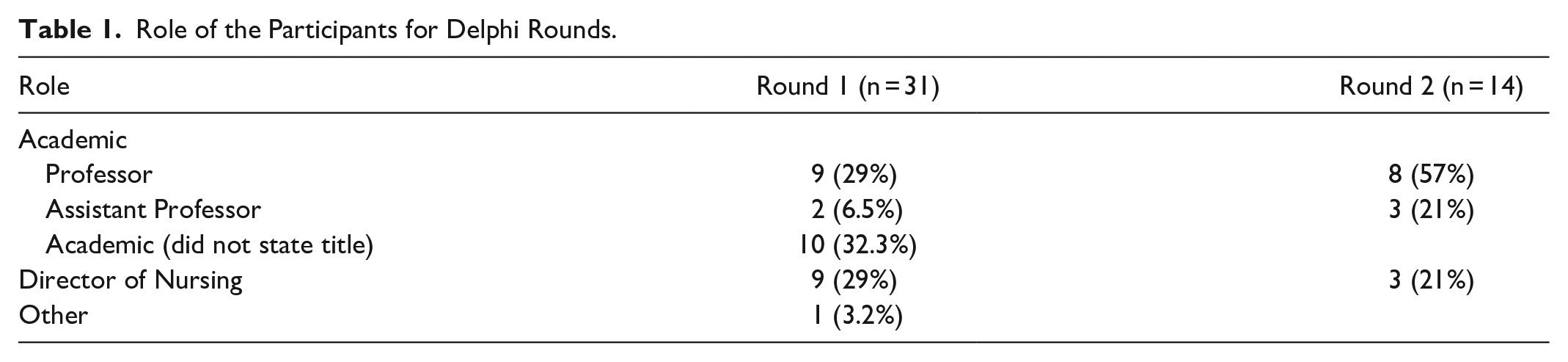
Two rounds of data collection were undertaken between June and October 2024. A total of 31 participants completed round 1 over a 2-week period (ie, including the face-to-face meeting and via e-mail). The participants consisted of 21 academics (9 professors, 2 assistant professors, and 10 who did not state their academic title), 9 directors of nursing, and 1 person who worked in the department of health. Round 2 took 6 weeks to complete, with 11 academics completing the survey along with 3 directors of nursing with 2 reminder e-mails sent to encourage participants from round 1 to respond to round 2. Table 1 presents the characteristics of the participants from round 1.
Role of the Participants for Delphi Rounds.
First Round Results
The response rate in round 1 was 100% (n = 31) with an overall survey completion rate of 100% (ie, the percentage of items within the survey completed). In round 1, nearly all statements were rated as being important or very important. For example, the statement “Advanced Practice Nursing roles need to be clearly defined” was rated as very important by 30 of 31 respondents (97%) and across the 25 statements, the number of “very important” responses ranged from 48% (statement 7) to 97% (statement 1). The “important” responses ranged from 13% (statements 11, 13, and 16) to 52% (statement 7). Ten statements included responses in the category “somewhat important,” but none of them went over more than 3 respondents. In relation to the use of CVI cutoff of 0.80, 12 statements reached this level of consensus. This included statements from all 6 categories (3 statements each from workforce-related issues, regulation, and career progression for qualified APNs and 1 statement from organizational and institutional issues, government and policy issues, and educational issues) (Table 2).
Results From Round 1.
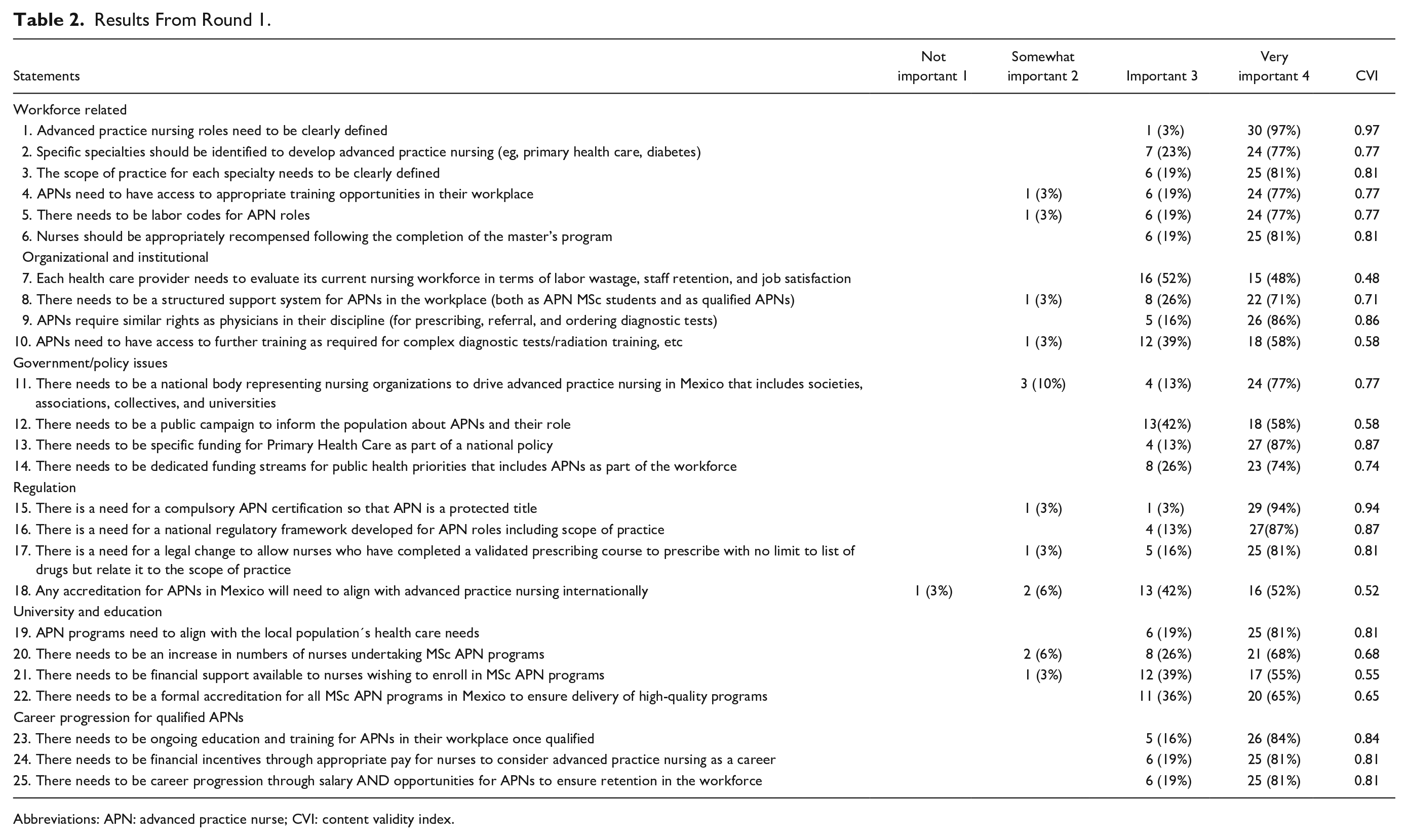
Abbreviations: APN: advanced practice nurse; CVI: content validity index.
Participants were also able add any comments, and some added their gratitude for the opportunity to be part of the Delphi.
Original quote from participant: “Es una gran área de oportunidad para fortalecer la regulación en enfermería y también la focalización de EPA.” Translated quote: “It is a great area of opportunity to strengthen the regulation of nursing and also the targeting of Advanced Practice Nursing.”
Another participant saw the importance of advanced practice nursing and the need for innovation to realize the role: Original quote from participant: “La enfermería de práctica avanzada se tiene que ir fortaleciendo con el tiempo y con disposición a la innovación.” Translated quote: “Advanced practice nursing has to be strengthened over time and with a willingness to innovate.”
The need for regulatory changes was noted by another participant: “Cambios regulatorios: Actualizar leyes y regulaciones educativas para definir cómo será el alcance de la práctica de los EPA, impulsando la capacidad diagnóstico y gestión del cuidado de los pacientes de manera autónoma.” Translated quote: “Regulatory changes: Update educational laws and regulations to define what the scope of practice of APNs will be like, promoting the diagnostic capacity and management of patient care in an autonomous way.”
Second Round Results
The second round questionnaire was administered to the sample (n = 31), and the survey remained open for 4 weeks following an initial e-mail and a follow-up e-mail after 2 weeks. This survey included 12 statements based on the results from round 1. The second round’s response rate was 45% (n = 14), with all fully completed surveys. The results from round 2 clearly demonstrated that regulation was a key priority with a median score of 1.5 for the statement around national advanced practice nursing regulation along with the statement about advanced practice nursing roles needing to be clearly defined.
The importance of the local health care needs was also highly ranked as a priority (median = 5) and the need for specific primary health care funding. There was acceptance of the importance of recognizing the rights of practitioners in terms of diagnostic tests and prescribing and the importance of career progression for those who had completed a Master’s program. The statements that were ranked as being less of a priority were in relation to regulation of those who already completed a prescribing course and compulsory APN certification (Table 3).
Results of Ranking of Priorities From Round 2 (n = 14).
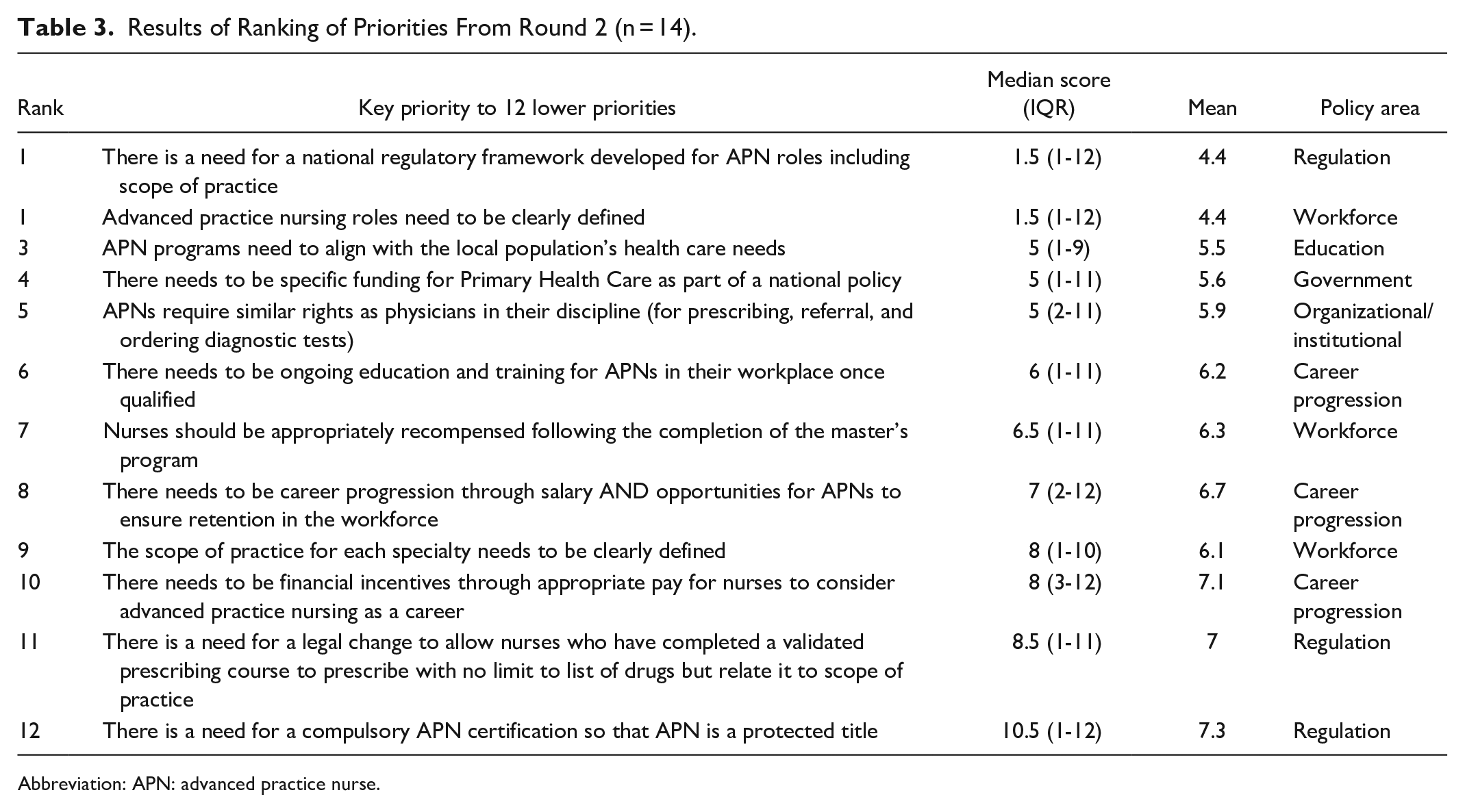
Abbreviation: APN: advanced practice nurse.
Discussion
In this 2-round policy Delphi study with 25 statements relating to developing advanced practice nursing in Mexico, a total of 12 statements were ranked as key priorities. The statements reflected key areas around advanced practice nursing, from workforce issues to regulation, education, and career progression. Although Delphi studies are usually associated with developing consensus, the use of statements is also a recognized methodological approach.16,18 The Delphi allowed a coherent approach to the development of advanced practice nursing in Mexico that shows there are specific requirements that need to be enacted if advanced practice nursing is to be implemented in Mexico. APNs are ideally placed to work in a variety of settings to meet the health care needs of the population, especially in primary health care.25,26 Given the burden of hypertension and diabetes in Mexico, APNs would be ideal to address these health care needs. 27 Having APNs as part of the workforce would fit in well to the new government who have identified the importance of expanding the health care workforce with a focus on health promotion and disease prevention and in line with the World Health Organization’s paper on the global strategic directions for nursing and midwifery. 28
From regulatory and workforce perspectives, the participants ranked the development of a national regulatory framework that included a scope of practice as a key priority while also recognizing that advanced practice nursing roles need to be clearly defined. This aligns with previous work and also with the International Council of Nurses in terms of the NP scope of practice and the need for local regulatory and legal parameters.15,19 It is critical that APNs have a scope of practice for their respective populations—whether in an acute specialty or in primary care, and under what circumstances NPs can provide care.1,11 The participants also ranked APNs having similar rights to physicians highly and demonstrated their understanding of the scope of practice in terms of prescribing and rights over ordering and interpreting diagnostic tests, which sits within the definition of an APN as outlined by the ICN. 15 Having a strategic approach to the nursing workforce in terms of scope of practice was also highlighted by the World Health Organization, 28 and the prioritization of the regulation and scope of practice demonstrates that the participants had a good understanding of the advanced practice nursing model from an international perspective as well as the local needs in Mexico.12,25
The fourth priority was about specific funding for primary health care. Mexico’s public expenditure on health care is estimated at 2.9% of GDP, which is the lowest in the OECD. 26 Primary care funding has previously been identified as essential in providing public health, especially in effective management of noncommunicable diseases such as cardiovascular disease and diabetes, 27 and APNs have been shown to be a highly effective workforce in a previous systematic review. 29
APN education programs aligning with local population health care needs was ranked third as a priority and complements the other priority for ongoing education and training for qualified APNs (sixth priority), as previously noted.30,31 A WHO report from 2021 recommended this approach: “Strengthening education capacity and quality: Educate enough nurses and midwives with the requisite knowledge, competencies and attitudes to fully meet health system needs and address current and future population health priorities.” 32 (p.5) This highlights how the health care needs of a population may change over time and how nurses need the appropriate knowledge and skills to respond to these. The new government has pledged improved training for practitioners and to reduce the high rates of hypertension and diabetes, which account for 24% of spending of the Mexican Social Security Institute. 27 Education has previously been identified as an issue for APNs during their Master’s programs and once qualified.30,31,33 Interestingly, 2 regulatory issues ranked as the lowest priority from the 12 statements; these were around a legal change to those who have completed validated prescribing courses and also having advanced practice nursing certification and making APN a protected title. It may be that if advanced practice nursing regulation is brought in, it may address the advanced practice nursing certification and recognition of those who have previously completed prescribing training as previously noted by Seck et al. 34
From a practical perspective, establishing advanced practice nursing in Mexico has several challenges to overcome, in particular how the Mexican health care system is currently organized. The first challenge is that the system is segmented, meaning that it is organized around several institutions (mainly social security and public ones) that provide services to different groups of populations based on their formal or informal link with the labor market with little formal interaction. 35 These institutions have different levels of resources, including personnel. A second challenge is in relation to policy and the employment of nurses. There are currently specific policies regarding the type of nurses employed, their salaries, and the functions they perform. For example, social security institutions over time have preferred to employ technical-level nurses while the public segment has been recruiting university-trained nurses. 36 A third challenge relates to the delivery of care as over time, institutions have developed health care models that prioritize hospital care vis-à-vis primary care, despite the efforts that several governments have displayed over the last 30 years. 37 These challenges imply that from a practical perspective, significant changes need to be made by stakeholders and policy makers to facilitate advanced practice nursing development in Mexico.
An additional challenge is the active resistance to the possibility of extending practice spaces for nurses, 34 because it is interpreted as a threat to the autonomy of other health professionals such as physicians. This fact must be taken into account in due course, especially since it is considered that in the care areas, interprofessional collaboration is decisive for achieving quality parameters. The promotion of advanced practice nursing is encouraged by the use of systemic strategies that favor the provision of services and the attention to needs, as well as the equitable distribution of functions among the health care team.
Regarding the regulation in the field of advanced practice nursing, we also identified important challenges such as promoting the coordinated participation of nursing organizations and groups and the definition of protected practice spaces in areas where advanced practice nursing is promoted. The creation of alliances with the key influencers in terms of advanced practice nursing and regulation (that is, with politicians and government officials) remains a collective challenge for nurses in Mexico.
It is clear that the development and establishment of the APN role in Mexico is contingent upon effective initial professional regulation and recognition, the clear universally acceptable definition of the APN in the Mexican context along with implementation of the required regulatory and legislative frameworks. The identified priorities clearly show that there are regulatory, workforce, educational, organizational, and institutional challenges, all of which have previously been reported.3,15,19,28,33,34 Advanced practice nursing must be attractive to potential recruits in terms of job satisfaction, pay, having a clear job description outlining their scope of practice, and access to continuing education and training. The priorities identified by the Delphi study reinforce this and provide an opportunity to develop advanced practice nursing and optimize the delivery of health care in Mexico.
There are some limitations that need to be acknowledged. The Delphi participants were identified by FENO and may not have included all those interested in advanced practice nursing in Mexico or those who, through their participation in the public space, had greater influence on the design of rules and laws. However, given that advanced practice nursing is not established in Mexico and the participants were able to suggest other potentially interested colleagues, we are confident that the sample was appropriate for the Delphi. Although meeting with participants is not the usual methodology for a Delphi study, it was felt that these meetings would be useful to ensure that all participants had a good overview of advanced practice nursing and a good understanding of the rationale for the Delphi study. A mixed-methods approach with the Delphi survey has previously been reported by others.38,39 We are confident that this approach was useful as all participants completed the survey and several added free-text comments thanking the researchers for the opportunity to discuss advanced practice nursing development in Mexico. An initial e-mail was sent to all round 1 participants along with 2 reminder e-mails over a 4-week period for round 2; however, despite these reminder e-mails, less than 50% responded. In terms of Delphi studies, this is not unusual.
Conclusion
This Delphi survey has allowed prioritization of the key issues around developing an advanced practice workforce in Mexico. There are significant regulatory, workforce, educational, organizational, and governmental challenges to advanced practice nursing development. This work will hopefully provide some impetus to stimulate and motivate the establishment of advanced practice nursing in Mexico with the appropriate regulatory framework and financial support to deliver a robust APN workforce.
Footnotes
Acknowledgements
We appreciate the support of Andrés Lizano in different stages of the collection and organization of data as well as the support of Veronica Tapia in the editorial management of the document.
Author Contributions
GL and GN designed the study and collected the information. GL wrote the first version of the paper. GN, PA, and RZ-G conducted critical revisions of the contents.
Declaration of Conflicting Interests
The author(s) declared no potential conflicts of interest with respect to the research, authorship, and/or publication of this article.
Funding
The author(s) disclosed receipt of the following financial support for the research, authorship, and/or publication of this article: Funds were generously released by UNAM’s Academic Research Visit Program (PREI in Spanish) to cover the visit of Dr. Geraldine Lee in May to June 2024, to carry out academic activities including the Delphi study reported in this document.
Ethical Approval
The original study was approved by the Faculty of Nursing and Obstetrics at the National Autonomous University of Mexico (Project Number 132, November 2021).
Informed Consent
Participants were provided with an overview of advanced practice nursing, including describing scope of practice and an overview of the thematic analysis. Following the presentation, there was a discussion among participants and researchers, and the Delphi survey was then outlined. Participants were made aware that consent was assumed by submission of the questionnaire at each round.
