




Abstract
Since 1987, Australia has witnessed dedicated policies and investment aiming to increase the number of girls and women participating in community sport. Over four decades, gender equity policies and initiatives have been extensive; however, these have rarely sought to explicitly address intersectional forms of discrimination experienced by women and girls. There is also a lack of understanding of how community sports clubs respond to intersectional discrimination within gender equity efforts. Using a feminist intersectional lens, we consider how community clubs seek to address inequities experienced by women, girls, and gender diverse people that experience multiple forms of oppression in Victoria, Australia. Through policy analysis, observations and interviews with 13 local government employees and 42 sports club volunteers, we examined understandings, discourses, and enactment of intersectional responses to gender equity. Most sporting clubs and local government employees did not understand intersectionality, nor considered or enacted intersectional approaches to gender equity. Across “diversity and inclusion” in local sports contexts, siloed or additive approaches to addressing discrimination were most common with limited consideration of gender. We recommend sport governing bodies to engage with power in developing policies and cultures that are responsive to intersectional forms of discrimination if gender equity efforts are to move beyond only benefitting white, able bodied, cis-gendered women.
Introduction
Sport is used as a mechanism by governments internationally to achieve social and health outcomes, yet many people are marginalized within and excluded from sporting participation. Due to historical structural and social inequities in sport, privilege and priority have been afforded to white, able-bodied, heterosexual, cis-gendered men, with men's achievements celebrated and valued more than women (Jeanes et al., 2021). Further, sporting structures and systems were made by and for men and thus men have traditionally been provided with more opportunities and resources than women (Bryson, 1987). In 1984, more men (37%) were participating in sports clubs such as cricket, football, soccer, or golf compared to women (24%) who were less active but also more likely to participate in activities such as netball (Australian Government, 1984). In recent times there has been greater investment, opportunities, and focus on women's sporting participation (e.g., see Toffoletti & Palmer, 2019). Yet, gendered gaps across girls and boys and women and men continue. In a recent study across an 8-year period, Owen et al. (2025) found that boys and men continue to participate in more team sports, with recommendations to develop more inclusive and enjoyable sports environments for girls and women. Further, girls and women who are marginalized have lower participation rates. For example, only 12% of Australian women with a disability participated in sport in 2024 (Australian Government, 2025) and women from non-English speaking backgrounds have the lowest rates of sports participation among cultural, racial, and linguistically diverse Australian citizens (Australian Government, 2021). However, the Australian government does not collect data on overlapping marginal identities beyond sex and a single identity, and thus we are unaware of who specifically is (not) participating in sport.
Within sports governance, policy, and participation, women are frequently positioned as a homogenous category within overarching “diversity” frameworks. Such approaches often operate through siloed classifications, treating identities such as “women” and “First Nations” as discrete and separate from each other, and as peripheral to the constructed “mainstream.” At times, sport diversity efforts do consider certain populations of women (e.g., (dis)abled women), however mostly there is a lack of consideration of intersectional inequities and siloed approaches that consider gender as separate from “other” diversity groups (Munro-Cook et al., 2024). Consideration of intersectional forms of discrimination in gender equity approaches appears to be missing in structures, policies, plans, and actions of sports organizations; (re-)producing gendered, settler colonialist, heteronormative systems of power, and oppression. Consequently, efforts to improve gender equity within sport have had limited impact and where some levels of success have been achieved, this has tended to be only for some women in sport, namely white, middle class, cis-gendered and able-bodied women, advances that (re-)produce the status quo (Trussell et al., 2024).
The aim of this article is to examine how key sporting leaders and volunteers at a local level understood intersectionality within the context of their gender equity work and how they enacted (if at all) approaches to gender equity that were responsive to intersectional marginalization. The research was undertaken in Australia in the State of Victoria. In this article, we will first outline the policy context and theoretical tools we have drawn upon in the analysis before overviewing existing studies on intersectional analyses of gender equity within sport. We then outline the methodology and findings from interviews, observations, and policy analysis of sporting clubs and local government authorities. Finally, we discuss the implications of this research, outlining the need for intersectional approaches to be embedded within sports governing bodies (e.g., sports organizations, local government authorities, and government) and sports decision-makers efforts to improve gender equity in sport.
Policy Context
Historically, some policy documents and reports in Australia have recognized discrimination against women with overlapping identities. For example, the Women, Sport and the Media report (1985), the first federal government gender equity in sport initiative, included “groups with special needs” such as disabled women, Aboriginal women and “ethnic women.” Although the language may not be inclusive by present day standards, the report acknowledged different layers of discrimination effecting sporting participation. The National Policy and Plan for Women in Sport (1987), which was an indirect outcome of the Women, Sport and the Media report, references “individuals whose disadvantage is compounded by their ‘group’ membership” and highlights “women with low socioeconomic status, older women, women of non-English speaking backgrounds, Aboriginal and Torres Strait Islanders, women geographically isolated, institutionalized women, or women with disabilities.” The language mirrors that of the recommendations in the Women, Sport and the Media report. In later national policy documents, including the Australian Women in Sport and Recreation Strategy 1992–1994 (1992) and the Australian Women in Sport and Recreation Strategy 1996–2001 (1996) references were made to “Consultation with non-English speaking background women's groups, Aboriginal and Torres Strait Islander groups” (1992) and “the special needs of young women, older women, women from a non-English speaking background, indigenous women and women with a disability also need to be considered” (1996). Active Women—National Policy on Women and Girls in Sport, Recreation, and Physical Activity 1999–2002 (1999), which was Australia's response to the Brighton Declaration and the Windhoek Call for Action, claimed that it sought to “reflect the principles” of the Charter of Public Service in a Culturally Diverse Society (Australian Sports Commission, 1999, p. s3). In the background section of the report, the authors write that they recognize that “women and girls are not homogenous” and that “those from many social, cultural, economic and physical backgrounds and circumstances face a variety of barriers to full participation in sport, recreation and physical activity” (Australian Sports Commission, 1999, p. 4). The authors go on to say that they “intend this reference [to different backgrounds and circumstances] to include race, colour, language, religion, creed, sexual orientation, age, marital status, pregnancy, disability, political beliefs and social origin” (Australian Sports Commission, 1992, p. 4). This final quote matches the language used in the Brighton Declaration and the Windhoek Call for Action. The national policy document, Towards Gender Equity in Sport: A Practical Guide for Sporting Organisations in Developing a Gender Equity Action Plan (Australian Sports Commission, 1992) only refers to ideas of discrimination against women with overlapping identities in the list of definitions at the end of the document. About Time! Women in sport and recreation in Australia (Commonwealth of Australia, 2006), a federal government inquiry into women and sport, acknowledged the characteristics—“socioeconomic strata, age, women with a disability, Indigenous or Culturally and Linguistically Diverse (CALD) women” (p. 1)—that can be barriers to participation. About Time! additionally acknowledges that sport “often forms the bond between people from different cultures” (p. 11) and devotes 11 pages to discussions of the specific challenges, barriers, and needs of women from low socioeconomic groups, older women, women with disabilities, CALD women, Indigenous women and women living in regional and rural Australia. While overall these historical policy documents recognize the varying needs of women with overlapping identities, many of their goals, strategies, and objectives do not reflect the specific needs of these women. For example, in the National Policy and Plan for Women in Sport (Australian Sports Commission, 1987), while “Policy Statement 3: Participation development” discussed women whose “disadvantage is compounded by their ‘group’ membership,” (Australian Sports Commission, 1987, p. 10), none of the targets and objectives under this Policy Statement explicitly addressed any of the communities identified. Despite devoting several pages to exploring the experiences of women from a variety of identities and experiences, none of the 18 recommendations in About Time! reference any of these identities and experiences.
A similar pattern appears in the Victorian Government's 2015 Inquiry into Women and Girls in Sport and Active Recreation. This document acknowledges disadvantage faced by “women experiencing social and economic challenges regardless of the cause (e.g., those from culturally and linguistically diverse backgrounds, those with a disability and those from low socio-economic backgrounds)” (p. 22). Further, religious and cultural norms may be “in conflict” with uniform requirements of some sports (p. 22). None of the Inquiry's nine recommendations explicitly addressed the barriers and discrimination faced by women with overlapping identities. In the NSW Government's 2019 Her Sport Her Way strategy, references were made to “background or ability” (p. 6) and “diverse backgrounds” (p. 23), but specific overlapping identities were not discussed. The strategy referenced AusPlay data that confirms women and girls from “disadvantaged areas” face barriers to participation (p. 14). It also mentioned a 2018 Sport Facility Needs for Multicultural Communities study (p. 23). However, only one recommendation (“Implement a research project to look at culturally diverse populations’ sport participation needs (including female specific needs) to inform facility planning”) (p. 25) speaks explicitly to the specific needs of women and girls with overlapping identities.
In 2020, the Gender Equality Act was passed by the Victoria State Government. The Act states, “gender inequality may be compounded by other forms of disadvantage or discrimination that a person may experience based on Aboriginality, age, disability, ethnicity, gender identity, race, religion, sexual orientation and other attributes” (Victorian Government, 2024). It was “one of the first discrimination statutes seeking to operationalise intersectionality” in gender equality in the public sector (Blackham et al., 2024, p. 3). As part of the public sector, local government authorities (LGAs) were mandated to implement internal gender equality action plans (GEAPS) and examine and advance gender equality in LGAs, including sport and recreation policies, programs and services. Government and sport policies and organizational practices have started to include more equity, diversity, and inclusion (EDI) approaches. However, these have often been critiqued due to their single identity focus, their lack of responsiveness to discrimination based on multiple, intersecting oppressions and their ineffectiveness in transforming oppressive systemic structures and systems (Hylton & Totten, 2013; Joseph, 2017; Lusted, 2014). Frisby and Ponic (2013) showed that Canadian sport policies and practices which target underrepresented groups do not create systemic change and instead reinforce assimilation. Further, Peers et al. (2023) Foucauldian analysis of Canadian sport equity, diversity and inclusion (EDI) policies found that organizations performed discursive inclusivity without any evidence of how inclusivity was enacted, perpetuating exclusion and inequity. They state that “EDI policies often lead to experiences of exclusion and marginalisation that are all the more insidious because they are done in the name of inclusion” (Peers et al., 2023, p. 194). Further, they found that women were often categorized as the opposite of men without any consideration of intersectional oppressions, thus sport EDI policies were not responsive to intersectionality (Peers et al., 2023). In an Australian context, diversity has been deployed as fundamental to the values of sports organizations, yet discursive practices damage equity efforts (Spaaij et al., 2020). Drawing on Ahmed (2017), Spaaij et al. (2020) details that sporting decision-makers use performative discourses and practices which only appear to be inclusive, instead of the deep structural transformation required to be inclusionary. Discourse analysis of policies claiming transformation of equity and inclusion in sport suggests instead that policies often reinforce exclusion and marginalization. Since White, heteropatriarchal normalcy permeates sporting structures, systems, and processes, it has been proposed that more intersectional approaches to gender equity in sport are needed (Abdel-Shehid & Kalman-Lamb, 2017). Decades of policy and research show that although intersectional oppressions have, at times, been included in policy; recommendations, strategies, and approaches can be siloed, additive, and harmful. This means that significant investments in gender equity without intersectional approaches continue to exclude women who are marginalized and “othered” (Ahmed, 2012).
Feminist Intersectionality
The concept of intersectionality stems from Black Feminist origins with complex social inequalities highlighted in the 1960s and 1970s by Black women activists such as Pauli Murray, Audrey Lorde, bell hooks, and Angela Davis (Collins & Bilge, 2020) and The Combahee River Collective (1977). In 1989, Kimberle Crenshaw brought the term “intersectionality” into legal academic settings, recognizing that people have “intersecting identities” of social categories, for example, social class, race, gender, Indigeneity, ethnicity, sexuality, and (dis)ability. In her seminal work, Crenshaw provided an intersectional framework illuminating how gender and race intersect in ways that legal discrimination frameworks could not respond to, with Black women facing discrimination distinct from white women and Black men that could not be addressed through antidiscrimination law (Crenshaw, 1991). Instead of being distinct systems of oppression, Black feminist scholars considered overarching structures as operating across domains of power (Collins, 1990), with privilege and power shaped by numerous, interconnected factors (The Combahee River Collective, 1977).
Collins (1990) argues that power is central to the (re)production of social inequalities, operating through interlocking systems at both macro and micro levels. At the macro level, the “domains of power” framework examines how intersecting oppressive structures such as racism, settler colonialism, capitalism, and heteropatriarchy, shape political power and influence social life (Collins, 2019). At the micro level, it considers how these systemic inequalities manifest in everyday experiences, affecting individuals whose identities (e.g., race, class, gender, ability, sexuality, Indigeneity) intersect in ways that produce overlapping forms of oppression, discrimination, and privilege (Collins, 2019). Collins (2019) identifies four main domains of power; structural, disciplinary, cultural, and interpersonal power, with oppression and resistance possible in each. The domains of power are mutually constructed, multilevel and can intersect, with no one domain more important than another (Collins, 2019). Domination is asserted by structural social institutions (e.g., law, education, governments, and media) who preserve Eurocentric, heterosexist, and patriarchal ways (Collins, 1990). Social hierarchy can be upheld by policy and daily life in the disciplinary domain, where rules and regulations can be surveilled and embedded into one's own behaviors. The cultural context of individuals can be shaped within social institutions and relations at the community level, where thoughts and actions can be influenced including across ideologies, ideas, and representation about social inequality (Collins, 1990, 2019). However, dominant groups can subjugate knowledge, which can also transpire through overarching structures. Interpersonally, everyone holds personal biographies of values, motivations, and experience and can be in positions of privilege, yet simultaneously experience oppression, such as white women who may experience oppression due to their gender but also hold privilege for their Whiteness (Collins, 1990). Helms (2017) defines Whiteness as “the overt and subliminal socialisation processes and practices, power structures, laws, privileges, and life experiences that favor the White racial group over all others” (p. 718). Similarly, Frankenburg (1993) states that Whiteness is a “location of structural privilege” and allows for white people's superiority in relation to the “Other.” Since Whiteness controls and dominates all environments in society—across structures, groups, and individuals—people are socialized to adhere to the norms and rules of Whiteness (Helms, 2017). Therefore, examining power and domination requires an analysis that considers multilevel and interlocking systems of oppression across structural, disciplinary, cultural, and interpersonal levels (Collins, 1990). Contextual and historical factors such as social, political, geographical, and economic factors also need to be taken into consideration in a domain of power framework, since they all influence policies, practices, and people in different ways. In the case of sport, an intersectional domains of power framework provides an insight into how historical, settler colonist hegemonic (dominant) structures, policies and processes have (re-)produced power and priority for some identities, while excluding many other identities (Anders et al., 2024). In this article, we use Collins’ (1990, 2019) domains of power to examine how structural, disciplinary, cultural, and interpersonal factors influence intersectional approaches to gender equity in sport, at a community level.
Intersectional Approaches to Gender Equity and Sport Research
Traditionally, women have been provided with fewer opportunities and resources, and their participation is less valued within sport (Paule-Koba, 2013). This is particularly prevalent when overlapping identities (e.g., Black, (dis)abled women) are present (Ekholm et al., 2019). Over the past two decades, research on gender equity in sport has predominantly been focused on White, middle-class women although there have been increasing calls to action for more critical evaluation of gender equity in sport utilizing intersectional frameworks (see Sherry et al., 2024; Trussell et al., 2024). A systematic scoping review found existing intersectional analyses have predominantly focused on intersections of binary sex/gender and race/ethnicity (Lim et al., 2021). This is likely due to the origins of intersectionality theory and the gender and racial stereotypes which permeate sport structures and discourses (Crenshaw, 1989).
Across different levels of participation (e.g., organizational structure, policies, and leadership), some research has examined specific intersections of oppression. From a policy perspective, Peers et al. (2023) found that equity, diversity, and inclusion policies aiming to promote sports participation for minoritised people, instead often (re-)produced exclusion. Policies can diminish any accountability of organizations, yet simultaneously “other” anyone who is not the status quo (e.g., white and able-bodied), thus causing more harm. Further, Black women's experiences in governance structures (e.g., sport organizations boards) found that leadership tend to be dominated by white men (and women), perpetuating settler colonial, heteropatriarchal cultures, and practices for leadership positions (Evans & Pfister, 2021; Simpkins et al., 2022). Across other forms of leadership, such as coaching positions, gender equality, and race research suggests that structures, policies, and practices reinforce a dominant masculine Whiteness that needs to be addressed (Rankin-Wright et al., 2020). While recent research from the Global North has started to examine intersectional oppressions within the context of education systems, showing how it influences adolescent girls’ school sporting participation. For example, Ogunrinde (2023) interviewed Black girls from a US Southwest middle school and found that the intersections of race, gender, and social class (re-)produced unique socioecological barriers to school sports participation. Similarly, McGovern (2024) examined how class, race, gender, and generation intersect influencing U.S. Latina women's participation in organized sport. They found that lower class and immigrant families have less resources to access opportunities and place less value on organized sport.
The voices of women who experience intersectional oppression have often been missing from the sporting rhetoric—across governance and regulation—down to the voices of community members within sporting clubs. Centralizing the voices of women and people who are gender diverse who experience intersectional oppression is fundamental to transforming dominant domains of power (Kriger et al., 2022). Even if there seemingly appears to be more inclusion efforts across sport, the systems, structures, and cultures which historically have prioritized some identities remain. White men athletes are the sporting norm; those who do not fit the norm are often categorized as “others” or “diverse,” essentially in opposition to privilege and thus, perpetuating systems of oppression (Collins, 1990; Lim et al., 2021). Sporting structures (re-)produce discrimination, and ideally, structural and disciplinary transformation would have a downstream effect. Yet, there is little research understanding intersectional approaches to gender equity in the local community context, where mass sporting participation is desired to achieve health and wellbeing policy objectives. Gender equity community sports research has highlighted the need for more critical intersectional analysis to interrogate how interlocking systems of power and oppression structure participation, representation, and lived experiences within community sport (Trussell et al., 2024).
The articles aim is to explore how intersectionality was understood and enacted at a local level by leaders engaging in gender equity work in the state of Victoria in Australia. By understanding local government and sporting clubs’ perspectives and engagement with intersectionality, we provide a snapshot of current structures, policies, programs, and cultural practices within gender equity work and consider who is (not) benefitting from these. Further, identifying successful local policies and practices that are responsive to intersectional forms of discrimination can help inform sports governing bodies and decision-makers who have not yet engaged in transformational work to learn how to embed intersectionality into their structures and systems through a bottom-up approach (Anders et al., 2024).
Methods
This study was part of an Australian Research Council discovery funded (DP220100880) project seeking to understand how different policies, resources, and supports that aim to improve gender equity in community sport impact on the everyday practices of clubs, volunteers, coaches, and players. The study examined gender equity across eight metropolitan LGAs, one regional LGA, and one regional sports assembly (RSA)—whose primary role is to support regional community sporting clubs (henceforth referred to collectively as LGAs). Between November 2022 and April 2024, 13 employees were interviewed in their capacity across LGA sports, recreation, and/or gender equality roles.
Eight community sports clubs were involved in the study. These clubs were actively engaged in gender equity or were well-known as “leading the way” in the broader sporting community (e.g., received grants or participated in inclusion forums). All sports clubs were based in metropolitan Melbourne, except one based in regional Victoria. To gather a comprehensive picture of each club, we collated, conducted and analyzed interviews, observations, and policy documents. At the start of the study, an observation template was designed to observe day-to-day activity across diverse club environments. This provided the researchers prompts to note interpersonal interactions, distribution, and physical spaces and online representations (e.g., website and social media posts, language, and pictures) particularly paying attention to gender. The local context was also taken into consideration (Collins, 1990). For example, before observations, we searched the Australian Bureau of Statistics (ABS, 2021) database to help contextualize local demographics of municipalities, such as sex, culture, education, income, and age differences. However, we must note this is inherently limited as intersectional identities are not recorded by any database. So, we also used our contextual knowledge of local demographics as researchers living in Melbourne.
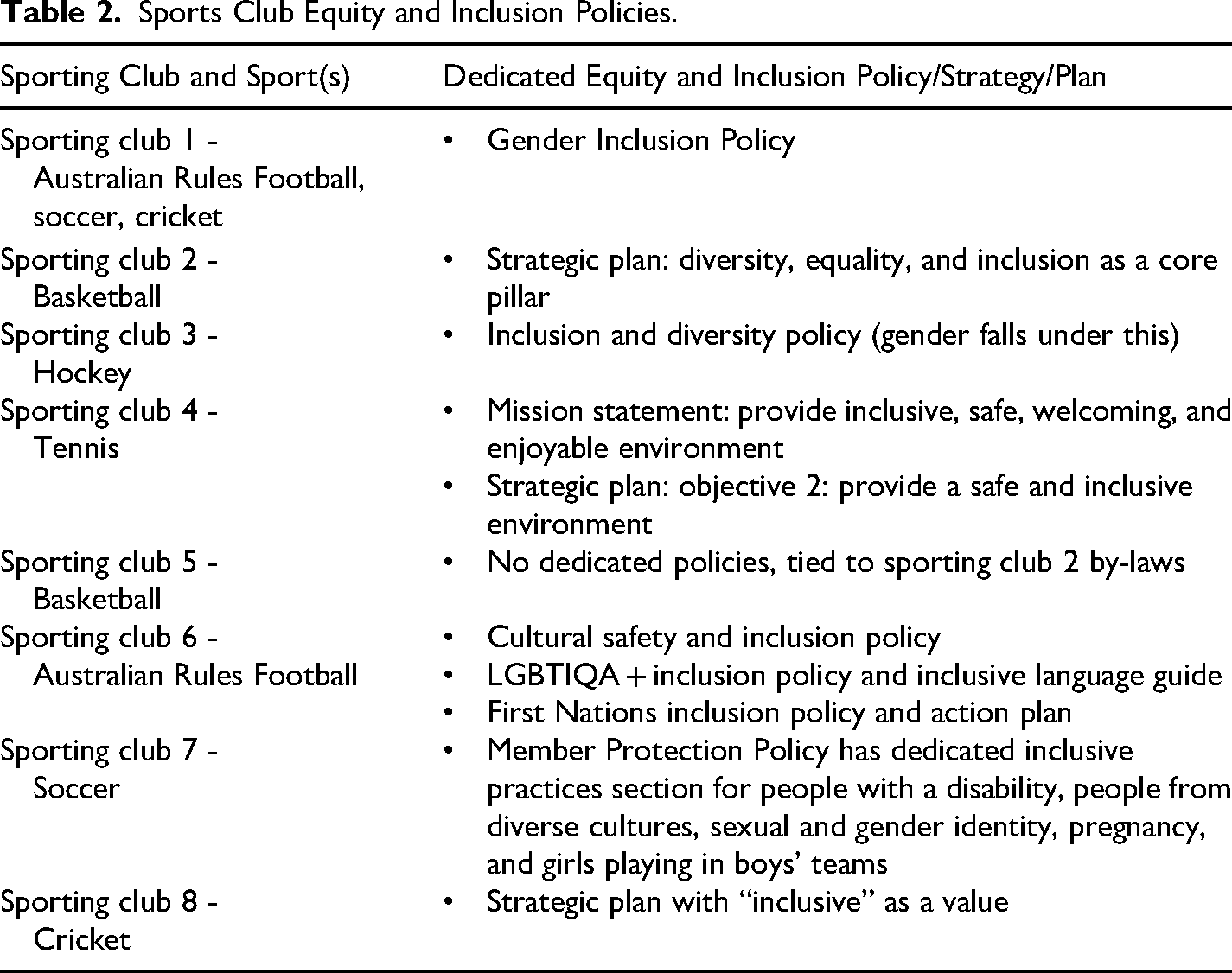
Prior to observations and interviews, we conducted a discourse analysis of publicly accessible LGA and sports club policies and strategies related to equity, inclusion and sport, recreation and/or leisure (see Tables 1 and 2). Since power is fundamental to intersectional feminist analysis, Collins (1990, 2019) domains of power were drawn upon through discourse analysis to examine how policies designed and enacted by structural institutions—local government and clubs—may influence community groups and individuals and (re-)produce oppression and exclusion (or not). Local government and clubs’ policies and strategies are documents which were often action oriented. The analytical approach examined how statements within policies and strategies served the (re-)production of power relations through discursive practices and actions. We analyzed any statements related to intersectionality, equity, diversity, gender and inclusion and across disciplinary, cultural and interpersonal layers and how statements may address or (re-)produce inequities or marginalization across sport. For example, where documents preserved or challenged social hierarchy, we would analyze under the disciplinary domain of power (see theme “discourses of intersectionality in policies” for examples). We were also cognisant of relevant literature on power and diversity, equity and inclusion in sport (e.g., Peers et al., 2023). Spaaij et al. (2020) note that at a micro-level, the value people place in equity and inclusion may also be contradictory in discursive practices. Thus, the value policy enactors place in equity and inclusion contributes to discursive actions (Ball et al., 2011; Jeanes et al., 2018).
LGAs Equity and Inclusion Sport Policies.
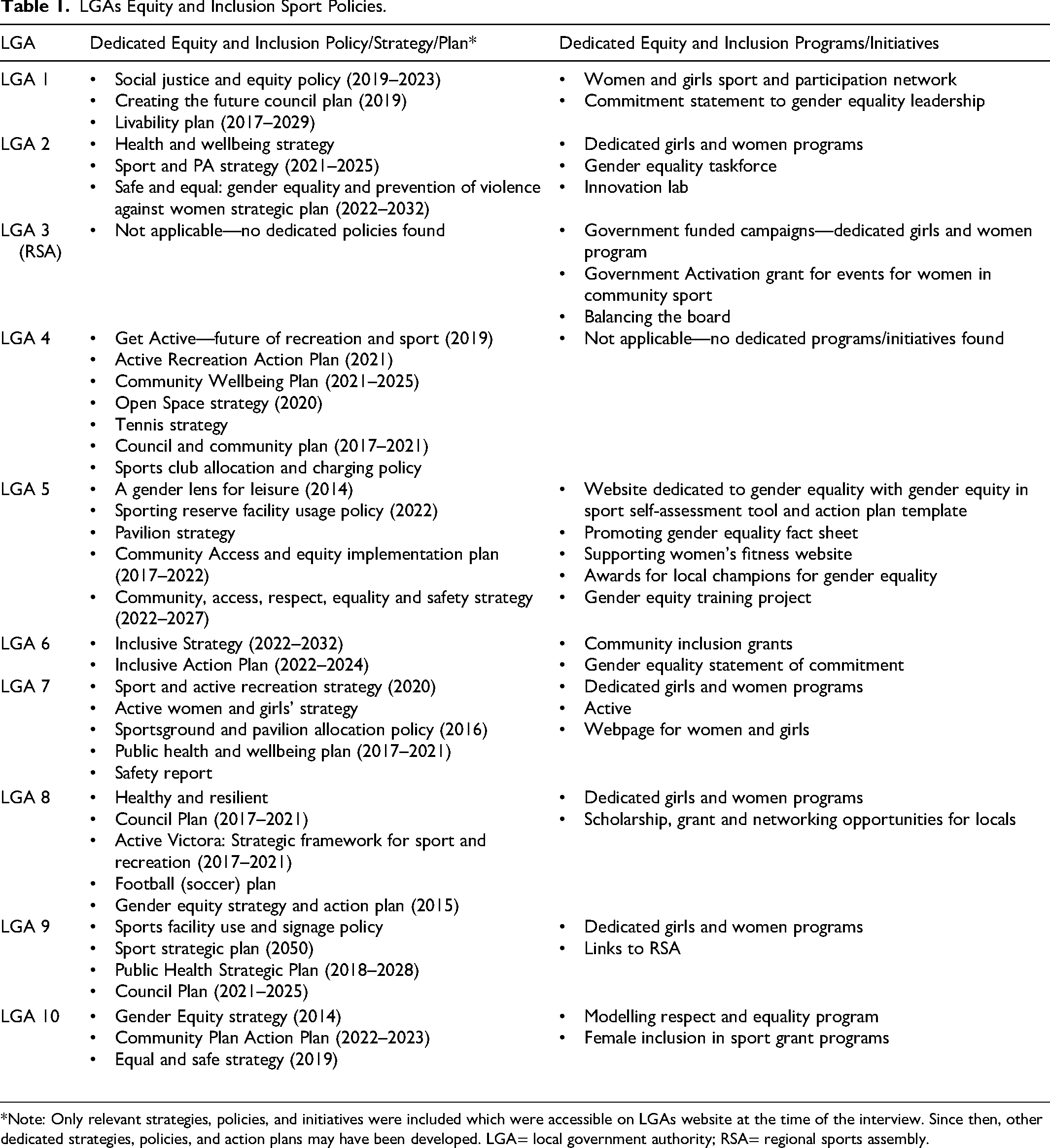
*Note: Only relevant strategies, policies, and initiatives were included which were accessible on LGAs website at the time of the interview. Since then, other dedicated strategies, policies, and action plans may have been developed. LGA= local government authority; RSA= regional sports assembly.
Sports Club Equity and Inclusion Policies.
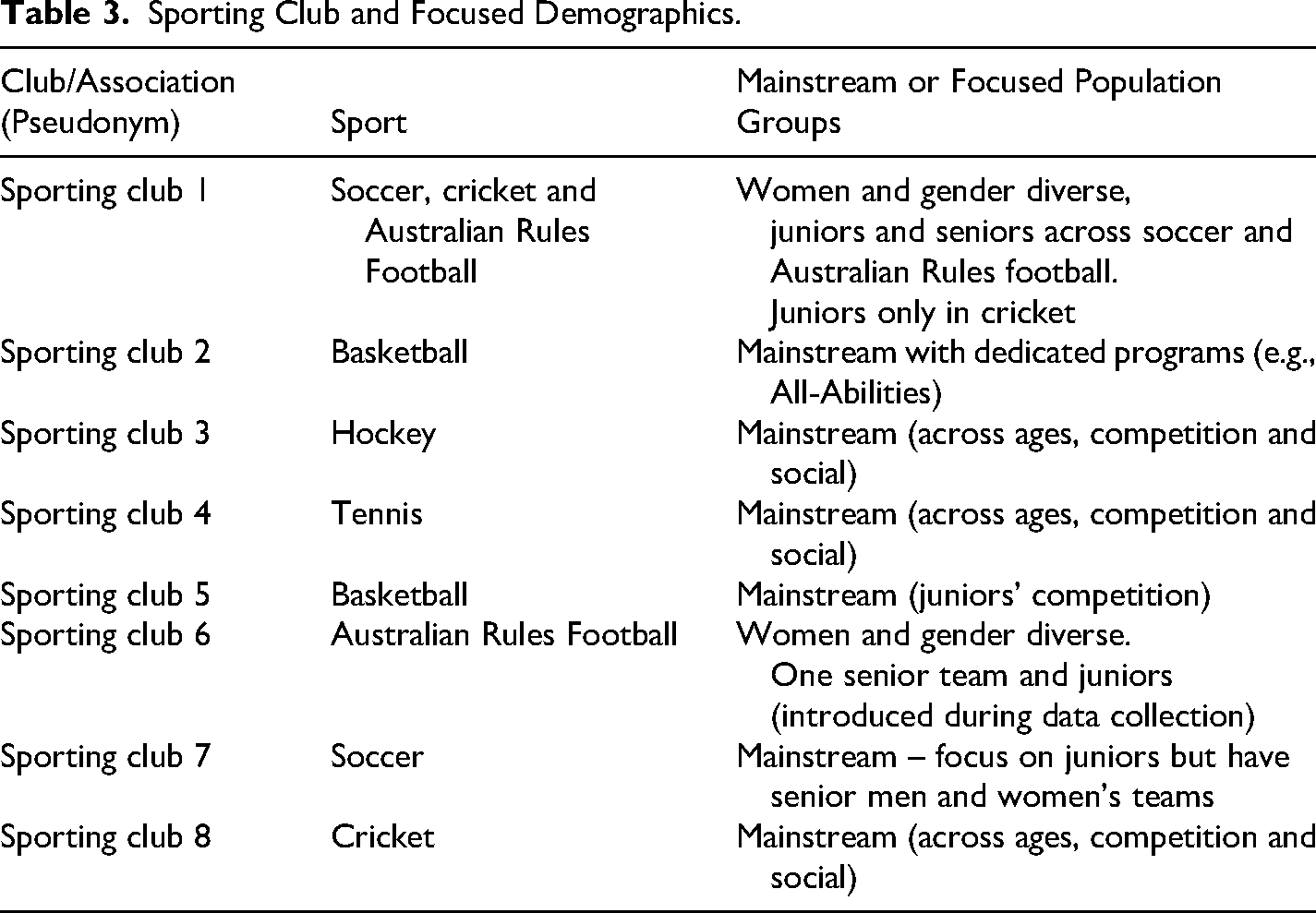
Across six sporting codes (cricket, tennis, basketball, soccer, Australian Rules Football, and hockey—see Table 3), interviews with 42 club leaders, administrators, coaches, and players were completed. All interview participants volunteered to complete an online (zoom) interview. The interviews were audio recorded and transcribed verbatim using transcription software (otter.ai). Data from interviews and observations were analyzed using Collins domains of power (1990, 2019). Specifically, a question on intersectionality from the semistructured interview guide was drawn on, “Do you know what intersectionality is and what it means in relation to gender equity?”. Although this specific question was the foci of the analysis, full interviews were analyzed examining domains of power across discourses and further, how power may have played out in club environments (observations). Underpinned by discourse analysis using Collins’ (1990, 2019) domains of power, we examined micro and macro layers of power and dominant hierarchies contributing to structural, disciplinary, cultural, and interpersonal oppression. Several clear themes were evident in the analysis, including understandings and enactment (or lack thereof) of intersectional approaches to gender equity across LGAs and local sports settings and how disciplinary power is (re-)produced in policy documents. Mostly, discourses focussed on interpersonal (micro) layers, where individual social identities were discussed in a way which “othered” to the norm (Collins, 1990) and without a gendered lens.
Sporting Club and Focused Demographics.
Reflexivity
The researchers have extensive personal and professional experience as participants and leaders across community sport and had no previous relationship with the clubs involved in this study. In our feminist approach, we asked how we may support structures, practices, processes, and people to embed gender equity and inclusion across the LGAs and clubs involved in the study. One example of this was when the researchers were later asked to present the results at community sports forums, to help educate club volunteers about enacting gender equity and inclusion. To practice reflexivity throughout this study, the researchers held regular meetings across the research process. From designing interview guides and the gender inclusion template, interviews, policy analysis, and observations, including two researchers attending an observation together. Engaging with intersectionality was part of our reflective process, it was the forefront of our design and analysis. For example, noticing, recognizing, and acknowledging who was and who was not in policies and how (and how often) minoritized groups were mentioned. Policy documents were repeatedly read and analyzed examining the framing of discourses and power. Often, the researchers would discuss sociocultural interpretations of policy documents, interviews, and observations including what it meant for the participants to be unaware of the concept of intersectionality, and who may have been missing from our research. We also reflected on our positions as academics entering community sporting spaces and discussed why racially minoritized participants may not have volunteered to be interviewed. In part, this may have been due to Whiteness dominating sporting spaces (Knoppers et al., 2021; Lee et al., 2023), reflecting the power structures, leadership, and those with perceived voice in clubs, alongside the White racial identity of the researchers which was visually evident during observations—a key site of recruitment for interviews. Further, to practice reflexivity, the lead author used a research diary through the research process, recording biases, feelings, interpretations and actions, as well as any changes, such as modifying a question related to intersectional approaches to gender equity to ensure participants understood the terminology used in the question (Braun & Clarke, 2021).
Findings and Discussion
The findings from interviews, observations, and policy analysis will be separated by LGA and sports clubs, and discussed across three overarching, yet overlapping, themes: knowledge of intersectionality in the context of gender equity; discourses of intersectionality in policies; and enacting intersectional approaches to gender equity. Across both LGAs and community sports clubs, there were limited understandings of intersectionality and enactment of intersectional approaches to gender equity were not considered, with the exception of women and gender diverse clubs. Often, council policies discussed intersectionality in gender equality action plans, but it was missing in sport and recreation policies. Few community clubs had dedicated equity and inclusion policies. Intersectional approaches to gender equity appeared to be absent across LGA and community sports settings. In the few exceptions where intersectional approaches to gender equity were considered, they were often siloed or additive. The present study showed that intersectional approaches to gender equity were not considered across structural, disciplinary, and cultural domains of power, with only some considerations of interpersonal power in most local level sporting communities.
Knowledge of Intersectionality in the Context of Gender Equity
Local Government Authorities
In interviews with sport, recreation, and/or gender equality representatives across municipalities in metropolitan Melbourne and regional Victoria, they appeared to have a limited understanding of intersectionality. None explicitly defined the concept or linked their discussions on gender equity to intersectionality. While representatives recognized that social location may influence sporting participation and were aware of the context of their local demographic, their interpretations rarely engaged with the ways intersecting oppressions and power structures (e.g., Whiteness) shape participation. For example, one sport and recreation representative identified three key social locations evident in their council but did not address how they relate to intersectional oppression, power, or gender equity: I think age and ethnicity plays a really big part within (municipality). I think those, those will probably be your, your two biggest factors, and then probably underlying potentially your socioeconomic status that we sort of see around the municipality that, that changes in certain areas. (LGA 10) I think she had one program in particular that she wanted to run, it was I think was, I think with multicultural women… it was just supposed to be generic, but we just discovered that um there was a need for it, and probably because we are such a growth um municipality, that the women who um were prepared to come to things, and, you know, perhaps weren’t working full time, could get to them, um, and we did it in areas where it was multicultural [sic]. (LGA 2) It's definitely those handful of sporting clubs that we’ve got that will do it (gender equity) across the board. There are some that, obviously, select different intersectionality's, I guess, your pink stumps day and your traditional, you know, that sort of thing. (LGA 1)
Sporting Clubs
When local sporting club volunteers were asked about intersectionality in relation to gender equity in interviews, 37 sporting participants stated they had not heard of the concept, or they had heard of it but did not know what it meant. There were a few exceptions, such as leaders and members of a women and gender diverse club who seemed to embed intersectionality in response to gender equity in their policies and culture (see Bevan & Jeanes, 2025). Since they were a new club focussed on gender inclusion and led by people knowledgeable in structural inequity, they considered power, the impact of settler colonization, and what may support disciplinary, cultural, and interpersonal approaches to gendered inclusion (Bevan & Jeanes, 2025; Collins, 1990). As a community, they resisted the disciplinary and cultural power (Collins, 2019) embedded in a sport with a long history of heteropatriarchy (Pavlidis et al., 2023). However, an alternate women and gender diverse sports club had limited consideration of intersectional approaches beyond gender and sexual diversity, showing that the leaders driving the club play an integral role to the cultural and interpersonal power layers in sporting clubs.
Overwhelmingly, most club leaders and members were unaware of intersectionality and appeared disconcerted when introduced to the term in interviews. For example, one soccer leader said; “I’ve heard it. But it's, I can’t remember. I feel, I feel dumb now” [sic] (Sporting club 7, Harry). These responses were unsurprising since intersectionality is a largely theoretical term. Therefore, after several similar responses to the one above and the obvious discomfort of participants when they were unaware of the term, the research question was modified to be more easily understandable (and potentially less confronting). The interview language was changed to explain multiple diverse identities of girls and women with examples of such identities and how they may overlap and face discrimination. After describing what intersectionality was, participants would then focus on a single identity which the club may have engaged with; certain siloed identities.
Consistent with previous research (Lim et al., 2021), the two most frequently discussed “identity categories” across interviews were culture/ethnicity or sexuality/gender. These groups were rarely considered through a gendered lens, except by leaders and members of women and gender-diverse clubs. In many cases, interview participants conflated sexuality and gender. For example, when asked what they understood gender equity to mean, several began by describing LGBTQ + initiatives or programs their clubs delivered. Those who took this approach discussed gender primarily in relation to transgender, nonbinary, or gender-diverse people, an important focus, but did not address inequities affecting girls and women more broadly, nor the intersectional forms of discrimination experienced across different gendered identities. Ethnically and racially diverse community members were often referred to as boys or men or more generally, that is without gendered considerations. Across interviews, there was no acknowledgement of intersections across social identities or the role of power.
Race and Indigeneity were notably absent from sporting clubs’ discussions about marginalized communities, showing how Whiteness is deeply embedded in Australian sport. The main form of engagement with racially minoritized groups were celebratory rounds, such as “First Nations rounds” which seek to celebrate and honor Aboriginal and Torres Strait Islander people. Celebratory rounds can promote a platform for education and awareness about reconciliation (Johanis-Bell et al., 2023). However, celebratory rounds can be tokenistic if clubs do not engage in cultural education and take no action to address or reflect on the structure, system, and culture of sport that is embedded in Whiteness and settler colonialism (Lee et al., 2023; Maxwell et al., 2022). Culturally and racially minoritized people were often treated in isolation from White identities.
From interviews, the wider data suggests that sporting volunteers tended to consider ethnicity or LGBTQ + participation as separate, siloed categories, and did so without applying a gendered lens. This focus remained largely on interpersonal domains of power, such as individual attitudes and behaviors, which reinforced the dominance of structural power such as Whiteness. Sporting volunteers should engage with the cultural factors that shape participation, and critically reflect on how safety and inclusion can be fostered beyond interpersonal niceness.
Discourses of Intersectionality in Policies
Local Government Authorities
Under the legislative requirements of the Gender Equality Act (2020), all councils were required to develop Gender Equality Action Plans (GEAPs). These plans were designed to prompt councils to audit gender equity within their workplaces and review all public policies to ensure compliance with gender equity obligations, including incorporating an intersectional approach (Victorian Government, 2022). At the time of the study, GEAPS were being implemented across councils. Further, relevant EDI and sport, recreation or leisure policies, strategies, and plans were analyzed (see Table 1). Based on discourse analysis of LGA policies, strategies, and plans, language was used to enhance physical activity and sport opportunities for “females,” “women and girls,” or “underrepresented” population groups, such as people with a (dis)ability, Aboriginal Victorians, recently arrived migrants, LGTBIQ + community, and “other” disadvantaged groups. Policies and plans largely siloed target groups (Christoffersen & McCabe, 2024), reinforcing their position as “other” to the norm (Collins, 1990; Peers et al., 2023). Documents did not operationalize an intersectional framework, despite some policies mentioning the term intersectionality.
Across the ten LGAs, five referred to intersectionality in their GEAPS, including as a guiding principle for one council. For example, in reference to the Gender Equity Framework, LGA 8 stated: Council has made a conscious decision to focus on “gender equity” because this concept recognises that people may have different needs and power related to their gender, along with relevant intersecting characteristics, particularly sex, and that these differences should be identified and addressed in a way that rectifies gender related imbalances. (LGA 8, n.d., p. 7) Our diversity is one of our greatest strengths, yet many groups (e.g., migrants, women and girls, people with a disability) experience significant barriers to participation—such as cost, transport and awareness. It is anticipated this strategy will make in-roads to addressing these barriers to see more people active more often. (LGA 8)
In this document, population groups were siloed, and throughout the document there was no reference to intersectionality or power. Further, the strategy discussed “female participation” being much lower than males sporting participation in a biological, binary sense. Intersectionality and in particular any mention of race was missing. Across most of the documents analyzed, intersectionality was not embedded in sport and recreation policies, and thus councils were limited in their reach to women and gender diverse community members who experience intersectional oppressions, with a lack of accountability of the power in these disciplinary documents.
Comparatively, there were better policies and strategies. One example was LGA 7, who were considered relatively progressive and had gender equity policies in place for over a decade. LGA 7 had a dedicated women and girls physical activity strategy which discursively highlighted the target groups they hoped to get more active, included intersections of “ethnicity, disabilities, older adult women (over 65), school students, females in single parent and low-income households” across both organized and recreational activities. This example shows consideration across intersections of girls and women, however, still used exclusionary biological binary discourses of “females” (Wiseman & Davidson, 2012). In an interview, the representative from this council, arguably a council with the best sport and recreation gender equity policies and strategies in place, stated how intersectional approaches to gender equity was an area that she wanted more guidance on, including “how we can, um, incorporate that (intersectionality) deeper into our policies” (sic) (LGA 7). Compared to most of the councils’ policies we analyzed and representatives we interviewed, this shows some understanding of the importance of intersectionality and a desire to learn more about how it can be operationalized. Further, a sports manager from an LGA with dedicated gender equity and access plans and mentioned intersectionality in its policies and plans, recognized that the work the council was undertaking to promote gender equity was missing population groups across their community, yet also homogenized girls and women in her discourses: We're putting all our eggs in the, a gender basket, which I think is very important, I think it's got some great outcomes, excellent outcomes, if we can get it right. But yeah, it's just, this is one out of so many other issues, and so many other, um, you know, representations of people across (municipality) that we're not getting to. (LGA 5)
Although she did not specify which community groups the municipality may be missing, this representative noted that the policy lacked a focus on intersectionality. She also described the challenges of introducing (homogenized) women's sporting participation strategies into clubs. Across the interviews, LGAs discussed the challenge to engage community sports clubs with groups of girls and women seen as homogenous, and struggled to incorporate intersectionality within gender equity efforts. Instead, intersectionality was viewed as an add-on rather than integral to these initiatives (Christoffersen, 2021). Several interviews suggested that a key starting point included ensuring that appropriate data collection supports the identification of who may be missing in the wider sporting picture. Although some councils collected data on (binary) girls/boys and women/men sports participation, further identities and intersections of these were often missing and thus, councils were unsure of who was (not) participating in sport across their municipalities. Council representatives suggested the need for collaboration across sports governing bodies (e.g., state-level government authorities and state sporting organizations) to gather this data to understand (and enact) gender equity with an intersectional lens.
Historically, gender equity policies and strategies have included intersectional considerations, even if they did not use the term “intersectionality.” Although the Gender Equality Act (2020) seeks to operationalize intersectionality, our discourse analysis of LGA policies and strategies showed that, often, (macro) layers of power were not considered. Nor were there clear actions for how intersectional approaches to gender equity in sport could be enacted at a local level (micro). Apart from five LGA GEAPS acknowledging intersectionality, document analysis showed how local sporting communities were governed by discourses in policies and strategies, which missed intersectionality, rendering it invisible (MacBeth & Sprake, 2025) and a lack of accountability of action. Thus, disciplinary power ensued with no challenge to the dominant power norms sporting and government structures (re-)produced of Whiteness and heteropatriarchy (Knoppers et al., 2021). In documents which were meant to be action-oriented, there was no clear guidance, showing no accountability by LGAs to consider intersectional approaches to gender equity and further excluding and marginalizing the groups they were claiming to support (Peers et al., 2023). Further, this preserved the cultural and interpersonal layers of sport where white, able-bodied, cis-gendered, heterosexual men and women are the dominant norm. The interviews reinforced how power inequities at a micro-level were perpetuated and dominant power sporting norms were (re-)produced, even by council representatives with policies and strategies which included intersectionality. The vast differences of examples across policies and strategies in municipalities showed that although GEAPS were internally mandated in the public sector, most sport and recreation council policies lacked intersectional approaches to gender equity, reinforcing priority for some identities of women (e.g., white, cis-gendered, and able-bodied women). Research has suggested that councils need policy directives, knowledge and capacity to support successful gender equity initiatives in community clubs (Hanlon et al., 2022). We would argue that such policies need to embed an intersectional lens, otherwise actions to address multiple forms of discrimination, especially racial oppression, across macro and micro levels will remain largely absent. In accordance with the Gender Equality Act (2020), LGA policies should be operationalizing intersectionality. Similar to Blackham et al. (2024), our study showed gaps where intersectionality remained absent in public sector policies.
The present findings show that a top-down normative approach operates in community sport, where the overarching sporting governance structures and disciplines, including policies, have limited consideration beyond a homogenized group of “girls and women,” or used siloed approaches to equity and inclusion (Lusted, 2014). Possibly, councils need more education and information to learn about intersectionality and how to embed intersectional approaches in response to gender equity including understandings about power. Since women and people who are gender diverse must conform to dominant power relations, or face exclusion and “othering” (Knoppers et al., 2021), policy-makers should center the voices of women and people who are gender diverse and experience intersectional oppression in transforming settler colonial, heterosexist sports structures, and systems (Kriger et al., 2022). Seemingly, where progress has been made, it has been for white, able-bodied, cis-gendered women (Jeanes et al., 2021; Trussell et al., 2024); and intersectional approaches to gender equity were not being considered in policies, thus (re-)producing power of intersecting oppressive sporting structures and cultures (Collins, 1990, 2019).
Sporting Clubs
Only three of the eight sporting clubs involved in this study had dedicated inclusion or equity policies (see Table 2). Two were women and gender diverse sporting clubs, with customized gender inclusion plans and language guides focused on equity and inclusion across women and diverse genders and sexualities. For example, one policy provided explicit examples of discrimination such as “dead naming someone (deliberately using incorrect names)” and outlined reporting guidelines and sanctions for breaching the policy. Further, this club also had First Nations and cultural safety inclusion policies, the only club in our study to recognize (in any form) the ongoing impacts of settler colonization and discrimination and oppression of people who are racially minoritised. The rest of the clubs involved in the study did not have gender inclusion plans or strategies. However, one large hockey club had a dedicated diversity and inclusion policy which referenced gender but directed members back to the overarching sports organizations by-laws. All sporting clubs had codes of conduct which referred to their respective sport's governing by-laws. Instead of having dedicated policies and/or action plans, most sporting clubs mentioned inclusion being fundamental to their core principles or values. Yet, inclusion and equity were not defined, which could mean that assimilation to the dominant culture was required by anyone “othered” (Frisby & Ponic, 2013; Peers et al., 2023), and (re-)producing disciplinary and cultural power.
Enacting Intersectional Approaches to Gender Equity
Local Government Authorities
Gender equity is fundamental to LGAs remit including mandates stemming from the Gender Equality Act with an intersectional approach. However, across the interviews representatives did not reflect on how their LGAs were taking intersectional approaches to gender equity. Further, they did not explain how the council supported sporting club volunteers in enacting intersectional approaches to gender equity. Possibly, this is due to limited understandings about the theoretical term of intersectionality. However, council representatives separated gender equity efforts and engagement with “othered” identities (e.g., short-term programs for “under-represented” groups). In interviews, they tended to place the onus of responsibility on sporting club volunteers to enact gender equity, in which they stated, few were doing. LGA representatives opinioned that very few sporting clubs were engaging in gender equity, let alone had any consideration of intersectional approaches to gender equity. Therefore, there was limited reflection of how councils may address intersectional discrimination in structures and systems and support sporting clubs to be doing this work. Sports structures and systems did not embed equity, diversity, and inclusion, let alone intersectional approaches in their structure, systems, and cultures (Legg & Karner, 2021; Munro-Cook et al., 2024).
Sporting Clubs
Most sport club volunteers believed that “inclusion” was a core value or fundamental principle of their club. This was reinforced by interviews with club volunteers who believed their club was “inclusive for all” and “everyone was welcome.” Excerpts below were illustrative of this mantra.
In terms of cultural sort of side of things, nothing in particular. Umm, because we’re a club that just advertises to anyone in the area. (Sporting club 5, Jenny)
Anyone that comes to our club is welcome. We don’t have a sign at the door that says, you know, ‘you’re not welcome’. (Sporting club 3, Lindsey)
When discussing intersectionality in interviews with sporting club volunteers, some siloed identities (e.g., LGBTQ + or cultural/ethnicity engagement/programs) were considered, but without a gendered lens. Sports clubs used siloed approaches, separating identity categories (e.g., girls and women or LGBTQ + or ethnically diverse). As an example from the wider data, based on the demographics of the area, one soccer club leader went to the local Sikh community and community members joined the club, while club representatives also went to Sikh community events. However, this was not driven using a gender lens. Research suggests that different gendered considerations for Sikh girls and women to play sports are needed, such as entering men dominated sporting spaces where their gender and/or cultural and/or religious identity was not reflected across leadership positions or peers (Ratna, 2024). The club did engage a few Sikh adolescent girls to play. Observations across sporting clubs showed that white bodies and Whiteness still dominated sporting spaces with leadership positions predominantly held by people who are white (Knoppers et al., 2021; Lee et al., 2023). Whiteness was reinforced through interviews, where some participants acknowledged the lack of ethnic diversity across their respective clubs, and did nothing to address it. Further, they did not reflect on power and had no consideration of gender, as demonstrated by the excerpt below.
We’re a pretty white Anglo Saxon club though, so I mean, there's, you know, I couldn’t speak of the cultural diversity sort of makeup of the club. (Sporting Club 3, Matt)
Further, many sport club volunteers did not mention race, showing a lack of reflexivity about their own (mostly white) racial identity. Thus, racial power and privilege were not considered, and Whiteness was preserved in local sporting communities as the dominant norm. Only dedicated ethnic and/or culturally diverse programs were run for short periods of time and were “othered” (Collins, 1990; Spaaij et al., 2018, 2020).
Sports volunteers enacting gender equity perpetuated normalcy, with no thought of intersectional identities who experience structural, disciplinary, cultural, and/or interpersonal oppression (Christoffersen, 2021; Collins, 2019), and therefore served to benefit white, able-bodied, cis-gendered girls and women. Yet, there were exceptions to the norm. In their respective clubs’ development, leaders from two women and gender diverse clubs considered equity and inclusion from an LGBTQ + women and gender diverse perspective. However, only one of these clubs’ leadership considered intersectional forms of oppression more broadly in their structures (e.g., policies and action guides) and cultural processes (e.g., daily practices). This club understood the structural and disciplinary barriers to marginalized women and people who are gender diverse, an anomaly to the hegemonic structures and practices permeating local sports environments. This was largely because the club was led by people who had knowledge and understanding of systemic discrimination and inequity and had a social justice lens, with professional skills they could draw on (e.g., criminal lawyer and LGBTQ + government support). The clubs’ founders took a consorted effort to develop and enact equity, inclusion and intersectional approaches to gender inclusion in their structures, policies, and practices, yet they still faced structural and disciplinary challenges (see Bevan & Jeanes, 2025).
Conclusion
This study demonstrates that despite a 40-year history of gender equity policies, intersectional approaches remain neither considered nor embedded in local sporting contexts. Although the Gender Equality Act (2020) mandates the operationalization of intersectional frameworks, current governance models continue to homogenize girls and women or apply additive, siloed approaches. Moreover, since community sport depends heavily on time-pressured, operationally focused volunteers who primarily aim to serve existing members (Fahlén et al., 2018; Jeanes et al., 2018), these club volunteers need support from broader (macro-level) sporting structures and systems to effectively implement intersectional strategies to gender equity. The volunteer nature of community sports clubs may limit enactment, even if policies are explicit about intersectional approaches to gender equity. Previous research shows that intersectional approaches to gender equity were missing across layers of power, from sports governance down to participation (e.g., Macbeth & Sprake, 2025; Munro-Cook et al., 2024). A strength of the present study was the comprehensive dataset, analyzing across policy to practice, to show that intersectionality (and power) was invisible (Macbeth & Sprake, 2025) in community sport gender equity efforts. White, cis-gendered, abled bodies are the dominant culture, normalizing and (re-)producing the status quo. There was limited (or no) reflexivity and accountability beyond the dominant White, masculine culture. For change to transpire, dominant groups need to recognize their power and be willing to redistribute it. Further, there was limited consideration about how power structures (e.g., Whiteness) need to be considered in gender equity efforts.
Organizations that play a role in the governance of community sport, such as LGAs need to transform macro and micro layers—across structures, systems, cultures, and individuals—to develop and embed intersectional approaches to gender equity in sport, and thus support sporting clubs to do the same. Instead of present approaches using additive and/or siloed models, often focussed on individual layers of oppression to diversity, equity, and inclusion (Christoffersen, 2021; Collins, 1990), intersectional approaches need to be embedded across sporting systems and structures. For example, policy-makers need to engage with and understand intersectionality, be reflexive about power and how sporting structures (re-)produce Whiteness and heteropatriarchy (see Lambert et al., 2025). Further, the voices of people who experience intersectional oppression need to be centered and genuinely embedded into sports organizations policies, structures, and processes (Kriger et al., 2022). These approaches may support the organizations and structures which shape the culture and practices of sport to be more inclusive. In turn, governing structures need to dedicate ongoing human resources (who meaningfully understand intersectional approaches to gender equity) to support sporting clubs in enacting intersectional approaches to gender equity, especially for sporting club leaders who are unaware of the concept of intersectionality or how power influences “inclusion.”
The few sporting clubs who were using intersectional approaches to gender equity were making bottom-up changes, transforming micro-level sporting norms for their local community (e.g., Bevan & Jeanes, 2025). However, this study showed that few sporting clubs were using bottom-up approaches to transforming hegemonic norms, and these approaches do not revolutionize the overarching heteropatriarchal, colonist settler structures, cultures, and individuals in dominant positions of power (Collins, 1990). The White racial group continues to hold power and privilege across all levels of sport, with little or no recognition and reflection of how Whiteness is deeply embedded across sport, and thus limited efforts to address this. For too long, white, able-bodied, heterosexual, cis-gendered men (and some women) have benefitted from holding power in sport, while women and people who are gender diverse with intersectional oppressions have been subjugated. Equity, diversity, and inclusion efforts have been on the periphery—segregated—instead of being core to sport to get more people active. Intersectional approaches to gender equity need to be embedded across the layers of power—sports systems and structures, disciplinary, cultures and interpersonally—with training to support sports administrators and volunteers to see and understand power. Otherwise, white, able-bodied, heterosexual, cis-gendered women will continue to be prioritized in gender equity in community sport efforts.
Footnotes
Acknowledgments
The authors wish to acknowledge the shared knowledge and experiences of the participants involved in the study.

Ethical Approval and Informed Consent Statements
This research was reviewed and approved by Monash University Human Research Ethics Committee (ID: 32999). Participants provided their consent to participate and associated publications.
Funding
The authors disclosed receipt of the following financial support for the research, authorship, and/or publication of this article: The research for this article was made possible by a Discovery Project grant (DP220100880) awarded by the Australian Research Council.
Declaration of Conflicting Interest
The authors declared no potential conflicts of interest with respect to the research, authorship, and/or publication of this article.
Data Availability Statement
The data that supports the findings of this study are available from the authors upon reasonable request.