




Abstract
While others have suggested that action sports offer avenues of escape from neoliberal imperatives like maximizing health and self-regulation, we argue that even the most mainstream of sports—amateur road running—holds similar potential. Using data from 20 “running reflections,” we explore running's everyday affective intensities using Deleuzo-Guattarian theory. We conceptualize running as a machinic assemblage that shapes what the body can do in myriad ways. We argue that while the running machine produces neoliberal imperatives and the disciplined subjectivity of “runner,” those almost inarticulable affects that runners struggle to express reveal deterritorial possibilities that challenge the stratification of running as a practice shaped by health and fitness discourse. Additionally, we show that it is important to cultivate methodologies and analytic strategies that excavate beneath the surface of participants’ stratified language, because runners’ tendency to default to wellness language—order-words—for the sake of effective communication in a world where neoliberal logics are most easily articulated and understood may elide other affective and embodied analytic possibilities in the form of a-grammatical deterritorializations.
As COVID-19 and associated pandemic restrictions proliferated, disrupting the normal patterns of our daily lives in March 2020, we found our orientations toward our sporting pursuit—distance running—altered. To contend with our changing relationship to running, our sudden disconnection from our running communities, and to understand our own emotional responses to pandemic-precipitated changes in our athletic practices, we set out to collect an archive of affect. We opened a call for participants, asking fellow runners to submit a written or voice-recorded reflection of their experiences running during the pandemic, with an emphasis on feelings and emotion. After reviewing 18 participant-submitted reflections and our own reflections, we found that our archive offered a treasure trove of feeling about running in general, in addition to empirical data on pandemic running. In reading participants’ reflections, we began to rethink many common tropes about running and runners, and to reconceptualize running as an affectively meaningful practice that produces myriad bodily potentials. To do so, we use feminist Deleuzo-Guattarian affect theory in the vein of Markula, MacLure, and Renolds and Ringrose, as explicated further below. This approach begins not with the runner as a stable subject, but by examining what the practice of running—conceptualized as a running “machine” or assemblage composed of human and nonhuman components brought together by productive desire—produces or makes possible.
Literature Review
Running and Discipline
A considerable share of academic work on running frames it as an individual sport concerned with self-regulation and the pursuit of neoliberal imperatives like health and wellness, self-improvement, self-mastery, and self-discipline. Foucauldian concepts of regulation, discipline, and technologies of the self are frequently used by scholars—often to great effect—to understand the role of discipline in the practice of running (Chase, 2008; Couture, 2021; Esmonde, 2020; Hardey, 2019) and coaching runners (Denison & Mills, 2014; Mills & Denison, 2013). Scholars also explore running as a means of maximizing health or as being motivated by pursuit of health and fitness outcomes (Little, 2017; Shipway & Holloway, 2016; Wiltshire et al., 2018). Much of this research focuses on how fitness and health are “part of a system of biopower which imposes discipline over the individual through internalization and self-policing” (Little, 2017, p. 323). Work celebrating running's efficiency in meeting these goals is common. For example, Bond and Batey's (2005, p. 69) study of women runners found, “running provided experiences which led to enhanced self-esteem, notably through perceived improvements to the physical self, but also through increases in mastery/achievement and physical competence,” while Shipway and Holloway's (2010, p. 270) qualitative exploration of distance runners investigated, “how distance running could positively contribute towards government objectives linked to tackling obesity levels, healthy living and physical well-being.” These approaches position running as a useful tool to improve health and/or increase self-mastery and achievement (Baxter, 2021; Putman, 2009; Wang, 2022).
Conversely, other scholars critique running's disciplinary regimes. For example, Konoval et al. (2019) worked with an endurance running coach, attempting (with mixed success) to facilitate escape from the disciplinary bounds governing running practices by encouraging him to think differently about discipline using Foucauldian approaches. The critical approach taken by Konoval et al. and other scholars (Couture, 2021; Esmonde, 2020) explicitly troubles the effects of running's disciplinary logics. Yet whether celebrating or problematizing, both approaches frame running as inherently disciplinary.
Much of the work exploring emotion from a psychological perspective takes a similar stance, exploring running's capacity to act on the individual. Sport psychologists explore whether running improves psychological wellbeing. Pereira et al.'s (2021) systematic review of 58 articles examined psychological and behavioral correlates of recreational running, finding that results related to improvements in mood and wellbeing were the most frequently reported findings. Oswald et al.'s (2020, p. 1) scoping review of 116 articles studying the relationship between running and mental health found, “a range of associations with mental health but also some associations with adverse mental health (such as exercise addiction).” Overall, psychologists primarily study running's impact on mental and emotional health, thus aligning with the approaches outlined above.
However, Csikszentmihalyi's (1990) work on flow states—wherein one becomes so absorbed in an activity that everything else ceases to matter, including personal costs—is an influential psychological perspective that diverges from health-focused approaches. As a concept, flow entered the popular consciousness of runners and has been used in many academic explorations of flow in sport and exercise (see systematic reviews: Goddard et al., 2023; Harris et al., 2023). Though not directly concerned with running's capacity to align the body with health imperatives, the concept of flow remains entangled with self-maximizing logics. As Soderman (2021, p. 13) argues in the context of game studies, flow is a framework that produces a consuming subject and is rooted in capitalist ideology underpinned by “individuality, self-determination, growth, and reduction of critical consciousness.” We thus argue that much of the psychological work on running, whether exploring emotion and wellbeing or flow, frames running as a neoliberalized practice concerned with what running does for the individual.
Overall, the above outlined approaches see runners as caught in and motivated by disciplinary systems in which health, broadly conceived, is an individual responsibility. Runners are seen as heeding the call for “responsible citizens” to “regulate, monitor and discipline bodily health as a part of the care of the self,” which includes daily wellbeing, long-term health, and the avoidance of physical or mental illness (Little, 2017, p. 322). Despite our critiques, we consider these frameworks important for understanding running as sport and leisure. Many runners will recognize these disciplinary capacities enable everyday and remarkable athletic performances, yet can also contribute to sports’ constraining effects (over-training, obsession, tolerance of abusive coaching practices, etc.). While self-regulatory and health-focused framings of running are by no means monolithic—as we discuss below—the popularity of these framings in academic and popular culture make it difficult to consider running otherwise. The inability of these framings to account for runners’ affective experiences beyond discourses of wellbeing and motivation has inspired us to examine what—if any—contestations may be found: Is neoliberal discipline and health-focused discourse the only frame through which to conceptualize running?
Beyond Discipline
Other sport researchers have similarly contested discipline- and health-focused approaches to running (Nichols et al., 2024) . In her partially autoethnographic study on running and pleasure, Caudwell argues “sport scholars are prone to objectify and make scientific the body's motion” (2015, p. 98). She argues that runners' pleasure and discussions thereof are often shaped by capitalist, Fordist, and Taylorist ideologies that value performance, competition, productivity, rationality, standardization, and individualism. Under these conditions, Caudwell argues, the pleasures of running are “tied to quantifiable criteria, and […] about knowing and mastering” (2015, p. 100). She moves beyond these forces of stratification in her work and centers embodied pleasures, acknowledging they remain shot through with and shaped by constraints based on race, gender, and class.
Atkinson (2010) makes a similar case in his study of “post-sport” fell running. He uses Deleuzian frameworks to argue that, as compared to the competitive, individualistic and disciplining pursuit of road running, fell running allows immersion in “desire-producing, personally rewarding and spiritual activity” that is less hierarchical and competitive (2010, p. 110). We recognize much of what Atkinson is analyzing, and his conclusions feel intuitive—the first author's main athletic pursuit is trail running, which shares many characteristics with fell running as Atkinson describes. However, we are skeptical about the utility of drawing too-neat binaries between mainstream sport (like road running) and post-sport (like fell or trail running). Whereas Atkinson (2010, p. 113) describes post-sport as “unhinged from the credo and ethics of capitalist, technologically enframed and spiritually limiting mainstream sports,” we suggest that the boundary between these categories is deeply porous.
Moreover, while post-sport may “operate under a central ethic of de-territorialisation” (Atkinson, 2010, p. 115, emphasis in original), many “post-sport” activities such as surfing (Evers, 2006; Roy, 2014), parkour (e.g., Saville, 2008), and scuba diving (e.g., Straughan, 2012) are niche and deeply shaped by geographic, class, and gender dynamics that can make their pursuit unattainable. The focus on such activities raises questions about whether sports’ deterritorializing possibilities (or, less technically put, whether sport's potential to disrupt powerful norms, expectations, and ways of being) are available only to those with privilege. Thus, grasping what more mundane practices—like accessible amateur sporting pursuits—allow the body to do is paramount. Additionally, as Andersson (2024, p. 14) points out, new sport and leisure trends have led to a sharp rise in self-organized sport, the transient nature of which results in the formation of heterogeneous sport assemblages (meaning, the coherence of heterogeneous, dynamic elements that come together to shape sporting experience) comprised of “streets, trees, buildings, people, cultures, local authorities, economies and so on.” Grappling with the heterogeneous and fluid nature of self-organized sport further upsets binary constructions of post sport versus mainstream sport, the latter also being a category that varies widely in method of organization.
In this article, we are interested in the ways that amateur road running (a popular sport in Canada, the USA, and Australia, the home countries of our participants) might serve participants in the same way niche, post-sport practices do. Certainly, amateur road running is shaped by competitiveness, technological fetishism, consumerism, healthism and other stratifying social forces that solidify as discursive “truths” about running. However, we contend that excavating the deterritorial potentialities of road running is an important process that resists the calcification (or, re-entrenchment of the extant hierarchy) of mainstream sport in practice and academic discourse.
In this regard, we share commonalities with Freeman's approach in Running (2023). While we have different theoretical underpinnings (we share with Freeman a commitment to queer and feminist theory, but where we draw on Deleuze and Guattari they draw on Barthes), we share an interest in running as capacious, deeply relational, and as a practice that can create new possibilities for what the body can do. Freeman (2023, p. 5) writes, “To run is to move and be moved. This is why it is vital that everyone have access to spaces for running.” While maintaining keen sight on the racial, classed, and gender inequalities that makes running impossible or dangerous for some people, she argues that experiences of running can “exceed your imagination; they can shift your sense of what you thought you knew” (Freeman, 2023, p. 5). While we are working from different frameworks, Freeman's work is helpful in demonstrating the productive nature of running as a habitual practice.
Building on the work of scholars like Thorpe et al. (2023), Freeman (2023), and Atkinson (2010), we employ a Deleuzo-Guattarian theoretical framework to complicate neoliberal conceptualizations of running as an instrumental tool of wellbeing and self-mastery. We demonstrate that the running assemblage produces a range of possibilities, including a disciplined body that conforms to normative understandings of health. However, we assert that the “loudness” of health and fitness rhetoric can elide the deterritorial affective intensities existing alongside it. We also demonstrate that whilst runners may employ disciplining language aligned with neoliberal imperatives, scholars can look beneath these discursive surfaces to excavate deterritorial possibilities that may be obscured by health and self-mastery focused language.
Running is our object on analysis, but our findings can apply to many amateur sport and leisure pursuits, from hiking to yoga to rec-league hockey or soccer. We do not believe running has unique potential for deterritorialization; rather, we use running as an example of a popular fitness pursuit deeply entangled with individualizing health and fitness discourses to demonstrate stratifying discourses do not capture all of the potentialities sport produces.
Theoretical Framework
Our approach in this article is rooted in Deleuzo-Guattarian affect theory, particularly as it has been taken up by feminist scholars including Markula, MacLure, and Renolds and Ringrose, among others. This approach to affect is one among many, and affect- and emotion-based approaches to sport and leisure draw from a wide variety of theoretical foundations. Many of these approaches have gained traction in social science research in recent years, as part of the broader “affective turn” (see, e.g., Fullagar & Pavlidis, 2012, 2018; Kennedy et al., 2006; Knobloch-Westerwick et al., 2009; Pavlidis & Fullagar, 2015; Rinehart, 2010; Thorpe & Rinehart, 2010; Webb & Forrester, 2015). In the case of running specifically, phenomenological explorations of emotions and the senses (see, e.g., Allen‐Collinson & Hockey, 2001, 2015; Gross, 2021; Hall et al., 2021; Hockey, 2006; Lorimer, 2012; Rana, 2022) are more common than Deleuzo-Guattarian ones. While our work is related to much of this scholarship, we are most explicitly building on the sport and leisure research rooted in Deleuzo-Guattarian affect theory.
There is a small but generative body of literature on running rooted in Deleuzo-Guattarian affect theory. As discussed above, Atkinson (2010) explores the desire-producing, deterritorial, and rhizomatic nature of fell-running, contrasting “post-sport” (including fell running) with mainstream modernist sport practices. Markula (2015) explores the “natural running” movement and the minimalist running shoe movement using Deleuze and Guattari's conceptualizations of smooth and striated space. Pringle (2015, pp. 95, 107) conducts an analysis of the magazine Runner's World and explores the way it “represents running as an affective practice” and “evokes the corporeality of running and mobilizes various affects and emotions.” In their research on marathon running in China, Cai et al. (2021, p. 1) explore the “affective potential of running bodies” and argue that while individual embodiment has been a focus of running scholarship, the relational and productive nature of affect has been “largely unexplored.”
We share with Cai et al. (2021, p. 3) a belief that affect theory can help “overcome the limitations” of scholarly approaches that “over-emphasises discursive power (e.g., the discourses of healthism) and the docility of body” by focusing instead on the excitability and instability of the body. Building on Cai et al. and Markula's (2019, p. x) work, in which she explores how Deleuzian theory “can benefit multiple ways of investigating physical culture,” we see close examination of mundane amateur road running experiences through the lens of desire and assemblage as an important way of interrupting the binarization of stultifying versus liberating sporting practices and developing nuanced, layered understandings of what the running body can do. We use the historical moment of the COVID-19 pandemic—an event that made runnings’ affective potentials raw and urgent for many—to demonstrate how affect theory can be used to complicate (though not supplant) neoliberal conceptualizations of amateur running as an instrumental tool of wellbeing and self-mastery. In doing so, we rely on a conceptual toolkit drawn from Deleuzo-Guattarian theory: affect and desire, stratification, territory, and assemblage.
Affect/Desire
For Deleuze and Guattari, affect is the “ability to affect and be affected. It is a pre-personal intensity corresponding to the passage from one experiential state of the body to another and implying an augmentation or diminution in that body's capacity to act” (1987, p. xvi). As Roy (2014, p. 42) summarizes in her affect-centered approach to surfing, Deleuzian affect theory is “closely aligned with nonrepresentational theory” and often counterposed with emotion, which is conceptualized as “sort of personal and discursive ‘making sense’ of feeling.” Like Roy, we do not hold either affect or emotion to be more significant. Indeed, elsewhere (Desjardins & Ketterling, 2024) we have used Ahmed’s (2004) emotion-centered theories to analyze our data.
The relationship between affect and desire is particularly important. Buchanan describes affect as the “agitations of mind and body … that move us in an emotional, spiritual or libidinal sense but we cannot name … they are the sensations we long to sustain when we’re on a ‘high’ and cannot wait to escape or extinguish when we’re stuck feeling ‘low’” (2021, p. 37). This is, Buchanan argues, Deleuze and Guattari's way of naming desire, which they conceptualize as “plentitude not lack” and as fundamentally productive: “desire creates by creating assemblages” (2021, p. 38). Desire produces running as an assemblage and, following Buchanan, the question we are interested in exploring is “…given a certain machine, what can it be used for?” (2021, p. 63). Certainly, as the research above discusses, the running assemblage can produce a disciplined subject (“the runner”), stratified (as we will discuss below) by normative conceptualizations of health and wellness. However, in this article, we contend that it is important to look beyond discipline and stratification to consider how desire might be otherwise organized within the running assemblage.
Stratification
Strata are a way of conceptualizing the congealing of affects into social and cultural structures, their normalization, and, importantly, their change over time (see Buchanan, 2021, p. 26). Deleuze and Guattari (1987, p. 40) write that strata are “layers, belts”; they are “acts of capture, they are like ‘black holes’ or occlusions striving to seize whatever comes within their reach.” Strata “cod[e] and territorializ[e]” the otherwise “unformed, unstable” circulating affect and assemblages (Deleuze & Guattari, 1987, p. 40). Markula argues that fitness pursuits are stratified by several main ideas: bioscientific and neoliberal understandings of health and wellbeing shaped by social and cultural ideals, and self-discipline as a way of achieving the “true” self, who conforms to these ideals (Markula, 2006, p. 39). Similarly, Atkinson (2010, p. 112) makes the case that mainstream sport is “hyper-competitive, hierarchical, and patriarchal” and “discipline[s] and enframe[s] physical bodies as spectacular resources to be deployed towards the attainment of competitive, rule-bound and performative outcomes.” The running machine or running assemblage is stratified by neoliberal demands for bodily discipline and self-surveillance, cataloged daily using watches, heart race monitors, diligent tracking of personal bests, and Strava uploads. It may be stratified by social ideals about the body and mind—we may desire to stay thin and “sane” through running. It is also embedded in the stratum of capitalist consumption—running satiates our urge for consumption through the accumulation of endless race medals, bibs, and t-shirts. As Buchanan notes, capitalism demands that we “valorize commodities and substitute little plastic toy cars…”—or race metal and t-shirts—“…we can put on the shelf in place of the exhilarating intensities (becomings) we can experience by passing through—not identifying with—the territory” (2021, p. 61). Finally, social hierarchies are also entrenched through running practices, as Desjardins (2024) demonstrates when arguing embodied performances of militarism in amateur running demarcate boundaries of national community belonging.
But crucially, the process of stratification is not inherently bad or good. While the term stratification may conjure associations with stultification, Buchanan (2021, p. 50) points out that while stratification may “bind” us, it is also “both beneficial and unfortunate” and a fundamental process of human society. We have covered the literature on discipline above. What Deleuzo-Guattarian theory requires here is attention to processes of stratification that shape the running assemblage into the “'something’ that is life as we know it” (Buchanan, 2021, p. 39). So, for many runners, stratification and its attendant subjectification is experienced as life-affirming and pleasurable and many researchers rightfully focus on how neoliberal imperatives around health and fitness shape running practice. We do not disagree. As runners ourselves, we recognize that stratification is both binding and productively enabling. But we also understand (as a result of our embodied experiences as runners) that these modes of stratification can come to dominate runners’ and researchers’ conceptualizations of what running can do to such an extent that they fail to fully account for the range of possibilities the running machine can produce. Our assertion is that the affective intensities of each run contains the possibility of a line of flight—the possibility of deterritorialization—away from healthism and neoliberal self-mastery.
Assemblage and Territory
Buchanan (2021, p. 85, 88 in which he draws on Grosz, 2008, p. 52) argues that, for Deleuze and Guattari, territory is “liveable order produced and sustained” by “rhythmic regularity”; it is a “fortress” that resists chaos. Assemblages relate to strata, territory and deterritorialization; assemblages “operate within the strata” in that they begin by extracting territory from the strata (Buchanan, 2004, p. 11). More than collections of objects, “assemblage” is a way of thinking about articulation and arrangement, and the desire-driven process by which things happen. Machinic assemblages—including the running body's temporary articulation with environment, atmosphere, and others—can gain new existential territory from the strata and produce opportunities for deterritorialization. As Deleuze and Guattari write (1987, p. 62) “the strata are continually being shaken by phenomena of cracking and rupture.” We might think of deterritorialization as a result of affective agitations that cut across territories and can subsequently be reterritorialized or deterritorialized by “break[ing] off of the normative line” (Ringrose & Renold, 2014, p. 774). For example, Markula (2006, p. 39) argues that Pilates is an assemblage (or a machine) that can deterritorialize the “fit feminine body” and “unhin[ge] [it] from the bioscientific notion of health, the construction of the beautiful body, and the liberation of the true self”; Pilates functions as a machinic assemblage that has the potential to produce moments of deterritorialization. Deterritorial possibilities can also be reterritorialized or folded back into the territory and strata. We contend that every run has the potential to carve out territory that resists or escapes normative bioscientific and neoliberal constructions of health and wellness. However, these are hard to escape, and most deterritorializations are, in fact, reterritorialized. As we explore below, the difficulty in deterritorializing fitness is evident from how participants fall back onto health and wellness rhetoric to make sense of their experiences of affective intensity. Drawing on Braidotti (2006), Renold and Ringrose (2011, p. 393) conceptualize this dynamic as the “schizoid double-pull.” Allan and Ingram articulate this in relation to their work on girl's sexual desires, which they argue “offer lines of flight which are simultaneously reterritorialized” (2015, p. 155). In their research, while the girls’ articulations of sexual desire disrupt normative conceptualizations of childhood sexual innocence, their talk also “reappropriates regulating norms” such as the sexual desirability of normative masculinity (2015, p. 155).
Methodology
While our empirical data speaks to the experience of running during the COVID-19 pandemic, our analysis is not focused on the pandemic, per se, but rather on the affective intensities running produces more generally. Nonetheless, the pandemic had an important role to play as a part of the running assemblage with the power to reorganize human and nonhuman relations—severing certain connections and generating new ones. This is particularly well demonstrated in Thorpe et al.'s (2023) analysis of women's active leisure practices during the pandemic. Taking a more-than-human, feminist new materialist approach, Thorpe et al. use Deleuzian theories of assemblage and becoming to attend to the ways in which “new relational movement experiences with places (i.e., home, digital, neighborhood), others (humans and pets), and objects (i.e., fitness equipment),” enabled encounters that, “initiated new connections, expressions, and contents between bodies, processes of deterritorialization away from the dominant gender-health-fitness assemblage” (2023, pp. 304, 322). Pandemic restrictions necessitated new ways of being, which Thorpe et al. argue allowed women to become-other through their leisure pursuits, at least for the duration of the pandemic. Similarly, for our participants, the pandemic informed the various desires that assembled running machines in the first place and also changed what that assemblage allowed the body to do. That said, all of our participants ran before the pandemic (often having decades-long practices). For them, the pandemic did not initiate the running assemblage, but rather reworked it in ways that changed what their bodies could do, often in very material terms—sometimes causing them to intensify their training considerably, while others found that their desires no longer assembled the running machine.
Inspired by Kinnunen and Kolehmainen's (2019) approach to affect autobiographies, we recruited participants to submit a “running reflection.” The study was open globally to all amateur runners, regardless of skill level, who were able to submit a written or spoken reflection in English. Participants were asked to either write a two- to three-page reflection or record a five- to ten-minute voice memo reflecting on how the pandemic had affected their relationship to running, with a focus on feelings and emotions. Participants were also invited to attach photos. We provided several prompts, but in this article, we focus on all data related to the following: “Think of one particularly ‘good’ or ‘bad’ moment related to running during the pandemic and then tell the story of that run. What emotions, thoughts and feelings were you experiencing?”
Assemblages, Order-Words and A-Grammaticality
Our approach to affect as a pre-personal intensity, or a capacity to affect and be affected, necessitates a focus on relationality. It thus raises the question of whether it is possible to capture affect in reflections that asked participants to focus on emotion and were completed after the event. In their article about how new materialist theories might be translated into research methodology, Fox and Alldred argue that “any method or combination of methods are potentially of use” provided they are designed to capture data on “relations and assemblages, affective flows and capacities” (and, importantly for Fox and Alldred, do so from a nonhumanistic, more-than-human approach) (2022, p. 631). As an exploratory study initially focused on emotion, we cannot claim that our methodology was designed purposefully in this way; indeed, if we were to do similar work in the future, we would approach gathering data differently and more inventively (see Coleman & Ringrose, 2013). Nonetheless, we found that asking participants to tell a story about a particularly salient running experience provided data that compelled us to reapproach our study with a focus on relations, affects, and bodily capacities. Participants focused on their relationships with friends, family, colleagues, and animal companions. They described running routes and landscapes and their relationship to their home and workspaces. They reflected on how running during the pandemic shaped their bodily capacities. That is, prompting participants to tell a story about a specific run provided us with data about how runners make sense of running through relationships and language, and how this is both stratifying and deterritorializing.
As written or spoken reflections, these pieces of writing or speech are neither contemporaneous nor “pure” distillations of affect, desire, or embodied experience. They are, rather, machinic pieces of writing assembled by participants to communicate the experience of running to us, the researchers (here, like other researchers employing Deleuzo-Guattarian approaches, we insist on the fact that we are part of these assemblages) (Coleman & Ringrose, 2013; Fox & Alldred, 2022). The methodological choice to ask for written or spoken reflections means that our approach bumps up against new materialist concerns about the over prioritization of language in qualitative research and thus raises questions about the incongruity of language-based methods and Deleuzo-Guattarian theory (MacLure, 2016). As MacLure argues, such representational approaches have been critiqued for “lock[ing] elements in place according to the position they are assigned on the forking branches of its ‘arborescent’ structure…” (2016, p. 174). We discuss this further below when we outline our approach to data analysis. Here, we will say that while our approach was initially “‘grammatically’ inclined” (i.e., sought to discipline language through coding structures that aimed to order and categorize participants’ emotional experiences) revisiting the data through Deleuzo-Guattarian theory helped us see that we “still [did] not really know what to do with the matter that lies on the borders of language, body, and the virtual—tears, laughter, hiccups, fidgeting, silence—to which it makes little sense to respond: What does this mean?” (MacLure, 2016, p. 180, emphasis in original). That is, a new theoretical approach to participants’ stories helped us account for the data that was initially marginalized in analysis—silences, stutters, and nonsequiturs.
Deleuzo-Guattarian approaches to language are instructive here. On one hand, participants’ stories were articulations of order-words—language from the stable territories of health and wellness discourse and neoliberal imperatives around fitness and productivity. MacLure (2016, p. 175) explains that order-words are “… disciplinary, both in the sense of commanding obedience and of creating order. They carry the implicit presuppositions that produce subjects and command social obligation in a given society and might be better translated as ‘slogans,’ as this emphasizes their unavoidably political, pragmatic, and collective force.”
Running Reflections and Participant Demographics
We received a total of 18 submissions, and each author also completed an autoethnographic reflection, which brought the total number of objects to 20. Participants were recruited through the study's website and through outreach efforts which included sharing the recruitment poster on social media, with running and triathlon listservs, and through email directly with amateur running clubs and coaches in Canada and the USA. The demographic data we gathered about participants is summarized in Table 1.
Participant Demographic Information.
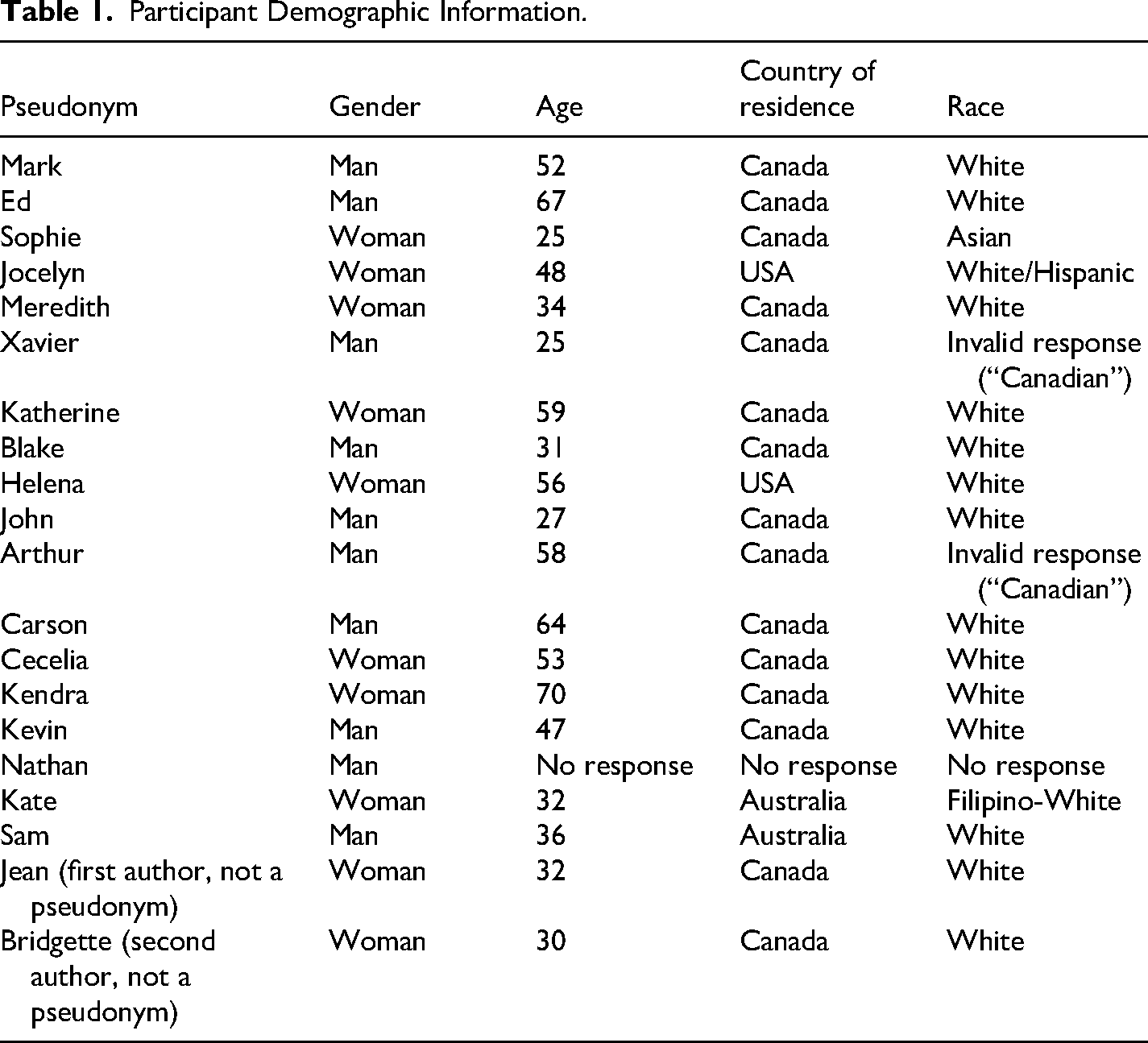
Submissions were structured in diverse ways. Many participants wrote general reflections on running while providing concrete examples from multiple runs completed during the pandemic. Some responded directly to the four prompts we provided, while others wrote unstructured, flowing paragraphs on the general topic. For the latter, it was not always clear which—if any—prompt they were addressing, and so we paid attention to all data for the purpose of this article. Written responses ranged between 437 and 1463 words and were 915 words on average. Spoken responses averaged 7 minutes. Two respondents included photographs, but we ultimately did not use them in our analysis for this article.
Coding and Hot-Spots
In a previous publication based on this data (Desjardins & Ketterling, 2024), we conducted line-by-line coding to analyze and categorize the emotions the participants were describing. This allowed us to focus on how the act of running produced emotions in both the runner and everyone they came into relation with as their running body circulated through time and space. This approach worked well for a paper focused on emotion, because participants often explicitly named their feelings (e.g., happy, sad, and angry) and described how these shifted and changed when moving through spaces and entering into relation with spaces, humans, and nonhumans.
However, as MacLure (2013, p. 168) suggests, this conventional approach to coding presumes rigid, static relations and “tree-like logic of hierarchical, fixed relations among discrete entities.” While “coding renders everything that falls within its embrace explicable” (MacLure, 2013, p. 169, emphasis in original), our own embodied experiences of running as detailed in our own running reflections, allowed us to notice moments where participants struggled to explain their experiences, deviated from conventional narrative structures, or described their running using evocative language that seemed to not fit into neoliberal discourse and was harder, if not impossible, to code using emotions-based language. Because of this, parts of the data were set aside and unaccounted for. As Maclure writes, coding “handles poorly that which exceeds and precedes ‘capture’ by language, such as the bodily, asignifying, disrupting (and connecting) intensities of affect” (MacLure, 2013, p. 170). As we worked with the data, we experienced the ways that coding helped us understand running as a practice imbricated with power which produced emotional effects that did concrete things in the world (Ahmed, 2004), but we were also struck by the ways this interpretive approach sometimes smoothed over the affective intensities that we recognized in participants’ reflections and our own experiences.
Therefore, in this article, we (re)approach the data with an eye toward “hot spots” or moments of affective intensity. As Ringrose and Renolds argue (2014, p. 775), a focus on what “glows” in data and research encounters can make visible the “slow burning intensities that propel the creation and generation of research encounters” and surface the situated affective relationships between researchers, their research, and feminist praxis. Throughout our data, we see moments where changes in bodily intensities evade language in ways that cannot be neatly captured through coding or where the order-words of normative fitness discourse falls away, if only for a moment. We are particularly interested in the moments where participants seemed to struggle to articulate their affective and embodied relationship with running or where they depart in some way from discussing running in neoliberal, individualizing, and health-related ways. We conceptualize these as a-grammatical “moment[s] of rupture” in health- and fitness-centered rhetoric that “resonated with the slow burn” of our research interest in the embodied experience of running and how this might produce deterritorializing possibilities (Ringrose & Renold, 2014, p. 776). Audio submissions were particularly illuminating in this regard, as participants stuttered, halted, or changed track mid-sentence as the communicative function of order-words failed to capture the affective/desirous nature of the running assemblage (see, e.g., below quotations from John). With written submissions, we paid attention to participants’ language: where they described intense affect (e.g., using words like “joyful” or “elated” rather than merely “happy”), their use of atypical or novel storytelling structures, or where they seemed to escape health-focused frameworks only to hem themselves in (e.g., describing feeling freedom and uncontained, then reverting back to simplified health discourses).
Writing and Speaking about Running
Order-Words and Territorialization
In this section, we engage with participants’ reflections to demonstrate that while health and fitness discourse stratifies running experiences, reading for moments of rupture reveals that this cannot fully account for what running does. In line with research demonstrating that running is governed by neoliberal logics of health attainment and physical mastery, many of our participants described health and fitness as animating their desire to run and be a runner and used their narrative to explain that “a healthy body is an outcome of running” (Shipway & Holloway, 2016, p. 80). Several explained that running is important for their physical and psychological health; for example, Blake describes running as a form of self-care that motivates him to “eat properly, stretch, and schedule my runs”. Similarly, Arthur positioned running as the driving force for better health: Running for me started in 2015 when I was told to straighten up or be prepared for an early death … Needless to say I stopped smoking after 35 years, got myself into running form and removed myself from the daily routine of Lipitor for high cholesterol, Advil and Benadryl…
In her work, MacLure describes a mother talking to her son. She analyzes the conversation as “an exercise in grammaticality and representation” and writes that the mother's language affects her son: [the mother's words] “contours and disciplines a bit of the world for him. She names it and peoples it, invests actions with purpose and reason, establishes what is normal and meaningful, and thereby demonstrates the very possibility of pinning meaning to the body of the world and the body of oneself” (MacLure, 2016, p. 176). Similarly, Blake and Arthur are rehearsing language from which a runner can “understand [themselves] as a subject” in contemporary society—the strata of fitness and health, acting through and on language as order-words, “subject the self and give it a function in a particular context” (Markula, 2019, p. 27, 37). Importantly, the men's experience exemplifies how, for many runners, health and fitness are positive territories to inhabit because they help concretize a sense of identity that they value and have pride in.
The Stutter
How can we begin to examine the moments where running is “unhinge[d]” from bioscientific and neoliberal conceptualizations of health and fitness (Markula, 2006, p. 39)? We suggest that one way is to read participants’ reflections with an eye towards a-grammaticality: moments of unsayability where the function of order-words to structure chaos fails. We use John's experience as a starting point. John described how the pandemic made him “antsy.” Without social interaction to help alleviate this feeling, he turned to running: I often find when I go for runs, I kind of feel a lot better. And it's a way for me to really see my emotions and kind of release my energy … So, there are definitely a number of times where I've been at home and it's kind of, you know, home all day. I read my book on my computer and have not really known what to do myself. And I go outside and it's … you know … really… and I run. It's a really nice way to clear my brain. And it's kind of an exercise and feel fresh and I feel really relieved.
Importantly, it seems that John's affective experience with running can “only partially be articulated” and that the complexity of sensations, feelings and emotions “quickly become absorbed into, or articulated by, dominant, already-available discourses [about health and wellness] and so lost” (Ivinson & Renold, 2013, pp. 371–372). After struggling to articulate the affective dimension of running, John resolves his difficulty by concisely saying that running “clears his brain” and makes him feel “fresh” and “relieved.” This language evokes the idea that running, like other physical pursuits, can help the runner manage their mental and physical health, helping to “reset” them and make them more productive. This is likely true for John, and he seems to experience it as a positive outcome of running. We do not intend to negate this but rather hope to prevent this deterritorializing moment of affective intensity from being subsumed by healthism rhetoric and thus effaced in our analysis.
The Rhizome
While most participants’ reflections were neatly organized (e.g., chronological stories with beginning, middle, and end), Kendra's reflection stood apart. The reflection begins with a staccato biography: in one- or two-sentence paragraphs, Kendra discusses her family history before moving into a more conventional structure in which she narrativized how her running changed during COVID-19. Her running group disbanded and she struggled to run alone, but joining a local club's Strava (a social media platform for logging and sharing workouts) helped keep her motivated. She eventually involved her adult children in her running hobby as well. What we found notable (and difficult to code in our initial approach to the data), was the second half of her reflection. After narrativizing her pandemic running, Kendra provides a page and a half of one-line reflections where she jumps between topics. She describes the runs and races she did (and her relationships to the organizers), an injury, and her future race plans before proceeding: I walk once a week with a friend. I don’t have a car and am reluctant to take public transit so my excursions have been only as far as I can walk. The joy we felt when I met dog walking acquaintances after they opened [a popular local running path] last year was indescribable. And meeting/acknowledging other runners out is amazing too, especially outside the more popular summer months when the number of runners out drops dramatically. Just a nod of the head means such a lot. Yes I’m isolated, my birth family sends Christmas cards but don’t call any more. My [children] & grandchildren keep in touch via WhatsApp. My … [child] asks for training tips—how many hills, how long should the hill be? … I ask her for stretches. We discuss knitting patterns
Passwords and Reterritorializations
As discussed above, many of our participants’ narratives demonstrated how they value running's capacity to bring the body in line with normative conceptualizations of health and wellness. Yet, participants’ reflections also reveal how healthism discourse is “loud” enough to subsume or reterritorialize the existence of running's deterritorial possibilities as expressed in “pass-words”—admittedly fleeting narrative moments where language seems to gesture toward new territorial possibilities that are often quickly recaptured and organized into “recognizable belts” (Markula, 2019, p. 32). For example, Mark articulates the embodied sensations that running provokes using language that is very common among runners: The runners high, though not unique to COVID, has come a few times in my runs…and on those days I return home close to elated. I also experience a sense of FLOW when running (as described by Mihaly Csikszentmihalyi in the book Flow). This state became especially helpful during COVID because it was like an escape, allowing me to get totally absorbed in my run.
We see similar passwords in other participants’ reflections in their mobilization of language related to escape and freedom. We suggest that this demonstrates that running is one machinic modality of a desire to plot a line of flight away from participants’ current circumstance (whether that be the pandemic, medicalization, the stress and constraints of work, a bad relationship, etc.) Nathan, who is living with cancer, explained that while running is important to his fitness and wellbeing, it means more than that: Running has been part of a commitment to living life as fully as possible and not just having a medical experience. It has been in the past a significant life passion and pursuit. An arena of social interaction, a catalyst for social change.
Similarly, Sophie writes that running “gives me a sense of clarity, of freedom… It also lets me sort of escape the world for the time being,” while Katherine comments on “the significant sense of freedom that running gave [her] during COVID” by saying, “Running was a simple paradise away from my world of work. Running is so free of rules, stupid and otherwise, it is breath-taking.” We are struck by these phrases, which seem to suggest that the running machine is the mechanization of a desire for deterritorialization. We might compare our participants’ experiences to those of the subject of Ivinson and Renold’s (2013) article: Rowan, a young girl living in an ex-mining town in Wales. Rowan's “inventive practices” shape “existential territories or imagined possibilities” necessary for her “survival and wellbeing” (Ivinson & Renold, 2013, p. 370). These passwords, moments where health- and fitness-based language temporarily took a back seat, demonstrates how running produces for participants “an alternative space” where they could “play, literally and imaginatively, with alternative modes of subjectivity” than those afforded by the strata that shape their lives (Ivinson & Renold, 2013, p. 370). Moments of affective intensity described using words like “freedom” and “escape” demonstrate that the body produced by running is not always one stratified by neoliberal forces. While the quotations above demonstrate that often the running body is at least partially enmeshed in disciplined assemblages, such stratification is not inevitable. The deterritorial possibilities afforded by running became more urgent for many during the pandemic, and participants’ stories about running during this time demonstrate that the running body can be “free” and “full of gaiety, ecstasy, and dance” (Deleuze & Guattari, 1987, p. 150).
However, these passwords are often “drain[ed] of their powers of affect when ordinary—that is, representational—language returns” (MacLure, 2016, p. 178). In Mark's case, elation and escape becomes rhetorically organized as “a runner's high” or “flow”—concepts that we argue flatten messy affective experiences using bioscientific and psychological frameworks of knowing. Such order-words help produce or pin down the runner as an individual, healthy, and disciplined subject. While passwords gesture toward deterritorial possibilities, these are often reterritorialized through processes of subjectification, which includes the stories runners tell about running. As Markula (2019, p. 27) argues, subjectification through an activity like running “creates subjects who think within the confines provided by its own boundaries.” Health and self-mastery are important to runners and their associated regimes of order-words may be used for the sake of effective communication in a world where neoliberal logics are most easily articulated and understood. This is not a bad thing. However, by looking at utterances that are difficult to reconcile with this rhetoric (elation, escape, and freedom) and that gesture toward affective intensity or becomings, we suggest that researchers can explore how order-words “flip into passwords” that reveal that bounded subjectivity is not the running machine's only possibility (MacLure, 2016, p. 176).
Conclusion
Amateur road running often “emulate[s] or replicate[s] hyper-competitive, hierarchical and patriarchal modernist sports” (Atkinson, 2010, p. 112), and is stratified by conceptualizations of fitness, health, the medicalization of the body, neoliberal self-discipline, capitalism, nationalism, and militarism. This is not inherently bad; strata are necessary. Nonetheless, understanding sports’ deterritorializing potentials is important. While others have suggested that action sports like fell-running and surfing offer avenues of escape from these neoliberal imperatives, we argue that even the most mainstream of sports—amateur road running—offers the potential to do the same. We contend that developing methods that excavate behind the stratification of healthism discourse to explore what else might be happening alongside stratification will deepen our understanding of running as everyday practice. Following Markula (2019, p. 12), we see this approach as allowing us to “think and know differently by accounting for the force of the physically active body as an active negotiator of social relations.”
We have argued that runners’ stories about running surface minor territories that demonstrate how the practice of running assembles new territory and new connections that healthism and self-mastery rhetoric does not fully capture or explain. Indeed, the running assemblage itself produces health and fitness as strata and many possible alternatives.While the strata of health and fitness organizing the affective potential of running are often shaped into “rigid, immobile segments that limit thinking by ‘capturing’ it within predetermined knowledge ‘belts’ in the current capitalism knowledge production” (Markula, 2019, p. 32), we suggest that participants’ language also opens space for us to conceptualize running as an assemblage of desire—a machine—that can be used for a multiplicity of things.
Our contribution is primarily conceptual. Though useful for allowing participants to share their emotional experiences without exacerbating ‘zoom fatigue’ (a phenomenon felt by many during the stage of the pandemic we collected data) our method did result in a small sample size and did not allow for opportunities to probe respondents to elicit richer data. As discussed at length above, some may find the pairing of our method and theoretical framework counterintuitive if not incompatible. However, the running reflections participants submitted, partial and stuttering as they were, prompted us to ponder the limits of language as well as its force in producing the runner as a healthy and self-masterful subject. In doing so, we believe we have contributed to the existing body of literature that demonstrates the utility of Deleuzo-Guattarian analysis for the study of sport and leisure. Furthermore, in rooting our analysis in desire and assemblage, we demonstrate that mainstream, amateur and low-barrier sports are not so different from other more exceptional forms.
As discussed in our methodology subsection, the findings outlined here were incidental within a project focused on how running through the pandemic felt emotionally. Approaching our data anew with Deleuzo-Guattarian theory raised a host of methodological questions for us. We could not ask participants to expound on what it meant that running felt like ‘freedom’ or ‘escape’ or to engage in more depth or in different ways with John to better understand his struggle to describe how running felt. Thus, our reflection-based analysis is only a first step. We are, admittedly, using Deleuze and Guattari's concepts of order-words and a-grammaticality to read between the lines of our participants’ descriptions and rely on our own embodied practices of running to facilitate interpretation. Following Ivinson and Renold (2013, p. 374), future efforts to study affect and running will necessitate multimodal and creative methodologies that move away from more conventional forms of interviewing to include running together, asking participants to film or photograph their experiences of running, and other “creative ethnographic methods” that help capture the “micro-intensities of everyday life.” Our use of written and spoken reflections had advantages in this regard, as does Atkinson's (2010, 118) use of photo-elicitation and infography, Palmer's (2016) “moving methodologies,” Cook's (2020; Cook et al., 2016) methodological experimentation. We are also curious about how research-creation methodologies (Loveless 2019) might be employed to produce “extralinguistic” forms of knowledge about running (Manning, 2016).
Footnotes
Acknowledgments
The authors would like to thank the journal editors and the anonymous reviewers for their generous feedback.

Ethical Approval and Informed Consent Statements
This research has been granted clearance by the Carleton University Research Ethics Board-A (CUREB-A). CUREB-A is constituted and operates in compliance with the Tri-Council Policy Statement: Ethical Conduct for Research Involving Humans (TCPS2). Approval was received on February 2, 2021. Ethics Clearance ID: Project # 115123. Researchers obtained written informed consent from all participants in this research.
Funding
The authors disclosed receipt of the following financial support for the research, authorship, and/or publication of this article: Bridgette Desjardins was supported in part by funding from the Social Sciences and Humanities Research Council. Jean Ketterling was supported in part by the Vanier Canada Graduate Scholarship.
Declaration of Conflicting Interest
The authors declared no potential conflicts of interest with respect to the research, authorship, and/or publication of this article.
Data Availability Statement
The datasets generated during and/or analyzed during the current study are not publicly available due to privacy and confidentiality considerations.