




Abstract
Coaches are key stakeholders in the world of youth-organized sports. As key stakeholders, they are influential to the “culture of sport” and how it pertains to safety and injury in sport. However, little data exists to inform injury prevention intervention in youth sport. There is a critical need to understand the perceptions and norms that contribute to youth sport culture and coaches’ perceptions of this culture. The purpose of this study was to develop an understanding of youth sport coaches’ attitudes, perceptions, and norms regarding sport culture and injury. Thirty coaches were divided into five recorded focus groups. Following transcription, researchers utilized a consensual qualitative research framework. The research team individually coded data into themes and categories, meeting to attain a consensus on findings. An auditor controlled for bias. Participants highlighted three key areas related to the purpose of the study: (1) influences and expectations, (2) sport safety, and (3) education and development. Findings suggest that youth sport coaches view themselves as an integral component of sports culture, safety, and injury prevention. As such, coaches must build relationships with the community to provide a foundation for optimal sport and health outcomes.
Introduction
Organized youth sport participation and competition have increased in recent years. Since 2015, participation for children aged six years and up has increased by five percent in team sports alone (The Physical Activity Council, 2020). This increase, in large part, is a result of efforts to combat the childhood obesity epidemic in the United States (Malina, 2009). The rise of youth sport participation is also based on the perspective that the structure of organized sports contributes to psychological well-being, social development, and career development (Anderson, 2013; Friedman, 2015). Increased youth sports participation places coaches in a unique position to balance sport success and the successful development aforementioned; both of which contribute to an overall youth sport culture. However, coaches’ perception of their position within youth sport culture has not been thoroughly investigated.
Sport culture, as a larger entity, has been defined as a microcosm of the culture at large, in which those at the professional level serve as models and representatives of the community (Delaney & Madigan, 2015). An individual team's sport culture is shaped by the internal environment as well as outside factors (Weiss & Norden, 2021). Youth sport culture includes many of the same aspects, though there are also unique characteristics to consider including, age, social obligations, education, and the presence and involvement of key individuals and organizations (Malina, 2009). A common perspective of youth sport culture is through a socio-positive lens espousing an overall “goodness of sport.” Where key individuals create an environment that positively contributes to society and benefits participants by fostering better health, wellness, character development, and the ability to learn life lessons (Weiss & Norden, 2021). Common key individuals in sport participation include medical personnel, school personnel, parents, and coaches, where coaches play a key role in youth sports due to the lack of sport administrative and medical personnel. Many individuals and organizations operate on the assumption that the goal of youth sports is to create athletes and provide potential health and other developmental benefits, emphasizing that there is value in sports participation for all children (Messner, 2009; Messner & Musto, 2014).
Malina (2009) identified the core objectives of youth sport as development, enjoyment, and socialization. However, their influence on youth sport culture is largely understudied (Fraser-Thomas et al., 2005; Smoll et al., 2011). Development pertains to youth physical development by promoting significant improvements in cardiovascular fitness and muscle strength (Hardy et al., 2013). A key role in youth athlete development is creating and fostering a safe environment for development to occur. The role coaches play in an athlete's development creates a potential for coaches to influence the identification and management of injuries, beliefs, and perceived actions (McCrea et al., 2004). Enjoyment and socialization objectives focus on creating a positive experience for those who participate and enhancing social development by fostering an interactive environment with peers, adults, and the community (Malina, 2009; McGlynn et al., 2020). A coach's chosen coaching style, whether it be with an emphasis on comradery, technique, or discipline, can also have a large effect on athletes’ physical and mental development, enjoyment of the sport, and socialization (McGlynn et al., 2020). Typically, for a coach to be seen as effective they have to be cognizant of the effect of their presence and intervention on athletes’ physiological, psychological, and social well-being (Denison & Avner, 2011). This involves a delicate balance between two coaching philosophies: one that prioritizes fostering a love for the game and encouraging children to have fun, and another that places value on skill development, healthy competition, and achieving victory (Messner, 2009).
Similar to sport culture at large, there is a myriad of social influences encompassed within youth sport culture including sport participation, ethics, governance, and health (Woods & Butler, 2020). Findings of previous research suggest social implications of sports are greatly influenced by relationships with peers, coaches, and family members (Coakley, 2021). These interactions can either reinforce of challenge established gender roles, perpetuate broad social inequities, involve parents in various capacities contribute to a sense of identity, and introduce influential role models and mentors (Messner, 2009). Therefore, given the key role of social implications on youth sports coaches in achieving the core objectives, the purpose of this study was to gain an understanding of how coaches view both youth sport culture as a whole and the role they specifically play as coaches within this culture. Understanding the attitudes and perceptions of coaches can highlight areas to address when considering their impact and role in larger social issues within youth sports.
Methods
Research Design
A consensual qualitative research design (CQR) was used to guide this study. CQR is a collaborative method often used to study an individual's inner experiences, attitudes, and beliefs and supports greater applicability for the findings (Hill et al., 2005). As Hill et al. (2005) describe, this design incorporates elements from phenomenology, grounded theory, and comprehensive process analysis. It allows researchers to identify themes and categories enabling researchers to present participant's shared and unique experiences (Goodrich & Luke, 2019). Institutional Review Board approval and participant written consent was obtained before each focus group.
Participants
Local youth sport coaches (n = 30) were invited to participate in this study. Criterion-based sampling required coaches to be (1) 18 years or older, (2) a coach in a community-based league or organization in North Carolina, and (3) actively coaching or planning to coach in the upcoming season. Each focus group was on average 60 min and contained approximately five coaches representing eight sports (baseball, basketball, football, hockey, lacrosse, soccer, softball, and tennis). Data saturation, the point where additional participants would create redundancy in data, was reached after five focus groups were conducted with 30 youth sport coaches (93% male; mean age = 46.2 ± 12.1 years; mean years coached = 12.1 ± 10.6 years). Participant demographics can be found in Table 1.
Instrumentation
The interview protocol for each group was developed by four content experts on youth sports. After initial development, a convenience sample of two youth sport coaches and two certified athletic trainers completed pilot testing to ensure the questions represented the values of both groups. Certified athletic trainers were included in this process as they are often involved in youth sport safety initiatives by raising awareness, advancing legislation, and educating key stakeholders and their expertise in concussion care. Revisions were made according to pilot test feedback and the final protocol for each focus group consisted of thirteen total questions concerning sports culture and safety.
Procedures
Recruitment e-mails were sent to youth sport organizations in North Carolina and study information fliers were displayed at various youth athletic venues. Individuals interested in participating contacted the study team for further details and clarifications and were then mailed or emailed a copy of the consent form and a general questionnaire. Participants were asked to bring the completed questionnaire to their scheduled focus group session which included questions regarding sex, coaching history, injury prevention education, and knowledge, attitudes, and behaviors around sport safety concepts (copies were also provided on-site if needed). A total of five focus groups were conducted between Fall 2015 and Spring 2016. Each focus group was recorded and transcribed verbatim using a professional transcription company (Dictate2US, London, UK). Focus groups from this time frame remain relevant as core tenants of youth sports’ culture as described by participants endure. These focus groups facilitated the investigation of the underlying attitudes, perceptions, and norms of coaches in youth sports and contextual factors related to culture, safety, and injury prevention.
Data Analysis
The research team for this study was comprised of three members with varying experience and expertise in CQR design (from novice to expert), which has been shown to be beneficial in reducing researcher bias and bringing in new perspectives (Welch et al., 2014). Alongside the research team, an internal auditor served as an additional frame of reference to further reduce researcher bias and ensure all aspects of the data were considered. The hallmark of CQR tradition includes the research team establishing consensus about the data in both meaning and interpretation (Hill et al., 2005). Using the CQR design, data analysis occurred in three stages where team members, (1) identified domains (topics used to group data), (2) developed core ideas (subcategories emerging from each topic) from the identified domains, and (3) cross-analyzed the data resulting in defined themes and categories as identified within each domain (Hill et al., 2005).
In accordance with the CQR design, all members of the research team individually identified domains in the first and second focus groups once the interviews were transcribed. The research team then met and developed a consensus codebook by coming to an agreement regarding the wording and usage of the representative categories to be used for coding the remaining transcripts. At least two research team members coded each of the remaining transcripts. After coding was completed, cross-analysis was performed by the research team to agree on the wording of each category and the placement of core ideas (Hill et al., 2005). Following cross-analysis, the frequency with which data were presented within each theme and category were determined. The frequency of the category was broken down into three groups based on the number of focus groups they pertained to. General categories were categories that appeared in all focus groups, typical in more than half of focus groups, and variant appear in at least one focus group.
Results
During data analysis, three themes were generated regarding youth sport coaches and their views and perceptions of sport culture . These themes were (1) influences and expectations, (2) sport safety, and (3) education and development. The frequency of categories within each theme can be found in Table 2. Additional data supporting the themes of influences and expectations and sport safety can be found in Tables 3 and 4, respectively. The data supporting education and development reached saturation quickly; therefore, quotations are provided directly within the text.
Participant Demographics (n = 30).
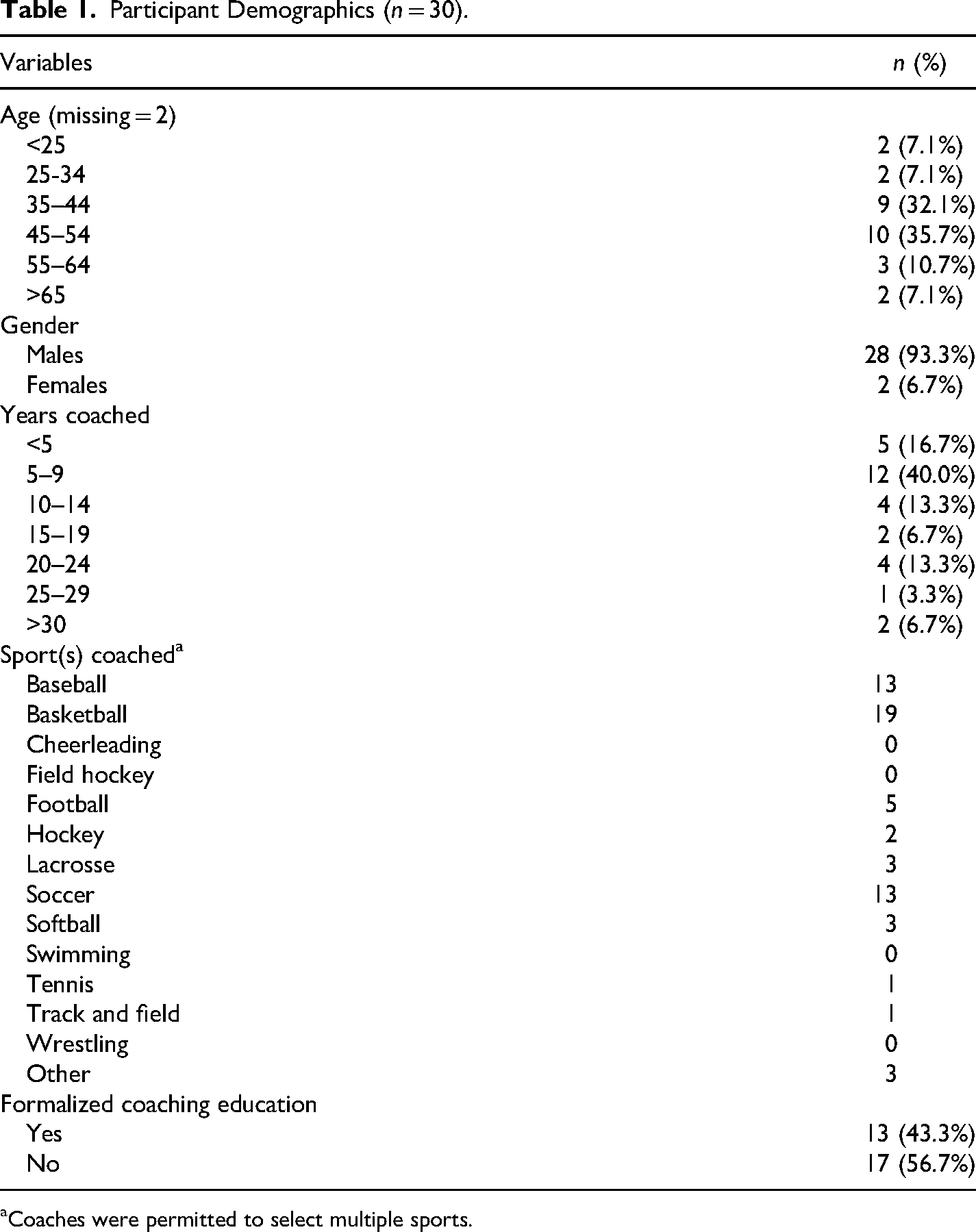
Coaches were permitted to select multiple sports.
Frequency of Categories.
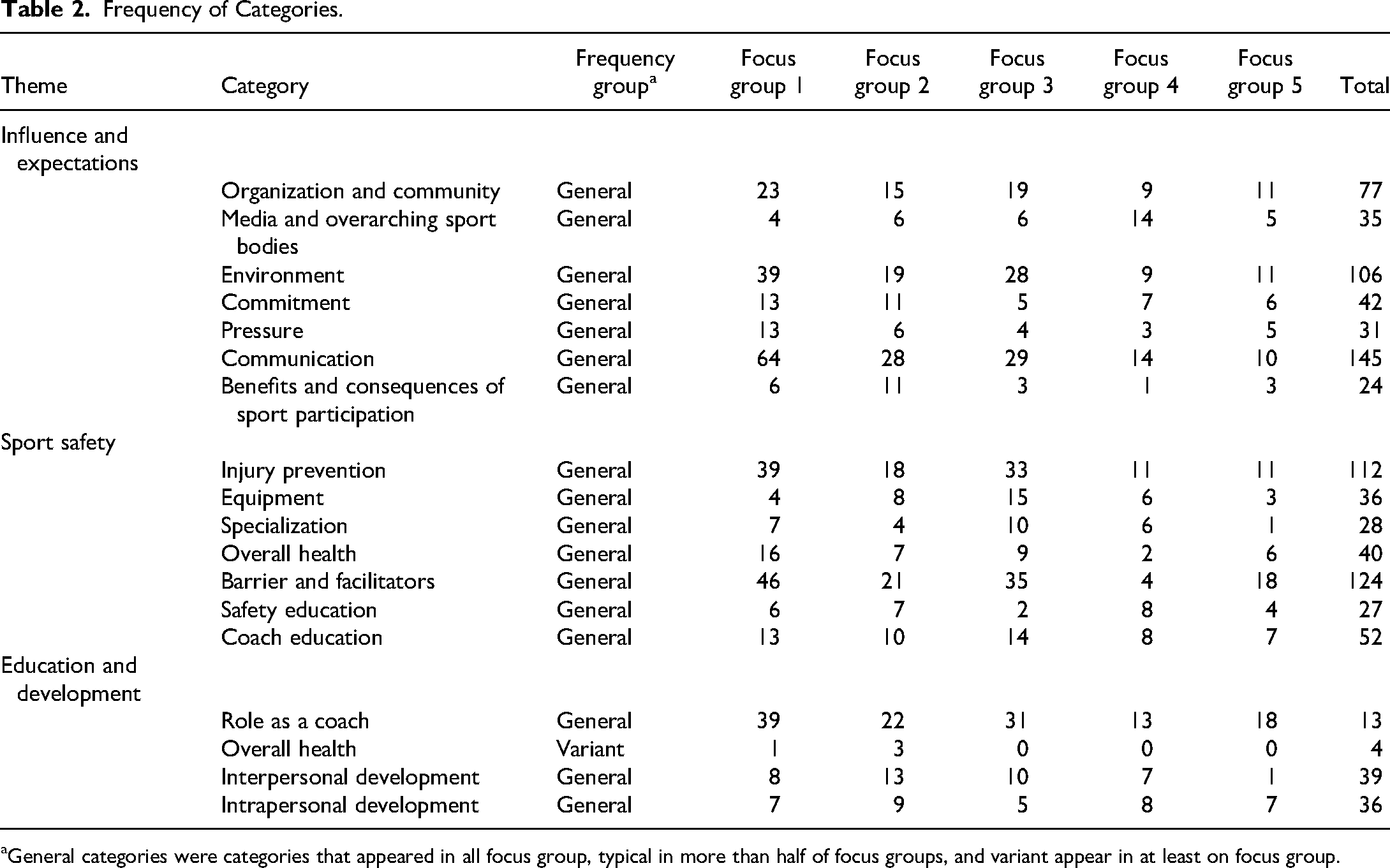
General categories were categories that appeared in all focus group, typical in more than half of focus groups, and variant appear in at least on focus group.
Additional Participant Data From the Influences and Expectations Theme.
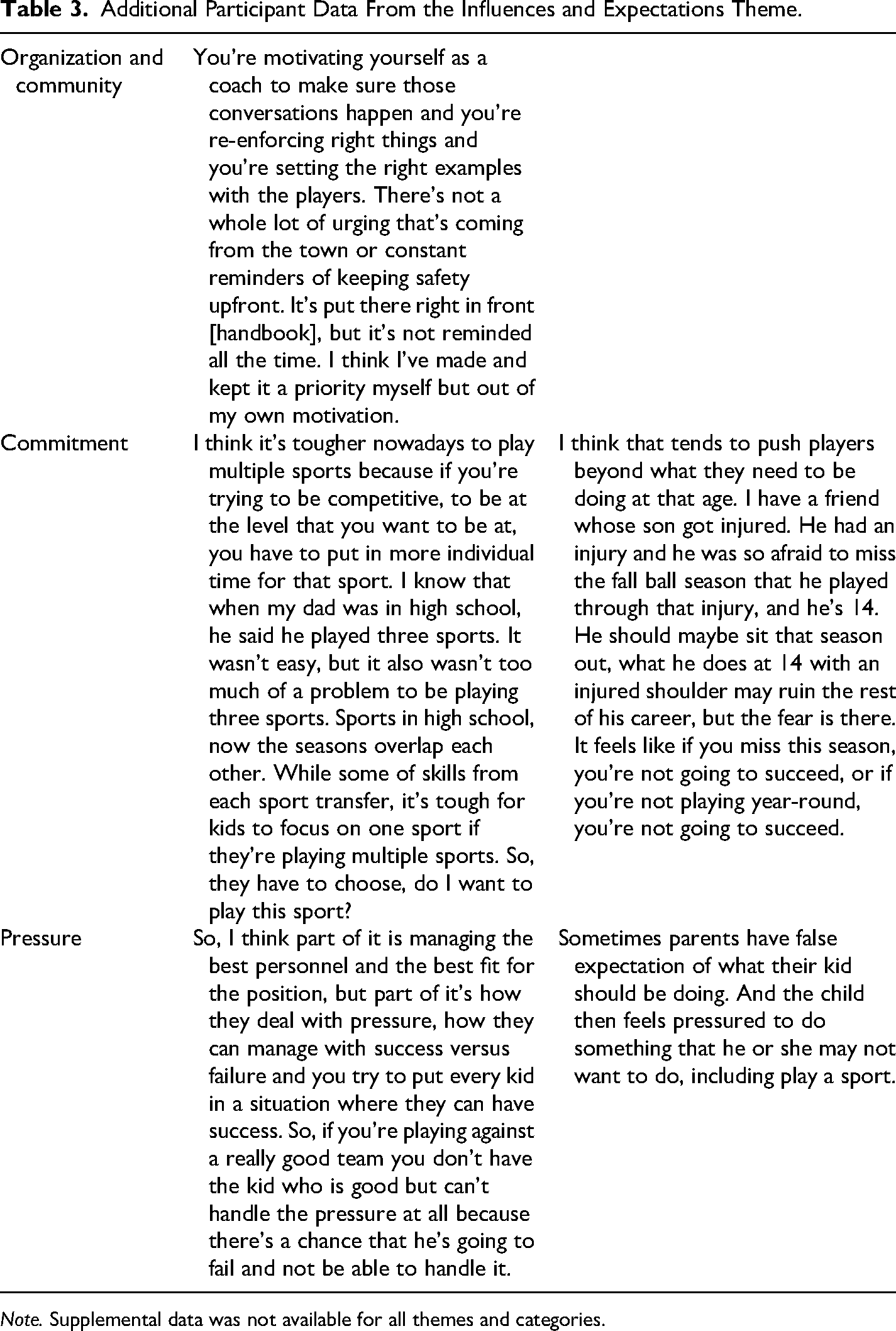
Note. Supplemental data was not available for all themes and categories.
Additional Participant Data From the Sport Safety Theme.
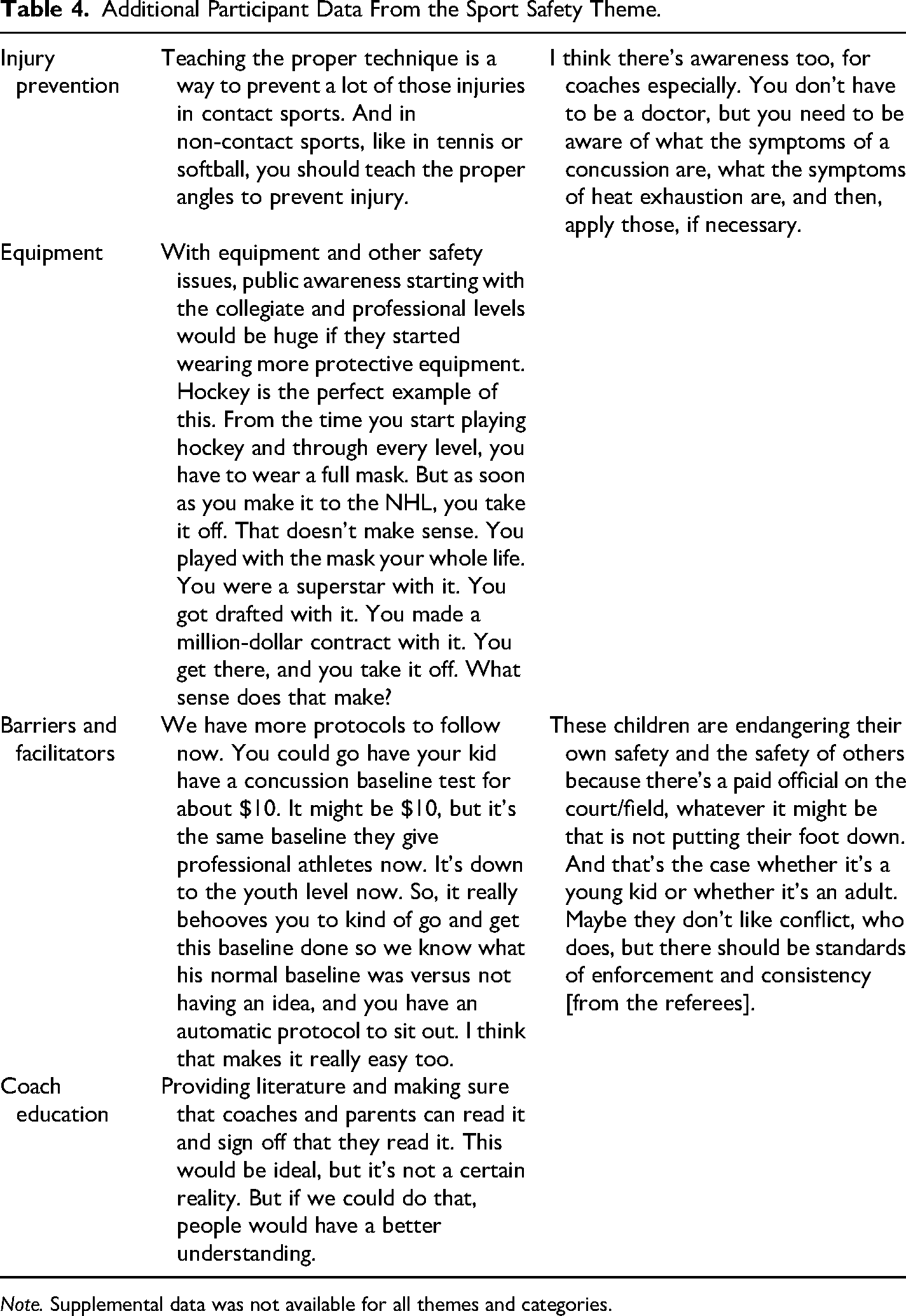
Note. Supplemental data was not available for all themes and categories.
Influences and Expectations
Coaches identified factors from various youth sport stakeholders influencing sport culture and the associated expectations that those stakeholders possess. The influences and expectations theme was further divided into seven categories: (1) organization and community, (2) media and overarching sports bodies, (3) environment, (4) commitment, (5) pressure, (6) communication and relationships, and (7) the benefits and consequences of sport participation.
Organization & Community
Coaches identified the organizing body and surrounding community as primary factors influencing sport culture. Coaches discussed the desire for additional support from other stakeholders including organization governing bodies and parents. One coach, Scott, proclaimed, You need the support of your organization and the support of your parents… and if you’re not getting the support from the league as well, whether it be with the proper equipment or training or whatever, then, that can be detrimental.
Coaches also emphasized that from a leadership standpoint, the coaches’ intrinsic motivation and care for athletes’ growth and well-being are necessary when coaching youth sports because the organizational structure often does not address all issues, such as diversity, parent involvement, and the development of positive mental wellbeing in youth sports.
Media and Overarching Sports Bodies
Along with organizational structure and community support, coaches discussed youth athletes emulating the behaviors and safety measures taken by professional athletes (often portrayed in the media), having both a positive and negative influence. Participants debated that professional athlete media coverage can both aid in promoting safety measures and hinder the teaching of proper mechanics. One coach, Derek, expressed, I think the safety culture starts at the top levels in all sports. Safety trickling down to everybody. You’re seeing more major league guys with face masks
1
on their batting helmets. Giancarlo Stanton has a mask, so Little Johnny's got to have a mask on. He's going to start wearing a mask now playing T-ball, stuff like that. So, I think when they see the safety at the highest level, it trickles down to the youth level as well.
Derek's statement not only underscores the benefit of professional athletes serving as role models for injury prevention but also emphasizes the role that the media coverage of athletes has in championing culture change in youth sports. The media that youth athletes consume helps to shape the future of sport as these athletes grow to be the college and professional athletes, coaches, and referees of the next generation.
Another coach, Taylor, responded, The problem is, like, in professional sports of course the strategy is totally different. In hockey there is a rule about having your head down crossing the blue line, right? Kids know that, they watch it, and the announcer will say it, “well that's what you deserve, right?” Then they start thinking well I need to emulate that behaviour and that's a legitimate thing. It's a way to get an advantage, for example.
Environment
Coaches examined the duty of stakeholders to create a safe environment both physically and emotionally. One participant, Aaron, stated, I’ve had some situations I recall from an officiating standpoint. When a player got hit with the ball, sometimes the player very immediately said, “I’m fine. I’m good.” I really respect the umpire who calls time and makes the coach truly assess the situation and make sure players are really good to go back. I really respect the umpire who takes that opportunity and allows the assessment to be made.
Commitment
Commitment was identified as a category within the theme of influences and expectations where coaches discussed the increased commitment to one sport (sport specialization) and the positive and negative effects that it had on sports as a whole. Some believed that specialization helps to improve the game and enjoyment for participants while others believed greatly prioritizing one sport while participating in others becomes a detriment to the team of the lesser prioritized sports as a result of partial commitment. Derek noted, So, this kid worked his tail off, he's doing the right thing, and he's there waiting. And the other guy didn’t do what he's supposed to do, but I’ve got to play him. I feel sorry for that guy, who's really working hard, doing the right thing, trying to improve his game, trying to master the fundamentals and that kind of thing. Then, he gets in a situation where some of these guys, unfortunately, really don’t care.
Pressure
Coaches explained pressure from multiple sources (e.g., coaches, teammates, parents, etc.) being placed upon youth athletes to achieve great success and become elite players. In regard to pressure from parents, coaches discussed the influence of athletic scholarships on the elevated expectations that parents have for their children. One coach, Rick, phrased it as, I think you also have parents really pushing for scholarships. It's ridiculous because the amount of scholarships for athletics is so tiny compared to academics. But parents push it so much as, ‘Oh, you can get an athletic scholarship. You’re so good at age 10.’ Well, that person might be great at age 18 too but if you push them, they’re going to end up hating the sport possibly.
Communication and Relationships
The influence of parents’ expectations of their children and how that affects the relationships coaches have with both parents and athletes, was a topic of discussion amongst the coaches. They discussed how communication, more specifically lack of open communication, can be a barrier to safety. Rick talked about communication as a barrier, stating, I think communication is hard. Some people think they’re great communicators and they’re not, and vice versa. I think people think that they’re not very good and they’re excellent. But if you aren’t able to communicate with the kids, if you’re not able to communicate with your other coaches, your assistant coaches, then nothing is going to happen. I try to scare parents into thinking about what's going on. I say, “Okay, any of you taken your child to a hospital because he's hurt, raise your hand.” “Any of you all who had to get him in the back of an ambulance and ride to the hospital with a kid that's hurt raise your hand.” And the hands start to fall. I said, “Now, any of you that have ever had to go into an emergency room to sit with a kid while his head is taped to a board to tell him that he's okay and you don’t have a clue whether or not the child is actually okay and the mom is too scared to come into the emergency room with you, raise your hand.” And by then, we all have this Casper look because this is serious. So, if I’m screaming at your kid for not paying attention, it's because I don’t want to have to get into the back of the ambulance with him.
Benefits and Consequences of Sport Participation
Coaches debated the benefits and consequences they have seen in children as a result of participating in sports. One of the benefits noted was the confidence that sport participation instils in athletes. A coach, Alex, revealed the confidence he saw develop in one of his athletes, saying, I had a kid last year, the first practice he stayed in the dugout with his mom. He was afraid to come out. By the end of the year – I think that's just the metric, do they sign up for the next season. That's all I care about when it's all said and done, do they sign up. End of the year he made a catch, his teammates mobbed him, he was just beaming from ear to ear. You live for those things.
I mean taken to an extreme, competition can certainly be a negative. And there's multiple facets in which it can be. I mean, I mentioned the burnout where somebody is just too competitive in what they’re doing, and they burnout. It can happen at the parent level whether they’ve got an overbearing parent who wants his kid playing on every play and doing this and doing that and seven days a week and all that crazy stuff.
Sport Safety
The sport safety theme was comprised of seven categories including 1. injury prevention, 2. equipment, 3. specialization, 4. overall health, 5. barriers and facilitators, 6. safety education, and 7. coach education.
Injury Prevention
Coaches discussed how increased research efforts and media attention on devastating injuries help them to bring awareness to and implement injury prevention measures. One coach, Avery, said, I think the work that has been done in recent years on concussion studies and overuse – we can all talk about concussions, but overuse and development of pitchers and so forth. I hope that's really feeding back and they’re minimizing how often and early they’re trying to teach kids curveballs and various things. I think it's made a difference.
Equipment
Coaches described the influence of higher-level athletes helping to promote safety equipment for youth athletes. One coach, Drew, noted, But all the way down through you know it's like, it's that public awareness for the parents and the athlete and everyone to take it seriously…public awareness would be huge if you know starting at collegiate levels, if you can get the pros to do it, you know, and put it out there everywhere that this is what you need to wear.
Specialization
Coaches discussed specialization occurring at a much younger age and how anecdotally, they believe it leads to burnout. Overall, coaches discussed sports specialization with a negative connotation. Jordan described, I guess it depends on who you ask and what their feelings are. So, to me, there's both sides of it. If somebody is perhaps talented, a youth is talented and is really driven, and wants to play baseball and wants to play competitive baseball and so forth, that can be a good thing; it can also be taken over the top. It's also leading to burnout of kids where they don’t want to, they’re missing out on their childhood. They’re not playing and having fun and they’re six days a week practicing if not seven days a week.
Overall Health
Coaches discussed their duty to care for the physical and emotional well-being of athletes and the actions they take to prevent bullying, in particular. Taylor told an anecdote about addressing bullying and using it as a teaching moment, I’m not sure if I’ll call it bullying, but I was in a game a few weeks ago where – I mean, the other team was beating us as usual, but the pitcher threw to his first baseman and – it's a coach pitch so the pitcher's right behind me. So he makes the play, throws to first base and he drops it and this guy's just ragging on this first basemen…you know, I stopped the game, I just walked over to the coach and said – and he didn’t know, he just didn’t hear or whatever so he wasn’t very happy. So he made it his teaching moment there, but it's like zero tolerance, you’re not ragging on each other during a game, that's not support, guys. We try to teach that.
Coaches also discussed the importance of being aware of athlete health. One coach, Kennedy, noted, Sometimes we have the opportunity to coach kids that have asthma, diabetes, or other things you have to be aware of. Being aware of who your athletes are and what their concerns are can help to keep them safe.
Barriers and Facilitators
Coaches suggested inconsistencies in policies and the lack of qualified health professionals as barriers to health and safety. One coach, Kyle, noted that the lack of healthcare professionals can be frustrating and ultimately places a burden on the coach saying, Back to the diagnosis and treatment just for the lack of whether skilled resource on board or the training that's required or you could have a doctor at every game. It's not impossible. It's not overly practical or feasible but it's not impossible. You can pay to have an athletic trainer or somebody there all day. It can be done.
Safety Education
Coaches discussed a lack of safety education for referees and officials while highlighting the improvements in available information for youth athletes regarding safety. Rick noted, … and you get into more conversations about anatomy and brain injuries. And there's just more knowledge at a younger age than I think we ever had as athletes at that age.
Coach Education
Coaches discussed the responsibility to be up-to-date on safety practices and the rules of the sport. They also discussed the benefit and need for thorough league-mandated training to provide coaches with better tools to understand and deal with health and safety concerns. Scott suggested, Well, it's getting a lot easier I think, and somewhat harder. Sometimes, depending where you look with the internet, because there's so much information out there. Some of it's good, some of it's not so good…So, you know, frankly, I think some of it comes from the organization of the league and the requirement of that, but at the same time, as a coach, you kind of have to do some of that on your own, you have to kind of want to.
Education and Development
Education and development was also a reoccurring theme throughout the discussions and was divided into five categories: (1) role as a coach, (2) overall health, (3) interpersonal development, (4) intrapersonal development, and (5) physical development.
Role as a Coach
Coaches discussed being a role model for their athletes and looking to develop skills in them that not only better them in their sports but can also be applicable in the “real world.” One coach, Blake, stated, You have to teach them how to be good leaders. I turned around one player because I pointed out to him, “You’re going to be the best player on your team for the next several years. And if you treat the players who are the weakest on your team as if they were dirt and you make them feel bad and so forth, every time they make a mistake, and you keep reminding them of it, they’re going to play worse and worse. And your team is going to be a losing team even if you are the star. If you boost him and then help him get the right attitude and improve their play then you got a better chance to win.” And he changed. Now that's a success.
Overall Health
Coaches once again emphasized the importance of teaching skills that will help them both in sport and life, particularly in the context of creating healthy life-long habits. One coach, James, stated, … going along with teaching is the life lessons that can be learned, the things that you can learn in your sport that you can transfer to life later on.
Interpersonal Development
Coaches discussed developing socialization skills in youth athletes and using the social situations that arise as a way to prepare them for interpersonal collaborations later in life. One coach, George, proclaimed, I think socialization, you know to bring people together. It's a way to expose them to other kids … It's sort of a time for them to really know how to learn how to negotiate and socialize.
Intrapersonal Development
Coaches suggested that sports provide a way to build self-awareness, confidence, and a good attitude in youth athletes. One coach, Harper, asserted, It's attitude as it's developed through sport because of sports and by the sports. I’m a middle school teacher and you know I say that athletes, you get a lot of diversity. You’re good in that and I’m a firm believer in athletics helping a child. And that [helping] part is attitude.
I think that just being in an environment where you’re learning new skills and having to apply them in game situations is just, it's a nice thing for kids to do and they’re working their brains and their bodies.
Physical Development
Coaches discussed their role in developing athletes’ physical sport-related skills and teaching proper techniques to carry athletes through every stage of life. Jordan stressed, I mean what we are teaching these kids today are things that hopefully will stay with them for their entire lives. And if you’re teaching them the proper way to go about doing something and doing it in a safe manner whether that's playing sports or using a circular saw or whatever it may be, teaching them the proper technique, those are skills that they’re learning and will transfer for their entire lives.
Discussion
This investigation identified three themes that encapsulated coaches’ perceptions of the makeup of youth sport culture. The key themes of influences and expectations, sport safety, and education and development are consistent with data reported in previous literature (Collins et al., 2009). The self-identified role of the coach in the context of youth sport culture includes many factors including coordinating pre-season educational and informational meetings for stakeholders, fostering positive relationships between all stakeholders, fitting athletes for protective equipment, and devoting large amounts of time to promoting positive physical, mental, and emotional growth for athletes. These themes encompassed in the role of youth sport coaches build the foundation for developing an effective injury prevention program. Thus, the identification of youth sport coaches’ perceptions of and role in youth sport culture is integral to the implementation of injury prevention strategies (Kroshus et al., 2015; Steffen et al., 2013).
Influences and Expectations
Coaches are integral stakeholders in youth sports settings. Out of all personnel, coaches are often the people who spend the most time with athletes, making it one of their duties to help carry out the expectations of organizations and people. In many instances, coaches reported parents having the expectation that their child will excel in their sport and earn an athletic scholarship which differs from the coaches’ expectations to enjoy playing the sport. Parental pressure has been inferred by athletes and coaches based on implicit and explicit communication about athletic achievement from parents. The divergence does not benefit the athlete, so as the forward-facing representative of stakeholders, coaches reported that they feel the need to find a way to balance the expectations of all stakeholders. Coaches reported the need for good relationships and open communication between themselves and parents. These positive relationships may help coaches to fully understand the expectations parents have for their children and create an environment suitable to carry out the objectives of youth sport. These results are similar to previous literature which suggests that positive relationships and effective communication between coaches and parents in youth sport gives coaches an insight into the athlete's personality and mental state (Jowett & Timson-Katchis, 2005; Smoll et al., 2011). These findings further emphasize the role and effect coaches have on their athlete's physiologically and psychologically (Denison & Avner, 2011). Kita et al. (2020) discussed the concept of ‘adult power’ where youth athletes found it meaningful when the adult stakeholders in their life were able to effectively communicate and leverage resources to provide support. This insight allows coaches to adapt their coaching style to best benefit that athlete (Jowett & Timson-Katchis, 2005).
Coaches reported that despite their best efforts to try to mitigate negative influences and balance expectations, they desire increased support from other stakeholders in the form of formal policy changes and reinforcement of practices and expectations. Coaches expressed that conflicting policies and procedures from organizing bodies make it difficult to create their desired sport environment. This concern from coaches subscribes to the theory of goal attainment where organizations have to develop systems and policies that allow for the achievement of goals (Weiss & Norden, 2021). Through a socio-positive lens, the concerns expressed by coaches if rectified would help to foster and environment that positively contributes to the life of their athletes (Weiss & Norden, 2021). Given coaches are often the facilitators of most policies at the youth level, input on policy changes can help to ensure the practicality and feasibility of policies, improving implementation. Therefore, including coaches in decisions on policy changes may allow for better implementation of policies at the team level. Previous studies have identified that coaches are more motivated to follow safety policies when they can see their ability to protect themselves and their players as well as the ability to enforce policies (Chrisman et al., 2014), which is especially important when it comes to safety. For example, Chrisman et al. (2014) found that 98.9% of high school football and soccer coaches in Washington State were required to complete a concussion education session as a part of state law.
Sport Safety
Coaches are in a unique position to facilitate the teaching of proper playing technique and promote injury prevention (Whatman et al., 2018). However, coaches reported many barriers to ensuring safety of athletes including early sport specialization, a lack of access to qualified healthcare professionals for real-time medical care provision and immediate treatment, and the inadequacy of coach education. Recent literature notes a marked increase in the number of youth athletes choosing to specialize, engaging in intense training for a single sport year-round, at an early age (Buckley et al., 2017). Buckley et al. (2017) theorized this increase is likely due to the belief that specialization can help athletes reach elite status in their respective sport. However, data from the National Collegiate Athletic Association (National Collegiate Athletic Association, 2018) suggests that despite specialization, the chances of youth athletes moving on to compete at elite levels, are very small, depending on the sport. The increase in specialization was noted as a barrier because coaches felt it was breeding a very specific skill set rather than helping an athlete be an all-around skilled athlete. Coaches were often worried that a lack of cross training would lead to injuries; a theory that is consistent with previous literature that suggests sports specialization may increase an athlete's risk of overuse injuries (Buckley et al., 2017; Post et al., 2017; Rugg et al., 2018).
Coaches also reported a lack of qualified health professionals at practices and games. Without these professionals, coaches felt the responsibility for healthcare fell, inappropriately, on them. Shrier et al. (2014) have found that coaches are the best suited to assess non-injury factors in a sport environment. The expertise of coaches in combination with the experience and knowledge of clinicians can foster a global approach to injury decision-making for youth athletes (Safai, 2003). There has been an increase in individuals pursuing a career in sports medicine, specifically athletic trainers. Despite the benefit they would provide to youth sports, there has been a lack of access to athletic trainers outside of traditional settings (Winterstein et al., 2013). As a part of this study, many coaches reportedly felt unprepared to handle safety situations that may arise due to the lack of effective formal safety training made available by organizations. Other studies have suggested that coaches have the self-confidence in the emergency skills and knowledge they have been provided through mandatory training, but the training does not adequately suffice to prepare coaches to handle an emergency situation (Adams et al., 2014). An increased effort by organizing bodies to formally educate coaches on sport-related injuries and their role in emergencies would help to better prepare coaches to handle emergency situations. Having a qualified medical professional available for teams would also provide better care for youth athletes and help to alleviate the pressure coaches feel to act as a medical liaison.
Despite the many barriers, coaches also reported facilitators of sport safety including increased research efforts and media attention. Coaches reported that the increased availability of high-quality sports medicine research made it easier to educate the community about issues in sport safety. In particular, accessible education coupled with advocacy by professional athletes made it easier to implement certain safety measures, such as the introduction of new safety equipment. Recent literature in sports marketing mirrors these observations made by coaches. Consumers expect a high level of social responsibility from professional athletes and are more apt to follow certain positive behaviors and purchase items that professional athletes promote (Roy & Graeff, 2003). Professional athletes engaging in safety practices and wearing enhanced safety equipment encourages the general population to follow suit. For example, research (Viano & Pellman, 2005) showed 61% of concussive events were a result of head impacts. It was suggested that there should be an increased effort to enforce heads-up tackling techniques. In response to this research, before the 2010 season, the NFL implemented a rule in an effort to reduce head injuries that would prohibit players from launching themselves off the ground and using their helmet as a weapon to strike another “defenseless” player (New NFL Rules Designed to Limit Head Injuries, 2010). Following the implementation of this rule, in 2012, many youth football leagues were created with the foundation of the league being to teach young athletes techniques to reduce head injuries in football (Heads Up Football, 2015). Continued efforts to educate the public about safety matters in sport could help to improve athlete development, health, and wellness within youth sports. Additionally, the improved safety of youth sports furthers the commonly held goal of providing health benefits for athletes (Messner & Musto, 2014).
Education and Development
Coaches described their role in youth sports having two primary objectives: (1) educating youth athletes and (2) developing athletes into successful individuals on and off the playing field. They described the use of sports as a way to teach youth athletes about character and discipline. Qualitative research conducted by Bissett et al. (2020), suggests that coaches and other group leaders are integral in communicating the accepted values and norms of youth sport teams. Coaches also described the importance of teaching proper and healthy fitness practices that will ideally carry the athletes through adulthood. Current literature suggests that youth sport coaches have a common philosophical belief that they are developing people, not just athletes (Camiré et al., 2012; Collins et al., 2009). Their core values of self-esteem, discipline, understanding how to achieve success, and character are the driving force behind many of the methods they use to coach (Collins et al., 2009). Those values drive them to convey clear expectations, provide strategies and tools for athletes to use in their everyday life and model the behavior they want athletes to emulate (Collins et al., 2009). By knowing how to coach athletes efficiently and safely, coaches can fulfil their objectives. These findings are consistent with previous literature where coaches describe a main component of their composite role being personal growth and development in both sport-specific and life skills (Gilbert & Trudel, 2004).
Limitations and Future Research
Despite reaching data saturation, it is likely that only youth coaches who have strong convictions about youth sport culture agreed to participate in this study. Moreover, youth sport coaches who participated in this study were predominantly male, and while the information they provided is useful for achieving the objectives of this study, it may not be representative of female youth coaches. Therefore, these findings cannot be generalized to the larger coaching body. Additionally, the researchers did not record the organizing bodies under which the coaches operate, so it is not possible to discern the culture between different organizations. Future research should investigate the role of the organization in youth sport culture. Lastly, additional research should focus on the development of methods to implement healthcare practices that utilize and maximize the influence and integral role of youth sport coaches in all aspects of youth sport culture.
Conclusion
This investigation identified coaches’ influences and perceived role(s), and how that impacted safety measures in youth sports. These themes were further divided into categories that can be used to identify areas to target and refine youth sport developmental and safety practices. A firm understanding of coaches’ views and perceptions, may promote the development of better healthcare and an environment more conducive to injury prevention.
The themes and categories identified as a part of this investigation, through the lens of coaches, define the most important parts of youth sport culture as developing well-rounded individuals and providing a safe environment for athletes. Considering coaches view themselves and their role as an important component of youth sport culture as it is integral in building the foundation for youth sports. Coaches should be involved and heavily considered when implementing and proposing safety measures in youth sports. Coaches can greatly influence youth sport core objectives given the amount of time spent with their team to develop and encourage them. By incorporating coaches in the development and implementation of youth sport safety measures, coaches may feel more accountable and take pride in their role as a coach for safety, making interventions more feasible and effective.
Footnotes
Declaration of Conflicting Interests
The authors declared no potential conflicts of interest with respect to the research, authorship, and/or publication of this article.
Funding
The authors received no financial support for the research, authorship, and/or publication of this article.
