




Abstract
Despite a growing body of research focused on women's experiences of menstruation in sports, most of this has been done by white women on white women and then applied to sportswomen from diverse cultural and ethnic backgrounds. Very rarely are the menstruation-related experiences of Black, Indigenous, and women of color considered, let alone the focus of such studies. To date, no research has explored Pacific sports women's experiences of menstruation. In this research, we adopt a contextually relevant Masi methodology approach to understand how Pacific sports women navigate different knowledge (i.e., scientific, family, cultural, religious, and social media sources) about menstruation in their everyday lives. Drawing upon Talanoa sessions (informal interviews and focus groups) with 21 Fijian sportswomen from a range of sports, we highlight the many ways sportswomen's knowledge has been overlooked, and their health needs ignored. We reveal how cultural and family knowledge shapes Fijian sportswomen's menstrual practices in and out of sports, and the lingering silences and stigma shaping coaching and medical support. Thus, this research seeks to improve the support structures for Pacific sportswomen by expanding sports and health providers’ understandings of culturally specific menstrual health needs and knowledge.
Introduction
After many years of silencing and stigma, the topic of menstruation in sports is garnering increased attention and focus. Athletes are speaking out about their experiences of menstrual health-related issues (i.e., leaking while playing, pain, and discomfort), with sports organizations and researchers increasingly focused on developing structures and strategies to better understand and support sportswomen throughout the menstrual cycle (Adam et al., 2022; Mkumbuzi et. al., 2022). However, culture and ethnicity tend to be overlooked in much of the research, policy, and media coverage on this topic (Gibbons et al., 2024). As non-sporting scholars have revealed, cultural ways of knowing menstruation vary considerably, with ethnicity and religion shaping how girls and women experience menstrual health (Uskul, 2004). In this paper, we build upon a small body of literature that has considered how culture and ethnicity shape women's experiences of sport and physical activity (Giles, 2005; Thorpe et al., 2020) focusing specifically on Fijian sportswomen.
In this paper, we use a Masi methodology (a cultural methodology specific to Fijian women), drawing upon interviews and focus groups with 21 competitive sportswomen we present three key themes: (1) menstruation in Fijian society, (2) menstruation in sports, and (3) the critical role of coaches in menstrual health knowledge and understanding. In each section, we highlight how gender and cultural ways of knowing menstruation intersect to impact the sports women's experiences of menstrual health. Ultimately this paper offers a significant contribution toward a better understanding of how culture and ethnicity shape sports women's experiences of menstruation in their families, communities, and sporting contexts, and the importance of sporting structures and health professionals rethinking their approaches through educational discussions such that cultural ways of knowing menstruation are understood and respected.
Literature Review: Menstruation, Culture, and Ethnicity
While a significant body of literature is focused on the cultural construction and social discourses surrounding menstruation (Laws, 1992; Newton, 2016), some have called for research that acknowledges more localized, cultural and place-based ways of knowing menstruation. For example, Johnston-Robledo and Stubbs (2013) argue that “when menstruation is stripped of its social, cultural, and political meanings, the diversity of women’s experiences with and perspectives on menstruation are neglected” (p. 1). In response to such concerns, literature on specific cultures and contexts has shown that cultural customs, rituals, religious beliefs, forbidden traditions, and traditional knowledge on the topic of menstruation shape women's local menstrual practices, and knowledge of menstrual health in wide ranging ways (Bobel et. al., 2020). Across this diversity of beliefs, practices, and knowledge, a common theme in the literature is that “menstruation means impurity” (Thapa & Aro, 2021) and other expressions of the so-called menstrual taboo or stigma. The literature on menstruation and indigeneity shows that Indigenous cultures can be contrasted with various religious perspectives and Westernized perspectives on menstruation not least because they are less likely to view menstruation as dirty or “bad” and frequently narrate it as something natural, healing, or even powerful.
For example, Mendlinger and Cwikel (2006) conducted interviews with women from different countries in the Middle East, the United States of America, and North Africa. This article discussed the cultural customs and rituals, religious beliefs, forbidden traditions, and traditional knowledge on the topic of menstruation. According to the authors, in Ethiopia, mothers and daughters spoke more freely about menstruation, with the menstruation hut often central in their discussions. Continuing, the authors explain that the hut was ever-present in Ethiopian daily life and a “natural part of a daughter's education”. In this study, the menstrual knowledge of the older Ethiopian women was “traditional and embodied” (p. 72). This culture ensured that they kept sacred the old traditions around menstruation, and this included the women separating themselves from society because this is “the time when she is at the height of her power”, with the women using this time to meditate about their life's “purpose” and focus (p. 84). Like the men's sweat lodge in other Indigenous North American cultures, the menstrual hut was associated with women's spiritual purification and strength.
Despite the rich heritage of menstruation knowledge, tradition, and practice in Indigenous communities, scholarship on Indigenous women's menstrual health practices and literacy has been described as “severely lacking” with “little to no information on how Indigenous beliefs may differ from the broader society in which they live” (Ciccia et al., 2023, p. 1). Menstruation thus provides the opportunity to decolonize (Risling Baldy, 2016) and indigenize literature and research by exploring more deeply the reality of different forms of menstrual knowledge and practices for Indigenous women currently and in the pre-colonial past.
Menstruation in the Pacific
Cultural understanding of menstruation in the Pacific is a topic that needs to be more widely researched, particularly from indigenous and local perspectives. Researchers have noticed that, due to cultural taboos and stigma, this topic is rarely discussed openly, and this has led to the lack of research and attention in this area. In so doing, Pacific women may not be receiving the menstrual health support they deserve.
In 2017, the authors of “The Last Taboo” (Literature Review, 2016) wrote that “there is little recent research on menstrual health and hygiene in the Pacific studies in the Solomon Islands and Papua New Guinea and anecdotal evidence from Vanuatu” (p. 24). Research on certain aspects of culture and menstruation in the Pacific is increasing, partially because of widespread issues of period poverty in the Pacific islands which impact human rights. Several reports and studies, for instance, have been undertaken by United Nations agencies and organizations (The United Nations Educational, Scientific and Cultural Organization (UNESCO), World Health Organization (WHO)), regional development funds such as the Asian Development Bank, and numerous non-governmental organizations (NGOs) such as WaterAid, Diva for Equality (Fiji), and Fiji Women's Rights Movement. These reports often focus on human rights and development issues, sexual health and hygiene education, access to hygiene resources, and related issues of gender discrimination. Such reports frequently portray cultural traditions or accounts of menstruation as challenges or obstacles to the implementation of human rights such as those included in the United Nations Convention on the Rights of Women (CEDAW). Adopting a deficit framing, such reports tend to cast Pacific women as disadvantaged, discriminated against, and poor.
Like these international sources, other existing research on menstruation in the Pacific often uses a Western lens to approach menstruation in the Pacific and does not directly relate to the specific cultural traditions and practices in the Pacific. Wilbur et al. (2022) used mixed methods, including data analysis, focus groups, and in-depth interviews in their study in Vanuatu to explore the complex relationship between menstruation, disability, sanitation and water facilities and health services, and stigma and discrimination. The authors briefly describe “socio-cultural beliefs” about menstruation that are reminiscent of some of the Yurok accounts including some of the positives of “taking a break” from regular work and chores, but they also relate the very real struggles of lack of access to water and sanitation (Wilbur et al., 2022). While studies are beginning to explore more of the socioeconomic complexities impacting Pacific women's menstrual health, there remains a tendency to narrate Pacific women as victims or passive actors in societies and communities where they experience the negative impacts of menstruation.
In contrast, other research studies reveal how indigenous Pacific beliefs and practices around menstruation seemingly empower women and cast them in a powerful light. Knight (1985) reported customs in Papua New Guinea that whenever a male individual encounters a rainbow snake it is believed that the individual may be cursed, or death is near. The only way to reverse this curse is to seek a menstruating woman. The menstruating woman will need to perform a massage or give him a drink of water that has soaked leaves stained with menstrual blood. Kanaka Maoli (Native Hawaiian) researchers (Kuahiwinui, 2018) have explored traditional Indigenous understandings of menstruation, including their stay in the hale pe‘a (a structure for menstruating women) as a sacred time where women were seen as strong. Such research “(re)writ[es] and (re)right[s] Indigenous menstrual practices” within the literature and against previous literature which assumed that these practices “were oppressive towards women” because they internalized the “Western menstrual taboo” (Risling Baldy, 2017).
Similarly, studying how pre-colonial Māori understood menstruation in Aotearoa New Zealand, Murphy (2011) explains: “In the Māori culture menstrual blood symbolizes the power of creation and destruction” (p. 13). According to Murphy (2011), “menstruation was not seen as a “curse” but as a blessing – a time when women could rest and take time for themselves, while the men took care of the meals and heavier work” (p. 83). However, Murphy (2011), also identifies colonization as the reason that many contemporary Māori women are not able to talk about menstruation publicly. As early White male scientists documented cultural practices and protocol, they misread Indigenous practices around menstruation (i.e., women not preparing food or entering sacred sites) as signs of Māori thinking about the menstruating wāhine (women) as dirty and unclean. However, as Murphy (2011) makes clear, this was a gross misunderstanding of cultural practices and customs, that has had devastating effects on Māori women's menstrual health (i.e., unwilling to seek medical advice). As these examples highlight, many Pacific cultures have their historical and contemporary ways of knowing and understanding menstruation. However, through processes of colonization (including the introduction of religion), some of these ways of knowing menstruation have been forgotten, revised, or reinterpreted.
As another overlay of identity, menstrual taboos, and myths can also be associated with religion. In contemporary society, many religions continue to practice sets of beliefs and taboos towards menstruating women (Kaundal & Thakur, 2014). In some religions, women who are currently menstruating were not to attend places of spirituality (i.e., mosques) or engage in some religious practices. Thus, a further insight from the literature is that Indigenous women, including the women of the Pacific, may also belong to diverse religions that may promote or practice menstrual understandings that are in tension with Indigenous and pre-colonial ways of menstrual knowledge and practice. In places like Fiji, religious understandings of menstruation may bear similarities but also differentiate Indigenous women from other ethnicities. For instance, the literature demonstrates that in Fiji, the Hindustani religion teaches that food will become contaminated if it is prepared by women during menstruation. Therefore, it must not be taken to the temple or given to their husband (Mohamed et al., 2018). Due to the cultural aspect of menstrual taboos, Indo-Fijian women have different reactions to these restrictions. Therefore, some women believed it was just a “waste of time”, and some women viewed this as an opportunity to take time off from family chores and to rest (Mohamed et al., 2018).
The current literature in Fiji reflects socio-cultural and religious factors with strong indications of menstrual taboo. According to Mohamed and colleagues (2018), “Fijian women and girls may have been less likely to experience and report menstruation-related behavioral restrictions due to social and cultural changes and a move away from traditional lifestyles or simply cultural differences in the way menstruation is perceived between countries” (p. 12). A study conducted by Sniekers (2005), From Little Girl to Young Woman: The Menarche Ceremony in Fiji, discussed the experiences of Fijian women and the topic of menstruation. The participants for Snieker's research felt ashamed to even mention the word “menstruation”: Though women did talk about the topic of menstruation, they were reluctant sometimes. They were hesitant in pronouncing words like “menstruation”. They said words like “you know” or they fell silent for a short moment. Shame and fear can be reasons why people do not discuss menstruation and related topics like sexuality. (p. 403)
Menstruation in Sport: Culture and Ethnicity
To date, very little medical or sociological research on menstruation in sports has focused on the importance of culture or ethnicity. Here we highlight a few notable exceptions. In one of the first studies to examine Indigenous women's knowledge of menstruation and physical activity, Giles (2005) used a Foucauldian approach to understand local tradition in the Dehcho region, northwest territories of Canada. Focusing on the different menstrual traditional and physical practices, she reveals Indigenous communities weave cultural traditions with knowledge of menstruation. Continuing, Giles (2005) explained: “Though attitudes towards female reproductive capabilities and the impact of exercise have changed, Euro-Canadian women still tend to view menstruation as a “problem” that needs to be dealt with, often in a secretive manner” (p. 15).
A recent study conducted by Thorpe et al. (2020) examined the menstrual experiences of Māori and Samoan women rugby players in Aotearoa New Zealand, highlighting the need for more research that unpacks the “whiteness” of sports science, particularly how sports scientists and medical professionals educate, treat, support and study female athletes from different cultural backgrounds. The authors conclude with a call for more research on the experiences of Māori and Pacific athletes who prioritize their ways of knowing health and well-being in elite sports environments. According to Thorpe et al. (2020), “Māori participants in our study did not reveal strong cultural understandings of menstruation, perhaps as a result of all-pervasiveness of Western discourses of the medicalized performing body in high-performance environments and the broader society in which they are immersed” (p. 78). More recently, Gibbons et al (2024) have offered a systematic review of the literature relating to menstrual health in sports and identified longstanding gaps and silences about the experiences of non-white sportswomen.
To date, the menstrual experiences of Pacific, and specifically Fijian, sportswomen are yet to be considered. The risk in such silences is that Pacific sportswomen are not receiving adequate menstrual knowledge and support, which could impact their health and performance. This research is important because it centers on Fijian sports women's voices, to advance knowledge and improve support for Fijian sportswomen. This research addresses the cultural and social aspects that are crucial for developing menstrual health literacy in sporting environments.
Context: Gender and Sport in Fijian Society
Every culture is unique, with different views of women's bodies. There are many different gendered identities and experiences in contemporary Fiji, with differences between those living in urban settings and those in more remote, traditional, village environments. According to Singh et al. (2022), “Women, especially in rural communities are equipped with family, environment and health-related knowledge due to their experience, dependence on ecosystem services and vast social networks” (p. 3). As well as rural and urban differences, there are also ethnic and religious differences, with the population consisting of predominately Indigenous Fijians (Itaukei and Rotuman's) and Fijians of Indian descent (Indo-Fijians or Fiji Indians). While the majority of Indigenous Fijians are Christian, the Indo-Fijian population includes various religious orientations, including Hindus, Muslims, Sikhs, and a growing number of Christian converts. Gender, culture, and religion intersect to shape the everyday lives of Fijian women in a range of ways.
Fijians enjoy participating in sports and many extracurricular activities. For example, the game of rugby is more than just a game; athletes play for the people, their families, and friends. According to Presterudstuen (2010), “To play rugby was viewed as an important way to show commitment and sacrifice for ‘Noqu Kalou, Noqu Vanua’ (lit. My God, My Country), and thus considered a constitutive practice for Fijian men” (p. 242). Even though sports participation is very popular in every Fijian community, the participation of Fijian women has received less attention. According to Sugden et al. (2020), “There are no reliable statistics about female participation in Fijian sports, yet it is well known by locals (though not widely understood) that engagement in sportive activities is rare among Indo-Fijian girls and women” (p. 769). Despite such claims, Fijian sports women participate in many sports such as netball, volleyball, track and field, basketball, soccer, and rugby. Even though Fijian women are showing more interest (and international success) in sports, they have continued to experience inequality and discrimination, even with the changes in women's rights that have been implemented by the Fiji government. According to Balram et al. (2022), “the Convention on the Elimination of all Forms of Discrimination Against Women (CEDAW) is one of the most relevant documents not only to protect but also improve the lives and the rights of girls and women across all dimensions of their social, cultural, and educational lives” (p. 2). Even though the CEDAW is now part of the country's legal structure, women in Fiji “still struggle with several aspects of gender equality and discrimination” (p. 2), including in sports.
However, after the outstanding (bronze medal winning) performance of the Fijiana Sevens team at the 2020/2021 Tokyo Summer Olympics, the sport of women's rugby has gained more attention and athletes are switching from other sports (i.e., track and field) in the hopes of one day winning a medal at the Olympic games. According to Salalo (2022), “Athletics Fiji is finding it hard to retain top female athletes following the popularity of rugby on the local front.” Despite international success, women rugby players still face stigmatization due to pervasive cultural norms and values, and the sport being male-dominated since the colonial days. According to Kanemasu and Molnar (2020), Fijian “women rugby players experienced widespread disapproval, stigmatization and sometimes physical/verbal abuse in their homes and communities for challenging the masculinist/heteronormative logic central to the hegemonic rugby discourse” (p. 402). Furthermore, Kanemasu and Molnar (2020) explain that “in the face of such relentless punishment and disapproval”, the women remained “resolutely committed to the game” (p. 402). Research on Fijian sportswomen acknowledged that women face many challenges while pursuing their sports, including lack of financial support and respect, and ongoing inequality. Fijian sportswomen sacrifice a lot to represent their country, and it is not an easy journey but through perseverance and determination many Fijian sportswomen have become successful whether it is in sports, education, employment, or within their families (Kanemasu, 2023). To date, research on women's sport in Fiji has focused predominantly on rugby, and none has focused on sports women's health, or menstruation specifically. According to Maulingin-Gumbaketi et al. (2022), “lack of menstrual knowledge was commonly linked to taboo and secrecy resulting in limited communication, shame, and embarrassment” (p. 13). Therefore, the lack of knowledge and support for Fijian sportswomen's menstrual health could lead to anxiety, stress, and confusion affecting their participation and performance, and possibly their long-term health and well-being.
Masi Methodology, Talanoa, and Pacific Sportswomen
For many decades, Pacific cultures have experienced various forms of colonization, including that in research. For too long, Western researchers have used Western research methods to study Pacific peoples, cultures, and communities. However, Pasifika researchers have found ways to decolonize research methods using traditional and contemporary Pasifika methodologies. According to Naepi (2019), “Pacific research methodologies can be understood as a resurgence practice for people who have always been scientists and whose scientific practice was interrupted by colonialism” (p. 1).
Masi Methodology
Given this project was led by a Fijian woman, conducting interviews and focus groups with Fijian sportswomen in Fiji, we considered it appropriate to take inspiration and guidance from the Masi methodology. The Masi methodology was derived from the cultural Fijian practice of Masi making which is a Fijian bark cloth created predominantly by women, and highly valued in Fijian culture. Each community has a traditional way of designing its own Masi. In traditional Fijian culture, the Masi was used to communicate with the gods (Neapi, 2019). However, in contemporary society, the Masi continues to be highly valuable and is used as a traditional gift for weddings, birthdays, achievements, and deaths. The Masi methodology is not only centered around the voice of Pacific women but also takes into consideration different values such as respect, relationships, cultural competency, meaningful engagement, reciprocity, utility, rights, balance, protection, capacity building, and participation.
According to Naepi (2019), “Masi methodology abides by general Pacific research values while also centering Pasifika women's voices” (p. 238). The Masi methodology is designed to help a researcher understand the process of doing research with Pacific women and ensure that Pacific women's voices are the main priority and always respected. According to Naepi (2019), “its potential to be a powerful tool for recording Pacific women's experiences of this world is unlimited” (p. 240). A Masi Methodology frames this entire project from the design of interview questions through to analysis, with Talanoa sessions an essential method for listening to and collecting the voices and stories of Fijian sportswomen.
Talanoa Methods
“Talanoa” is a research methodology created by Timote Vaioleti (2006). Talanoa is a gathering of individuals to have conversations, discussions, or just storytelling. According to Vaioleti (2006), “Talanoa can be referred to as a conversation, a talk, an exchange of ideas or thinking, whether formal or informal” (p. 23). Storytelling has been used to pass down knowledge and understandings throughout Pacific history, and Talanoa is shaped by such cultural knowledge, customs, and values. Furthermore, the Talanoa methodology creates a connection between the researcher and participants. According to Vaioleti (2006), “Talanoa firmly places the power to define what the Pacific issues are within the encounter between the researcher and the participant” (p. 26). In this project, we combined Talanoa (Pacific approach to conducting interviews and focus groups) with Masi methodology, bringing cultural and gendered knowledge and methodologies together to create a safe space for Fijian sportswomen to share their stories and lived experiences of menstruation.
Participant Recruitment
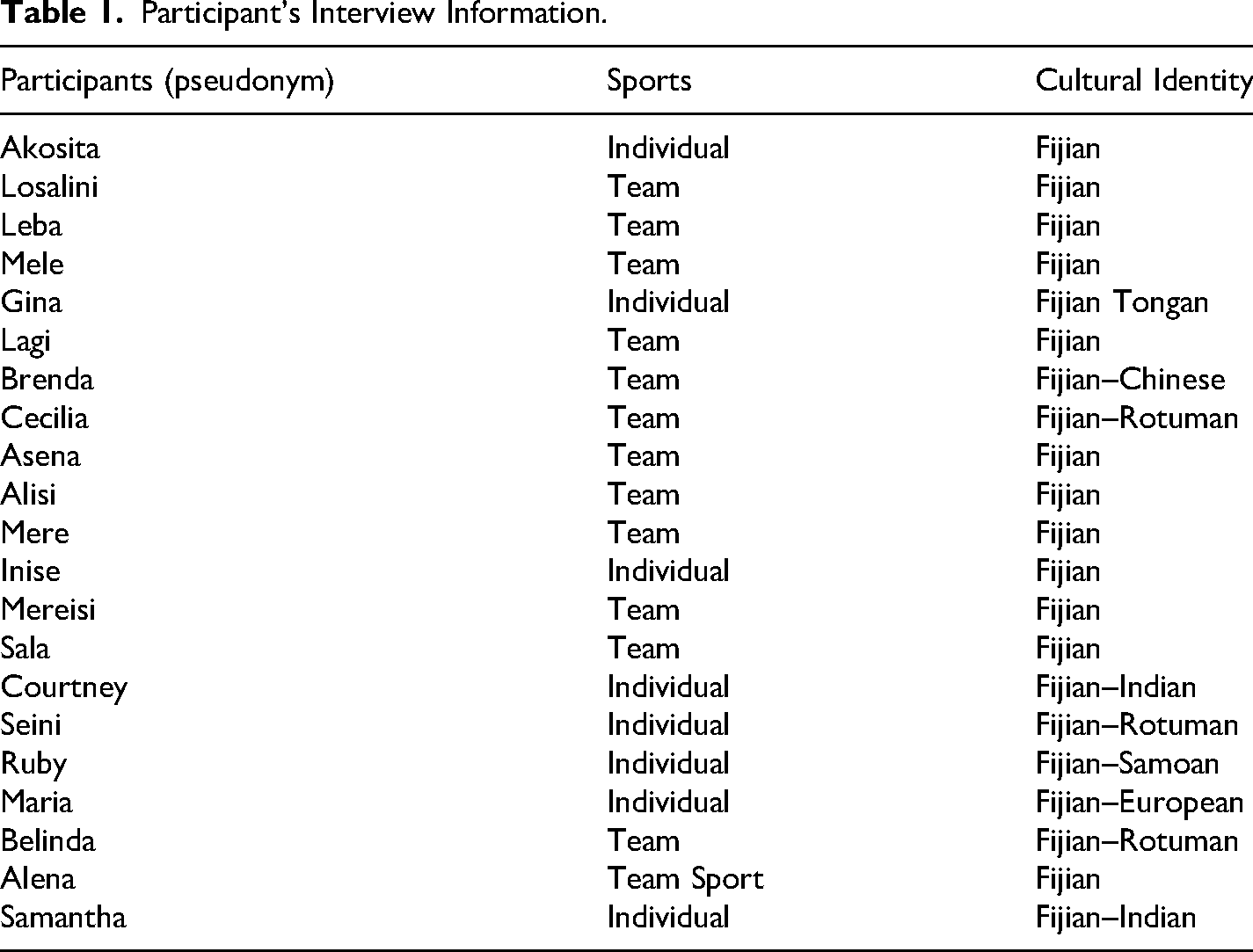
With ethical approval from the University of Waikato, we commenced the recruitment process, focusing specifically on Fijian sportswomen who currently or in the recent past had competed at a national and/or international level in at least one sport. The recruitment strategy revealed some of the challenges of talking about menstruation in sports. After multiple attempts with different sporting organizations, the first author (a Fijian sportswoman herself) was able to get in contact with various Fijian sportswomen. Each participant received an email with information about the project, as well as a consent form. In total, nine Talanoa sessions with different sports teams (focus group sessions consisting of 5–12 participants) and 12 individual interviews (interview questions included the early experiences of menstruation, menstrual health, menstrual products, family, culture, and sports participation) were conducted with a total of 21 sportswomen. The women ranged from 18 to 48 years old and participated in a range of sports, including rugby, swimming, track and field, basketball, netball, volleyball, touch rugby, tennis, and soccer (See Table 1: Participants Interview Information). Some of the participants were identified as belonging to mixed ethnicity (e.g., Fijian Tongan), but all identified primarily as Fijian. In this research, we respect and prioritize women's self-identification, even if this differs from governmental terminology (e.g., Fijian Indian rather than Indo-Fijian). Many participants are practicing Christians (Methodist) and Catholics, including the Fijian Indian participants (Methodist).
Participant's Interview Information.
The Talanoa Sessions
In the Fijian culture, a formal Talanoa session usually involves kava (a traditional drink in the Pacific Islands made from the roots of the Piper methysticum tree) but we provided food and beverages (cakes, bread, pies, tea, and coffee) due to the strict nutrition plans that some participants were following. Talanoa sessions and interviews took place in locations of convenience to the sportswomen, including locker rooms, meeting rooms, and cafes. Each of the participants was asked 30 questions about their knowledge and experiences with menstruation. However, shaped by Talanoa, these questions were used simply as prompts, and the conversations were often very free-flowing, with the athletes guiding much of the dialogue. While the questions were used to guide the conversation, the Talanoa sessions centralized sportswomen's own individual and collective storytelling.
The Talanoa (focus group sessions) and interviews were all audio-recorded and transcribed by the first author. Furthermore, due to the language barriers with some of the sportswomen, the Talanoa sessions were conducted in the Fijian language, translated, and later transcribed (by the first author). During the interviews, each participant was observed, and behaviors and reactions toward the questions and dialogue were documented as notes. The participants were either very comfortable or uncomfortable when discussing their menstruation knowledge and experiences, thus reflecting the key themes from Snieker's (2005) study cited above. The lead author worked to create a culturally safe and supportive environment for the athletes to share their experiences, with consideration for the privacy and comfort of the locations, offering of food, use of humor, storytelling and sharing her own experiences as a Fijian athlete. Recognizing the sensitive nature of this topic, each participant was given a pseudonym with all efforts not to reveal the identities of the sportswomen.
Data Analysis
We engaged in a reflexive thematic analysis (Braun & Clarke, 2006) to identify and prioritize the key themes. Importantly, our researcher positionings shaped this project, particularly the identity of the first author. As a Fijian sportswoman, her understanding of the Fijian culture's customs, traditions, different upbringings, and experiences with menstruation, were important in creating a safe environment where the participants were confident to share their experiences. Before every interview, she shared some of her own experiences as a Fijian sportswoman, leaving home straight out of high school to pursue her dreams and playing elite sports in the United States of America. As an Indigenous Fijian researcher, understanding cultural safety was a priority throughout the Talanoa and interviews, and the analysis and writing process. Fijian sports women's voices were always centered, and the main topic of discussion for this research. The broader research team brings different strengths to the project, including feminist research on sport and menstruation, Pacific methodologies, and sports science research on menstrual health. Throughout this research process, we individually and collectively reflected on how our varied researcher positionalities shaped this project, including the analysis presented herein. Importantly, the first author led this project, and as a Fijian sportswoman herself, demonstrates the importance of more research focused on menstruation in sport by, with, and for women of varied cultural and ethnic identities. The research team is made up of two Pasifika researchers (AG, and KH), and four white researchers from New Zealand and the United Kingdom (HT, BH, CP, and GB), with the research team bringing together expertise in sports sociology, sports science, sportswomen's health, and Pacific methodologies.
Results and Discussion: Fijian Sports Women's Experiences of Menstruation
We have organized our key findings into three parts. Firstly, we discuss how cultural ways of knowing menstruation shaped the sportswomen's initial experiences of menstruation. Secondly, we focus on women's understanding and reflections of menstruation and sports in Fiji. Thirdly, we share some of the suggestions made by the participants on how to improve Fijian sportswomen's experiences and knowledge of menstruation.
Menstruation in Fijian Society
In many parts of Fijian society, menstruation is still a taboo topic. However, the topic is gaining more attention, and families are increasingly having open discussions with their daughters. In his study of Indigenous Fijian culture, Sniekers (2005) explains, “The first menstruation is the only time when menstruation is marked by a ceremony in Fiji. All other menstruations do not get this special attention. People do not discuss menstruation openly” (p. 403). The family invites other family members and celebrates this special occasion with a feast where traditional foods will be served. In their research on menstruation in the Pacific, Maulingin-Gumbaket et al. (2022) write that “at the center of a menarche ceremony is not the adolescent girl, but rather traditional, familial, and hierarchical ways of being—thereby a girl's first menstruation is appropriated by her family to affirm and celebrate these values through collective feasting and nourishment of the communal body” (p. 13).
For some of the Fijian sportswomen in our study, they recalled their first period as a special moment, and a celebration of entering womanhood. However, a few of the participants expressed how they were embarrassed or felt shame during their early menstrual experience: I got my first-period experience in the village. It was half an hour by boat to the closest shop, so I just used the toilet paper. I just thought that it was embarrassing because we never talked about it at home and so yeah, I just kept it to myself until I gained the courage to pull my oldest sister to the side and then she's the one that guided me on what to do. (Seini, 35 years old) Before my first menstrual experience, it wasn’t spoken about very much in the house. But when my younger sister got her period, my parents were more open about the topic. My sister is eight or nine years younger than me. I noticed my mom and dad too would talk about it to her very openly. So over time, they discussed a lot of things openly, but during my time, not even my dad acknowledged periods. But no, I think he already knew about it, but he just didn’t want to make me feel uncomfortable in front of my brothers because there's such a big age gap between my younger sisters and me.
In the Fijian culture (and other cultures in the Pacific), “matavuvale” (family) plays a major role in the development of an individual. As various Pacific scholars have highlighted, family is central to Pacific communities and ways of life (Brison, 2007; Forrest et al., 2021). Cecilia (23 years old) described how her family created a safe space where they could discuss their menstruation experiences as a family, however, the topic of “sex” was still very much taboo: I grew up overseas, yeah, it's like spoken about. It's not like a taboo. I must speak about that with my parents. There are three girls in my family so my dad's also really understanding. So, we are open about topics like periods and stuff. My mum is as well, and I speak about contraception. But topics like sex are still like a no, no. I know we all do it, but then, you know, like after pregnancies happen and stuff and you feel like you must hide it from your parents.
Some of the participants with prior knowledge before their first menstrual experience were not ashamed and understood that it was a way to welcome womanhood. This was particularly the case with the younger participants. Mele (20 years old) mentioned: “When I was 12 years old my mom already knew what to do because we’re all girls, so she told me like it was a big thing and advised me on what to do and then she told my dad.” Another participant Akosita (18 years old) expressed how having a menstrual cycle was hard to accept even though her mum had shared with her information about menstruation. Akosita described her experience: “My mom, you know, had already briefed me to be aware of it, but I think for me it was just probably just like a shock, like looking at blood coming out of me.” A few sportswomen who had parents or siblings who were part of the medical profession mentioned that the topic was not sensitive or taboo in their family.
Many of the participants (including those of mixed ethnicity) referred to their menstrual cycle as “tauvimate” or “sickness.” Mere (25 years old), shared how she was educated on the topic, but her menstrual cycle was referred to as sickness: Growing up, I was told that all girls when they turn a certain age (11–14 years old), they will get what the community would call “women's sickness”. By calling it that, it makes people (mostly males) think that menstruation is a bad thing that happens to women and young girls. We were not taught why it happens.
In this research, some participants also mentioned grandparents telling them stories about how menstruation was historically understood as very sacred and a celebration. Such comments align with Sniekers’s (2005), findings that “during the menarche ceremony, the girl is going through a rite of passage whereby she passes the different stages of separation, transition, and incorporation and transforms from a little girl into a young woman” (p. 421). According to Sniekers (2005), “The taboo of leaving the house when bleeding is related to mana, the sacred and special power of the menstruation blood” (p. 410). However, Sniekers (2005) continues to explain that such ceremonies, and a recognition of the powerful time of menstruation, are rare in contemporary Fijian society. As Lagi (21 years old) explained, My grandparents said that they used to celebrate it back in the day and I wonder what happened over time which makes us feel like it is a taboo topic? Westernization made menstruation seem like a taboo instead of making it better. Something went wrong somewhere.
The family and cultural ways of knowing menstruation also shaped the women's relationships with menstrual hygiene products, particularly tampons. In the Indigenous Fijian culture, many female figures in the family (i.e., mothers, grandmothers, aunts, older sisters) do not authorize their daughters, nieces, or sisters to use a tampon. Tampons have been sexualized due to the impression that a girl may lose her virginity through insertion. As Samantha (aged 48) recalls: Culture in terms of pads, I remember when I used the tampon a friend of mine, said “Hey, you can use this”, and I went and tried the tampon. However, my aunt gave me a good lecture on using tampons because it was believed that you could lose your virginity. So yes, it is a taboo from a cultural aspect. My mom didn’t want me to use tampons. I think just the whole idea of something being stuck up there. She just said we could only wear pads, it's taboo to use tampons.
Menstruation and Sports in Fiji: Discomfort, Leaking and Product Displacement
International research has highlighted the challenges for sportswomen during their menstrual cycle. This research has focused particularly on uniforms (i.e., white shorts), but other issues include access to bathrooms, as well as pain and discomfort during training and competition (Heather et al., 2021; Marashi et al., 2023). According to Findlay et al. (2020), “Psychological symptoms manifested as worry, distraction, negative mood states, feeling tearful and emotional, reduced motivation and feelings of agitation. These symptoms have been noted in the general population and an elite athletic population” (p. 3). Many professional athletes such as Lydia Ko, Carla Papac, and Dina Asher-Smith have expressed how menstruation plays a major role when it comes to their performance during competitions or training. Many of the Fijian sportswomen spoke of similar challenges of menstruating while training or competing: It takes a lot out of me and my day having to worry about how I will manage my period around training and even more so when I compete. This takes me away from the visualization of my race plans and all my energy diverts to my period rather than being focused on how I am going to perform to my best. (Sala, 32 years old) Mentally, it has the biggest impact. I feel I am at a disadvantage if I am racing another girl who doesn’t have their period (and the physical symptoms that limit us). (Losalini, 18 years old) I get bad cramping on day one and day two. Sometimes it's like to the point when I'm thinking of everything from praying to yoga to try [to] heal it, other than pain relief medication. But typically, when I'm on my period day one and day two because of the awkward cramps and stuff, I tend to have a big drop of energy and you know a lot of discomfort when doing things like running for basketball. And stuff like that, or even swimming just being extra conscious. (Maria, 40 years old)
As well as the physical discomfort and logistical considerations of training and competing while menstruating, some struggled with cultural attitudes and beliefs that women should not engage in physical activity during their menstrual cycle. For example, Leba (18 years old) found the decision of whether to not train because of her period challenging: “I struggled with whether I should train when I got my period, and it came down to my goals and how best I wanted to achieve them.” The Fijian sportswomen navigated such cultural beliefs in a range of ways. Some did not train or compete when menstruating because they had internalized the belief that menstruation should be treated like a sickness, and due to their lack of knowledge about sports and menstruation. This was explained to us by Belinda (41 years old): In school when we had swimming, without prior knowledge of the period. Athletes understood that if you are menstruating you don't swim! If you have your menstruation, [you] must not take part in any physical activity. However, over the years I read somewhere that when go into the pool it stops. So that changed my thinking and understanding of periods. It's like a taboo here in Fiji or an unspoken rule that athletes should sit out during menstruation. The stigma stops athletes from wanting to learn more about the topic.
Among the latter, the most common fear the Fijian sportswomen expressed was the fear of leakage. The fear of leakage or product displacement was a major limitation, both physically and mentally, as this distracted some athletes from their game plans, and brought discomfort. In the sports that had white or light-colored uniforms, the athletes described their efforts to ensure that they had a spare change of shorts just in case of an emergency. Others spoke of how tight-fitting and revealing uniforms (i.e., togs, skirts) prompted concern about exposing their menstrual products or blood-stained clothing: The fear of leakage is a big limitation for me physically and mentally especially being in a swimsuit and having to walk on deck and to the block for a race. I lose my focus on my races because I am worried and trying to manage my period and some discomfort. It impacts my preparation not only during competitions but during training as well. (Alena, 45 years old) I played netball growing up so like our netball dresses, it was like a one piece and the underwear was like our tights that were attached to the skirt. And like you'd be embarrassed to wear it due to the fear of leakage or that your pad could be seen when you jumped. (Ruby, 36 years old) It was the fear of leakage. Sometimes we wore double pads and like made sure that they were tight on, so they didn't move out of place. I think I wore pads before, but in one PE class, oh my gosh, we were playing basketball and somebody's pad fell out and ever since then, I think I've just been scared that this might happen to me. So, I don't use pads. When I play a sport, I just use tampons. Just for the fear of it falling. (Inise, 30 years old) For volleyball, I just used the pad, although it was uncomfortable because you are wearing shorts. When you touch you know the backside of your shorts, it makes you wonder, can somebody see my pad sticking out or something? (Alisi, 25 years old) I always use pads during swimming since you are in the water, just don't use pads, and then when you come up you will have to change. That's why it's the most frustrating for me because every time, I'd be like waiting for my next event, I'd have to change every time. (Lagi, 21)
The sportswomen who participated in the Talanoa also had similar answers when asked about the use of hormonal contraceptives. Of the 21 participants interviewed, only one participant used contraceptives to help with her menstrual pains and regulate her flow during competitions. However, other sportswomen use Panadol to help with their menstrual pains. In Fiji, hormonal contraceptives are usually not associated with the menstrual cycle or sports. The use of contraceptives is usually associated with unwanted pregnancy and family planning. According to Naidu et al. (2017), “Fiji has a low contraceptive uptake rate and high rates of unplanned pregnancy and sexually transmitted infections (STIs)” (p. 223). Naidu et al. (2017) also explained how the use of contraceptives was common among women who were working professionals or had a higher level of education. Our findings contrast with research on athletes in Western contexts where oral contraceptives are often used to regulate and manipulate the menstrual cycle (Oxfeldt et al., 2020; Schaumberg et al., 2018), highlighting how cultural ways of knowing shape athletes menstrual health practices.
The Need for More Awareness of Menstruation in Sport: The Critical Role of Coaches and Support Staff
Herein we see how sportswomen actively navigate different ways of knowing menstruation, including some conflicting expectations and norms between their Fijian culture and competitive sport. International research has highlighted the importance of normalizing conversations about menstrual health in sports (Findlay et al., 2020) and expanding coach and medical support staff knowledge about menstruation in sports (Brown et al., 2021). However, as our research highlights, such information sharing, and educational work must take into consideration not only gendered silences and stigma but also how intergenerational cultural knowledge shapes coaches’ and athletes’ willingness to engage in such initiatives. Furthermore, considering how gender and culture intersect to impact the knowledge landscape in elite sporting contexts is important, and educational initiatives must be locally specific, recognizing how processes of colonization, religion, and cultural ways of knowing shape athlete's needs regarding menstrual health, and coaches’ willingness to engage in female athlete health-oriented initiatives.
According to Brown et al. (2021), “Improving both athlete and coach knowledge and providing education on the menstrual cycle, correct terminology, constructing positive conversations, and changing the perception of awkwardness could significantly reduce the discomfort and outdated nature of not having conversations relating to the menstrual cycle” (p. 64). However, rarely do researchers or sports practitioners consider how culture may change such conversations, or rather, how cultural knowledge and context should be considered to ensure such conversations are respectful of different ways of knowing menstruation. Some of the Fijian sportswomen offered nuanced and thoughtful suggestions as to how to improve knowledge and understanding of menstruation in sports. For example, Courtney (35 years old) acknowledged the power of longstanding cultural taboos and stigma, and identified a need for greater education in families and schools: It's such a taboo subject and everybody's either scared to talk about it or tries to avoid it. So, I think educating the younger generation about menstruation is part of the female body function and not a sickness. Just more details about it so they have a better understanding, and everyone is a bit more open to the topic, not only to the females but to the males as well. So, males have a better understanding and as they get older, it would be easier to discuss. Talk about it with their peers, sisters, females, and any other athletes. It was never something to discuss; only the managers would tell us to prepare if we were leaving for our tournament. Like if you're traveling, and it is the same time as your period, please come prepared for it. The previous coach was very religious, and only the manager could talk to the girls. Like, if he had something to say to us, he would go through the manager, who was a female, and then she'd approach us. (Sala, 32 years old) It feels more like ignorance in my experience in the sense that they would rather not know when we are menstruating. There will never be an initiation of the topic to see how we feel or how it affects us and how best they could best support us. (Belinda, 41 years old) I struggled with a male coach who would say “So what?” when I would say I had my period. Female teammates yes, we just share the same struggles and frustrations, and usually when we are on tour in our hotel rooms just resting. Coaches never wanted to acknowledge this topic. (Mere, 26 years old) There were a couple of times when earlier on when I was, you know, bloated or cramping or heavy flow or uncomfortable for swimming. And I had a swimming coach, and she would say “OK, just put a tap on it and swim. You'll be fine”. So that was when I think I came to learn that no matter what, we can still train, and push through. She was just mainly like, “There's always a way to swim”. (Cecilia, 24 years old)
Many of the athletes highlighted the need for coaches and medical support staff to better understand sportswomen's experiences of training and competing while menstruating, with the hopes that such knowledge might enhance empathy and awareness of the importance of the topic: I feel this needs to be part of the coaching curriculum. So just as a topic about you know, inclusivity about understanding women in sports. Whenever they have women coaches, they must be able to talk about it openly… So, whether it's during a team briefing, or the induction of athletes, and even like coaching sessions, like when the athletes come in to train, it could be like a checklist, or you talk about it openly and you say these are very important. So yeah, including it in the coaching curriculum, and making it a significant part of team preparation. (Samantha, 48 years old) Well, I think if you influence a group of people, especially if they're females, provide space for them to be able to talk about not just menstruation, but also anything like understanding their bodies or mental health. Yeah, maybe like having medical groups come and talk to women about being more aware of their periods and their bodies and listening to their bodies. So, providing this space, I think. And communities can start talking about it more with an open mind. (Seini, 35 years old)
Conclusion
In this paper, we drew upon Talanoa sessions with 21 Fijian sportswomen to reveal their knowledge and experiences of menstruation in sports. Guided by the Masi methodology and ensuring that the voices of these women were always the main priority, we discovered three key themes. Firstly, menstruation in Fijian society is still a taboo subject, particularly if males are present. However, some of the athletes mentioned how their parents were increasingly willing to talk about menstruation, suggesting signs of social change regarding the attitudes towards menstruation. Secondly, the Talanoa sessions with the sportswomen showed that they navigate an array of challenges while menstruating, particularly discomfort and pain that is not acknowledged by coaches, and concerns about leaking or displacement of menstrual products (mostly pads) while training or competing. Thirdly, many of the athletes acknowledged the difficulties of navigating cultural stigma and taboo, particularly the unwillingness of coaches to listen to or empathize with their experiences of menstruation. These athletes called for change from the grassroots level in sports and in the classrooms, as important for changing cultural attitudes towards menstruation, which will then lead to more coaches and sporting professionals being willing to talk on the subject. More education is needed on the topic, with the Fijian people, and sporting and health professionals, needing to understand that menstruation is not a “sickness”, but part of a woman's bodily function, and an integral part of female athlete health.
While the Fijian sportswomen in this study were culturally and religiously diverse, our data did not reveal significant variations across those of different ethnic and religious backgrounds. Many of the participants came from religious families and often noted this in the interviews, yet they rarely spoke specifically about how religion shaped their own and other’s experiences of menstrual health in sports or daily life. This silence is noteworthy. We anticipate that religion and ethnicity were often combined when the sportswomen spoke of the influence of “culture” on menstrual knowledge and practices in Fijian society and sport. Future research would do well to focus more closely on how ethnicity and religion shape sportswomen's experiences of menstruation, and their preferences for approaches to menstrual health support.
In sum, this paper highlights the value of culturally responsive methodologies that create safe spaces for sportswomen's experiences of menstruation as shaped by the gendered and cultural contexts in which they live. We conclude with a call for more research that considers the menstrual health experiences of sportswomen from diverse cultures and ethnicities, particularly research that centers on the voices of Indigenous and ethnic minority sportswomen. It is only when we create space for sportswomen's multiple and nuanced experiences of health and wellbeing in different contexts that coaches and health professionals can better understand and cater to their unique needs, rather than fitting them into existing systems of Westernized knowledge that have for too long silenced and ignored cultural ways of knowing menstruation. Our research also highlights the importance of research methodologies designed by, with, and for women from Indigenous and diverse cultural positionalities.
Footnotes
Author's Note
Georgie Bruinvels and Charles Pedlar are affliated with Orreco Ltd. Business Innovation Unit, University of Galway, Ireland Georgie is affiliated with Institute of Sport, Exercise and Health, UCL, London, UK.
Declaration of Conflicting Interests
The authors declared no potential conflicts of interest with respect to the research, authorship, and/or publication of this article.
Funding
The authors received no financial support for the research, authorship, and/or publication of this article.
